



Abstract
Residency restrictions stipulate the living arrangements of sex offenders, but underdiscussed are geographic restrictions that limit spatial interactions relating to loitering, presence, and entry. Our statutory analysis of state-level geographic restrictions identifies 38, 18, 19, and 14 states which have implemented residency, loitering, presence, and entry restrictions. Geographic restrictions are widely adopted, particularly between 2006 and 2010, and are dispersed randomly by region and division, with some states being more comprehensive than others, particularly in West South Central. Residency restrictions were typically older and longer, with distance markers progressively less common for loitering, presence, and entry restrictions. Geographic restrictions were more often offense-specific than registration-specific and demonstrated heterogeneity in the number and types of prohibited venues that were commonly youth-centric.
Introduction
Roughly 4.3 million people in 2019 were under probation and parole, double the population incarcerated in federal and state prisons and jails (Carson, 2020; Oudekerk & Kaeble, 2021). Standard conditions are applied during supervised release, and in some cases, additional special conditions can be discretionally imposed for specific offenses, such as residency restrictions for registered sex offenders. Failure to meet these standards typically results in the revocation of probation and parole, alongside increased penalties, such as an extension of supervision or return to custodial control. Registration and supervision noncompliance can also be a product of residency restrictions, which has increased the likelihood of homelessness and transience among sex offenders (Barnes et al., 2009; Levenson, 2008; Levenson et al., 2015; Zandbergen & Hart, 2006). Such unstable living arrangements compromise the premise of these proximity laws as monitoring is made much more difficult.
After completing their initial criminal sanction, the collateral consequences are particularly substantial for sex offenders, adversely affecting stable and/or affordable housing, educational and employment pursuits, pro-social bonds, and treatment options (Barnes et al., 2009; Chajewski & Mercado, 2009; Levenson, 2008; Levenson et al., 2015; Zandbergen & Hart, 2006). Reentry can be made much more difficult by other closely related geographic restrictions that can supplement residency restrictions, which can prohibit sex offenders from loitering, being present, and entering specific venues. One of the two recommendations for policy reform to offset these collateral consequences includes linking residency restrictions to specific offenders by risk and case circumstances (Levenson, 2018). 1 The other recommendation is to replace these policies with loitering restrictions. But, since our empirical knowledge of loitering restrictions and other exclusionary zones pales in comparison to residency restrictions, we respond by indexing each of the four forms of geographic restrictions per state to describe how these policies are implemented.
We undertake a statutory analysis of state-level statutes relating to the geographic restrictions imposed on sex offenders in the United States. Currently, there is no complete directory of these four geographic restrictions or any analysis of their range, geographic scope, or other patterns of diffusion. Moreover, despite scholars collating state-level residency restriction statutes (Leipnik et al., 2016; Lester, 2007; Mancini et al., 2011; Meloy et al., 2008; Velazquez, 2008), this research has not yet investigated the nuances of policy language associated with the protections to direct victims, prohibitions of living with other sex offenders, and within-state variation of other residency restrictions. Thus, our research questions are the following. First, what variation exists in the types and number of geographic restrictions enacted across states? It is important to highlight other geographic restrictions as these laws are often conflated with residency restrictions and realize the ever-widening set of additional geographic restrictions that can be implemented. Second, and in tow, how do particular types of geographic restrictions vary in their design? Since there is a considerable amount of empirical knowledge of residency restrictions, but not on loitering restrictions, presence restrictions, and entry restrictions, it is important to identify if their implementation would be a meaningful substitute, if not suitable alternatives for certain offenders. Third, what geographical diffusion occurs of geographic restrictions across states? These findings can inform scholars, policymakers, and managers of sex offenders, such as law enforcement and probation and parole officers, and the direct victims of sex offenders and the sex offenders themselves.
Sex Offender Legislation and Research on Residency Restrictions
Residency restrictions are the third most common sex crime policy following sex offender registration and notification (SORN; Mancini et al., 2011). The vitality of this policy is remarkable as there are no federal guidelines for residency restrictions. Thus, states are left to decide the design of their residency restrictions, which can accompany sex offender policies at the federal level, including the Jacob Wetterling Act, Megan’s Law, and the seven titled Adam Walsh Act (AWA), widely known for its Title I, the Sex Offender Registration and Notification Act (SORNA). The AWA is of particular significance to residency restrictions for two reasons. First, section 638 of the Act contained language directing the U.S. Attorney General to pursue a study identifying the link of residency and other related restrictions to recidivism rates of sex offenders. Second, violations of these residency restrictions can result in tier reclassification and additional challenges that increase the likelihood of collateral consequences.
Residency restrictions fall within the second wave of sex offender legislation that occurred between 1989 and 2008 (Velazquez, 2008). Aside from the influence of media and the restructuring of sentencing laws, the proliferation of residency restrictions can be linked to a response to the increasing growth of released sex offenders on parole. Meloy et al. (2008) attributed the high legislative activity of residency restrictions between 2005 and 2007 to the deaths of two young females, Jessica Lunsford and Sarah Lunde, in Florida in early 2005 by two convicted sex offenders in isolated incidents. Additionally, the evidence suggests that residency restrictions have been consistently tinkered with as policymakers do for SORN policies (Lytle, 2019). In other words, states may have added statutes on top of the initial residency restriction statute, with states relying on more than one statute to enforce a residency restriction.
Studies have identified anywhere from 19 to 33 states which had active residency restrictions (Leipnik et al., 2016; Lester, 2007; Mancini et al., 2011; Meloy et al., 2008; Velazquez, 2008). While the range can be explained by the passage of time and methodological decisions, there may be a conflation of residency restrictions with other geographic restrictions imposed on sex offenders. Loitering laws have been referred to as child or school safety zones. They are conceptually distinct from residency restrictions as they restrict where sex offenders can visit without a legitimate purpose. Scholars have strongly endorsed loitering restrictions as they are deemed less intrusive on housing options and more sensible than residency restrictions as they presumably target specific types of high-risk offenders who sexually offend children (Colombino et al., 2011; Levenson, 2008, 2018; Levenson et al., 2015; Zandbergen et al., 2010). But no research has collated statewide loitering restrictions to identify how they compare to residency restrictions. Even less scholarship has paid attention to presence or entry restrictions, akin to trespassing laws and sometimes referred to as social exclusion zones, which aim to immobilize other daily activities of sex offenders (Budd et al., 2018).
The purported goal of residency restrictions is to distance offenders from potential victims by limiting access to and contact with children, but because there are no federal guidelines, it should come as no surprise that there is significant state-level variability in their design. Residency restrictions may be registration- or offense-specific, subjecting all individuals who must register as sex offenders or tailoring toward specific types of sex offenders with specific sexual offending patterns (Lester, 2007). The distance between the designated offender to a prohibited venue is often 1,000 ft but can range from 500 to 2,000 ft, with some notable exceptions that exceed the upper limit (Leipnik et al., 2016; Velazquez, 2008); however, some statewide residency restrictions may not specify a distance, but mentions of these statutes are sparse across the related literature. Finally, while the prohibited venues are often youth-centric, typically schools (Leipnik et al., 2016; Lester, 2007; Meloy et al., 2008; Velazquez, 2008), it is unknown precisely what educational institutions apply. Though youth-centric areas have appreciated significant empirical discussion, it has not unaccounted for residency restrictions for the direct victims of sex offenders.
Residency restrictions exhibit geographical patterns, but these patterns vary across studies (Leipnik et al., 2016; Mancini et al., 2011; Meloy et al., 2008). One study divided states by region and found an absence of residency restrictions in the nation’s central region and northeast corridor (Meloy et al., 2008). A later study divided states by division and identified that residency restrictions were more common and lengthier in southeastern states than in Mid-Atlantic, New England, and intermountain West states (Leipnik et al., 2016). When considering the implementation of six other sex crime policies in addition to residency restrictions, the geographic pattern of policy adoption changes (Mancini et al., 2011). Once again, northeastern states maintained the fewest number of sex crime policies, with Midwest, Southern, and Western states comparable in the number of sex crime policies adopted. Rather than specific geographic regions exhibiting distinct tough-on-crime philosophies, Mancini et al. (2011) found substantial variability within each region. That is, certain states adopted a greater number of sex crime policies than others per region, with Illinois and Wisconsin regarded as the most punitive Midwest states, Massachusetts exercising the most number among other northeastern states, Florida and Texas for Southern states, and Arizona for Western states.
Assumptions and criticisms of residency restrictions
A discussion of the current literature on residency restrictions is necessary to understand the current controversies surrounding these policies. Residency restrictions are premised on multiple assumptions, often argued by scholars as simplifying the complexities of sexual offending. Given the dearth of research on presence, loitering, and entry restrictions, the criticisms of residency restrictions can shed light on the impact of other geographic restrictions.
First, these laws assume that sex offenders are motivated offenders with a high risk of sexual recidivism. However, repeat sex offenses are rare (Colombino et al., 2011; Huebner et al., 2014; Sample & Bray, 2006; Sandler et al., 2008). National data showed that persons released from state prisons whose most serious crime was a sex offense often had a lower offense-specific rearrest rate than arrestees in most other offense categories over a nine-year period (Alper & Durose, 2019). To date, only one study demonstrated that residency restrictions have a deterrent effect; however, they are at odds with their intended legislative aim to prevent sex crimes against children (Socia, 2012a). To ascertain the effect of residency restrictions on sex crime arrests against child and adult victims by first-time or current sex offenders, Socia (2012a) identified all county-level residency restrictions in New York, which ranged from 500 to 2,000 ft, with its prohibited venues typically including schools, daycares, parks, and playgrounds. Results showed that the policy was only associated with a 10% reduction of sex crime arrests against adults by first-time sex offenders. Yet the focus is on legislation to prevent recidivistic sexual offenses, which has the potential to impact less than 5% of all new instances of sexual violence, as one study finds (Sandler et al., 2008). In fact, it is more likely for sex offenders to recidivate by committing nonsexual crimes (e.g., technical violations) than sexual crimes (Colombino et al., 2011; Duwe & Donnay, 2010; see Huebner et al., 2014).
Second, residency restrictions are designed assuming all persons who commit sex offenses are homogeneous (Anderson et al., 2015; Levenson et al., 2007). However, the perpetration patterns of sex offenders vary across offender subtypes. For instance, arrest patterns demonstrate that persons with adult victims were more likely to recidivate sexually than those with minor victims (Colombino et al., 2011; Sample & Bray, 2006), but not always (Zandbergen et al., 2010) with other research suggesting no distinctions (Socia, 2012a). In support of demonstrating the heterogeneity of sex offender perpetration patterns, Sample and Bray (2006) used Illinois arrest data from 1990 to 1997 and explored recidivism rates across various categories of sex offenders in one, three, and five years, finding rapists tend to recommit the same offense more often than people who offended against prepubescent or pubescent children. When sexual recidivism occurred for a different sex crime, child pornographers had the highest rearrest rate within a five-year period, followed by rapists, persons who offended against prepubescent children, and persons who offended against pubescent children. Overall, the scholarship suggests that residency restrictions should be customized per sex offending group.
Third, these laws are premised on sexual offending patterns by strangers seeking children. However, the empirical evidence consistently demonstrates that most sex crimes occur between known persons, mainly when the victims are minors (Budd et al., 2018; Chajewski & Mercado, 2009; Levenson, 2008; Mogavero & Kennedy, 2017). Thus, the wide impact of residency restrictions is greatly diminished, particularly when preventing intrafamilial or acquaintance-based sex offenders.
Fourth, the youth-centric public areas commonly identified by residency restrictions are not hotspots for sex crimes. Rather, sex crimes often occur at the offender’s, victim’s, or a shared residence, particularly when victims are minors (Budd et al., 2018; Colombino et al., 2011; Mogavero & Kennedy, 2017). Common non-residential locations offenders and victims converged were generally public places, with public streets often the most common (Colombino et al., 2011; Mogavero & Kennedy, 2017). Most who make direct contact in youth-centric public places cited in residency restrictions do so with older children and adults (not younger children) for their current or previous sex offense. The efficacy of residency restrictions is further diminished as these offenders had a justification for their presence at these proscribed venues or pre-established relationships versus the purposeless lurking.
Fifth, sex offenders subject to residency restrictions are no more likely to reside near prohibited venues than community members (Chajewski & Mercado, 2009; Huebner et al., 2014) or non-recidivists (Zandbergen et al., 2010). Some of this research demonstrates that urban-based registrants reside closer to all schools or the nearest schools than community members, on average (Chajewski & Mercado, 2009). However, this outcome may be a function of urban design rather than strategic placement near potential victims, as argued by some scholarship that also explored the geographic distribution of sex offenders residing nearby potential victims in metropolitan areas (Walker et al., 2001), particularly as housing typically envelopes these prohibited venues (Chajewski & Mercado, 2009). When offenders are analyzed by victim type, registrants whose victims were minors (both in general and stranger victims) were no more likely to reside closer to the nearest or all schools in comparison to adult victimizers—in fact, urban-based registrants with minor victims resided further from all schools than those with adult victims—regardless of residing in a rural, suburban, or urban community. Nor were stereotypical sex offenders (e.g., single, extrafamilial, and no children) residentially congregating near parks/playgrounds, daycares, and religious institutions more often than non-stereotypical sex offenders (e.g., married, intrafamilial, and has children) within a 2,500-foot residency restriction, with the latter residing closer to schools, on average (Mogavero & Kennedy, 2017). Moreover, Zandbergen et al. (2010) matched sexual recidivists against children to non-recidivists against children from Florida based on relevant risk factors (e.g., age and marital status), finding that those who sexually recidivated against children between 2004 and 2006 were no more likely to live within 1,000, 1,500, and/or 2,500 ft of schools and daycares than their counterparts.
Sixth and finally, the theoretical basis for residency restrictions has been challenged. The policy relies on the distance decay function, suggesting offenders are more likely to recidivate closer to home (Rossmo, 2000), which is problematic when applied to sex offenders. First, when residency restrictions are applied to all sex offenders, it assumes that they have a similar journey-to-crime pattern from their residences. Second, distance from youth-centric venues bears little relevance in preventing sexual offenses when there is a pre-existing relationship between the offenders and victims. Third, these laws apply to those who confront their victims, which is atypical behavior across most sex crimes (Budd et al., 2018; Colombino et al., 2011; Mogavero & Kennedy, 2017; Rossmo, 2000). Fourth, scholars and surveyed registrants indicate that these laws do not inhibit them from offending elsewhere (Levenson, 2008). Accounting for this spatial behavior is the buffered distance decay function, which posits that offenders begin their search for a target some distance from their residence to avoid recognition (Rossmo, 2000). In support, direct contact with victims by sex offenders typically occurred in excess of the standard distances for residency restrictions (Mogavero & Kennedy, 2017).
Collateral consequences of residency restrictions
The latent effects of sex crime penalties arguably undermine the successful reentry and recidivism rates of sex offenders subject to residency restrictions. While a host of collateral consequences are introduced as barriers to reintegration for sex offenders, the core collateral consequence often reported by registrants subjected to residency restrictions is the difficulty of acquiring stable, affordable housing (Levenson, 2008). The social dislocation often reported by the surveyed registrants subjected to residency restrictions may increase psychosocial stressors if they are also required to abide by other restrictions that limit their day-to-day activities.
Housing options in urban communities are so greatly minimized due to residency restrictions that registrants are effectively pushed into unlivable areas like non-residential areas such as highway overpasses or commercial spaces (Chajewski & Mercado, 2009; Zandbergen & Hart, 2006). Research also shows that the risk of violation increases for offenders released into urban areas, with homelessness likely associated with registration noncompliance (Duwe & Donnay, 2010). In addition to homelessness among registrants being at rates greater than the general population, transience among registrants is well-documented and can be linked to residency restrictions (Barnes et al., 2009; Duwe & Donnay, 2010; Levenson, 2008; Levenson et al., 2015; Zandbergen & Hart, 2006). One such study demonstrated that transient registrants more often resided in Floridian counties with higher average rent prices and areas with lengthier and more comprehensive residency restrictions than non-transients (Levenson et al., 2015).
Several studies have demonstrated that residency restrictions push applicable registrants out of urban living and into the outskirts of communities (Barnes et al., 2009; Chajewski & Mercado, 2009; Zandbergen & Hart, 2006). South Carolina, a state without residency restrictions at the time of the study, demonstrated that one-fifth to four-fifths of registrants would need to relocate (to avoid violation), presumably to rural areas, if a 1,000 or 5,280 (a mile) foot is imposed, respectively (Barnes et al., 2009). Logically, increasing distances will incrementally increase the number of available housing within its radius (Barnes et al., 2009; Chajewski & Mercado, 2009). While rural areas tend to be outside the restricted areas, with increased housing availability, these options are generally unlivable residences as they comprise private farms and agricultural parcels of substantial sizes (Chajewski & Mercado, 2009). Since some research shows residency restrictions systematically push registrants away into less centralized, less urbanized communities, it also increases their distance from treatment centers and registration obligations often located in metropolitan areas (Barnes et al., 2009). Research demonstrates that registrants are being pushed into a highly specified area by abiding by residency restrictions, in turn, at risk of violating relevant statutes that may bar them from residing with or near other registrants. However, the extent to which this phenomenon is occurring is unknown.
The cumulative additions of restricted venues may be more consequential than lengthening the distance of residency restrictions. Roughly 4% of any housing for registrants was left available in Orange County, Florida, when the 1,000-foot residency restriction was applied, further reduced to 0.3% within 2,500 ft (Zandbergen & Hart, 2006). School bus stops were notoriously restrictive in comparison to schools and daycares, restricting 93% of all potential residential dwellings (99.6% within 2,500 ft), while schools and daycares yielded restrictive rates of 19.7% and 24.2%, increasing to 55.8% and 55.4% within 2,500 ft, respectively. Notably, parks and attractions yielded 15.9% and 0.2% of residential dwellings as off-limits within 1,000 ft, increasing to 38.2% and 0.2% with a 2,500-foot buffer zone. Thus, not all venues are equal, with some venues generating more significant challenges for applicable sex offenders than others (Levenson, 2008; Zandbergen & Hart, 2006).
Current Study
To ascertain the barriers sex offenders may face while under community supervision, we conducted a content analysis of statutes in state criminal codes containing references to residency restrictions, in addition to loitering, presence, and entry restrictions. In tow, this study pursues three research objectives: (1) to form a unified directory of state-level statutes of residency restrictions, loitering restrictions, presence restrictions, and entry restrictions in the United States, (2) to describe the nature of these geographic statutes, and (3) to explore patterns of policy diffusion across states. These findings can provide a clearer understanding of how these geographic restrictions are being used as a policy solution to sex crimes across the United States and under what conditions it is being applied.
Methods
Data Collection
A statutory analysis drove our two-step methodology in identifying state-level statutory requirements associated with the geographic restrictions for sex offenders. In our first step for acquiring sex offender statutes, we identified the National Inventory of Collateral Consequences of Conviction (NICCC; https://niccc.nationalreentryresourcecenter.org/), a branch of the National Reentry Resource Center. These laws were identified in the keyword search box on the home page as “sex offender registration, residency, and proximity.” A total of 430 sex offender statutes were web scraped and organized by count, the statute code, the statute title, and URL into a separate CSV file. To verify the accuracy of the statute code and title as well as acquire the text of the law, one coder visited the URL during spring 2020, which would direct them to various legal domains—Cornell, FindLaw, LexisNexis, the state legislature, and Westlaw. In our second step, the state legislature websites and Westlaw were used to gather sex offender statutes related to registration, notification, and geographic and employment restrictions. Results of that search added 1,514 sex offender statutes, totaling 1,944 sex offender statutes.
Data Analysis
To identify state-level geographic restrictions imposed on sex offenders, we began coding our dataset through a multi-step process that drew upon strategies consistent with grounded theory methods and inductive qualitative analyses, with an emphasis on constant comparative methods (Charmaz, 2014; Glaser, 1965). First, two coders independently read through the dataset of the compiled statutes, labeling each statute as addressing (a) registration and notification, (b) geographic restrictions, (c) employment restrictions, or (d) other. At the end of this process, several relevant search and root terms were used to identify whether other geographic restriction statutes were overlooked within the dataset, which included but not exhaustive, being there, distance, enter, entry, feet, foot, loiter, miles, presen*, remain, resid*, restrict*, and victim*. Second, after coding disagreements were settled with 100% congruency between the lead author and two coders, our analysis dataset consisted of state-level residency restrictions, loitering restrictions, presence restrictions, and entry restrictions. Each state-level geographic restriction in the analysis dataset contained a statute code, state, statute title, URL, the legal domain the URL directs to for the statute text, the date the statute was last accessed or consulted, relevance to geographic restrictions, statute text, and legal history. The state legislative websites and Westlaw were used in combination to identify the year of inception and iterations of the statute. 2 Third, one of the coders culled the contact information reported on each registry website, with the other coder reaching out either by email or phone to ensure the accuracy of our analytical dataset. 3 Fourth, the final step in our data analysis incorporated constant comparative methods, which involved an interactive process where past research on geographic restrictions and communications with registry managers entailed further investigation if specific state-level statutes were referenced, invoking iterative strategies between the analysis and data. The final sample of active geographic restriction statutes is current as of May 2022. 4
Results
The descriptions of the geographic restriction enacted per state are available as Supplemental Files, with statutes organized by year of inception, the prescribed distance, the applicable sex offender, and the prohibited venue(s) (Supplemental Tables S1–S4). 5 Figure 1 illustrates the cumulative growth of states enacting their first version of a geographic restriction, prominently residency restrictions. Figure 2 considers that states may have sets of statutory geographic restrictions, illustrating that all four geographic restrictions had a marked increase in implementation from 2005 to 2010, particularly residency restrictions.

The cumulative growth of states enacting geographic restrictions by year (1995–2020).
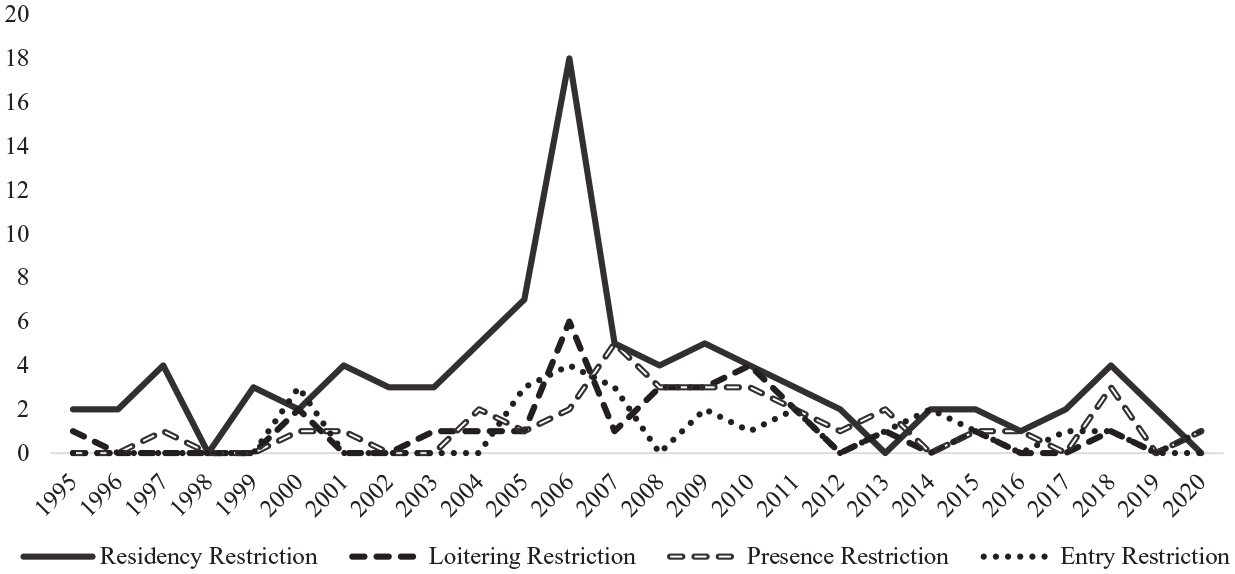
The number of geographic restrictions by year (1995–2020).
Residency Restrictions
Of the four geographic restrictions, most states (n = 38) enacted at least one statute prohibiting sex offenders from residing near specific venues (Supplemental Table S1). Nebraska, Maine, and Texas each exercised a statute that leaves municipalities to mandate a residency restriction up to 500, 750, and 1,000 ft, respectively. Minnesota is distinct as a judge is appointed as the arbiter when dealing with sexual violence predators.
Residency restrictions are the oldest among the geographic restrictions, with most enacted in 2006 (median = 2006). States with sets of statutory residency restrictions generally lengthened distances and/or added venues to the same class of sex offenders over time. Though we support that Delaware and Florida enacted the first state-level residency restriction in the modern sense (Meloy et al., 2008), we found Oregon mandated a three-mile (15,840 ft) residency restriction for persons convicted of sex crimes under parole/post-supervision where the victim was under 18 years of age in 1973/1989. 6 Following Oregon’s residency restriction was a considerable time gap as subsequent residency restrictions passed state legislation from 1995 to 2019.
Distances for residency restrictions ranged from 300 to 15,840 ft when explicitly defined. The most common geographic boundary was 1,000 ft (median = 1,000 ft), comprising roughly half (52.11%) of the residency restriction statutes that specified an exact distance, followed by 500 ft and then 2,000 ft. We add to the related literature by identifying that residence with other sex offenders was consistently associated with an undefined distance. Further, direct victims were incorporated in the original residency restriction or considered in a subsequent statute, often accompanied by a longer distance.
It was more common that residency restrictions identified sex offenders by offense characteristics than registration. One-third (34.21%) of the 38 states exercised registration-specific residency restrictions. Thus, while some residency restrictions were broadly applied, many more states targeted a specific subset of applicable sex offenders. Residency restrictions were often linked to probation or parole.
The venues statutorily defined as off-limits varied. Previously, scholars used schools broadly; the current study distinguished schools when possible. Sex offenders are not unilaterally barred from residency near all schools (e.g., preschools, postsecondary institutions, and vocational/technical schools), but, at a minimum, offenders are prohibited from living near elementary and secondary schools. It is worth mentioning that only South Carolina, Tennessee, and Texas enacted residency restrictions that bar applicable sex offenders from residing on postsecondary campuses.
Loitering Restrictions
A total of 18 states exercised loitering restrictions, prohibiting sex offenders from being around certain areas for an extended period (Supplemental Table S2). Delaware enacted the first state-level loitering restriction in 1995, with the remaining states following in suit primarily during the 2000s. Most loitering restrictions were enacted in 2006 (median = 2008). Over the years, states often broadened the types of prohibited venues for applicable sex offenders to loiter.
The offender and distance selected among loitering restrictions were distinct from residency restrictions, but the proscribed venues remained similar. On offenders, exactly one-half of loitering restrictions were registration-specific, while the other half were offense-specific. When loitering restrictions specified distance, they were shorter than residency restrictions, ranging from 100 to 1,000 ft. The most common loitering distance restriction was 500 ft (median = 500 ft), comprising over half (54.55%) of the loitering statutes that specified exact distances, followed by 1,000 ft, and finally, 100 ft. On venues, nearly all loitering state-level statutes included schools. Notable among loitering restrictions is the reliance on the encompassing term, areas where children often congregate.
Presence Restrictions
Nineteen states exercised presence restrictions (Supplemental Table S3). Eleven states relied on one presence restriction. Intratemporal variation by states resulted from adding more venues rather than lengthening distances. Many states enacted their presence restriction in 2007 (median = 2009), ranging from 1997 to 2020. Compared to residency and loitering restrictions, the distance of presence restrictions is more often undefined. When distances are defined, presence restrictions range from 100 to 1,000 ft. The most frequent distance was 100 or 1,000 ft (median = 300 feet), each comprising about one-third (30.77%) of all presence restrictions. Applicable offenders barred from being present at certain venues were roughly split evenly between registration- or offense-specific. States varied in being selective in the proscribed venues, while other states listed a rich set of venues where certain sex offenders cannot be present.
Entry Restrictions
Entry restrictions are a more recent phenomenon than the other three geographical restrictions. A total of 14 states exercised entry restrictions, of which three states were registration-specific (Supplemental Table S4). All states enacted entry restrictions after 2000 (mode: 2006; median: 2007). States which demonstrated intratemporal variation added venues to the same class of sex offenders. Sensibly, entry restrictions are not associated with a specific distance; thus, they stand apart from residency, loitering, and presence restrictions, except for Louisiana and New York, which mandated a 1,000-foot entry restriction for a narrow set of sex offenders.
Where Are Geographic Restrictions Supported?
Figure 3 illustrates the distribution of geographic restrictions with the four insets that each depict the presence of residency, loitering, presence, and entry restrictions per state across the nation. First and foremost, 11 states do not exercise any of the four geographical restrictions: Colorado, Connecticut, Hawaii, Kansas, Massachusetts, Michigan, New Hampshire, New Jersey, New Mexico, Pennsylvania, and Vermont. By contrast, Alabama, Florida, Illinois, Louisiana, Oregon, and Virginia exercised all four restrictions. Second, there is a regional diffusion, whereby states in the Northeast and West were more likely to have no presence of geographic restrictions versus the Midwest and South. Third, there is a divisional diffusion of geographic restrictions: A concentration of the geographic statutes in the West South Central.

Map of the summed presence of statutory support for geographic restrictions, with insets depicting the presence of residency, loitering, presence, and entry restrictions.
Discussion
Overall, the statutory analysis of state-level statutes reveals considerable heterogeneity in the imposition of geographic restrictions onto sex offenders as it relates to residency, loitering, presence, and entry. Discernable patterns emerged when exploring the diffusion of the four geographic restrictions. First, these geographic restrictions had notable legislative activity concentrated within five years, from 2006 to 2010. On this point, three temporal trends are noteworthy. In the first temporal trend, states initially implemented residency restrictions and followed suit with loitering restrictions, presence restrictions, and entry restrictions. In the second temporal trend, states concurrently imposed geographic restrictions. In the third temporal trend, states piecemealed geographic restrictions. Second, residency restrictions are more often associated with a specific distance; however, the exactness of the distance progressively becomes a less common feature in loitering restrictions, followed by presence restrictions, with nearly all entry restrictions unassociated with a specific distance. Third, while there is considerable variability of who applies to the geographic restriction, some but not all states geographically managed sex offenders as a homogenous population via registration. Fourth, prohibited venues are often youth-centric, with schools nearly universally barred, with childcare and daycare facilities often considered. Fifth and finally, there is a marked geographic distribution of these geographic restrictions, with states within specific regions and divisions being more restrictive than others, most remarkably in the West South Central division.
Implications and Future Research
While the empirical research on public perspectives on residency restrictions is limited (Anderson et al., 2015; Levenson et al., 2007), these results call attention to research on public attitudes and knowledge toward loitering, presence, and entry restrictions. Though previous work on public attitudes toward sex offender legislation may shed some light on perspectives toward geographic restrictions, several questions should be investigated to ascertain a public temperature in managing sex offenders through policies limiting their daily social activities. For instance, we know that potential and secondary victims have a higher opinion of the registry and are more supportive of sex offender legislation than direct victims of criminal or sexual victimization (Levenson et al., 2007); therefore, we may expect the same pattern of support for other less notable geographic restrictions. Perspectives on residency restrictions also vary by community type, with persons in rural areas in support of greater distances than urbanites (Anderson et al., 2015). Research is ripe in this field, particularly as these laws systematically shift sex offenders into less urban areas (Barnes et al., 2009; Chajewski & Mercado, 2009; Zandbergen & Hart, 2006). Finally, future scholarship should understand why some states have resisted or chosen not to adopt certain geographic boundaries. Population density, political identity, and urbanization have been suggested to explain the diffusion of residency restrictions across states (Leipnik et al., 2016; Mancini et al., 2011; Meloy et al., 2008). Just as Mancini et al. (2011) pointed out with the geographic distribution of sex crime policies, geographic restrictions diffuse randomly by region and division, with some states more aggressive than others. Though the units of analysis are not states, Socia’s (2012b) results demonstrated that political competitiveness among rival parties was one likely factor influencing the adoption of countywide residency restrictions.
It may be valuable to explore the temporal variation in the adoption of geographic restrictions as our results suggest a cumulative growth in statutory adoption by states. First, our results suggest that residency restrictions have grown in scope over time since Meloy et al. (2008) collected the year of inception of state-level residency restrictions. Indeed, states added registration- or offense-specific residency restrictions, lengthened the distance for the same set of sex offenders, and/or added venues over the years. A similar pattern emerges—particularly in the additions of venues in subsequent statutes—for loitering, presence, and entry restrictions, though not enough time has passed for them to undergo significant policy reconstruction as they are relatively younger than residency restrictions. Second, a directory of state-level geographic restrictions that includes the year of inception can help scholars analyze trends of sex crimes before and after implementation. Moreover, the directory helps acknowledge subsequent statutes that states add to the initial statute or the presence of other statewide geographic restrictions to avoid erroneous conclusions, particularly when employing time-series analyses or determining policy efficacy.
Future research can explore the implications of registration-specific and offense-specific geographic restrictions. While states with registration-specific residency restrictions often continued being registration-specific with their remaining geographic restrictions, this pattern was in the minority. Conversely, and more frequently, states tailored their geographic restrictions by prohibited venues, victim type (e.g., age), offender mental health (e.g., sexually violent predator), and offender level of risk (e.g., Tier III), as called for by scholars (Budd et al., 2018; Colombino et al., 2011; Mogavero & Kennedy, 2017). Though, it is worth mentioning a caveat when using risk level as the singular determinant when evaluating the imposition of geographic restrictions as a condition of supervision. Research by Zgoba et al. (2016) identified that SORNA’s three-tier taxonomy of registrants by the severity of their convicted offenses overestimates risk; therefore, it behooves states to use their own risk classification tools and actuarial risk assessments to triangulate their assessment of offender threat to community safety (Huebner et al., 2014). Other evidence suggesting that the imposition of geographic restrictions is not necessarily always indiscriminately applied included registry managers who indicated through our telecommunications that these restrictions targeted sex offenders by specific attributes, such as the locational preference of the sex offender (Colombino et al., 2011).
The venues identified as restricted across these state-level statutes are uniformly youth-centric, signaling their legislative aim of protecting children from sexual victimization. Schools and daycares continue to be commonly proscribed venues within state-level residency restrictions (Leipnik et al., 2016; Lester, 2007; Meloy et al., 2008; Velazquez, 2008) and geographic restrictions. Whereas schools have been broadly termed in the related scholarship for residency restrictions, our findings demonstrated that statutes carried varying specificity when referencing schools. In other words, schools are not universally youth-centric or all-encompassing. Some schools referenced K-12, but others referred to K-8 and were occasionally coalesced as references to child and daycare facilities, thereby undercounting child and daycare facilities. Adult victims are often excluded from protection by many residency and geographic restrictions, with few states containing statutory protections for the direct victims harmed by sex offenders. Moreover, broad terms like “children regularly congregate” or “community safety zone” are criticized for being intentionally vague by scholars (Levenson, 2008; Zandbergen & Hart, 2006), which we found were more frequently used in loitering, presence, and entry restrictions than residency restrictions.
Limitations
Research entailing statutory analyses does carry limitations. First, our research suggested that the design of the examined geographic restrictions is subject to change due to high legislative activity. At a pace that may have accelerated as residency restrictions are being realized as unconstitutional and overly burdensome due to the recognizance of the collateral consequences faced by sex offenders, as noted by Levenson (2018). Second, we identify only statewide geographic restrictions. Our communications with registry managers indicated the discretion that other municipalities had with the imposition of geographic restrictions, which can differ from the state-level geographic restriction, varying in the year enacted, the proscribed distance, the offender specified, and the prohibited venues. These discussions also revealed that while the geographic restriction exists as a statute, they are discretionarily applied on a case-by-case basis, with probation and parole officers often named the final arbiters to identify the offenders subjected to these restrictions. As much of the design of these laws are open to interpretation by the jurisdictional body responsible for managing sex offenders, there may be jurisdictional variation in applying these geographic restrictions. For instance, many statutes did not have clear language on how the distance is applied (either as the “crow flies” or by walking distance). Third, we did not record sex offenders subject to employment restrictions, which prohibit employment in certain occupations and may carry a specific distance restriction from certain venues.
Conclusion
Geographic restrictions are incredibly diverse in their design and intensity. Much work remains to be done to learn whether geographic restrictions present a practical policy solution for addressing sex crimes and securing justice, such as quantitative approaches to help understand states’ adoption of geographic restrictions. This exploratory study aims to provide a starting point for collaborative dialogue between law enforcement, practitioners, policymakers, and scholars to consider the viability of residency restrictions and alternative geographic restrictions, specifically loitering, presence, and entry restrictions. Though public concerns about sexual recidivism may make it unlikely for geographic restrictions to meet opposition, there must be a reasonable balance between public safety, policymaking, and the successful reintegration of offenders that do not generate unintended collateral consequences that exhaust law enforcement resources.
Supplemental Material
sj-docx-1-cad-10.1177_00111287221108707 – Supplemental material for A Statutory Analysis of State-Level Sex Offender Residency, Loitering, Presence, and Entry Restrictions
Supplemental material, sj-docx-1-cad-10.1177_00111287221108707 for A Statutory Analysis of State-Level Sex Offender Residency, Loitering, Presence, and Entry Restrictions by John C. Navarro, Kate E. Knudsen and Christina L. Richardson in Crime & Delinquency
Footnotes
Acknowledgements
We thank Michael A. Hansen, Rebecca Konkel, and Joanne Savage for their helpful comments and guidance on earlier versions of this study. The authors would like to thank the editors of the special issue and the two anonymous reviewers for offering their valuable critiques and suggestions.
Correction (January 2023):
Article updated online to correct the Funding details.
Declaration of Conflicting Interests
The author(s) declared no potential conflicts of interest with respect to the research, authorship, and/or publication of this article.
Funding
The author(s) disclosed receipt of the following financial support for the research, authorship, and/or publication of this article: This study received funding from the University of Wisconsin—Parkside’s Undergraduate Research Apprenticeship Program (URAP).

Supplemental Material
Supplemental material for this article is available online.
Notes
Author Biographies
References
Supplementary Material
Please find the following supplemental material available below.
For Open Access articles published under a Creative Commons License, all supplemental material carries the same license as the article it is associated with.
For non-Open Access articles published, all supplemental material carries a non-exclusive license, and permission requests for re-use of supplemental material or any part of supplemental material shall be sent directly to the copyright owner as specified in the copyright notice associated with the article.
