



Abstract
Criminologists typically test rational choice theory by examining the relationship between one aspect of decision making—the perceived costs and benefits of crime—and the likelihood of crime, primarily using (experimental) surveys that lack consideration of the neighborhood context. Building on decades of research in the risk and decision sciences, the current study utilizes broader models of decision making to qualitatively examine how youth living in concentrated disadvantage make decisions during incidents of violence. Our thematic analysis of 22 in-depth interviews with youth in a midsize midwestern city indicates that the decision process regarding violence is much more complex than previously theorized.
Introduction
Criminologists have historically tested rational choice theory by examining the relationship between one aspect of decision making—the perceived costs and benefits of crime—and the likelihood of crime (Piliavin et al., 1986), primarily using (factorial) surveys. Recent work uses similar methodologies to investigate additional components of the decision process (Thomas et al., 2023) and social influences on decisions (Barnum & Pogarsky, 2022; Thomas et al., 2022). Qualitative researchers have also examined some aspects of offender decisions, such as target selection (Jacobs, 2010) and perceived risk (Jacobs & Cherbonneau, 2018). Yet, scholars continue to study only a small portion of the decision process and give limited consideration to how it unfolds among those living in the contexts that produce a high rate of street crime, especially violence (Sampson et al., 2018) among young people (OJJDP, 2020). Currently, the basic science needed to understand how key elements of the decision process operate and interrelate in such spaces to produce crime is lacking.
The major contribution of the current study is the use of qualitative methods to begin to examine multiple aspects of the decision process in real world incidents of violence among youth living in concentrated disadvantage. We draw on the “risk as feelings” model of decision making (Kahneman, 2011; Loewenstein et al., 2001) from the risk and decision sciences to unpack the black box of the decision process regarding violence in structurally disadvantaged spaces. This model is important for two reasons: (1) it is built on decades of research in the field of decision making in different contexts; (2) it presents a normative conceptualization of how individuals make decisions; specifically, this model recognizes that emotions play a healthy role in most of our decision process. This model goes beyond conventional notions of decision making prevalent in economics and criminology that focus on rationality to instead recognize the complexities of the lived experiences of decision makers. Drawing on systematic thematic coding of interviews with 22 youth in the city of Lansing, Michigan, we qualitatively explore how previously unexamined and undertheorized aspects of the decision process unfold in recent incidents of violence or avoided violence. Including multiple types of violent incidents is important to focus on the decision process rather than predicting an outcome that is often beyond a single person’s control. It also moves beyond the narrow focus of many qualitative studies on forms of violence that require motivation, such as carjacking and stick ups (e.g., Jacobs & Wright, 1999).
This work is significant because if the decision process is more complex than previously recognized, it suggests the need for a more nuanced conceptualization of rational choice theory. This also has implications for practice, as the reliance on punitive sanctions in the United States is based on the assumption that increasing the cost of crime will reduce it. A more nuanced understanding of decision making in context may highlight the necessity of other approaches, such as addressing structural inequalities and crime prevention through decision aiding.
In the following review, we situate our work within several bodies of literature. We begin by comparing the risk as feelings model of decision making to criminological rational choice scholarship and couple this comparison with key findings from ethnographic work on violence. The integration of these qualitative studies provides the rationale for unpacking additional components of decision making through qualitative exploration of the decision process in real world incidents of violence as they unfold in the structural contexts that produce it.
Relevant Literature
Decades of decision science produced the “risk as feelings” model of decision making (Kahneman, 2011; Loewenstein et al., 2001). 1 Although depicted in a linear fashion in Figure 1, in reality the decision process is more complex. Multiple components can occur instantaneously and the process can be iterative in nature. The first component, the framing of the decision, refers to the conceptual boundaries that demarcate the need to create a set of feasible behavioral options to respond to an incident or conditions that act as a catalyst for a decision. 2 In the moment, a decision maker may or may not realize they are framing a decision, as framing can involve conscious thought about how to respond to a catalyst or a habitual response without much thought. This framing/catalyst is often shaped by context or factors external to the decision maker (Brewer & Kramer, 1986; Kahneman & Tversky, 1984). For example, highly disadvantaged neighborhoods have specific rules that govern how an individual responds to threats of violence to prevent future violence and garner respect (E. Anderson, 1999). Responding aggressively to minor provocations or refusing to ask authority figures for assistance due to mistrust can become normative in disadvantaged neighborhoods (E. Anderson, 1999; Harding, 2010), but would be uncommon or unacceptable in more affluent settings. Thus, the framing of a decision is often beyond the control of an individual, especially in situations that involve violence. Depending on how a decision is framed, different scripts may be referenced to guide behavior during a decision process. For example, youth in high-crime neighborhoods in Boston learned informal rules/scripts from others (e.g., peers, respected adults) that helped them determine the most appropriate behavior to take in the decision context (Harding, 2010). 3
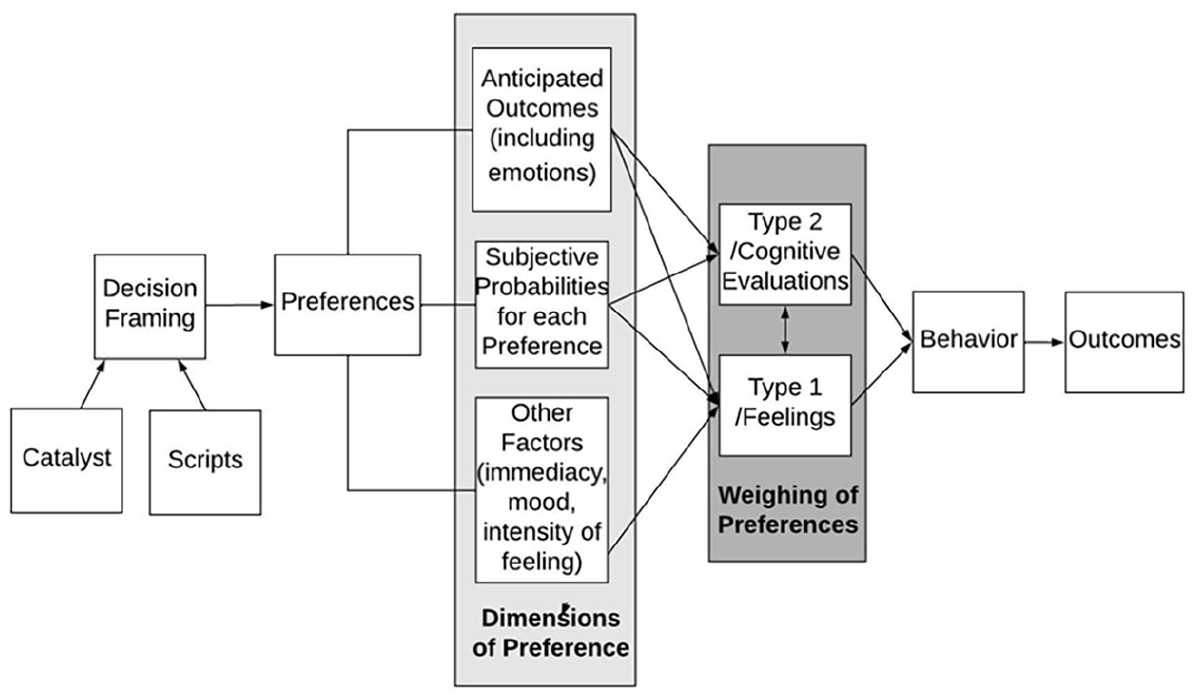
The conceptual model for the decision process adapted from Risk as Feelings (Loewenstein et al., 2001).
In addition to framing the decision, the decision maker constructs preferences, or the preferred course of action in a decision context, that can change from situation to situation, and are constructed based on context (Slovic, 1995; Warren et al., 2011). Often these preferences do not match with the actual options available to a decision maker. For example, neighborhood context may limit the set of potential preferences an individual considers when responding to a catalyst. Again, highly disadvantaged settings create conditions where individuals may feel compelled to respond to even minor provocations in a highly confrontational manner to maintain respect and therefore stay safe (E. Anderson, 1999). The decision maker next evaluates or weighs the options by processing, or making mental calculations (often instantaneously or without conscious thought) to consider the positive and negative ramifications associated with a potential behavior. The “Risk as Feelings” framework suggests that emotions (affect) play a role in the weighing of preferences similar to cognitive processes (Loewenstein et al., 2001) and researchers have developed a dual categorization of these mental calculations: Type 1 calculations are guided by intuition and emotions, while Type 2 calculations are guided by critical evaluations and rules (Kahneman, 2011; Loewenstein et al., 2001). Individuals often make use of Type 1 and Type 2 thinking in coordination when making decisions (Evans, 2003; Loewenstein et al., 2001).
Recent rational choice scholarship has begun to draw on the risk as feelings model by incorporating additional aspects of the decision process and considering a few social influences on decisions. Yet, this scholarship largely remains constrained to a narrow portion of the decision process and the conceptualization and measurement of newly incorporated components of it differ from the risk as feelings framework. The consideration of context is limited, in part because this scholarship relies heavily on (experimental) surveys (e.g., Barnum & Solomon, 2019; Thomas et al., 2023) and vignettes (e.g., van Gelder & de Vries, 2014).
Criminological studies that have begun to examine additional aspects of the decision process—preferences and the weighing of preferences—differ significantly from the risk as feelings model. Preferences are conceptualized and measured based on behavior. Thomas et al. (2023) operationalize “preferences for risk” as the estimated slope coefficients when perceived risk is regressed on crime. The assumption that our actions reflect our preferred behavioral outcome, and therefore our preferences, fails to recognize the lived reality of decision makers. Often a decision maker would prefer an option or resolution to a decision scenario that is not perceived to be available due to a number of contextual factors, such as neighborhood structure. In addition, in the decision sciences literature, preferences are not considered to be stable (or consistent) across different situations (Slovic, 1995). A wide body of literature suggests that preferences are significantly influenced by how a decision is framed and other contextual factors (Lichtenstein & Slovic, 2006; Slovic, 1995). Recent assessments of dual processing are similarly limited. The weighing of preferences was first introduced as a proxy for cognitive (Type 2) thinking referred to as “thoughtfully reflective decision making” (TRDM) (Paternoster & Pogarsky, 2009) and later dual processing to incorporate the role of emotion (Type 1) and cognition (Van Gelder, 2013). 4 Newer studies use perceived risk (costs) as a proxy measure of the cognitive aspect of weighing preferences, conceptualizing and measuring Type 2 thinking with the same measures historically used to test rational choice. These and other studies also elevate cognitive processing as “good” decision making and presume that emotions play the singular role of disrupting cognitive assessments (Barnum & Solomon, 2019; Paternoster & Pogarsky, 2009; van Gelder & de Vries, 2014). However, literature in numerous decision contexts suggests it is normative for individuals to make simultaneous use of Type 1 and Type 2 processing to make everyday decisions (Evans, 2003; Loewenstein et al., 2001) and that due to the constructed nature of preferences, decision processes are highly malleable depending on context (Lichtenstein & Slovic, 2006; Slovic, 1995).
Yet, only two criminological studies consider context. One investigates the effect of TRDM on violence in schools with different punishment regimes (Maimon et al., 2012) and another how living in disadvantaged neighborhoods shapes the perceived costs and benefits of crime (Thomas et al., 2022). These studies are limited in similar ways to previous work. For instance, Thomas et al. (2022) examine the impact of neighborhood on the perceived costs and benefits of crime without considering framing, preferences, or dual processing. Focusing on the perceived costs and benefits of one potential behavioral option is not equivalent to studying the decision process. These and other quantitative studies are similarly limited in scope, meaning the basic science on how key aspects of the decision process operate and interrelate in incidents of crime in the disadvantaged (or other) contexts is lacking.
In response to these gaps in the literature, our study begins to unpack the black box of the decision process regarding youth violence as it unfolds in the real world context of concentrated disadvantage. We draw on the risk as feelings model of decision making to explore incidents of violence among youth living in neighborhoods high in concentrated disadvantage and violent crime. Our use of qualitative methods enables us to offer novel insights into key aspects of the decision process (i.e., decision framing, preferences, weighing of preferences) in these incidents.
Methodology
The primary data for this research is in-depth interviews with 22 youth residing in or attended school in Lansing, Michigan. Lansing has a median household income below the national average and a poverty level above it (U.S. Census Bureau, 2020a). Furthermore, crime in Lansing has increased since 2019 (Hunter & Harding, 2021), including shootings (Kaminski, 2021). Conducted between July 2021 and August 2022 via Zoom (due to COVID-19), the interviews were voluntary, recorded, and transcribed verbatim. 5 On average, interviews lasted approximately 1 hr. Respondents received a link to a $40 gift card for participation and were promised strict confidentiality.
Youth were recruited to participate if they were between 13 and 19 years old and lived or went to school in a high-poverty, high-crime neighborhood in Lansing in the last 2 years. Interviews with youth service providers (Gibbs, et al., 2023) indicated that recruiting respondents from multiple disadvantaged neighborhoods was a reasonable approach due to similarities in those neighborhoods in Lansing. As in Harding’s (2010) qualitative examination of youth decisions (regarding education and relationships) in disadvantaged contexts, we relied on census data (described below) and interviews with youth service providers (Gibbs et al., 2023) to verify neighborhood characteristics. Four participants went to school within but resided outside the city; one went to school outside of, but primarily lived in Lansing. During the same time period, participants must also have experienced an incident of community violence, most commonly defined as incidents in which one non-familial party attempts to or harms another (Stein et al., 2003). Given the disadvantaged context in which youth reside, we were interested in how youth from disadvantaged communities make decisions about violence in any context—both neighborhoods and schools. We took this approach because a number of studies have shown the importance of neighborhood effects on school violence (D. Anderson, 1998; Gottfredson & Gottfredson, 1985) and for adolescents, both school and neighborhood violence are deeply interrelated (Mateu-Gelabert, 2000). Specifically, scholars have documented conflict initiated in the neighborhood spills over into the school and conflict initiated on school premises can carry into the neighborhood (Brunson & Miller, 2009; Mateu-Gelabert, 2000).
Sampling was convenient in nature. Recruitment occurred primarily through educational, vocational, and skill-building youth service programs associated with schools, community-based organizations, and nonprofits, some of which were affiliated with the juvenile court. Flyers and information sheets that described the project goals, eligibility criteria, interview logistics and contact information for the project recruiter were distributed to potential participants by program personnel. The recruiter explained the project to interested parties and at least one of their caregivers, verified that youth met the sampling criteria, obtained caregiver informed consent, and collected self-reported demographic information on the youth who indicated they wanted to complete an interview. Interviews with the youth were scheduled for a later date and youth were instructed to complete the Zoom interview in a private space and to play soft music if they had concerns about being overhead. Interviewers obtained their official informed assent before starting the interview. The final sample includes 12 youth who identified as men and 10 as women; 4 self-identified as White, 11 as Black or African-American, 2 as Hispanic, 3 as Biracial, and 2 missing. 6 The mean age was 16.5.
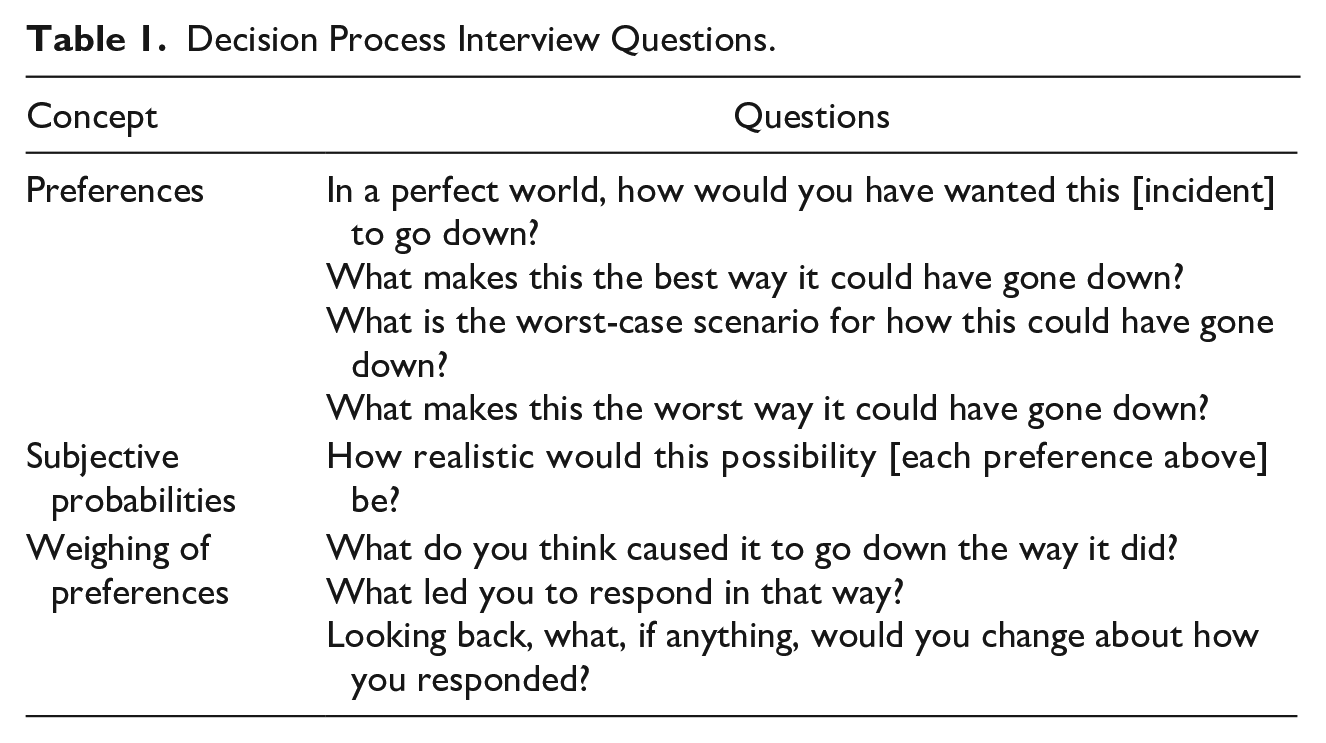
Interviews were semi-structured and open-ended to allow for considerable probing. 7 Respondents were first asked to describe their neighborhood and school environments and how often they saw various types of conflict in those spaces. We next asked them to detail an incident of neighborhood or school conflict they experienced in the last 2 years, whether they avoided or engaged in physical violence. “Conflict” was described as arguments/beefs, harassment, threats, or fights/assaults. We limited incidents to the past 2 years because research shows that as more time passes, more errors are made in dating events (Baddeley, 1992). To minimize memory recall errors, we prompted respondents to share an incident they felt comfortable discussing, that really stood out in their mind, and that they could talk about in detail. We also cued respondents with the COVID-19 start date and changes between remote and in-person school to bound the time period. We did not limit respondents to incidents in which they engaged in violence because our focus was on the decision process, the outcome of which is not under the sole control of one party. We next asked questions about the incident (e.g., what started it) and their decision process during the incident. As shown in Table 1, interview protocol questions were designed to capture specific aspects of the risk as feelings model, including preferences and their perceived likelihood and the process of weighing preferences. The interview concluded with questions about neighborhood safety, how COVID-19 changed neighborhood conflicts, and what would help them stay out of conflict. In addition to reminding them of the forthcoming virtual giftcard, we also concluded the interview with a resource sheet with a variety of low-cost or free resources and services.
Decision Process Interview Questions.
Coding
To begin developing our interview codebook, we adopted a deductive approach based on the risk as feelings decision making model. We first created themes for questions designed to elicit specific concepts in the model (i.e., the first column in Table 1) and then analyzed respondent’s narratives within those themes to identify subthemes in the data (Bingham & Witkowsky, 2022). This analytic process was done through systematic coding.
Four members of the team developed the codebook to increase interrater reliability. Using the codebook, the team independently coded two interviews. The codebook was further revised, and any discrepancies were discussed and resolved by the coding team. The data were subsequently categorized into themes and subthemes by two members of the team. They worked together to arrive at mutually agreed on thematic patterns, and met with the full team weekly to discuss emerging themes and patterns, rework the codebook, and resolve coding discrepancies. After coding each account, we tabulated the frequency of each category to identify the strengths of the patterns we uncovered. To increase the validity of the analysis, care was taken to depict themes and illustrations that reflect the most common patterns in youths’ accounts, including the search for and explanation of deviant cases (Strauss, 1987). Although not generalizable, the study raises significant issues that may guide future inquiries into the contextualized nature of the decision-process to engage in or avoid violence.
Mapping
To verify our eligibility criteria and further contextualize neighborhood conditions, we mapped respondent neighborhoods. To protect their anonymity, we asked participants to identify the nearest intersection (i.e., cross-streets) to their homes. 8 We used the street address locator tool in ArcGIS Pro (version 2.8) to geocode addresses to the street segment level (Esri, 2022). This tool uses a polyline shapefile containing reference information on street addresses from the U.S. Census Bureau (2020b) to identify the locations of each address along the street network. The street address locator tool is highly flexible, accommodating intersections, addresses with street numbers and names, and dual-address ranges. All 22 addresses were successfully geocoded. Finally, we identified the block group of each (geocoded) address (hereon referred to as participant block groups) using a shapefile from the U.S. Census Bureau (2020b). 9
To capture concentrated disadvantage, we obtained socio-demographic characteristics from the U.S. Census Bureau’s American Community Survey (U.S. Census Bureau, 2020c) and the Decennial Census (U.S. Census Bureau, 2020a) for the state of Michigan. These census characteristics included percent (1) Black, (2) less than age 18, (3) female-headed family households, (4) unemployed, (5) living below the poverty line, and (6) receiving public assistance. 10 Following Sampson et al. (1997), we created a scaled (0–1) factor score capturing concentrated disadvantage that was informed by the results of a factor analysis. The factor loadings for percent receiving public assistance and percent less than 18 were below 0.2 and therefore were excluded from the model. The factor loadings for the remaining census characteristics ranged from 0.57 to 0.78, with an eigenvalue of 1.9 and Cronbach’s α of 0.78. We identified the median factor score for all block groups, capturing the state of Michigan (i.e., Michigan block groups). To facilitate comparisons, we subsetted our dataset to identify the median factor score for block groups comprising the city of Lansing (i.e., Lansing block groups) and block groups that captured the addresses of our participants (i.e., participant block groups). 11 We additionally considered percent receiving public assistance and percent less than 18 for Michigan, Lansing, and participant block groups.
We also calculated the violent crime rate (per 100,000) for the state of Michigan, the city of Lansing, and the population comprising participant block groups. 12 For participant block groups and Lansing, we used incident-level data from the Lansing Police Department (2020) on Uniform Crime Reporting (UCR) Part I offenses (homicide, aggravated assault, sexual assault, robbery) that occurred in 2020. 13 For Michigan, we obtained incident-level data on UCR Part I offenses from the Federal Bureau of Investigations’s (FBI, 2020) crime data explorer. Population estimates were obtained from the U.S. Census Bureau (2020a).
Findings
Table 2 depicts the median values for the concentrated disadvantage factor score, percent receiving public assistance, and percent less than 18 for Michigan, Lansing, and participant block groups. It also includes the violent crime rate (per 100,000) for the state of Michigan, city of Lansing, and the population comprising participant block groups. The median concentrated disadvantage factor score for participant block groups is 2.4 times higher than that for Michigan block groups and 1.4 times higher than that for Lansing block groups. In comparison to Lansing and Michigan block groups, the residents of participant block groups are more likely to be on public assistance and are also more likely to be under 18 years of age. Notably, the violent crime rate (per 100,000) where participants live is 5.2 times greater than that of Michigan and 1.7 times greater than that of Lansing.
Comparison of Block Group Characteristics.
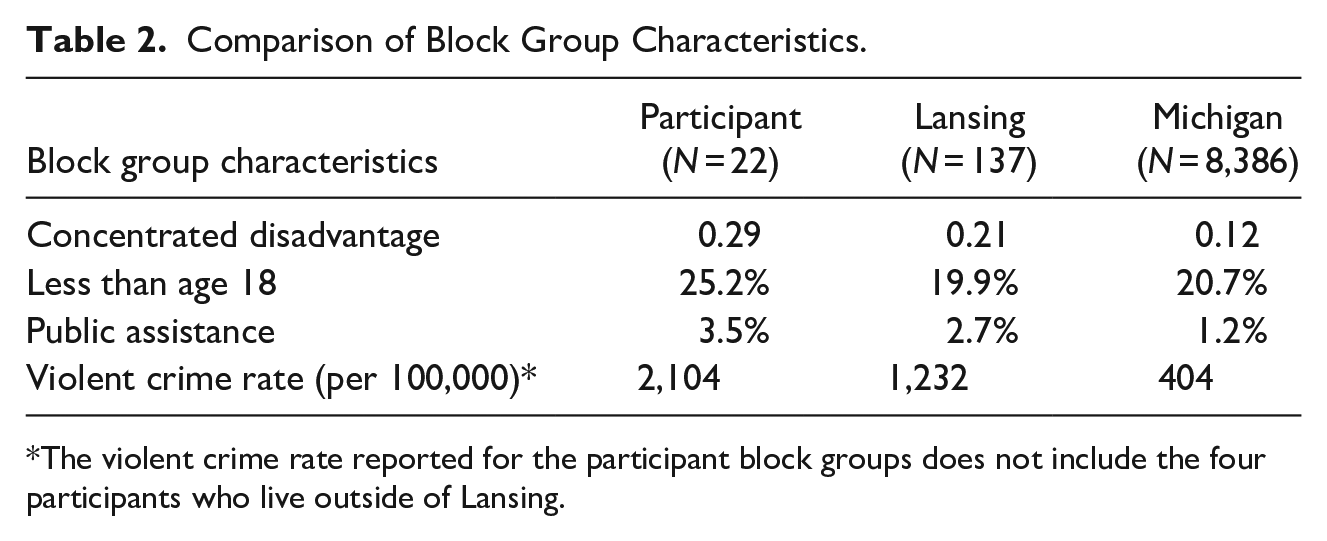
The violent crime rate reported for the participant block groups does not include the four participants who live outside of Lansing.
We interviewed 22 youth who reported a total of 24 incidents—two respondents reported two incidents. 14 These included 17 incidents in which they avoided physical violence and 7 in which they engaged. Findings are organized by the components of the risk as feelings model. We begin describing decision processes in these incidents with decision framing, specifically the scripts youth held regarding how to handle conflict that would shape decision framing and the catalysts they experienced that prompted the need to make a decision. It is important to note that we use the words “the vast majority” to indicate approximately three-quarters or more; “most” or “the majority” to indicate more than one-half; “many” to indicate more than one-third; “a number” to indicate approximately one-quarter or more; and “several” or “a few” to highlight themes mentioned by a small number of respondents but more than two.
Decision Framing
Scripts About Conflict
Recall that scripts are rules that help youth guide their behavior in unfamiliar decision contexts (Harding, 2010). Our findings show that the scripts guiding youth in whether to engage in a physical fight were based on experience navigating high crime communities and guidance from trusted individuals. Half of the youth we interviewed were taught by their families not to engage in violence. Asked how he learned to handle conflict, Daniel said from “my brother cause you know I talk to him about a lot of things. He try to keep me out of it.” Similarly, Veronica said she learned to handle conflict “from having experience with it from my siblings. Just learning how not to react to everything. Like, not give everybody a reaction, because that’s what they want.” Other family members encouraged their children to talk things out when engaged in conflict. Laura was instructed not to “use your fist, you talk . . . [b]ecause if you talk, you could talk it out, eventually. And if you don’t talk it out then that friendship’s not meant to be.” Some were instructed to specifically avoid conflict not pertaining to them. Naomi received advice from her parents that “if a situation has nothing to do with me, then don’t try and do anything about it. Tell an adult or someone that’s close by.”
In addition to family, a number of youth mentioned that they learned how to handle and avoid engaging in conflict from themselves. Ashley asserted “ It’s just within myself . . . because I don’t want to be the one in jail or dead, so I think of it as that. Like I motivate myself to not be into too much and not be in drama because I don’t want to be dead or nothing.” Likewise, Nina surmised:
: You just adapt to it and you just learn what to say and what not to say. Know your surroundings really.
: Yeah, so who are you learning that from?
: Myself. You just got to pay attention to these types of things because if not, you’re going to be brought into the situations or conflict. It’s not easy to avoid but it’s avoidable. Like you can do it though.
: So, you didn’t learn this from anybody? You didn’t get advice from anyone in terms of how to handle yourself?
: No. Because I used to be a lot of drama. I used to really be in drama. And like I said, as I got older, you just learn how to adapt and go a different direction with that and learn how to handle a situation better. So, that’s really all I had to do and it takes time. But like I said, it’s achievable.
Although not as common, a few respondents described being taught to engage physically when the situation called for it, such as when they have been physically attacked or are at risk of it. James said “I’ve been told if I get hit, hit them back.” Likewise, Austin stated that his parents taught him “Unless somebody lays their hands on you, just keep walking . . .. If they put their hands on you, then do something back. That’s it . . .. They swing first and they hit me, then I can swing back.” Furthermore, Marie said “my brother had taught me, if someone ever tried hitting me, try pinning them to the ground and tell them to knock it off. Not trying to hit them, just put them on the ground.” For Marie, this was a defensive maneuver to avoid getting physically assaulted. Some youth believed it was necessary to present themselves in a matter that demands respect so as to deter potential acts of future victimization from others (see E. Anderson, 1999). Most respondent scripts emphasized avoiding violence; however, contextual factors (e.g., neighborhood structure) often made violence unavoidable. These scripts are used as a reference point for potential behavioral options (preferences) when an incident begins or is catalyzed.
Catalyst
One component of decision framing is the realization that a situation requires a behavioral response and therefore a decision must be made about how to proceed. Of the 24 conflict incidents detailed by youth in the study, the vast majority emanated from words and actions that were perceived as disrespectful. Such actions were often perceived as challenges that precipitated a conflict. Naomi witnessed an incident at a store in which “people were bumping into each other because the store . . . [is] really small . . .. So everybody gets bumped into or something . . .. They were just all yelling back and forth at each other.” Likewise, after a day of being picked on by another student “because of my color and how I talk and things like that,” Mia was trying to return the student’s shoe that had fallen off. “Then he wanted to get rude about it . . . he wants to get mad . . . [even though] I was going to hand it to him.” As a result, she decided “I’m not going to give you your shoe because you’re being disrespectful to me.”
In a few cases, disrespectful triggers that set a situation off were tied to name calling, which for young men included derogations such as “snitch,” “punk,” or “soft.” Clayton detailed an incident in which his friend stole a PlayStation and asked Clayton to hide it: [He] stole a PS4 and some of his friends wanted me to hide it at my house because we were staying in the same neighborhood. I went through with it at first, and then I ended up going back to this house. Then his next-door neighbor came and they bust in the door and was like, “I’m finna to call the police. And I’m finna have my brother and my dad come over here . . .. [W]hen she had left, I told them they got to get that game out of my house. And they got mad at me.”
Clayton ended up getting into a fight with his so-called friends after they started “calling me all these names, calling me snitches . . . and a whole bunch of stuff.” Though Clayton said he didn’t care that his friends were calling him names because he realized they were trying to “blame everything on me,” it is important to note that the fight started after his friends accused him of snitching, another script that shaped violent incidents in disadvantaged communities.
Likewise, Brandon got into a fight with someone who started “talking crazy on Snapchat.” Brandon ignored him on social media but when he went to the park to play basketball a few weeks later, the guy was there “still talking crazy . . . He was saying ‘oh you soft, you ain’t really about nothing’ . . .. I was like, ‘Bro, it’s whatever. I’m not going to just let you say whatever. I don’t even know you like that, so it’s really whatever you want to do.’ And boom, we fight.” In a similar fashion, after being placed in a residential placement, Chris asserted that “one [of] the kid[s] kept nagging at me. Because what they used to say was I’m from Lansing and they’re from Detroit so it makes us soft because we’re not from somewhere like that.” After being picked on for 3 weeks, Chris said he “had made [the] decision and just hit him . . . [and] we just started fighting . . . and [I] knocked his teeth out.” Some young men are unable to let the incident go because the term “soft” remains heavy-laden with implications about reputation.
Another catalyst that served as a disrespectful trigger was when others insulted loved ones, especially family. In a few incidents, respondents explained that speaking disrespectfully of family members warranted violence. For example, Marie explained that while she generally ignored two girls at school who often spread rumors about her, when they started “talking bad about my mom and about my family . . . she’d gone too far.” She continued: “[the girl] slapped me and then walked off and she was just saying stuff under her breath. And so I got really mad and I was like, ‘Whatever’ . . . I just punched her.” In particular, insulting a dead loved one often provoked a violent reaction. Jacob explained a fight he witnessed: “[M]y friend, he has a dead friend . . .. There was this other guy [who] said something about my friend’s dead friend . . . that somebody’s going to end up like him or something - something disrespectful . . . so my friend swung on him.” And Laura articulated the times when she has engaged in violence: “T]he only thing that I have a problem with is people talking about my family. You could talk all the crap you want about me, go ahead. Say it. Say whatever makes you feel happy . . . But once it gets to my family, then that’s where I have a problem because that’s my family. You don’t know them . . . you don’t know them personally.”
She went on to explain a conflict she entered into with another girl who spoke about her dead father: “She started talking crap about my dad. My girlfriend came to me with it . . .. It was like a 25 minute conversation of her just talking shit about me repeatedly, repeatedly and then she brought my dad into it.” Because her father passed away, Laura felt a duty to defend him.
Conflicts triggered around disrespect were tied to being taken advantage of. This was generally associated with those who were already engaged in deviant or criminal behavior. Daniel explained that while “I was at my man’s crib . . . he was selling . . . some [drugs] . . . they pulled up, you know, some like a car deep . . . [But] they were trying to get over [take advantage of my friend].” Daniel continued: “there was words said and next thing you know somebody step out the front seat and then just started talking about, ‘I’m finna do this, do that’ [and] . . .. [there] was a shootout.” Likewise, Anthony gave a detailed account of an incident that led to a shootout: Look, I was with my friends and all my friends at the time, they carry guns and they were arguing and stuff like that . . .. it started over somebody taking somebody’s stuff, or money, or whatever . . .. I think, somebody took $300 off somebody’s wallet or purse . . .. [T]he dude was like, “Hey, where’s my wallet at? Where’s my wallet at? Have you seen my wallet?” and his wallet was in a chair. And he opened his wallet, because we had like plastic chairs out there. He opened his wallet and he was like, “Where my money at? Where my effin money at? Where’s my money, I’m not playing with nobody” . . .. And people were like, “I don’t got your money. Don’t blame me.” And then its “Shut the hell up. I’m not talking to you.” And it’s “Ain’t nobody gonna blame me for nothing” . . . And then, everybody’s like, “Ooh! Who you gonna turn up on, you ain’t talking to me. I didn’t steal nothing. . .don’t even talk to me.” Then, it’s, “What’d you say? What’d you say?” Then, he pulled out a gun and everything just started happening . . .. things were so quick, all I heard was, “Pah. . .pah.” I’m just looking. “What’s going on. What’s going on?”
This illustrates how despite holding scripts that prioritized avoiding fights, youth often experienced contextual challenges to adhering to those scripts. The scripts that youth developed with trusted people, the catalyst/framing of an incident, and other contextual factors led youth to develop the following preferences, or behavioral options for specific decision contexts.
Preferences
Even though some youth in our study engaged in conflicts that included physical or verbal disputes, most of the time youth preferred to have avoided the situation altogether. In particular, the vast majority of youth stated that they preferred not to have been engaged in the conflict. In some cases this was tied to the potential lethality of such violence and the perceived triviality of the disputes. In his reflection on the shootout he witnessed after someone found $300 missing from his wallet, Anthony noted “there’s a way of getting your point across than yelling and cussing and doing all that . . .. If it was a perfect world, I would have just wanted somebody to sit down and talk about it, handled it in the right way. I would have wanted whoever stole that money just to admit it and give it back.” Nina lamented an incident in which an argument escalated into a girl “coming to my house with her brother and stuff, and they shot through my living room window.” Though no one got hurt, Nina expressed that in a perfect world, she preferred that the parties involved “just fight, get it done . . .. [rather than] people [going] to get guns.” Although Nina advocated for a physical fight to solve the dispute, in her mind it would have evaded the potential for lethal violence that involved casualties.
Moreover, some youth in the study underscored the triviality of some conflicts. For instance, Caitlyn described witnessing “two dudes fighting in the hallway just because it was too hot, and the school didn’t have A/C . . .. I was just sitting there, not even believing that it happened because they were fighting because it’s hot.” This led her to conclude that “people will fight over the pettiest reasons.” Similarly, Henry asserted that a lot of fights in schools “most of them [a]re just petty fights . . . [resulting in] some big brawls.” Nina explained what started the incident of a girl and her brother shooting through the window of her home: “It was something about somebody dating [or] some relationship problems . . . just something petty.”
As a result of the conflict, some lost friendships, which they wished did not happen. Of the incident he found himself in, Clayton reflected that after his friends stole the PS4 “I should never [have told] them I’d take the game to my house.” He concluded “It would’ve helped not to get into it . . . [and] [w]e probably would’ve still been cool.” In a similar fashion, Laura noted that after a former friend came to her house to jump her, she wished they would have “just hash[ed] it out . . . [because she ended up] losing my best friend.” Due to these losses, several youths emphasized the desire to have simply talked things out in a mature manner. Chris noted that “instead of fighting” with a kid at the residential placement where he resided “I should have talked to him . . . [instead of] bickering back and forth.” Likewise, in her situation, Marie claimed that “having a chat with her [assailant] and whoever else” would have been ideal. Though she asserted that she “already tried talking to her and all that and I guess that didn’t really work,” the next course of action should have been “getting grownups involved . . . to sort it out.”
In addition to their ideal preferences for the conflict, youth were asked about the preference they would least want. The vast majority stated that the worst case scenario was for more severe forms of violence to take place. For many involved in incidents that could have escalated, they acknowledged that either they or their aggressor could have been physically assaulted. Recall that Mia explained that in her attempt to return her classmate’s shoe, he got angry and so she refused to give it back to her. Consequently, she asserted that “he pulled my hair, slapped me, and ran.” She claimed that he was racist and if he was not dealing with her, a calm person who had managed to control her anger, the worst case scenario was he would have “been beaten [by other kids] so bad that he [would have] went to the hospital.” Likewise, Laura stated that her former best friend went to her house to jump her along with three guys (two of which were her brothers) and a girl. Asked the worst case scenario as to how the incident could have gone down, Laura replied: “We could have fought and then she would’ve got hurt . . . I know that I would’ve hurt her . . .. I used to be her best friend for four years. I know that she can’t fight. And you trying to come fight the one girl that you came to the most to fight your problem.”
Others noted that weapons could have been used in the conflict, resulting in fatalities. After a shootout over a drug user trying to pay less than the agreed upon price, Daniel said the worst case scenario would have been “somebody getting killed or hurt . . . [on] either side.” Similarly, Henry asserted that after getting robbed at gunpoint late at night while walking home, he was able to talk the assailant down and walk away; however, he was well aware that the robber could “have just walked up behind me, shot me in my back, and taken everything I had.” And after a shootout in which two people died because of $300 being stolen, Anthony explained: The gun violence could’ve went a lot more intense than just two people getting shot. I mean, just only a few people getting shot and two people dying . . . It could have been everybody got injured . . .. [A]fter the situation . . . it could have kept continuing . . . kept on tripping about it . . . Whoever was there that night, they probably, you know, pay back to them or something like that. That’s the only way it could have been worse.
Anthony tied his concerns to the potential for more people getting injured or killed and the likelihood of retaliatory violence taking place. Overall, the youth’s preferences were normative—they wished to avoid violence. Nonetheless, they experienced challenges in using these preferences to guide non-normative situations that could result in deadly outcomes.
Though not a common theme, a few noted that incidents could have resulted in more severe consequences. After his friends stole the PS4 and he went to his friend’s house to pick it up to keep it at his house, Clayton asserted that “CPS [Child Protective Services] could have been in my family’s life . . . [b]ecause I was somewhere I wasn’t supposed to be while my little brother and sister at home by theyself.” Others who engaged in physical assault realized they could have acquired a criminal record. After getting into a fight with a boy who kept calling him soft and being placed in a residential placement, Chris said “I could have gotten charged with a felony because I technically assaulted him first . . .. I could have got charged with a felony. I probably could have got more time . . .. They could have moved me to a different placement and gave me even more time.” Overall, youth understood that the conflicts they were engaged in could have resulted in more severe violence and injuries, as well as legal consequences.
Subjective Probabilities
Youth were also asked about subjective probabilities—the probability that the outcome would occur the way they wanted (i.e., they would receive their preference), which shapes the weighing of preferences. Specifically, the majority of youth thought the probability of their preferred outcome was low, or unlikely to happen. After being treated disrespectfully and slapped by a classmate, Mia said it was not possible that he would have been respectful because “I’ve know[n] him since elementary. There’s no changing him.” Similarly, Veronica explained that after her brother was locked up, her neighbor wrote a Facebook post making fun of her brother, resulting in a physical fight with her mom, aunt, and herself against the neighbors. Although Veronica said they should have simply messaged the neighbor to take the post down, she did not think that would work because “I know how people are. Even if you text them, they still might feel some type of way about it. Like they’ll still take it as disrespect.”
Others believed that their preferred outcome was not likely to happen because of the tendency for people to escalate the violence. Recall that a girl and her brother shot through Nina’s living room window after an argument. Though Nina preferred that the parties fight to hash the issue out, she said it was unrealistic because “nowadays, people like to get guns involved. They don’t know how to just fight and handle their problems. They just want somebody to know that they big and bad and that they are going to get the last word.” Likewise, James who witnessed a fight take place outside after school between a few people morph into 16 and 18 people asserted a one-on-one fight is rare unless “you bring people with you to make sure you don’t get jumped.” He continued: “But if you beating on them too much, some people really just don’t care, and then they turn it into a riot . . .. Everybody would be jumping [in].” Other (older) respondents were able to contextualize the lethality of violence with a structural lens. For example, in response to our question about how they would have wanted the incident to “go down in a perfect world,” one respondent stated “I don’t know ‘cause I don’t even know what it feels like to be perfect.” Further probing revealed that he held a myriad of alternative preferences. He states “there’s a way of getting your point across than yelling and cussing and doing all that. . .If it was a perfect world, I would have just wanted somebody to sit down and talk about it, handled in the right way.” After the interviewer asked how realistic he thought that possibility would be, he replied “No chances. . .. with the way this city is.”
Although few youth in the study believed that their ideal preference was likely to occur, most thought it was more probable that the worst-case scenario would take place. After witnessing a fight spill from the classroom to the hallway, Caitlyn feared that it would result in one of the parties being thrown down the stairs. She thought this scenario was “very realistic . . .. [and] would have happened if the security guards wouldn’t have gotten there when they did.” And after witnessing a fight at a store take place because “people were bumping into each other,” Naomi believed the worst case scenario would have been the use of guns. She admits, “I wouldn’t have been shocked if one of them had weapons, but luckily neither of them did . . . [b]ecause somebody would have got more hurt.” Overall, worst case scenarios were viewed as quite likely.
Weighing of Preferences
The interviews also provided insights into how youth weighed their preferences, or alternatives that guide behavior. Recall that the weighing of preferences involves both Type 1 (emotional, intuitive) and Type 2 (rule-based, cognitive) thinking. Two reported that Type 1 thinking guided their response in the past, but learning ways to manage their anger helped them avoid physical violence in the incident. Mia stated that the worst case scenario did not happen because “I learned how to control my anger. Be me instead of being an aggressive person. And I’m trying to get myself together instead of using violence towards everyone.” She elaborated: If I didn’t learn how to control my anger, control my feelings, and stuff like that, that could’ve been bad for him. I blacked out when I’m really mad and when I’m frustrated . . . I don’t know what happens when I blackout . . . All I know is just end up somebody’s laying on the floor. Either hurting badly, bleeding badly. It all depends. Because I don’t see what happens. It just happens.
After walking away from a provocation, Jeremy stated that “[i]f I was to be honest, if I was really mad, I would’ve probably hit him . . . Because any other time, I would’ve probably got mad and probably tried to fight him . . . I’m really a good person, but when it comes to other things, I get mad when I hear people start to talk about me.” But, he developed strategies to manage the interaction stating that “[w]hen I get mad, sometimes I just don’t talk . . . When they say something negative to me, I just don’t say nothing back because I don’t want to get mad.”
Three youths described relying exclusively on Type 1 thinking as the incident escalated into a fight, but the weighing of preferences ultimately also involved Type 2, rule-based thinking. In explaining why the “perfect” outcome didn’t happen during a fight with another student, Chris stated that “When we had got back [from lunch], I just had made [a] decision and just hit him. I just hit him . . . We just started fighting . . . Because I didn’t think it through . . . I acted on impulse, without even thinking.” Yet, this was after 3 weeks of bullying, at which point Chris decided that he needed to act or it wouldn’t stop. Similarly, Marie reported hitting a student because “When she walked away, she was still talking all this smack. . .And I mean, I guess. . .I don’t know. I was still mad. I was mad at the time. . . And I guess it just kind of happened.” However, the incident escalated because of rule-based thinking. After reflecting on what caused it to go down the way it did, Marie responded, “I guess just her talking about my mom.”
Similar rules were evident in incidents solely based on Type 2 thinking. Informal rules regarding bullying were mentioned by four respondents. Chris described his thought process: “In my head before I like start thinking and stuff like that, I’m going to show him that I’m not soft and that everybody from Lansing [is] not soft. I ended up fighting him. I accidentally, well, I didn’t accidentally strike him and knocked out his front teeth.” He explained that the incident went down that way because “[a]fter I was ignoring him and he kept going, it’s not going to stop until I did something.” In describing what led up to a fight after a friend stole a playstation, Clayton said that “They was just calling me all these names and stuff. Basically, they was trying to be some bullies, but I didn’t even . . . I don’t go for none of that.” Austin reported similar thought processes, stating “she threatened to stab me with a pencil, so I was like . . . I cussed her out because she threatened to stab me with the pencil. That’s when I went off, because I don’t let nobody threaten to stab me with a pencil.” In reflecting on getting in a fight with a boy who bullied him on social media, Brandon said “Just seeing him at the park, I came to play basketball and because I hate bullies . . . so if I’m trying to come play basketball and you think you’re some big bully guy. Well, okay, let’s see.” One respondent reported similar rule-based thinking, in this case regarding responding to insults to family. Laura stated that even though she didn’t want to, she came very close to fighting a friend for this reason. She explained: “My head said I don’t want to fight her . . . Like I love you, you’re my best friend. I don’t want to fight you because I know I’m going to hurt you. . .the thing that I have a problem with is people talking about my family. You could talk all the crap you want about me, go ahead. Say it. Say whatever makes you feel happy . . . But once it gets to my family, then that’s where I have a problem because that’s my family. You don’t know them . . . Don’t talk about my family and then you won’t have to deal with me.”
Respondent’s also reported Type 2 rules akin to the code of the street (E. Anderson, 1999), in two instances, in combination with Type 1 (emotional) thinking . Peyton felt like he had been set up when he went to meet a girl he liked at her house. He explained that after “three people who hopped out of the car and tried to grab me out of mine,” he “had [to] open fire because I’m not going to try to fight off three people. I’m not going to shoot nobody either. But still, I’m just going to let it be known like, ‘No. Don’t do that no more.’” Ultimately, he fled the situation, but later retaliated against one assailant at the same girl’s house, stating “I found out that he was in the car and in my mind, I’m heated now [Type 1 thinking] because why would you bring him over here and I’m over here? So I went outside and smashed the window out and smack them up with the gun and took his phone and took his coat and took some pills from them.” Consistent with the code of the street, he indicated that a strong response was necessary to avoid future violence and retaliated because he felt disrespected. In his view, all of this happened because both parties had a similar “mindset . . .living life a little bit too free, maybe,” with neither thinking about the consequences because they were “in over their heads.” Daniel also reported a combination of Type 1 and Type 2 thinking. A group of people bought drugs from his friend and picked a fight because they didn’t have enough money and it turned into a shootout. Daniel says: “I was just scared [Type 1] that I was going to lose somebody. I was at my man’s crib and, you know, he was selling you know some stuff and it led to something bad. It was a shootout so I wasn’t really scared about the situation, I was just scared that I was going to lose him because I’m not one of those people that if you take one of mines, I’m just going to sit there. You take one mines I’m taking one of yours and especially if it’s somebody real close to me, that’s going to hurt me. So I want you to feel my hurt. It’s just, I don’t know. I just couldn’t go through that. So I mean I guess I would say that.”
Knowledge of the street code kept another respondent out of harm’s way. After another partygoer discovered that $300 was missing from his wallet and pulled out a gun (and shot and killed two people), Anthony said “I didn’t run, but I ducked.” He further explained the rules of the game: [W]when shootings are going on, you’re not supposed to run. Because the first person they see running, they gonna shot at. Because they gonna feel like they guilty. You know, people just running to get away from . . . but I’m telling you, that’s what people think. If like a shooting going on and if somebody’s running, they like “Oh, he did something. Shoot him.” That’s how people be. So I wasn’t trying to run or make no attention on me.
Two respondents reported using Type 2 thinking to weigh the potential costs of escalation. When asked why the worst-case scenario did not happen, Laura replied, “Because we didn’t want to get that badly in trouble . . . I don’t like getting in trouble,” with authorities or parents. Jeremy was most concerned about being in trouble with his mom, stating that if he had gotten into a fight, “[s]he’d [have] took my game away . . . and then I would’ve been grounded.” Overall, in the interviews that captured the weighing of preferences, Type 2 was most common. When youth described the use of Type 1 thinking, it was typically in combination with Type 2 thinking prior to the escalation of the incident or at some other point during the incident.
Discussion
To our knowledge, this is the first study to qualitatively examine key aspects of the risk as feelings decision process as it unfolds in incidents of youth violence in spaces of concentrated disadvantage. Overall, we found that youth held normative scripts, or informal rules, regarding how to handle conflict. Most were taught by family or learned through observation of the consequences of violence in their communities not to engage it. A few respondents also described being taught to engage physically when necessary to defend themselves.
Despite scripts that emphasized avoiding violence, all respondents experienced catalysts for violence, or situations that required a behavioral response and therefore a decision about how to proceed. Much of this was in the form of words and actions that were considered disrespectful, such as direct (physical) challenges, name calling (including on social media), or insulting loved ones, but also unwanted touching (e.g., having something thrown at them) and the respondent (or other parties) feeling someone had taken advantage of them. Consistent with the most common script for managing conflict, the youth’s preference for an “ideal outcome” in these situations was to avoid it altogether—for these catalysts never to occur in the first place. Unfortunately, they saw this preference as quite unlikely. Equally unfortunate, they viewed the worst-case scenario, which most often was more severe violence, to be much more likely to occur.
These subjective probabilities shaped the way our respondents weighed their preferences during the incidents. Although some described weighing preferences with Type 1 (emotional, intuitive) thinking, these respondents also reported Type 2 (rule-based, cognitive) thinking; many reported avoiding or engaging in violence based on Type 2 thinking alone. Type 2 rules defined when a response was necessary, which, as we saw in the catalysts, included ongoing bullying, insults to family, and the rules of engagement in the streets. Our work suggests that viewing the best-case scenario as unlikely increased the need to use these rules to navigate the catalysts the youth regularly experienced, whether they were involved in drugs and street life or not.
It is important to contextualize these findings within the limitations of our study. This study is the first of its kind, with a small sample of youth, the youngest of whom were less able to reflect on the incident to describe their decision process (as one would expect). However, the sample size is more than sufficient for qualitative work (Guest et al., 2008), and there is remarkable consistency in themes across different ages and incidents in which youth avoided or engaged in violence that they initiated or in response to provocation. We also note that the prefrontal cortex is still forming from ages 13 to 19 (Cohen & Casey, 2014). Therefore, our findings may not generalize to other developmental periods. Future work should examine how the decision process unfolds among older youth and adults. It is likely that our sample does not include those involved in the most serious violence, such as the small number of young men that drive the cycle of retaliatory gun violence (Braga & Weisburd, 2015). However, all of these youth experienced catalysts for violence, many were involved in serious violence (including lethal incidents), and some reported throwing the first punch and/or engaging in violence in the past. Thus, our sample has more experience with community violence than the general population and includes youth with a range of levels of involvement in violence. This is to be expected since we targeted youth from areas higher in concentrated disadvantage.
Thus, despite these limitations, these findings have important preliminary implications for theory and suggest several directions for future research. In contrast to recent studies that assume behavior matches preferences (Thomas et al., 2023), we find that preferences often do not align with behavior. Our findings are consistent with the risk as feelings model and suggest that the view in the prior criminological literature is problematic on several fronts. It is inconsistent with the way we understand our own decision making. When we do not reach writing goals for the week, for example, we typically do not assume that our preference was to underperform. When we make such assertions about those involved in crime, it can increase stereotyping and lead to the assumption that deviant behavior is the result of aberrant or non-normative decision processes. This assumption limits how we study decision making, which in turn shapes policies that are meant to address criminal behavior.
We began this study with the assumption that decisions that lead to violence in our population are the result of normative decision processes in the context of concentrated disadvantage and violence that makes many preferred options/preferences unachievable for the decision maker. Critically, the vast majority of our respondents did not see the best case as likely to occur and thought the worst case scenario of more violence/harm was likely to happen. Their rationale for why this was the case typically centered on how other people were likely to react. Although few were able to articulate how that connects to social structures, we know from prior literature that the search for respect becomes elevated in disadvantaged spaces (E. Anderson, 1999).
In contrast to arguments that crime is the result of a lack of TRDM (Paternoster & Pogarsky, 2009) or Type 1 thinking derailing the cognitive process (Barnum & Solomon, 2019), we found that Type 2 thinking often guided the respondent’s behavior, sometimes in concert with Type 1 thinking. However, Type 2 thinking was rarely about the consequences or costs of fighting. Youth most often talked about the rules they held regarding how to respond to the issue at hand. The respondents’ scripts regarding how to manage conflict often competed with their rule-based thinking, but sometimes aligned with it, such as when bullying came to the point of activating scripts regarding the need to stand up for one’s self. This again challenges the assumptions that offenders are poor decision makers (Paternoster & Pogarsky, 2009) who only consider the costs and benefits of crime (Thomas et al., 2022). The field would benefit from a more holistic integration of work from the decision sciences and qualitative studies to further flesh out how the full decision process operates in various contexts.
The code of the streets (E. Anderson, 1999) is one neighborhood influence to explore in future studies. In addition to explicit recognition of the rules of engagement in some respondents weighing preferences, incidents often escalated quickly. This was sometimes unexpected, but many youth anticipated it, which shaped their perception of the likelihood of various alternatives. Many perceived that other members of the community or school tended to feel easily disrespected or were likely to resort to violence and therefore, their best case scenario would not happen but their worst case would. Although our work is incident-specific and could be interpreted as situational, this dynamic is tied to broader structural contexts (E. Anderson, 1999).
Yet, many of the catalysts for violence were normative. Dealing with and developing rules about standing up to bullies is a regular part of adolescence, as is struggling to find a method of doing so that is effective and nonviolent. The search for respect and reactivity to disrespect of one’s family and closest friends is also universal, albeit potentially exaggerated in these neighborhoods (E. Anderson, 1999). In addition, the struggle to behave in a manner consistent with one’s scripts and preferences is also a common challenge for people of all ages. This struggle to align behavior with preference is universal, as exhibited by cottage industries that try to help people live healthier, drink less, or exercise more (Tsai & Wadden, 2005). Such struggles in relation to violence may be exacerbated in disadvantaged communities in a way that is less familiar to academics from more advantaged spaces, which may lead us to construct explanations for crime that inaccurately presume cultural or individual deficits.
Yet, like Harding (2007, 2010, 2011), we found that youth deviated from their stated preferences and scripts as they struggled to manage the complex and dynamic environments of their neighborhoods and schools. Incidents often unfolded over time (sometimes days or even months) with multiple decision points that led to the outcome as earlier decisions by both parties shaped the trajectory of the interaction. There was also complexity as youth tried to reconcile scripts that prioritized avoiding violence with encountering situations and rules that required it. In some incidents, the complex and dynamic environment extended beyond neighborhoods and schools to social media. Some respondents described virtual provocations and reported considering whether an altercation might be filmed and posted. In essence, our respondents were grappling with a lot and their decision process was more complicated than theorized in rational choice perspectives. Our work indicates that it is too simplistic to assume that “offender” decisions are the product of a simple cost and benefit calculation about crime alone or poor decision making.
Future work should refine the interview protocol to flesh out additional aspects of the decision process, such as what alternatives youth perceive to be available to address provocations that continue over days or even weeks. To further unpack neighborhood influences, future research should also integrate factors that relate to crime and vary by neighborhood, such as legal cynicism (Kirk & Papachristos, 2011), and also examine the role that social media plays in community and youth violence outside of the realm of gangs (e.g., Pyrooz et al., 2015). It would also be beneficial to examine the decision process among young adults who will likely be better able to articulate neighborhood influences. From a methodological perspective, it is critical that future studies of the decision processes associated with violence seek to create a holistic understanding of relevant contextual factors. Developing relationships with study participants is key to facilitating an atmosphere of trust in which participants feel comfortable openly sharing about their experiences. This may be achieved by embedding researchers in the neighborhood through partnerships with service providers and other trusted individuals via community-based and engaged scholarship.
Footnotes
Declaration of Conflicting Interests
The author(s) declared no potential conflicts of interest with respect to the research, authorship, and/or publication of this article.
Funding
The author(s) disclosed receipt of the following financial support for the research, authorship, and/or publication of this article: This work was supported by a grant from the College of Social Science at Michigan State University.
