




Abstract
Ransomware victims must decide quickly whether to pay, yet the emotional dynamics of this decision are not well understood. We report the results of a pre-registered between subjects vignette experiment with a nationwide U.S. adult sample testing how ransomware notes shape such emotions as fear, anger, guilt, and shame, and how these responses relate to stated willingness to pay. Participants were randomly assigned to a neutral policy frame, or a ransomware note, and we additionally compare locked files versus stolen data threats. Results show clear differences between threat messaging and the neutral policy condition in both emotional responses and payment intentions. The locked versus stolen contrast affected the emotions only.
Introduction
Ransomware is a form of malicious software used by cybercriminals to encrypt or restrict access to digital systems, thereby denying users control over their data until a ransom is paid. In many cases, perpetrators also threaten to publish or sell exfiltrated data if their demands are not met, further increasing coercive pressure on victims. The primary objective of such attacks is not simply data theft, but extortion, that is, extracting payment, typically in cryptocurrency, in exchange for the decryption key or the assurance of data confidentiality (Kharraz et al., 2015; Paquet-Clouston et al., 2019).
Recent years have seen a sharp escalation in ransomware activity worldwide. The Office of the Director of National Intelligence (2025) estimates that there were approximately 2,593 ransomware incidents in 2022 globally, rising to 4,591 in 2023 (a 77% increase), and 5,289 in 2024 (a further 15% rise). Although major law-enforcement operations have disrupted several high-profile groups (for instance, the FBI-led take-down of the Hive ransomware network in 2023 and the coordinated Europol action against LockBit affiliates in early 2024) these interventions have had only limited impact on the overall trajectory of attacks (Sophos, 2025). Certain sectors remain particularly vulnerable: in 2024, ransomware affected at least 85 U.S. hospital systems (covering more than 1,000 hospitals), over 2,200 public schools, and 117 state or local government entities (United States Senate Committee on Finance, 2024).
Globally, victims paid approximately US$813 million in ransoms in 2024, which is only slightly down from the record-breaking US$1 billion in 2023 (Chainalysis Team, 2024, 2025). Individual payments have grown substantially, with recent estimates ranging from an average of US$1 to 2 million per incident (Coveware, 2025; Sophos, 2024, 2025). In one of the most serious incidents to date, Change Healthcare allegedly paid approximately US$22 million to attackers in 2024 (Greenberg, 2024), following the exfiltration of sensitive medical and personal data including diagnostic records, insurance identifiers, and social security numbers (Abrams, 2024).
The financial toll of ransomware extends beyond ransom payments. Even for organizations that refuse to pay, the costs associated with recovery, downtime, and reputational damage are often substantial. A recent global survey estimated the average recovery cost (excluding ransom) at approximately US$1.53 million (Sophos, 2025). Despite law enforcement agencies consistently advising against payment (Federal Bureau of Investigation, 2025), nearly half (49%) of affected organizations in 2024 reported paying ransoms, with a median payment of around US$400,000 (Sophos, 2025).
A defining feature of ransomware, and extortion-based crime more broadly, is that the crime’s outcome depends critically on what occurs during the extortion phase, when victims decide whether to pay or not to pay the ransom. Victims’ decision-making can therefore have systemic implications, influencing the profitability and persistence of ransomware operations. Understanding the factors that shape victims’ decisions is thus essential to effective ransomware prevention and response strategies. And while traditional economic and rational-choice perspectives conceptualize ransom payment as a cost–benefit calculation, they overlook the powerful emotional dynamics that accompany victimization. Research shows that victims of both online and offline crime often experience acute emotional reactions such as fear, anger, and shame (Borrion & Connolly, 2020). These emotions can alter judgment under stress and bias rational decision-making (Lerner & Keltner, 2001; Loewenstein et al., 2001). In ransomware incidents, these emotions are particularly salient: the threats are immediate, the stakes are high, and the offender’s message is deliberately crafted to provoke affective responses. Yet, despite the growing sophistication of ransomware operations, the role of emotion in shaping victim behavior remains strikingly underexplored in cybersecurity research.
The present study addresses this gap by employing an experimental, between-subjects factorial vignette design to examine how variations in ransomware-note content influence emotional reactions and ransom-payment decisions. Specifically, it investigates:
Literature Review
Factors Affecting Victims’ Decision-Making in Ransomware Attacks
After a ransomware attack, victims, whether individuals or organizations, must quickly weigh complex costs, benefits, and risks to decide whether to pay the ransom. Research and industry reports reveal that this decision is driven by a range of factors, including the importance of data and availability of backups; downtime and business interruption costs; attacker tactics and trustworthiness; cybersecurity insurance coverage; knowledge and preparation; ethical stance, among others (Connolly & Borrion, 2022).
Victims of ransomware must weigh the cost of prolonged downtime against the ransom amount. For industries like healthcare, for example, every hour of downtime can be extremely costly, and in the case of hospitals, even life-threatening (Dameff et al., 2023; National Audit Office [NAO], 2017). Hospital ransomware can paralyze operations, forcing cancellations, diversions, and manual fallback that jeopardize patient care. For example, during WannaCry ransomware attack, the NHS (National Health Service, the publicly funded healthcare system in the United Kingdom) recorded 6,912 confirmed (and an estimated approximately 19,494) canceled appointments and multiple emergency department diversions (NAO, 2017).
Although many organizations espouse “do not pay” principles, such commitments can be overridden when data are irreplaceable, reputational exposure is severe, or safety risks are acute. Paying the ransom might promise the fastest path to restoration, potentially reducing losses from halted production or services. Illustratively, in 2016, Hollywood Presbyterian Medical Center paid more than 40 bitcoins in ransom (approximately $17,000 at the time) to restore access to medical records, citing patient care imperatives (Zorthian, 2016). In 2024, Change Healthcare (USA) paid $22 million to ransomware attackers in one of the most disruptive healthcare cyber-attacks in U.S. history, illustrating how, in situations like these, faster recovery via ransom payment is weighed against the slower and often costlier alternative of rebuilding systems manually.
Importantly, acute emotions (panic, stress, and anger) triggered by a ransomware attack may steer the choice whether to pay away from narrow cost–benefit logic as such a choice is a high-stakes gamble involving practical trade-offs and intense psychological pressure. Research suggests that victims “conduct thorough cost–benefit analysis” but also that “less predictable” emotional elements (panic, stress, uncertainty, and moral judgment) can heavily influence the final call (Connolly & Borrion, 2022). On one side of the dilemma is the promise of a quick fix through payment; on the other side are long-term risks and principles of not negotiating with criminals.
The Risk-as-Feelings Perspective on Decision Making Under Risk
Early work in decision science modeled choice under risk as a purely cognitive, consequentialist calculation of probabilities and outcomes. The risk-as-feelings account argues that immediate emotions experienced at the moment of choice can diverge from, and at times dominate, those calculations, so that fear, anxiety, or shame drive behavior more than analytic assessment (Loewenstein et al., 2001). This perspective explains systematic departures from “rational” choice in high-stakes contexts.
Substantial empirical research supports the risk-as-feelings hypothesis. Experiments show that emotions shift risk perception and choice, independent of informational content. For example, imagining vivid negative outcomes in risky scenarios raises fear/stress and, in turn, increases perceived risk; imagining positive outcomes has the opposite effect (Sobków et al., 2016; Traczyk et al., 2015). Interestingly, exogenous stressors unrelated to the task also heighten subsequent risk judgments (Sobków et al., 2016). These findings are in line with the risk-as-feelings prediction that affect at decision time influences risk appraisal and behavior.
Laboratory research further supports the risk-as-feelings view by illustrating how specific emotions (e.g., fear or anger) impact decision biases (Lerner & Keltner, 2001). Fear, which is typically accompanied by appraisals of uncertainty and low personal control, tends to inflate perceived risk and encourage precaution or compliance. Anger, which is linked to appraisals of certainty and control, often dampens perceived risk and promotes defiance or risk seeking. Thus a fearful decision-maker may put too much weight on worst-case outcomes and select defensive options, whereas an angry decision-maker may downplay hazards and resist even at cost. Such emotion-specific findings reinforce a central tenet of risk-as-feelings: the nature of one’s affective reaction at the moment of choice can fundamentally shape the decision process, sometimes more powerfully than objective risk metrics. Field evidence echoes these dynamics. Following the September 11, 2001 attacks, heightened fear led many Americans to substitute driving for flying despite its higher objective risk per mile, producing a measurable increase in traffic fatalities (Gigerenzer, 2006). The broader lesson is that intense, dread-laden contexts can yield choices that depart from the choices that would be made by simply considering objective statistical risks (Gaissmaier & Gigerenzer, 2012).
High-stakes situations are the settings in which emotional responses are most likely to override deliberation. When potential losses are catastrophic or personal stakes are high, people’s emotional reactions tend to intensify and can dominate deliberation. For instance, studies of terrorism threats show that people strongly influenced by fear or anger will support very different protective actions and policies than those who remain calm – fear can lead to the overestimation of the threat and an exaggerated preference for safety measures, whereas anger might engender risk-taking or punitive responses (Huddy et al., 2005; Lerner et al., 2003). The common thread is that the more intense the emotional stake, the more likely feelings will “speak louder” than facts in guiding decisions.
Despite extensive support for the risk-as-feelings perspective, the evidence is not uniform. In a longitudinal field study of trained naval personnel, perceived risk predicted later worry, but worry did not feed back into subsequent risk judgments. This suggests that in structured, high-expertise settings cognitive evaluations may be more insulated from affect (Kobbeltvedt et al., 2005). These results suggest that in some contexts (e.g., highly trained individuals or structured environments), cognitive evaluations of risk may remain somewhat insulated from emotional fluctuations. This highlights that the magnitude of risk-as-feelings effects can depend on context, and individual differences.
Applying Risk-as-Feelings to Ransomware Victim Decision-Making
Ransomware incidents present victims with an emotionally charged dilemma. Whether they are individuals or institutional representatives, victims often experience fear, anger, shame, or guilt – emotions known to influence judgment and behavior in high-stakes decisions. Building on the risk-as-feelings framework introduced earlier, this section explores how these discrete emotions may affect the decision to pay or refuse to pay a ransom, and highlights the need for systematic empirical testing in this context. We take the point of view that in our setting the risk-as-feeling approach predicts that fear induces risk-averse and anger risk-seeking behavior, consistent with the hypothesis that fear is associated with overestimating and anger with underestimating the probability of a loss. Shame is also predicted to increase risk aversion as paying the ransom can be seen as taking a remedial action. Guilt, on the other hand is predicted to have an ambiguous effect on behavior.
Fear may play a particularly strong role when the perceived consequences of inaction are catastrophic, for example, the loss of sensitive data or disruption of life-critical services. When people feel afraid, they often prioritize immediate safety and security over other considerations, such as long-term financial well-being or a desire to avoid rewarding criminal behavior (Wake et al., 2020). Research suggests that fear shapes how individuals perceive and evaluate risks (Barnum & Solomon, 2019; Kahneman & Tversky, 1979; Lerner et al., 2003; Lerner & Keltner, 2001), leading to distorted risk assessments where fear-inducing threats are perceived as more likely or severe than they actually are. Victims of a ransomware attack driven by the fear of losing irreplaceable data might thus pay the ransom more often than if fear were not a factor.
Shame is directed toward the self rather than a specific behavior; it reflects a global negative self-evaluation that may discourage victims from seeking help, prompting attempts to resolve the situation privately and quietly (Gausel & Leach, 2011; Tangney & Dearing, 2002). In organizational contexts, this self-conscious distress may heighten reluctance to involve authorities or publicize the incident, thereby increasing the likelihood of paying the ransom privately to contain reputational damage (UK National Cyber Security Centre [NCSC], 2021).
Anger, by contrast, may promote defiance. It has been linked to diminished sensitivity to deterrents and greater risk-taking, potentially leading some victims to reject payment and pursue punitive or confrontational responses (Barnum & Solomon, 2019; Meier, 2022). Finally, when victims believe they contributed to the breach (for example, by clicking a malicious link or neglecting updates) they might experience guilt, activating a desire to repair the harm (Baumeister et al., 1994; Tangney & Dearing, 2007). This may motivate payment to restore control, but may also induce defiance.
In practice, victims are unlikely to experience only one emotion. Instead, ransomware incidents may evoke multiple, sometimes conflicting emotional reactions, such as fear of data loss, anger at the attacker, shame over security failures, and guilt over human error. These mixed emotional states may exert competing influences on decision-making, a dynamic that remains poorly understood. Existing research offers some preliminary insights. Borrion and Connolly (2020) found that while most ransomware victims describe their actions in rational terms, many reported feeling panic, confusion, and emotional distress. Similarly, interviews conducted by MacColl et al. (2023) highlight fear, helplessness, and shame as common reactions among victims. These findings underscore that emotional responses matter – and that their influence likely varies across emotional types. Yet no existing study has systematically tested how different emotions, or combinations of emotions, affect ransomware decisions. The present study addresses this gap by experimentally manipulating the content of ransomware notes and measuring resulting emotional reactions and payment intentions.
The Current Study
This study examines how ransomware note content influences payment intentions and the emotions that accompany those decisions. Building on the “risk as feelings” theoretical framework, we test the following hypotheses in relation to whether specific ransomware note designs (locked files vs. stolen files) differentially shape emotions, and whether those emotions are statistically linked to payment intentions:
Experimental Design
We fielded a pre-registered, between-subjects factorial vignette experiment in which participants were randomly assigned to one of three conditions. All participants were asked to imagine serving as the head of cybersecurity at a mid-sized regional hospital. In the neutral policy condition (Condition 0), participants indicated their preferred default policy for ransomware incidents, that is, whether the hospital should generally pay or not pay a ransom, without being exposed to a threat message. In the two threat conditions, participants read a simulated ransomware note demanding US$1.2 million in cryptocurrency. The note informed them that either critical patient data had been locked (encryption leverage, Condition 1) or stolen (data-theft leverage, Condition 2). The Neutral condition was designed as a policy-framed baseline that captures respondents’ normative/pragmatic stance on whether an organization should pay a ransom in a hospital context, rather than an “absence of ransomware risk” or an emotionally neutral decision state. Accordingly, treatment effects are interpreted as the difference between an abstract policy judgment (Neutral) and responses to a direct coercive threat message (Locked Files / Stolen Files).
The experimental notes were developed by adapting language and structural elements from a large body of real-world ransomware communications collected by the authors for a separate project. After reading the note, participants were asked to decide whether they would pay or refuse to pay the ransom. This design isolates the causal effect of the attacker’s leverage (encryption vs. data theft) on payment decisions while holding all contextual features constant and using the neutral condition as a baseline for non-threat policy attitudes.
We used a between-subjects design so that each participant responded to exactly one scenario. This choice minimizes demand and contrast effects that arise when respondents see multiple manipulations in sequence, reduces fatigue and learning effects, and avoids emotional carryover or desensitization – risks that are salient for affect-laden vignettes such as ransomware notes. It also mirrors real-world decision making, where a victim typically faces a single extortion message rather than comparing several variants in a short span. Presenting multiple vignettes to the same respondent can introduce fatigue and learning effects that degrade data quality, as well as demand characteristics and contrast across scenarios, all of which threaten internal validity (e.g., Auspurg & Hinz, 2015; Iyengar, 2011; Orne, 1962). For emotion eliciting stimuli, repeated exposure can also blunt responses through desensitization or carryover, reducing the very variation in affect we aim to measure (Greenwald, 1976). A between-subjects design therefore limits these threats and preserves ecological validity, since real-world victims typically encounter a single ransomware note rather than a series of variants. The protocol received ethics approval from the HREC of Monash University, and we preregistered hypotheses, design, analyses, robustness checks, and target sample size on AsPredicted (protocol #246119).
Measures
The central independent variable in this study was the experimental condition, reflecting the type of ransomware scenario to which each participant was randomly assigned. Participants were allocated to one of three conditions: a neutral policy frame (Condition 0), a “locked files” ransomware note (Condition 1), or a “stolen data” ransomware note (Condition 2). In the neutral frame, respondents indicated whether the hospital should generally pay or not pay ransoms in principle, without exposure to a threat message. In the two ransomware conditions, participants viewed a simulated attacker note demanding US$1.2 million in Bitcoin. The content of the messages differed in the leverage used by attackers: the locked-files note stated that patient records, diagnostic files, and financial documents had been encrypted and would be permanently damaged if recovery was attempted; in contrast, the stolen-data note asserted that these files had been exfiltrated and would be sold on the dark web if the ransom was not paid. Each note emphasized the attackers’ “reputation” for keeping their word. These conditions were subsequently coded as dummy variables (Locked Files vs. Neutral; Stolen Files vs. Neutral), with the neutral frame serving as the reference category.
The primary dependent variable was the binary payment decision measured immediately after exposure to the vignette. Participants indicated whether they would “Pay the ransom” or “Not pay the ransom,” and were then prompted to briefly explain their choice. While these qualitative explanations were not analyzed quantitatively, they confirmed that participants understood the decision context.
Immediately following the decision item, participants completed the emotion measures, which served both as outcome variables in the manipulation check and as mediators in the mediation analysis. Four discrete emotional responses – Fear, Anger, Shame, and Guilt – were measured using 0 to 100 slider scales anchored at “Not at all” and “Extremely.” Participants reported the intensity of each emotion experienced “immediately after reading the note,” capturing a proximal state response rather than a post-hoc evaluation. These emotions were selected because they represent central high-arousal, self-relevant negative emotions theorized to influence judgment under threat. This approach of measuring each emotion on a single 0 to 100 intensity rating helps minimize respondent burden and demand effects. Any remaining unreliability would be expected to introduce classical measurement error that attenuates estimated associations and indirect effects; accordingly, the emotion and mediation estimates are best interpreted as conservative.
In addition to analyzing emotions individually, we constructed a latent Negative Affect factor to capture shared variance across the four indicators. Confirmatory factor analyses (CFA; reported in the Supplemental Materials) demonstrated excellent fit for the one-factor model, supporting the use of a standardized composite score in robustness analyses.
Several individual difference measures were included as covariates to improve precision and adjust for baseline tendencies relevant to emotional reactivity and risk-based decision-making. Trait anxiety was measured using the seven-item GAD-7 scale (Spitzer et al., 2006). Items ask respondents how frequently in the past two weeks they experienced symptoms such as “Feeling nervous, anxious, or on edge” or “Worrying too much about different things,” with response options ranging from 0 (“Not at all”) to 3 (“Nearly every day”). Cybersecurity efficacy was assessed using a six-item scale measuring confidence in performing routine security behaviors. Items included statements such as “I routinely adjust privacy and security settings on my devices,” “I enable multi-factor authentication on important accounts,” and “I routinely back up important files,” rated on a five-point Likert scale from “Strongly disagree” to “Strongly agree.” Both the GAD-7 and cybersecurity efficacy scales were validated via confirmatory factor analysis and demonstrated excellent reliability; full loadings and fit indices are reported in the Supplemental Materials A.2.
Participants also reported their prior experience with ransomware, selecting whether they had previously encountered an attack personally, at work, both, or not at all. Those indicating prior exposure were asked about the outcome of their most recent incident (e.g., “Ransom was paid,” “Ransom was not paid”). For analysis, this measure was recoded into a three-level categorical variable distinguishing participants with no ransomware experience, those who had experienced ransomware without paying, and those who had paid a ransom in the past.
Cybersecurity training was measured in two stages. Participants first indicated whether they had received any formal cybersecurity training. Those answering affirmatively were presented with a list of possible training contexts, such as university coursework, community college programs, intensive bootcamps, employer-provided training, U.S. government or military programs, independent certification courses (e.g., Security+), vendor-specific training (e.g., Cisco, Microsoft, and AWS), and self-paced online courses. Participants could select multiple options. The total number of distinct training types was then summed to produce a count variable capturing the breadth of formal training exposure rather than the mere presence of training.
Baseline risk tolerance was measured using an allocation task in which respondents distributed an imaginary US $100,000 across low-, medium-, and high-risk investment categories (e.g., savings accounts, index funds, and cryptocurrency). As preregistered, we converted these allocations into a single risk-tolerance score by applying weights to each category (Low = 1, Medium = 2, and High = 3) and calculating a weighted average of the respondent’s investment choices. This produces a continuous score that increases as respondents allocate more of their money to higher-risk options, providing an interpretable measure of financial risk-taking.
Finally, demographic variables included age (measured in years), gender, race/ethnicity, education, household income, and U.S. region. Gender was recorded with an open option; however, because very few participants selected non-binary or self-described genders (n = 8), these responses were retained descriptively but excluded from regression models to avoid model instability. All other demographic variables were treated as categorical factors or, in the case of age, as a continuous measure. Continuous predictors were z-standardized using Gelman’s g-scaling procedure (by dividing the values by two standard deviations) to facilitate interpretation and comparability of coefficients (Gelman, 2008). All survey items, including the full text of vignettes, emotion items, cybersecurity scales, and demographic questions, are provided in the Supplemental Materials A.6 for transparency and replication.
Sample and Participants
Participants were recruited through the Cint online panel aggregator between 10 and 21 September 2025. Eligibility was limited to U.S. residents aged 18 years or older. Quota sampling was employed to obtain a sample broadly representative of the U.S. adult population. Of the 2,157 individuals who began the survey, those who did not provide consent or failed the attention check were excluded. The final analytic sample included 2,085 participants.
Analytical Strategy
Prior to the analysis, the dataset was screened and flagged for straight lining, excessive speeding, and failed comprehension checks. Descriptive comparisons of demographic and baseline variables across the three experimental Condition cells were conducted using χ² tests (for categorical variables) and one-way ANOVA to confirm successful random assignment (i.e., no significant differences at α = .05).
We then tested four hypotheses: whether the ransomware note condition affects payment decisions (
Yi = payment decision for person i, where Y i ∈ {0,1} with 1 = pay and 0 = not pay,
Di1 = dummy indicator for Condition 1 (Locked files),
Di2 = dummy indicator for Condition 2 (Stolen Files), Feari, Anger i , Shame i , Guilt i , NegativeAffect i = emotions variables, measured from 0 to 100, were rescaled by dividing by two standard deviations (Gelman, 2008).
Results of the logit regressions are reported as un-exponentiated log-odds (β) with 95% confidence intervals. Model fit is evaluated using information criteria (AIC and BIC) and prediction error (RMSE). Lower AIC and BIC values and smaller RMSE indicate better model performance.
Hypothesis 1

Hypothesis 2
To test

Hypothesis 3
To test





Hypothesis 4
To examine whether experimental note effects on payment decisions operate in part through emotional responses, we estimate indirect effects using a potential outcomes mediation framework (Imai et al., 2010; Pearl, 2012). This approach improves on the traditional “causal steps” procedure of Baron and Kenny (1986) by defining indirect and direct effects in terms of contrasts between counterfactual outcomes, accommodating nonlinear outcome models, and avoiding reliance on sequential significance testing (Imai et al., 2010; Imai et al., 2011). Throughout, we interpret estimated indirect effects as statistical decompositions that can be given a causal interpretation only under standard mediation identification assumptions (including no unmeasured confounding of the mediator–outcome relationship, conditional on treatment and covariates; Imai et al., 2010; VanderWeele, 2015; Figure 1).
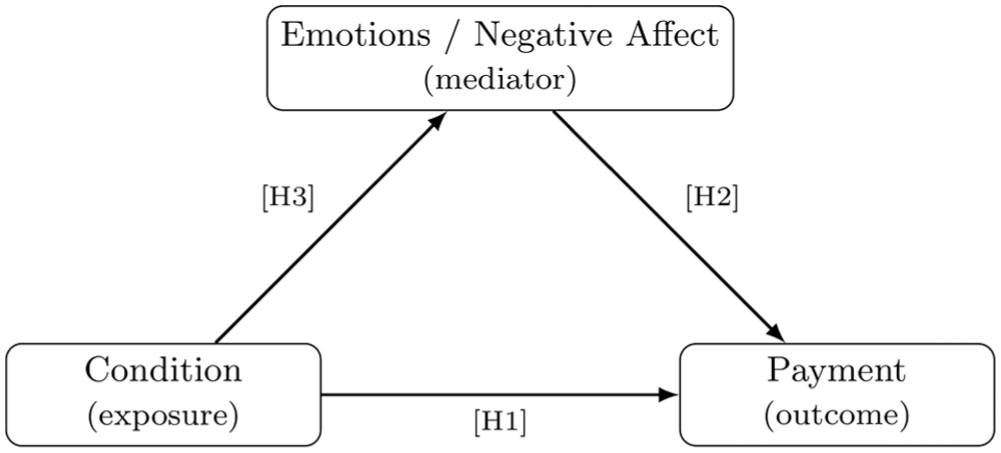
Mediation model (
Because the discrete emotions in this study (Fear, Anger, Shame, and Guilt) were moderately inter-correlated and conceptually overlapping, estimating emotion specific indirect effects within a single simultaneous multiple-mediator model would require strong assumptions about the independence and causal ordering of the mediators that are difficult to justify in this setting (VanderWeele, 2015). We therefore adopted two complementary strategies:
All mediation models were estimated in R using the mediation package with 5,000 nonparametric bootstrap replications to obtain percentile-based confidence intervals (Imai et al., 2010; VanderWeele, 2015). For Strategy 1, we fit a linear mediator model and a logistic (logit) outcome model for payment; ACME and ADE were computed by mediate() from simulated counterfactual predictions with nonparametric bootstrap confidence intervals. For Strategy 2, we estimated the same mediator model but used a probit-linked outcome model so that the package’s sensitivity analysis procedure (medsens) could be applied (it is only implemented for probit outcome models); results were substantively similar under a logit link (see Supplemental Materials A.5). Covariates were included to improve precision and to reduce the plausibility of mediator–outcome confounding, though unmeasured confounding cannot be ruled out.
Estimation of the parallel mediation specification combines Equations 3 to 6 with the following outcome model:

Estimation of the Negative Affect specification combines Equation 7 with:

Within the potential outcomes mediation framework, the total effect of condition j ∈ {1, 2} on payment can be decomposed into an estimated indirect component through mediator E ∈ {F, A, S, G, N} (reported by the package as ACME) and an estimated direct component not operating through that mediator (reported as ADE). In nonlinear models, these effects are computed from counterfactual predictions rather than as simple products of coefficients. We therefore report ACME and ADE as the package-defined average indirect and direct effects, along with bootstrap confidence intervals. Note. We report ACME and ADE using the conventional terminology of the mediation package. ACME is interpreted here as an estimate of the average indirect effect (indirect component) and ADE as the average direct effect, conditional on standard mediation identification assumptions.
We also conducted sensitivity analyses (via medsens) to quantify how strong residual mediator–outcome confounding would need to be to attenuate the estimated indirect effect to zero, reporting the implied ρ (residual correlation) and associated R² benchmarks.
To verify that the study was adequately powered to detect indirect effects, an a priori power analysis was conducted using the approach outlined by Qin (2024). Full details of assumptions, parameters, and results are provided in Supplemental Materials A.1.
Robustness Checks and Sensitivity Analyses
All robustness and sensitivity procedures were preregistered. The analytic sample excludes participants who did not provide consent or who failed the preregistered attention check. Other potential data quality indicators, such as speeding, straight-lining, and comprehension check failure, were treated as flags and retained in the primary analyses; robustness models were re-estimated by (i) adding these indicators as covariates and/or (ii) excluding flagged cases.
We assessed robustness to alternative emotion scoring by re-estimating models using (1) item-level emotion ratings (0–100; standardized) and (2) a latent single-factor Negative Affect score estimated via CFA (WLSMV), with empirical Bayes factor scores used in regressions. To evaluate potential satisficing, we flagged respondents in the fastest 5% of completion times (completion time ≤5th percentile) and re-estimated models including this indicator and excluding fast responders. We also examined sensitivity to comprehension by re-estimating models with a binary indicator for comprehension check failure and by excluding comprehension failures.
Results
Descriptive Statistics
The final analytic sample comprised 2,085 U.S.-based participants, approximately evenly distributed across the three experimental conditions. The average age was 47 years (SD = 18), with respondents ranging from 18 to over 90. Gender representation was balanced, with 49% identifying as male and 51% as female; a small proportion (0.5%) identified as non-binary or another gender. The majority of participants identified as White (69%), followed by Black or African American (15%), and smaller proportions identifying as Asian, American Indian/Alaska Native, or other racial groups. Respondents were geographically diverse. Figure 2 shows the geographic distribution of participants across the United States.

Map of participants’ locations.
In terms of education, 28% had completed high school, 19% had some college education, and 15% held a 4-year degree. A further 16% held professional or doctoral-level qualifications. Annual household income was varied, with 22% earning less than $25,000, and 23% earning between $25,000 and $49,999. About 9% reported incomes above $150,000. Across all demographic categories (with the exception of age, gender and location, which were compulsory and do not have any missing data), rates of missing or unreported data were low (approximately 8%–9%). Table 11, which contains descriptive statistics for socio-demographic characteristics of the sample, including means (SD) and ranges for continuous variables, and counts and percentages for categorical variables, including overall and stratified by condition, is provided in the Supplemental Materials A.4.
In Table 1, we report pairwise Pearson correlations among continuous variables (lower triangle; stars indicate statistical significance). The four discrete emotions were moderately to strongly inter-correlated (|r| = .39–.77), with the largest association between Shame and Guilt (r = .77, p < .001). Age showed small-to-moderate negative correlations with Fear, Shame, Guilt, and GAD-7 (up to r = −.38, p < .001), indicating that younger participants tended to report higher negative affect and anxiety symptoms. Training types was positively related to emotions and GAD-7 (r = .08–.32, p < .001), and Cybersecurity efficacy displayed uniformly small correlations with other constructs (|r| ≤ .16). Risk tolerance exhibited weak associations overall (|r| ≤ .15). Overall, coefficients were modest in magnitude aside from the inter-emotion correlations, suggesting limited risk of extreme multicollinearity beyond the emotion cluster.
Correlation Matrix (Pearson r).
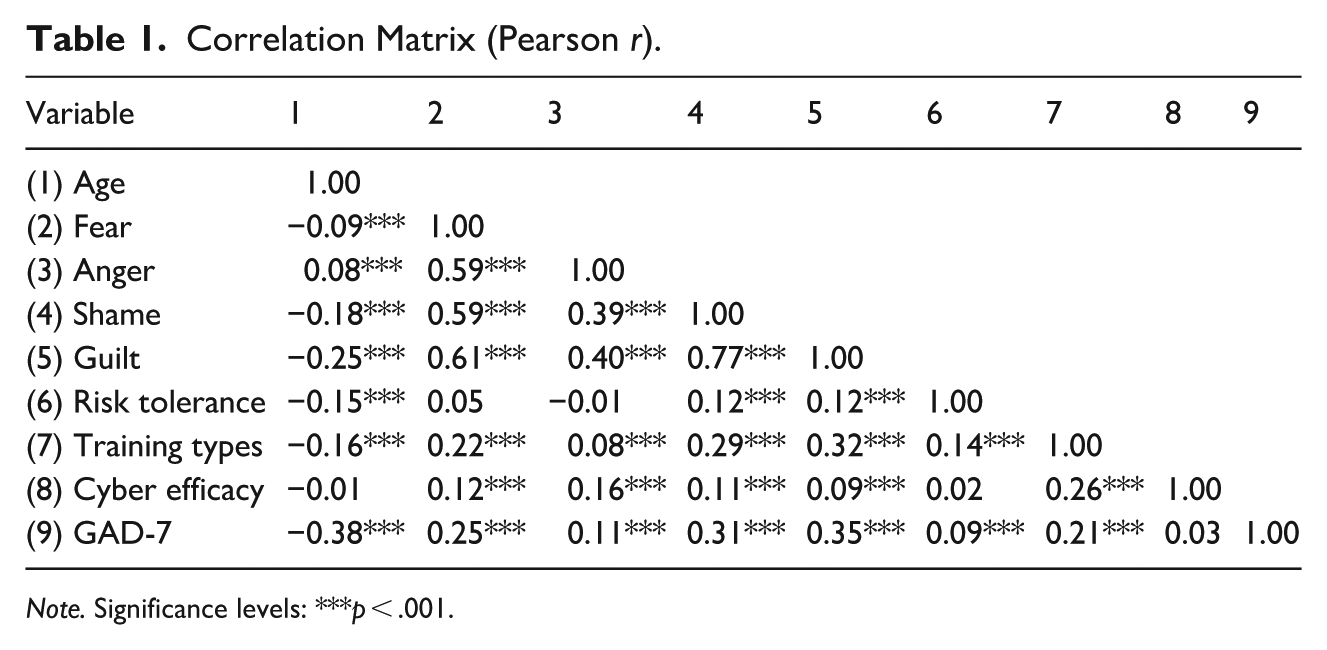
Note. Significance levels: ***p < .001.
The proportion of participants who chose to pay the ransom varied by condition: 45.7% in the Neutral scenario (Condition 0), 36.4% in the Locked Files scenario (Condition 1), and 37.7% in the Stolen Files scenario (Condition 2).
Hypotheses Testing Results
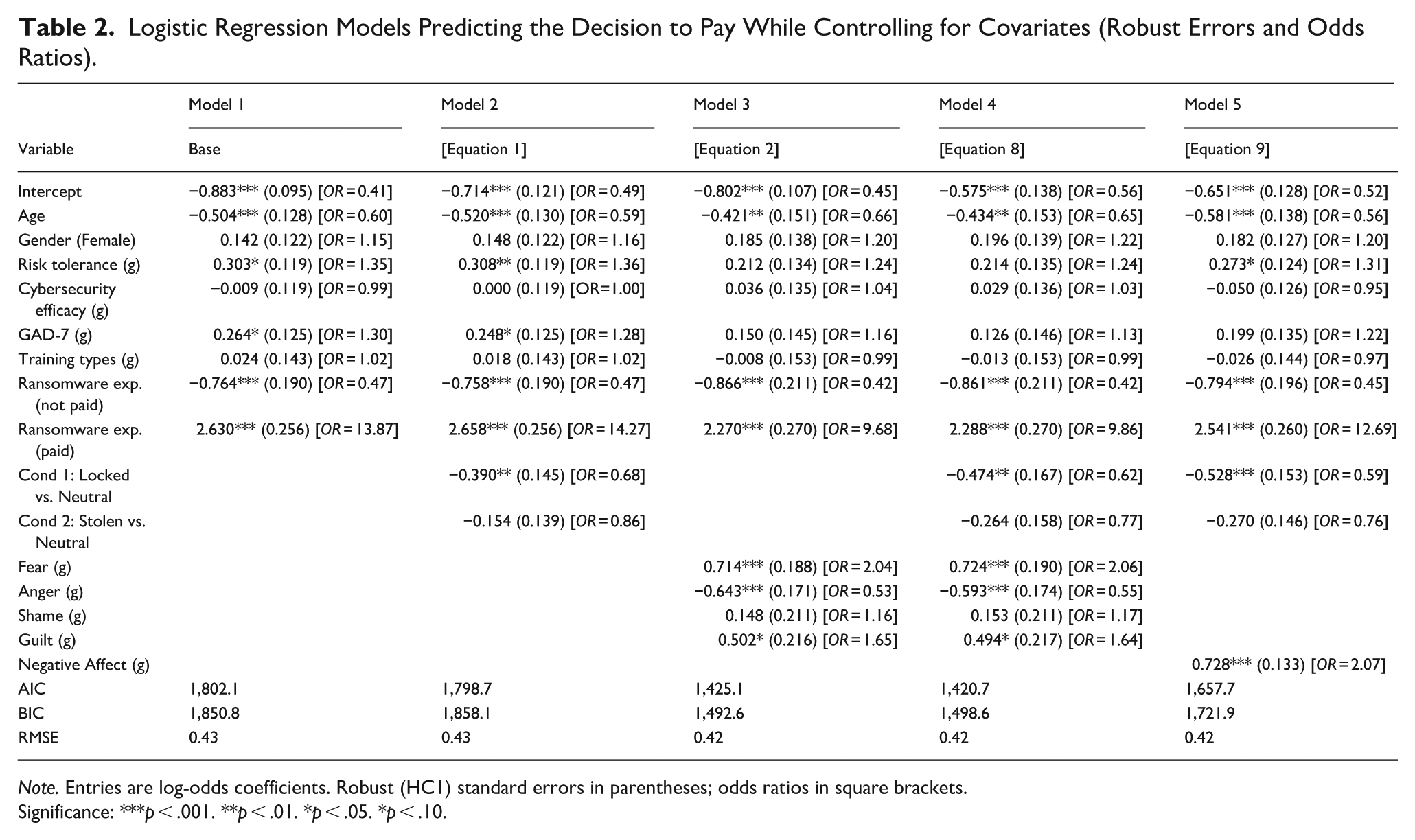
Table 2 reports logistic regression models predicting the decision to pay. Entries are un-exponentiated log-odds coefficients (β) with robust (HC1) standard errors in parentheses, and odds ratios are reported in square brackets. Odds ratios are obtained by exponentiating the corresponding log-odds estimates (OR = eβ ) and can be interpreted as multiplicative differences in the odds of paying associated with a one-unit increase in the predictor (here, a two standard-deviation change for g-standardized variables). Model 1 includes covariates only. Model 2 adds the experimental condition contrasts to test
Logistic Regression Models Predicting the Decision to Pay While Controlling for Covariates (Robust Errors and Odds Ratios).
Note. Entries are log-odds coefficients. Robust (HC1) standard errors in parentheses; odds ratios in square brackets.
Significance: ***p < .001. **p < .01. *p < .05. *p < .10.
H1: The Effect of the Ransomware Note Condition on the Payment Decision
As shown in Table 2 (Model 2), participants exposed to the Locked Files note had about 32% lower odds of paying than those in the neutral condition (OR = 0.68, p < .01), whereas the Stolen Files note was associated with only a small (about 14%) and statistically non-significant reduction in payment odds (OR = 0.86; p = .27). Taken together, these results support
H2: Emotions and the Payment Decision
Model 3 (Table 2) indicates that emotions are strongly associated with the decision to pay. Higher Fear and Guilt were associated with higher odds of payment (Fear: OR = 2.04, p < .001; Guilt: OR = 1.65, p < .05), whereas higher Anger was associated with substantially lower odds of payment (OR = 0.53, p < .001). Shame was not statistically distinguishable from zero (p = .48). Consistent with these patterns, model fit was better in specifications that included emotion measures than in the covariate only model (Table 2).
Model 4 includes both the condition contrasts and the discrete emotions. The Locked Files condition remained a significant negative predictor of payment (OR = 0.62, p < .01), while the Stolen Files contrast remained negative but was weaker and not statistically significant at conventional levels (OR = 0.77, p = .10). The emotion associations were stable: Fear and Guilt remained positive, Anger remained negative, and Shame remained non-significant (Table 2). Model 4 provided the best overall fit among these specifications.
Model 5 replaces the four discrete emotions with the Negative Affect composite. Negative Affect was positively associated with payment (OR = 2.07, p < .001), but this composite specification fit worse than the discrete-emotion model. This pattern suggests that retaining emotion-specific information (particularly Anger) better accounts for heterogeneity in payment decisions.
H3: The Effect of the Ransomware Note Condition on Emotions
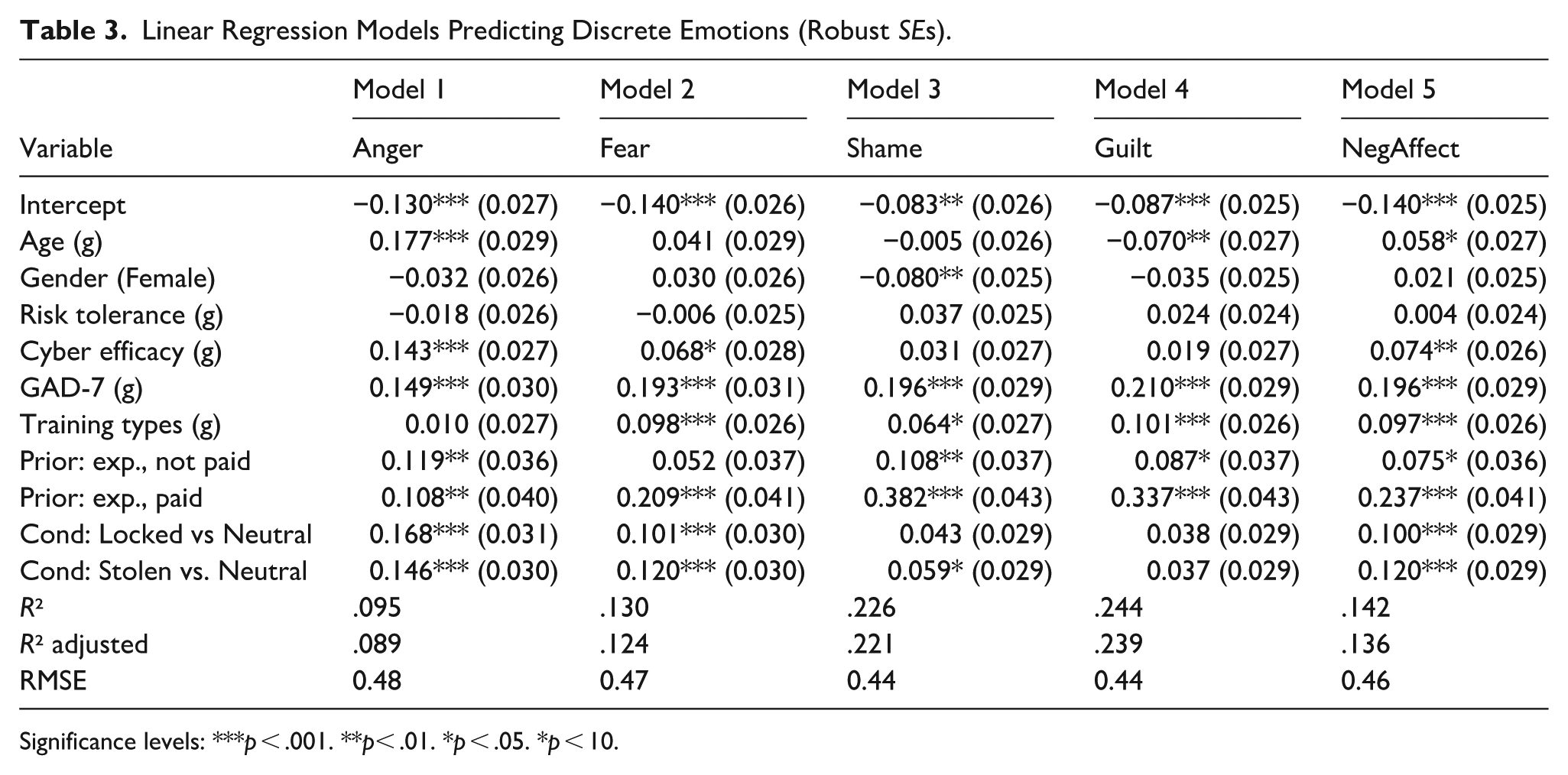
As shown in Table 3, both ransomware notes increased negative emotional responses relative to the Neutral condition, consistent with
Linear Regression Models Predicting Discrete Emotions (Robust SEs).
Significance levels: ***p < .001. **p< .01. *p < .05. *p < 10.
When emotions were summarized as a composite Negative Affect factor score (Model 5), both ransomware notes again produced significant increases relative to Neutral, indicating a general elevation in negative affect in response to ransomware threats. Figure 3 visualizes these patterns using both unadjusted means and covariate-adjusted marginal means; adjustment for demographics, psychological covariates, training, and prior ransomware exposure did not substantively alter the condition differences.

Emotions by condition (model-adjusted and unadjusted means ± 95% CIs).
H4: Mediation Results
We estimated mediation models to decompose differences in payment across note conditions into indirect components through emotions and residual direct components (reported as ACME/ADE; see
Parallel Mediation Through Discrete Emotions
Table 4 reports mediator-specific indirect and direct components for each discrete emotion (Fear, Anger, Shame, and Guilt). Each model treats one emotion as the focal mediator while adjusting for the other three emotions in the outcome model to partial out shared variance. For interpretability, effects are presented on the probability scale as percentage-point (pp) changes in the probability of paying (see Methods for full estimation details).
Parallel Mediation by Discrete Emotions.

Note. Values are percentage points (pp) with 95% CIs in brackets. Prop. med. = /Total, reported as %; negative values indicate suppression (the indirect path offsets the direct effect). ACME = average indirect effect; ADE = average direct effect; Total = ACME + ADE.
Across the parallel models, the Locked Files note had a consistently negative and statistically significant total effect on payment, corresponding to an approximately 8.8 to 10.8 percentage-point (pp) lower probability of paying (all p ≤ .004). The only robust estimated indirect effect was through Anger: ACMEAnger = −2.0 pp with a 95% CI [−3.3, −0.9] (p < .001). In magnitude, this corresponds to about 18.4% of the total reduction in payment probability. Estimated indirect effects through Fear, Shame, and Guilt were close to zero, with confidence intervals including zero. The direct effect (ADE), conditional on the four emotions, remained sizeable and negative across specifications (approximately −8.9 to −9.0 pp; all p ≤ .005), suggesting that most of the total effect is not accounted for by the measured emotions in these models.
A similar pattern was observed for the Stolen Files note. Across the parallel models, the total effect remained negative and statistically significant, corresponding to an approximately 7.5 to 9.3 pp reduction in payment probability (p = .001–.013). Again, Anger showed the clearest estimated indirect effect: ACMEAnger = −1.5 pp with 95% CI [−2.6, −0.6] (p < .001), accounting for about 16.1% of the total reduction. The Guilt pathway was small and borderline (ACME = −0.8 pp; p = .065). Direct effects (ADEs) were consistently negative and substantially larger than the indirect effects (approximately −7.9 to −8.0 pp; all p ≤ .011).
Overall, both ransomware notes (Locked Files and Stolen Files) reduced the probability of payment by roughly 8 to 11 pp. A modest share of this difference is captured by the estimated indirect effect through Anger (about 16%–18%) in these parallel models, whereas Fear, Shame, and Guilt contribute little. In absolute terms, the emotion-specific indirect effects are small (approximately 0–2 pp), while the remaining direct effects are sizeable (approximately 8 pp), indicating that much of the total effect is not explained by the measured emotions in this specification.
Mediation Through Negative Affect
Table 5 reports a mediation model using Negative Affect (a latent composite of Fear, Anger, Shame, and Guilt) as the mediator. The model adjusts for pre-specified covariates (age, gender, risk tolerance, trait anxiety [GAD-7], cybersecurity efficacy, and training exposure). Indirect and direct components are interpreted as model-based decompositions and discussed cautiously given that emotions were self-reported and not experimentally manipulated (see Section
Mediation Model of Ransomware Note Conditions on Payment Decision via Negative Affect.

Note. Models control for age, gender, trait anxiety (GAD-7 latent), baseline risk tolerance, cybersecurity training exposure, and cybersecurity efficacy. Effects estimated using 5,000 nonparametric bootstrap replications with probit link. Proportion mediated is reported for completeness but can be unstable in nonlinear mediation models (e.g., probit), particularly when direct and indirect effects operate in opposing directions; we therefore interpret this quantity descriptively. ACME = average indirect effect; ADE = average direct effect.
Significance levels: ***p < .001. **p < .01. *p < .05. *p < .10.
For the comparison between the Locked Files condition and the Neutral condition, the indirect effect via Negative Affect was statistically significant (ACMEavg = 0.019, 95% CI [0.009, 0.030], p = .0004). In practical terms, this corresponds to an increase of roughly two percentage points in the predicted probability of payment captured by the affective pathway. The direct effect remained negative and significant (ADEavg = −0.091, 95% CI [−0.145, −0.037], p = .001), indicating that – net of Negative Affect – the Locked Files note reduced the payment likelihood. The total effect was also negative (Total = −0.072, 95% CI [−0.125, −0.017], p = .001).
A similar pattern emerged for the Stolen Files condition relative to Neutral. The indirect effect via Negative Affect was again positive and significant (ACMEavg = 0.020, 95% CI [0.009, 0.030], p < .0001), again implying an approximately two percentage-point increase in predicted payment probability through Negative Affect. The direct effect was negative (ADEavg = −0.072, 95% CI [−0.127, −0.020], p = .010), while the total effect was smaller and marginal (Total = −0.052, 95% CI [−0.108, 0.000], p = .058), consistent with offsetting pathways.
Robustness Checks
We re-estimated the full logistic regression models adding indicators for (i) participants in the fastest 5% of completion times and (ii) participants who failed the preregistered comprehension check, entered separately and jointly. Across specifications, effect sizes and statistical inferences for the experimental condition, Fear, Anger, Guilt, and prior ransomware experience were essentially unchanged (see Supplemental Materials). Comprehension check failure was not meaningfully associated with payment behavior, and its inclusion did not materially affect other coefficients. Fast responders were substantially more likely to recommend payment (OR = 11), but adjusting for this indicator did not alter the key predictors, suggesting that speeding/satisficing is unlikely to account for the main results. Cybersecurity training remained non-significant in all robustness models. Overall, the primary findings appear robust to these alternative specifications and exclusion-related concerns.
Discussion
This pre-registered vignette experiment examined whether ransomware note content affects willingness to pay, whether it alters emotional responses, and whether those emotions help explain payment decisions. Several clear patterns emerged. Relative to a neutral policy frame, both ransomware notes reduced the probability of payment, with the Locked Files condition producing the clearest reduction (
A notable pattern observed in this study is that respondents in the Neutral condition were more likely to recommend payment than respondents exposed to the ransomware threat notes. This should not be interpreted as “no-risk baseline” behavior. Rather, the Neutral condition captures an abstract normative policy judgment about whether an organization should pay to maintain continuity, made without confronting an offender’s demands. By contrast, the Locked Files and Stolen Files notes make the coercive exchange salient and may trigger reactance, moral resistance to rewarding extortion, and/or skepticism about whether attackers will follow through or whether payment will resolve the problem. On this interpretation, ransomware messages can reduce stated willingness to pay even while increasing negative emotion, because the framing shifts respondents from policy pragmatism to a more morally and strategically contested decision context.
One motivation of this study was to compare encryption leverage with data theft leverage. The observed behavioral differences between the Locked Files and Stolen Files notes were modest. Several explanations are consistent with this pattern. First, the two leverage types may activate partially offsetting psychological pathways. In our data, the threat notes reliably elevated negative affect (and discrete emotions), but anger was associated with reduced willingness to pay while fear was associated with increased willingness to pay. If stolen-data threats heighten negative affect while simultaneously triggering anger-based resistance or moral opposition, net differences in payment can be dampened even when emotional intensity increases. Second, the hospital scenario may foreground service continuity and time-critical disruption, rendering encryption-based harm more salient than downstream privacy or reputational harms in the moment of decision. These interpretations suggest clear boundary conditions for future work: manipulating proof-of-exfiltration, time horizon (immediate disruption vs. delayed exposure), and regulatory framing (e.g., breach notification and penalties) should help identify when data-theft leverage meaningfully exceeds encryption leverage.
A key finding in this study is that emotions are related to ransomware responses in two ways: they are directly associated with payment decisions, and they capture a small, mediated component of the experimental note effect in the mediation models (under standard identification assumptions). Consistent with
At the same time, the mediation models (
The results also suggest that ransomware scenarios elicit multiple emotions at once, rather than a single dominant feeling. Fear and Anger were prominent, but many participants also reported Guilt and Shame. This supports a view of ransomware decision-making as affectively complex: fear may pull toward compliance, anger toward resistance, and self-conscious emotions may activate additional moral or reputational concerns. The co-occurrence of emotions may also help explain why aggregate mediation is modest: different emotions can push behavior in competing directions within the same decision episode.
In addition to note content and emotions, several individual difference variables were associated with payment decisions. Prior experience with ransomware emerged as one of the strongest predictors. Participants who had previously paid a ransom were dramatically more likely to recommend paying again (approximately 10 to 14 times more likely than those with no prior experience; β = 2.27–2.66, OR = 9.7–14.3), whereas those who had experienced ransomware but refused to pay were substantially less likely to endorse payment (β = −.76 to −.87, OR = 0.42–0.47). Several psychological covariates also showed meaningful associations, including trait anxiety and risk tolerance. By contrast, the number of cybersecurity training types completed showed no measurable effect on payment behavior (β = −.01 to .02, OR = 0.97–1.02), suggesting that existing training, at least as captured by training exposure counts, may be insufficient to shift high-stakes decision-making under coercion.
Finally, while the mediation models indicate that only a small proportion of the treatment effect is captured by self-reported emotional responses, this likely underestimates the role of affect in real-world incidents. Survey vignettes cannot fully reproduce the intensity, uncertainty, and consequences of a live ransomware attack. The emotional reactions measured here may therefore represent a conservative lower bound. In field settings, where patient safety, livelihoods, reputations, or sensitive data are at stake, emotions such as fear, panic, guilt, and outrage may be stronger and more consequential for decision-making.
Theoretical Implications
Our findings contribute to and complicate existing theories of affective decision-making in high-stakes cybercrime contexts. Drawing on work in risk-as-feelings theory (Loewenstein et al., 2001), we expected that emotional responses to ransomware would play a central role in the decision to pay or not to pay a ransom. Our results support this general expectation, but also reveal a more complex picture.
Importantly, the results suggest that ransomware notes are not merely informational cues about “risk”; they function as designed communications that can activate different appraisal structures depending on the leverage being signaled (encryption-based disruption vs. threatened dissemination of stolen data). In this sense, the study extends risk-as-feelings to a distinctive class of decisions in which offenders strategically engineer the emotional environment of choice.
Our findings suggest that victims of ransomware attacks experience mixed emotions that push in competing directions: fear, guilt, and shame were positively associated with the likelihood of paying, while anger significantly reduced the odds of payment. This pattern underscores the value of conceptual precision about emotion function. Fear and anger plausibly reflect external threat appraisal, whereas guilt and shame reflect moral self-assessment; these pathways need not operate as interchangeable indicators of a single negative state.
Yet, even after accounting for these affective influences, a substantial proportion of the treatment effect remained unexplained. Rather than undermining the affective account, this points to bounded scope conditions: emotional reactions appear to shape ransomware payment decisions alongside normative, strategic, and institutional considerations that extend beyond affect alone. This supports dual-process theories that treat emotional and deliberative reasoning as interacting, rather than competing, systems (Kahneman, 2011; Loewenstein et al., 2001). It also echoes findings in crisis decision-making research, where emotions such as fear and guilt sharpen attention to consequences but do not deterministically drive compliance (Gross & Thompson, 2007).
Implications for Policy and Practice
Our findings have direct implications for the ransomware incident response guidance issued by national cybersecurity agencies (e.g., CISA 1 , NCSC, and ENISA 2 ) and law-enforcement bodies. Ransomware is, at its core, a form of online financial crime: it is extortion conducted through digital infrastructure, with cryptocurrency payments flowing through transnational networks that also facilitate fraud, money laundering, and other financially motivated cybercrimes. Understanding the emotional dynamics that drive victim compliance is therefore relevant not only to cybersecurity policy but also to the broader effort to reduce the profitability of online financial crime and to develop evidence-informed responses across law enforcement, regulatory, and victim-support domains.
Current advisories typically focus on technical containment, that is, isolating affected systems, preserving forensic evidence, and notifying authorities. They also offer only generic counsel against payment. Our findings suggest that these guidelines should explicitly acknowledge the emotional pressures that victims face during the extortion phase, particularly the fear that drives compliance and the anger that may support resistance. Ransomware incident response guidelines could incorporate structured “emotional preparedness” checklists: for example, reminding decision-makers that ransomware notes are deliberately crafted to provoke panic, that fear-driven decisions tend to overestimate the probability of catastrophic data loss, and that initial emotional reactions should be expected rather than treated as signs of personal failure.
Our data show that fear increases payment likelihood while anger decreases it, yet both are elevated by threat exposure, creating competing pressures within the same decision episode. Organizations can mitigate these dynamics by establishing clear decision-making frameworks in advance. This could be in the form of specifying payment-authorization authority, requiring a mandatory deliberation period before payment, as well as mandating consultation with legal counsel, cyber-insurance providers, and law enforcement. The strong association between prior payment and willingness to pay again (OR = 10–14) further underscores the need for institutional safeguards: without structural checks, an initial payment may create a behavioral precedent predisposing the organization toward future compliance.
Relatedly, our results inform communication strategies during ransomware events. Communications that reduce uncertainty and enhance perceived control, such as by outlining clear recovery timelines and decision-making processes, may help mitigate fear-driven compliance and avoid triggering counterproductive anger. The finding that anger was the only emotion with a robust mediated effect on payment, accounting for approximately 16% to 18% of the total treatment effect, underscores how incident communications can materially influence outcomes. Internal communications should provide factual, measured updates that reduce uncertainty and, therefore, fear, without employing language that amplifies anger toward the attacker, which may impede clear-headed deliberation despite its association with resistance. External communications from cybersecurity agencies should similarly avoid framing that heightens shame or guilt (e.g., implying victim fault), as these self-conscious emotions, though less influential individually, contribute to elevated negative affect positively associated with payment.
These communication principles extend directly to law-enforcement practice. Police and federal agencies are often among the first points of contact for ransomware victims, yet officers and agents may receive limited guidance on how emotional states shape victim cooperation and decision-making during active extortion. Our findings suggest that law-enforcement personnel involved in ransomware response, including cyber-crime units, victim liaison officers, and ransom negotiation teams, could benefit from training in emotionally informed communication. Specifically, understanding that fear drives compliance while anger promotes resistance can help investigators calibrate how they advise victims: messaging that reduces panic and restores a sense of agency may support more deliberate decision-making and increase willingness to engage with law enforcement rather than pay covertly. Furthermore, awareness that shame and guilt discourage help-seeking implies that law-enforcement outreach should actively reduce stigma around reporting ransomware incidents, which remains a significant barrier to accurate intelligence on the scale and financial impact of these crimes.
Further, the findings have implications for public awareness campaigns and cybersecurity education. Our observation that the number of cybersecurity training types completed showed no measurable effect on payment behavior (β = −.01 to .02, OR = 0.97–1.02) is notable and suggests that existing training programs, which are typically focused on threat recognition and technical hygiene, may be insufficient to prepare individuals for the psychological realities of a live extortion event. The observed associations between prior ransomware experience, training, and payment decisions imply that some individuals or roles may be predisposed toward payment due to situational pressures rather than learned best practices. This highlights the importance of distinguishing between the effects of exposure and the actual impact of training. Evaluating training programs in this context should consider not only technical outcomes but also their influence on decision-making legitimacy and governance under pressure. Training curricula should therefore incorporate scenario-based exercises simulating the emotional and time-pressured conditions of ransomware incidents, building not only technical response skills but also psychological resilience and structured decision-making habits. Tabletop exercises using realistic ransomware notes with explicit debriefing of participants’ emotional reactions could build affective awareness and reduce fear-driven decision-making. Public awareness campaigns could similarly move beyond purely technical messaging to address how to recognize and manage emotional manipulation during cyber extortion. Importantly, these recommendations are likely to generalize beyond ransomware to other forms of online financial crime that rely on emotional manipulation, including romance fraud, business email compromise, and sextortion, where victim compliance is similarly shaped by anger, fear, shame, and guilt. Developing emotionally informed training and awareness programs thus represents a cross-cutting investment in victim protection.
Finally, regulators considering mandatory reporting, payment bans, or safe-harbor provisions should account for the emotional dynamics of victim decision-making documented here. Blanket payment prohibitions without adequate support infrastructure, such as rapid-response teams, technical recovery assistance, and psychological support, may redirect emotional distress rather than resolve it. Conversely, structured support pathways, including incident-response coordinators trained in crisis communication and emotional de-escalation, could reduce fear-driven compliance that undermines broader anti-ransomware efforts. Notably, both ransomware notes reduced stated willingness to pay relative to the neutral policy frame, suggesting that coercive demands activate resistance alongside distress, and that well-designed support interventions during the extortion window could further reinforce victims’ capacity to refuse payment.
Limitations
The findings should be interpreted with several constraints in mind. The mediation analyses are grounded in the potential outcomes framework and avoid conditioning on post-treatment covariates, but they still rely on the assumption of sequential ignorability – that no unmeasured factors jointly influence emotional responses and the payment decision (Imai et al., 2010). While this assumption cannot be directly tested, the design incorporates baseline measures of trait anxiety (GAD-7) and general risk tolerance to account for stable predispositions toward emotional reactivity and risk-based decision-making. Even so, additional unmeasured influences may remain, and sensitivity analyses indicate that modest violations of ignorability could attenuate some weaker indirect paths, particularly those involving guilt and shame.
A further limitation is that emotions were measured immediately after exposure to the scenario and note. This timing is necessary to capture proximal affect, yet it cannot fully separate immediate emotional reactions from post hoc rationalization of the payment decision. Future research could strengthen temporal ordering by incorporating time-sensitive physiological or behavioral indicators (e.g., galvanic skin response and response latency) alongside self-reports.
The vignette-based experimental design involves a trade-off: random assignment yields strong internal validity and allows differences in stated payment intentions across conditions to be attributed to the note content, but the scenario necessarily simplifies the operational complexity and stakes of real ransomware incidents. Participants responded to a single, hypothetical scenario under constrained information, which may not reproduce the full intensity of affective and strategic pressures that arise during actual attacks. Relatedly, the outcome reflects self-reported intentions rather than observed behavior; although intentions are predictive, they may be influenced by hypothetical bias or social desirability in high-stakes moral contexts.
External validity is constrained primarily by the sampling frame and the nature of the outcome. The study draws on a general online panel of U.S. adults rather than verified ransomware victims, and the dependent measure therefore captures a hypothetical binary pay/not-pay intention under standardized exposure rather than behavior under real operational, financial, legal, and reputational pressures. Although prior ransomware exposure and the reported outcome of the most recent incident were measured, the number of respondents reporting payment is necessarily small in a general-population sample, limiting power for experience-stratified comparisons and constraining claims about confirmed victim–payers in particular. Robust external validation with verified victim–payers and refusers remains an important next step. However, scaling such work typically requires specialist recruitment pathways (e.g., incident-response or insurer partnerships and victim registries), reliable verification of incident and payment status, and heightened ethical safeguards, which were impractical within the scope of the current study.
Generalizability may also vary across institutional and regulatory contexts. The vignette was situated in a U.S. regional hospital, implying a specific organizational backdrop and decision environment. Payment decisions may differ across jurisdictions with different moral norms regarding payment, legal and regulatory expectations (e.g., reporting requirements, official guidance, and sanctions risk), and the availability of incident-response support and cyber insurance, as well as across victim types and organizational settings (e.g., individual victims and small firms) that face different resource constraints, operational dependencies, and response capacity. In addition, although the sample is demographically diverse, it may not reflect the experience, responsibility, or technical expertise typical of real-world incident responders. The results should therefore be interpreted as evidence about how note content shapes emotions and intended payment decisions in this controlled U.S.-hospital scenario, and the resulting estimates should be treated as U.S.-context parameters rather than assumed to generalize to jurisdictions with different cultural norms, institutional arrangements, or regulatory regimes. Future research should replicate the design cross-nationally and in country-comparative samples, and extend it across victim types and organizational contexts to assess the stability of these effects across environments.
Conclusion
Our study demonstrates that emotional reactions play an important, but previously under-acknowledged role in shaping victim behavior during ransomware incidents. While research and policy have traditionally emphasized technical defenses, and incident-response protocols (still central to ransomware response), our findings show that emotional reactions triggered by ransomware notes influence whether victims comply with extortion demands. Fear and anger, in particular, emerged as influential and divergent drivers of payment decisions, indicating that victims do not simply “calculate” their options but instead, their responses are shaped by negative affect.
These results have several implications for both theory and practice. Theoretically, they point to the need for cybercrime frameworks that move beyond rational-choice assumptions and explicitly incorporate affective mechanisms. Practically, our findings suggest that improving ransomware resilience will require more than technical target hardening. Organizational cybercrime response protocols must be designed with an understanding of how victims actually feel and think in the moment of attack.
Finally, our results open several avenues for future research. Experimental work could examine other emotional states (e.g., shame, disgust, and moral outrage), message features (tone, threats, length, and visual design), and organizational factors (team coordination and leadership response) that shape victims’ willingness to pay. Longitudinal studies could also trace how emotions evolve across the incident-response timeline – from initial discovery through negotiation and recovery. As ransomware attacks continue to escalate in frequency and sophistication, understanding the emotional architecture of victim decision-making will be increasingly important for developing human-centered approaches to cyber extortion.
Supplemental Material
sj-docx-1-cad-10.1177_00111287261440149 – Supplemental material for Ransomware, Emotions, and the Decision to Pay: Evidence From a Factorial Experiment
Supplemental material, sj-docx-1-cad-10.1177_00111287261440149 for Ransomware, Emotions, and the Decision to Pay: Evidence From a Factorial Experiment by Zarina Vakhitova and Claudio Mezzetti in Crime & Delinquency
Footnotes
Acknowledgements
This study was pre-registered on AsPredicted (protocol #246119). The experimental protocol received ethics approval from the Human Research Ethics Committee (HREC) of Monash University (Project ID 47500).

Ethical Considerations
This study received ethics approval from the Human Research Ethics Committee (HREC) of Monash University (Project ID 47500).
Consent to Participate
All participants provided informed consent prior to participation. Eligibility was limited to U.S. residents aged 18 years or older.
Funding
The authors disclosed receipt of the following financial support for the research, authorship, and/or publication of this article: Mezzetti gratefully acknowledges financial support from the Australian Research Council Grant DP190102904.
Declaration of Conflicting Interests
The authors declared no potential conflicts of interest with respect to the research, authorship, and/or publication of this article.
Data Availability Statement
The data and materials that support the findings of this study are available from the corresponding author* upon reasonable request.
Supplemental Material
Supplemental material for this article is available online.
Notes
Author Biographies
References
Supplementary Material
Please find the following supplemental material available below.
For Open Access articles published under a Creative Commons License, all supplemental material carries the same license as the article it is associated with.
For non-Open Access articles published, all supplemental material carries a non-exclusive license, and permission requests for re-use of supplemental material or any part of supplemental material shall be sent directly to the copyright owner as specified in the copyright notice associated with the article.
