




Abstract
Social psychological research has taught us a lot about why people protest. This article provides a theoretical and empirical overview. Discussed are grievances, efficacy, identification, emotions and social embeddedness, followed by the most recent approaches, which combine these concepts into dual pathway models. Finally, two future directions are discussed: (1) to shed light on the paradox of persistent participation, and (2) to clarify how perceptions of sociopolitical context affects protest participation.
Why do people protest? This question has always intrigued social scientists. Why are people prepared to sacrifice wealth, a pleasant and carefree life, or sometimes even their lives for a common cause? This question brings us to the level of analysis of the individual and therefore to the realm of social psychology. People – social psychologists never tire of asserting – live in a perceived world. They respond to the world as they perceive and interpret it. Indeed, this is what a social psychology of protest is about – trying to understand why people who are seemingly in the same situation respond so differently. As social psychology explores the causes of the thoughts, feelings and actions of people – and primarily how these are influenced by social contexts – it has a lot to offer to the study of protest participation. We illustrate this point with an overview of state-of-the-art theoretical approaches and a review of empirical evidence.
The question as to why people engage in protest has occupied social psychologists for at least three decades, and it has received diverging answers over the years (see Klandermans et al., 2008 for empirical evidence combining these explanations; Van Stekelenburg and Klandermans, 2007; 2010 for a theoretical overview; and Van Zomeren et al., 2008 for a meta-analytical overview). We will describe the main theoretical approaches and empirical evidence will be discussed. We close with a concluding section. In this section we will try to assess where we stand and propose future directions that theorizing and research might take.
Before we proceed to the social psychological answer as to why people protest, we devote a few words to protest behaviour itself. There is a vast array of specific protest behaviours that people might exhibit as a reaction to strongly felt grievances. Wright et al. (1990) have proposed a framework based on three distinctions: the first between inaction and action, the second between actions directed at improving one’s personal conditions (individual action) and actions directed at improving the conditions of one’s group (collective action). The third distinction is between actions that conform to the norms of the existing social system (normative action like petitioning and taking part in a demonstration) and those that violate existing social rules (non-normative action like illegal protests and civil disobedience). This distinction is important because one may expect that the motivational dynamics underlying the different protests are different. Indeed, the fact that someone is prepared to take part in street demonstrations does not automatically mean that he or she is inclined to use violence to reach their group’s goals?
Why people protest
Classical theories proposed that people participate in protest to express their grievances stemming from relative deprivation, frustration, or perceived injustice (Berkowitz, 1972; Gurr, 1970; Lind and Tyler, 1988). Scholars of social movements, however, began to question the effects of grievances on movement participation and proposed that the question to be answered is not so much whether people who engage in protest are aggrieved, but whether aggrieved people engage in protest. They suggested that efficacy, resources and opportunities would predict protest participation (Klandermans, 1984; McAdam, 1982; McCarthy and Zald, 1977). Meanwhile, scholars such as Reicher (1984), Simon et al. (1998) and Klandermans and de Weerd (2000), began to explore the role of collective identity in protest behaviour. Recently, the role of emotions has drawn the attention of protest researchers (Van Zomeren et al., 2004). In our work on migrants’ protest participation we integrated these elements into a single theoretical framework, and we proposed a fifth element to consider – social embeddedness (Klandermans et al., 2008). Discussions about politics within networks increase efficacy and transform individual grievances into shared grievances and group-based anger, which translates into protest participation.
Grievances
Grievance theories
Prominent among grievance theories was relative deprivation theory. Feelings of relative deprivation result from comparison of one’s situation with a standard – be it one’s past, someone else’s situation, or a cognitive standard such as equity or justice (Folger, 1986). If comparison results in the conclusion that one is not receiving what one deserves, one experiences relative deprivation. Runciman (1966) referred to relative deprivation based on personal comparisons as egoistic deprivation, and to relative deprivation based on group comparisons as fraternalistic deprivation. Research suggests that fraternalistic deprivation is particularly important for engagement in protest (Dubé and Guimond, 1986; Guimond and Dubé-Simard, 1983; Major, 1994; Martin, 1986). Foster and Matheson (1999), however, showed that the relation is more complex. They demonstrate that when the group’s experience becomes relevant for one’s own experience – i.e. when the personal becomes political – motivation to protest increases. People who experience both personal deprivation and group deprivation are the most strongly motivated to take to the streets. On the basis of a meta-analysis, Van Zomeren et al. (2008) conclude that the cognitive component of relative deprivation (as reflected in the observation that one receives less than the standard of comparison) has less influence on action participation than the affective component (as expressed by such feelings as dissatisfaction, indignation and discontent about these outcomes).
Next to relative deprivation, social psychologists have applied social justice theory to theorize on grievances and protest (Tyler and Smith, 1998). Social justice literature distinguishes between two classes of justice judgements: distributive and procedural justice. Distributive justice is similar to relative deprivation; it refers to the fairness of outcomes. Procedural justice refers to the fairness of decision-making procedures and the relational aspects of the social process (being treated with respect, dignity, etc.; Tyler and Smith, 1998). People care more about how they are treated than about outcomes – do authorities treat them with respect, can authorities be trusted to do well by their people? On the basis of these findings Tyler and Smith proposed that procedural justice might be a more powerful predictor of social movement participation than distributive justice, although they never tested this idea directly (but see Blader, 2007, for a test in the context of labour union participation).
Grievances and protest
At the heart of every protest are grievances, be they the experience of illegitimate inequality, feelings of relative deprivation, feelings of injustice, moral indignation about some state of affairs, or a suddenly imposed grievance (Klandermans, 1997). Illegitimate inequality is what relative deprivation and social justice theories are about. Suddenly imposed grievances refer to an unexpected threat or inroad upon people’s rights or circumstances (Walsh, 1981). Grievances resulting from violated principles refer to moral outrage because it is felt that important values or principles are violated. In more general terms, intergroup conflicts can be framed as conflicts about principles or conflicts around material interests (Van Stekelenburg and Klandermans, 2009). This distinction is important in the context of protest, because in a conflict of interests people are more inclined to take an instrumental route to protest to enforce changes, whereas a conflict of principles more likely leads to protests in which people express their views and indignation (Van Stekelenburg et al., 2009).
Efficacy
Grievance theories came under attack in the 1970s by scholars arguing that grievances do not provide a sufficient reason to participate in protest. Indeed, grievances abound while protest does not. Therefore, they continue, the key question to address is: why do some aggrieved people become mobilized, while others do not? Availability of resources (McCarthy and Zald, 1977) and the presence of political opportunities (McAdam, 1982) were suggested as key to protest mobilization. Groups with more resources and opportunities are more likely to mobilize. The social psychological answer to the question as to why some people become mobilized, while others do not is efficacy. Do people expect that group-related problems can be solved by united efforts? Do people feel politically efficacious, do they trust their politicians, or are they cynical about politics?
Efficacy – theory
Efficacy refers to the individual’s expectation that it is possible to alter conditions or policies through protest (Gamson, 1992). This echoes certain properties of the classic sociological construct of agency, which similarly refers to beliefs that individual actions have the potential to shape, and thus change, the social structure. For the perception of the possibility of change to take hold people need to perceive the group to be able to unite and fight for the issue and they must perceive the political context as receptive to the claims made by their group. The first refers to group efficacy: the belief that group-related problems can be solved by collective efforts (Bandura, 1997), and the second refers to political efficacy: the feeling that political actions can have an impact on the political process (Campbell et al., 1954). Political efficacy is conceptualized as having two dimensions: internal efficacy – the extent to which someone believes to understand politics and therefore participates in politics; and external efficacy – citizens’ faith and trust in government. Related to political efficacy is political cynicism – defined as the opposite of political efficacy and inversely related to trust in government (e.g. Cappella and Jamieson, 1997).
Efficacy and protest
Several studies have shown that feelings of efficacy are highly correlated with participation in protest and also meta-analytically this relation proved to be important (Van Zomeren et al., 2008). Mummendey et al. (1999) propose that group – rather than personal – efficacy predicts protest participation. Furthermore, Klandermans (1984, 1997) shows that people are more likely to participate in movement activities when they believe this will help to redress their grievances at affordable costs. The relationship is straightforward: the more effective an individual believes protest participation is, the more likely she or he is to participate. Efficacious and inefficacious people take different routes to social change though: while normative forms of protest like petitioning and demonstrations tend to attract highly efficacious people, non-normative forms of protest are more likely to attract low efficacious people (Tausch et al., 2008). Cynicism, finally, works to both reduce and reinforce action participation depending on whether it goes together with perceived unfairness (Klandermans et al., 2008). The least active are those who combine political cynicism with the feeling that they are treated fairly; the most active are those who combine cynicism with the feeling that they are treated unfairly.
Identity
In the 1980s it became clear that instrumental reasoning is not a sufficient reason to participate in protest. Increasingly, the significance of collective identity as a factor stimulating participation in protest was emphasized. Several empirical studies report consistently that the more people identify with a group the more they are inclined to protest on behalf of that group (de Weerd and Klandermans, 1999; Kelly and Breinlinger, 1995; Klandermans et al., 2002; Mummendey et al., 1999; Reicher, 1984; Simon and Klandermans, 2001; Simon et al., 1998; Stryker et al., 2000). Also meta-analytically this relation is confirmed (Van Zomeren et al., 2008).
Identity is our understanding of who we are and who other people are, and, reciprocally, other people’s understanding of themselves and others (Jenkins, 2004). Simon et al. (1998) succinctly describe identity as a place in society. A place is a metaphorical expression and stands for any position on any socially relevant dimension such as nationality, ethnicity, gender, age and so forth. A person has a personal and several social identities. Personal identity refers to self-definition in terms of personal attributes, whereas social identity refers to self-definition in terms of social category memberships (Tajfel and Turner, 1979). If a social identity becomes more salient than personal identity, people are inclined to define their personal self in terms of what makes them different from others, whereas they tend to define their social identities in terms of what makes them similar to others. The redefinition from an ‘I’ into a ‘we’ as a locus of self-definition makes people think, feel and act as members of their group and transforms individual into collective behaviour (Turner, 1999)
Social identity theory
In the 1970s, a social psychological identity perspective on protest emerged in the form of social identity theory (SIT; Tajfel and Turner 1979). Tajfel and Turner (1979) showed that social categorization according to some trivial criterion such as the ‘blue’ or the ‘red’ group suffices to make people feel, think and act as a group member. Compared to this ‘minimal group paradigm’, real world intergroup conflicts with histories, high emotional intensity attached to them and sociopolitical consequences can be seen as ‘maximal group paradigms’ that bring group membership powerfully to mind (Van Stekelenburg et al., 2010). SIT proposes that people generally strive for and benefit from positive social identities associated with their groups. The only way for participants in minimal group studies to obtain a positive social identity is by identifying with the groups into which they are categorized, and then ensuring that their group comes off best in the only available comparison between the groups (i.e. giving more rewards to the in-group than the out-group). Why, then, would people identify with groups that reflect negatively on them (e.g. disadvantaged or low-status groups)? SIT’s answer is that three social structural characteristics affect how people manage their identity concerns. The first social structural characteristic is permeability of the group boundaries, the possibilities perceived by the individual to attain membership of a higher status group. Permeable group boundaries allow disadvantaged group members to leave their group for a higher status group, whereas impermeable boundaries offer no such ‘exit’ (cf. Hirschman, 1970). When people do not perceive possibilities to join a higher status group, they might feel commitment to the lower status group. The second social structural characteristic is stability, the extent to which status positions are stable or variable. People who conceive status positions as variable see protest as a possible method to heighten group status, especially when the low group status is perceived as illegitimate. Members of a low-status group who perceive the dominant group’s position as illegitimate and unstable can use a variety of strategies to obtain a more positive social identity. They may, for instance, redefine characteristics of their own group previously seen as negative (Black is beautiful!); or they may engage in social competition of which protest is the clearest expression.
Protest of powerful vs powerless
Groups in conflict often differ in power and status, and changing status relations and their perceived legitimacy are crucial in understanding intergroup conflict. Traditionally, SIT studies have focused on low-status groups collectively challenging the actions of high-status groups. However, members of high-status groups may also challenge the authority in solidarity with members of low-status groups (Subasiç et al., 2008). At the core of this political solidarity is psychological change in the self-categorization of members of high-status groups through which it is no longer the authority but the minority that best embodies the relevant norms, values and beliefs that define who ‘we’ are and how ‘we’ should relate to each other. Through this process, high-status members embrace low-status members’ cause as their own and become willing to collectively challenge the authority. Moreover, members of high-status groups may perceive their own identity to be threatened too if they believe that their status is eroding or that low-status groups are becoming more powerful (Van Stekelenburg et al., 2010). For instance, whenever an ethnic threat arises – due to substantial immigration flows or economic contraction – majority groups react with exclusionary measures (Olzak and Koopmans, 2004). Interestingly, it is perceptions of competition rather than actual competition that evoke hostility to minorities (Sniderman et al., 2004).
Dual and multiple identities
Recent work on multiple identities (cf. Kurtz, 2002) emphasizes that people can hold many different identities at the same time, which may push in the same direction or may come into conflict. When two of the groups people identify with end up on opposite sides of a controversy (for example, union members who are faced with the decision to strike against their company), people might find themselves under cross-pressure (Oegema and Klandermans, 1994). Indeed, workers who go on strike or movement activists who challenge their government are often accused of being disloyal to the company or the country. González and Brown (2003) coined the term ‘dual identity’ to point to the concurrent workings of identities. These authors argue that identification with a subordinate entity (e.g. ethnic identity) does not necessarily exclude identification with a supraordinate entity (e.g. national identity). In fact, they hold that a ‘dual identity’ is the desirable configuration as it implies sufficient identification with one’s own group to experience some basic security and sufficient identification with the overarching identity to preclude divisiveness (see also Huo et al., 1996). There is evidence that immigrants who display a dual identity are more inclined to take onto the streets on behalf of their group (Simon and Ruhs, 2008). This is further specified by Klandermans et al. (2008), who report that immigrants who display a dual identification tend to be more satisfied with their situation than those who do not display such identity, but if they are dissatisfied they will be more likely to participate in protest.
Identification and protest
Why is group identification such a powerful motivational push to protest? First of all, identification with others is accompanied by an awareness of similarity and shared fate with those who belong to the same category. Furthermore, the ‘strength’ of an identity comes from its affective component (see Ellemers, 1993, for a similar argument); the more ‘the group is in me’ the more ‘I feel for us’ (Yzerbyt et al., 2003) and the stronger I am motivated to participate on behalf of the group. Collective identification, especially the more politicized form of it, intensifies feelings of efficacy (see Simon et al., 1998; Van Zomeren et al., 2008). Next to shared fate, shared emotions and enhanced efficaciousness, identification with others involved generates a felt inner obligation to behave as a ‘good’ group member (Stürmer and Simon, 2003). When self-definition changes from personal to social identity, the group norm of participation becomes salient; the more one identifies with the group, the more weight this group norm will carry and the more it will result in an ‘inner obligation’ to participate on behalf of the group. Together these dynamics explain why group identification functions as a ‘stepping stone’ to a politicized identity.
Politicized identity
Collective identities must politicize to become the engine of collective action. Typically, politicization of identities begins with the awareness of shared grievances. Next, an external enemy is blamed for the group’s predicament, and claims for compensation are levelled against this enemy. Unless appropriate compensation is granted, the power struggle continues. Politicization of identities and the underlying power struggle unfold as a sequence of politicizing events that gradually transforms the group’s relationship to its social environment, whereby the tactical choices are again shaped by identity (Polletta, 2009). Hence, workers strike and anarchists fight the police. If in the course of this struggle the group seeks to win the support of third parties such as more powerful authorities (e.g. the national government) or the general public, identities fully politicize (Simon and Klandermans, 2001). Langner (in prep.) developed a measure of politicized collective identity (PCI) to assess individual differences in the political meaning of an identity. The more politicized group members are the more likely they will engage in collective action directed at the government or the general public. This is meta-analytically also demonstrated (Van Zomeren et al., 2008).
Emotions
The study of emotions has become a popular research area in the social psychology of protest. Such was not always the case. As rational approaches were the state-of-the-art, emotions were often regarded as some peripheral ‘error term’ in motivational theories. Group-based appraisal theories of emotions have reintroduced emotions to the social psychology of protest. Emotions function as accelerators or amplifiers (Van Stekelenburg and Klandermans, 2007). Accelerators make something move faster, and amplifiers make something sound louder. In the world of protest accelerating means that due to emotions motives to join a social movement translate into action faster, while amplifying means that these motives are stronger.
Appraisal theory of emotions
People are continuously evaluating or appraising the relevance of their environment for their well-being. After a quick and automatic evaluation of an event’s implications for one’s well-being and of one’s ability to cope with the situation, other appraisal dimensions are evaluated: How does the event influence my goals? Who or what caused the event? Do I have control and power over the consequences of the event? Are the consequences of the event compatible with my personal values and (societal) norms (Lazarus, 1966)? As a consequence, two persons can appraise the same event differently and have different emotional responses (for an overview of different appraisals, see Roseman et al., 1996).
Appraisal theory was developed to explain personal emotions experienced by individuals. Yet, ‘the self’ implicated in emotion-relevant appraisals is clearly not only a personal or individual self. If group membership becomes part of the self, events that harm or favour an in-group by definition harm or favour the self, and the self might thus experience emotions on behalf of the in-group. With such considerations in mind, Smith (1993) developed a model of intergroup emotions that were predicated on social identification with the group. The main postulate of intergroup emotion theory is that when a social identity is salient, situations are appraised in terms of their consequences for the in-group, eliciting specific intergroup emotions and behavioural intentions. Thus people experience emotions on behalf of their group when the social category is salient and they identify with the group at stake (Devos et al., 2002; Gordijn et al., 2006).
Group-based emotions and protest
Anger is seen as the prototypical protest emotion (Van Stekelenburg and Klandermans, 2007). For those of us who have been part of protest events or watched reports on protest events in the news media, this is hardly surprising. Indeed, it is hard to conceive of protest detached from anger. Van Zomeren et al. (2004) show that group-based anger is an important motivator of protest participation of disadvantaged groups. Leach and colleagues examined readiness for political action among advantaged Australians to oppose government plans to redress disadvantaged Aborigines. They found that symbolic racism and relative deprivation evoked group-based anger which in turn promoted willingness for political action (Leach et al., 2007). But advantaged group members can also perceive the in-group advantage as unfair and feel guilt and anger about it. Anger related to in-group advantage, and to a lesser degree guilt, appears to be a potent predictor for protest (Leach et al., 2006).
There exists a relation to efficacy. People who perceive the in-group as strong are more likely to experience anger and desire to take action; people who perceive the in-group as weak are more likely to feel fearful and to move away from the out-group (Devos et al., 2002; Klandermans et al., 2008). Anger moves people to adopt a more challenging relationship with authorities than subordinate emotions such as shame and despair (Taylor, 2009) or fear (Klandermans et al., 2008). In explaining different tactics, efficacy appears to be relevant too. Group-based anger is mainly observed in normative actions where efficacious people protest. However, in non-normative violent actions contempt appears to be the more relevant emotion (Fischer and Roseman, 2007; Tausch et al., 2008). This suggests two emotional routes to protest: an anger route based on efficacy leading to normative action and a contempt route when legitimate channels are closed (Wright et al., 1990) and the situation is seen as hopeless invoking a ‘nothing to lose’ strategy leading to non-normative protest (Kamans et al., 2011).
Social embeddedness
The decision to take part in protest is not taken in social isolation. On the contrary, individual grievances and feelings are transformed into group-based grievances and feelings within social networks. As early as 1965, Almond and Verba observed a positive correlation between active engagement in voluntary associations and political efficacy. They argued that by engaging in voluntary associations people learn about the working of political institutions. This became known as social capital (Putnam, 1993), defined by Lin (1999: 35) as ‘resources embedded in a social structure which are accessed and/or mobilized in purposive actions’.
Social embeddedness and theory
The concept of social capital has important implications for advancing our understanding of the role of social embeddedness in protest participation. Exploring the impact of social capital takes into account the social context in which the decision to participate or not is produced. As a set of relationships, social capital has many different attributes, which are categorized into three components: a structural, a relational and a cognitive component (Nahapiet and Ghoshal, 1998). The structural component of social capital refers to the presence or absence of network ties between actors and it essentially defines who people can reach. Structural social capital encourages cooperative behaviour, thereby facilitating mobilization and participation (Baldassarri and Diani, 2007; Putnam, 1993). The relational component of social capital concerns the kinds of personal relationships people have developed through a history of interaction (Granovetter, 1973). It focuses on the particular relationships people have, such as respect, trust and friendship. The structural position may be necessary, but it does not appear sufficient to help individuals overcome the collective action dilemma. Relational capital implies what people are actually able to receive in terms of informational, physical and emotional support. When trust is built between people they are more willing to engage in cooperative activity through which further trust can be generated (on trust, see Lind and Tyler 1988; on respect, Stürmer and Simon, 2003). The third – cognitive component – is defined as those resources providing shared representations, interpretations and systems of meaning. It constitutes a powerful form of social capital in the context of protest. The cognitive dimension is in protest literature referred to as raised consciousness – a set of political beliefs and action orientations arising out of an awareness of similarity (Gurin et al., 1980: 30). Consciousness raising takes place within social networks. It is within these networks that individual processes as grievance formation, strengthening of efficacy, identification and group-based emotions all synthesize into a motivational constellation preparing people for action. Both resource mobilization theory and political process theory emphasize the structural component, the role of social networks, especially as mobilizing structures (Diani and McAdam, 2003; Kitts, 2000; McAdam et al., 1996). Sociological and social psychological approaches put more emphasis on the relational and cognitive component.
Social embeddedness and protest
Social embeddedness plays a pivotal role in the context of protest, but why? The effect of interaction in networks on the propensity to participate in politics is contingent on the amount of political discussion that occurs in social networks and the information that people are able to gather about politics as a result (McClurg, 2003). Klandermans et al. (2008) provide evidence for such mechanisms: immigrants who felt efficacious were more likely to participate in protest provided that they were embedded in social networks, especially ethnic networks, which offer an opportunity to discuss and learn about politics. Networks provide space for the creation and dissemination of discourse critical of authorities, and provide a way for active opposition to these authorities to grow (Paxton, 2002). In other words, this is where people talk politics and thus where the factuality of the sociopolitical world is constructed and people are mobilized for protest. Being integrated in a network increases the chances that one will be targeted with a mobilizing message and that people are kept to their promises to participate (Klandermans and Oegema, 1987). For example, people with friends or acquaintances that are already active within social movements are more likely to take part in movement actions than others (Gould, 1993; Klandermans, 1997). Social networks function as communication channels, discursive processes take place to form consensus that makes up the symbolic resources in collective sense-making (Gamson, 1992; Klandermans, 1988), people are informed of upcoming events and social capital as trust and loyalty accumulate in networks to provide individuals with the resources needed to invest in protest (Klandermans et al., 2008).
Mobilization
When an individual participates in protest this is the result of a sometimes lengthy process of mobilization. Mobilization is a complicated process that can be broken down into several, conceptually distinct steps. Klandermans (1984) proposed to break the process of mobilization down into consensus and action mobilization.
Consensus mobilization
Participating because of common interests or ideologies requires a shared interpretation of who should act, why and how. Movements affect such interpretations by the information they disseminate, a process known as framing (see Benford and Snow, 2000; Snow and Benford, 1988, 1992). Gerhards and Rucht’s (1992) study of flyers produced by the various groups and organizations involved in the protests against the International Monetary Fund (IMF) and the World Bank in Berlin is an excellent example in this respect. These authors show how links are constructed between the ideological frame of the organizers of the demonstration and those of the participating organizations in order to create a shared definition of the situation.
Action mobilization
Action mobilization is further broken down into four separate steps: people need to sympathize with the cause, need to know about the upcoming event, must want to participate and they must be able to participate (see Figure 1; Klandermans and Oegema, 1987).
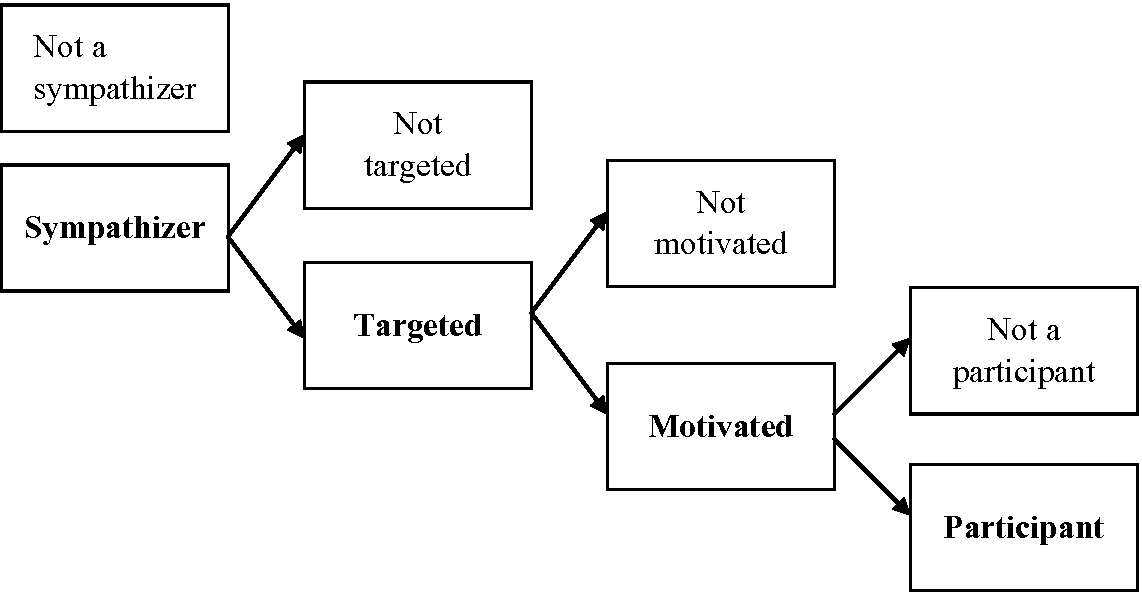
The process of action mobilization.
The first step accounts for the results of consensus mobilization. It distinguishes the general public into those who sympathize with the cause and those who do not. The more successful consensus mobilization has been, the larger the pool of sympathizers a mobilizing movement organization can draw from. The second step is equally obvious as crucial: it divides the sympathizers into those who have been target of mobilization attempts and those who have not. The third step divides the sympathizers who have been targeted into those who are motivated to participate in the specific activity and those who are not. Finally, the fourth step differentiates the people who are motivated into those who end up participating and those who do not. The net result of these different steps is that some (usually small) proportion of the general public participates in protest. With each step smaller or larger numbers drop out until an individual eventually takes the final step to participate in an instance of collective political action.
Where do we stand: Assessment of research to date
In providing answers to the questions as to why people protest, we separately discussed grievances, efficacy, identity, emotions and social embeddedness, but obviously in practice all these concepts are interwoven. And this is precisely what social psychological protest research to date focuses on. Simon et al. (1998) proposed a dual path model to protest participation in which they distinguished between an instrumental pathway, guided by calculative reasoning that concentrates on the costs and benefits of participation, and an identity pathway, guided by processes of identification. In several studies Simon and his collaborators find empirical support for their concept of a dual pathway to protest participation. Be it in their studies of identification with the Fat Acceptance Movement (Stürmer and Simon, 2003), the older people’s movement or the gay movement (Simon et al., 1998), both instrumentality and identification made unique contributions to the prediction of willingness to participate. Rather than replacing instrumentality as an explanatory paradigm, identification is added to the explanation as a second pathway. Van Zomeren et al. (2004) also propose a dual path model, comprising an efficacy and emotion path. The importance of emotions as motivators is shown, again without replacing the instrumental pathway. In our own work we combined grievances, efficacy, identity and emotions. The model we developed and began to test assigns a central, integrating role to processes of identification (Van Stekelenburg et al., 2009). In order to develop the shared grievances and shared emotions a shared identity is needed (Figure 2). According to this model grievances originate from interests and/or principles that are felt to be threatened. The more people feel that interests of the group and/or principles that the group values are threatened, the angrier they are and the more they are prepared to take part in protest to protect their interests and principles and/or to express their anger.
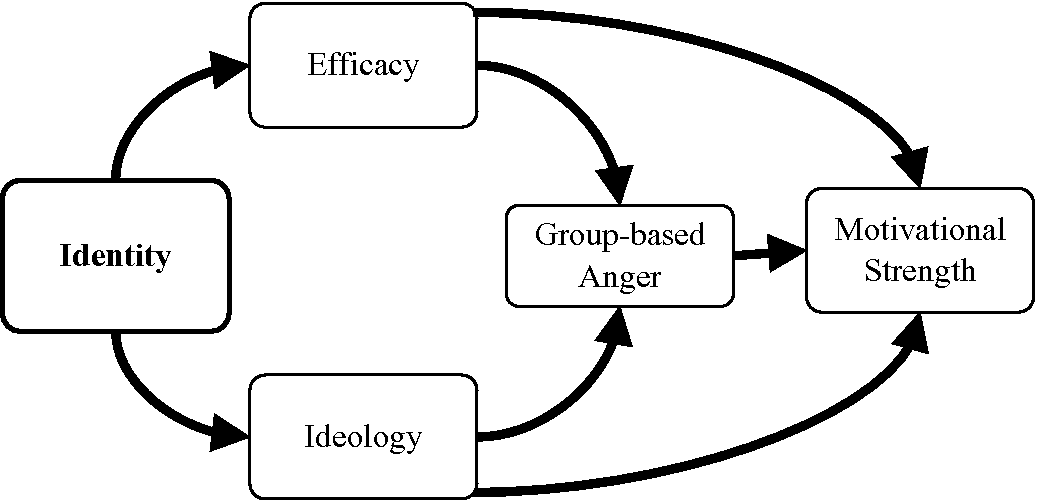
Motivational framework integrating identities, grievances and emotions.
Future directions: Challenges for the social psychology of protest
What are the challenges a social psychology of protest faces? Probably, the most significant challenge is the paradox of persistent participation (Louis, 2009). Activism frequently persists despite pessimism regarding the action’s ostensible goals (Louis, 2009; Oegema and Klandermans, 1994). Why do people continue participating in protest although it does not effectuate their claims? Drury and Reicher (2009) suggest that participation generates a ‘positive social-psychological transformation’. They argue that participation in protest strengthens identification and induces collective empowerment. The emergence of an inclusive self-categorization as ‘oppositional’ leads to feelings of unity and expectations of support. This empowers people to offend authorities. Such action, they continue, creates collective self-objectification, that is, defines the participant’s oppositional identity vis-a-vis the dominant out-group. More generally, the theme of sustained participation raises another underexplored issue, namely the personal consequences of movement participation. The individual consequences of participation in collective action are a relatively untouched area which scholars have just recently begun to investigate (for instance on empowerment, see Drury and Reicher, 1999, 2000, 2009; Drury et al., 2005; on empowerment and politicization and on individual trajectories of participation, see Corrigall-Brown, 2012; and for a more general overview making a plea for the investigation of individual consequences of protest, see Louis, 2009).
This brings us to probably the most important challenge of the social psychology of protest, namely to move from static decontextualized explanations of protest to more dynamic, contextualized models of protest. In 2007 (Van Stekelenburg and Klandermans) we made a plea for more dynamic models. We argued that a more dynamic approach would provide the opportunity to study mechanisms through concepts like identification, participation motives, efficacy, emotions and feelings of injustice as consequence and antecedent of collective action. This is not easy, as Ellemers observes: ‘From an investigational point of view, it is difficult to deal with a variable that, at the same time, can be a dependent and an independent variable, can develop over time or change across contexts‘ (Ellemers et al., 1999: 3). Yet, studying protest participation in a more dynamic way would do more justice to the theoretical and empirical richness of the concepts and may be crucial to gain better insights into the processes at hand (cf. McAdam et al., 2001). An example of such a dynamic model next to those we discussed in the previous pages is Van Zomeren et al.’s dynamic dual pathway model of protest (Van Zomeren, 2012; Van Zomeren et al., 2012). These authors introduce a dynamic model that integrates many common explanations of collective action (i.e. group identity, unfairness, anger, social support and efficacy). The model conceptualizes collective action as the outcome of two distinct processes: emotion-focused and problem-focused coping. The former revolves around the experience of group-based anger, while the latter revolves around beliefs in the group’s efficacy. The model makes explicit the dynamic nature of collective action by explaining how undertaking collective action leads to the reappraisal of collective disadvantage, thus inspiring future collective action. Tausch and colleagues are among the first to report empirical findings on how emotions affect the dynamic nature of collective action participation. They show that protest participants experience more out-group-directed anger and contempt, and self-directed positive affect. Out-group anger and contempt rather than self-directed positive affect inspire future collective action (Becker et al., 2011). In yet another study – a two-wave longitudinal field study – they examine how emotional responses to success and failure of collective action inspire future collective action (Tausch and Becker, in press). They found that both pride (in relation to success) and anger (in response to failure) motivated future collective action. While anger stemming from failure predicted future protest directly, pride resulting from success enhanced feelings of efficacy which inspired future actions. These few examples are an excellent start for the years to come, taking the dynamic nature of collective action seriously will shed light on the many unanswered questions related to sustained participation and disengagement – and indeed on the question of protest, and then what (Louis, 2009)?
Next to antecedents and consequences of protest, our plea for dynamic models also alludes to the thorny issue of causality. Indeed, the majority of the findings and relations we reported is based on correlational data. Correlational data can be interpreted in causal terms based on the theories we have, but cannot demonstrate causality. Take for instance the relation between efficacy, embeddedness and protest. Based on social capital theories, we interpreted our correlational data in causal terms, that is, the more embedded people are, the more efficacious they feel and the more they protest. However, are more efficacious people more inclined to become members of organizations or do people become more efficacious in their networks? We simply do not know. Social psychologists attempt to overcome the problem of causality by employing experimental methods. These experiments have a high internal validity, and have the potential to make strong causal statements. However, laboratory experiments are often detached from natural settings resulting in low ecological validity. Indeed, are students in the lab who report high intentions to protest, really willing to take to the streets? We cannot be sure about it. First of all, because the correlation between intentions and actual participation is moderate at best (Oegema and Klandermans 1994), but perhaps more importantly, because we simply do not know whether artificially created grievances, identification and efficacy are comparable to real life indignation stemming from imperilled interests or violated principles. In a longitudinal field study in a natural setting we seek to address this issue of causality (Van Stekelenburg et al., 2012). Longitudinal data are collected in a newly built Dutch neighbourhood. Within approximately a month of their arrival inhabitants receive a questionnaire pursued by four follow-up surveys, which encompasses predictors of protest, several protest intentions and actual participation and network questions. Thus, we monitor the development of demand and supply of protest as it starts from scratch. This means moving beyond correlation studies and studies of isolated individuals in surveys or laboratories. In that way, we hope to be able to shed more light on causality issues in protest participation.
A final theme that begs for more social psychological research is the impact of the sociopolitical context affecting people’s routes to protest. If people are very angry and decide to not take it anymore, the decision to protest is not taken in a social vacuum. Collective struggles rooted in a social or political context are, by definition, fought out in this context. Koopmans and Statham (2000) and Roggeband (2004), for example, showed that the dynamics of participation are created and limited by characteristics of the national contexts in which people are embedded. So far, social psychological research has hardly focused on the subjective experience of these macro-level factors. To be sure, three decades ago social identity theory (SIT) proposed social structural characteristics as the permeability of the group boundaries, stability and illegitimacy affecting people’s inclination to protest. These rather abstract structural characteristics were good to manipulate in the laboratories, but what do they tell us about how real life economic, social and political processes affect the routes that individual participants take towards protest? How do political opportunities or restraints, or the strength or weakness of multiorganizational fields, or organizational frames, or the proposed tactic affect the routes that individual participants take towards participation? Future social psychological research should try to identify variables at the meso or macro level that are important in affecting people’s subjective interpretations of their collective disadvantages.
Footnotes
Funding
This research received no specific grant from any funding agency in the public, commercial, or not-for-profit sectors.
Author biographies
Jacquelien van Stekelenburg is Associate Professor at the Sociology Department of the VU University Amsterdam, the Netherlands. She studies the social psychological dynamics of moderate and radical protest participation, with a special interest in group identification, emotions and ideologies as motivators for collective action. She co-authored (with Bert Klandermans) ‘Individuals in movements: A social psychology of contention’ (in The Handbook of Social Movements across Disciplines, Springer, 2007) and (with Bert Klandermans and Jojanneke van der Toorn) ‘Embeddedness and grievances: Collective action participation among immigrants’ (American Sociological Review, 2008. She edited (with Conny Roggeband and Bert Klandermans) The Future of Social Movement Research: Dynamics, Mechanisms and Processes (University of Minnesota Press, 2013). She is currently conducting an international comparative study on street demonstrations with Bert Klandermans (VU University Amsterdam) and Stefaan Walgrave (Antwerpen University) funded by the European Science Foundation entitled Caught in the Act of Protest: Contextualized Contestation and a study on emerging networks and feelings of belonging funded by the Dutch Royal Academy of Science entitled The Evolution of Collective Action in Emerging Neighbourhoods.
Bert Klandermans is Professor in Applied Social Psychology at the VU University, Amsterdam, the Netherlands. He has published extensively on the social psychology of political protest and social movement participation. His Social Psychology of Protest appeared with Blackwell in 1997. He is the editor and co-author (with Suzanne Staggenborg) of Methods of Social Movement Research (University of Minnesota Press, 2002) and (with Nonna Mayer) of Extreme Right Activists in Europe (Routledge, 2006). With Conny Roggeband he edited the Handbook of Social Movements across Disciplines (Springer, 2007). He is the editor of Social Movements, Protest, and Contention, the prestigious book series of the University of Minnesota Press and of Sociopedia.isa, a new online database of review articles published by Sage in collaboration with the International Sociological Association. He is co-editor of Blackwell/Wiley’s Encyclopedia of Social Movements.