



Abstract
Of all temporary unskilled migrant workers who originated from Bangladesh in 2010, women accounted for less than 3%. This extremely low proportion of women results from the numerous sociocultural, religious and political barriers women labour migrants encounter. Based on 23 in-depth interviews collected in 2009 in Bangladesh with former migrant domestic workers who worked in the Gulf region, the article argues that women actively negotiate these barriers prior to going abroad and upon return. Using a micro-sociological perspective of gender and family relations, the article shows that, depending on women’s family situation and relationships, they were more or less at risk of suffering stigma in the pre-departure and return stages of temporary labour migration. The article builds on a solid body of research that examines how international labour migration challenges the global and local patriarchal gender order. The findings show how international migration of women may unsettle the patriarchal gender order, but can also serve to further subordinate women after they return home.
Introduction
Research on Asian migration discusses the phenomenon of ‘feminization of migration’ whereby, starting in the 1980s and accelerating in the 1990s, the share of independent women migrants represents an increasing proportion of all women migrants. This important shift, observed in countries such as the Philippines, Sri Lanka and Indonesia, has not occurred in other countries. Bangladesh is a case in point with women representing only 3% of migrant workers who left the country in 2010. Bangladesh belongs to a group of countries – which includes India, Pakistan and Nepal – that has restricted women’s emigration in order to ‘protect women’. In these countries, men’s labour migration is strongly encouraged and put forward by sending governments as an economic development strategy. In contrast, policies towards women’s migration are driven by social values located in a patriarchal global and local gender order. The ‘value-driven emigration policies’ of these countries have, from time to time, entirely banned the migration of women or imposed barriers to it in the name of safety and appropriate female patterns of mobility (Oishi, 2005). When states officially construct female migration as being negative, harmful or dangerous, a patriarchal ideology is reproduced and significant barriers for aspiring migrants and for returnees are created. In such context, women who migrate internationally have to overcome numerous structural, cultural, religious and political barriers.
This article unpacks how women negotiate these barriers at two moments of the temporary labour migration process: prior to migration and upon return. Using data from in-depth interviews with returnees who worked as domestic workers in the Gulf region, we analyse the causes and impact of migration at the micro-level of families and communities. The findings underscore that women’s labour migration is greatly influenced by the gendered sociocultural realities of Bangladesh and the intra-household gendered power relationships. Additionally, our analysis highlights how labour migration has some contradictory effects on women migrant workers we interviewed. On the one hand, the opportunity for labour migration increases women’s vulnerability because of the social construction of gender in Bangladesh; on the other hand, migration is beneficial because it provides migrant women with the opportunity to resist existing power and authority over them. As such, women’s labour migration creates complex social dynamics that remain insufficiently explored in existing academic literature on migration and development in Asia.
Our argument builds on previous work on the power of transnational migration to challenge and even transform gender relations. As argued by Dannecker (2005), labour migration takes place within gendered transnational spaces which challenge gender orders. The experience of transnational migration may lead migrants to question gender hierarchies and to form new identities. Incorporating gender into migration studies and recognizing the potential of migration to reconfigure gender power relations and structures stem from works that call for theorizing migration as a factor of social transformation (Castles, 2010; Schuerkens, 2005). This article also contributes to our understanding of the temporary labour migration process in the Asian context by examining the pre-departure and the return stages. Because most migration theories emerged from empirical work on more permanent migration flows, investigations into migrants’ experiences of return have been neglected to date (Dannecker, 2011). We thus examine the context and process of departure and the context and process of return.
Gender and labour migration
In existing studies, economic ‘push and pull’ factors undoubtedly appear to be an important driving force for international labour migration, especially temporary labour migration in Asia (Haque, 2005; Stahl, 2003). Castles (2003) argues that globalization has a significant impact on labour migration in Asia, and Castles (2003) and Stahl (2003) identify various ‘pull factors’, such as rapid economic growth, low fertility rates, demand for cheap workers and an ageing population in the destination countries, as the main driving forces behind labour migration in these regions. Haque (2005) documents that some ‘push factors’ in the country of origin, including poverty, rapid population growth, high unemployment rates, land scarcity, political unrest and lack of satisfactory opportunities, also make a significant contribution to the increasing magnitude and changing pattern of labour migration in Asia.
Overall, these studies increase our understanding of labour migration, but they consider the causes of migration to be the same for both women and men. Conversely, feminist scholars (Dannecker, 2005; Dodson, 2008; Oishi, 2005; Piper, 2005) document that the experiences of women migrants in the migration process differ from those of men in terms of migration motives, patterns and practices. Feminist studies emphasize the need to consider gender as a constitutive element of migration. For example, recent analyses emphasize how migrant networks and the impact of remittances are gendered (Thieme and Siegmann, 2010). Weiss examines migration and inequality and notes how lower positioned migrants can migrate because of ‘the depreciation of their location-specific capital’ (Weiss, 2005: 723). Within this source of inequality are embedded gender differences which often segment the transnational labour markets for migrant who have a ‘lower position on a world scale’ (Weiss, 2005: 715).
In analysing the recent trend of women migrating abroad for domestic work, some feminist research (Anderson, 2000; Li et al., 1998; Lindio-McGovern, 2003) highlights the structural gendered inequalities in the global political economy. Scholars identify domestic workers as export–import trade commodities and characterize ‘poor Third World women’ as ‘victims’ of a global capitalist economy. In contrast to the structural-based studies, some feminist research (Barber, 2000; Gibson et al., 2001; Tacoli, 1999) focuses on the ‘agency’ of women contract workers to show that not all women migrant workers are victims of exploitation. These studies note that structuralist views fail to recognize the complexity of the individual’s experience and/or women’s role in overcoming their subordinate status in the country of origin. Giving weight to the positive aspects of women migrant workers’ experiences, these studies document that, in the global labour market, individual women migrant workers make their own decision to migrate in pursuit of the opportunities available overseas. They document the social and financial gains that migrant workers acquire from their overseas work. Davin’s (1996) research also shows that women migrants may have advantages over non-migrant women because they have more autonomy, more savings, better clothes and more personal property. In addition, their migration status challenges the traditional concept of the woman as being the ‘inside person’ who is only responsible for activities in the home (Davin, 1996). Bélanger and Tran (2011) argue that, in the case of Southern Vietnam, emigration of young women alters the local gender structures by enhancing the social construction of female children and increasing the value of girls. However, some studies (Dannecker, 2005, 2009; Davin, 1996; Fernandez-Kelly, 1983; Tiano, 1994) also document that the social and financial gains of women migrant workers do not always have positive effects on their status within the households and communities. Some research indicates that the employment of migrant daughters, wives and mothers neither erodes domestic patriarchy nor enhances women’s position in families (Davin, 1996; Fernandez-Kelly, 1983; Tiano, 1994). In such cases, husbands and fathers, when present, usually maintain authority in the family, and women continue to take primary responsibility for domestic household chores, even if employed (Fernandez-Kelly, 1983; Tiano, 1994).
In brief, feminist studies show the importance of gendered sociocultural contexts within which the women migrant workers’ experiences are embedded and significantly advance our understanding about women’s labour migration. With respect to the power of migration to reconfigure gender power relations, the existing evidence indicates a variety of patterns and outcomes.
Women’s migration from Bangladesh
Bangladesh is increasingly dependent on remittances of its overseas workers who are predominantly semi-skilled, low-skilled and unskilled. In fact, Bangladesh presently stands as one of the main suppliers of workers in the international labour market; however, the number of women migrating from Bangladesh is negligible when compared to the total flow of emigration. Statistical information shows that, during the year 2010 the total outflow of migrant workers was 390,702, among them only 27,706 were women. These women workers migrated mainly to countries in the Gulf region – Lebanon, Jordan, Saudi Arabia, United Arab Emirates, Oman, Bahrain and Qatar (BMET, 2011). A small number of women also migrated to Libya, Malaysia, Singapore, the UK, Italy, Hong Kong, Cyprus, Brunei, Mauritius and some other countries (BMET, 2011).
To shed light on the situation of women’s labour migration in Bangladesh, some studies (Afsar, 2005; Siddiqui, 2001) uncover various important economic, social and structural incentives for women’s international migration, such as the desire for economic solvency, unhappy marital/family relations, a desire for new challenges, limited opportunities for women’s employment and economic opportunities that exist outside Bangladesh. We build on these past studies (Afsar, 2005; Dannecker, 2005; Siddiqui, 2001) to address how the gendered state policies and sociocultural aspects of Bangladeshi society influence women’s decision to migrate abroad for work.
Oishi’s (2005) research argues that gender differences in the number of workers who emigrate in each country depends on the degree of social legitimacy of international women’s migration as well as the gendered nature of state ideologies and policies. In Bangladesh, international labour migration for women is generally restricted and was banned by the government several times between 1981 and 1998. In September 2003, the ban on women’s migration was finally lifted. Bangladeshi women can now legally migrate abroad for work; however, they continue to face many more policy constraints than men. For example, women must be at least 25 years of age to qualify as overseas migrant workers. Earlier bans on women’s migration for work served to fuel the ideology that female migration is inappropriate, unsafe and undesirable. For the year 2008, Bangladeshi women’s share in migration outflows was only 2.9%, while in the Philippines and Sri Lanka over half of the migrant workers were women (BMET, 2011; Martin, 2008). This underscores that migration from Bangladesh is still a male-dominated phenomenon and the state plays a significant role in shaping women’s international migration in Bangladesh.
Other factors that strongly impact women’s ability to migrate include the social acceptance of women’s employment, level of education, levels of women’s autonomy within households and decision-making power over household finances. Oishi (2005) found that, compared to women from the Philippines and Sri Lanka, Bangladeshi women have much less control over household finances and, consequently, enjoy less autonomy within the household.
Focusing on the sociocultural and religious context of Bangladesh, Dannecker (2002, 2005, 2009) documents how women migrants are accused by their peers and other members of society of violating the norms and values of purdah. Dannecker’s work (2005, 2009) reveals that, due to the sociocultural realities in Bangladeshi society, a woman’s decision to migrate not only negatively impacts her status, but also her family’s social status within society. She discusses how female migration takes place within a transnational Islamic patriarchal order. Dannecker (2009) also documents how the migrant workers’ visions of development are reconstructed and negotiated through the migration process and shows that these visions differ significantly between male and female migrants. For instance, she argues that, although the social and economic developments play a role in men’s and women’s migration, individual development – the desire to see other countries, experience new things, or travel by plane – appears to be an important motivator for women’s migration; whereas, it plays less of a role in men’s migration.
All these studies significantly advance our understanding of women’s migration from Bangladesh. In this article, we build on this body of research further and explore how, at the micro-level, the sociocultural context of migration and the gendered power relations within the family have a direct and significant impact on the causes and impact of migration.
Fieldwork
This article relies on fieldwork conducted in Bangladesh between June and August 2009. Empirical evidence shows that, in Bangladesh, labour migration is a location-specific phenomenon (Rahman, 2009). Bandhura and Jurain were chosen as the sites for investigation due to their significance as migrant-sending communities. Bandhura is located outside the city of Dhaka, 40 kilometres east of the capital in Nawabgong Upazila. Jurain is a suburban area situated within Dhaka city.
The fieldwork for this research lasted 10 weeks. First, we had to become accepted by the communities before collecting any data. This involved interacting informally and mostly conducting participant observation research when visiting women from the community to chat about their lives, work and migration. We kept a detailed diary of observations during this phase of the fieldwork. After a good relationship had been established through several visits, we began to conduct interviews. This lengthy process of collecting interviews meant that we were able to gain the participants’ confidence. The interviews lasted between one and two and a half hours. Given the depth of our data, this empirical analysis relies extensively on quotes from the narratives collected.
The interviews were conducted using a semi-structured guideline. The key questions provided insight into the women’s motivation for seeking employment abroad, the barriers and challenges they faced in the decision-making process, and the ways in which they negotiated their situations. Women narrated their experience abroad and since return. Questions also served to explore the role of personal networks in the migration process. Standard ethical guidelines were followed throughout the fieldwork and ethics approval was obtained prior to fieldwork from the home institution of the two researchers.
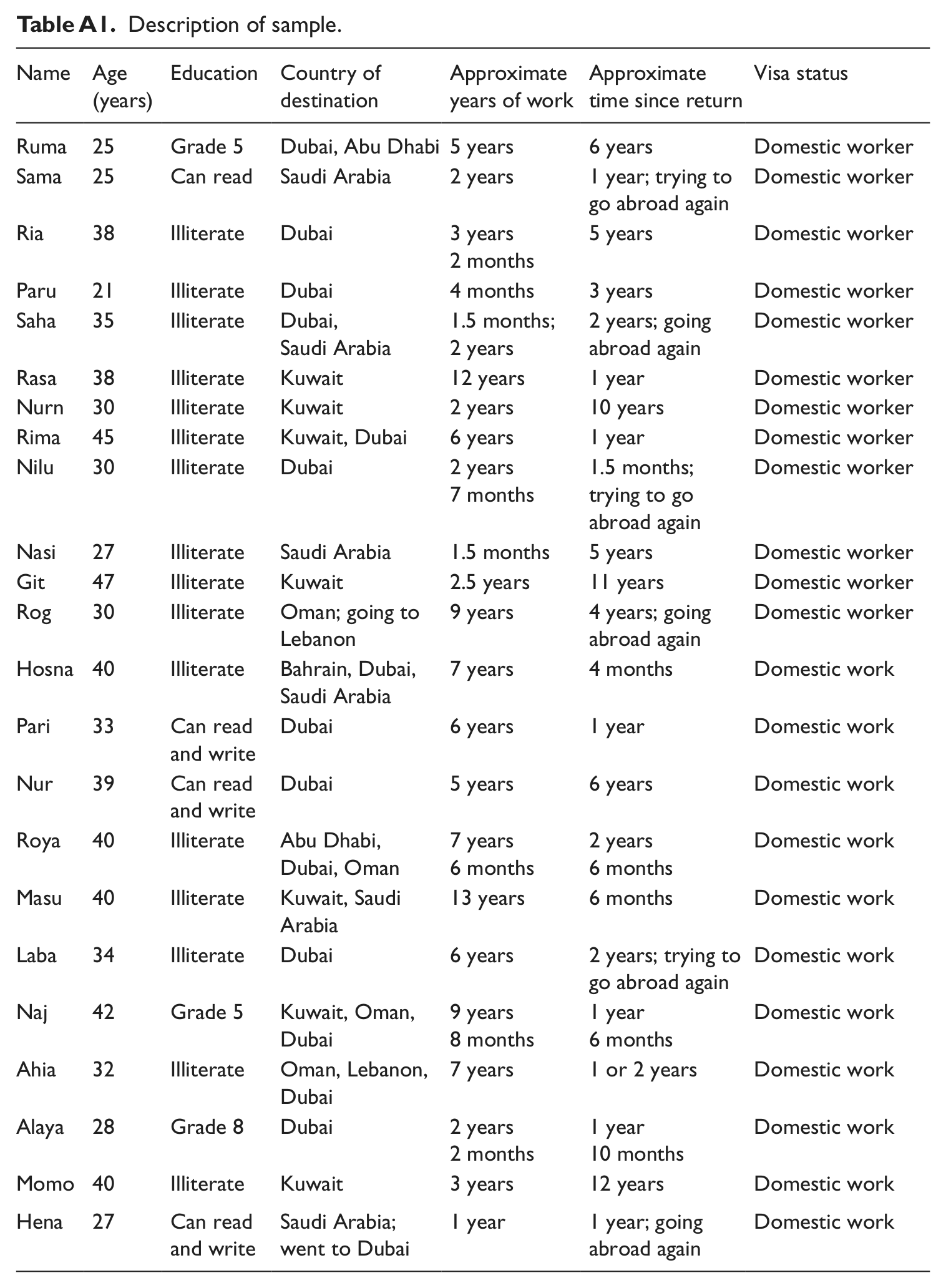
A total of 23 women migrant workers were recruited successfully using a snowball strategy (12 in one location and 11 in the other one). Our sample includes low-skilled and unskilled workers (see Appendix) who had migrated overseas as domestic workers in the Gulf region and returned to Bangladesh between 1988 and 2009. None of the participants had ever attended school and most were illiterate. Most were Muslim and some were Hindus. Most of them were married with children. Some of the interviewees were separated, divorced, or widowed and either lived with their parents or by themselves with their children.
Women in our sample migrated because they have to assume the breadwinner role when there are no male wage earners in the family and/or the husbands or other male members fail to meet the financial needs of their families. Our sample included unmarried women who went abroad to shoulder the responsibilities of their parental home. Interviews were conducted in Bengali language and audio recorded in their entirety. They were transcribed in Bengali and then translated into English. Data analysis was done on the Bengali and English transcripts.
This research also included the collection of detailed data on migrants’ experiences abroad. These findings are presented separately, but it needs to be mentioned here that women experienced total seclusion while abroad and migrated from one purdah society to another. For this reason, our findings may differ from those of other scholars who focused on women who had migrated to other destinations (such as Malaysia).
Negotiating waged work and migration: The context of departure
Poor and uneducated Bangladeshi women have to face numerous structural and cultural barriers when they attempt to find employment overseas. Interview participants narrated how they had to negotiate with the cultural institution of purdah in Bangladesh. In particular, purdah, a set of prescriptions aimed at protecting women, particularly in the realm of sexual matters – plays a vital role in controlling women’s mobility. According to this cultural ideal, women need to be protected from ill-intentioned men whenever they are outside the home. This ideology dominates women’s lives and limits their participation in the workforce. When women migrate overseas for paid work unaccompanied by male guardians, their honour and that of their families is negatively affected. In fact, for violating the norms of purdah, women migrants are stigmatized because they transgressed gender norms. It is often assumed by relatives and neighbours that former migrants were sexually harassed by their employers or worked as sex workers to earn more money while abroad. Consequently, purdah impacts the entire experience of the migrant women we interviewed, regardless of their being Muslim or Hindu. Despite this adverse context for migration, women we interviewed had agency and actively negotiated with the institution of purdah and/or social stigma about women’s migration to achieve their desire to go abroad for work: Hearing my decision, my father became mad at me. He told me, if I went, people would make many bad comments about me. At last I told my father that I was needy, he would help me for one or two days. But nobody would help me day after day. I had to go. I had to raise my child properly. (Momo) People in this society always said that ‘abroad is bad, it is not good for women to go abroad and only “bad women” go abroad’. Why did I want to go abroad? I should stay in this country and try to run my family by begging or in some other ways? Then I said to them, ‘Is abroad good or bad? I want to see that with my own eyes.’ In this situation my husband and natal relatives were always with me. (Hena)
Men, non-migrant women and even migrant women themselves play important roles in upholding, interpreting and perpetuating the negative social perception of migrant workers in Bangladesh. Some of our participants supported this perception by saying that going abroad was not good for women. Although not every woman had a bad experience, they thought the potential was there. Nevertheless, not all our participants agreed; most of them had positive opinions about this opportunity. The following quotes show these contrasting opinions: I also heard that going abroad is not for good women; abroad is for men. It is my opinion too. I heard it from people who went abroad and people who had not. Men and women both said so. Even those women who went abroad once also said so. (Nasi) No, I did make the right decision. I did not think that I made any wrong decision. People could say whatever they wanted to say about me. My honour is with me. I did not care about what others said about me. Nobody would feed me if I starved. However, when I heard all these [comments], I felt bad. They did not see what I really did abroad. They just suspected me. Allah saw what I did. I usually tried to avoid those who made bad comments about me. If I am good then the world will also be good for me. I had no deep feelings about these bad comments. When I die I will have to go alone. (Hosna)
Women reported that the social disapproval about women’s overseas employment affected their social status within the community. They also reported feeling very bad when they heard any negative comments about women migrant workers, but claimed they did not care what people said about them. Some participants protested and others remained silent when they heard derogatory comments. However, most of them tried to justify and defend their decision about overseas migration by pointing to the failure of their husbands or other male guardians to protect them and provide for them. Almost all the women used religion to defend themselves against the stigma and relied on it to uphold their image as good women in society, as reflected in comments like, ‘Allah saw everything that I did abroad’. In this way, the women migrant workers were struggling with concurrent efforts to fulfil the image of a good woman, while also taking advantage of opportunities to economically better themselves and their families.
It is in this adverse sociocultural context that economic needs pushed many of our interviewees into migrating abroad to work. For many participants, migration was chosen as a way to move out of acute poverty, hunger and even starvation. Many women migrate to cover the costs of their children’s education, their daughters’ weddings, or adult sons’ migration: My husband was a weaver. I also worked hard with my husband. But we failed to run our family. My daughter was an adult, but I could not arrange a marriage for her because of money. I failed to provide the cost of my children’s education. I had different problems. I could not maintain my family, as my other relatives did. So, I decided to go abroad. (Rasa)
Unmarried women migrated to support their parents and siblings. They did not go overseas for their own well-being or to establish economic independence from their parents, as Lan (2006) found in some cases among Filipinas and Indonesian single domestic workers: When I went abroad for the first time I was unmarried. My father did some small business. He was able to provide food to us only once a day. The other two meals we had to starve. We were needy. Seeing the suffering of my father I made the decision to go abroad. (Roya)
Women who were separated, divorced, or widowed living either with their parents or by themselves with their children, chose overseas employment after a sudden upheaval in the family, like divorce or the death of the provider. These unexpected difficulties pushed women into paid employment in order to survive economically: Before I went abroad, I had many problems. I was poor. I had been working to maintain my family. Even though I worked hard, the earnings were not enough for my family. I had failed to provide food for my children. I could not bear the cost of their education. So, I went abroad. (Nilu)
Due to the high cost of men’s migration, many men from the poorer households do not see overseas migration for work as an option for them because they could not raise the necessary capital. However, it is possible for lower-class families to manage the cost of women’s migration: I am a woman. A woman needs less money than a man to go abroad for work. My trip cost only US$750. To go abroad my husband needed approximately US$2850 to US$3570. Where could I get the money? Who would give it to me? (Hena)
Gender discriminatory practices and attitudes in Bangladesh, resulting in a lack of employment opportunities and low wages in the local job market for women, frequently intersected with economic needs. Due to the gendered nature of the local job market, it was difficult for these uneducated, unskilled women to obtain jobs that provide a sufficient salary.
Poverty is far from being the only reason for out-migration: many women – a third of our sample – opted for migration as a temporary escape from acute conjugal conflicts. Some of our participants reported that ‘women go abroad only because of their husbands’: Women go abroad because some of them do not have good relations or any peace with their husbands. I also went abroad for that. I had no peace living with my husband. My husband did not work properly, he was drug addicted. My husband always quarrelled with me and he also beat me. I went abroad four times. Due to the suffering and stress from the heavy workload abroad, every time I came back from being away, I decided not to go abroad again. However, when I came back home, I found the same anxiety within my family. I found no peace with my husband. Each time I also found very little money in my hand. So, I went abroad again and again. (Naj) I did not go abroad for any economic reason. I just wanted relief from my husband. I did not want to stay in this country. If I stayed in Bangladesh and did tailoring, I could run my family very well. However, due to the torture of my husband, I was impatient and thought that if I stayed away from him I might find peace in my life. (Alaya)
These accounts show that women migrated abroad because they wanted to distance themselves, physically and emotionally, from their husbands and that they were not very concerned with the economic benefit of overseas employment. In some cases, women were pressured by their abusive husbands to resolve financial difficulties by working abroad: Now I am trying to go abroad again. But you know my husband has his own house in this town. … It is very tough to make you understand. … A woman’s life is for suffering. From my last two trips, I sent money to my husband’s bank account. Although he has my money, now he gives me only US$1.50 per day for the household expenditures. I am suffering again with my children. … Moreover, when I was abroad, he remarried again. He never valued me. He always treats me badly. Now he is pressuring me to go abroad by saying that he bought land, built a house, and now a little more work is left. If I go abroad he could finish the work. (Hosna)
In addition to conjugal conflicts, tensions between the women and their in-laws also appear to be an important issue that pushes women to take overseas employment: I had unhappy family relations. My mother-in-law and my sisters-in-law could not tolerate me. If I wanted to do anything good, they had always taken it otherwise. They physically abused me a lot; they beat me with sticks and broke my nose two times. My husband did not protest against this. Only once he did; that time my sister-in-law came to beat my husband as well. My mother-in-law also told my husband to get lost from the house. So my husband never said anything against her because of fear. After that I made the decision to go abroad for work. At first my husband forbade me from going abroad, as he heard many bad things from people. Then I insisted; I told him, did he want my death by his mother and sister? After a few days he told me he could not do anything for me. So, I could go wherever I wanted to go. (Ria)
For Ria, the economic benefits were less important than the opportunity to escape from her home situation. Conjugal conflicts and tension between women and their in-laws may work alone and, in some cases, intersect with economic issues to motivate these women to seek overseas employment.
Some interviewees who wanted to work could not because it would have harmed their family’s status too much. The solution was to go abroad: We were needy. My father failed to run the family by working alone. However, because of my father’s [relatively good] social status in the village, we could not work as a domestic worker in other people’s houses, or we could not even beg food from others. For all these reasons, I thought that it was better for me to go abroad for work. (Roya)
As mentioned earlier, most of our participants did not have any formal education, so they could only obtain lower-status jobs in Bangladesh, which would damage the social status of their families. Their only available alternative was to take paid employment abroad where nobody would ‘see’ what type of work they were doing.
For a woman who is preparing to go abroad, securing childcare arrangements stands as their number one concern. In most cases, the migrant women’s mothers took the children into their homes to provide care. Other interviewees left their children with either natal relatives or their fathers. Sometimes, our participants arranged for somebody (usually a mother, mother-in-law, or sister) to stay with the children and cook food for the family; in these situations, the children could stay with their fathers in their own homes. If our interviewees had elder daughters who could cook meals for the family, then the children could remain in their homes as well: I left my daughters with my parents at their house. In the beginning my husband also stayed with them. After a few days he moved to another place, but did not take the children with him. Thus, I had to send money to my parents and also to my husband. (Naj) When I went abroad I brought my mother from the village and told her to stay with the children in our house. After a few days my husband sent her back to the village and started to look after the children by himself. But my husband did not take proper care of the children. (Laba)
The left-behind husbands were unlikely to take on their wives’ role in the family while they were absent. This research supports Piper’s (2005) arguments that the left-behind men usually do not adjust to the new situation by taking on more ‘motherly’ roles. They often shift certain tasks to other female family members, rather than learn to perform them themselves. This also reaffirms the patriarchal ideology that leaves the responsibilities of the household sphere primarily to women.
In the process of deciding to go abroad, social and personal networks played an important role. Most participants consulted with their female relatives or neighbours about their migration plans and many were influenced by them or by the success stories of women migrant workers in their community. Personal networks not only inspired and motivated our participants to migrate; they also provided the migrant women with a feeling of safety when they migrated overseas. Personal networks, however, do not necessarily reduce women’s subordination and vulnerability (Bélanger and Wang, 2013). In fact, as underscored by Thieme and Siegmann (2010) and Dannecker (2005), powerful agents in networks of patriarchal societies, such as Bangladesh, tend to be males who use their ties to further subordinate women. Perhaps for this reason, female migration does not lead to the migration of other women across generations. While some participants migrated specifically to save money in order to arrange marriages for their daughters, none of them considered sending their daughters abroad for work. Unlike Dannecker (2011), who notes a migration culture among Bangladeshi men, we do not find this process among our study participants.
In sum, our participants’ pre-migration experiences point to the intersecting and overlapping problems with domestic violence, family economic crises, family social status and the near absence of employment opportunities for poor women in Bangladesh. Conceptually, our evidence underscores how structural gendered inequalities –in this case reproduced through purdah – play a central role in making migration difficult to negotiate for women. These inequalities, however, play out differently in women’s lives depending on women’s specific family circumstances. In addition, while the family is the primary space of production and reproduction of gender inequalities, it is also the site where such inequalities can be contested and challenged.
Personal and social impact of migration on women: The context of return
Given the stigma attached to female migration, returnees must cope with a negative social attitude towards them. Their violation of the norms of purdah is harshly judged. State policies towards female migration – such as the periodic bans mentioned earlier – also contribute in creating a negative climate for returnees. Our analysis examines how macro-level social constructions of returnees as ‘bad women’ plays out at the micro-level and affect sub-groups of women to different degrees. Women’s narratives show how women’s post-migration experiences vary depending on their economic success abroad, their connection to the community and the quality of family relationships before they went abroad. Along with the general hostile attitude towards returnees, some women are more disadvantaged and at risk of being stigmatized than others, but, in spite of mixed experiences in social and family relations among returnees, most felt personally changed and empowered by the experience of migration.
Most women felt that they had benefited at the personal level by gaining confidence and courage. The experience of migration and paid work was transformative for them: The first time I went abroad I feared a lot. Now, I have courage and do not fear going abroad for work. Moreover, I have my own money. I do not need to ask my husband for money. I can spend money where I want. I do not have to ask permission from my husband for that. (Pari) Before I went abroad I was so timid. But now I have courage. Now I can go anywhere in this world. I have no fear now. I think that, if my husband did not feed us, I could run my family. This is not a big issue for me now. I feared my husband before. I honoured and obeyed him, but now I quarrel with him. I told him, ‘24 years I listened to you and the results were that I failed to feed my children’. Now I want to make my own decisions and I want to see if I can do something for my children or not. (Laba)
For many, their sense of having changed found expression in the types of clothes they chose to wear upon return: There is no change in my economic condition, but there are changes in me since I returned back home. Now I can talk and communicate with people properly. My social status is also changed, and it is better than before. Changes also happened in my dress. Before I went abroad I wore a shari, but now I wear salor kamis [pants and long top], a maxi, or a shari. Moreover, I used soap once a week, but now I could not go a day without using soap. I also walked barefoot, but now I cannot. I have changed a lot. (Hena) I have many changes in myself. I learned a lot. I was very foolish before – I did not know how to count money and how to tell time. But after I went abroad, I learnt those things on my own. I liked all the changes in me. I have changed my clothes too. (Momo)
In some cases, our participants’ experiences of overseas migration helped them become more agentic and gave them the strength to fight against their husbands’ abusive behaviours: Before, if I asked my husband for money he got angry with me. Sometimes he also beat me. But now he does not beat me. I have my own money, and I have courage in me. My relationship with my husband is changed now.(Pari)
Most women, however, did not experience an improvement in their relationship with their husband: Things have not changed. Due to the family burden I failed to save money. My husband is not cooperative. He did not bear the cost of the children when I was abroad. Moreover, I had to send him money for his daily expenses. Now, I do not have any savings. Thus, I do not see any change in me. If I had money, I could change myself. Although my husband always physically abused me, I never thought of leaving him. I also fear that if I divorced him, people would make bad comments about me and my daughters. (Naj)
Naj’s narrative also reveals a fear of losing her status and reputation within the community. She was afraid of leaving her husband and taking any step against his abusive behaviour because Bangladeshi society would not accept such action. In some cases the relationship deteriorated due to the husband’s suspicious attitude that his wife did something ‘wrong’ abroad. This unfounded psychological harassment led some women to express deep feelings of desperation; some even mentioned having thought about suicide: I had no peace in my family. Not only that, when I came back from abroad, from the first night, my husband started to quarrel with me. He suspected me. He thought that I might have done bad work abroad. Thus, from the first night of my arrival he asked me for money as he wanted to go abroad. He wanted to investigate what I actually did abroad. His sister and some other people told him that it would not be possible for me to stay abroad for six years without doing any bad work. My sister-in-law told my husband that Allah knows what I was doing abroad. (Laba)
Beyond the realm of their immediate family, returnees’ social status within their community depended on their display of economic success abroad. But having been too successful led to questions and doubts. Returnees are commonly accused by community members of having had a ‘loose lifestyle’ (which means having worked as sex workers to earn more money abroad). Additionally, manner of dress and lifestyle influence people’s perceptions: My social status is changed now. If you have the money the social status will change automatically. My relatives (aunts) did not invite me to ceremonies before. At that time my family was poor. But now, they invite me and want to know how I am. My relatives valued me more after I returned back home. They never made any bad comments about me. It is just the outside people who made bad comments about me. (Hosna)
The status of returnees also depends on their pre-migration status. When a migrant woman is originally from the place where she lives – village or suburban area – and used to having good relations with her neighbours, it is much easier for her to be incorporated into the community after she returns: My relatives and neighbours have always respected me. They never made any bad comments about me. They respect me, since I went abroad and worked hard to raise my children after my husband’s death. I was able to educate my children. Moreover, I also arranged marriages successfully for my daughters. Everybody respects me for my hardships that I endured for my family. Nobody told me that I am a ‘bad woman’ because I went abroad. Nobody made any bad comments about me. When I came back, everybody – my relatives, parents, and neighbours – told me that as a woman what I did for my family could not be done by a man. I think my social status is now better than before. If I stayed in Bangladesh, I might beg or borrow money from others. Now, I do not need to do that. By the blessings of Allah, I am in a good economic situation now. (Masu)
Women returnees we interviewed in a suburban community, where most of the residents were internal migrants and did not know each other, suffered a lot more from gossip, rumours and insults: Now I live in this town, but my home is in Dohar [village]. The people of Dohar know me and how I am. They and my relatives never made any bad comments about me, but some people in this area made bad comments about me. They are from different places. They do not know me. They just think that women who go abroad do bad work, so they think the same of me. (Roya)
Because of this, some respondents reported that they did not reveal their migration status to people who did not know them well: I did not tell anybody that I was a migrant worker. People who know me, knew already, but I never tell those who do not know me that I was a migrant worker. However, I do not think that my migration status is a matter of shame for me. Actually, I also think that some women migrant workers are not good. Some women workers do bad work abroad. Because of that now it is spread everywhere that all migrant women do bad work abroad. Thus, I think it is better not to tell those people who do not know me about my migrant status. They did not know if I am good or bad. (Alaya)
Generally former migrant women are perceived as being different from other women in the society. These women migrated unaccompanied overseas for paid work and ignored the cultural prescription that they needed to be protected by a male. Some of our participants internalized these norms, accepted them, and did not challenge them after they returned home. In addition, some of them played an important role in upholding, interpreting and perpetuating these social perceptions. Although most of our participants faced difficulties re-entering their communities after they returned home, in most cases, they experienced an increased status among their families and natal relatives. Women who left out of desperation and due to particularly severe conjugal conflicts experienced no improvement and, in some cases, a deterioration of their family relations and status within their family. In sum, these findings indicate how the impact of migration requires an examination of the micro-family and community gendered context.
Conclusion
This analysis makes two contributions to existing research on gender and labour migration in the Asian context and migration as a factor of social transformation in general. First, our analysis of the causes of female migration adds to the evidence that underscores the complex and gendered causes of migration beyond purely economic motives. Women challenge the gender order by going abroad, but they also go abroad to escape gender-based repression, subordination and abuse. Prior to departure, processes of negotiation emerged clearly with respect to childcare arrangements, issues of stigma and the negative perception of their migration. Although the gendered sociocultural norms of purdah create challenges and barriers that affect women’s decisions and ability to migrate abroad for work, most of our participants overcame these barriers and took the opportunity of overseas employment by drawing on their strong will and agency. In this way, our participants – who were strongly motivated to participate in paid employment – defied the existing gendered ideology related to work and overseas employment. Consequently, they were also able to question the subordinate and limited roles that Bangladeshi society had assigned to them.
Second, our analysis indicates that labour migration has contradictory effects on women after they return. The opportunity of overseas employment may be liberating, but it may also increase women’s vulnerability through processes of exclusion and stigmatization once they return home. In fact, the struggles some women face after return suggest that international migration can reinforce a patriarchal ideology and may increase women’s vulnerability and subordination. At the same time, the experience of returnees was far from homogeneous, and we do note that some women felt empowered personally and reported a better personal status within their own families. By taking employment abroad women became independent and began to question the gendered sociocultural norms and practices of Bangladeshi society. Women proudly stated that migration provided them with the opportunity to escape from violent, threatening and even dangerous situations. These research findings challenge the structurally based studies that view women migrant workers from the ‘Third World’ as victims of the global capitalist economy.
In relation to existing literature, we note a more ambivalent effect of migration on women than Dannecker (2005). These differences may be related to Constable’s (2010) notion of hierarchies: hierarchies of destinations and of job sectors. Interestingly, women who migrated to Malaysia to work in manufacturing and women who migrated to the Gulf region as domestic workers felt both transformed and changed by their experience. At the same time, their experiences differed significantly in the sense that our participants worked as domestic workers and were locked inside a private house, completely secluded from society or any collective workplace. They were under the total control of their female employer and in a country where strict purdah rules prevail. Unlike Dannecker’s (2005) study participants, ours did not call upon comparisons of women’s position in other Muslim countries (Malaysia). While most of our study participants had extremely difficult experiences abroad, the very fact that they decided to go, boarded a plane and were able to send money home was extremely meaningful and transformative for them. The extent to which it may transform gender relations and the gender order of Bangladesh remains to be seen. In sum, our findings show that international migration unsettles patriarchal gender orders, but at the same time may also contribute to strengthening them.
Footnotes
Appendix
Description of sample.
| Name | Age (years) | Education | Country of destination | Approximate years of work | Approximate time since return | Visa status |
|---|---|---|---|---|---|---|
| Ruma | 25 | Grade 5 | Dubai, Abu Dhabi | 5 years | 6 years | Domestic worker |
| Sama | 25 | Can read | Saudi Arabia | 2 years | 1 year; trying to go abroad again | Domestic worker |
| Ria | 38 | Illiterate | Dubai | 3 years 2 months |
5 years | Domestic worker |
| Paru | 21 | Illiterate | Dubai | 4 months | 3 years | Domestic worker |
| Saha | 35 | Illiterate | Dubai, Saudi Arabia |
1.5 months; 2 years |
2 years; going abroad again | Domestic worker |
| Rasa | 38 | Illiterate | Kuwait | 12 years | 1 year | Domestic worker |
| Nurn | 30 | Illiterate | Kuwait | 2 years | 10 years | Domestic worker |
| Rima | 45 | Illiterate | Kuwait, Dubai | 6 years | 1 year | Domestic worker |
| Nilu | 30 | Illiterate | Dubai | 2 years 7 months |
1.5 months; trying to go abroad again | Domestic worker |
| Nasi | 27 | Illiterate | Saudi Arabia | 1.5 months | 5 years | Domestic worker |
| Git | 47 | Illiterate | Kuwait | 2.5 years | 11 years | Domestic worker |
| Rog | 30 | Illiterate | Oman; going to Lebanon | 9 years | 4 years; going abroad again | Domestic worker |
| Hosna | 40 | Illiterate | Bahrain, Dubai, Saudi Arabia | 7 years | 4 months | Domestic work |
| Pari | 33 | Can read and write | Dubai | 6 years | 1 year | Domestic work |
| Nur | 39 | Can read and write | Dubai | 5 years | 6 years | Domestic work |
| Roya | 40 | Illiterate | Abu Dhabi, Dubai, Oman |
7 years 6 months |
2 years 6 months |
Domestic work |
| Masu | 40 | Illiterate | Kuwait, Saudi Arabia | 13 years | 6 months | Domestic work |
| Laba | 34 | Illiterate | Dubai | 6 years | 2 years; trying to go abroad again | Domestic work |
| Naj | 42 | Grade 5 | Kuwait, Oman, Dubai | 9 years 8 months |
1 year 6 months |
Domestic work |
| Ahia | 32 | Illiterate | Oman, Lebanon, Dubai | 7 years | 1 or 2 years | Domestic work |
| Alaya | 28 | Grade 8 | Dubai | 2 years 2 months |
1 year 10 months |
Domestic work |
| Momo | 40 | Illiterate | Kuwait | 3 years | 12 years | Domestic work |
| Hena | 27 | Can read and write | Saudi Arabia; went to Dubai | 1 year | 1 year; going abroad again | Domestic work |
Acknowledgements
We thank Eileen Alma for her continued support in the development this study. We also thank Mizanur Rahman for introducing us to people who facilitated the fieldwork and Gale Cassidy for editing assistance. We are extremely grateful to the women who generously shared their stories with us.
Funding
Support for this study was provided from a grant of the International Development Research Centre (IDRC) of Canada.
Author biographies