



Abstract
Although attitudes toward homosexuality have been widely studied over the past 30 years, few studies have scrutinized the interaction effects between gender and race, and gender and religiosity, on attitudes toward homosexuality. This article analyzes US data from the fifth wave of the World Values Survey, collected in 2006 – a nationally representative sample of individuals residing in the United States. Contrary to previous research, no significant interaction is found between gender and race on attitudes toward homosexuality. This finding challenges conventional thinking on essentialized differences regarding racial groups and their attitudes toward homosexuality. The interaction between gender and religiosity, though, suggests that religiosity has a greater effect on women’s attitudes than men’s. Finally, the article shows that most of the difference in attitudes toward homosexuality between men and women is explained by differences in gender role beliefs.
Introduction
Over the past 30 years, scholars in the social sciences have researched attitudes toward homosexuality using a variety of approaches. Regardless of design, most recent studies have concluded that substantial differences exist between individuals’ attitudes toward homosexuality on the basis of gender and race (Finlay and Walther, 2003; Hicks and Lee, 2006; Jenkins et al., 2009; Lemelle and Battle, 2004; Roper and Halloran, 2007; Wills and Crawford, 1999). However, limited attention has been afforded to dissecting gender differences: what explains this difference and how do other variables interact with gender in affecting attitudes toward homosexuality?
In this article we focus on differences in gender for attitudes toward homosexuality. First, we consider the combined effects of gender and race on attitudes toward homosexuality – particularly since scholars have posited that the relationship between gender and race creates social categories that are unique in their perspectives and overall experiences (Collins, 1990; Hunter and Sellers, 1998). Second, we try to understand gender differences by ascertaining whether religiosity plays a different role for men and women in determining their attitudes toward homosexuality. Finally, we attempt to explain gender differences in attitudes toward homosexuality by exploring differences in the gender role beliefs held by men and women.
We focus on intersections in this study, and our decision to do so is based heavily on one of the central tenants of intersectionality theory – that people have multiple, interlocking identities. As Stewart and McDermott (2004: 532) emphasize, ‘there are unique, non-additive effects of identifying with more than one social group.’ Thus, it becomes essential that we use an intersectional approach in order to look at more specific social groups (e.g., Black men, or ‘very religious’ women) in order to further our understanding of the indicators of attitudes toward homosexuality. Intersectionality theory was born out of a need to better analyze and accommodate unique identities along one particular intersection – that of race and gender. Unfortunately, as Nash (2008) demonstrates, the social sciences lack a clearly defined methodology for exploring intersectionality. But in utilizing a large quantitative dataset, we feel that the employment of interaction effects is an appropriate method for exploring intersectionality and gaining a better understanding of the many facets of gender and its relationship to attitudes toward homosexuality.
All too often gender, race, and religiosity are singularly analyzed, thus missing the complexity of our intersectional identities. Considering how attitudes and public opinion affect policy decisions concerning homosexuality (Olson et al., 2006), we feel that our current line of inquiry can better inform change agents involved in advocating for equality on the basis of sexuality. Rayside (2007) reiterates that attitudes toward homosexuality are closely related to the presence or absence of legal protections for same-sex couples in a given country. The United States is increasingly engaging in broad public discourse over social issues rooted in gender and sexuality. Thus, the findings of this study have immediate relevance to public policy concerning equal rights on the basis of sexual orientation and the current debate on marriage equality in the United States.
Literature and hypotheses
Gender and race
The cultural pervasiveness of gender has led contemporary western societies to assume that gendered behavior is bred into our genes (Lorber, 1994). But gender is not innately ‘real.’ It is a social construct. Thus, gender is real only because we treat it as such. Although gender differences are not inherent, gender socialization has created and duplicated many cultural differences (including attitudes, beliefs, and values) in the ways women and men live their lives.
Kite (1984) found, in her early meta-analysis of studies related to gender differences in attitudes toward homosexuality that men consistently held more negative attitudes toward homosexuality than women. In more recent years, a large number of studies have reported substantial gender differences concerning attitudes toward and tolerance of homosexuality (Herek, 1988; Hicks and Lee, 2006; Roper and Halloran, 2007; Wills and Crawford, 1999). Thus, gender is one of the most pervasive explanatory determinants of attitudes toward homosexuality: women, on average, show more positive attitudes toward homosexuality than men. However, few studies have attempted to provide plausible explanations as to why men and women report such differences in their attitudes. We attempt to do so by focusing on racial and religious differences as well as differences in gender role beliefs between men and women.
Over the past few decades, studies have begun taking a closer look at racial differences in attitudes toward homosexuality; however, findings on racial differences are less consistent than those centered on gender (Finlay and Walther, 2003). Some studies demonstrate no meaningful racial differences in attitudes toward homosexuality. For example, Jenkins et al. (2009) found no significant differences between the attitudes of Black and White students in their study of 551 college students. On the other hand, Hicks and Lee (2006) found, in their analysis of opinion polls conducted between 1977 and 2003 that White respondents reported significantly less anti-gay attitudes than non-White respondents. Aside from Jenkins et al. (2009), many studies conclude that Blacks maintain more negative attitudes toward homosexuality than do Hispanic or White non-Hispanic people (Bonilla and Porter, 1990; Ernst et al., 1991; Waldner et al., 1999; Whitley et al., 2011). Data from the National Black Survey (collected since 1972) indicates that African Americans are more likely than Whites to believe that homosexuality is ‘always wrong’ (Hill, 2013). In 2008, 72% of Blacks agreed with this statement, while only 51% of Whites agreed with this statement.
Studies that investigate the relationship between race and attitudes toward homosexuality typically include either separate analyses of gender and race or controls for these two characteristics. The combined (interaction) effects of these two variables are seldom included. There is little mention of how, for example, White men compare to Black women. The use of interaction effects enables researchers to compare gender effects across multiple racial/ethnic groups including Black, White, and Hispanic groups. Controlling for race, men hold significantly more negative attitudes toward homosexuality than women (Bonilla and Porter, 1990; Jenkins et al., 2009). However, evidence on the combined effect of gender and race is not entirely congruent.
Although there appear to be some conflicting findings among studies utilizing college-aged populations (Finlay and Walther, 2003; Waldner et al., 1999), studies that contain a broader age range (Bonilla and Porter, 1990; Ernst et al., 1991) concur with the findings of Hicks and Lee (2006) and Waldner et al. (1999) that non-White men, particularly Black men, hold the most negative attitudes toward homosexuality. Some scholars attribute the more negative attitudes toward homosexuality seen among Black men to Black masculinity and conservative male gender roles – each of which encourages social distancing from homosexuality within the Black community (LaSala and Frierson, 2012; Lemelle and Battle, 2004). But explanations for Black men’s attitudes are still quite varied. Douglas (2004) asserts that, in a White patriarchal society which oppresses the Black community on multiple fronts, Black men lean more heavily on heterosexual privilege in order to move toward the center of society – thus making homophobia quite formidable in the US Black community. Mercer (2004) takes this one step further by asserting that dominant White ideologies feminize Black male identities in a way so as to encourage Black men to counter with what hooks (1995) calls ‘hypermasculinity.’ Thus, Black men’s negative attitudes toward homosexuality may be less about explicit anti-gay attitudes and more about what Kimmel (2010: 166) calls the ‘flight from the feminine.’
In line with these rationales, and the majority of prior findings on the combined effects of gender and race on attitudes toward homosexuality, we hypothesize that, among all gender/race combinations, Black men report the most negative attitudes toward homosexuality. Based on evidence that men consistently exhibit more negative attitudes than women (Bonilla and Porter, 1990; Herek, 1988; Jenkins et al., 2009), Black men are likely followed closely by men of other racial/ethnic groups, and ultimately by the women of each racial/ethnic group. In their study of women’s attitudes toward homosexuality, Wilson et al. (2009) also found that African American women maintain more negative attitudes than White women.
H1a: Black men report more negative attitudes toward homosexuality than Black women or White men and women.
H1b: Non-Black men report more negative attitudes toward homosexuality than women of any other race.
Religiosity
Differences that appear to be the result of race may be due to the influence of other factors such as religiosity (Brown and Henriquez, 2008; Schulte and Battle, 2004). Religiosity is of particular interest as it is one of the most significant indicators of attitudes toward homosexuality (Andersen and Fetner, 2008; Bauermeister et al., 2007; Herek, 1988; Herek and Gonzalez-Rivera, 2006; Hicks and Lee, 2006; Jenkins et al., 2009; Lemelle and Battle, 2004; Olson et al., 2006). Religious beliefs are particularly important in explaining attitudes toward homosexuality in countries with a strong emphasis on self-expression such as the US (Adamczyk and Pitt, 2009).
In one of the few studies that considers gender differences in the effects of religiosity, Lemelle and Battle (2004) found, among an all-Black sample, that religiosity has more influence on men’s attitudes toward homosexuality than women’s. The authors conclude that the only statistically significant factor explaining the negative attitudes of Black men is their religiosity, which was calculated by measuring frequency of church attendance. Douglas (2004) and Hill (2013) reiterate the connection between the strong influence of religious practice and religiosity and negative attitudes toward homosexuality in the Black community.
Regardless of race, religiosity yields a greater negative influence on men’s attitudes toward homosexuality than women’s (Herek, 1988; Lemelle and Battle, 2004). The most prominent explanation for such differences is that, despite being overall more religious (Miller and Hoffman, 1995), women are generally more empathetic and therefore express greater concern for the well-being of others than do men (Beutel and Marini, 1995). These (somewhat dated) justifications sound essentialist in design, but gendered outcomes do exist as a function of gender socialization – such as greater conveyance of empathy among women (de Corte et al., 2007). Constructionist views of gender do not purport that women are more empathetic than men, but rather that women are socialized to express more empathy. The interaction between religiosity and gender will allow us to re-test the findings of the studies conducted by Jenkins et al. (2009) and Lemelle and Battle (2004) with a nationally representative sample of the general population.
H2: Religiosity has a stronger negative impact on attitudes toward homosexuality for men than for women.
The effects of religiosity on attitudes toward homosexuality have also been shown to vary depending on the religious group to which an individual belongs. Therefore, the religious affiliation is an important consideration. Conservative Christian denominations, namely Protestant, are more influenced by religiosity than are other groups with more moderate ideological stances (Finlay and Walther, 2003). However, Hicks and Lee (2006) found, even when controlling for religious conservatism, that religiosity is a valid predictor of attitudes toward homosexuality.
Gender role beliefs
One of our major goals is to help explain why gender differences related to attitudes toward homosexuality exist. One proposed explanation for gender differences in attitudes has to do with the overall social construction of gender. Due to the construction of differing gender roles for men and women, ‘[each] are likely to have different experiences associated with the principal correlates of homophobia (perceived attitudinal norms, religiosity, personal contact with gay people, and ideologies of family and gender)’ (Herek, 1988: 471). Another explanation for gender differences is the theory that heterosexual men are more likely to place heavier emphasis on traditional gender roles than women (Kerns and Fine, 1994; Kurdek, 1988; Stark, 1991; Whitley, 1987).
Men and women largely occupy different social positions in contemporary US society. As of 2013, the US is still male-dominant in many important ways: men are overrepresented in leadership roles (Eagly and Karau, 2002), men earn higher salaries (US Bureau of Labor Statistics, 2012; Weinberger and Kuhn, 2010), men pay less for many goods and services (Ayres and Siegelman, 2001; Duesterhaus et al., 2011), men are less likely to stay home and engage in unpaid domestic labor (Kan et al., 2011), and men are less likely to have their bodies under close public scrutiny (Crawley et al., 2008).
The gender gap in these domains has contracted over time, but these changes have altered women’s roles more so than men’s roles (England, 2010). Gender role theory assumes that gender differences in social behavior stem from the tendency to behave consistently with prescribed gender roles (Stark, 1991). Thus, as women’s roles in society have changed, women have altered their gender role beliefs to be less traditional in order to keep their beliefs consistent with their new opportunities. Meanwhile, men, whose social roles have not changed as much (and who have much to gain in maintaining traditional gender roles) have altered their gender role beliefs only minimally. Thus, the consistency between traditional gender roles and men’s actual behavior in our society is greater than the consistency between traditional gender roles and women’s actual behavior.
Gender role beliefs have been shown to be the strongest direct predictor of attitudes toward homosexuality (Brown and Henriquez, 2008; Carter and Borch, 2005; Whitley, 2001; Whitley and Ægisdóttir, 2000) – those with more traditional gender role beliefs also maintain more negative attitudes toward homosexuality. It is conceivable that those with traditional gender roles see homosexuality as a strong threat to their gender belief system (Kite and Whitley, 1996). If this is true, the presence of more negative attitudes toward homosexuality among men might be explained by having more traditional gender role beliefs. Therefore, we hypothesize:
H3: The relationship between gender and attitudes towards homosexuality is partially mediated by gender role beliefs: men have more negative attitudes towards homosexuality because they have more traditional gender role beliefs than women.
To conclude, we focus on three sets of hypotheses related to gender differences in attitudes toward homosexuality. First, we consider the intersectionality of gender and race, hypothesizing that of all race–gender combinations, Black men report the most negative attitudes toward homosexuality, followed by non-Black men, and then women of each race (H1a and H1b). Second, we expect religiosity to have a stronger negative impact on attitudes toward homosexuality for men than for women (H2). Finally, we hypothesize that gender differences in attitudes toward homosexuality are partially explained by differences in gender role beliefs (H3).
Method
Data
We use the US data from the 2006 wave of the World Values Survey (WVS), conducted by Inglehart. The fifth wave of the WVS (2006) is the most recent available wave in this series (data from the sixth wave of the WVS should be available in April 2014). As a result of cultural variation in the construction of racial categories and religious affiliations, we chose to limit our study to the US data in the WVS. As the survey indicates, the US population also reports a remarkably higher level of religiosity than other, peer nations (e.g., 59% of Americans report being ‘very religious,’ compared to only 17% of Canadians, and 7% of the Dutch). A recent Pew study on acceptance of homosexuality shows that the United States differs from European countries also based on the acceptance of homosexuality: about 60% of respondents in the US say that society should accept homosexuality while in Western Europe and Canada this percentage varies from 74% to 88% (Pew Research Center, 2013). Furthermore, in the comparison of different nations, countries with higher levels of religiosity show less tolerance toward homosexuality (Pew Research Center, 2013).
The WVS was administered in 63 nations across the world, resulting in a total sample of 60,579 respondents. Representative samples from each nation were interviewed using a standardized questionnaire. The US data (collected by Knowledge Networks in September 2006) contained a total sample size of 1249 respondents (the valid sample size was 1145 after the data were cleaned for missing values). Knowledge Networks used its panel of members to select a nationally representative sample of people aged 18 or older. All interviews were conducted on the internet or on WebTV. The survey took 49 minutes, on average, and respondents received an incentive worth $10 for their participation. Survey completion rate was 70.2%.
Dependent and explanatory variables
Attitudes toward homosexuality were determined by a survey question regarding whether respondents ‘think [homosexuality] can never be justified, always be justified, or something in between’ (Inglehart, 2005). Responses to this item ranged from 1 to 10: a response of 1 represents extremely negative attitudes and a 10 indicates very positive attitudes toward homosexuality. The mean value was 4.52 with a standard deviation of 3.23. Based on the scale described above, it is apparent that, on average, the attitudes of US respondents are on the negative side of the 10-point scale (one-sample t-test comparing against the middle point of the scale 5.5 is significant at p < .001). A relatively large standard deviation indicates that there is much variance in the attitudes toward homosexuality held by Americans.
Indices containing multiple dimensions of religiosity are the best way to measure this construct (Gay and Lynxwiler, 1999) – thus, we created an index of religiosity using a series of five questions: (1) how important is God in your life? (1–10); (2) are you a religious person? (a dichotomous variable of religious or not; the category ‘convinced atheist’ is collapsed into ‘not religious’ category); (3) how often do you attend religious services? (never to more than once a week; seven ordered categories); (4) are you a member of a church or a religious organization? (not a member; inactive member, active member); (5) how important is religion in your life? (not at all important; not very important; rather important; or very important; coded 0–3). The Cronbach alpha for the index is .75. The factor analysis indicates that all these variables load on one factor (eigenvalue drops from 2.87 to .43 from factor 1 to factor 2; 98% of the variance in the indicators is explained by the first factor; and the individual factor loadings vary from .69 to .82). We rescaled the resulting index to vary from 0 to 1. The mean for the index is .66 (SD = .29). The average religiosity is higher than the center point of the scale (one-sample t-test significant at p < .001).
We also control for religious denomination. In contemporary times, a handful of religious groups have begun to put forth a platform of tolerance toward homosexuality (e.g., liberal elements of Judaism and the Episcopal Church), while the vast majority of world religions have continued to treat it as a sin (e.g., mainline Protestant, Roman Catholic, and Evangelicals) (Sands, 2007). We separate out four groups: Protestant (34%); Roman Catholic (21%); other religion (19%); and no religious affiliation (26%).
Gender role beliefs are measured by a scale that is an average of four indicators showing an agreement with the following statements: (1) when jobs are scarce men should have more right to a job; (2) men make better political leaders; (3) university is more important for a boy; and (4) men make better business executives than women (all measured on a four-point Likert scale ranging from ‘agree strongly’ to ‘disagree strongly’). The Cronbach alpha for the scale is .77. The eventual scale, where higher numbers indicate more traditional gender roles, varies from 1.25 to 4 (with a mean of 2.06, SD = .54).
Control variables
We control for age, education, and voting preferences. Age is included in virtually all attitudinal research. Education and voting preferences were included on the basis of their ability to help explain attitudes toward homosexuality in recent research (Herek and Gonzalez-Rivera, 2006; Jonathan, 2008; Whitley and Lee, 2000). According to Greenberg (2001), religious beliefs, social conservativism, and Republican voting preferences are intimately tied, particularly for women. Thus, the inclusion of voting preferences in our models was based on the rationale that their potential influence in affecting attitudes toward homosexuality must be teased apart from the effects of religiosity in order to make clear assertions based on our findings.
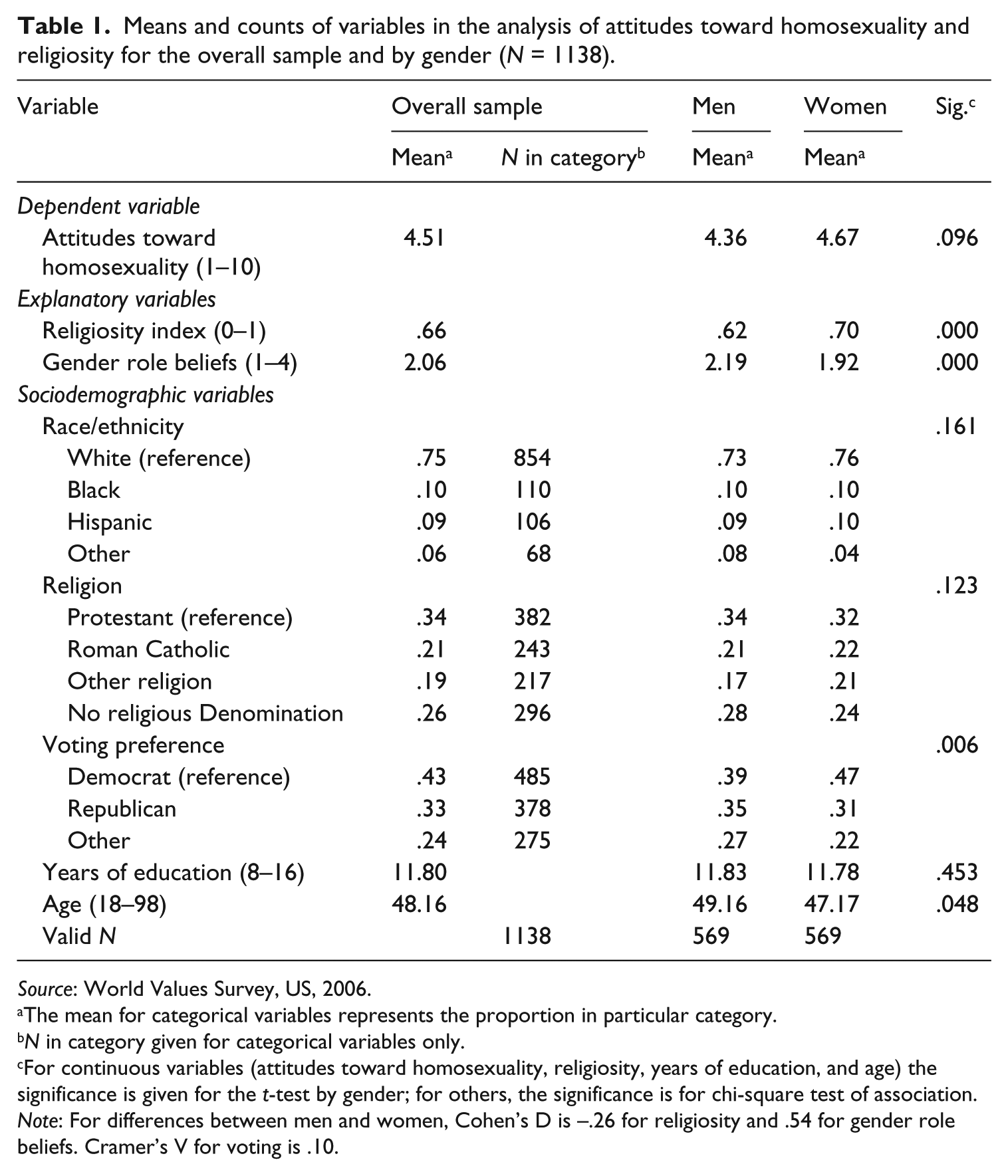
As Table 1 shows, in this sample, 50% of respondents were women. We separated out four racial groups: White (74%), Black (10%), Hispanic (10%), and ‘other’ race, including mixed race (6%). The average age of respondents was about 48 years old, and the distribution of age among respondents was quite broad (18–98), yielding a standard deviation of 16.96 years. Education was measured as years of education, the average being 11.8 years (high school education). Voting preference separated respondents into three categories: Democrat (43%); Republican (33%); and ‘other’ (24%). We expect that younger, more educated, and those leaning toward Democrat hold more positive attitudes toward homosexuality.
Means and counts of variables in the analysis of attitudes toward homosexuality and religiosity for the overall sample and by gender (N = 1138).
Source: World Values Survey, US, 2006.
The mean for categorical variables represents the proportion in particular category.
N in category given for categorical variables only.
For continuous variables (attitudes toward homosexuality, religiosity, years of education, and age) the significance is given for the t-test by gender; for others, the significance is for chi-square test of association.
Note: For differences between men and women, Cohen’s D is –.26 for religiosity and .54 for gender role beliefs. Cramer’s V for voting is .10.
There are very few missing data in this study. In fact, it is the dependent variable, attitudes toward homosexuality, which was missing the most values. Out of a total sample of 1249 respondents, values for attitudes toward homosexuality were missing for 74 cases (5.92%). Incidentally, no patterns exist in regard to the missing values for the dependent variable. The survey data for respondents’ age, gender, and religious denomination were all 100% complete. The only two explanatory variables that were missing any values are the indicator for religiosity, which was missing a total of 10 cases (.8% of the total sample) and gender role beliefs (1.44% of cases). Of the 10 cases in which religiosity was not reported, six were of those individuals who reported not belonging to any religious denomination. These may not necessarily be true missing cases; rather, they could simply be miscoded zeros on the religiosity scale. Considering there are so few missing cases in this study, listwise deletion was utilized with no imputations. The final sample size used in the analyses is 1138.
Method
The first two sets of hypotheses (H1a; H1b; and H2) were tested using interaction terms in linear regression: an interaction term between gender and race and an interaction term between gender and religiosity predicting attitudes toward homosexuality. The last hypothesis was treated as a mediation test in linear regression (we used the Sobel–Goodman mediation test in Stata).
Results
Bivariate analyses
As a first step in our analysis, we explore the bivariate relationships between our independent variables and attitude toward homosexuality. Based on a t-test, women express only slightly more positive attitudes toward homosexuality than men (p < .10) with means of 4.67 and 4.36 respectively (Cohen’s D is .10; standard deviation of 3.26 and 3.19, respectively). However, attitudes toward homosexuality do not seem to vary by race (insignificant F-statistic from ANOVA test; F = 1.24, p < .292).
Religion does seem to affect attitudes toward homosexuality. One-way analysis of variance yields a significant F-statistic (F = 19.10, p < .001), indicating that some religious groups have more negative attitudes toward homosexuality than others. Based on a Bonferroni test, those who identify as Catholic and those who do not identify with any religious denomination maintain more positive attitudes toward homosexuality than Protestants (all p-values lower than .001 except for p < .01 for the comparison between Roman Catholic and ‘no religious denomination’). Participants with no religious denomination, with a mean value of 5.50 (SD = 3.24), reported the most positive attitudes toward homosexuality (but not significantly different from Roman Catholics). On the other end of the spectrum, Protestant respondents showed the most negative attitudes with a mean of 3.78 (significantly lower than the attitudes indicated by Roman Catholic respondents and those with no religious affiliation; SD = 3.11).
A significant correlation coefficient (r = –.42, p < .001) indicates that religiosity and attitudes toward homosexuality have a strong negative correlation. In other words, those who claim greater religiosity are likely to express negative attitudes toward homosexuality. Age is also negatively correlated with attitudes toward homosexuality (r = –.12, p < .001), but to a slightly lesser extent than religiosity (a Fisher r-z transformation was conducted to confirm that there is a significant difference between these two correlation coefficients). It is important to point out that age and religiosity are positively correlated with one another (r = .13, p < .001), indicating that older people have gradually higher religiosity levels than their younger counterparts. As for gender role beliefs, the more traditional gender role beliefs one has, the more negative one’s attitudes toward homosexuality (r = –.34, p < .001). Consistent with prior research, the more education one has, the more positive one’s attitudes toward homosexuality (r = .19, p < .001).
Finally, voting preference is also related to attitudes toward homosexuality (ANOVA F = 42.67, p < .001). Based on a Bonferroni test, those who prefer to vote Republican conveyed, on average, the most negative attitudes toward homosexuality with a mean of 3.33 (significantly lower than the attitudes for Democrats – mean of 5.25; and ‘other’ – mean of 4.84; p < .001; SD = 2.80). There is no significant difference in attitudes toward homosexuality among those indicating a preference to vote Democrat or ‘other’ (the ‘other’ category also includes those with ‘independent’ voting preferences).
Regression analyses
We employed linear regression analysis with ordinary least squares (OLS) estimates and conducted nested models including interaction effects with gender to disentangle the gender and race and gender and religiosity effects on attitudes toward homosexuality. We used an interaction effect between gender and race to test the intersectional hypothesis that Black men will report the most negative attitudes toward homosexuality among all gender/race combinations (H1a and H1b). The interaction effect between gender and religiosity shows us whether religiosity has a greater effect on men’s attitudes toward homosexuality than women’s (H2). Finally, we also used a mediation test to estimate whether gender role beliefs explain the difference between men’s and women’s attitudes toward homosexuality (H3).
Considering that all data in this study are cross-sectional, caution should be exercised in terms of assuming causality. We also conducted tests of multicollinearity: there are no issues of multicollinearity among the variables in any model in this analysis. The lowest levels of tolerance are .45 to .46 for the ‘gender × race’ interaction terms (H1a) and .42 for the ‘gender × religiosity’ interaction term (H2). The lowest tolerance for the main effects (without interaction terms) in the model is .53 for no religion. All of these are high enough not to warrant concern (Hamilton, 1992). We should note that separate tests for curvilinearity (using dummy variables as well as ‘squared’ variables) concluded that age and education do have a linear effect on attitudes toward homosexuality.
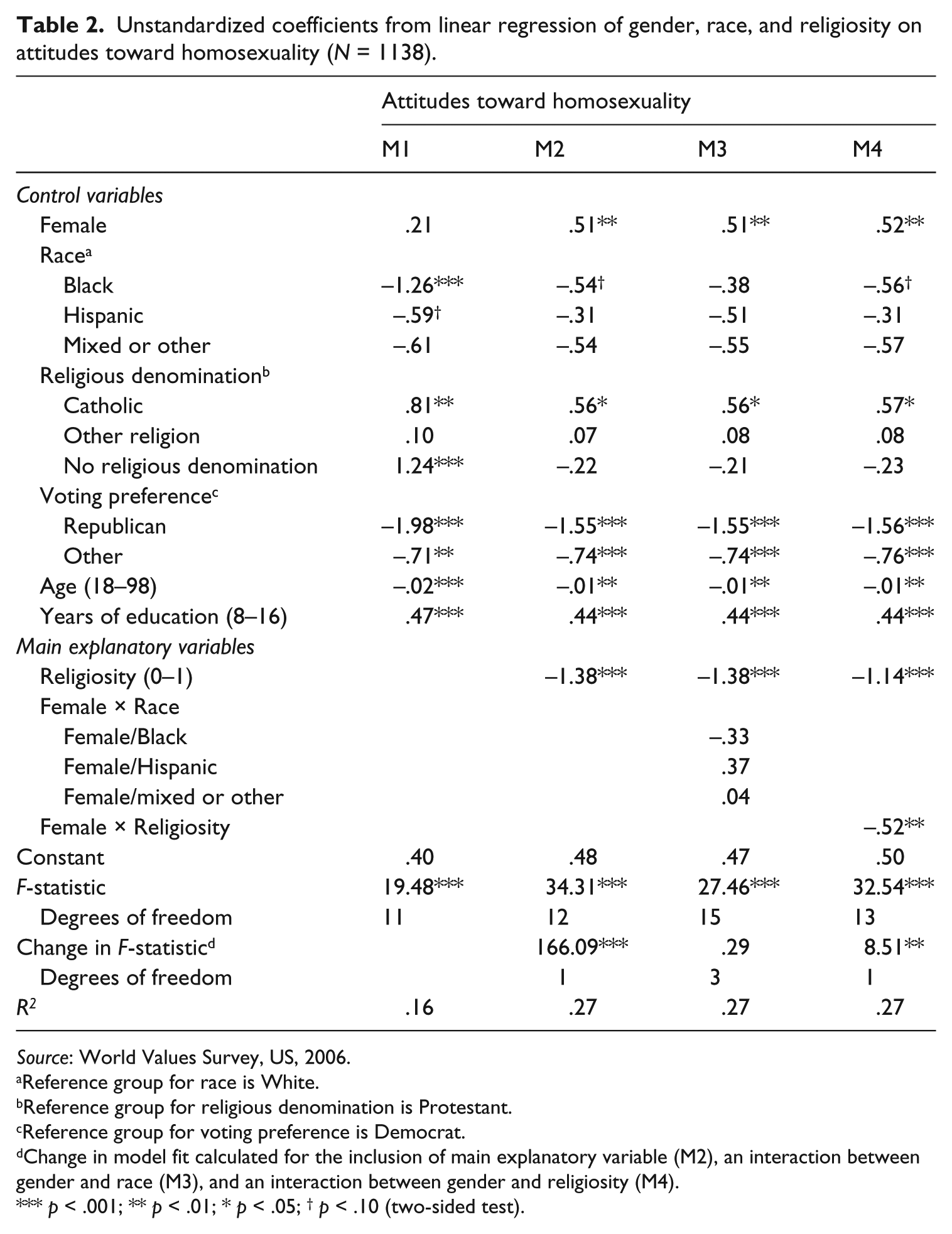
Four different nested models were estimated (see Table 2). The first two models focus on direct effects (effects considered in previous literature), while models 3 and 4 test our hypotheses (H1a; H1b; and H2). Model 1 includes all of the main effects except religiosity; model 2 adds religiosity index as an independent variable. Adding religiosity to the model improves the model fit significantly (change in F-statistic = 166.09, p < .001). The higher the religiosity, the more negative the attitude toward homosexuality (p < .001). For each point increase in religiosity, respondents’ attitudes toward homosexuality decrease by 1.38 points (p < .001). This distinction lies as the single, largest determinant of attitudes toward homosexuality in this model (religiosity has the largest standardized coefficient at –.4, compared to the next largest of .17 for education).
Unstandardized coefficients from linear regression of gender, race, and religiosity on attitudes toward homosexuality (N = 1138).
Source: World Values Survey, US, 2006.
Reference group for race is White.
Reference group for religious denomination is Protestant.
Reference group for voting preference is Democrat.
Change in model fit calculated for the inclusion of main explanatory variable (M2), an interaction between gender and race (M3), and an interaction between gender and religiosity (M4).
p < .001; ** p < .01; * p < .05; † p < .10 (two-sided test).
There are several differences between model 1 and model 2 showing that without controlling for religiosity one can misinterpret the effects of the main demographic variables. Gender is insignificant in model 1 but becomes significant once religiosity is controlled for (p < .01). This provides some evidence that gender differences are related to the effects of religiosity on attitudes toward homosexuality.
The second major difference between model 1 and model 2 pertains to race effects. In model 1 Black and Hispanic respondents reported, on average, more negative attitudes toward homosexuality than White respondents (significance levels of p < .001 and p < .10 respectively). Black respondents, reporting on average 1.26 points less on the 10-point attitudinal scale than their White counterparts, conveyed the most negative attitudes toward homosexuality (std. coef. –.12). Once controlled for religiosity, race becomes less significant. Of all the racial/ethnic groups included, only Black respondents maintained any level of significance after the inclusion of religiosity (p < .10). This decrease in significance provides support for Lemelle and Battle’s (2004) finding that religiosity is the prime factor in explaining the attitudes of Black men.
Among religious denominations, Catholics showed more positive attitudes toward homosexuality than Protestants. Catholics report .5 points higher attitudinal scores than Protestants (p < .05; std. coef. .07). Those with no religious denomination and those of ‘other’ religious groups are statistically no different from Protestants in terms of attitudes toward homosexuality.
Voting preferences and age have consistent effects across all models. Voting preferences were originally included under the assumption that they may be tied to religiosity, but this appears not to be the case. Rather, voting preferences are nearly equally significant across all models (regardless of the inclusion of religiosity). Respondents who indicated a Republican voting preference or a preference for voting ‘other’ reported significantly more negative attitudes toward homosexuality than the Democratic reference group (p < .001 for both).
Age is negatively correlated with attitudes toward homosexuality. Individuals’ attitudes toward homosexuality decrease by .01 (p < .01; std. coef. –.07) for each additional year in age (that is, they get more negative with age). In other words, based on this model, on average, a 70-year-old man would report attitudes equivalent to half a point less on the scale than a 20-year-old man. Older people typically report more negative attitudes toward homosexuality than do their younger counterparts (Hicks and Lee, 2006), but education can limit the negative effect of increased age (Jenkins et al., 2009). In fact, in the current study education has a stronger effect than age: each additional year of education improves attitudes toward homosexuality by .44 (p < .001; std. coef. .17).
Model 3 in Table 2 adds the interaction effects between gender and race to test our intersectionality hypotheses (H1a and H1b) – expecting Black men to report the most negative attitudes toward homosexuality among all gender/race combinations. We included three interaction terms – one for each of our three race dummies. The inclusion of the gender and race interaction in model 3 does not significantly increase the overall model fit. Therefore, counter to what was hypothesized no significant differences appear among any of the gender/race combinations in this study. Thus, we cannot conclude that race has any differential effect on attitudes toward homosexuality for men or women. Women across all races have more positive attitudes toward homosexuality than men. Blacks have somewhat more negative attitudes toward homosexuality than Whites (regardless of gender), however, this result is only marginally significant (p < .10). Thus, the intersectionality of different social positions in terms of gender and race does not matter for attitudes toward homosexuality once we control for religiosity.
Model 4 adds an interaction effect between gender and religiosity (improving the model fit significantly, change in F-statistic = 8.51, p < .01). We have already concluded from the results of model 2 that religiosity serves as a significant predictor of attitudes toward homosexuality. The interaction included in model 4 provides evidence that women’s attitudes toward homosexuality are influenced more by religiosity than is the case for men (p < .01). This finding runs counter to our second hypothesis (H2) – that religiosity has a greater effect on men’s attitudes than women’s for all racial groups. Each additional point on the importance of religiosity reduces men’s attitudes toward homosexuality (making them more negative) by 1.14 (p < .001); however, it reduces women’s attitudes toward homosexuality by 1.66 (additive of unstandardized coefficients: (–1.14) –.52 = (–1.66)). Thus, while women in general hold more positive attitudes toward homosexuality, being religious reduces women’s attitudes significantly more so than men’s. To better illustrate the interaction effect, we calculated the predicted values based on model 4 of Table 2 (see Figure 1). In particular, women who are not religious have more positive attitudes than non-religious men (8.03 vs. 7.51), while there no difference in attitudes toward homosexuality among the most religious men and women (both predicted values on homosexuality scale are 3.87).
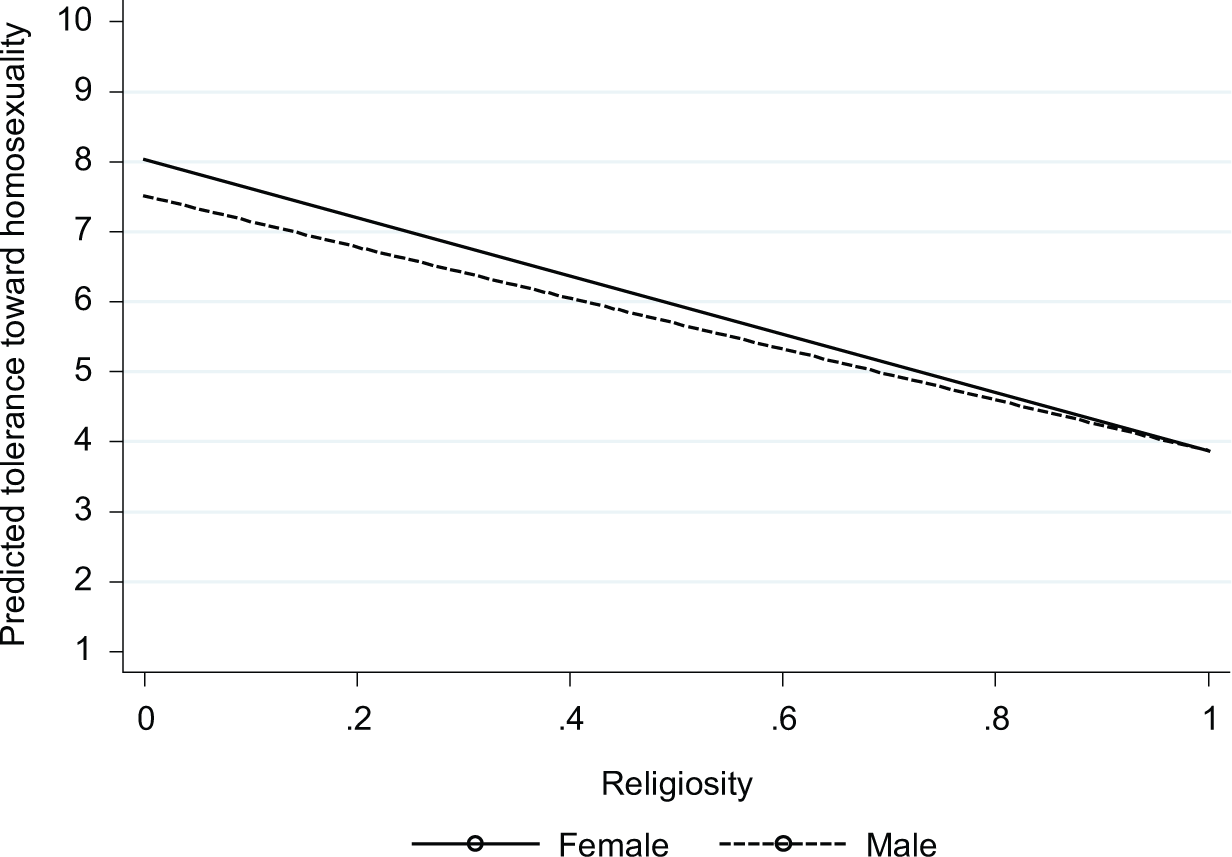
Predicted values from religiosity and gender interaction effect (based on model 4 in Table 2) (N = 1138).
To test our final hypothesis (H3) that the gender differences in attitudes toward homosexuality are explained by differences in traditional gender role we performed a Sobel–Goodman test (sgmediation command in Stata) while controlling for all the other direct effects listed in Table 2, model 2. Since the effects of control variables replicate results already presented in Table 2 we present the Sobel–Goodman test results in a simplified figure (see Figure 2; full results available from authors on request).
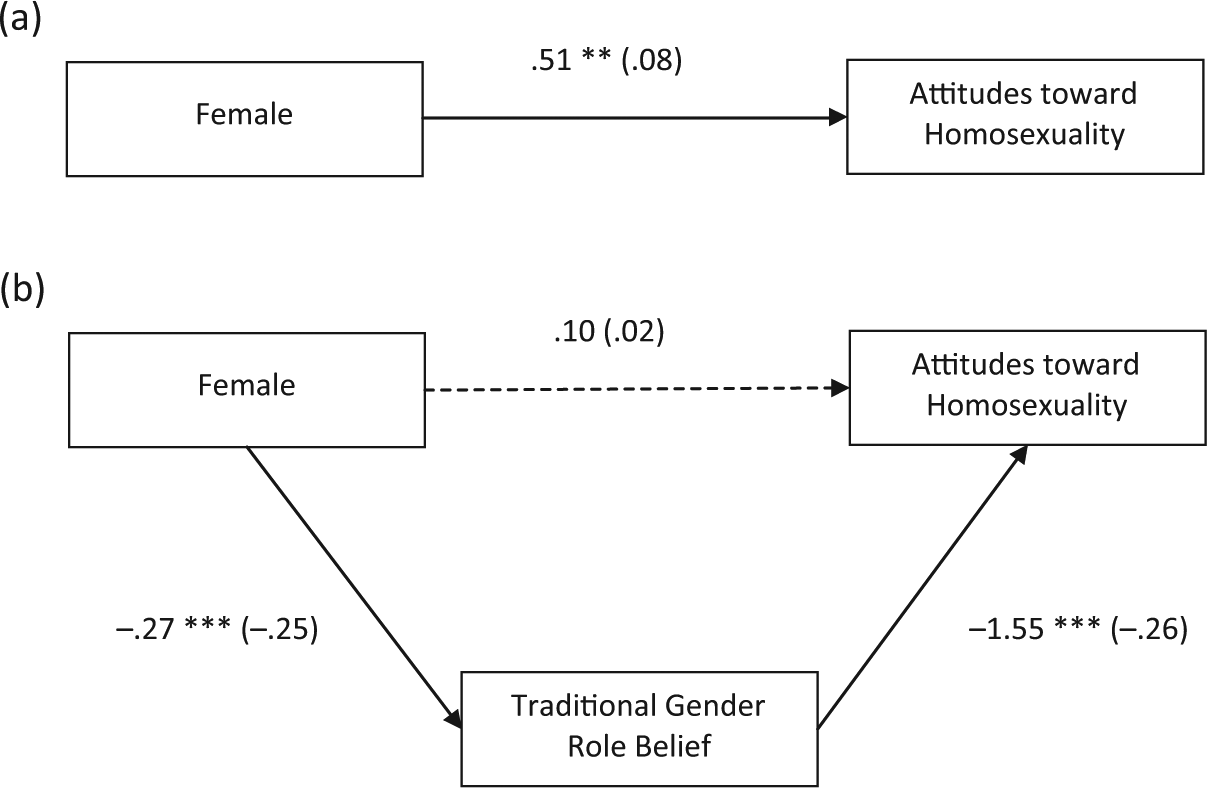
Sobel–Goodman mediation test: traditional gender role belief mediating gender effect on attitudes toward homosexuality, unstandardized (and standardized) coefficients (N = 1138).
Panel (a) shows the gender effect without controlling for gender role beliefs (the same as in model 2 of Table 2). Panel (b), however, demonstrates that this significant gender effect disappears (p > .5) once we control for gender role beliefs. Based on the Sobel–Goodman test, 81% of the total gender effect on attitudes toward homosexuality is mediated by gender role beliefs. This means that most of the difference between the attitudes toward homosexuality held by men and women is explained by women having less traditional gender role beliefs than men (unstd. coef. –.27; p < .001). Furthermore, having traditional gender role beliefs decreases one’s attitudes toward homosexuality (unstd. coef. –1.55; p < .001). Thus, our last hypothesis (H3) finds support.
Discussion
In the present study, a series of hypotheses were tested in order to understand the differences in gender effects on attitudes toward homosexuality. We specify the intersectionality of gender and race (H1a and H1b), show how religiosity has a different effect on men and women (H2), and finally, show that most of the gender differences in attitudes toward homosexuality are explained by gender role beliefs (H3). Gender differences have already been well documented, as have the effects of religiosity on attitudes toward homosexuality. The combined effects of gender, race, religiosity, and gender role beliefs are much less understood.
The first hypothesis of the current study emphasized the importance of intersectionality: that Black men would have the most negative attitudes (H1a) followed by men of other racial groups (H1b), and then women of each racial group. However, the interaction terms between gender and race were insignificant. This initial result is, statistically, insignificant – but still substantively significant and therefore important (Grady, 1998). The finding itself serves as a clear challenge to the notion of essentialized racial differences in attitudes toward homosexuality. Blacks do hold more negative attitudes toward homosexuality than Whites and non-White Hispanics, when analyzed free of control variables and as a monolithic category. But the inclusion of other explanatory variables (namely religiosity) and various controls considerably diminishes the apparent significance of race in predicting attitudes toward homosexuality. In other words, if Black men do maintain more negative attitudes toward homosexuality, it appears to be simply a function of their religiosity (Shulte and Battle, 2004).
Future research should ascertain the combined interaction of race and religiosity on attitudes toward homosexuality in order to better understand the heightened influence of religiosity on Black men’s attitudes toward homosexuality. In terms of gender, the clearest conclusion we can make is that, across all racial groups and consistent with previous literature, women in general tend to have more positive attitudes toward homosexuality than men. In addition, there is some indication that Blacks tend to have more negative attitudes toward homosexuality than respondents from other racial groups (regardless of gender), but this result is only marginally significant. Considering common rhetoric that the Black community contains a heightened level of homophobia, these findings suggest what Douglas (2004) and Hill (2013) propose – that the level of homophobia in the Black community may well be exaggerated.
The interaction effect for gender and religiosity provides a different look at intersectionality, emphasizing religiosity as a social category. We find that that women’s attitudes toward homosexuality are influenced more by religiosity than men’s. This finding contradicts the second hypothesis (H2) that religiosity has a greater effect on men’s attitudes than women’s for all racial/ethnic groups. It also contradicts previous findings by Herek (1988) and Lemelle and Battle (2004) that religiosity has a greater impact on men’s attitudes than women’s. Our finding serves as a strong indication that, among a racially diverse nationally representative sample, religiosity has a greater (negative) effect on women’s attitudes than men’s attitudes. The heightened impact of religiosity on women’s attitudes toward homosexuality (when compared to men) could be attributed to a relationship between religiosity and traditional gender roles beliefs. Among women in the current study, the correlation between religiosity and gender role beliefs is significant at p < .001 – but only at the p < .05 level for men. Thus, women with low religiosity do not report adhering to traditional gender norms, while women with high religiosity are more likely to mirror the belief in traditional gender roles seen among most men. Evidence for this interaction appeared in a recent study by Norton and Herek (2013), who found that the association between religiosity and attitudes (in their case, toward transgender people) was significant only for women (p < .001). Further, they found that the correlation between religiosity and traditional gender roles beliefs was highly significant for women and not significant for men. Considering how gender role beliefs mediate the effects that gender has on attitudes toward homosexuality, this interaction helps explain why the gender gap in attitudes closes as religiosity increases (see Figure 1).
Finally, the mediation test showed that most of the gender differences in attitudes toward homosexuality are explained by differences in traditional gender role beliefs between men and women (H3). Men tend to have more traditional gender role beliefs than women and, therefore, maintain more negative attitudes toward homosexuality. A total of 81% of the difference between men’s and women’s attitudes toward homosexuality is accounted for by differences in gender role beliefs. This finding is supported by previous research that also finds gender differences in attitudes toward homosexuality to be predominantly (and potentially entirely) explained by differences in gender role beliefs among women and men (Kerns and Fine, 1994; Nierman et al., 2007; Whitley and Ægisdóttir, 2000). Whitley and Ægisdóttir (2000) even confirmed the direct link between gender role ideology and attitudes toward homosexuality by controlling for a generalized conservative belief system. Whereas prior studies have utilized samples of college students, the advantage of the current study is that our finding is based on a generalizable, nationally representative sample.
One important limitation of the current study is the fact that the dependent variable (attitudes toward homosexuality) consists of a single survey item. The World Values Survey includes only a single measure of this topic. However, this singular indicator has yielded valid results across other studies scrutinizing attitudes toward homosexuality (Adamczyk and Pitt, 2009; Rayside, 2007). It would be ideal to locate and utilize a national dataset that includes enough relevant survey items to justify an index that represents attitudes toward homosexuality. Such would allow for a better determination of reliability in measurement, and it would tap into more dimensions of this attitudinal construct. Another limitation is the relative datedness of the dataset employed in the current study. A sixth wave of the WVS is predicted to be released in April 2014 which will serve as an excellent opportunity to extend the current study. Attitudes toward homosexuality continue to improve in the US (Andersen and Fetner, 2008; Loftus, 2001), so many of the relationships found within the 2006 data may shift in subsequent waves of data.
A final limitation of the current study is that the analyses establish only that there is a relationship between variables. It is more difficult to establish causality (i.e., that heightened religiosity contributes to negative attitudes toward homosexuality, etc.). Future research should consider conducting a path analysis similar to that found in Brown and Henriquez (2008) using longitudinal data in order to map out and scrutinize the directional flow between a variety of factors and attitudes toward homosexuality. The difficulty in conducting such a path analysis is that they often require the collection of original data which is typically restricted to a regional sampling frame.
Outside of the primary hypotheses and subsequent findings of this study, there are a number of other noteworthy trends and outcomes. Based on the current study, religiosity serves as a significant indicator of attitudes toward homosexuality on all accounts. Individuals who report having high religiosity consistently express more negative attitudes than their minimally religious counterparts. The attitudes of women appear to be substantially more influenced by religiosity than men. An interesting finding is that religiosity appears to serve as a mediator in the influence of age on attitudes toward homosexuality. Put more succinctly, as age increases so does religiosity. Without longitudinal data we cannot conclude that individuals’ religiosity increases as they age – we can only conclude that older respondents in the WVS report significantly higher levels of religiosity. Future research should investigate the influence of age on religiosity in order to further differentiate its effects on attitudes.
In summary, the combined effects of gender and race did not serve as significant predictors of attitudes toward homosexuality. However, the combined effect of gender and religiosity substantiated claims that the effect of religiosity on attitudes does vary by gender. Women’s attitudes toward homosexuality were significantly more likely to be influenced by religiosity. Finally, we find that most of the gender differences in attitudes toward homosexuality are explained by differences in gender role beliefs among men and women. A greater understanding of the role these factors play in determining attitudes toward marginalized groups and issues of social justice can make an important contribution to the understanding of the processes of social change. On a national level, attitudes toward homosexuality are closely related to the presence or absence of legal protections for same-sex couples (Rayside, 2007). Further research concerning the dynamics between individual attitudes and stated perceptions could contribute greatly to our understanding of why people do or do not support various legal issues that involve homosexuality.
Footnotes
Funding
This research received no specific grant from any funding agency in the public, commercial, or not-for-profit sectors.