



Abstract
This article analyses the redefinition of global discourse in semi-peripheral settings; it proposes a model for the semi-peripheral recontextualization of critical discourses originating from the western core of the global intellectual system. The process of redefinition of global discourses in semi-peripheral settings appears to involve their parallel appropriation by actors whose positions can be reconstructed through Bourdieu’s field concept, in particular through the usage of his theory of cultural capital in the field of contemporary Polish sociology. The model presented in the article emphasizes a strong homology between the political field and the broader field of social sciences in peripheral countries. It appears that they are usually structured according to specific peripheral pro- vs anti-centre cleavages. Peripheral fields of power, which are organized around this binary logic, tend to produce specific, often contradictory, parallel redefinitions of western critical theory. Meanings become politically defined and distant from their original context. One of the paradoxical effects of these mechanisms is that the concepts which originally emerge as critical theory, in a semi-peripheral context, are often used in legitimization of and as apology for a neoliberal social order.
Introduction
In this article we want to present a model of reception of critical theory and, more generally, of global intellectual ideas in semi-peripheral settings. Our model is based on Pierre Bourdieu’s theory, in particular his notion of field of power, which is understood to be a central social structure of any society and a new label for what is traditionally called the ruling or dominant class. At the same time, we use Bourdieu’s theory of cultural capital as a case study to illustrate the function of our model. The reception of the theory of cultural capital in Poland is analysed as a specific case of critical discourse, moving from core areas to world semi-peripheries and used in social struggles. We have arbitrarily selected this concept because its uses in Poland may indicate a perfect illustration of the mechanisms of redefinition of a much wider spectrum of discourses imported from the global core. The present global prestige and significance of Bourdieu’s theory are of importance here, which makes reference to it very common in modern sociological discourses.
Bourdieu’s theory is treated here not only as an explanatory tool, but as an object of analysis. More specifically, we point out the social conditions in which the strategic use of critical discourse in semi-peripheries is taking place. Our model is based on assumptions made by world-systems theory and refers to earlier findings concerning the process of the global circulation of ideas. However, it extends beyond the simple paradigm of diffusion of innovations from the core to semi-peripheries. In particular, we link patterns of the application of western critical thought to structures of (semi-)peripheral intellectual and political fields following their conceptualizations proposed by Bourdieu. Our approach constitutes an innovative attempt at extending world-systems theory by combining it with Bourdieu’s concept of the field, in particular, the field of power.
Fields are treated here as fundamental social contexts of symbolic production, therefore their shape and complex structural location have a strong influence on the meaning of any discourses and ideas, including scientific and critical theories. Our main thesis is that (semi-)peripheral fields of power are organized around a different principle than fields of power of the core countries and this observation allows us to explain not only specific uses of ideas but, subsequently, the nature of hierarchies and directions of key social struggles (political, scientific, economic, etc.) in (semi-)peripheral conditions.
What is even more important is that by using this model we are able to explain a paradoxical situation observed at the semi-periphery: the usage of original critical discourse by local sociologists for legitimization of the social order and naturalization of its hierarchies.
Poland and the Polish sociological field, in particular, seem to be a good example of the above mentioned processes taking place in (semi-)peripheries. In view of Wallerstein’s model (1974), during the period of emergence of the world-system (16th century), Poland could be seen as a paradigmatic case of a peripheral region. In the 19th century, and after regaining independence in 1918, Poland became part of the European semi-peripheries. The communist regime reinforced this condition and resulted in a paradoxical ‘double dependence’ of the region – both on the Soviet Union and, at another level, on core countries. Thus Poland, as a relatively large dependent country, seems to illustrate well the effects of global pressure on peripheral regions of the world-system. For this reason the findings presented in this article, which are based on the example of Poland, seem to be of relevance (with necessary modifications) to other dependent regions of the world, including semi-peripheral and peripheral areas. As it appears, most (semi-)peripheries are characterized by tension and even conflict between ‘globally’ oriented (cosmopolitan) and ‘locally’ oriented actors, a cleavage which, as we will show, redefines the key relations of power there.
Circulation of ideas and the peripheral field of power
Most applications of Bourdieu’s theory concern specific national contexts, for instance the analyses of the class system in France (Bourdieu, 1984) or Great Britain (Bennett et al., 2009), the French field of fashion (Bourdieu, 1993), etc. In this text, an attempt is made to apply Bourdieu’s methodology to study symbolic relations on an international level. For our case study we have selected the Polish intellectual field, in particular its sociological sector. As we will argue, the pattern of structuration observed in the field of sociology is homologous with other fields (religious, political, economic, etc.) and the whole peripheral field of power as well.
Bourdieu himself mentioned several important characteristics of the global movement of ideas (Bourdieu, 1990a). In particular, he pointed out the common phenomenon of taking ideas out of their original context and putting them into fields where they are adapted without knowledge of their origin. As Bourdieu argued, in new contexts foreign ideas are usually employed in completely new struggles. At the same time, Bourdieu stressed the importance of the role of gatekeepers, possessing the power to arbitrarily select ideas from their original fields and using them in new contexts. The diffusion of Bourdieu’s ideas has already become a topic of specific studies (e.g. Miller, 2003; Sallaz and Zavisca, 2007). Other authors, using different theoretical tools, have also demonstrated interesting examples of the movement of ideas from the core to peripheries (Bockman and Eyal, 2002; Fairclough, 2006). While the above works offer useful insights into the process of dissemination of ideas, they usually rely on a very generalized view of the process of recontextualization of ideas, in particular in peripheral areas. In our study we would like to offer a much more specific model of the reproduction of discourses originating from the core of the world-system (or the centre) in semi-peripheral settings. To achieve this aim we have adapted Pierre Bourdieu’s approach to the context of world-systems theory. Following Pascale Casanova (2004), we see the world-system as a space with an objective hierarchy/continuum extending from the dominant core to dominated regions, both in terms of economic and cultural relations. Such a space is complex and cannot be reduced to political or economic power. The world-system consists of many overlapping, but relatively independent, spaces (global literary field, scientific field, economic field, etc.) with their own struggles and hierarchic structures. Drawing on this model, we try to show how meso-structures, that is individual national fields (field of power along with the sociological field and others in the semi-peripheries), are shaped by macro-structures of the world-system and how they influence the patterns of semi-peripheral symbolic production. In other words, we argue that symbolic strategies cannot be understood without determining a national field’s position in a wider hierarchy of the world-system. 1
Thus our findings are based on the observation of the peculiar structure of the field of power in semi-peripheral settings. Bourdieu (1984, 1996) has identified that the main opposition in the field of power runs between the dominant pole of economic capital and the dominated pole of cultural capital and those agents who occupy positions near one or the other pole (with various compositions of economic and cultural capital). The same principle can be found in most specialized fields. Although the most heteronomous fields (such as the artistic field) reverse such an order (‘art for art’s sake’ dominates over commercial art) they do not undermine the general axis opposing economy and culture (temporal and spiritual power), which Bourdieu presents as universal. In our view, however, this axis can be observed primarily as the key axis of fields of power of the core countries of the world-system. As we suggest, the semi-peripheral field of power is usually divided by a cleavage, which is defined by the attitude towards a dominating centre or centres. This line of conflict seems to be a much more important dimension of structure of the field of power at the periphery than the opposition between economic and cultural capital.
As Stein Rokkan (1980) has pointed out, political scenes of the core countries are characterized by political cleavages based on a right vs left dichotomy, which usually have their roots in conflicts sparked by the French national and English industrial revolution. One of these conflicts is the centre–periphery conflict, which appears in two basic forms. In large nation-states, it is based on the opposition between core and peripheral regions. However, inside peripheral states and regions themselves it is usually defined by differences in attitudes towards external domination. The early form of development of political scenes along such lines can be observed in Ireland since the 19th century with its two dominant parties: Fine Gael and Fianna Fail (McAllister and O’Connell, 1984). Russia has developed an intellectual cleavage known as the opposition between Slavophiles and Westerners (Walicki, 1979). Currently, however, we can point to several other countries where typical peripheral centre vs periphery cleavages have emerged. They may also be seen as having been formed in reaction to globalization. Cases from Russia to the Middle East can be quoted in which not only the underlying political stakes are related to cleavages based on attitudes towards the West, but also the same structures are reflected in intellectual fields (e.g. Hanfi, 2011; Zhuravlev et al., 2009). This specific structuration of the peripheral political fields reflects the basic structures of fields of power of peripheral countries. Thus, as we posit, we can usually observe political and public life in the peripheries (including semi-peripheries) to be organized according to such a fundamental centre–periphery conflict. In effect, models of the peripheral field of power, along with other fields (cultural, economic, religious), may be seen as divided between a part closer to the core of the global, capitalist system (in Wallerstein’s sense) and the opposite sector, which keeps a distance or even manifests its direct antipathy to the core. In other words, we can talk about pro-centre and anti-centre positions and, consequently, position-taking in that field. On one side of such peripheral or semi-peripheral fields of power there are those who are western-oriented, ‘modern’, ‘liberal’, while, on the other, there are those who are locally oriented, ‘traditional’, ‘conservative’. Such a cleavage appears not only in the peripheries. A similar conflict between ‘global’ and ‘local’, cosmopolitan mobile elite (Boltanski and Chiapello, 2007) and immobile groups, has been also noted in some of the core countries. Recent research on cultural stratification in Britain and Denmark identified new tensions between dominant cosmopolitan tastes and dominated, local (or national) ones (Prieur and Savage, 2012), which shows not only macro-changes but also suggests a new condition of class habitus formation.
Thus we argue that in order to fully understand the mechanisms of adoption of central ideas in (semi-)peripheral settings one needs to gain insight into the workings of (semi-)peripheral systems of fields and their logic of symbolic production.
The semi-peripheral Polish sociological field is a good case for two main reasons. First, Polish sociologists are very active in the national public sphere. One can even argue that they co-created the new social order during the transition period (after 1989), in particular by legitimizing a new political and economic system. Second, specific semi-peripheral conditions make the linkages of the above mentioned processes to the global mechanisms in Poland quite visible. Thus, the Polish sociological field may be seen as what has been defined by Bourdieu (following Bachelard) as a ‘particular instance of the possible’ (Bourdieu and Wacquant, 1992: 233). Let us also specify that, following Bourdieu’s insights, we assume that discourses in general are organized around several hierarchical categories (systems of classification), which are, at the same time, symbolic reflections and legitimizations of the hierarchy of a given field.
A semi-peripheral intellectual field: The case of the Polish sociological field today
One should point out several important structural traits of the field of Polish sociology as it has emerged since 1989. First of all, it can be noted that Polish sociology is strongly connected to the political field and, in effect, partly depends on the latter. The main mediator between these two universes is the media field. Numerous Polish sociologists and other social scientists are media stars. Using Burawoy’s (2005) division of the field of sociology into professional, policy, public and critical, it could be claimed that public sociology is very strong in Poland. On the other hand, one may note that a specific form of public sociology dominates, since most Polish sociologists appearing in the media seem to conform to the political doxa developed in the political and media fields and used by journalist to justify or supplement their own claims. In this respect, their discourse may be seen as a form of what Wacquant (2004: 100) calls ‘sociological journalism’ – one of the important tools of legitimization of the current social order. Individual sociologists featured in the media represent clear political options and usually they can be related to specific main political forces at any given moment. At the same time, they are not marginal but, quite the contrary, eminent scholars in the sociological field. Among other factors, this enables us to argue that the Polish sociological field is, to some extent, a structural reflection of the political field. In other words, it is heteronomous towards the political field.
As we have argued, the political field in Poland, like in many other peripheral states, rather than being structured by left vs right logic may be seen as divided between pro- and anti-centre poles. After the communist and early post-communist period, during which time the dominant centre was the Soviet Union/Russia, the main cleavage developed based on different reactions to western domination. Currently this division is represented by the two main political parties in Poland: the ‘liberal’ Civic Platform (PO) and the ‘conservative’ Law and Justice (PiS). Similarly, the Polish sociological field is structurally divided into a western-oriented pole and a locally oriented pole (Figure 1). Because of this proximity between political and sociological fields, scientific struggles often assume political forms while being presented in sociological terms. Due to its strong relationship with the forces of the global core, the western-oriented sector of the sociological field is much more powerful and has absorbed not only the main elements of ‘public’ sociology but ‘professional’ and ‘policy’ sociologies as well. This is very clear in the latter case because numerous Polish sociologists, while trying to supplement their meagre salaries, often work at the same time for state agencies and private companies, including international and local consultancies, which tend to impose their frames of neoliberal orthodoxy. The rhetoric of ‘modernization’ and ‘catching up with the West’ is typical of discourses of these organizations and often legitimizes the imposition of neoliberal institutional arrangements across various social areas. In the social conditions described above, sociology is dominated by normative approaches (in which ideal models are almost always borrowed from the West) and, consequently, there is little space for critical sociology. Critical interpretations of the dominant discourse of ‘modernization’ are usually depicted as ‘anti-modern’ and are attributed to the ‘conservative’, ‘locally oriented’ pole of the sociological field.
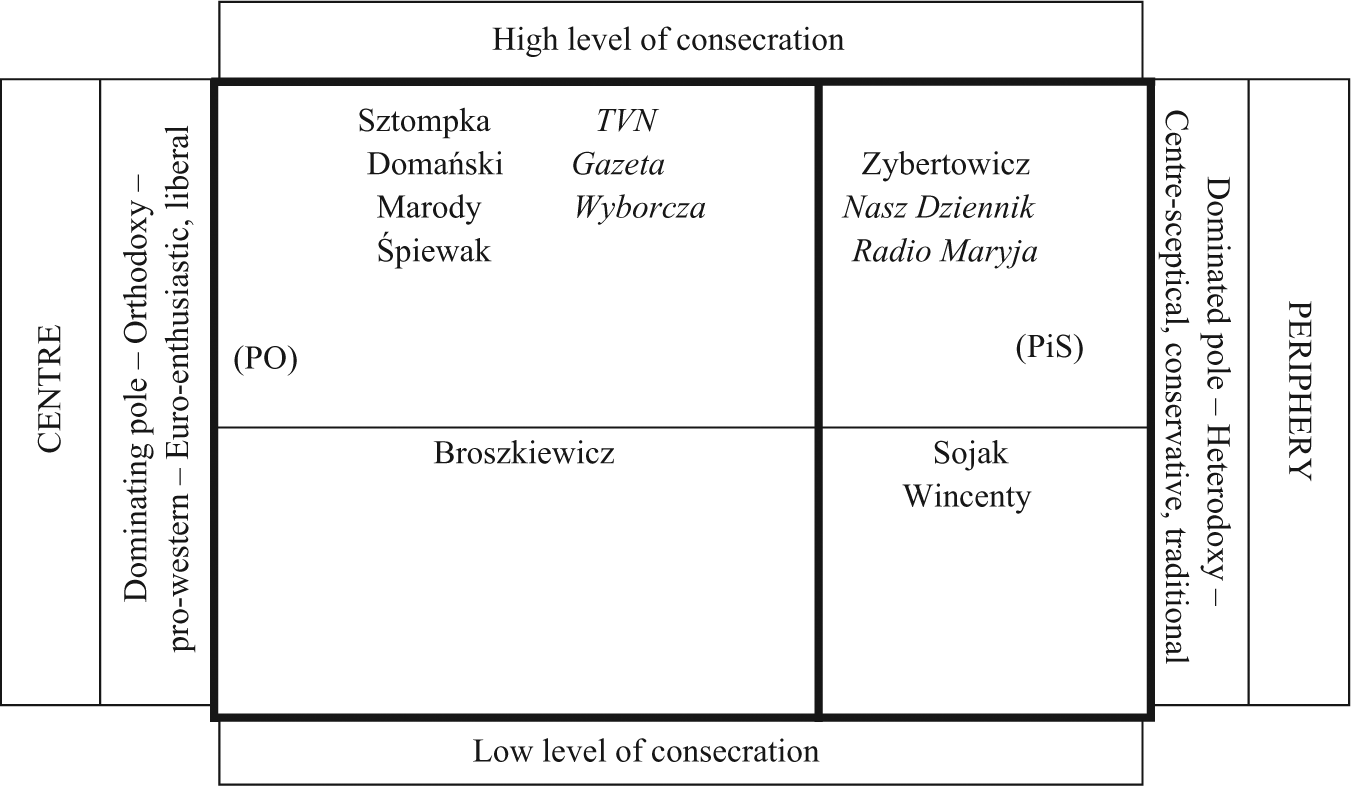
The structure of the Polish sociological field.
At the same time, the academic field, in particular the social sciences, appears to be falling under a growing dependence on the economic field, which happens through the above mentioned dual employment of numerous scholars. This reinforces dependence on the private sector and on state agencies implementing neoliberal reforms, as these institutions create a strong demand for a specific kind of discourse. Therefore, instead of conflicts and tensions between economic and cultural poles in the field of power, which are typical for core countries (Bourdieu, 1984, 1993), we observe symbiotic although unequal cooperation in semi-peripheries between such poles – at least in certain dimensions. Such a tentative harmony also results from a traditional role of the intelligentsia in the periphery. Because of the dominated position of the country, accumulation of local economic capital and development of a native bourgeoisie have always been and still remain difficult (Eyal et al., 1998). Almost a quarter of a century after transition the Polish economic field is divided between dominant multinationals and subordinated small local companies, which have to cooperate with the latter in structurally unequal conditions. In this context, the intelligentsia themselves (and the sociologists among them) aspire to the role of main actor implementing a programme of ‘modernization’ and ‘catching up with the West’, etc. Specifically, this refers to the introduction and legitimization of changes that allegedly bring a peripheral country closer to ‘the West’ (or rather an idealized vision of it) and bridge the gap between the core and periphery. In effect, Polish mainstream social sciences become key providers of academic and intellectual discourse legitimizing neoliberal reforms – becoming, in this way, an integral part of what Drahokoupil (2008) called the ‘comprador service sector’.
In our attempt to reconstruct the logic of peripheral uses of Bourdieu’s theory, which we use here as an example of the use of critical theory in general, we focus exclusively on those Polish scholars who systematically refer to Bourdieu and his analytical terms. Even though his theory is relatively well known in Poland, it is often used in a peculiar way. On the one hand, Bourdieu’s theory may be seen as enjoying high prestige and it is difficult to ignore it in the local sociological field. On the other hand, because of the specific construction of the field, its critical nature appears embarrassing to many Polish sociologists.
Bourdieu’s theory appeared in the Polish sociological field between the 1970s and 1980s. However, it did not result in any creative applications of his models. This can be explained by its potential for demystification, which, if applied to the reality of the communist state, could lead to politically incorrect conclusions. After the transition in 1989, several of Bourdieu’s books were translated into Polish along with a growing stream of publications presenting syntheses of different parts of Bourdieu’s work, usually without any empirical applications in a national context (e.g. Matuchniak-Krasuska, 2010; Sztandar-Sztanderska, 2010). Nevertheless, some prominent Polish sociologists began to use his theory (or rather elements of it) to analyse Polish society. In the subsequent sections we examine both their position-taking and location in particular fields.
Let us emphasize here that we do not treat the scholars we analyse as ‘empirical individuals’ but rather as ‘epistemic individuals’ (see Bourdieu, 1988), that is as selected exemplars of specific positions and position-taking. Their overall status in the field may be defined in terms of the degree of consecration (academic prestige) and amount of scientific capital, measured first by foreign publications and citation patterns. The key dimension of the field is the above discussed opposition between pro- and anti-centre orientation. Figure 1 shows the location of selected Polish sociologists in such a space. On the upper level we find Piotr Sztompka, Henryk Domański, Mirosława Marody and Paweł Śpiewak, who represent pro-centre positions, while Andrzej Zybertowicz, for example, occupies the centre-sceptical sector of the field. Below those figures, who can be seen as the gatekeepers in the field, sociologists with fewer assets of scientific capital are to be found. Of high importance in this context is the fact that the pro-centre sector clearly dominates over the centre-sceptical camp. This is also visible in terms of scientific capital. When looking at the leading figures on both sides of the field, that is on the one hand Piotr Sztompka, and on the other hand Andrzej Zybertowicz, we can clearly see Sztompka’s preeminence both in terms of books published in recognized international publishing houses and journals and in citation statistics.
Looking at the structure of the field, we can easily see pro- or anti-centre positions of the main actors being reflected both in their scientific stances and in direct and indirect links to individual media outlets. In other words, we can identify homology between the field of sociology and the journalistic field. The latter, just like the political and other fields, is divided unequally into pro- and anti-centre poles. Thus, for example, Andrzej Zybertowicz of the centre-sceptical camp publishes regularly in Nasz Dziennik, a clearly dominated daily (or relatively dominated Rzeczpospolita), but never in dominant (in terms of sale and prestige) newspapers like Gazeta Wyborcza or Newsweek. On the other hand Henryk Domański regularly appears on the private TVN channel and in Gazeta Wyborcza, while never in Nasz Dziennik. This structure is homologous to the political field, with its main axis defined by the contrast between the ruling pro-centre Civic Platform (PO) (a pro-European and liberal party) on the one hand, and the oppositional anti-centre Law and Justice (PiS) (an anti-centre, Euro-sceptical conservative party) on the other hand. Sociologists, through their political or political-sociological stances expressed in the media, support one or the other political party. However, they sometimes take on political roles directly. For instance, Zybertowicz became actively involved in work in the political field as a key adviser to leading politicians of the PiS Party. In other words, subordinate positions of the centre-sceptical sociological camp and the dominant location of the pro-centre sides are also manifested in the media and in political fields. 2
Strategies of orthodoxy
The key tenets of the mainstream discourse of Polish sociology and, at the same time, a particular usage of Bourdieu’s theory in the post-communist period can be illustrated by using selected writings of Piotr Sztompka, arguably one of the most eminent, internationally recognized contemporary Polish sociologists. Sztompka, as we have mentioned above, represents the pro-centre position in the Polish sociological field. Thus, one of the main lines of reasoning of Polish sociology post-1989, which is particularly visible in Sztompka’s writings, is the divide between the so-called winners and losers of the post-communist transformation. Just as in the Kabyle house, where the central opposition of male/female organized the whole symbolic classification (Bourdieu, 1990b) and a dichotomy of past/future was the basis of other oppositions (Bourdieu and Boltanski, 1976), so too the hierarchical pair of winners/losers has been a fundamental frame in the dominant sociological discourse explaining and legitimizing the transition in Poland.
With the evolution of the dominant political cleavage in Poland from post-communist (produced by Soviet domination) to western oriented, this dichotomy has been supplemented by new categories like modern/traditional (populist) or pro-European/anti-European and others, but always according to the same binary code. The ‘losers’ are usually described in terms of their inability to adapt to new social and economic circumstances. Sztompka came up with one of the most influential proposals of looking at ‘losers’ in terms of what he called ‘civilization competence’. His basic definition of the concept was that it should be understood as a ‘complex set of rules, norms and values, habits and reflexes, codes and matrixes, blueprints and formats – the skillful and semi-automatic mastery of which is a prerequisite for participation in modern civilization’ (Sztompka, 1993: 88). Simultaneously, he used his notion of ‘civilizational competence’ interchangeably with one of ‘cultural capital’ (Sztompka, 2000). For Sztompka, the value of this capital is not the object of a symbolic struggle but is determined in a highly arbitrary way as a set of features attributed to an idealist vision of western (or even American) culture (cosmopolitanism, tolerance, professionalism) (Sztompka, 1993: 89). Most importantly, Sztompka’s diagnosis, which links the sources of success of winners of the transformation to their high assets of cultural capital, is presented as a legitimization of their privileged status, rather than its deconstruction or critique.
A similar conceptualization can be found in Henryk Domański’s work. Domański usually uses an approach based on a general functionalist vision of the social world but, in several of his works, he makes reference to Bourdieu’s terms as well. For instance, when presenting cultural hierarchy in Polish society, Domański (2000) applies the term cultural capital, but without using Bourdieu’s other categories such as symbolic violence. As a result, instead of classification struggle and class conflict in the area of culture (he does not mention hierarchy of tastes), what emerges from his analysis is a functional, conflict-free image of stratification of cultural lifestyles. As a matter of fact, Domański stresses the indirect transfer of cultural capital from families through school. At the same time, however, he applauds the process of matching the level of income with education degrees and the professional position of individuals (one could note that this concerns first and foremost the members of the intelligentsia). Domański sees this process as ‘an increase of meritocracy, that is, a reward for individual “merits”, if we assume, as we do according to most authors, that higher income means adequately higher “merits” …, including skills, talent, professional qualifications and other expenditures of individuals’ (Domański et al., 2005: 21). Domański, in a mode completely different from Bourdieu, not only ignores the role of school in the process of legitimization of social inequalities but, using the authority of science and the argument of ‘meritocracy’, he himself legitimizes these inequalities. Domański justifies them in a functional fashion arguing that ‘it can be said that diversity of income in capitalist society is a functional mechanism making sense of the existence of middle classes’ (Domański et al., 2005: 61). Thus binary representations, descriptive and prescriptive, hidden behind scientific discourse but organizing it imperceptibly are completed by ‘merit’ (talent, skills, etc.) and its absence on the losers’ side. In this way, ‘winners’ deserve their success and, consequently, ‘losers’ are guilty of their failure.
Paweł Śpiewak presents an even stronger naturalization of social hierarchies. Using Bourdieu’s terms (habitus and social classes) Śpiewak presents the good taste of the elite as obvious and self-evident and contrasts it with the bad taste of ordinary people who do not respect the elitist cultural status any more. In contrast to the allegedly intolerant and cynical ‘majority’, who represent asocial individualism, authoritarian and ‘claimant attitudes’ and love kitsch, Śpiewak presents his own group which he calls the ‘post-intelligentsia’. They are, as Śpiewak convinces us, non-conformist and free-floating consumers of rare art. Unlike the others, the post-intelligentsia represent and admire true beauty. Śpiewak describes this group as ‘classy people’ who ‘avoid swank’ and do nothing for show. They do not impress the masses (Domański et al., 2005: 191). In this kind of discourse, we can see a clear effort at purification of the sacred (elite) polluted by the profane (masses).
What is more, scientific legitimization of the new post-communist hierarchies is emphasized by an appeal to naïve evolutionism. For example Sztompka, despite his rhetoric of ‘social becoming’ (Sztompka, 1991), seems to find that history goes from communism to liberal democracy and (American) market economy in a linear fashion and, in this way, the basic pair of opposition winners/losers is homologous to such oppositions as capitalism/communism, future/past and further: collectivism/individualism, egalitarianism/meritocracy, ordinariness/success, certainty and safety/risk, fate/agency, welfare/life, etc. (Sztompka, 2012). The process of change in Sztompka’s model is correlated to, among other factors, a general perspective of a ‘cultural lag’ or ‘cultural inertia’ suffered by the less successful Poles (Sztompka, 2000). Such a view can be related to what Bourdieu describes as ‘implicit evolutionism, which enables the dominant to perceive their way of being or of doing things as the realized ideal’ (Bourdieu, 1984: 384). Furthermore, Sztompka’s binary taxonomy turns out to be the manifestation of the map of neoliberal discourse drawn by Bourdieu and Wacquant (2001).
Naïve evolutionism as a form of legitimization of the hierarchy is clear in the peculiar uses of the term habitus in Sztompka’s and Mirosława Marody’s work. According to Sztompka, the ‘losers’ have ‘socialist habitus’ (Sztompka, 1995) (the meaning of which seems close to ‘mentality’), that is mental habits derived from the communist period. A similar usage of the term habitus, inscribed in the binary code (future) winners/losers, ‘modern’/‘backward’, western/eastern (communist), can be found in the works of Marody. This kind of habitus allegedly includes numerous unfavourable habits (stress on solidarity and collective negotiation, expectations of immediate gratification, etc.) that hamper the development of a capitalist economy and liberal democracy (Marody, 1991). In fact, Marody, just like Sztompka, changes Bourdieu’s materialist anthropology into an idealist anthropology, underlining the ‘subjective’, non-material dimension of habitus. Both completely ignore the dimension underlined strongly by Bourdieu (2000). Emphasis on the cultural aspects of social life and omission of the material conditions of social practices imply that the position of the losers appears as a result of one’s own misguided choices.
Scholars with a lower amount of scientific capital who use Bourdieu’ theory follow gatekeepers of the local sociological field and include their findings in research. For instance, Wojciech Broszkiewicz (2010) tries to verify whether Polish youth have enough social skills to play the role assigned to them, that of modernizers of Poland. Broszkiewicz uses old modernization theory enriched by notions of an information society (also postmodern society, knowledge-based society, etc.) and its formation – understood to be the main aim of Polish modernization. The author suggests that the achievement of this ‘universal’ aim depends on the level of cultural capital, which he identifies with Sztompka’s ‘cultural competence’. Among abilities and dispositions, which define his ‘cultural capital’ aka ‘cultural competence’, Broszkiewicz includes skills related to new technologies, and attitudes such as openness to new experience, acceptance of change and innovation, readiness of risk-taking, etc. Similar to Sztompka’s interpretation, the value of cultural capital is deduced here from a naïve evolutionist vision of modernization as ‘catching up with the West’. In this way, however, Bourdieu may be shown as compatible with Sztompka’s vision of Polish society presented above, as a binary code based on the symbolic opposition between ‘progressive’ ‘competent’ winners and an ‘incompetent’ majority of ‘backward’ losers.
Thus one can note that scholars who occupy the pro-centre region of the sociological field and draw dichotomous representations based on winner/loser oppositions (along with the whole body of legitimization) relate to two different but connected mental and social spaces – the space of sociopolitical journalism and the academic space of sociology. They draw meanings and terms from both of these sources and create a common discourse in which true political sense is hidden behind a strictly scientific form. Political classifications such as the neoliberal point of view remain misrecognized because of the space of possible sociological stances homologous to them. The latter is manifested in the sociological field and political stances are ‘censored’ in it by the principle of neutral and objective science. Moreover, the opposition between winners and losers of the transition may be seen as a reflection of the field’s structure, divided into pro- and anti-modern parts (pro- and anti-centre). This opposition is applied to the sociological field as well as to the entire field of power (including the political field and the journalistic field which has structures homologous to the sociological field). This may explain how Bourdieu’s theory may be used in such a peculiar, conflict-free way by the pro-centre dominant camp. By imposing their binary representation, dominant actors played an important role in the creation of two opposite groups, the winners and losers of the transformation. Having the symbolic capital of scientific authority, Polish sociologists were able to impose categories of perception, and through them, in an almost magical way, the cultural and economic capital of the winners of the transition (money, credentials, proper taste) became symbolic capital. The simultaneous legitimization of the new social order could also be achieved because sociologists imposed values (for example ‘meritocracy’) that are favourable to the group they themselves represent, that is, first and foremost, the progressive intelligentsia.
A heretical reply
On the other side of the field, which can be called ‘conservative’, anti-centre or centre-sceptical, Bourdieu’s analytical apparatus is used as well. Because this camp is much smaller and its overall role (both in the sociological field and in the field of power in general) is weaker, we dedicate to its discussion less space in this article. The opposition between winners and losers or between competent, innovative pro-Europeans and non-competent, backward Euro-sceptics is, in this case, replaced by the opposition between Polish patriots and cosmopolitan ‘half-Poles’ or even traitors. The pro-European cosmopolitans are usually depicted as not entirely loyal to the Polish nation and actually serving foreign interests – Soviet in the past, Russian and sometimes western in the present. Typically, such sociologists use elements of Bourdieu’s theory to criticize the dominant factions of the elite. However, they do so in specific ways, which are again quite different from Bourdieu’s critiques of French elites. Rather than pointing to the arbitrary character of cultural and economic domination of ‘cosmopolitan’ elites, conservative critiques focus on supposedly hidden post-communist networks and interests of power groups identified as being related to former communist nomenklatura and former secret service agents. In this perspective, these groups have a strong influence on the Polish political and economic field. Andrzej Zybertowicz, one of the leading Polish researchers in this area, argues that such groups originating in the former elites are interconnected through links of political capital accumulated during communist times. Moreover, in his view they have a special kind of cultural capital, which includes, among other things ‘inside knowledge and special intelligence, expertise in acting both on the margins of the law and outside of it; … the habit of treating people as instruments; the capacity to lie convincingly and to recognize lies by others’ (Łoś and Zybertowicz, 2000: 55). This kind of application of Bourdieu’s concepts seems rather restricted and is usually focused on exposing allegedly intentional hidden structures of operation of those elites considered by the author to be related to post-communist and liberal milieus. What is, however, clearly different in this approach is that forms of capital are considered as assets, the nature of which have to be deconstructed rather than as assets legitimizing the status of the elites – as is the case in mainstream discourses.
In an interesting study of the ‘social construction of ignorance’, Zybertowicz’s followers, Daniel Wincenty and Radosław Sojak (Sojak and Wincenty, 2005), use elements of Bourdieu’s theory (of fields and capitals) in their analysis of the symbolic naturalization and concealment of the greatest political and economic scandals in Poland. Their research can be seen as oriented towards demystification of the liberal doxa of the Polish transition – understood as a successful march towards the market economy and liberal democracy. Thus, one could argue that it belongs to critical sociology. However, as we have already mentioned, Zybertowicz constantly emphasizes that social sciences should, above all else, serve national interests. Complaining about the lack of scholar-practitioners working in national think-tanks he asks rhetorically: ‘Has anybody precisely characterized the range of the so-called symbolic violence generated by the multinationals which promote consumer culture and the cosmopolitan system of values?’ (Zybertowicz, 2006). His approach envisages, at the same time, an open reference to core–periphery structures with critical views of core dominance. However, these references are rather occasional and not systematic. In Zybertowicz’s view, it is not Poland’s dependency on the western core that is the key problem, rather it is corruption on the part of the illegitimate elite, whose privileged position can be defined in terms of Bourdieu’s capitals.
Thus, Zybertowicz and his followers with a smaller amount of scientific capital are using a specific selection of Bourdieu’s terms to more generally build their specific variant of ‘national’ critical sociology. These researchers tend to perceive only part of the hidden interests and power relationships. Zybertowicz calls social structures, which are usually at the centre of his interest, ‘anti-development interest groups’ (Zybertowicz, 2005). It should be noted that such a Machiavellian perspective can be seen as ‘negative functionalism’ and, as Bourdieu points out, the principle of sociology is to challenge it, because: ‘[s]ocial mechanisms are not the product of Machiavellian intention. They are much more intelligent than the most intelligent of the dominant agents’ (Bourdieu, 1993: 71). Moreover, scholars working in this paradigm seem to imply that elimination of the groups defined as ‘anti-development interest groups’ would automatically ensure full and just development of the country. Zybertowicz’s insights were popularized by him (he is a very active media commentator) as well as by politicians and journalists occupying homologous positions in the political and journalistic fields. His key concept of ‘układ’ (‘the system’ or ‘plot’, a vague word denoting, in this particular context, an interconnected group of former nomenklatura and communist secret police members and their agents) was used as one of the watchwords in the 2005 successful election campaign of the Law and Justice (PiS) Party. At the same time, it has become an important part of a new right-wing sociodicy, explaining the misery of transition losers. Thus, one could argue that Zybertowicz and his collaborators’ interpretations refer to elements of Bourdieu’s theory. At the same time, they partly legitimize free market ideology and a neoliberal regime by ignoring, in their enquiry, dominating mechanisms of the development of social and economic inequalities.
Simultaneously, the sociological and political actions of this group have some attributes of heresy. They occupy relatively dominated positions in the general field of power and their language is critical towards well-grounded orthodoxy. Thus, they undermine the dominant narrative of successful transformation in Poland or, to put it in other words, they try to reverse the classification system imposed by the dominants. Through this part of the transition winners are depicted as a cunning group that have brought about the misery of the losers.
What is interesting is that the heretical group present not only an opposite vision of social reality but also a different version of the same social theory. Unlike the pro-centre camp, they use the theory with strong emphasis on conflict. We can see it as a ‘field effect’, the consequence of the game in the sociological field itself. It happens because, despite huge dependence on outside forces, the field has a certain autonomy that allows opposites camps to influence each other. It also forces them to use very different forms of the same theory. As a result, the theory itself becomes a political tool in scientific and social struggle.
We have to add that, according to that logic of social struggle, the heretics, as dominated in the field of power, represent the dominated in the general social field. However, in the example presented above, despite a critical stance towards orthodoxy, heretics do not undermine the doxa of transition, that is the self-evident nature of the rule of the free market. It is puzzling why they appear as mostly right-wing oriented. One reason may be that most members of the former communist elite joined the Euro-enthusiastic liberal camp, so their criticism is automatically labelled as right-wing and Euro-sceptical. Another more general reason may be that, given the pro- vs anti-centre division of the field of power, there is no place for the classical western left. Most leftist stances are pushed aside from the field of power, and it remains to be defined by the neoliberal doxa. A homologous situation can also be identified in the Polish religious field where the struggle between pro-centre ‘liberals’ and centre-sceptical ‘conservatives’, also conducted in economic and political terms, has not undermined neoliberal doxa.
Conclusion
As we have argued, typical semi-peripheral uses of nodal discourses imported from the global western centre can be seen as following the dual logic of semi-peripheral fields of power. Thus, discourses originating from the centre may be recontextualized in at least two parallel and usually opposite ways. Such recontextualization works according to the lines of the pro-centre vs anti-centre peripheral cleavages, which are considerably distinct from the classic central cleavages – those which usually emerge in the context of western intellectual and political discourses. A particularly interesting case of the peripheral redefinition of central discourses is the broadly defined set of critical discourses. We have illustrated modes of their appropriation in peripheries through the example of Bourdieu’s analytical terms. Interestingly, his original critical stance defined in terms of western class cleavages gets redefined in two parallel ways in peripheries. First, it is redefined around the fundamental opposition between pro-western, liberal ‘progressive’, ‘modernizers’, and ‘backward’, anti-western ‘traditionalists’. Second, it is redefined around the same code, but as a clash between traitors, cosmopolitan, cynical compradors and traditional, patriotic ‘true national elites’. In the case of the first phase of the post-communist period this was defined as separating out winners from losers of the ‘transition’, liberals from authoritarians (communist, Homo Sovieticus), civic and cultural tastes from populist and rude tastes and normal from abnormal (psychologically and morally).
We have shown that the field of Polish sociology, as one of the fields of symbolic production in the periphery, is divided between pro- and anti-centre (centre/Euro-sceptical) poles, which seems to be a universal pattern for most peripheral fields of power. Of particular importance is that the peripheral field of power appears to have a structure fundamentally different from the one outlined by Bourdieu. In his model, the meta-field of power was divided between the economic (economic field) and the cultural (field of cultural production) poles with several other fields in the middle. Our findings show that similar structures can also be identified in peripheries. However, due to the limited autonomy of individual fields, the pro- vs anti-centre axis turns out to be the crucial dimension of the peripheral field of power. Consequently, that cleavage crossing Bourdieu’s culture vs economy (autonomy vs heteronomy) axis organizes directions and meanings of the main social struggles in peripheries.
There is considerable evidence for our thesis that the same logic of structuration can be seen in many individual fields including the Polish artistic field (cleavage between cosmopolitan and strictly locally oriented art), the journalistic field (with the similar pro- and anti-centre or centre-sceptical structure and classification struggle presented above) and the Polish economic field, which, like other fields in peripheries, is divided into a global pole represented by the multinationals and a local one composed of small and medium size national companies. Moreover, as we have argued, quoting examples from Hungary, Russia and the Middle East (Hanfi, 2011; Molnár, 2005; Vargha, 2010; Zhuravlev et al., 2009), the pro- vs anti-centre cleavage seems to be a universal structure of most peripheral fields – one defining their specific condition of discourse, (re)production and recontextualization. Elena Gapova (2009), in her study of the Belarusian academic field, not only confirms the existence of the same dual structure, but also its parallel usage of selected western critical discourses (e.g. in gender studies). One could note, however, important differences between, on the one hand, countries like Poland, where the pro-western camp is clearly dominant and the anti-centre camp is weak and Euro-sceptical rather than anti-western and on the other hand, countries such as Belarus and Russia. In their cases, the anti-western camps should be considered as dominant as they are centred around strong semi-authoritarian states that control a major part of the local economic resources. Pro-western forces in these areas can be considered as dominated. Nevertheless, in all these countries the main pairs of oppositions (the hidden codes that organize the whole discourse and create the above mentioned sociodicy) are nothing more than the unconscious reflection of the field structure. Simultaneously, the pro-centre discourse presents this hierarchical structure as equally symbolic and social, and as a simple and desirable evolution – from ‘backwardness’ to ‘modernity’. The anti-centre discourse presents the same process as a gradual loss of sovereignty and a fall into dependence on the West, because of the treason of the cosmopolitan elite. Tools of critical sociology, including Bourdieu’s theory, are subordinated to legitimize both of these interpretations. In effect, two parallel readings of western critical theory are produced, the meanings of which are clearly defined by the logic of the political conflict of the peripheral field of power. As we posit, such a dual redefinition of critical discourses originating from the centre may be characteristic of most other peripheral societies. This potentially makes our model, which has been exemplified here by the case of the uses of Bourdieu’s theory in Poland, a useful point of reference for analysis of other cases of the reception of western ideas.
Footnotes
Funding
This research was supported by the Polish National Science Center (NCN) (grant no. 2012/05/B/HS6/00834).