




Abstract
Academic publishing is one of the most unequal areas of the circulation of ideas. Recent studies have analyzed the dominance of ISI-style standards and its consequences for scientific production in the periphery. This article delves into the Latin American publishing circuit and its performance in the midst of four different types of circuits in the world academic system: (a) mainstream ‘international’ publishing circuits, sustained by major private enterprises and publishing houses (Thomson Reuters, Elsevier, Google); (b) transnational networks and repositories built as open access (DOAJ, Dial-net, INASP) to create an alternative to previous (c) regional Southern circuits (LATINDEX, SCIELO, CLACSO, REDALYC, AJOL); and (d) national circuits based on local publications. Given that these four circuits all come into play in national scientific fields, this article addresses the case of Argentina in order to prove that these circuits are segmented, partly due to the hierarchies of the World Scientific System and partly to structural constraints and the local history of professionalization. Focusing on tenure evaluations for research positions at Argentina’s National Scientific Research Council (CONICET), the article examines the results of a survey among coordinators of the council’s evaluation committees in order to analyze the relationship between international publishing and tenure. By exploring the evaluative culture at CONICET, common trends are highlighted along with alternative forms of regional academic prestige.
While the evolution of dominant academic centers during the 20th century was closely tied to national projects, Latin American scientific research and higher education developed in the midst of a longstanding regional intellectual tradition that was furthered by the post-Second World War internationalization. A regional academic circuit was created during the 1950s and 1960s, the higher education system was modernized, postgraduate schools expanded and peripheral centers were consolidated in the main academic metropolises (Mexico City, San Pablo, Rio de Janeiro, Buenos Aires, Santiago de Chile). This favored early trends of intra-regional academic mobility and local forms of academic prestige – particularly postgraduate degrees and expert positions at intergovernmental agencies (Beigel, 2010). Professionalization was a complex and contradictory process, marked by both progress and backwardness, driven by exogenous and endogenous forces. The former include the programs headed by the ‘titans’ of the alliance between science and development: the United Nations Education, Science and Culture Organization (UNESCO), the Organization of American States (OAS) and the Catholic Church. In terms of the endogenous factors, the Latin-Americanist movement [Latinoamericanismo] has played an important role as a political current, a cultural experience, an intellectual tradition and a diplomatic position since the 1950s (Beigel, 2011, 2013a).
Thus, internationalization and regionalization are not new phenomena in Latin America (LA). What is new, undoubtedly, is the expansion of the international circulation of knowledge and collaborative research, due to the emergence of internet search engines, databases, online journals and virtual archives. Several studies (Altbach et al., 2009; Didou and Gérard, 2009; Leclerc-Olive et al., 2011) have shown the extent to which the movement of people, knowledge and ideas has grown and diversified, along with increasing transnationalized strategies for reproduction and distinction. These mobility flows, scientific circuits and networks involve public policies and scientific logic, but they are also intertwined with private interests. In terms of higher education and research, these new flows have promoted the global dissemination of academic and pedagogical models of thought and standards of excellence created in concrete spaces, ‘universalizing’ the bond between university and market logics. Mainstream international databases are dominated by publishing companies and bibliometric indicators have been increasingly used to make public investment decisions. Thus, although the internet seems to rapidly democratize the circulation of knowledge, the hierarchy of traditional academic centers has been further consolidated, and what Bourdieu (1975) referred to as scientific authority is increasingly attached to the US model of science and scientists.
Over the second half of the 20th century, American academia played a main role in this process by ‘universalizing’ a set of criteria to define the ‘quality’ of a paper and dominating research agendas. Established in Philadelphia in 1959, the Institute of Scientific Information (ISI; now the Web of Science-Thomson Reuters) steered a large part of this process, creating citation indexes and journal rankings supposedly based on objective procedures. However, as Wouters (1999) has shown, building ISI was not only a technical initiative but a political enterprise.
It was mainly due to the Science Citation Index (SCI) that international publishing became the most valorized academic capital and the most relevant indicator for institutional evaluations worldwide. The increasing faith of both scholars and public agencies in the intrinsic value of ‘scientometrics’ gave mainstream journals the power to consecrate scholars and attract funding. As several studies have highlighted (Guédon, 2011; Heilbron, 2002; Ortiz, 2009), ISI perpetuated the notion of ‘core journals’ and the impact factor became a yardstick for ‘excellence’ in a publishing system in which the English language became progressively dominant. ISI produced the only databases available for the bibliometric analysis of countries and institutions, until SCOPUS was founded in 2004 by Elsevier, providing a comparative source in range and scale (Archambault et al., 2009).
For almost 50 years, ISI served as a tool for a sort of primitive accumulation of scientific prestige that benefited certain geographic areas, language groups and disciplines, extending the distance from areas increasingly devoid of ‘international’ recognition. Publishing circuits became differentiated by a principle of hierarchy built on the basis of institutional resources, selected disciplines and a proficiency in English. This triple hierarchy (institution, discipline, language) has had an impact on the process of differentiation along the periphery among internationalized scientists and researchers restricted to domestic circuits. Accordingly, the position of a given scientific community/individual researcher is related to its historical path of integration into these circuits of circulation of knowledge (Beigel, 2013b).
Currently there are at least four types of publishing circuits that allow scholars to accumulate prestige in different ways: (a) mainstream publishing circuits, sustained by major private enterprises and publishing houses (Thomson Reuters, Elsevier); (b) open access transnational networks and repositories (DOAJ, Dial-net, INASP) created as an alternative to the previous (c) regional Southern circuits (LATINDEX, SCIELO, CLACSO, REDALYC, AJOL); and (d) national circuits based on local publications. These four circuits all come into play in national scientific fields and are relatively segmented, as the result of the uneven distribution of cultural and linguistic capital among scientists, structural constraints and local histories of professionalization/internationalization.
The link between evaluation, funding and bibliometric performance in mainstream circuits has had an increasingly negative impact on the circulation of knowledge produced in peripheral circuits. However, at the same time, open access has paved the way for alternative circuits. Scientific peripherality has become a complex phenomenon that goes beyond geographical dynamics and ‘academic imperialism.’ A Chilean journal indexed in ISI-WoS could become ‘mainstream’ within Chile’s scientific field but remain completely marginal among ‘mainstream’ American journals. China’s recent elevation to a second world status in the volume of articles published in ISI-WoS is a well-known fact, but this was not accompanied by a comparable increase in papers cited per 1000: 1.95 (China) versus 70.15 (USA) (Adams, 2011: 10). Thus, entering mainstream circuits does not necessarily provide ‘international’ consecration, although it surely provides local recognition.
In previous works I have delved into theoretical discussions related to the historical configuration of the World Scientific System (WSS) and the concept of ‘academic dependency.’ Against simplifications of the center–periphery focus that reduce asymmetries to export–import relations, I have argued that although knowledge produced on the periphery has little margin for ‘export’ (circulation) to mainstream circuits, this does not imply that this knowledge is the result of massively importing the central models. By combining dependency analysis with Bourdieu’s reflexivity, I have developed a relational concept of academic dominance that considers the unequal distribution of both research capacities and ‘international’ scientific reputation, attempting to go beyond the classic stereotype that likens centrality to autonomy, and assumes periphery as its heteronymous alter ego (Beigel, 2013a). Given that structural constraints and individual trajectories operate at multiple levels (local, national, regional, transnational), national fields cannot be the only unit of analysis to explain the structure of academic dependency. Observing ‘circuits’ is a more accurate way to understand the entangled processes that are at work in gaining recognition through publishing, at both the national and transnational levels.
It is commonly accepted that ‘international publishing’ has become a central requirement for personal trajectories and for institutional accreditation, but there have been few empirical studies on its implications within the periphery. In this article, I explore the role of publishing circuits in providing local academic recognition and reorienting evaluative cultures. In the first section, I describe the LA regional circuit and evaluate how it compares to the mainstream circuit in terms of the visibility of peripheral scientific production. In the second section, I examine Argentina’s national publishing circuit and its heterogeneous structure. I then elaborate on the results of a survey I conducted among members of the evaluation committees of the National Council for Scientific and Technical Research (CONICET-Argentina). By exploring the tensions and intersections among publishing circuits in the evaluations for tenured research positions at CONICET, I observe the impact of the hierarchies established in the WSS within the national scientific field, highlighting trends of academic dominance but also emerging alternative forms of regional publishing recognition.
The Latin American circuit and the regionalization of academic recognition
It is commonly accepted that LA currently has enormous potential in spite of the great challenges it faces, although to affirm today the existence of a regional circuit is not free of tensions. The idea of a Latin America as a unit dates back more than 200 years, but the concept of ‘Latin America’ has been the topic of an intense debate in the last decades, a debate that has highlighted the heterogeneity and internal inequalities of the region (Beigel, 2005). In terms of a regional academic circuit, the first was established in the 1950s, when Brazil became actively integrated and LA intergovernmental institutions emerged. A proactive academic diplomacy contributed to the creation of regional centers such as ECLA (the Economic Commission for Latin America) and FLACSO (Spanish acronym for the Latin American Faculty of Social Sciences) (Beigel, 2009).
This circuit was weakened during the 1970s and 1980s, when military dictatorships took hold in South America and struck out against the university. After democracy was restored, neoliberal policies brought severe cutbacks for higher education and science in the 1990s. The scarce resources available in that decade were directed to applied research, a tendency that harmed the social sciences, which mainly conducted basic research. During this period, individual strategies of integration to ‘international’ science prevailed. Many LA scientists emigrated to US or European universities and generally published their work in journals edited outside the region.
Recently, the LA academic circuit has recovered its impetus. Latin-Americanism has been revived along with post-neoliberal policies and Brazil is once again enjoying its role as a dynamic regional hub. Built on strong intellectual traditions and similar professionalization paths, this circuit has been consolidated through common guidelines on university accreditation, intra-regional academic mobility agreements and strong scientific networks. In addition, there is a general belief that public institutions are the main producers of scientific knowledge, a belief which has benefited the circuit. As recent studies have pointed out, LA is at the forefront of open access (Babini, 2011; Cetto and Alonso, 2011). 1
Table 1 compares databases, portals and indexes according to accessibility, date of creation, headquarters and quantity of LA journals in order to examine the visibility of this region’s production in different circuits. The mainstream circuit is represented by two companies, with a similar number of indexed journals: ISI-WoS and SCOPUS. A comparative study by Archambault et al. (2009) shows high correlations between the two databases and provides evidence that indicators of scientific production and citations at the country level are stable and largely independent of the database. The features of this circuit are: the high costs of subscription; the release of citation reports; journal rankings based on impact factors; and research fronts 2 determined by most-cited articles. All of this, in turn, elevates the bounce rate of these journals and has direct effects on research agendas. Two databases connected to the American university system (JSTOR, HAPI-UCLA) also relate to the mainstream circuit, although they are distinguished from ISI-WoS and SCOPUS by their share of social sciences journals and a major presence of non-English language papers.
Portals, databases and indexes of scientific journals, with special reference to the social sciences/humanities and LA journals. a .

There are other relevant databases and abstract services such as Ulrich, CSA-ProQuest, etc. This table does not include all of them but instead aims to compare different circuits. The table was updated in July 2013 except in the cases where a different date is indicated.
The SCIE+SSCI+A&HCI journals list in May 2013.
SCOPUS, list of active journals, April 2013.
Includes academic journals, conference proceedings, books, full-text journals and abstract services such as Pascal, Sociological Abstracts, among others.
Includes journals, books, conference proceedings.
The SocIndex+Social Sciences Index Retrospective: 1907–1983 (HW Wilson database) count has only been done for academic journals.
Information on the journal’s country is not included in the available coverage lists for EBSCO databases.
Google Scholar collects contents from individual and institutional websites, university repositories, portals, etc. Thus, it is not possible to establish an accurate list of indexed journals.
Impact is measured through the H Index.
DOAJ counts have been done on journals per country. Only 5102 journals are available in full text for article-level searches.
Only journals with electronic access in LATINDEX-Catalogue are considered.
A serious limitation of the mainstream circuit is the poor coverage of journals published in Asia, Africa and Latin America. In the case of WoS, in 2003 only 55 LA journals had been indexed. By 2013, this number had risen to 316, but despite the general growth of the database, the region’s share is still only 2.35%. The share of LA affiliated authors in terms of total papers is higher than the journal share. The distribution of journals among LA countries in WoS is highly concentrated: 153 from Brazil, 55 from Chile, 3 42 from Mexico, 25 from Colombia and 21 from Argentina. Regarding SCOPUS, Table 1 shows a higher number of LA journals, but its share in the total list of active journals is 2.9%.
Included within the open access databases, although it belongs to a major internet company, Google Scholar should be considered in the mainstream circuit. Recent comparative studies (Kousha and Thelwall, 2009; Pinto and Moreiro-González, 2009) have found significant correlations between WoS and Google Scholar in terms of citations and rankings, although the latter is more comprehensive for the social sciences, regarding online conference papers and the visibility of non-English languages.
A group of open access portals have a global range and represent an alternative to the mainstream circuits: DOAJ, Dial-net, INASP. These include abstract indexing and full text papers but not citation reports or impact factor. They share open access and originate in non-profit institutions, but their degrees of transnationalization and representation of language groups vary significantly.
What could properly be called the LA publishing circuit (excluding Spain and Portugal) is represented in Table 1 by three major regional portals 4 (SCIELO, 5 REDALYC, LATINDEX) and two indexes, CLASE and PERIODICA. These portals have made important contributions to increasing the visibility of scientific research done in Latin America. LATINDEX has elaborated a set of criteria that many public scientific agencies have adopted as a basis for national indexes and for the external evaluation of institutions. When comparing the global number of LA journals, the majority are indexed in LATINDEX, but few of these are available in full text. REDALYC and SCIELO include journals in full text and operate as search engines. 6 The social sciences comprise the largest share in LATINDEX and REDALYC, while SCIELO is a more balanced database. The journals on natural and applied sciences edited in LA mostly aim for mainstream indexation. Accordingly, the journals indexed in this regional circuit are mainly published in Spanish and Portuguese. Scientific publishing is, indeed, a recent phenomenon in Latin America, especially in the social sciences and humanities, where few journals have managed to publish regularly for more than two decades. 7 Fischman et al. (2010) have observed that a great number of the editors of LA journals define ‘quality’ in terms of ‘international standards’ and that these are necessarily hegemonic in nature. The pressure that the editors are facing to have their journals indexed in WoS or SCOPUS ‘functions as a de facto official policy’ (2010: 13).
Other Southern regional portals included in Table 1 are AJOL (African Journals Online) and BANGLAJOL (Bangladesh Journals Online), both of which receive support from the International Organization for the Availability of Scientific Publications (INASP/JOL). Recently other portals have been founded in Asia, including Nepal Journals Online (NepJOL) and Vietnam Journals Online (VJOL). All face similar challenges related to language, connectivity, scarce funds, lack of professional publishers, among others.
When these circuits are compared in terms of international visibility, natural and applied sciences produced in LA prove more visible in the mainstream circuit than within the regional circuit. As shown on Table 2, the volume of articles found in SCOPUS and WoS is three times that of SCIELO – the LA portal with the greatest number of journals in these disciplines. An important issue that also emerges from the article/affiliation analysis is that SCIELO journals have a strong extra-LA component: European and other affiliations represent more than one-third of all authors.
Papers by authors with institutional affiliation in Latin America (per index); natural and applied sciences.
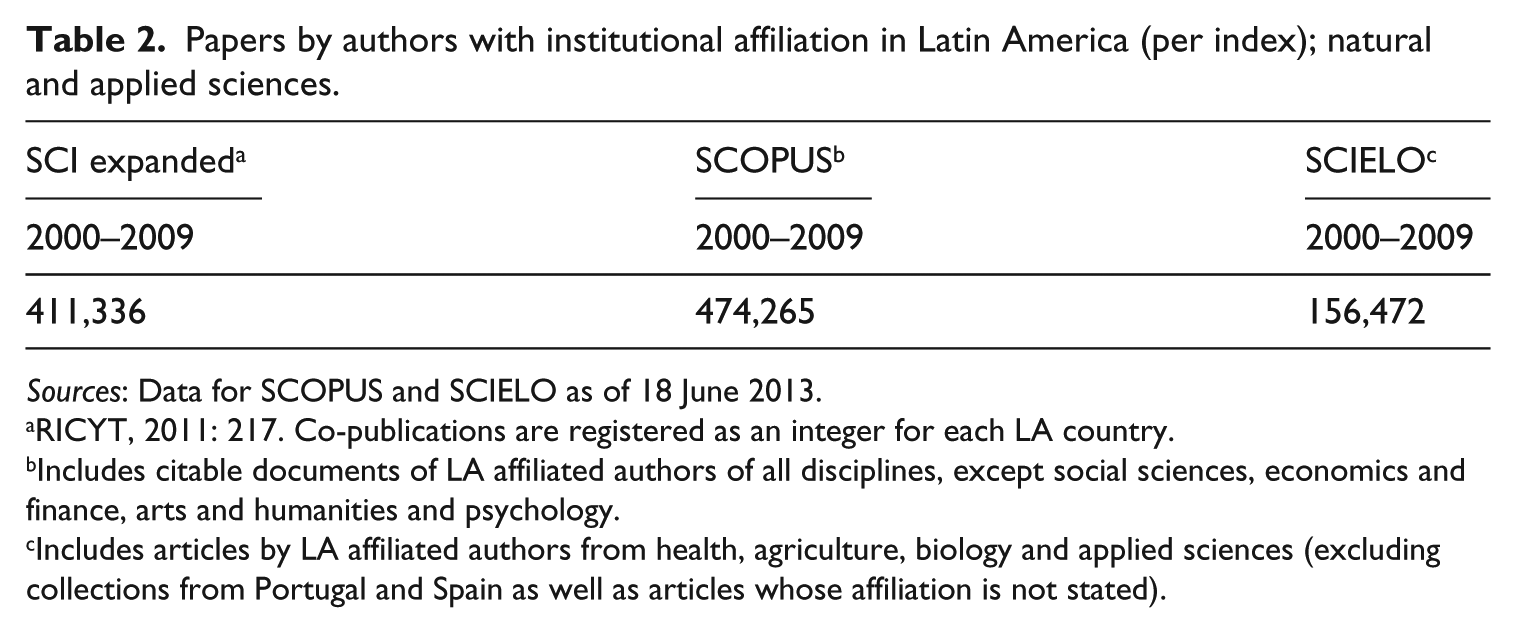
Sources: Data for SCOPUS and SCIELO as of 18 June 2013.
RICYT, 2011: 217. Co-publications are registered as an integer for each LA country.
Includes citable documents of LA affiliated authors of all disciplines, except social sciences, economics and finance, arts and humanities and psychology.
Includes articles by LA affiliated authors from health, agriculture, biology and applied sciences (excluding collections from Portugal and Spain as well as articles whose affiliation is not stated).
The situation changes drastically when focusing on LA social science and humanities (SSH). These are more nationally grounded disciplines with publications that tend to be in Spanish or Portuguese and are oriented to local journals where the country’s problems are discussed. Visibility is, thus, greater in regional portals. A similar situation can be observed for Sub-Saharan Africa, as shown in Table 3. As we will see in the case study of Argentina, hundreds of journals in the SSH are restricted to domestic circuits. In addition, these disciplines generally publish books, which are not included in this study and deserve specific attention. In fact, the LA circuit is particularly dynamic in terms of local publishing houses specializing in certain disciplines with high national and regional circulation.
Papers in social sciences and the humanities per region, per index.

Sources: aTotal articles SSCI in: WSSR-UNESCO (2010: 152); bcitable documents of social sciences, economics and finance, arts and humanities and psychology; cSub-Saharan articles in AJOL+South African journals, in WSSR-UNESCO (2010: 64); darticles by LA affiliated authors from applied social sciences, linguistics, the arts and human sciences (excluding collections from Portugal and Spain as well as articles whose affiliation is not stated).
As a result of the triple principle of hierarchy that applies throughout the publishing system, the LA circuit has a subordinate position in the mainstream circuits but a dominant position within the region. Its subordinate position is exacerbated by its marginality; LA journals have little visibility and few are indexed in English-speaking circuits. This situation is due to institutional instability and scarce resources; the predominance of Spanish/Portuguese and the strong tendency of scholars from the natural and exact sciences to publish in ‘international’ journals. The empirical evidence presented in the third section of this article will show that this is not only due to external forces but the result of the increasing belief of LA scholars in WoS rankings and the prestige associated with being published by mainstream journals.
The position of the LA circuit within the region is heterogeneous regarding disciplines, but it is clearly dominant when examining Spanish and Portuguese production – especially in SSH journals (see Table 1). Peripheral centers and intra-regional inequalities have been reinforced on the LA circuit, as papers are mainly from three countries: Brazil, Mexico and Argentina. This dualistic position of the LA circuit becomes particularly clear when domestic circuits are analyzed, given the fact that mainstream and regional publishing circuits yield diverse results in terms of accumulating scientific recognition and acquiring tenured research positions.
As mainstream and regional circuits have changed over time, the morphology of national circuits in LA has also been modified. This can partly be attributed to ‘universalized’ publishing standards for both individual promotion and university accreditation. National circuits are nurtured by indexed and non-indexed journals, with diverse scientific recognition at the local level. National indexes have recently been developed in many LA countries, based on international or regional standards, to provide lists of respected journals. 8 Publishing in these journals does not bring high academic rewards but being included in these national indexes grants the journal a certain academic citizenship. Exceptionally, some of these journals are published in English or include abstracts in several languages.
In addition to the journals in national indexes (most of which are also included in regional or mainstream circuits), there are domestic circuits with hundreds of non-indexed local journals. These circulate mostly on paper, within limited circles and can sometimes end up in university warehouses due to distribution issues. 9 As has been observed, these journals are not considered prestigious in the LA scientific community and have not received much public support because the trend has been to stimulate international publishing (Piccone and Atrio, 2011). Accordingly, domestic circuits are mostly nourished by the SSH and dominated by the local language and nationally oriented scientists. There are of course exceptional cases of prestigious journals that refuse to comply with the rules of indexing and yet are more widely read than many indexed journals.
Structural heterogeneity and segmented circuits: Academic publishing in Argentina
Argentina represents a very complex case because, although it shares some of the trends common to LA, the national publishing circuit is quite small given its important position as a peripheral center in the region. It boasts a high production of articles in regional/mainstream circuits and dynamic book publishing but a relatively weak showing in national academic journals. 10 It is difficult to get a grasp on this circuit: Argentina has 14,980 ISSN registries, but many of these are inactive and a great number are not academic journals. Some of these are indexed and circulate internationally and regionally, as can be seen in the list of 411 Argentine scientific journals indexed in LATINDEX-Catalogue (LATINDEX-C). 11 Other Argentine indexed journals are found in SCIELO, REDALYC, SCOPUS or WoS. But hundreds of journals remain non-indexed and have only limited circulation. In the social sciences and humanities alone, I registered 327 active journals, 200 of which are not indexed in any form. Thus, if we include indexed and non-indexed journals for all disciplines, the full list could come close to that of the LATINDEX-Directory (LATINDEX-D), which includes 1279 Argentine scientific journals. 12
The official national index (Núcleo Básico de Revistas–NBR) includes a very limited list of 160 journals, as can be seen in Figure 1. This list is drafted by CAICYT-CONICET through evaluation committees according to discipline. The NBR list is more restrictive than that of the Argentine journals in LATINDEX-C. Many of these 160 journals are included not in LATINDEX but in other international systems, particularly some of the journals on natural and applied sciences that are published in English. Most of the journals indexed in the NBR belong to the SSH, and of these, only one is published in English. 13 However, there is a growing tendency on the national circuit to publish journals in multiple languages, respecting the original language of the article.
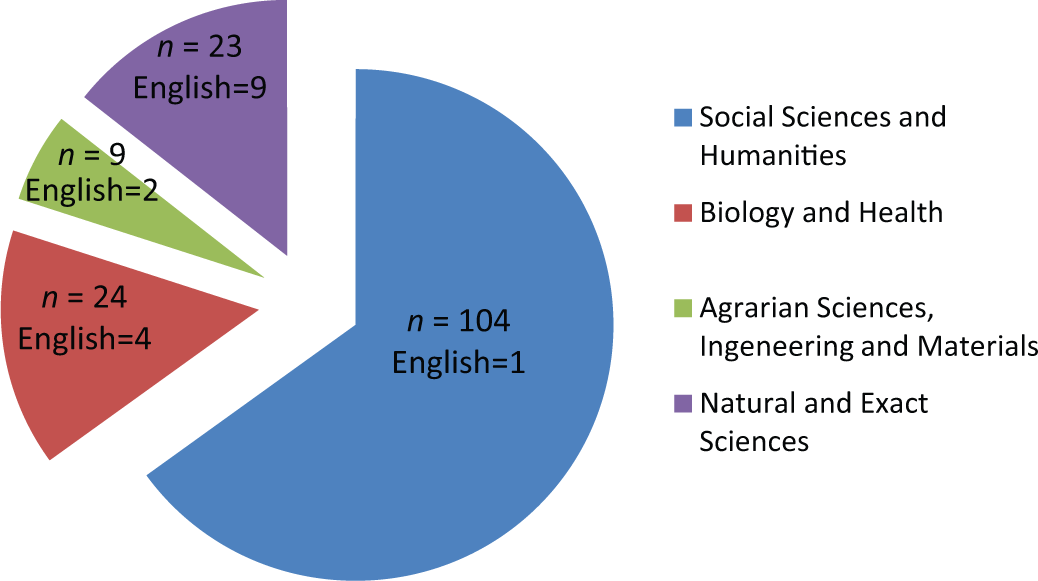
The 160 Argentine journals included in the NBR, by discipline and language.
This national publishing landscape is quite surprising, given the dynamic, predominantly public and professionalized state of Argentina’s scientific field today. The public sector accounts for 71% of all scientific and technological activities in the country and the rest takes place in private universities and companies. The state finances undergraduate programs at public universities: students do not pay tuition. There are 47 public universities and 49 private universities, but enrolment is higher at the public institutions. The science agency CONICET offers research positions (see details in third section), subsidies for scientific projects and fellowships for doctoral-postdoctoral studies. Public expenditure in science and technology has multiplied in the last decade, with a marked increase of full-time positions: by 2011, there was a total of 32,962 full-time researchers, 12,412 of whom were with CONICET and other public agencies and 16,178 at national universities (MINCYT, 2013: 60). 14 The researchers at public universities and CONICET were responsible for 90% of all publications in 2000–2008 (Lugones et al., 2010: 124).
The unique features of the national publishing circuit in Argentina can be attributed to the country’s historical paths of professionalization and internationalization. The country has a long history of distinguished scientists who have been integrated into prestigious networks/academies, publishing in mainstream journals and receiving important awards. This international circulation of relevant figures was also furthered by political exile, reinforcing an internationalization more based on individual trajectories than on stable institutional policies. During the 20th century, Argentina suffered several coups d’etat (1930, 1943, 1955, 1966, 1976) which were marked by military intervention in public universities and the recurrent changes of public policies associated with science. As shown by Bekerman (2013), the last dictatorship (1976–1983) implemented a scientific policy deliberately aimed at creating a rift between CONICET and the public universities, transferring a great amount of financial resources to the decentralized agency and creating more than 100 institutes outside the universities. Although the return to democracy brought renewed support for research at national universities and various public policies were implemented, the system designed in the 1990s to encourage research careers (Programa de Incentivos) produced few full-time positions (Vaccareza, 2007). In the last decade, this program has been stationary and the rift between CONICET and the public universities has not been completely settled after the Ministry of Science (MINCYT [its Spanish acronym]) was founded as a separate entity from the Ministry of Education (Ministerio de Educación).
University accreditation is performed by a single public agency, the National Commission for University Evaluation and Accreditation (CONEAU [its Spanish acronym]), but publications are not a determinant factor in their periodic evaluations nor do they have any impact on government funding for public universities, as is the case in Chile (see note 3). When it comes to applying for teaching positions in Argentina, publications in mainstream circuits are not considered as important as one’s teaching background. 15 While at CONICET a PhD is required and many CONICET researchers work part-time at public universities, only 23.5% of all university staff in Argentina have a doctorate (MINCYT, 2013: 77).
Research at CONICET is developed at institutes with different degrees of collaboration with public universities and 13 regional centers located in different provinces. 16 Starting a career as a researcher depends mainly on publishing articles in mainstream indexes and researchers highly value international recognition. When considering applicants for fellowships and project subsidies, CONICET prioritizes articles published in WoS or SCOPUS, and this has discouraged the consolidation of national journals and Spanish language texts. Of course, this dynamic is prevalent in the applied and natural sciences. A recent study (Gantman, 2011) of social sciences researchers at CONICET shows that articles published in local journals are prevalent and that few publish in SSCI indexed journals.
As a result, Argentina’s scientific field is structurally heterogeneous 17 because it combines different styles of scientific production within diverse institutions, with diverse practices and academic illusio (Bourdieu, 1999: 220). The enjeux shared by agents engaged in the field is disputed in different evaluative cultures (Lamont, 2009), one clearly internationalized at CONICET and another more nationally oriented at the public universities. The former is dedicated to research and the latter, basically to teaching. Mainstream publishing is therefore valued at CONICET and at a few of the country’s top universities, such as Universidad de Buenos Aires, Universidad Nacional de La Plata and Universidad Nacional de Córdoba.
Heteronomy and autonomy in the evaluation for tenure at Argentina’s CONICET
Evaluations for tenure operate in the midst of structural constraints and personal trajectories. Therefore, it is useful to examine the weight of established hierarchies and what scope exists for individual strategies. In this section I examine the competition for tenured research positions at CONICET, which is completely independent from competition for regular positions in the Argentine university system. CONICET positions are financed by the agency’s own public budget and do not involve teaching duties.
To apply for a regular full-time position as a scientific researcher (CIC [its Spanish acronym]), it is necessary to present an application describing one’s research background and a scientific project. There are five positions with different ranks: assistant, adjunct, independent, principal and superior. The lowest position (assistant) is reserved for young researchers aged 30–35 who must be promoted to the next position within five years in order to keep their place at the institution. Positions from adjunct to superior are tenured for life, as long as the researcher gets his/her bi-annual research report approved.
Evaluations for a research position at CONICET are based on general criteria elaborated by the Board of Directors, whose nine members are in charge of overseeing the agency. After the general criteria have been established, evaluation committees (EC) adapt this general framework to a specific discipline, establishing grid scores for different profile requirements. For each candidate, the committee asks for two peer reviews by specialists in the field who give an expert opinion on the quality of the proposed research project and scientific contribution. With qualitative reports by peer reviewers and quantitative information on scientific production and background, the EC finally ranks applicants on their merit. All recommended candidates then pass to the Qualification Board (QB) composed of 25 members, representatives of the different scientific areas. Finally, the Board of Directors decides on which candidates will be offered the post based on the often diverging recommendations of the EC and the QB.
In order to explore the relationship between international publishing and acquiring a research position at CONICET, I conducted a survey with the coordinators of the 22 ECs working at the council during 2012 (18 responded). This was a structured questionnaire with multiple choice questions and space reserved for comments or explanations that were analyzed qualitatively. 18 The 18 ECs included in this study are:
Biochemistry and molecular biology
Agricultural sciences
Medical sciences
Law, political science and international relations
Economics, management and public administration
Philosophy
Environment
Industrial engineering and biotechnology
Literature, linguistics and semiotics
Mathematics
Chemistry
Sociology, social communication and demography
Veterinary science
Physics
Technological and social development
History, anthropology and geography
Civil, mechanical, electrical and other related engineering
Astronomy.
The first general observation is that all respondents to the survey agreed on one prerequisite for the lowest position (assistant): a candidate must have published a minimum of five papers in indexed journals in order to be recommended for tenure. Some coordinators argued that even if a candidate’s academic profile and the proposed research project were considered excellent by the evaluation committee, the QB would not accept a candidate without the required quantity of published papers. ‘Getting a CIC post is tantamount to giving tenure to a researcher. If candidates do not have a research background that includes published papers in indexed-refereed journals, they could hardly be considered researchers. Completing a PhD is not enough to guarantee the research profile required by the CONICET statute. If during their academic formation, the candidates have not generated publishable results, they should apply for a postdoctoral fellowship in order to complete their research training’ (Q25-Board). This reveals an important feature of competition in the scientific field in Argentina, given that a postdoctoral fellowship is not granted until a scholar has published three or four papers. In comparison with other countries and regions, a young doctorate-holder in Argentina is expected to publish early, and there are opportunities to do so. Year after year, the candidates who apply have more papers published. Therefore, the minimum of five papers may be surpassed substantially in the final list of candidates considered for the available posts.
One of the most important issues in the survey was to analyze how each EC defines the quality of a published article. The differences among disciplines can be seen in the type of circuits valued (mainstream or regional) and the scores given to books and book chapters – insignificant for natural and applied sciences but very important in the social sciences and humanities. A list of six possible criteria was offered: originality, excellence of the journal’s referees, indexation, up-to-date literature cited, pertinence of the article in relation to the candidate’s research project, and if it was written in collaboration with an international scholar. Each EC coordinator surveyed was asked to list these in order of importance. On several questionnaires a seventh criterion was added by the interviewee (distinguished from ‘international collaboration,’ which was rarely mentioned on the questionnaires): the position of the author in co-written papers. This is a key issue in scientific recognition for the natural and applied sciences because most articles are written in collaboration and experimental papers may be the result of two or more research teams. Some of these positions are well-established: in chemistry, the first author has taken an active and central role in the research work, while leadership in coordinating the research teams and the writing is indicated by an asterisk (*) (Q18-chemistry). In molecular biology, the first author is normally the one who has carried out the experimental work, the last author is the director of the project and generally a well-recognized researcher (Q2-biochemistry and molecular biology). In the social sciences, the dominant trend is individual publishing and no established rules on the sequence/recognition were observed. Accordingly, the sixth criterion was thus reformulated as ‘author position in co-written papers.’
The general average of the weighing of the criteria for evaluating published articles shows that, taken together, quality is associated with the journal’s referees and its indexation. As can be seen in Figure 2, originality came in fourth in importance.
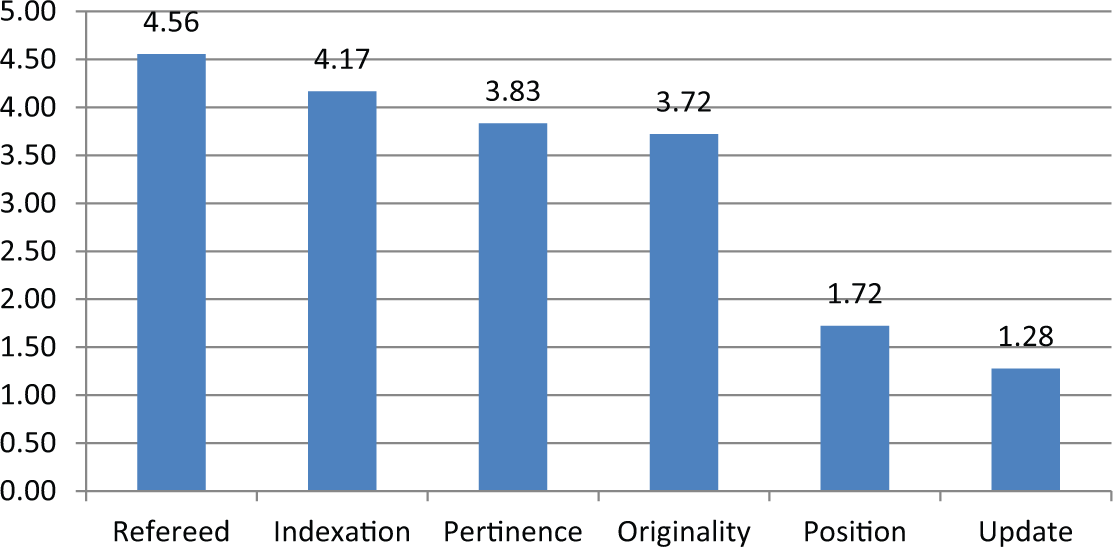
Averagea weighed criteria to evaluate the quality of an article in competition for tenure at CONICET.
A few things in common can be observed within the three scientific areas commonly known as the ‘hard sciences’: agricultural sciences and engineering, life sciences and health and natural sciences. 19 In these areas, indexation and excellence are considered connected items that can be measured with the impact factor of the journal. The position of the author is particularly relevant to his/her scientific background because experimental articles have multiple authors. Meanwhile, the social sciences and humanities (SSH) do not have established criteria for considering the author sequence in collaborative publications. Indexation is considered for scores but the impact factor is not weighted in the quantitative or qualitative analysis of candidates.
An analysis of the ranked criteria reveals interesting results. When examining the first criteria selected, it is worth noting that the philosophy EC coordinator mainly valued the pertinence of the article in relation to the candidate’s project while for physics, originality came first. Criteria Nos 1–2–3 were marked by interdependence and importance, while criteria Nos 4–5–6 seemed hardly relevant and were very often left blank. The combination of refereed journal and indexation was particularly recurrent in criteria Nos 1–2–3. Several interviewees argued that even if a journal is well-recognized in its discipline, indexation becomes the guarantee for ‘excellence.’ Originality is taken for granted as the result of the rigorous evaluation made by referees of a journal that has been, in turn, periodically evaluated by the indexing system. Therefore, ‘originality is tied to refereed and indexed journals’ (Q13-industrial engineering and biotechnology).
The survey shows important differences across disciplines when the first criterion marked in each questionnaire was analyzed. Four ECs selected the author position and also valued indexation and the impact factor of the journal in the cases of biochemistry and molecular biology, medical sciences, technological and social development, and civil, mechanical, electrical and other related engineering. These disciplines are located at the top of the hierarchies in Argentina’s scientific field, with a long academic tradition. The quality of the candidate is related to hierarchy within authorship, which in turn is tied to decisions made by the director of the team and the constraints of publishing in a high impact journal. One of the EC coordinators added: ‘Impact factor is not the only one considered – we also take into account the location [ranking] of the journal in the field’ (Q2- biochemistry and molecular biology). Within these disciplines, SCI is the valid indexing reference, while regional/local publishing or Spanish language journals are not considered relevant for tenure.
Six ECs selected indexation in first place, highlighting that originality comes second to the indexation of the journal. However, for these ECs, indexation is not dependent only on the ISI-system. Social sciences prevail here, and thus regional databases such as LATINDEX-C are dominant. Veterinary science members also selected indexation first, but added that they not only consider mainstream indexes but also regional indexes.
Four ECs selected refereed first: agricultural sciences; industrial engineering and biotechnology; law, political science and international relations; and astronomy, confirming a strong dependency on international publishing and recognized journals in the evaluation for tenure. These ECs consider international rankings, but do not consider impact factor when assigning scores to each article. Originality is ‘guaranteed by the rigor of the referees’ (Q13-industrial engineering and biotechnology).
Four ECs seem more committed to the belief in academic purity and selected pertinence followed by originality. According to these EC coordinators, priority is given to a qualitative analysis of papers (over indexation or impact factor to assign scores). Among the ECs included here are coordinators of literature, linguistics and semiotics, philosophy, chemistry and physics. Some argued that the main input for the analysis of publications for a given post is ‘the opinion of expert peers and the opinion of the member of the evaluation committee in terms of the quality of the text’ (Q15-literature, linguistics and semiotics). For the chemistry EC coordinator, ‘It is very common to use very complex equations in biomedicine considering author positions, a journal’s ranking, etc. Personally, I don’t like to leave the evaluation to an equation. Ultimately, I prefer to use it as a general guide to divide large groups but then analyze case by case’ (Q18-chemistry). For the physics EC, ‘The evaluation of a young candidate has to be based on concrete elements but only experts will be able to assess the real value of the scientific production of a given candidate. This is why peer review is essential, and peer reviewers should be selected carefully, outside the institution of the candidate, with experience and expertise in the subject’ (Q23-physics).
The following part of the survey was dedicated to analyzing the hierarchy of the different indexing systems when assigning scores to a given article (see Figure 3). In the natural and applied sciences, SCI was ranked at the top of the selection in the questionnaires, while SCOPUS took second place in many cases or tied with SCI for first place. In three disciplines, only SCI-SCOPUS were selected: agricultural sciences, mathematics and astronomy. ‘Databases used in astronomy are only international. There are no national refereed journals, except for the Boletín de la Sociedad Argentina de Astronomía, but this only publishes papers presented at its national conferences. These publications are not as highly valued as papers presented at international conferences, and these, in turn, are less prestigious than an article published in a refereed journal’ (Q1-astronomy). Two disciplines included SCIELO as a third option: veterinary science and technological and social development. On the whole, 67% of all the EC members interviewed gave higher scores to mainstream indexes, first SCI and then SCOPUS.
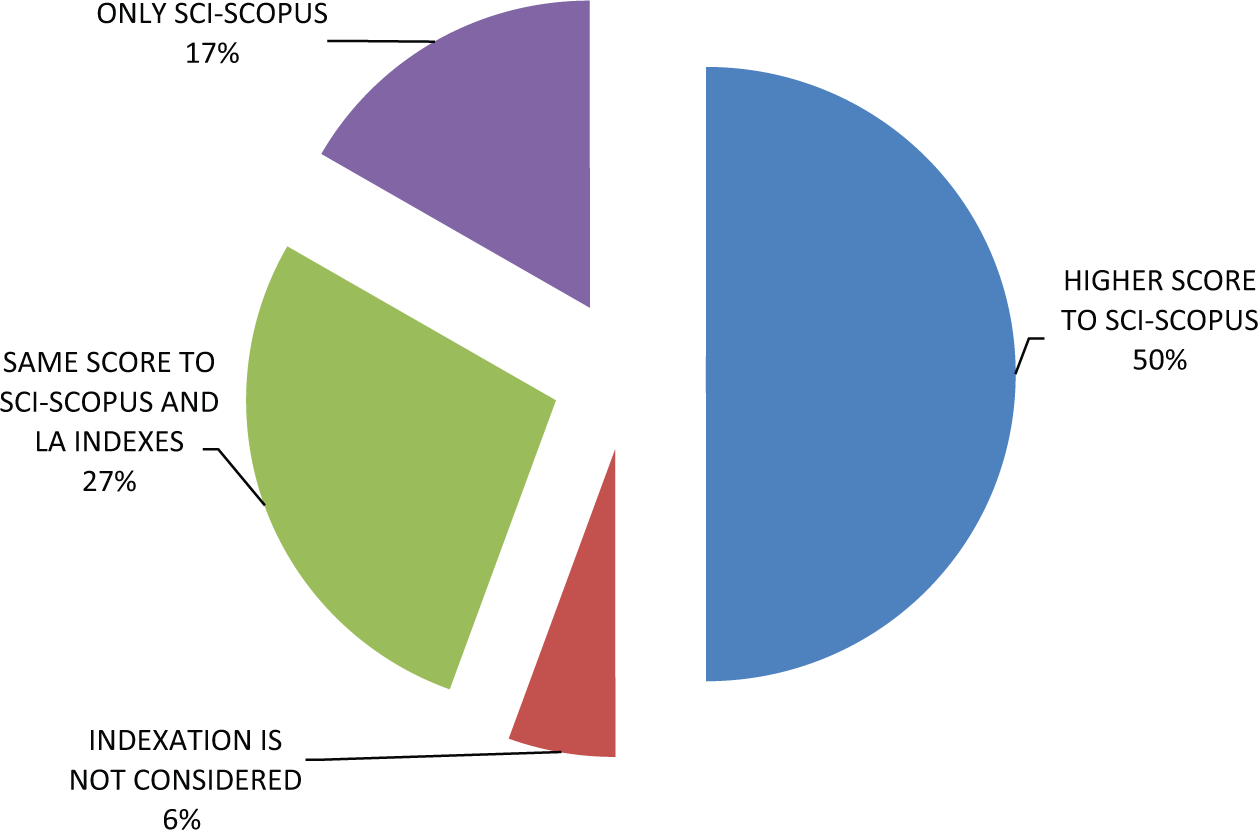
Hierarchy of indexing systems by CONICET EC coordinators.
In the SSH, in turn, English language papers are exceptional; there are many national/LA journals in Spanish and few researchers publish in WoS or SCOPUS. As a matter of fact, the SSCI is not available in research centers, public universities, or CONICET, not even for ECs. There is a general consensus that mainstream and regional indexes are equivalent in the SSH. As an exception, one EC interviewee answered that no international or regional databases are given priority for scoring because ‘Scientific papers in my discipline are rarely included in international indexes’ (Q15-literature, linguistics and semiotics).
After years of discussions among ‘hard’ and ‘soft’ scientists at the QB, a certain consensus has been reached on the existence of three groups of journals, according to their ‘international recognition.’ For the natural and applied sciences, ‘The first group are SCI high impact journals, the second group are low impact and the third group includes national journals included in NBR’ (Q4- agricultural sciences). ‘National journals usually don’t have the same quality as international journals … . If the article is not in English, its reach and referees are restricted’ (Q17-mathematics). ‘In hard sciences, all journals considered to be high quality (even those published in Spanish-speaking countries) publish their articles in English because that assures a greater dissemination of results in the scientific community. Articles published in Spanish or languages other than English reach a very limited audience’ (Q18-chemistry).
For the SSH, three groups of journals are considered when evaluating published papers: the first group includes indexed journals (WoS, SCOPUS, LATINDEX-C, SCIELO, REDALYC, NBR and others); the second group includes non-indexed but refereed journals which receive lower scores; and the third group includes non-refereed journals which rarely receive scores. The coordinators of SSH committees usually defend this scoring within the QB (a body reluctant to accept regional indexes), when each candidate is discussed. The fact that books and book chapters are highly esteemed in the SSH presents an additional problem in the evaluation for tenure. In Argentina, publishing houses specializing in specific fields increasingly ask external peers to evaluate manuscripts, but they normally require that the author help to pay for the book publication. Therefore, according to the QB, quality is not guaranteed by external evaluation. Books and book chapters published internationally are more highly regarded but it is still hard to gauge local publishing houses – a classification demanded by the QB in order to accept book/chapter scorings.
In summary, the survey revealed that the tenure requirements established by the QB and the Board of Directors, in the evaluation practice, tend to identify top quality with international publishing in indexed journals. This tendency was present in the evaluative culture traditionally forged in the natural/applied sciences, but it has been recently extended to the SSH ECs, along with a set of beliefs of what a scientific researcher should be. When the candidates pass through the QB, there is some tension among the different conceptions of which international indexes rank highest, and the SSH clearly favor alternative forms of regional academic prestige. Nevertheless, in all the areas of science, national journals are viewed much less favorably than publication in international journals.
Conclusions
In this study, I sought to examine the recent dynamics of the WSS in order to determine the impact of the triple principle of hierarchy (institution, discipline, language) on regional and national circuits. Although the natural and applied scientists in Latin America have developed a long tradition of internationalization (adapting to writing in English and ISI-WoS publishing rules), established hierarchies prevail within mainstream circuits and the presence of LA production is still minimal. For its part, the LA publishing circuit is strengthening within the SSH and Spanish/Portuguese language scientific production, but it is still weak in the natural and applied sciences. In the case of the latter, LA portals are less valued by evaluators and scholars than WoS or SCOPUS. In the SSH, knowledge is still produced and written mainly in local languages, with few translations into English. Accordingly, they have a major presence in LA portals and national indexes.
By analyzing tenure evaluations, I have highlighted the fact that indexation has replaced the focus on originality in scientific articles. 20 This directly undermines the distinction of what Bourdieu called temporal and scientific capital (Bourdieu, 2003) and proves to what extent the structure of scientific power has been built through the ‘international’ publishing system. The study of the practice of evaluation at Argentina’s CONICET shows the coexistence of diverse publishing circuits which in turn contribute to a full-time research position application in different ways. A minimum of five papers published in English in the mainstream journals indexed in SCI-SCOPUS (natural and applied sciences) or in Spanish in the LA regional circuit (SSH) is required, but this minimum is rising, as is the weight given to ‘international’ publishing as mandatory for a full-time researcher.
Domestic circuits, nourished by non-indexed journals, are clearly left outside the play at CONICET, thus bringing no scientific recognition. On the other hand, these are valued at many universities, especially in the SSH. International publications are not a determining factor for university evaluations performed by the national accreditation agency nor are they mandatory for teaching competitions. Accordingly, domestic/regional/mainstream circuits are valued diversely in coexistent evaluative cultures that are segmented by the structural heterogeneity of Argentina’s scientific field.
The Argentine case shows the unequal nature of ‘international’ publishing and its impact on the differentiation among internationalized and nationally grounded researchers. An individual’s presence on mainstream circuits results in local recognition for research positions, but rarely changes the hierarchy of knowledge produced in the periphery. Even if an enormous increase in the volume of publications in ISI-WoS or SCOPUS takes place, this will be no guarantee of expanded reception in the WSS. On the contrary, successful strategies of integration seem barely effective in challenging the persistence of US and other scientific authorities in lists of most-cited papers and journal rankings. Open access is, in return, a fruitful way to undo the structure of ‘international’ scientific power as long as this alternative pathway does not become commercialized by mainstream circuits.
Finally, the fact that knowledge produced on the periphery yields scarce few ‘exports’ in mainstream circuits does not mean that peripheral scientific communities are merely passive or massive ‘importers’ of mainstream knowledge. Moreover, academics in the prestigious academic centers can be more dependent on heteronymous forces, such as journal rankings, indexing criteria, impact factor or ‘research fronts’ (see note 2). Accordingly, peripherality should not be reduced to homogeneous national fields distinguished by their dependency on the core: academic heteronomy and autonomy coexist in specific historical situations, which should be examined empirically.
Footnotes
Acknowledgements
The author wishes to express thanks for the productive suggestions made by anonymous reviewer 2, and the comments by Denis Baranger, Cynthia Yeppesen and Dominique Babini to the first version of this article.
Funding
This work was funded by two public institutions: CONICET (PIP N°0213) and Universidad Nacional de Cuyo (SECTYP 2013-2015 N°284/6)