



Abstract
This article contributes to the discussions on Internet mobilization and on international social movements’ ability to influence national policy. The event studied is the ‘first Internet strike’ of 18 January 2012 aimed against the SOPA legislation proposed in the USA. Wikipedia’s volunteer editors from all around the world took part in the vote concerning whether Wikipedia should undertake a protest action aimed at influencing American policymakers. Wikipedia editors are shown to share values of the international free culture movement, though experienced editors were also likely to be conflicted about whether taking part in a protest action was not violating the site’s principle of encyclopedic neutrality. Further, Wikipedia’s participation in this protest action allowed non-US citizens to have a visible impact on the US national legislation. As such, Wikipedia can be seen as an international social movement organization, whose 24 hour-long blackout of its popular website was a major factor in the success of the anti-SOPA protests. Wikipedia’s blackout was an expression of an international political opportunity structure in the form of worldwide awareness and protests, which in turn enabled a national political opportunity structure by informing and mobilizing American citizens.
Introduction
On 18 January 2012 millions of Internet users saw the Wikipedia site blacked out and were invited to join the protest action against a proposed piece of American legislation, SOPA, that the Wikipedia community found threatening to its very survival (see Figure 1). Wikipedia’s blackout was part of a coordinated action by hundreds of websites. The support for the SOPA legislation evaporated quickly, and this Bill was dropped by the US congress within a matter of days.

Blacked out Wikipedia home page, 18 January 2012.
Described in the media as ‘the first Internet strike’, fitting into the recent globally coordinated cycle of contention discussed by Tejerina et al. (2013), and given Wikipedia’s movement size (about 20 million volunteers) and reach (about 500 million distinct monthly viewers), the 18 January protests are an intriguing case that furthers our understanding of social movements and volunteering in the Internet age. I aim to contribute to the discourse on Internet participation and mobilization and international social movements influencing national policy. This is done through an examination of editor participation and motivation employing the content analysis of public archives of Wikipedia community discussions related to the 18 January protests. Six hypotheses related to experience, US-interest, threat-interest and Internet rights-interest are tested, revealing Wikipedia to be a part of the ‘free culture’ movement. As part of this movement Wikipedia will be shown to have played a major role in transforming international sentiment into successful political action by the American public.
The chronology of Wikipedia and the SOPA vote
The proposed SOPA (Stop Online Piracy Act) legislation was presented by its supporters as a tool aiming to stop copyright infringement committed by foreign websites, but in the opinion of its detractors, it would disrupt free expression and ‘harm the Internet’. A common example of said harm, discussed by anti-SOPA activists, was that the legislation would force Internet service providers to implement site-wide censorship if a website was accused of any copyright infringement (thus in the context of Wikipedia, if a volunteer uploaded a copyright-violating image, access to the entire Wikipedia could have been blocked to anyone trying to access it using a US Internet service provider). On 10 December, Wikipedia founder Jimbo Wales posted a straw poll on his Wikipedia talk page regarding whether Wikipedia should take any action to address this development (Wales, 2011). Wales’s talk page has a high visibility, and the discussion held there from 10 December to 15 December attracted 508 participants, the majority of whom were clearly opposed to the SOPA legislation. Also around the same time, opposition to SOPA begun growing on the Internet, spearheaded by various free culture and related organizations dedicated to promoting digital rights (the human rights that allow individuals to access, use, create, and publish digital media or to access and use computers, other electronic devices, or communications networks).
On 13 December the Wikipedia:SOPA initiative page (en.wikipedia.org/wiki/Wikipedia:SOPA_initiative) was created. The discussions focused on the reach of a protest (United States-only or worldwide), its method, and even whether any protest should be held after all. The Wikimedia Foundation (the non-profit organization that is responsible for the legal side of Wikipedia) took an active interest in the discussion. On 10 January, the social news site Reddit announced a plan to ‘go dark’ in protest of SOPA on 18 January; soon it was joined by others. Wales was reported as supportive of the idea, and suggested that Wikipedia might take part in this protest action.
On 13 January, on the Wikipedia:SOPA initiative page a Wikimedia Foundation staffer opened another discussion and a straw poll regarding what, if any, action should be taken by the Foundation to support the Wikipedia community. In the subsequent poll that lasted till 16 January, 1674 editors took part, with the majority supporting some form of a protest. The discussion was closed by three Wikipedia administrators who jointly agreed that the community is in ‘broad-based support for [global blackout] action from Wikipedians around the world’, and requested support from Wikimedia Foundation ‘on behalf of the English Wikipedia community … to allocate resources and assist the community in blacking out the project globally for 24 hours’ (Wikipedia, 2012b). Subsequently the Wikipedia site was blacked out on 18 January. (For more information on the mechanics of Wikipedia governance that were used in this particular process of decision making, the reader may want to visit Oz, 2012.)
In addition to English Wikipedia, 37 other language Wikipedias and several affiliated Wikimedia projects displayed support banners (as illustrated by the example shown in Figure 3). About 20 million people visited Wikipedia during the protest day to be greeted by a blackout message; the Wikipedia page about SOPA which purposefully was made available during the blackout was accessed more than 162 million times. The news about the blackout spread throughout both traditional media outlets and the Internet, accounting for hundreds of news stories and millions of tweets. More than 12,000 people commented on the Wikimedia Foundation’s blog post announcing the blackout, the majority supporting the protest. More than 8 million looked up their elected representatives’ contact information via the tool provided by Wikipedia (Wikipedia, 2012a). The support for the SOPA legislation in the US Congress evaporated within hours (this process is illustrated by Figure 2).

International → national political opportunity structure: influence progression from movement members → Wikipedia editors → Wikipedia readers → US politicians.
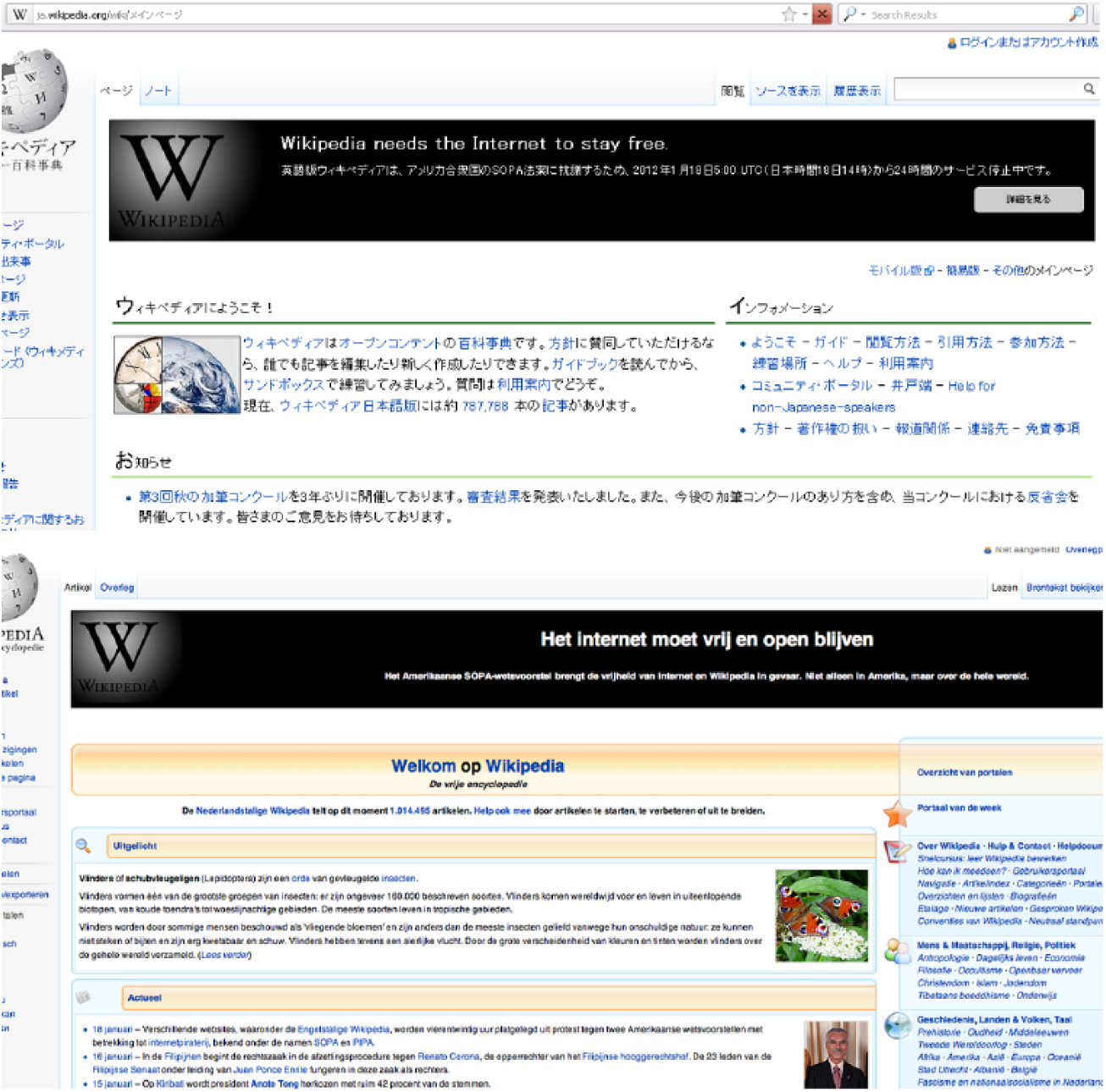
Main pages of the Japanese Wikipedia and the Dutch Wikipedia on 18 January, expressing support for the English Wikipedia protest.
The following sections highlight the factors which made Wikipedia such a major part of the anti-SOPA protest.
Wikipedians’ values as a factor in the 18 January protests: Wikipedia as a part of the free culture movement
Wikipedia certainly was, at its inception, first and foremost an encyclopedia. It has, however, long since outgrown that simple description. Wikipedia is the manifestation of an unusual set of organizational roles and relations facilitated by the new information and communication technologies. A key aspect of the Wikipedia project is that it is run by an online community of contributors (commonly referred to as ‘editors’ or ‘Wikipedians’), who are responsible for creating the site’s content, as well as designing its governance structures. That community can be understood as a social movement organization located within the free culture movement. For a discussion of how Wikipedia fits the definitions of a social movement, see Konieczny (2009b).
Several authors such as Bridy (2012), Schmitz (2013), and Yoder (2012) have looked at the 18 January protests in the context of growing public interest in the discourse on the issues of copyright vs. free speech. Indeed, such protests as the Internet witnessed on that date are usually a work of one or more social movements: in this case, the free culture movement, a movement focused on intellectual property and culture reform that emerged online in the late 1990s from the Free and Open Source Software (FOSS) movement and which has grown in strength since. In the past few years those movements have also become identified in the literature as part of the digital rights movement (see Lessig [2004], MacKinnon [2012], and Postigo [2012] for the history of those movements; Reagle [2010: 78–79] for a discussion of Wikipedia’s place in those movements; and Croeser [2012] for an analysis of their role in the 18 January protests).
Nonmarket, alternative solutions created by those movements, from Wikipedia to Linux software, are becoming increasingly prominent in our daily lives. To be able to create and diffuse them in the current economic and legal environment, members of those movements – even if, like in the case of Wikipedia and its editors, they rarely frame themselves as such – are usually much more familiar with the law, in particular, copyright law, than the average person. Lessig (2004), Coleman (2009), and MacKinnon (2012) observe that one of the key values for the participants in those movements is a desire to reform the intellectual property rights. A major part of such a reform is the development and promotion of alternatives to copyright, such as copyleft licensing, extensively used on Wikipedia in the form of the Creative Commons license which grants the editors and readers many more rights than the traditional copyright license would (such as the right to copy and modify the content without asking for permission).
Wikipedia’s influence was visible on other websites where the SOPA protest was discussed; for example one Wikipedia editor, a participant of Reddit – a major online discussion site – declared: ‘[I] was heavily involved in the runup to the blackout. We have a fair number of Reddit users who casually dropped wikiisms like “NPOV” (Neutral Point of View)’ (Wikipedia Signpost, 2012). In turn, the familiarity with free culture values was seen in the comments of many Wikipedians voting whether to participate in the protests (to quote one of the voters: ‘our voice should be heard alongside the free culture community’). Several studies related to motivations of Wikipedia’s contributors have consistently pointed to such values. Nov (2007) found that the top three motivations among Wikipedians were: fun (enjoying oneself), ideology (‘information should be free’), and values (helping others, sharing knowledge). As already observed by Kuznetsov (2006), there is a significant overlap between Wikipedians’ values and those of the free culture movement, particularly through the understanding of the word ‘free’: Wikipedia is not simply free as in free beer (gratis), it is also free as in free speech (libre); the latter referring to the freedoms granted by the Wikipedia’s Creative Commons license.
18 January Wikipedia protests as an example of a nested political opportunity
Goodwin and Jasper (2004: 29) observed that ‘its very proliferation of definitions and applications demonstrate the utility of [political opportunity theory]’. This case study is an example of how this theory can be applied to new movements with significant presence in cyberspace, yet aiming at interaction with the traditional authorities (in this case the 18 January protests and the US Congress).
The concept of political opportunity is defined (Tarrow, 1994: 17) as a series of coherent dimensions of the political environment which can both encourage or discourage people from taking political action. Political opportunity can often take the form of increasing public awareness (Gornick and Meyer, 1998); this was termed by McAdam et al. (2001) as ‘cognitive liberation’, the ability for those active in political protest to recognize their collective strength and take advantage of new political opportunities. Similarly Kurzman (1996: 154) defines one of the forms of political opportunity as ‘the public’s awareness of opportunities for successful protest activity’. Such a type of political opportunity is particularly relevant to the case presented here, as it was the international mobilization of the one of Internet’s most popular websites, used by the free culture and digital rights movement to spread its anti-SOPA message that greatly contributed to the eventual success of the January 2012 protests.
Giugni et al. (1999: 183) note the consensus among scholars that international (transnational) social movements allow the international community to influence national policies. It is here that the model of ‘nested political opportunity’ can be of particular use. Rothman and Olivier (1999) who developed it noted that the ‘local political opportunity structures are embedded in national political opportunity structures, which are in turn embedded in international political opportunity structures’. This allows the consideration of the Wikipedia participation in the anti-SOPA protest as an example of an international political opportunity structure (the mobilization of the Wikipedia editors in the wider context of the mobilization of the free culture and digital rights activists) that was able to create a national opportunity structure (the mobilization of the US-based Wikipedia readers to contact their elected representatives). More recent works have provided insights into the use of new, digital repertoires, and activities of online movements. However, the majority of such studies, with few exceptions (MacKinnon, 2012; Postigo, 2012), have focused on more traditional movements, and are sorely lacking in analysis of how the emerging free culture movement empowers individuals from around the world, creating an ‘international political opportunity structure’ in cyberspace, and giving them a voice in national politics. Thanks to the events of 18 January we are now able to remedy this deficiency.
Next I would like to address the question of participation and representativeness of both the sample of editors who voted for the general Wikipedia population and the representativeness of the Wikipedia population for the wider society. In other words, who were the individuals who made themselves heard on 18 January?
Representativeness of the Wikipedia community
A question to consider with regard to wider implications of this study is this: how representative are Wikipedia editors? A typical Wikipedia editor, according to the recent 2011 data (Wikimedia, 2011a), ‘has a college degree, is 30-years-old, is computer savvy but not necessarily a programmer’. Notably, Wikipedia’s editor base is heavily slanted towards males, with the previous surveys reporting the number of female editors at about 10%. The majority of Wikipedians hail from North America or Europe, although the United States itself accounts for only 20% of editors.
As such, demographics of Wikipedians are quite similar to those of the FOSS movement. The studies conducted in the early 2000s found that only 1–2% of the developers were female. The average (male) FOSS member is 22–30 years old, with 70% of them having a university degree, and FOSS members are also composed primarily of residents of Europe and North America (Berlecon, 2002; David et al., 2003; Krieger et al., 2006).
Research questions and hypotheses
This article asks (1) whether the Wikipedians who participated in the vote belonged to the small group of American editors or the more diverse international community and (2) whether the support for the protest is a result of a simple self-preservation motive or represents a more complex expression of values similar to those found in the free culture movement.
The first two hypotheses look at the global aspect of the protest. As the SOPA legislation was a US federal legislation, to what degree was this issue important only to the American editors? A finding that a significant number of non-US editors were involved in those protests would support framing of Wikipedia participation in the anti-SOPA protest as an example of an international political opportunity structure:
US-interest hypothesis (H1a): US editors will make up over two-third of the voters.
In addition to surveying the nationality composition of the participating editors, I also intend to test whether the SOPA issue itself was seen as global or not. It is unlikely that international editors would be significantly interested in what they would see as domestic US legislation, therefore it is likely that any significant international voter turnout should be correlated with the non-US editors seeing the SOPA legislation as having an impact reaching beyond US borders:
Global scale of SOPA hypothesis (H1b): Non-US citizens will see the SOPA legislation as a global issue.
The next two hypotheses are mutually exclusive and concerned with editors’ motivations. Experienced editors highly value the site’s principles and policies (Pentzold, 2011), often using language of terms and values similar to that of the free culture movement in general, talking about free culture and that ‘information should be free’. This is represented by the following hypothesis, which locates Wikipedia within the sphere of the free culture community and its values:
Internet rights-interest hypothesis (H2a): The global threat to the Internet, digital rights, and free culture values was the most common rationale mentioned by the voters supporting the protest.
However, as noted by Maslow (1943) in his classic hierarchy of needs, self-preservation is among the most basic of human motivations. Thus an alternative primary motivation seems possible: that voting in support of the protest due to the desire to protect the Wikipedia project would be the most common rationale among the voters. (While Maslow’s theory was originally developed for analyzing individuals, it has since found widespread use in analyzing collective groups and organizations; see the discussion and literature review in Cianci and Gambrel, 2003.)
Threat-interest hypothesis (H2b): The threat to Wikipedia was the most common rationale mentioned by the voters supporting the protest.
Finally, while the SOPA vote was overwhelmingly supported by the Wikipedia community, during my initial analysis I observed that a significant number of editors who opposed the protest action were concerned about whether taking a stance on this issue would not compromise Wikipedia’s encyclopedic ethos, often summarized as ‘being neutral’. Therefore I propose to test the following final two hypotheses:
Neutrality as a key value hypothesis (H3a): The perceived conflict between participating in a protest action and following Wikipedia’s encyclopedic ‘neutrality’ ethos was the most common rationale mentioned by the voters opposing the protest.
The last hypothesis concerns the difference between editor values and their experience on (engagement with) Wikipedia. It seems reasonable to expect that more experienced editors will be more concerned about Wikipedia’s policies such as neutrality, compared to the newcomers, many of whom might have never heard of such policies:
Neutrality and experience hypothesis (H3b): The perceived conflict between participating in a protest action and following Wikipedia’s encyclopedic ‘neutrality’ ethos was much more likely to be expressed by more experienced editors.
Methodology
In order to test the proposed hypotheses I collected data from the two publicly available pages on Wikipedia where editors voted and left comments: the Jimbo Wales talk page where the December vote and discussion were held (Wales, 2011), and the Wikipedia:SOPA page (Wikipedia, 2012b), where the January vote and discussion were held. The purpose of this was to create a list of editors who participated in the voting, gathering information on their nationality, Wikipedia experience (number of edits, length of registration), votes, and their rationale. There were 2097 editors identified as having participated in the voting process and these formed the studied population.
To obtain further information I collected data from three sets of other publicly available information. The first of those were the editors’ userpages, where many voluntarily provide various information about themselves, such as nationality. The second of the data sets analyzed were the editors’ contributions, accessed through the Edit Counter tool (toolserver.org/~River/cgi-bin/count_edits?). Finally, the ListUser Wikipedia function (en.wikipedia.org/wiki/Special:ListUsers) was used to check which editors have administrator rights.
The following six independent variables were included in the model: total number of edits, total number of edits in talk/discussion name space, total number of edits to policy pages, length of registration (in days), having a userpage, and having administrator status.
I divided editors into the following editor classes based on their number of edits:
Anons – editors who have no official account;
Newbies – editors who have between 1 and 9 edits;
Regular (experienced) editors – those with 10 or more edits, but not veterans (see below);
Veteran editors – the most active editors. ‘Veterancy’ is a composite categorical variable based on the following five independent variables: having 50 or more edits project wide, including at least one to a Wikipedia policy page (or its discussion page) and at least one to any discussion page; having been registered for over a month; and having a userpage. Administrator status was purposefully not included in my measure of veterancy (there are many otherwise highly active and accomplished editors who are not administrators).
While the majority of the variables resulted in a clear quantitative or categorical variable, the comments were subject to two passes of discourse analysis coding. In the end, 15 separate motivations were identified, 10 for support and five for opposing (see Table 3). Several of the highly correlated variables about sentiment and rationales were combined into a variable representing the values most common in the free culture and FOSS communities, as suggested by previous research (David et al., 2003; Lessig, 2004; MacKinnon, 2012).
The most serious limitation of the data analyzed here concerns the fact that said data come from editors who voted. Why the vast, silent majority of Wikipedia editors chose not to voice their opinion is an intriguing question that will hopefully be answered by further research. The fact that there was no significant backlash against the blackout does, however, allow a tentative conclusion that the said silent majority did approve of the protest action, whether it learned of it during or after the fact.
Findings
Editor support by country
Of the editors who participated in the vote 50% declared their nationality either in their comments or on their userpage: 47% of them were US citizens; 24% came from another English-speaking country; 29%, from a non-English-speaking country (see Table 1). A one-sample t-test confirms this hypothesis as statistically significant (p < .001). Therefore hypothesis H1a about voters from the US dominating the vote cannot be supported.
Descriptive statistics for nationality (percentages).
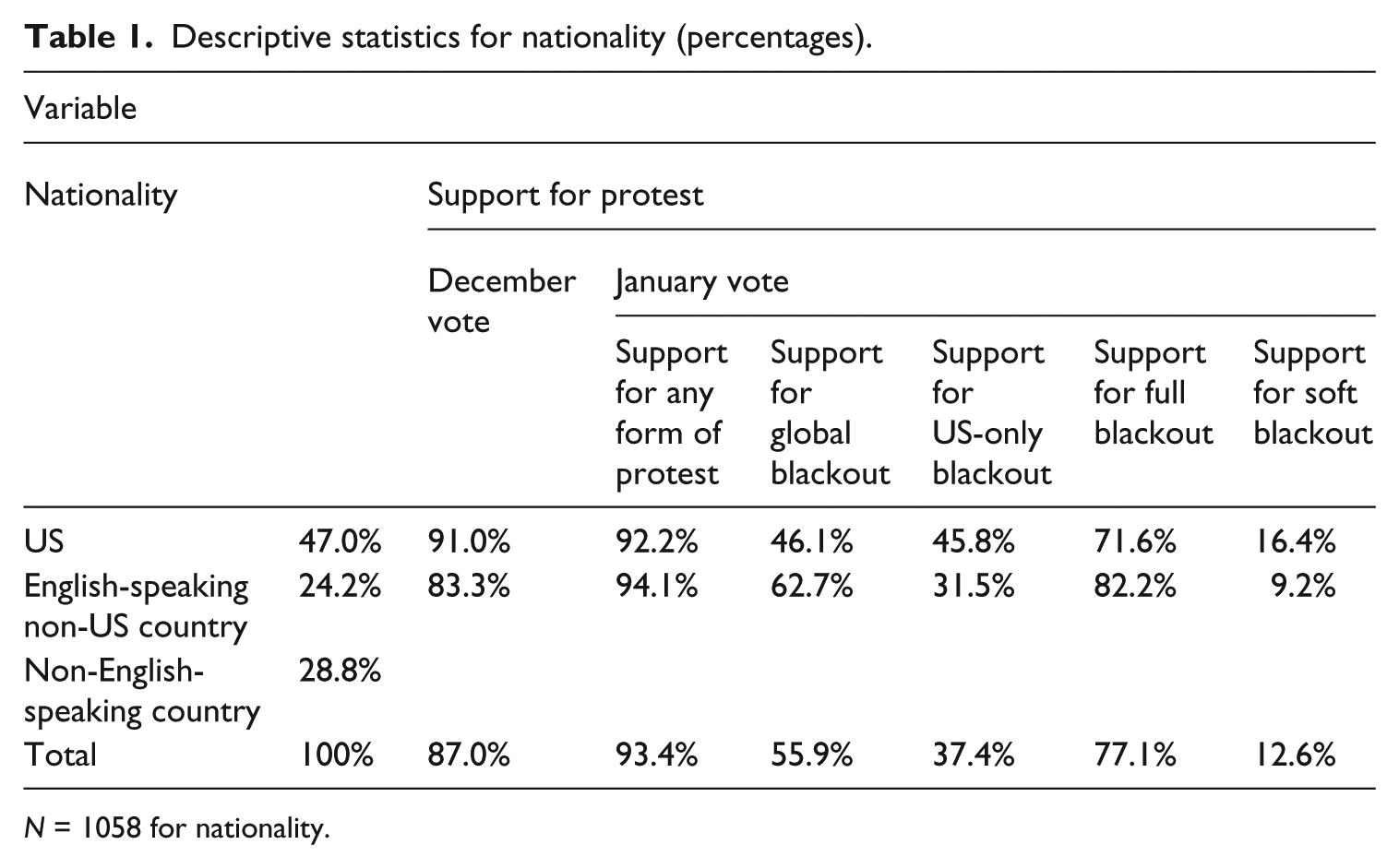
N = 1058 for nationality.
Compared to the international editors, US-based editors were more likely to support the protest; however both groups voted overwhelmingly for the protest: in the December vote, 91% of US-based editors and 83% of international ones supported taking some form of a protest action (87% of all voters, in total). In the January, the numbers were 92%, 94%, and 93%. Full blackout was significantly more supported than the soft blackout, with roughly similar voting weights in both groups (77% to 13% in total). Editors were more split on whether to make the blackout global, or limited to the US only (56% to 37%). US editors were almost equally split on whether to make the protests global, and it was the international editors whose endorsement of the global scale of the protests made the English Wikipedia blackout visible to visitors around the world (almost two-thirds of the international editors supported the idea of a global blackout).
In the January vote, the roles were somewhat reversed, as the international editors became more supportive of the protest than the US-based editors. Nationality (being a US citizen or not) does not seem to be a good predictor of whether one would support or oppose the protest action, with one notable exception. Nationality is a statistically significant variable in a logistic regression model predicting whether one would prefer a global blackout to US-only (see Table 2 for regression models). Model 1 predicts that being a non-US citizen increases the log odds of supporting a global protest by 0.681. As the support for protest in general was very high among both groups, this suggests that the major difference between the US and international editors was that the former did not see the SOPA issue as a global one. This is further confirmed as logistic regression Model 2 predicts that being a non-US citizen increases the log odds of seeing the SOPA issue as global by 0.582. Other variables did not prove to be significant when controlled for in either model. This confirms hypothesis H1b.
Logistic regression models.
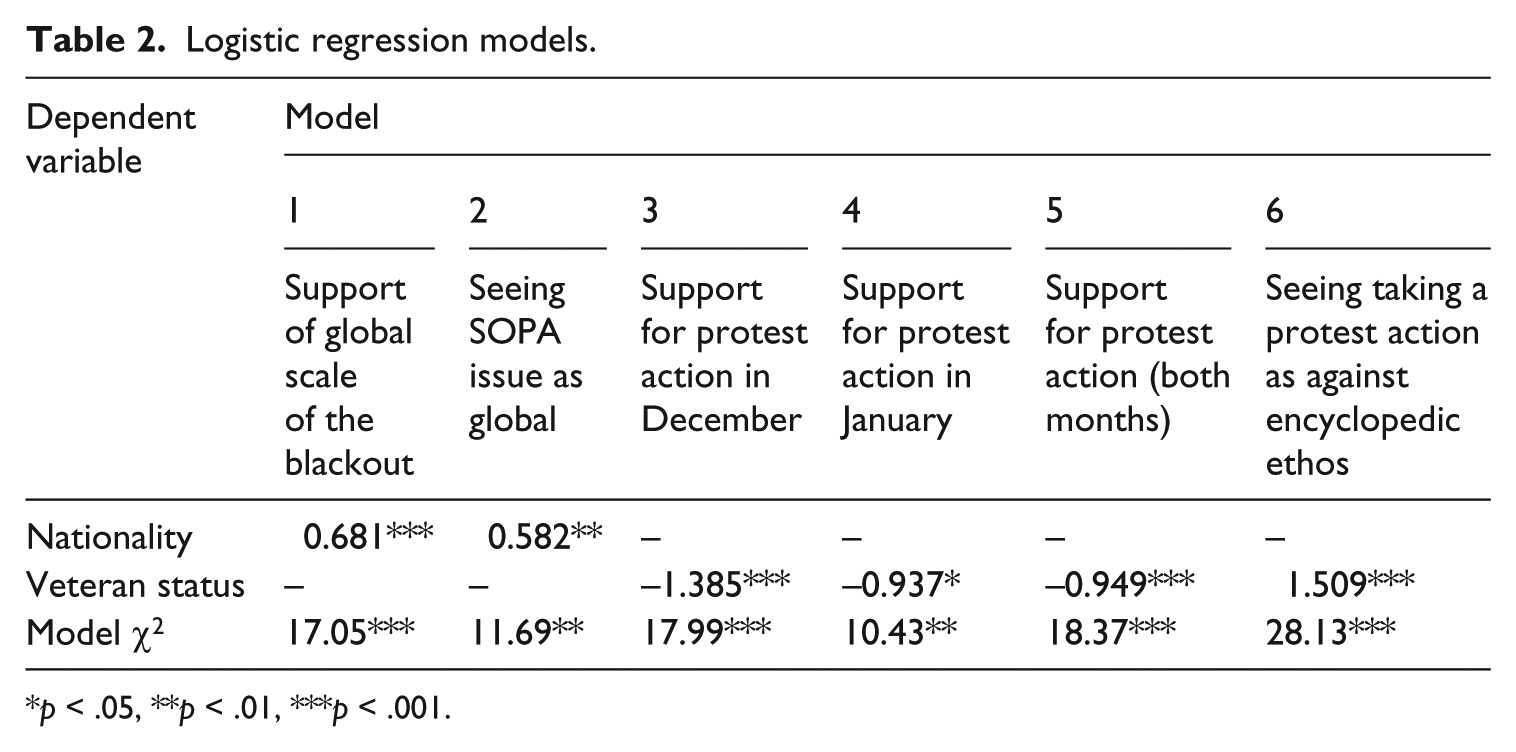
p < .05, **p < .01, ***p < .001.
Descriptive statistics for editor motivations.
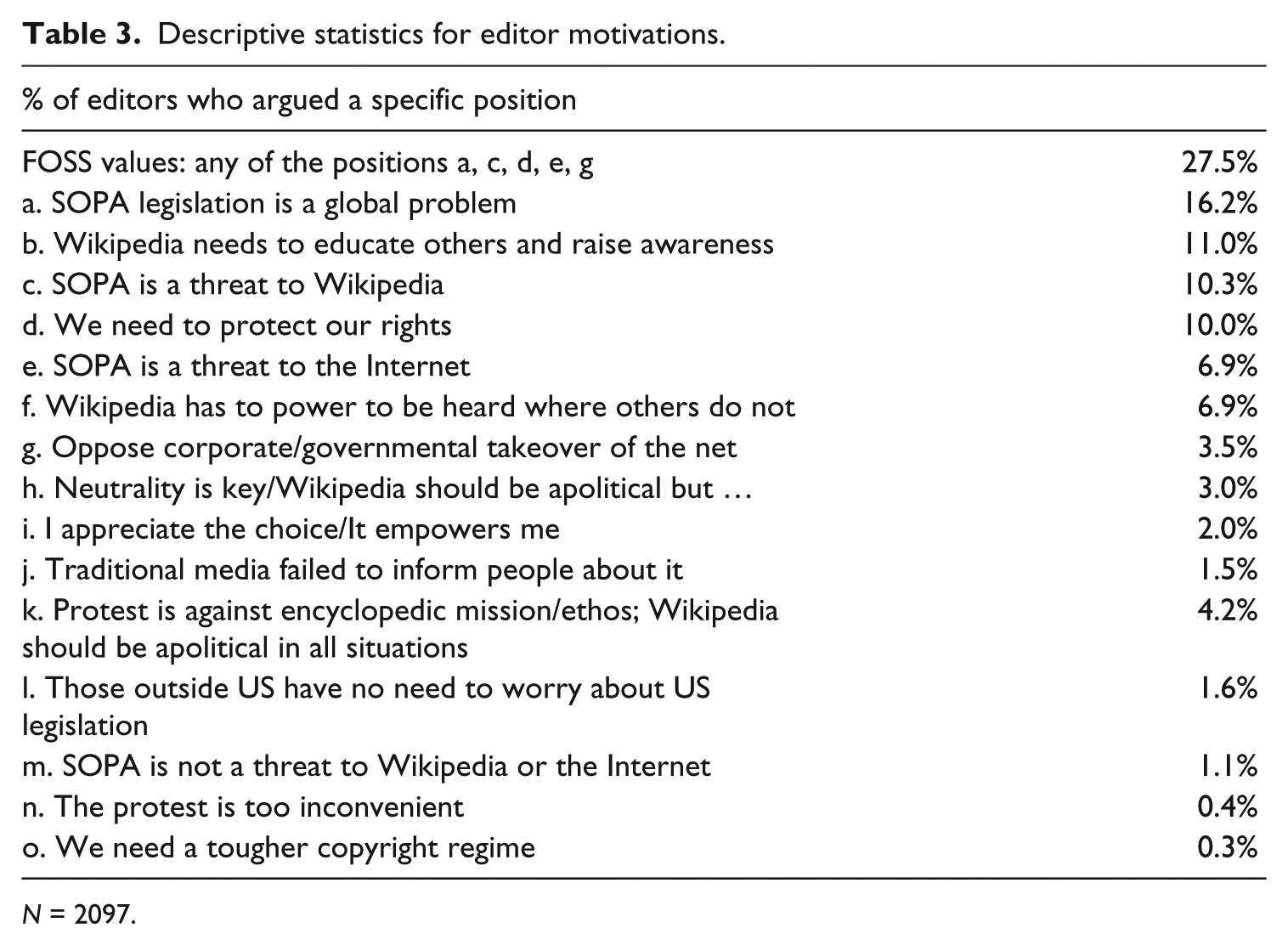
N = 2097.
Editors’ motivations
Over a quarter (27.5%) of editors supporting the blackout mentioned at least one of the following arguments: global threat, threat to the Internet, threat to rights, and the opposition to governmental or corporate takeover of the Internet. All of those values are highly relevant to the values of the free culture movement. As the value of 27.5% is the highest reported for motivations, this leads to support for hypothesis H2a, suggesting that Wikipedia values are aligned with those of the free culture movement, free culture values were a common argument for supporting the protest.
The most common argument made by the supporters was that SOPA was a worldwide threat, as about 16% of the voters stressed its global, international repercussions. In justification of this, they primarily focused on two observations: that it affects the Internet, which is global by definition; and that the American laws are often a template for those adopted in other countries.
The second argument concerned Wikipedia’s having a mission to educate others and raise awareness about issues like SOPA; this was mentioned by 11% of the voters. This is also tied to the sixth most common argument, that Wikipedia can make itself heard where most other organizations cannot (voiced by about 7%). Thus the desire to educate others, or at the very least provide them with access to information that they can use for that purpose, can be still seen as a top motivation behind the Wikipedia’s SOPA vote.
With regard to ‘a threat to what’, this represented an issue elaborated by supporters in their third to fifth most popular arguments. Thus supporters mentioned that SOPA is a threat to Wikipedia (10%), but also to ‘freedoms and rights’ (10%), and to the Internet (7%). Partially echoing the editors discussing ‘freedoms and rights’, about 3.5% of the voters used a rhetoric about ‘opposing the government and/or corporate takeover of the Internet’. While the threat to Wikipedia was a major motivation, it was only the third most common argument, thus hypothesis H2b cannot be sustained.
About 3% of supporters noted that while Wikipedia’s mission is to be neutral, this does not apply to the SOPA protest, either because Wikipedia neutrality affects articles and not community actions, or because of the threat that SOPA represents to Wikipedia. About 2% of supporters expressed satisfaction due to being able to vote, and noted that they felt empowered by having been given a choice.
With regard to the full vs. soft blackout, opponents of the soft blackout primarily pointed to the fact that as a tiny annoyance it would have a smaller impact and would be likely ignored.
With regard to the voters who opposed the protest, about half of them (4% of all voters) pointed to Wikipedia’s neutrality policy (Wikipedia:Neutral Point of View), 1 and argued that by taking part in a protest, Wikipedia was taking sides in a political issue, and thus violating its own core principles. This was the most common rationale for opposing, and as such supports hypothesis H3a. About a tenth of protesters (1% of all voters) argued that SOPA did not threaten Wikipedia, and six individuals (about 0.3% of all voters) supported a tougher copyright regime; slightly more (10 individuals – 0.4% of all voters) argued against the protest, seeing it as too inconvenient to be justifiable.
Comparing US editors to those from the rest of the world, several major differences in motivations became apparent. US editors were about twice as likely to be motivated by the desire to increase awareness and the threat SOPA posed to Wikipedia and the Internet. They were however only half as likely to recognize that SOPA was a global problem, with almost two-thirds of the votes in that category coming from editors self-identified as non-US citizens.
Editor support and experience
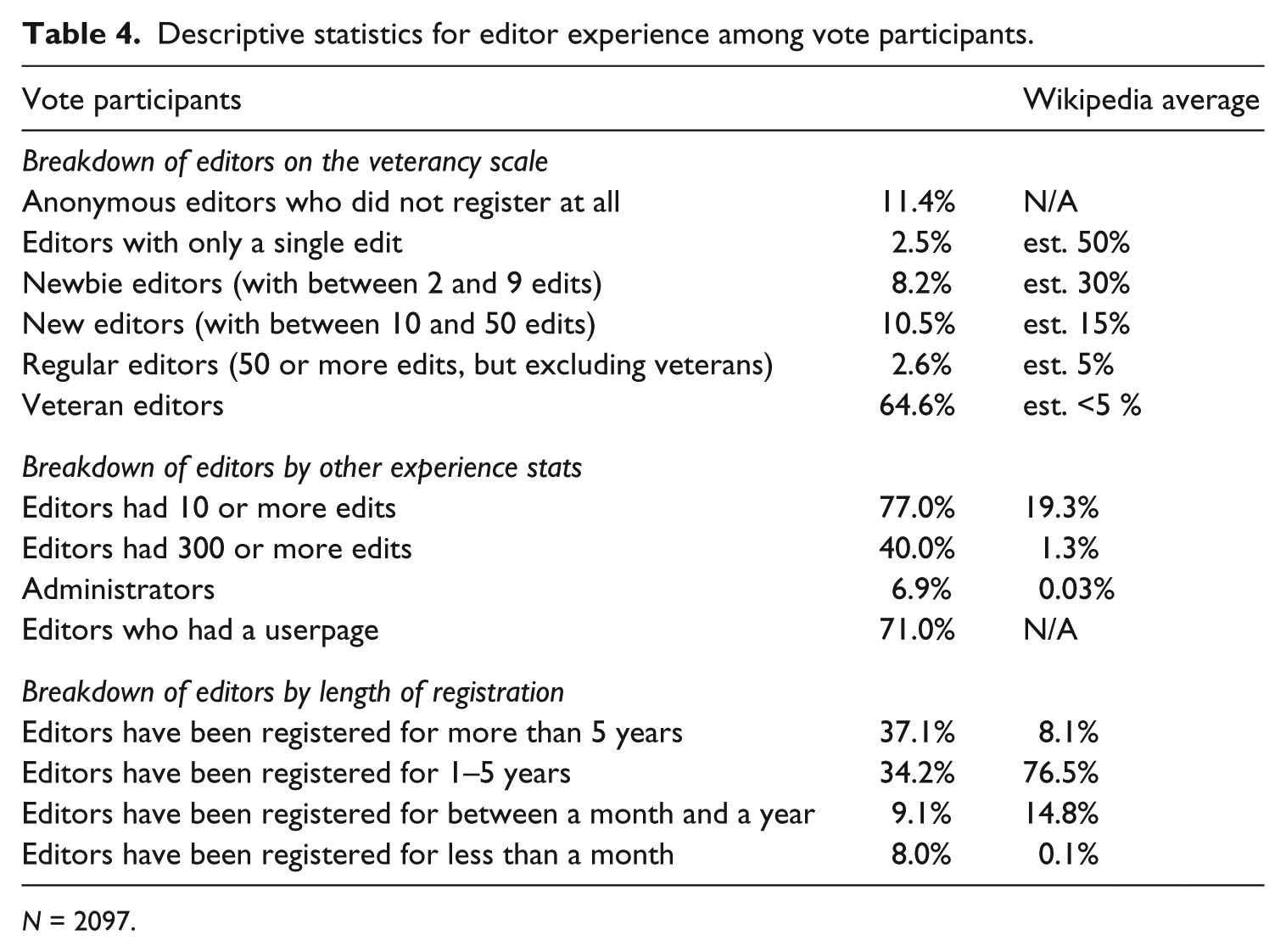
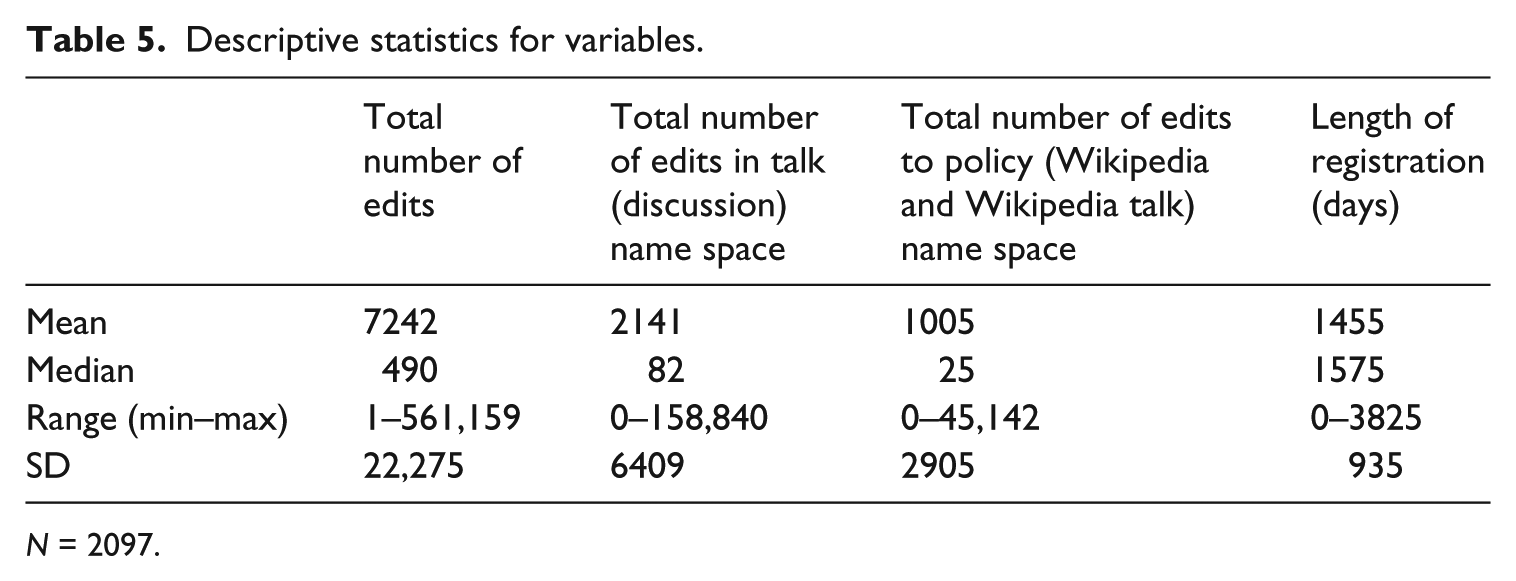
As illustrated by Table 4, compared to the average distribution of Wikipedia editors by the length of registration, two groups are significantly overrepresented: the oldest and the newest editors. Around December 2010–January 2011 editors who have been registered for over five years form only 8.1% of Wikipedia editors, but they represented over a third (37.1%) of the vote participants. At the same time, the group of editors registered for barely a month, usually only a tiny percentage of Wikipedia editors (around 0.1%), formed 8% of the voters. Anonymous editors, also likely to be first-time or otherwise very junior editors, accounted for 11.4% of the total. At the same time, 40% of vote participants had over 300 edits, while in the general population of Wikipedia editors this group accounts for only about 1% of all editors. Of the editors who participated in the vote and discussion 64.5% can be defined as veterans. See Table 5 for the descriptive statistics of the variables discussed here.
Descriptive statistics for editor experience among vote participants.
N = 2097.
Descriptive statistics for variables.
N = 2097.
Veteran and inexperienced editors had somewhat different views and motivations with regard to the SOPA issue.
In the December vote, participating in a protest was supported by 95.5% of the inexperienced editors (216 voted in support, out of 226) and 84.3% (238 voted in support, out of 282) of the veteran group. Experience is a statistically significant variable in a logistic regression model predicting whether one would support the protest action in December. Model 3 predicts that being a veteran editor decreases the log odds of supporting a protest in December by 1.385. No other variables have proven to be significant when controlled for in the model.
In the January vote, participating in a full blackout was supported by 88.4% of the inexperienced editors (223 total out of 253) and 78% (539 out of 694) of the veteran group. Soft blackout was supported by a small minority, 6.7% (17) of the inexperienced editors, and 12.6% (87) in the veteran group. Experience is a statistically significant variable in a logistic regression model predicting whether one would support the protest action in January. Model 4 predicts that being a veteran editor decreases the log odds of supporting a protest in January by 0.937. A related Model 5 also predicts that being a veteran editor decreases the log odds of supporting the SOPA protest in either month by 0.949. No other variables prove to be significant when controlled for. This again suggests that as editors become more experienced they are less likely to support the protest.
Finally, the data reveal that the support for the protest action was stronger among the inexperienced group than among the veterans; this is further confirmed by the statistically significant positive correlation between variables related to editor’s experience (their total number of edits and their number of edits to policy pages) and the motivation about opposing the protest action as it is against the encyclopedic ethos. A logistic regression model confirms this, with Model 6 predicting that being a veteran editor increases the log odds of stating this motivation by 1.509. Thus we can conclude that the more experienced a Wikipedian is (particularly with regard to familiarity with the project’s policies), the more they are concerned about losing neutrality, damaging Wikipedia’s reputation, and going against encyclopedic ethos. Models 3–6 therefore allow us to confirm hypothesis H3b.
In addition, the veteran editor variable has outperformed the variables it is composed of in all cases, retaining statistical significance in all comparative models. This suggests that when defining experience on Wikipedia, we should include not only the number of edits (as has been the common trend in current literature on Wikipedia studies), but also other factors, such as length of registration, having a userpage, and having edited Wikipedia policy and discussion pages. Administrator status was controlled for, and also proved to be less significant, which also cautions against trying to define an experienced editor as an administrator.
Discussion
Who voted: Nationality
Compared to the regular demographics of Wikipedia’s editors, participation of editors from the USA was higher than among those from the rest of the world: the American voters formed about 47% of the total, whereas in the general editor population, the American editors constitute only 20% of the editors of the English Wikipedia. It stands to reason that the issue was most familiar to and most directly affecting the US residents. Nonetheless, the significant representation of non-US residents, who still formed over half of the voters, is indicative of the international nature of the (English) Wikipedia project, and the international interest generated by the SOPA legislation.
While the support for the protest was constantly high, there was a not insignificant increase of support from the international editors, who by the time of the January protest became even more likely to express their support than the US-based editors. This can be explained by the increased familiarity the international editors had with the SOPA legislation’s global consequences by January. As indicated in Table 1, it is not that support from the US editors faltered – on the contrary, it rose over time. Instead it was the support from the non-US editors which rose more quickly, matching and even surpassing the desire of the US editors to engage in the protest action. The most significant aspect of the nationality division was the fact that the US editors saw the SOPA issue as their domestic issue, and often argued that international editors should not be inconvenienced by the planned protest action; whereas the international editors saw SOPA as an international issue, and thus demanded that the protest be global. As such, Wikipedia participation in the anti-SOPA protest can be seen as a factor which enabled the ‘international political opportunity structure’ to boost ‘national political opportunity structure’ (Rothman and Oliver, 1999), as the US-based activists received increased support through international Wikipedia editors interested in stopping the SOPA legislation, not only to support the rights of US citizens, but to safeguard themselves from the perceived risk of losing their own rights, in case the US law change would be used as a model for law changes in their own countries.
The influence of experience on editors’ motivations
This takes us to the next finding, that of declining support for the protest among the more experienced Wikipedians. This may at first seem counter-intuitive, as one could assume that veteran editors would be more concerned over a legislation that could threaten to shut down the Wikipedia project. However, those editors highly value the site’s principles and policies (Pentzold, 2011). Hence, the diminishing support among the group of veteran editors seems related to the fact they are more likely to be familiar with Wikipedia’s policies, including the ‘Neutral Point of View’ one. That policy can be summed up, in Wikipedia’s own words, as ‘Wikipedia articles mustn’t take sides, but should explain the sides, fairly and without bias’. It was the most popular argument made by the protest detractors (89 editors, or half of those who explained their rationale for dissenting pointed to this principle). This sentiment can be illustrated with comments like ‘we should not choose sides in political debates, NPOV should not only be a guideline in our articles’. Further, many supporters recognized this as an issue but nonetheless weighted participation in the process as a necessary evil; about 4.5% (64 individuals) of those who supported the process felt the need to address this issue in their rationale. Such an attitude was perhaps most succinctly summed by an editor who wrote: ‘The articles are neutral, the mission is not.’ Incidentally, this comment about the non-neutral mission of the project (‘to provide free information to mankind’) is yet another strong indication of Wikipedia’s participation in the free culture movement.
This also suggests that the neutrality of Wikipedia, while of importance to veteran editors, is much less valued by the inexperienced editors or readers, who are also less likely to even know of the NPOV policy.
The number of new editors who joined Wikipedia to express their opinion about the protest action, rather than participate in the core encyclopedic building mission, was tiny in the overall scheme. Wikimedia (2012) data show that the average number of about 7000 editors registering a Wikipedia account monthly held steady from fall 2011 to spring 2012, up to and including the period of December 2011/January 2012. Indeed, out of the 2097 voters there were only 238 anonymous editors and 170 editors who joined within the last month or so (110 joined within 24 hours before casting a vote). Nonetheless, those groups still accounted for about 20% of the overall vote participants. It is worth noting that only a few of those 170 editors have made any edits to the encyclopedic content either before or after voting. It seems clear therefore that this group was indeed strikingly different from the regular Wikipedia editors, as they demonstrated no significant interest in engaging with the project’s core mission, instead being interested only in utilizing Wikipedia as a tool for expressing their opposition to the SOPA legislation. Reading between the lines of veteran editors’ concerns about losing neutrality and damage to Wikipedia’s reputation if the site was to take a political stance we may be seeing a more or less subconscious fear of losing control of the project to politically motivated newcomers. Nonetheless, even as such a fear was voiced, the majority of veteran editors chose to side with the more radical newcomers, eventually lining up behind the most radical solution (full day, global blackout). Therefore it does not appear that the Wikipedia community was significantly changed during or after the mobilization; rather it reinforces the point that it simply shared most of the free culture/digital rights movement values from day one.
It is perhaps even more surprising that the many regular readers who one would think would be inconvenienced by the protest chose not to voice their objections. Media coverage both before and after the Wikipedia blackout suggested that many would be annoyed and inconvenienced at the unavailability of this resource, yet that sentiment was hardly expressed by the voters. Among all of the 2097 participants, only 10 objected to the protest on the grounds of it being inconvenient.
The SOPA initiative serves as a good illustration of all elements of Wikipedia governance functioning in practice, during an emergency decision making process (for an analysis of Wikipedia’s governance, see Konieczny, 2009a, 2010). Wales was instrumental in bringing the issue to the community’s attention, but then the community took his idea and developed it in its own way. The SOPA initiative’s main page where most of the discussion took place was created by a veteran editor and the Wikimedia Foundation made only one significant injection, exercising its mandate to bring an issue to the community’s attention at a time-sensitive moment, by starting a new poll on 13 January. The vote then continued without the Foundation intervening again, and within hours, some poll questions were reworded, and others added, as members of the community sought to improve the process. Wikipedia may be seen as a mostly adhocratic organizational form with very little hierarchy, however with elements of other decision making systems, particularly democratic decision making (through the polls) and charismatic authority (personified by Jimbo Wales).
Rationale for supporting
Against the background of who voted, and how, we now approach the following question: why did the Wikipedia readers and editors decide to vote so overwhelmingly in support of joining the protest?
There are several major currents of thought that can be distinguished among the supporters. For many Wikipedia editors, SOPA was perceived as a worldwide threat: 23% of those who supported the vote noted that they were opposing SOPA as it was more than just an American problem, seeing it instead as a piece of legislation with implications reaching far beyond Wikipedia. Many respondents noted that American legislation has a habit of becoming a model for similar legislation abroad. To quote one of the respondents: ‘US legislation has a way of creeping itself into other countries by economic pressure etc. So, don’t expect SOPA-style legislation to remain confined to the US for long once adopted.’ A likely reason for the primacy of this argument is that over half of the voters came from outside the US, and thus felt compelled to justify their right to vote on and influence domestic US legislation.
About 10% stressed the importance of Wikipedia’s self-preservation, and a further 7% extended this to the entire Internet. Another 10% went further, seeing the proposed legislation as a threat to their rights, a threat that some (3.5%) framed in a language critical of a governmental and corporate agenda. They expressed their sentiments with comments like ‘the corporate oligarchs are simply trying to control all our thoughts. Fight the power!’ or ‘It’s not just about downloading films and music, its about the whole INTERNET for god’s sake, our culture, our commons, our privacy and our freedom. They [copyright industries] want it all, and the US govt wants to give it to them. … It has to stop!’ Another voter even paraphrased a poem about the Holocaust: ‘First they came for the pirates, and I didn’t speak out because I wasn’t a pirate. Then they came for the blogs, and I didn’t speak out because I wasn’t a blogger. Then they came for the social networks, and I didn’t speak out because I didn’t use any social networking site. Then they came for me (Wikipedian), and there was no one left to speak out for me.’
About 27.5% of editors supporting the blackout mentioned at least one of those arguments, with 16% expressing a less combative sentiment, tied to the primary mission of Wikipedia – the idea that Wikipedia must do everything possible to educate others, and if joining a protest would provide a chance to educate the public, it was something worth doing.
Those comments indicate that Wikipedia is a part of the emerging transnational community focused on the Internet-centric issues, a community that began as a part of the software-focused FOSS movement but is now evolving into something larger, using the language of freedom and rights. This entity is a part of the free culture movement, as represented by diverse organizations such as the Electronic Freedom Foundation, Creative Commons, the Pirate Party, and others.
Only 3% of opponents (or 0.28% of all voters) supported a tougher copyright regime. This further suggests that the groups like the Motion Picture Association of America (MPAA) and the Recording Industry Association of America (RIAA), which are in the forefront of arguing for even more protection for intellectual property, have very little grassroots support – at least, among Wikipedians.
This begs the question to what degree Wikipedia editors are representative of a general population. The short answer is that no, Wikipedia editors are not very representative of that group, but perhaps they may be more so of the Internet-savvy youth. Age wise, after all, the average Wikipedian is indeed a member of the Millennial/Net Generation. Mannheim’s classic theory of generations is pertinent here. Mannheim suggested that if a new generation is raised in a substantially different environment, and witnesses significant historical events, it will display different modes of behavior from its predecessors. Already in the early 2000s Lenhart and Madden (2005) showed that more than half of US teens were digital content creators: they blog, they create websites, they post videos and photos, and they edit wikis; this process has only accelerated since. As described by MacKinnon (2012), there is a growing realization across that generation that issues of digital rights and free culture are becoming increasingly vital – and as noted by Reagle (2010: 79), Wikipedia is probably the best known example of the free culture movement today. Different generations have been used as predictors of involvement in social movement activity. Bridy (2012), MacKinnon (2012), Schmitz (2013), and Yoder (2012), among others, suggest that we are seeing a shift in norm discourse and creation among the Internet users, and the case of Wikipedia participation in the 18 January protests, and its editors’ values, may be seen as a case study of this emerging phenomenon. Further studies, hopefully, will shed more light on the topic of how widespread are the values of free culture and digital rights among both the Wikipedia editors, and members of the Millennial/Net Generation.
Conclusions
This article presented the case of Wikipedia acting not as an encyclopedia, but rather as a collaborative, global civil society site of contention and democratic decision making. It provided a public forum for individuals that successfully used it to transparently propose, democratically discuss, and finally implement a protest action. Wikipedia editors share a number of values and motivations, which makes them likely to mobilize against legislation that is seen as infringing upon the values of the digital rights and free culture movement, and this supports the framing of the Wikipedia project as a part of that movement. It is worth noting, however, that experienced Wikipedians are likely to be conflicted about whether taking part in a protest action is not violating the site’s principle of encyclopedic neutrality. In conclusion, the primary reason why the vote was not purely unanimous revolved around the discussion of Wikipedia’s mission and ethics. This indicates that Wikipedia’s values are significantly but not fully compatible with active participation in the wider free culture movement.
International netizens, organized through the free culture movement organizations, have been shown to be able to influence American internal policy and legislation. The SOPA protests demonstrated that in a modern interconnected world, people from outside the US increasingly realize that American legislation has an international impact. They have no American representatives – but they can cooperate with social movements that do. International supporters of the free culture and digital rights movements do not have political representatives in the US, but were able to make themselves heard by the American general public, who have access to such political representatives. In the case studied, both the international and US Wikipedia editors decided to black out Wikipedia, using the Wikipedia project discussion space as a public sphere. The international political opportunity structure, in the form of the free culture and digital right movements, working through the social movement organizations, including Wikipedia, encouraged American citizens to complain to their elected representatives, thus enabling the creation of the national (US) political opportunity structure, which eventually contributed to the failure of the SOPA legislation.
The votes and comments of the inexperienced editors (of whom for many this vote was the first and only edit on Wikipedia) give us a more representative window into the views of the general population (for a better idea on how representative that group may be, see the demographic analysis in the Wikipedia Readership Survey results in Wikimedia, 2011b). Tellingly, this group was even more strongly opposed to the SOPA legislation’s demands for stronger copyright enforcement being pushed by certain corporate and security interests than the Wikipedians in general. Thus analysis of Wikipedia editors’ motivations supports the conclusion that among the demographic represented by the English Wikipedia volunteer editors (computer savvy, English-speaking 30-year-old males with a college degree) and the likely more representative group of inexperienced editors the SOPA legislation had almost zero support. While we have to account for the digital divide, i.e. the fact that it still takes some amount of computer expertise to participate in the process of Wikipedia voting, thus significantly slanting those groups’ populations toward the digitally literate, as well as for the fact that the inexperienced group was likely skewed by overrepresentation of activists, the data presented here seem supportive of the argument that the clash of individual digital rights with corporate intellectual property is becoming of increasing importance to the Internet-savvy, Wikipedia-engaged members of the Millennial/Net Generation.
Footnotes
Funding
This research received no specific grant from any funding agency in the public, commercial, or not-for-profit sectors.