



Abstract
Sharp social inequalities in Latin America persist not only as a result of structural elements, but also because people justify and legitimate them in everyday life. Thus, to overcome inequalities it is necessary that individuals subjectively perceive them as unjust. This is an issue that is especially relevant in Chile, one of the first countries to experience neoliberalism in the 1970s. More than social inequalities as such, which are widely studied by Latin American sociology, this article analyzes social justice as a subjective judgment about inequalities. On the basis of the findings of an empirical game-based research project, the article examines the justice criteria used by ordinary people regarding differences between members of society. The authors argue that according to these subjective criteria, social justice refers to aspects that differ from neoliberal discourse about distributive justice based on equality of opportunity and that procedural justice is also key in ordinary discourses about social justice.
Introduction
Social inequalities are reproduced because of structural reasons, but also because they are subjectively tolerated or justified by people. Overcoming them depends not only on their being perceived as inequalities, but also on their being apprehended as unfair. This creates a need for inquiry into the subjective appraisal of inequalities, as they materialize in the daily lives of ordinary people and in their interaction with others.
Within sociology, we may describe the field of subjective inequality as ‘the study of what people believe about who gets what and why’ (Kluegel and Smith, 1981: 30). Empirical research on social justice seeks to know what people consider just or unjust. These assessments are based on personal preferences or criteria and are therefore different from a normative approach which is defined according to universal, rational and objective criteria (Liebig, 2001). At the subjective level, social justice can be understood as a component of justice, a construct of what is just in terms of both material or symbolic advantages and resources in society (Kymlicka, 1999). The most analyzed conceptual dimension of social justice is distributive justice, which relates to what individuals within a group or society should receive (Hegtvedt et al., 2003; Kellerhals and Languin, 2008).
Latin American sociological analyses have focused on the study of social inequalities as such, the collective actions to address these inequalities, or public policies designed to reduce them; and have dedicated less time to examine social justice as the benchmark against which to measure inequalities. In this article we argue that in a mature neoliberal regime, as is the case in Chile, from the perspective of individual perceptions, ordinary conceptions of social justice assume particular forms. Chile is a small country in the southern cone of Latin America, in which the authorities of the civic-military dictatorship (1973–1990) imposed a neoliberal economic regime that was more orthodox than in countries where this model was tried out within democratic institutional frameworks. Since the return to democracy and for over two decades, this model has for the most part continued being applied with some limited reforms. The country has experienced sustained economic growth and social policies were implemented at the same time. The result of this strategy is a drastic drop in poverty without change in the unequal distribution of income. 1 In 2011 the student movement, critical of educational inequalities, led a series of protests, which together constitute a massive collective action that gave rise to a period of public questioning of social inequalities.
In order to explain what people believe about social justice, it is necessary to identify the criteria that determine perceptions of it. There is evidence that in the last few decades there has been a shift in capitalist countries, from the subjective predominance of principles linked to an equality of positions referring to equalizing the conditions of life among people, to an equality of opportunities with merit-based principles (Dubet, 2010). To illustrate this point, most people worldwide tend to agree that doing the job well and trying hard should be rewarded (Evans et al., 2010). In this context, it is of interest to verify whether the subjective evaluation of distributive justice is effectively based on principles associated with the justice of opportunities over justice of positions and to determine the concrete criteria relevant for people when assessing this matter.
However, what is perceived as just may depend not only on the distribution of societal resources, but also on the evaluation of what are considered fair procedures, or in other words, not only on distributive justice but also on procedural justice. ‘Suspicion’ about procedures being manipulated in ways that are not transparent may act as a trigger for social criticism (Goffman, 1974). Beyond sociology, in the area of social psychology, there have been significant advances in examining how and why people value procedural fairness – and not distributive justice exclusively – and according to these studies, procedure has an intrinsic value in interpersonal relationships (Mueller and Landsman, 2004; Tyler, 2006). Broadening this perspective towards a sociological approach, our investigation examines the extent to which procedural justice is relevant to people in assessing social justice. It also permits approaching the question of which procedural justice criteria have more influence in people’s judgments.
This article advances our understanding of the subjective evaluation of social justice by maintaining that in order to understand people’s judgments on social justice it is necessary to identify the criteria by which they assess both distributive and procedural justice. Particularly, this article aims to identify the principles of justice that people in Chile apply in their perception of the inequalities among members of society and the criteria that influence their assessment of these inequalities as just or unjust. When making judgments about others, people express feelings and ideas about justice or injustice. This study refers then to the perceptions of ordinary individuals with diverse socioeconomic characteristics. In particular, it includes the appraisal of one of the most relevant expressions of inequality – the economic elite, understood as a social segment that concentrates economic, social, cultural and political power, and is thus the par excellence embodiment of unequal access to social resources.
The methodology used in this research is based on games played by focus group participants. This makes it possible to monitor semi-reflexive processes as the players assess social differences. Most of the analysis of the results is qualitative but it is also supported by quantitative data.
The first section of the article addresses the way in which inequality and social justice have been approached by Latin American sociology and describes the scope of our work on subjective appraisals of inequalities at the micro level. In the second section, we describe the methodology, which is based on games played in groups. In the following two sections, we present the results and formulate key distinctions in the assessment criteria according to the principles of justice, which range from substantive distributive to procedural justice.
Social justice in Latin American sociology
In the early days of Latin American sociology, social justice was considered functional to the integration of society and analyzed indirectly, from the perspective of the normative framework established by modern national institutions (Germani, 1962). At a later stage, social scientists turned their attention to the social conditions of this regulatory framework, their structural determinants, and thus contributed to the social and political criticism of social injustices in the continent. In recent decades, the mainstream sociological focus on inequality analyzed it as an empirical phenomenon outside of a value-based framework, implicitly suggesting value-based analyses were improper approaches for the social sciences, as was criticized by González (2006). But contemporary Latin American sociology assigns increasing relevance to social justice itself as object of research.
Recent approaches in Latin American sociology are oriented to the study of perceptions of social justice in a context that differs from that of the previous historical period (1930–1970 in the Chilean case). Garretón (2007) argues that what defined the ‘classical socio-political matrix’ of twentieth-century Latin America was the role of the state as the political articulator of a society in which the political representation system was linked to the social and economic base. In the case of Chile, the dictatorship dismantled social and political actors and imposed a neoliberal model during the 1970s, thus transforming this matrix. The most lasting effect of this rupture was that the economy became autonomous not only from politics but also from society, thereby reducing the state’s distributive and cohesive functions. In this context, a central question becomes what subjective principles of social justice and injustice accompany the current societal processes and whether these differ from those of the past.
A relevant analysis of the current era focuses on how individuals relate to societal processes, arguing that Chileans understand their life as one where they are obliged to assume responsibility for themselves. This can be defined as ‘agentic individualism’ which is opposed to ‘institutional individualism’ (Araujo and Martuccelli, 2014). The latter is characteristic of the previous period, in which individuals and social actors defined their identity and chose options framed by their institutional rules. In contrast, neoliberalism has exacerbated values associated with consumption (Moulian, 1997) and individual merit (Engel and Navia, 2006). In this model, inequalities become naturalized through a pre-reflexive process in which social differences are seen as established a priori by mechanisms and classifications that are not consciously examined, eroding the imaginary of both a social and a political ‘we’ (Lechner, 2003; Souza, 2004). This prompts the question of whether perceptions regarding social justice are atomized and reduced to multiple individual interpretations or whether they allow the emergence of collective values, albeit shaped in a particular neoliberal-like way.
On a collective and macro-social level, over the last three decades the notion of social justice in Latin America has been addressed in relation to public policy, the demands of social movements for more democracy and the expansion of citizenship and social rights. As for social policies, they have been framed in a citizens’ social rights discourse (Abramovich, 2006) and in terms of social protection (Cecchini and Martínez, 2013). Studies that are mainly sociological have analyzed the constraints of implementing these social rights and policies (Midaglia et al., 2013; Robles, 2013) and the fact that they generate a sense of social injustice among their recipients (Mailleux, 2013). This is an open debate in contemporary Chile and there have been a plethora of studies that address this issue. From a theoretical and normative perspective, Atria (2004) criticizes the social rights discourse arguing that in the neoliberal context individuals are consumers of collective goods and services – from water to education – on the private market. In this context, this discourse ultimately seeks to improve individual consumption, thus moving away from the realms of solidarity and communitarian principles. Referring indirectly to procedural justice, Salvat (2003) signals that only legal norms that are recognized via a democratic process are considered legitimate; this is not achieved by the technocratic policies that are characteristic of the decision-making process in a neoliberal system.
There is also a substantial body of research on social movements that demand increased levels of social justice but less analysis on the ideas of social justice involved, as well as individual perceptions of social justice. Gender, ethnicity, education and other inequalities have been extensively described and analyzed in relation to the barriers they establish. Less is known about the conceptions of the just and unjust held by individuals who daily experience these inequalities.
From a quantitative viewpoint, income inequality, viewed as a central component of distributive justice, has been studied in Latin America using national and international surveys. For example, a nationwide representative survey was conducted in Mexico, in which the poorest segments were asked what they thought about social justice (Székely, 2005). The results showed that the satisfaction of basic food needs constitutes the minimum condition for social justice and that beyond this minimum, respondents expressed that conditions not controlled by individuals should be leveled and their most valued principle of distributive justice was personal hard work (Dieterlen, 2005). Research in Chile and Brazil shows that the perception of income inequality is lower in the poorest groups, where there is also a weaker feeling of injustice (Cardoso, 2004; Castillo, 2011; Costa, 2009). Interviewees in Brazil perceive less injustice with regard to differences in income as compared to the perception of respondents in European countries (Cardoso, 2004). In addition, a large number of respondents refer to education as a status-improvement strategy, which also constitutes a criterion that legitimizes inequalities (Cardoso, 2004; Scalon, 2007). In turn, regardless of perceptions of distributive justice or injustice related to income, it is interesting to note the scant importance assigned to inequalities arising from the accumulation of capital (Garretón and Cumsille, 2003), which is concentrated within the economic elite, identified as the richest 1% (or less) of the world population (Piketty, 2013; Stiglitz, 2012) and regarded by contemporary sociology as the modern incarnation of inequality. 2
In sum, while there is recent research on the barriers produced by inequality as well as the collective actions taken to break these down, individual perceptions of social justice have remained understudied. In this article, we expand the knowledge about these perceptions and contribute to the current debate from a perspective that rather than theoretical and normative is based on individual perceptions of social justice. This approach broadens the analytical focus of social justice in Chile and Latin America by examining ideas of justice beyond income inequality and distributive justice, and incorporating an analysis of judgments about the economic elite.
Method: The contribution of games to the analysis of social (in)justice
This article is part of a research project aimed to reveal the micro and intermediate social processes at work at the subjective level – which are the basis for the reproduction of inequality or conversely, for criticism of social injustice. The main goal of this study is to expand our knowledge about how ordinary people perceive social inequalities. A basic relevant issue both for Chile and the rest of the world is whether inequalities are accepted and justified or whether they trigger perceptions of injustice and foster criticism. This research focuses on the perception of social differences between persons of different social classes and zooms in on the inequalities embodied in the economic elite.
We used games, namely a Classification Game and an adapted version of the Dictator Game, which trigger standpoints that do not emerge from other instruments habitually applied in social sciences. In particular, this method unveils subjective processes with a lesser degree of reflexivity, permitting the researchers to approach the way citizens assess stratification and determine it just or unjust. In this respect, game theory refers to what happens when people interact, thinking about what others do and what others infer from what the player does, all of which provides a suitable approach to study social interaction (Camerer, 2003). The games were conducted in the context of focus groups in order to engage the participants in a social interaction simulation. The applied method may be regarded as quasi-experimental, because games are conducted in a controlled setting with external variables held constant. It is quasi-experimental in the sense that participants were not randomly assigned to groups, implying potential selection bias and bias with regard to the validity of findings. However, the applied method allows us to systematically obtain empirical evidence relevant for the analysis of perceptions of social justice. The simulation exercises carried out for this research involved 24 groups representative of different social classes with a total of 90 participants or ‘players’, 36 in the Classification Game and 54 in the Dictator Game. In order to avoid cross-contamination between the games, no single individual participated in both simulations. 3 For both games, each group of players was composed of individuals with similar socioeconomic backgrounds and included men and women of different ages. The composition of each group was implemented according to an adapted version of the scheme proposed by Erikson, Goldthorpe and Portocarero (Erikson and Goldthorpe, 1993), and the groups ranged from upper middle class to working class.
In these games, players were asked to categorize people and represent society, as well as to formulate judgments about other individuals. The games consist of a simplified representation of the social world, in which individuals seek to use the best strategies and have delimited specific information and clear-cut rules that make it possible to control a set of conditions relevant to the object of study (Camerer, 2003; Deauvieau et al., 2014). A central aspect of our research is that these methods permit the observation of subjective processes that occur at a semi-reflexive level; they do not call for much rationalization and are largely intuitive. The seemingly innocuous way in which people perceive other individuals in society, the string of thoughts and language that they use to ‘place’ others socially, the cognitive and non-cognitive processes involved, the perceptions associated with practical behavior and the criteria present in social processes can be reproduced and observed using games.
In this article, we examine the results of both the Classification and Dictator games. The Classification Game was originally developed by Boltanski and a team of French researchers (Boltanski and Thévenot, 1983) and was recently replicated in Europe (Deauvieau et al., 2014). 4 The Dictator Game is a model used in many research projects in social sciences in the last decades (Camerer, 2003; Engel, 2010).
The Classification Game consists of a set of cards representing members of the Chilean society. Each player must use his/her understanding and interpretation of social life to classify the individuals and thus represent the differences between members of society. The participants check and sort 62 cards representing a wide range of people. Each card contains distinctive individual characteristics, such as occupation, level of education, income, municipal district of residence, religion, ethnicity and looks – as shown by a photo that makes possible to infer age, gender and other characteristics. 5 The main point of the game is that the players must group the cards according to their own criteria and define the most important groups in Chilean society. Once the cards are sorted, the players are asked to name the groups and indicate which card from the pile best represents each category. This game permits the identification of shared perceptions and the criteria that structure players’ views of social inequalities, including their appraisal of what is just or unjust.
The second game – the Dictator Game – measures players’ disposition towards altruism or aversion to inequality (Camerer, 2003; Engel, 2010; Henrich et al., 2005, 2010). Our adaptation of the game is oriented to observe whether aversion to inequality is expressed in a critical judgment of inequalities as crystallized in the economic elite. This is followed by an exploration of players’ perceptions and judgments about the elite. In this game, players are allocated a sum of money, part of which they can give to somebody else. The term ‘Dictator’ refers to the player’s absolute power of decision to choose to donate money. In our research, we use the Dictator Game to observe whether participants’ aversion to inequality undergoes modifications depending on the beneficiaries’ socioeconomic profile and to test the influence of the information that the players have on the beneficiaries (Bekkers, 2007; Eckel et al., 2007). In our adapted version, the money can be allocated to three individuals, one of whom belongs to the middle class and the other two are members of the economic elite. 6 The players are told that each one of these characters runs a nonprofit organization that helps people in need. Each player receives an amount of money equivalent to US$36 and must decide whether to allocate the whole of the money or part of it to the three possible recipients. This allows for the subsequent quantification of the players’ preferences and permits to analyze the ways in which the players’ judgments vary with respect to the characteristics of the three potential beneficiaries. The players are finally asked to account for their decisions to the group, and this triggers the expression of judgments about the economic elite and more general opinions on social (in)justice.
These games elicit subjectivities that have not been thoroughly studied. They trigger an explicit expression of prejudices and values or moral principles that would not have been detected by simply adding up the different individual opinions provided by surveys, individual interviews or more traditional focus groups. The combined analysis of both games provides information on subjectivities concerning not only the social categories commonly studied, but also judgments on the economic elite. Thus, these games contribute to a better understanding of what the ideas of social justice consist of and how they emerge.
The conditions under which the games were conducted follow predefined and replicable protocols, reproduce similar exercises implemented in other countries and allow further repetitions in other contexts. These protocols permit controlling for the variables analyzed, particularly in relation to the differences between members of society and the inequality embodied by the economic elite. The effects of these games are measured quantitatively via the order of cards and the monetary amounts assigned to them by players; and are also objects of qualitative analysis. The applied methodology facilitates accurate measurements and delimited analyses, which would not be viable with less formalized procedures.
Equality of opportunity: What is at stake in people’s judgment about inequalities
This section presents a first aspect of our findings related to the way in which individuals perceive and differentiate members of society. This allows understanding their feelings and ideas regarding the justice or injustice of social inequalities. Here we analyze players’ decisions and the expressed reasons for these choices. Unlike in a ‘pure’ rational choice approach, these are understood in a historical context. While in twentieth-century Latin America the prevailing principle of justice was that of equality of social positions and was focused on the narrowing of existing gaps between social classes (Garretón, 2007; Germani, 1962), our study permits a discussion of the extent to which the prevailing principle of justice nowadays is equality of opportunity, as observed in other countries of the world, emphasizing the importance of individual responsibility, which posits that every individual should be rewarded according to his/her own merit and effort. Moral standards associated with neoliberalism are manifested in the players’ positive appraisal of the ‘successful’, the ‘winners’, the ‘self-sufficient’ and the ‘enterprising’. Upward social mobility is positively assessed with expressions such as ‘overcoming’ and ‘struggling middle class’. On the contrary, downward mobility or stagnation is negatively assessed with expressions such as ‘conformists’, ‘in the doldrums’ and ‘resigned’. The prevailing ethical principle is individual effort achieved through education and work and from which income differences are allegedly derived.
In practice, the implementation of the neoliberal model in Chile is relatively hybrid (Garretón, 2012) and in this vein neoliberal principles do not overrule players’ opinions in an absolute way. References to equal opportunity respond to heterogeneous moral standards. Players’ judgments mainly refer to structuring social principles that are culturally embedded – such as those related to equality of opportunity – that organize the daily life of individuals. At the same time, at the micro-social level, individuals are constantly examining evidence about the validity of such principles (Martuccelli and Singly, 2012). Our analysis of the validity of the equal opportunity principle in society begins with the value judgments expressed by individuals and goes on to examine whether people consider this principle resistant when submitted to a collective ‘test’ – or ‘épreuve’ in French, according to Boltanski’s expression (2009). The goal is to observe what is tested in people’s discourses, i.e. what is said about equality of opportunity using the evidence provided by players. In order to do this, we defined dimensions in which equality of opportunity might be put to the test. Our focus is guided by the distinction established by Bourdieu (2000 [1983]) between different types of resources in the relation between social actors: economic, cultural and social capital, the sum of which constitutes the total capital of an actor. 7 The main evaluation criteria expressed by the players are summarized in Table 1, which separates judgments on the whole of society from those that are specifically focused on the elite.
Equal opportunity: main criteria used by the players.
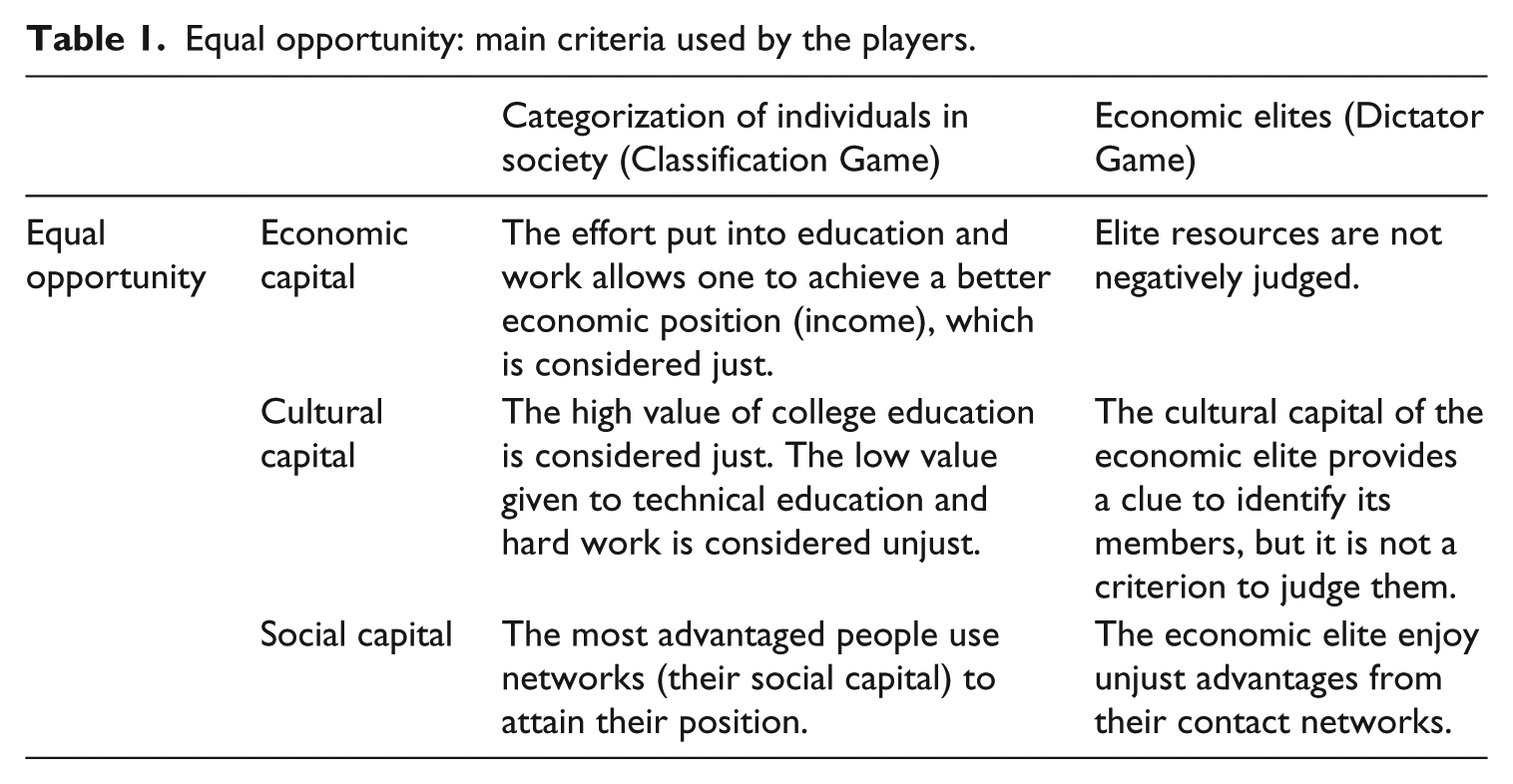
The evaluation of equal opportunity according to economic capital is expressed in the career trajectory that the participants of the Classification Game considered most desirable. One of the cards which sums up a socially valued trajectory and with which some groups of players identified as ‘we would like to get there’, was that of a young professional who started his career with a good salary. The model embodied by this card is installed firmly enough to be accepted, valued and desired by players of different ages and with different education levels. Conversely, despite the way in which the model represented by this card was valued, being part of the economic elite is not something that the players aspire to. On the contrary: the two cards representing members of the economic elite in the Dictator Game received less monetary allocation for their foundations than the card showing the middle-class individual, which points to a comparatively higher acceptance of the latter. The traditional elite member is more strongly rejected than the self-made plutocrat, a newcomer to the economic elite.
However, the players uttered no criticism of the concentration of economic resources by the elite and several players expressed that this was not a problem for them. This could be interpreted as a pattern following from power–dependence relationships in which given that balancing operations are not viable, individuals experience tolerance and accept their share of resources (Turner, 2007). But in the games this was replaced by or transmuted into other evaluation criteria of social justice, which are examined below.
From the players’ perspective, the existing justifications for the distribution of economic resources came into conflict when they were assessing the distribution of cultural and social capital, and not economic capital, as is shown in Table 1. In fact, educational level and cultural capital, in a broad sense, play a central role in the representation of social differences. There is consensus between the players on the idea that access to higher education is a determinant of income differences and the favorable economic conditions of the upper categories of Chilean society. Participants associate cultural capital mainly with educational credentials, which confirms that education in Chile is a prominent principle of differentiation and distributive justice, as compared with other countries. 8 But this principle is not applied in the same way by the different groups of participants: the attention paid to educational level focuses on university education in the case of upper middle-class players and on technical education among players of the lower social strata. Due to the increasing number of university graduates in Chile, 9 the players said that job opportunities are few, unstable and poorly paid compared to tuition costs, the latter because of the devaluation of educational credentials. Technical education is considered to be of low quality and to offer scarce employment opportunities for graduates. Thus, education and cultural resources were considered as legitimate standards in the social hierarchy, but there were harsh critiques of inequality within educational opportunities. In addition, lower middle-class players and manual worker participants pointed out that university education is overrated compared to the value of work: unskilled work is poorly paid and neither effort nor work experience are recognized.
Inequalities perceived by the players as unjust are also related to the evaluation of the distribution of social capital, more specifically, through networks formed by family, friends and contacts. The more positive evaluation of the newly elite character in the Dictator Game is mainly based on the fact that unlike his counterparts from the traditional elite, he did not, according to players, inherit his money but earned it through his own effort. In any case, pre-existing social capital tends to favor the upper classes and not only the traditional elite: private schools and universities attended by young people from these classes create a ‘niche’ – a term used by one of the players – for people to know one another. This increases social differences, all of which is later translated into contact networks that provide economic benefits. According to several players, social capital was also a criterion to criticize the fact that individuals from the economic elite get unfair advantages thanks to their present situation: ‘money begets money’ – as one player put it.
Thus, according to these evaluation criteria, social capital operates against equality of opportunity, which is also limited by inequality of educational opportunities.
Procedural justice: Neutral rules and fair treatment in the assessment of social justice
A second aspect of our findings refers to the importance individuals assign to procedural justice in the social justice framework. One model of procedural justice from an instrumental point of view observed that people value it because by exerting control over processes, they can influence the outcome, and therefore this is more likely to result in distributive justice (Hegtvedt et al., 2003; Thibaut and Walker, 1978). In a second model, procedural justice is not related to outcome. Tyler (2006) argues that there are two aspects which refer to fairness in procedures that are important in themselves and independent from outcome: the first one consists in neutrality and absence of bias in the ‘rules of the (social) game’ and the second is related to individuals’ appraisal of whether they are getting a fair treatment when dealing with those in power. This double definition of procedural justice allows differentiating it from distributive justice and facilitates the analysis of to what extent and under which conditions it is used by game participants as justice criteria.
We consider that differentiating between these two types of procedural justice is even more important if we consider one of the most recent and interesting theoretical studies on justice formulated by French sociologist Luc Boltanski. He argues that in social life, there are three alternative types of judgment (Boltanski, 2009). The first type is the judgment of ‘truth’, which is mainly justified by repetition as the credible and visible proof that in practice the same rule has always prevailed, as happens for example in the routine of official, religious and family ceremonies. These are practices that have become naturalized, as also noted by the Latin American sociologists previously mentioned (Lechner, 2003; Souza, 2004). The second type is the judgment of ‘reality’, i.e. rationalizing statements based on evidence intended to be contrasted with phenomena of social life, such as an assessment based on facts about the way individuals are treated by others. Finally, the third type consists of ‘existential’ judgments formulated by individuals and based on life experiences either of their own or of people close enough for them to consider such experiences as their own, for example the way they feel or think they are treated by others. In our approach, the position of individuals regarding the fairness of procedures can be based on any one of these three types, truth (naturalizing), reality, or life experience judgments.
Following Tyler and Boltanski, when we consider the two aforementioned aspects jointly, rules and the way people feel they are treated, as well as the types of judgments they apply, we can distinguish different criteria used by ordinary people about the justice or injustice of procedures. Table 2 shows the way in which such judgments were assessed by game participants, once again distinguishing between judgments on the whole of society from those that are specifically focused on the elite.
Procedural justice: main criteria used by the players.
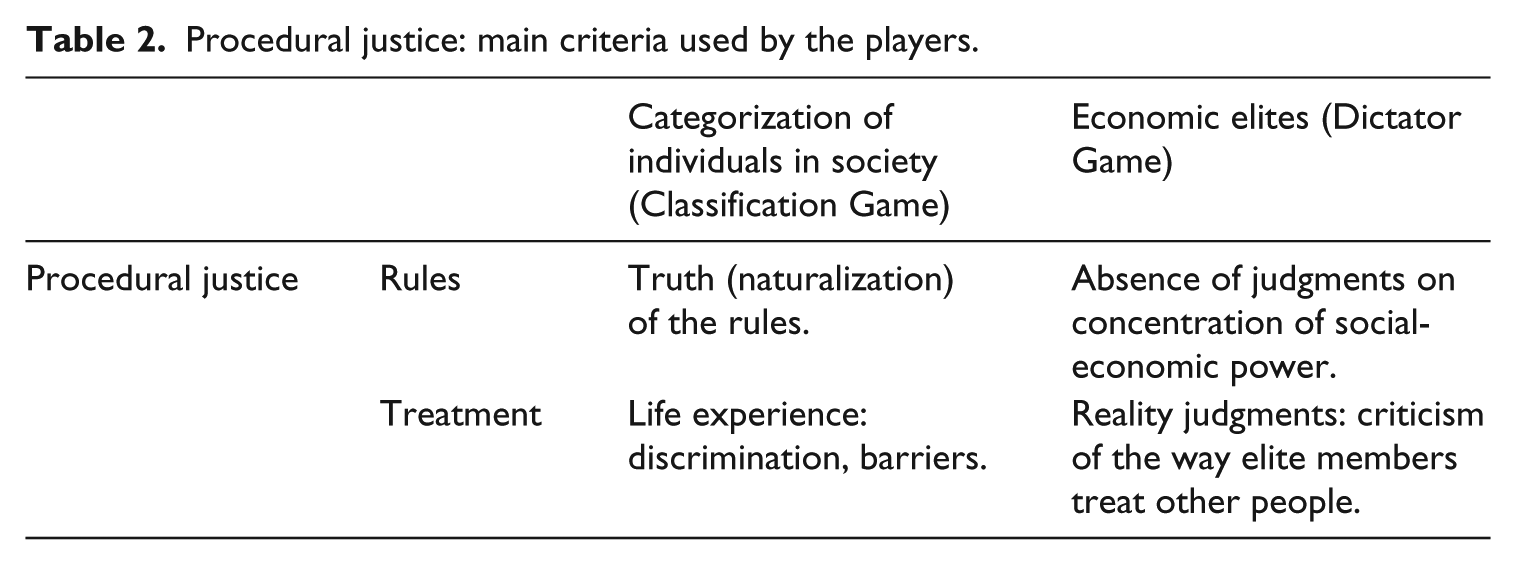
While they were categorizing people, the players’ first criterion to appraise procedural justice is that ‘the rules of the game’ of coexistence in society are acknowledged as true and natural principles that are not subject to questioning. In the Classification Game, players from different social classes repeated many times that through effort and dedication associated with work and study, it is possible to earn a good living. The players justify this as a self-evident truth that requires no discussion, and thus social success should depend on individual will and perseverance. Furthermore, the players criticize those who do not put this rule into practice, because failure to strive and experience social progress is an individual fault of ‘mediocre’ and ‘conformist’ people. Education, and particularly university education, is accepted as a rule of social differentiation. A person ‘without a degree is worth nothing in Chile’, said a waitress resignedly, but without questioning the matter. If we add to this the absence of judgments about the concentration of power among the economic elite during the Dictator Game, this points to the fact that players consider this to be irrelevant and not related to the neoliberal order. From this we can derive that there is ample justification of the basic rules of the Chilean version of the neoliberal model. Even the position in which housewives and pensioners find themselves – which is acknowledged as disadvantaged – is considered as a ‘truth’ of the structural functioning, whose rules, according to the players, are what they have always been and will remain unchanged. According to the players, housewives 10 ‘sacrifice themselves’ for the sake of the other members of the family; they work ‘for free’ and are ‘dependent’. The players assume this to be an immutable truth and one of the groups even referred to them as ‘sovereign dependents’ – an oxymoron used to justify their status. As for pensioners, a player made an ironic comment about how ‘good’ Chilean pensions are, which made the other players laugh. However, the underlying assumption was that this situation is an unbreakable pattern.
The players’ second criterion of procedural justice was that based on their own life experience or their interpretation of the life of the individuals pictured in the cards; they identified discrimination and barriers that affect people in society. Despite the justification of the rules that reproduce sharp inequalities in the neoliberal regime, the players express experiences in the first-person singular and formulate generalizations from their own experience with expressions such as me or you or us or reference a specific card using personal pronouns such as he or she.
During the games, physical appearance and ethnicity were considered strong markers of social inequality and discrimination at work and in social life. A female participant in the group of manual workers referred to the card corresponding to a woman who takes in washing, did not go beyond primary education and has a low income, and compared her to a company vice-president with university education and a high income, making the following generalization: ‘The way she looks, the way she talks, the way in which she expresses herself is different from hers [the vice-president] … They watch how you speak, how you express yourself, how you sit down.’ Other members of the group concluded that ‘they are treated in a different way’ and that these differences are forms of discrimination. At the other end of the social scale, upper middle-class professionals with a university degree coincided in their opinion that two of the people in the cards, with different educational levels and living in socially differentiated municipal districts, would not even ‘give each other the time of day’ were they to run into each other. The participants also referred to discrimination towards native indigenous people 11 and to other sources of discrimination. With the exception of upper income districts, municipal district of residence are seen as a segregating factor when people interact socially. A person’s occupation, and even his/her parents’ job, is seen as another factor of social discrimination when it is a low status one. There were also multiple references during the games to the differences in the social evaluation of schools and universities. In the opinion of the participants, these institutions are of similar academic quality and distinctions are exclusively due to the social composition of their attendees and work against equal participation in the labor market. Thus, the procedures typical of a traditional order coexist with the justified and basic rules of the neoliberal model. From this perspective, the model is both traditional and modern, a hybrid creating multiple barriers and social discrimination that generates perceptions of inequality regarding the way people are treated in social life.
Finally, a third criterion for procedural justice specifically regarding the economic elite consists in judgments about the way they treat others, supported by real-life evidence. Although players abstain from giving an opinion on the concentration of economic power, which from the point of view of substantive justice is a constitutive rule of the economic model, they judge the economic elite harshly because of the way its members treat people, which shows the importance of procedural justice. The dialogue between participants in the Dictator Game reached emotional intensity due to opinions about the treatment allegedly given to others by the two elite characters. Few players had had personal contact with members of the economic elite, which explains the absence of life experiences when evaluating elite characters. Instead, they relied on reality judgments based on their assertions about what they consider real-life evidence in Chilean society and more general rationalizing statements, subject to verification with other players.
Regarding the traditional elite character, the fact that his economic capital was inherited from family members received critical judgment. A player sarcastically characterized him as someone ‘born with a silver spoon in his mouth’. Criticism was extended also to the new economic elite character whose networks and general social capital are considered the origins to his fortune. But what is being judged is not only the origin of economic capital: the quality of interpersonal treatment as a rationalizing evaluative criterion was harshly and repeatedly criticized regarding the character of the traditional elite. What really troubled the participants about this individual is the distance that his substantial wealth put between him and the rest of society. He was perceived by the players as devoid of ‘humanity’ in his relations with others. One participant portrayed him as ‘arrogant, despotic’. Several players also made harsh judgments about the way he supposedly treats others and most of them allocated less money to him than to the other elite character – the newcomer – because the former ‘lacks humility’, ‘cares little about what the rest thinks’, ‘is unaware’ of ‘what others lack or need’ or because he has ‘never been in need himself’. According to the players, he also has ‘lots of prejudices’ and is ‘very biased’ ideologically, which would result in his inability to deal with the ‘real needs’ of others. By contrast, the track record of the middle-class character would enable him to ‘know’ the needs of the people that he helps. In short, when the elite interact with other members of society, they establish allegedly superior social distances, ignore the problems of others, and therefore ‘humiliate people’, ‘discriminate against other people and are snobbish’, all of which is considered unfair treatment of others. However, the perception of the newcomer elite member by participants in the Dictator Game is less unfavorable compared to their perception of the traditional elite member. His attitude to others is perceived as more ‘humane’, as one sales assistant said. However, another sales assistant in the same group, sarcastically depicted the character of the newcomer as ‘a resurrected louse’, 12 someone who forgets ‘they used to be badly off’ and now ‘turn their backs on those who helped them’. Thus, the evaluation of what is (un)just refers mainly to the distance that the economic elite members put between themselves and others and not to their economic resources and their wealth per se.
In sum, social representation (Moscovici and Duveen, 2000) of the unjust includes symbolic contents and the attribution of meaning to treatment in social life, which refer to a procedural justice.
Conclusions
In Latin America and particularly in Chile, empirical sociological studies about individual perceptions of social justice are a relatively new phenomenon. This article shows that at the semi-reflexive level, far from the individualistic fractioning advocated by the neoliberal model, ordinary people apply well-defined and relatively shared criteria about social justice. Demand for social justice has been a recurring issue in the life of these societies and vibrant in the current juncture where neoliberal policies are being debated and reformulated, as is the case of contemporary Chile. A central question is what is at stake with a conception of social justice that simultaneously produces tensions in social interactions between individuals and generates justifications or criticism of social inequalities. In this regard, our findings contribute to expand our knowledge by observing how people judge the principles proclaimed in neoliberal discourse. The results illustrate how people think about social justice: unraveling the expression of judgments about the position of others in society, by means of a game-based methodology, the dominant concept of equality of opportunity is put to the test not only in relation to the income of other people, about which there is a relative acceptance, but also in relation to cultural and social capital, about which there is a strong disapproval among the players.
From the perspective of distributive justice, the principle of equality of opportunity prevails, but there are barriers that delimit and specify it, generating criticism on how the neoliberal model works. Individuals also assign great importance to procedural justice: being fairly treated is a relevant issue for common people. This fact is obscured in analyses where social justice is considered only insofar as linked to distributive justice. The perception that members of the economic elite treat other people in an unfair way prevails over the conclusion that there are unfair and non-neutral rules that work in favor of the elite. The fact that the players criticize unjust treatment from the perspective of procedural justice in Chilean society provides new evidence about the incomplete penetration of the neoliberal model four decades after its installation. The perceptions of social injustice that emerge are related to discrimination and other forms of unfair treatment in social interactions and not only linked to substantive aspects of distributive justice.
Footnotes
Acknowledgements
We thank our colleagues for their collaboration in this research, especially Virginia Guzmán, María Luisa Méndez, Ana María Valenzuela, Magaly Mella and Cristóbal Moya. We also thank the reviewers for their comments, and Carolina Pinto and Jael Goldsmith for their suggestions.
Funding
This research was supported by the Chilean Sciences and Technology National Council (grant number 1130800 and 1130276). We also thank the support of the Center for Social Conflict and Cohesion Studies (CONICYT/FONDAP/15130009) in which Emmanuelle Barozet is associate researcher and for the translation of this article.