




Abstract
This article explores the relational power and responsibilities to migrant workers on physical infrastructure projects in Qatar connected to the sovereign state hosting the Fédération Internationale de Football Association (FIFA) World Cup 2022. Currently, these construction workers operate under the Kafala system, which is upheld in Qatar. However, large numbers of Qatar’s visiting migrant construction workers were recorded as injured or killed through incidents that were related to their work. Further still, many other migrant workers reported poor, unsanitary living conditions and being ‘trapped’ by their Kafil with passports withheld or wages not forthcoming, prompting criticism from international non-governmental organizations. This article adopts a relational sociological approach to discuss how ‘responsibilities’ for deaths, injuries and illnesses are passed between key actors that include the State of Qatar, FIFA, World Cup sponsors, building contractors and sub-contractors, and the recruitment agencies that find workers in other countries to work on the construction sites. As such, it makes three scholarly contributions: it leads in unpacking and discussing the treatment of migrant construction workers in World Cup 2022 infrastructure projects in Qatar; it follows work by Timms in adding to the literature on the passing of responsibilities for migrant workers between states and corporations in globalized societies; and it uses the case to further critically unpack Castells’ notions of relational power in networks.
Introduction
On 2 December 2010 Qatar won the right to host the 2022 Fédération Internationale de Football Association (FIFA) World Cup (hereafter World Cup) finals. Readiness for hosting this sports mega event (SME) entails constructing nine state-of-the-art stadia, US$20bn worth of new roads, a high-speed rail network, a new airport and hotels with 55,000 rooms to accommodate fans, players and officials (Pattisson, 2013). These physical infrastructure projects are being built by migrant workers who live under the rules of the ‘Kafala system’. However, the conditions such migrant workers experience have been described as ‘unsatisfactory’ in separate reports by International Non-Governmental Organizations (INGOs) including the International Trade Union Confederation (ITUC, 2011, 2014), Human Rights Watch (2012), Amnesty International (2013, 2014) and Engineers Against Poverty (2014). The State of Qatar has since – in 2014 – commissioned ‘independent advisors’ DLA Piper to devise proactive responses to these pressure groups. Nevertheless, tolls and estimates of migrant workers’ deaths are high: for instance, PlayFair Qatar estimates 62 workers will die for each game played (Hyde, 2015), while Gibson and Pattisson (2014) find that there were 157 recorded migrant workers deaths in the country in 2014 alone. However, the INGO reports showed the poor treatment of migrant workers extended beyond those that died: for instance, showing images of workers queuing up in sweltering temperatures waiting for their bus back to their crowded, edge of Doha dormitory (see Amnesty International, 2013), or at the money transfer offices in shopping malls at lunch time to send their money home (see ITUC, 2014).
This article discusses how ‘responsibility’ for the questionable treatment of migrant workers on World Cup 2022 related infrastructure projects in Qatar is passed between key actors in the network by drawing upon Manuel Castells’ ‘relational power’. In doing so, the article illustrates how those involved in allowing migrant construction workers’ death, injury and illness frame the situation as both ‘regrettable’ but also beyond its responsibility. Through making these points, the article makes three scholarly contributions: first, by unpacking and discussing the treatment of migrant construction workers in World Cup 2022 infrastructure projects in Qatar – an area that has not yet been addressed in the academic literature; second, in following Timms (2012a, 2012b) and adding to the modest literature on the passing of responsibilities for migrant workers between states and corporations in globalized societies; and third, using this case study to further critically unpack Castells’ notions of relational power in networks.
Literature review
FIFA’s decision to award the right to host World Cup 2022 to Qatar has proved to be controversial for at least two reasons: first, (European) critical journalists claimed that FIFA executive committee votes in the ballot to host the SME had been ‘bought’ (see Blake and Calvert, 2015; Weinreich, 2015). These allegations gained further traction in 2015 when United States federal prosecutors disclosed cases of profiteering, vote rigging and ‘corruption’ by FIFA officials and associates, and FIFA President Sepp Blatter – just days after winning his fourth Presidential Election – announced that he would stand down. New FIFA Now emerged, asking for reform of football’s world governing and collaborating with established campaigns such as PlayFair (see Harvey et al., 2014: 38 for a history of PlayFair). Second, awareness about the treatment of overseas construction workers grew when journalist Pete Pattisson reported the story in The Guardian on 25 September 2013. Despite Downey and Fenton’s (2007) cautions against taking journalistic accounts at ‘face value’, this coverage was significant because The Guardian’s website globally receives in the region of 77.9 million unique browsers per month (MediaWeek, 2013). The Guardian recorded Pattisson’s article had been ‘shared’ on social media almost 100,000 times by January 2016. The online storage of the article was accompanied by a short video, a discursive section that drew in over 1600 readers’ comments and gave rise to an ongoing (INGO ‘Humanity United’ supported) section entitled ‘Modern Slavery in Focus’.
However, the politics surrounding World Cup 2022 has thus far given rise to little academic debate. Brannagan and Giulianotti (2014, 2015) provide rare exceptions by suggesting that Qatar’s appetite to host World Cup 2022 is driven by an attempt to leverage ‘soft power’ in the Middle East global region and across the world at large. SMEs come imbued with ‘legacy’ promises (Roche, 2000; Rowe, 2012), and Brannagan and Giulianotti (2015) argue that an intended legacy of World Cup 2022 is to emphasize the cultural and political power of Qatar. Indeed, this aligns with the 2005 sovereign investment made in the Qatar Tourism and Exhibitions Authority with the intention of boosting the annual number of visitors to 1.5m by 2010 (Reiche, 2015).
FIFA has been bold in its claims to subjectively improve people’s lives across the world. In 2012, it declared its mission statement was ‘to develop the game, touch the world, build a better future’ (cited in Tomlinson, 2014: 27), claiming ‘it is FIFA’s responsibility to foster unity across the football world and to use football to promote solidarity’ (cited in Tomlinson, 2014: 28), while in 1997 then-FIFA President João Havelange had claimed ‘football can succeed where politicians cannot’ in soothing the tensions of the Israeli–Palestinian conflict (cited in Tomlinson, 2014: 66). FIFA is organized into six continent-specific groupings and the Asian Football Confederation – headed by Qatari Mohammed bin Hammam when the country was awarded the right to host the 2022 World Cup finals – has also made brash claims about its power to bring about social justice and change (see Weinberg, 2015).
World Cup 2022 is not the first SME to come with question marks about the rights of workers and citizens employed in connection to it. For instance, Tzanelli (2015) points out that in 2013 and 2014, hundreds of thousands of people joined nationwide protests in Brazil against grievances of inadequate public services (specifically including public transport) and the high cost of staging both World Cup 2014 and summer Olympics 2016 in the country. Further, Cottle (2011) pointed out that at World Cup 2010, South Africa street ‘hawkers’ were subjected to harassment when trying to sell their merchandise, while Bird and Donaldson (2009) noted that sex workers would be ‘cleaned’ from Cape Town ahead of the event with little concern for their welfare. This action was repeated in the later preparations for London’s summer Olympics 2012 (Watt, 2013). Amid the criticisms made of World Cup 2010, Cottle (2011) argued that construction companies in South Africa generated sizable revenues but this did not transfer into improved pay or conditions for construction workers. However Wellings (2012) countered that the role of a football tournament is not to deliver legacies of improved pay and conditions in host countries. What is more, these controversies are not only associated with the global South, with Boykoff (2014) terming the London summer Olympic Games 2012 ‘celebration capitalism’.
Most pertinently, Timms (2012a, 2012b) examined PlayFair2012’s struggle for workers’ rights connected to the summer Olympics 2012. In particular, Timms explored protests aiming to achieve ‘corporate social responsibility’ (CSR) advantages for workers around the world who produced merchandise and sportswear after PlayFair2012 had found widespread poverty wages and exploitative conditions in factories and production units. This was despite ‘official Olympic themes of responsible, ethical and sustainable business practices and local promotion of the event as providing responsible employment’ (Timms, 2012b: 361). However, PlayFair2012’s pressure made the local organizing committee, LOCOG, adopt the ETI Base Code and complaints mechanisms, giving rise to spaces for dialogue between Olympic officials and the owners of the factories that made merchandise and sportswear for the SME. Yet, in the process of this happening a TUC representative (who was part of the PlayFair2012 coalition) told Timms: There is in all of this a constant kind of merry-go-round of people going ‘well this is not our responsibility, it is the IOC’s responsibility’ and the IOC going ‘it’s not our responsibility, it’s the Games organizers at the local level’s responsibility’, and the Games organisers say ‘well it’s the company’s responsibility’ and the companies say ‘it is the IOC’s or LOCOG’s responsibility’. (quoted in Timms, 2012b: 364)
Strydom (1999) explored arguments in speeches and reports from leaders in politics and business and INGO/Third World Network personnel and found all attempted to discuss (a) what responsibility was, (b) to whom and (c) whose duty it was to deliver it. He argued ‘responsibilities’ became ‘co-responsibilities’. In the case of Timms’ work, responsibility for change was palmed off elsewhere, a theme which continues in the case of infrastructure projects related to World Cup 2022 in Qatar. What is more, although O’Connell Davison (2015) found direct evidence of some international industries not treating ‘foreign workers’ well, Timms (2012a) – drawing upon material from PlayFair2012, the cut flower industry and the ‘Keep Burberry British’ campaigns – usefully offered the concept of ‘geographies of responsibility’ (2012a: 258–263). In doing so, she argued that in a global market, more companies take advantage of cheaper labour costs, meaning connections between workers and corporations are increasingly complex. Concurrently, Tombs and Whyte (2015: 100–129) argue that legal and commercial structures of corporations in a transnationally connected world are set up to provide ‘irresponsibility’ (rather than ‘responsibility’) towards workers. Therefore Timms (2012a: 258) makes two points: first, that lines of responsibility are messy and second, place is important in the understanding of workers’ rights. Carrying these points forward, workers who are ‘far away’ or ‘less visible’ might be granted fewer rights than those who are close to global regions where campaigners may congregate.
Therefore workers in and around World Cup 2022 were not the first to be subjected to questionable treatment, nor are such problems only associated with the ‘global South’. However, and reiterating Downey and Fenton’s (2007) point for caution in treating newspaper reports as ‘facts’, the scale of deaths marks it as an extreme case. Quantifying precisely how many people have lost their lives on construction projects in Qatar because of World Cup 2022 infrastructure developments is difficult because even without the SME the urban environment in Qatar is changing at pace. However, the number of those who have lost their lives is higher than those that were reported to have died on building projects associated with World Cup 2010 (according to Marinho et al., 2014, two people died) and World Cup 2014 (in which Marinho et al., 2014 reported that seven construction workers died building the infrastructure for the SME).
To understand Qatar and World Cup 2022, the recent social and political context of the country must be understood. The State of Qatar gained independence from Britain in 1971 and since then has been ruled by an absolute monarchy – its current head of state, Emir Tamim bin Hamad Al Thani, has unrestricted political power over the country and people (Ulrichson, 2014). According to Ulrichson (2014) Qatar’s population was 1.8 million people in 2013, of which 278,000 were Qatari citizens – who adhere to the strict Wahhabi interpretation of Islam – and around 1.5 million expatriates. The global significance of Qatar arises from both its natural gas/oil reserves and its large sovereign wealth fund, Qatar Investment Authority (QIA), which contribute to it being the world’s richest country per capita (Ulrichson, 2014). Indeed, Qatar’s National Vision 2030 placed investment in renewable resources as a core objective in the country, in response to its depleting gas/oil national production levels (Kamrava, 2013). The diversification of the economy – including investment in real estate and the cultural sector – continued with the Qatari banking sector escaping the direct impact of the global subprime fallout and QIA subsequently strengthening its position in the global economy with investments in Barclays Bank, Santander Brasil, Bank of America, Agricultural Bank of China and car manufacturer Volkswagen (Kamrava, 2013).
Qatar uses the ‘Kafala system’. Historically, this involved the host ‘Kafil’ (‘sponsor’ or ‘employer’) assuming responsibility for the safety and protection of foreign ‘guest workers’ (Pessoa et al., 2009). However, over time, its practices provided governments with the means of regulating labour flow into their respective countries (Bajracharya and Sijapati, 2012). Under today’s Kafala system, workers’ contracts are a minimum of two years in which their visa and legal status is tied to the Kafil (Pessoa et al., 2009). Bajracharya and Sijapati (2012) point out that this means that the sponsor is required to take full economic and legal responsibility for the worker, including the worker’s recruitment fee, medical examination and issuance of a national identity card. The Kafil effectively has complete control over the mobility of the worker, taking away all individual autonomy since an employee cannot transfer employment or even leave the country without an exit visa from a sponsor. Such treatment is ‘legal’ in national and international criminal justice systems (Bajracharya and Sijapati, 2012).
Theoretical and methodological approach
Understanding a ‘society’ from a relational approach entails seeing it as reducible to the relationships within it, with ‘the social’ being the patterned networks of connection between social actors (Crossley, 2010). Crossley suggests that relational sociology gives the potential to analyse interactions on both micro and macro levels – thus acknowledging that relationships and interactions can exist between human beings, organizations, multinational organizations and nation-states. As such individuals, organizations, governments and multinational corporations do not exist in isolation but are the consequences of interaction and various kinds of networks. Crossley (2010) is relaxed about the specific theory and methods used in his relational sociological approach, on the proviso that they make central the relationships and interactions of social actors, and the networks that they constitute. Castells’ relational power and frame analysis fits within this position.
Castells (2009: 10) defines ‘power’ as a ‘relational capacity that enables a social actor to influence asymmetrically the decisions of other social actor(s) in ways that favour the empowered actor’s will, interest and values’, viewing it as configured by social, political, informational, cultural and material ‘capital’. Castells (2009: 42–47) distinguishes four forms of power in the network society. First, Networking Power is the power to define the network and in doing so, exclude from it. In the context of World Cup 2022, this is the power to define who contributes to the building of infrastructure projects and what legislation is created to ensure migrant workers are not poorly treated. Second, Network Power is ‘the power resulting from the standards required to coordinate social interaction in the networks [which] … is exercised not by exclusion from the networks but by the imposition of the rules of inclusion’ (Castells, 2011: 773). In other words, it is the power to set conventions, in this case with respect to the (mis)treatment of workers. Third, Networked Power is ‘the power of social actors over other social actors in the network’ (Castells, 2011: 773). Thus networked power is the managerial, agenda-setting, editorial and decision-making power in the operating networks. However, Castells cautions that the forms and processes of networked power are specific to the ‘programme’ of each network. Fourth, Network-making Power ‘is the capacity to set up and program a network’ and tends to be ‘in the hands of a small number of conglomerates, their surrogates, and partners’ (Castells, 2009: 420). For Castells, Network-making Power would likely be concentrated among the corporate few. In sum, Castells sees power as attributable to relationships that give rise to economic, social, cultural and political ways of controlling other actors in a network. In making these points, he argues power is relational, residing in networks of complex sets of alliances and joint activities constituted around projects and interests (Castells, 2009: 45).
My data are drawn from a frame analysis of interview materials and official statements collected through the online newspaper and newsblog repository LexisNexis. A computer search in the repository for articles between the dates of 2 December 2010 – when it was announced that Qatar would host World Cup 2022 – and 1 July 2015 published in ‘UK broadsheets’ with the words ‘Qatar’, ‘construction work’ and ‘World Cup’ yielded 26 articles (by comparison a similar search, replacing only ‘construction work’ with ‘corruption’ in the same time period, yielded 2230 articles, perhaps reflecting public interest in the two issues). The articles were closely read and when additional online sources were referred to they were snowballed into the pool of articles, giving 36 in total. As earlier stated, extreme caution should be taken when dealing with newspaper articles, especially given that the journalist’s position is less likely to be ‘objective’ and more likely to be matched to the ability to ‘sell’ that article to its targeted audience. This caution is especially necessary when dealing with opinion pieces and editorials. My data came from the direct statements of and interviews with key players among the social actors/organizations involved in World Cup 2022 and the treatment of migrant workers in Qatar, as outlined in Figure 1; thus the unit of analysis were the statements and quotes provided by key players rather than journalistic descriptions of the treatment of migrant workers. This is not to say that evidence gleaned from interviews and statements is without journalistic bias but the use of the quotes in the news sources went uncontested by all of the social actors/organizations included. These data were then analysed by, first, gathering them into the ‘type’ of social actor involved in World Cup 2022 (see Figure 1) and the building of infrastructure projects in Qatar, and second, performing a ‘frame analysis’ on them.

The network of key social actors related to the processes that permit the treatment of migrant construction workers in Qatar.
Erving Goffman (1974) pioneered frame analysis by outlining a methodological need to look at the ways in which individuals organize their experiences into meaningful activities and settle on a clear definition of their reality. To do this, Goffman drew upon letters published in newspapers to explore how discourse set and changed the way in which situations and issues were described. He called this a ‘frame’. Thus, frames render ‘what would otherwise be a meaningless aspect of the scene into something that is meaningful’ (Goffman, 1974: 21). The approach became associated with strands of political sociology and social movement research (Crossley, 2002). In this article, the published interviews and statements from key individuals among the social agents/organizations involved in World Cup 2022 and the construction of infrastructure projects were analysed according to two frames: (a) how the situations that bring about poor working conditions, illness and sometimes death are discussed, and (b) who is framed as ‘responsible’ for such treatments of migrant workers.
Relational power in networks and the framing of relational responsibility
There are two issues at play in the (mis)treatment of migrant construction workers on World Cup 2022 infrastructure projects in Qatar: first, the treatment of many migrant workers in Qatar and second, the treatment of migrant workers in readiness for a FIFA tournament. By recognizing these two overlapping issues, the four forms of power (networking, network, networked and network-making) can be understood. There are six types of social actor that might be argued to play a role in the circumstances that permit the treatment of migrant workers such that death, illness and injury occur. These are outlined in Figure 1, showing their relationships to each other, and the ‘power’ they have over one another.
The ties (lines) in Figure 1 represent the connections between the key social actors (labelled). Arrows represent the flows of ‘power’ between the social actors. The State of Qatar (including its government agencies) carries: (1) economic power over the international contractors it employs to manage the construction projects and (2) political/legislative power over both the sub-contracted construction firms and the recruitment agencies they use in finding overseas guest workers by allowing a specific reading of the Kafala system. It can exercise power by withdrawing contracts awarded to the international firms it employs or amending its legislation to alter the way in which migrant workers are treated.
FIFA has cultural power over the State of Qatar by awarding the right to host World Cup 2022. In principle, it could use its power by withdrawing the right to host the tournament. FIFA is financially connected to its World Cup sponsors, referring to them as its ‘official partners’. These sponsors could demonstrate their economic power over FIFA by withdrawing financial support. As noted, international building contractors are subjected to economic power from the State of Qatar but hold that same form of power over both the sub-contractors they employ and the recruitment agencies that source migrant workers. Similarly, the sub-contractors exercise economic power over recruitment agencies: if a sub-contractor found that a recruitment agency was ill-preparing migrants for construction work in Qatar it could cease to work with it. Hence, the various forms of power in the network are relational and exercised upon the various actors. Perhaps as a result of INGO and critical media reports and pressure group interest, representatives from the various social actors have made statements about the death, illness and injury of migrant workers in Qatar, as we see below.
Relational economic power, the State of Qatar and the Kafala system
The State of Qatar grants the Kafala system legitimacy. This gives it ‘network power’ in the context of the treatment of many migrant workers in its country over the contractors and sub-contractors that draw upon it and ‘networking power’ – as the ability to define which contractors’ networks operate in Qatar – through deciding which one to award work. However in its statements, individuals representing it claim issues around injury, illness and death belong to the international contractors and sub-contractors who sponsor the migrant construction workers, as it is they who, under the terms of the Kafala system, should be responsible for the individuals they employ. For instance, Stefan Van Dyke, a member of the Qatar 2022 (hereafter Q22) welfare committee, stated: Once the worker lives well and eats well, he works well. We had to get the contractors to buy into the process and there is a return on their investment. We are being told that they are seeing a lower rate of absenteeism … Some of the difficulties the contractors have is to visualise the standard [we want]. (quoted in Booth and Pattisson, 2014)
Q22 is made up of ‘more than 40 nationalities’ (Qatar 2022 Supreme Committee, n.d.) and is locally responsible for the organization of the event. It announced it was ‘deeply concerned with the allegations … [and] considers this issue to be of the utmost seriousness’ (Q22 statement quoted in The Guardian, 2013). Ultimately, its defence against the allegations was that it would work with ‘international NGOs, including Human Rights Watch and Amnesty International’ and has been ‘informed that the relevant government authorities are conducting an investigation into the allegations’ (Q22 statement quoted in The Guardian, 2013), deferring judgement to elsewhere in the country’s sovereign power. The Qatar Labour Ministry responded by answering a number of questions that were posed by The Guardian, framing responses as: (a) a concern at migrants’ loss of life and (b) a lack of acceptance of responsibility for such loss. For instance, when asked why so many young Nepalese construction workers were dying of heart problems in Qatar, it responded: ‘This question would be better suited for the relevant health authorities or the government of Nepal.’ In addition, with respect to late and unpaid wages, the Supreme Committee for Delivery and Legacy admitted that there had been ‘challenges with calculation of overtime pay and hours’ (quoted in Booth and Pattisson, 2014) but responsibility was not taken. Responsibility was not accepted, with the State of Qatar happy for it to be positioned elsewhere in the network.
Networking power and corporations
Corporate building contractors are employed by the sovereign state of Qatar and then, in most cases, find sub-contractors to deliver their projects. They have clear ‘networking power’ (Castells, 2009) in the relationships that lead to the treatment of migrant workers in the country in that once they gain the contract from the State of Qatar, they choose which sub-contractors to employ. As such, if a sub-contractor’s Kafil record is questionable its contractor could remove its input – giving it ‘network-making power’, as the ability to shape the ‘programme’. If the sub-contractor works with unscrupulous recruitment agencies that deceive migrant workers about the nature of their employment, the State of Qatar could choose not to award its contracts to it. Lusail City development is one such place where poor working conditions exist, and it has been alleged that the Qatari state-owned Lusail City Real Estate Development Company (LREDC) was guilty of poor treatment of workers afforded by the Kafala system (Gibson and Pattisson, 2014). Two months later, in November 2013, Amnesty International named both SEG Construction, a contractor company concerned with engineering and construction work that is based in Beirut, and the Floridian construction company Krantz as corporate actors who were key perpetrators in creating such ‘harms’ against Nepalese and other migrant workers.
In response LREDC stated that it would not tolerate breaches of labour or health and safety law and that ‘all of our subcontractors are legally obliged to meet, as a minimum, Qatar labour law’ (LREDC spokesman quoted in The Guardian, 2013). In fact, it also pledged an expectation that all of its sub-contractors ‘go beyond the law in the protection of individual employees both in health and safety and labour law’. It stated that it was ‘extremely concerned at the allegations’, pointing out that it ‘employs, directly and via subcontractors, over 20,000 people’ who are ‘each valued’ (LREDC spokesman quoted in The Guardian, 2013). Most notably, LREDC attempted to remove itself from any culpability by placing the ‘blame’ onto an individual sub-contractor. ‘Responsibility’ is relational, lost in the reframing of ‘blame’ to elsewhere in the network. Contractor Halcrow framed responsibility to be elsewhere by declaring: Our supervision role of specific construction packages ensures adherence to site contract regulation for health, safety and environment. The terms of employment of a contractor’s labour force is not under our direct purview. We, at Halcrow, ensure that our staff are compensated fairly according to industry standards and are provided with training on skills necessary to conduct their work efficiently, including training on health, safety and sustainability. (Halcrow statement quoted in The Guardian, 2013)
Both LREDC and Halcrow insisted that their treatment of migrant workers in Qatar was ‘legal’. Carillion, a Wolverhampton-based building contractor, was awarded a £316m contract in December 2011 to develop the Msheireb Downtown area of Doha, including building hotels, offices and apartments in readiness for the World Cup. The BBC (2014) found migrant workers on Carillion construction projects who had not been provided with adequate health and safety equipment or insurance to meet work-related illness and injury medical costs, and had also had their passports withheld. Carillion’s response was to point out that it had ‘operated in the Middle East for over 40 years and we take pride in setting and achieving high standards for all of our people in respect of health, safety, welfare and employment conditions’ (Aitken, 2014), levelling such responsibility on its sub-contractors by pointing out that it uses 50 such companies in Qatar which all ‘must abide by Qatari labour law in respect of wages, living conditions and employment rights … and we expect them to comply with Qatari law which prevents employers withholding workers’ passports’ (BBC, 2014). The Kafala system does not prescribe that migrant workers are treated poorly but it allows such actions to be permitted. Thus, in this case ‘responsibility’ was passed between state and corporate actors. However, the issue stands that the Kafala system and its adoption into Qatari law means that the treatment of migrant workers was harmful but not ‘illegal’, permitting the legitimate reframing of responsibility.
The ‘programmes’ of Corporations and the Affordance of the Kafala system
Building sub-contractors are required to deliver competitively priced quotes for the completion of projects in a short space of time. ‘Responsible’ Kafil practices cost time and money. Each sub-contracted corporation bids against other sub-contractors for the right to win contracts according to the programme of cost and speed – not care for migrant workers. Thus sub-contractors are subjected to ‘networking power’ (through gaining a contract or not), ‘network-making power’ (through the programmatic grounds upon which bids for sub-contracted work are offered) from contractors, and ‘network power’ from the State of Qatar (through the legal frameworks it must obey). However they have ‘networking power’ over the recruitment agencies, as they choose which to use in the recruitment of migrant workers. Responsibility for sub-contractors would thus fall between the contractor and the lack of legal rights offered by the national state. Similarly, Amnesty International (2013, 2014) accused recruitment agencies based in host countries of misleading migrant workers about the nature and scale of pay for their work, while charging such individuals high fees to join the agency. Recruitment agencies are also sometimes accused of responsibility for the death of migrant workers who, for instance, lose their lives in road accidents in Qatar after failing to offer orientation support. Once again, the first of these issues can be addressed by looking into the under-regulated nature of such recruitment practices, which could be enforced by either the migrants’ home governments or the State of Qatar. The second of these occurs because the agencies, which seek to return as much profit as possible, are not required to offer orientation support under any legislation. As such, in the case of sub-contractors and recruitment agencies, mistreatment and death is not denied but responsibility is lost within the network of relations.
FIFA has complete power (networking power, network power, networked power and network-making power) in the treatment of workers on projects that bear its name. It has the right to exclude countries from its SMEs (networking power), can impose its own rules that country’s must abide by if they are to take part in/host events (network power), has decision-making power in the operating of networks using its name (networked power) and the ability to set the programme of values in that operation (network-making power). British MP and New FIFA Now founder Damien Collins argued: ‘If workers are dying [in Qatar] FIFA has blood on its hands, as do these sponsors, for as long as they turn a blind eye to what’s going on there’ (Gibson, 2015). There are two dimensions to Collins’ argument: first, one of FIFA’s World Cup official partners is Budweiser beer. In the run up to World Cup 2014, legislation on alcohol licensing in the host country, Brazil, was changed at the behest of FIFA and the sponsor. FIFA, thus, has a recent history of successfully demanding changes to World Cup host’s national laws – activating ‘network power’ (Castells, 2009) over nations who are very keen to host FIFA SMEs – and questions are asked whether it could have such power over the State of Qatar to create the change or removal of the Kafala system affordances. Yet, second, by awarding Qatar the right to host World Cup 2022, FIFA legitimized the way in which the Kafala system is often used in the country, knowing that stadia and infrastructure developments would have to be built in advance of 2022. However, Sepp Blatter has not consistently framed FIFA’s role and responsibilities in the same way, despite the grand claims it makes in its mission statement (see Literature review section). To be sure, after the story concerning some of the conditions of migrant workers in Qatar broke in The Guardian, Sepp Blatter warned that FIFA cannot ‘turn a blind eye’ to the deaths of the migrant construction workers but stated: ‘I am going to Qatar now and we will put the situation of Qatar with the situation we are facing with their responsibility [my emphasis]. We have plenty of time concerning Qatar but it is 2022, it is in nine years [away]’ (quoted in Gibson, 2013). By 21 March 2014, this position had altered as he said: ‘we [FIFA] have some responsibility but we cannot interfere in the rights of workers. We [FIFA] are insisting that the responsibilities lie first with the state of Qatar and secondly with the companies employing the workers’ (Sepp Blatter, quoted in Al-Jazeera, 2014). In making this point, Blatter suggested that FIFA is implicated within the context in which the Kafala system operates, having ‘some responsibility’, but qualified this by placing most of the responsibility on the State of Qatar and the migrant workers’ employers. On 2 December 2014, he followed up this sentiment by reiterating that employers (contractors and sub-contractors) of migrant workers in Qatar ‘are responsible for their workers and not FIFA’ (quoted in The Guardian, 2014). Thus, FIFA frames responsibility for the treatment of migrant construction workers in Qatar as belonging elsewhere in the network of actors. For Blatter, responsibility is relational but does not belong to FIFA.
World Cup sponsors hold ‘network’ and ‘networked’ power over FIFA. In other words, they can pressure FIFA to impose ‘rules of inclusion’ (Castells, 2011: 773) on the countries that host and/or compete in football tournaments (network power) and can set the agenda for the governing body (networked power). To be sure, sums between £15m and £28m per year are paid by FIFA’s five ‘partners’ (Visa, Adidas, Coca-Cola, Gazprom and Hyundai) for an association with the ‘brand’ (Shergold, 2015). A host of other ‘second tier’ World Cup sponsors, including Budweiser and McDonald’s, pay FIFA between £6.5m and £16m a year for association with the World Cup. These corporations could exert economic power over FIFA if they were to withdraw their association on the grounds of the treatment – and potential death – of migrant workers in Qatar. If carried out, these moves might force the governing body into a more active role in assuming ‘responsibility’ for the welfare of such individuals. Statements from the sponsors, however, have been cautiously disapproving of poor treatment of migrant workers but have fallen short of exerting their influence. For instance, Visa and Coca-Cola said: We continue to be troubled by the reports coming out of Qatar related to the World Cup and migrant worker conditions. We have expressed our grave concern to FIFA and urge them to take all necessary actions to work with the appropriate authorities and organizations to remedy this situation and ensure the health and safety of all involved. (Statement by Visa quoted in Reuters, 2015) The Coca-Cola Company does not condone human rights abuses anywhere in the world. We know FIFA is working with Qatari authorities to address questions regarding specific labour and human rights issues. We expect FIFA to continue taking these matters seriously and to work toward further progress. (Statement by Coca-Cola quoted in Reuters, 2015)
The statements suggest that the sponsors are not keen to exert their ‘network’ and ‘networked’ power over a complex set of relationships that end up in the mistreatment of migrant construction workers and, for some, the loss of life. Visa is ‘troubled’ by the situation and Coca-Cola ‘does not condone human rights abuses’ but both are unprepared to involve themselves in any solution. Instead, they pass responsibility for change back into the network. This responsibility does not appear to fall upon any particular set of actors but on the relationships between them.
Responsible for what? Manuel Castells and relational power in networks
Among the network of social actors each passes on responsibility, framing the situation as regrettable but unconnected to them without reference to its own ‘power’, and the situations many migrant workers face continue unabated. However, following Castells’ (2009) four-part notion of relational power in networks it is clear that influence exists in multiple ways. ‘Power’ in the networked relationships that have been discussed is summarized in Figure 2.
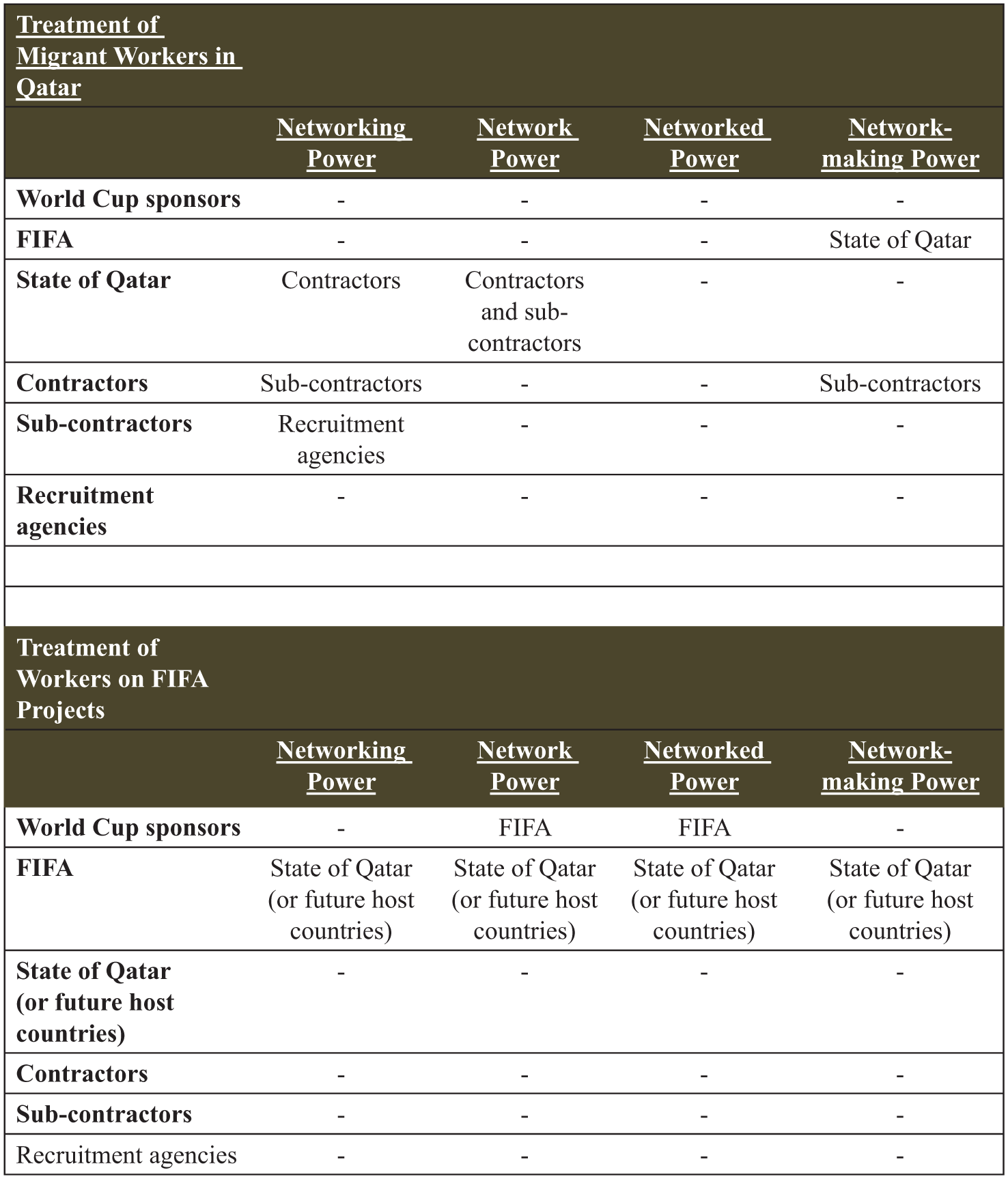
Key social actors related to the processes that permit the treatment of migrant construction workers in Qatar and the treatment of workers on FIFA projects, by the forms of relational power.
The analysis of Castells’ relational power in the network that gives rise to the current treatment of migrant workers on World Cup 2022 infrastructure construction projects in Qatar prompts the questions of ‘power to change what?’ My analysis, summarized in Figure 2, suggests there are two answers: first, the (mis)treatment of migrant workers in Qatar and second, the (mis)treatment of workers on FIFA projects. Dilemmas about the building work for World Cup 2022 brings the two together. In the former, the State of Qatar has networking power (the power to exclude) over the contractors it – ultimately – holds economic authority over. In return, the contractors hold similar power over the sub-contractors they use, which the sub-contractors have over recruitment agencies. Each could choose not to employ ‘disreputable’ companies, thus excluding them from the network. Similarly, as a national law-making authority, the State of Qatar has network power over both the contractors and sub-contractors with respect to treatment of ‘sponsored workers’ in Qatar. Effectively, it could – as recommended in the DLA Piper report – repeal the use of the Kafala system and ensure that ‘fair’ (recognizing the subjectivities of the term) treatment is given to migrant ‘employees’ (as they would become). 1 This change would need adequate inspections and other regulation methods, and research conducted by Carson (1982) on the North Sea British petroleum industries suggests this is not easy to achieve. In the context of the treatment of migrant workers in Qatar, FIFA has only network-making power, in its ‘soft’ abilities to be able to influence national jurisdiction (as evidenced by changes to alcohol licensing in Brazil before World Cup 2014) and, potentially, could lever this on the State of Qatar to abolish/change the Kafala system in Qatar, given the sovereign state’s clear desire to hold the SME. However, when it comes to the treatment of workers on FIFA projects, football’s world governing body has the capacity to hold all four of Castells’ forms of relational power in networks over Qatar and future host countries. In essence, it can define the programme for selection (network-making power), control the agendas of FIFAs networks (networked power), impose rules about the treatment of workers on its projects (network power) and exclude those countries that run counter to those rules (networking power). It could have the capacity to enforce host countries to live by the values in its mission statement (see Literature review), if it wished. In recognition of this, at the Asia Cup Final on 31 January 2015, Blatter stated with reference to holding the 2018 tournament in Russia – where state-sponsored homophobia exists – and the 2022 tournament in Qatar: ‘2 December 2010, I will never forget this date where we have made the decision for two World Cups, which was wrong … I will tell you, that human rights and other rights will be part of the basic conditions to organize the competition. That will be new for the next World Cup – the World Cup 2026’ (quoted in The Independent, 2015). Whether this promise is delivered by future presidents of FIFA remains to be seen. In the present and the future, however, World Cup sponsors could lever their economically dimensioned network power over FIFA by enforcing ‘standards’ of behaviour on the governing body as part of the package that sees them pay large sums of money to have their brand associated with football tournaments. Similarly, in doing so, they could lever their networked power (‘power of social actors over other social actors in the network’, Castells, 2011: 773) over FIFA to use its powers on host countries. Thus, the forms of relational power that create the conditions for migrant construction workers on infrastructure projects related to World Cup 2022 in Qatar are multiple.
With power in the network comes relational responsibility. Each of the six types of social actor in the network have framed the situation where migrant workers on projects related to World Cup 2022 in Qatar become ill, injured, unpaid, ‘trapped’ or even die as ‘sad’ or ‘regrettable’. However each framed ‘responsibility’ for such treatment in a way that excluded itself. Yet, according to the types of relational power in networks that Castells outlines, all but the recruitment agencies have some form of ‘power’. This power can be used to change a programme, situation or circumstance and so each has some ‘responsibility’ towards the treatment of migrant construction workers on projects relating to World Cup 2022 in Qatar. A failure to act upon this power is a neglect of responsibility, which is passed onto the network of relations.
Conclusions
This article makes a scholarly contribution by adding to the very small amount of pre-existing literature on the complex politics of World Cup 2022 (see also Brannagan and Giulianotti, 2014, 2015) and workers’ rights in the transnational industries in and around SMEs (see also Timms, 2012a, 2012b). It also applies the abstract notions of relational powers in networks that Castells (2009, 2011) devises in a concrete sense and it is on this point that the transferability of the approach emerges beyond the specific context of FIFA projects and workers’ rights in Qatar. By drawing upon the different forms of power Castells outlines, we are encouraged to pull apart responsibilities and see them as embedded and constituted through relationships between social actors, including human beings, organizations, multinational organizations and nation-states, analysing social interactions on micro and macro levels in way Crossley (2010) outlines.
World Cup 2022 potentially offers Qatar a catalyst to deliver on its target of enhancing the country’s tourist numbers and ‘soft’ political powers across the Middle East and the world at large (Brannagan and Giulianotti, 2015; Rowe, 2012). This is important as the country seeks to further diversify its global influence beyond its finite oil and gas resources. However when, in December 2010, it was awarded the right to host the 2022 World Cup it had to enhance its infrastructure to include new stadia, hotels, airports and road links. To do this, the country had to depend upon the labour of migrants, given that fewer than 300,000 people hold Qatari citizenship. As such, construction workers were sourced by recruitment agencies from a range of countries and arrived in Qatar. Such workers became the legal ‘responsibility’ of their employer, or Kafil, under the terms of the Kafala system. Between 2011 and 2015, large but varying numbers of migrant workers were recorded as injured or killed through incidents that were related to their work. Further still, many other migrant workers were reported as being ‘trapped’ by their Kafil with passports withheld and wages not forthcoming.
The Kafala system allows this treatment but does not create it. Rather, relationships between nation-states, corporations and sports governing bodies do this. According with the relational approach that Crossley (2010) advances, a society is the relationships within it. Castells (2009, 2011) sees capital as underpinning power relationships. The Kafala system affords the mistreatment of migrant workers on projects connected to World Cup 2022 in Qatar but does not enforce such behaviours. The programmatic charge towards profitability, manifest in cheaper production costs of buildings and other physical infrastructure, conditions this behaviour. On this point, Castells is right to see economic capital as underpinning relationships that see some migrant workers treated in the way they have been, and continue to be. This point accepted, there are different forms of power in the network society. Deciphering the issue to be about both the treatment of migrant workers in Qatar and the treatment of workers on FIFA projects, shows power to be multiple and all actors – with the exception of the recruitment agencies – hold some form in the network outlined.
It seems likely that World Cup 2022 will be mired in controversy. From the perspective of the treatment of workers on FIFA projects, a simple answer might be to suggest that tournaments should be hosted by only those countries that can demonstrate they have the physical infrastructure at the point of the bid for the SME. This answer may be straightforward but is not correct as, first, Timms (2012a, 2012b) showed how workers related to the ‘fair’ and ‘ethical’ summer Olympics 2012 were exploited, and second, this might wrongly suggest the problems are associated with the ‘global South’ alone. The ‘corruption’ associated with the voting process which saw Qatar awarded the right to host World Cup 2022 has played a role in prompting a ‘reform’ of FIFA. This reform offers political opportunities (Crossley, 2002) to create change in what FIFA requires host cities to provide in their bid to take the SME. In other words, a reform of FIFA could see it call upon its networking, network, networked and network-making powers in the way Sepp Blatter suggested it might in 2015. This is unlikely to happen without public pressure, hence the need for the New FIFA Now campaign on this matter opening the door to relational social ‘counterpower’ (Castells, 2009) in challenging and reforming arrangements. As it stands, it is only the recruitment agencies from the six categories of social actor who do not hold relational power in the network, and they directly interface with migrant workers. Each of the other five actors frame their answers in two ways when they are questioned about the illness, injuries and deaths of migrant workers in Qatar on World Cup 2022 related projects. First, they typically express regret at the situation and second, they frame responsibility for the situation in a way that precludes their organization/agency. To be sure, a frame of ‘regret’ does not automatically mean responsibility is passed elsewhere in the network. It is possible to be ‘regretful’ and accept responsibility (or ‘co-responsibility’ as Strydom, 1999, found). However, in these instances ‘regret’ leads to the framing of the passing on of responsibility and the passing on of responsibility produces regret – but neither change the conditions migrant workers on World Cup 2022 related construction projects in Qatar endure.
Footnotes
Acknowledgements
I would like to acknowledge the guidance and support offered by Current Sociology Editor in Chief Dr Eloísa Martín and three experts who reviewed the piece for the journal. Additionally, thanks are due to Dr Laura Kelly and Dr Emma Poulton for advice on early drafts of the article and the audience of the 2016 Political Study Association’s Sport and Politics conference for feedback on a later draft of the article.
Funding
This research received no specific grant from any funding agency in the public, commercial, or not-for-profit sectors.