




Abstract
This article methodologically develops one theoretical issue regarding the sociological debate on relational space: How do past, present and future times interfere in the relations between human bodies and in their interconnectedness with material and/or symbolic goods in places, by considering that space is generated through these relations? After demonstrating the absence of this issue in the debate, the article presents a methodology for analytically identifying and conceptually interpreting the relational space produced through historically relational time in relational bodies in places, with the aid of Henri Lefebvre’s dialectical concerns with everyday life and the production of space. In order to show the approach ‘in action’, the study focuses on the rules of pedestrians’ body conduct in the cathedral square of the Brazilian city of São Paulo in 2013–2014. Hence the approach is analytically complemented by Erving Goffman’s phenomenological approach to the bodily dimension of social interaction. In conclusion, three contributions of this methodology for relational-spatial sociology are summarized.
Assuming that the particularity of the human body throughout the history of sociology lies in the simultaneity of physical and symbolic skills (for a summary see Knoblauch, 2005: 92–95), and that the sociological debate on so-called relational space concerns the various conceptualizations of space generated by the relations between human bodies and the interconnectedness between these and material and/or symbolic goods in places (for summaries see Ruhne, 2003: 66–71; Schroer, 2006: 175), this article aims to develop in methodological terms one specific theoretical issue regarding this discussion. How does the historical dimension of time interfere in the space generated through these links?
It is difficult to define time (Weidenhaus, 2015: 23–24), which is inseparable from space and hence from the production of space within both social and individual life (see respectively Lefebvre, 2000; Weidenhaus, 2015). My interest lies in the entanglements between temporal categories that Western common sense names ‘present’, ‘past’ and ‘future’. The scope of connections between temporalities – which for heuristic reasons I call historical time – is inseparable from one specific ‘form of time determination’, the so-called historicity, whose immediate references are the (individual or collective) subject and present-time (Weidenhaus, 2015: 24–25). 1 Since historicity is socially embedded it may well be the object of sociological enquiry by considering that studies defined as being sociological aim to enroot social phenomena in the ‘tissue of social interactions and relations’ that is the ‘reference point’ for any expressly sociological description of social life (Fernandes, 1970: 20–21).
Hence the theoretical issue at stake becomes more precise. My focus is not on the historicity of individual lives or of society, whose references are respectively the subject’s biography or society’s development (Weidenhaus, 2015: 36, 194), but rather the historicity of what I call ‘body relations’: the links that human beings nurture with each other and/or with material/symbolic goods in places on the phenomenal level of everyday life through the mediation of their bodies. What does the historicity of these embodied social relations conceptually reveal about the space brought about through them? Or, to put it briefly: Which relational space is produced through the ways in which historically relational time makes itself present in relational bodies?
My twofold argument is that Henri Lefebvre’s regressive-progressive method for analytically identifying and conceptually explaining the possibilities of social transformation in empirically given research fields is unique in addressing the topic within the framework of the current sociological debate on relational space. Nonetheless, in order to be analytically operational it has to be complemented by an approach that is sensitive to the bodily dimension of social relations in empirically given places such as Erving Goffman’s phenomenological perspective regarding the communicative dimension of the human body in social interaction.
With the aim of demonstrating this statement, the article follows four steps. The first section shows that the issue of time in the relational links between body and space is lacking in the sociological debate on relational space, and that Lefebvre’s dialectical sociological ponderings on everyday life and the production of space (1958, 1961, 1965, 1974, 2000, 2001a, 2001b, 2009) offer a unique theoretical contribution to the discussion. The second section, in turn, presents a peculiar methodology for addressing the issue based both on Lefebvre’s regressive-progressive method, which this author developed in order to cope in operational and conceptual terms with the relations between historical time and (body-) space, and on Goffman’s phenomenological approach to the rules of conduct in situations of verbal and non-verbal interaction (1963, 1967, 1970, 1983a, 1983b). Indeed, this has helped me in analytical terms in the framework of wider documentary and ethnographic researches on the everyday ‘bodily’ experiences of pedestrians in the São Paulo downtown streets and squares from the early 19th to the 21st centuries (Frehse, 2005, 2011, 2013a, 2013b, 2013c, 2014, 2016a, 2016b, 2016c, forthcoming; Frehse and Vidal, 2016).
In the third section, this specific dialectical cum phenomenological methodology is empirically put into action by means of examples from the rules of body conduct in one geographically and symbolically central place of this South American megacity with roughly 12 million inhabitants during a specific time-span: the Praça da Sé, or cathedral square, during daytime business hours in 2013–2014. Based on this case study I conclusively summarize three contributions of the methodology to the sociological debate on relational space. They respectively concern the conceptual value of historical time, the analytical significance of rules of body conduct and public places, and the methodological importance of Lefebvre’s approach for the conceptualization of the space produced through body relations impregnated with historically relational time.
Sociology and the relational nature of space through bodies – and time?
My starting point is to focus on works by Pierre Bourdieu (1991, 2003) and Martina Löw (2001, 2005), which, according to recent bibliographic reviews, are especially influential in the sociological debate on relational space, particularly in the German-speaking context (on Bourdieu see Löw, 2001: 179; Ruhne, 2003: 67–70; on Löw see Schroer, 2006: 175; Keller and Ruhne, 2011: 10–11). Both conceptions have already incisively shown that structural principles associated with class, gender and ethnic background interfere in the social construction/constitution of space both through the relations between human bodies and between these with material and symbolic goods in places. Ranging from Bourdieu’s praxeological emphasis (1991: 2; 2003) on the bonds that social agents, as human bodies, nurture with ‘properties’, i.e. with appropriated things, to Löw’s action-theoretical approach (2001: 157; 2005) to the relations of unitary and combined bodies of ‘living beings’ with ‘material or symbolic social goods’, concepts such as habitus, and practices of spacing and synthesis framed in institutional rules and resources, elucidate that social relations of a structural nature interfere with the production of space within the phenomenal level of social life; i.e. on the scale in which social reality appears (in visible terms) to the cognoscente subject.
But what about the historical dimension of time within body relations through which social space is ‘retranslated’ in physical space (Bourdieu) or through which (social) space is ‘constituted’ (Löw)? Indeed, habitus is ‘embodied history’ (Bourdieu, 1989: 82), and rules and resources are shaped in practical consciousness, a kind of knowledge that generally operates repetitively in everyday life in such a way that social change depends on ‘collective action’ and the mobilization of ‘relevant rules and resources’ of social institutions and structures (Löw, 2001: 162–163, 170, 188). Nevertheless, the historicity of these social phenomena and its role in the social construction/constitution of space remain conceptually underexplored.
Two of Löw’s colleagues explicitly address the interference of historical time in the generation of space. By intertwining Bourdieu’s emphasis on the social construction of space through power-loaded gender relations with Löw’s focus on the constitution of space as a materialized and ‘objective’ phenomenal form, Renate Ruhne (2003) develops a conceptualization of the relations between space and gender in which the processual nature of the ‘social construction’ concept is especially explored with regard to the past-time. Notably, public space and two-gendered relations are examined as to their ‘historical emergence’ in specific past centuries (Ruhne, 2003: 88, 108). The outcome is a ‘multidimensional and relational-processual research conception’ about the reciprocal conditioning of space and gender relations (Ruhne, 2003: 196). Gunter Weidenhaus (2015), in turn, explicitly addresses the interference of historicity in the relational generation of space as he researches ‘social space-time’. In order to demonstrate the bond between spatial and temporal determinations, Weidenhaus scrutinizes the relations between biographical historicity and relationally constituted space by mobilizing both the aforementioned (time-philosophical) historicity-concept and Löw’s ‘relational space’.
Besides signalling that the relations between historical time and relational space are a relevant theoretical issue within the sociological debate on the relational nature of space, both approaches indirectly suggest that we still know little about the connection between space and time when bodies, or more precisely body relations, enter the scene. Without referring to ‘historicity’, Ruhne examines how historical temporalities entangle in two representations on space and gender whose social scope is particularly broad in present-day Western European societies. Conversely, Weidenhaus (2015: 36) tackles through biographical historicity ‘the relation between the past, the present, and future that human beings constitute in meaningful ways for their own lives’. Although the bodily dimension of both research objects is evident, it is not explicitly addressed.
This brief review locates this article’s theoretical stance as a contribution to current sociological debates on relational space. I aim to both conceptually and methodologically connect three categories rarely considered together in a direct way. Bodies are conceptually recognized as crucial elements of the relations which bring about space, as the following two arguments summarize: social structures are ‘converted’ into spatial structures through arrangements of the agents’ ‘body movements, poses and postures’ (Bourdieu, 1991: 4, original emphasis; see also Bourdieu, 2003); spaces ‘may only be formed through the inclusion of placed bodies’, whereas bodies, including human bodies, are ‘components of space’, although they themselves are spaces (Löw, 2005: 241; 2001: 128). However, the role that the relations between the past, the present and the future – implicit in the links between these bodies – may play in the conceptualization of the space generated through them remains an open question.
The situation changes, however, when we address Lefebvre’s explicitly sociological interests on everyday life and the production of space. Although not containing a fully developed account on body relations in places, these ponderings address the connection between historical time, space and the (living and particularly human) body in a comparatively more explicit manner. Hence, they allow theoretical inferences about the relational nature of historical time, space and human bodies, which as we will see in the next section, may well be transposed into the methodological level of enquiry if complemented by an approach analytically receptive to the bodily dimension of social relations in places. Indeed, Lefebvre also conceived a method to convert his theoretical conceptions about the historicity of everyday life and the production of space into both operational and interpretive research procedures.
I speak of ‘conceptions’ rather than ‘theory’ as Lefebvre never developed one self-contained systematic theory on this issue. Besides being critical about any ‘system’, which he conceived as impermeable to social life’s openness and contradictions (see in particular Lefebvre, 1971: 67–110), his thoughts about the relations between historical time, body and space are scattered throughout his works as of the second half of the 1940s, making it impossible to identify one single formalized conceptual scheme.
As a starting point I remind the reader of Lefebvre’s both epistemological standpoint and theoretical topic regarding the (meta-philosophical) dialectical relation between theory and practice, concept and ‘practical reality’ (Lefebvre, 1975: 132). As for the first, he follows a ‘transductive’ logic of empirical enquiry, concerned with the identification of historical possibilities for future social change contained in empirically given realities of the present and the past (for a summary see Lefebvre, 1961: 121). This stance is inseparable from ‘praxis’ conceived as an ‘act, dialectical relation between nature and human beings’: in everyday life, praxis concerns either the possibility of ‘repeating’ acts, ‘mimetising’ models, or ‘inventing’ discontinuities in the ‘global socio-historical process’ (Lefebvre, 1974: 41, 47). Therefore, a reference is Karl Marx’s central statement of the humanization of mankind as a historical process mediated by the mismatches (alienation) temporally underpinning the relations that human beings nurture with their work, and hence the links between ‘the real’ and ‘the possible’. All of this takes place within the framework of a sociological recovery of Marx’s dialectical method in search of its interpretive potential concerning post-war capitalism. Therefore, Lefebvre’s early sociological works pursue the possibilities for social transformation contained in everyday life in the so-called modern world, according to historically embedded social contradictions of this level of social reality that is most evident and simultaneously most indiscernible to the observer (1961: 52, 56; 2001a: 21–87).
Three theoretical implications of this brief summary matter here. First, everyday life is a historical product and thus impregnated by society’s (and simultaneously humankind’s) historicity. Indeed, the source of historical time is ‘the becoming [le dévenir]’ (Lefebvre, 1986: 40), a future possibility inseparable from the present; or rather from the relations between times (past, present and future), which are expressed in the phenomenal immediacy of everyday life. Thus, history’s temporalities are the past, the present and ‘the possible’ (for a summary see Lefebvre, 1965: 36). Social contradictions (conflicts) not overcome in the past are present-day historical contradictions signposting possible social transformations (Lefebvre, 2001b: 101).
A second implication derives from the first. If everyday life is saturated with historically relational time, being a mediation of historical processes, historicity also impregnates human bodies in everyday life. This link subtly appears in Lefebvre’s work as of the 1960s, amid his growing theoretical concerns with the role of (Marx’s) human ‘radical needs’ and ‘appropriation’ within historical processes concerning the city and urbanization (Lefebvre, 1965: 20; 2009: 134). Therefore, it should come as no surprise that in his last (posthumous) book (Lefebvre, 1992), on rhythms, a phenomenon which decades previously had been conceived as ‘the everyday lived’ – i.e. as simultaneously a ‘residuum’ and a ‘product’ of facts and concepts, which concern all human activities (Lefebvre, 1961: 62) – is equalled with ‘the carnal, the body’ (Lefebvre, 1992: 18, my emphasis).
Taken together, both conceptions regarding the historicity of everyday life and the body contain a third appealing theoretical implication. In the 1970s, when Lefebvre addresses the issue of the production of space, ‘the living body is and owns its space: he produces itself in it and produces it [simultaneously; FF]’ (Lefebvre, 2000: 199, original emphasis). This statement suggests that space is saturated with historicity and that the body plays a central role within this link. The vigour of both implications in La Production de l’espace insinuates that space, and therefore the body, have a relational nature in the sense of the current sociological discussion on relational space. It does not matter that Lefebvre himself did not use the notion of ‘relational space’ in this sense, but rather as a specific (Western) kind of space (Lefebvre, 2000: 52, 419). The crucial aspect is that space was summed up as a ‘set of relations’ between ‘things (objects and products)’ inseparable from social practice – the activity, the use, the necessity, the ‘social being’. Moreover, space implies, contains and dissimulates social relations, which, in turn, only exist ‘in and through’ space (Lefebvre, 2000: xx, 100, 465).
Based on this common denominator alongside the present-day sociological debate on relational space, two important differences may come to the fore. First, the approaches at stake privilege body relations in places on a phenomenal level. By mobilizing Marxian dialectics, Lefebvre, in turn, does not restrict himself to this cognitive level. Thus, a place is a ‘level of social space’ discernible through ‘words of the everyday discourse’ (in the phenomenal level of everyday life), which, in turn, correspond to a use of space, a spatial practice that such words say and compose (Lefebvre, 2000: 108, 23–24). Moreover, the author establishes a sound dialogue with French phenomenology (Schmid, 2005: 238–240) by proposing that ‘the body’ is the (methodological) ‘reference’ for understanding space in the three (dialectical) moments through whose mediation this same space is produced: ‘the perceived – the conceived – the lived’ (Lefebvre, 2000: 50, original emphasis). This perspective, however, bears a second one: an emphasis on the (social) spatial dimension of these same moments – therefore, the formula ‘triplicity – the perceived – the conceived – the lived (in spatial terms: practice of space – representations of space – spaces of representation)’ (Lefebvre, 2000: 50). The referential body for the three moments of space is simultaneously underpinned by the dialectical links that the spatially (re-)produced social practice nurtures with both the rational-scientific conceptions about space (by experts, planners, urbanists, by ‘agencing’ and ‘fragmenting’ technocrats, and by ‘some artists close to scientificity’) and with the ‘images and symbols’ of this same space (by ‘dwellers’, ‘users’, and artists like writers and philosophers). Hence Lefebvre’s critique of Maurice Merleau-Ponty’s commitment for ‘the philosophical categories of “subject” and “object”, without connections to social practice’ (2000: 212–213, n2; see also Lefebvre, 1961: 349). And now a second difference between Lefebvre’s approach and the previously named sociological conceptualizations becomes evident. Besides being a phenomenal outcome of socially embodied connections in places, space is a (perceived–lived–conceived) product that simultaneously interferes with the production of economic and social relations: it is a mediation of social practice on a bodily level.
After this brief overview, I hope it becomes clear that Lefebvre’s sociological works on everyday life and the production of space are underpinned by relational conceptions of historical time and space – and hence the body. Whereas historical time is dialectically forged in the relations between the past, the present and the possible, (body)space is produced through (the mediation of) links between socially produced things. As for the theoretical nature of these links, they are dialectical: historical time and (body-)space are (logical and factual) unities of what is (logically and factually) diverse.
From this viewpoint, Lefebvre is a unique forerunner of the current sociological debate on relational space. Besides returning to Marx’s dialectics, which is absent from the aforementioned approaches to the issue, his sociological work enquires into the production of space by taking historicity into consideration. In summary, Lefebvre is a groundbreaking historically-relational time-spatial sociologist. However, this facet of his work is not explored in recent spatial-sociological reviews of his pioneering role in establishing a ‘relational concept’ of space (Löw, 2001: 110; 2005: 241, 266; Weidenhaus, 2015: 40).
What remains open is how to transpose this dialectical viewpoint onto the methodological level and hence to address in empirical and conceptual terms the links between historical temporalities, body relations in places and relational space.
In search of relational space through the historicity of body relations in places
A first operational question concerns how to identify the historicity of body relations in places in analytical terms. A second operational issue, in turn, concerns how to interpret the space that the phenomenon discloses.
Assuming his aforementioned transductive and dialectical viewpoint, Lefebvre presented for the first time in 1953 the ‘regressive-progressive method’, which comprises both methodological dimensions required here. Based on participant observation and on interviews, surveys and statistics, the researcher first ‘describes’, in the ‘descriptive moment’, the empirically given ‘field’ (Lefebvre, 2001a: 73); or, more precisely, that what an analyst termed ‘social life’ or ‘social relations’, and the ‘elements of material and spiritual culture’ (Martins, 1996: 21). Lefebvre’s ‘analytical-regressive’ assessment, in turn, involves the attempt to identify the ‘exact’ dates of the previously described ‘reality’ (Lefebvre, 2001a: 74). Then a third ‘historical-genetic’ moment enters the scene: the ‘transformations’ of each of the previously dated ‘structures’ are ‘elucidated and understood’ against the background of ‘the further (internal or external) development’, and of these structures’ ‘subordination to the overall structures’, to the ‘overall process’. The effort is ‘to return to the previously described actual, in order to meet the present again’, but this time an ‘explained’ present (Lefebvre, 2001a: 74, original emphasis). As I summarized elsewhere, ‘[t]he coexistence of things, social relations and representations of different ages in the actual – of society, of the individual – discloses contradictions between the research-field elements that historically changed and those that did not – from the methodological viewpoint of other, already accomplished historical possibilities embedded in the contradictory overall process’ (Frehse, 2014: 245).
In this sense, at first sight this approach seems well-suited for my purposes here. Thereby, Lefebvre (2001a: 65–71) demonstrated that social reality simultaneously bears a ‘horizontal’ and a ‘vertical’ (or ‘historical’) complexity, regarding the ‘historical date’ or ‘age’ of its elements – i.e. the specific temporal moments of the past in which these objects, social relations or conceptions emerged. On the one hand, ‘essential differences’ become manifest in ‘formations and structures’ with ‘the same historical date’, and on the other hand, ‘formations’ of different ages and with different dates’ coexist in the same social ‘world’ (Lefebvre, 2001a: 65–66, original emphasis). At first applied to the ‘rural world’, the approach was subsequently mobilized for analysing and interpreting the possibilities of social transformation ‘in and through’ research fields ranging from cities to the ‘field of representations’ as well as to the production of space (Frehse, 2014: 246).
Nonetheless, the phenomena whose historicity the method helps to depict are roughly different from the body relations in places, which are of interest here. Although based in descriptive terms on the empirical existence of social relations, objects and conceptions in a specific research field – hence in a place – the author’s regressive-progressive emphasis explicitly lay on the relations between ‘techniques’ and ‘human groups and social structure’ (Lefebvre, 2001a: 66) rather than in the bodily dimension. Elsewhere (Frehse, 2013c, 2014) I detailed the three procedures of the method, its conceptual and methodological possibilities and uniqueness for current (Latin American) urban research by emphasizing that it helps to empirically and conceptually investigate the role of historicity in the search for differences between present-day cities. Hence I could recognize that the regressive-progressive method only tacitly underpins Lefebvre’s analyses of issues related to the ‘living’ body: either of the perceived, the conceived and the lived (Lefebvre, 2000: 50, passim; Frehse, 2014: 247–258) or of rhythms, overtly enquired into as from the 1960s and particularly at the end of his life (Frehse, 2016c: 107–108; Lefebvre, 1961: 233; 1992; Lefebvre and Régulier, 1985). The relative silence in Lefebvre’s publications regarding the regressive-progressive unfolding of his ponderings on the body at first sight hinders the relational-spatial sociologist to mobilize the method for interrogating the relational space produced through body relations in places.
Hence, adjustments are necessary – and a methodological combination with Goffman’s conception of ‘rules of conduct’ becomes possible. Given this article’s limits, my choice for developing the theoretical issue at stake in Lefebvrean terms is to analytically concentrate on one specific empirical dimension of the body relations on which I have been working in ethnographic terms regarding particular places of downtown São Paulo from 2013 to 2014 (Frehse, 2013a, 2013b, 2014, 2016a, 2016b, 2016c, forthcoming; Frehse and Vidal, 2016). I mean the rules of what I call body conduct by pedestrians in this city’s public streets and squares in these two years, i.e. regularities of a symbolic nature implicit in the body connections of the human beings of various ages, genders and religions, but also of diverse socioeconomic and sociospatial backgrounds that physically crisscrossed these places or stayed therein on a regular basis at a time in which the city still testified to the economic effervescence amid a vigorous redistributive policy, which prevailed in Brazil from the turn of the 21st century to 2014. Methodologically speaking, this choice implies considering the subtle mechanics of verbal and non-verbal social interaction in the phenomenal level of everyday life. Hence it is suitable to mobilize sociological approaches of a phenomenological nature focusing on the bodily dimension of these behaviour patterns in places. An appealing alternative is Goffman’s set of analytical tools for defining in sociological terms the phenomenal variety of rules of body conduct implicit in the situations of verbal and non-verbal interaction. Both indeed prevail among the empirically examined pedestrians.
Strongly marked by his concurrent sociological and anthropological training (Frehse, 2016d), methodologically crucial for research sensitive to both bodily dimensions of social interaction, Goffman focused on ‘rules of conduct’, i.e. morally impregnated guides for action (1967: 48; 1970: 342). This implied dissecting in phenomenological terms ‘situations’ of social interaction, ‘spatial environment[s]’ with reciprocal monitoring possibilities of the normative patterns implicit in the sequence of reciprocal acts by individuals in physical co-presence (Goffman, 1963: 18). Hence the author demonstrated that social interaction is both verbal and non-verbal: in situations individuals communicate with one another both through words and their ‘bodily appearance and personal acts: dress, bearing, movement and position, sound level, physical gestures … , facial decorations, and broad emotional expression’ (Goffman, 1963: 33). Whereas verbal idiom remains crucial to situations in which verbal interaction is either relatively spontaneous (as in the participant observation I conducted in the São Paulo downtown public places) or induced (as in my interviews therein), there is also a ‘body idiom’, a ‘conventionalized discourse’ whose normative signs convey information about interacting individuals through physical appearance and physical acts (Goffman, 1963: 34). Therefore, I consider this author’s analytical approach to rules of conduct to be useful for a research on patterns of rules of body conduct.
As my interest here lies in analysing and conceptualizing in regressive-progressive terms the space produced through the presence of historicity in these rules in places, one could counter-argue against the usefulness of Goffman’s phenomenological approach. After all, he privileged patterns of verbal and non-verbal interaction ‘occurring within the boundaries of a situation’ (Goffman, 1963: 22, emphasis added; 1983a: 4–5; 1983b: 201); and, based on their own definition, historical dates of body relations in places transcend these situational frontiers. It should be stressed, however, that Goffman (1963: 22) simultaneously emphasized the existence of ‘the merely-situated aspect of situated activity’, a ‘component’ occurring in situations without being of situations, and which also undergoes ‘normative regulation’. This becomes particularly salient in the case of the historicity of the rules of body conduct presented in the next section.
Based on this peculiar dialectical cum phenomenological standpoint, both the methodologically crucial ‘overall process’ to be scrutinized in regressive-progressive terms, and the empirically given subjects, place and time by means of the rules of body conduct by São Paulo’s pedestrians become precise. This kind of enquiry of relational space first depends on scrutinizing the horizontal and vertical complexities that impregnate the production of urban space, which is a specific ‘layer’ of ‘space(-time)’ that, together with the rural and the industrial spaces, are ‘either superposed, telescoped and reabsorbed or not within each other’ (Lefebvre, 1970a: 167). Hence a specific kind of ‘spatial practice’ comes to the conceptual fore as an overall process: ‘the process of urbanization’, a set of contradictory economic, social and cultural processes implicit in the expansion of the city and of the ‘urban tissue’, and in the formation of ‘centralities’ (Lefebvre, 2000: 450; for a summary see Schmid, 2005: 132). By conceptualizing in regressive-progressive terms the urban space that is produced through the patterns of pedestrians’ verbal and non-verbal interaction in São Paulo’s central public places in 2013–2014, theoretical contributions for the sociological conceptualization of the (not only urban) space produced through body relations in places emerge.
Therefore, I secondly chose to empirically focus on my ethnographic data concerning verbal and non-verbal interaction by pedestrians I call non-passers-by of São Paulo’s cathedral square on Monday and Friday afternoons (2-6 p.m.) from February 2013 to March 2014 (Frehse, 2013a, 2014). The heuristic category refers to a broad array of pedestrians who stood out amid the square’s physical appearance during my fieldwork due to a peculiar rule of body conduct. They regularly stayed in physical terms therein during business hours, regardless of the physical constraints of passers-by and vehicle traffic – not to mention police repression. Hence these pedestrians, 25 of whom I have more deeply interacted with through participant observation and in-depth interviews, may be sub-typified as street craftsmen (among others, both the male shoemaker and shoe shiner I privilege here), street artists (particularly two male musicians and one male dancer), street preachers (especially three male and one female Pentecostal pastors), street merchants (e.g. one male sandwich seller) and street people living in the city’s public places (among others, eight male and seven female self-proclaimed street dwellers). These pedestrians clearly differ from the so-called passers-by, a type whose existence owes everything to the rule of body conduct of regularly crisscrossing in physical terms the public places by means of a specific pattern of social interaction: the establishment of impersonal bonds with other pedestrians (Frehse, 2011: 45).
By privileging the patterns of body conduct by non-passers-by in São Paulo’s cathedral square during workday afternoons, the approach analytically heightens an element of the production of urban space that instantaneously insinuates the horizontal complexity of the phenomenon at stake. After all, non-passers-by strongly contrast with passers-by, which are the ‘classic’ pedestrians of cathedral squares during business hours in other present-day urban realities – and for the heuristic sake of brevity here I especially think of London, Paris and Berlin. These not only are cities I know relatively well, but they are protagonists in internationally influential sociological conceptualizations about the relation of passers-by (old and recent dandies, flâneurs, blasés, etc.) with ‘modern’ and, more recently, global urbanization. Indeed, as from the Middle Ages (Pastro, 2010: 264) cathedral squares are in functional terms geographically and symbolically central public places in Western cities, they allow instantaneous ‘horizontal’ comparisons with other current urban spaces whose production is mediated, among others, by cathedral squares.
Besides differing at a phenomenal level from the usual pedestrians of these public squares during business hours in the aforementioned European centres, the non-passers-by in focus used to physically stay on a regular basis in São Paulo’s cathedral square during the time period in which passers-by traffic is most intense. Thereby they performed rules of body conduct whose historical ages stand out in a vertically complex way for regressive-progressive purposes due to their variety amid the diversity of historical dates of the square’s built materiality. Hence, a synthetic regressive-progressive conceptualization of the production of urban space and of the space produced in relational terms, particularly through the historicity of the rules of body conduct by non-passers-by amid the built materiality of a public place such as Praça da Sé in 2013–2014, is made possible. And the vertical dimension of the rules of body conduct therein plays the methodological role of a mediation of the space produced through body relations in places.
In order to show all of this ‘in action’, the peculiar methodology demands a focus on the descriptive and analytical ‘moments’ of Lefebvre’s method for the patterns of verbal and non-verbal interaction of the non-passers-by amid the square’s built materiality. More precisely, the horizontal complexity of the production of urban space is disclosed via the description of patterns whose historical dates matter, and which in turn may be empirically depicted based on documentary evidence of the historical roots of these rules in São Paulo’s downtown squares. Based on the analytical-regressive treatment of these clues, the ‘historical-genetic’ moment allows me to dialectically link both complexities of the production of urban space in search for its ‘explanation’.
In this sense, I do not assume the clues at stake as isolated from the social practice through which three ‘moments’ of space are produced. Indeed, the rules of body conduct whose historicity matters and is empirically demonstrable are traced through how non-passers-by perceive Praça da Sé via the mediation of their bodies, as social practice presumes the use the body (use of hands, limbs, sensory organs – Lefebvre, 2000: 50). In addition, it is crucial to seek the images of the square of these non-passers-by, and these are affective individual and communicable inventions located in ‘the sensitive’ (Lefebvre 1961: 288). In fact, spatial practice is mediated by representations, and only when these connect with values do ‘they become consolidated, ethic or aesthetic; they guide the action’ (Lefebvre, 1980: 81) Both enquiries, however, should not neglect the rationally conceived space, which presents itself to the researcher in Praça da Sé. Far from being an abstract ‘model’, the perceived–lived–conceived triad ‘seizes the concrete’ (Lefebvre, 2000: 50), the ‘human concrete’ being the infinite complexity of human beings’ real life (Lefebvre, 1955: 63). On the empirical level, these moments ‘gather in such a way that the “subject”, the member of any social group may step from one to the other without getting lost’ (Lefebvre, 2000: 50). Thus, to summarize it methodologically, the rules of body conduct of interest in Praça da Sé refer to the place that is bodily perceived and lived by non-passers-by amid the ways this same place is conceived in architectural and urbanistic terms (by specialists such as architects and urbanists).
Given limits on the article’s length, the description of the rules of body conduct of these non-passers-by in Praça da Sé will be abridged. I shall concentrate in ‘analytic-regressive’ terms on the vertical complexity of the perceived and lived Praça da Sé that is respectively disclosed by one respective pattern of non-verbal interaction and of images of the space by the aforementioned non-passers-by. This in turn enables me to move forward to the historical-genetic step.
What the historicity of patterns of body conduct in Praça da Sé reveals about space
In physical terms São Paulo’s cathedral square is a rather plain octagonal forecourt of circa 37,500 square metres, extending northeast and east of the Roman Catholic Metropolitan Cathedral of São Paulo across the hill from where, as of 1554, the urbanization of the current megacity that was founded as a hinterland Jesuit settlement began.
The cathedral’s paved forecourt (see the upper half of Figure 1) is the primary focus, because of the diversity of historical dates coexisting in its built materiality and in the bodies of the non-passers-by therein. This partially tree-shaded area comprises the place’s historically first shape, a triangle (see the shaded area in the upper right of Figure 1). This was the square’s appearance between the late 16th century and 1912, when the second Portuguese colonial-architecture church extant there (as of 1745) and three blocks of houses further southwest (formerly located in an area to which the upper centre and left of Figure 1 corresponds) were demolished for the construction of a large neo-Gothic temple covered by a Renaissance dome. This church was to be fronted by a wide rectangular plaza and surrounded by new architectural expressions of political and religious powers (for more details see Frehse, 2013a: 153–154). Officially inaugurated in 1954, in the early 1970s the temple witnessed the square’s most radical urbanistic refurbishment: during Brazil’s last military dictatorship (1964–1985), the installation of the city’s main subway junction under the square became a pretext for tearing down two blocks of buildings to the east (in the lower half of Figure 1).
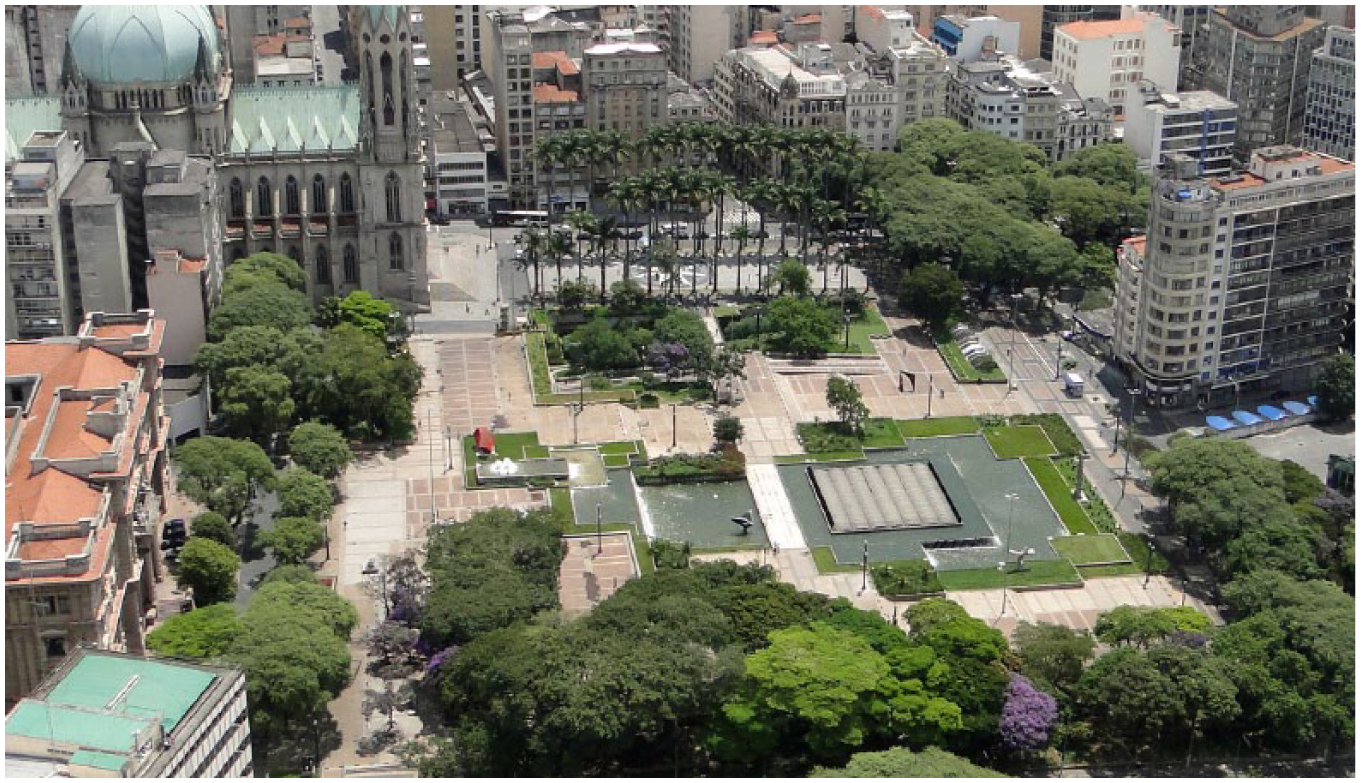
Northwestern bird’s-eye view of Praça da Sé (Friday, February 2012).
This brief description suggests that for the sake of the historicity of the rules of body conduct of the non-passers-by in Praça da Sé during business hours in 2013–2014, one has to consider that these connections occurred in a place whose physical appearance has undergone radical changes in episodic rhythms since the 1910s. This urbanistic conjuncture is accompanied by an urbanization logic which historically dates back to the late 19th century and may be summarized with the aid of Claude Lévi-Strauss’s (1955: 107) sensitive comment about the São Paulo he saw in 1935: ‘The city develops in such a rapid way that it is impossible to procure a plan for it: each week would demand a new edition.’ To understand this dynamic implies considering the ever increasing socioeconomic role real estate speculation has played in Brazilian cities since the mid-19th century, when this country’s economic and political elites realized that the end of century-long African slavery was imminent (for a summary see Martins, 2011; see also Frehse, 2011: 276).
What matters here is that the historical dates of the architecturally and urbanistically conceived square are relatively recent. In 2013–2014 the oldest built material object there was the cathedral, erected in 1912 and marked by an architectural style that dates from the Gothic European past, long before the Portuguese arrived in Brazil. The square’s current paved and gardened areas, in turn, stem from the 1970s, following the urbanistic representation of space that the square should mainly be a passageway for passers-by; thus seating facilities therein are rare, and since the last refurbishment (2007) restricted to the gardened area (Frehse, 2013a: 153–157).
For older historical ages, one has to look at bodies of the non-passers-by – as illustrated in Figure 2.
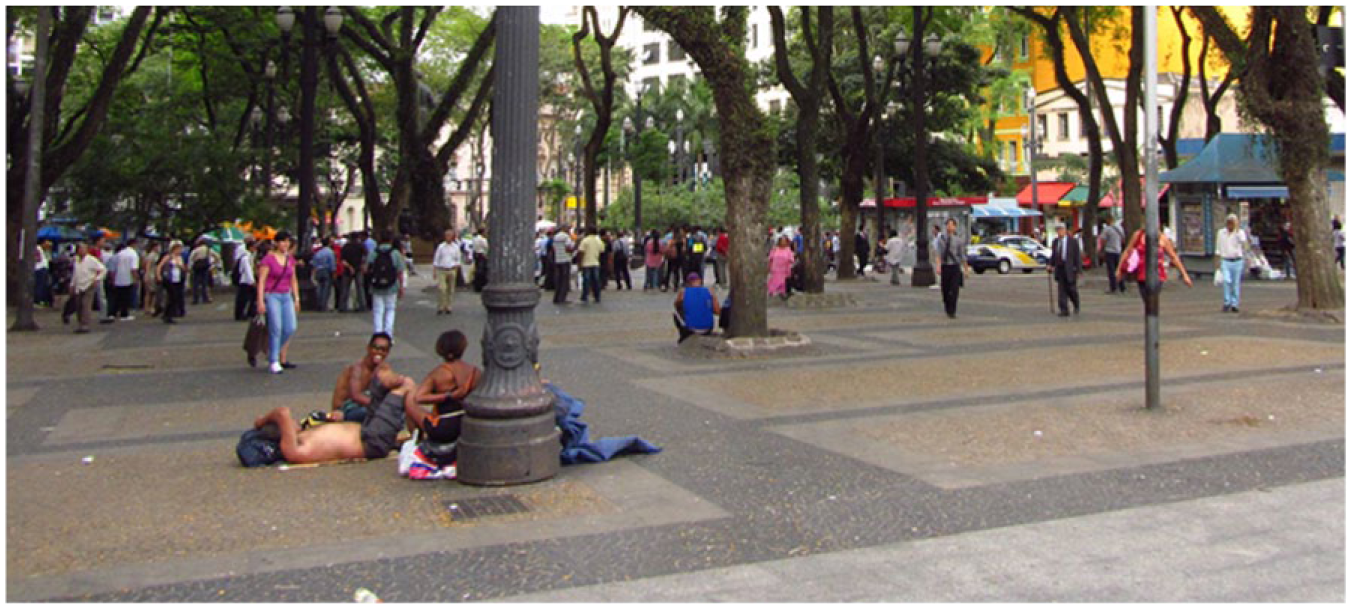
Among passers-by: non-passers-by lie or sit on the square’s pavement and on former flower beds under trees (Monday, October 2013).
Intrinsically related to the aforementioned rule of physically staying put on a regular basis in Praça da Sé there is a pattern of non-verbal interaction that I call the physical expansion of parts of one’s body and/or personal objects over the square’s material surface. One only has to focus via participant observation on the personal acts implicit in the body idiom of the 25 non-passers-by researched. The pattern concerns spreading parts of one’s body (e.g. stretching one’s limbs, raising one’s voice, lying down on the pavement, etc.) and/or personal belongings (mainly rucksacks besides apparel for street-vending, street-music and street-preaching; but also street-dwelling blankets, and portable chairs and benches) around the site where one physically stays on a regular basis (see for example Figure 3). Hence these places of work and sociability inevitably convey the ethnographic impression of being bodily perceived by these people as physical extensions of their own dwellings.
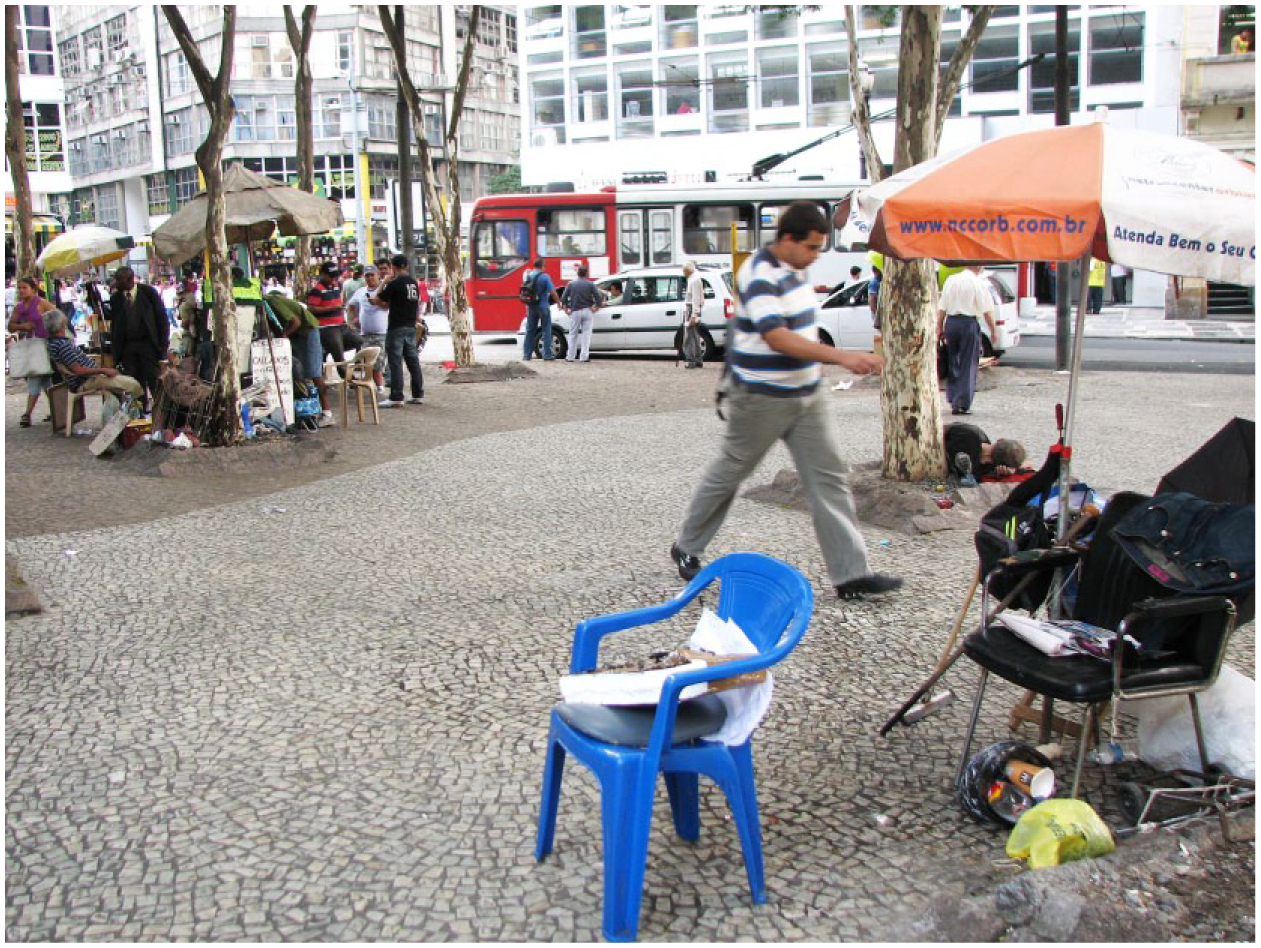
Two shoemaking stands in the square’s Northern triangular area (Wednesday, April 2011).
The revealing aspect is that during my fieldwork all of this remained apparently unnoticed by the regularly patrolling policemen. It did not matter that by then street-vending was formerly prohibited in Praça da Sé, and street-music and preaching often repressed; that shoe-shining therein was only allowed with restrictions, and within portable shoeshining stands, and that street-dwellers were occasionally expelled from the square during the night. Indeed, the pattern of physically expanding parts of one’s own body and objects as if one was at home seemed indifferent to any counter-rule. It is thus impossible to interpret it as an attitude of politically-loaded resistance against legal spatial practices (Frehse, 2013a: 168).
How, then, can the rule be explained? A second alternative would be to resort to structural principles of class. My field notebook contains many allusions to the body idiom attributes of non-passers-by indicating a material deprivation of goods; and at least to poverty in the economic sense of the term (for details see Frehse, 2016a: 140). Furthermore, since the 1970s São Paulo’s downtown has been a space for work and housing by economically poor population sectors amid an urbanization process that brutally restricts the economic and social opportunities for those who live far from the city centre, where land rent is lower and poverty prevails (Frehse, 2014: 257). However, on the one hand, the body idiom of the non-passers-by reveals social positioning asymmetries that were (re-)produced among such pedestrians, although they were all materially poor (Frehse, 2016a). On the other hand, if structural class categories may help to explain why non-passers-by frequented Praça da Sé, then they do not explain why this presence was mediated by this specific rule of body conduct.
For a regressive-progressive explanation of the space produced through this mediation, there are inspiring documentary data on the rules of body behaviour usual in São Paulo’s downtown squares in the city’s slaveholding 19th-century past. European and North American travelogues, journals and memoires by former inhabitants, and newspaper articles and street photographs from before the official abolition of African slavery (1888) indicate in various ways that during the daytime the city’s downtown streets and squares almost exclusively harboured the regular permanence of pedestrians involved in manual labour (street-vending, loitering, begging, animal husbandry, prostitution) and/or in sociability connections that evolved mainly among poor (freed) slaves or freemen in this context (Frehse, 2011: 65–263). Surrounded by street-vending trays, baskets and animals raised outdoors, these men and women (re-)produced their economic and sociability ties there and then, given that night curfews dictated the routine of slaves in São Paulo’s streets and squares until the 1870s at least, and that in slaveholding São Paulo housing spaces were directly or indirectly linked to the manor-house (Frehse, 2011: 125, 175). Following, in turn, an alternative tacit rule of body behaviour, men and women of high social standing only left their homes on exceptional and ceremonial occasions, such as festivals and religious processions or to visit relatives. To put it briefly: in this urban context, the pattern of the regular physical crisscrossing of streets and squares, which particularizes passers-by, was the exception, whereas the forerunners of the current non-passers-by were the norm. Indeed, it was only in the wake of the many socioeconomic, demographic and political transformations related to European 19th-century modernity that passers-by became the new protagonists of the regular to-and-fro in São Paulo’s central streets and squares as of the late 1800s, making it also historically possible to assume them as cognitive parameters for heuristically naming their phenomenal counterparts non-passers-by. Passers-by practised the routines of the increasing numbers of salaried or self-employed workers in a city strongly marked by the presence of both ex-slaves and European immigrants. This trend went hand in hand with the streets and squares becoming public places, i.e. socially signified as being of legally unrestricted access at any hour as of 1888.
Evidently, the socioeconomic conjuncture, the human bodies and personal objects in Praça da Sé in 2013–2014 differ drastically from the above. However, the pattern of non-verbal interaction that mediates their body relations is strikingly analogous, reaffirming Lefebvre’s (2001b: 22) claim that ‘the historical’ persists and acts upon ‘the actual’ everywhere, without, needless to say, resorting to historical determinism. Indeed, ‘the society in act, the result and product of the social activities’ is ‘inscribed’ in space through the mediation of (past) time. Therefore, the claim is that ‘the space generated by time is always actual’ (Lefebvre, 2000: 131).
After this contextualization, the second and last rule of body conduct at stake here may be addressed more briefly. It concerns the verbal interaction of the Praça da Sé passers-by with me during the interviews. Whereas the historical date of the pattern of the physical expansion of bodies and objects lies at least in the slaveholding 19th century, the interviewed pedestrians’ verbal images on the square are much more recent. When asked what they thought about Praça da Sé and what it meant/represented for São Paulo, the most frequent verbal representation they quantitatively converged on referred to the square as São Paulo’s symbolic epicentre. Common to 10 interviewees, the association was complemented by other terms, used without any explicit reference to the downtown area’s historical monuments: ‘heart’, ‘core’, ‘magnet’, ‘centre’.
Considering that images are the forms assumed by representations and that the latter are mediations of ‘the imaginary’ – that is, of ‘the relation of (reflected, subjective) the conscience with the real’ (Lefebvre, 1980: 240, 83, 56) – it is methodologically difficult to pinpoint a specific historic date. The (lived) space of representation ‘has a knot or affective centre’ that could be, among others, ‘the square, the church’ containing ‘the places of passion and of action, of the lived situations; therefore, immediately involving time’ (Lefebvre, 2000: 52). In summary, affection therein prevails and the factual barely matters.
Nonetheless, the unprecedented incisiveness of mnemonic and newspaper accounts as of the 1950s associating Praça da Sé in symbolic terms to São Paulo’s main centre (see Campos and Simões, 2006; Frehse, forthcoming) suggests that these images are dated in historical terms from that period. In the wake of São Paulo’s 400th anniversary in 1954, the city’s economic and political elite inaugurated the new cathedral in a uniquely pompous manner by heightening in ideological terms the ‘progress’ of this city, the demographically largest and economically richest (and most industrialized) Brazilian metropolis at the time. Moreover, the square had also become the city’s main bus stop junction then. This context inevitably turned Praça da Sé into São Paulo’s main mobility crossroads, a central place for passing through and staying – and not only physically, but imaginarily.
This vertical combination of historical times may now be dialectically connected in historical-genetic terms with the horizontal complexity of the production of urban space through the historicity of the given body relations of non-passers-by in Praça da Sé. Hence the methodologically decisive urbanization process may enter the scene. From this viewpoint, Lefebvre showed in a pioneering way that post-war capitalism brought a historical novelty to the dialectics of centrality, characterized by ‘movements based on the inclusion–exclusion spatially provoked by a definite cause: the centre gathers only by spurring distance and dispersion’: its pretension of totality in the name of a ‘superior, political rationality’ referred to the state or to the city (Lefebvre, 2000: 445, 383). In São Paulo this dynamic implied the unprecedented urban expansion and the city’s current polycentrism (for a summary see Frehse, forthcoming).
Indeed, the process is mediated by the increasing power of ‘abstract space’, which is underscored by the forms and quantities that drive the functioning of capitalism (Lefebvre, 2000: 61). If one considers that in this context Praça da Sé became a privileged passageway for passers-by, it is easy to infer that the current urbanization in São Paulo is more than integrated into the logic of homogeneity–fragmentation–hierarchization that characterizes the (abstract) space of ‘modernity’ (Lefebvre, 2000: xxiii). In the post-war abstract space passers-by prevail, and hence also ‘a non-aggression pact, a quasi non-violence agreement’ (Lefebvre, 2000: 69, original emphasis). Moreover, abstract space carries with itself, as a possibility, ‘the formation in the field’ of a ‘differential time-space’, or ‘differential space’; the latter ‘joints the functions, elements and moments of social practice that abstract space disjoints’ (Lefebvre, 2000: 64). In light of these conceptual references, the Praça da Sé as perceived and lived by the non-passers-by seems at first sight to be a differential space, with these pedestrians allowing themselves to remain there for work and sociability purposes instead of hurriedly moving through as passers-by.
But things are empirically more contradictory, and there are at least three clues to attest to this. From the viewpoint of conceived space, São Paulo’s cathedral square is an abstract space for the (quantitatively) disjointing traffic, rather than a place that in urbanistic terms implies – like public squares in modern capitalism – human (qualitative) gathering. From the viewpoint of perceived space, in turn, the place does not function exclusively for traffic, as attested by the presence of non-passers-by therein, with their rules for regularly staying there and their physical expansion of their bodies and personal objects. Finally, from the viewpoint of lived space, these pedestrians, some of whom imagine the square as the city’s centre, use the image without verbally making any reference to the historical deepness of the material goods the place bears.
These three examples suggest a different logic for producing urban space through the mediation of the body relations of the ‘pedestrians’ in Praça da Sé in 2013–2014. One merely has to assume ‘difference’ as both a (logical) concept and as (factual) content historically produced in the wake of the ‘reciprocal, conflictive, and appeased relationships’ between the ‘qualities’ of the ‘particularities’ that ‘survived’ these encounters (Lefebvre, 1970b: 65). On the one hand, the urban space produced is empirically different: the historicity of the rules of body conduct by non-passers-by in Praça da Sé insinuates bodies historically multiple in such a way that they contribute to distancing the production of the current urban space ‘in and through’ these links from European 19th-century modernity. Indeed, up to today this modernity underpins the increasingly accelerated and individualized mobility of the passers-by prevailing in the streets and public squares of European and North American countries. On the other hand, the urban space produced is conceptually different, contrasting with the ones from which arise the concepts of public space inspiring the current sociological debate (see among others Harding and Blokland, 2014: 186–214; Klamt, 2012).
In fact, in regressive-progressive terms, historically relational time comes to the fore and, with it, a particular sociocultural combination of historical temporalities. From the viewpoint of its historical date, the pattern of the physical expansion of bodies and personal objects alludes to a way of producing space that is typical of São Paulo’s slaveholding society until the late 19th century. In historical terms it refers to a spatial practice in the framework of which streets and squares are spatial reference cores. Since the abolition of slavery did not result in quick and significant change in social status for those economically doomed to physical labour on the streets and squares and the corresponding sociability, what did change was the material mediations which accompanied the patterns of how these places were bodily used. Social contradictions of the past became current historical contradictions, and new personal objects, including those related to the diffusion of the modern logic of traffic across the four corners of the world, such as rucksacks and portable chairs, were promptly made use of.
If the historicity of this rule of non-verbal interaction refers to the force of 19th-century slavery in the 21st-century cathedral square, the imaginary verbalized by the non-passers-by insinuates one impact of its crisis in the production of urban space in 2013–2014. The image of the square’s centrality was most commonly verbalized by migrants born in Brazil’s rural or semi-rural regions. Given the sociospatial origin of its authors, the representation refers to an imaginary about São Paulo that expanded across the country in the wake of the unprecedented national migration toward this city as of the 1930s, and gave rise to a process that remains vigorous to this day. This, in turn, is a historical unfolding of labour relations and access to land ownership forged precisely during the slavery crisis in Brazil (Martins, 2011: 8–9). Perhaps due to such an imaginary interviewees experience and live Praça da Sé as the city’s symbolic epicentre – although representatives of the middle and upper classes are currently far from recognizing it as São Paulo’s most important centrality (Frúgoli, 2000).
Hence, the historical dates of both patterns of body conduct by non-passers-by in Praça da Sé insinuate, within a very circumscribed place, a particular logic behind the production of urban space. Amid the dialectics of centrality – that attracts while expelling – the city centre attracts precisely the ones it expels – and whose bodies are strongly guided by patterns of non-verbal interaction and of verbally articulated imagined space whose historical origins are ultimately located in Brazil’s slaveholding past.
As for the space produced through the rules of body conduct, the Praça da Sé case suggests that space is a historical product of the relations between recurrently updated material goods and/or recurrently outdated human bodies, whereas symbolic goods mediate between both. Space is fraught with a peculiar combination of historical temporalities, most of which concern the difficult sociocultural transition implicit at the end of African slavery in Brazil. But this combination only becomes empirically evident when one focuses on another space and its times: body relations and their historicity.
Conclusion
Forged in an unsuspected encounter between Lefebvre and Goffman, my regressive-progressive methodology for conceptualizing the interference of relationally historical time in relational space through body relations in places can be summed up in the following operational steps: (1) to descriptively collect documentary data on the social and urbanistic history of the researched place in order to grasp the historicity of its material appearance based, among other things, on urbanistic conceptions of space; (2) to descriptively collect ethnographic data on the patterns of body idiom implicit in non-verbal and verbal interaction with the aid of participant observation (including the production of visual images) in the place; (3) to descriptively collect ethnographic data on patterns of non-verbal and verbal images of the place at stake with the aid both of the prior participant observation and of in-depth interviews in the place; (4) to regressive-analytically depict the historicity of the previously described patterns with the aid of documentary research on the social history of analogous types of places; (5) to historical-genetically interpret the previously identified historical dates regarding the conceived, the perceived and the lived space in light of the wider overall process in search of both the historical contradictions they suggest and what these, in turn, disclose about the production of space in that place and beyond and hence about the space produced ‘in and through’ the rules of body conduct in focus.
Under the word count limitations of a journal article, the empirical data allowing me to perform the approach was sparse, providing no more than a glance at my point. If the researcher includes in his/her analysis of space the historical dates of the relations human beings nurture with one another and/or with material/symbolic goods in places, the conceptualization of space becomes impregnated with historical time – or, better stated, with an empirically peculiar combination of historical temporalities. This is certainly no easy task, and this methodology aims to contribute to ways to accomplish this.
In light of the contemporary sociological debate on relational space, the case of the rules of body conduct of pedestrians in Praça da Sé indicates that the space produced ‘in and through’ these links owes plenty, on the one hand, to a historically dated habitus. If space empirically demonstrates this historicity through bodies, how could we not incorporate this dimension when conceptualizing this very space? On the other hand, the pedestrians’ non-verbal and verbal interactions show the importance of historicity also in practices of spacing and synthesis in places. If the former are underpinned by historically and culturally specific body techniques (Löw, 2005: 264), and the latter are indebted not only to perception and to abstract representation, but to memory (Löw, 2001: 199), their historical dates vary, although they coexist in the research field.
What may this socioculturally specific combination of historical temporalities tell us about the space constituted through them? Or, to return to the issue that inspired this article: how does historicity interfere in the body relations in places that generate space?
The methodology presented offers three contributions to the question. First, if socioculturally specific combinations of historical time impregnate the body relations in places through which space is produced in relational terms, body relations and space are necessarily impregnated with difference. From the viewpoint of historicity, neither relational bodies nor space are conceptually conceivable without the relational-spatial sociologist’s receptivity to including difference in the relational conceptualization of both bodies and space.
But all of this requires empirical research. Therefore, second, the analytical roles of both rules of verbal and non-verbal body conduct and of public places are not to be dismissed. They instantaneously enlarge the scope of possible ‘horizontal’ comparisons amid the analytical importance of the ‘vertical’ dimension of the (production of) space to be scrutinized.
Last but not least, the methodology indicates not only Lefebvre’s theoretical but also methodological importance for the sociological discussion on the relational nature of space, as his regressive-progressive approach proposes that the synchronic relations that generate space also have to be addressed in their diachronic dimensions. Therefore, particularly ‘the perceived’ and ‘the lived’ have to be analytically distinguished from each other amid ‘the conceived’. Indeed, historicity varies depending on how the data are collected, whether in situations of non-verbal or verbal interaction, with the protagonists of the body relations in places through which, in turn, space is produced.
If this seems abstract, it nonetheless remains crucial for sociological research in and on the streets and squares of the biggest South American megacity. To perform sociology in these places is to daily face human bodies involved in relations whose understanding is not limited in any way to the empirically visible and verbalized. A complex dialectic unites the space of bodies and the bodies of space: the spatially visible is at the same time hidden and allows one to unravel what is temporally invisible.
This is all too reminiscent of the interaction between the vertical and horizontal complexities of social life on which Lefebvre (2001b: 66, original emphasis) wrote so long ago: ‘Hence an entanglement of facts that only a good methodology may sort out’.
Footnotes
Acknowledgements
The author thanks Martina Löw and Martin Fuller for their stimulating comments on earlier versions of this article.
Funding
This research received no specific grant from any funding agency in the public, commercial, or not-for-profit sectors.