



Abstract
Class identity is a key mechanism in the explanation of class-based collective action. For decades, this was particularly relevant in Latin America, where objective class inequality was persistent and there was a long history of collective action, originating in the workplace and expressed through unions and labor parties. Despite persistent inequalities in the region, since the 1990s scholars increasingly claimed that the relation between objective class position and subjective class identification weakened significantly, and that class dynamics centered on work were no longer central to explain group formation and collective action among the popular sectors. While in countries like Argentina scholars have explained these processes by focusing on the effects of the de-industrialization of the economy and the informalization of the job market, in Chile analysts have done so by emphasizing the growth of the service sector and the emergence of a middle-class society where ‘old-fashioned’ working-class identities have become irrelevant. This article questions these arguments based on a comparative analysis of the relationship between objective class position and subjective class identification in Argentina and Chile in 2009. The results show that class still matters. In both countries, people with a working-class position or a working-class trajectory are significantly more likely to uphold working-class identity than individuals with a privileged class position or trajectory. Surprisingly, the authors’ analysis also demonstrates that the overall rates of working-class identification are higher in Chile than in Argentina. The authors explain these unexpected results by looking at contemporary class-related phenomena (e.g. higher inequality and economic concentration in Chile) and longer-term class dynamics (particularly differences stemming from the ‘radical’ party–union configuration in Chile and the state-corporatist incorporation of labor in Argentina).
Is class dead? A view from Latin America
In sociology, the field of class analysis studies class-related causes and consequences of social inequality. Regardless of key theoretical differences, both Marxist and Weberian scholars agree on a relational concept of class (Goldthorpe, 1982; Wright, 1979; 2005: 21–27). Accordingly, they see class inequality not as the result of individual attributes (e.g. income differences), but rather as the outcome of relations of exploitation and domination originated in the production process (Marxists) or as the result of market capacities that create inequality in life-chances (Weberians). In particular, Marxist class analysts have emphasized the ways in which objective social classes (originated in the production process) are expected to produce similar interests and identities, which are in turn the basis for class-based collective action (Wright, 2015). 1
From this perspective, class identity (measured in quantitative research as class self-identification) has been a fundamental dimension in the study of class consciousness and class formation. Defined as the subjective meanings through which people identify themselves as part of a class (Giddens, 1973; Jackman and Jackman, 1983; Mann, 1973; Vanneman and Cannon, 1987), class identity has been conceived as a key factor which reinforces the understanding of class interests, as well as a central precondition for class-based collective action (Steinberg, 1999; Thompson, 1966; Wright, 1997).
In recent decades, class analysis – and by extension the study of the link between objective social class, class identity, and collective action – became increasingly questioned. From different perspectives, scholars argued that class was an outdated category and that class analysis obscured rather than clarified the study of inequality and collective action (Kingston, 2000; Pakulski, 2005). According to these scholars, the demise of class-based collective action and class-politics around the world was related, among other processes, to the weakening of the causal link between objective class position and subjective class identification (Pakulski and Waters, 1996). In other words, it was argued that individuals’ location in the class structure was no longer a good predictor of subjective class identity, and that class identity was no longer relevant to understand patterns of social and political conflict (Pakulski, 2001).
In Latin America, the category of class identity has also been in decline as an explanatory factor of mobilization and conflict. Since the post-dictatorial period, scholars interested in the Argentinian case argued that the process of economic liberalization and increasing social fragmentation related to the rise of unemployment and labor informality had produced the demise of labor movements and class-based politics (Oxhorn, 1998). Because of this fragmentation, it was contended that the popular sectors 2 were now organized around neighborhood politics and demands to the state rather than around work and class-related issues (Roberts, 2002). In focusing on the case of Chile, some authors maintained that in periods of rapid neoliberal development, working-class identities were also threatened by processes of upward social mobility that have expanded the middle class (Ruiz and Boccardo, 2015).
Since the early 2000s, Latin American countries experienced a period of relative political stability 3 and economic growth which was very different from the crisis-driven 1980s and 1990s. In this context, the literature contended that popular sector organizing did not match the classic labor-centered mobilization of the import substitution industrialization (ISI) period (De la Torre and Arnson, 2013: 59; Garretón, 2001). As part of these arguments, scholars seemed to agree that the weakening of the causal link between objective class position and subjective class identification was a central factor that explained the demise of class politics in the region.
In this article, we seek to demonstrate that in spite of the repeated farewell to working-class identity and politics that appears from time to time in the literature, class continues to be relevant to explain group identity formation among workers. We do this through a comparative study of the relationship between objective class position and subjective class identity in Argentina and Chile. The comparison takes into account macro-level differences in the way in which the political economy of each country shapes patterns of class identity, as well as individual-level determinants of identity associated to people’s class position and class trajectories. To do so, we use an approach to class analysis that emphasizes the structural aspects of class, i.e. the way in which people’s location in structurally defined class positions shapes their material interests, identities, and resources and, by extension, defines the material basis for potential class formations (Wright, 1997: 394–395). In other words, our study centers more on the analysis of class structure and its relations with subjective-level outcomes – particularly class identity – than on the analysis of the way in which classes are shaped ‘subjectively’ through, say, struggles over the definition of classes (on this, see Aronowitz, 2003; Przewroski, 1977). That said, we do not imply that the relationship between class location and class identity is simple. In line with the evidence presented throughout this article, we will show that such relationship is complex because it is largely mediated through political and socioeconomic factors associated with the historical trajectories of the political economies in which they take place (Argentina and Chile in this case).
The findings of the article contradict the strong expectation about the weakening of the link between objective class position and subjective class identification in Latin America. On the contrary, the evidence suggests that workers in both Argentina and Chile sustain oppositional class identities, defined as the existence of levels of identification with the working class that are significantly higher for working-class individuals (or people with working-class trajectories) than for individuals in privileged class positions (or with privileged class trajectories). Surprisingly, data show that in Chile the levels of working-class identification are higher than in Argentina, and that working-class identity permeates even some middle-class locations. We explain this anomaly by noting contemporary class-related phenomena such as higher inequality and economic concentration in Chile, and longer-term class dynamics associated with Chile’s ‘radical’ party–union configuration developed throughout the twentieth century and the way it differs from the state-corporatist configuration observed in Argentina.
The puzzling persistence of class identities in Latin America
Latin American societies have a long and rich history of working-class collective action expressed both in the prevalence of strong working-class identities among workers and the political relevance of unions during most of the twentieth century. After the formation of relatively strong labor movements during the incorporation period of the 1930s and 1940s, Latin American workers were key players in the social and political conflicts of the region (Collier and Collier, 2002 [1991]; James, 1986). This trend was particularly strong during the 1960s and early 1970s, when labor movements and labor parties were central actors in historical processes such as the Cordobazo in Argentina and the Cordones Industriales in Allende’s Chile (Balvé and Balvé, 2005; Marín, 2003; Winn, 1986).
Until the 1970s, the consensus among scholars of popular sector politics was that the subordinated classes were organized and mobilized around class and work-related grievances, which in turn found its political expression in labor-based parties and unions (Abós, 1986). However, this picture has been drastically modified since then. It is well documented how different dictatorial regimes destroyed the party–union ties forged during the ISI period (Drake, 1996). In all Southern Cone countries violent repression aimed to de-mobilize labor and impose pro-business economic policies and legislations (Drake, 1996; Feres, 2009; Gutierrez, 2016; Osorio and Gaudichaud, 2015; Petras and Leiva, 1994; Winn, 2004).
The processes of economic liberalization and the flexibilization of labor also undermined old patterns of class-based collective action, organization, and political representation. Different scholars have accounted for the decline in unionization rates observed since the end of the ISI regime (cf. De la Garza, 2011, 2016; Roberts, 2002; Stillerman and Winn, 2007), and some have argued that the expansion of flexible labor relations associated with globalization and post-industrial economy significantly erased traditional working-class identities and interests (Garretón, 2001).
In particular, studies on the dynamics of the political system suggested that a fragmented social landscape reduced the interest of party leaders to mobilize a labor constituency based on strong working-class identities (Roberts, 2002: 27). On the contrary, parties organized the popular sectors around political clientelism, which further weakened the political weight of organized labor (Levitsky, 2003). These tendencies were particularly relevant in countries like Argentina, where the 1998–2002 crisis resulted in an unprecedented growth of unemployment and informal work (Auyero, 2002). In this context, it seemed that the collective formation of the popular classes moved away from work and unions and was now to be located in the livelihood struggles of the poor such as those led by the Unemployed Workers’ Movements (Collier and Handlin, 2009). Thus, factors such as working-class identification or union membership were disregarded as relevant explanations of identity formation (Svampa, 2000).
In addition to the weakening of class identities from below, in the last decade some authors also maintained that in periods of economic stability or growth strong working-class identities were also threatened by processes of upward social mobility that have expanded the middle class. In particular, in the case of Chile, scholars have argued that the dismantling of the industrial sector and the growth of the service economy resulted in a middle-class society and the weakening of subjective attachments to the working class (León and Martínez, 2007; Ruiz and Boccardo, 2015). They suggested that in spite of high levels of inequality, the Chilean class structure fostered consumption-based middle-class identities that weakened traditional patterns of class struggle (Castillo et al., 2013; Espinoza et al., 2013).
In line with this idea, World Bank experts identified the 2000s as the decade of the ‘middle-class boom’ in the region (Ferreira et al., 2012). They showed that around 30% of Latin Americans were now located in the middle class, which represented an important growth when compared to past trends. They related these structural changes to the fact that the region experienced a reduction in unemployment and a growth of the relative weight of skilled manual and non-manual occupations within the total workforce (CEPAL, 2014: 95). Although there are debates about the real consequences of economic growth for the social structure of Latin American societies (Salvia and Chávez Molina, 2007), the overall trend of poverty reduction in the region is not disputed (CEPAL, 2014).
Since the early 2000s, all Latin American countries have experienced a period of relative political stability and economic growth. In this new context, the scholarly consensus around the demise of working-class politics and identity has not been challenged. Although in some countries such as Argentina scholars have identified a process of labor revitalization and union-based collective action (Elbert, 2017a; Senén Gonzalez and Del Bono, 2013; Varela, 2015), the literature on popular sector politics still notes that the making of populist movements and multi-class parties during the so-called ‘progressive cycle’ departed from exclusive labor demands (Roberts, 2013; Schamis, 2013).
In summary, the golden years of strong working-class identities and collective action in the region are thought to be over because workers’ class identities have been eroded both upwards through processes of social mobility and downwards through patterns of labor market informalization. In this explanatory framework, the literature assumes that the link between objective class position and subjective class identification in contemporary Latin America has significantly weakened. In other words, if patterns of class-based collective action, organization and political representation have been severely eroded, we would expect class identities to weaken as well.
However, recent data contradict this strong expectation. In Argentina, recent research has shown a correspondence between objective class position and class self-identification, with a relative prevalence of working-class and lower-class identities among working-class individuals (Elbert, 2017b; Jorrat, 2008). On the other hand, recent research on Chile has suggested that despite the weakness of organized labor, class position is still a significant determinant of class consciousness, and that working-class identities and interests are prevalent among blue-collar and white-collar workers alike (Pérez-Ahumada, 2017).
What explains the puzzling persistence of working-class identities in a context where class-based politics has been eroded? What are the structural and sociopolitical processes that allow for persistent working-class identities in the context of weakened working-class politics? In this article, we aim to address this puzzle through a comparative analysis of the determinants of subjective class identification in Argentina and Chile based on the Marxist class schema proposed in the work of Erik Olin Wright (1985). Unlike research focused on one single society, this comparative analysis is helpful to assess how different class-related phenomena (e.g. national differences in the size and composition of the working class, different patterns of social mobility) as well as sociopolitical processes (e.g. differences in the power of labor parties and in labor’s capacity to promote labor-friendly policies) explain national patterns of working-class identity as well as their variations.
The causal link between objective class position and subjective class identity
Research on the relationship between objective class position and class identity occupies a central place in the study of the subjective implications of class inequality (Giddens, 1973; Jackman and Jackman, 1983; Mann, 1973; Vanneman and Cannon, 1987). In referring to the set of subjective meanings through which people define themselves as part of a class – i.e. as playing a distinct role in common with others in the productive process (Mann, 1973: 13) – class identity is considered a basic precondition for more complex measures of class consciousness (e.g. perception of class conflict, recognition of oppositional interests, support for class-based collective action).
In this article, we define class identity as the subjective meanings through which people define ‘who is similar to and who is different from themselves, who are their potential friends and potential enemies within the economic system’ (Wright, 1997: 396). We contend that class identity is a central mechanism through which class structures shape the possibilities of class formations. Class structure defines not only material interests and the resources available for classes to build alliances, but also the lived experiences that shape class identities. These identities are central because they reinforce the understanding of common interests and act as a basis for forging class formations (Wright, 1997: 395–396). Thus, we sustain that class identity, defined as the most basic level of class consciousness, constitutes the precondition for class-based action (Giddens, 1973; Mann, 1973).
The link between class identity and class action is a central component of both the processual and the structural approach to class (Pérez-Ahumada, 2014; Wright and Shin, 1988). The processual perspective focuses on the manner in which class experiences – shared by people during day-to-day productive relations – create a sense of commonality expressed in cultures, traditions, institutions, and values (Thompson, 1966). On the other hand, the structural approach to class focuses on the study of class through people’s location in relations of exploitation and the objective material interests which stem from this location (Sautu, 2011; Wright, 1985). Consequently, this approach defines class consciousness as awareness of material interests (Wallace and Junisbai, 2003; Wright and Shin, 1988) and considers subjective class identity as a key mechanism which reinforces the perception of those interests (Wallace and Junisbai, 2003; Western, 1999; Wright and Shin, 1988).
Some scholars have recently attempted to integrate both perspectives into the same research agenda. These scholars have studied the effects of class trajectories (as an indicator of class experiences) and class location on class identity and interests (Wright and Shin, 1988). This article follows this line of research through a study of the effect of objective class position and past class trajectories – particularly biographical and work trajectories – on subjective class identification in Argentina and Chile.
To pursue our analysis of the structural determinants of class identity at the micro level, we develop a definition of objective class position that uses a modified version of Wright’s (1997) class schema. According to Wright, the fundamental locations in the class structure are derived from the distinction between those who own the means of production (employers and self-employed) and those who do not (employees). Among the latter, Wright (1997: 80–87) identifies contradictory locations occupied by individuals who have authority and/or skilled assets within the production process (experts, managers, and supervisors). The remaining location is the working class, which includes skilled and unskilled workers.
In addition to the class locations previously mentioned (small employers, petty bourgeoisie, experts, managers, supervisors, and workers), we add to the schema the informal petty bourgeoisie location (Portes, 1985; Portes and Hoffman, 2003). The reason for this is that in Latin America, many self-employed individuals are either employed or self-employed in the informal economy (Klein and Tokman, 2000; Tokman, 2000). Therefore, the group of self-employed is socially heterogeneous because it includes highly skilled and formal occupations on one hand, and irregular activities of own-account workers engaged in survival activities on the other (PREALC, 1978). In our schema, the first group is located in the formal petty bourgeoisie, while the latter composes the informal self-employed. While the first one is part of the privileged classes, the latter is a faction of the subordinated classes.
The structural explanation for this division is to be found in the characteristics of capitalism in Latin America, that lead to the coexistence of modes of production in the region, through the combination of a core capitalist sector with the unregulated and small-scale production of commodities. Following Portes, we define an informal economic activity as a process of income generation that is unregulated by the institutions of society (Castells and Portes, 1989: 12). In terms of the class structure of Latin American societies, Portes shows that individuals employed in the informal economy are fully integrated in the class structure of Latin American societies 4 (Portes, 1985; Portes and Hoffman, 2003). Taking into account the process of informalization of the economy in Latin America since the late 1970s, any study of the relationship between objective class position and subjective class identity has to take into account the particularities of these social positions. In particular, the existence of a group of workers that are self-employed in the informal economy raises the question of whether or not they identify themselves as part of the working class. In fact, the literature suggests that the fragmentation of the popular sectors in structural terms has contributed to the weakening of the working class’s capacity to organize and mobilize the forces of resistance.
Class and politics in Argentina and Chile
Argentina and Chile are good cases for a comparative study of the relationship between class structure and patterns of class identity. Since the ‘incorporation period’ in the 1930s and 1940s (Collier and Collier, 2002 [1991]: 22), the two countries represented two divergent pathways of labor mobilization. In Argentina, the labor movement has been historically strong and with close ties to the Peronist political party. Since the 1940s, Argentine workers have enjoyed strong protections to their right to unionize and bargain at the industry-wide level. In Chile, in contrast, unionism has been comparatively weaker. Although the first labor code enacted in 1931 provided significant protections for individual workers, it promoted the development of weak and fragmented workers’ organizations (Angell, 1972; Marshall, 2005). Despite their weakness, unions managed to become powerful political actors through their links with leftist parties, especially the Communist Party and the Socialist Party (Angell, 1972).
During the military dictatorships, both countries also exhibited important differences. In Chile, the systematic repression of the left and the labor movement and the successful neoliberal restructuring carried out by the military regime (1973–1990) significantly weakened the collective action capacities of the working class (Etchemendy, 2004). Although the Argentine working class was equally repressed during the 1976–1983 dictatorship, labor was able to resist a full neoliberal restructuration (Cook, 2007; Drake, 1996). Recent data for Chile show that during the last 25 years unionization rates have never surpassed the peak of the 18% observed at the beginning of the democratic transition in 1991. The same data indicate that only 8% of the Chilean labor force is engaged in some type of collective bargaining (Durán, 2013). The weakness of the labor movement in Chile is also expressed in its incapacity to affect policy reforms. This explains why the main pillars of the dictatorial pro-business labor code (the 1979 Labor Plan) remain intact (Cook, 2007; Feres, 2009).
Unlike Chile, in Argentina the full adoption of neoliberal policies occurred in a post-dictatorial, democratic context, which allowed for the maintenance of relevant organizational assets for the labor movement even in a context of high unemployment and labor informality (Cook, 2007; Murillo, 2001). Although Argentine unions managed to defend the basis of their institutional power (Murillo, 2001) and unionization rates in the country remained relatively high (Marticorena, 2014: 93), since the 1990s the labor movement has lost its traditional political influence.
The main reason for this is that the neoliberal program in Argentina was implemented by a Peronist government which downplayed class identities and loosened its ties to traditional trade union constituencies (Levitsky, 2003). The full implementation of neoliberalism produced sky-rocketing labor informality and unemployment, which further weakened the labor movement and traditional class-based politics. In fact, during the 1998–2002 crisis the country was the best example of how popular sector politics have moved away from unions and into social movements and neighborhoods as a way to fight the social consequences of neoliberalism (Auyero, 2002).
The social and economic crisis that marked the end of the neoliberal experiment in the region gave birth to a new wave of left-oriented governments that contested the neoliberal orthodoxy with different degrees of polarization and success (Roberts, 2013). In general, the wave of leftist governments that came to power in Latin America in the late 1990s and 2000s restored some of the social welfare programs previously eliminated and enjoyed a period of relative economic growth and political stability that has been defined as the ‘progressive cycle’ in the region. Although some of these new regimes recuperated the memory of classical forms of populism, different analysts point out that they ‘did not readily construct party organizations around labor unions or other mass-based civic associations’ like classical populist examples (Roberts, 2013: 59–60). This is true even for the Argentine case, where the 2000s showed a pattern of labor revitalization and spiking labor conflicts but the Peronist party has not given unions a relevant place in the ruling coalition.
At the end of the ‘progressive cycle’, Argentina and Chile exhibit interesting contrasts regarding patterns of inequality and social mobility. In Argentina the Gini index dropped from 53.8 in 2002 to 42.3 in 2013, 5 and since the collapse of neoliberalism there have been greater chances of upward intergenerational class mobility (Dalle, 2016). By contrast, with a Gini index that has never fallen below 48.0, Chile can be described not only as a highly unequal country, but also a society characterized by very high levels of ‘social closure’ at the top of the class structure (Aguilar, 2011; Espinoza and Núñez, 2014; Wormald and Torche, 2004). This class structure is now less fluid – i.e. less open to intergenerational class social mobility – than before (Espinoza and Núñez, 2014).
Finally, Argentina and Chile are interesting to compare because the recent transformations of their class structures have given rise to different arguments regarding the class identity of the working class. Whereas in Argentina scholars explain the weakening of working-class identities as a result of the fragmentation of the working class associated with the growth of informal work and unemployment in the 1990s (Svampa and Pereyra, 2003), in Chile such a weakening is explained as the result of the expansion of the middle class over the last 30 years (León and Martínez, 2007; Ruiz and Boccardo, 2015).
Data and methods
This article analyzes data from subsamples 6 of two national surveys applied to probability samples of the population (18 and older) in Argentina and Chile in 2009, as part of the International Social Survey Programme: Social Inequality IV (ISSP Research Group, 2017). (See Table 1 for a description of the datasets.)
Descriptions of datasets.
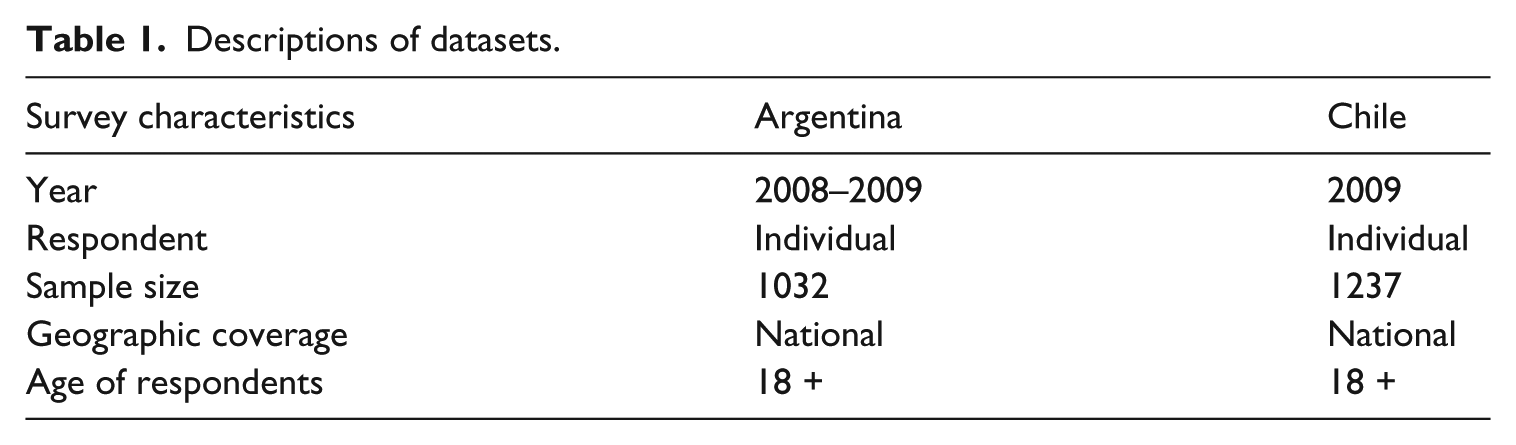
The same ISSP questionnaire was applied in all countries incorporated in the survey. This common questionnaire includes the basic questions used to operationalize our dependent variable of interest (class identity) as well as relevant explanatory variables (class position and class trajectories). 7
Dependent variable
Class identity was measured through the standard survey question on class self-identification. Respondents were asked to identify the class they believed they belong to. The categories of response were the following: upper class, upper-middle class, middle class, lower-middle class, working class, and lower class. We recoded the class identity variable into a dichotomous variable. The first category (named ‘working class’) includes those respondents who identify themselves with the working class, lower-middle class, and lower class. The remaining categories (middle class, upper-middle class, and upper class) were recoded as ‘middle class’. We decided to do so because recent research suggests that in countries like Chile (and probably in Argentina as well) workers tend to use the concepts of ‘working class’, ‘lower class’, and ‘lower-middle class’ interchangeably to draw a line between themselves and those who are ‘really middle-class’ (Pérez-Ahumada, 2017). 8
Independent variables
Class position is measured through a modified version of Wright’s (1997) class scheme. We use a nine-class location scheme that distinguishes between property owner and salaried class positions. Within the former, we separate small employers (property owners with 2 or more employees) from the petty bourgeoisie (property owners with 0–1 employees). 9 In Latin America, many self-employed individuals who do not hire the labor force of others are actually disguised workers who are either employed or self-employed in the informal sector (Klein and Tokman, 2000; Tokman, 2000). Therefore, we follow widespread definitions of informal work in Latin America (PREALC, 1978) and create a category of ‘informal self-employed’ to distinguish between unskilled and semi-skilled self-employed workers (i.e. self-employed with incomplete tertiary educational level or less) and the ‘truly’ petit bourgeois (independent, high-skilled workers).
Within the salaried population we distinguish class locations on the basis of the possession of skill and authority assets. Skills levels are measured through the combination of the occupational titles included in the two-digit ISCO-1988 codes and educational levels. In doing so, we create three categories: experts, skilled workers, and unskilled workers. Data limitations prevent us from constructing the full authority dimension such as suggested by Wright (1997: 74–90). Thus, we only analyze authority levels through a crude distinction between employees with authority (managers or supervisors) and employees without authority (which form the skilled and unskilled working class). In total, we use six salaried class positions: expert managers, expert without authority, skilled managers/supervisors, unskilled supervisors, skilled workers, and unskilled workers.
In summary, we use a modified version of Wright’s schema which includes nine class positions: (1) small employers, (2) formal petty bourgeoisie, (3) expert managers, (4) experts, (5) skilled managers/supervisors, (6) unskilled supervisors, (7) skilled workers, (8) unskilled workers, and (9) informal self-employed. In part of the analysis we grouped the nine class positions of the original schema into two groups: the ‘privileged class locations’, which include positions 1 to 6 and the subordinated or ‘unprivileged class locations’ which include positions 7, 8, and 9. The reasoning behind these groupings is that the ‘privileged class locations’ are in possession of different types of assets that locates them in a privileged position in the social structure (means of production, skills, and/or authority). This group includes what other class schemas define as the ‘elites’ or ‘capitalist class’ as well as different factions of the ‘middle class’. On the other hand, the ‘unprivileged class locations’ include those exploited and dominated in the point of production (skilled and unskilled workers) as well as the informal self-employed, which the literature defines as part of the ‘subordinated classes’ of Latin America (Collier and Handlin, 2009).
Along with class position, the two other class-related variables are class origin and respondents’ first job. In both cases, data allow us to construct variables with four categories: ‘privileged (middle-class, petit bourgeois or bourgeois)’, 10 ‘informal self-employed’, ‘skilled working class’, and ‘unskilled working class’ class origin or first job. These variables are particularly helpful to analyze the impact of biographical and work trajectories on class self-identification.
Methods and hypotheses
In this article we analyze the impact of class position and class trajectories on class identity through descriptive statistical techniques and logistic regression models. In line with previous research on class identity (Pérez-Ahumada, 2014), in the models we also include sociodemographic controls such as gender (1 = female, 0 = male), age (in years), marital status (1 = married or live-in partner, 0 = other), and employment sector (1 = private, 0 = public).
Based on the discussion on class identity and the political economy trajectories of both countries noted above, the following hypotheses guide our analysis:
H1: In both countries, the chances of upholding working-class self-identification should be higher among people located in the working class and the informal self-employed class than among people in privileged class locations (salaried middle class and property owner class positions).
H2: At a macro-level, we expect that the identification with the working class will be higher in Argentina than in Chile as a result of a more powerful labor movement and more pro-worker labor institutions that existed before, during, and after the dictatorships.
H3: In both countries, the identification with the working class should decrease as we move from individuals with class trajectories in the working class (biographical and/or work-related trajectories) to individuals with privileged class trajectories.
Results
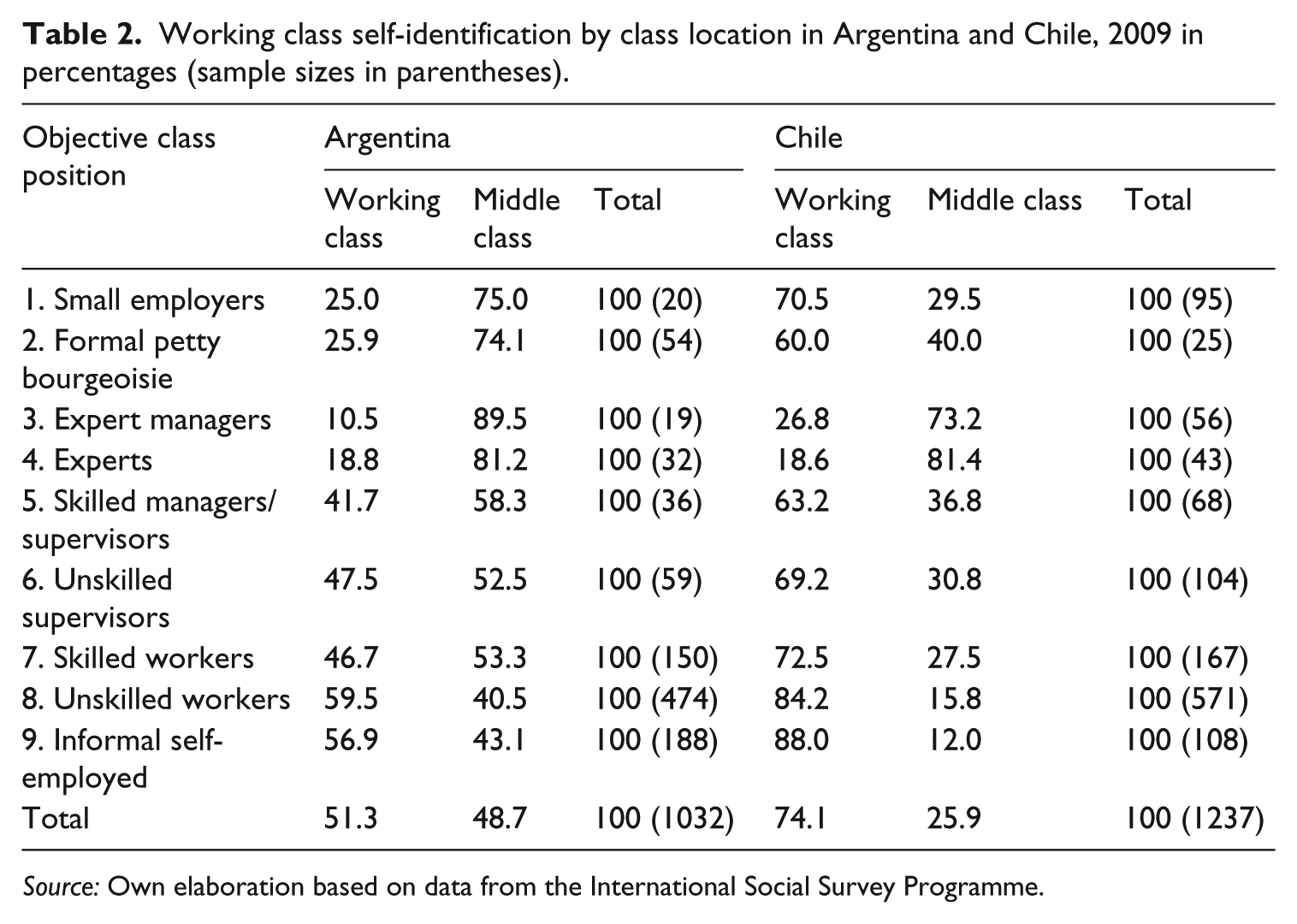
Table 2 presents the levels of working-class self-identification according to class location in Argentina and Chile. Data show that the relationship between objective location and subjective identification is statistically significant in both countries (χ2, p < .000).
Working class self-identification by class location in Argentina and Chile, 2009 in percentages (sample sizes in parentheses).
Source: Own elaboration based on data from the International Social Survey Programme.
This evidence supports our Hypothesis 1 about the correspondence between objective class position and subjective class identification in both countries. The only exception is the surprisingly high levels of working-class identification among the small employers and the formal petty bourgeoisie in Chile (71% and 60% respectively). This might reflect the tenuous barriers that exist in Chile between self-employment and salaried employment, as well as the economic precariousness of many formal self-employed individuals derived from Chile’s flexible labor market (Acuña and Pérez, 2005; Henríquez and Uribe-Echeverría, 2003). In both countries, expert class locations show the lowest levels of working-class self-identification while highest levels are found among the unskilled working class (Argentina) and the informal self-employed (Chile).
Table 2 also shows that the overall level of working-class self-identification is higher in Chile than in Argentina – 74% of Chileans identify themselves as working class, whereas 51% of Argentineans do so. This is a surprising finding that contradicts Hypothesis 2, as it challenges the widespread notion that low levels of identification with the working class explain the relative weakness of the Chilean labor movement (León and Martínez, 2007; Ruiz and Boccardo, 2015). This prevalence does not deny the fact of the high correspondence between objective class position and subjective class identification in Argentina. It just means that this correspondence occurs within relatively higher levels of middle-class identification when compared to Chile (Jorrat, 2015).
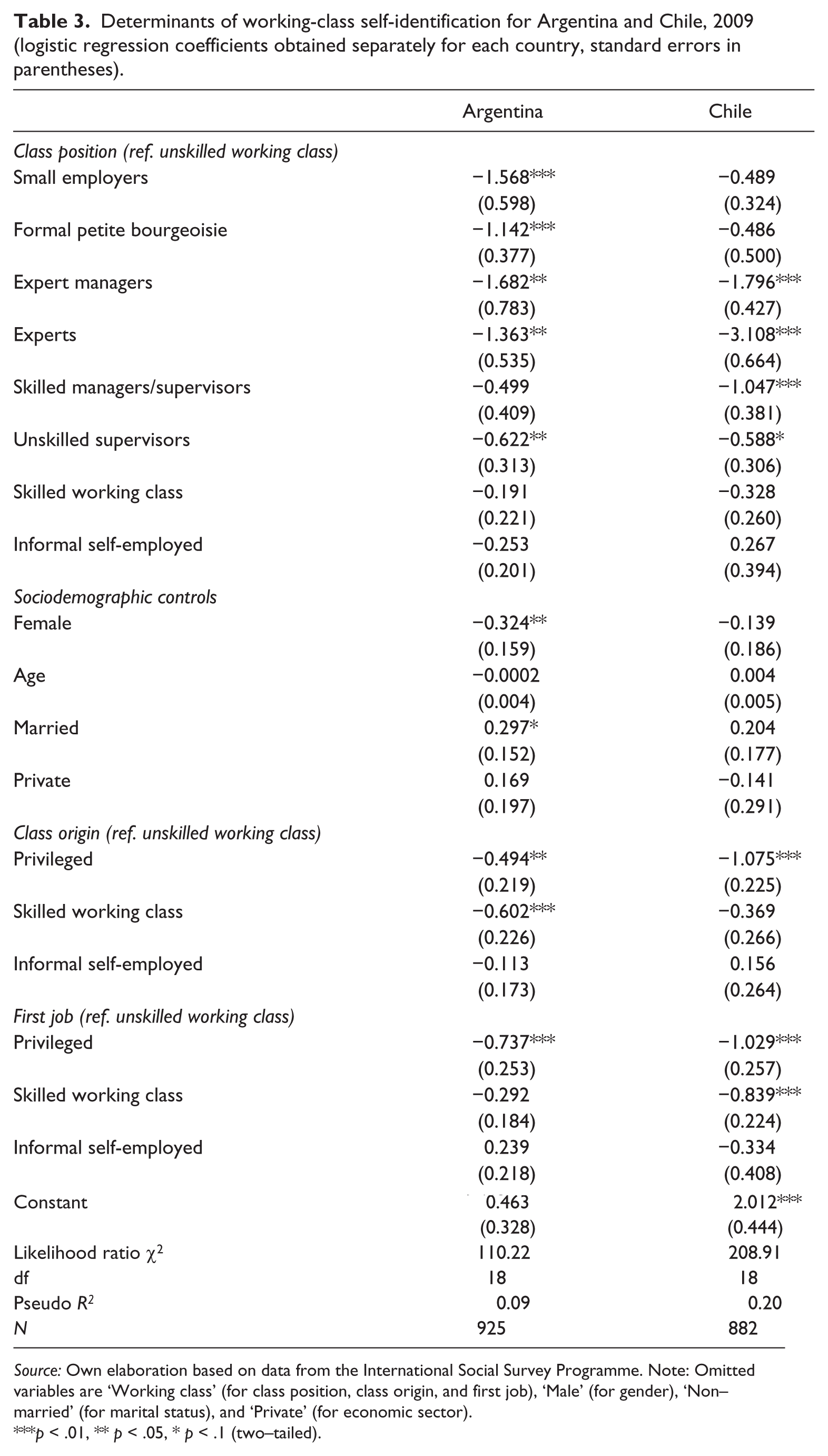
Table 3 presents the coefficients of logistic regressions that predict self-identification with the working class in Argentina and Chile separately. Particularly, we aimed to analyze the net effect of current class position and past class trajectories (understood as biographical and work trajectories) on the levels of class self-identification. To do so, the regression models also included sociodemographic controls (gender, age, marital status, and employment sector).
Determinants of working-class self-identification for Argentina and Chile, 2009 (logistic regression coefficients obtained separately for each country, standard errors in parentheses).
Source: Own elaboration based on data from the International Social Survey Programme. Note: Omitted variables are ‘Working class’ (for class position, class origin, and first job), ‘Male’ (for gender), ‘Non–married’ (for marital status), and ‘Private’ (for economic sector).
p < .01, ** p < .05, * p < .1 (two–tailed).
Table 3 shows that current class location remains a significant determinant of working-class self-identification. In Argentina, property owners (small employers and formal petty bourgeoisie) show strong and significant coefficients that differentiates them from the unskilled working class. This differs from the case of Chile, whose results confirm that having a small employer or formal petite bourgeois class position does not reduce the chances of upholding working-class self-identification, compared to being an unskilled worker. As already noted, these are surprising results: they contradict Hypothesis 2 and show that two relevant ‘middle-class’ positions in Chile have a class identification that does not differ statistically from that upheld by unskilled workers. In addition, while in both countries the levels of working-class self-identification among experts in managerial and non-managerial positions are significantly lower than those of the reference category (unskilled working class), the log odds associated with being an ‘expert’ are particularly important for the case of Chile. The statistical importance of the ‘experts’ category was also noted in other regression models (not shown here) in which we added an interaction term to test whether the class coefficients differed across countries. The results were statistically significant, and showed that the impact of being an expert in Chile was higher than in Argentina.
Despite differences like this, in both countries the levels of working-class self-identification of skilled workers, unskilled workers, and the informal self-employed are statistically the same. This indicates that in both countries the structural basis of working-class identity is to be found in the three unprivileged class locations: the informal self-employed, unskilled workers, and skilled workers. Finally, the results of Table 3 confirm our Hypothesis 3. Both measures of class trajectory (class origin and first job) follow the predicted pattern. Other things being equal, having a privileged class origin (or first job) significantly decreases the chances of working-class self-identification. Despite the pattern being similar in the two countries, the effect of a skilled working-class origin is significant only in Argentina, whereas the effect of a skilled working-class first job is significant only in Chile.
Discussion
The results presented in this article show that Argentine and Chilean workers uphold oppositional class identities, defined as the existence of significantly higher levels of working-class identity among workers vis-a-vis individuals in the privileged classes. This finding contradicts the expectation of the literature with regard to the weakening of class identities in Latin America. Moreover, it is surprising that the levels of identification with the working class are significantly higher in Chile than in Argentina. 11 If anything, we would have expected higher levels of working-class identity in Argentina, where a relatively strong labor movement has remained a constant throughout history and there was a recent trend of labor movement revitalization (Ranis, 1992; Varela, 2015). These results also question prevalent explanations for the weakness of the Chilean labor movement based on the alleged absence of a strong class identity among Chilean workers (León and Martínez, 2007; Ruiz and Boccardo, 2015). It is surprising that unlike Argentina, in Chile working-class identity permeates even some privileged class locations such as those of the small employers and the formal self-employed. How can we explain these results? In other words: What explains the Chilean ‘anomaly’?
Recent research shows that Chile’s high levels of inequality and economic concentration have erased traditional social distinctions that used to divide wage earners – particularly, that between white-collar and blue-collar workers. Instead, this research suggests that Chilean workers uphold cross-sectoral identities based, among other things, on broad ideas such as being a ‘hard worker’, which are framed in opposition to ‘the rich’ who ‘don’t work’ (Pérez-Ahumada, 2017). According to our results, it is likely that similar types of discourses permeate middle-class positions such as that of the small employers and the formal petite bourgeoisie. This is a likely explanation considering that there are weak barriers between self-employment and salaried employment in Chile, and that many small employers and petit bourgeois individuals tend to work under conditions of economic precariousness derived from a highly flexible labor market (Acuña and Pérez, 2005; Henríquez and Uribe-Echeverría, 2003). This is also a plausible interpretation in light of recent events observed in Chilean society. In the past decade, Chile has experienced a surge in social protests led by social movements with explicit anti-neoliberal agendas. These movements, which have demanded profound changes in education and labor laws, and more recently have rallied against the privatized pension funds system, might be the political expression of the apparently ‘anomalous’ high levels of working-class identification reported in this article.
In addition to the inequality-related features of Chilean neoliberalism, longer-term historical factors might explain the particular features of the Chilean case when compared to Argentina. Since the incorporation period in the 1930s, the Chilean labor movement has been weaker than the Argentine one (Angell, 1972; Collier and Collier, 2002 [1991]). The relative strength of the labor movement in Argentina is explained, among other things, by the state-corporatist mode of incorporation of labor into the political system. This initial incorporation through labor legislation and social policy resulted in relatively unified and large labor organizations, which according to historical evidence have coexisted with strong class identities and reformist political views (Ranis, 1992). The systematic repression of the left and the militant factions of labor throughout history reinforced the reformist approach of mainstream labor organizations.
Historical evidence also shows that in the case of Chile, workers attempted to overcome the institutional weakness of labor by establishing a militant party–union configuration (Drake, 1996; Huber and Stephens, 2012; Winn, 2004), which gave rise to what Cook called a ‘radical legacy’ of alliances between unions and ideologically committed anti-capitalist parties (Cook, 2007: 19–20). In placing the working class at the center of their political agendas, these parties privileged labor mobilization and promoted militant ideologies among workers. Although the dictatorship’s repressive policies were able to dismantle the political capacities of militant labor unions, it is possible that they did not succeeded in the total elimination of radicalized working-class identities. The high levels of working-class self-identification observed in Chile and reported in this article might indicate the resilience of old identities derived from longer-term political configurations.
Conclusion
This article analyzed the relationship between objective class location, class trajectories, and subjective class self-identification in Argentina and Chile. Evidence confirmed many of our hypotheses but also generated some surprising findings.
First, the percentage of self-identification with the working class in both counties increases as we move from the privileged classes to the working classes. In Argentina and Chile, it is more likely that workers and informal self-employed individuals self-identify as working class than individuals in any of the privileged classes (experts, managers, and employers). This supports the structural Marxist argument (Wright, 1985), and confirms previous findings regarding the persistent relationship between objective class position and subjective class identification (Hout, 2008; Jorrat, 2015; Pérez-Ahumada, 2014). In addition to current class location, it is important to note that in both countries a working-class origin or first job is related to a growth in the probabilities of upholding a working-class self-identification.
Thus, both Chilean and Argentine workers sustain oppositional class identities based on their current class location and class trajectory. In spite of this similarity, our results showed that the overall levels of working-class self-identification are higher in Chile than in Argentina. This is a surprising result not only because the Argentine labor movement is far more influential and holds more institutional power than its Chilean counterpart, but also because Chile is usually depicted as a middle-class society where class is absent from public discourses.
To explain this anomaly we drew upon evidence of the impact of contemporary class-related phenomena (e.g. higher inequality and economic concentration in Chile) and longer-term trajectories such as the radical union–party configuration that took place in Chile between the 1930s and 1973. Both factors might explain why Chileans are more likely to identify themselves as working class than Argentines, and why working-class identities permeate even some middle-class positions in Chile. Nonetheless, further research is needed to examine the mechanisms through which dictatorial and pre-dictatorial legacies shape current patterns of working-class identity, as well as more general patterns of class formation in Argentina and Chile. In line with this, it would be important to combine the study of class identity with an analysis of class interests and collective action in both countries. This type of investigation would help explain the wide gap between class identity and working-class organization existing in countries like Chile. This gap deserves attention as the Chilean case shows that although a necessary condition, class identity is not sufficient for class-based collective action. In any case, the findings presented here suggest that further research should always keep in mind that the concept of social class plays a key role in any comprehensive explanation of inequality and politics in Latin America.
Footnotes
Acknowledgements
The authors would like to thank Erik Olin Wright who discussed the findings of this article with us during his visit to Argentina in October 2015. A previous version of this article was presented at one of the Labor Studies and Class Relations section panels during the 2016 meeting of the Latin American Studies Association in New York City. The authors would like to thank Cecilia Senen Gonzalez and Peter Ranis, for their helpful comments and suggestions to that version of the article. Finally, we would like to thank the three anonymous reviewers that provided helpful feedback to subsequent versions of this article during the review process.
Funding
This research was partially funded by the Centre for Social Conflict and Cohesion Studies – COES (CONICYT/FONDAP/15130009).