



Abstract
This article investigates the association between personal networks and stress, both positively through support and negatively through conflict. In a representative sample of 755 individuals residing in Switzerland, each individual was asked to name people in their lives who they perceived as very important, as well as to report their mutual support and conflict interactions. First, the article develops and investigates a typology with five relational patterns based on indicators of emotional support and conflict relationships in personal networks. These patterns are the following: bonding social capital, bridging social capital, ego-centered conflict, overload, and ambivalent. Second, it explores the association of these patterns with stress levels that are perceived in various life domains. Results show that individuals involved in relationships that were predominantly supportive had lower levels of stress, whereas individuals experiencing relationships characterized by conflict, or an imbalance in support by giving more than receiving, had higher levels of stress. Finally, ambivalent relationships in which support and conflict were equally present were associated with an intermediate level of stress. These results show the importance of considering support and conflict relationships together in personal network structures.
Introduction
Personal networks can be positively or negatively related to stress (Pearlin et al., 2005). On the one hand, the literature emphasizes the importance of personal networks not only for promoting positive psychological states, but also for using them as a buffer against stress (Cohen, 2004; Shor et al., 2013). Indeed, they provide support in dealing with everyday life routines and in overcoming critical life events (Kadushin, 2002; Ryan et al., 2008; Wellman and Wortley, 1990; Widmer, 2010). On the other hand, however, personal networks create conflict that may generate stress. Personal networks encompass both support and conflict and, therefore, create ambivalent relational dynamics (Girardin et al., 2018; Sapin et al., 2016). Previous research on the relational origins of stress has focused on specific dyads (e.g., the couple or the parent–child relationship) and showed the extent to which such dyads are characterized by ambivalence (Fingerman et al., 2008; Hillcoat-Nallétamby and Phillips, 2011). Nevertheless, as personal networks are composed of a variety of relationships, assessing the link between such dyadic interactions and stress without considering the larger set of relationships in which they are embedded would be questionable. Depending on the distinct combination of support and conflict relationships, some patterns of relationships may be associated with either high or low stress. For instance, emotionally supportive relationships may not have positive outcomes on stress when conflict is also present. This research, using a random representative sample of the Swiss population, considers patterns of emotional support and conflict relationships in networks of people perceived by respondents to be very important in their lives. It investigates the association of those different patterns with the levels of stress perceived in various life domains.
Social capital in personal networks
A great amount of research has been devoted to the social support and relational resources that arise from personal networks (Kadushin, 2002; Ryan et al., 2008; Wellman and Wortley, 1990; Widmer, 2010). Relationships with family members have been found to be the primary source of instrumental and emotional support (Bonvalet and Ogg, 2007), but friendships also represent a source of solidarity (Allan, 2008), as well as work-related relationships (McDonald and Mair, 2010). Moreover, support is associated with positive health outcomes, especially when the support comes from family members (Shor et al., 2013) or from couple relationships (Smith and Christakis, 2008). For instance, a recent study showed that positive contact among network members was associated with less stress than frequent contact among network members (Ellwardt et al., 2019). Overall, personal networks are a major source of social capital (Ryan et al., 2008; Wellman and Wortley, 1990; Widmer, 2010). Personal networks produce two main types of social capital, bonding and bridging (Burt, 2002; Coleman, 1988). Bonding social capital refers to network structures with a high density of supportive relationships between network members (Coleman, 1988). People in such networks may feel well-protected, yet more subjected to social control. Bridging social capital refers to network structures with a high centrality of respondents. Central people, who serve as a bridge between network members, benefit from a series of advantages such as power in social exchanges, control over the flow of resources, and independence (Burt, 2002; Cook and Emerson, 1978). Nevertheless, occupying a bridging position is demanding because of the energy that one needs to invest in the position. A bridging position may, therefore, be associated with higher levels of stress than bonding social capital. For instance, in old age, common but challenging life events and transitions like retirement, widowhood, and health problems reduce bridging potential (Cornwell, 2011). Furthermore, older men are less likely than older women to have bridging potential, as they tend to focus more on their intimate partner and strong ties (Cornwell, 2011). To our knowledge, however, little empirical evidence exists to support the claim that bridging social capital is actually associated with stress or has less positive outcomes than bonding social capital.
Conflict and ambivalence in personal networks
Research on personal networks had first focused on the positive side of social interactions before investigating the negative side of them (Rook, 1984). Recent research acknowledges that personal networks are vulnerable to conflict (Everett and Borgatti, 2014; Widmer, 2010). In some instances, support acts as a compensatory factor that can buffer the detrimental consequences of conflict (Walen and Lachman, 2000). However, it is not clear whether overall conflict exerts stronger, similar, or weaker effects than support (Ingersoll-Dayton et al., 1997; Rook 1984). As conflict is often related to support in personal relationships, it is preferable to consider them together rather than independently and to investigate how they interact in specific patterns of relationships (Cohen, 2004; Ross et al., 2019). Indeed, conflict may not have the same consequences, whether it comes alone or within support relationships. The latter case is characteristic of ambivalent relationships; that is, situations in which support and conflict relationships are simultaneously present (Connidis and McMullin, 2002; Widmer and Lüscher, 2011). There are many sources of ambivalence in family relationships such as gender roles, care-giving responsibilities, and intergenerational solidarity (Spitze and Gallant, 2004; Widmer and Lüscher, 2011). Thus, conflicts are more likely to arise in close family ties (Fingerman et al., 2004; Rook, 2003). For instance, ties to partners, parents, offspring, and siblings are more likely to be ambivalent than ties with extended family members, friends, and acquaintances (Fingerman et al., 2004). Moreover, presence of conflict is overrepresented for individuals in disadvantaged social positions, individuals with lower income, individuals without a partner, and for women (Connidis and McMullin, 2002; Girardin et al., 2018; Widmer et al., 2018).
Stress and patterns of relationships in personal networks
An extensive literature review of the joint effects between positive and negative relationships pointed out a number of health outcomes ranging from cardio-metabolic and immune indicators to psychological and self-reported health indicators (Ross et al., 2019). Stress is a risk factor for further physical and mental health problems, and it deserves special attention (Pearlin et al., 2005; Thoits, 2010). While the combination of a large number of positive relationships and a low number of negative relationships is clearly related to positive health outcomes, other combinations of positive and negative relationships are less straightforward (Ross et al., 2019). Other evidence linking perceived stress with conflict and support relationships shows that conflict with spouses and friends exerts a stronger impact on anxiety and mood disorder than spousal or friendship support (Bertera, 2005; DeLongis et al., 2004). Similarly, ambivalent relationships between adults and their parents lead to poorer psychological well-being (Fingerman et al., 2008). Interestingly, ambivalent ties seem to generate more psychological distress than solely negative ties, which are easier to end (Steglich et al., 2010; Uchino et al., 2004).
For the most part, previous studies have investigated outcomes stemming from conflict or ambivalence in dyadic relationships, especially between partners (DeLongis et al., 2004) and between parents and children (Fingerman et al., 2008; Hillcoat-Nallétamby and Phillips, 2011), without considering the structural dimensions of personal networks (with some exceptions such as Girardin et al., 2018). As previously stated for support in personal networks, the structure in such networks can be either dense (bonding social capital) or centralized (bridging social capital). Similarly, in regard to conflict, a few research results have shown that in some networks all members negatively interfere in each other’s lives, while in others one individual stands at the center of conflicts (Widmer, 2010; Widmer et al., 2018). One critical paper assesses how positive and negative relationship patterns are associated with perceived stress in family networks of people undergoing psychotherapy (Sapin et al., 2016). The authors found that four patterns of support and conflict relationships were differently related with psychological distress: the bonding social capital pattern was characterized by dense support, the bridging social capital pattern was characterized by centralized support, the overload pattern was characterized by a large number of negative relationships and an imbalance between received and given support, and the ego-centered conflict pattern was characterized by centralized conflict (ego here refers to the respondent). Overall, overload and ego-centered conflict patterns were associated with higher levels of stress. Interestingly, the overload pattern produced the most stress. This may be related with the fact that reciprocity is a crucial component of relationships (Kumbasar et al., 1994; Molm et al., 2007).
Hypotheses
This article contributes to the literature by assessing multiple patterns of emotional support and conflict relationships in personal networks, as well as their association with perceived stress. Based on previous research, we first expect individuals to have more ambivalent ties than conflict ties. Indeed, relationships featuring exclusively conflict ties are rare, as these conflict-oriented relationships are likely to be dropped from personal networks in the long run, whereas ambivalent ties that mix positive and negative dimensions are more likely to be kept. Second, we hypothesize that perceived stress is higher in relational patterns with strong conflict or ambivalence in comparison with overall positive relational patterns. Third, we expect both bonding and bridging social capitals to be associated with less stress, as little empirical evidence exists to support the claim that occupying a bridging position is linked to stress. Fourth, we posit that stress arises when there is an imbalance in support by giving more than receiving. Such an imbalance challenges the principle of reciprocity in interactions and, therefore, may exacerbate stress.
Methods and measurements
Sample
The Family tiMes survey was carried out in 2011, and it was based on a representative sample of 803 individuals living in Switzerland (Gauthier et al., 2017). The recruitment was made through the Swiss Federal Statistical Office to select random individuals representative for all three major linguistic regions of Switzerland (German-, French- and Italian-speaking regions). These were individuals who were born either between 1950 and 1955 or between 1970 and 1975. The response rate was 55%, which is satisfying, considering the response rate for other national surveys. For example, the response rate for the European Social Survey in 2016 was 52.2% in Switzerland (ESS, 2016). A survey institute conducted face-to-face interviews using a computer-assisted personal interviewing method.
Respondents
Seven-hundred-and-fifty-five respondents provided valid network data and reported at least one network member. The sample was composed of 51% women, 52% respondents belonging to the 1950–1955 cohort, and 82% Swiss citizens. With regard to education, 64% of the respondents had a vocational education, 20% had a tertiary education, 10% had a lower secondary education, and 7% had an upper secondary education. Regarding employment, 48% of the respondents were employed full-time (80–100%), 22% were employed part-time (less than 80%), 15% were self-employed, 7% stayed at home, and 7% were in other situations.
Methodological approach
We first built up a typology of relational patterns based on network indicators, which would make it possible to test the first hypothesis regarding the prevalence of ambivalent ties over conflict ties. Second, we assessed the association of those patterns with the level of perceived stress by means of linear regressions, including a set of control variables, to test the three other hypotheses. All computations were made using the R statistical environment (R Development Core Team, 2020). We chose to adopt a typological approach for three main reasons. First, as positive and negative relationships often coexist, this approach is a very efficient way to investigate how they are concretely combined in personal networks to form distinct relational patterns. Second, a typological approach is well-suited for theory building, as it captures the holistic nature of configurational assertions (Doty and Glick, 1994). Finally, related to theory building, we wanted to be able to compare our findings that are based on a representative sample with those of Sapin et al. (2016), which are based on a clinical sample.
Emotional support and conflict in personal relationships
Following previous validation studies (Widmer, 2010), network analysis measures were applied to investigate emotional support and conflict in personal relationships (Borgatti et al., 2013; Wasserman and Faust, 1994). Respondents were first asked to name ‘the individuals who, over the past year, have been very important to you, even if you have not gotten along well with them.’ Respondents could name up to 20 important people.
They were then asked to report emotional support relationships, received and given, existing among all of their network members. The question started with, ‘Among the persons you have just mentioned, who could give you emotional support if needed?’ and was followed by, ‘And what about the first (second, third,. . . nth) person you mentioned? Who could give him or her emotional support if needed (yourself included)?’ Perceived emotional support appears to have more positive outcomes than the availability of concrete support (Shor et al., 2013). Perceived emotional support also works for various stressful events, in contrast to instrumental or informational support, which respond to specific needs (Cohen, 2004). Regarding conflict, respondents were asked to report who, among their network members, could anger or bother them and the other network members. Similarly, the question started with, ‘Among the persons you have just mentioned, who could anger you (annoy you)?’ and was followed by, ‘And what about the first (second, third,. . . nth) person you mentioned? Who could anger him or her (annoy him or her) (yourself included)?’
Following the same procedure as Sapin et al. (2016), we used two sets of six indicators, each shown in Table 1: one set related to the dimension of density and one set related to the dimension of centrality. Each set has three indicators for support and three indicators for conflict.
List of the network indicators: mean values for support and conflict.
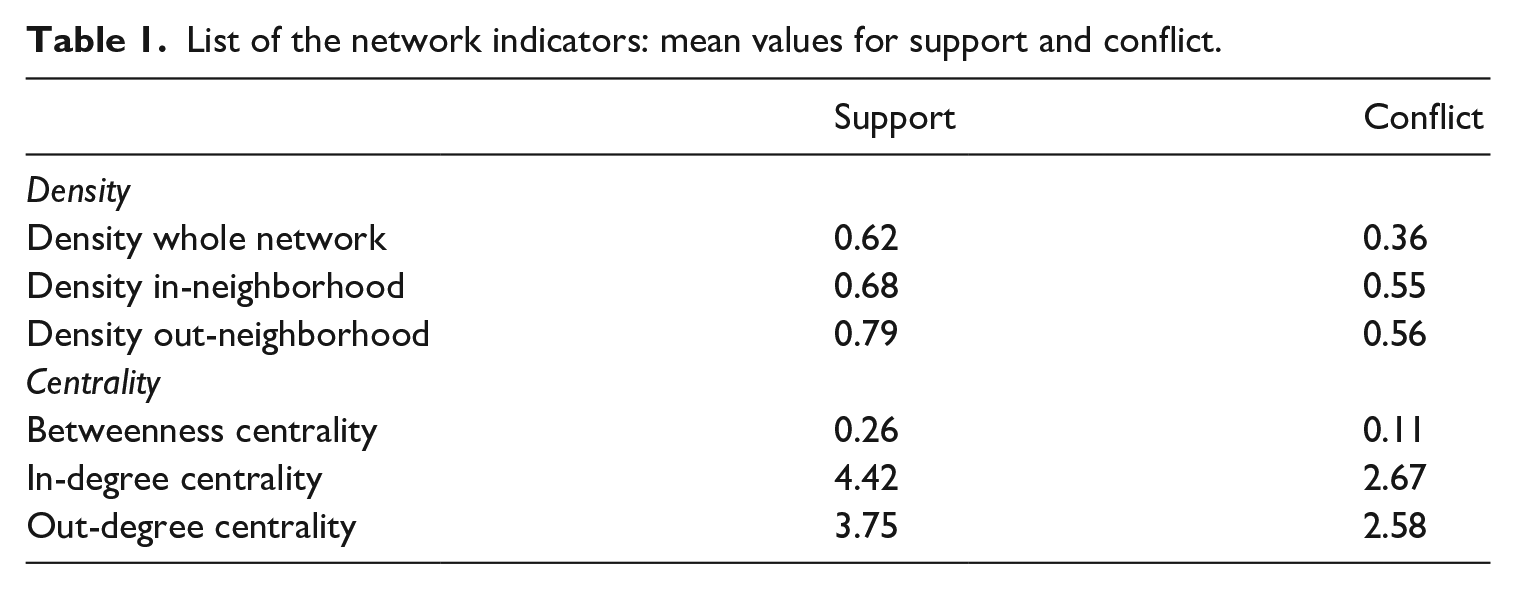
Density was first assessed for support relationships within the whole network. Density within the whole network corresponds to the number of actual connections reported by the respondent divided by the maximum theoretical number of connections in a given network. We then distinguished two types of density. The first type was measured in the subset of network members to whom respondents provided support (density ‘in-neighborhood’), and the second type was assessed in the subset of network members who provided support to respondents (density ‘out-neighborhood’).
Although personal networks are by definition ego-centered, the extent to which respondents play a critical role in support provision or reception varies and centrality indices capture such variations (Wasserman and Faust, 1994). Following Freeman (1978), centrality is documented using the following indicators: betweenness centrality of respondents in the whole support network, the number of network members to whom respondents provided support (in-degree centrality), and the number of network members who provided support to respondents (out-degree centrality). Degree centrality is a straightforward measure in personal networks, as such centrality is a local property and the measure provides the same result for personal networks and full social networks (Everett and Borgatti, 2005). Betweenness centrality examines the extent to which an actor stands between all other actors within the same network (Freeman, 1978). It is computed as the number of shortest paths that pass through the respective node, corresponding here to the respondents. Its use in personal networks is more ambiguous than degree centrality, as the measure aims to capture the position of actors beyond their local environment. Research, however, showed that the betweenness centrality of actors in their local set of ties was highly correlated with their betweenness centrality in the full social network in which they belonged (Everett and Borgatti, 2005). Thus, it was deemed a good measure because it addressed the extent to which individuals achieve some form of autonomy in their personal networks by acting as bridges between their potentially disconnected network members (Widmer, 2010). It should be noted that the use of betweenness centrality in personal networks is not new. It was used, for example, in organizational research that assessed the potentially beneficial effect of structural holes (Burt, 2002).
As we wished to assess structural features of relationships as comprehensive patterns of positive and negative interactions (Sapin et al., 2016), we used the same indicators for assessing conflict. The meaning of density and centrality indicators, however, is different in this case. For positive ties, increased density suggests a group with greater social cohesion. For negative ties, one expects the opposite: that is, a prevalence of disharmony and antagonism in the group (Everett and Borgatti, 2014). Conflict degree centrality assesses the extent to which respondents have negative relationships with their family members, thus representing an indicator of local antagonism. In this perspective, a high degree of centrality in conflict ties represents a likely producer of stress (Widmer et al., 2018). The betweenness centrality of respondents in conflict ties reflects the extent to which they are negatively connected with family members who are not yet feuding with each other. Whereas betweenness centrality captures the control of the flow of goods or information for positive interactions (Everett and Borgatti, 2014), in the case of conflict, the central individual may play a critical role in the diffusion of negative feelings toward others throughout family triads, as psychoanalysis suggests (Bowen, 1976).
Stress in various life domains
Stress has been measured through individuals’ subjective perceptions of life stressors (Scott et al., 2013). According to this perspective, there are different types of life stressors and, among them, ‘chronic stressors’ stem from the roles that individuals hold in different life domains. Accordingly, stress was assessed with a 5-point scale ranging from ‘no stress’ to ‘a lot’ for 12 life domains: five related to family life (love, couple relationships, children, housework, and family relationships), two to occupational life (work, education), four to social participation (spending time with friends, leisure activities, civic activities, and religion), and one with oneself (self-realization). For each domain, the question was, ‘Many of these activities and interests may have been sources of stress (anxiety and nervousness). Please indicate to what extent each one has contributed to you feeling “a lot,” “quite a bit,” “some,” “little,” or “no stress” during your life.’ Overall, respondents reported a medium level of stress. Respondents perceived work as the most stressful domain (mean score: 3.12), children as the second-most stressful domain (2.27), and couple relationships as the third-most stressful domain (2.06), highlighting the difficulties arising from the work–family balance. We also computed a total stress indicator based on the 12 domains. Cronbach’s alpha was 0.75, which confirms the reliability of this new indicator. For each respondent, we summed up the score of all 12 indicators and then divided it by 12 to obtain a 5-point scale again. Missing values in a given domain were attributed the mean value of this domain when computing the overall score; we did this for 5.5% of the answers. For instance, respondents who did not answer about their stress related to children were given the score 2.27, which corresponds to the domain mean because they are stress-neutral in this domain.
Control variables
We included several control variables in the analyses, namely sex (women or men), birth cohort (1950–1955 or 1970–1975), and education (lower secondary, upper secondary, vocational, and tertiary education). Indeed, women and individuals with lower levels of education perceive more social negativity (Bertera, 2005), which leads to more stress. Regarding age effects, there is a reduction in conflict with age, which is explained by selectivity processes in which older individuals tend to let go of less rewarding relationships (Akiyama et al., 2003; Walen and Lachman, 2000). Concerning network composition, we controlled for the presence of partners, the presence of children, and the presence of at least one tie to non-kin. Indeed, Smith and Christakis (2008) have shown that being in a relationship helps coping with stress. Having children may trigger intergenerational ambivalence (Widmer and Lüscher, 2011), whereas ties to non-kin are expected to be less imbued with ambivalence (Fingerman et al., 2004). Finally, an indicator of self-mastery was included, as individuals with a high level of self-mastery deal better with stress (Thoits, 2010). This indicator included five items that were rated on a 4-point agreement scale. The five items were: (1) There is really no way I can solve some of the problems I have, (2) Sometimes I feel that I’m being pushed around in life, (3) I have little control over the things that happen to me, (4) I can do just about anything I really set my mind to, and (5) I often feel helpless in dealing with the problems of life.
Results
A typology of the relational patterns
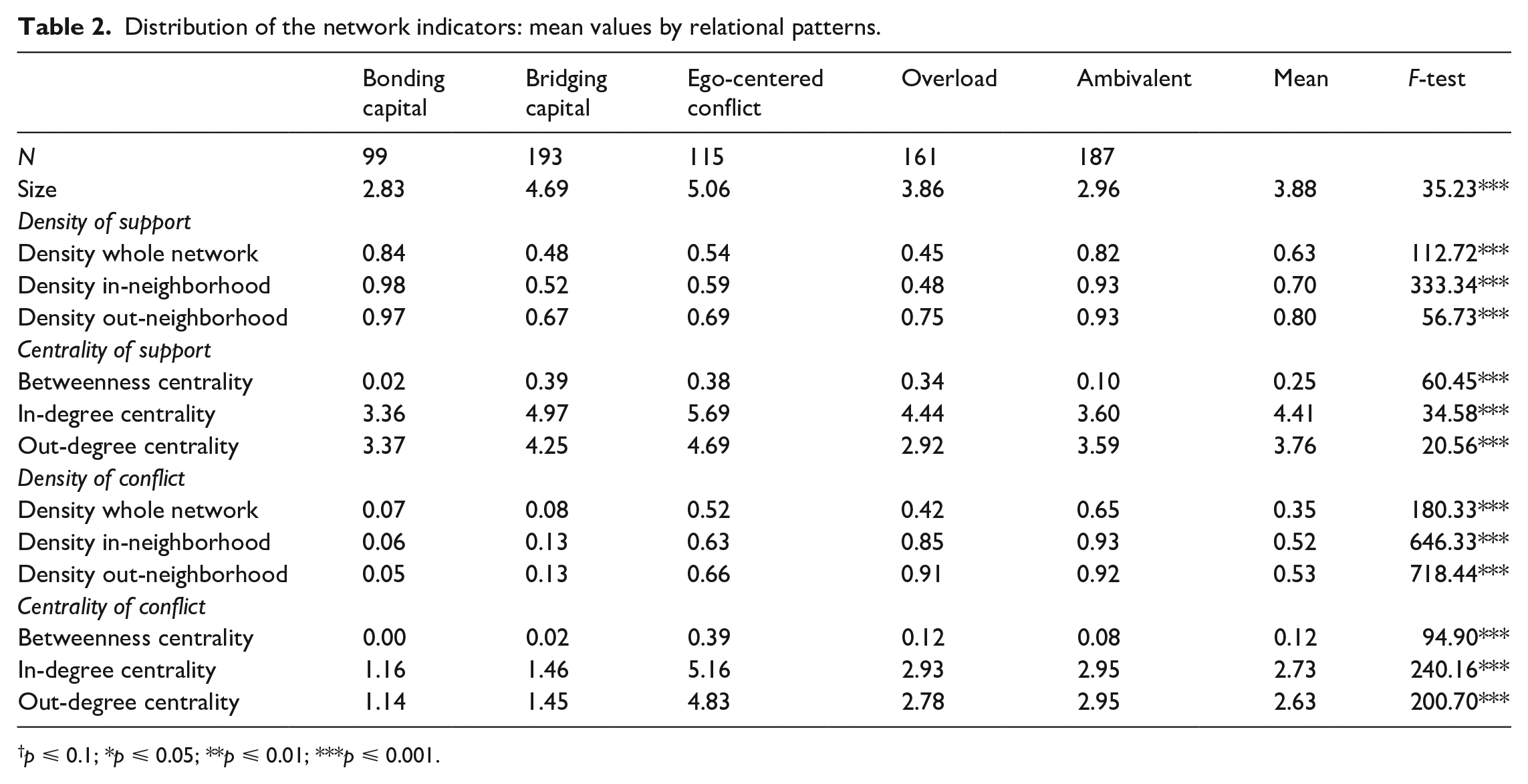
Following standard practices used to develop typologies of personal networks (Bidart et al., 2018; Sapin et al., 2016; Widmer, 2010), we performed a factor analysis, followed by a cluster analysis in order to obtain a typology of relational patterns. The factor analysis was performed on the 12 network indicators described in Table 1. Based on this factor analysis (Tabachnick and Fidell, 1996), we retained four components that accounted for 69% of the explained variance (eigenvalue > 1). The first factor was mainly based on conflict density indicators, the second factor was based on support density indicators, the third factor was based on support centrality indicators, and the fourth factor was based on conflict centrality indicators. The scores of the four principal components were inputted into a hierarchical cluster analysis based on a measure of the Euclidean distance between individuals and on the Ward clustering algorithm (Ward, 1963). We retained a solution with five clusters, which we chose because of its balance of interpretability and statistical efficiency (Everitt et al., 2011); the four-cluster solution (explained in-depth below) did not differentiate the direction of relationships, and thus was deemed unsatisfactory. Table 2 presents the correlations between network indicators and relational patterns with the average score for each indicator. We also computed the mean scores of all indices, as well as the results of F-tests for the equality of means in a one-way analysis of variance.
Distribution of the network indicators: mean values by relational patterns.
p ⩽ 0.1; *p ⩽ 0.05; **p ⩽ 0.01; ***p ⩽ 0.001.
The first relational pattern from the cluster analysis was dominated by high density in support relationships and a quasi-absence of conflict. Thus, it corresponded to a bonding social capital pattern. The overall density of emotional support was the highest (0.84), and the density in the neighborhoods was very high for network members receiving support (0.98) and for network members giving support (0.97). In addition, the betweenness centrality of support was the lowest (0.02). The second relational pattern was characterized by high betweenness centrality in emotional support and a quasi-absence of conflict. Thus, it corresponded to a bridging social capital pattern. The betweenness centrality was high (0.39), and the in-degree and out-degree centralities were large, indicating the presence of network members receiving support from (4.97) and giving support to the respondents (4.25). In both types, emotional support was more predominant than conflict. The third pattern was characterized by a high betweenness centrality of the respondents in conflict relationships (0.39) with many people angering the respondents (4.83) or being angered by them (5.16). There was also support that was organized around the respondents (betweenness of support: 0.38), but the predominant presence of conflict indicated that this type corresponded to an ego-centered conflict pattern. Both support and conflict were salient in the fourth pattern, in which conflict was interconnected and not centralized around the respondents. In this case, there was an imbalance between the number of network members the respondents were providing support to (in-degree centrality: 4.44) and the number of network members the respondents were receiving support from (out-degree centrality: 2.92), corresponding to an overload pattern. Finally, the last pattern not only had a high density of emotional support (with levels similar to the bonding social capital pattern), but it also had a high density of conflict (density of conflict: 0.65). Although the balance tended to consist more of support, conflicts were also present. Therefore, we named this pattern ambivalent. In decreasing order of frequency, 26% of the respondents had a bridging social capital pattern (n = 193), 25% had an ambivalent pattern (n = 187), 21% had an overload pattern (n = 161), 15% had an ego-centered conflict pattern (n = 115), and 13% had a bonding social capital pattern (n = 99). In a four-cluster solution, the overload pattern and the ego-centered conflict pattern formed a single larger cluster, which did not distinguish whether there was an imbalance between giving and receiving support. Overall, this typology matches the one described by Sapin et al. (2016), which studied the family networks of people undergoing psychotherapy, while providing an alternative type with the ambivalent pattern.
Figure 1 summarizes the main features of the relational patterns produced by cluster analysis. Two types were characterized almost solely by support (bonding social capital pattern and bridging social capital pattern), and three types included conflict (ego-centered conflict, overload, and ambivalent patterns). Besides the presence of support or conflict, the difference between the types was based on the structure of relationships. Indeed, some networks were more densely connected (e.g., bonding social capital and ambivalent patterns), more centralized around the respondents (e.g., bridging social capital and ego-centered conflict patterns), or they were dense in one dimension and centralized in the other (e.g., overload pattern). In summary, dense support is linked either to a bonding social capital pattern or, in the co-presence of dense conflict, to an ambivalent pattern. Centralized support with a balance between giving and receiving is associated with a bridging social capital pattern or an ego-centered conflict pattern that is in the co-presence of centralized conflict. Centralized support in which the respondent is giving more than receiving in the co-presence of dense conflict is linked to an overload pattern. In contrast, centralized conflict only happens in the presence of centralized support and, therefore, it is absent when support is dense. Finally, we found that there was always at least some support, which explains why the last row of Figure 1 is empty. This finding confirms our first hypothesis on the prevalence of ambivalent relationships (mix of positive and negative dimensions) over conflict-oriented relationships. This typology provides a further confirmation that support and conflict come in distinct patterns of relationships.
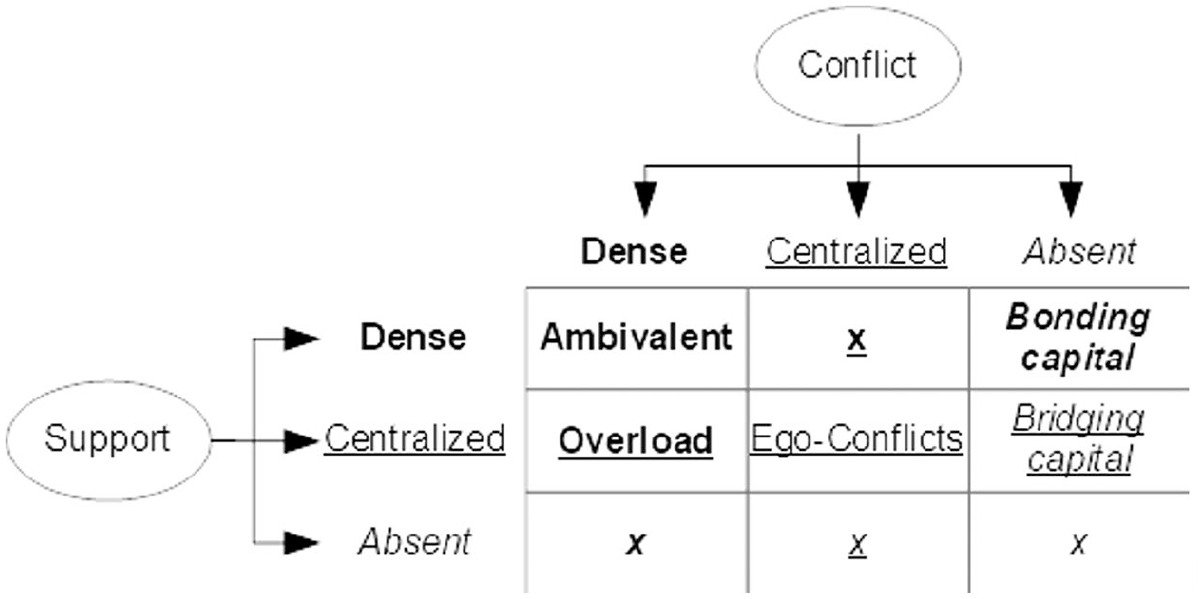
Summary of relational patterns.
Association of relationship patterns with domain-specific stress
We then investigated the associations between stress and the five relational patterns. In Table 3, the life domains were classified from the most to the least stressful; it presents the correlations between stress indicators and relational patterns, with the average score for each indicator. We also computed the mean scores of all indices, as well as the results of F-tests for the equality of means in a one-way analysis of variance. The levels of stress associated with the eight first domains indicated in Table 3 varied according to the relational patterns. Stress was systematically lower in the bonding and bridging social capital patterns, medium in the ambivalent pattern, and higher in the ego-centered conflict and overload patterns. Four domains had very low levels of stress and did not significantly vary: spending time with friends, leisure activities, civic activities, and religion. The total stress indicator followed the same trend when considering the indicators one by one (see last line of Table 3).
Distribution of stress in life domains: mean values by relational patterns.
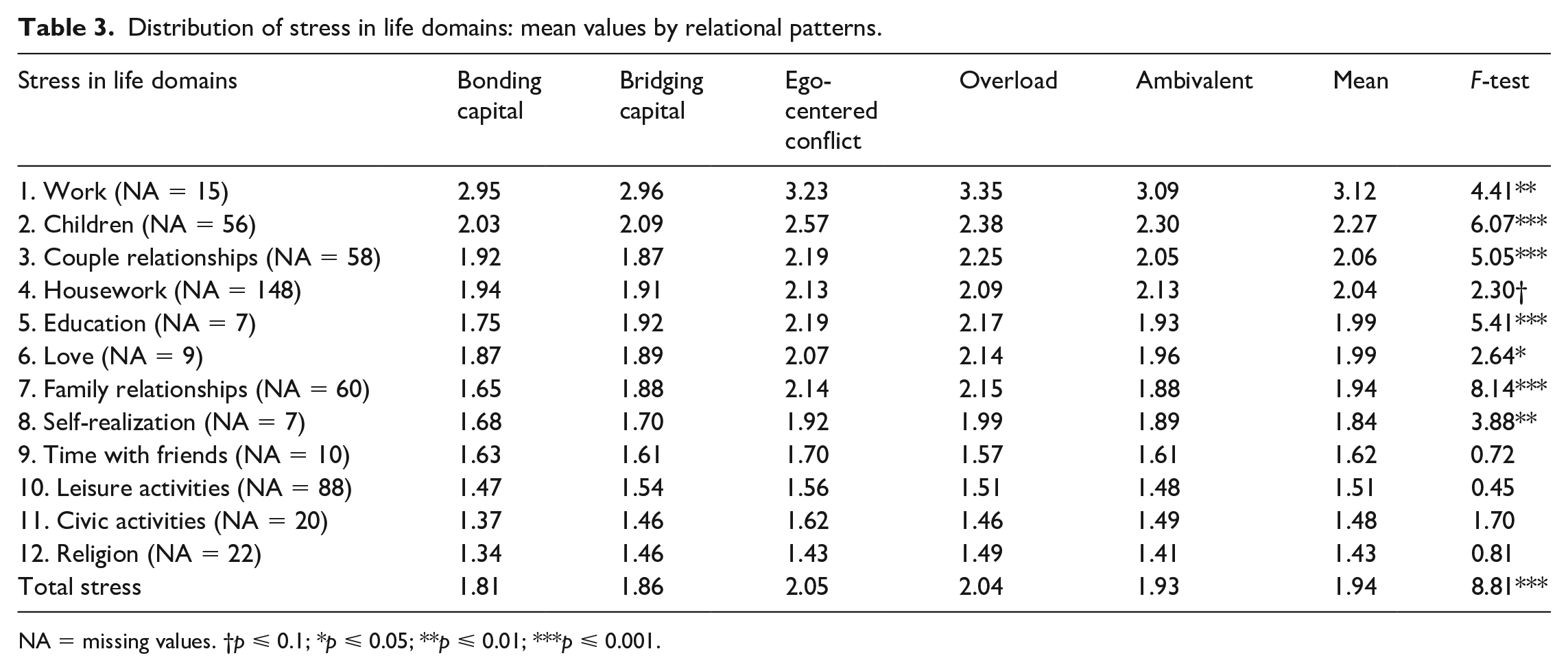
NA = missing values. †p ⩽ 0.1; *p ⩽ 0.05; **p ⩽ 0.01; ***p ⩽ 0.001.
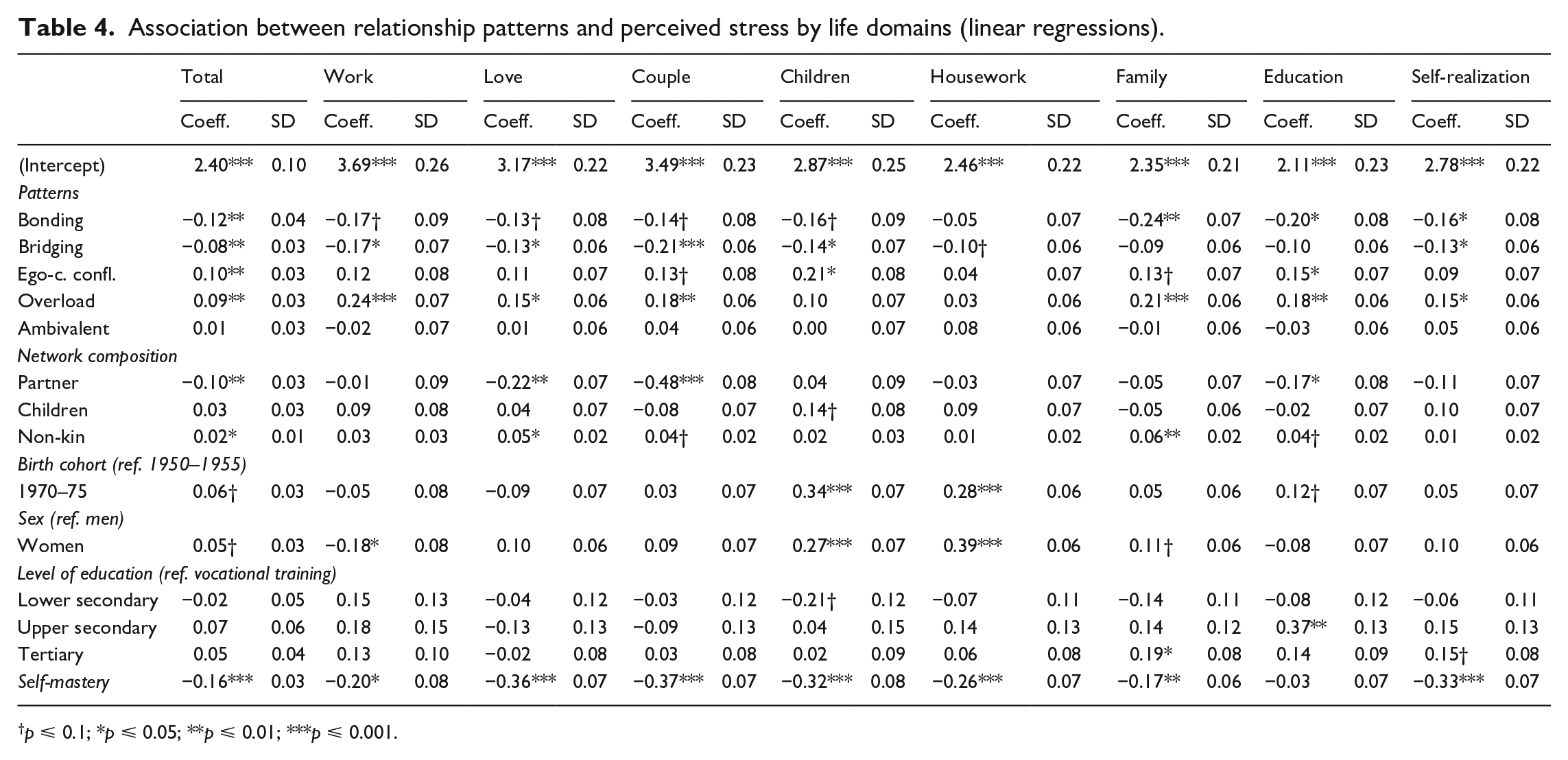
We then investigated the association between relational patterns and the level of stress by means of linear regressions, controlling for a variety of likely confounders (see Table 4). Regarding the five patterns, instead of choosing a reference category, we used a deviation contrast method to estimate the effect of each relational type in comparison with the overall effect of the typology. Results confirmed those found in the bivariate analyses. Overall, bonding social capital and bridging social capital patterns were associated with less stress, whereas ego-centered conflict and overload patterns were associated with significantly more stress. This confirms the second hypothesis regarding a stronger association between stress and relational patterns characterized by conflict or ambivalence in comparison with overall positive relational patterns. While the bonding social capital pattern was associated with lower stress in the domain of family relationships, the bridging social capital pattern was associated with lower stress in the domains of couple relationships and self-realization. The fact that both bonding and bridging social capital patterns were associated with less stress, despite minor differences depending on the type of life domain, confirms our third hypothesis. The ego-centered conflict pattern was associated with more stress in children and family relationships. The overload pattern characterized by an imbalance in support by giving more than receiving was related to the most stress, as it was associated with stress stemming from occupational life (work, education), from family life (love, couple relationships, and family relationships), and from self-realization. This is a confirmation of the fourth hypothesis linking stress and such imbalance. Finally, the ambivalent pattern was characterized by an average stress level, indicating that support and conflict relationships counterbalanced one another.
Association between relationship patterns and perceived stress by life domains (linear regressions).
p ⩽ 0.1; *p ⩽ 0.05; **p ⩽ 0.01; ***p ⩽ 0.001.
Considering control variables, mentioning a partner as a significant network member was associated with a lower level of perceived stress for domains related to love and couple relationships, as well as to education. The inclusion of non-kinship ties was associated with higher levels of stress, especially for domains related to love and family relationships. The inclusion of children was inconclusive. Regarding gender differences, women perceived more stress related to children and housework, while men perceived more stress related to work. Concerning age, there was an association between younger individuals and stress in childrearing and housework. Higher levels of education were also associated with more stress in family life and to a lower extent in the domain of education. Finally, higher levels of self-mastery were associated with a lower level of perceived stress.
Discussion
Personal networks are important to consider when studying the stress experienced by individuals in different life domains. On the one hand, personal networks serve as social capital that contributes to decreasing stress. Overall, individuals experiencing either bonding or bridging social capital patterns had lower levels of stress, which shows that support stemming from both bonding and bridging social capital buffers stress. On the other hand, the presence of conflict in personal networks is a strong stressor. In contrast to the two relational patterns characterized mainly by social capital, individuals experiencing either overload or ego-centered conflict patterns had higher levels of stress. This result confirms the relevance of considering social capital and conflict simultaneously (Sapin et al., 2016), as a large amount of conflict decreases the positive outcomes of social capital and may even be more detrimental for the mental health of individuals than positive interactions (Bertera, 2005; DeLongis et al., 2004; Rook, 1984). In addition, the lack of reciprocity in support (e.g., playing the role of a caregiver in one’s personal network without also being a care-recipient) was linked to stress in the overload pattern. Finally, the ambivalent pattern had an intermediate position and was not associated with especially low or high levels of stress. This is not congruent with other studies, which show that ambivalent relationships generate unpredictability and stress (Ross et al., 2019). It indicates that conflict, when rooted in otherwise positive and supportive relationships, is a non-disruptive component of personal relationships (Widmer and Lüscher, 2011). Interestingly, no pattern was characterized solely by conflict, which confirms previous research indicating that it is easier to put an end to wholly negative ties than to ambivalent ones (Steglich et al., 2010; Uchino et al., 2004).
Patterns of relationships were associated with stress in several life domains: family life, occupational life, and self-realization. Indeed, the diffusion of stress and the mobilization of resources are inherently multidimensional, as they simultaneously involve losses and gains of resources and stress from multiple life domains (Spini et al., 2017). In contrast, social participation (spending time with friends, leisure activities, civic activities, and religion) was not linked to stress. Indeed, engagement in these four life domains is clearly voluntary-based and, in the case that they would generate stress, individuals are free to withdraw.
Individuals who did not mention a partner in their network were more likely to report stress, as well as individuals who included non-kin. Indeed, research has shown that marriage is a protecting factor against stress (Smith and Christakis, 2008). Furthermore, the presence of non-kin in personal networks may be related to less satisfying experiences of partnering and family life, which are consequently perceived as more stressful. With regard to gender, women perceived more stress related to their role of caregiver, while men perceived more stress related to their role of breadwinner. This set of results is accounted for by the greater normative expectations about family care toward women than men in various countries, including Switzerland (Giudici and Gauthier, 2009). Concerning education, there was an association between higher levels of education and stress in family life. Interestingly, whereas a higher level of education is usually associated with a wide range of positive outcomes, it also requires substantial investment to be achieved and hence is associated with high expectations regarding successful occupational career outcomes. This may eventually contribute to triggering work–family conflict(s) and generate a higher level of stress for individuals in the managerial/professional occupations class in comparison with those in occupations of lower status (McGinninty and Calvert, 2009). Finally, individuals aged from 36 to 41 are more likely to be in charge of young children and/or teenagers, which requires a high level of parental investment and is associated with stress, while individuals aged 56 to 61 are more typically confronted with the departure of their adult children. Overall, it shows that conflict in personal networks is more likely to happen in situations characterized by social disadvantages, for instance, individuals with a lower income, with health issues, without a partner, and women (Connidis and McMullin, 2002; Widmer et al., 2018). Furthermore, as homophily characterizes personal networks (McPherson et al., 2001), a lack of resources among the respondents translates to a lack of resources among their network members, increasing the likelihood of conflict and, consequently, the experience of stress.
The present research has some limitations that should be noted. First of all, we investigated the association between patterns of support and conflict relationships and perceived stress, assuming, for the sake of analysis, some sort of causal directionality. However, stress also impacts personal networks as it may lead respondents to drop conflictual ties (Steglich et al., 2010; Uchino et al., 2004). Bi-directionality has to do with social selection and homophily, as shown with friendship ties and well-being: individuals with high levels of well-being tend to get acquainted with individuals also showing high levels of well-being (Elmer et al., 2017). Further research should tackle this issue, as these various mechanisms need to be disentangled. Second, we used a stress indicator related to specific life domains whereas some of the life domains were not relevant for all respondents (e.g., children). By including 12 domains and creating a total stress indicator, we were able to overcome this limitation to a certain extent. Also, we asked respondents to complete a retrospective assessment on perceived stress. This implies that the assessment on a 5-point scale may have been approximate, but respondents were likely to remember experiencing or not experiencing stress. Nevertheless, further research should use additional indicators to develop a more complete picture of potential sources of stress. Finally, the personal networks at hand were collected from a single informant who gave his or her perception of the support and conflict relationships existing between all of his or her personal network members. Multiple informant designs should be developed in the future in order to better understand how differences in perceptions of relationships between network members are associated with stress. Despite these limitations, our research contributes to the debate on the joint effects of positive and negative relationships beyond specific dyads by considering structures of personal networks.
Footnotes
Funding
This publication benefited from the support of the Swiss National Science Foundation (grant number: 100017_130343/1), and of the Swiss National Centre of Competence in Research LIVES – Overcoming vulnerability: Life course perspectives (NCCR LIVES), which is financed by the Swiss National Science Foundation (grant number: 51NF40-160590). The authors are grateful to the Swiss National Science Foundation for its financial assistance.
