



Abstract
The educational community is divided over which is the best approach for improving urban schools: focus on teaching and learning or underlying social inequity? This article argues that the students who attend urban schools can inform the debate. The study draws on interviews with fourteen urban youth about their participation in a community-based program that supports school activism. In the program, the students selected a surprising, and seemingly trivial, set of school problems as their top reform priorities. Yet findings reveal that from the students’ vantage point, these concrete changes will enhance engagement and the perceived fairness of the educational environment. Urban students therefore bridge current policy debates by posing recommendations pertinent to both educational and social reform advocates. The study concludes with reflections on students’ contributions to the content and process of urban educational reform.
How can urban schools be improved? Here are some suggestions from urban students, in their own words:
“I would have a variety of lunch.”
“I think a teacher should sit there and talk to their students.”
“The bathroom is what I really want to happen.”
This is what students say they need but these are not the strategies being discussed in higher level policy circles. Indeed, in the recent past, the predominant approach was to hold schools “accountable” for ever-higher benchmarks of student achievement. The version of the Elementary and Secondary Education Act that is still on the books prescribes a series of interventions to accomplish these results, including upgrading teachers’ qualifications, offering school choice, providing tutoring, and “restructuring” a school’s management. To update the statute, supporters of the original No Child Left Behind Act call for buttressing its basic premises: raising the standards and the stakes of performance, crediting improvement, expanding choice, and tying employment decisions to educators’ effectiveness and schools’ needs (Haycock, 2010, 2006; Hess, 2008; Hess & Finn Jr., 2007; Hess & Petrilli, 2009). With these adjustments, advocates argue, the revised legislation will advance urban schools by strengthening the bedrock teaching and learning functions that these schools provide.
The change in administration has revived a push for a “broader” view of urban education that links its failures to underlying social causes (Anyon, 1997, 2005a, 2005b; Ladd, Noguera, & Payzant, 2008; Noguera & Rothstein, 2008; Rothstein, 2004, 2008; Warren, 2005). Relying solely on educational policy levers to correct what amounts to economic and political inequality is misguided and “naïve,” according to these scholars and advocates (Noguera & Rothstein, 2008, p. 2). Perhaps the most forceful spokesperson of this perspective, Jean Anyon characterizes education reforms that reduce class sizes or restructure schools as merely “small victories,” that “rarely affect the material trajectory of most students’ lives” (1997, p. 165; 2005a, p. 13). What is needed, she and others argue, is “more fundamental social change”: minimum wage increases, expanded employment opportunities, extensive public transportation systems, affordable and mixed-income housing, accessible health services, and educational programming for students before kindergarten, after-school, and in the summer (Anyon, 1997, p. 13, 2005a; Ladd et al., 2008; Noguera & Rothstein, 2008; Rothstein, 2004, 2008). Although conceivably better equipped to accomplish equal outcomes, these structural changes are “not likely to be popular with political and economic elites, or indeed, with many in America’s middle class” unwilling to yield power or privilege (Anyon, 2005b, p. 109; Oakes & Rogers, 2006). Low-income parents, community organizations, and many scholars have therefore turned to social activism for the political capacity to overcome resistance and push through such sweeping reform (Anyon, 2005b, 2009; Oakes & Rogers, 2006; Shirley, 2009; Warren, 2005).
The Department of Education under the Obama administration has staked out some of its policy stances with the release of its blueprint for the Elementary and Secondary Education Act (Dillon, 2010; Klein, 2010a, 2010b; U.S. Department of Education, 2010). The proposals allude to the crosscurrents of reform described above, with an emphasis on educational accountability (e.g., school turnarounds, test score–based teacher evaluations) and the consideration of more holistic approaches (e.g., Promise Neighborhoods, full-service community schools). Yet with the renewal of the ESEA still outstanding, the policy context is presently in flux, making it an ideal time to add more voices to the conversation at both the national and local levels.
In this article, I argue that the debate over how to improve the education offered at urban schools can be informed by the students who attend them. This thesis stems from my investigation of a community-based program designed to facilitate urban students’ activism for school reform. As part of this program, the students selected what they believed were the most important school problems and worked to engineer solutions. Their choices may seem curious, for the students most often focused on the tastiness of the school lunch, their personal relationships with teachers, and the cleanliness of the bathrooms.
The chance that leading policymakers would stress the same priorities is slight. And yet, I contend in this article that the students’ motives for supporting these changes align remarkably well with the intentions of educational and social reform advocates. The reforms the students recommend are both integral to their learning and a necessary first step to addressing social inequality.
The Urban Research Context:
The City of Gorham and the Gorham School District
The youth activists profiled in this study live in an urban, Midwestern community called Gorham. 1 Decades of discrimination, job losses, and population dislocations have created a city landscape that is racially and economically isolated. Residents consequently face monumental challenges including poverty, unemployment, and a lack of security. One quarter of the city’s residents, and 40% of children under the age of 18, live below the poverty level (U.S. Census Bureau, 2005b). The unemployment rate in Gorham exceeded the national average in 2005 by more than twofold; African Americans living in the city experienced even greater hardship at almost 18% unemployment (U.S. Census Bureau, 2005a). As in many urban locales, safety is a significant concern for area residents. Gorham’s rates of violent crime were twice the national average in 2005 and incidents of homicide are rising (Federal Bureau of Investigation, 2005; Zernike, 2006).
Embedded within this context, the public school district in Gorham enrolls a student population that encounters many of these challenges in their home and community lives. In addition, like all public school districts, it is highly sensitive as an institution to the resources available in the community. In Gorham, these are very limited.
The majority of students in the Gorham School District (GSD) are students of color with African Americans making up the largest ethnic group (59%), followed by Latinos (19%), Whites (14%), and Asian Americans (4%). Low-income students are also in the majority: 60% of high school students receive subsidized lunch ([Gorham] School District, 2004-2005).
GSD receives in total revenues about US$12,000 per student, a figure that is thousands less than the assets available to students in nearby suburbs ([State] Information Network for Successful Schools, 2004-05b). Only 42% of students in the district reached proficiency or above on the state standardized reading test in 2004-2005 and even fewer, 32%, achieved this level in mathematics ([State] Information Network for Successful Schools, 2004-05c). Although GSD claimed a graduation rate of 60%, the same year an independent study reported an even more alarming rate below 50% ([State] Information Network for Successful Schools, 2004-05a; Editorial Projects in Education Inc., 2006).
Overall, the urban district has a population with substantial needs, few resources at its disposal to meet them, and pronounced underachievement. The students in this study, and the community-based program that provided support, sought in some small way to combat these trends.
The Mobilize 4 Change School Activism Program
The students’ reform efforts took place with the help of a community-based youth organization in Gorham called Mobilize 4 Change (M4C). The mission of M4C is to enhance the personal and leadership capacities of youth, and motivate a youth movement to better the community. In keeping with this mission, the organization’s staff established a program to “mobilize, train, and support the actions of students” to “address issues within their schools.” The youth were recruited to the program during staff presentations at area high schools.
The school activism program met twice a week after-school in the M4C office, which is located in a Gorham neighborhood. There, with the guidance of the staff, the youth membership discussed pressing social issues and strategies for change. The student-led campaigns that emerged varied each year. During the first year of the program, the youth members went onto establish school clubs that served as a base for organizing around school problems. The second year, the youth designed a survey on school-related topics, with the intention of gathering their peers’ perspectives and using the results to guide future actions. 2 In both years, the students focused on directly observable features of the school environment when selecting their reform priorities.
Method
This article derives from a larger study of Mobilize 4 Change’s school activism program, which investigated the processes and strategies students developed while working for school change and the outcomes of the program for schools and students (Taines, 2007). The larger project includes an interview study with the participants of the program’s first year and my fieldwork at the community organization during its second year.
Qualitative research is particularly suited for exploring the kinds of meanings participants construct about their social world and how they act on these interpretations (Bogdan & Biklen, 2007; Charmaz, 2005; Denzin & Lincoln, 2005; Miles & Huberman, 1994). Hence a qualitative design fits well with the current inquiry into students’ perceptions of the urban school environment, their adverse reactions, and desire for a proactive role in reform.
The student sample for this research includes members of both the first and second years of the school activism program. Since the first-year members had already concluded their participation by the time I collected data in 2004-2005, I asked the M4C staff for nominations. The staff suggested youth who had been very active in the school activism program and provided their contact information. Of those nominated, I was able to locate 6, first-year students. During the second year of the program, 8 students consistently participated and I recruited all of them to the study.
The 14 youth in the total sample are African American except for 1 White student. They reside in Gorham’s lower to lower-middle income neighborhoods, attend (mainly) urban public high schools, and represent all grade and achievement levels (see Table 1). 3
Students in the Mobilize 4 Change School Activism Program
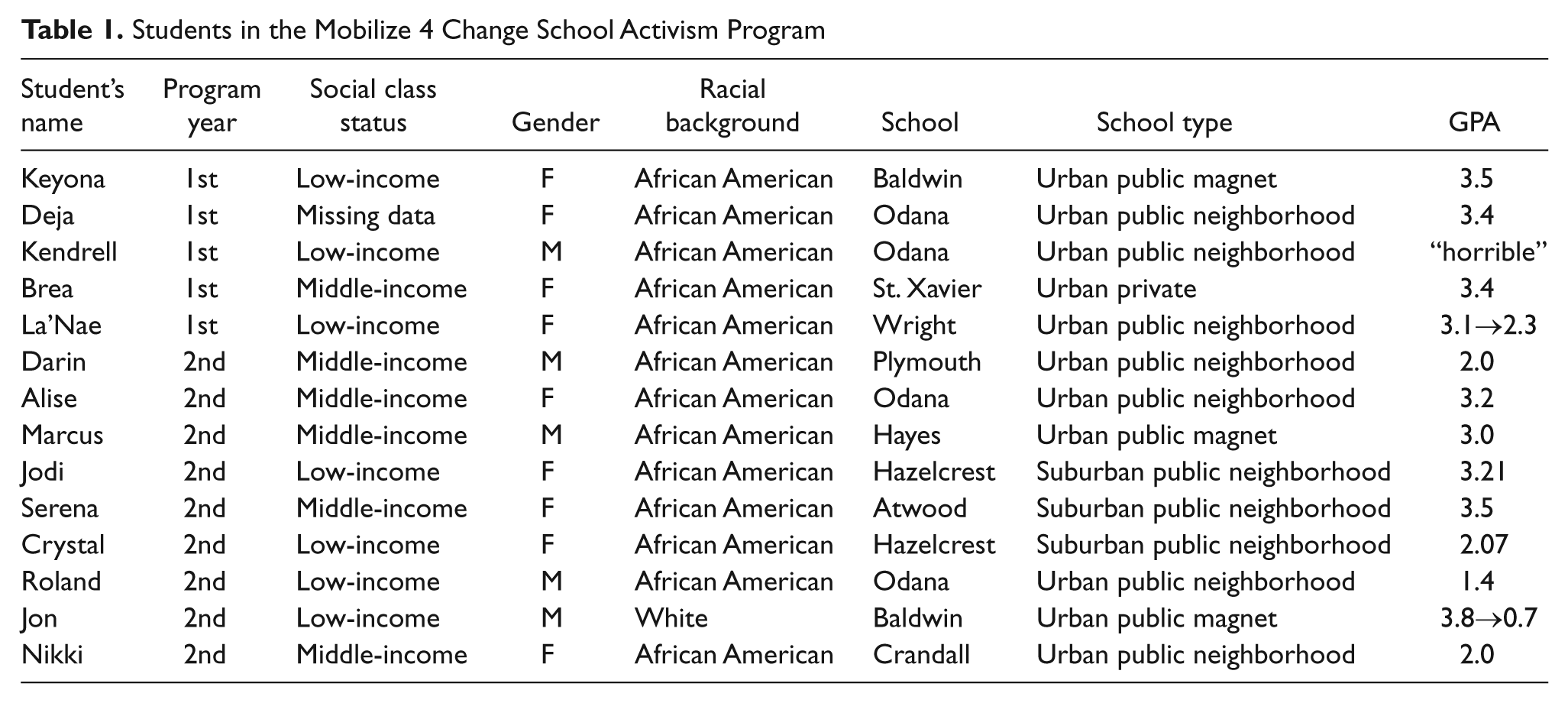
The data referenced here draw heavily from interviews conducted in 2004-2005. Each of the first-year students participated in a single, approximately hour-long, interview that took place in the community organization’s office suite. The M4C staff facilitated the development of trust between the first-year students and me by offering introductions and mingling until our interviews began. Developing rapport was simpler the second year due to the length of time I spent in-person with the youth at the community organization. I interviewed the second-year students at the beginning and end of the program, in sessions ranging from a half to a full hour. With the exception of one meeting at a neighborhood ice cream shop and another over the phone, these interviews also took place at M4C.
I conducted interviews to “enter the other person’s perspective,” to better understand the students’ knowledge, views, and “symbolic constructs” of their educational institutions (Patton, 2002, pp. 48, 341). Each interview followed a general interview guide that contained both open-ended questions focused on the research topic and space for exploring new directions and themes with the student participants (Bogdan & Biklen, 2007; Patton, 2002).
To gain a general sense of their educational views, I asked the students about their teachers, classes, and extracurricular activities; school rules and policies; and the “best” and “worst” thing about school. Then, we discussed the specific school issues that came up in their school organizing and activism. For the first-year students, we talked about the importance of the school problems at the center of their action campaigns for school change. Outpourings of narrative followed questions about “what kinds of things” they strategized over with fellow students and raised with school administrators. Asking, “how come you wanted” a certain change helped me understand their rationales for reform. The second-year students explained why they selected particular issues for inclusion on their school survey. Inquiring how these policies or practices “work;” how they “affect you” and “other kids;” and what “changes you would like to see” yielded vivid depictions of school life from the inside. Since students from both program years engaged in publicizing their school concerns, I asked them why they thought doing so was important and “what schools would be missing if they didn’t talk to students about school.” I asked these latter questions to understand how the students answered the central question of this article: how can students inform the debate over reforming urban schools?
To enhance the robustness of findings, I supplement the interviews with data drawn from program documents and my biweekly observations of the school activism program’s second year (Bogdan & Biklen, 2007; Denzin & Lincoln, 2005; Patton, 2002). At M4C, I observed as the second-year youth participants formulated their school survey. I also collected successive versions of the survey document they generated (the students’ final survey is reprinted in the appendix).
Qualitative researchers are encouraged to “follo[w] up surprises” since they represent challenges to “taken-for-granted assumptions” and expectations (Miles & Huberman, 1994, p. 270). The analysis presented in this article was prompted by my surprise over the issues students focused on: so seemingly trivial when compared to “big stuff” like achievement and resource inequality. I went back to the data to examine more closely why students felt these school conditions mattered.
To do so, I treated each year of the school activism program as a separate case (Miles & Huberman, 1994; Patton, 2002; Yin, 2003). Within each case, I identified the issues the students selected for their action campaigns or school survey and examined what each individual said in interviews about those issues. I then compared the students’ perspectives—first within and then across cases/years—and noted recurring, common themes (Charmaz, 2005; Miles & Huberman, 1994; Patton, 2002).
During this analysis, I saw not only commonalities in what students thought about particular issues but also a broader theme: that students were moving from these particulars to holistic (and negative) assessments of their schools. Furthermore, an important theme emerged not from the substantive content of what students said—but in how they told the story (Fontana & Frey, 2005, pp. 713, 719). The volume, pitch, and pacing of their speech, and the language they used (“angry,” “disgusting,” “awful!”), revealed a theme of emotional distress over their school conditions. Themes of hopefulness surfaced too, when they proclaimed the difference that students’ inclusion in reform could make to schools and individuals. Thus, my analysis proceeded in an interpretivist fashion to focus on the language, emotion, and larger meanings that students attach to schooling (Bogdan & Biklen, 2007; Charmaz, 2005; Denzin & Lincoln, 2005; Fontana & Frey, 2005). These patterns, along with illustrative quotations, are discussed in the results sections.
Results
The results sections explore the school issues at the center of the school activism program with a student lens. Taking each program year in turn, I examine the issues for their meaning and larger significance to students. Next, I depict the detrimental reactions these school conditions provoke by profiling students’ alienation and disengagement. Finally, I elucidate the logic behind the students’ argument that they should be included in any effort to transform urban education. These results illustrate an alignment between the urban youth’s reform objectives and the aims of both educational policymakers and social reformers. I show that the students support improvements that will enhance their learning and the perceived fairness of the educational environment.
The School Issues of Importance
From the students’ point of view, the problems of their urban schools could be boiled down to a concrete set of directly observable phenomena. Given the opportunity to select educational problems for reform, the students in the program’s first year chose three major issues to work on: the school lunch, school security, and teacher–student relationships.
The school lunch affronted the students of Plymouth and Wright High Schools for what looks like, at first, straightforward reasons. The poor taste of the food was at the top of the list—“our lunch is nasty”—along with the repetitive lack of options. “People got tired of eating pizza and subs every day.” There were larger issues at stake, however. Darin revealed, “I’d be scared to eat lunch because . . . if you see a roach in your school? You know they bound to be somewhere else.” Even though he never witnessed this himself, he felt the cleanliness of the cafeteria infected the entire school plant at Plymouth. In addition, La’Nae characterized the school lunch issue as one of control. “They wouldn’t let us go out for lunch,” she stressed. “Man! That’s the worst thing.” This policy signified to La’Nae that “we had problems with our freedom” at Wright. If the school was this “strict” about “stuff that was tiny, that didn’t really make a difference,” then it was willing to supervise every aspect of students’ lives. What seems like a simple meal was actually much bigger—for both the students and their schools.
The lack of school security was a particular concern for organizers at Baldwin because of a violent fight between students that occurred on school grounds. Keyona explained, “We only have two active all-day security guards” in a school beset by “overcrowding” and they were inside at the time. “Why weren’t they outside?” she asked, her voice rising in alarm. “That person coulda been dead by the time they got out there.” The potential consequences of this event indicated to Keyona and her fellow activists that “security didn’t do what they were supposed to be doing in certain situations.” To Darin, the issue of security was one of overreaction rather than negligence. Hanging out in front of the school, “the security guards, they be like, ‘Get outta my doorway!’” Indignant, Darin felt like responding, “This [is] GSD’s doorway! This ain’t your doorway!” A mixture of anxiety and anger motivated the students’ focus on the school security staff.
The conduct of teachers similarly stirred the student organizers and their supporters. Teachers and students, they believe, are bound to a kind of relational bargain in which each party has responsibilities to fulfill for the other to succeed (Cushman, 2003). To have a “relationship between teachers and students,” La’Nae explained, requires that the “relationship is even.” “It should be fifty-fifty thing,” added Deja. The problem, as the student activists saw it, was that teachers sometimes did not uphold their side. Some teachers displayed what students felt was a lack of respect, talking to them “any kind of way,” and being “rude.” At its worst, this disrespect devolved into sexual harassment, an issue that La’Nae and her compatriots at Wright protested in a meeting with the principal. Other teachers declined to offer support to academically struggling students. Kendrell reenacted his frustration over this classroom dynamic, “It’s like, ‘Man! I have to ask you this question!’” And yet, “they don’t answer it” or, in Darin’s experience, “the teachers get irritated and then think I’m causing trouble or something.” In an “even” bargain between teachers and students, the responsibility to follow school protocols is shared, according to the student organizers. Like the others, however, Deja expressed her exasperation at “some of the basic rules they try to make us abide by but they don’t do themselves.” When students and teachers have no relationship at all, their compact completely dissolves. For example, high teacher turnover meant a constant parade of “new teachers” at Brea’s school who “don’t know you. They don’t know if you’ve grown, they don’t know if you fell behind.” High student to-teacher produced similar effects. “At a lot of big high schools,” Darin explained, “I feel the teachers just don’t get a chance to really work with you ’cause they got so many students.” Everyday teacher–student relations frequently fell short of the youth organizers’ ideal.
During the second year of the school activism program, the youth members designed a survey to gauge their peers’ perspectives about local school conditions. 4 The benefit of a student-authored survey, Alise and the rest of the participants felt, was that they could add in the “real stuff”: the issues that actually touched their school lives. Similar to the previous year’s program, the “real problems” the students incorporated into their survey were very tangible concerns.
The most prevalent issue on the survey—as expressed by the number of questions they formulated on the topic—concerned the teachers in local schools. These questions focused on the more relational aspects of teaching—whether teachers gave students individual attention in class, behaved safely and appropriately toward students, fairly followed and enforced school rules, helped students learn, and were generally good (on a scale of 1 to 10). In interviews, the students explained their questions stemmed from doubts about the devotion of some of their teachers to the educational profession. “I don’t want no teacher in the classroom teaching me, telling me she don’t care about her job,” Marcus told me adamantly, having previously experienced just this outburst from a teacher. Even when not stated explicitly, the students believed they could intuit when teachers did not hold their positions or charges in high regard. “Some of the teachers . . . come to work and they don’t really care what the students do,” Roland observed. This attitude revealed itself in teachers’ classroom practice, when teachers “just give up” on students by allowing them to flounder, socialize, sleep, or watch movies all period. Students like Nikki and Alise felt abandoned in these situations, as if their teachers were allowing them to fail by default. “She’ll let you go to sleep and just give you a zero,” Nikki reported resignedly, on one of her teachers. “You educating me! I need you!” admonished Alise, to teachers who left students to struggle (or sleep) through school. “If you not there, then who is?” The feeling of neglect could elicit furious objection. Discussing a teacher who “don’t teach anything,” Jon exclaimed, “Oh my God! . . . She is awful! She is horrible! . . . She didn’t give a damn about anything in the class!” Of his teachers who adopted an, “I’m getting my money anyway,” indifference, Roland vented, “That’s so wrong. It makes me angry.” When they sensed their teachers did not care about teaching, the students reacted with strong, emotional disfavor.
After teaching, the remainder of the students’ survey focused on the “hard goods” of schooling, particularly supplies, lunch, and the school facilities. The school supplies issue, for the students, revolved primarily around textbooks and computers. They criticized the “raggedy” condition and the dated content of their books. In addition, they expressed concern about the shortage, disrepair, and inaccessibility of computers at urban high schools, particularly when many students, including Roland and Serena, lacked working computers at home.
Just as in the first year of the program, the second-year members obsessively focused on their school lunch, complaining about the quality of the food, its taste and variety, and the serving of leftovers. The most palatable meal was a microwaved “Hot Pocket;” side dishes included “rotten oranges, dry bread;” and “the mayonnaise, it’s like poison. It looked like cottage cheese.” These offerings evoked revulsion—Roland’s response, “I don’t like that! Nasty!” was typical. And just like the prior year, the students’ grievance with the school lunch extended beyond taste. “The lunchroom is personal,” Alise said. Alise, who continuously pushed her team to add more survey questions about this issue, seemed to interpret the school lunch as a personal insult to students. The cafeteria staff, she protested, did not even make the effort to properly prepare food for them. “If you’re a cook, it’s part of the title of your job. You’re supposed to cook! Not reheat or warm up!” she insisted. The minimalist attitude toward food service implied little regard for the students in the cafeteria line. “We have to eat it! If the lunch-fixers had to eat what they serve us! Look what they plop on our tray!” She added, “You wouldn’t want to eat that for your dinner, now would you? No.” Alise accused school personnel of holding a double standard by serving food to students that they would never consume themselves. Eating the school lunch, then, meant absorbing the indignity of a meal prepared without apparent esteem for the recipients. In an urban district where the majority of students lacked the income for alternatives, this disparagement was unavoidable.
Last, the condition of the school facilities, especially the bathrooms and the cafeteria, loomed large in the second-year students’ survey. Their descriptions of these problems communicated a sense of outrage: “It’s disgusting,” “it’s horrible,” “it’s crazy,” “this is just ridiculous,” they said, of their bathroom facilities. “We do have nasty bathrooms,” Roland confirmed. “You go look in: Stank. Ugh!” Alise had a litany of complaints about the same area of the school: “every bathroom has a stench to it,” “it looks so dim . . . you can’t see,” “it’s water everywhere” and the paper towel rolls are “all on the floor.” The worst part, a detail which she repeated to both her teammates and me, was “the stupid girls’ bathroom on the second floor” which had such “scorching hot water” that you could “burn your hands” using it. The youth’s discussions also encompassed the lack of basic bathroom supplies, like toilet paper, soap, dry towels, and reflective mirrors (many local schools used shiny metal sheets instead). Their impressions of the cafeteria did not lag far behind. “I wanna fix the lunchrooms,” Marcus said. “Just keep ’em clean. Clean!” Roland witnessed “little insects” in the kitchen and mice elsewhere in the school. Cleanliness, in addition to food quality, contributed to the students’ perceptions of their “nasty lunches.”
Observations of conditions like these added up to a more global exasperation with the school environment. Alise explained, “If you seeing things, you know, you not quite sure if everything is iffy. If the bathroom, if the school, just got like this certain smell to it, [if] it’s like it’s so hot in there you can’t concentrate . . . I’m just gonna get real frustrated.” After seeing a mouse, Roland relayed, “I was so mad the whole day . . . I was very upset.” He concluded he had a “dirty school,” and “that’s just nasty!” The collective impact of poor building conditions, Crystal explained, was great. “If our desk is broken . . . We’re gonna be worried about our desk. Or it being so hot. So it’s gonna be a distraction to our learning.” To the students, the school plant was not inanimate; rather, it was an active agent that directly interfered with their composure and attentiveness.
Looking across both program years, the issues the students selected for reform took on a symbolic importance beyond the obvious necessities. To the students, seemingly minor and isolated grievances implicated the broader school setting and experience. The on-campus lunch and the reheated leftover meal signified the school’s control and disregard of students. A question left unanswered or a class left to socialize or sleep denoted teachers insufficiently invested in their practice. A stinky bathroom, an insect or rodent sighting, suggested a contaminated school plant. The students established these outwardly small offenses as a metric by which to assess their schools. The emotional tenor of their responses reveals just how unsatisfactory they found their school circumstances. From the lunch (“I’d be scared to eat.” “Nasty!” “Look what they plop on our tray!”); to their teachers (“Man! I have to ask you this question!” They “don’t know you.” “She is awful! She is horrible!”); to the state of the facilities (“disgusting,” “ridiculous,” “ugh!”), the school issues they focused on did not feel trifling to them. Rather, the students appeared to react viscerally to these conditions: judging their schools guilty of disrespect and humiliation, lacking in dedication and support. Subjection to what the students perceived as unfair treatment caused them considerable distress, disrupting their poise, concentration, and readiness to learn.
The Influence of Negative School Conditions
The students became so agitated by particular elements of schooling that they formed negative impressions of the institution as a whole. Prior to joining the school activism program, reaching these conclusions elicited an alienated response in each student who participated in this study. The following discussion highlights three youths with varying levels of alienation to illustrate the corrosive influence of much of the urban school environment on students’ well-being and engagement. 5
Nikki attended Crandall, a small school in the Gorham School District with a troubled reputation. 6 There, she observed plenty of problems: “It’s boring and hot in the classroom,” the lunch hour is “chaotic” with students “fighting” and “security guards at every door,” “the teachers don’t care what the students do” and the “students don’t care” either. Nikki slept in and skipped class, and directly confronted teachers when she believed she was treated unfairly. “If you talk to me like that,” she said, describing her credo toward teachers, “that’s the way I’ll talk to you.” This behavior got her suspended twice in the span of a year. Her estrangement also showed up in her achievement: she received mostly “C’s and U’s [unsatisfactory]” that averaged out to a “2-point-something.” Nikki believed she had more potential than her transcript suggested. “I could be a good student until you make me mad,” she said. But she added she was often angry in school, objecting both passively and actively to the overheated, disordered setting and what she perceived as indifferent and arbitrary teaching. Seeing little of educational value to engage in, her achievement suffered accordingly. “I wish I’d gone to another school. At least I’d learn something instead of nothing.” With defiance and academic disinvestment, Nikki signified intense alienation from her educational circumstances.
In comparison to Nikki, La’Nae’s approach to substandard school conditions was more moderate. La’Nae was enrolled in Wright High School, a Gorham neighborhood school with average academic standing, some highly regarded specialty programs, and faulty construction. What La’Nae noticed when she surveyed her school was how strictly it enforced the policy of eating on-campus. Exasperated “’cause teachers wouldn’t let us go out for lunch,” La’Nae felt tempted to “just bring it in they face” by leaving school anyway and risking punishment. La’Nae also detected problems in the classroom, reporting that some of her teachers behaved in a sexist and racist manner. For example, after enduring repeated, suggestive comments from a teacher, La’Nae became “mad to the point that I stopped going to his class. And I ended up failing his class.” The downsides could be agonizing, but when La’Nae described school life she also portrayed some of her teachers as “mentors” who “taught real good”; expressed great enjoyment in multiple extracurricular activities including cheerleading; and noted a close relationship with her principal who was “all about his athletes.” La’Nae’s mixed school experiences produced a mid-level alienated response. The restrictive lunch policy and mistreatment by some teachers made her angry: she imagined putting “Wright … in the ground,” and in reality skipped lunch and class, and failed courses. The positive aspects of her school experiences offset these sentiments and reactions somewhat, allowing her to comply with certain school norms and succeed in some areas. La’Nae’s achievement and disciplinary record ultimately varied according to her fluctuating perceptions of school conditions and events.
From the outside, Marcus’s relationship with school looked fairly rosy. At Hayes, a citywide magnet school facing severe budget shortfalls, Marcus got along with his teachers, did his homework, studied for tests, and expressed care about his grades, achieving a B-average. Yet underneath this success was a student contending with school conditions like “bad teachers,” poor maintenance, insufficient safety, and unappetizing food. Before he participated in the school activism program, Marcus regarded these features of his school environment with a kind of numbed detachment. “I just go to school every day with, like, ‘Oh, that’s bad but I can’t do nothing about it . . . I’m basically going to leave it the way it was.” Desiring to be a good student and complete high school, Marcus chose to accommodate these problems. Both in and out of the classroom, he described his stance as, “I just sit here, not saying nothing. Minding my own business. You ask me a question and I answer it and let it go.” He did what was expected of him in school—sitting quietly, responding to teachers’ recitation questions, following the rules. Yet he did not participate proactively in the instructional interchange or speak out against practices he disagreed with. After all, as a junior, he had “only one more year of this,” before he graduated. Marcus’s lower level alienation from adverse school conditions, although not calamitous, muffled his engagement. The “model student” demeanor masked an internal struggle to engineer his academic success while abiding, or trying to evade, obstructions.
Thus, the students’ perceptions of their school surroundings influenced their response to schooling and investment in their education. Conditions like overly warm classrooms and unsympathetic teachers triggered impressions of an uncaring, unjust school—and the students responded with degrees of alienation. Their alienation manifested as emotional upwellings of anger, numbness, or umbrage at the school environment. Alienation also surfaced in various guises of disengagement: when students held back in classroom discussions; slept during class; skipped class altogether; or became embroiled in confrontations that led to suspension.
These reactions left them susceptible to lower academic performance (Connell, Spencer, & Aber, 1994; Fredericks, Blumenfeld, & Paris, 2004; Newmann, 1981; Newmann, Wehlage, & Lamborn, 1992). “If you don’t like your school, you probably won’t work as hard, you probably won’t do anything, like, extra. You go to school and go home and just like the end of it. You might not even try.” Drawing negative inferences about school, Serena explains, precipitates declines in students’ motivation to learn and achieve. However, the students saw a hopeful message embedded in this very familiar trajectory. If they could fix the most demoralizing of school problems, the youth believed their engagement and effort in school—and that of their fellow students—would increase.
The Logic of Inclusion
And yet, the students felt that under existing arrangements, they had no space to convey their school concerns, much less participate in school improvement. The most obvious venue, the student government, appeared to be engrossed in social pastimes. “I was so disappointed in my student council,” Brea said, for acting like it was “here to throw parties” such as “homecoming” and “spirit week.” Besides planning social events, it was unclear what the student government did on behalf of the student body. “They just so quiet,” said Alise of her student council representatives. “When it was time for them to reelect, that’s it, that was the only time we heard from them.” Between election cycles, advocacy for students’ issues seemed to fall outside of the council’s jurisdiction. The work to “change the different things within the school that may be bothering other students” was simply “not being done in school with student government,” attested Keyona. The school activism program helped fill the gap for this set of students, but they knew the opportunity was rare. In the subsequent narrative, the study participants articulate why students routinely belong in the process of educational reform.
The young members of the school activism program feel it is vital that older decision-makers understand students’ views of schooling. The student body, they say, holds important, proprietary knowledge. “We really the real experts here,” Alise asserts. Jodi explains that their expertise stems from observations of the learner’s domain. “[Students are] the people who are in the schools actually learning, going through there every day. So they know what’s going on . . . They got problems. They know the good things and everything.” This is information that educators do not have access to, Roland emphasizes. “They could learn a lot about the student or a lot about the school that they didn’t really know was going on.” By conversing with students about school, the youth participants believe, adults can compensate for their lack of direct knowledge about students’ daily lives.
The intent of these conversations is to convert students’ knowledge into school improvements, the student organizers assert. “You have to ask the students what they’ll need,” Serena states, to help them achieve. When schools do ask, students can come up with ideas for generating more engaging experiences. “Stuff to make school more interesting for them . . . academic-wise,” Marcus says. Communication with students can lead to more productive ways of supporting learning. “They’re kicking people out because . . . their grade point average isn’t high or because they can’t pay attention well,” Crystal reports. Instead, schools should, “sit there and talk to ’em, see what’s going on.” The students’ feedback will help make schools “a better place for us to focus,” she believes. Roland hopes that conversations like these will improve relations between educators and students. “When you listen, you learn a lot that you never knew happened to somebody.” Both groups may discover that their experiences overlap and “you all could connect like that.” According to Darin, when the school staff seems accessible, students will feel more comfortable sharing information that can improve school and community safety. They will be more likely to alert school adults to potential threats and “stay off the streets” by faithfully attending school. In all of these ways, the youth activists believe that their inclusion will support efforts to make schools more supportive, effective, and safe places to be.
Moreover, the students argue that if they take, or are given, the opportunity to participate in school decision-making, their passivity and disengagement from school can begin to reverse. 7 Students who feel they are heard, Roland maintains, get drawn into the educational process. “When [students] have an opinion, they feel like they could be more into it and they could have, like, more to do with it so they could help out.” The opportunity to contribute their input can alter students’ entire perspective on school and academic work. “If you become more school active, it will change your whole lifestyle,” Darin states emphatically. “Because, you know, if you talk to your teachers and stuff about . . . your work, I mean, you’re gonna be more focused on it.” La’Nae agrees that providing students with a space to communicate their interests and concerns will increase academic motivation. Students will “wanna learn,” she says, since the content will be shaped by their suggestions. When I asked Serena why she thought it was important for students to “have a say in how the school runs,” she replied, “If you feel, like, your school has a high standard for you, has hope, believes in you, that you have help and stuff like that, you’ll wanna try harder.” For the program members, when school practice is determined in consultation with students, their perceptions of and investment in school rise together.
Discussion
At first glance, the issues that students worried about most in this study—the taste of the food, the shape of the facilities, and the friendliness of the teachers—seem irrelevant to current educational policy initiatives. Compared to the weighty issues of massive underachievement and minimal teacher preparation in urban schools, fixing the school lunch and the cleanliness of the bathrooms appears trivial. In the context of the serious social inequalities that produce failing urban schools, the students’ concerns come across as still more inconsequential. Nonetheless, this study warns against the dismissal of students’ reform preferences as either insignificant to schools’ core teaching and learning functions or too “small” to be relevant to social equality (Anyon, 1997, p. 165).
The condition of the school facilities and the tastiness of the school lunch are important not just because of their inherent qualities but also for what they symbolize to students about how the institution views them (Lawrence-Lightfoot, 1999; Rutter, 1979). The students in the school activism program interpreted the “ridiculous” bathrooms and the food “you wouldn’t want to eat” as a signal that their schools did not consider them worthy of the investment necessary to ensure their educational and future success. And the students responded in kind, defending themselves against these perceived insults and dismissals of worth in ways that derailed their academic attention. With the potential to be “a good student until you make me mad,” students’ emotional distress and disengagement made them vulnerable to underachievement (Connell et al., 1994; Fredericks et al., 2004; Newmann, 1981; Newmann et al., 1992). The school issues at the center of the youth’s reform campaigns can therefore be understood as obstacles to student learning.
The student activists, then, confirm policymakers’ focus on educational reform as an important lever for improving urban schools (e.g., Haycock, 2006b; Hess & Finn Jr., 2007; Hess & Petrilli, 2009). Upgrading the school facilities, for example, will directly reduce the “distraction[s] to our learning” that Crystal and other students experienced, furnishing schools more conducive to intellectual pursuit. And indeed, previous research ties better building quality to increases in student achievement (Crampton, 2009; Durán-Narucki, 2008; Fuller et al., 2009; Schneider, 2002; Tanner, 2008, 2009; Uline & Tschannen-Moran, 2008). Furthermore, meeting the students’ reform goals can indirectly support learning by encouraging more constructive and academically oriented responses toward schooling (Newmann, 1981). If students’ responses become accumulatively more positive, then urban schools will be better positioned for academic growth.
Even if the modest reforms proposed by the students are achieved, the question still arises of whether this does enough to address the social inequality that underlies urban schooling. In interviews, the students revealed that they had only limited knowledge of the political and economic forces that constrict their educational opportunities. However, they were exceedingly aware of the symptoms of this inequality, expressed as substandard school facilities, supply shortages, and frequently shoddy treatment. These were the injustices they could see from their perspective “on the ground”—while they roamed the halls, ate lunch, and sat at their classroom desks. For all of the students, even those who could be classified as successful, alienation and cynicism ensued from such observations (Fine, Burns, Payne, & Torre, 2004). The immediate school environment therefore mediates students’ experience of wider social inequity.
In their own way, the students affirm the perspective and methods of social reform advocates who argue for a more contextual, equity minded, and politically active approach to improving urban educational institutions (e.g., Anyon, 2005a; Ladd et al., 2008; Rothstein, 2004; Warren, 2005). The inequalities salient to students are the proximal ones—the near-at-hand, painful slights to their educational success and well-being. When they seek to correct these basic unfairnesses, the students are in some measure contributing to the effort to transform larger social disparities. In addition, by participating in an activist-oriented community program they endorse the strategy of using social struggle to propel urban school reform.
In this article, students propose a set of concrete school changes that they believe will strengthen both the teaching and learning environment and the equality of their educational experiences. Thus, the students pose recommendations pertinent to the reform agendas of both educational policymakers and social reformers. The changes they suggest bridge the debates of adult activists, scholars, and policymakers by underscoring that urban educational improvement hinges on direct enhancements—both small and large—to urban students’ school lives.
The school issues identified by the students are relevant to the broader goals of these diverse reform constituencies—but they are also germane to the pragmatic side of educational reform. Urban school reform advocates of all persuasions operate in contexts that are politically charged and resource-poor, and so must prioritize their reform portfolios based on feasibility. The students’ reform choices are helpful in this regard because they are relatively uncontroversial, inexpensive and quick, but hold great consequence—at least in students’ minds—for student success.
The students’ testimony in this article can inform the process of educational reform in addition to its content. Collecting students’ perspectives from afar, by passing out a survey or checking in with a few student council representatives, fails to take full advantage of their insights and enthusiasm for reform (Jones & Yonezawa, 2002; Mitra, 2006). The students tell us that their insider knowledge and ideas for change are best communicated through ongoing dialogue and intensive collaboration with other educational stakeholders. “You have to ask the students,” they instruct, and then make sure to “listen” and “learn” from what students say. Fostering this kind of collaboration necessitates a different kind of reform effort, one where urban students are invited to serve on educational reform panels and school committees, advise legislators, policymakers, and school leaders, and join social activists’ educational campaigns. A more inclusive reform process maximizes students’ contributions and adds the support of an important ally. Moreover, according to the youth activists, students who participate in this way “wanna try harder,” becoming more invested in their schooling (Rodriguez & Conchas, 2009). Educators and assorted reformers who engage students in the drive to improve urban schools can capitalize on these individual-level outcomes in addition to students’ proposals and advocacy for the educational system.
Will improving our urban educational institutions require more comprehensive and substantive change than what students in this article have requested so far? Of course. In this too, however, students can play a role. The educational reform process will offer many “teachable moments” to the young people who participate. As they learn through their involvement about the educational system and the social structure, students may feel galvanized to ask both schools and society for more of what they deserve.
Footnotes
Appendix
The author declared no potential conflicts of interest with respect to the authorship and/or publication of this article.
The author received no financial support for the research and/or authorship of this article.