




Abstract
Historically, strong teacher unions have been successful at gaining benefits and security for their members, but they have been put on the defensive by recent proposals for education reform. Charter schools are one such reform that could threaten unions, but there is wide variety in the content of state charter school laws. Using state-level data from 3 different years, I find that the stronger a state’s teacher union, the more antiunion provisions a state’s charter school law will contain. These results suggest that antiunion sentiment has reached a level high enough to overcome the unions’ ability to influence policy on this issue.
Two education policy scholars recently questioned whether charter schools represent the empowerment of parents or “the institutionalization of anti-union interests” (Lubienski & Weitzel, 2010). While both may indeed be true, this study examines the latter possibility and finds evidence supporting the scholars’ suspicions that charter school laws are vehicles for circumventing teacher unions. By analyzing state-level data regarding teacher union power and the content of state charter school laws, I find that states with stronger teacher unions are more likely to have provisions within charter school laws that run against the interests of unions. This article begins with discussions of teacher unions, charter school legislation, and the relationship between the two. It then outlines the method, results, and conclusions of the study.
Teacher unions, perhaps the most influential interest groups in education, have the capacity to play important roles in shaping the future of education policy, yet lately they have been blamed for blocking popular reforms, inflating state budgets, and serving the interests of individual teachers at the expense of improvements in education. Teacher unions enthusiastically embrace innovations that improve working conditions for educators. Reduced class sizes might be the most obvious example. However, unions resist reforms that jeopardize job security for their members. Reforms that fall into that category include many of the market-based choice reforms that attempt to improve schools through increased competition and accountability.
Charter school programs have roots in such market-based education reforms. When Milton Friedman (1955) theorized that the performance of educational institutions would improve if more competition were introduced, charter schools may not have been what he had in mind, but probably neither were a host of other choice-type programs. Interdistrict transfers, interschool transfers, residential schools, schools for the gifted and talented, alternative schools, college-level classes, for-credit programs through private contractors, and magnet schools are all “choice” programs that have existed for decades (Fossey, 1992), but do not much resemble the vouchers that Friedman envisioned and Chubb and Moe (1990) advocated, largely because they offer only limited freedom to the supply side.
Teacher unions, school administrators, and school boards have all been wary of charter schools for fear that their own positions as education suppliers would be put at risk (Massell & Fuhrman, 1994). Charter schools, however, are not nearly the threat to these groups that vouchers might pose, so in many states the unions have been willing to compromise (Moe, 2008). The result has been the rapid adoption of charter school laws by many of the states, but with considerable variation in their content, particularly regarding issues such as authorization, caps on the number of charters permitted, for-profit charter applicants, and funding (Hill, 2006). These differences are not trivial. Provisions within the laws have profound impacts on the ability of would-be education suppliers to secure charters, open schools, grow enrollments, and continue operating (Hoxby, 2006). For example, both Mississippi and Washington, DC, passed their initial charter school legislation in the 1990s. The law in DC gets high marks from charter school advocates for the flexibility and autonomy it offers to charter schools. Mississippi’s law is far more restrictive. 1 Today, Washington has more than 100 charter schools serving nearly 30,000 students. Mississippi, with more than five times the population of DC, has just one charter school and it serves fewer than 400 students (Center for Education Reform [CER], 2010). While the more rural setting of Mississippi certainly plays a role in the slow growth of charters, it cannot account for the lack of charters in the more urban areas.
The content of charter school legislation can also have an effect on student achievement, as shown by a 2009 study for the Center for Research on Education Outcomes (2009). That study found that permissive guidelines on authorization procedures and a generous cap on the number of charters are associated with lower student performance while the existence of appeals procedures for denied charter renewals improves performance. It is likely that an appeals process forces the reviewing authority to be more judicious when evaluating schools and that relaxed caps and authorization guidelines allow more lower quality charter schools to be established.
For all their suspicion over school choice, teacher unions agree that there are some charter schools that may have the potential to improve education for some students. Albert Shanker, during his tenure as head of one of the largest teacher unions, was one of the earliest champions of charter schools. Today, both the American Federation of Teachers (AFT) and the National Education Association (NEA) 2 state their support for charter schools as opportunities for educators to enjoy flexibility that would allow them to experiment with methods of teaching and administration that may not be possible in traditional public schools. Through a charter school program, teachers could have the chance to be their own managers and develop courses, programs, and policies that are tailored to the interests of the teachers and the needs of the students. For every teacher who has ever been frustrated by administrators, school boards, or state bureaucracy, the decentralized authority inherent in charter schools has some appeal.
At the same time, both the NEA and the AFT are clear in their positions that charter schools must be subject to strict regulations and limits. Among their concerns are the possible diversion of funds away from traditional public schools, the loss of collective bargaining or licensing rules, the expansion of for-profit education management organizations, and the relative lowering of standards for charter schools. As Godwin and Kemerer (2002) point out, no state has passed charter legislation that satisfies the unions’ concerns.
Despite opposition by union members and their allies, charter schools have received substantial political support. Charter schools compete with each other and traditional public schools, thus appealing to some market reform advocates. Charter schools also enjoy broad public appeal due to the potential for individualized and child-centered teaching, communal values and multiculturalism, community empowerment, and the opportunity to circumvent the more deeply entrenched interests, including teacher unions (Henig, 1995). Charter schools are appealing to the political right because charters reflect choice, deregulation, and competition; the left supports charters because they are public schools with open enrollments, secular missions, and accountability to public authorities (I. C. Friedman, 2004).
Perhaps the greatest appeal of charter schools is simply that they are a tuition-free alternative to traditional public schools and thus enjoy substantial grassroots popularity and coalitions of diverse groups (Schneider, Teske, & Marschall, 2002). More specifically, Hess (2006) identifies three “great constituencies” that push for charters: businesses, civil rights groups, and parents, particularly urban minorities. Each for its own reasons, these groups allied with advocates for market reforms to introduce charters state-by-state. In most states, neither governors nor legislators had strong feelings about charter schools, so they were willing to listen when voters from such varied constituencies approached them with requests for charter school legislation (Hill, 2006).
The federal government has also played an important role in the rapid diffusion of charter school laws across the United States. Under President Clinton, the Department of Education provided US$6 million to support charter schools in 1995 and within 4 years raised its investments to US$100 million. Another 4 years later President Bush doubled that amount (I. C. Friedman, 2004). At the outset of the next administration, Obama told states to remove caps on charters or risk missing out on a share of the US$5 billion of discretionary funds (Ravitch, 2010) and then made his support clearer by listing the promotion of charter schools as one of the evaluation criteria in Race to the Top. Although charter school policy is determined at the state level, funding from the federal government has provided states with substantial incentives to hasten the passage and development of charter school laws.
Teacher Unions and Charter School Policy
This study borrows its theoretical approach from Berry and Berry (1990), who argue that state policy innovations result at least in part from motivation and resources overcoming obstacles within a state. Most research on charter school laws has approached the issue from this perspective. Studies have shown that Republican party dominance, population growth, and poor test scores increase motivation for the passage of charter school laws while a strong teacher union can create obstacles to passage (Holyoke, Henig, Brown, & Lacireno-Paquet, 2009; Kirst, 2007; Renzulli & Roscigno, 2005; Stoddard & Corcoran, 2007).
Why unions should be concerned about the content of charter school laws, and not simply their passage, is another theoretical consideration. According to Chubb (1983), interest groups attempt to “capture” state government policymaking by feeding lawmakers and bureaucracies with information at times and in ways that advance the purposes of the groups. In the case of state teacher unions, this means arming their allies in the legislature, usually Democrats, with data, arguments, and voter support to guide the growth of charter schools in a manner that suits the interests of union members. A union with a large number of members in its ranks, readily available for raising funds and getting out the vote, can be a convincing political entity. Even though private sector unions declined in popularity and membership in the latter half of the 20th century, public sector unions (and teacher unions in particular) enjoyed substantial growth in both numbers and power (Farber, 2006).
One might expect that strong unions would be quick to use their power to tailor charter school laws to their interests. However, teacher unions have been slow to join the dialogue on recent education reforms (Kerchner, Koppich, & Weeres, 1997). One explanation is that in the 1990s, when charter school laws were being proposed, the power that teacher unions could exert over policy slipped. In Michigan and Pennsylvania, for example, strong showings by Republican candidates for gubernatorial and legislative positions put otherwise powerful unions on the defensive (Boyd, Plank, & Sykes, 2000). Sensing their own vulnerability, teacher unions tried to evolve into something that was different from the traditional labor union by emphasizing the professional and specialized nature of educators’ work (Demitchell, 1998). However, the claim that such professionalism made teachers into authorities who should somehow dominate the processes of making education policy was weak (Kerchner & Caufman, 1995), and teacher unions found it difficult to balance both individual member and broader interests (Poole, 2000). Most teacher unions chose to prioritize job security, wages, and benefits for teachers over participating in education reform (Moe, 2003). As a result, the inertia behind charter schools and other reforms has grown without much constructive input from the unions (Landsberg, 2010).
Strong Unions Slowing the Passage of Charter School Laws
Berry and Berry’s theory of innovation states that a new policy results when motivation supporting the change outweighs the obstacles before it. Several studies have shown evidence that where teacher unions are strongest, proposed charter school legislation is slow to become law. Renzulli and Roscigno (2005) found that Republican legislators and racial minorities increased the likelihood that a state would pass any sort of charter school law while higher rates of NEA membership made any passage less likely. The study also found that strong memberships in either the NEA or the AFT made particularly “strong” 3 charter laws less likely. Similarly, Stoddard and Corcoran (2007) showed that high percentages of racial minorities and lower standardized test scores in a state encouraged the passage of charter school laws while high levels of NEA membership delayed passage. These studies focus on whether or not a law was passed as a result of union influence and do not compare the laws from different states to one another. One study that does compare was conducted by Holyoke et al. (2009) and it found that strong NEA membership rates are associated with less flexible charter school laws. The study did not account for AFT membership.
Minnesota and Rhode Island are two cases in which strong unions managed to keep charter schools under fairly restrictive and union-friendly regulations (Godwin & Kemerer, 2002; Hassel, 1999). In contrast, Arizona has legislation that is among the friendliest to charter school operators, at least in part because teacher unions are so weak there (Maranto, 2001). These examples are not the rule, however. Union strongholds such as New York, Pennsylvania, and Michigan have very permissive charter school laws while states such as Virginia, North Carolina, and Kansas, where unions are less powerful, have strict charter school laws.
If teacher unions oppose flexible charter school laws, how is it that so many states have passed them, especially states with strong unions? As Henig (2008) argues, charter school laws did not follow the usual patterns of education policymaking for two reasons. First, voters developed their opinions about charter schools based not on policy framing by large interest groups but rather based on their opinions of local school boards and would-be charter school founders. Second, the division within the Democratic Party on the issue of charters weakened the ability of unions to secure votes in legislatures.
The variation among charter school laws, however, is not merely a reflection of the popularity of local leaders. I contend that antiunion education reformers are especially motivated in states with strong unions and that this increased motivation has resulted in particularly antiunion charter school legislation. The presence of strong teacher unions, be they chapters of the NEA or AFT, increase the motivation of school reform advocates, thus resulting in laws that are less friendly to unions.
I see several reasons why this may be the case. First, as Terry Moe and others have observed, unions have prioritized member pay and benefits, not education reforms. In that regard, teacher unions have sacrificed influence over policy in exchange for securing individual benefits for members. Second, political circumstances in the 1990s favored charter school advocates far more than teacher unions, providing an opening for those interested in reducing the power of the strongest teacher unions. In that decade Republicans made big gains in winning elected offices, the “reinvention of government” became politically popular (Brudney & Wright, 2002), and states gained greater importance in setting education policy (Malen, 2003). Moreover, teacher unions were taking substantial blame for the perceived decline in educational quality in America (Hoxby, 1996; Kurth, 1987). Finally, strong teacher unions found it difficult to bring their power to bear against charter law proposals when accused of hypocrisy by some progressives for opposing reforms that would presumably free their own members from bureaucratic control (Nathan, 1996). Thus charter schools, by increasing accountability on educators and decentralizing authority in education (Ingersoll, 2003), became an ideal opportunity for antiunion interests to loosen the grip unions had on schooling, an opportunity that would be especially appealing and have the greatest impact in the states with the strongest unions.
Strong Unions in the Crosshairs
This study asks whether states with strong teacher unions produce legal provisions that favor charter school applicants and operators over the interests of teacher unions. Eight hypotheses are offered, each reflecting the idea that charter school legislation is being designed to give charter schools opportunities to circumvent the power of teacher unions. The first four hypotheses concern the flexibility that the legislation would offer to potential charter applicants.
Hypothesis 1: States with strong teacher unions have less restrictive charter school caps compared to states with weaker unions.
Hypothesis 2: States with strong teacher unions have laws allowing more diverse entities to authorize charter schools compared to states with weaker unions.
Hypothesis 3: States with strong teacher unions have fewer restrictions regarding who is eligible to apply for charters compared to states with weaker unions.
Hypothesis 4: States with strong teacher unions provide more funding to charter schools compared to states with weaker unions.
The next set of hypotheses concerns the autonomy that charter schools are given once in operation. As above, the hypotheses are based on the idea that school reformers are more motivated in states with strong teacher unions.
Hypothesis 5: States with strong teacher unions have laws that allow more exemptions from collective bargaining processes for charter schools compared to states with weaker unions.
Hypothesis 6: States with strong teacher unions allow more waivers of state education policies for charter schools compared to states with weaker unions.
Hypothesis 7: States with strong teacher unions offer greater legislative autonomy to charter schools compared to states with weaker unions.
Hypothesis 8: States with strong teacher unions will offer greater fiscal autonomy to charter schools compared to states with weaker unions.
These hypotheses contradict the conventional wisdom that powerful teacher unions are somehow consistently able to shape state education policy to their benefit. Certainly unions would like to cap the number of charters, protect collective bargaining rights, and limit autonomy for charter schools. Stronger unions indeed have had some success at delaying charter school legislation, but at this point there are only a few states left without charter school laws on the books. Because state teacher unions differ in their power, it is reasonable to expect that the existing charter school laws reflect the public’s degree of frustration with union control of education.
Data and Method
This study uses the power of state teacher unions as the independent variable of interest for all eight hypotheses. There is great variety among unions in terms of their strength and function. Some engage in collective bargaining while others are merely professional associations. Some enjoy large memberships while others are quite modest in size. Hammer and Wazeter (1993) showed that the most effective teacher unions were those with a “union mentality” and strong leadership, but these are difficult variables to measure for empirical research. Instead, most scholars have looked at membership rates and the prevalence of collective bargaining. A district-level study by Eberts and Stone (1987) considered whether or not collective bargaining agreements were in effect. Hoxby’s (1996) district-level study used both collective bargaining and union membership by incorporating them into a dummy variable in which a school district was considered “unionized” if at least half of the teachers in the district were part of a collective bargaining agreement. Although respected for its approach, scholars have found it difficult to adapt Hoxby’s methods to state-level research on charter schools (Wong & Shen, 2006).
State-level studies such as those by Nelson and Rosen (1996), Steelman, Powell, and Carin (2000), and Kurth (1987) used percentage of teachers covered by collective bargaining agreements to calculate measures of unionization. Like Hoxby, Nelson and Rosen developed a variable with cutoff points rather than a continuous measure. Steelman et al. (2000) and Kurth (1987), however, used a continuous variable measuring percentage of teachers covered by collective bargaining to capture differences across the range of union power. The teacher unions−charter law studies by Stoddard and Corcoran (2007), Renzulli and Rscigno (2005), and Holyoke et al. (2009) used continuous variables of teachers’ union membership rates. While the Holyoke study considers only NEA membership, Renzulli and Roscigno measured both NEA and AFT membership rates, although in separate variables. Stoddard and Corcoran measured total membership rates of teacher unions in each state. This study does the same as the Stoddard and Corcoran study, drawing data on each state from three different years from the ongoing “Unionstats” project maintained by Hirsch and MacPherson (2002).
The dependent variables for this study measure aspects of charter school legislation within states. The Center for Education Reform (CER) is a charter school advocacy group that closely follows state policies and encourages legislation that frees charter schools from state regulations, collective bargaining agreements, and school district oversight. They maintain a website that provides details regarding each state’s charter school laws and gives scores to each state reflecting how charter-friendly their policies are on various measures. Several studies have used CER’s grading system. For example, Stoddard and Corcoran (2007) used CER evaluations in their study of the effects of poor public schools and heterogeneous communities. Kirst (2007) used CER’s evaluations to show regional variation in charter school laws.
Table 1 shows the year that each state passed charter school legislation, if any, and the overall score that CER gave to each state’s charter school law in 2008. The differences in CER scores across states and measures reflect the different pressures and routes that existed within each state (Kirst, 2007; Mintrop & Trujillo, 2005) and have a profound effect on how quickly and in what number charter schools will proliferate (Stoddard & Corcoran, 2007).
State Charter School Law Passage and 2008 CER Score.
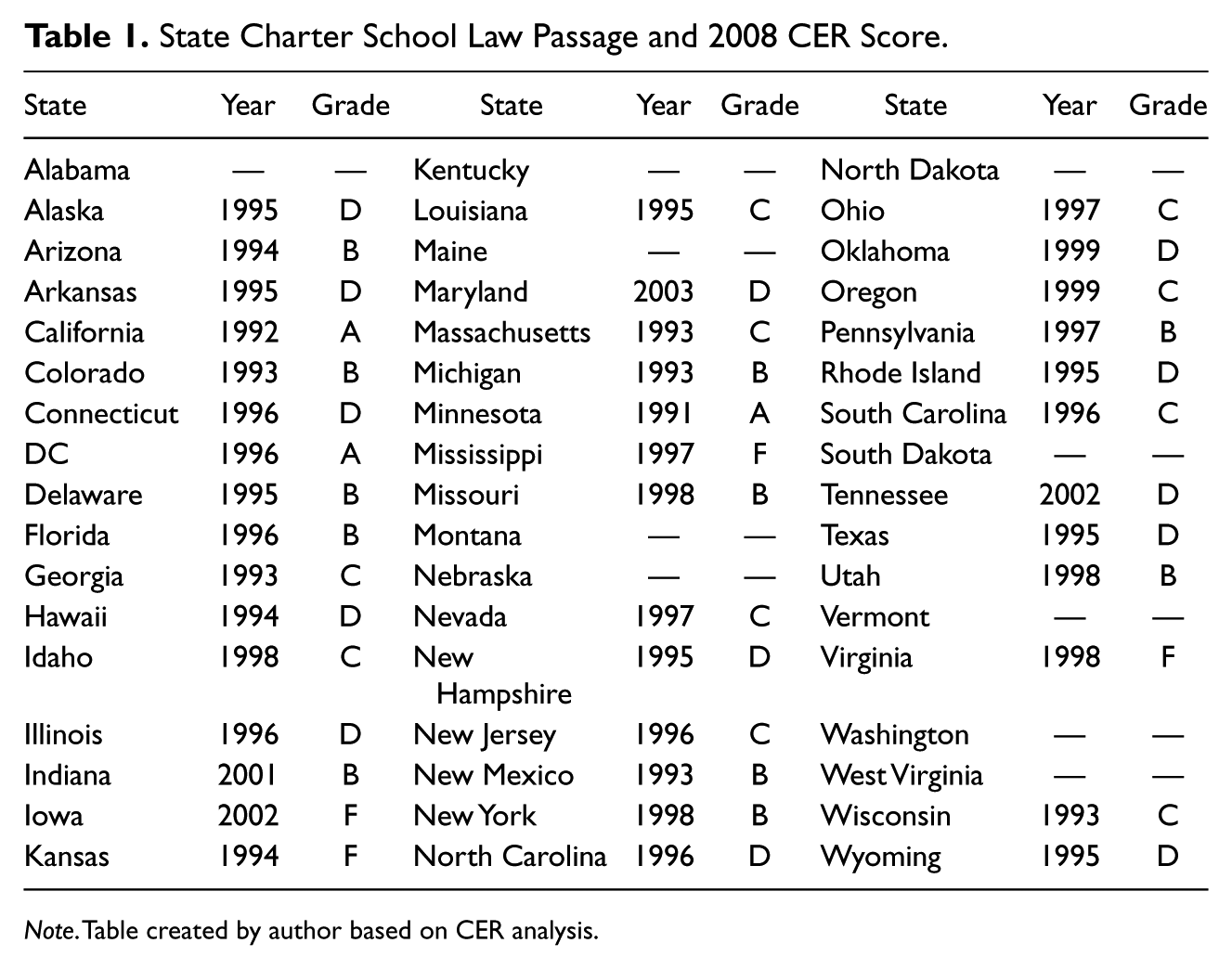
Note. Table created by author based on CER analysis.
While CER presents their results in the form of an overall grade for each state, doing so risks oversimplification because the various aspects of the legislation within a state may cancel each other out (Witte, Shober, & Manna, 2003). In this study I ignore the overall state score and instead look at the different components that CER used to create the index. These components are the same as the dependent variables in the eight hypotheses of this study. In each model I test to see whether an increase in union membership is associated with a change in CER’s score on a particular aspect of charter school legislation. CER was kind enough to provide the scores for each state on each measure over multiple years.
Several control variables are employed in this study to account for the influence of other factors on charter school policy. As discussed earlier, a state’s minority population, party control, school performance, and population growth can all affect charter school laws. Racial minorities and Republican legislators both make charter school laws more likely (Renzulli & Roscigno, 2005). For those two variables I use census data on race in each state and records of the percentage of Democrats in the lower house of state legislatures. 4 Population growth and poor standardized test results can stress school systems, pressuring states to consider alternatives such as charter schools (Stoddard & Corcoran, 2007). For those variables I use NAEP eighth-grade reading scores and percentage of population changes for each state. Berry and Berry’s theory also mentions the role of resources in policy changes. Although charter schools are seen as a comparatively inexpensive reform, I include median family income (in thousands of dollars) in each of the models.
Results
Using panel data from the 41 states (including Washington, DC) that had charter school legislation in 2003, 2005, and 2007, I employ linear multiple regression analysis clustered by state. Results for the first four dependent variables appear in Table 2 and results for the others appear in Table 3.
Effects on the Permissiveness of Provisions Within Charter School Legislation Related to Establishment of New Charter Schools, Clustered by State.

Note. Robust standard errors are in parentheses.
Significant at .05.
Effects on the Permissiveness of Provisions Within Charter School Legislation Related to Administrative Flexibility, Clustered by State.

Note. Robust standard errors are in parentheses.
Significant at .05.
The results in Table 2 indicate that as teacher union membership increases, charter applicants enjoy diverse authorizing opportunities, broad eligibility requirements, and better funding. The score for caps also is positively related to union membership, but just misses being statistically significant. In the case of the first model, a 1% increase in union membership is associated with a 0.025 point increase on CER’s 5-point scale for a state’s charter school law on the measure of multiple authorizers. A policy on multiple authorizers that is generous to charter school applicants would make it difficult for a teacher union to exert influence over what applications get approved and which do not.
Results in Table 3 show that as teacher union membership increases, the operators of charter schools enjoy more freedom from union, bureaucratic, and legislative control. Specifically, charter operators have more freedom from collective bargaining agreements, state standards, public school legislation, and budget oversight in states with more powerful teacher unions. Note that an increase in union membership seems to have the greatest effect on the score for collective bargain exemptions—the very measure that unions would probably make their highest priority.
A few other patterns stand out in the results. Besides union power, the results show statistically significant increases in CER scores associated with lower median incomes, increases in state populations, and low numbers of Democrats in the legislature. These trends should not surprise us. Charter schools are an attractive alternative to states with more limited budgets because they represent a major change in schooling without a major increase in expenses. Growing populations stress existing school districts, so charters might be a welcome option in states where schools are becoming increasingly crowded. Finally, even though Democrats are divided on the issue of charter schools many members of the party are loyal union allies.
To measure sensitivity of the results, I substituted the percentage of teachers covered by collective bargaining agreements and “right to work” status for union membership. Results for the collective bargaining coverage, not surprisingly, closely resembled those for membership found above. States with “right to work” status, and therefore weaker teacher unions, were associated with more restrictive laws. In other words, the charter school laws in states with more teacher union members, more collective bargaining agreements, and more union-friendly legal environments all tend to have provisions within charter school laws that are unfriendly toward unions.
Discussion
The above results are evidence that provisions within charter school laws are especially antiunion in states where teacher unions are strongest. How is it that some of the historically strongest interest groups in education could be losing a major policy debate to such a degree? Although school choice has attracted broad national support, it is remarkable that charter school proponents have won their biggest victories in states where union have the highest rates of membership.
Those strong unions may have their own success to blame. Malin and Kerchner (2006) describe a “legislative backlash” against teacher bargaining in the states in the 1990s, the same time that the charter school movement gained traction. In that decade Michigan, Oregon, Illinois, and Pennsylvania—all states with histories of strong unions—passed charter school legislation with limits on teachers’ opportunities to strike and bargain collectively.
Other factors also fed into the stream that drove charter school legislation. Henig (2008) points out that charter schools represent the shift in authority from bureaucracies toward communities, the reallocation of responsibility (but not necessarily power) within educational systems, and the liberation of teachers from public administrators. Only the last of these had roots within the education community, and none of them had much to do with market theory. Instead, they had to do with public skepticism of existing bureaucratic systems. Empowering a wide array of authorities to approve charters, maximizing the size of the applicant pool, and providing ample funding to charter schools might threaten powerful unions, but they are also actions that move responsibility for education away from the state and school districts to communities and local policy entrepreneurs. Similarly, flexibility in personnel matters, standards, regulations, and budgets also hands responsibility over to local leaders. This perspective reveals one of the potential limitations of this study: the backlash represented by charter school laws might be against educational bureaucracy in general, not just teacher unions. Developing measures of antibureaucracy provisions in charter school laws would be useful for future studies in this area.
How do these results fit in with previous studies? The reader may recall that Stoddard and Corcoran (2007) found that stronger union memberships are associated with delayed adoption of charter school legislation. Considering those findings in conjunction with this study, we may conclude that a strong union can slow the adoption process, but if a bill is passed it will likely contain more antiunion provisions. That strong unions may have some success delaying legislation but less success in guiding the details is not unique to teacher unions. In a study of workplace drug testing legislation, Lamothe (2005) found that states with higher percentages of union workers were less likely to pass drug-testing legislation, but when the states did pass such laws those with more unionized workers had the strictest provisions. In other words, strong unions of various types may be better at slowing policy adoption than influencing its content. Although he is unable to explain why strong unions would be able to block legislation but then lose when the legislation passes, Lamothe points out that a labor union’s real power is not in legislation but rather in contract negotiation. Teacher unions may want to heed his conclusion and note that according to the results of this study it is those collective bargaining powers that have the highest coefficients.
Clearly teacher unions are not pushing for provisions that threaten their members’ job security and compensation. Even the most reform-minded teacher unions would still seek to protect collective bargaining and fight for charter schools to be held to strict accountability and oversight. The results of this study, however, suggest that opponents of teacher unions have found opportunities in charter school legislation. It would be in the interest of teacher unions to take a seat at the debates over school reform, and not just in an effort to obstruct passage. Rather, unions need to realize that resuming their role as active, constructive participants in discussions of school reform might be the best way to serve their members, not to mention students. If recent developments concerning collective bargaining rights in Wisconsin and other states are any indication, charter schools are not the only area that union opponents may be gaining ground.
Conclusion
For opponents of teacher unions, charter schools have provided an opportunity to weaken the position of strong unions. In states where unions are weak anyway, charter school laws have not been nearly as aggressive. States with the highest percentages of teacher union membership produce charter school legislation that is most damaging to the position of unions, following Berry and Berry’s theory that even big policy obstacles will be overcome when the motivation is strong enough and resources sufficient. Organizations such as the NEA and AFT failed to frame the charter school debate to their advantage, and in many states missed the opportunity to maintain control over this aspect of education policy.
Footnotes
Declaration of Conflicting Interests
The author declared no potential conflicts of interest with respect to the research, authorship, and/or publication of this article.
Funding
The author received no financial support for the research, authorship, and/or publication of this article.