




Abstract
This study documents the important role school and community-based programs have for sustaining the persistence of Latina/o high school students in an urban, low achieving school district. Consensus among student participants revealed these programs provided a safe space where students were able to develop confianza (mutual trust) with caring adults. Safe spaces were also culturally and linguistically affirming where students could be themselves. Adults associated with these programs served as institutional agents who helped students address personal and school barriers, which allowed students to successfully negotiate within schools. Without these community and school-based programs and the supports available through them, students indicated they would leave their respective high schools.
Introduction
As this nation experiences dramatic population growth among Latina/os they are experiencing low educational attainment with approximately 53% of Latina/os graduating from high school compared to the national graduation rate of 68% based on 2001 estimates (Orfield, Losen, Wald, & Swanson, 2004). Although national dropout estimates show that they have decreased since the late 1980s, the the dropout rates for Latina/os are higher than national averages. For example, while 8.7% of young people from a cohort of 16- to 24-year-olds in 2007 dropped out of high school without obtaining a general education degree (GED), dropout rates for Latina/os were 21.4% (Synder, Dillow, & Hoffman, 2009). When reviewing Latina/o subgroup educational attainment statistics, 49% of Mexicans and 33% of Puerto Ricans have less than a high school diploma with Cubans obtaining the highest high school completion rate at almost 39% (Chapa & De La Rosa, 2004). In addition, it has been well documented that Puerto Ricans have experienced high rates of dropouts in large urban cities including Philadelphia, Chicago, and New York City for almost 40 years (Nieto, 2004).
Exiting high school leaves limited educational and occupational opportunities as once Latina/o students dropout of high school, only 10% obtain their GED and the unemployment rates for those with a GED are lower than high school graduates (Fry, 2010). Leaving high school before graduation takes Latina/o students out of the traditional pipeline for higher education. According to Perez Huber, Huidor, Malagon, Sanchez, and Solorzano (2006), for every 100 Latina/o students who enter elementary school in the United States, 54 will graduate from high school and of these students only 11 will graduate from college, with only four graduating from graduate or professional school, and less than one earning a doctoral degree (p. 2). As a result of dropping out, Latina/os have limited access to jobs that provide living wages and are placed at higher risk for involvement with the criminal and the social welfare systems (Belfield, 2008; Gándara, 2010; Orfield, 2006). Therefore, finding ways to keep Latina/o students in school provides the best chance for long-term educational and job success.
The purpose of this article is to understand the factors that contribute to Latina/o students’ persistence in school by examining the experiences of those who stay. The experiences of Latina/os who persist provide important lessons to address the school leaving process. This analysis is part of a larger investigation about the educational experiences of Latina/o students in a low-performing urban school district in the upper Atlantic region of the United States where Latina/o student graduation rates during the 2008-2009 academic year was 47% with a dropout rate of 36%. The research question that guides this study is: how does the involvement with school and community-based programs influence the persistence of Latina/o secondary school students?
As public schools serve increasing numbers of Latina/o students especially in urban settings (Fry, Gonzảlez, & Center, 2008; Garofano & Sable, 2008), it is necessary to understand the conditions that promote their success, as well as the factors that inhibit school progress, so as to adopt effective policies and interventions. This is especially important now as schools face massive budget cuts and must decide how to allocate their remaining resources with many valuable programs in danger of being cut. Findings from this study will also assist school districts to make informed decisions about the resources needed to have a positive impact on Latina/o student outcomes including persistence.
Review of Literature
Determinants of School Leaving
Several scholars including Calabrese and Poe (1990), Rumberger (2006), and Woolley (2009) suggest that students do not leave school suddenly since the school leaving process accumulates over time and is often the result of student disengagement and alienation. A number of student and school-level factors are considered as contributors to the school leaving process (see Bryk & Thum, 1989; Rumberger, 1987; Rumberger, 2006; Rumberger & Thomas, 2000). Student and family attributes including poverty and parental support, are often cited as explanatory variables for Latina/o educational outcomes (Wiggan, 2007) and are also major contributors to students leaving school before completion (Rumberger, 2006). For instance, research indicates student characteristics including being from a low-income family, coming from a non-English speaking home, and being Latina/o or African American increases the likelihood of dropping out (Rumberger, 1995; Rumberger, 2006)
School-level factors including the hyper-segregation of Latina/o students in public schools place them in racially isolated school contexts that tend to be urban and underfunded and are often composed of students who live below the poverty line (Cammarota, 2006; Gándara, 2010; Garofano & Sable, 2008). Such learning environments place students at a disadvantage and put them at risk of dropping out because these schools tend to lack adequate instructional resources, including highly qualified teachers (Darling-Hammond, & Post, 2000; Kozol, 1991; Kozol, 2005, Rumberger & Thomas, 2000). A number of studies show that being educated in an urban public school with mostly African American and Latina/o children can lower teachers’ expectations and sense of responsibility for student learning (Balfanz, 2000; Diamond, Randolph, & Spillane, 2004; Wiggan, 2007). In fact, Rumberger and Palardy (2005) found that dropout rates were lower in high schools with high teacher expectations.
To understand why Latina/o students are at risk of leaving school before completing high school we must also consider that as youth of color they tend to experience additional barriers in the school transition process that impacts how they persist in school when compared with White students (Reyes, Gillock, Kobus, & Sanchez, 2000). Reyes et al. provide a normative definition of school transition with respect to how students adapt to movement within and between schools, grade levels, and classrooms. In particular, Latina/o youth endure school transition and persistence differently from that of White students due to many factors such as cultural incongruence, language barriers, deficit views, lack of culturally specific social support and resources, and administrative and peer misperceptions (Reyes et al., 2000). In order for Latina/o students (and other marginalized communities) to successfully move through schools, they must acquire the social capital aligned with the middle class norms of schools and sacrifice the cultural norms and knowledge that exist among marginalized racial and ethnic communities. As a result, school becomes a subtractive experience (Valenzuela, 1999).
Other researchers suggest that the lack of both caring teachers and social support within middle and high schools indicate to students that they are not valued and such factors contribute to whether or not Latina/o students stay in school. Dei, Mazzuca, McIssac, and Zine (1997) document how the lack of social support is an important factor that is often overlooked when understanding why students leave high school. However, the presence of caring school personnel and social support can have a positive impact on the academic engagement and educational progress of Latina/o students (DeGarmo & Martinez, 2006; Rolón-Dow, 2005; Valenzuela, 1999; Woolley, 2009).
Conceptual Framework
We draw on the literature regarding institutional agents, confianza, and school and community-based programs as a framework to guide our analysis that examines how student persistence is affected by connections with caring adults encountered in these alternative sites within and outside of school where students are assisted with negotiating between the spheres of home, community, and school.
Caring Adults as Institutional Agents
Woolley (2009) argues that the success of Latina/o students can be nurtured among adult relationships that provide overt signals about academic success, attention to the overall well-being of students, and academic support. Stanton-Salazar (1997) suggests that nonfamily adults can play a key role for students by functioning as institutional agents who provide key support for Latina/os as they navigate in schools. “Institutional agents can be formally defined as those individuals who have the capacity and commitment to transmit directly, or negotiate the transmission of, institutional resources and opportunities” (Stanton-Salazar, 1997, p. 6). Institutional agents play multiple roles including serving as advocates, translating the hidden curriculum of schools, acting as an intermediary between students and teachers, providing socioemotional support and providing the tools needed to effectively problem solve within schools (Stanton-Salazar). Stanton-Salazar (1997, 2001, 2011) suggests that institutional agents can include adults such as mentors, clergy, staff at community organizations, athletic coaches, and teachers. Although teachers can serve as institutional agents, Stanton-Salazar indicates this can be difficult since they also have a gatekeeping role in schools.
The Role of Confianza
In order for adults to develop caring relationships with students and serve as institutional agents, the development of confianza (mutual trust) is necessary for them to be in a position to provide Latina/o students with the necessary academic and social support for academic persistence (Stanton-Salazar, 2001). Stanton-Salazar (2001) states that “When individuals have confianza in each other, they are willing to make themselves vulnerable to each other, to share intimacies without fear of being hurt or taken for granted. Confianza also allows people to engage in important transactions without fear of being deliberately deceived and used” (p. 37). When mutual trust is cultivated, then authentic caring relationships are developed between adults and students (Rolón-Dow, 2005; Stanton-Salazar, 2001; Valenzuela, 1999). Likewise, authentic care is realized when students are valued holistically without the marginalization based on race, ethnicity, culture, socioeconomic status, or language status (Rolón-Dow, 2005). Sharing common experiences can help build mutual trust between students and adults in schools and the community (see Gibson, Bejinez, Hildalgo, & Rolón, 2004). Often when these authentic relationships are developed between students and adults they can be characterized in familial terms (Stanton-Salazar & Spina, 2003). In addition, the presence of confianza is a necessary condition for students to participate in the exchange of assistance with adults (Stanton-Salazar, 2001).
The Role of School and Community-Based Programs as Sites to Connect With Caring Adults
Although prior studies established the potential of institutional agents for Latina/o school persistence, we draw on research about school and community-based programs to consider the ways in which these sites allow for interpersonal connections to develop between students and adults and reflect about the various ways these organizations provide social and academic supports within and outside of schools. As Stanton-Salazar (2004) states
Thus, although many working-class status and minority youth come from families and communities that experience difficulty in providing the proper class-specific socialization deemed necessary for school success, alternative sites within the school and community do provide compensatory opportunities for many low-status youth to receive the proper support, socialization, and integration. And within these contexts, peer relations with similar others play an important mediating role (p. 28).
School-Based Programs
School-based programs are centrally located in schools with many operating after school and may be extracurricular in nature, providing students with sports, arts, and academic activities, among others. These programs serve important roles by connecting students with caring adults via mentoring or programming focused on cultural rites of passage. Effective afterschool programs are found to promote positive relationships between students and adults; serve as safe spaces for students and family members; offer enriching and culturally relevant curriculum; and provide social support and academic assistance including tutoring (Woodland, 2008).
At the secondary level there are a number of national school-based programs including Upward Bound where nonfamily adults play a key role in supporting students by focusing on college preparation. Upward Bound, one of the federally funded TRIO Programs established during the 1960s, targets students in Grades 9 through 12 from low-income households who are the first generation in their families to attend college. Staff for this multiyear program provide a number of resources to students including tutoring, college assistance, academic counseling, and cultural enrichment with the ultimate goal of facilitating students’ successful entrance into and through postsecondary education (McElroy & Armesto, 1998; Pitre & Pitre, 2009). Saliwanchik-Brown (2005) found that when positive relationships existed among Upward Bound staff and students, participation in the program contributed to students’ sense of belonging.
Community-Based Programs
Community-based programs include initiatives developed by nonprofit and social service agencies that may function outside and within schools. Adult staff from community organizations provide a number of supports that align with being an institutional agent including serving as a tutor, counselor, and student advocate. For example, Wong (2008,2010) describes how adults associated with a youth center based solely in the community assisted Chinese American students by providing academic support via English acquisition classes and assistance with negotiating public schools. Other programs sponsored by community-based organizations may be located in schools. For example, the Baltimore Big Brothers and Big Sisters program provides weekly mentoring in local schools (see Henry, 2009). As Nettles (1991) suggests community organizations provide students with “incentives for achievement (p. 382)” and “social support (p. 383).”
A number of studies show that community organizations provide the context that allows Latina/o students to connect with caring adults who support their educational aspirations, engagement, and attainment (Liou, Antrop-González, & Cooper, 2009; Stanton-Salazar, 2001;Woolley & Bowen, 2007
This study builds upon the existing literature by exploring how both school-based and community-based programs concurrently help students mediate the various personal, school, and cultural factors that can lead Latina/o students to dropout. We focus particularly on how school and community-based organizations link students with caring adults who act as institutional agents and provide the social, emotional and academic support that ultimately contributes to high school persistence. In addition, we consider how these various sites provide culturally relevant safe spaces where familial relationships are established that allow for students to persist in local high schools.
Method
We approached this study with the view that Latino/a youth and families have experiences and opinions that need to be heard and resources to be drawn upon, rather than viewing Latina/o youth and families as problems to be resolved. Therefore, our aim in the data collection and analysis process was to engage youth and families in identifying both problems and solutions, and offering recommendations. In what follows we describe the origins of the study as well as the data collection and analysis.
Study Site and Context
The students included as participants in this study attended a midsized urban school district where Latina/os make up about 12.5% of the total population of the city, with the predominant group being Puerto Rican (9.96%) and just over 20% of the total of the school district population. The school district has been dealing with the persistent high dropout rates among all students with a 32% dropout rate versus the 36% dropout rate for Latina/os for the class of 2009 cohort. In order to address this issue, a community mobilization effort was initiated during 2008 by a local Latina/o community organization. This effort was meant to address concerns about the low levels of achievement, low graduation rates, and high dropout rates among Latina/os in the local school district, which we will call the Great Lakes School District (GLSD) that have been well documented in key reports from previous years and in local media. This study was an outgrowth of the community’s mobilization efforts to understand, document, and address Latina/o educational attainment and dropout trends, representing a partnership between the Latina/o community organization and researchers from the University of Rochester.
Data Collection
Recruitment
Seven researchers made up of faculty and doctoral students from the University of Rochester were involved with data collection and analysis. Recruitment was a multistep process that included community nominations of students and family members by school counselors, local community leaders, teachers, and community advocates. Information letters were sent to every nominated student or parent. Additionally, GLSD provided us with a contact list of parents of students who had dropped out of school. These individuals and their families were also sent information letters and invited to participate. Finally, recruitment occurred through already established school-based and community programs and community events like college fairs and parent forums. Focus group interviews began in November of 2009 and continued until April of 2010. Focus group interviews were held at nine community locations including community organization buildings, high schools, elementary schools, a local church, the university, and GLSD district buildings.
Participants
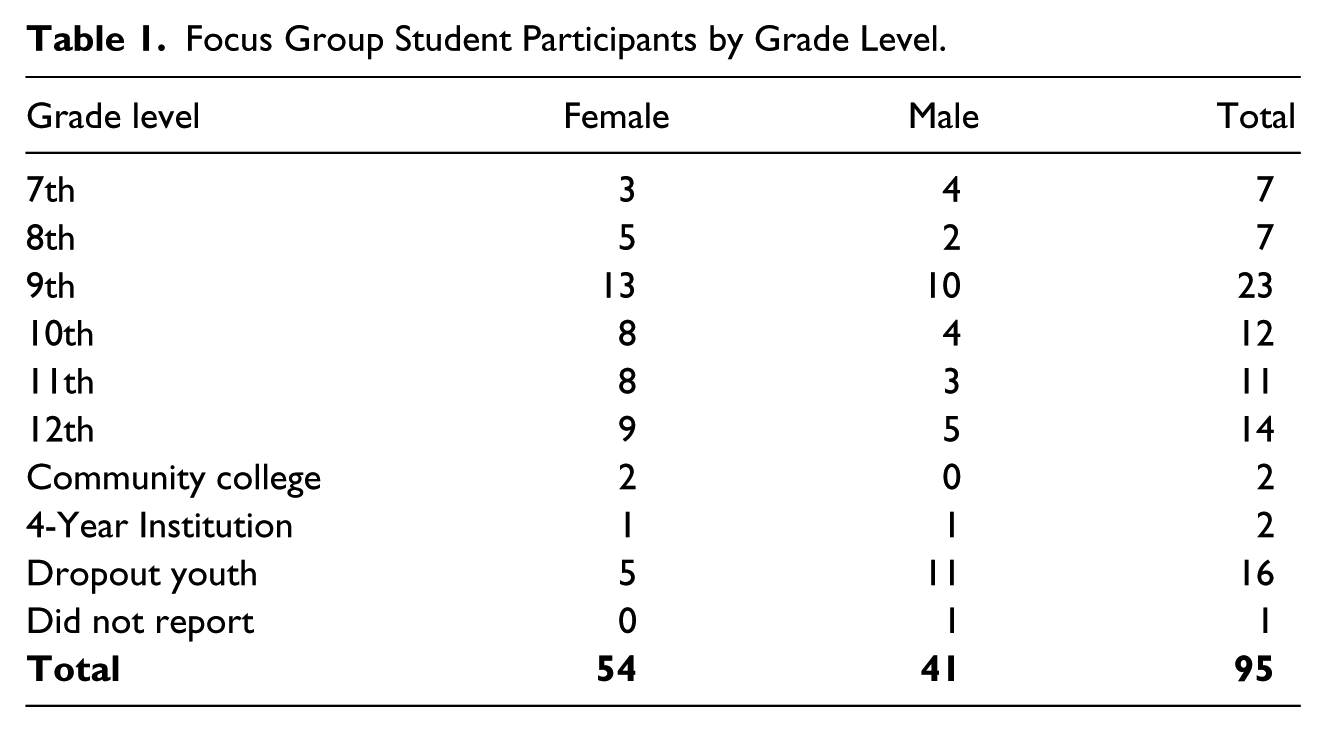
In total, we conducted 31 (English and Spanish) focus groups, which included 41 parents or guardians and 95 current and/or former students. Of the parent/guardian participants, 83% (34 parents) were female and 17% (7 parents) were male. Of the student participants, 56% (54 students) were female and 43% (41 students) were male. Students represented seven of the 18 district high schools (including several schools within schools), three of the local higher education institutions and former GLSD students (either transfer or dropout). The majority of participants (approximately 66%) identified as Puerto Rican, but also offered the following as personal identifiers: Cuban, Dominican, Hispanic, and Latina/o. Over 10 participants identified as biracial or biethnic (e.g., Puerto Rican and Black and/or another Latina/o subgroup like Dominican, Mexican, and/or Cuban). Table 1 demonstrates the student breakdown by grade and gender.
Focus Group Student Participants by Grade Level.
Data Analysis
Data analysis began with all interviews being transcribed verbatim and if conducted in Spanish, translated into English. Data analysis of the focus groups began with an initial reading of two transcripts by the all members of the research team. This strategy ensured intercoder agreement and consistency in preliminary findings and provided an important element of trustworthiness (Creswell, 2007). Using NVivo 8 qualitative software, inductive and deductive analysis was employed for interview transcripts, including the development of a preexisting coding structure from the initial reading of focus group transcripts, and further organized by drawing from relevant literature (Creswell, 2007). Initial analysis began with two primary categories: factors influencing Latina/o dropout and factors influencing Latina/o success. Categories were then organized into subcategories around personal/youth factors, environmental factors and school factors. These preliminary categories refer to what Yin (2003) terms, “relying on theoretical propositions” (p. 111).
Findings
While prior research establishes the importance of caring adults and school and community-based programs for aiding with improving student experiences in school, the findings from our study help to formally illustrate the relationship between school and community-based programs, caring adults as institutional agents, and Latina/o student persistence.
School and Community-Based Programs and High School Persistence: A Theory of Action
Our findings contribute to a theory of action that allows us to characterize how participation in school and community-based programs influences student persistence. As illustrated in Figure 1, the educational literature and our data confirm that Latina/o students have important personal background characteristics to be considered in an investigation regarding their schooling experiences (Kiyama & Harris, 2010). These include race/ethnicity, family background, and barriers related to Spanish dominance and English language acquisition. In addition, students’ experiences are influenced by school factors such as low teacher expectations, the lack of qualified bilingual teachers, or limited social and academic support (Valenzuela, 1999). For our student participants they described inconsistent relationships with their teachers and their school counselor
Programs based solely in the community that have no presence (either formally or informally) in the schools such as the local Boys and Girls Club.
School-based programs that do not have presence and/or coordination based in the community. This would include programs like Upward Bound.
Community-school based programs with a presence in schools. This might include the youth advocates who work with the local Latina/o organization or the mentors associated with the Urban League that operate programs in local high schools.

Theory of action: Latina/o student persistence model.
As the model further illustrates the involvement with these school and community-based programs mediate Latina/o students’ school experiences (Figure 1, Column 3) by connecting them with adults and serving as sites for fostering the development of confianza (i.e., mutual trust) . Once these trusting relationships are created, adults associated with these programs are able to function as institutional agents by providing students with both social and academic support that allows students to address the personal, school, and cultural barriers they confront allowing students to persist in high school. In particular, the school and community-based programs create a safe space where students can be themselves.
School and Community-Based Programs as Safe Spaces
Study participants indicate that these school and community-based programs provide a haven for Latina/o students given their marginalized status within their communities, schools, and classrooms. Students often referred to these programs as providing a “safe space” for them. This was noted in two ways—school as a physical or literal safe area (such as a room in school or a building in the community) where they could go for support and a figurative safe space where they could turn for advice and support including finding the emotional help needed when working through difficulties at home.
Among the programs that were significantly important to students in our sample included the Latina/o Youth Development Program, a community-based program with a presence in a number of high schools in the Great Lakes School District. A key program feature included adult mentors who were located in designated high schools and played a prominent role for Latina/o youth by providing direct resources and social support via counseling to students. This program, in particular, was culturally relevant for Latina/o students since many of the adult mentors were members of the Latina/o community, bilingual, and had prior experiences with the local schools as either a student and/ or a parent. In some of the local high schools the Latino Youth Development program was provided a dedicated classroom where students could gather before, during, and after the school day. These particular locations functioned as a safe space because as one particular student described:
You don’t have to be something else outside of these four walls to impress everybody else. You can be yourself. You can be yourself in this classroom. You can say what you want. You can express how you feel. And we got the whiteboard so we can express whatever we feel. We can write it on the board. We got our signs everywhere. I’m really dedicated to this group.
In comparison to the general school environment that requires Latina/o students to conceal many aspects of their linguistic and racial/ethnic identities, the Latino Youth Development program is a context that allows them to fully embrace all aspects of who they are.
Students involved with Latino Youth Development played an active role in creating and maintaining this safe space for themselves and others. In some instances students stated how they would convene as a group in a section of the cafeteria where they engaged in activities including birthday celebrations. When confronted with negotiating within large urban schools and everyday practices that marginalize Latina/o students, these programs as another student described, provide “peace among chaos.” These findings complement Carter’s (2007) research among African American students who transformed common school areas (e.g., the staircase) into informal safe spaces that helped to combat the marginalization experienced in school and affirmed their racial identities.
At the same time that school and community-based programs serve as safe spaces for students, they also allow for the development of confianza (mutual trust) between students and adults associated with these initiatives. The greater confianza that developed, the more likely students were to seek assistance and resources from peers, teachers, and community-based mentors (Stanton-Salazar, 2001). This was the case for one male focus group participant who described his ongoing relationship with a staff member at a local Boys and Girls Club. As a result of this strong connection, the student sought out the Boys and Girls club when addressing racial conflict with African Americans in his neighborhood.
And then you talked about the director of the Boys & Girls Club. So that’s a person in the community that is supportive of you.
Uh-huh. And he’s helped me a lot because—well, I’m not—when I’d be on the streets and stuff—you see like—I’m the only like [the only Puerto Rican] where I live, it’s mostly African American people, so we’re the only Puerto Rican family around there.
So then everywhere you go, they’ll just start talking trash at you and all that. So then I used to keep going, but once I got tired of it—they was talking and messing with my mother and sisters and stuff, so I used to always get into fights and stuff.
So then, when I got to the Boys & Girls Club, he helped me a lot because he helped me get out of trouble. I went there, and then it calms me down. It’s like another world.
As this student describes, the Boys and Girls Club staff member acted as an institutional agent by helping to effectively problem solve (Stanton-Salazar, 1997). As a result, the presence of the Boys and Girls club served as a buffer for this student as an alternative community space to get help so that he could prevent any negative consequences associated with an escalated conflict since getting in trouble outside of school could have negative consequences (i.e., being incarcerated) for school attendance and persistence (see Hirschfield, 2009; Rodríquez & Conchas, 2009).
Caring Adults + Familial Relationships + Confianza = Social and Academic support
Students in our study often characterized caring relationships between themselves, adults, and peers in terms of familial relationships (i.e., mother, brother, sibling). Confianza in the context of such relationships allow for students to share their personal concerns freely with trusted adults (Stanton-Salazar, 2001) as indicated by the following:
I mean Ms. Gallego
1
, she’s the Latino Youth Development teacher. She’s like—I’ve got my own counselor, but she’s like my mother. My other mother. I’m really close to her, and I can actually talk to her and say some secrets.
The student’s description of Ms. Gallego as her, “other mother” suggests a level of confianza and caring that allows for students to be vulnerable without concern that their confidence will be betrayed. These close relationships help to mediate negative forces found outside of this particular program and allow students to get the social support needed that may be absent at home or in school. These caring relationships are also the result of adults and students having contact with each other beyond the school day. Even when programs are based in schools, adults from school and community-based programs may make contact via cell phone or home visits.
Student responses show that adults associated with school and community-based programs are able to convert the established family relationships and confianza into social and academic assistance. In characterizing his relationship with his program mentor the following conversation shows how assistance was provided:
So, you said you passed though [referring to school]. So, what brought that around?
Alan Carpio helped me to pass.
How so?
He kept my mind on track for the classroom, tried to help with my work.
So do you all have other people like Alan who are—I don’t know what you would describe him as, but somebody who you could go to.
An older brother.
As Stanton-Salazar (2001) further notes confianza is necessary for Latina/o students to engage in “regular help seeking and for the fluid, recurrent, and tailored transfer of key institutional resources from agent to student” (pp. 198-199).
Once confianza and social support are established, academic support can be provided by adults who act as institutional agents. The students discussed the various ways academic support is provided including being encouraged to attend class. As one student who had challenges with attending assigned courses states they [the Latino Youth Development mentors] “Tell me not to skip, and they actually motivate me to get class more often.” A number of school-based programs such as the Tutoring by Phone afterschool program provided homework assistance for a number of students. In reference to this program a student reported attending this initiative several times a week. “Tuesdays and Thursdays I stay after school and do Tutoring by Phone. So I am also in that which makes it more work to do.” Upward Bound was also reported as a place where students could get academic assistance as the following student describes,
So whenever I get confused with work, I don’t really have anybody to go talk to, so that’s why I joined Upward Bound because they help me figure out things that I can’t talk to them [family members] about because they don’t know anything about math. My dad’s not very good at it.
Students also discussed that the caring adults available via the school and community-based programs connected directly with teachers to aid them when addressing academic issues (Stanton-Salazar, 1997). A student needing bilingual services, although placed in an Algebra course taught solely in English, sought the assistance of the Latino Youth Development program mentors to help change to another section taught in Spanish.
Yeah, they changed it because every year if they got Algebra and English, I’ll be like, I can’t do it. Transfer me in Spanish, and I’m trying to see if Latino Youth Development teacher [can] try to change it in Spanish. If I keep having that class, I’m going to fail it and I’ve got [the state] exam right now.
Adult mentors from the Latina/o Youth Development program indicated how as institutional agents they deliberately taught students strategies to effectively solve problems by developing the skills to successfully navigate within schools (Stanton-Salazar, 1997, 2001). As one mentor/parent states,
Basically, we mentor and try to just guide them that way. Not only that, but we also try to teach the students how to advocate for themselves to be able to know what—how to use your words. You can still fight for what you believe in, but professionally, the way adults do it. Advocate for yourself. If you have a problem or a situation with a teacher, this is how you go about it. You don’t go ahead and tell the teacher off and cuss and use all types of four-letter words and stuff like that. This is the way you go about doing it. Basically just doing that—I mean, that’s how we’ve done it in the past.
The availability of the multiple school-based programs including Upward Bound, also help to create a cadre of Latina/o students who serve as a supportive academic peer group. The supportive peer groups complement and mimic the mentoring received from caring adults as they help students to address academic isolation. For the following student, participation in two school-based programs including Upward Bound and the Young Entrepreneurs program, a selective multiyear academic pathway for students, allows her to connect with a supportive academic community.
Like being accepted into both of these programs (Upward Bound and the Young Entrepreneurs Program), you realize that there are people who do take an interest in you, and you don’t have to feel like being a minority is a bad thing because I used to consider it as an insult like, “You’re a minority,” and I hated the word so much. Then when I got here, it was like there’s so many of us. And it’s—like to me it was very overwhelming because I felt special.
Such programs not only help students develop strong academic identities, but also negotiate and feel proud of their racial and ethnic identities. As a result, academically oriented school-based programs such as Upward Bound limited the academic and racial/ethnic isolation some students regularly experienced in school by allowing students to simultaneously possess positive racial and academic identities.
The social and academic support provided by school and community-based programs aid with students’ academic progress which is essential for their persistence. Student participants directly indicated that the assistance provided by adults in these local programs helped them academically and kept them in school.
Being in [the] Urban League program has improved [my] grades.
Do you think your grades have improved since you’ve been in the program? Honestly?
Yeah Miss cause in math I was, I had like [a] C, now I got [an] A.
Students consistently described these relationships as having “una confianza que uno le brinda (a confidence that they offer).” Yet, our data also revealed that if those programs and the people within them were removed, students felt a profound loss.
Entonces si sacas Latino Youth Development, si sacas Family Services, y estas aqui en [la escuela] y quieres hablar con alguien . . .
(Then, if you take away Latino Youth Development, if you take out Family Services, and you are here in [the school] and you want to speak to someone.)
No tienes a nadien. (You don’t have anyone.)
Si no esta [program mentor] con quien habla?
(If it’s not the [program mentor] who do you talk to?)
Nadie. (No one.)
The same focus group conversation also indicates that when students lack these embedded supports among caring adults available in school and community-based programs, they are less likely to be successful in school.
Lo que vas hacer es, las notas son la que van a pagar.
(What you are going to do is, the grades are what will suffer.)
¿Ese es tu opinion, si?
(That’s your opinion, yes?)
Si. (Yes.)
No hay mas nadien, no hay mas nadien.
(There isn’t anyone else, there isn’t anyone else.)
Student responses illustrate that without adults from these school and community-based programs they are confronted with as Stanton-Salazar (2001) suggests No le tengo confianza indicating there is no one for them to trust in schools. When no one is available, then he states “It can act as a siren warning others in the community to be aware (p. 27).” When Latina/o students express that they have limited or no strong connections with caring adults, then these schools put students at greater risk of leaving early because of limited access to the support needed to address personal and academic challenges.
In fact, a number of students observed that their ability to stay in school was directly related to the adults associated with school and community-based programs. A focus group participant who left school prior to graduation describes how the loss of support from a caring adult influenced his high school persistence.
I had a counselor from the Student Advocacy Program [community-based program] that used to come to Webber [high school] weekly, and I used to have counseling sessions with him.
Was he helpful?
Yeah, he was helpful in a lot of ways. He was very accepting.
So how did he help you stay in school? Was he involved in your decision to quit school?
He tried to encourage me to stay in school. But as soon as he left and I had a different counselor, there was nobody with me on my 2009 year.
So it seems as though not having the emotional support was a big deal for you in terms of being able to stay in school when you were doing the work.
Absolutely.
Many students indicated that without access to the community and school-based programs they would drop out of school.
Okay. So what would school be like without [Latino Youth Development].
Hell. School would be hell without [Latino Youth Development].
I would drop out. To be honest, I would drop out of school if [Latino Youth Development] wasn’t here.
What is clear in the above conversations is that without a caring adult or the school and community-based programs in schools, the signals about academic success are missing. These relationships are significant because of the confianza and positive social and academic support provided to students. Yet, what is most significant about students’ experiences is that in certain cases, the support given by these caring adults via school and community-based programs is the only support students had. We question why in these cases, the responsibility of caring adults has fallen solely to the school and community-based programs and wonder why students have not been able to develop such relationships with other school personnel. Further complicating these relationships is the fact that these programs are not available in all of the schools within the GLSD. There was awareness about the inequity in access to programs across local high schools shared among some parents including the following statements. As one parent states,
You know and it’s funny that the majority of our services are targeted at Cleveland [high school] because that’s where the majority of the Latino population is. When you go to Garfield or Arthur, [high schools] there’s no Latino services for any of those students and they might be a handful but there’s still some there. There’s no services there provided.
Such an omission of resources suggests that Latina/o students in these schools could be at greater risk of dropping out because they lack the embedded supports necessary for meeting their needs.
As demonstrated, the relationships developed because of students’ participation in school and community-based programs provided them with mentors and peer support aimed at social, academic, personal and racial/ethnic development. It is not an overstatement to suggest that in some cases, students would have been alone without these critical relationships.
Conclusion
Access to community and school-based programs can be a significant moderator regarding Latina/o student experiences in schools because of the positive role of institutional agents and the resources provided by the connections that school and community-based programs have for educational outcomes. Findings consistently pointed to the school and community-based programs serving as “human bridges” (Stanton-Salazar, 2001) or organizational bridges to additional resources. Our data suggest that adults available through community and school-based programs acted as institutional agents for Latina/o students as they negotiated within schools. Once mutual trust is established, the influence of such programs on students’ educational opportunities is evident and this assistance contributed to school persistence. Our findings speak to the important role authentic, interpersonal relationships between students and adults have for improving the educational experiences of Latina/o students (Rolón-Dow, 2005; Valenzuela, 1999).
The school and community-based programs not only offer Latina/o students with access to institutional agents who assist with providing resources to stay engaged with school, these programs provide safe spaces for Latina/o students to be shielded from the marginalizing forces confronted within schools. A number of studies show the importance of having places where students can be themselves culturally and linguistically (Carter, 2007; Gibson et al., 2004; Wong, 2010). Our data along with preexisting research suggest that schools must be able to address the academic, social, linguistic, and cultural needs of Latina/o students if we are to improve this community’s educational outcomes (Cammarota, 2006; Lopez, 2002; Rolón-Dow, 2005, Valenzuela, 1999). This assistance is facilitated by caring adults who are able to create bonds with students in order to help them access resources needed to successfully progress through school. The onus for providing caring adults is not the exclusive responsibility of school and community-based programs. Teachers need to become more culturally attuned to the needs of Latina/o students. In order for teachers to meet the social, linguistic, cultural, and academic needs of their students, we will need to address the challenge that teachers have various roles including serving as gatekeepers in school. As a result, this unresolved tension may make it difficult for teachers to become institutional agents and advocates for Latina/o students (Stanton-Salazar, 1997). Therefore, the need for both school and community-based programs are essential to fill the void currently in our public schools.
Given current budget crises at federal, state, and local levels, there is scrutiny regarding how to allocate scarce resources in education especially in low-performing urban school districts. Our study suggests that allocating funding to ensure that school and community-based resources are available in all local high schools is a wise investment given that students reported these programs assist with keeping them in school. Therefore, it is necessary for these support systems to be available for an expanded number of Latina/o students to be served. Our findings also inform the benefits of successful programs that partner community organizations and schools districts given the federal government’s interest in funding such initiatives that improve student outcomes through the Obama administration’s Investing in Innovation grant competition.
Footnotes
Declaration of Conflicting Interests
The authors declared no potential conflicts of interest with respect to the research, authorship, and/or publication of this article.
Funding
The authors received financial support for this research project from the Warner School of Education at the University of Rochester and the Rochester Area Community Foundation.