



Abstract
Policy makers’ attempts to improve low-achieving schools through reform measures are not new to the 21st century. Research asserts that this policy churn has done little, if anything, to change student achievement levels. Based on the research, I assert that policy reforms such as teacher evaluations and test-based assessment, and school improvement cannot occur without an integration of organizational components. Furthermore, through a theory of action analysis of the School Improvement Grant (SIG) program, I suggest that the link between what we know about school improvement and what is put forth in policy is tenuous at best. Continuing to pass reform simply for political reasons is not a viable option if our schools are to produce sustainable, positive change in student outcomes.
Since its inception in 1965, the Elementary and Secondary Education Act (ESEA) has provided resources serving low-income and low-performing students in an effort to improve school performance. Despite multiple reauthorizations of the ESEA, little improvement in these schools has occurred. In 2009, the Obama administration announced the School Improvement Grants (SIG) program under the ESEA. SIG is one program in a long history of federal reforms targeting the nation’s lowest achieving schools. The SIG program, as the latest of these efforts, requires specific changes by schools and districts to receive funds (National Center for Education Statistics [NCES], 2009). However, little is known about the reform models introduced by the SIG program (Center on Education Policy [CEP], 2011). Multiple failed policy levers aimed at low-achieving schools begs the question: Why will the SIG program change achievement levels when previous reforms failed? To answer this question, this article examines the theory of action behind the SIG policy. Furthermore, by setting SIG in the context of California schools, this article presents the potential impact of this particular reform.
SIG’s theory of action is based on five underlying presumptions. Each of these theories is discussed in terms of what is known about effective school improvement. Based on the tenuous link between the policy levers of SIG and school improvement, this article concludes with a reflection on what we do and do not know about policy that supports sustainable school improvement and potential important considerations for policy in the future.
Examining the theory of action behind SIG funding is important because improving low-achieving schools is an ongoing problem in the U.S. education system despite large spending. Prior to the SIG program, the restructuring program under the No Child Left Behind Act (NCLB) spent US$500 million on schools with virtually no effect (CEP, 2010). For example, in a case study of California school districts under restructuring, CEP researchers found that schools in restructuring were more focused on decreasing the number of students scoring below the proficient level than on making adequate yearly progress (AYP) targets that would enable them to leave restructuring.
Background/History
Low-achieving schools are a policy problem at all levels: federal, state, and local. Beginning as early as 2002, funding through NCLB was distributed to states, districts, and schools to restructure low-achieving schools (U.S. Department of Education, 2009). To receive NCLB funding from the federal government, states selected one of the following restructuring options for low-achieving schools: reopen a school as a charter, replace all or most of the staff, contract with an external provider, allow state takeover of the school or engage in other major restructuring. The majority of schools selected “other restructuring.” This open-ended option provided the most flexibility (CEP, 2008). During the period from 2005 to 2009, the majority of schools who entered restructuring had not achieved adequate progress to exit the restructuring program. A total of 1,521 more schools entered restructuring than exited restructuring between 2006 and 2008 (U.S. Department of Education, 2009). The small number of schools leaving the restructuring phase compared with those entering or staying suggests that the policy or the implementation was ineffective. The goal to turnaround schools failed.
Similar to George W. Bush administration’s restructuring program, the Obama administration created SIG as part of the American Recovery and Reinvestment Act (ARRA) of 2009. The SIG funds intend to improve persistently low-achieving schools. The legislation designates three levels of eligibility for schools. Tier I schools represent the bottom 5% in terms of achievement of Title I schools. Tier II includes Title I eligible secondary schools based on equivalent poor performance. Tier III schools, which may only be addressed after Tier I and Tier II schools in a district, may include Title I schools in improvement, corrective action or restructuring (U.S. Department of Education, 2011). Title I Schools receive additional funding to improve the academic achievement of the disadvantaged. Under Section 1003(g) of the ESEA, SIG funds may be used to improve student achievement by implementing one of four rigorous models. The improvement models eliminate the “other restructuring” option that existed under NCLB legislation. This policy change presumes that the “other restructuring” option in some ways hindered the policy of improving student achievement levels. States apply for SIG funds and then distribute grants to Local Education Agencies (LEAs) based on applications that are similar to the one required by the Federal government for states.
Briefly, SIG requires one of the following implementation choices:
Restart model—occurs when a school closes and reopens under a charter school operator, a charter management organization or an education management organization.
Closure model—occurs when a LEA selects to close a school entirely and enroll the students in other higher achieving schools within the LEA.
Turnaround model—occurs by replacing the school principal and up to 50% of the staff as well as other improvement activities.
Transformation model—occurs by replacing the principal, increasing instructional time as well as other improvement activities.
This article analyzes the theory of action behind two of the programs set forth by the SIG policy, the turnaround and transformation models. The justification for eliminating school closure from the discussion is that school closure does not suggest the implementation of a model. By definition, school improvement aims to change an existing school, not to close it. Closing a school and sending its students to other schools is complex. Forced school closures can negatively affect students’ self-esteem and peer relationships as they transition to new schools (Bogat, Jones, & Jason, 1980). Furthermore, charter schools are not included in the theory of action presented in this article. The research related to charter schools and student achievement suggests large variations in charter school quality (Carnoy, Jacobsen, Mishel, & Rothstein, 2005). Based on the existing literature, it cannot be determined if converting a low-achieving school into a charter school will improve student learning.
SIG and School Improvement
The enactment of NCLB under the renewal of the ESEA solidified for the foreseeable future the role of schools as delivering a specific set of test-based accountability measures. School improvement refers to improving student outcomes. In the high stakes era of NCLB, school improvement refers most directly to raising student test scores.
Student learning may not be clearly understood through one measure such as standardized tests (Hargreaves & Shirley, 2008; Peters, 2007; Sahlberg, 2007; Simon, 2010). For the purpose of this study, schools that increase student learning are improved schools, with the acknowledgment that measures of student success may include a variety of outcomes such as engagement, retention, authentic assessment, and test scores.
California and SIG
School reform is neither new to the federal government nor to the state of California. In 1999 as part of SB1x, the California legislature created the Immediate Intervention/Underperforming Schools Program (II/USP). Funds were targeted at 680 of California’s lowest achieving schools. An independent evaluation team reported that the low-performing schools’ increased focus on student achievement in math and reading at the expense of other subject areas ultimately resulted in negligible changes in student outcomes (O’Day & Bitter, 2003).
California also passed the Public Schools Accountability Act (PSAA) in 1999. This legislation focused on the development of a comprehensive system of accountability for improving student performance. As part of PSAA, the High Priority Schools Grants Program (HPSGP) was introduced in 2001 to provide extra funding for the lowest achieving schools. The HPSGP replaced the underperforming II/USP program. The effects of the HPSGP were similar to those of its predecessor: “the effect of participating in the program on student performance was negligible” (Harr, Parrish, Socias, & Gubbins, 2007, p. 2). The minimal change of the outcomes of these programs despite millions of dollars in funding suggests that policy design has yet to address effectively the problems faced by low-performing schools. Yet, policy continues to direct resources at the nation’s lowest performing schools.
In 2009, another education reform model was suggested, the SIG program. California applied for and received US$416 million in SIG funds in 2010. These funds are allocated over a 3-year period. In each of these years, a new cohort of schools may be funded. In the first cohort, the state identified 2,720 low-achieving schools eligible to receive SIG grants. In the second cohort in 2011, the state announced 2,885 schools that were eligible for SIG funding. LEAs and charter schools could apply for 3-year targeted grants. Under 1003(g) SIG funding guidelines, states award grants through a competitive application process, similar to the SIG application process. States set criteria to judge applications. Grants were awarded to 92 of the schools in the first cohort (California Department of Education, 2011). The application process required the designation of schools that receive funding into one of the four SIG models for change. As demonstrated by Figure 1, the LEAs overwhelmingly chose the transformation model over other implementation choices.
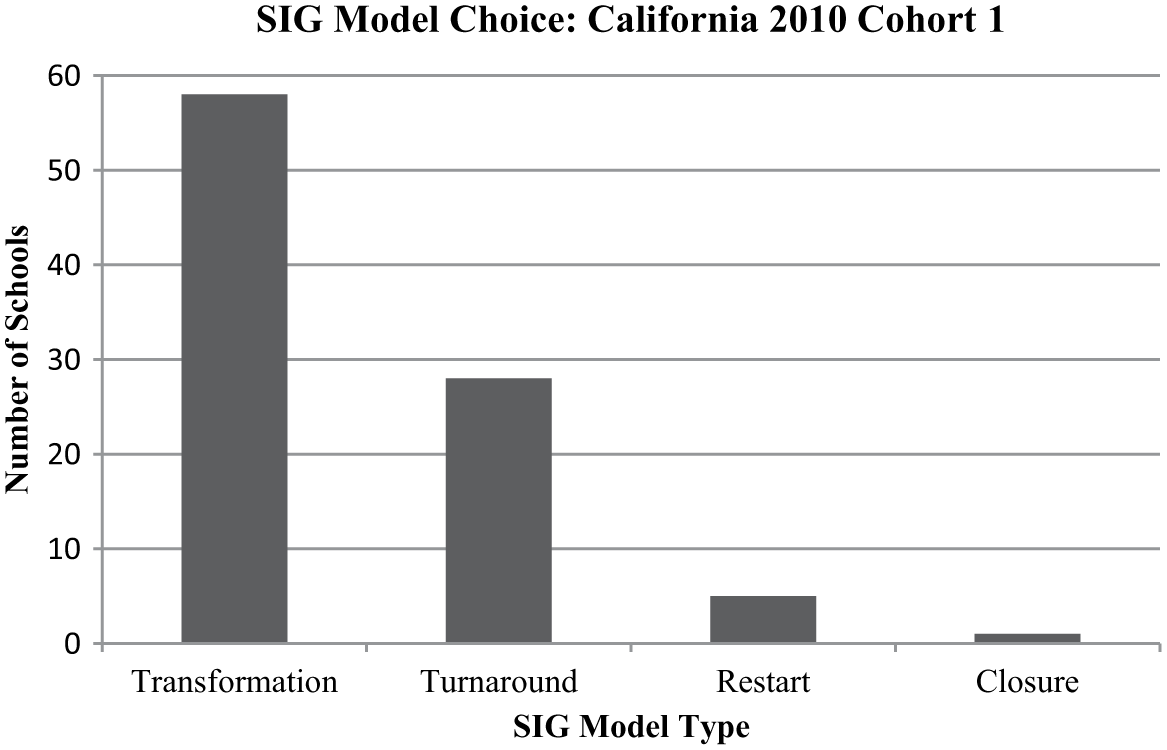
SIG school improvement models selected by 2010 California Cohort 1.
The transformation model requires the smallest personnel change. The principal is the only required change in staff in this model. In contrast, the turnaround model requires the removal of the principal as well as at least 50% of the teachers. The conversion of a school into a charter would also likely result in a substantial change in staffing. Los Angeles Unified School District (LAUSD) was the only LEA in California that opted for some of their schools to be given over to charter school operators in the restart model. These schools represented 5% of the first California cohort. The first cohort of schools collectively received US$412,732,454 for a 3-year period beginning with the 2010-2011 school year. Figure 2 illustrates the distribution of funds by urbanicity, as defined by the U.S. Census Bureau.
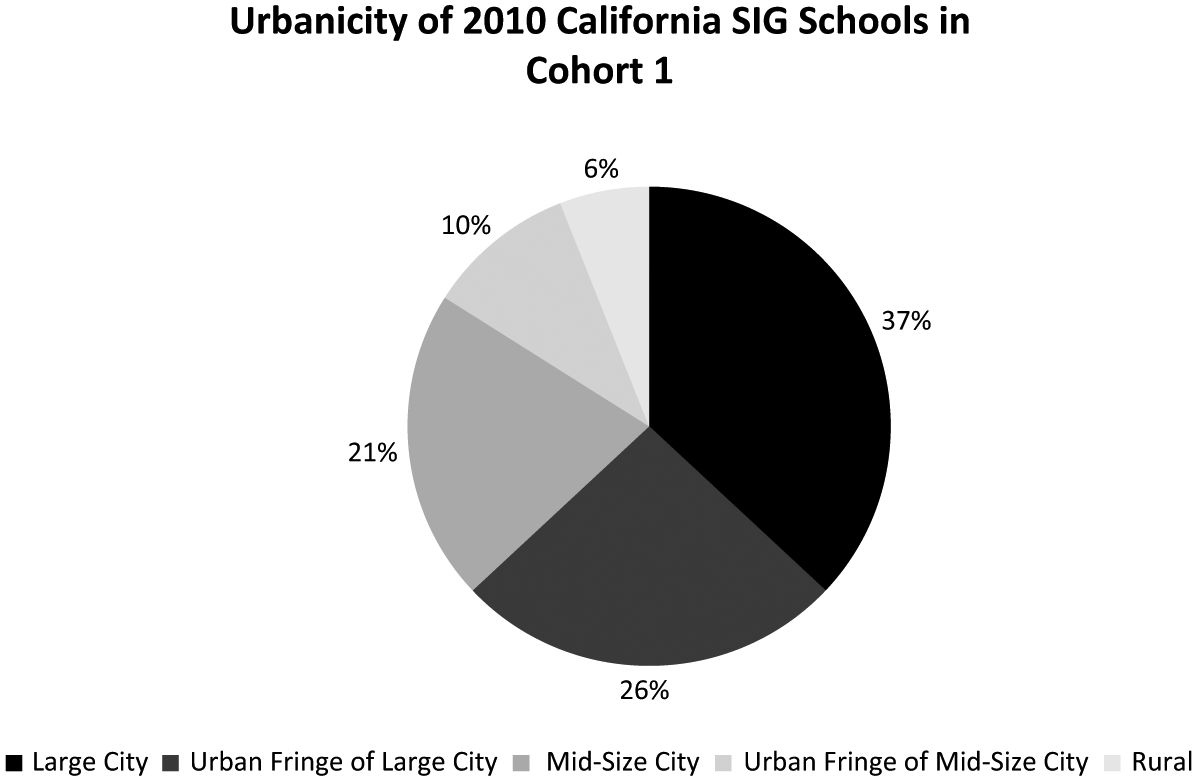
Urban distribution of 2010 California SIG Cohort 1.
The schools are distributed among urban and suburban areas with only a small percentage in rural areas. Approximately one third of the schools that received grants are urban. Collectively, 58% (53 schools) are in mid- or large-size cities. Less than 10% (five schools) that received funds are located in rural areas.
Students in SIG schools tend to come from low socioeconomic status (SES) backgrounds. On average, 85% of students in SIG schools are from a low SES as defined by being eligible for free or reduce-priced lunch. The peer effect on student achievement shows a negative effect in schools with high percentages of low-income students (Rumberger & Palardy, 2005; Suárez-Orozco, Pimentel, & Martin, 2009). Students from low-SES backgrounds perform better academically when in schools when less than 50% of the students come from low SES backgrounds (Rumberger & Palardy, 2005).
The distribution of SIG funds in California can be characterized as largely serving minority students in urban settings. Research shows that urban, minority schools have reduced access to resources such as highly qualified and experienced teachers (Darling-Hammond, 2004; Lankford, Loeb, & Wyckoff, 2002; Lippman et al., 1996). In general, students in high-minority, low-income schools are more likely to have underqualified teachers than students in affluent schools (Darling-Hammond, 2004). In short, the students most in need are those who are most likely to have the least access to the best resources available.
Theory of Action Framework
The theory of action is based on the perceived problems with the present state of schools and the changes required to help address these issues (Nave, Miech, & Mosteller, 2000; Rothman & Elmore, 1999). Education reform draws on different theories of action. Policy makers focus reform on areas of schooling they perceive to be causing enduring problems (Cuban, 1990). Reform is based on presumptions about the actions linked to student learning. Implementation of these actions is likely to vary and will affect policy. While implementation has a nontrivial influence in the outcomes of a policy (Lipsky, 1980), the basic premises set forth by the policy suggest that SIG policy may be counterproductive to long-term improvement of the nation’s “failing” schools. The underlying assumptions of SIG is that with an infusion of money, the removal of the principal and possibly additional staff, and changes to the organization, low-performing schools will “transform” into higher performing schools, and maybe even “high-performing” schools.
SIG and Its Theories of Action
The theory of action behind the SIG policy includes the following presumptions: (a) current school staff, and in particular the principal, hinder student success; (b) the current level of time committed to learning is insufficient to change student outcomes; (c) the current curriculum does not generate sufficient student learning; (d) the structure of the school does not support student achievement; and (e) sustainable change can be developed in a 3-year period. The mechanisms included in the SIG policy rest on the presumption that changing these aspects of low-achieving schools will increase student test scores.
Table 1 illustrates the specific requirements for the turnaround and transformation models next to the evidence from the school improvement literature. The next section expands on each of these mechanisms, their theory of action, and their relationship to the literature.
SIG Policy Components and the School Improvement Literature.
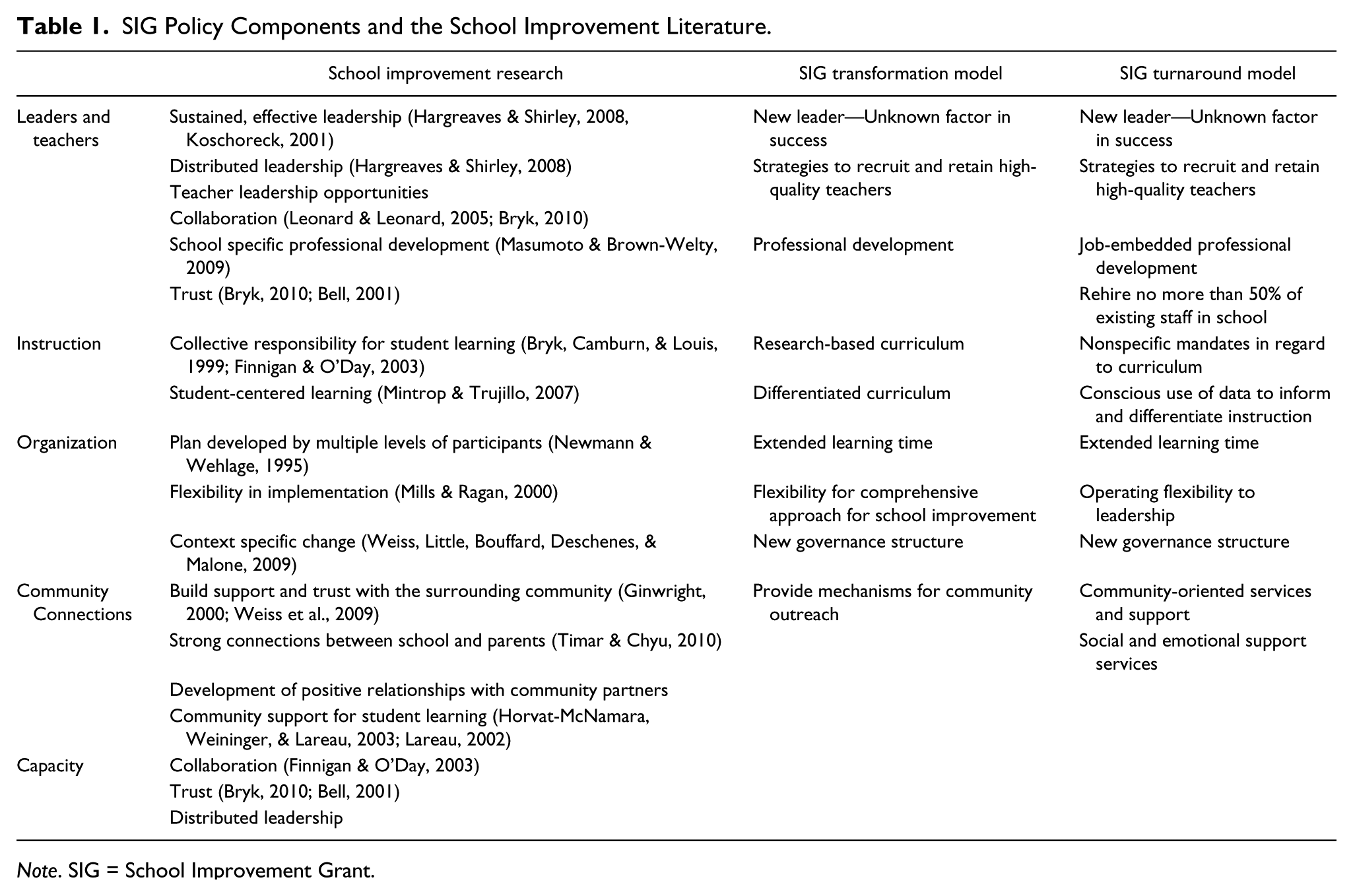
Note. SIG = School Improvement Grant.
Analysis
Policy component: New principal, and in the turnaround model, new staff
Theory of action: Change the staff because the current school staff, and in particular the principal, hinder student success.
The importance of leadership in school improvement is apparent in the literature and SIG policy. The theory of action behind changing the principal presumes that the introduction of a new leader will serve as a catalyst to “transform” the school culture into one in which students will learn more and/or more students will achieve at a preset level of proficiency. A school is determined as improving by bringing more students to a proficient level on a standardized tests rather than improving the test scores of those already deemed proficient. The SIG policy presumes that the school principal is a central factor in a failing school. By this theory, the existing leadership is perceived to lack the capacity to turnaround a school. Viewed as part of the problem, the principal cannot be part of the solution.
The theory of action further rests on two presumptions: one, that the current principal is incapable of turning around a failing school, and two, that a pool of qualified, dynamic leaders are awaiting the opportunity to take over a challenging school. Changing leadership has been shown to be an effective solution if the new principal has the skills and resources to create a culture of learning and build a trusting atmosphere among staff (Timar & Chyu, 2010). Unfortunately, a new principal does not guarantee improvement. The SIG policy does not outline the specific guidelines for the selection of the new principal, and therefore significant level of uncertainty as to how effective this approach will be in improving schools remain. Changing principals may introduce “novice” administrators who are limited by their lack of experience (Malen, Croninger, Muncey, & Redmond-Jones, 2002). Novice administrators may or may not have the capacity to build the culture necessary to improve a failing school.
Strong leadership or the absence of it affects school improvement measures (Fullan, 2010; Timar & Chyu, 2010). In improving schools, leaders have collegial relationships with their staff, a long tenure with the school and a clear, student-centered vision (Hargreaves & Shirley, 2008, Koschoreck, 2001). In contrast, schools that fail to generate substantial improvement are characterized by high turnover rates of principals (Timar & Chyu, 2010). Turnover of key leadership may challenge school improvement measures (Copland, 2003). In schools with high principal turnover, teachers and staff tend to be demoralized (Dembo & Gibson, 1985; Eisner, 1988; Fullan, 2010). The school culture and ultimately student learning suffer in a depressed culture. High principal turnover may also result in fragmentation of resources. Programs are begun but not finished or maintained. Each new principal comes in with his or her own agenda that may not incorporate previous initiatives.
The turnover of principals is counterproductive to the improvement of schools. Sustained leadership is vital in school improvement. Improving schools has a clearly defined vision coupled with an action plan that originates from the principal. The principal takes responsibility for shaping the plan with input from the staff. Accessing resources, maintaining the vision, and shaping the school culture rely on the effectiveness of the leader. Researchers of Chicago schools found common characteristics of leaders in productive schools: an institutional focus on student learning, efficient management, and inclusiveness of staff input (Sebring & Bryk, 2000). Specifically, in these schools, staff members were part of the improvement process. Students reported feeling safe and having a sense that the teachers cared about them. This had a positive effect on student outcomes. Among the mechanisms used in these improving schools was the development of a principal-initiated vision focused on student learning with the input of teachers, staff, and community. The absence of consistent, strong leadership will hinder any attempts at school improvement.
Expelling multiple staff may erode the school culture beyond the time allotted for implementation of SIG policy. In the turnaround model, no more than 50% of staff may be rehired. The theory of action attributes insufficient student achievement levels to teachers. The presumption here is that at least half of the teachers in a failing school lack the skills to address the academic needs of its students.
This theory of action presumes an eager and skilled pool of candidates ready to replace exiting staff. In a similar transformation model enacted by a superintendent of a metropolitan district, the affected schools had higher turnover rates of teachers following implementation than preceding it. The new staff was characterized as “inexperienced” and “overwhelmed” (Malen et al., 2002). High teacher turnover impedes capacity building.
Turnover reduces trust within the school as well as with parents. Ultimately, staff upheavel may not produce the intended outcome of raising student scores. Building a vision in which the staff and community take collective responsibility for learning requires time and trust. SIG policy limits the time for change, which ultimately may hinder the potential for success.
Policy Component: Extended learning time
Theory of action: More learning time is required based on the presumption that the current level of time is insufficient to change student outcomes.
The second theory of action addressed in this study is the concept of learning time. The policy presumes that one factor contributing to “failure” is insufficient allotment of time to increase student proficiency levels. This includes time for professional development of teachers, increased learning time, time to address nonacademic needs such as emotional support, and time to engage the surrounding community.
Another component of SIG is extended learning time. This factor presumes that students need additional learning time after school, on Saturdays, and throughout the summer to make gains. Extended learning time by itself does not yield improved student outcomes (Smith, Roderick, & Degener, 2005). In a comparison of national systems, evidence of increased studying time has increased student success (Paik, Wang, & Walberg, 2002). That which is specifically done in that extended time may be more important than simply adding more minutes to instruction time.
Policy Component: Adopt a new curriculum
Theory of Action: New curriculum presumes that the current curriculum used in “failing” schools does not generate sufficient student learning
SIG policy requires the implementation of a new curriculum, a policy mechanism that only has limited links to increased student outcomes. The theory of action behind this change is that the existing textbooks and other learning tools in the schools are not facilitating student achievement. The transformation model takes the theory of action one step further in presuming that only research-based curriculum can support improved student outcomes.
The link between research-based curriculum and student achievement is underwhelming. For example, researchers developed an Afro-centric curriculum for use in schools with high percentages of African American students (Ginwright, 2000). The idea was that connecting students to their African roots would spark interest and improve student outcomes. Neither teachers nor students embraced the new curriculum, and student learning did not improve as measured by test scores (Ginwright, 2000).
This discussion does not suggest the extent to which research-based curriculum is successful only that the curriculum—student achievement link is unclear when thought of as an isolated component of school improvement. The intended effect of changing curriculum may be a collective focus on student learning.
Policy Component: Adopt a new governance structure to support learning and retention of the best teachers.
Theory of Action: New governance presumes that the current school structure does not support student learning.
SIG policy demands the development of a new governance structure. However, the guidelines and individuals responsible for determining the new structure are not apparent from the legislation itself. The presumption is that some component of the existing organizational structure impedes student learning.
The school structure may not support improvement measures (Lee & Smith, 1996; Raywid, 1990). Improving schools demonstrate an organizational structure that builds a professional community for teachers, provides opportunities for collaboration, and develops a trusting culture centered on student learning. Changing the school structure does not predetermine improvement. Flexibility, as allowed in the development of new governance, may lead to a fragmented approach that has not historically led to improvement in other schools (Lee & Smith, 1996; Timar & Chyu, 2010). A change in the organizational structure may also result in the disenfranchisement of staff members. These components allow for the possibility of change but do not ensure that student learning will improve.
Governance as it relates to changing the school culture can improve student learning (Bryk, Camburn, & Louis, 1999; Lee & Burkam, 2003). In improving schools, the school culture shifts to a cooperative model. Teachers are elevated beyond specialists to team members that work collaboratively to improve learning for all students. Teachers take collective responsibility for learning. Fullan terms this collective efficacy (Fullan, 2010, p. 44). The school as an organization and the people within it believe they can affect change. Collective responsibility is linked to increased student learning in all subjects (Lee & Smith, 1996).
Low-achieving schools that improve are characterized by a high commitment to collective responsibility for learning. Teachers, staff, and administrators share ownership in values focused on student learning (Bryk et al., 1999; Finnigan & O’Day, 2003). In improving schools, adults are accountable for change. Change from within demands an intense focus on collegial decision making (Cohen, 1995; Little, 1981; Purkey & Smith, 1983). The school staff collaborates to improve. They engage in active dialogue. Adults in high-performing, high-poverty schools take charge of instructional decisions (Bell, 2001; Lee & Burkam, 2003; Masumoto & Brown-Welty, 2009). Teachers learn together. They work as a collective group to engage in meaningful change.
In improving schools, teachers and staff believe that their students are capable of learning. Effective schools understand the educational issues of their context and also believe they have the power to change and improve (Mackenzie, 1983). High growth schools generate internal collective responsibility to improve student outcomes (Mintrop & Trujillo, 2007). They maintain high expectations for students. Teachers’ expectations for their students are linked to student outcomes (Rubie-Davies, Hattie, & Hamilton, 2006; Weinstein, 2002). Teachers in improving schools expect that students are capable of improved outcomes (Bryk & Schneider, 2003; Timar & Chyu, 2010). To the extent that a change in governance structure contributes to a culture of collective responsibility for learning, a change in governance structure may have a positive impact on student learning, but it is unknown.
Policy Component: Funding period of 3 years
Theory of action: Sustainable change can occur by top-loading funding in the first 3 years.
One key resource for school improvement is time. The concept of time goes beyond allotting time to collaborate and plan among the staff. Time includes a multiple-year investment in a school to build the capacity for improvement. Capacity includes resources, financial and personnel, which are required for sustainable change in student outcomes. In low-performing schools, high levels of distrust may lower the capacity of the school (Timar & Chyu, 2010). Time combined with leadership and staff buy-in is required to build the foundation on which schools can improve.
SIG provides additional funds for a 3-year period. The policy presumes that schools will not need additional funds after this period to sustain improvement. Research supports a 3-year minimum requirement in elementary and a 6-year minimum in secondary schools to affect student outcomes (Fullan, 2000). In a nationwide survey, Title I directors expressed concern over the limited timeline: “the tight timeline for implementing significant reforms and the restrictions on the models, particularly the requirement to replace the principal, have and will be challenging for our schools” (CEP, p.4). Whether the timeline present in the policy is realistic for school improvement is realistic suggests a need for further study. An in-depth study that examines the effect of SIG for the 3-year period and beyond to identify the long-term effects of SIG would inform future school improvement measures.
Discussion
Based on evidence of the components of the turnaround and transformation models, SIG policy seems flawed. SIG policy aligns with school improvement literature in its focus on comprehensive reform but lack substantial support for its components. Genuine reform requires the development of solutions to address complex problems (Purkey & Smith, 1983). The policy design recognizes that factors of school improvement are interrelated. Principal and teacher turnover are components of nonimproving and failing schools.
SIG policy is neither the first nor is it likely to be the last policy aimed at the nation’s lowest performing schools. Similar reforms focused on overhauling schools have come at a high price. Reconstituted schools undermined teacher efficacy and increased teacher turnover (Rice-King & Malen, 2003). In Chicago, reform meant to transform “failing” urban schools in Chicago yielded little significant change in the school culture. Improvement of student achievement was also absent from the results (Hess, 2003). We may know little about improving the most need schools through policy. Developing and maintaining reform is a complex problem that cannot be pinpointed to one specific plan that works for all schools. Policy makers often fail to diagnose problems and make correct solutions (Cuban, 1990).
Even well-designed policy may not get implemented in individual classrooms (Lipsky, 1980; McLaughlin, 1987). Coherence in policy is not necessarily coherence in practice (Cohen, 1995). In a survey of district leaders across the United States, researchers found that more than one third of the districts were unfamiliar with the proposed SIG models (CEP, 2011). This may present challenges during implementation because new staff will not only have to get oriented to the school but also to the complex demands of the policy itself. Research shows that districts are unfamiliar with the tools for implementation. Less than 12% of the districts had implemented any of the models (CEP, 2011). In addition, surveyed Title I directors express resistance to the required models. They find the models restrictive and are concerned with issues of time (CEP, 2011). School improvement literature supports the need for buy-in of reform at multiple levels.
Leadership needs to believe in the policy to enable its success. The CEP study found little support for SIG policy as it is currently constituted. Because this study is limited by its examination of specific factors of school improvement, the greater impact of SIG policy on low-performing schools requires further research. An examination of the applications for SIG grants from LEAS may lend some insight into how the policy was interpreted. For example, professional development in the San Francisco Unified School District’s application largely focuses on training in specific curriculum. The literature suggests that professional development is more successful when addressing the specific needs of a school, its staff, and students (Foote & Cook-Cottone, 2004; Raywid, 1990). In addition, this study recognizes but does not specifically address implementation issues. Research into the different models once implemented will increase an understanding of their impact on student learning. The policy suggests further research into elements such as the turnover of principal and staff as well as capacity issues of each model individually.
Conclusion
The principle behind SIG policy is that by temporarily infusing money into failing schools, students will show marked improvements. This presumes two things: (a) The models designated by the policy will create improvement and (b) improvement can continue after the funding disappears. The literature suggests that this policy faces considerable challenges. Title I directors may agree with the concept of comprehensive reform but find the models too restrictive (CEP, 2011). Furthermore, leaders at the district and state level have little experience with the reform models and may need time and resources to learn during the implementation phase. Three years may not be enough time to build the capacity to sustain long-term improvement.
Furthermore, the policy does little to account for the peer effect presented by the schools receiving SIG funds. Without changing the socioeconomic makeup of schools, policy may have little impact. There is evidence that the peer group of students impacts student achievement (Rumberger & Palardy, 2005; Suárez-Orozco et al., 2009). Students from low SES backgrounds perform better academically when in schools with less than 50% of students coming from low SES backgrounds (Rumberger & Palardy, 2005). SIG is aimed to improve 1,000 schools in our nation (U.S. Department of Education, 2009). The extent to which policy designers understand the components of school improvement is subject to analysis in this study. The policy may do better to integrate students by SES than to expend money overhauling individual schools for short periods, a policy that is similar to its predecessors, II/USP and HPSGP.
SIG policy improves on previous reform by acknowledging the need for comprehensive rather than piecemeal reform but may ultimately fail in achieving its goal to improve the nation’s lowest performing schools. The theory of action outlined here demonstrates that the policy mechanisms to change school outcomes have little potential for success. SIG policy touches some components of school improvement such as the need to retain good teachers, but presents little support for how to make this happen. We know that the development of a professional, trusting school culture with a capable leader promotes school improvement. It may be that improving individual schools is beyond the reach of what national policy makers can do to be able to build that culture. A culture builds from within the local community. As veteran researchers, Larry Cuban and Jane David (2010) remarked there’s little evidence that [the current] turnaround strategies will fare much better than previous efforts to improve low-performing schools. In fact, there’s little evidence on turnaround strategies at all. The U.S. Department of Education says as much in their purportedly evidence-based guide for turning schools around, which is, at best, underwhelming in available studies (2010).
The extent to which policy may support the placement of the complex set of components required to improve schools is minimal. Based on the presumptions about these complex factors, SIG policy appears poised to do little to change the outcomes of the nation’s lowest performing schools. Furthermore, as is suggested by the history of similar reforms as well as the importance of external factors to student achievement, policy may best serve students by focusing on changes to improve the students’ environment even before they enter the classroom.
Footnotes
Declaration of Conflicting Interests
The author(s) declared no potential conflicts of interest with respect to the research, authorship, and/or publication of this article.
Funding
The author(s) received no financial support for the research, authorship, and/or publication of this article.