




Abstract
Focusing on a cohort of high school students from a Midwest metropolitan region, this study combines multiple sources of data and uses a multinomial logistic regression to model student postsecondary choices with respect to whether and where to attend college. Specifically, we examined the enrollment patterns by proximity to the home region and factors associated with these college decisions. The results suggest that these students’ college choices were a process influenced by both precollege individual characteristics and social contexts. The findings also supported our hypothesis that acquisition of various types of capital and academic success of the school district (as one of several indicators of a college-going culture) were negatively related to student preferences for college proximity. These findings highlight the interplay between individual, family, community, and school at different levels as it influences college decisions of students from the deindustrialized Midwest region and regions alike.
The stratification of opportunity across higher education (Carnevale & Strohl, 2013), particularly by race, economic status, and geographical location (Fry, 2013; Gerald & Haycock, 2006; St. John & Meyer, 2013), underscores the need to better understand the predilections of students from historically marginalized populations and factors that shape their college enrollment outcomes. Despite the ample attention given to college access in higher education research in recent decades, limited empirical work has considered college geographical location when exploring student college choices (Turley, 2006, 2009) Unraveling these broad enrollment trends can point to potential areas for policy and practice. This is particularly needed in understanding the choice processes of students living in urban and metropolitan regions, who though may have more colleges in proximity face additional barriers, such as unconscious assumptions and attitudes of school personnel, organizational practices which may act to maintain inequities, and biases contained in placement policies and standardized testing (Noguera, 2003; Teranishi, Allen, & Solorzano, 2004).
To date, the existing research considering proximity to home in the college-going process has focused on how geographical locations of colleges affect the likelihood of college attendance in general and enrollment at a particular (type of) college (Goble, 2010; Turley, 2006, 2009) Limited understanding has been achieved about the extent to which individual characteristics and contextual factors explain student preferences for college proximity and the related enrollment outcomes. Focusing on a cohort of high school students from urban and metropolitan areas in a Midwestern state, this study combines a wide range of data sources and examines how individual, family, and school contexts shape student postsecondary enrollment outcomes, with particular attention to proximity-based college choices. This context is particularly important because like many Midwestern metropolitan regions, it is an area that has been deindustrialized and disinvested in, resulting in great stratification by race and income. While a common story across much of the Midwest, little work has examined college-going within this context of experiences. Our work seeks to fill in this gap.
Literature Review and Theoretical Framework
Within the college choice literature, while proximity to home has consistently been found to play a role in students’ college choice processes (Perna, 2006; Turley, 2009), it has insufficiently been examined as an outcome of interest. Drawing from the bulk of literature on student college choice and the limited research concerning college proximity, this study integrates perspectives from both economic and sociological theories (Cabrera & La Nasa, 2000; Perna, 2006), proposing that the geographical mobility of a student pursing higher education is likely to be affected by their acquisition of various types of capital, as well as by the opportunities structured by social contexts.
Costs of Attending College
According to the human capital theory (Becker, 1964), personal investment in education is largely determined by expected benefits and costs associated with attending college. Students weigh their perceived benefits and costs associated with their choices and “engage in ‘constrained optimization’ behavior” when making decisions about if and where to go to college (Paulsen & Toutkoushian, 2008, p. 15). Particularly amid increases in tuition costs and shifts in federal support for higher education from grants to loans (D. Cheng & Reed, 2010; Choy & Carroll, 2000), pursuing a college degree is a great investment. Though for the most part students of all backgrounds are concerned about finances (St. John, Paulsen, & Carter, 2005), financial constraints indicated by family income and perceived ability to pay (Paulsen & St. John, 2002; Perna & Titus, 2005) are particularly important for first-generation students (Cho, Hudley, Lee, Barry, & Kelly, 2008), students from historically marginalized backgrounds, and low-income students (McDonough & Antonio, 1996; St. John et al., 2005). Because cost of attendance is not limited to tuition and fees, attending a college close to home may alleviate financial costs associated with boarding and relocation, as students may remain living at home and maintain the same jobs (Terenzini, Caberera, & Bernal, 2001).
In addition to finances, scholars have pointed to the psychological costs (Maddox, 1960) related to departure from home and settlement in a new place (Schwartz, 1973), which can be considered within the context of college students. For instance, for Latino students, given strong cultural values emphasizing familismo, leaving home for school may have strong emotional costs that can impact themselves and their families (Delgado-Romero, Galvan, Hunter, & Torres, 2008; Vega, 1990).
Resources for Attending College
Human capital accumulated through previous academic preparation and achievement (Perna & Titus, 2005; Rowan-Kenyon, 2007) play a key role in college-related decisions. Research has found that students estimate their own likelihood of acceptance and probability of achieving educational goals within an institution and may base decisions about if and where to apply to college on those perceptions (An, 2010; Chapman, 1981). Structurally, as documented by stratification of opportunity in higher education (Carnevale & Strohl, 2013), selective institutions typically require demonstrated levels of academic achievement, measured largely by students’ SAT scores, high school grade point average (GPA), and class rank (Bowen & Bok, 1998; Carnevale & Rose, 2004).
Scholars have drawn on theorizations of social and cultural capital (Bourdieu, 1986; Coleman, 1988) to examine issues of college access (e.g., Perna, 2006; Perna & Titus, 2005). Framing social capital as an important resource that enables exposure to other resources to support college-going (Coleman, 1988; Lin, 2001), Coleman (1988) emphasized the significance of social relations between and among actors within a variety of social networks and described social capital as a means of individual acquisition of information necessary for success (Perna & Titus, 2005). Particularly with regard to college going, research suggests that advice of others (Hossler, Schmit, & Vesper, 1999) and availability of information on college preparation and admission (Engberg & Wolniak, 2010; O’Connor, Hammack, & Scott, 2010) play a major role in college choice. For instance, first-generation students tend to rely on teachers and counselors for college-related information (Farmer-Hinton, 2006; Plank & Jordan, 2001), whereas Latino students are likely to place emphasis on information from friends and family (Ceja, 2006; Pérez & McDonough, 2008).
Parental educational attainment, a commonly adopted measure of cultural capital (e.g., Perna & Titus, 2005) implies important norms and values passed on from parents to children. Cultural values that emphasize family orientation and prioritize family needs over personal interests are found to have stronger impact on women (Kenny & Donaldson, 1991; Sorokou & Weissbrod, 2005) and Latinos (Espinoza, 2010; Sy & Romero, 2008), who wherefore tend to remain close to home. Embedded understandings of how to navigate institutions, for example, may be transmitted more easily and provide resources to children of parents who have successfully gone through them before (Paulsen & St. John, 2002).
Contextual Influences on College-Going
In addition, this study draws attention to the social contexts where individual behaviors occurred and developed. Based on an extensive review of college access literature, Perna (2006) proposed a framework that conceptualizes four social contexts that affect student college choices, namely, student, family, school, and sociopolitical conditions (e.g., state and federal policy milieus). In our study, we draw particular attention to the school context and the role it plays in shaping students’ educational opportunities. Particularly, high school is a social network where transmission of social capital happens (Coleman, 1988) and exerts critical contextual influence on student college choices (Hossler et al., 1999; McDonough, 1997; Perna, 2006). In general, the normative functions (Kelly, 1952) of the high school context “set and reinforce group standards on the value of aspiring to go to college” (Nelson, 1972, p. 32), as aspirations and decisions are influenced by peer effects, guidance from personnel, and school resources to support students (McDonough, 1997; Tierney & Colyar, 2005). Nuñez and Kim (2012) categorized school-level factors that are essential to student college enrollment into two groups: structural characteristics and college-going culture.
School structural characteristics considered in previous research have included student body socioeconomic status (SES; e.g., Konstantopoulos & Hedges, 2008) and racial composition of the school, with research finding that racial diversity in schools supports higher achievement and increased college-going rate and educational aspirations (e.g., Eaton, 2001). While research regarding per pupil expenditures have yielded mixed findings (Hanushek, 2001), generally positive outcomes are associated with higher spending (e.g., Deke, 2003; Greenwald, Hedges, & Laine, 1996). While the literature has advocated that smaller schools are associated with better student outcomes (e.g., Cotton, 1996, 2001), some have argued that the relationship is indirect at the best and mediated by other factors (e.g., Darling-Hammond, Ross, & Milliken, 2006).
In addition, college-going culture refers to the school and its surrounding community’s environment, attitudes held by members, and practices in place that support students’ college access and success (McDonough, 1997). In a college-going culture, students appreciate academics, desire to succeed, and are encouraged to attend college (College Board, 2006). The strength of a college-going culture may be indicated, for example, by pass rate of the standardized tests and percentage of students taking SAT test—a crucial step toward access to many colleges and universities.
Informed by the theoretical perspectives and empirical findings discussed above, the conceptual framework of this study assumes that traditional-age students’ decisions on whether and where to enroll in college is structured by student background characteristics, the acquisition of various types of capital, and the schooling context. The study further hypothesizes that levels of acquired capital and the strength of a college-going culture are positively related to college enrollment but negatively associated with preferences for college proximity.
Study Context and Research Methods
Study Context
Like many other deindustrialized regions in the United States, the study region has witnessed dramatic decreases in manufacturing jobs and aggravated racial segregation and economic inequality. According to the 2000 census data, the tri-county region consisted of 18% African Americans, 9% Latinos, and 70% Whites, with overrepresentation of the two ethic minority groups compared with the state averages. More than 90% of African Americans in the region were concentrated in the most densely urban county. Family income varied considerably, with 10% families in the urban county below the poverty line but only 4% with comparable income levels in the suburban county. Regarding educational attainment, about 44% of the population aged 25 years and older had at least attended college, with moderate variations across the three counties. There were about 50 high schools dispersed across 32 school districts. The postsecondary institutions serving the area included three public 4-year regional campuses, a multicampus community college, two private nonprofit colleges, and two for-profit institutions.
Data and Cohort
This study utilized data compiled from multiple sources including an annual, statewide survey of ninth graders in 1998 that asked students about their college preparation and educational aspirations; school district data from the state department of education; 1 geo-demographic census data for the region from the Nelson Claritas, Inc, and postsecondary enrollment data from the state’s Commission of Higher Education and supplemented by data from the National Student Clearinghouse (NSC). The final cohort included 7,688 students residing in the tri-county metropolitan area.
Research Variables
We focused our analysis on student initial enrollment outcomes between 2002 and 2004 (within 3 years of expected high school graduation), indicated by a nominal variable with four alternatives: no enrollment captured, enrollment at one of the region’s higher education institutions, enrollment at an in-state institution outside of the region, and out-of-state enrollment.
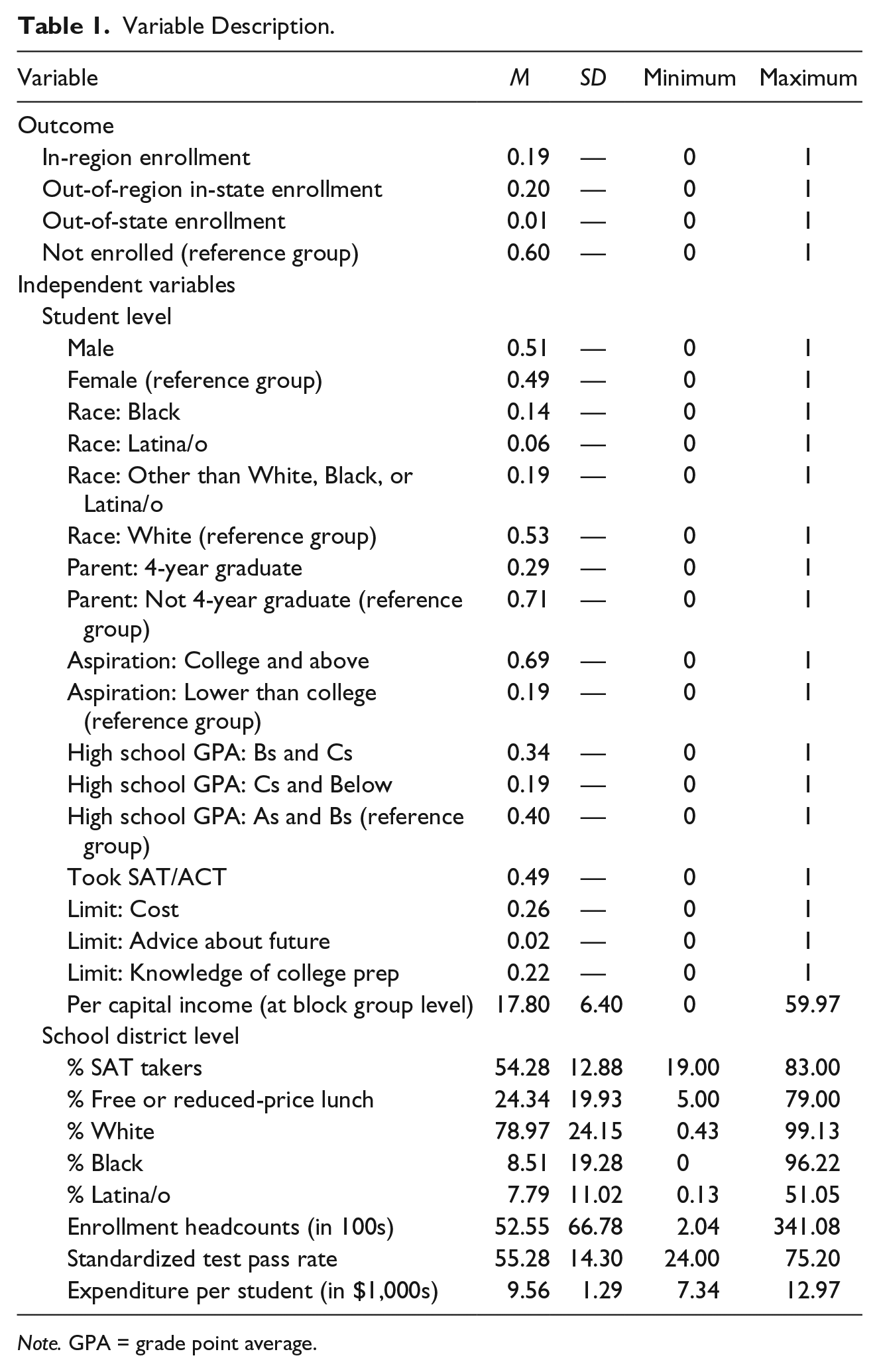
The individual characteristics of interest included gender, ethnicity, aspirations for college—measured by espoused aspirations reported on the ninth-grade survey and whether or not the student took SAT/ACT test, high school GPA, perceived barriers to higher education, and whether parent(s) graduated from a 4-year college. We used per capita income of the block group where a student resided as a proxy for family income. The model also included students’ school district characteristics: enrollment size, racial composition, aggregated SES—described by rates of free/reduced-price lunch students, per pupil expenditure, percent of SAT takers among 12th graders and state standardized test pass rate. Table 1 provides a brief description of the variables used in this study.
Variable Description.
Note. GPA = grade point average.
Treatment of Missing Data
We created a missing category for each student-level categorical variable in our analysis, given that they are not likely to be missing at random. This approach enabled us to preserve the sample size and examine whether or not data might be missing at random and also enhanced our understanding of the target population. At the school district level, a total of 560 (7%) students were not matched with their corresponding school districts, thus missing contextual information. Multivariate multiple imputation (MI) techniques were applied to simultaneously impute missing data across all eight variables at the school district level. MI is a technique that imputes missing data for a number of times and combines the estimates from each complete data set to get pooled estimates (Newman, 2003). Following the recommendation of Royston, Carlin, and White (2009), we conducted 20 imputations to reduce the sampling errors due to imputation. In addition, we generated a dummy variable to represent these 560 cases to capture the shared characteristics among these students.
Statistical Models
For data with nested structure where, for example, students from the same school district are likely to be more similar on many aspects than students from another district, the correlations within each cluster needs to be accounted for to obtain correct estimates of coefficients and standard errors. For correlated (clustered) data not collected through a sampling plan, there are generally two analytical methods, namely, clustered standard errors and multilevel models. While it seems inconclusive about the statistical advantages of one method over the other, some argue that multilevel models make more assumptions and are “data- and computation-intensive” (Primo, Jacobsmeier, & Milyo, 2007, p. 453; Steenbergen & Jones, 2002). Adjustment for clustered standard errors is recommended when the number of clusters is relatively small and no sophisticated statistical backgrounds of the audience are assumed (Primo et al., 2007; Steenbergen & Jones, 2002). That being said, we used multinomial logit model with clustered standard errors, allowing “for intragroup correlation, relaxing the usual requirements that the observations be independent. That is, the observations are independent across groups (clusters) but not necessarily within groups” (StataCorp, 2013, p. 21).
Critical to multinomial logit models is the independence of irrelevant alternatives (IIA) assumption, which posits that the introduction or removal of a choice should not affect the preferences for existing choices. As proved by S. Cheng and Long (2007), tests of IIA assumption often provide inconsistent results; and multinomial logit model is still recommended when the distinct alternatives are not substitutes for one another (Long & Freese, 2006)—the case of our study. We estimated four sets of coefficients,

To identify the model, we arbitrarily set one of the
In nonlinear models such as the multinomial logit, the robust estimator of variance that assumes dependence across observations within the same cluster/group defined in Equation 2 is an approximation instead of an exact estimate (Sribney, 1998):

where
The Wald test was used to examine the significance of individual independent variables across all outcomes. In doing so, we identified factors that are generally important for making college-going decisions and then investigated the relationship between a specific variable and a pair of enrollment outcomes.
Limitations
Limitations include the following. First, there were varying coverage rates across states and years in the NSC Student tracker data, potentially underestimating college enrollment. Second, use of per capita income at the block group level and the imperfect match between student records and geographic units provided only a rough estimate of family SES. Last, contextual influences at the school district level may to some extent differ from those imposed by high schools, the latter of which were likely to have more direct impact on students’ college choices.
Results
As shown in Table 1, the cohort of this study was 52.6% White, 14.3% Black, and 6.4% Latino, with the majority (71.1%) being the first in their families to attend college. Approximately the same number of female and male students was surveyed, with nearly 70% expressing an aspiration for college. The vast majority of students reported a GPA of C and above, and nearly half had already taken either SAT or ACT test. About a quarter of these students perceived costs as a limitation to further education, while lacking college information was seen as a constraint for 22% respondents. All but 2% of the students received advice on their future. On average, per capita income of the block group where a student lived was about $18,000.
In addition, students were mapped to 32 public school districts in this area. Suggested by ranges and standard deviations of the variables, racial composition, aggregated SES as indicated by percentages of students qualified for free or reduced-price lunch, enrollment size, and college-going culture as indicated by percentages of both SAT takers and the state standardized test pass rates varied widely across school districts.
Within 3 years of their expected high school graduation, only 1.0% initially enrolled at out-of-state institutions, 19.2% enrolled at institutions within the region, 20.2% enrolled elsewhere in the state, and 59.6% did not enroll at all.
The distribution of college choices by individual characteristics (see Figure 1) shows that more than 60% of SAT/ACT takers attended college. Latinas/os, females, students who lacked knowledge on college preparation or general future advice, students who perceived educational costs as a barrier, and students who were academically underprepared, showed higher proportions of enrollment at an in-region college than enrollment elsewhere. Greater in-region enrollment than out-of-region in-state enrollment was seen for male students, students with college aspiration, and students whose parents had 4-year degrees.

Prevalence of each college choice associated with individual characteristics.
The Wald test on the coefficient estimates of the multinomial logistic regression with clustered standard errors suggests that factors at both individual and school district levels including gender, ethnicity, parental college education, individual educational aspiration, high school GPA, knowledge on college preparation, district racial composition, student body SES, and collective academic performance were significantly associated with these students’ college choices (see Appendix Table A2). To better understand how these different variables affected college choices, odds ratios of independent variables for respective pairs of outcomes were examined and odds ratios for significant predictors are presented in Table 2. The complete results from model estimation can be found in Appendix Table A1.
Odds Ratio for Independent Variables.

Note. GPA = grade point average.
p < .05. **p < .01. ***p < .001.
In general, college enrollment outcomes differed significantly between male and female students, and across races/ethnicities. Compared with females, male students had lower odds of attending an out-of-state (odds ration [OR] = 0.78, p = .001) or an in-region institution (OR = 0.61, p = .003) over not attending any college. Furthermore, the odds of out-of-region in-state enrollment over in-region (OR = 1.25, p = .009) or over out-of-state enrollment (OR = 1.58, p = .007) were higher for males. Black and Latina/o students, compared with their White counterparts had lower odds of attending colleges outside of the region over not attending at all by factors of 0.55 (p < .001) and 0.54 (p < .001), respectively. Furthermore, as compared with their White peers, Black students had lower odds of enrolling at an institution in the region over not enrolling at all (OR = 0.54, p < .001), while Latina/o students were less likely to attend colleges elsewhere in the state than choosing an institution in the region (OR = 0.20, p < .001).
Parental college attainment, an indicator of both family SES and acquisition of cultural capital, was found to be significantly correlated with students’ college choices. Having at least one parent with a 4-year degree increased the odds of a student attending an out-of-region, in-state institution over not attending any college or over an in-region institution by factors of 1.23 (p = .003) and 1.52 (p = .002), respectively.
Our findings on high school GPA were consistent with the bulk of literature emphasizing the critical role of academic preparation in college-going decisions. By and large, the lower high school GPA, the less likely the student would successfully enroll in college. Students with GPAs of mostly B’s and C’s, or GPAs of mostly C’s and below had higher odds of attending an out-of-region, in-state institution over an in-region institution by more than 50%, as compared with peers with GPA of mostly A’s and B’s.
Perceiving lack of knowledge about college preparation as a barrier to further education was associated with higher odds of in-region enrollment over enrollment elsewhere. 2 In addition, lacking such information increased the odds of attending an out-of-region, in-state institution over an out-of-state institution (OR = 3.38, p = .002) but decreased the odds of out-of-state enrollment over non-enrollment (OR = 0.28, p = .001). These results together suggest that among college enrollees in our cohort, lack of college information was likely to restrict students from considering higher education institutions farther from home. The evidence that perceiving college information as an educational constraint appeared to increase the odds of in-region enrollment (OR = 1.22, p < .001) over non-enrollment perhaps suggests that these students at the very least indicated intent to pursue higher education and that the options near home were potentially more accessible.
Student college aspiration preceded college application and enrollment. Both early aspirations for college reported by ninth graders and taking SAT/ACT test were found to increase the odds of college enrollment over non-enrollment. However, holding college aspirations did not seem to explain where students enrolled.
At the school district level, although per capital income (of the block group) was not a significant predictor, coming from a low-SES school district—as measured by the percentage of students qualified for free or reduced-price lunch—increased the odds of non-enrollment over in-region enrollment by 3% (p < .001). Racial composition of a school district was found to be correlated with student college choices. Interestingly, higher proportions of Black students was associated with higher enrollment at out-of-region in-state institutions, as compared with enrollment within the region (OR = 1.03, p = .001) or non-enrollment (OR = 1.03, p = .001). Further exploration is needed to understand how and to whom the composition of student population matters. Higher percentages of students passing the state standardized test appeared to have encouraged students to enroll at an out-of-region in-state institution over an in-region institution. Overall, these results tend to support the hypotheses that acquisition of various types of capital, and the collective academic performance of a school district—a partial indication of a college-going culture, were positively associated with college enrollment but negatively related to student preferences for college proximity.
Discussions and Implications
Findings of this study echo previous research that supersedes gaps in college enrollment outcomes between races, genders, and social economic statuses. More importantly, the study contributes to our understanding of student choices on college proximity and potential challenges faced by students from deindustrialized metropolitan regions. The study provides an example of how multilevel framework and the statistical adjustment for data clustering could be applied to examine educational phenomena.
Discussions of Findings
The results of this study support findings from previous research that females and Latinas/os experience greater pressures to stay home for college. Although female students tend to do better in high school and have a higher overall presence in U.S. higher education (Buchmann, DiPrete, & McDaniel, 2008; Goldin, Katz, & Kuziemko, 2006), the social expectations of females to be home oriented (Murdock & Provost, 1973) could shape their options, restricting them from leaving home for college. This is sometimes interpreted as self-fulfilling prophecy (Jussim, 1986) that emphasizes individual’s behavioral confirmation of others’ gender-stereotypic expectancies. Alternative interpretation may relate to the generally higher level of parental attachment among women than men (Kenny & Donaldson, 1991; Sorokou & Weissbrod, 2005).
Despite finding that students of color were least likely to attend higher education immediately after high school, Latino students who did enroll in college demonstrated a stronger preference for institutions closer to home. On one hand, students of Latina/o origin have inherited a culture highly values familismo, emphasizing family obligation and the value of children as well as relationship with community. Family members and community affiliates oftentimes serve as the main and sometimes exclusive source of information and network of support for making college choice (Kim, 2004; Pérez & McDonough, 2008). Heavy reliance on extended family networks and peers from the same community can significantly narrow the range of college options considered.
The significant association between academic preparation and college enrollment outcomes has enhanced our previous understandings that precollege academic achievement serves as a gatekeeper for college admission. Students with higher academic achievement are more likely to enroll at colleges further from home, perhaps because they are recruited by more selective institutions elsewhere, like the flagship campus and the top-ranked private institution in the state. These institutions unlike institutions within the metropolitan region which were mainly open-access or non-highly selective are able to use merit aid and tuition leverage to attract high-ability students within and across states (Bowen & Breneman, 1993; Hossler, 2000).
Consistent with previous research, family SES played a significant role in college access and choice. Given various financial benefits associated with living close to or at home, including savings on room and board, utilities, food and transportation, cheaper tuition, and so forth, students from low-SES families may restrict their college choices to nearby, less expensive in-state or community colleges. Perceived college affordability further constrains college options available to low-income students via lowering their level of educational aspirations (St. John, Kirshstein, & Noell, 1991). Sufficient information about the college-going process, which undoubtedly includes information about financial aid, is likely to alleviate the restrictions on college options (McDonough, 1998). Access to college information is further leveled by variations in resources available to and services provided by high schools of enrollment.
Findings regarding the contextual influences of school districts provide some insights into how school SES and campus culture might influence student college decisions. This in part reiterates the role of family SES in student college decisions, given that lower SES students are likely to attend schools that are less resourced. Moreover, the association between racial composition of the school district and student college choice suggests potential peer effects on college-going behaviors. Further research is needed to understand how peers of different or same races influence each other’s college choices. Collectively better performance in standardized tests perhaps foster a stronger culture that promotes individual academic achievement and thus college attendance.
Implications for Policy and Practice
Widely adopted college choice frameworks oftentimes neglect students’ geography of opportunity that can systematically shape their attitudes and behaviors. Expanding educational opportunities requires that underrepresented students be provided a range of college options beyond their home region. Cooperation between communities, high schools, higher education institutions, and policymakers that aims to support college access and educational mobility for historically marginalized populations is critical.
Although various studies have explored the impact of outreach programs on college preparation and choices (see Tierney, Corwin, & Colyar, 2005), few have considered the role proximity plays in shaping the scope of outreach activities. Restricted by resources and institutional commitment, colleges and universities tend to form close partnerships with local communities and high schools where they routinely advertise and recruit potential students (Barnett & Hughes, 2010; Gullatt & Jan, 2003). To form a wider applicant pool and narrow opportunity gaps between geographical areas, institutions ought to consider extending their outreach efforts toward areas beyond the confines of local regions through both traditional face-to-face outreach programs and technology-based communications such as online sessions (e.g., Generation TX, College for All Texans) and university call centers (e.g., Illinois Student Assistance Commission’s statewide corps program [ISACorps]). In addition to campus visits, web-based virtual campus tours as an alternative ought to be considered for students and families facing resource and time constraints (Kittle & Ciba, 2001).
This study highlights the role social networks play in college decisions. Given the high values attached to families and peers among students of color, communities could establish networks of college goers and organize social events where high school students could communicate with college students who originated from the same or adjacent neighborhoods, while high schools could establish networks of alumni and invite honored graduates to share their experiences with current college-bound students.
Finally, academic preparation and awareness of college affordability are two important factors that affect college aspirations, which further influence college choices (St. John et al., 1991). Early commitment financial aid programs—which target low-income students and provide promises of financial aid for higher education —have been found to be effective in promoting low-income student success (Blanco, 2005). Examples of these programs include the I Have a Dream (IHAD) projects implemented in 27 states and 64 cities, Indiana’s Twenty-First Century Scholars (TFCS) program, and the Oklahoma Higher Learning Access Program (OHLAP). However, even within the states where these early commitment programs have been implemented, including the state of this study, a large number of eligible students are not being reached (Blanco, 2005), suggesting the necessity of understanding policy appropriations, especially at the street-level and within urban areas. In addition, efforts at the local, state, and federal levels that encourage parental savings for college, such as the 529 plan, ought to be implemented at early stages and enhanced throughout secondary education, targeting efforts toward parents of students from underrepresented backgrounds.
While leaving home for college is not always the best choice for students, having the opportunity to do so if one wishes should not be limited by the high school you attend or societal forces which perpetuate inequality by race, gender, and class. As educators, we have a responsibility to provide opportunity and support the development and realization of students’ aspirations for higher education.
Footnotes
Appendix
Results of Wald Test on the Significance of Predictors Across All Enrollment Outcomes.

| Variable | F-statistics | p value |
|---|---|---|
| Gender: Male | 5.16 | .002 |
| Race: Black | 23.61 | .000 |
| Race: Latina/o | 10.27 | .000 |
| Race: Other | 58.01 | .000 |
| Race: Missing | 29.48 | .000 |
| Parent(s): 4-year graduates | 3.97 | .008 |
| College aspiration | 17.67 | .000 |
| Aspiration missing | 0.24 | .871 |
| High school GPA: B-C | 16.64 | .000 |
| High school GPA: C-F | 18.15 | .000 |
| High school GPA: Missing | 3.08 | .026 |
| SAT/ACT taker | 126.07 | .000 |
| Perceived limit: Cost | 1.56 | .197 |
| Perceived limit: Advice | 1.42 | .234 |
| Perceived limit: College prep knowledge | 7.66 | .000 |
| Community per capita income (in $1,000) | 1.31 | .271 |
| Corp: % taking SAT | 2.29 | .077 |
| Corp: % free/reduced-price lunch | 9.94 | .000 |
| Corp: Enrollment (in 100) | 2.79 | .039 |
| Corp: % White | 3.72 | .011 |
| Corp: % Black | 6.26 | .000 |
| Corp: % Latina/o | 1.08 | .357 |
| Corp: % passing standardized test | 2.72 | .043 |
| Corp: Per pupil expenditure (in $1000) | 0.27 | .845 |
Note. GPA = grade point average.
Acknowledgements
The authors would like to acknowledge Dr. Don Hossler at Indiana University Bloomington, Dr. Vasti Torres at University of Southern Florida, and three anonymous reviewers for their comments on a preliminary draft.
Authors’ Note
An earlier version of this manuscript was presented at the annual forum of the Association for Institutional Research, Toronto, Ontario, May 21-25, 2011.
Declaration of Conflicting Interests
The author(s) declared no potential conflicts of interest with respect to the research, authorship, and/or publication of this article.
Funding
The author(s) received no financial support for the research, authorship, and/or publication of this article.