




Abstract
Objective of the study is to determine the opinions of university students on urbanization and urbanizing (urbanizing can also be defined as “becoming urbanized,” “urban culture,” or “urban adaptation” and will be used with these meanings throughout the study) and their misconceptions on this subject. Data of the research were obtained from the free word association test applied to 74 fourth- and fifth-grade students from the geography teaching department who took the course of urban geography and 67 students from the social sciences teaching department who took the four lessons in which the subjects of urbanization and urbanizing were told by the researcher. Data obtained from the study were classified and categorized according to their semantic relationships by researcher. When categories examined, it is seen that students cannot distinguish the concepts of urbanization and urbanizing thoroughly and they include almost the same statements. This result shows that there are a lot of misconceptions. Although some student-teachers took the course of urban geography and others were presented about the subject briefly, it is difficult to capture a conceptual integrity in perception. Students mostly confuse the concepts of urbanization and urbanizing. In fact they are not even at the cognitive level needed for distinguishing the concepts of urban, urbanize and urbanization. Statements that they wrote about the concepts of urbanization and urbanizing resemble and these statements define the urban more.
Introduction
Although there is a possibility to provide a unity in the definition of urbanization, when making the definition of urban, every branch of science makes an interpretation in terms of their focus. So it is possible to come across countless definitions of the concept of urban. Urbanizing is defined according to different aspects because it expresses a more social process. In addition to the definitions of urban and urbanization, the definition of urbanizing is gaining importance. Urbanizing, a social phenomenon is a process living together with urbanization but it takes a long time to occur. Concepts of urbanization and urbanizing can appear with different perceptions and evaluations in different societies or countries. There are obvious differences between the process and phenomenon of urbanization and urbanizing in developed countries and developing or underdeveloped countries. Therefore, the perceptions of the individuals about these subjects will vary. For example, members of a developed country can evaluate the urbanization concept from a more positive perspective while members of a developing country can see it as an atmosphere in which chaos maintains its existence.
What is a city? Before we can have any meaningful discussion about the importance of urbanism, it is useful to ponder what it is we mean by such terms as city and urban. To do this, we can identify five themes or topics that can be used to add insights into the definition of urbanism: population, economic base, political organization, culture, and landscape. Different countries have very different definitions of urban (Ford, 2000, p. 153). The concept of the urban is a dynamic concept that has had different meanings throughout all the historical periods. Indeed, it is seen that both in literature and in legislation, there is not a certain definition that is applicable for all countries and for all the times. In addition, today countries create their own definitions to use in legislation and legal practice by using criterions appropriate to their own conditions such as population size, population density, economic activity base and distribution of population on the working sectors (Topal, 2004, p. 276). Urban is a common theme for many disciplines from sociology to economy, from architecture to archeology, from anthropology to ethnography, from geography to history, and so each discipline has tried to understand and define this concept with its all aspects that concern it (Koyuncu, 2011, p. 31). Urban is examined by different disciplines with its different aspects. The word urban mostly used with an adjective to show with which aspect it will be examined such as urban sociology, urban planning, urban geography, and so on (Avcı, 2012, p. 9). While defining the urban, different definitions have been done by using population, administrative status, and social criteria. Each of these definitions defines and illuminates a different aspect of urban, but none of them are enough to make a complete description of urban alone (Kurt, 2006, p. 3). According to a general definition, urban is a settlement with different social classes in which society makes the artificial environment dominant to natural environment and people lead their lives in accordance with the rules of urban life (Zengin, 2003, p. 221). Urban is a place which born from the common lives of people living together and shaped by their way of life. But urban is more than just a place, it embodies historical, social, cultural and political features (Kaya, 2003, p. 2). The urban as a living space is a human ecosystem in which a lot of natural and cultural elements interact together and mutually (Karadağ, 2009, p. 31). Urban is situated in the basic research topics of geography. Urban, as one of the elements organizing the place, creates one of the most significant products of human-environment relations (Yürüdür, 2009, p. 1). Urban is a concept which contains population, economy, social, political, and cultural dimensions and these dimensions have mutual relations (Tapur, 2009, p. 59).
The concept of urbanization is the focus of many different disciplines as the concept of the urban and defined by taking into account its different characteristics by each discipline (Yıldırım, 2014, p. 332). Urbanization is one dimension of social change process. This change which began with the industrial revolution in the West has developed in less developed countries differently and it has been at the top of the most dynamic social realities (Es & Ateş, 2004, p. 212). Urbanization is a complicated concept with demographic, sociocultural, economic, and administrative dimensions (Nacar & Sağır, 2008, p. 30). Urbanization is one of the most important characteristics of development and modernization. It is generally believed that urbanization is a result of industrialization (Ahmed & Islam, 2014, p. 161). Urbanization is the excessive increase of the population at a certain place, and as a result of this, there occurs the creation of new factors, and new solutions are found (Yıldırım, 2004, pp. 4-11). Rapid urbanization is arguably the most complex and important socioeconomic phenomenon of the 20th and 21st centuries. Generally understood as a shift from a predominantly rural to a predominantly urban society, it also represents major and irreversible changes in production and consumption and the way people interact with nature (Allen, 2001, p. 1). Urbanization in our country is known not to be based on a rapid industrialization. The repellence of the rural areas plays a bigger role in the influx of the population to the urban than the attractiveness of the urban (Tokuçoğlu, 1993, p. 19). Today in the world there is a very lively population movement between the rural settlements and urban settlements. This movement causes an increasing growth of the urban population (Özey, 2004, p. 171). Today, urbanization is tended to be confused with urban planning and urbanism problems consciously or unconsciously. Those in this tendency consider the urbanization with physical problems that it created (infrastructure services, arranging transportation, residential planning, and so on) and try to simplify it (Erkan, 2004, p. 16).
When the word urban mentioned, some of the most important elements that come to mind are the adaptation to urban and having the values of the urban; briefly it is needed to be concentrated on the concept of urbanizing and belonging to urban (Yıldırım, 2014, p. 332). Urbanizing (can also be defined as becoming urbanized, urban culture or urban adaptation) is a concept that is often confused with urbanization. But the concept of urbanizing as differently from urbanization can be described as the process of social changes’ creating differences in the lifestyles, behaviors, value judgments, and relationships of people after urbanization (Keleş, 1980, p. 80). Urban not only refers to a new economic organization and an altered physical environment but also refers to a new and different order affecting the human behaviors and thoughts. The specific behaviors and social relations of this newly formed city are called as “urbanising” (Yıldırım, 2004, p. 17). According to Kartal (1983, p. 92), urbanizing is necessary to be evaluated and discussed with two dimensions. One of them is urbanizing in terms of economy and the other one is urbanizing in terms of sociality. According to Erkan, urbanizing is a step of population dynamic that begins with the migration to urban and goes till the gaining determination at a certain segment of urban. Urbanization is a process of social change, adaptation, and integration (Erkan, 2004, p. 25). Urbanization is not only a matter of land use change, but also socioeconomic changes, which may or may not manifest itself as physical changes in built-up area and land use. It is therefore useful to analyze the urbanization patterns along an urban-rural continuum, based on a broad range of indicators (Madsen, Kristensen, Fertner, Busck, & Jørgensen, 2010, p. 47). One of the challenges confronting cities in nonindustrialized countries today is the fact that cities are growing at unprecedented rates, sizes and densities. Growth trends in these cities are largely unregulated. In these countries, cities have changed in at least four major ways: their size, spatial organization or morphology, the quality and distribution of public services and infrastructure, and their employment base (Lupala, 2002, p. 1). The values of a person living in the urban show different characteristics when compared with the values of a person living in the rural areas. When a person living in the rural areas migrates to urban, he also carries his different values (Es & Ateş, 2004, p. 223). Urbanization level of the industrializing countries cannot meet the needs of the population coming through migration so there emerges “unplanned urbanization” in these countries when compared with industrialized countries (Mutlu, 2007, pp. 1-5). Although the phenomenon of urbanization in the world has similarities in terms of the process, the speed and nature of urbanization do not occur in the same way. Urbanization rate refers to the proportion of the population living in a certain area, at a certain date, in the settlements called the city. Urbanizing (becoming urbanized) refers to the change of a social system in time (Ünal, İlter, & Yılar, 2013, p. 31). In general, the transportation facilities, mass media, and communication facilities of urban surround the lives of the social sectors and subvert the traditions and especially because of geographical differences caused by the contrast between urban and rural, the influence of subcultures is considered to have reduced. Therefore, it is claimed that along with urbanization “urban integration” and “urban harmony” emerged or will emerge (Yılmaz, 2004, p. 266). When looked at the early research about the urban, it is observed that they were built on traditional-modern axis more. It has been emphasized that people who migrated from rural to urban change from tradition to modern gradually, within this framework, the “urban integration” and “urban harmony” are considered as important concepts (Güçlü, 2002, pp. 13-14). Risk factors associated with urbanization—overcrowded living conditions in informal or slum settlements, unemployment, insecure tenure, food insecurity, poor access to services, health risks associated with pollution and poor sanitation, the proliferation of small arms, and high levels of crime and displacement—are all areas of concern (Martin & Mosel, 2011, p. 1). Cities are the settlements where the interaction between humans and the environment is observed intensively and actively. In this context, with the behavioral approach to geography, the cities are very important and primary places for the studies about how the human–environment relations are perceived and in what ways they are expressed (Karadağ & Turut, 2013, p. 32). Urban perception is a product of the individual’s experiences which start with his first contact with urban and came to the present as a result of complicated relations as well as his present relations established with the city (Sağdıç, 2014, p. 1268). There is a two-way relationship between the city and citizen which create, change, shape, and define each other (Uzun, Altun, & Bal, 2009, p. 109). The definition of Thoreau (transferred by Aliağaoğlu & Uğur, 2010, p. 5), “urbans is a place where millions of people have always been alone together,” is the shortest and most comprehensive way of expressing the urban, urbanization, and urbanizing. Because in this definition, there is a nice touch to the process people can live along with urbanization. The cities which are the pioneers of the civilizations according to some researchers are the places in which there is loneliness according to some other researchers. Geography examines the cities in terms of the physical and human geography and interaction of them, and reveals the lifestyle of the city and its function features (Tuna, 2010, p. 219). The examinations that how the environment is perceived and how the thoughts and perceptions influence the behaviors are the subjects of behavioral geography. In this context, behavioral geography is an approach based on the idea that the reactions of people to the different environments depend on how they perceive and understand them (Özgüç & Tümertekin, 2000, p. 277). With the behavioral geography, some new concepts such as perception, image, and mind map have started to be seen in geography. Place is a center of meaning constructed by experience. Place is known not only through the eyes and mind but also through the more passive and direct modes of experience, which resist objectification (Tuan, 1975, p. 152). Geography education should pay special attention to students’ own experiences, and when they live in cities or other urban areas, their living environment should naturally form part of the geography curriculum (Beneker et al., 2007, p. 56). Misconception is defined as students’ own comments and meanings which are not true scientifically, acquired with experience and observation and change resistant (Bahar, 2003, p. 56).
Related Researches
Some studies were conducted about how the concepts of urban, urbanization and urbanizing are perceived by people or in specific by university students and their thoughts about urban. At this point, the number of surveys conducted by geographers is limited. Especially the concept of urbanizing is more interested by sociologists than geographers.
Ünal et al. (2013) conducted a study named as “Perceptions of Undergraduate Students Residing in Rural Areas: A Qualitative Analysis.” In one of their study, Karadağ and Turut (2013) discussed the perceptions of university students about urban environment at the base of the example of İzmir. A study about this subject by Tunçel (2009) includes the perception of urban space moving from the example of Sandal (2007) conducted a study about three neighborhoods of Kahramanmaraş which show differences in terms of culture and socioeconomy. Coşkun and Zaman (2012) made a research about urban adaptation and urbanizing level of the rural population who migrated to city in 26 different neighborhoods of the city of Erzurum. In his study, “The city as a post-modern metaphor,” Larsen (2004) dwelled on the city culture and stated that all cities create their own cultures. In his study; “An Example to Behavioural Geography: Student Centered Balıkesir City Image,” Aliağaoğlu (2007) examined how the students perceive the city, the time-dependent change of this perception, factors affecting the perceptions, the use of the city, and its physical features. In one of their study about the urban perception of the rural population, Doğanay and Alım (2010) examined the urban perceptions of people living in a village in the city of Trabzon. Sağdıç (2014) conducted a study named as “Analyzing of Perceptions of University Students In Terms of the City Image On İstanbul.” Gürbüz (2007) conducted a study to determine the socioeconomic features of the population that migrated to the district of Yüreğir in the city of Adana, their socioeconomic changes, and their future expectations. Koca and Karadeniz (2014) conducted a study about the need for housing in urban areas caused by migrations from rural to urban and agencies and institutions working to meet this requirement.
Objective
The objective of the study is to determine the perceptions of the student-teachers about urbanization and urbanizing and to what extent they exhibit a distinctive approach for these two concepts. Also, it was tried to be determined whether they had misconceptions about this concept or not.
Method
Research Model
The model of the research is based on case study pattern of the qualitative research approach. Qualitative researches are the types of researches using qualitative data collection methods such as observations, interviews, and document analysis.
The main feature of qualitative case study is to investigate one case or a few cases deeply (A. Yıldırım & Şimşek, 2011, p. 77). In the study, word association test was used to determine the current situation.
Word association is a technique developed to reveal the relationships which people set among concepts. Because concepts may be the units within the subjects, word association technique may not only be used just to measure how concepts are understood but also used to measure how a discipline, situations and even individuals are understood (Atasoy, 2004, p. 292). Word association is a technique used to analyze the students’ cognitive structures and bonds between the concepts in these structures; namely the information network; and also used to determine whether the relationships between concepts in long-term memory are sufficient and meaningful or not (Bahar, Johnstone, & Sutcliffe, 1999, p. 134). For solving a number of practical problems word association technique proved to be very valuable (Kostova & Radoynovska, 2008, p. 211). There are different variations of word association tests but the underlying principle remains the same: Stimulus words are presented to the subject (either verbally or in written form) who is asked to respond with the first word or words that come to mind. The resulting word association is thought to mirror the way the words are stored and linked in the mental lexicon (Peppard, 2007 p. 7). With the effect of constructivist approach, alternative methods instead of the traditional methods started to have been used in the diagnosis of students’ cognitive structures, in determining conceptual change process and their misconceptions (Ercan, Taşdere, & Ercan, 2010, p. 138). In this method, student answers with certain words that came to his mind first in a certain period of time about key concepts given on any subjects. In addition, it is assumed that sequential response which student gives for any key concepts from his long-term memory reveals the bonds between the concepts in cognitive structures and shows the semantic proximity (Bahar & Özatlı, 2003, p. 76).
Working Group
Working group consists of students in the Geography and Social Sciences Teaching Departments of Ahmet Keleşoğlu Faculty of Education, in Necmettin Erbakan University. WAT (Word Association Test) was applied to 141 students totally: 74 students from Geography Teaching Department and 67 students from Social Sciences Teaching Department.
Data Collection and Data Analysis
Research is based on the data obtained from the results of the word association test which applied to fourth- and fifth-grade students from Geography Teaching Department and fourth-grade students from Social Science Teaching Department of Ahmet Keleşoğlu Faculty of Education, in Necmettin Erbakan University in the 2014-2015 academic year. Geography Teaching students who attended the research took the course of Urban Geography. Students of Social Sciences Teaching Department took the four lessons in which the concepts of urbanization and urbanizing (being urbanized) were told by the researcher a week ago. In the next step, statements written by students were evaluated one by one and it was tried to be understood how a category would be formed roughly and the semantic link between statements (Figure 1). Students were also observed to have difficulty especially in writing statements on the concept of urbanizing. It was identified that some of the students couldn’t write even 10 statements about the concept of urbanizing. After this preliminary study, it was passed the stage of the determination of categories considering the semantic proximity for written statements. When the emerging categories are taken into account, students are determined to have positive and negative thoughts about both these concepts and classification was carried out in this direction.
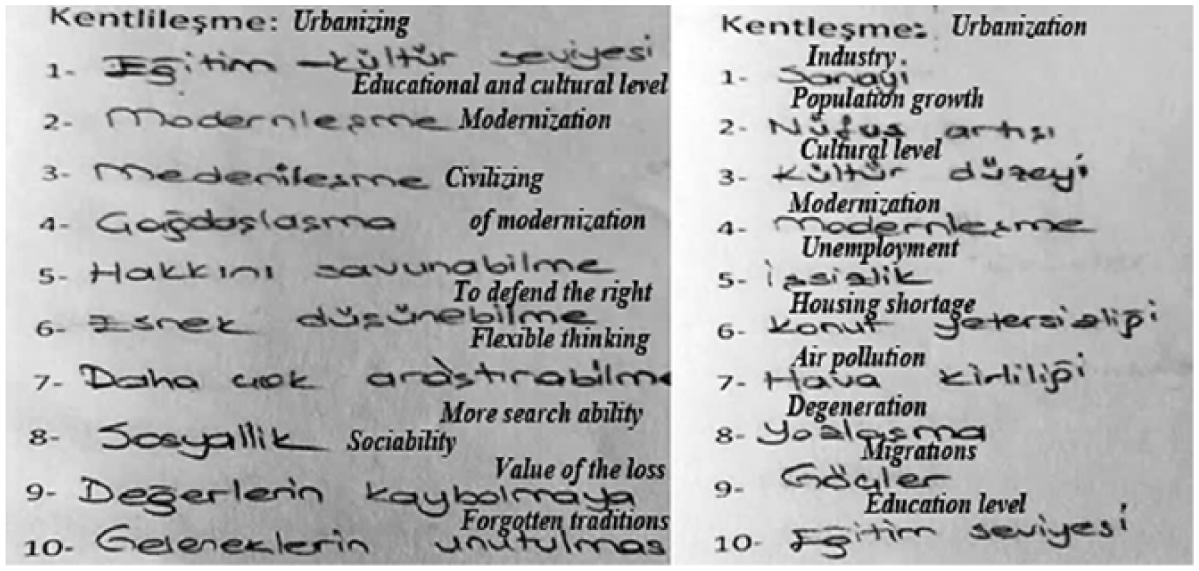
An example of statements which student-teachers wrote about the concepts of “urbanization” and “urbanizing.”
It was tried to reveal how a cognitive structure that students have in their minds about the concepts of “urbanization” and “urbanizing” and their ability to distinguish the difference between these concepts. In addition, it was planned to reveal the misconceptions of students about “urbanization” and “urbanizing” and also in this direction to give the suggestions in the conclusion part.
Findings and Comments
After data analysis, findings obtained from the study were given as tables and tried to be interpreted.
In this category, the positive image of the urban in students’ perceptions about the concept of urbanization is noteworthy. Students defined the urbanization with expressed words such as infrastructure services, employment opportunities, industry, and modern houses. These statements are concepts that can actually be used to define the image of the urban rather than urbanization. The opinions expressed here can actually be considered among the consequences of urbanization. However, urban and urbanization are different concepts. This shows that there is confusion in the perception that was created by the concept of urbanization. It is observed that the concepts of urban and urbanization are perceived to be close to each other by students.
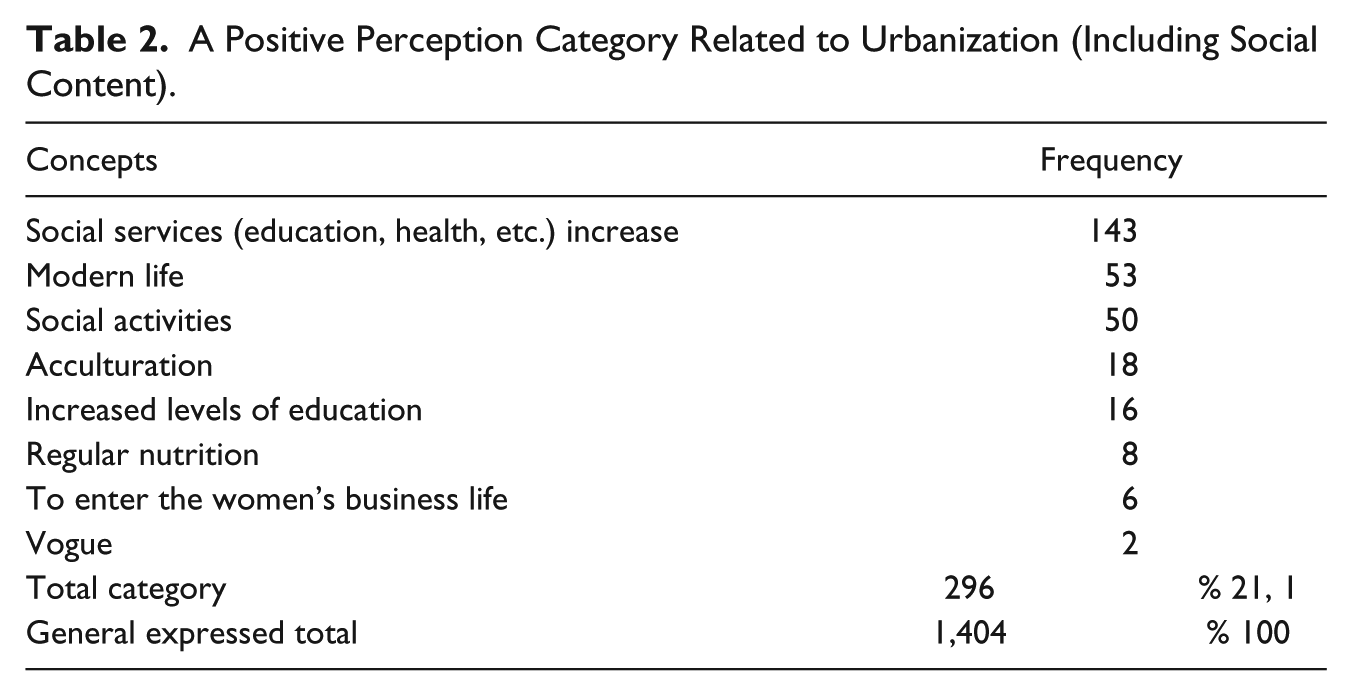
In the second category, students used some expressions such as modern life, the increase in the level of education, the participation of women in business life, and social activities. Among the total urbanization statements, the rate of this category is at a very high level—21%. It appears that students have perception confusion about the concept of urbanization. Students sometimes evaluate the concepts of urban, urbanization, and urbanizing as if they had all same meanings. Many of the expressions used are statements pointing to urban life. The idea that the concept of urbanization is in fact the accumulation of population at a certain place did not take place much in the expressions. What students understand from the urbanization refers rather the reflections of city life that they see in their daily lives.
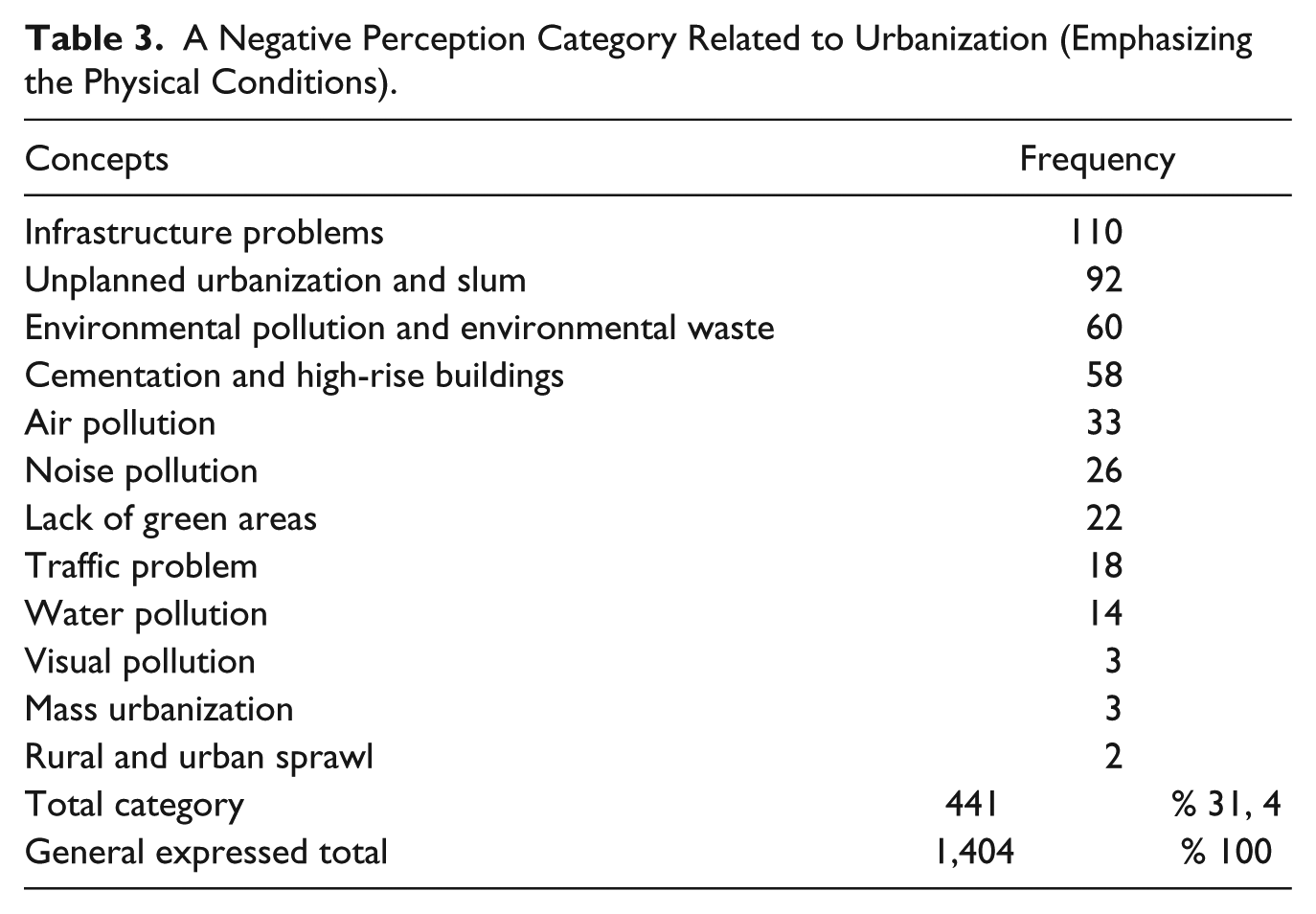
The third category represents negativity more. The frequency of statements used by students such as unplanned urbanization, environmental and visual pollution, traffic problems, and concretion is rather high. Although this category is evaluated as negative according to students’ point of view, it is one of the main categories which emphasizes the urbanization. Although the statements stated by students here tell the complexity of the urban life, they indeed refer the increase in population in a certain place. There is not a direct emphasis to population movements; however, having raised the problems caused by the accumulation of the population can be evaluated as a positive approach.
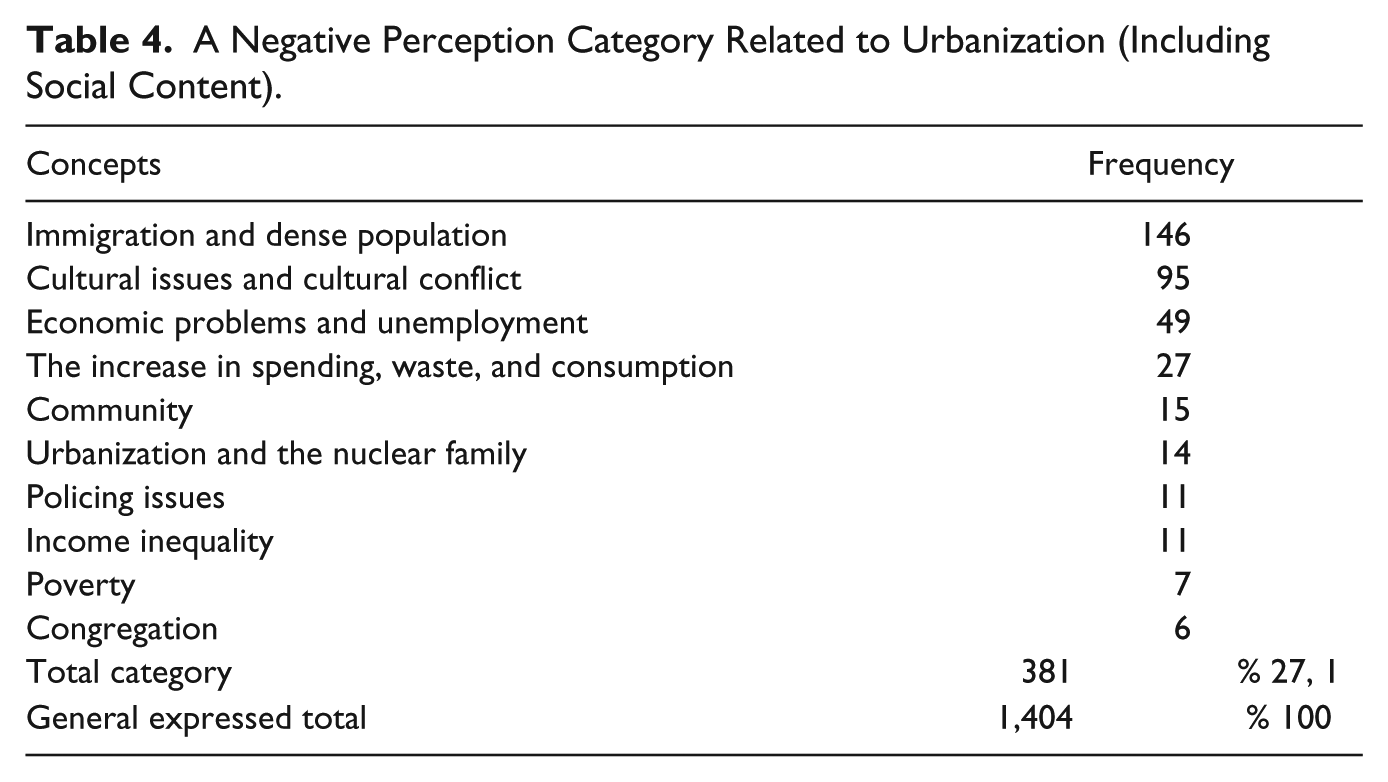
Although statements in this category have a negative impression, they are the opinions telling the concept of urbanization. Statements such as migration and population density, economic problems, and unemployment are stated as problems caused by urbanization. However, the statements such as life with community style and cultural problems evoke the concept of urbanization more. Based on these statements, it is possible to say that the concepts of urbanization and urbanizing were not understood by students. Some of the statements here especially are needed to be used to describe the concept of urbanizing. Indeed, it is a high possibility to have a complexity when urbanization and urbanizing concepts are not evaluated in the context of cause and effect relationship.
In this first category related to urbanizing, statements such as the development of services and employment opportunities, changes and development, industry and technology, and increase of income level take part mainly. In this category, students used statements related to the social aspects of urbanization more. The opinions wanted to be written in this category characterize the concept of urbanization rather than urbanizing. The most appropriate expression to make comments for this category is that students could not comprehend the concept of urbanizing exactly.
In this category about urbanizing, students used some statements such as social activity, a modern life, adapting to urban life, a conscious generation, acculturation, and information diversity. Maybe among the written statements, these are the closest statements defining the concept of urbanizing. Because social activities, the change of lifestyles, and acculturation have important roles for the concept of urbanizing. This category’s having a percentage of 22.6% shows that students partly configure the concept of urbanizing cognitively but when it comes to write 10 statements, they are getting away from the subject.
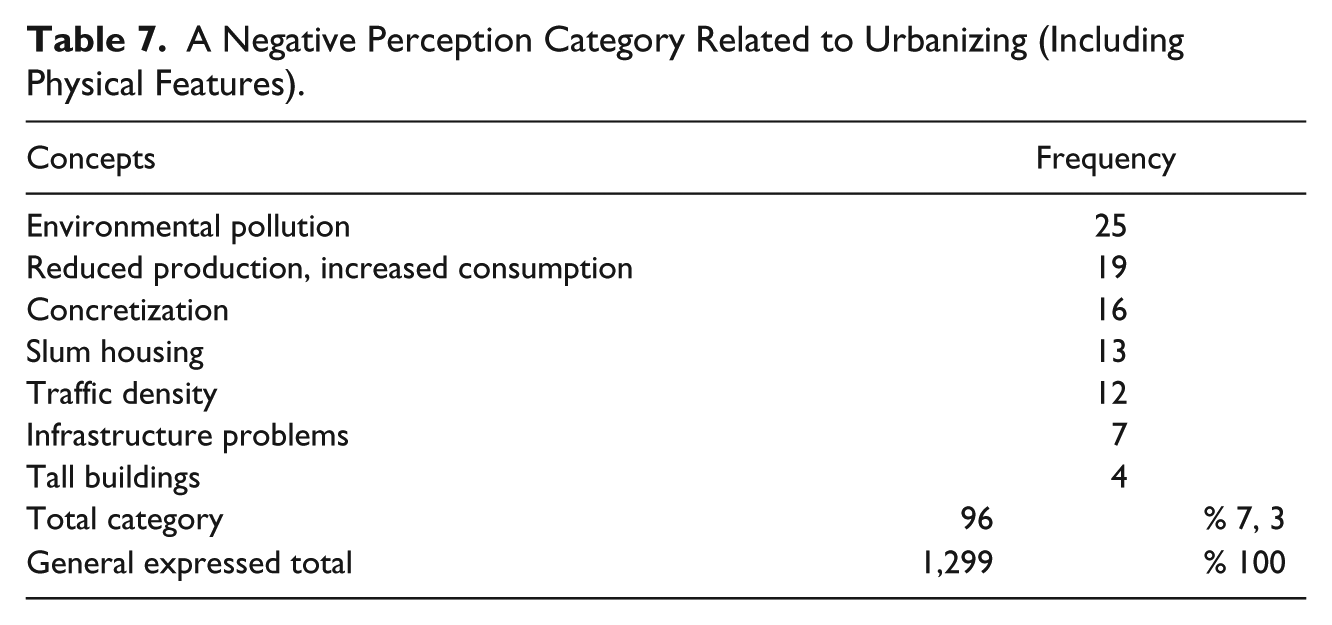
When looked at this category about urbanizing, it is observed that such statements were written mostly as environmental pollution, decrease in production, increase in consumption, concretion, and unplanned urbanization. These statements refer to problems caused by urbanization more. From this point, it is possible to conclude that students could not configure the subject of differentiating the concepts of urbanization and urbanizing in their minds or they have difficulty in writing 10 statements. It is noteworthy that the most of the statements written here are also used in the concept of urbanization. When it is thought that the concept of urbanizing is a social phenomenon, it is difficult to associate the answers given in this category directly with urbanizing. An evaluation which can be done in the direction that behavioral change which has been formed with urbanizing develops negatively can only include these statements
The statements written in the fourth category belonging to urbanizing are more suitable to the essence of the issue. The statements written by students such as social and cultural differences, artificial behavior, and psychological problems evoke the concept of urbanizing. The statements in this category such as assimilation, family problems, and income-level differences also refer to the concept of urbanizing which is a social phenomenon. Such statements as migration and population density and unsanitary conditions evoke the concept of urbanization more. The percentage of category’s being very high as 46% shows that students but not all of them have a cognitive level about urbanization. These statements show that students know the concept of urbanizing but they have difficulty in expressing them partly. Maybe the truest thing to say is that students cannot comprehend the differences between the concepts of urbanization and urbanizing completely.
Conclusion, Discussion, and Suggestions
When the findings are evaluated, it is seen that there are misconceptions about the perception of the concepts of urbanization and urbanizing. Most of the definitions written for both urbanization and urbanizing actually define the urban. But urban, urbanization, and urbanizing are very different concepts; however, they are in a relationship with each other. For example, it can be inevitable that a change is observed along with urbanization in the city’s appearance. Urbanizing is a process emerging as a result of urbanization. Expressed words that are written by students define the urban concept more. It is also seen that students do not have enough information to distinguish the phenomena of urbanization and urbanizing. The concept of urbanizing seem as a subject of sociology but for geographers information belonging to urban is especially located in the subjects of behavioral geography. When looked at the opinions expressed by students, it is noteworthy that there is a negative viewpoint about the urban and subjects related to urban (urbanization, urbanizing). Although more than half of the students attended to survey took the course of Urban Geography, opinions that they stated characterize the connections established between the urban and their daily lives. When the percentage of Tables 1 and 2 which reflects the negative viewpoint in students written statements about urbanization is compared with the percentage of Tables 2 and 3 which reflects positive viewpoint, it is noteworthy to see that negative views have a greater percentage. This result may not be surprising when it is evaluated in terms of the perspectives of the individuals of developing countries about the concept of urbanizing. The impact of country conditions on the perception of urbanization should not be underestimated. With a simple description, defining the urbanization including the movements of population with such a simple way will be a distant approach expressing the event exactly. On one side migration which occurred for various reasons from rural areas to urban led to the growth of the city spatially and on the other side may lead a transformation of some settlements into urban. Therefore, describing urbanization only as population mobility would be to ignore the changes occurred in the city. As a result of this population mobility, it is inevitable to have infrastructure, economic, and sociocultural problems in cities. The size of the problem can sometimes become a case with which local authorities cannot cope. The same situation attracts attention in the expressions written on the concept of urbanizing. Among the views students expressed about urbanizing, emphasis is more on the negativity raised by urbanizing. There observed an outcome that reflects the outlook of individuals in developing countries. It is natural for urbanizing phenomenon to be perceived as an evaluation including the problems in developing and undeveloped countries. The process of urbanization’s being a long-term event plays an important role in students’ negative evaluations. The answers to be given for the same concept by individuals of developed countries might not emphasize the negativity mostly in this way.
A Positive Perception Category Related to Urbanization (Including Physical Conditions).

A Positive Perception Category Related to Urbanization (Including Social Content).
A Negative Perception Category Related to Urbanization (Emphasizing the Physical Conditions).
A Negative Perception Category Related to Urbanization (Including Social Content).
A Negative Perception Category Related to Urbanization (Including Physical Conditions).

A Positive Perception Category Related to Urbanizing (Including Social Content).

A Negative Perception Category Related to Urbanizing (Including Physical Features).
A Negative Perception Category Related to Urbanizing (Including Social Content).

In his study named as “Perceptions of Undergraduate Students Residing in Rural Areas City: A Qualitative Analysis,” Ünal et al. (2003) looked for the answers to the questions related to the concept of the urban, urban life, important factors of urbanization, the perception created by the urban, and the choice of urban life, challenges, and opportunities. According to the findings, they reached the conclusion that university students’ urban, urbanization, and urban life phenomena do not resemble to each other so much. In the study about the urban perception of the rural population, Doğanay and Alım (2010) examined the urban perceptions of people living in a village in the city of Trabzon. In the research, it is seen that most of group members forming the sample do not want to settle in urban although they see the urban as the center of occupation, shopping, health, and education. Tezcan and Kara (2014) conducted a study to determine the perceptions of high-school students in the city of Çanakkale about the concept of “urban” and to reveal the “urban” definition in their minds. According to the results of the research, in the metaphors that students write about the urban life, concepts reflecting the positive and negative viewpoints emerged related to urban image in their minds. Findings acquired from the study of Sağdıç (2014) about İstanbul are briefly as follows: natural elements created the basic elements of the urban perception of university students rather than rich historical places. But perception has an important place in their historical and cultural heritage. In the urban life elements of the students, there are negative urban life elements such as crowd, chaos, noise, and stress; besides, there are also image elements that can be expressed as positive such as; mobility, culture, mystery, university, opportunities, and diversities. In his research about the image of the city of Balıkesir, Aliağaoğlu (2007) reached the conclusion that not only physical features but also the use of the urban is effective in the urban perception. In one of their study, Karadağ and Turut (2013) discussed the perceptions of university students about urban environment at the base of the example of İzmir. Students were asked questions to define the urban environmental perception of İzmir and their thoughts were tried to be detected about their satisfaction levels for the city in which they live and the aspects that they like or they are disturbed. In addition, participants were asked to write down their impressions about İzmir and to reflect them with symbols to their mind maps. From this point, the difference in the perception of the city of İzmir was tried to be revealed comparatively based on students’ education, cultural history, and interests. In his study of “The Perception of Urban Spaces: Research on Elazığ,” Tunçel (2009) investigated the perception of urban and especially the shopping places in the mind maps of various population groups such as high-school or university students, housewives, officers, academicians, and tradesmen, and also investigated whether there are similarities or differences in the perception of these groups and whether there are the reasons of differences. When looked at the findings, in the perception of urban spaces of all groups involved in the study, some qualities showed a remarkable association while in some groups; it was observed that there is a remarkable selective perception. It is also observed that tradesmen, teachers, academicians, and university and high school students emphasize more about the topic they are interested in their perceptions. Sandal (2007) conducted a study on three neighborhoods of Kahramanmaraş showing differences in terms of cultural and socioeconomic aspects. According to the findings of the research, the findings acquired from these three neighborhoods reflect the features of the neighborhoods. Mentioned problems show parallelism with the socioeconomic and cultural situations of neighborhood residents. In the study conducted by Coşkun and Zaman (2012), it was interpreted about the urban adaptation and urban level of the rural population migrated to the city with questionnaires applied in 26 different districts and neighborhoods of the city of Erzurum. When the survey results are evaluated as a whole, it is seen that although most of the participants (approximately %90) have been living in the urban for more than 10 years, they have not been able to adapt to urban and urban life and so their urban adaptation is low. As a result, it is determined that although participants are satisfied with the urban life mostly, they still could not adapt to urban thoroughly. Gürbüz (2007) conducted a study to identify the socioeconomic characteristics of the population migrated to the district of Yüreğir in the city of Adana, socioeconomic changes occurring in their lives, and their expectations for the future. It was determined that after the migration unemployment and financial troubles are the biggest problems of the families that attended the survey. Also the infrastructure and superstructure problems of Yüreğir make it difficult to adapt to urban life for the people who migrated there. In addition to this, significant socioeconomic changes occurred in the families migrated. Men always being in contact with the things outside the home make the change easy but women generally being at home cause a slower interaction and a less change. Also there are families saving their traditions and customs after migration and having just a little sociocultural change. Such individuals do not consider themselves as an urbanite and tend to turn back to their hometown soon. In the study named as “Experiential Learning, Spatial Practice, and Critical Urban Geographies,” Elwood (2004) conducted a study about experiential learning in urban geography teaching. As a result, students’ actively constructing their own information is provided. In the study named as “The Pedagogical Benefits of SimCity in Urban Geography Education,” Kim and Shin (2016) dealt with the educational potential of the subject by asking the students to build their own city in the game of SimCity in the course of Urban Geography. As a result; students stated that creating several unique and interesting cities with the SimCity activity presented opportunities for them to encourage their geographic creativity. In his article named as “Fieldwork in an Urban Setting: Structuring a Human Geography Learning Exercise,” Walcott (1999) acted with the idea that carefully constructed urban areas contribute to the students’ geography education. The aim of this study is to apply a model of urban setting study in human geography. For this purpose, the relationship between the city of Atlanta and its suburbs was studied. To collect data, students carried out interviews, surveys, and fieldworks on five different communities living in the Atlanta metropolitan according to the dependency theory of the suburbs. At the result of the study, it is stated that students gain an experimental experience in authentic learning, fieldwork, and determining the regions of the metropolis.
When looked at the findings of the referred study together with the results of the study, it is remarkable that there are more similarities. As some of the referred studies involve spatial researches, comparison of the results is not very convenient at all. However, there are great similarities between the studies in similar directions and the results of the research. It is noteworthy that there was a negative perception mainly in the previous studies about the subjects of urbanization and urbanizing and there is a similarity at this point. It would be the right approach to say that the most important cause of this similarity is the country’s conditions (developing country). It is also remarkable that almost all the results of the results show that individuals’ perceptions of urbanization and urbanizing reflect a more negative perspective. Especially intensively expressed features such as incompatibility and psychological problems about the subject of urbanizing suggest that the negative perception on this issue is strong. As Lynch (1960) said “urban image is important. A well-designed city invites the senses to participation.”
The impact of arranging the cities on the perception is very important. Looking at the perception that cities of our country created, it is possible to see the negativities more. As a result, it is clear that students have misconceptions about urban, urbanization, and urbanizing (“becoming urbanized,” “urban culture,” or “urban adaptation”). These events are interrelated but when their definitions are taken into account, they are different phenomena. Especially the phenomenon of urbanizing is a result born from urbanization and it is completely a social event. Maybe for this reason, it has been a subject which sociologists take care more. Students’ having this misconception although they took the course of urban geography can be evaluated as an indicator that they do not have a differentiating perception about this subject.
The features that can be suggested in this regard may be as follows:
Students are needed to comprehend the concepts of urban, urbanization, and urbanizing correctly.
It would be beneficial to teach the students that these concepts are interrelated but their meanings are quite different.
The inaccuracy of evaluating the urbanizing only under the topics of sociology science and the place and importance of this subject in the topics of human geography must be taught.
It must be taught that urban can be evaluated with its features such as economy, appearance, architecture, and so on; urbanization is especially a population movement, and it may have some conclusions; urbanizing is a process happened as a result of urbanization.
Footnotes
Declaration of Conflicting Interests
The author(s) declared no potential conflicts of interest with respect to the research, authorship, and/or publication of this article.
Funding
The author(s) received no financial support for the research, authorship, and/or publication of this article.