



Abstract
If education could be considered the profession of the utilization of knowledge, then this would be difficult to pass on, especially when we talk about human sciences. In such disciplines, it is critical to develop students’ ability to reflect philosophical contemplation, theories, and different themes on the real life. Consequently, education in humanities is a process through which the student and the lecturer alike are immersed in the reviewing and making of knowledge. Therefore, this research aims at investigating the potentials of the interactive photography exposition as an inquiry-based learning tool. The study methodology depended on carrying out an educational experiment where an interactive photography exposition was held as a learning and assessment tool within the curriculum of “Humanities in Landscape Architecture.” The study ended up with the idea that the interactive photography exposition experience promoted the making of knowledge; addition and transformation of the preexisting knowledge occurred through different phases of the immersive experience of photographs and themes interrelation and contrasting.
Keywords
Introduction
As Whitehead (1967) reported, “Education is the art of the utilization of knowledge, this is an art very difficult to impart” (p. 4). Unfortunately, some lecturers conduct courses without having precise knowledge of how students can learn. Although many academics know how to learn best, they do not cogitate whether the method they use to teach is grounded on enabling learning to happen. There is a continuous research on learning; because there are no straightforward answers to the questions “how do we learn?” This is, in fact, a relative process because education deals with particular objectives and contexts that widely differ and with students as people, who are disparate and ever changing (Fry, Ketteridge, & Marshall, 2009).
Most contemporary educational theorists rely on constructivist theories of varying types to explain how human beings learn. The idea rests on the notion of the continuous building and amending of structures in the mind that is known as schemata. Schemata change due to new understandings, experiences, and information. Namely, changing in schemata denotes that learning occurred. In this respect, learning is not just adding more knowledge, but it is the process through which changing or transformation occurs to the preexisting knowledge of the learners (Fry et al., 2009). In this sense, it should be acknowledged that planning for teaching and learning methods is one of the fundamental roles of any academic staff. The methods involved are not carried out in a vacuum, but in accordance with intended outcomes.
In the field of human science, it is really crucial to develop students’ ability to reflect philosophical contemplation, theories, and different themes on the real life. This is especially true when teaching a course concerned with humanities and the design of the built environment. Such disciplines are strongly associated with acts of continuous reinterpretation and revision. Accordingly, “teaching and learning” and “knowledge and understanding” are awkward terms for humanities, that is, we cannot say that we do not use them, but they will be tackled in a qualified way. In natural sciences, change in any subject is a result of discoveries and technological factors. On the contrary, humanities change continuously by the virtue of their being associated with culture that is always in a condition of transition. They change through internal debates and revision of preferences and methods. Consequently, education in humanities could be defined not as imparting of knowledge or skills. Rather, student and lecturer alike are immersed in the reviewing and making of knowledge. Instructors in this field do not tell their students what and how to think; they try to boost them to think within a broad academic rationale (Fry et al., 2009).
There is a real need for more constructive activities that mainly depend on student-based model. In this respect, it is significant to pursue the active learning approach. It is an approach that is typically conceptualized by opposing to teacher-based model which is a more passive method of learning. Incorporating active learning approach into traditional lecture, seminar and tutorial classes can influence students’ higher order thinking. The active learning approach gives students control over their own learning. The learners take the responsibility for important learning decisions. They must explore and experiment with a task to derive certain ideas, concepts, rules, principles, strategies, and so on. On the contrary, active learning approach provides learners with the opportunity to mediate and control learning by engaging in meaningful social interactions with other colleagues and instructors (Gogus, 2012).
One-minute papers, asking students to respond to a discussion question, using interactive technology to get immediate responses from students, writing reflections, reviewing other’s work, assessing the materials, giving immediate feedbacks, cooperative groups, developing comprehensive lists of the concepts, role-playing, group presentations, and games are all techniques of active learning (Gogus, 2012). However, the dilemma here is how to select the best technique in a specific learning medium. Disciplines vary in their objectives and intended outcomes which definitely affect the learning process itself—the methods that could be adopted to enhance learning.
Literature Review
Teaching humanities is extremely crucial in architecture, because architecture in its essence is associated with creativity that is mainly emerged as a result of human needs. In spite of the dominance of science and technology that rapidly turns creative ideas into practice, humanities still provide the critical understanding of the limits of freedom to accept and cherish (Bandyopadhyay, Lomholt, Temple, & Tobe, 2010). Therefore, and based on what is mentioned in the introduction section, it is essential to always bring students in a teaching/learning context of continuous shared experiences and debates where meanings could be transformed into concrete reality. This could bring us back to the concept of active learning. While we define the active learning as “anything course-related that all students in a class session are called upon to do other than simply watching, listening and taking notes” (Felder & Brent, 2009, p. 2), the inquiry-based learning can be considered a more structured approach to developmental learning. Students operate within a framework supported by a driving question or problematic scenario which conforms to what is said by Dewey, that thinking does not occur spontaneously but must be “evoked” by “problems and questions” (King, Goodson, & Rohani, 1998). The inquiry-based learning requires guidance from the instructor in the role of facilitator who provides structure and support that guide students in their developmental stage (Victoria University, 2017). The value of inquiry-based learning has long been recognized in schooling and higher education undergraduate courses. Often associated with the work of Dewey (1938) and Bruner (1966) and constructivist learning theory, inquiry-based learning is commonly described not only as an active but also as an interactive student-driven process, where knowledge is constructed rather than transmitted. The meanings of inquiry-based learning in higher education are multiple, contested, and subject to different interpretations within and across disciplines and settings. There are a number of education practices that have been associated with inquiry-based learning, such as problem-based learning, discovery learning, project-based learning, experiential learning, cooperative learning, or group-based learning.
Inquiry is viewed both as a means of gaining knowledge and new understanding and a method of teaching that prepares students to become researchers and lifelong learners (Preston, Harvie, & Wallace, 2015). This is the virtue that promotes inquiry-based learning to be pursued in teaching humanities, where students’ higher order thinking skills which include critical, logical, reflective, metacognitive, and creative thinking can be boosted. In this sense, it is essential to mention Bloom’s taxonomies (cognitive, affective, and psychomotor), which all have lower levels which provide a base for higher levels of learning. Comprehension and application form linkages to higher order skills in cognition. Higher order thinking skills include analysis, synthesis, and evaluation and require mastery of previous levels, such as applying routine rules to familiar or novel problems (King et al., 1998). This model was revised where the higher order thinking skills became analysis, evaluation, and creation (see Figure 1). In brief, learning occurs when instructors succeed in developing students’ cognitive skills through the recall of information to a higher level of thinking, such as understanding, applying, analyzing, evaluating, and creating (Armstrong, 2017). In such approach, peer communication and student–teacher relationships strengthen student motivation and promote responsibility for one’s own learning (Yalamanchili, Vaddi, & Anne, 2015).

Bloom’s cognitive levels of learning.
In this respect, exhibitions/expositions can be a powerful inquiry-based learning tool that can promote the higher order thinking skills in the field of humanities, not in its traditional manner, but through adopting an interactive mode where peer communication and student–teacher discourses take place. Despite that the term exposition refers to projects, presentations, or products that demonstrate whether, and to what degree, students have achieved the expected learning outcomes (namely, being an assessment tool), the interactive mode promotes the potentials of this method to be a constructive learning tool that combines discovery learning, experiential learning, cooperative learning, or group-based learning at the same time. In brief, expositions can be both a learning experience in itself and a means of evaluating academic progress and achievement (The Glossary of Education Reform, 2014). Expositions significance can be concluded in the following: Engaging students in an in-depth collaborative inquiry that provides the opportunity for students to demonstrate independence and responsibility for their own learning and exploring multiple perspectives. Guiding students in synthesizing and reflecting their knowledge. Providing an authentic process for evaluating student understanding. Joining students and instructors in a collaborative experience (International Baccalaureate Organization, 2008).
Therefore, this research will focus on the effectiveness of carrying out an interactive exposition as an inquiry-based learning tool in addition to its potential as a means for evaluating the academic progress.
Method
This research is an educational experiment that depends on carrying out an interactive photography exposition as an inquiry-based learning tool in the field of humanities in architecture. This experiment was expected to test the ability of students to realize understanding, applying (linkage to higher order thinking skills), analyzing, and evaluating skills (higher order thinking skills) due to the revised model of Bloom’s cognitive levels of learning.
Experiment Design
This educational experiment was achieved via experiencing teaching/learning in a humanities course. This experiment aims at exploring the potential of an interactive exposition as a learning tool relevant to the virtue of the humanities discipline as mentioned before.
General information
This part refers to the basic information of the experiment:
The interactive photography exposition was examined through its application in a course titled “Humanities in Landscape Architecture.”
The number of students who attended the course was 19, but 18 students shared in this experience.
Term: Fall 2016.
Course theme
The question of this experiment upon which the interactive photography exposition was held, was as follows: How can students experience the built environment via applying their studied themes?
Experiment goal
The main goal of this experiment is exploring the potential of an interactive photography exposition as an inquiry-based learning tool that can boost understanding, applying, analyzing, and evaluating skills which, in turn, promotes the making of knowledge (addition and transformation of the preexisting knowledge).
Experiment structure
By the end of week 9, students were asked to select one of the studied themes to apply it on their real life by experiencing different spaces. Four captured shots connoting this theme should be stuck on a cardboard sheet (50 cm × 70 cm), with a comment card beside each photograph for the participation by the other colleagues. Exhibitor’s comment card should be stuck on the back of the cardboard (to avoid any prejudice that might affect participants’ opinions). On this card, the exhibitor defined his or her selected theme explaining how it was reflected on the photographs (see Figure 2). Accordingly, this experiment had two main phases, first, experiencing the built environment to prepare the exhibited product, and then presenting it via an interactive mode. Through these phases, the students could construct knowledge as follows:
In the first phase, while students were experiencing their environment to apply their selected theme, they actually tested their understanding and applying as levels of thinking. They needed to define the studied themes to engage mental process beyond habitual response (International Assembly for Collegiate Business Education, 2016). They needed to distinguish and show how these themes became concrete in their real world.
In the second phase, on the day of the exposition, students were expected to achieve another two higher levels of thinking. First, when they commented on their colleagues’ work (an hour session), they actually needed to analyze and evaluate. Students should cite evidence and develop a logical argument to make a judgment based on specific criteria (see Figure 3). Second, when the discussion took place (an hour session), the captured photographs were compared first to what was written by each exhibitor. Then, another level of analysis and evaluation was accomplished via comparing what was written by each exhibitor and what was written by the other participants in relation to the captured photographs. In this part, more comprehension, analysis, and evaluation could be achieved, and hence the learning process could be assessed (International Assembly for Collegiate Business Education, 2014-2016).

Preparing the interactive photography exposition product.

Students were commenting on their colleagues’ work.
Data Gathering Tools
Through this experiment of carrying out an interactive photography exposition, two major data gathering tools were applied.
Discussion session
Through the second phase of the experiment, the exposition day, two levels of analysis and evaluation were achieved; accordingly, the data produced from the discussion session can be presented in terms of the following:
Photographs and themes interrelation: This tool is concerned with comparing photographs with the themes selected by every student in an individual manner. The importance of this step was embedded in checking to what extent the theme selected by every student was strongly represented by their captured shots.
Contrasting: This tool means comparing the different views to investigate consistency and interrelation between the intended themes explained through the photos by each exhibitor and the other participants’ opinions. The result was illustrated in a qualitative manner via analyzing comments and rating the levels of association by being similar, related, or confusing.
Questionnaire
A two-question questionnaire was designed to investigate students’ feedback about the impact of carrying out such exercise on the learning process. The questions were about reinforcing and meaningful (Teller, 2007) aspects of the exposition. Being reinforcing means the influence of the exercise on enhancing understanding of different themes. On the other hand, being meaningful denotes to which extent the interactive exposition adds value through relevant experiences and promotes change in students’ knowledge (affects application, analysis, and evaluation skills). The questionnaire used a 5-point Likert-type scale (see Figure 4).

Questionnaire template.
Data Analysis Method
It is a case study research with a qualitative intent, seeking to explore the potential of an interactive exposition as an inquiry-based learning tool. The question of whether or not the use of the method is predicted to cause such change in future cases does of course need quantitative analysis and then a conclusive statistical inference of a fairly representative sample of a variety of classes rather than focusing on one school of architecture. Hence, the researcher used only “descriptive statistics” to describe data.
Findings
The findings of the interactive photography exposition are drawn in terms of the results of the data gathering tools as follows:
Discussion Session
By comparing every student’s photographs and their selected theme and its description written on the back of the cardboard, it was found that (see Table 1)
the majority of students succeeded to capture photographs denoting their selected themes,
many photographs connoted other meanings that provide the opportunity to be open to other interpretations, and
specific themes seemed confusing to be illustrated, such as topophilia and aesthetic experience.
The findings of the interactive and discussion/contrasting phase
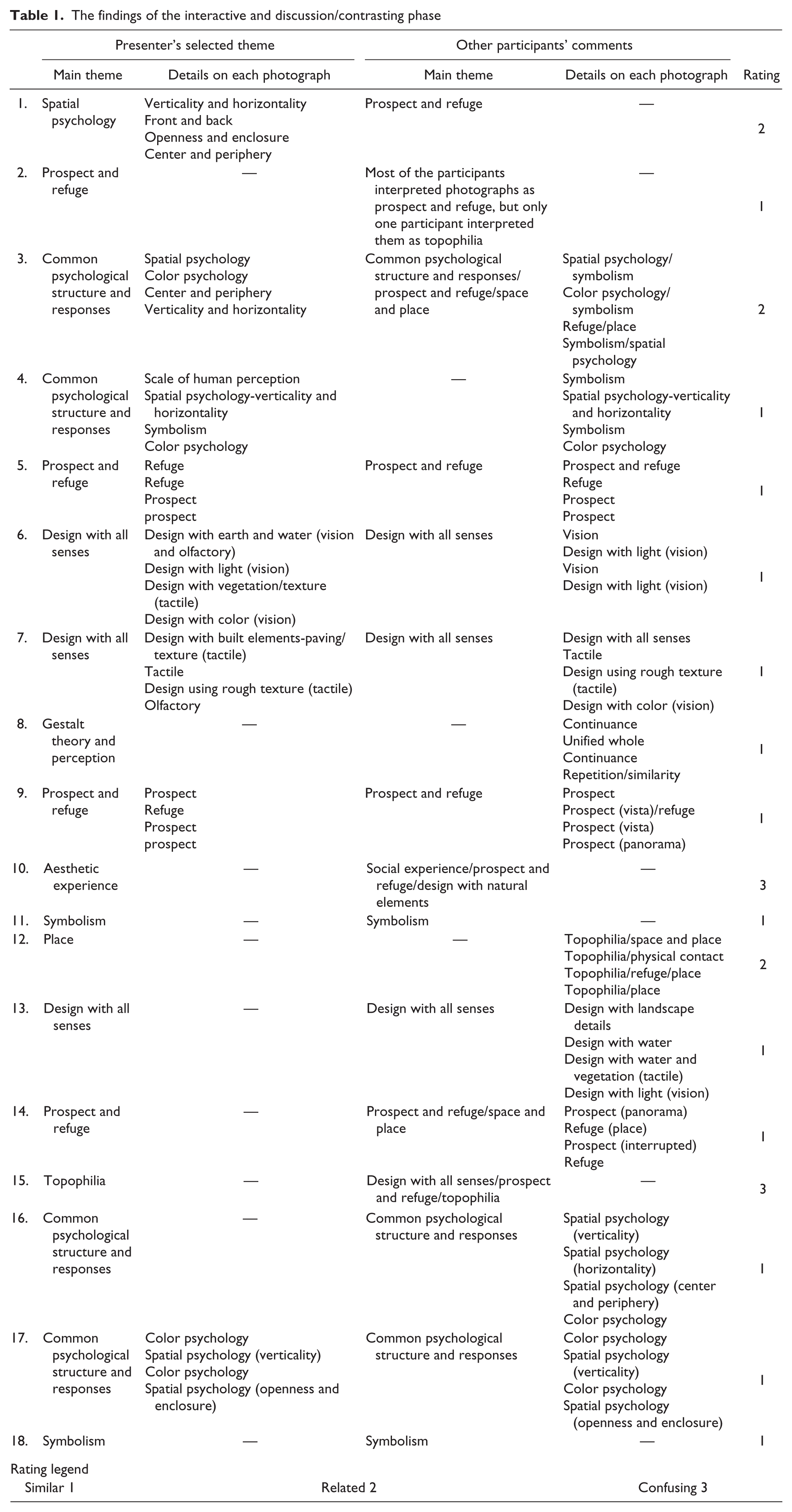
On the other hand, contrasting each exhibitor’s view with the other participants’ interpretations was achieved as shown in Table 1.
Comparing what every student wrote at the back of their cardboard with what other participants wrote beside photographs revealed the following (see Figure 5):
72% denoted similar responses.
17% connoted associations.
11% was confusing; responses were extremely dissimilar.

Themes interrelations.
Questionnaire
The questionnaire result revealed the following:
Reinforcing
Students agreed that the experience of the interactive photography exposition was reinforcing to a great extent. This exposition as a learning tool enhanced the understanding of the different taught themes, ideas, and theories. About 54% rated the exposition as being reinforcing by “good,” and 38% described it as “very good” (see Figure 6).

The interactive photography exposition as being reinforcing.
In addition to what was presented in rating the aspect of being reinforcing, students added valuable comments because they were allowed to add any extra comment in their sheets as shown in Figure 4. Students’ comments in this sense can be concluded as follows:
Applying themes in the real life by experiencing the surrounding environment to reflect themes was very useful in assimilating the studied topics not only in a theoretical way but also through the lived experience with all senses.
Limited variety in the themes selected was noticed, which affects the experience to some extent. Some topics were understood thoroughly, whereas others were not mentioned at all.
Meaningful
Students agreed that the experience of the interactive photography exposition was meaningful also. This exposition as a learning tool added value through relevant experience and promoted change in students’ thinking (additional concepts and interrelations were realized). About 38% rated the exposition as being meaningful by “4” and 31% described it as fully “useful” (Figure 7).

The interactive photography exposition as being meaningful.
In this aspect of being meaningful, students also added specific comments as follows:
Discussing themes in relation to the captured photographs and comparing other point of views affected the concept of ideas association. Themes were reexplained and interrelated with other themes, which, in turn, affected changing schemata and, at the same time, enhanced understanding.
It could have been more beneficial in this sense, if students had been required to select themes without any repetition to cover all the studied themes to enhance ideas associations.
Discussion
Based on the findings of the data gathering tools, discussion will be presented to explain the efficiency of the interactive photography exposition as an inquiry-based learning tool in teaching humanities in architecture.
The interactive photography exposition as an inquiry-based learning tool that boosts different levels of thinking skills:
The findings of the photographs and themes interrelation showed that the majority of students succeeded to capture photographs denoting their selected themes. This proved that this experience enhanced students’ skills in understanding and applying what they have learnt to a great extent.
The findings of contrasting each exhibitor’s work with the other participants’ interpretations revealed that students could read and interpret their colleagues in a similar manner. However, many photographs connoted other meanings which, in turn, promoted the opportunity to be open to other interpretations. Accordingly, students succeeded to discover new meaning associations through their curriculum, which reflects achieving higher levels of thinking, analysis, and evaluation. On the other hand, specific themes seemed confusing to be illustrated, such as “aesthetic experience” and “topophilia.” Students showed a wide range of different responses. Actually, both themes are very comprehensive to be presented in only four simple shots; in such cases, the holistic context should be understood and this could be achieved through videos not static scenes. However, many responses to “aesthetic experience” and “topophilia” were accepted. In addition, students declared that specific topics became clearer, whereas others were still vague in the lived experience. This happened because students were free to select any of the studied themes. Therefore, this resulted in the inequality in understanding all topics in depth. Nevertheless, this weak point in such experience is really difficult to manage, because if we ask students to not repeat themes, they can easily guess what is presented.
The findings of the students’ feedback through the questionnaire were consentient with the findings of the other tool. Students confirmed that the experience was both reinforcing and meaningful. They appreciated this experience which enhanced their assimilation of different topics and themes while addition and transformation of the preexisting knowledge were realized. Definitely, this happened via reaching higher order thinking skills through analysis and evaluation.
The interactive photography exposition as an evaluation tool:
Although investigating the potential of the interactive exposition as an evaluation tool was not targeted, it is worthy to be discussed in this context. Previous studies pointed out that exposition can be held by the end of the courses to evaluate the intended learning outcomes. Expositions or exhibitions are summative assessments, but the process of building up to this final event should include ongoing assessment, feedback, and revision (Brooke & Andrade, 2013). The findings of this research were in correspondence with these previous studies. The findings of the photographs and themes interrelation and contrasting, and the questionnaire as well, brought out remarkable achievement in understanding, analysis, and evaluation skills. These concordant results emphasized the potential of expositions as an evaluation tool especially when adopting an interactive mode that enhances testing a wide range of thinking skills.
Conclusion
Humanities incite a deeply interesting, passionate pedagogic enterprise (for both teachers and students). However, the dynamism of that enterprise that is derived from the relation between the abstract studied themes at the classroom and the world beyond is the most crucial virtue of such discipline. Therefore, justification, legitimization, and acceptance in terms of our concrete and designed world are one of the key issues that should be considered deliberately. In this respect, considering learning methods to achieve the optimum assimilation of the studied themes, concepts, and theories is indispensable.
Accordingly, this article, as a case study research, aimed at exploring the potentials of the interactive photography exposition as an inquiry-based learning tool. The research was ended by explaining the inherent capacity of expositions to enhance not only students’ understanding and application abilities but also the higher order thinking skills of analysis and evaluation. Holding expositions via an interactive mode among students promoted the making of knowledge. In other words, addition and transformation of the preexisting knowledge can occur through the different phases of this interesting experience of photographs and themes interrelation and contrasting. Students’ feedback was consentient with the findings of this experience. Students showed great satisfaction about the value of the interactive photography exposition in enhancing their understanding and building their knowledge. Furthermore, the results brought out remarkable achievement in understanding, analysis, and evaluation skills which also punctuated the potential of expositions as an evaluation tool, especially when pursuing the interactive mode that enhances testing a wide range of thinking skills.
Footnotes
Declaration of Conflicting Interests
The author(s) declared no potential conflicts of interest with respect to the research, authorship, and/or publication of this article.
Funding
The author(s) received no financial support for the research, authorship, and/or publication of this article.
