




Abstract
Students placed in special education programs for emotional and behavioral disorders with emotional disturbance (ED) identification have academic outcomes that lag both students in regular and special education. This issue is especially important for youth attending urban schools. Although prior research has examined students identified as ED, little research has examined how students who experience de-identification fare with regard to academic or behavioral outcomes. To our knowledge, this is the first study to examine the relationship between ED de-identification and student outcomes in the United States. The study uses longitudinal, administrative data to estimate the relationship between special education de-identification from ED and both academic and school discipline outcomes. Results of regression models with a variety of fixed effects, including student fixed effects, suggest that students who are de-identified have higher academic achievement after de-identification and a lower probability of experiencing an in-school suspension (ISS). Results for out-of-school suspension (OSS) are mixed. The results suggest that appropriately timed exit from special education services for students with ED who have been determined by individualized education program (IEP) teams to be suitable for de-identification is unlikely to harm students academically but that extra attention to OSS may be needed. The results point to the need for more attention to de-identification.
Keywords
In the United States, a disability label is required for students to receive free and appropriate special education services and accommodations. A total of 6,048,882 students aged 6 through 21 years, or 8.8% of the general student population, were served under the Individuals with Disabilities Education Act in 2016 (IDEA; U.S. Department of Education Office of Special Education and Rehabilitation Services [OSERS], 2018). IDEA (2004) covers 13 disability categories. More than 330,000 students aged 6 through 21 years (approximately 5.5% of the total special education population) are currently identified as having emotional disturbance (ED; OSERS, 2018). In the federal law, an ED is characterized by the persistent and educationally impactful presence of “(a) an inability to learn that cannot be explained by intellectual, sensory, or health factors, (b) an inability to build or maintain satisfactory interpersonal relationships with peers and teachers, (c) inappropriate types of behavior or feelings under normal circumstances, (d) a general pervasive mood of unhappiness or depression, and (e) a tendency to develop physical symptoms or fears associated with personal or school problems” (IDEA, 2004).
To date, research on students experiencing behavioral problems at schools and identified as ED has generally focused on the processes by which students become identified, the academic performance and behavioral outcomes of students once identified, and the characteristics, such as race and gender, of students who become identified (Dhuey & Lipscomb, 2010; Donovan & Cross, 2002; Harry & Klingner, 2014; Skiba et al., 2005; Sullivan & Bal, 2013). Research shows that students with ED have significantly lower academic outcomes than students without ED (Donovan & Cross, 2002; U.S. Department of Education, 2016; Wagner, Friend, et al., 2006). In addition, students with ED are more likely to experience exclusionary discipline, such as suspensions (U.S. Department of Education Office for Civil Rights, 2014). Although, these disparities are more significant for youth in urban schools, especially for students of color at the intersection of disability, race, and urban education, disability identification is an understudied subject in urban education (Blanchett et al., 2009; Harry & Klingner, 2014).
The receipt of special education services is contingent upon being labeled as having a disability that requires accommodations and adaptations (IDEA, 2004). By federal law, an individualized education program (IEP) must be developed for each student by a multidisciplinary team called an IEP team. The IEP teams review student progress and needs against the IEP objectives annually. The teams must formally re-evaluate student eligibility at least every 3 years, at which point the extent to which the qualifications for special education services are met will be reconsidered and de-identification can take place (IDEA, 2004). 1 To date, little research has explored student outcomes following such de-identification, but the implications of de-identification are potentially significant.
The potential implications of de-identification do matter for all schools but are particularly important for schools in urban settings. The pressures to address special education enrollment as well as student behavioral incidents, particularly those that result in exclusionary discipline (e.g., suspension), have been particularly pronounced in urban settings (Connor, 2008; Harry & Klingner, 2014). Guidance and accountability efforts from the federal government have, over the last several decades, pressured school districts to reduce racial disparities in special education and in the use of exclusionary discipline (U.S. Department of Education, 2016; U.S. Department of Justice & U.S. Department of Education, 2014). To the extent that urban schools educate larger proportions of students of color, these pressures have been particularly pronounced for urban schools. This potentially creates a quandary for urban educators who may face dueling pressures to reduce disparities in special education identification, leading them to de-identify students from special education, while also facing pressure to address misbehavior, which might motivate them to desire providing special education services to students with disabilities that result in behavioral challenges.
Given the requirements for ongoing qualification, students with ED who are making academic and/or behavioral progress, perhaps in part as a response to special education services, would be the most likely to be considered for de-identification. That said, although selection would suggest that students showing academic progress or improved behavior would be most likely to be considered for de-identification, theory suggests that such de-identification could have additional positive or negative implications for student progress.
The Special Education Paradox: Effects of Special Education Identification
There are theoretical arguments for both negative and positive outcomes to be associated with ED de-identification. On one hand, the appropriation of school-based special education services is designed to improve the academic outcomes for students with individualized needs by providing such students with free and appropriate services and accommodations (Bateman & Linden, 1998). For instance, rigorous experimental evidence points to the availability of academic interventions that can significantly improve achievement (Swanson & Hoskyn, 1998). Furthermore, students referred for special education typically receive assessments in speech and language as well as physical and mental health, which may result in additional wraparound support services (Morgan et al., 2015). Indeed, empirical research exploiting variation over time in students’ receipt of special education services has demonstrated positive impacts of special education placement, including for students classified as ED (Hanushek et al., 2002).
As a result, while students who are recommended for de-identification are likely to be those who are performing well and have made significant improvements under special education services, label removal could negatively affect student academic achievement by removing beneficial services. Similarly, for behavioral outcomes, students in special education receive protections against disciplinary consequences insofar as school administrators must consider whether misconduct is a manifestation of the disability. As a result, de-identification from special education may open students to an increased likelihood of experiencing exclusionary discipline given that any misconduct would no longer be subject to manifestation hearings and legal protections. This risk is particularly pronounced in urban settings serving higher proportions of students of color insofar as urban schools are more likely to employ zero tolerance approaches to discipline and less likely to use alternative, non-punitive approaches, such as restorative justice (Curran, 2019; Payne & Welch, 2015; Welch & Payne, 2010).
However, researchers and practitioners have also noted that there may be negative consequences associated with having a disability label and being placed in special education. Specifically, a disability label may stigmatize students, segregate them from their peers, expose them to lower expectations and weaker curricula, and result in students’ internalization of negative self-concepts (Connor, 2008; Donovan & Cross, 2002; Harry & Klingner, 2014; Higgins et al., 2002; Varenne & McDermott, 1998). Indeed, some research has found that, overall, special education services may have negligible or even negative effects on academic and behavioral outcomes in elementary school (Morgan et al., 2010). Students placed in special education have a much lower rate of grade promotion and graduation than their non-labeled peers (Heubert, 2002; McGee, 2011; Schifter, 2011).
Although federal law (IDEA, 2004) affords greater protections, limiting the circumstances under which students in special education programs can receive exclusionary disciplinary actions, students with a disability label are more than twice as likely to receive an out-of-school suspension (OSS) compared with students without a disability label (U.S. Department of Education Office for Civil Rights, 2014). To the extent, then, that de-identification results in students experiencing less stigma, having greater access to rigorous curriculum and instruction, or encountering differential teacher expectations, we might expect that de-identified students could experience more positive academic and behavioral outcomes.
Donovan and Cross (2002) have described these competing theoretical positions as the special education paradox. The tension between the positive and negative potential outcomes has led researchers, educators, policymakers, families, and other stakeholders to debate the consequences of special education identification. Although it is beyond the scope and ability of the data used in this study to explore these particular mechanisms, the competing theoretical perspectives motivate the importance of empirically examining academic and behavioral outcomes for students who experience de-identification from an ED classification.
Students Classified as Emotionally Disturbed
The special education paradox becomes more visible for students classified as emotionally disturbed. Only 47.2% of students with an ED label spend more than 80% of their school days in general education classrooms (OSERS, 2018). Although not specific to ED students, prior work has found that students in special education programs in urban contexts are more likely to be placed in non-inclusive settings (Brock & Schaefer, 2015). When these special education services are provided in self-contained special education classrooms, they may also be linked to tracking practices that limit students’ access to general education curricula. Furthermore, for students with ED identification in inclusive settings, prior work has shown that they can have disruptive effects on peers’ learning as a result of behavior (Horoi & Ost, 2015).
IDEA (2004) mandates behavioral support plans for students with the ED identification as a part of their IEPs. However, only about half of the students with ED actually receive behavioral support plans and a small percentage of students with ED at any grade level receive mental health or behavioral support services (Wagner, Friend, et al., 2006). This lack of service may be exacerbated in urban settings given that city schools have been found to have higher student–counselor ratios than non-urban settings. In fact, less than 5% of urban school districts meet the recommended ratio of counselors to students, meaning that ED students in urban schools may be less likely to have access to needed support services both while receiving special education services and after being de-identified (Gagnon & Mattingly, 2016). However, other work has found that urban schools tend to offer more mental health-specific counseling than non-urban schools, suggesting that while the ratio of counselors may lag non-urban settings, there may be variation in the types of counseling provided (Slade, 2003).
Of students with disabilities, students with ED have the third lowest graduation rate (57%) with attainment of a regular high school diploma just above students with intellectual disabilities and students with multiple disabilities, 42.2% and 47.7%, respectively (OSERS, 2018). Students with ED have the highest dropout rate among all disability categories at 34.8%, substantially larger than the dropout percentage for any other disability categories (OSERS, 2018). Students with ED are arrested and incarcerated at a higher rate than their peers with and without disabilities (47.7%; Quinn et al., 2005). Students identified as ED had the highest rate of suspensions for more than 10 days of any disability category. For every 10,000 children and students aged 3 through 21 years with ED, there were 365 students who received OSSs or expulsions and 114 children and students who received in-school suspensions (ISSs) for more than 10 cumulative days (OSERS, 2018).
In summary, theory suggests that de-identifying students as ED could either have positive or negative consequences and that these consequences are particularly important given the at-risk nature of the group (U.S. Department of Education, 2016; Wagner, Friend, et al., 2006; Wagner, Newman, et al., 2006). Although better understanding the implications of de-identification is important for all schools, the findings are particularly relevant for urban schools that, in virtue of serving greater proportion of students of color, may face differential pressures to reduce special education disproportionality. Despite this importance, to date, little empirical research has examined the academic and behavioral performance of ED students who are de-identified from the ED classification.
Present Study and Research Questions
The purpose of this study is to address an important gap in the literature by providing some of the first evidence on disability label removal for ED students. The empirical approach uses both a student fixed-effects model as well as models that condition on prior year academic achievement and behavioral measures to examine outcomes of de-identification from the ED classification. Drawing on longitudinal data from the state of Wisconsin for the 2005–2006 through 2012–2013 academic years, this study addressed the following research questions:
In answering these questions, this study provides insights that can be directly useful to educators and policymakers considering decisions regarding ED de-identification.
Method
Data
We drew on administrative data from the Wisconsin Department of Public Instruction (WDPI). The data included information on students in public schools within the state for the 2005–2006 through 2012–2013 school years—the full set of years made available by the state agency, though the outcomes related to discipline were available for only a subset of these years. The dataset was longitudinal in nature with students being observed in each of the years of data. The full dataset had more than 3 million student-year observations. Across all student-years in the data, approximately 1.70% of students were classified as emotionally disturbed at a given time. The highest rate was in city settings (1.89%) and the lowest in suburban settings (1.35%). In general, about 16.5% of students in urban schools had some disability status compared with about 12% in suburban settings.
For the purposes of this study, we restricted our primary analyses to students who were identified with an ED label at some point in the observed dataset. This restriction allowed us to produce estimates based on comparisons to other students who were labeled ED at some point in the observed data rather than drawing comparisons to students who never had this identification. We further restricted the sample to observations with non-missing data on key independent and dependent variables, such as special education status, test scores, and disciplinary outcomes. Furthermore, the first year of observed data was not directly used in analyses, as the calculation of de-identification indicators was dependent on observing students’ disability status in a prior year. Finally, disciplinary data were available for all grade levels, whereas achievement data were only available in tested grade levels (3rd-8th and 10th grades). As a result of these restrictions, our primary analytic sample size was 43,892 student-years for models predicting academic achievement and 60,779 student-years for models predicting disciplinary outcomes.
Our key independent variables were indicators of ED status. The administrative data included an indicator of whether a student had an ED label in a given year. Using this indicator, we created four binary variables representing (a) whether a student was ever identified as ED in the data and, for students who were, whether the observation was in a time period (b) prior to being identified as ED, (c) when they were identified as ED, or (d) after they had been de-identified as ED. In particular, for students identified with an ED label at some point, the latter three of these variables represent indicators of the time before, during, and after the ED identification. In our primary models, we dropped observations in the pre-ED period and focused on the indicator of whether the observation was in a time period after the student had been de-identified as the primary independent variable of interest. In all models, the comparison group was the time period during which students were identified as having ED.
We focused on several key dependent variables. First, we explored the degree to which ED de-identification relates to academic achievement on mathematics and English/language arts tests. In this study, academic achievement was captured by scale-scored tests administered in grades 3rd to 8th and 10th grade. These scores came from the Wisconsin Knowledge and Concepts Examination (WKCE), Wisconsin’s accountability exam (WDPI, 2017). We standardized these scale scores within grade-years allowing us to estimate the relationship between the ED indicators and standardized achievement in mathematics and English/language arts content areas.
The second set of dependent variables consisted of measures of school disciplinary outcomes. We focused on the two most commonly used forms of exclusionary discipline, namely OSSs and ISSs. The administrative records included the number of days that a student experienced OSS and/or ISS during the school year. We created binary indicators of whether a student experienced OSS or ISS during the school year and used these binary indicators as the primary disciplinary dependent variables.
Primary Analysis
We estimated the relationship between ED de-identification and outcomes of academic and disciplinary outcomes using an ordinary least squares regression framework with fixed effects. In our primary models, we predicted academic or disciplinary outcomes from our binary indicators of ED status as follows:

where Outcome represents either a continuous measure of standardized mathematics or English/language arts achievement or, for models examining disciplinary outcomes, a binary indicator of whether student i experienced OSS or ISS in grade g in school s in year y; ED_De-identified represents a binary indicator for the period after a student was de-identified as ED; PriorYearOutcomes represents lagged outcome variables (either math and English/language arts achievement or days in ISS and OSS); YearFE introduces year fixed effects through a series of year dummy variables; GradeFE introduces grade-level fixed effects through the inclusion of grade dummy variables; and Student/SchoolFE represents either a student fixed effect or a school-year-grade-level fixed effect. The coefficient of interest in this model is β1 which represents the difference in standardized achievement score or likelihood of receiving exclusionary discipline for students in a time period after ED de-identification as compared with students who are identified with an ED label.
In the results presented, we focus on four variations of our primary model. The base model controls for just year and grade fixed effects. The second model adds students’ prior year outcome measures as controls. The third model includes students’ prior year outcomes but replaces the year and grade fixed effects with the school by grade by year fixed effect. In the final model, we include student fixed effects rather than prior year outcome measures along with the grade and year fixed effects. As discussed by Angrist and Pischke (2009), although the inclusion of both lagged outcomes and student fixed effects in the same model is not recommended, including each in separate models may offer brackets or bounds on the true relationship. Consequently, we present and focus on models with lagged outcomes and student fixed effects separately in our results.
As with any observational study, a primary concern in this analysis is that of omitted variable bias. As previously noted, given IDEA eligibility criteria, students classified as ED who are considered for de-identification are likely to be those who are showing the most progress under special education services, potentially biasing estimates toward observing higher academic achievement and lower disciplinary infractions for de-identified students. To ascertain the true effects of ED de-identification on the outcomes of interest, the ideal research design would employ random assignment in which students are randomly chosen to either be de-identified or remain identified.
In the absence of such random assignment, this study’s use of a variety of fixed effects approaches attempts to address concerns of bias by accounting for a number of unobserved characteristics of schools and students. The inclusion of grade fixed effects implicitly controls for all shared characteristics of students in a given grade. For instance, if students in upper grades are both more likely to be suspended and also more likely to experience ED de-identification, the grade fixed effect can account for this relationship. The inclusion of a year fixed effect implicitly controls for all fixed aspects of schools and students in a given year. For instance, if the use of suspension increased over time as did the rate of ED de-identification, the year fixed effects would account for this temporal trend. The inclusion of the school-year-grade fixed effects implicitly controls for all fixed aspects of students in a given grade level in a given school in a given year. Estimates derived from such models are based off comparisons of students in the same grade, in the same school, and in the same year. The inclusion of a student fixed effect implicitly controls for all characteristics of a given student that do not vary over time (e.g., gender and race). For instance, if a male student is more likely to be de-identified and more likely to be suspended, the inclusion of the student fixed effect would account for this relationship. In models including prior year academic or disciplinary outcomes, the analytic approach further attempts to mitigate selection based on time-varying characteristics of students.
Although the use of each of these fixed effects and the inclusion of prior year outcomes as controls addresses many potential sources of omitted variable bias, it is possible that time-varying covariates that are not captured in the prior year academic or behavioral measures could still bias estimates. Consequently, the results should be interpreted as adjusted relationships rather than definitive causal estimates. Furthermore, we note that our study seeks to understand the resulting academic and behavioral outcomes for students who are chosen to be de-identified. Our results then should not be taken to generalize to all students who are classified as ED. In particular, students who are struggling academically or behaviorally are likely to be best served with the additional supports and services of special education. Our results, then, pertain to students who, in the opinion of an IEP team, have reached a level suitable for de-identification.
Results
The results of our analysis indicate a consistent positive relationship between ED de-identification and academic achievement. In addition, we show that de-identification is related to a consistently negative relationship with ISS but mixed results with regard to OSS. In particular, students who have been de-identified are significantly less likely to experience ISS in a given school year as compared with students who are identified as ED, but, depending on model specification, may or may not be less likely to experience OSS.
Descriptive Findings
Tables 1 and 2 provide a descriptive overview of the primary sample for models predicting academic outcomes, whereas Tables 3 and 4 provide a descriptive overview of the primary sample for models predicting disciplinary outcomes. Across both samples, the proportion of students who are labeled as ED at some point in the data is relatively small compared with the total population of public school students in Wisconsin. However, within this group, there is non-trivial movement between ED status across time. As shown, in any given year, approximately 3% to 7% of the sampled students (those who have an ED identification at some point in the data) have the label removed, whereas between 13% and 22% of the students in the samples receive the ED identification.
Means and Standard Deviations for Key Independent and Dependent Variables for the Full Academic Achievement Sample and by Year.
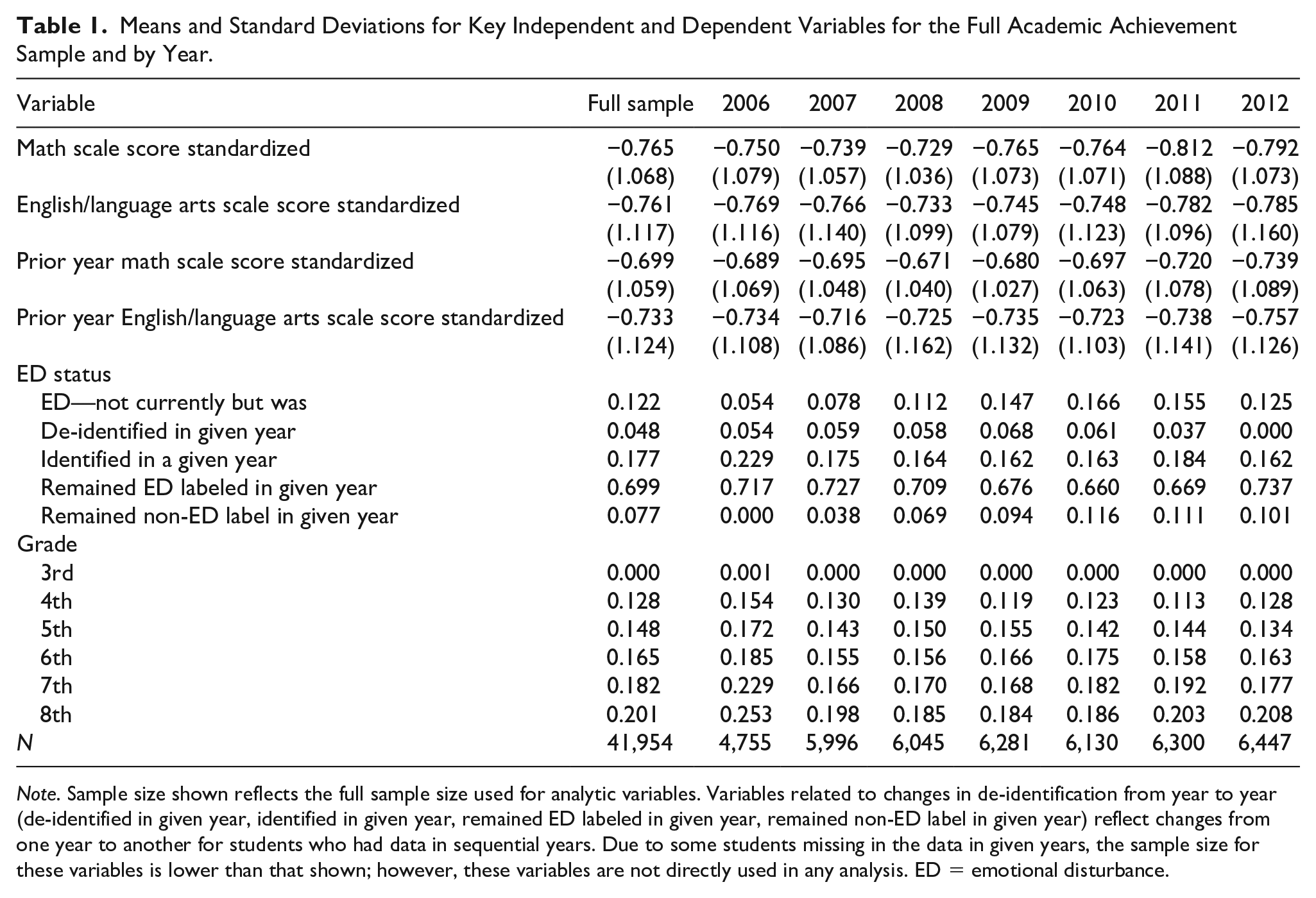
Note. Sample size shown reflects the full sample size used for analytic variables. Variables related to changes in de-identification from year to year (de-identified in given year, identified in given year, remained ED labeled in given year, remained non-ED label in given year) reflect changes from one year to another for students who had data in sequential years. Due to some students missing in the data in given years, the sample size for these variables is lower than that shown; however, these variables are not directly used in any analysis. ED = emotional disturbance.
Means and Standard Deviations for Key Independent and Dependent Variables for the Full Academic Achievement Sample and by ED Status.
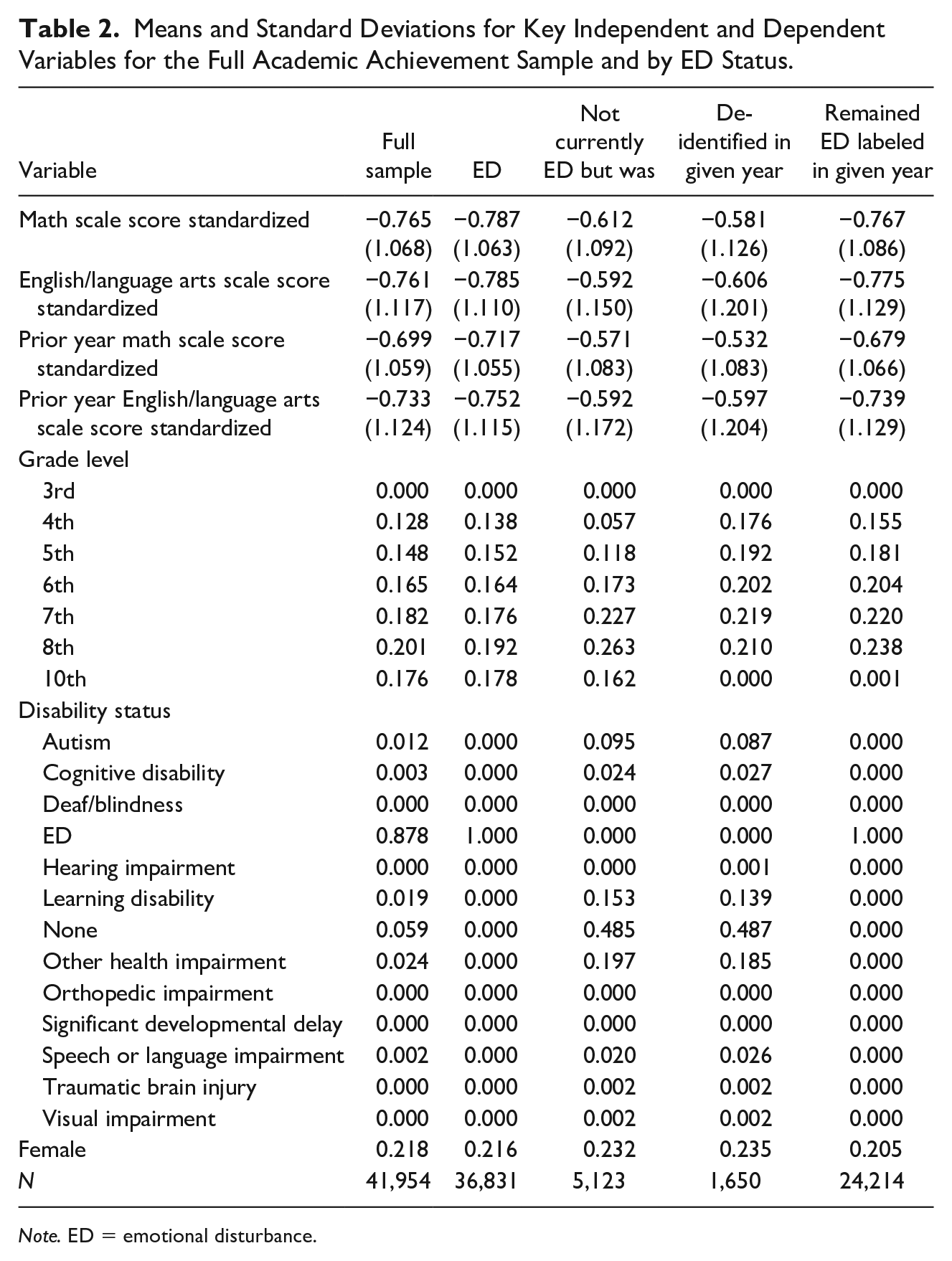
Note. ED = emotional disturbance.
Means and Standard Deviations for Key Independent and Dependent Variables for the Full Discipline Sample and by Year.
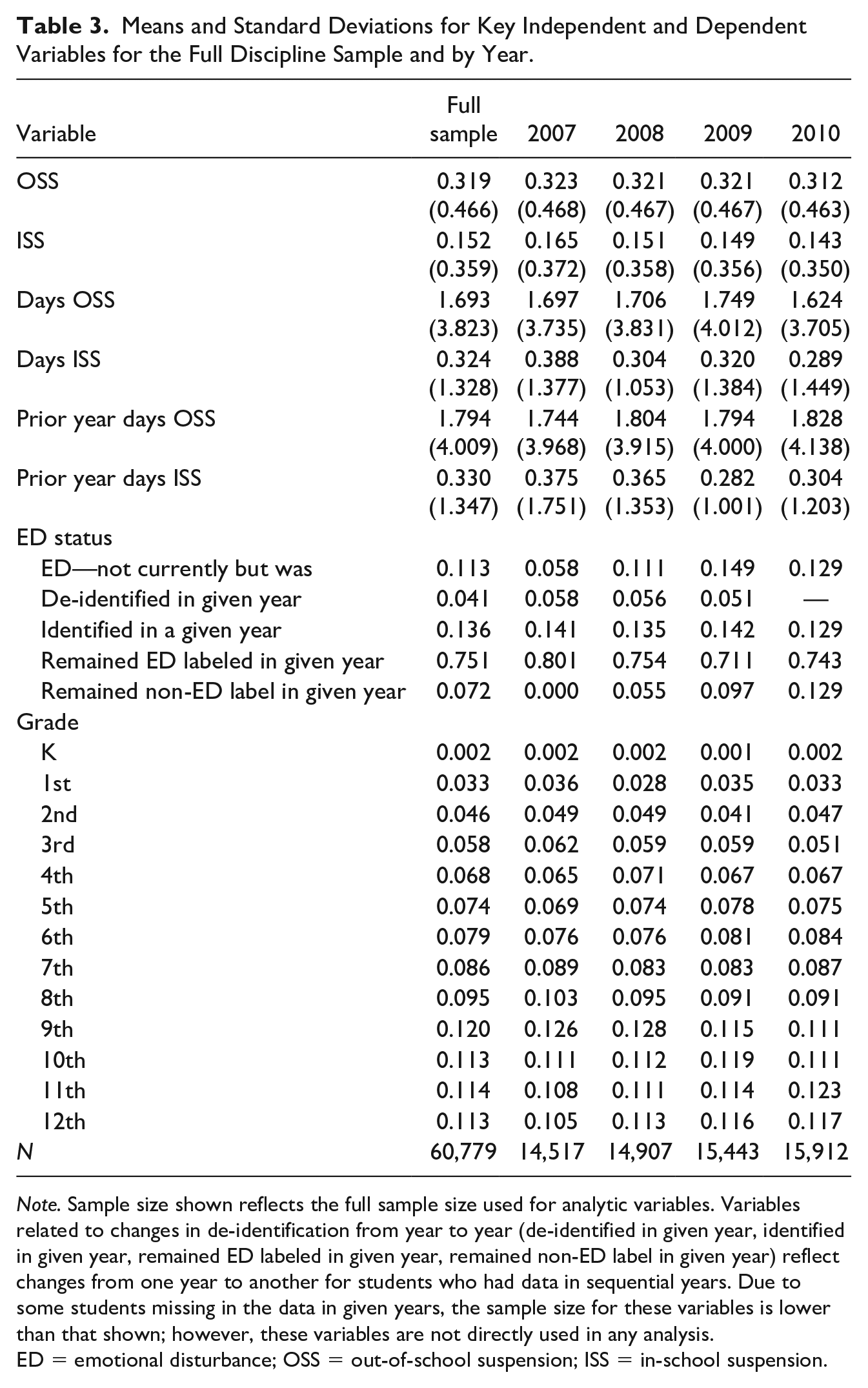
Note. Sample size shown reflects the full sample size used for analytic variables. Variables related to changes in de-identification from year to year (de-identified in given year, identified in given year, remained ED labeled in given year, remained non-ED label in given year) reflect changes from one year to another for students who had data in sequential years. Due to some students missing in the data in given years, the sample size for these variables is lower than that shown; however, these variables are not directly used in any analysis. ED = emotional disturbance; OSS = out-of-school suspension; ISS = in-school suspension.
Means and Standard Deviations for Key Independent and Dependent Variables for the Full Discipline Sample and by Disability Status.
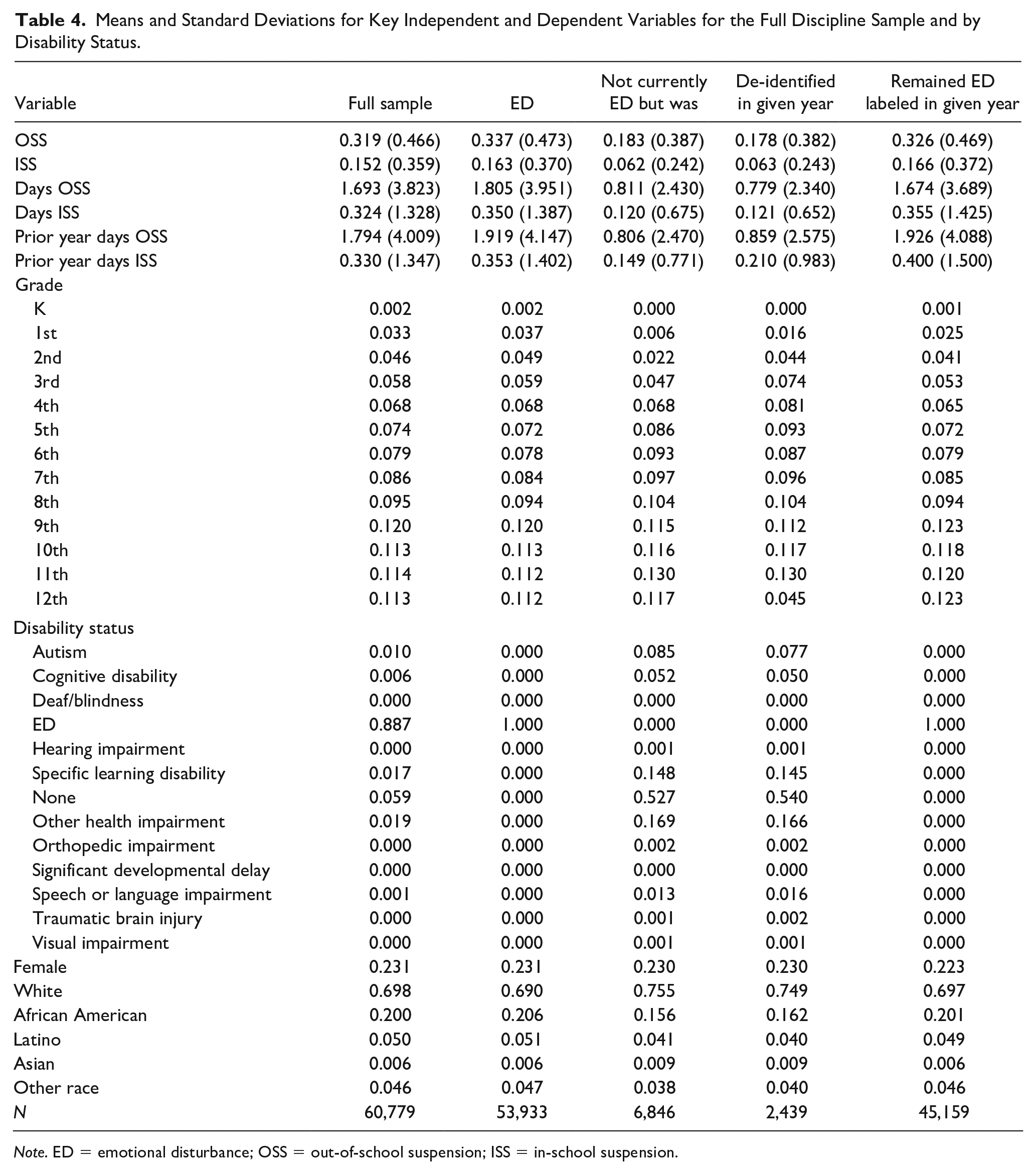
Note. ED = emotional disturbance; OSS = out-of-school suspension; ISS = in-school suspension.
In general, students who are identified as ED at some point in the data differ significantly from the broader student population. In particular, as evidenced by the standardized versions of the math and English/language arts test scores, students who at some point have an ED label score approximately three quarters of a standard deviation lower than the state average (see Table 1). These students experience relatively high levels of suspension with nearly 1 in 3 students in any given year receiving an OSS and around 15% receiving an ISS (see Table 3).
Within the group of students who experience an ED identification at some point, there are noticeable differences between those who are de-identified and those who maintain their ED identification. As shown in Table 2, students who were de-identified in a given year tended to have both higher achievement scores in that year compared with students who maintained their ED label (see Columns 4 and 5 of Table 2). Importantly, this difference was present prior to de-identification, as students who were de-identified in a given year had higher prior year test scores than those not de-identified as well. Likewise, when examining disciplinary outcomes, students who were de-identified in a given year had both fewer OSS and ISS experiences in that year as well as fewer of these incidents in the year prior to de-identification as compared with students who remained in the ED identification in a given year (see Columns 4 and 5 of Table 4). These differences were expected insofar as students who are struggling academically or behaviorally would be less likely to be considered for de-identification.
Although there were meaningful differences in academic achievement and suspensions across those de-identified and those remaining labeled in a given year, differences on observable student demographics were less pronounced. For example, the grade levels of students de-identified and those not de-identified were largely similar (see Tables 2 and 4). Likewise, while students who are male were greatly overrepresented among those who had an ED identification at some point, the gender composition of those de-identified or maintaining their label in a given year was similar (see Table 4). With regard to race, students who are White tended to be more likely to be in the de-identified group than in the group that remained ED labeled, whereas Black students were more likely to be in the group that remained ED labeled than in the de-identified group (see Table 4). This suggests that students who were already overrepresented in ED were less likely than their White counterparts to experience de-identification.
Finally, our descriptive results also suggest that when students are de-identified, they are not necessarily removed from the special education system. In fact, only about half of the de-identified students moved out of a labeled disability category (see Tables 2 and 4). The other half had their primary disability status category switched from ED to a different disability status. The most common disability categories for ED students to be de-identified into included a specific learning disability, other health impairment, autism, or a cognitive disability. It is possible that students may have been identified with multiple disabilities (comorbidity) and that this change reflects a remaining disability classification or a change in the student’s primary disability classification. Our data do not allow us to identify cases of comorbidity. For other students, de-identification into a different disability category may be the result of a more specific diagnosis.
Academic Achievement
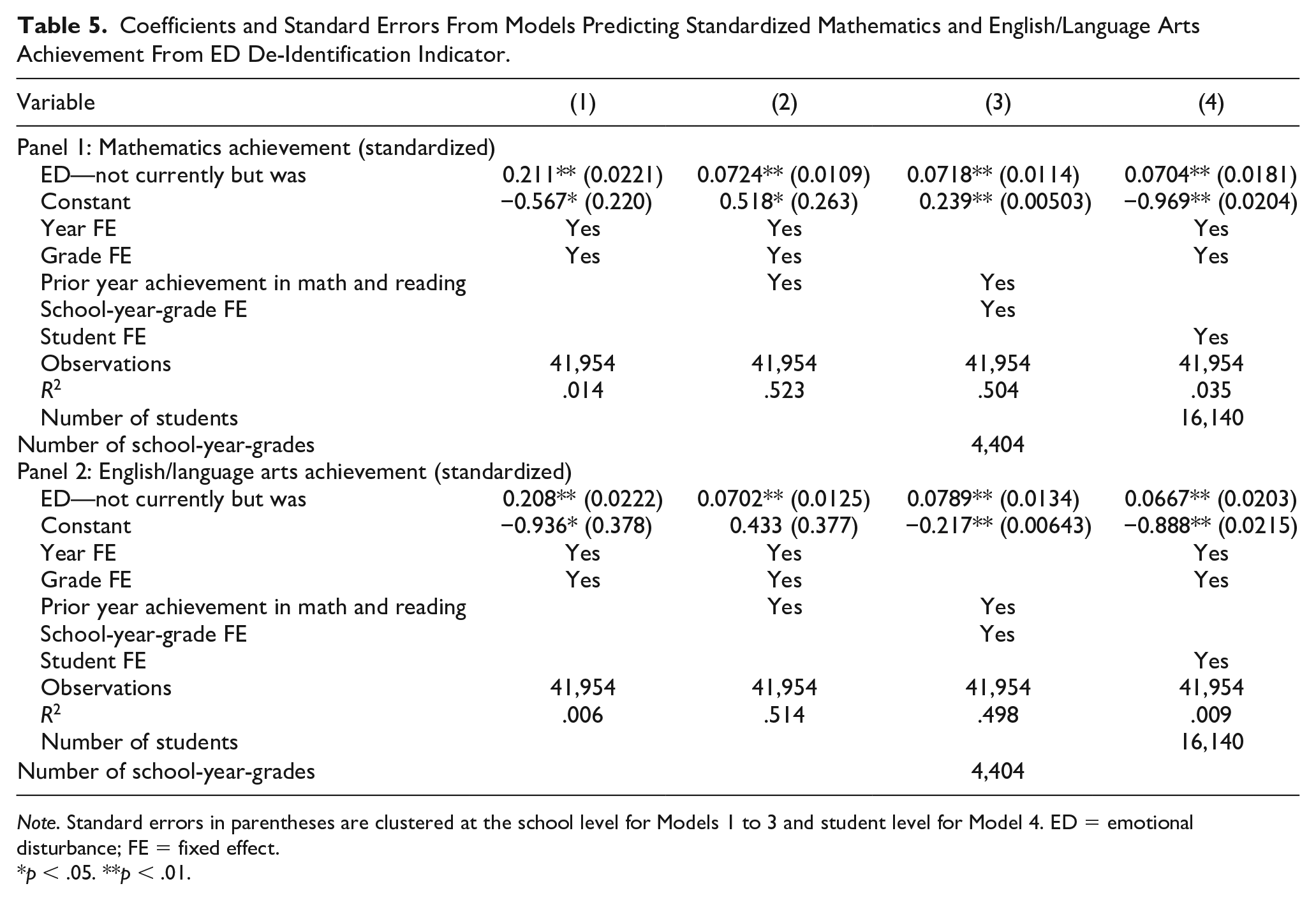
Our findings indicate that students’ academic achievement is significantly related to whether they are currently labeled as ED or have been de-identified despite scoring, in general, lower than the average student in the state. Table 5 shows results of regression models predicting standardized academic achievement in mathematics (top panel of Table 5) and in English/language arts (bottom panel of Table 5) from a binary indicator of being in a period after an ED de-identification. In these models, observations in the period prior to being labeled have been dropped from the analysis. Thus, the coefficients can be interpreted as comparing the achievement of students who have had an ED label removed to the achievement of students who currently have an ED label.
Coefficients and Standard Errors From Models Predicting Standardized Mathematics and English/Language Arts Achievement From ED De-Identification Indicator.
Note. Standard errors in parentheses are clustered at the school level for Models 1 to 3 and student level for Model 4. ED = emotional disturbance; FE = fixed effect.
*p < .05. **p < .01.
As shown, we find that ED de-identification is predictive of higher academic achievement as compared with students with an ED label. The magnitude of the relationship is around 0.2 standard deviations when not adjusting for prior student achievement or student fixed effects (Column 1). Columns 3 to 4 present results for models that include a range of different controls. In Columns 2 and 3, we control for a student’s prior achievement in math and reading while also controlling for either year and grade fixed effects or a school by grade by year fixed effect. In Column 4, we introduce the student fixed effects in lieu of prior achievement. The relationship between ED de-identification and achievement is positive and statistically significant across models, suggesting that students who have been de-identified are performing higher in both mathematics and English/language arts than students who have not. The inclusion of the student fixed effect (Column 4) does little to change the magnitude of the estimate, suggesting that the prior year achievement scores and various fixed effects were already accounting for many of the fixed characteristics of students. In short, these models suggest that even after controlling for prior achievement, fixed aspects of schools, years, and grade levels as well as fixed aspects of students over time, the relationship between ED de-identification and academic achievement remains positive.
OSSs and ISSs
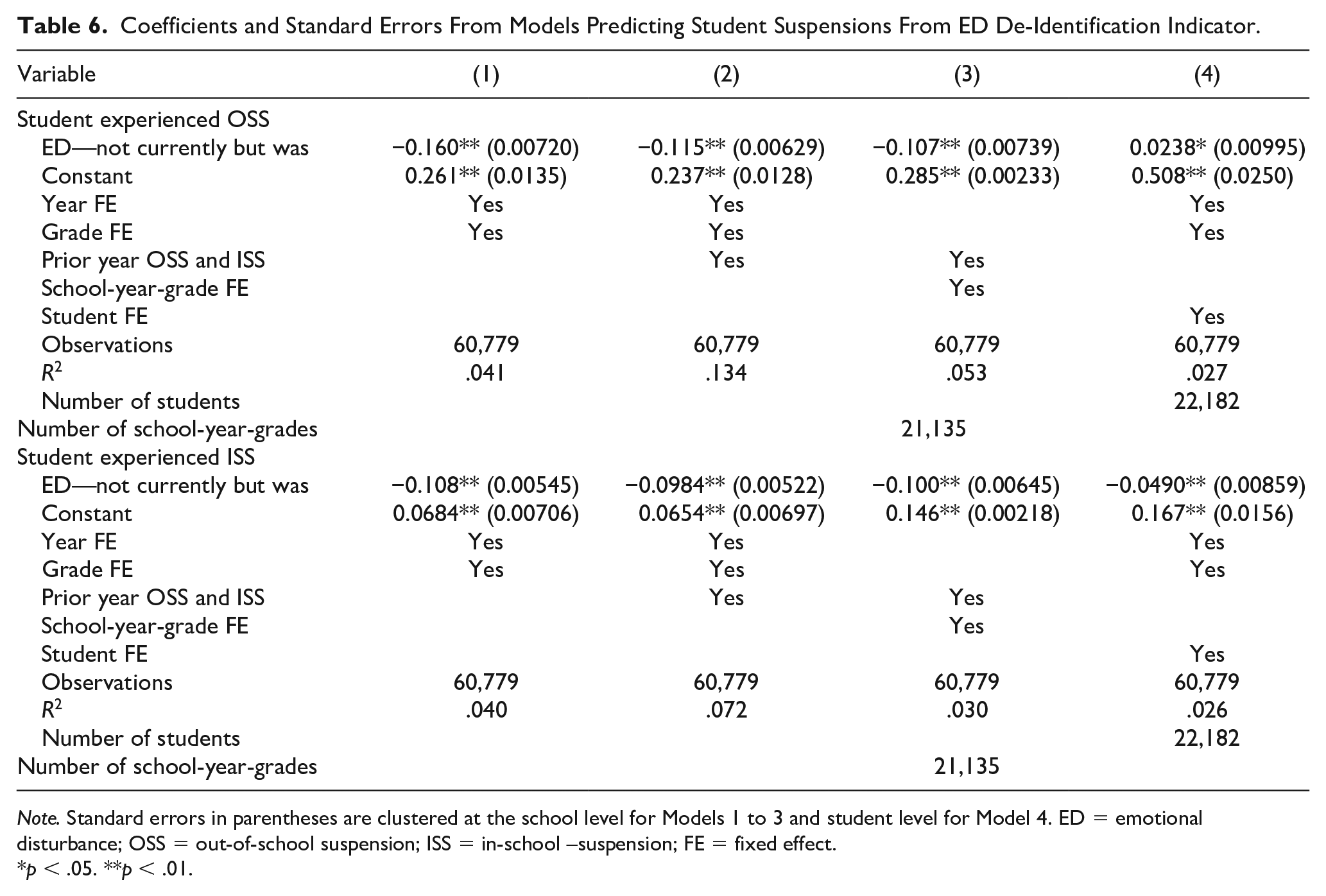
Turning to results from models examining school discipline outcomes, the findings suggest that students who have had the ED label removed are less likely to experience an ISS as compared with students who are identified as ED but may not experience decreases in OSS. Table 6 shows results of regression models predicting whether a student experienced an OSS (top panel of Table 6) or an ISS (bottom panel of Table 6) from a binary indicator of being in a period after an ED de-identification. As in the academic achievement models, observations in the period prior to being labeled have been dropped from the analysis, so the coefficients can be interpreted as comparing the achievement of students who have had an ED label removed to the achievement of students who currently have an ED label.
Coefficients and Standard Errors From Models Predicting Student Suspensions From ED De-Identification Indicator.
Note. Standard errors in parentheses are clustered at the school level for Models 1 to 3 and student level for Model 4. ED = emotional disturbance; OSS = out-of-school suspension; ISS = in-school –suspension; FE = fixed effect.
*p < .05. **p < .01.
As shown, we find a consistently negative relationship between having an ED identification removed and ISS. The relationship between ED de-identification and OSS is more nuanced, with models controlling for prior year discipline indicating a negative relationship but the student fixed effects model showing a positive relationship. In the model controlling only for year and grade fixed effects (Column 1 of Table 6), students who have been de-identified are approximately 16 percentage points (p.p.) less likely to experience an OSS and approximately 11 p.p. less likely to experience an ISS. As before, Columns 2 to 4 present results for models that include both prior year controls and student fixed effects.
In models with controls for prior year suspensions (Columns 2 and 3), the relationship remains negative and statistically significant with coefficients near the magnitude of that of the base models. When including a student fixed effect (Column 4), the magnitude of the relationship between ED de-identification and ISS is reduced by about half, with de-identified students being about 5 p.p. less likely to experience an ISS. Interestingly, the inclusion of the student fixed effects changes the direction of the estimate of the relationship between de-identification and OSS. Although small in magnitude, the student fixed effect model suggests de-identified students may be slightly more likely to be suspended than those with the label. Overall, then, the models suggest that even after controlling for fixed aspects of schools, years, and grade levels as well as prior disciplinary infractions and fixed aspects of students over time, de-identification is predictive of lower probabilities of ISS but less clearly related to changes in OSS.
Heterogeneity by Whether Students Remain in Special Education
As shown in the descriptive statistics, there was variation in whether students were de-identified out of special education entirely or whether they moved from an ED classification to a different primary disability category. To examine whether the relationships observed in the primary models were driven by those students de-identified entirely or those moved to other special education categories, we ran additional models in which we included two binary indicators, one indicating de-identification out of special education entirely and another indicating de-identification from ED to a different primary disability category. Results of these models are shown in Supplemental Appendix Tables A1 (achievement) and A2 (disciplinary).
Consistent with our primary findings, being de-identified entirely out of special education is predictive of higher achievement across models. Being de-identified into a different primary disability category predicts higher achievement in the student fixed effect model (Column 4 of Table A1) but predicts lower achievement in models controlling for prior achievement (Columns 1–3 of Table A1). For discipline outcomes (Table A2), de-identification entirely predicts a lower likelihood of ISS and either decreased or no change in likelihood of OSS depending on whether one considers the student fixed effect or lagged outcome models. Being de-identified from ED to a different primary disability status predicts a lower likelihood of ISS and OSS in models (Columns 1–3) using lagged disciplinary outcome controls but predicts a null relationship with ISS and a higher likelihood of OSS in student fixed effects models. In short, then, the primary findings are most robust for students de-classified entirely out of special education status with more ambiguous findings for those classified into other disability categories.
Heterogeneity by Urbanicity
We also explored whether the relationship between ED de-identification and students’ academic and disciplinary outcomes varied based on the urbanicity of the school. Appendix Tables B1 and B2 present results from models that include an interaction term between ED de-identification and whether a school was located in a city (as opposed to a suburban, town, or rural setting). As shown, in the fully specified models (Columns 3 and 4), we find the relationships between ED de-identification and student outcomes are fairly consistent between urban and non-urban settings. The only significant interaction was in predicting ISS, where, in the school-year-grade fixed effects model, ED de-identified students in a city school experienced less of a reduction in likelihood of ISS than those in non-city schools. Overall, these are promising findings as they suggest that, despite potentially higher pressure to move students out of special education and, in some cases, limited resources to serve students in urban settings, the generally positive relationship between ED de-identification and student outcomes holds.
Robustness and Sensitivity Tests
We conducted a number of robustness and sensitivity checks. These included modeling the period prior to ED identification, limiting the sample to students who were in the earliest grade in the first year of data, omitting the 10th grade achievement scores, using logistic regression for suspension outcomes, and modeling days suspended. Each of them suggests that the findings are robust to a number of specifications and support the findings presented in the primary tables. The full results and discussion of them can be found in the Supplemental Material. We do note here, however, that in models that include an indicator for the period prior to ED classification, our results show consistent positive results of ED classification relative to the period prior to being identified as ED. This is consistent with special education services improving the academic outcomes of such students relative to the period before they were receiving services while still suggesting that students who are determined to be ready for de-identification may continue to display positive academic outcomes after de-identification.
Discussion
Special education identification and its consequences have been a controversial issue in the United States for the last five decades (Donovan & Cross, 2002; Dunn, 1968; Heller et al., 1982). To our knowledge, this is the first study to examine the relationship between ED de-identification and academic and disciplinary outcomes. As a whole, our findings suggest that among students whom IEP teams currently de-identify, students who experience ED de-identification tend to, on average, experience more desirable achievement as compared with students who are currently identified as ED. Likewise, although results for discipline, in particular OSS, are slightly less conclusive, the results do indicate that students who are de-identified are less likely to experience ISS. That de-identified students have higher academic achievement and may receive fewer ISSs suggest that de-identification of students who are deemed ready for de-identification is not systematically harming students.
We note that our results speak to the relationship between de-identification and outcomes for students who are de-identified and do not necessarily inform what would happen if de-identification was used more liberally. In short, our results should not be interpreted to mean that all students with an ED label would experience academic gains if de-identified. Instead, our results more likely indicate that students who are de-identified under current systems are the students who are ready for such de-identification. Indeed, robustness checks, including the period prior to ED identification, suggest that student achievement is higher when identified as ED than prior to identification, though not as a high as the time after de-identification. In other words, our findings suggest that special education services may benefit students identified as ED and that, perhaps in virtue of the gains made under such services, appropriately timed de-identification is unlikely to result in academic regression.
There are several possible mechanisms by which the positive relationship between ED de-identification and academic outcomes may arise. First, it may be that students who are being de-identified are those who have reaped the benefits of special education services, and through these services, they have been prepared to continue making academic gains in the absence of such supports. Indeed, we observe that students perform better academically while receiving services than prior to identification and it may be that the benefits of these services persist for students who make sufficient progress so as to qualify for de-identification.
Next, for students who are de-identified out of a disability status entirely (about half of all ED de-identifications), it is possible that de-identification reduces the stigmatizing effect of being identified as a student in special education. Prior literature primarily relying on ethnographic studies indicated the potentially negative impacts of labeling. In particular, a disability label may lower teacher expectations, alter peer interactions, as well as influence students’ self-perception regarding their potential and worth (Connor, 2008; Donovan & Cross, 2002; Harry & Klingner, 2014; Higgins et al., 2002; Varenne & McDermott, 1998). The removal of such a label, then, may reduce these negative psychosocial associations and improve educational and social outcomes.
Another possible mechanism for such students is that ED de-identification increases student access to general education curriculum and high-quality academic instructions. Prior studies demonstrated that students identified as ED are commonly placed in more restricted environments outside of the regular classroom as compared with their peers in special education. Furthermore, some work has suggested that students with other types of disabilities in urban settings are more likely to experience non-inclusive settings than in other locales (Brock & Schaefer, 2015). Therefore, students with an ED label, especially in urban schools, may be less likely to engage with as rigorous of academic material and have fewer opportunities to develop positive social and behavioral skills, such as problem-solving (Harry & Klingner, 2014; U.S. Department of Education, 2016). By returning students who are ready to the regular classroom setting, ED de-identification may enhance students’ opportunity to learn and thereby improve outcomes. These mechanisms are consistent with our finding that the relationships seen are most consistent for students de-identified out of special education entirely.
A fourth possible mechanism applies to students who are de-identified into a different primary disability status. For these students, ED de-identification may come as a result of a more accurate diagnosis of their primary disability. A refined understanding of the disability affecting the student, such as learning disabilities, might result in more targeted and useful special education services. Unfortunately, the data employed in this study cannot disentangle or speak to the mechanisms that drive the relationship between ED de-identification and academic and disciplinary outcomes. Examination of such mechanisms is a worthwhile next step for inquiry.
In the United States, African American students are overrepresented in the ED category (OSERS, 2018). With regard to the intersection of race and ED de-identification, we found that African American students were more likely to be in the group that remained ED labeled as compared with their White peers with an ED label. This suggests that African American students, who are disproportionally identified as emotionally disturbed, were relatively less likely than their White counterparts to be de-identified as ED. If these students are more likely to be at a stage where they still require the supports and services of special education, then this racial disparity may reflect the allocation of necessary services to those with demonstrated need. If, however, IEP teams are overlooking African American students who are similarly situated to those White students who are deemed eligible for de-identification, then it may be the case that African American students are less likely to experience the academic gains associated with timely de-identification. This is an important consideration particularly for schools in urban settings who disproportionately educate African American students (Blanchett et al., 2009).
With regard to disciplinary outcomes, the mixed finding with regard to OSS raises concerns that schools should closely monitor disciplinary outcomes in the time after de-identification. While in special education, students are afforded greater legal protections that often limit the circumstances under which they can be suspended out of school (IDEA, 2004). It is possible that by removing these protections, de-identified students are possibly experiencing more OSS—though we note that this result is not consistent across our robustness specifications. In the case of ISS, which are typically less likely to be limited by special education law, we do see a consistent reduction in experiences of ISS after de-identification, though this reduction is less pronounced in urban schools.
Turning to the implications of this work for broader special education policy, the federal law and state polices do not provide a specific process for label removal. However, districts are obligated to re-evaluate continuing eligibility students with ED for services every three years. One policy implication of our study is that states should offer clear guidance on how to identify students who are ready for de-identification. School districts should have structured opportunities and guidance for IEP teams for re-evaluation and de-identification. Schools and districts should re-examine the services and practices for students identified as having an ED to make sure they are maximizing the benefits of special education services.
For urban schools serving higher proportions of students of color, attention to de-identification may be particularly relevant given efforts to reduce racial disproportionality in special education classification. Such schools have been caught in an ongoing national debate regarding over- and underrepresentation of students of color (Morgan et al., 2016; Skiba et al., 2016). Appropriately timed de-identification then may be an opportunity for urban schools to reduce racial disproportionality in special education while doing so in a way that does not deny services to students in need. In other words, reducing racial disproportionality by de-identifying students who are ready to return to general education is preferable than failing to identify students of color demonstrated a need for services.
Nationally, schools are moving toward using Positive Behavioral Interventions and Supports (PBIS), a school-wide multitier system of supports model, as a means of ED identification. PBIS has been implemented in more than 20% of U.S. schools (approximately 20,000, Horner, 2015). In 13 states, including Wisconsin, more than 40% of schools have implemented PBIS (Horner, 2015). The implementation of school-wide intervention teams and the tiered level of services may provide adequate and timely services and support for students and school staff (e.g., professional development in classroom management or improving student engagement). Historically, the majority of students (70%-90%) who are referred to special education end up placed in special education (Algozzine et al., 1982; Ysseldyke et al., 1997). PBIS and other multitier system of support models may function as a buffer and an alternative model against using special education referral as the only behavioral management strategy for students experiencing behavioral problems in schools. Thus far, there have been contradicting findings regarding PBIS implementation and the consequences for ED identification and de-identification, such as racial disproportionality (Gage et al., 2019; Vincent et al., 2011). Future studies may investigate ED de-identification in schools implementing PBIS and other multitier system of supports models, such as Response to Intervention (RtI) and Comprehensive, Integrated Three-tiered Model of Prevention (Ci3T). Such investigations will be particularly beneficial in urban schools as systemic contradictions exist regarding the educational opportunity gap, and disparities are more prominent and consequential in urban schools where the majority of students of color are educated.
Conclusion
Improving outcomes for students identified as having behavioral disorders is an important goal for educators, families, and policymakers. This research study provides some of the first evidence on the potential impacts of de-identifying students with an ED label. While not providing causal estimates, our study suggests that students who experience ED de-identification are generally experiencing positive outcomes in academic achievement and disciplinary actions. The results point to gains in academic achievement and though results for OSS are mixed, we observe reductions in ISS. Our findings provide important information about disability, race, and space (urbanicity) in educational outcomes. Much work remains to explore the mechanism behind these relationships and to improve the processes by which students experience de-identification. This study provides a jumping off point for such future research utilizing statistical, ethnographic, spatial, and mixed methods while pointing to the importance of considering de-identification in addition to special education placement and service delivery.
Supplemental Material
Appendix_Tables – Supplemental material for Estimating the Relationship Between Special Education De-Identification for Emotional Disturbance and Academic and School Discipline Outcomes: Evidence From Wisconsin’s Longitudinal Data
Supplemental material, Appendix_Tables for Estimating the Relationship Between Special Education De-Identification for Emotional Disturbance and Academic and School Discipline Outcomes: Evidence From Wisconsin’s Longitudinal Data by F. Chris Curran, Aydin Bal, Peter Goff and Nicholas Mitchell in Education and Urban Society
Footnotes
Declaration of Conflicting Interests
The author(s) declared no potential conflicts of interest with respect to the research, authorship, and/or publication of this article.
Funding
The author(s) received no financial support for the research, authorship, and/or publication of this article.

Supplemental Material
Supplemental material for this article is available online.
Notes
Author Biographies
References
Supplementary Material
Please find the following supplemental material available below.
For Open Access articles published under a Creative Commons License, all supplemental material carries the same license as the article it is associated with.
For non-Open Access articles published, all supplemental material carries a non-exclusive license, and permission requests for re-use of supplemental material or any part of supplemental material shall be sent directly to the copyright owner as specified in the copyright notice associated with the article.
