



Abstract
Determining the ethnic differences in academic performance among immigrant students is important in terms of adapting them into the system they live in. Examining the variables related to students’ performance will be a guide in overcoming the issue. The purpose of this study is to examine the direct effect of economic, social, and cultural status (ESCS) on science performance and the indirect effect of ESCS on the relationship between science dispositions and science literacy in Canadian immigrant students using hierarchical linear modeling. Data were obtained from Program for International Student Assessment (PISA) 2015 science literacy test and student questionnaire and data sets were provided from the official website of PISA. The results of the research show that ESCS had a direct and indirect effect through science dispositions with medium to large on science performance of immigrant students. The impacts of significant variables were discussed and implications for further research were provided.
Keywords
Introduction
Immigration, a sociological phenomenon, has become widespread after the second half of the 20th century, especially in underdeveloped or developing countries, due to the war starvation and natural disasters. Depending on the increasing migration movements, there are problems that countries have to overcome such as employment, education, health, housing, socialization, and security. The factors such as low education level, poverty, lack of social security, and cultural differences reinforce the disadvantaged position of the immigrant in social or academic life. Governments are, therefore, seeking to develop and implement the most effective policies to successfully manage diversity and integrate immigrants into society so they can contribute to the economic prosperity and sociocultural structure of their society. Therefore, it is important that immigrant children are given the educational opportunities that will enable them as adults to have jobs that will allow them to contribute to the sociocultural fabric of their communities. The role of schools is to support this process and successfully integrate immigrant children through education.
The benefits of giving immigrants a quality education outweigh the costs for a country and allow them to contribute to the national economy as a qualified labor force (Rumbaut, 1997). For this reason, education expenditures on immigrants can be seen as an investment for the host country. But, according to the Migrant Integration Policy Index (2015), education emerged as the greatest weakness in the integration process in most countries. There are research findings suggesting that immigrant students achieve poorly in school compared to native students, repeat more classes, drop out of school before completing compulsory education, or fail to attend university (Archambault et al., 2017; Rumberger, 2011).
Immigrants of Canada
In survey conducted by Organisation for Economic Co-operation and Development (OECD), immigrant status identified students by country of birth. Native referred to students born in the country where the Program for International Student Assessment (PISA) was administered and with at least one parent born in the country of assessment. First-generation immigrant referred to students and their parents born outside the country of assessment. Second-generation immigrants were students born in the country of assessment but whose parent(s) were born in another country (OECD, 2017). Overall, Canada possesses one of the highest immigrant student populations as a percentage of the total population (OECD, 2012). According to data from the 2011 National Household Survey (NHS), immigrants represented 20.6% of the total population, the highest proportion among the G8 countries. Asia and Pacific areas are the biggest source (47.4%). Immigrant groups in Canada are more diverse than ever before with respect to their countries of origin, sociocultural background, and the channels through which they enter the country. Certainly, the source of this diversity can be explained by the number of refugees from the Middle East and Asia. For example, more than 40,000 Syrian refugees were recently resettled across Canada between November 2015 and May 2017 (see https://www.canada.ca/en/immigration-refugees-citizenship/services/refugees/welcome-syrian-refugees/key-figures.html). In keeping with the increasing number of immigrants, there has been a corresponding increase in the numbers of immigrant children entering educational systems throughout Canada.
Scientific Literacy and Immigrant Student PISA Achievement Across Canada
It is clear that international migration can be a force for positive development when supported by the right set of policies, one of which is education policy. One of the skills that emerge in this context is scientific literacy. Reports argue that many Western countries will experience a future shortage of skilled personnel in the scientific- and technical-orientated industries (OECD, 2007). It is known that the aims of educational policies and reform in many countries are to increase literacy rates and reduce disparities among citizens of different socio-cultual groups and genders (Willms, 2003). As the OECD (2017) suggests: Scientific literacy is important for understanding environmental, medical, economic, and other issues that confront modern societies, which rely heavily on technological and scientific advances. Furthermore, the performance of a country’s best students in scientific subjects could have implications for the role that the country will play in tomorrow’s advanced technology sector, and for its general international competitiveness. (p. 299)
Researchers and policymakers investigate why some countries are more successful than others in science among students. International assessments are frequently cited as a key measure of relative school outcomes across jurisdictions. Thanks to large sample sizes, these assessments can provide comparative and desciriptive information on the performance of non-migrant and immigrant students, nationally and internationally. Popular international assessments include the Trends in International Mathematics and Science Study (TIMSS), Progress in International Reading and Literacy Study (PIRLS), and the PISA. However, PISA has a unique feature in these applications. PISA is issued by the OECD and tests the skills and knowledge of 15-year-old students in reading literacy, mathematical literacy, and scientific literacy. A total of 72 countries and economies participated in its most recent 2015 survey, which focused on scientific literacy (OECD, 2017).
Although some criticism has been directed toward PISA (see Araujo et al., 2017; Holliday & Holliday, 2003) for its growing influence on global education policies (see Niemann et al., 2017; Sellar & Lingard, 2014), it remains the most widely utilized measure for judging international student performance and the performance gaps between different segments of the student population (Volante et al., 2017). Also, PISA results have been frequently used to study the achievement gap between native and immigrant students within a country or sometimes from particular cultural groups (see Acosta & Hsu, 2014; Areepattamannil & Kaur, 2013; Murat & Frederic, 2015). Thus, PISA consistently serves as a comparative measure both within and across countries and contexts.
Canadian performance on PISA 2015 was well above the OECD average with scores of 528 in sicence literacy and is ranked in the top 10 for this domain. These results are similar to the previous administration of PISA. Despite having such a large immigrant student population, Canada is one of the few countries that showed negligible performance differences between immigrant and native students in PISA 2015 (OECD, 2016).
Making Sense of Immigrant Student Achievement: Socioeconomic Status and Science-Related Disposition
The results of many studies show that the academic achievement of immigrant students is poorer than that of native students (e.g., Murat & Frederic, 2015; OECD, 2016). A number of factors have been suggested to explain the lower academic achievement of immigrant students, but the research focus on three main factors: minorities are more likely to live in low-income households; their parents are likely to have lower levels of education; and they often attend schools with inadequate financial resources (Sirin, 2005). All of these factors are components of socioeconomic status (SES). It is well known that SES is one of the most important demographic factors related to children’s development and learning (White, 1982). It is possible that the SES will have a direct effect on academic achievement as well as indirectly affecting academic achievement through other variables. For example, families with both parents instead of one typically have higher SES, more educational home resources, spend more time with their children and are more involved in their children’s schooling (Schoon & Parsons, 2002), so these students often learn more (Sirin, 2005).
Another dimension in academic achievement is closely related to dispositions. Studies have consistently found significant associations between dispositions and academic achievement (e.g., Meredith et al., 1997; Tuan et al., 2005). It is believed that students are motivated to learn when they value either the outcome or the process of learning and expect that they will be successful. There are many studies showing that students who have a more positive attitude toward mathematics and science have higher average achievement in mathematics and science (e.g., Hattie, 2009; Martin et al., 2012). For example, TIMSS routinely presents very powerful evidence showing that within countries, students with more positive attitudes toward science have substantially higher achievement, and the results from TIMSS 2011 are consistent with previous assessments (Martin et al., 2012). Therefore, PISA placed much emphasis on the assessment of students’ attitudes toward science because it considers attitudes to be the crucial component of scientific literacy: willingness to engage with science-related issues and with the ideas of science, as a reflective citizen (OECD, 2006). In PISA 2015, students’ dispositions toward science are addressed in the context of science self-efficacy, epistemological beliefs about science, and students’ science activities (OECD, 2016).
Self-efficacy refers to people’s beliefs about one’s ability to perform a task successfully (Bandura, 1977). Self-efficacy makes a difference in how people feel, think, and act, such as in science-related learning or activities. The positive effect of student self-efficacy on achievement has also received attention in the literature and been confirmed by many studies (e.g., Lau et al., 2015; Liu et al., 2006).
Scientific epistemological views refer to ideas about the value of science, assumptions, processes, and the formation of scientific knowledge (Chai et al., 2010). As our beliefs about people and things in this world influence our attitudes and behavior, it is inevitable that students’ beliefs knowledge (i.e., epistemic beliefs) affects their beliefs about learning and academic performance. Studies in the related field support the relationship between epistemological views and science achievement (Chen & Pajares, 2010; Lin et al., 2013).
As is known, effective science learning cannot be based solely on textbook-based knowledge, as the acquisition of deep learning requires critical thinking practices and direct experiences (e.g., Crowley et al., 2001; Lee, 2012). In this context, after-school science activities are thought to be an important factor in science learning as both a cause and consequence (Lau et al., 2015). Crowley et al. (2001), in particular, noted that parents who involve children in informal science activities provide their children with an opportunity to learn real-life scientific information and to practice scientific reasoning, and also provide an opportunity for them to participate in the culture of learning about science. Results from PISA 2006 showed that the science-related activities were found to be positively associated with performance and attitudes in all the countries, and this was true even after controlling the gender and socioeconomic background of the students (Lau et al., 2015).
The Present Study
As is known, Canada is one of the countries where the differences in levels of achievement between immigrants and natives are very low, and it is considered successful in integrating the immigrant students into the education process. In this regard, studies on immigrant students in Canada will be able to provide important scientific data for other countries where the academic achievement of immigrant students is low. In short, immigrant students’ academic achievement is important because it affects their later success in social or academic life. Also considering the relationship between SES, dispositions, and success, it is important to determine the indirect effects of SES on academic achievement through dispositions. A deep understanding of immigrant academic achievement would not only guide schools and policymakers in meeting the unique educational needs of this rapidly growing population but also advance theories explaining the integration process. Therefore, the purpose of this study is to examine the direct effect of economic, social, and cultural status (ESCS) on science achievement and the indirect effect of ESCS on the relationship between science dispositions and science achievement in Canadian immigrant students.
Method
Source of Data
Data for this study were drawn from the Canadian sample of PISA 2015 survey conducted by the OECD. PISA 2015 item formats included open constructed response, closed constructed response, and multiple-choice types. For specific details on sampling design, assessment frameworks, sample items, and psychometric reports (construct validation, internal consistency, and cross-country comparability), refer to OECD (2017) and www.pisa.oecd.org.
Sample
PISA 2015 sampled Canadian students in two stages: first, schools and then 15-year-old students were sampled in the participating schools (OECD, 2005, 2017). The Canadian PISA sample comprised 4,163 immigrant students nested within 554 schools. Missing data were excluded from the data analyses resulting in a final sample of 3,849 immigrant students nested within 538 schools. In the sample, there were 1,929 (51.12 %) female and 1,920 (49.88 %) male students.
Measures and Variables
Science performance (outcome)
We used plausible values (PVs) of the combined scientific literacy for representing students’ scientific performance. PISA uses scaling models to summarize the performance of students in a learning area, accounting for the substantial amount of missing data using multiple imputation procedures and creating vectors of PVs for the scale scores. PVs represent the range of abilities that a student might reasonably have, given the student’s item responses (Wu, 2005). They are random numbers drawn from the distribution of scores that could be reasonably assigned to each individual. In the 2015 science assessment, PISA provided 10 PV estimates for each student. National reliability of the science cognitive domain based on all 10 PVs is 0.91 (OECD, 2017).
Independent variables
The independent variables were identified using indices variables, and they were gathered by the scales consisting of several questionnaire items to measure science-related disposition and ESCS. More detailed psychometric explanations of variables in the study are available in the PISA 2015 technical report. These variables are briefly described below (OECD, 2017).
Science-related dispositions (mediators)
Three dispositions were included to measure science-related dispositions: Science self-efficacy, epistemological beliefs about science, and students’ science activities.
Science self-efficacy (SCIEEFF)
Eight items (e.g., “Explain why earthquakes occur more frequently in some areas than in others”) were used to measure science self-efficacy. Students were asked to rate how they would perform in different science tasks, using a 4-point answering scale with the categories “I could do this easily,” “I could do this with a bit of effort,” “I would struggle to do this on my own,” and “I couldn’t do this.” Higher scores correspond to higher levels of science self-efficacy. The Cronbach alpha reliability score for Canada is 0.898.
Epistemological beliefs about science (EPIST)
Six items (e.g., “A good way to know if something is true is to do an experiment”) were used to measure the variable. Items were about students’ views on scientific approaches. A 4-point Likert-type scale with the answer categories “strongly agree,” “agree,” “disagree,” and “strongly disagree” was used for rating. The Cronbach alpha reliability score for Canada is 0.907.
Students’ science activities (SCIEACT)
Nine items (e.g., “Borrow or buy books on broad science”) were used to measure the variable. Students were asked how often they engaged in science-related activities and to rate them using a 4-point scale with the answering categories “very often,” “regularly,” “sometimes,” and “never or hardly ever.” Higher difficulty corresponds to higher levels of students’ science activities. The Cronbach alpha reliability score for Canada is 0.924.
ESCS (initial variable)
ESCS is a composite score obtained from parental education (PARED), highest parental occupation (HISEI), and home possessions (HOMEPOS) via principal component analysis (PCA). The Cronbach alpha reliability scores for the components for Canada are 0.79, 0.80, and 0.64, respectively.
Data Analysis
In the present analysis, we used hierarchical linear models (HLM) (Raudenbush & Bryk, 2002) to examine the effects student-level variables had on immigrant students’ science performance. In the conditions where mediational models are tested, the appropriate analysis method should be preferred by considering the hierarchical structure of the sample. As the PVs did not share the same measurement scale with indepentdent values, all PV variables were standardized to have a mean of 0 and a standard deviation of 1. In this study, the following model has been tested (Figure 1). The aim was to show that the student’s dispositions have a partial mediating effect on science performance for ESCS.
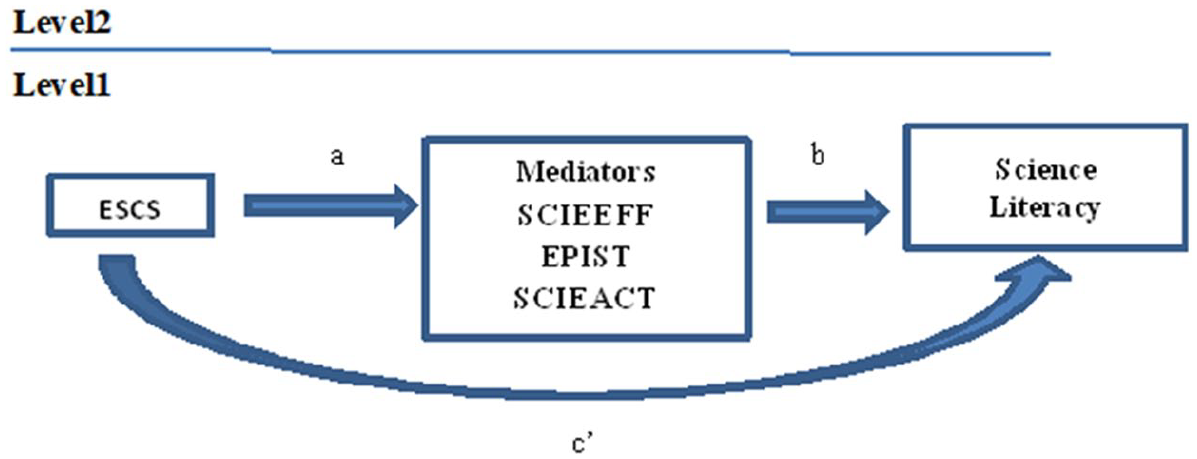
The relationships of predicted mediational model.
A mediational model at the lower level was created by considering the hierarchical structure of the PISA sample. All variables are measured at Level 1. The model is labeled 1-1-1. The Level-1 units (students) are nested in Level-2 units (schools). In the model, the predictive variables are fixed; that is, they do not vary across upper-level units.
The relationships between variables are given in Table 1.
Relationships Between Variables.
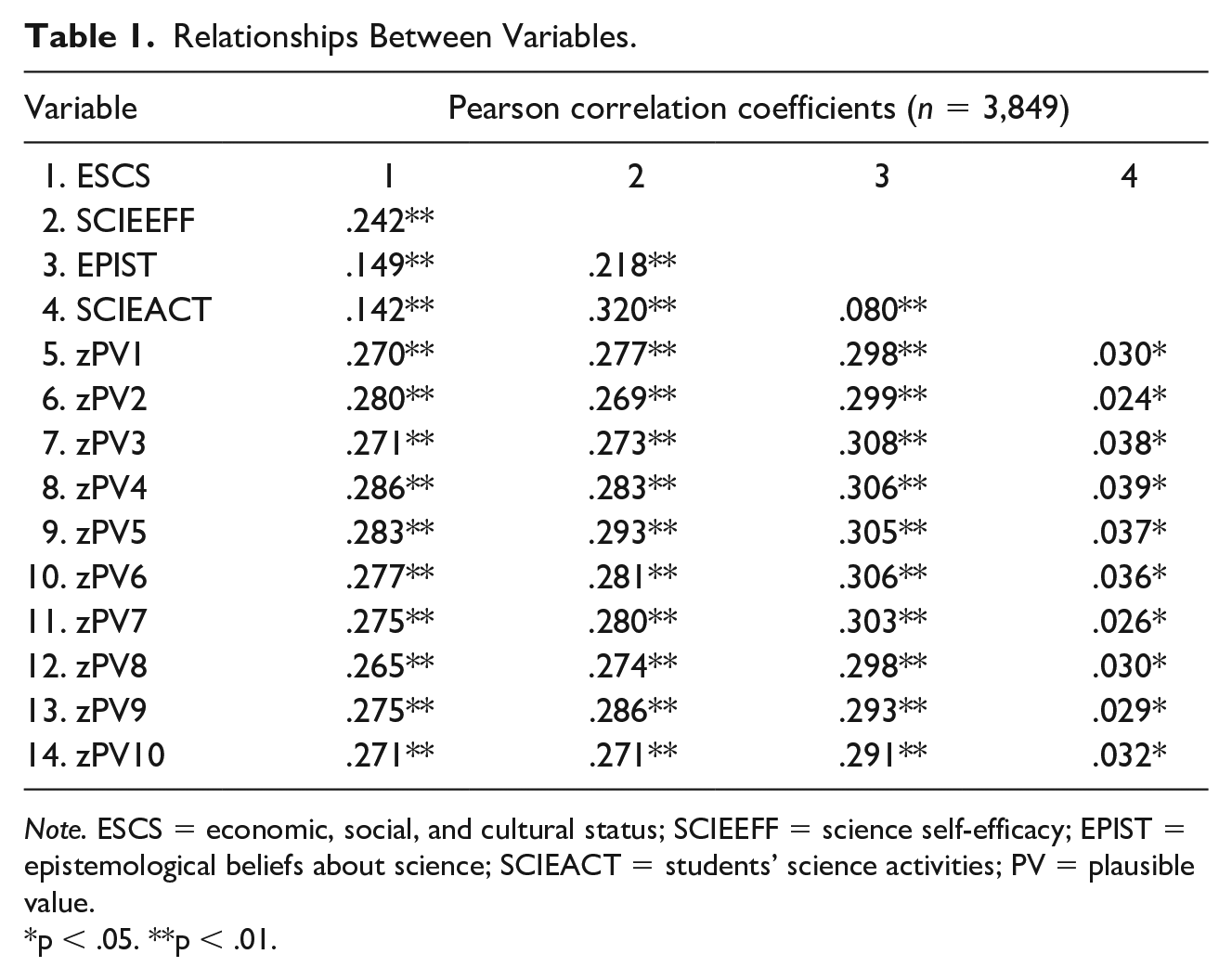
Note. ESCS = economic, social, and cultural status; SCIEEFF = science self-efficacy; EPIST = epistemological beliefs about science; SCIEACT = students’ science activities; PV = plausible value.
p < .05. **p < .01.
As shown in Table 1, the correlation coefficients between the variables are statistically significant, but the correlation coefficient between the SCIEACT and zPV values is lower than the others. Due to the high number of samples, the correlation coefficient might be significant for SCIEACT. In the process of testing the hierarchical model, the effect of this variable might not be observed.
Considering the HLM model tested in the study, the following regression equations were created (Krull & MacKinnon, 2001; Zhang et al., 2009):
Model 1-1-1
















Model 1-1-1 refers to the model where all variables measured at Level 1. Equations presume that predictive variables are fixed; that is, they do not vary across upper-level units. As seen in Model 1-1-1, science literacy has been predicted by ESCS (a) in order to be able to talk about an indirect effect. Following this model, ESCS predicted SCIEEFF (b), EPIST (c), and SCIEACT (d) separately. In the last equation, Science literacy was predicted by ESCS and SCIEEFF, EPIST, and SCIEACT all variables.
The mediation effect was determined by multiplying the alpha levels of initial variable in the second, third, and fourth model and the alpha levels of the mediator variables in the fifth model ((γ10(2) * γ20(5)); (γ10(3) * γ30(5)); (γ10(4) * γ40(5)). The significance of this effect was calculated by Sobel (1982). The variances explained by the variables in the model and the effect sizes based on these variances were calculated using formula of Snijders and Bosker (2012) and the Cohen’s effect size was computed. Restricted maximum likelihood approach was used for variance estimation. Data were analyzed using HLM6 (Raudenbush et al., 2004).
Results
Partitioning of Variance in Science Literacy
A one-way analysis of variance (ANOVA) model (null model) was created for dependent variable science performance before the direct and indirect effects were tested. Thus, the intraclass correlation (ICC) value was calculated from the student-level and school-level variance components, and the amount of variance between schools was determined. Estimation indicated that about 19% of the variance in science performance would be between schools and that the remaining variance (81%) would be within schools.
Direct Effect of ESCS on Science Performance
In Equation 1, the direct effect of ESCS on science performance was determined. The findings of the model are given in Table 2.
Direct Effect of ESCS on Science Performance.
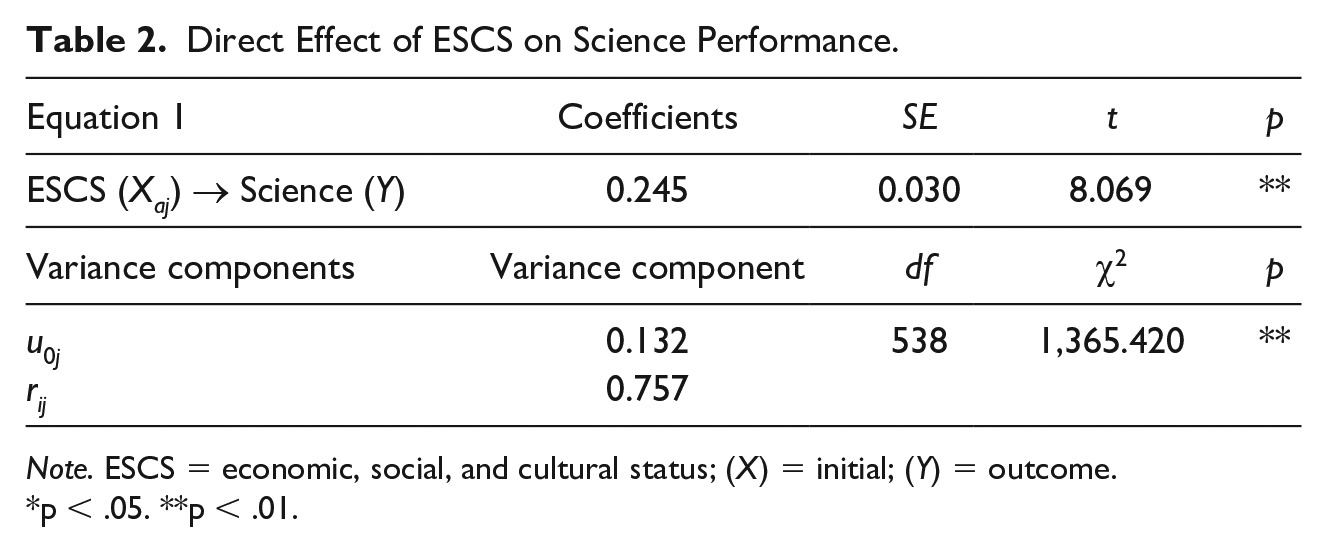
Note. ESCS = economic, social, and cultural status; (X) = initial; (Y) = outcome.
p < .05. **p < .01.
As shown in Table 2, Equation 1 was estimated, and the standardized coefficient for ESCS is 0.245 (p < .01). This indicates that the coefficient for ESCS significantly predicted science performance; that a one-unit increase in ESCS is related to 0.245 expected unit increase in science performance. It was determined that ESCS explained 7% (R2) of the variance in science performance. The effect size of ESCS on science performance is 0.23 ( f2), indicating a medium-to-large effect.
Relationships Between ESCS and Science Dispositions
ESCS as a predictor of science-related dispositions was tested in Equations 2 to 4, and the findings are given in Table 3.
Relationships Between ESCS and Science Dispositions.
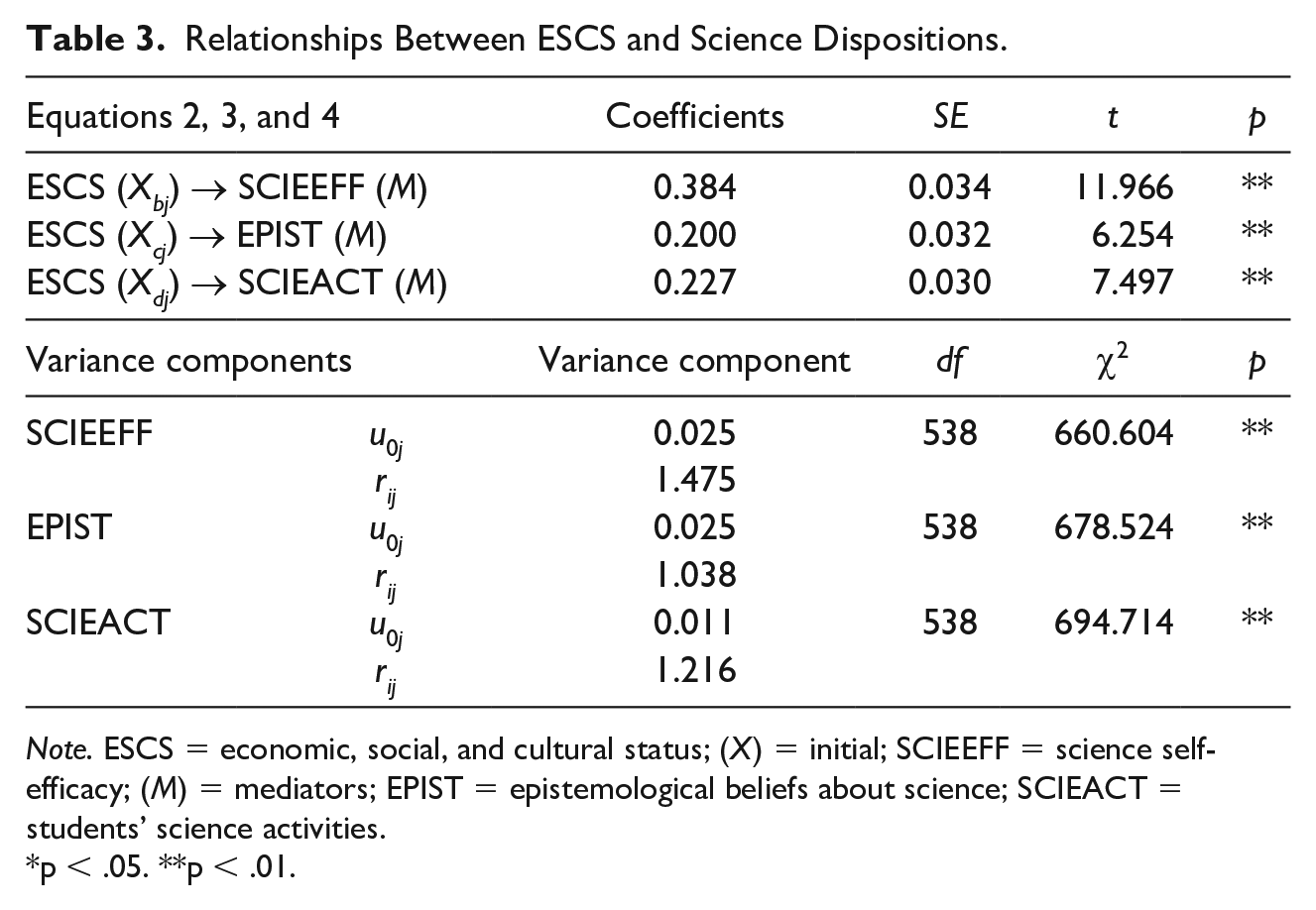
Note. ESCS = economic, social, and cultural status; (X) = initial; SCIEEFF = science self-efficacy; (M) = mediators; EPIST = epistemological beliefs about science; SCIEACT = students’ science activities.
p < .05. **p < .01.
These results in Table 3 show a coefficient of 0.384 (p < .01) for ESCS on SCIEEFF, 0.200 (p < .01) for ESCS on EPIST, and 0.227 for ESCS on SCIEACT, indicating that ESCS was significantly predicting science-related dispositions. Immigrant students with higher ESCS were expected on average to score 0.384 standard deviations higher on SCIEEFF, 0.200 standard deviations higher on EPIST, and 0.227 standard deviations higher on SCIEACT. ESCS explained 6% (R2) of variance on SCIEEFF, 3% (R2) of variance on EPIST, and 2% (R2) of variance on SCIEACT. The effect size of ESCS on science-related dispositions was found to be 0.15 (f2), 0.42 (f2), and 0.25 ( f2), respectively, indicating a medium effect, a large effect, and a medium-to-large effect.
The Mediation Effects of Science-Related Dispositions
The mediation effects of science-related dispositions were tested in Equation 5. The results are given in Table 4.
Relationships Between Science Dispositions, ESCS, and Science Performance.
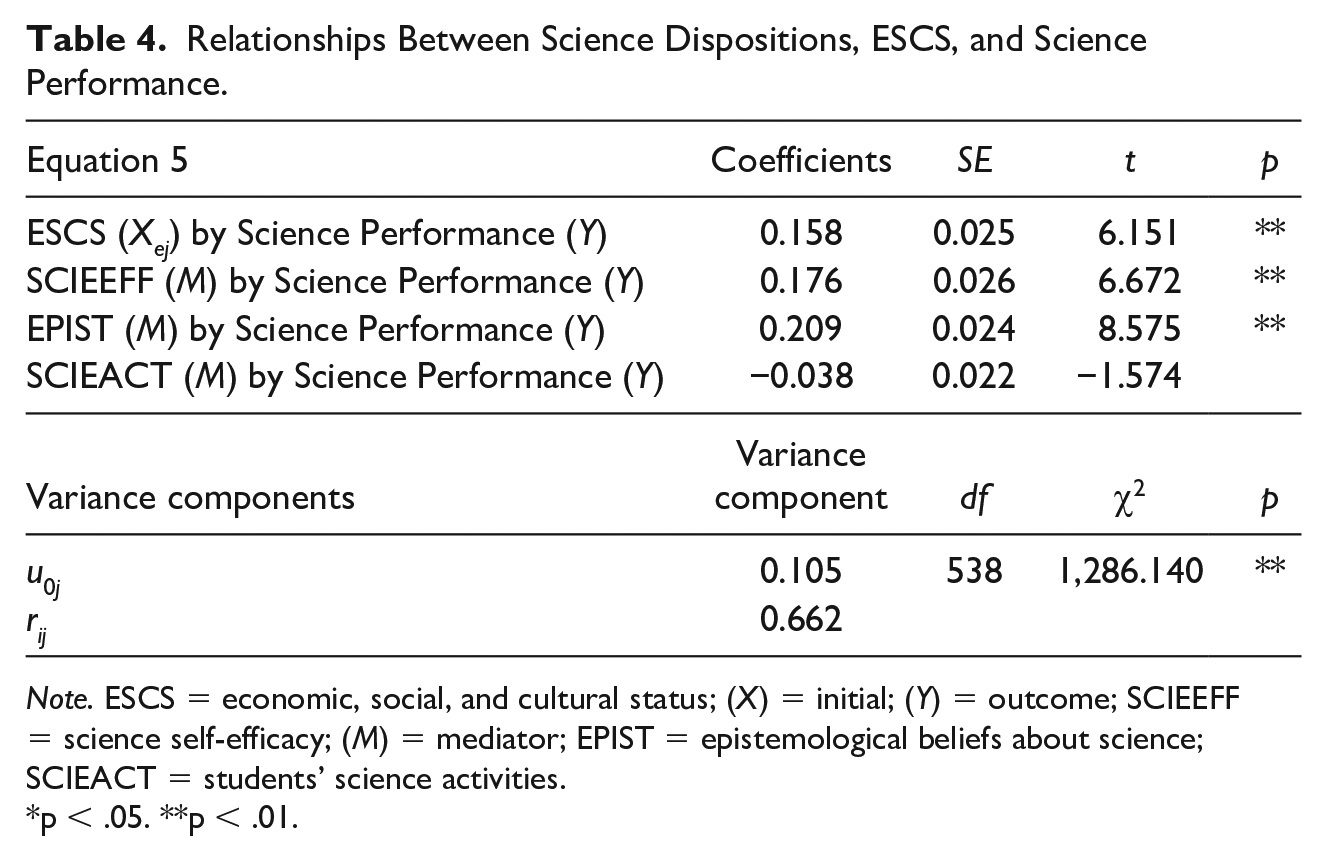
Note. ESCS = economic, social, and cultural status; (X) = initial; (Y) = outcome; SCIEEFF = science self-efficacy; (M) = mediator; EPIST = epistemological beliefs about science; SCIEACT = students’ science activities.
p < .05. **p < .01.
As shown in Table 4, ESCS, SCIEEFF, and EPIST were significant predictors of science performance with positive relations (p < .01), but SCIEACT was not (p > .05). This indicates that ESCS, SCIEEFF, and EPIST of immigrant students increased their science performance. A one-unit increase in ESCS level is related to 0.158 expected unit increase in science performance; a one-unit increase in the SCIEEFF variable is related to 0.176 expected unit increase in science performance; and a one-unit increase in the EPIST variable is related to 0.209 unit increase science performance, checking for associated covariates. All the variables explained 20% (R2) of the variance in science performance. The effect size of the variables was calculated as 0.25 (f2). This means that the variance explained by the variables is a medium-to-large effect. Figure 2 shows the indirect effects on science performance.
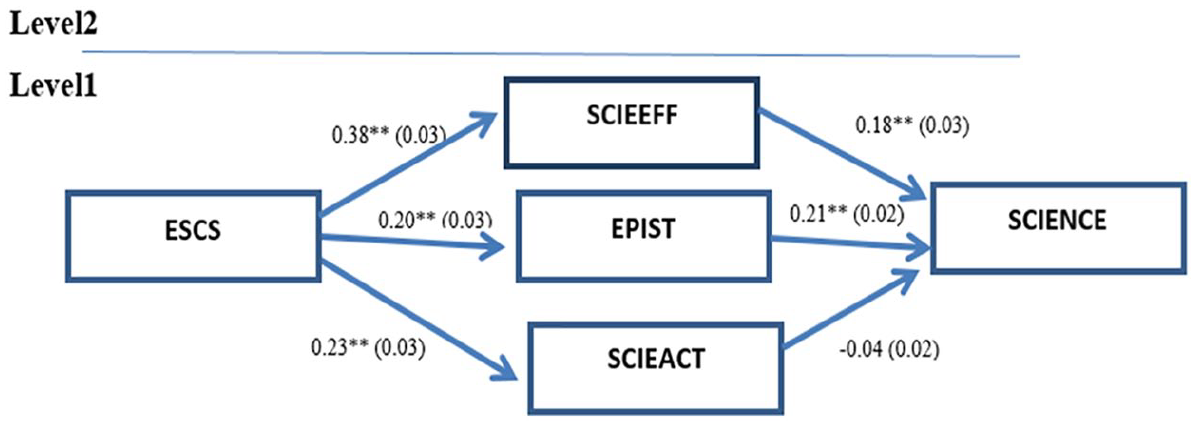
Mediator effects in Model 1-1-1.
The effect of ESCS in science performance through the effect of SCIEEFF, EPIST, and SCIEACT was tested. It was determined that ESCS significantly predicted the science performances of immigrant students through the SCIEEFF and EPIST variables (p < .01). This indicates that SCIEEFF and EPIST had a mediation effect in science performance and that SCIEACT did not have any mediation effect on science performance (p > .05). As the ESCS level of the immigrant student increases, so the levels of SCIEEFF and EPIST increase; the increase in SCIEEFF and EPIST levels increases the science performance of the immigrant student, mediation effect for SCIEEFF γ10(2) * γ20(5) = 0.384*0.18 = 0.07, zsobel = 5.42, p < .01; for EPIST γ10(3) * γ30(5) = 0.20*0.21 = 0.04, zsobel = 5.63, p < .01. A one-unit increase in ESCS index values leads to an increase of 0.38 unit in SCIEEFF, and 0.18 part of this increase is transferred to science performance. Thus, the indirect effect of ESCS on science performance was 0.07. A similar explanation can be made for EPIST; a one-unit increase in ESCS index values leads to an increase of 0.20 unit in SCIEEFF, and 0.21 part of this increase is transferred to science performance. The indirect effect of ESCS on science performance was 0.04.
Discussion and Conclusion
Determining the differences in educational attainment among the children of immigrants is vital for understanding why some groups achieve successful adaptation while others lag behind. Scientists who study immigrants define the main differences in the integration process among immigrant children. These differences include assimilation into mainstream society, economic success, and downward mobility in class or urban poverty (Portes et al., 2005; Portes & Zhou, 1993). In Canada, features affecting immigrant student achievement can be classified as characteristics of the individual/family, local policies, and sociocultural and demographic characteristics. The success of immigrant students should be associated with these three lenses (Volante et al., 2017). This study would like to show the importance of both the direct and indirect effects of economic and cultural status on immigrant student’s science literacy through science-related dispositions.
First, the relationship between ESCS and science performance was tested, and it was found that ESCS has a direct, medium-to-large effect on immigrant student’s science performance. Many studies supported this finding, noting that immigrant students’ successes increase as their socioeconomic levels increase (e.g., Acosta & Hsu, 2014; Areepattamannil & Kaur, 2013; Murat & Frederic, 2015; OECD, 2013). When the PARED and occupational level as ESCS’ indicators increases, the parent’s expectation of the student’s academic success increases. School and community attitudes tend to support education (Kroneberg, 2008). Traditional assimilation theory (Gordon, 1964) emphasizes that the integration of immigrant groups into the society is accompanied by an increase in socioeconomic and academic success.
Second, we would like to emphasize the importance of the indirect effect of ESCS. ESCS might also affect science achievement through science dispositions because parents with high cultural and social capital are likely to transmit knowledge and dispositions to their children’s norms and values associated with science education (Adamuti-Trache & Andres, 2008; Lyons, 2006). If the students are motivated to learn, they value the outcome and process of learning. They expect that they will be successful (Lefton, 1991). To prove our thesis, first, the relationships between ESCS and science-related dispositions were tested. It was seen that ESCS had a positive relationship with science-related dispositions (SCIEEFF, EPIST, and SCIEACT). As the ESCS level increased, the immigrant student’s level of science dispositions also increased. ESCS had a medium effect on self-efficacy, a large effect on epistemological beliefs, and a medium-to-large effect on science activities. As mentioned above, parents with high SES often have the necessary skills to interact with their children and direct them into science-related learnings and activities (Schoon & Parsons, 2002). Participation in different science-based activities might support the development of science beliefs.
Third, the effects of all variables on science performance were tested with full model. It was found that all variables other than SCIEACT were significant and were positively related to science performance. This indicated that SCIEACT did not have any mediator effect, while SCIEEFF and EPIST did have mediator effects on science performance. All these variables had a medium-to-large effect on science performance.
Self-efficacy is essential for learning and academic performance (Zimmerman, 2000). People with high levels of self-belief are likely to attribute their success to variables within themselves, which increases their likelihood of performing tasks (Bandura, 1977). Studies in the literature support our findings. It was seen that students’ high self-efficacy beliefs in science influenced their science achievement positively (Britner & Pajares, 2001). In this study, epistemological beliefs were found to be other significant predictors of science performance. The students’ epistemological beliefs reflect on their learning and academic life. The student’s ideas about science, assumptions, processes, and the formation of scientific knowledge have been determined to increase the performance of science (Chen & Pajares, 2010; Lin et al., 2013).
When the results of the study were evaluated, it was determined that ESCS have both direct and indirect effects on science performance. Although a small proportion but medium-to-large effect of ESCS is transferred to science performance via science dispositions, self-efficacy and epistemological beliefs have a partial mediator role for ESCS.
Limitations and Future Research Directions
Although there is much disagreement in the educational research community about the validity of international studies in education, mainly because student-level factors affect the learning processes and the outcomes of immigrant students, this study identifies some of the factors. Some limitations of the present work should be discussed. The data of PISA are cross-sectional, and therefore it is not possible to draw inferences about cause–effect relationships. Thus, future researchers could use an experimental research design to test the causal relationships among variables, which can help us to understand whether the relationships between them are truly causal. Despite the positive contributions of the current research, the findings are only based on scientific literacy of immigrant student. Similar studies could be conducted for other learning areas such as mathematical or reading literacy. Future studies may continue examining cognitive or affective factors either in natural settings or by implementing experimental studies that focus on other affective or teacher-related factors and their contribution to scientific literacy. In addition to SES, there is a need for further research to reveal the mediating effects of other variables, such as gender. This issue merits future research.
Footnotes
Declaration of Conflicting Interests
The author(s) declared no potential conflicts of interest with respect to the research, authorship, and/or publication of this article.
Funding
The author(s) received no financial support for the research, authorship, and/or publication of this article.
