




Abstract
This study examined the role of select intrapersonal and microsystem factors in high school adolescents’ academic achievement. A combination of factors, derived from an ecological framework, were hypothesized to be unique in their ability to explain greater proportions of variance in academic achievement in adolescents. Participants included 379 high school students (176 males, 193 females) from a mid-western high school in a large metropolitan area with a 53% poverty rate that enrolls approximately 1,500 students. A variety of variables emerged as significant predictors of academic achievement, with social emotional learning, self-efficacy, socio-economic status, parental involvement, peer support, and teacher support all explaining significant proportions of variance in achievement, and some to stronger degrees than others. This lends support to the notion that learning is shaped by a myriad of ecological factors. These findings are discussed with regard to their usefulness in understanding ways in which to target each of the investigated variables to ultimately increase academic achievement in adolescents.
Keywords
Introduction
According to the National Assessment for Educational Progress (NCES, 2015), many U.S. students are struggling in all three of the main academic domains—reading, writing, and mathematics. It is estimated that only about one third of students are scoring at or above Proficient in these subject areas, with the majority of students graduating high school without adequate skills. In the face of pressures of legislation demanding high levels of student proficiency, this has become clear and concerning. Indeed, meta-analyses of SEL programs have found increased academic achievement as well as an indirect effect of reduction in mental health concerns (Durlak et al., 2011; Neil & Christensen, 2007). Therefore, the intersection between social and emotional learning (SEL) and academic functioning in understanding academic skill development is dire and thus the focus in the current study.
Social and emotional skills are considered to be a vital part of a child’s overall development (Weissberg et al., 2003, 2015). SEL can be identified as the way students think, feel, and behave in regard to themselves and others around them (Elias et al., 1997) and emphasizes specific cognitive, behavioral, and affective competencies (Durlak et al., 2011). These skills allow for more positive social interactions with others, as well as demonstrations of self-control, and understanding of emotions (Payton et al., 2000). Ultimately, the goal of SEL is to enable students to demonstrate appropriate responses to a variety of environmental demands, whether positive or negative, as well as to take advantage of different opportunities presented.
SEL Framework
The Collaborative for Academic, Social and Emotional Learning (CASEL, 2005) is identified as developing one of the most well-recognized frameworks for SEL (Osher et al., 2016). According to CASEL (2015) there are five interrelated components of comprehensive SEL. The first component, self-awareness, includes identifying emotions, promoting self-confidence and enhancing self-efficacy. Next, self-management, focuses on curbing impulse control, improving stress management and self-discipline. Relationship skills is another component identified by CASEL. This focuses on communication skills, increasing social engagement, developing cooperation and conflict resolution skills, and seeking and/or offering help. Lastly, responsible decision making is a component of SEL. Skills falling under this include teaching problem solving skills and developing ethical responsibilities.
A meta-analysis conducted by Sklad et al. (2012) identified the majority of intervention programs focused on improving social and emotional competencies resulted in seven categories of beneficial effects: social skills, antisocial behavior, mental health, substance abuse, academic achievement, positive self-image and prosocial behavior. SEL has been associated with improved academic performance, physical health, and citizenship, while reducing the risk of maladjustment, failed relationships, interpersonal violence, substance abuse, and unhappiness; it is a skill set demanded by employers, and is considered essential for lifelong success (Elias et al., 1997; Zins et al., 2004). Other benefits include success in the labor market and life in general (Heckman & Kautz, 2012) as well as wellness later in life (Jones et al., 2015).
The benefits of well-developed SEL also include reduction of negative outcomes that are associated with limited development of appropriate skills (Elias & Weissberg, 2000). Students that demonstrate poorer SEL can experience greater peer rejection, poorer relationships with teachers, risk of school failure, aggressive behaviors, temperamental difficulties, and poor self-control (Jones et al., 2015; Raver & Knitzer, 2002). Specifically, students with low social and emotional functioning may go on to develop poor peer relationships, in which they engage in risky behaviors, such as underage drinking, unprotected sexual interactions and experimentation with illegal drugs (Catalano et al., 2004).
Moreover, when evidence-based SEL interventions have been implemented with youth, there have been positive impacts on improved social and emotional skills, attitudes, behavior, and academic performance (see meta-analysis by Durlak et al., 2011; Elias, 2004; Johnson & Johnson, 2004; Payton et al., 2000). Parker et al. (2004) found higher SEL to be positively correlated with reported levels of student academic success at both the high school and college levels. Due to the host of benefits, educators are focused on how to identify the best predictors of academic achievement in order to help foster protective factors in at-risk students (Salmela-Aro & Tynkkynen, 2010).
Ecological Theory
As noted above, SEL is important for academic achievement. However, a major purpose of the current study is to understand whether other variables make significant contributions to achievement independent of SEL, or in combination with it. Indeed, some researchers believe that learning occurs in collaboration between various individuals, including teachers, peers, and family members (Durlak et al., 2011). Similarly, the same holds true for SEL; there are individual child factors, family factors, and environmental factors to consider, that impact the development of these skills (Hemmeter et al., 2006). Bronfenbrenner’s bio-ecological perspective is one such way to view the varying impacts of multiple contexts on a child’s overall development (Bronfenbrenner, 1979). He identified four interacting systems: the microsystem, mesosystem, exosystem, and macrosystem. At the core of this system of contextual influences is the individual and his/her unique characteristics. In this study, the focus is on variables at the individual/intrapersonal (self) as well as microsystem (immediate environment—family, peers, teachers) levels (Bronfenbrenner, 1979).
It is clear that social and emotional competence and academic success are interwoven (Durlak et al., 1997; Elias, 2004; Johnson & Johnson, 2004; Payton et al., 2000; Zins & Elias, 2006) and that children learn different skills based on the different environments they inhabit (Bronfenbrenner, 1979). These interactions work in shaping their overall development. Thus, it is necessary to look at the variables that can ultimately impact development of SEL in adolescents. The variables that will be examined in this study include students’ self-perceptions of their social and emotional skills and their self-efficacy, and students’ levels of social support from peers, parents, and teachers, parental involvement, and school climate.
Intrapersonal Predictors
Self-efficacy has been consistently found to be important correlates of both SEL and academic achievement. Self-efficacy can be defined as the explanation and prediction of one’s emotions, actions, and thoughts (Bong & Skaalvik, 2003). Self-efficacy is important as individuals gauge how successfully they can manage different experiences and situations, and is believed to be task-specific (Bandura, 1997). It is considered to be an essential component of youth development, and according to CASEL, falls under the self-awareness component of SEL. As a result, self-efficacy as well as students’ perceptions of their social emotional skills were examined in this study.
Microsystem Predictors
Peer, parent, and teacher support
An important factor in promoting increased academic achievement is having students cultivate meaningful relationships with peers, teachers, and parents (Martin & Downson, 2009). Social support is defined by Malecki and Demaray (2002) as an individual’s perceptions of supportive characteristics from individuals in his or her social network that may improve functioning and may act as a buffer from negative outcomes. Research suggests that students with perceived higher levels of support from teachers, parents and peers earned better grades compared to those students lacking perceived social support (Domagała-Zyśk, 2006; Rosenfeld et al., 2000).
Peer support in particular increases during the transition from childhood to adolescence, when youth begin to look to peers and friends to influence their behaviors, which can also transfer to influence on achievement (Nichols & White, 2001). Additionally, Wentzel et al. (2004) found that adolescents with academically high performing friends not only showed improvement in their own academic achievement, but also increased involvement in school (Bissell-Havran & Loken, 2009). Equally as so, peer support can also operate as a risk factor, as some students may feel pressure to conform to negative peer pressure, or other norms that detract from increased academic achievement (Goldsmith, 2004; Wentzel & Caldwell, 1997).
Parents also provide great influence on children’s overall development. In addition, research has indicated that parents play a necessary role in fostering high achievement in their children throughout childhood and adolescence (Bouchey & Harter, 2005). Parents lend perhaps the greatest level of support during infancy and into early and middle childhood. However, despite increased autonomy during adolescence, parents are still found to be involved in teens’ decision making processes regarding major life choices (Kerpelman et al., 2008). Some find parental support to be the best predictor for overall psychological functioning, when compared to teacher support and peer support (Stewart & Suldo, 2011).
The relationship between a student and teacher is also a significant predictor of a student’s academic and social-emotional competence (Bryan et al., 2012; Malecki & Elliot, 1999; Tennant et al., 2015). Teacher support is thought to encompass characteristics such as warmth and acceptance, as well as providing knowledge and feedback to students (Tennant et al., 2015). In terms of SEL, empirical evidence suggests emotional and instrumental teacher support to be significantly related to middle school students’ well-being (Suldo et al., 2009). Further, research has linked teacher emotional support to positive social-emotional competence (Tennant et al., 2015).
Parent involvement
Further, parental involvement is considered to be important in helping to facilitate a student’s overall positive development, academic success, and motivation to learn (Epstein & Sanders, 2002; Hill & Taylor, 2004; Jeynes, 2012; Seginer, 2006). Parental involvement is defined as the interactions parents have with the school, as well as their interactions with children in order to benefit their children’s academic success (Hill et al., 2004). Research indicates that when there are high parental aspirations for children in high school, there is a positive outcome with students’ academic behaviors such as homework completion (Epstein & Sanders, 2002), overall academic performance (Catsambis, 2001), and emotional functioning (Wang & Sheikh-Khalil, 2014).
School climate
Lastly, school climate is important to consider when looking at both academic and emotional competencies. While there is no universal definition of school climate, it can be thought of as the overarching beliefs, values and attitudes of students, teachers, parents, and community members (Cohen, 2009). Overall, research suggests a link between positive school climate and greater academic achievement (Stewart, 2008; Thapa et al., 2013; Wang & Degol, 2016). In addition, Bear et al. (2011) found positive school climate perceptions to be positively correlated with mean standardized tests scores. Schools should be safe, encouraging and inclusive environments that look to foster the whole child and his or her full potential. However, reports suggest not all students feel safe or included in their school settings (Grover et al., 2015; Robers et al., 2013). As a result, school climate can act as a potential risk-factor for students or a protective factor.
Limitations of Prior Research and Purpose of Proposed Study
As there continues to be growing evidence highlighting the benefits to academic success of social and emotional competencies, there are also limitations to the current research. To begin with, the term SEL is viewed as an umbrella term, which makes specific skills difficult to operationalize, and the idea somewhat ambiguous (Hoffman, 2009). However, CASEL’s definition of SEL is described as well-known in the field (Osher et al., 2016), and will be utilized for the purpose of this study. While there is valuable research available on social and emotional development for students, there is a limitation when examining SEL from the ecological perspective, specifically looking at variables within the home, school, and community settings, and those individuals involved in a child’s life. The purpose of the study will be to comprehensively examine academic achievement and SEL from an ecological perspective.
Based on the literature reviewed, the aims of the current study were: (1) How strongly correlated are SEL and achievement? (2) Of the two intrapersonal variables (social emotional learning, self-efficacy) which is most predictive of academic achievement? (3) What microsystem (peer support, teacher support, parent support, parental involvement, school climate) variables are most predictive of academic achievement? (4) In a combined model, do the microsystem variables and self-efficacy significantly predict achievement above and beyond SEL? The results of this study are expected to contribute a more thorough understanding of the social emotional and social support predictors of academic achievement among high school students. With a movement towards educating the whole child, it is necessary to determine the influence that these variables have on achievement so that curriculum and instructional approaches may be more informed.
Method
Participants
The participants were 378 males (n = 176) and females (n = 193) (10 did not indicate sex) from a public high school of a major metropolitan area in the Midwestern USA. This large urban area is comprised of many overlapping communities. This particular area contains over 72,000 residents and over 9,000 K-12 students and is a large part of the broad urban context. The sample district is considered an urban district by the Michigan Department of Education. More than half of the student body (53%) meet criteria as economically disadvantaged. Only 32% of the students were proficient on state tests compared to the state average, which is 40%. The average of similar schools is 43%. The graduation rate is 42%, and the state graduation rate is 45%. The sample included students in the 9th (n = 113), 10th (n = 111), 11th (n = 104), and 12th (n = 51) grades, majority Caucasian (n = 211), and the others African American (n = 40), Hispanic (n = 64), Middle Eastern (n = 10), Native American (n = 5) and Mixed-Race (n = 44). Demographics were comparable to the overall student population.
Measures
Demographics
Students completed a short demographic survey containing questions pertaining to grade, age, gender, socioeconomic status, and ethnicity. To measure socio-economic status, students were asked to circle yes or no to the question, “Do you receive free or reduced lunch?” The response was coded as Yes (1) and No (0). It is important to note that the larger number means lower SES in this data set.
Academic achievement
Students reported their most recent grades in their four core classes (language arts, math, science, social studies). Specifically, they were asked to circle A, A–, B+, B, B–, C+, C, C–, D+, D, D–, E or N/A for each grade. Students selected N/A if they did not have one of the four identified core classes. Grades were coded by 11 (A) to (0) E. They were also asked to note the grades that they typically achieve, with the prompt, “What grades do you typically receive?” Students circled one of the following responses: Mostly As, Mostly As and B, Mostly Bs, Mostly Bs and Cs, Mostly Cs, Mostly Cs and Ds, Mostly Ds, Mostly Ds and Es, and Mostly Es. Responses were coded between Mostly As (9) and Mostly Es (1).
Social-emotional learning
The Social Emotional Learning Scale (SELS) was used to measure students’ perceptions of SEL (Coryn et al., 2009). The SELS is a 20-item questionnaire designed to look at three different factors of the social and emotional learning, as defined by the CASEL categorizations: Task Articulation (TA) (e.g., “I keep track of my progress toward a goal”), Peer Relationships (PR) (e.g., “I understand the feelings expressed by others”, and Self-Regulation (SR) (e.g., “I figure out different solutions to personal problems”). There are five response options ranging from strongly disagree to strongly agree. A total score was computed by summing all items on each subscale; higher total scores reflect that the individual has the identified social-emotional learning attribute. The SELS is found to have good reliability and internal consistency (Arslan, 2015; Coryn et al., 2009).
Self-efficacy
The Self-Efficacy Questionnaire for Children (SEQ—C) was used to measure students’ own self-efficacy (Muris, 2001). The SEQ-C is a 24-item, valid and reliable questionnaire designed to look at three different domains of self-efficacy, including social self-efficacy (perceptions on peer relationships and assertiveness), academic self-efficacy (the ability to fulfill academic expectations, manage the learning processes, and master academic subjects), and emotional self-efficacy (the ability to manage negative emotions) (Muris, 2001). The responses are scored using a 5-point likert scale ranging from 1 = not at all to 5 = very well. Examples of items from the SEQ—C include “How well can you pay attention during every class,” “How well can you succeed in staying friends with other children,” and “How well do you succeed in not worrying about things that might happen?”
The SEQ—C seems to be a valid and reliable questionnaire in which students’ perceptions of self-efficacy are gathered. The internal consistency reliability of the SEQ-C had a total self-efficacy score of 0.88; the Cronbach’s < for the subscale scores was between .85 and .88. In addition, Muris (2001) found the subscales of the SEQ—C to be significantly intercorrelated. Specifically, the emotional self-efficacy subscale correlated with the social self-efficacy (0.40; p < .001); emotional self-efficacy was correlated with academic self-efficacy (0.41; p < .001). However, it should be noted the correlation between academic self-efficacy and social self-efficacy were lower (0.17; p < .005). Lastly, there were significant gender differences found with the SEQ—C. Girls were found to report lower levels of overall self-efficacy, specifically due to lower levels of perceived emotional self-efficacy than boys (Muris, 2001). The alpha was 0.91 in the current sample.
Peer, parent, and teacher support
In order to survey students’ perceived levels of parent, teacher, and peer support, the Child and Adolescent Social Support Scale (CASSS) was used (Malecki et al., 2000). This is a 60-item, reliable and valid multi-dimensional survey that looks to explore perceived support from areas including parents, teachers, classmates, close friend, and school with children in third through twelfth grades. The rating scale includes a 6-point Likert Scale for responses, ranging from 1 (Never) to 6 (Always). For the purpose of this study, three subscales were used: peer support, parent support, and teacher support.
Students completed the peer subscale of the CASSS to measure perceived levels of classmate support. This 12-item subscale includes items such as My classmates. . . “treat me nicely,” “give me good advice,” and “tell me good job when I’ve done something well.” The parent subscale of the CASSS was used to measure perceived levels of parent support. This subscale consists of 12-items. Example items include My Parent(s). . . “show they are proud of me,” “help me solve problems by giving me information,” and “take time to help me decide things.” The teacher subscale of the CASSS was used to measure perceived levels of teacher support. This subscale consists of 12-items that include My Teachers. . . “care about me,” “help me solve problems by giving me information,” and “nicely tell me when I make mistakes.”
Parent involvement
The Commitment to Achievement Measure (Paulson, 1994) was used to measure students’ perceptions on parent involvement. This 22-item, reliable scale looks at parent involvement in their children’s academics and schooling. Students are given a five-factor Likert rating scale, ranging from Very Unlike, More Unlike than Like, Neither Like nor Unlike, More Like than Unlike, Very Unlike. Sample items include “My parent usually does not go to school functions,” “My parent usually goes to parent-teacher conferences,” and “Hard work is very important to my parent.” Items are designed to explore students’ perceptions of specific dimensions of parental involvement, including, achievement values, interest in schoolwork, and involvement in school functions. It is important to note that the term “mother” in the original measure was changed to “parent/guardian” for the purpose of this study.
School climate
The Delaware School Climate Survey—Students (DSCS-S) developed by Bear et al. (2014) was used to measure students’ perceptions of school climate. There are a total of 29 items on this measure, which focuses on eight subscales of school climate, including Teacher-Student Relations (five items), Student-Student Relations (four items), School Safety (three items), Clarity of Expectations (four items), Fairness of School Rules (four items), Respect for Diversity (three items), Student Engagement Schoolwide (five items), and Bullying Schoolwide (four items), which all yields a Total School Climate measure. Students select from four response options, ranging from Disagree a Lot, Disagree, Agree, and Agree a Lot. A revised version of the DCSC—S was developed in 2013, which was used in this study. The revised version has good internal consistency and validity (Bear et al., 2011, 2014)
Procedure
After approval from Wayne State University’s Institutional Review Board (IRB), data was collected throughout the students’ academic center classes at the selected high school. The Academic Center classes are a mixture of students from every grade, and included both general education and special education students. The Academic Center class was selected so as not to interrupt instruction in core or elective classes. Parents were sent supplemental information forms via first-class mail 2 weeks prior to data collection. These letters described the nature of the study, what type of information was to be collected, and information on how to opt their child out of the study. A total of 10 students were requested by their parents to not participate in the study. Although there were about 140 survey items, there was no indication that the length of the questionnaire interfered with students’ stamina while completing the measures.
Results
The purpose of this study was to investigate the roles of select intrapersonal and microsystem factors in adolescents’ academic achievement. In addition, social and emotional learning was examined to determine how predictive it was of achievement compared to intrapersonal and microsystem level variables. The distribution of the sample was normal. There was little missing data from this sample. Mean substitution by key demographics was used for the small amount of data that was missing. In all of the analyses, a criterion alpha level of .05 was used to determine statistical significance.
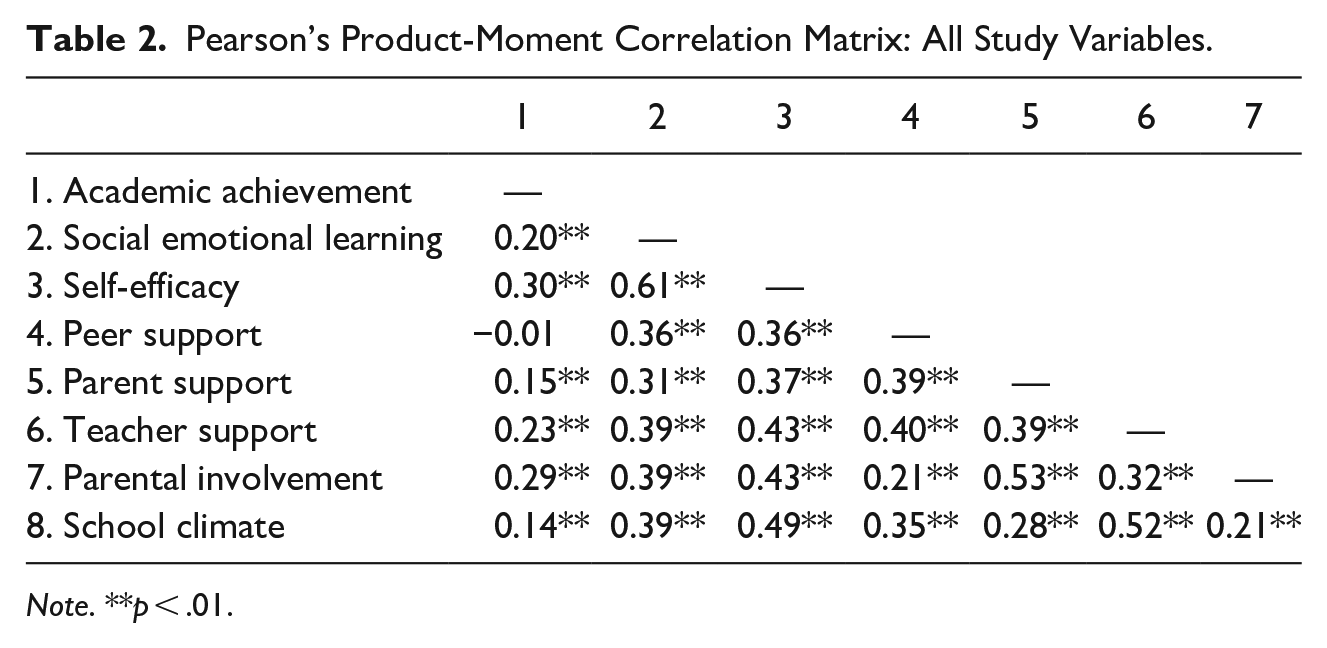
Preliminary analyses involved a series of Analysis of Variance (ANOVA) tests for gender, grade-level, socio-economic status (SES), and race differences in the study variables. These analyses revealed gender, SES, race and grade differences in about half of the variables. These differences were not the focus of the study and thus were controlled for in subsequent analyses, which involved hierarchical regression analysis with gender, grade, socio-economic status and race entered at step 1 of each analysis. Means and standard deviations for primary variables are in Table 1 and correlations among these variables are included in Table 2.
Descriptive Statistics and Cronbach’s Alphas for Study Variables.

Pearson’s Product-Moment Correlation Matrix: All Study Variables.
Note. **p < .01.
SEL and academic achievement were correlated to a small degree (r = .20, p < .01). Additionally, the three subscales of SEL were examined to see if results varied for the three constructs compared to overall SEL. There were significant, but weak, correlations between academic achievement and self-regulation (r = .20, p < .001), task articulation (r = .20, p < .001), and personal relationships (r = .14, p < .01) (see Table 3). Next, correlations were run to determine associations between subscales of SEL and grades earned in each of the four core classes (math, language arts, social studies, science). Results revealed that most all correlations were statistically significant but low in strength, regardless of the specific subscale of SEL and the type of classes. As this was no greater than the correlation for the total SEL scale, only the overall academic achievement score/overall GPA and the overall SEL scores were used.
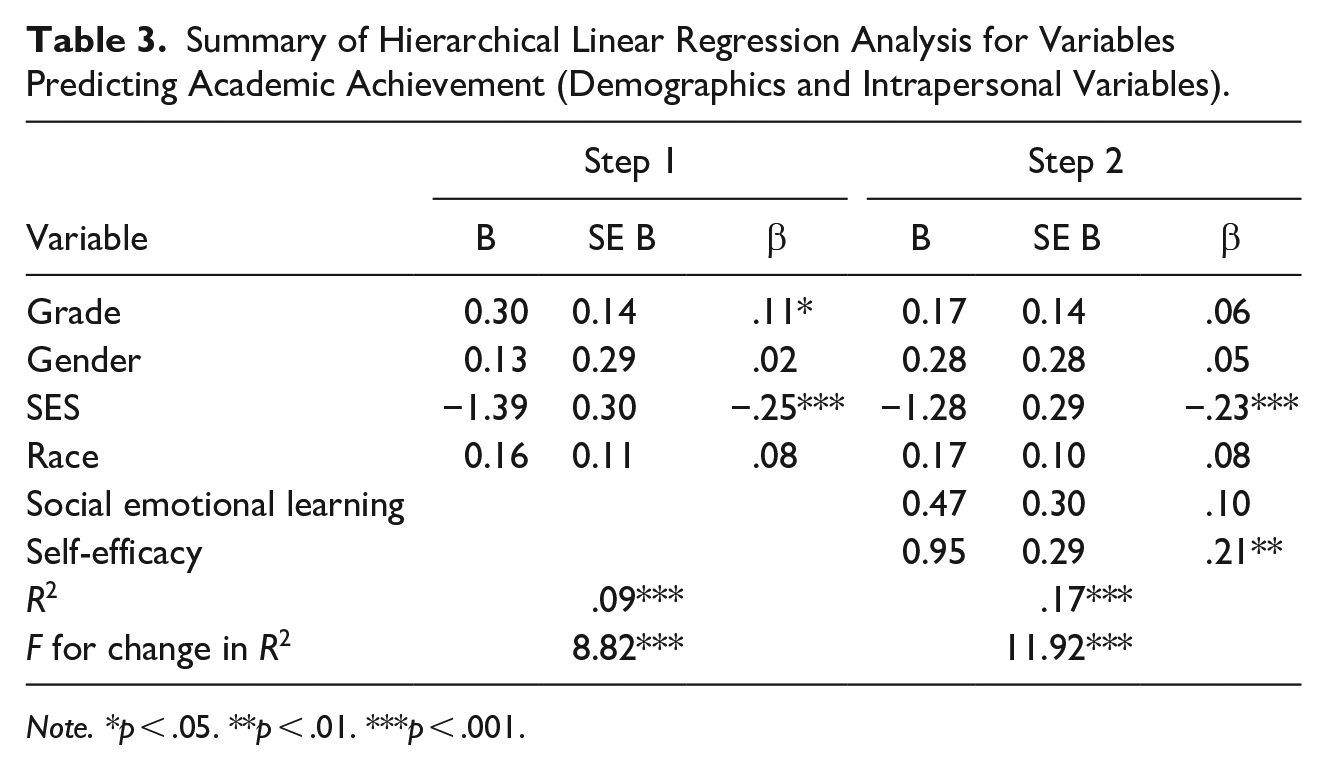
Summary of Hierarchical Linear Regression Analysis for Variables Predicting Academic Achievement (Demographics and Intrapersonal Variables).
Note. *p < .05. **p < .01. ***p < .001.
In addition, a hierarchical regression analysis was conducted to examine the association between total SEL and academic achievement to be able to control for demographics. A total of 9% of variance in academic achievement was accounted for by these demographic variables (F = 8.93, df = 4, 359, p < .001). Specifically, two demographic variables, SES (β = –.25, p < .001) and grade (β = .12, p < .05), were the significant contributors. However, at the second step, SEL was also found to be statistically significant (β = .23, p < .001) above and beyond the explanation of variance by the demographic variables entered at the initial step. SEL explained an additional 5% of the variance of academic achievement at the second step, significantly uniquely beyond what accounted for at step one (R2 change = .05, p < .001). Grade did not remain significant at step 2 once in the presence of SEL, but SES did. Interestingly, SEL and SES had similar BETA weights, suggesting similar amounts of contribution in explaining the variance. In the overall model, a total of 14% of the variance of academic achievement was explained by demographics and SEL (see Table 3).
Hierarchical regression analysis was conducted to determine the degree to which the intrapersonal factors of self-efficacy and social and emotional learning explained variance in academic achievement, controlling for demographics. SES and grade made significant contributions to the variance in academic achievement (Grade β = .11, p < .05 and SES β = .25, p < .01) and explained a total of 9% of the variance (F = 8.82, df = 4, 349, p < .001). At step 2, social and emotional learning and self-efficacy were entered, and while SES continued to be significant (β = –.23, p < .001), grade was no longer found to be significant in terms of demographics. The introduction of intrapersonal variables increased the variance by an additional 8% (R2 change = .08, p < .001). Self-efficacy was found to be a significant contributor (β = .21, p < .01) above and beyond that accounted for at the first step. However, SEL was not significant when in the presence of self-efficacy. Self-efficacy and SES had similar beta weights, suggesting similar amounts of contribution to explaining the variance in achievement. A total of 17% of the variance was explained by demographic and intrapersonal variables (see Table 3).
To determine the degree to which microsystem level variables, including school climate, parental involvement, parent support, teacher support, and peer support, explained variance in academic achievement, another hierarchical regression analysis was run. As in the prior research question, the same proportion of variance was explained at steps 1 and 2. At step 1, grade (β = .11, p < .05) and SES (β = –.28, p < .001) were found to be the significant demographic contributors to the variation in academic achievement, accounting for a total of 9% of the variance (F = 9.635, df = 4, p < .001). Specifically at Step 2, SES continued to be significant (β = –.24, p < .001); however, grade was no longer a significant contributor. The microsystem variables that statistically contributed to the variation in academic achievement included parental involvement (β = .22, p < .001) and teacher support (β = .21, p < .002); SES, parental involvement, and teacher support all had nearly the same beta weights, suggesting similar amounts of contribution to explaining variance in achievement. School climate, parent support and peer support were not found to be significant contributors. The introduction of the microsystem level variables explained an additional 8% of the total variance in academic achievement at the second step (R2 change = .08, p < .001), which accounted for above and beyond what the demographics contributed to the variance in the initial step. Together, demographics and microsystem level variables accounted for a total of 17.2% of the variance in academic achievement (see Table 4).
Summary of Hierarchical Regression Analysis for Variables Predicting Academic Achievement (Demographic and Microsystem Variables).

Note. *p < .01. **p < .001.
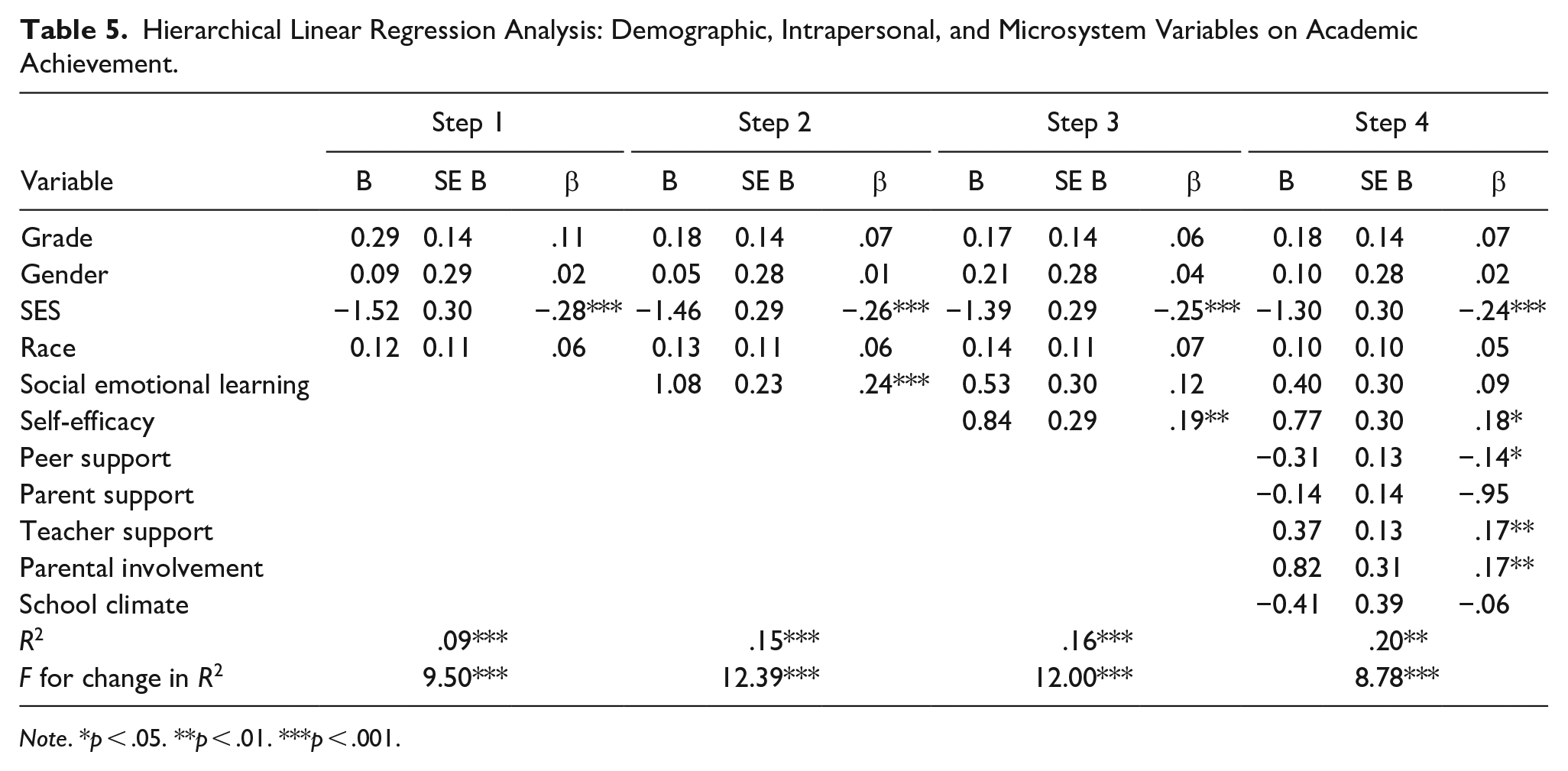
Lastly, a hierarchical regression analysis was run to determine in a combined model which variables were significant beyond SEL. At step 1 of the regression (R2 = .09, p < .001; F = 9.50, df = 4, p <.001), and it was again grade (β = .11, p < .05) and SES (β = –.28, p < .001) that surfaced as the significant contributors to variance in academic achievement in the initial step.
At the second step, SEL (β = .24, p < .001) and SES (β = –.26, p < .001) were found to be significant, with SEL accounting for an additional 6% of variance (R2 =.15, p < .001; β = .24, p <.001). While SES continued to be statistically significant at the second step, grade was no longer significant. A total of 15% of the variance was explained by the variables in the second step.
Self-efficacy (β = .19, p < .005) and SES (β = –.25, p < .001) were found to be statistically significant contributors at step three. However, SEL was no longer found to be significant when self-efficacy was included in the model. SES had the largest beta weight, suggesting it contributed to the variance to a greater degree than self-efficacy. Although statistically significant, with the addition of the self-efficacy variable at step 3, there was only a 1% increase in variance (F = 12.00, df = 6, p < .001). The third step accounted for a total of 16% of the variance in academic achievement (see Table 5).
Hierarchical Linear Regression Analysis: Demographic, Intrapersonal, and Microsystem Variables on Academic Achievement.
Note. *p < .05. **p < .01. ***p < .001.
Lastly, an additional 4% of the variance was explained by the addition of the microsystem level variables (R2 change = .20, p < .01; F = 8.78, df = 11, p < .001), with SES (β = –.24, p < .001), self-efficacy (β = .18, p < .05), parental involvement (β .17, p < .01), teacher support (β = .17, p < .01), and peer support (β = –.14, p < .05) as contributors, while SEL, parent support, and school climate were not found to be significant. A total of 20% of the variance in achievement was explained by this full model when demographics, intrapersonal variables, and microsystem variables were all added into the analysis.
Discussion
Social and emotional learning (SEL) encompasses a critical set of skills for children and adolescents to master, skills that have demonstrated a plethora of positive effects (Durlak et al., 2011). Prior research has indicated that students with developed social and emotional skills have increased positive outcomes including increased academic achievement and a reduction in mental health concerns (Durlak et al., 2011; Neil & Christensen, 2007). Based on this information, one of the major aims of the current study was to identify whether several key variables would better explain variance in academic achievement conducted in previous studies.
There were various themes that emerged in the study. First, SEL and academic achievement were found to have a small, but significant relationship. In addition, SEL played a significant role in explaining variance in academic achievement, but SEL was not as strong a contributor as hypothesized, at least among this sample. In addition, SEL was no longer significant once entered in combination with other study variables. This suggests that while SEL played a role, other variables appeared to play stronger roles in understanding academic achievement.
Another important theme was that self-efficacy explained a significant amount of variance in academic achievement and was more strongly correlated with achievement than was any other variable in this study. This supports current literature that highlights the important role self-efficacy plays in education and achievement (Affuso et al., 2016; Galyon et al., 2012; Schunk et al., 2010). Self-efficacy encompasses a set of skills that allow students to gauge how successfully they can manage different experiences and situations, and is thought to be a task-specific compilation of skills. Furthermore, the multicollinearity of SEL and self-efficacy indicates that self-efficacy may be conceptually part of SEL. This may lend evidence to Payton et al. (2000), as it was suggested in CASEL’s earlier work that self-efficacy could potentially serve as a foundational skill, one that is pertinent in developing further competencies within SEL.
SES also consistently explained the variance in academic achievement across analyses. This is not surprising, as prior research highlights that students who come from higher SES backgrounds generally perform better in school (Ransdell, 2012; Van Ewijk & Sleegers, 2010) and the importance of SES in education has been documented throughout the past several decades (Harwell & LeBeau, 2010; Sirin, 2005).
Moreover, parental involvement and teacher relationships significantly explained variance in academic achievement above and beyond demographics. In addition, when all variables were entered into a hierarchical regression, microsystem variables including parental involvement, teacher support, and peer support accounted for an additional amount of variance uniquely above everything else. This suggests that these variables play an important role in adolescent achievement in combination with other variables present in one’s ecology. The negative directionality of peer support suggests that it may come in many forms. For example, future research should explore if less peer contact frees up more time to focus on academics, if there are less negative influences, etc. It appears that peer support can be a risk or a protective factor. In any case, the current findings are consistent with previous literature signifying that peer and teacher support, as well as parental involvement, are associated with higher academic performance in adolescents (Bissell-Havran & Loken, 2009; Jeynes, 2012; Seginer, 2006; Tennant et al., 2015).
Durlak et al. (2011) highlighted the position that learning is considered a collaborative process between various individuals, including teachers, peers, family members, and even one’s self. Indeed, this study supports the idea that collaboration of learning occurs between the individual and the various microsystems he or she interacts with. Overall, SEL, self-efficacy, parental involvement, and teacher relationships appear to best explain variation in academic achievement in this group of adolescent students. This lends more support to the notion that learning may be shaped and positively influenced by a myriad of ecological factors. Considering SEL in the broader academic learning process is a key take away from this study.
Limitations and Future Directions
There are a few limitations that exist within the present study. It might be important to consider developmental trends more broadly than was done here, as it would allow for understanding whether these patterns vary for younger adolescents compared to those embarking on emerging adulthood. Additionally, the way in which SES was measured could also be considered a weakness. According to Harwell and LeBeau (2010), having free and reduced lunch as the SES proxy may be somewhat problematic because of potential deficiencies that can bias inferences. Further, the self-reported mechanism for measuring free and reduced lunch may be problematic, as it is possible that some participants were unaware if they qualified for free and reduced lunch. However, it was the only option for the current study and this particular measure is identified as the SES measure in roughly 17% of education research articles (Sirin, 2005). Looking forward, it may be helpful to have additional measures of SES that incorporate factors such as parent education level or household income. Lastly, students self-reported their academic performance, which may have led to a misrepresentation of the participants’ true grades due to inflated reporting.
Summary and Implications
Despite the limitations of the current study, several of the findings make it a significant contribution to the existing literature on better understanding academic achievement through an ecological lens. Always considering demographic, intrapersonal, and microsystem variables is important, as it can aid educators in creating both home and school interventions. Specifically, while SEL was revealed to have less predictive value than originally hypothesized, it still emerged as linked to academic achievement, which is similar to previously documented research (Durlak et al., 2011). With continued support of SEL, and inclusion of the construct at both the state and national education levels, the impact of SEL must continue to be examined and understood. As SEL skills are thought to be malleable (Elias et al., 1997), targeting specific skills within the high school setting may be helpful in demonstrating a stronger link between SEL and academic achievement. One such SEL skill to focus on is self-efficacy. Specifically selecting evidence-based programs that focus on fostering self-efficacy may be the most beneficial.
In addition, there are also implications for the results of the significant roles the microsystem level variables played. The ecological context suggests that there are multiple opportunities in which individuals within the school environment can positively impact a student’s achievement. For example, educators can utilize online portals to increase parent communication and encourage more involvement with school. In terms of fostering supportive teacher relationships, perhaps ancillary school support can promote staff to work on building relationships with more behaviorally challenging students, or set up teacher-student mentoring to make sure each child in the school setting has an identified trusted adult. One possibility for fostering increased peer support would be to have teachers match up high-low pairings of students to allow student leaders to connect with students who may be having difficulty. All of these suggestions are the result of understanding the outcomes of this study, in combination with prior research, and identifying strategies that can be done to foster relationships between students and the individuals with whom they interact with in the microsystem of the school setting.
Footnotes
Declaration of Conflicting Interests
The author(s) declared no potential conflicts of interest with respect to the research, authorship, and/or publication of this article.
Funding
The author(s) received no financial support for the research, authorship, and/or publication of this article.
