



Abstract
Leadership training and administrative experience are key components of sponsored mobility as the candidate’s participation in district- or school-sponsored training for aspiring school principals combined with the opportunity to avail of administrative experiences effectively constitute a pipeline to the principalship. The literature reveals that principals are the primary sponsor of teachers entering into the principalship pipeline. We conceptualize two of the above key areas (leadership training & administrative experience) as components of contest mobility and the other two (participation & opportunity) as components of sponsored mobility. Contest mobility encompasses academic credentialing and management experience and assumes every candidate has an equal chance and the same opportunity as any other candidate to contest for a school leadership position. These actions are not sponsored by the candidate’s district or school. In contrast, sponsored mobility encompasses the informal process used to facilitate transition to leadership for some teachers, but not for others. We use restricted data from the 2011 to 2012 Schools and Staffing Survey (SASS) to discern whether there were differences between Black and White principals’ exogenous contest mobility and endogenous sponsored mobility prior to the attainment of their principalships.
The failure to socialize Black candidates for advancement while they serve in line positions marginalizes them, effectively limits their employment opportunities, and impedes their access to leadership positions in educational administration. Preparatory skill acquisition can be centered in four key areas: academic credentialing, management experience, leadership training, and administrative experience. Each of these areas plays a critical role in signaling readiness for advancement from line positions, and are the focus of this study that examines Black leadership socialization in traditional public schools.
Career mobility is critical to growth both individually and organizationally. We conceptualize career mobility as operationalized in individual instances through the mechanism of either or both endogenous or exogenous levers. Endogenous levers to mobility (those that operate via sponsorship within the institution) commonly operate organizationally through “tapping.” Tapping of an individual by a supervisor initiates leadership training and administrative experience, and may consist of the grooming of an individual for advancement by that supervisor who provides access to networks of support, thereby increasing the tapped individual’s visibility. Tapping may go further and increase access to unique and customized training or work experiences—created or initiated by the supervisor—that sharpen skills, raise proficiency, and increase the exposure that may lead to advancement.
On the other hand, exogenous levers to mobility (those that operate via self-sponsorship outside of the institution) pertain to the initiation of academic credentialing and management experience endeavors by means of which the employee focuses on acquiring additional skills or certifications on their own, or seeking out opportunities for management experiences or management training that demonstrate their readiness for advancement by means of external credentialing not sponsored or initiated by the school or district in which they are employed.
These two tightly intertwined yet contrasting concepts of endogenous and exogenous levers underpin this paper and subsume the four key areas of academic credentialing, management experience, leadership training, and administrative experience. In terms of earlier literature, exogenous and endogenous levers are analogous to Turner’s (1960) contest mobility and sponsored mobility, respectively. Turner created his conceptual framework of contest mobility and sponsored mobility and applied it to the British and American School systems. Turner’s framework was featured in the American Sociological Review, and played a critical role in examining the socialization of an individual in mass and elite systems of schooling. Our adaptation of Turner’s framework offers an informative approach to understanding the socialization of individuals into the principal’s role. We believe that a transformative research lens facilitates the unpacking of traditional ways of thinking about the leadership pipeline, particularly with respect to equitable access to power and influence in society. There are numerous studies that have used the Turner framework in various disciplines since 1960. Of note and relevance to this study are intersectional approaches. Intersectional scholarship emphasizes the importance of structural and institutional forms of discrimination (Browne & Misra, 2003; Cho et al., 2013; Zajicek et al., 2020), and barriers to attaining leadership positions (Myung et al., 2011; Rosette & Livingston, 2012; Shields & Cassada, 2016; Smith, 2005). Of note is also access to principal preparation programs. The National Association of Secondary Principals (Levin et al., 2020) reported that access to affordable principal preparation programs assists with stabilizing the principal leadership pipeline, which impacts teacher satisfaction and turnover. However, they noted that debt from teacher and principal preparation programs contributes to whether the principal workforce remains stable.
Understanding the intertwining of the exogenous levers of contest mobility and the endogenous levers of sponsored mobility in preparation for the principalship sheds new light on ways principals are inducted into their leadership roles, and how race may play a part in this induction.
Sponsored mobility is a mechanism for advancement through sponsored induction. One who is tapped or sponsored adopts attitudes and interests of the hierarchical network. Typically, this network is described as unique, or characterized, in many respects, as an inner circle. This inner circle has the power and influence to sort candidates into “proper” niches, and determine early on when the candidate is selected to be inducted into the inner circle. Early selection is a critical aspect of sponsored mobility because it allows the future inductee time to prepare or become groomed for the elite or aspirational position. Induction through sponsored mobility tends to take place early in a candidate’s selection, often at the time of recruitment, so that the sponsoring elite has control of how the selection is performed and can exert influence on the career of the inductee as they are integrated into the elite network.
In contrast, contest mobility envisages a candidate competing for an earned spot in the organizational hierarchy. Contest mobility asserts that every candidate is eligible for the particular career advancement, and has a fair and equal chance of being selected because of widely accepted credentials that signal their readiness for advancement. These credentials must be displayed in a way that is highly visible and requires no “special skill” for their evaluation. The skills to which the credentials attest are available for all who are interested in attaining them—for example, earning an advanced certification. The primary stipulation in contest mobility is that the playing field is level, with equal availability to the masses of a commonly respected vehicle for advancement. In contest mobility, the aspirational role in the hierarchy is present, but effective access to it may be delayed as long as necessary to permit a fair race. For example, teachers may have an opportunity to pursue the principalship if they acquire more skills through administrative experiences, additional training (e.g., in a principal pipeline program), or acquiring additional academic credentialing. However, the lever to access is activated when there is an opening in the principalship, and eligibility is based upon prerequisite skills attained. Figure 1 illustrates the intertwining of contest mobility and sponsored mobility and the four key areas of preparatory skill acquisition for principals.
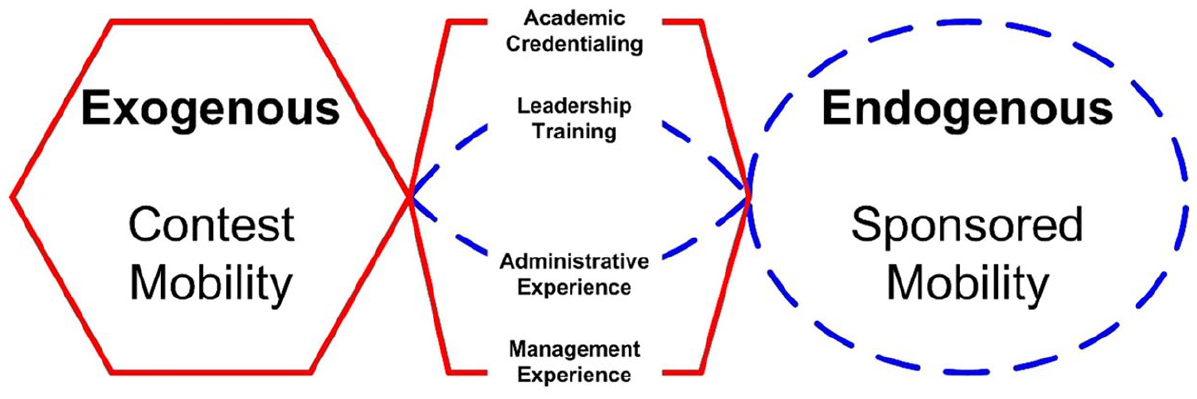
The intertwined yet contrasting concepts of the exogenous levers of contest mobility (solid lines) and the endogenous levers of sponsored mobility (broken lines) that subsume the four areas of preparatory leadership skill acquisition.
Contest Mobility
Academic credentialing
The first component of contest mobility is academic credentialing. As Figure 1 shows and as discussed above, we view contest mobility as one of two exogenous factors that are more closely related to a potential candidate’s determination to successfully compete on the leadership stage than to any action on the part of district leaders.
Throughout the country, academic preparation for those entering the teaching profession is required in every state, and academic preparation for a principal typically begins with teaching (Davis, 2010). Consequently, licensure attainment and master’s degrees are often noted as starting points in the preparation phase for candidates aspiring to the principalship.
In their examination of the 2011 to 2012 data from public schools, Bitterman et al. (2013) found that most principals held a master’s degree (62%) as their highest credential, followed by an education specialist/professional diploma (26%), a doctorate/first professional degree (10%), and that only 2% possessed a bachelor’s degree or less as their highest credential.
However, prerequisite academic credentials for the principalship may not equate to a clear path to the principalship for Black teachers. Rance (1992) found that Blacks enter the field of education with high aspirations of success and buoyed by the promise of opportunities. However, as Black teachers move into administrative roles, they encounter difficulty in advancing to higher positions, and, according to Rance, are unduly hindered relative to their ability. Rather than give up completely, Rance conjectured, Black teachers may settle in and do the best they can, given the opportunities they are afforded. Thus, understanding the part played by academic credentials in determining how Black principals acquire the principalship is critical to understanding their career trajectory and tracking their leadership pathway.
Management experience
A second component of contest mobility is management experience. There are several types of aspiring principal and leadership development programs available including university-based programs and district-operated programs. In addition, third-party, nonprofit organizations, and statewide leadership academies are available to support leadership preparation. However, access by aspiring principals to district or school programs often rests in the hands of current school principals who play an active role in the identification and nurturing of future school leaders.
Retrospectively, Black principals have noted a lack of principal support for their candidacy, and a lack of clarity concerning which opportunities led to career ladders, together with an overall scarcity of clear leadership pipelines as obstacles to be overcome. Bloom and Erlandson (2003), Brown (2005), and Jean-Marie et al. (2009) reported that this lack of support and clarity has the potential to compound racism and sexism—thereby effectively excluding future leaders of color.
The lack of principal support for or even the active discouraging of individual aspiring leaders results in determined aspirants seeking management experience exogenously—outside the official parameters ordained by the institution.
Sponsored Mobility
Leadership training
The first component of sponsored mobility is leadership training. Effective access to leadership training is a key element of career mobility and advancement. Aspiring principals may participate in various training opportunities prior to attaining the principalship including school district-based or individual school-based training or development programs. In contrast to the management experience that individuals are constrained to seek for themselves, leadership training is an endogenous provision.
An early step on the career path to the principalship includes identification. There is no secret to the fact that the identification and subsequent grooming of potential leadership candidates rests with current principals. For example, the mentoring of teachers whom a principal regards as having leadership potential has been framed as a core responsibility of leadership (Gardiner et al., 2000; National Association of Secondary School Principals & National Association of Elementary School Principals, 2013). According to Farkas et al. (2001), 67% of principals play an active role in the identification and encouragement of future school leaders, and it is not unusual for leadership programs at universities to require candidates to submit professional letters of recommendation from their current principal as part of the admission process.
As adverted to above, however, many educators of color have reported alternative forms of mentoring in their career pathways, and have asserted that support did not always come from school principals or other positional leaders (Foster, 1997; Gay, 2003; Gay & Howard, 2000; Tillman, 2007).
Organizational factors such as exclusion from or limited access to interactive networks is often attributed to a universal preference for homophily (Ibarra, 1993). Homophily refers to the degree to which pairs of individuals who interact are similar in identity or organizational group affiliations (Lomotey, 1993; Marsden, 1988; Rogers & Kincaid, 1981). Women and minorities have a much smaller set of potentially similar others among whom to develop professional relationships based on identity group homophily. Restricting network interactions on the basis of homophily reduces access to information from disparate parts of the social system (Aldrich, 1989; Granovetter, 1973, 1982), and strengthens peer group enforcement of norms concerning appropriate behavior (Rogers & Kincaid, 1981).
Administrative experience
A second component of sponsored mobility is administrative experience. Previous administrative experience is usually rated as a strength in an applicant for a principalship. This experience can be acquired in a number of educational leadership positions including department head, curriculum specialist or coordinator, assistant principal, or program director.
Since administrative experience is a critical feature in demonstrating preparedness for the principalship, understanding the degree of access to previous administrative experiences accorded to a Black principal is key to our understanding of whether they are appropriately prepared for the principalship.
Bitterman et al. (2013) identified that there were a total of 89,810 public school principals during the 2011 to 2012 school year. Of these, 80% were non-Hispanic White, 10% were non-Hispanic Black or African American, 7% were Hispanic, and 3% were another race/ethnicity. They also estimated that the percentage of Black teachers has fallen from 8% to 6% between 1987 and 2015.
As noted above, principals play a pivotal role in identifying future educational leaders, and many educators of color have reported not being mentored in a traditional manner by their school principals or other positional leaders (Foster, 1997; Gay, 2003; Gay & Howard, 2000; Tillman, 2007). Instead, their journey has been contingent on whether they could balance the demands of the managerial responsibilities of their job as an assistant. Fullington (1976) noted this tendency years ago, and sourced it to desegregation: “(the) black assistant is not in control of his [sic] destiny. He is dependent upon his white superior for both his successes and his failures” (p. 467).
Contest Mobility and Sponsored Mobility in Black and White Principal Preparation
As detailed above, contest mobility presupposes that every candidate has an equal chance and the same opportunity to pursue a school leadership position, based upon their individual merit. As illustrated in Figure 1, academic credentialing, and management experience exemplify contest mobility consistent with the teacher’s role in pursuing academic credentialing and taking on additional responsibilities outside of the field of education to demonstrate their preparedness for the principalship. These exogenous actions are not sponsored by the candidate’s district or school.
In contrast, sponsored mobility invokes the informal process used to facilitate transition to leadership for some teachers but not for others. Leadership training and administrative experience typify sponsored and involve participation in district- or school-sponsored aspiring school principal training or development, or a number of administrative experiences attained prior to the principalship. Principals are the primary sponsors of mobility and facilitate it by tapping teachers for entry into the principalship pipeline.
Upon closely examining the preparation and appointment of Black school administrators, Brown (2005) discerned several trends at different stages in the appointment process. From 1980 to 2005, Brown found that Blacks were under-represented at the preparatory level in leadership preparation programs and in appointments to administrative positions. Even greater difficulty was reported by Coleman & Campbell-Stephens (2010) in obtaining promotion to the principalship by under-represented aspirants. In their examination of models of progress through career stages, Coleman and Campbell-Stephens (2010) found that Black teachers were less likely to be promoted to leadership positions than White teachers, and, by implication, were more likely to become stalled before the acquisition of leadership positions.
Along the same lines, Kerr et al. (2016) found that, while Blacks were overrepresented in assistant principal and principal positions in interethnic school districts, they were underrepresented among classroom teachers and administrators (p. 472). This is pertinent because promotion into the principalship traditionally comes from teaching. Furthermore, they found that, on average, Blacks and Latinos were underrepresented among classroom teachers in 2002 and 2008, and that neither group has made sizable gains between those years. They attributed these findings to the impact of interethnic competition whereby gains in one traditionally underrepresented group, and losses in another traditionally underrepresented group can be attributed to barriers to equal employment opportunity.
In essence, reducing the pool of qualified minority candidates further restricts their capacity for advancement. Ultimately, these restrictions inhibit their economic progress (as leadership positions provide higher salaries, enhanced benefits and greater job security), and their power in influencing the substantive representation of minority interests (Blalock, 1967; Stewart et al., 1989; Waldinger, 1996).
Meanwhile, Whites are found to be generally overrepresented or well-represented in all job categories, and have been noted to consistently prevail in employment competitions across all contexts, even in cities in which shares of White non-Latino populations are decreasing.
In summary, our study is timely in that “while previous empirical research has systematically studied the role of gender in career paths of principals . . . there are no such studies exploring race” (Williams & Loeb, 2012, p. 3).
Method
Research Question
The central question of this study is: Are there differences between the preparation experiences of Black and White principals in terms of exogenous (academic credentialing and management experience attained outside of the field of education) and endogenous (sponsored leadership training and previous administrative experience) characteristics? According to Myung et al. (2011) contest mobility and sponsored mobility can be understood as hypothetical mechanisms that drive a teacher’s leadership trajectory.
Data Source
Our study used an existing data set to investigate preparation experiences among Black and White principals—data from the 2011 to 2012 Schools and Staffing Survey (SASS), administered by the National Center for Education Statistics (NCES, 2011-2012). SASS was conducted by NCES seven times between 1987 through 2011. After 2010 to 2011, NCES redesigned SASS and named it the National Teacher and Principal Survey (NTPS). While the content of the 2011 to 2012 SASS formed the basis of the NTPS content, many questions were shifted to different questionnaire instruments. The new focus provided descriptive data, covering core topics such as professional development, working conditions, and evaluation.
The 2011 to 2012 Schools and Staffing Survey is an integrated set of surveys collected from public, private, public charter, and Bureau of Indian Affairs (BIA) schools in all 50 states in the United States and the District of Columbia. Originating in the late 1980s, SASS provides information about teachers, administrators, and the general condition of public and private elementary and secondary education in the United States. A wide range of topics is covered related to teacher and principal characteristics, general conditions of schools, perceptions of school climate and problems in schools, and the basic characteristics of the student population. SASS provides estimates for public and private school districts, schools, principals, and teachers at both the national and state level.
NCES maintains public files and supports a Data Analysis System that is available for public use. Although these resources are easily accessible, they are limited to data that are predetermined and fixed in tables. For instance, the race and gender variables openly available are reported only for teachers and not principals, limiting one’s ability to compare trends over time within and among these variables. (Many of the same survey questions have been used in each cross-sectional cycle of the survey allowing researchers to investigate certain trends over time.) In this case, we wished to use race of teachers and principals as independent variables to predict their congruence with persistence factors. Neither public files nor the Data Analysis System could adequately facilitate this study.
More comprehensive and current data sets are made available to researchers by granting them restricted use access. Obtaining restricted use access is a highly prescribed process, as administrative rights govern the release of current data sets. Researchers are required to implement data security measures and random unannounced site visits serve to protect and ensure the confidentiality of the data. Obtaining restricted use access allowed us to manipulate and isolate variables across categories according to our research interests.
The 2011 to 2012 administration of SASS consisted of five questionnaires focusing on the school district, the school principal, the teachers, the schools, and the school library/media center. SASS makes provision for the linking of information from all these surveys.
The Public School Principal Questionnaire—the second of the five questionnaire’s mentioned above—within the 2011 to 2012 SASS collected information from a nationally representative sample of public and private school principals. For our study, responses from “White, non-Hispanic,” or “Black, non-Hispanic” full-time, public school principals were included.
We linked the 2011 to 2012 SASS Public School Principal Questionnaire responses in the Public School Principal data file to the Public School District data file to connect each principal with his or her school. The Public School Principal data file includes records from principals in traditional public schools and public charter schools, but we concentrated only on the responses from principals of traditional public schools.
Analysis
The SASS Public School Principal Questionnaire (NCES 2011–2012), referred to as the Principal Questionnaire for convenience in the following, was grouped into 10 sections:
I. Principal experience and training.
II. Principal education and professional development.
III. Goals and decision making.
IV. Teacher and aide professional development.
V. School climate and safety.
VI. Instructional time.
VII. Working conditions and principal perceptions.
VIII. Teacher and school performance.
IX. Demographic information.
X. Contact information.
In keeping with our conceptual schema (Figure 1), we focused our attention on Section I: Principal Experience and Training (in order to operationalize the concept of principals’ preparation with respect to management experience attained outside of the field of education, sponsored leadership training, and previous administrative experience prior to becoming a principal), and Section II: Principal Education and Professional Development to operationalize the concept of principals’ preparation with regard to academic credentialing prior to the principalship.
We were interested in understanding the degree of academic preparation principals attained beyond the master’s degree and whether there were statistically and practically significant differences by race.
We were interested in understanding and highlighting the role that race may play in shaping occupational outcomes in administrative experience, training, and academic credentials. We also sought to understand whether Black principals’ administrative experience (noted by their employment in leadership positions prior to their appointment), training (noted by their participation in district or school training for aspiring principals and management experience outside the field of education), and academic credentials (evidenced by the highest degree they earned) differed when compared to White principals.
For the purpose of this paper, we created a set of preparation variables by selecting SASS fields as they related to the preparation phase. Table 1 provides the preparation variables as they related to the principal’s race.
Demographic Variables: Race (Principal).

Participants
Demographic variables related to principal’s race is indicated in Table 1. In total, we included data from 7,360 White, non-Hispanic, or Black, principals.
Principals were selected for inclusion in SASS if the school they led was part of the SASS public or private school sample (our study used the 2011–2012 SASS data). For SASS, a school was identified as “an institution or part of instruction that provides classroom instruction to students, has one or more teachers to provide instruction, serves in one or more of grades 1 to 12, and is located in one or more buildings apart from a private home” (Goldring et al., 2013, p. 1). Thus, it was possible for multiple schools to share the same building and have separate principals.
Measures
Table 2 provides a list of variables associated with principal preparation. Key variables of interest include the principal’s preparation pathways related to administrative experience, training, and academic credentials.
Variable Table for Preparation: Principal.

Procedure
Analytical approach
Of the SAS and ASCII restricted access data files made available by NCES, we used the ASCII data file and the accompanying SPSS syntax dictionary files for converting the ASCII data file for use with IBM SPSS Statistics (Version 16). Of the 7,360 principals who identified their race as either Black or White (non-Hispanic), we focused on the responses of the 6,900 who were principals in traditional public schools, 6,340 (91.8%) of whom identified as White (non-Hispanic; labeled “White” subsequently), and 570 (8.2%) of whom identified as Black.
We conducted a series of chi-square tests to answer the research question: What administrative preparation components represent career containment for Black principals? Preparation categories were created, and a sequence of chi-square tests were completed to detect statistically significant professional development categories Black principals experienced when compared to White principals.
Findings for academic credentials
The principals who responded to the SASS questionnaire were asked about the highest degree they earned and what type of degree. The degree options ranged from no degree to receiving basic academic preparation, to those with terminal degrees. We were particularly interested in looking at those who held the highest degree. Table 3 depicts the results. A chi-square test revealed that there were statistically significant differences between the proportion of Black principals who held a doctorate and the proportion of White principals who held a doctorate (χ² [1, n = 7360] = 42.70 p < .001, φ = .08). These results suggest that Black principals, when compared to White principals, are more likely to hold a doctoral degree. Race accounted for 8% of the variance.
Crosstabulation of Percentage of Doctoral or First Professional Degree Overall by Principal Race.

Academic differences by locality
Tests for statistical and practical significance by locality noted in Table 4 show that there are significant differences between Black and White principals who work in city, suburban, and rural districts, although the variance is low for city and suburban comparisons.
Crosstabulation of Percentage of Doctoral or First Professional Degree by Principal, Race, and Locality.

Administrative Experience (Prior to the Principalship)
Previous administrative experience is usually rated as a strength in a principal applicant. This experience can come in a number of areas including department head, curriculum specialist or coordinator, assistant principal, or program director.
Prior administrative positions
Survey respondents were asked whether or not they held the following school positions prior to becoming a principal (department head, curriculum specialist or coordinator, and an assistant principal or program director). These items were weighted and summed, for each prior administrative position held to create a variable that represented the number of different administrative or quasi-administrative jobs the principal reported. The range for this item was 1 to 3, the maximum value was 3. One point was assigned for each reported prior administrative experience: department head, curriculum specialist or coordinator, and assistant principal or program director. This variable does not represent the number of years in these jobs, but rather the number of previous positions that provided administrative experience. No item in the SASS questionnaire asked for years of previous administrative experience.
Findings for Administrative Experience
Table 5 shows the results of the statistical tests. An independent samples t test to determine whether Black principals had more or fewer administrative positions prior to the principalship than White principals indicated that Black principals reported having more administrative positions (2 v 1). The test was statistically significant (t [7360] = −6.41, p < .001, η2 = .01). Black principals (M = 1.57, SD = 0.80) reported having more administrative positions than White principals (M = 1.35, SD = 0.83) with principal race accounting for 1% of the variance. Black principals held statistically significant more administrative jobs before being chosen for the principalship. However, principal race accounts for about 1% of the variance, so this is not a meaningful difference.
Administrative Positions Prior to the Principalship by Race Overall.

Prior administrative experience
We then decided to look at whether the principal had any previous administrative experience, as opposed to number of positions. As shown in Table 6, 94% of Black principals had previous administrative experience in comparison with 86% of White principals (χ2 [1, n = 7360] = 31.78 p < .001, φ = .07). Race accounted for 7% of the variance.
Crosstabulation of Percentage of Prior Administrative Experience by Principal Race Overall.

We examined whether these differences in administrative experience were similar between Black and White principals across city, suburban, rural, and town localities. Table 7 depicts the results. We found no statistically significant differences by locality except in rural areas where 98% of Black principals had previous administrative experience as compared to 81% of White principals (χ2 [1, n = 7360] = 22.87 p < .001, φ = .09). Race accounted for 9% of the variance.
Crosstabulation of Percentage of Prior Administrative Experience by Principal Race and Locality.

Prior management experience (outside of education)
Survey respondents were asked whether or not they had prior management experience outside of education. This item was originally developed by SASS to measure teacher supply and demand. In the early 1980s, policy makers grew concerned about demographic trends indicating an impending shortage of teachers. A smaller cohort of children of baby boomers passed through college, and more career opportunities were available outside of teaching. As a result schools found it difficult to retain teachers.
Table 8 shows the results of a series of chi-square tests. Fifty percent of Black principals had prior management experience outside of education when compared to 42% of White principals (χ2 [1, n = 7360] = 18.09, p < .001, φ = .05), with principal race accounting for 5% of the variance.
Crosstabulation of Percentage of Prior Administrative Experience by Principal Race.

We examined whether these differences in prior management experience were similar across localities. Table 9 provides the results.
Crosstabulation of Percentage of Prior Management Experience by Principal Race and Locality.

Results for Black principals who had prior management experience outside of education were marginally significant in the city (χ2 [1, n = 1510] = 4.81 p < .02, φ = .06) with principal race accounting for 6% of the variance, suburb (χ2 [1, n = 1870] = 6.25 p < .01, φ = .06) with principal race accounting for 6% of the variance, and rural localities (χ2 [1, n = 2740] = 5.44 p < .01, φ = .04) with principal race accounting for 4% of the variance. Results for town localities showed no statistically significant difference.
Administrative Training
While the predominant preparation avenue for aspiring school leaders is university-based programs, there are other competing training avenues that have emerged (Grogan et al., 2009). In addition to acquiring licenses or certificates in school administration, an aspiring school principal may already have attained administrative training prior to becoming a principal.
Programs for aspiring principals
Survey respondents were asked whether or not they participated in any district or school training or development programs for aspiring school principals prior to becoming a principal.
Findings for Administrative Training
Results of a one-sample chi-square test shown in Table 10, reveals that 70% of Black principals had participated in programs for aspiring principals, compared to 52% of White principals, with race accounting for 11% of the variance, (χ2 [1, n = 7,360] = 82.55, p < .001, φ = .11).
Crosstabulation of Participation in a Program for Aspiring Principals by Race.

We examined whether these differences in participation in programs for aspiring principals were similar across localities. The results of the tests shown in Table 11 were statistically significant. In each locale, Black principals had participated in greater numbers in programs for aspiring principals, when compared to White principals. We found that Black principals were more likely than White principals to have participated in a program for aspiring principals in city areas (χ2 [1, n = 1,510] = 8.04 p < .005, φ = .07), with race accounting for 7% of the variance; in suburban areas (χ2 [1, n = 1,870] = 23.32 p < .001, φ = .11) with race accounting for 11% of the variance; in town areas (χ2 [1, n = 1,240] = 14.12 p < .001, φ = .11), with race accounting for 11% of the variance; and rural areas (χ2 [1, n = 2,740] = 26.64 p < .001, φ = .10), with race accounting for 10% of the variance.
Crosstabulation of Participants in a Program for Aspiring Principals by Race and Locality.

Black principals primarily traversed the most traditional and common path to the principalship by fulfilling the middle level entry requirement at statistically significant but not practically significant levels. The middle level entry requirement is where educators seeking promotion to principal positions are required to obtain experience as teachers and/or assistant principals and accumulate the academic credits required to obtain the relevant administrative certification (Clark et al., 2009). Table 12 collates selected prior analyses to provide an overview of the containment characteristics of the preparation phase.
Containment Characteristics: Preparation Phase.

In summary, having held an administrative position prior to the principalship was much more likely to be an aspect of the background of Black principals at statistically significant, but not practically significant levels when compared to White principals (.05 was the η2 threshold for practical significance).
Black principals were also more likely than White principals to have additional managerial experience outside of education as well as more types of principal preparation experiences. This was especially true for participation in aspiring principal institutes and academies, with Black principals outparticipating Whites by 18% in programs for aspiring principals (as shown in Table 12; see also Table 10). These participation differentials remained statistically significant across locales (Table 11).
Black educators who became principals entered with more preparation, experience, and higher levels of credentials. These findings suggest that Black principals’ entry routes to the principalship were characterized by more preparation than Whites. For example, in terms of formal academic credentials, Black principals were more likely than White principals to have earned a doctorate. In short, we found no areas of preparation in which White principals had stronger backgrounds in preparation or experience.
Discussion
In an effort to identify whether there were differences between Black and White principals’ career pathways with respect to preparation, several themes emerged: Black principals have more advanced academic credentials (doctoral or professional degrees); greater administrative experiences and jobs such as department head, curriculum specialist or coordinator, and assistant principal or program director; and management experience (outside of education), and administrative training (aspiring principal training) prior to their placement in the principalship. A key containment characteristic maintains that Black principals acquire more educational and administrative experience than their White counterparts prior to entering the principalship.
Limitations
The 2011 to 2012 Schools and Staffing Survey dataset is based on a nationally representative sample of school districts, public and private schools, principals and teachers in K-12 settings in the United States. These data are now somewhat dated. Access to these data requires the receipt of a restricted data license. This process, while rewarding, can be time consuming to obtain. The 2011 to 2012 school year was the final year these data were collected in this format. The National Teacher and Principal Survey replaced the Schools and Staffing Survey.
Conclusion
While there is robust research on Turner’s (1960) contest mobility and sponsored mobility framework, there are few studies that center Black principals and their career mobility patterns using these concepts. Our examination of administrative experience, training, and academic credentials found that Black educators entered the principalship with more preparation experience and training, and higher levels of academic credentials than White principals. This finding is important to understanding a Black principal’s career pathway to the principalship. This analysis revealed that, although Black principals have the prerequisite knowledge, skills, and abilities in preparation for the principalship, their preparation path may be subject to containment. Findings from this study revealed that, in addition to following a traditional pathway to the principalship through administrative experience, training, and credentials, a Black principal’s preparation journey may require more administrative experience, training, and academic credentials to obtain an entry level principalship.
Implications for Practice and Future Research
Recommendations
Academic experience
College and university educational leadership preparation program providers should take steps to ensure equity across leadership development by evaluating their programmatic approaches to the preparation of Black educational leaders. They can begin this work by identifying potential opportunities to ensure equity across leadership preparation programs.
Aspiring principal program providers should also consider creating and enhancing collaborations with school districts for the purpose of identifying aspiring Black educational leaders, tracking their journey to the principalship, while coupling education for aspiring Black educational leaders about the pitfalls of containment and strategies to overcome it – both individually and systemically. Aspiring principal leadership programs should also strive to identify multiple pathways to Black principal leadership that bypass leadership tapping.
Academic credentials
College and university educational leadership preparation program providers would do well to develop a career pathways rubric for aspiring Black principals and principals of color to ensure that they are following a career pathway that does not lead to containment.
Leadership preparation committees should be implemented within school district hiring authorities–membership including but not limited to human resource directors, principals, superintendents, and educational directors—for the sole purpose of ensuring equitable career pathways for aspiring leaders of color.
Educational leadership preparation program providers should collaborate with local school division hiring authorities to detect containment trends through the development of early warning systems at the recruitment, selection, and placement phases of an aspiring Black educational leader’s career.
Administrative training
College and university educational leadership preparation program providers should consider several interventions related to the prevention of containment for aspiring Black educational leaders, including but not limited to actively recruiting teachers of color and increasing their enrollment in principal licensure programs. As previously noted, principals are often tapped while they are teachers. In an effort to target underrepresentation in the field, Black teachers should be recruited actively. Educational leadership program providers should also use the career pathways rubric recommended above to increase awareness of the characteristics of containment and to facilitate the development of dissemination strategies and trainings.
Summary
The failure to socialize Black principals for advancement in line positions marginalizes them and limits their equal employment opportunities and access to top positions in educational administration. Preparatory skill acquisition remains critical for advancement in line positions. Lack of access to these skills limits employment opportunities and ultimately succession to top positions in educational administration.
Footnotes
Declaration of Conflicting Interests
The author(s) declared no potential conflicts of interest with respect to the research, authorship, and/or publication of this article.
Funding
The author(s) received no financial support for the research, authorship, and/or publication of this article.
