



Abstract
As California is one of the primary states with the highest influx of Latinxs, the rise of Latinx enrollment in California high schools calls to the importance of understanding methods to increase academic and overall wellness. Cultural congruity (i.e., match of one’s cultural values with those of the educational setting) is hypothesized to influence positive academic and psychological outcomes for Latinx students. However, no study to date has examined the role cultural congruity in further explaining psychological outcomes for high schoolers. Using the psychosociocultural framework, the study’s purpose was to examine if cultural congruity further explains the relationships between academic self-efficacy, family support, and ethnic identity with coping, respectively. For a sample of 104 Latinx Californian high school students, results revealed that cultural congruity partially explained the relationships of academic self-efficacy and ethnic identity with coping, respectively. Educators and mental health practitioners may benefit from implementing a curriculum that is culturally validating, as it may support positive psychological functioning and coping strategies.
Keywords
In the United States, Latinx youth comprised one of the largest minority group in both elementary and secondary institutions (Hussar & Bailey, 2016). Particularly, the Latinx population is the largest in California (Krogstad, 2020), with Latinx youth comprising the majority of public-school students (Buenrostro, 2016). Of the six million students who attend California public schools (kindergarten through 12th grade), over half (54% or 3,360,562 million) are Latinx (Buenrostro, 2016). Such rates, however, do not align with Latinx youth’s educational success. For instance, Latinxs are undereducated, (Education Trust-West, 2017), have the high dropout rates (Bauman, 2017), and low high school graduation rates (Snyder, de Brey, & Dillow, 2016). Overall, Latinx youth’s educational pursuits are described as in “crisis” (Gándara & Contreras, 2009). Considering the high K-12 enrollment in California and that Latinx youth are projected to increase by 32% by the year 2023 (Hussar & Bailey, 2016), addressing non-cognitive factors to increase educational success is important (Bell et al., 2019). For the present study, a culture-centered approach was implemented to understand the role of culture congruity in further explaining the relationship between psychological, social, and cultural variables to coping, respectively.
Latinx youth, are exposed to numerous mental health strains, which subsequently may influence their ability to cope (Christophe et al., 2019). “The Majority Report: Supporting the Educational Success of Latino Students in California,” (Education Trust-West, 2017) indicated that a barrier for Latinx youth is feeling a lack of connection the school environment. Academic environments in the U.S. often reflect the values, beliefs, and behaviors aligned with white cultures (Castillo et al., 2004, 2006). In turn, Latinx students may feel they have to conceal their heritage/culture or reject their cultural values, beliefs, and behaviors in order to succeed educationally (Gloria et al., 2015; Gloria & Robinson-Kurpius, 1996). Such experiences are described as cultural incongruity, or perceived lack of fit between one’s cultural values and the values of their respective academic institutions (Gloria and Robinson-Kurpius, 1996). Cultural incongruence can result in feeling unwelcomed and isolation, and informed negative educational outcomes (Gloria & Robinson-Kurpius, 1996). Intercultural transactions, or interaction with the host (i.e., white) culture is an important consideration to understand Latinxs coping and subsequent wellness. Although cultural congruence is suggested to influence well-being for Latinx college students (e.g., Gloria et al., 2005), how it may further explain coping is still not fully understood.
Latinxs face distinctive varied psychological, social, and cultural experiences, calling attention for a contextualized and culturally-centered approach to understand their coping . Notably, the current literature points that self-efficacy (Hsieh et al., 2012), support (Stewart, 2008), and ethnic identity (Umaña-Taylor et al., 2008) aid Latinxs’ coping and overall mental health. Such relationships, however, have primarily been explored through linear analyses, with none examining the mediational role of cultural congruity. As Latinxs lead as the largest and youngest racial/ethnic group in the nation generally—and in public schools in California in particular (Buenrostro, 2016; Education Trust-West, 2017; Taggart, 2018)—supporting their coping is necessary to subsequently aid their overall educational achievements (Christophe et al., 2019). Taking a culturally holistic psychosociocultural focus (Castellanos & Gloria, 2007), the present study was guided by the following research questions:
Does cultural congruity further explain (mediate) the relationship between academic self-efficacy and coping?
Does cultural congruity further explain (mediate) the relationship between support and coping?
Does cultural congruity further explain (mediate) the relationship between ethnic identity and coping?
Guiding Theoretical Framework
The psychosociocultural (PSC) approach (Castellanos & Gloria, 2007; Gloria & Rodriguez, 2000) served as the study’s guiding framework. The PSC framework takes a culturally-holistic and person-environment focused understanding of Latinx students’ educational experiences (e.g., Castellanos et al., 2013). As an integrative meta-model, the psychological (P, self-beliefs and perceptions), social (S, connections and relationships), and cultural (C, campus fit, worldviews, and values) dimensions are theorized to individually and collectively explicate educational processes. Although originally developed for higher education students (Castellanos & Gloria, 2007), the framework was successfully extended and applied with Latinx parents who had high school students (e.g., Castellanos et al., 2013) and high school students (e.g., Castillo, 2002; Herrera et al., 2019). For the present study, self-efficacy, social support, and ethnic identity were the study’s respective, P, S, and C variables.
Each of the model’s dimensions were theorized to collectively inform students’ educational experiences; however, a focus on an individual dimension-specific exploration through mediation models can deepen and expand the overall application of the PSC framework. A mediation model dimension-specific focus addresses unique nuances of educational outcomes focusing on how the constructs “work” discretely to inform the PSC approach holistically (e.g., Aguinaga & Gloria, 2015; Dueñas & Gloria, 2017). For example, previous studies took an individual dimension-focused, mediation model approach via focus on the “Cultural” dimension (Aguinaga & Gloria, 2015; Castillo et al., 2006; Herrera et al., 2017). The present study similarly the same approach culture dimension-focused aproach by examining whether cultural congruity would further explain the relationships among self-efficacy (psychological), perceived social support from family (social), and ethnic identity (cultural) to coping, respectively.
Review of the Literature
The goal of the subsequent sections is to: (1) concisely define cultural congruity, self-efficacy, social support, and ethnic identity; (2) present studies exploring the relationship of self-efficacy, social support, and ethnic identity with coping; and (3) explore the role of cultural congruity within such relationships.
Mediating Variable
Cultural Congruity
Cultural congruity is the match between students of color’s cultural and personal values with those of the educational environment (Gloria & Robinson-Kurpius, 1996). Cultural congruity does not equate with diversity and inclusivity. Schools can be ethnically and culturally diverse while simultaneously offering spaces where ethnically diverse students do not feel genuinely respected and honored. Therefore, cultural incongruity occurs when students’ values and beliefs are inconsistent with the education system and not valued (directly and indirectly) by educators, generating experiences of exclusion and marginality (Cano et al., 2004). As US school systems are often an extension of and/or reinforce dominant-white ideologies, teachers, staff, administrators, or school counselors may consciously (and unconsciously) implement deficit and westernized ideological practices that dismiss and oppress Latinx youth and their values (Monzó, 2016; Valencia & Black, 2002).
Past studies have reported that cultural incongruity has been associated with poor mental health outcomes (Cano et al., 2014; Flores, 2013). Gloria et al. (2010) make the case that stress rooted in challenges within the academic environment (e.g., cultural incongruity) may create vulnerability for mental health challenges among Latinx college students. As such, a point of interest for the present study was to examine if increased cultural congruity may further explain the relationships between self-efficacy, social support, and ethnic identity to coping processes, respectively.
Psychological Dimension
Self-Efficacy
Academic self-efficacy is the level of confidence one has to complete academic tasks or milestones successfully (e.g., Hayashi, 2014). Academic self-efficacy is specific to the context of academia and focuses on a person’s belief about themselves regarding academic tasks. Academic self-efficacy has been shown to be a major factor in understanding academic performance (Castillo, 2002; Chemers et al., 2001). The approach to coping is particularly linked with self-efficacy (Devonport & Lane, 2006; Hsieh et al., 2012). For example, high self-efficacy is associated with active coping (i.e., problem-solving, information seeking), whereas low self-efficacy is related to passive coping (e.g., avoidance, distraction; Hsieh et al., 2012). Khan (2013) found that academic self-efficacy was related with planning and positively reinterpretation-related coping. However, much of the current research examining the association between academic self-efficacy and coping is limited to college students (e.g., Hsieh et al., 2012).
Importantly, the role of cultural (in)congruity in understanding the relationship between self-efficacy and coping is unknown. What is known is that feelings of cultural incongruity may result in negative self-efficacy among Latinxs (Comas-Díaz, 2006; Mendoza Aviña, 2016; Monzó, 2016; Valencia & Black, 2002). Further, “The Majority Report: Supporting the Educational Success of Latino Students in California,” Education Trust-West (2017) found that two of the biggest barriers to the educational achievement of Latinx youth are: (1) beliefs that their teachers perceive them as less academically capable and (2) that they do not feel connected to the school environment. The report further highlighted the role of the important role of environment in creating cultural (in)congruity and self-efficacy. As self-efficacy is related to coping, and cultural incongruity may affect one’s beliefs about their academic abilities, how cultural congruity may mediate the relationship between academic self-efficacy and Latinx high school students’ coping strategies was explored.
Social Dimension
Perceived Support from Family and Friends
Perceived social support is the extent one believes their needs are fulfilled (Prodiciano & Heller, 1986). Support from family, peers, and school staff, allows students to become socially integrated and involved in the academic environment, decreasing decisions to drop-out (Castillo et al., 2004). Support from parents and friends is essential to Latinx adolescents’ positive educational and mental health outcomes (e.g., Castellanos et al., 2020; Flores, 2018; LeFevre & Shaw, 2012; Woolley et al., 2009; Zarate, 2006). Among 907 Latino/a first-generation students, Suwinyattichaiporn and Johnson (2020) found that increased family social support was negatively associated with stress and depression.
Although the role of social support is important, how cultural (in)congruity may further explain the relationships between support to coping is unknown. In her dissertation, Orozco () found that Latinos college students who reported higher levels of coping strategies also reported higher levels of perceived support from family, friends, and higher cultural congruity. Such results may similarly align with Latinx high school students. The present study seeks to understand theserelationship by looking at the role of cultural congruity in the relationship between social support (from friends and family) to coping.
Cultural Dimension
Ethnic Identity
Ethnic identity is the part of one’s identity associated with their racial/ethnic group membership, and a process of exploration, resolution, and affirmation (Phinney, 1991, 1992; Umaña-Taylor, 2004). Fuligni et al. (2008) found that first-generation youth were more likely than second-generation youth to identify with their country of origin (e.g., Mexican) than identities such as “Hispanic”, “Latino/x”, or hyphenated with American identity (e.g., Mexican-American). Adolescence is a pivotal period where ethnic-racial identity employs complex coping strategies to combat life stressors (Quintana & Scull, 2009; Umaña-Taylor et al., 2008). Youth with stronger ethnic racial identity ties are hypothesized to develop more effective coping skills due to the additional stressors they contend, such as discrimination, stigma, and acculturation pressures (Quintana & Scull, 2009). For instance, in a study of Latinx youth, Umaña-Taylor et al. (2008) found that aspects of ethnic-racial identity were associated with using more primary, proactive coping strategies.
Latinx youth actively attempt to develop positive notions of their ethnicity in the midst institutionalized racism (Monzó, 2016; Quintana & Scull, 2009). As it stands, Latinx youth still occupy few educational spaces or have limited access where they can reflect positively on their identities in schools through an anti-oppressive, feminist, and social justice lens (Mendoza Aviña, 2016). Thus, how cultural congruity may further explain the relationship between ethnic identity and coping warrants exploration.
Study’s Purpose and Research Questions
Taking a cultural dimension approach, congruity was theorized to mediate Latinx high school students’ coping. Three research questions guided the present study:
Does congruity mediate the relationship of self-efficacy and coping?
Does congruity mediate the relationship of support and coping?
Does congruity mediate the relationship of identity and coping?
Given the primary role of congruity in Latinx students’ educational experiences (e.g., Aguinaga & Gloria, 2015), we anticipated that cultural congruity would meditate (either partially or fully) the relationships of the psychsociocultural variables with coping, respectively.
Method
Setting and Procedure
After securing appropriate approvals (i.e., institution, school, parental consent, student assent), Latinxs from a high school in southern California were recruited. At the time of the study, Latinx students totaled more than half (52.7% n = 3,281,066) of the California student population (Aud et al., 2013). The majority of the school’s population were of Latinx descent (98%, n = 5,012), with the remaining students white (1%) or other (1%). Per school report, about 47% of the students were socioeconomically disadvantaged and 83% participated in the Reduced-Price Lunch Program. The average class size was 27.
Students were recruited from Social Studies/History, English, and elective courses. Students were informed that their participation was voluntary, that they could discontinue their participation at any time, and return of their completed survey served as participation assent. The study’s purpose was presented to the students, to facilitate their asking any follow-up or clarifying questions. Students were reminded that their participation was voluntary. Researchers were present during the survey completion in case any student had questions; no student asked any questions about the survey items. The surveys were completed during class and took almost 45 minutes to complete as it contained additional scales for a separately conceptualized research study. Snacks were provided to all students at the time of the survey completion.
Latinx High School Participants
The participants were 104 Latinx students (16–18 years old, M = 16.86, SD = 1.5). The majority were first-generation to the US, of Mexican heritage, in 11th or 12th grade, and had higher education aspirations. Table 1 presents participant demographics.
Participant Descriptives.

M = 3.48, SD = 0.64.
Survey Instruments
The survey consisted of a demographic sheet, followed by the survey instruments. The use of the PSC framework guided the use and administration of the study’s scales. Particularly, participants’ backgrounds and cultural experiences were holistically considered in the conceptualization, item selection, recruitment, and analyses. Additionally, the following steps were taken to mitigate bias: (1) items were short and clear; (2) leading questions were omitted; and (3) interval questions allowed choice. Researchers also attended to response bias by counterbalancing the survey scales.
The scales were counterbalanced to avoid a response set. See Table 2 for scales’ Cronbach’s alpha.
Descriptives and Correlations.

Note. Self-efficacy = Academic Self-Efficacy Scale; support = Perceived Social Support Scale-Family; identity = multi-ethnic identity measure; congruity = Cultural Congruity Scale; coping = Student Coping Scale.
p = .01. ***p = .001.
Demographic sheet
The demographic sheet had 22 questions of which 8 addressed information (e.g., sex, age, race/ethnicity, family income, whether the student is bused to school, reduced lunch, work status) and 14 assessed education-related matters (e.g., self-reported grade point average, class standing, highest academic degree expected, continuity of enrollment).
Academic self-efficacy
The Academic Self-Efficacy Scale (Noble et al., 1992) measures high school students’ self-beliefs about their perceived academic ability related to specific course content. Students rated how confident they are to complete a class with an A or B grade in classes including math (algebra, geometry), chemistry, biology, history, and English. The 13 items are rated on a 5-point Likert-type scale ranging from 1 (Not Sure at All) to 5 (Completely Sure), with higher scores indicative of increased self-efficacy in one’s specific academic abilities. The original study found an internal consistency of .94 when used with 374 high school students (9th and 10th grader) of whom 227 were Hispanic, 110 white, 15 African American, 19 American Indian, and 3 Asian American. Castillo (2002) found a reliability coefficient of .85 in a sample of 96 Latino high school students.
The Academic Self-Efficacy scale was chosen as it (1) is one of the few self-efficacy scales designed for use with high school students; and (2) differs from other academic self-concept instruments by focusing on students perceived ability to succeed in coursework areas, as a opposed to a general sense of self-efficacy.
Support
Perceived Social Support Inventory-Family and Friends (PSS-Fa and PSS-Fr, Procidano & Heller, 1983) consists of two scales that assess the perception of their support from family and friends, respectively. Each scale has 20 items and is based on a “yes,” “no,” or “don’t know” format. Higher scores reflect increased perceptions of support. A sample item includes, “My family and I are very open about what we think about things.” The present study only used the PSS-Fa subscale.
The PSS-Fr and PSS-Fa have yielded strong reliability and validity. When tested with a sample of 222 undergraduates (mean age 19), the internal consistency coefficients of .88 and .90 were indicated for PSS-Fr and PSS-Fa, respectively. High internal consistency coefficients have reported for African American (Gloria et al., 1999) and Chicana/o undergraduates (Gloria, 2005), and Latinx high school students Castillo (2002). Procidano and Heller (1983) found strong construct validity or the scales in three separate studies. Construct validity was supported by significant relationships with other instruments (e.g., Social Network Questionnaire, Marlowe-Crowne Social Desirability, Short Form of the MMPI) designed to assess similar constructs. Perceived Social Support Inventory-Family and Friends was chosen for the present study as it measures the extent to which an individual perceives that support is fulfilled.
Identity
The Multi-Ethnic Identity Scale (MEIM; Phinney, 1992) measures individuals’ sense of ethnic identity (Ethnic Identity, 14 items) and attitudes toward other groups (Other-Group Orientation, 6 items). For the present study, only the Ethnic Identity scale was used. A sample item includes “I have a strong sense of belonging to my own ethnic group.” Based on a 4-point Likert-type scale from 1 (Strongly Disagree) to 4 (Strongly Agree), higher scores reflect a positive sense of ethnic identity. A review of 12 studies incorporating the MEIM found its two subscales—Ethnic Identity (EI) and Other-Group Orientation (OGO)—to be relatively distinct, have satisfactory levels of internal consistency, and have moderate degrees of construct and criterion related validity (Ponterotto et al., 2003). The MEIM has been used extensively and consistently indicated reliability at .70 and above. For instance, scale was developed and validated with 417 high school students (.81) and 136 college students (.90, Phinney, 1992) and used in the assessment of social context with Latinx high school students at three different high schools (.76, .80, .82, Umaña-Taylor, 2004). The MEIM was chosen because it is the most widely used ethnic identity scale and assesses both students’ beliefs and feelings about their own ethnicity and orientation toward other groups (Ponterotto et al., 2003).
Cultural congruity
The Cultural Congruity Scale (Gloria & Robinson-Kurpius, 1996), originally developed for Latinx undergraduates, assesses the congruence of student’s personal and school values. Eight of the 13 items are reverse-scored and a modified sample items included, “I feel I have to change myself to fit in at school.” Items are based on a 7-point scale from 1(Not at all) to 7 (A great deal), with higher scores reflecting an increased sense of congruity of one’s internal values with those of the external setting. The wording of two of the items of the scale was altered to reflect a high school experience versus a college experience. Use of the CCS has demonstrated strong reliability and validity. Adequate reliability (.80 and above) was found with 110 Latinx community college (Gloria et al., 2015) and 454 Chicanx university students (Gloria & Robinson-Kurpius, 1996). Using regression analysis, predictive validity was found with CCS explaining 11% variance in academic persistence (Gloria & Robinson-Kurpius, 1996) and 26.8% for well-being (Gloria et al., 2015). In the first prior use of the CCS with Latino high school students, Castillo (2002) reported a Cronbach’s alpha of .74 with 96 Latino high school students to assess persistence decisions. The internal consistency coefficients for the present study .79. The CCS was used in this study, because it addresses a crucial construct of cultural environmental fit for Latinx students that has not previously been operationalized in the literature for high school students.
Coping
A 30-item scale, the Student Coping Scale measures students’ problem-focused (n = 15) and emotion-focused (n = 15) coping responses within the educational setting (Struthers, 1995). Based on a 10-point Likert-type scale ranging from 1 (extremely uncharacteristic) to 10 (extremely characteristic), students report their use of different coping responses. A sample problem-focused item includes “I try to come up with a strategy about what to do;” an emotion-focused item includes “I pretend to believe that it happened.” Previous use of the SCOPE with 203 college students yielded adequate internal consistencies of .80 and .70, respectively, for the SCOPE-P and SCOPE-E (Struthers et al., 2000). Additionally, adequate Cronbach’s alphas of .73 (problem-focused) and .90 (emotion-focused) were found in a sample of 100 Latinx male undergraduates (Gloria et al., 2009). Although originally created to address methods of coping at the college level, the SCOPE lends itself to the high school setting as the methods of coping are within the context of education-related stressors.
Results
Internal consistency coefficients for the study’s scales ranged from .79 to .88. Missing data were addressed using an 80% mean scale score and ranged from .04% to 1% (See Table 2 for more information). Review of data descriptives revealed acceptable ranges of skewness and kurtosis (i.e., −1.0 to 1.0) indicating standard normal distribution of the data. Correlations revealed that increased self-efficacy, support, and identity and congruity were significantly related to increased coping. See Table 2 for scale descriptives and bi-variate correlations.
Overview of Mediation Analyses
A series of regression were conducted to assess if cultural congruity more fully explains the relationships of academic self-efficacy, parental support, and ethnic identity to coping, respectively (See Figure 1a and b).
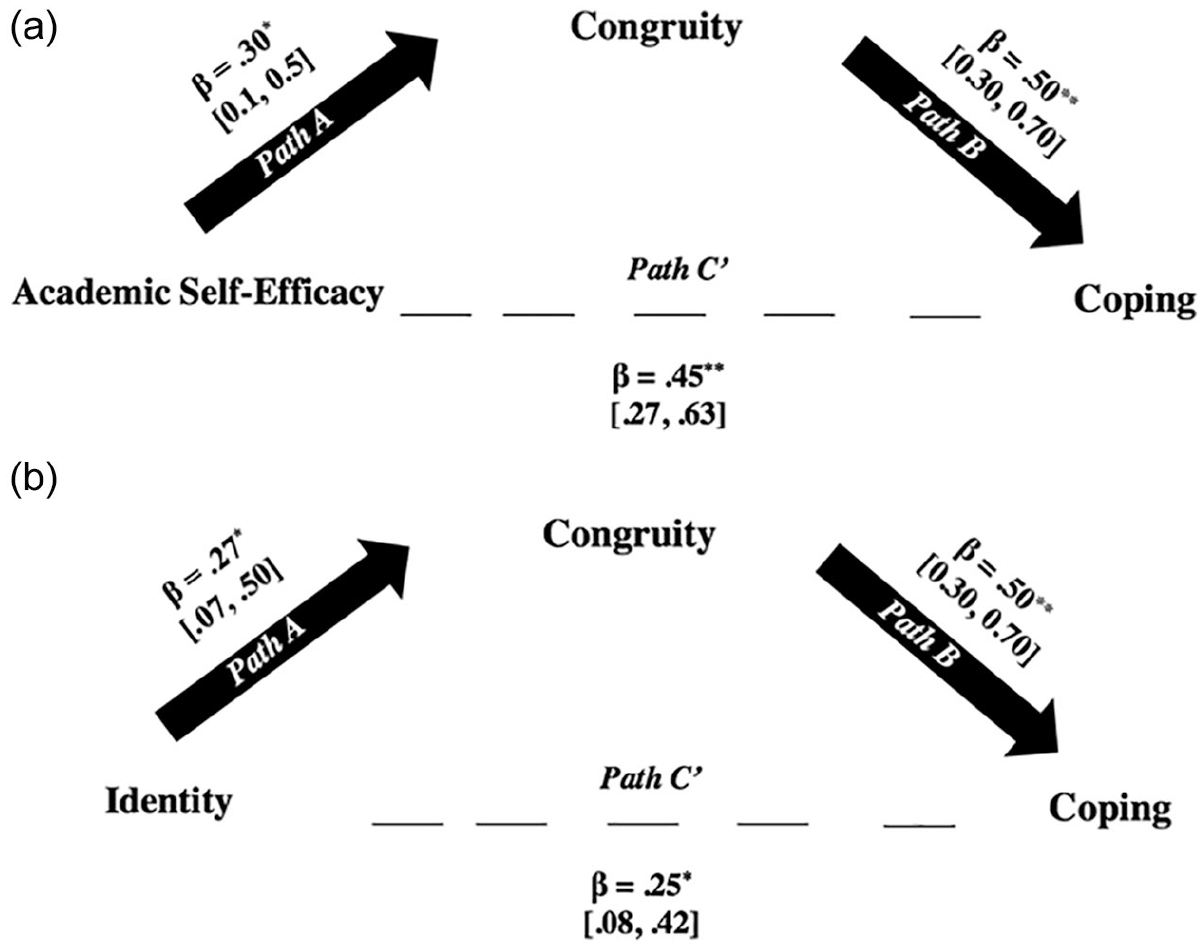
Congruity mediates psychosociocultural variable with coping: (a) mediation analysis 1 and (b) mediation analysis 1.
Does congruity more fully explain the relationship of self-efficacy and coping?
For Path A, academic self-efficacy positively influenced congruity (β = .30, p = .004, 95% CI [.1, .5]). For Path B, congruity predicted coping (β = .50, p < .001, [.30, .70]). For path C, congruity partially mediated (β = .45, p < .001, [.27, .63]) the relationship of self-efficacy and coping (β = .25, p = .009, [.05, .45]). Culturally congruity partly explains the relationships between Self Efficacy and Coping.
Does congruity more fully explain the the relationship of support and coping?
For Path A, support did not significantly predict congruity (β = .19, p = .069) and thus the subsequent steps were not performed. The role of Cultural Congruity did not further explain the relationship between Social Support and Coping.
Does congruity more fully explain the the relationship of identity and coping?
For Path A identity positively influenced congruity (β = .27, p = .009, [.07, .50]. Path C revealed that congruity (β = .46, p < .001, CI [.30, .64]) partially mediated the relationship of identity (β = .25, p = .006, CI [.08, .42]) and coping. The relationship between ethnic identity and coping is further explained when cultural congruity is considered.
Discussion and Pedagogical Recommendations for Eductors
Consisting primarily of first-generation high school students of Mexican descent, the study assessed if cultural congruity mediated the relationships among self-efficacy, social support, and ethnic identity to coping, respectively. The current study is one of the first to explore Latinx students’ coping through a culturally- and Latinx-specific framework and conceptualization. The current study adds to the existing educational research by highlighting the importance of feeling connection between cultural and educational values, as these support their coping and mental health. The study underscores the importance of taking a holistic and cultural-focused approach to Latinx students’ mental health via coping (Flores, 2013), as an alternative to outcome reports and cognitive indices (Bell et al., 2019; Taggart, 2018). Latinx adolescents’ experiences with marginalization within and outside of the confines of school are “wounds to [their] soul, body, and heart” (Flores, 2013, p. 93). Therefore, these results are timely to support the achievement and wellness of Latinx students holistically.
The current literature base on Latinx adolescents’ coping is in a nascent state, with few studies examining coping as an outcome variable (e.g., Brietzke & Perreira, 2017). As a whole, the study adds to the current research by centering the role of cultural congruity to understand coping within the context of navigating endemically oppressive educational institutions (i.e. culturally incongruent). Results of the study revealed Latinx youth experienced relatively positive sense of cultural congruity, which in turn informed how they cope with educational stressors. The study’s results underscore that understanding Latinx youth’ mental health is limited if culture is overlooked (Piña-Watson et al., 2015, 2018).
The results evidenced that feeling culturally congruent more clearly explains the relationship between academic self-efficacy and coping. To help increase Latinxs’ confidence in completing educational tasks successfully and in turn support their coping, implementing pedagogical approaches that are culturally-centered and congruent are essential. In particular, centering Latinx youth as experts in their lived experiences (Delgado-Bernal, 2002; Flores, 2013) may support their self-efficacy and subsequent coping. For instance, opportunities where Latinx youth can co-create or lead conversations where their racialized, gendered, and classed histories are incorporated in their learning (e.g., Cruz, 2013), can provide congruent spaces of validation, value, and academic self-efficacy. Such facilitation gives Latinx students the power to own their learning as well as conveys the message that beyond the role of “students” their identities as cultural beings are of equal value in school (i.e., congruity; Pérez Huber, 2010).
Next, the results suggest that cultural congruity more fully explains how positive notions of one’s ethnic identity may facilitate coping. Managing incongruent values can be psychologically taxing for Latinx students who may feel the need to inhibit their genuine cultural identity and self-expression (Anzaldúa, 2007). Our finding is aligned with previous research where Latinx high school students who resolved their ethnic identity concerns utilized proactive style coping to deal with discrimination (Umaña-Taylor et al., 2008). As ethnic identity development is a day-to-day process, educators must consider themselves ethnic identity advocates, beyond supporting cultural-specific months or holidays (e.g., Latinx Heritage month, Cinco de Mayo). Additionally, Mendoza Aviña (2016) argued that Latinx youth’s strenghts in navigating oppressive spaces is crucial via platicando (conversing), finding humor within situations, code-switching, and connecting over stories (i.e., coping strategies). Educators and school counselors are advised to conceptualize such behaviors as cultural methods of coping (Flores, 2013), versus white-centered explanations that such actions are “inappropriate” or “unprofessional”.
Study Limitations and Future Research
The results support that the sample of Latinx youth overall perceived the education system as valuing their cultural practices and congruent to their Latinx values. However, noteworthy limitations are sampling and selection bias, as the results may not be transferable across all United States school systems, different Latinx ethnic identities, and locations where Latinxs are not the majority (e.g., college preparatory high schools, Midwestern states). In particular, the study sample were Californian students, predominately of Mexican descent; findings from this study may not generalize to other Latinx subgroups or to Latinx living outside of California. Particularly, Blackness is still glaringly overlooked (Adames & Chavez-Dueñas, 2020) in the Latinx literature. Thus, the erroneous belief that all Latinxs descent people are mestizos (from Spanish and Indigenous descent) compounds the lack of Afro-Latinx-centered educational research Future studies are suggested to examine how diverse locations, school compositions, anti-blackness, and racial/ethnic composition of the teachers influence students’ sense of cultural congruity. Additionally, it is essential to consider the rise of White nationalism and supremacy due to the ongoing political context and changing policies and laws may affect cultural congruity across states, regardless of ethnic composition. Future studies can expand the context beyond the classroom or school to community or state as it informs Latinx youth experiences as evidenced by research regarding documentation status (e.g., undocumented students, mixed-status families).
Although no student outwardly expressed not understanding survey items or trouble completely the survey, social desirability may have influenced students not expressing such concerns to the researchers. In addition, collecting data in students’ classes have resulted in an undo peer pressure to not endorse difficulty with items or packet. It is recommended that Future studies include social desirability scale as well as giving students the option of where to fill out the survey.
The researchers were sensitive to consider culture in every facet of the study; however, there are limitations to the scales used. It is important to consider that with the exception of the cultural congruity and ethnic identity scales, all the scales were initially normed and created for a general population. The issue with scales that are not initially created and normed for specific cultural groups is that the perceived generalization often minimizes important cultural nuances. As a whole, it is important to consider that the scales used do not account for the intersectionality and the impact of mulitiple cultural congruity and Latinx coping. As a main limitation of the current educational research field is the need for Latinx centered and validated scales, intersectional and culture-centered research is warranted.
Although there was conceptual rationale for using a composite coping score as problem and emotional coping co-occur, it is questioned as to whether examination by specific type of approach may have yielded different results. Coping mechanisms by gender are limited in the high school literature, and thus an understanding of how coping may manifest in Latinas, Latinos, transgender or gender non-conforming Latinx students in not known.
Although previous use of the cultural congruity scale yielded high reliability with Latinx high school students (Castillo, 2002), the study’s scales have not yet been validated with this population. Therefore, conducting a categorical confirmatory factor analysis to test the factor structure and measurement invariance is suggested. Continued examinations of how cultural congruity informs educational processes and cultural wellness is an essential, as it is an act of resistance against endemically white and racists educational systems (Delgado-Bernal, 2002).
Footnotes
Author Note
Mi Conexión Cultural al Ambiente Educativo translates to: “My connection to the educational environment.”
A special thanks to Vern Farber for facilitating the data collection.
Declaration of Conflicting Interests
The author(s) declared no potential conflicts of interest with respect to the research, authorship, and/or publication of this article.
Funding
The author(s) received no financial support for the research, authorship, and/or publication of this article.
