



Abstract
With the increasing cross-country immigration and human mobility, different cultures are reflected more in the schools. The behavioral patterns of educational leaders in multicultural settings and the affecting factors have been subject to many discussions and researches. This study examines the relationship between school principals’ distributed leadership behaviors and teachers’ social justice leadership and attitudes toward multiculturalism. A structural model has been created and tested through the mentioned variables integrative approach. The results partially confirm that teachers’ social justice leadership behaviors mediate the relationships between the principals’ distributed leadership behaviors and their attitudes toward multiculturalism. In a structure where leadership roles are shared at school, teachers can exhibit more social justice leadership behavior; their attitudes toward multiculturalism become more positive. Distributed leadership increases teachers’ support, critical consciousness, and inclusive behavior. Implications for practice, theory, and policy are also discussed in the paper.
Introduction
The number of international migrants numbered almost 272 million in 2019, and its trend continued upward (UNDESA, 2019). Human mobility is generally affected most by crises like persecution, conflict, violence, human rights violations, wars, and disasters (UNHCR, 2020). Turkey is one of the most influenced countries by this trend in the last 8 years. The 2020 report showed that more than 3.6 million Syrian refugees were recorded; half of these refugees are school-aged children (Directorate General of Migration Management, 2020). The United Nations High Commissioner for Refugees 2018 data indicated that worldwide primary education enrollment for refugees was 61%, and Syrian students reached 96.30% primary education enrollment rate in Turkey (TEDMEM, 2019). The increase in the registration rate of Syrian refugees in Turkey has sparked widespread debate about the merits of cultural diversity and the policy of multiculturalism. There are many discussions on the schooling, contents, and methods of education of refugee children.
Teachers play a critical role in removing refugees’ academic and social constraints and increasing their wellbeing (Banerjee, 2016; Richman, 1998). This role is very demanding in terms of having positive multicultural attitudes toward others, believing the necessity of working for social justice, and having theoretical and practical knowledge to create a positive school environment for all (Kovinthan, 2016; MacNevin, 2012). This equitable distribution of the educational resources and aiming the educational excellence for all without differentiating their “gender, race, culture, or socioeconomic status” is called social justice leadership (Brooks et al., 2007; Feng & Chen, 2019). In more culturally homogeneous countries, with the increase in immigration, teachers and school administrators face deep-rooted challenges in considering the needs of all students and creating a school environment where all students feel valuable (Faas et al., 2018).
In the literature, there are some characteristics defined for the principals with social justice leadership orientations. First of all, as the primary change agent (Furman, 2012), the principals can recognize the inequities in school society and have a high consciousness of pressure, discrimination, and marginalization (Brooks & Miles, 2008; McKenzie et al., 2008; Starr, 2020). Social justice leaders focus on the academic excellence of disadvantaged groups and work for their attainment of educational goals, eliminate the achievement gaps between the students from different socioeconomic backgrounds (Branch et al., 2013; Jean-Marie, 2008; Sammons et al., 2011; Scheurich & Skrla, 2003; Wang, 2018). In addition to these dimensions, social justice-oriented principals’ one of the most cited praxis in the literature, is developing culturally responsive and inclusive schools (DeMatthews & Mawhinney, 2014; Devine, 2013; Faas, 2016; Johnson & Fuller, 2014).
Providing refugee children a safe and welcoming classroom setting depends on teachers’ knowledge, attitudes, values, and practices and the role of school administrators’ leadership. A vast amount of research investigating the best schooling practices of successful resettlement of refugee children focuses on the school administration (Miller et al., 2018; Taylor & Sidhu, 2012). The studies proved that school leaders have a particular position to assist in the remarkable change regarding ethics and equality in educational settings (Brooks et al., 2007). If the leaders keen on considering social justice, they can support the teachers struggling with reaching targeted academic benchmarks despite diverse racial, cultural, and linguistic differences in their classroom settings and help them to close achievement gaps (Marshall & Young, 2006; Merchant & Shoho, 2006). Distributive leadership (DL) motivates the sharing of responsibilities and roles among multiple groups and advocates every member of the school can share the leadership function and tasks to contribute to the change process of the school (Goleman, 2002; Spillane et al., 2004). Therefore, DL theory is particularly described as a facilitator of justice and equity in schools, has growing attention in the literature over two decades (Bolden, 2011; Gumus et al., 2018; Woods et al., 2004). Most of the DL debates in the literature have focused more on the theory development, hypothesis generation, and definition of the dimensions (e.g., Elmore, 2000; Gronn, 2008; Spillane, 2006). Spillane (2006) advocated that DL is a collective form of leadership, including teacher leadership as well as principal leadership dimensions (Elmore, 2000; Harris & Muijs, 2005). Heck and Hallinger (2009) mentioned the school culture developed with DL supports collaboration among administrators, teachers, and students. The literature firmly confirms a positive relationship between DL and the organizations’ and educational attainments (Bolden, 2011; Elmore, 2000; Kempster et al., 2014; McBeth, 2008). The attainment of the learning goals and objectives and the increase in the student performance demand on the content, pedagogy, curriculum, and instruction knowledge of DL school principals (Elmore, 2000; Spillane, 2006).
There has been a considerable amount of discussion and empirical studies on DL, social justice leadership, teachers’ attitudes toward multiculturalism, multicultural competencies, and multicultural teacher education worldwide. However, a limited number of research aimed to explore the relationship between distributive leadership, social justice, and multicultural attitudes of teachers in Turkey. Therefore, the main motivation of this study is to examine the impact of the perceived principals’ distributive leadership on social justice leadership and teachers’ multicultural attitudes (Figure 1). To understand these relationships, this study aims to test the model that hypothesizes the relationships among these factors.
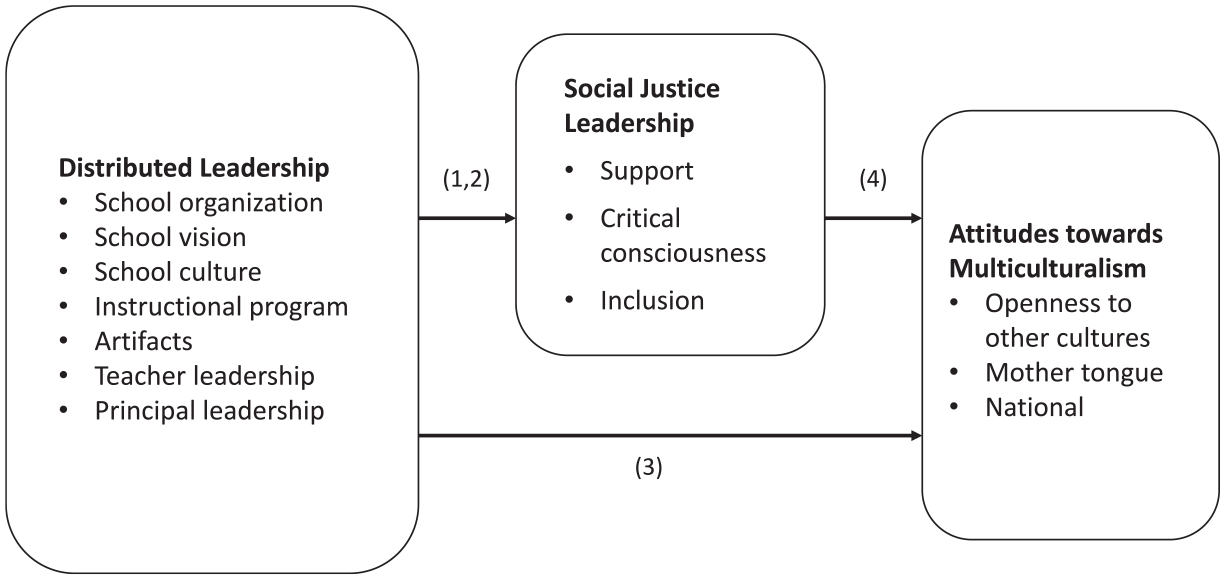
The theoretical model of the relations among principals’ distributed leadership behaviors, teachers’ social justice leadership, and attitudes toward multiculturalism (with hypotheses in parentheses).
Theoretical Perspective
Distributed Leadership
When Gronne and Spillane first proposed their ideas about the concept of leadership, they stressed a transition from a leader-centered and the only leader approach to an analysis of “concertive” and “conjoint” actions that were performed by more than one person who interacts and leads together (Bolden, 2011; Gronn, 2002; Harris, 2008; Lumby, 2019; Spillane & Orlina, 2005; Storey, 2004; Woods et al., 2004). For example, Gronn (2002) discusses DL as the distribution of effort at work. Similarly, Spillane’s (2006) leadership theory is based on how leadership practices are distributed among formal and informal leaders. In this approach, the total cognition, responsibility, and expertise are reciprocal among individuals with different capabilities and work collaboratively. In other words, DL “equates with maximizing the human capacity within the organization” (Harris, 2004, p. 14).
DL is institutionalized as a part of culture and working practices in school organization and is deliberately and coordinately promoted (Elmore, 2000; Leithwood et al., 2006; Louis et al., 2009; MacBeath et al., 2004). School leadership is not an area that only belongs to the school principal, but teacher leaders also possess a significant role in directing the educational processes (Goleman, 2002; Spillane et al., 2004). There are also essential issues surrounding distributing mission development, professional development, organizational management, redesigning the instructional program (Leithwood et al., 2006, 2009).
DL practices provide teachers with appropriate support and encourage them to adopt and dedicate themselves to the school vision (Berjaoui & Karami-Akkary, 2020; Hargreaves, 2005; Munro, 2005). Furthermore, studies are emphasizing the indirect impacts of school leaders’ DL behaviors on learning outcomes (Chang, 2011; Day et al., 2009; Heck & Hallinger, 2009; Hughes & Pickeral, 2013; McBeth, 2008; Robinson, 2009; Sammons et al., 2011; Timperley, 2005). In light of this framework, the Distributed Leadership Questionnaire, which Davis (2009) developed, was used, and it was conceptually based on the theory of Spillane, Gronne, and Elmore.
Social Justice Leadership
Social justice leadership (SJL) is another leadership style acceptable in the context of the single heroic leader discourse, which is less defensible. Nevertheless, rejection of that “heroic leader” concept does not mean that a school leader is not necessary (DeMatthews et al., 2016). Dantley and Tillman (2010) portrayed SJL as “investigating and posing solutions for issues that generate and reproduce societal inequities” (p. 19). SJL supports the social groups marginalized dues to race, status, gender, disability, and sexual orientation, shaping leadership practices accordingly (Theoharis, 2007). Blackmore (2009) stated that social justice is an umbrella term that combines the adoption of concepts like “equality, inequality, equality of opportunity, positive discrimination and diversity” and that these concepts include “different meanings in different national contexts” (p .7).
McKenzie et al. (2008) describe SJL as information and content, emphasizing the dimensions of “support,” “critical consciousness,” and “inclusion.” They conclude that social justice leaders apply proactive support systems in schools. Hence, SJL applications include efforts to provide support services for all students to increase their academic success and focus on the development of disadvantaged students (Freire, 2002; Pounder et al., 2002). The social justice leader realizes her/his assumptions and prejudices on race, class, language, and sexual preference in the critical consciousness dimension. S/he endeavors to teach students such critical thinking discovered in the inner world of him/her (McKenzie et al., 2008). It also includes recognizing economic, social, and political contradictions and pressures and resisting the forces (Freire, 2002; Furman, 2012). The inclusion dimension refers to social justice leaders’ striving for all students to benefit from quality education opportunities in a similar and equal way. S/he investigates how students who relatively have and do not have advantages can benefit from the school’s physical and human resources on an equal basis (Devine, 2013; Faas, 2016; Szeto & Cheng, 2018). S/he cares to create heterogeneous classes with this aim (McKenzie et al., 2008). For example, s/he takes measures to ensure that children with special education can benefit from similar educational opportunities at the highest level as other students (Frattura & Capper, 2007). The present study assumed that teachers’ social justice leadership behaviors could be measured with similar dimensions by considering the given conceptual literature.
Multiculturalism
Some researchers criticizing traditional management and narrow vision leadership theories indicated a multicultural democracy vision, including tolerance to go beyond an education system embedded with racism, classism, and sexism (e.g., Marshall & Ward, 2004; Marshall & Young, 2006; Santamaría, 2014; Stewart, 2012). Banks and Banks (2010) defined multicultural education as a kind of education that provide students from different gender, race, language, ethnic, and cultural backgrounds with the same educational achievement opportunities. Principals and teachers are expected to be tolerant toward diversity and meet these students’ needs at school and in the classroom (Kang & Hyatt, 2010; MacNevin, 2012; Yuan, 2018). Generally, when educators are not aware of their positionality (e.g., political, ethnic, racial, linguistic), they tend to adopt negative attitudes toward multiculturalism, which could cause discriminatory practices (e.g., Kovinthan, 2016; Stewart, 2012).
Multiculturalism consists of “content integration, knowledge construction, prejudice reduction, equity pedagogy, and empowering school culture and social structure” dimensions (Banks & Banks, 2010). Seguin et al. (2010) examined a structure addressing three dimensions of multicultural/diversity perceptions in schools: National, international, and educational. Similarly, Banks and Banks (2010) emphasized that these dimensions should be addressed as an eclectic whole due to the complex structure of its personal, cultural, and national aspects. Multicultural education is often equated with intercultural education. Activities such as migrant education, bilingual education, immersion programs, and minority and community education can vary from country to country and be described in different national terms (Husén & Postlethwaite, 1994).
Equality in multicultural structures is essential for a country to achieve universal democratic parameters like fundamental human rights, social justice, respect for different lifestyles, beliefs, and choices, and responsible for ensuring equal opportunities for all (Bennett, 2018). Considering Turkey, where approximately 4 million refugees, mostly Syrians, and 680 thousand children enrolled in the Turkish education system (UNICEF, 2019), the multiculturalism concept and the teachers’ attitudes are of critical importance in this regard. In this study, the meanings of the components determined by Seguin et al. (2010), were tested in Turkish culture, and detailed findings are given in the following section.
Conceptual Framework
This article has attempted to present an integrative approach for the variables and structures separately described in the literature. The model used here includes the relationships between the principals’ distributed leadership behaviors, teachers’ social justice leadership, and multicultural attitudes (Figure 1).
The literature confirms that the distributed leadership behaviors of school principals contribute to cultural values such as social justice and democracy in the school environment (Hill-Berry, 2019; Risku & Tian, 2013; Woods, 2015; Woods & Roberts, 2013, 2016). The distributed leadership practices in the school environment improve the social justice understanding of formal and informal leaders (i.e., leaders and followers, sometimes vice versa). Besides, the followers of distributive leaders are beginning to demonstrate social justice leadership behavior thanks to the dynamic interaction (Brooks et al., 2007). As Brooks et al. confirm, social justice leadership is an “action-oriented” approach to change educational practices from oppressive and unfair ones to more equitable and culturally-response methods (Furman, 2012). According to Shields and Hesbol (2020), this approach signifies the need to redistrict forces at school. In this sense, this study presumes that as school principals’ distributed leadership behaviors increase, teachers are expected to exhibit more social justice leadership behaviors (Hypothesis 1).
Social justice leaders are expected to combat discrimination and prejudices and create a multicultural and inclusive curriculum (DeMatthews, 2015; Pounder et al., 2002; Theoharis, 2007). Teachers’ attitudes toward multiculturalism are closely linked to the concept of social justice as it prepares to teach, interact with students, and collaborate with colleagues and communities (Cochran-Smith, 2004; Giroux, 2002; Gorski & Dalton, 2020). In this research, teachers’ social justice leadership behaviors are considered effective in their attitudes toward multiculturalism (Hypothesis 4).
Systemic and effective leadership is essential to create a multicultural environment in schools (Hargreaves, 2005; McGlynn, 2008). The complex social and political realities significantly impact schools, especially principals’ justice and multicultural perceptions. There is a relationship between the distribution of school resources and power, and principals’ perspectives toward different cultural or religious values, immigrants’ presence, and opinions about violence stemming from nationalism (Brooks et al., 2017; Theoharis, 2009; Zembylas & Iasonos, 2017). Based on the relevant literature, school administrators’ distributed leadership practices are considered to directly affect teachers’ attitudes toward multiculturalism in this study (Hypothesis 3). Besides, it is expected that social justice leadership has a mediator role between the distributed leadership behaviors of school administrators and teachers’ attitudes toward multiculturalism (Hypothesis 2).
Method
This correlational research was designed to contribute to the growing discussion in social justice and multiculturalism literature by testing a model describing the teachers’ perceived distributed leadership on social justice leadership and multicultural attitudes through structural equation modeling.
Sample
The sample of the study consists of teachers working at public schools in Turkey. Teachers from all over the country voluntarily applied to in-service vocational training offered by the Ministry of National Education (MoNE). Such a sampling medium is generally not available due to its high cost. During the in-service training in the summer of 2019, a questionnaire was distributed to 567 teachers from 67 provinces. 437 teachers returned the completed forms in the summer vacation of 2019, which yielded a return rate of 77%. 419 participants from 66 provinces comprised the sample after the data cleaning process (missing data, repetitive answers, criteria for the absence of extreme values). The surveys collected from 66 provinces represent 81.5% of all the provinces in Turkey (There are 81 provinces in total).
Approximately one-third of the participants are women (n = 151, 36%), and two-thirds are men (n = 268, 64%). Their average age is 38.02 (SD = 6.69). Participants are mostly married (78.3%). Approximately two-fifths are classroom teachers (39.4%), and almost half of them work at the primary school (40.1%). The average teaching experience is 14 years (SD = 6.89). The education levels are predominantly at the undergraduate level (76.4%). Approximately half of them stated that they had received training on multiculturalism before (54.4%). The average number of international students in their schools is 30 (ranging from 0 to 400 students), but about half of the participants do not have international students (46.5%). The average number of students with disabilities in their schools is seven (ranging from 0 to 220), but about one-third do not have students with disabilities (33.7%).
Data Collection Instruments
The Distributed Leadership Scale, Social Justice Leadership Scale-Teacher Form, and Multicultural/Diversity Questionnaire-Revised were used as a data collection tool. The validity and reliability of the data for each scale were tested before starting the path analysis. The factors, number of items, and sample items of the scales are presented in the Appendix.
Distributed Leadership Questionnaire (DLQ)
The five-point Likert-type DLQ was developed by Davis (2009) and adapted to Turkish by Sahin et al. (2014). Although the original scale has 37 items with seven factors, the Turkish version has a one-factor structure with higher validity. In this study, validity and reliability analyzes of DLQ were repeated. The researchers investigated the expressions on the scale. The sixth and seventh items, which had the same root of expression and addressed to different school levels (in the first/second level, adequate school time is provided for group leaders so they can help their counterparts in developing educational strategies), were converted into a single expression since the level they served were not checked. A similar process was made for the 32nd and 33rd items (School principals actively participate in group meetings of classroom teachers in the second stage/grade). The confirmatory factor analysis (CFA) did not prove the construct validity of the one-factor model of DLQ. The reason for this result can be associated with the sample of the study (n = 268) conducted by Sahin et al. (2014), which was about half of the sample of the current study (n = 419). Since the χ2 value is sensitive to sample size, it may not distinguish between good or poor fitting models in small samples (Kenny & McCoach, 2003). Thus, it was decided to test the 35 items with the seven-factor model as in the original version of DLQ. The results of the CFA indicated a valid satisfactory model fit; goodness of fit values were (n = 419); χ2 = 1,565.55 (df = 553, p < .001), χ2/df = 2.83, RMSEA = 0.07, SRMR = 0.08, GFI = 0.77, CFI = 0.98, and IFI = 0.98. The Cronbach’s Alpha coefficients yielded reliable values as follows: Total scale = 0.97, school organization = 0.89, school vision = 0.93, school culture = 0.81, instructional program = 0.83, artifacts = 0.87, teacher leadership = 0.91, and principal leadership = 0.95. The item-total correlations ranged from 0.39 to 0.81.
Social justice leadership scale-teacher form (SJL)
The five-point Likert-type SJL scale has 24 items with three factors (Ozdemir & Pektas, 2017). The explained total variance of SJL was 73.39%. In this research, the researchers examined the expressions of the items. The fifth item (S/he creates a comfortable school environment for students with disabilities) did not find a correspondence in the entire sample and was excluded from data due to the lack of disabled students in some participants’ schools. Then, the three-factor structure consisting of 23 items was tested by CFA. The CFA verified a valid satisfactory model fit; the goodness of fit values were (n = 419); χ2 = 659.94 (df = 206, p < .001), χ2/df = 3.20, RMSEA = 0.07, SRMR = 0.03, GFI = 0.82, CFI = 0.99, and IFI = 0.99. Cronbach’s alpha coefficients of the SJL confirmed the reliability of the data: Total Scale = 0.98, support = 0.95, critical consciousness = 0.97, and inclusion = .92. Item-total correlations ranged from 0.69 to 0.89.
Multicultural/Diversity Questionnaire-Revised (MCR)
The five-point Likert MCR with 30 items was developed by Seguin et al. (2010) under the “Multicultural/Diversity Assessment Project” in the USA. The reliability of the scale was found as 0.88. In this study, the MCR was adapted to Turkish by following the scale adaptation stages of Humbleton and Patsula (1999). EFA yielded a 22-item structure with four factors. The fourth factor had three items, of which item-total correlations values were below 0.30; thus, they were excluded from the data. The remaining factors were labeled as “openness to other cultures” (eight items), “mother tongue” (five items), and “national” (six items). These three factors explained 59.47% of the variance. The rates of the factors were 26.06%, 24.32%, and 9.09%, respectively.
The data set with the remaining 19 items with the three-factor structure was tested with CFA to ensure the cross-validation (Gerbing & Hamilton, 1996; Jöreskog & Sörbom, 1993; Thompson, 2004). Along with this structure, the one-factor eclectic structure was also tested as proposed in the original version of the scale because multiculturism is a dynamic concept. In other words, cultural identity’s dynamic nature means that multiculturalism has different meanings at different social levels (McGoldrick, 2005). Since the translated version of the scale was applied in Turkish culture, it was essential to empirically investigate whether it was better depicted as a single or multidimensional structure. Thus, the nested approach was adopted, and a direct comparison was made among the recommended models. Nesting signifies that while the main constructs of the model stay constant, the number of the estimated relationship changes (Brew et al., 2004). The models created and tested with this approach were (a) the one-factor model (complex structure in the conceptual framework), (b) the three-factor model (the structure obtained from EFA and item-total correlation results). As shown in Table 1, MCR’s three-factor model was of higher index values than the one-factor model. Cronbach’s alpha coefficients of MCR for the reliability were: Total scale = 0.90, openness to other cultures = 0.88, mother tongue = 0.81, and national = 0.84. Item-total correlations ranged from 0.35 to 0.69. MCR with 19 items and the three-factor model was valid and reliable for this data.
Comparison of the Goodness of Fit Index Values of MCR.

p < .001.
Data Analysis
After verifying the validity and reliability of the data, to reveal the mediator role of teachers’ social justice leadership on their perceived school principals’ distributed leadership behaviors and their attitudes toward multiculturalism, a structural equation modeling (SEM) was used.
SEM is a proper quantitative technique for identifying, predicting, and testing hypothetical models that define several significant variables (Kline, 2011; Pearl, 2000). A series of structural equation models were made in LISREL 8 to check the path relationships in the model (Jöreskog & Sörbom, 1993). It is recommended to use covariance matrices when the normality assumption is not met in continuous data streams (Du Toit & du Toit, 2001). Therefore, the Robust Maximum Likelihood Method and asymptotic covariance matrix were applied.
The χ2 in the model is the classical goodness of fit, which tests whether the original variable matrix differs from the assumed matrix. This test checks the sign and significance level of the regression coefficients and gives information about the model’s parts. It is also possible to measure the accuracy of the entire model with this test (Kline, 2011). Since the χ2 value is sensitive to the sample size, other indicators must be used. Hence, the fact that the value of χ2 is relatively higher than the degree of freedom (df) can be interpreted as the sign of a bad fit (Tabachnick & Fidell, 2007). Since the variables in nested models generally are not distributed normally, Satorra-Bentler scaled chisquare difference test (
Results
The present paper primarily examined to what extend teachers perceived school principals’ distributed leadership behaviors and explored the relationship between teachers’ social justice leadership behaviors and their attitudes toward multiculturalism (Table 2). Mean scores showed that school principles exhibited DL behaviors “very often” (M = 3.67; SD = 0.75). Similarly, teachers showed SJL behaviors “very often” (M = 3.82; SD = 94). However, the average attitude score toward multiculturalism was at the “medium” level (M = 3.36; SD = 0.46). Pearson correlation coefficient value indicated a certain high level and a significant correlation between DL and SJL behaviors (r = 0.81, p = .001). There were positive, low, and meaningful relationships between DL and multicultural attitudes (r = 0.18, p = .001) and a similar relationship between SJL and multicultural attitudes (r = 0.15, p = .001). These correlations anticipate the path effects reported in the subsequent structural equation model.
Descriptive Statistics on the Scale and Sub-Dimensions.

Correlation is significant at the .01 level.
Correlation is significant at the .05 level.
Testing the Theoretical Model
The hypotheses presented in the theoretical model in Figure 1 were tested by Maximum Likelihood Robust Estimation: χ2 = 192.22, (df = 59, p < .001), χ2/df = 3.26, RMSEA = 0.07, SRMR = 0.11, GFI = 0.92, CFI = 0.81, and IFI = 0.82. These results verified a medium-level fit of the model. However, it was of several regression effects. Thus, the relationships among the sub-dimensions of the scale (mother tongue-national, support–inclusion) were revised. The values obtained from the second model were χ2 = 50.46, (df = 2, p < .001), χ2/df = 25.23, RMSEA = 0.24, SRMR = 0.02, GFI = 0.97, CFI = 0.99, IFI = 0.99, and

Completely standardized solution for the path analysis of attitudes toward multiculturalism explained by social justice leadership and distributed leadership behaviors.
Standardized Total Effects for Explanatory Variables on Mediating and Outcome Variables.

Note. All effects are significant at p < .01.
The final results of the structural model demonstrated that school principals’ DL behaviors partially explain teachers’ attitudes toward multiculturalism through SJL. School principals’ DL behaviors had a direct effect on teachers’ SJL (Hypothesis 1). School principals’ DL behaviors for school organizations significantly affected teachers’ critical consciousness (γ = 0.11) and inclusive (γ = 0.21) behaviors. However, contrary to expectations, there was no significant relationship between school principals’ DL behaviors for school organization and teachers’ support decisions. Instead, school vision had a direct and positive effect on teachers’ support behaviors (γ = 0.21).
The distributive characteristics of school principals on the instructional program (γ = 0.07) also positively affected teachers’ support behavior. At this point, the most substantial impact appeared with principal leadership (γ = 0.63). As school principals showed leadership behavior on artifacts, teachers’ inclusion behavior increased (γ = 0.16). Principals who had teacher leadership behavior affected teachers’ critical consciousness levels (γ = 0.12). However, there was no significant effect on support and inclusion decisions. As expected, principal leadership had strong, positive, and meaningful relationships with teachers’ decisions of support, critical consciousness, and inclusion (γ = 0.63, 0.64, 0.42, respectively).
The indirect effects of distributed leadership practices on attitudes toward multiculturalism were partially confirmed (Hypothesis 2). School organization, teacher, and principal leadership significantly affected teachers’ multicultural attitudes in the national dimension through critical consciousness (respectively, γ = 0.01, 0.01, 0.06). Also, DL behaviors about school vision, instructional program, and principal leadership showed a significant relationship with teachers’ multicultural attitudes under the dimension of openness to other cultures indirectly through their support decisions (γ = 0.03, 0.01, 0.08, respectively). When the leadership roles are shared at school, teachers often exhibit social justice leadership behaviors, and their attitudes toward multiculturalism become more positive.
DL behaviors of school principals also directly affected teachers’ attitudes toward multiculturalism (Hypothesis 3). There were positive relationships between school culture and teachers’ openness to other cultures and national attitudes (γ = 0.14, 0.15, respectively). Additionally, DL practices on instructional programs affected teachers’ attitudes toward the mother tongue (γ = 0.18). As school administrators create a shared culture, teachers’ attitudes toward multiculturalism become more positive.
It was partially confirmed that SJL had implications for multiculturalism (Hypothesis 4). Teachers’ support decisions affected their attitudes toward being open to other cultures (β = 0.19). There was also a positive relationship between teachers’ critical consciousness levels and their national attitudes toward multiculturalism (β = 0.13). In a school where SJL practices are standard, teachers’ attitudes toward other cultures living in their culture are more favorable.
When the explained variance rates were analyzed, it was seen that teachers’ SJL behaviors were predicted more by the support dimension compared to critical consciousness and inclusion dimensions (73%, 68%, and 53%, respectively). The attitude toward multiculturalism was explained more by the openness to other cultures than the national and mother tongue dimensions (8%, 6%, and 3%, respectively).
Discussion and Conclusion
In this study, our purpose was to investigate the relationship between the principals’ distributed leadership behaviors and teachers’ social justice leadership practices to explain teachers’ attitudes toward multiculturalism. We first reviewed the previous studies on the distributed leadership (school organization, school vision, school culture, instructional programs, artifacts, teacher leadership, school leadership), social justice leadership (support, critical consciousness, inclusion), and the subdimensions of teachers’ attitudes toward multiculturalism (openness to other cultures, mother tongue, national). A structural model was established and tested with a nested approach.
The SJL “support” dimension mediated the relationship between the aspects of DL “vision,” “program,” “principal leadership,” and multicultural attitudes “openness to other cultures.” Besides, SJL “critical consciousness” dimension mediated the relationship between DL “school organization,” “teacher leadership,” “principal leadership” dimensions, and MCR “national” dimension. Nevertheless, the SJL “inclusion” aspect was not valid on multiculturalism. The mediating effect of the SJL “mother tongue” dimension toward multiculturalism was not found significant.
These findings partially supported the assumption that teachers exhibit more social justice leadership behaviors as school principals’ distributed leadership behaviors increase. As school principals’ distributed leadership behaviors regarding school organizations increase, teachers possess critical thinking toward cultural differences and prefer more inclusive practices. Teachers may adopt more social justice behaviors with the redistribution of social and economic goods, such as finding a way of funding the students with scholarships, financial aid, or enactment of academic support programs (Fenech & Skattebol, 2021; Power & Taylor, 2013). This finding is parallel with what the previous research found about the role of school principals’ distributed leadership on teachers’ social justice leadership behaviors (Brooks et al., 2007; Hill-Berry, 2019; Louis et al., 2009; Risku & Tian, 2013; Woods, 2015). However, contrary to expectations, a statistically significant relationship was not found between distributed leadership behaviors regarding school organization and teachers’ support decisions. In this sense, if the goals are not well-established, the democracy among adults, which requires greater participation of teachers in co-decision-making processes, can put much strain on teachers and cause negative consequences for both teachers and school organization (Conway & Calzi, 1996; Smylie, 1994; Storey, 2004; York-Barr & Duke, 2004). Berjaoui and Karami-Akkary (2020) mentioned the distributive leaders provide teachers with appropriate support and encourage them to implement the school vision. The present findings affirmed this by proving the distributive practices about the vision and instructional program of school affect teachers’ perception of being supportive.
One of the most potent effects on teachers’ social justice leadership stems from principal leadership (Woods & Roberts, 2013, 2016). In line with the existing literature, principal leadership had strong relationships with teachers’ support, critical consciousness, and inclusion decisions in this study. A vast amount of literature also confirmed that the effect of school principals on artifacts is possible through the development of teachers’ leadership capacities (Day et al., 2009; DeMatthews, 2015; Taylor & Sidhu, 2012). These school principals support teachers to develop cultural awareness and acknowledge them to reflect diversity more in school climate, including curriculum, materials, and activities, and adopt strategies to empower students and parents (Faas et al., 2018; Khalifa et al., 2016). This study reached a similar conclusion; as school principals display leadership behaviors about artifacts, teachers’ inclusion behaviors increase. The principals’ distributed leadership behaviors affected teachers’ critical consciousness while not affecting their support and inclusion decisions. Noticing the distributed nature of leadership may not always guarantee democratic leadership applications supporting social justice and adopting democratic values (Hall, 2013; Santamaría, 2014; Santamaría & Santamaría, 2012; Scribner & Bradley-Levine, 2010). The findings also showed that support for social justice leadership and critical awareness were more reliable predictors than inclusiveness. Although social justice leadership is embraced, local rules, traditions, politics, and lobbying activities in the school district can be more influential on school board meetings (Starr, 2020). The incentive for the principle of inclusiveness suffers when bias and favoritism shape decisions made in places like school board meetings.
It was partially confirmed that social justice leadership had a direct effect on attitudes toward multiculturalism. In a school where social justice leadership practices are standard, teachers possess more favorable attitudes toward their own and other cultures. As teachers demonstrate support behavior, they become more open to different cultures. “Educators have had good reason to be concerned with social justice. As diversity has become more apparent in our schools and communities, the divisions that separate the advantaged from the disadvantaged have also widened” (Ryan, 2006, p. 4). To decrease these gaps between the advantaged and disadvantaged, not only the school leaders but also the teachers are key points. Social justice leaders try to eliminate undesired actions against marginalized groups and use their leadership mission to build safe places and opportunities that encourage equality between individuals and groups (Branch et al., 2013; Miller, 2020). In this context, social justice leaders provide an opportunity to overcome the inequality among students with various disadvantages in their classrooms (Wang, 2018). According to Woods (2015), each individual’s actions are valuable in a holarchy social environment with a sense of belonging, social equality, flexibility, openness, and respect are scattered throughout the organization. There is also a positive relationship between teachers’ critical consciousness levels and their national attitudes toward multiculturalism. Multicultural education is defined as a progressive way of schooling, aspiring social change, social justice, and educational equity (Gorski, 2010).
Hargreaves (2005) and Munro (2005) claimed that distributed leadership helps create a shared culture in a learning environment, which is imperative to develop an accessible and sustainable multicultural education. Similar to what the literature tells, this study found that distributed leadership directly affects teachers’ attitudes toward multiculturalism. As school principals create a shared culture, teachers’ attitudes toward multiculturalism become more positive. In a shared school culture, teachers become more open to other cultures and have a positive sense of national positions. Openness to different cultures dimension predicted the attitudes toward multiculturalism more than national and mother tongue dimensions. Furthermore, the distributed leadership practices related to instructional programs positively affected teachers’ attitudes toward the mother tongue. Brown (2006) found that children with different mother tongues could not achieve national benchmarks due to not benefiting from the comprehensive program. Hence, school leaders’ perspectives on multiculturalism should have a student-centered approach as well as teachers’ (Banks, 1999; Brooks et al., 2017; Faas, 2016; Faas et al., 2018; MacNevin, 2012; Seguin & Ambrosio, 2002; Wang, 2018). Market-oriented school management that concentrates only on comparable national and international outcomes assessed by enrollment-based funding and standardized educational means are indicators of the capitalization of education that cause inadequacy of leaders’ performance to ensure equality (Blackmore, 2009).
The indirect relationship between distributed leadership and attitudes toward multiculturalism was partially confirmed. These findings supported the theoretical approach to an indirect relationship between leadership and beliefs toward multiculturalism (Brooks et al., 2017; Goleman, 2002; McKenzie et al., 2008; Theoharis, 2007; Woods & Roberts, 2016). It was found that different dimensions of distributed leadership affect various aspects of attitude toward multiculturalism. School organization, teacher, and principal leadership affected teachers’ national attitudes toward multiculturalism in a small but essential way through their critical consciousness levels. Besides, distributed leadership behaviors about school vision, instructional program, and principal leadership significantly affected teachers’ indirect attitudes toward being open to other cultures through their support decisions. In general, teachers can show more social justice leadership behavior and possess more positive attitudes toward multiculturalism in a setting where leadership roles are shared.
To broaden our understanding of the complex ways in which distributed leadership practices in schools are substantial in the attitude toward multiculturalism, more integrated models are required, including teachers’ social justice and teaching leadership qualities (Bolden, 2011; McKenzie et al., 2008). Therefore, researchers need to focus mainly on the impact of specific leadership practices, including the shared and democratic ones, on teachers and multicultural learning environments (e.g., different ethnicity, race, and cultural backgrounds, socioeconomic status, prominent attitudes and beliefs, schooling characteristics) (Blackmore, 2009; Brown, 2006).
The majority of scholars admitted that principal leadership does not affect the students’ learning outcomes directly but affects the learning environment (Chang, 2011; Day et al., 2009; Harris, 2009; Heck & Hallinger, 2009; Hughes & Pickeral, 2013; Leithwood & Seashore-Louis, 2012; Timperley, 2005). This study also showed that teachers who experience distributed leadership; they adopt social justice leadership concepts more, which leads to more positive attitudes toward multiculturalism. Turkey is a developing country where the achievement gap between the low and high-SES students is one of the largest (Akiba & Liang, 2014), the cultural bias increasing the gender gap in educational achievement (Caner et al., 2016), and the amount of children with special education needs, and refugees in the mainstream education is increasing (Aydin & Kaya, 2017; Karsli-Calamak & Kilinc, 2021). The structure of the teacher and principal recruitment system in Turkey is centralized, which treats all 65,000 schools in the same way. Therefore, working in disadvantaged neighborhoods does not bring recognition for them. Hence, Turkish teachers have not committed themselves to work with underprivileged children (Kondakci et al., 2021). This paper suggested that in such systems where teachers do not get recognition, they can still show awareness to teaching in multicultural settings if they are led by principals who adopt DL and SJL perspectives.
Despite the growing interest in the literature, there has been limited conceptual analysis and decisive actions in the Turkish educational policy development context to ensure the principal and teacher leadership development to cope with the educational gaps arisen from the diversity of factors. The consistent research testified to the Turkish school principals’ and teachers’ not having enough sources and reference in the policy papers to practice the principles of SJL in the school settings (Arar, 2015; Arar et al., 2017). The findings of this study underpin the need for policy articulations that address the equity, inclusiveness, justice, and democracy concepts to teacher and principal leadership professional development programs. Such programs can enable Turkish teachers and school principals to explore how to integrate social justice and equity values in their leadership roles and generate necessary knowledge and skills to cope with the constraints of increasing multicultural school settings.
Limitations and Directions for Future Studies
This study contributes to the development and understanding of the model, which is required to observe the effects of distributed leadership practices, one of the new approaches to leadership, on social justice and multicultural perspectives in schools. It provides a holistic approach to variables and structures that are typically presented separately in the literature.
Gathering the data from a single source limits the understanding of the concepts. The study was designed on the perceptions of teachers. The data collected from the teachers who participate voluntarily can be considered as promising regarding the correctness of the answers given, even if it creates a variance problem. However, the data from a purposive sample could limit the generalization of the study findings in Turkey. Still, it is recommended for future researchers to pay attention to data triangulation to verify the teachers’ perceptions of the students’ multicultural school experiences as well as the teachers’ opinions.
Furthermore, as a cross-sectional study, this research is limited to explain a causal direction. Perhaps the most prominent effect of this limitation is the lack of a significant relationship between teachers’ inclusive behavior and their attitude toward being open to other cultures. However, studies in the literature stressed the relationship between these variables (Cochran-Smith, 2004; Woods, 2015). Thus, it is likely that the relationships (including demographic variables) which were deleted due to meaninglessness could be mutual (Brooks et al., 2017; Sammons et al., 2011). However, we cannot test reciprocity due to the absence of longitudinal data.
Lastly, using a scale to measure school principals’ distributed leadership skills has some limitations. Direct observation or teacher and student interviews may provide more depth in data on principals’ distributed leadership behaviors and multicultural school settings for future research (Theoharis, 2007; Woods & Roberts, 2016). Considering that each diversity and dynamic differ in every society and school setting, there is no one-size-fits-all approach to social justice leadership (Brooks et al., 2017).
Footnotes
Appendix
Overview of Scaled Variables.

| Factors | # of items | Sample items |
|---|---|---|
| Distributed leadership (DL) | 35 | |
| School organization (DL organization) | 6 | Teachers who assume leadership roles in the school have sufficient resources to be able to make meaningful contributions to the school. |
| School vision (DL vision) | 5 | The school has a set of shared values that guide school improvement efforts. |
| School culture (DL culture) | 6 | There is mutual respect and trust among the staff. |
| Instructional program (DL program) | 3 | Teachers and administrators share accountability for students’ academic performance. |
| Artifacts (DL artifacts) | 4 | The school examines and discusses student work samples. |
| Teacher leadership (DL teacher lead) | 6 | Teachers are interested in participating in school leadership roles. |
| Principal leadership (DL principal lead) | 5 | The principal provides a structure that encourages all teachers to participate in improving academic achievement. |
| Social justice leadership (SJL) | 23 | |
| Support (SJL support) | 11 | I strive to increase the success of students with low success. |
| Critical consciousness (SJL critical) | 9 | I provide opportunities for students to express their thoughts openly. |
| Inclusion (SJL inclusion) | 3 | When I set the rules, I consider student views. |
| Attitudes towards multiculturalism (MCR) | 19 | |
| Openness to other cultures (MCR openness) | 8 | I almost always try to understand customs of diverse cultures. |
| Mother tongue (MCR mother tongue) | 5 | Public school teachers should encourage their foreign students to speak in their native language. |
| National (MCR national) | 6 | Citizens who have different national backgrounds should be encouraged to retain their various customs and traditions. |
Authors’ Note
All demographic variables were included separately and together in the model. Consistent with prior research, none of them achieved statistical significance, nor did they improve model fit.
Declaration of Conflicting Interests
The author(s) declared no potential conflicts of interest with respect to the research, authorship, and/or publication of this article.
Funding
The author(s) received no financial support for the research, authorship, and/or publication of this article.
