



Abstract
Recent studies have provided insight into the schooling experiences and lives of Black girls. These studies highlight the challenges that Black girls face in the school environment including underachievement, disproportionality in school discipline, deficit ideologies, and educator and counselor bias. The current study centers the voices on high achieving Black girls in an effort to center their unique and nuanced experiences in high school. Data was collected using in-depth individual interviews and analyzed using Interpretive Phenomenological Analysis. We found that high achieving Black girls must navigate deficit thinking and negative stereotypes similar to their peers while they also pull strength and resilience from their intersecting identities. Further, high achieving Black girls were tenacious in their pursuits and found familial and teacher relationships to be paramount in their success. These findings support the importance of developing intentional and systemic supports to counter intersectional oppression to meet the needs of high achieving Black girls.
The experiences of high achieving Black high school girls are important and fertile grounds for research. While high achieving Black P-12 students in general are emerging areas of interest (Andrews, 2012; Griffin & Allen, 2006; Marsh et al., 2012), a gap in research still exists regarding high achieving Black girls, specifically. Although assets of Black girls have been investigated (Evans-Winters, 2011; M. Morris, 2019), the invisibility, deficit-framing, and inadequate research paradigms employed to investigate the lives of Black girls are well-documented (Butler, 2018; Lindsay-Dennis, 2015). The absence of their experiences contributes to a false narrative of Black girls’ educational failure that abounds in the literature. This oversight has contributed to a lack of educational programing and policies that address the impact of the intersection of racism and sexism on the educational experiences of Black girls (Evans-Winters, 2011; Evans-Winters & Esposito, 2010; Ricks, 2014).
Ricks (2014) asserted that educational practitioners including school administrators, teachers, and policymakers often overlook the specific needs of Black girls due to the plight of Black boys. Historically, administrators, educators, and policymakers address opportunity gaps that center the plight of Black boys and men despite the many Black girls and women who experience barriers to opportunities to learn (Neal-Jackson, 2018; Ricks, 2014). These conversations have yielded much needed initiatives for academic success and activities to address opportunity gaps focused on Black boys; however, addressing the unique needs of Black girls is equally important (Neal-Jackson, 2018.)
Black girls experience marginalization in classrooms and there has been an evident failure on the part of researchers to examine and conceptualize the intersectional issues of racism and sexism (Boston & Baxley, 2007; Mirza, 2009; Ricks, 2014). Yet, according to the U.S. Census Bureau (2018), girls and women of color will comprise approximately 53% of the U.S. population by the year 2060 with Black girls and women comprising approximately 15% of this population. Due to these statistics, ignoring the diverse needs of Black girls through an intersectional lens of race and gender leaves them educationally disenfranchised and marginalized (Boston & Baxley, 2007; Mirza, 2009).
Most research about Black girls focuses on underachievement, discipline disproportionality, negative stereotypes, and other deficits (Annamma et al., 2019; Esposito & Edwards, 2018; E. W. Morris, 2007). Relatedly, research with a focus on high achieving Black girls is even more scarce (Mayes & Hines, 2014). Thus, there is a limited understanding of the nuances of the intersection of Black girlhood and academic ability which may contribute to their exclusion or deficit-oriented research and related practices related to Black girls.
There remains a pressing need to tell a more complete story which would reveal that not all Black girls are struggling academically, most are not involved in the judicial system, and other stereotypical notions, but that large numbers of them are thriving, often despite schooling that is meant for their demise. Additionally, rather than engaging in deficit views, Black girls’ success serves as an indication of their assets, such as persistence, resistance, and adaptability in the face of institutional and societal forms of oppression including the ways that school fails to support them (Mims et al., 2021, 2020; Mayes et al., 2021; Chavous & Cogburn, 2007). For example, as she explained how Black girl cartographers go about the study of Black girls, Butler (2018), argued, “Black girl practices emerge as temporal and spatial acts of intentional resistances, innovative productions, and creative engagements” (p. 38). As such, Black girl cartography interrogates intersections of race, gender identity, disability, sexuality, and location as a way to understand how Black girls are physically and sociopolitically mapped into spaces like education. Representations of Black girls in research is a complex undertaking, as it should be. It is crucial to provide a counternarrative to the often-told story of Black girls being in constant crisis, while not minimizing the need for education practitioners to change their practices so that schools are equitable and caring institutions. Further, it is important to avoid mischaracterizations and overgeneralizations of Black girls’ resilience as the norm, which might lead to the erroneous conclusion that they do not need appropriate academic and social supports (Butler, 2018). Toward this end, the current study explores the unique and nuanced experiences of high achieving Black girls in high school.
Literature Review
In the sections below, we discuss what is known about race and high achieving Black students, followed by the experiences of Black girls through an intersectional lens of race and gender.
Influence of Race on the Educational Experiences of Black High Achieving Students
There are more than 3.4 million high achieving students, that is students who have an A average in their coursework or are in the top 10% to 25% of their class, from marginalized groups that defy the many negative stereotypes that are associated with their race and class (Wyner et al., 2007). However, because they defy these stereotypes, high achieving Black students have historically been overlooked both in practice and in research (Walker, 2006; Wyner et al., 2007). A growing body of strengths-based research regarding holistic development and success for Black students has allowed for a deeper understanding of their schooling experiences and outcomes beyond test scores. Such literature points to the ways that Black students engage in critical identity development, reflection, and behaviors to support their achievement as a form of resistance to school-based and structural racism (Berry et al., 2011; McGee & Pearman, 2014; M. Morris, 2019). Essentially, while Black students experience institutional racism and discrimination, they engage and demonstrate their resilience and resistance through the implementation of strategies such as coping mechanisms (Goings et al., 2015), envisioning academic success as racial uplift (Andrews, 2009), cultivating supportive relationships with school staff (Skiba & Losen, 2016), building culturally supportive and affirming peer relationships (Anderson et al., 2019), enrolling in advanced coursework (Rodriguez & McGuire, 2019), and having access to positive role models (McGee & Pearman, 2014). Essentially, Black students both create and engage the community and supports they need as they navigate the many potholes of institutional racism in their schooling.
However, Tabron and Venzant Chambers (2019) posited that success in school for some Black high achievers is attained at a cost. This cost, also known as racial opportunity cost, is the price students of color must pay in terms of challenges faced as they work to successfully navigate their school environment, such as tokenism and losing connections with peers (Tabron & Venzant Chambers, 2019). Relatedly, high achievement and academic success among Black students have been attributed to their resiliency and their ability to translate difficult environments into a source of motivation (Griffin & Allen, 2006). These students felt that the costs of their representation in rigorous courses were manifested through tokenism and the pressure to prove that students from their cultural groups are academically successful (McGee, 2013; Venzant Chambers et al., 2014). Additionally, students expressed the cost of losing a connection to their cultural communities as they pursued academic success (Tabron & Venzant Chambers, 2019).
It is important to also understand the context that shapes Black high achieving students’ school experiences. In particular, U.S. schooling remains the product of U.S. colonialization which often works to protect whiteness while systemically pushing Black students to the margins (Dumas, 2016). High achieving Black students face anti-Blackness that occurs across multiple levels including peer, school staff, school-wide, and policy levels (Dumas, 2016; Fisher et al., 2000). Further, Black students report increased experiences of anti-Blackness in schools when peers and staff are not representative of their backgrounds (Benner & Graham, 2013). These experiences can have a significant impact on identity formation and academic motivation among Black children and adolescents where limited representation contributes to limited identity formation and motivation to pursue goals (Harpalani, 2017). However, when Black students counter limited representation by employing specific beliefs and coping strategies that counter anti-Blackness and stereotypes, they have greater identity salience (Harpalani, 2017). These coping strategies can result in higher self-esteem and allow them to combat and unlearn internalized anti-Blackness and negative messages (Harpalani, 2017).
Environmental challenges often present the biggest problems for Black high achievers. Peer groups are large influences on the educational outcomes of Black students (Griffin & Allen, 2006). Often, Black high achievers were characterized by their peers as becoming and “acting” like white students (McGee, 2013). This insult can affect Black students’ view of their racial and ethnic identity in that they may not associate academic achievement and success as “acting” Black or a part of their culture (Durkee & Williams, 2015). However, if Black students are able to internalize that their success and achievements are, indeed, a part of their culture, they are better able to navigate negative peer messages while and integrate their academic success and culture. Additionally, policies and practices related to course enrollment, particularly around rigorous courses (i.e., Advanced Placement, honors, international baccalaureate) often serve as a gatekeeping mechanism to ensure that course enrollment is primarily for white students to access better course instruction in comparison to regular courses (Archer-Banks & Behar-Horenstein, 2012; Howard, 2018). These policy and enrollment practices essentially keep Black students out of rigorous courses, despite being high achieving and fully capable. Moreover, should high achieving Black students be able to enroll, they are often one of a few people of color in said courses, and subject to even more anti-Blackness including negative expectations from peers and teachers (Archer-Banks & Behar-Horenstein, 2012).
While high achieving students experience academic pressures and related stress (Luthar et al., 2020), these experiences of anti-Blackness can contribute to the aforementioned stress and lead to lower levels of academic efficacy, school connectedness, and significantly interfere with high achieving Black students’ mental health and well-being (Goodwin et al., 2021). While this research is helpful in understanding some of the needs and challenges for high achieving Black students, more is needed to understand within group differences along with specific supports needed to ensure their positive development and success. This is true for high achieving Black girls, in particular.
Exploring High Achieving Black Girls’ Experiences Through an Intersectional Lens
Understanding the experiences of high achieving Black girls is an important yet often overlooked part of fostering student success (Davis, 2018). While there are a number of studies examining various aspects of high achieving students, most studies only adopted a race or a gender perspective. This one-dimensional lens is often used to view Black girls’ experiences through their race or their gender but never both (Evans-Winters & Esposito, 2010). However, Black girls’ multiple intersecting identities (e.g., race, gender, ability status) compound to create a “double jeopardy” experiencing both racism and sexism for high ability Black girls. Because of this jeopardy, Black girls are discriminated against in unique ways not traditionally captured in definitions of either racism or sexism or ableism and often omitted from research (Evans-Winters & Esposito, 2010). In her groundbreaking article, Crenshaw (1989), wrote, “because the intersectional experience is greater than the sum of racism and sexism, any analysis that does not take intersectionality into account cannot sufficiently address the particular manner in which Black women [and girls] are subordinated (p. 140).” Thus, accounts of Black girls’ experiences that only look at one aspect of identity (e.g., race or gender) are insufficient in understanding the complexity of their lives. For example, E. W. Morris (2007) illustrated this argument through observations of Black girls in classrooms. She found that teachers perceived Black girls as “abrasive and aggressive” rather than “assertive and outspoken” in educational settings. This misperception was arguably not due to either race or gender in isolation, but due to the particular manner Black girls are subordinated at the intersection of race and gender.
National and statewide statistics indicate that Black girls are at greater risk of experiencing educational injustices (Edwards et al., 2016; Evans-Winters, 2011; M. Morris, 2013; Ricks, 2014). For example, recent research has found that Black girls are more likely to attend schools that are underserved and under-resourced, be taught by underqualified teachers, and/or be taught by teachers who have low expectations for them (Evans-Winters, 2011; Francis, 2012; Ricks, 2014). Additionally, the U.S. Department of Education Office for Civil Rights reported that in the 2013 to 2014 academic year, Black girls were 5.5 times more likely to be suspended from school than white girls and more likely than any other race or gender to be suspended more than once. In P-12 schools, Black girls were 8% of enrolled students, but 13% of students receiving one or more out-of-school suspensions.
While these trends require a more sophisticated understanding of the experiences of Black girls, they may not speak to the unique challenges and successes of high achieving Black girls. For instance, researchers and practitioners may normalize Black girls’ resiliency by assuming that all high achieving Black girls are inherently resilient against insurmountable odds (Evans-Winters, 2011). In doing this, researchers and practitioners may fail to recognize the difficulties high achieving Black girls’ experience and/or assume that their academic abilities disqualify them from needing resources to be successful (Davis, 2018). Sadly, adultification is a common experience for Black girls across all levels and abilities (Mayes et al., 2021). This practice often means that Black girls, including high achieving Black girls, may not receive resources to meet their basic and unique needs. For example, despite experiencing typical developmental issues in addition to race and gender-based discrimination in schools, school counselors are unlikely to provide counseling services and supports to Black girls. In fact, despite being charged with supporting the success and holistic development of all students, school counselors seem to only meet with Black girls if Black girls intentionally seek them out (Mayes et al., 2021).
Purpose of the Study
Given the absence of specific consideration to the unique challenges and successes of high achieving Black girls in the literature (Archer-Banks & Behar-Horenstein, 2012; Davis, 2018; Evans-Winters, 2011), it is important to explore the complexities surrounding the educational experiences of high achieving Black girls. This study sought to understand how high achieving Black girls make meaning of their identities in high school and which experiences were formative in shaping their success. Findings from this study allow for a more comprehensive understanding of high achieving Black girls including critical moments that supported their success along with challenges which they had to navigate. These experiences are important for educators, administrators, and counselors as they each create the conditions and supports which ultimately promote the success of all students, including high achieving Black girls.
Methods
Theoretical Framework
Our study was informed by a Black feminist-womanist research paradigm (Lindsay-Dennis, 2015). As Lindsay-Dennis (2015) explained, this paradigm is a merging of two frameworks important to the culturally relevant study of Black women and girls: Black feminism (Collins, 1986) and Womanism (Phillips, 2006). Although there are unique distinguishing characteristics of each framework (i.e., Womanism’s emphasis on spirituality and healing), scholars operating within each framework recognize that to understand the lived experiences of Black girls requires an understanding of the legacy of race, gender, sexuality, and class oppression in the United States. Additionally, this framework centralizes the importance of intersectionality, in that the race and gender of Black girls must not be isolated when analyzing their experiences. Equally important, this paradigm rejects deficit notions of Black girls. It is “a strength-oriented perspective” that places African American girls “at the center of analysis” (Lindsay-Dennis, 2015, p. 511).
Furthermore, Black feminist-womanist researchers do not attempt to bracket themselves from their research. We do not attempt to conduct positivist research in order to be seen as credible. Rather, we understand that our identities as Black women, two of whom are graduate students and two of whom are professors, influenced are interest and commitment to understanding and centering the lives of Black girls. As Lindsay-Dennis explained, “A BFW researcher has a deep sense of personal and professional responsibility to the Black girlhood scholarship” (p. 512). As Black female researchers and allies of Black girls operating within this paradigm, we stand on the shoulders of our African American female heritage and acknowledge our positionality as we collected and analyzed our data.
Participants
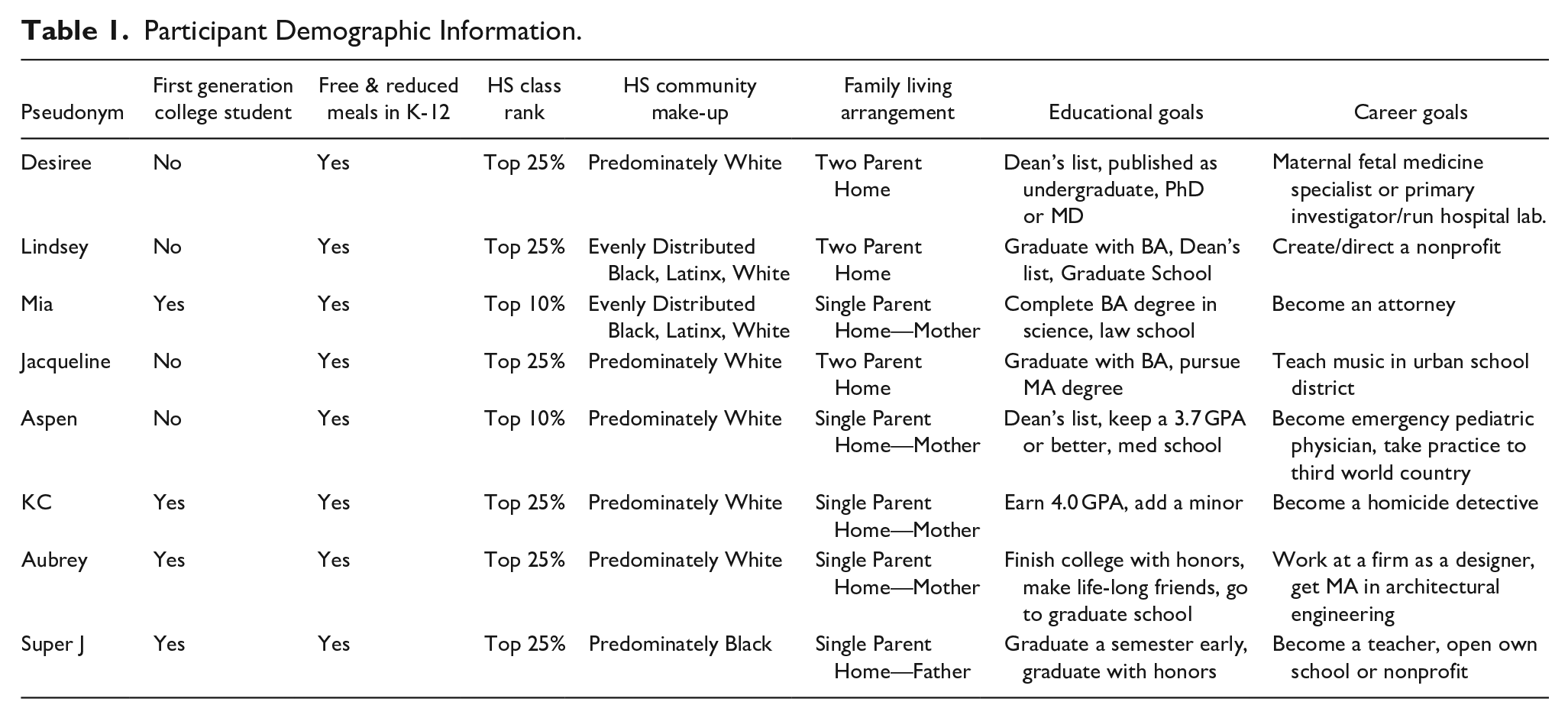
Participants from this study came from a larger study on the holistic high school experiences of Black girls. This study, in particular, included eight Black women in their first year, first semester at a large, public university in the Midwest. These cases in particular were a unique subset of the larger study based on the intersection of their identities including high achieving (top 10-25% of their class) status. All of the participants were on free and reduced meals and half were first generation college students. Over half (5/8) attended predominately white high schools. All participants had high educational aspirations including attending graduate or professional school (6/8) and maintaining high academic achievement (i.e., graduating with honors and/making the Dean’s list; 6/8). For more details about the participants, see Table 1.
Participant Demographic Information.
Procedures
After approval from the Institutional Review Board was secured, the first author worked with university representatives to identify Black women enrolled in their first semester, first year at the university. University representatives provided the first author with the contact information for 301 students who met the aforementioned criteria. Each student was contacted by the first author and provided with an overview of the study along with the contact information of the first author should they be interested in participating in the study. Students who contacted the first author were provided with an informed consent document and demographic questionnaire for their review prior to scheduling an individual interview. Individual, face-to-face interviews were scheduled in a private, designated space (i.e., office or small conference room) in a mutually agreeable location.
Data Collection
Data collection included two sources. First, each participant completed a demographic questionnaire designated to collect demographic information including school information, grade point average, and educational and career goals. Second, participants participated in an individual interview. Interviews were guided by a semi-structured interview questions which allowed for modifications and subtractions based on participants throughout the interview process (Patton, 2002). This process allowed for flexible and comprehensive interviewing (Patton, 2002). Individual interviews were face-to-face in a private designated space. Interviews lasted 1 to 1.5 hr and were recorded and transcribed under a participant-chosen pseudonym.
Data Analysis
Authors engaged in the narrative approach which garnered a range of stories and experiences for each of the participants (Hays & Singh, 2012). Authors then used Interpretive Phenomenological Analysis (IPA; Smith, 1996) for a detailed analysis and examination of these stories without preexisting theoretical conceptualizations. First, transcripts were read five times by each author which allowed for authors to become familiar with stories while also annotating significant and interesting areas in the left margin (Smith & Osborn, 2008). Then each transcript along with annotations were reviewed individually to identify subordinate themes. Finally, authors collapsed subordinate themes into larger categories which represented superordinate themes across all transcripts (Smith & Osborn, 2008).
Authenticity and Trustworthiness of Data
To ensure trustworthiness of data, authors utilized several strategies. First, a comprehensive literature review was used to create the semi-structured interview protocol. This literature review included literature related to Black girls in K-12 schools, Black youth in K-12 schools, gifted education, and high ability students. The protocol was then shared with experts in the area of working with Black youth and Black girls in particular. Experts provided feedback which was used to revise and edit the semi-structured interview protocol. Additionally, authors incorporated an external auditor as a part of the data analysis process. When subordinate and superordinate themes were determined by the authors, the transcripts were shared with the external auditor who also completed their own independent review of transcripts and themes. The auditor and authors then discussed the transcripts and themes until there was consensus.
Findings
The authors used IPA for data analysis, which allow for thick, in-depth descriptions and quotes to illustrate the participants experiences which were analyzed through a Black feminist-womanist lens. To understand how high achieving Black girls making meaning of their intersecting identities and what experiences have contributed to their success, authors organized findings into five unique categories. These categories include (1) I am because we are; (2) a village builds confidence; (3) double jeopardy at school; (4) finding mental health and wellbeing support; and (5) needs for success are discussed in detail below.
I am Because We Are
As participants thought about who they were in the school environment, they highlighted the ways in which they felt connected with peers. The connection that they talked about with peers related to shared identities they had with fellow girl and Black students. For example, Mia characterized her experiences with other Black girls as positive in that she felt she could connect with them and felt they had a bond after growing up in a similar way. In particular, she described an all-girls yoga group where they could “escape” and come together as girls. They felt they could talk to each other and connect on a different level because they were all girls. Another participant, Aubrey, described her experience at an all-girls school as having a positive impact. She discussed how it was “empowering seeing women of all different backgrounds trying to get an education.” To each of these participants, having a group of girls to rely on and relate to helped to affirm their goals within school and positively impacted their educational experience.
Peer relationships with Black students were also a significant source of strength for participants. Jacqueline shared that her peer group included “comradery amongst Black people” who had the “same attitude” and focus on being successful. Essentially, being successful wasn’t counter to but a part of how they understood their cultural identity. Similarly, Desiree compared and contrasted her experiences at two high schools—a predominantly Black high school and a predominantly white high school. When speaking about her first experiences at a predominantly Black high school, she described how her classmates and faculty connected through common experiences: We just kind of understood-something about being Black, everybody just understands and knows. My teachers were Black too, so when they were making jokes in the class, they were actually jokes that I understood. And like, pep rallies were like the “littest” [ meaning exciting or fun] time because they would do like, throwback old hip hop songs and you’d be jumping like, ‘Ayy.’ And yeah, I really liked it.
Whether explicit or not, Desiree felt an instant connection and understanding with those who shared her cultural background. It was not only a connection with peers and faculty, but also a part of the school environment. Even when in predominantly white spaces, participants drew strength from their identities. For example, Aspen talked about being one of a few Black students in her high school and seeing it as important to excel. She explained, I exceeded everyone’s expectations and I wasn’t the stereotypical Black girl. I don’t know, I’m not saying I’m amazing, but my greatness made a difference there. I used my position to be more of a role model for the other Black girls there and they still look up to me. They still call me, they still email me, and I’m still giving them advice, you know, on how to deal with being there and being with stuck up rich kids. I definitely made a difference and an impact on the school, and that’s something I’m grateful for, for sure.
However, Desiree when she transferred to a predominately white high school, she was the only Black student. She instantly felt different and that she stood out. She recalled, I’ve never been to white high school in my life or a white school in my life. So I didn’t know anything about white culture. So I was like, what is going on? Who are these people? Why are these people calling me Desiree? Yeah, I didn’t really like it. . . I didn’t dress-I didn’t wear Uggs, I wore J’s. And um, I didn’t dress like them. And my hair, back then I rocked this nice afro. And it was orange so I looked like a fabulous princess, I felt so good. But yeah, everybody was like looking at me and stuff. Like, leave me alone.
In standing out, she had to cope with a new school, and what it meant to be a smart Black girl where her peers readily noticed and made clear she was different. This is an experience that often occurs for high achieving Black girls in that they may be one of the few who look like them to access rigorous courses. As such, there can be a stark contrast between Black girls and their white peers in those spaces that force them to turn inward for strength and motivation to not only be successful in the course but to also navigate their peers.
A Village Builds Confidence
All of the participants discussed the importance of their village to their success in school and preparedness for life after high school. They explained how their family encouraged them in their education and helped them to succeed in the future. For example, Jacqueline felt her parents were her biggest supporters who held high aspirations for her. Her parents would often tell her “You’re going to be president.” This helped her see and believe in her own abilities to be successful, “they were shooting for the stars for me. . . I may not aspire to be president, but I aspire to be the most of what I want.” Similarly, Desiree was encouraged by her family and wanted to use it to push herself to pursue graduate degrees. She wanted to “one up” her mother by getting a PhD and an MD. Moreover, participants also discussed their family’s involvement in their high school experience, both in building their confidence and helping them navigate their high school experiences. Lindsey sought family support regularly. She stated, I rely on family support a lot. . . my mom and my dad really stress education. So if I have a problem I could easily go to them . . . I used my family, I utilized them a lot more and probably than other girls [might go to their parents].
The consistent family support and guidance helped all the participants successfully navigate their high school experience and served as a motivating force to push them to excel.
In addition to family encouragement, many of the participants reported having positive relationships with at least one teacher, especially when they were invested in helping the students in and out of the classroom. For example, Imani felt she had passionate teachers who saw her potential. She stated, “they saw something important, and they saw something different” in her. Aspen’s teachers encouraged her in small ways, such as sharing her work with fellow students as the exemplar. Perhaps more importantly, participants shared the ways that these teachers were invested in their lives beyond their academic success. For example, Aspen would go to her favorite teacher for support. She reflected, “my favorite teacher was actually more helpful than my counselor because she-I took everything to her, she gave me advice. She actually wanted me to be great.” She worked with her teacher for planning postsecondary options including completing scholarship applications. Lindsey also shared the importance of having a teacher who shared her identity. She attended a high school where her peers were mostly Black and Latinx, but the teachers were mostly white. However, when Lindsey had her first Black teacher, she recalled the positive impact as, It’s comfortable. You feel like you can trust them more because you kind of like, recognize with them more-like I don’t even know how to describe it. It’s like since I felt like she could understand me as a Black girl was like, okay, I can ask her for help and whatever. So she would help me with my math. Sure she’s a gym teacher, but she knew math so it’s like, it was just easy and comfortable with her.
This kind of personal investment helped Lindsey throughout her high school experience as this teacher remained in her life. All of the girls attributed their success to the mentorship and encouragement from teacher or a family member. They knew their journey was not a solo endeavor, but an intentional village offering consistent support.
Double Jeopardy at School
All of the participants expressed they had experienced some type of stereotyping at school, either about their gender or race and many times, both. This double jeopardy of both racism and sexism shaped the stereotypical thoughts and expectations from both peers and teachers who placed them in a “box.” For example, Super J felt teachers and other adults around her assumed “Black people in general don’t really care about school and things like that” when it came to being successful in school. She believed that others put this narrative on her being and assumed that she was underachieving and disengaged with school. While she was academically successful, these assumptions made her feel isolated from her teachers and her peers. Mia also felt that adults held stereotypical views of her and her fellow Black classmates. She felt like when fights would happen between Black students, then adults began to “think that’s what we’re [Black students] all about. Like, we’re not really there for education.” She added that others viewed Black students as “either we’re good at sports or we’re bad and don’t really wanna go to school. There wasn’t no in-between.”
Lindsey and Jacqueline both described some of the ways they were put into a box by their peers. Lindsey shared despite being in a school with greater diversity, her peers, particularly boys, still held stereotypical views of Black girls. In particular, Lindsey felt that the boys in her school often saw Black girls as “angry” “crazy and loud. . . that’s how they [boys] thought even though they come from the same cultures.” Similarly, Jacqueline experienced stereotypes from boys that went beyond just thoughts: We were always the stereotype. That we were the ones that would be pregnant at the beginning of the freshman year, and have one or two kids by the time we’re seniors. Or we’re the ones you’re never going to see again because we did have these children, so if it wasn’t us, it was the Hispanic women. You could see there was a lot of people who gravitated towards the white women because my high school was predominantly white, but you’d see a lot of the African American males date the white women. So that relationship was interesting, but you’d see the comradery amongst all Black people. We were all friends with each other, we just weren’t in that type of relationship with each other.
While Jacqueline believed that there was comradery among Black students at her school, Black girls where never seen in a romantic light as students often pursued romantic relationships with white girls.
These experiences with stereotypes also existed in extracurricular settings. One participant, Desiree, shared how the boys in her class made assumptions about her physicality simply because “she’s just a girl.” The boys in her class assumed she couldn’t lift weights and she was weak but were shocked that she was a state champion power lifter. She felt as though she was looked at to be weak because she’s a woman, but she felt strong because of it. The stereotypes the participants experienced led to feelings of being different or worse than their peers as well as led to some negative relationships with those around them. Peers and teachers often misunderstanding of Black girlhood had a greater impact on high achieving girls social interactions as opposed to their academics. They still had a great desire and commitment to their academic success as evident by their grades, but they were more likely to withdraw socially to avoid being confronted by negative stereotypes and perceptions. This social withdraw is certainly a protective factor, but also makes the aforementioned vetted village of support all the more important.
Finding Mental Health and Wellbeing Support
Discussions of school experiences often focus on academic and even career development with limited attention to socioemotional development. In their high school experience, most participants sought trusted adults, particularly teachers and family members to provide this kind of emotional support. Participants shared that while each of their schools had a school counselor, a staff member who is charged with supporting the holistic development of all students, they, by and large, did not feel a connection. In fact, participants likely viewed the school counselor as an academic scheduler at best who “just didn’t relate very well” to their unique and typical developmental needs. Lindsey captures this experience in the following, I don’t think I really like went to my counselor for like, social or problems in that area or even, like. growth. I never went to my counselor for stuff like that. It was always just like grades or scholarships, or you’re being recognized for this. Like, it wasn’t really, we didn’t have like an emotional connection.
Essentially, any connection or opportunity to meet with the school counselor beyond failing grades, was likely the initiation of the participants. If participants had a basic or unique need, they had to intentionally seek out the school counselor rather than school counselors being proactive in building relationships. Mia shared, I know my close friend, she went to the school counselor a couple times. She told her ideas of what she wanted to do [for college], but it’s like, they didn’t really dig into it. It’s just like- ‘I’m thinking about going to [University removed]and they were like ‘oh, okay’ and just wrote it down. It’s like- it’s nothing. It’s just you tell them what you’re going to do and they’re like ‘okay’. . .They [other students] weren’t as engaged [with the school counselor] as I was. I wanted to ask questions so I was like ‘yeah I want to go to [University removed], but I got questions about my financial aid. I got questions on this.’ I’m like- but not everybody is like that. . .but a lot of people are not like that so I feel like you have to be assertive to the counselors to get information out of them. That’s how it was.
At that, participants were unlikely to talk about personal issues, but rather sought the school counselor for information gathering purposes regarding coursework, college visits, college applications etc. Lindsey captures the transactional nature of working with the counselor, I would like, I don’t know, my school counselors never- they never really told me about their experience. Like I didn’t know a lot about where they went to college or how they got there. Um, so like I always thought like, ‘Oh my counselor will be like a personal friend, somebody I can go to schedule classes, but somebody I can also go talk to if I have a problem.’ And there were some people that got along with the counselors and will be in their office all the time, but I never had that like connection to where I could be like, ‘Hey, so if I’m not sure what college I want to go to, what do I do?’ Um, I was never comfortable with that because it was always just like you go in, you schedule [your courses] and that’s it. You make your appointment, and you go and do your other thing.
This is not to say that participants did not experience socioemotional challenges in school. For example, participants discussed challenges understanding their identities (i.e., race, gender, affectional identities), dealing with social anxiety, and working to really find and understand themselves in their high school experience. Despite the lack of relationship, participants did desire to be seen holistically and have a connection with school counselors.
Needs for High School Success and Beyond
While each of the participants ultimately graduated and moved onto postsecondary educational opportunities, each detailed ways their high school experiences could have better prepared them for the next steps in their educational journeys. First, within the high school setting, they wanted more holistic supports embedded in high school. They wanted opportunities to build connections with teachers and school counselors, to be seen and supported fully. For example, several participants wanted more support for the many identities that students have. Taken on an individual level, for example, Lindsey, Aubrey, and Desiree believed that school counselors and teachers should get to know them personally, understand their identities, and tailor their support and services to their specific journey and needs. Aubrey believed that this would allow for “someone who can kind of guide me through things. Like, academically” while also checking in on things at home, too. Taken on a larger level, participants wanted greater emphasis on identity and diversity in their schools. They wanted to learn more about other cultures, especially for those who were in predominately white high schools. For example, Desiree wanted more intentionality done with diversity at her school, “more inclusive culture in school and having more culturally diverse events at schools. . .. So address all this stuff instead of beating around the bush and being like, ‘Oh yeah, slavery. Okay bye.’” She wanted to learn more about cultures beyond the minimal, and often stereotypical renderings of such.
In focusing on their transitions to college, they talked about a need for more support that was holistic, not only helping them to learn and work with different kinds of people, but also one that helps them to balance all of the different aspects of college. For example, the transition and different social space of college surprised Aspen. She wished she had a better understanding that
not everybody’s nice. Like, my personality, I’m not super talkative. I’m not super social at all, but I guess I have a friendly nature. So I was walking down the street [at college] smiling, acknowledge that you exist and keep it moving. It’d be polite, but not everybody’s like that. [Where I grew up], you know it’s not small, but like you knew everybody so they’ll be like, “Hi, how are you?” Little conversation, keep it moving. But here you’re like, “Hi.” Nothing. Oh, okay that’s fine. If I had known before, it wouldn’t have so like-caught me off guard and kind of painful. Not like painful-painful, but like, “Oh, do they not like me? Or is that just how they are?” I don’t know. I don’t know if it’s just because I’m Black, I don’t know. I felt that vibe from a couple of people though. I notice that they act a certain way. Like If I say something they kind of pushed me off like I’m like “oh, that’s fine.”
All of the participants also gave practical suggestions toward their needs for a more successful transition to college. Almost all of the students talked about their lack of previous knowledge that college required more time management skills than their previous schools. One student, Marie, described the differences of expectations in high school versus college. She said in high school her teachers would give them time to work on papers in class and make sure they were on track to finish on time. However, once she got into college, she was in charge of making sure she kept track of her assignments and how much work she needed to do ahead of time. Marie said she wished she’d learned more about “self-reliance” in high school and how to adjust to the college environment. Many participants expressed similar desires for the difference in time-management expectations being discussed in their high school classes.
Time management is a skill many of the students mentioned they wished had been emphasized in high school, as well as how to balance academics with other areas of their life. Particularly, Mia said she wished there had been more talk of the independence they would experience once they were college students. She talked about her and other students shock when it came to managing college courses and how she wished that high school offered help with understanding “what to expect when you go to college.” Participants seemed to experience a shock at the independence they had within college. Teachers and faculty have been cited as being a source of information and support within school that is vital. While academics are important, the students seemed to be lacking more in other areas of school needs.
Discussion
Our findings reveal how intersecting identities of gender and race contribute to a unique experience for Black high achieving high school girls. Furthermore, these findings confirm previous findings about this population (Archer-Banks & Behar-Horenstein, 2012). In particular, interviews in which the participants were able to engage in self-definition within a Black feminist-womanist research paradigm (Lindsay-Dennis, 2015), revealed intersectionality. For example, some girls found strength and support being among peers and teachers who shared their identities. Yet, in other contexts, participants discussed how they faced anti-Blackness and stereotypes that are particular to their race and gender, as indicated by reflections about Black girls being loud and angry (E. W. Morris, 2007). Confronting and navigating stereotypes of Black girls is perhaps the most prevalent challenge that Black girls encounter in school (Annamma et al., 2019; Archer-Banks & Behar-Horenstein, 2012; Mayes et al., 2021; Esposito & Edwards, 2018; Watson, 2016). This study again reveals that high achieving Black girls also must deal with this burden due to stereotypes and subjective judgments of school personnel. The Black feminist-womanist research paradigm does not force them to choose whether they are Black or female as they recount their experiences. Rather, participants are invited to explore their identities in different contexts as they see fit.
Nurturing the identities of Black high achieving girls through affinity groups and creating culturally responsive environments, particularly in classes where they may be the only Black girl, or one of few, is a necessity. Through their reflections about the positive experiences they had in school due to opportunities to connect to peers based on gender in some instances and race in others, the participants revealed why it is important to see them as Black and female (Evans-Winters, 2011). This nurturing of identity was exhibited by participants who appreciated being in support groups with their peers, and also by mentoring younger Black girls. This is an indication that formalized peer mentoring programs might be promising avenues of support. It is equally important for faculty and staff, including school counselors, to understand, acknowledge, and support the confidence that Black girls may express. The glorious confidence expressed by Desiree, who wore an orange Afro and referred to herself as a “fabulous princess” should not be misinterpreted as arrogance. Rather, her self-esteem that indicates pride in her identity and culture in ways different from mainstream school culture, must be acknowledged and nurtured within the school environment. Although not about Black girl high achievers specifically, Butler-Barnes et al. (2018) found that “racial identity and ideology were associated with higher achievement motivation beliefs over time” (p. e552) among Black girls in seventh, eighth, and ninth grades.
Powerful relationships with adults, namely parents/caregivers and teachers continue to stand out as an essential avenue of support for Black high achieving girls. Adult actions leave an indelible impression on students. As Archer-Banks and Behar-Horenstein (2012) recounted, the participants in their study recalled the actions of teachers they thought were prejudiced as well as those who showed care. Likewise, the girls attributed their parents and families to the development of their confidence and post-secondary goals, a theme found in extant literature. While participants found support with their families and select teachers, there was a deep desire for holistic understandings and supports across all facets of school. Despite their experiences of double jeopardy, participants shared a hopefulness that schools could be better in the way they actively build connections and support high achieving Black girls.
Finally, the participants’ self-actualization contributed to their clear understanding about areas for additional support for high school success. Their desire for more emphasis on the skills necessary for college success such as time management during the school day is a reflection that they understand the value of those skills, and that they understand that they are entitled to access to such skills from their school. That understanding, that it is the school’s responsibility to provide equitable and inclusive access to such opportunities, is reflective of scholarship in the related field of critical race feminism. Evans-Winters and Esposito (2010) asserted that “scholars, policymakers, the judicial system. . .and society at large are responsible for seeking to understand and improve the state of Black girls’ education” (p. 22). Therefore, the responsibility to eliminate inequities and provide access for Black girls, especially high achieving Black girls, rests on practitioners and scholars to influence change in schools. We provide such possibilities in the next section.
Implications
Several implications for practice and research abound from this study. First, given that race and gender formation and identity are critical parts of Black girl high achievers’ self-esteem and schooling experience, having culturally responsive Black women teachers, counselors, and administrators would be a great service. Gist et al. (2018) contend, given the historical legacy of Black women educators. . .the impact Black teachers have on the expansion of educational opportunities, increased academic performance, and high expectations for Black students. . .their teaching and learning experiences should be more closely examined to contemplate the pedagogical and knowledge producing leadership roles they play in schools (p. 57).
Second, high achieving Black girls deserve all of their teachers and staff to be culturally responsive in their curriculum and pedagogy. Ongoing professional development and culturally responsive training opportunities as a part of preservice educator programs are essential for this to occur. Hall and Smith (2012) suggested teacher preparation faculty could develop curriculum with students to explore stereotypes. Hines and Wilmot (2018) asserted, “colleges and schools of education play a critical role in the teacher education pipeline. . .[and] should serve as barriers that prohibit preservice teachers from harboring anti-Black attitudes. . .” (p. 68). It is important to note that while often colleges/schools of education are primarily thought of for preservice teacher education, it also houses additional stakeholders who are who are vital to the educational enterprise who also need training for culturally responsive practices including but not limited to school counselors, school psychologists, and administrators.
As a part of culturally responsive training, more is needed for in-service professionals as a way to continue to grow skills and identify ways that whole schools can work together toward more inclusive school culture and climate. As such, principals should ensure that ongoing professional development occurs that creates opportunities for faculty and staff to address inherent biases while also building skills (Martin & Smith, 2017). For example, teachers, and administrators must be aware of how their perceptions of, and relationships with Black girls are influenced by stereotypes about Black femininity (Andrews, 2012; Annamma et al., 2019; Esposito & Edwards, 2018).
Third, Black girls deserve to have meaningful access to school counselors. While Black girls had limited access, likely due to the intersection of racism and sexism, it must be noted that school counselors are also limited by high school counselor to student ratios. While the American School Counselor Association (2019) recommends that there should be one school counselor to every 250 students, the national average in 2021 to 2022 was 408:1. Further, in high-poverty and high minority schools, which Black girls often attend, the school counselor-to-student ratio is often higher than both the recommended ration and national average. So efforts toward culturally responsive training and supports offered by school counselors must also be met with resources that allow for schools to be staffed with an adequate number of school counselors who have appropriate caseloads. Caseloads that are in alignment with the recommended ratios also have a significant positive impact on student outcomes including increased attendance and graduate rates as well as decreased disciplinary infractions (Kearney et al., 2021).
Finally, counterspaces are safe classroom spaces that allow for the full expression and experiences of a particular traditionally marginalized group, in this case high achieving Black girls. Relatedly, Watson (2016) recommended that administrators establish affinity groups. Relatedly, as educators purposefully seek to understand the intersecting identities of Black girls and interact with them by centering the girls’ own constructions of their identities, they can create counterspaces that offer social and emotional support and caring.
Implications for research start with a call for more research about high achieving Black girls. We must collectively contemplate how to continue to push for scholarship that centers intersectionality as lens for examination of Black high achieving girls can be disseminated, placed at the forefront and made relevant to practitioners and scholars. As such, more research is needed to understand the experiences of high achieving Black girls in general, but also may look into specific facets of their lives. For example, future studies might examine identity development for high achieving Black girls, peer relationships, the transition from high school to postsecondary opportunities, and the career decision making process. Further, additional studies may focus on the development and implementation of specific holistic supports and interventions for high achieving Black girls. The aforementioned studies may allow for a deeper, more nuanced understanding of high achieving Black girls while also adding to the knowledge base on needs and better ways to support their holistic development success.
Conclusion
The tenacity and commitment to excellence exhibited by the high achieving Black girls in this study demonstrate their strength and resilience in spite of school contexts which viewed them negatively. While they should be lauded for their success, their stories also highlight the ways in which schools are often hostile and riddled with barriers which high achieving Black girls must navigate (Archer-Banks & Behar-Horenstein, 2012; Evans-Winters, 2011; Ricks, 2014). As such, schools, must work to address systemic issues in policy and practice to create environments which cultivate success and excellence for all students, with particular attention to the specific needs of high achieving Black girls. By centering Black girls including high achieving Black girls, schools can transform policies and practices that systemically disadvantage and push out Black girls and create an environment which honors their identities while integrating strengths-based practices.
Footnotes
Declaration of Conflicting Interests
The author(s) declared no potential conflicts of interest with respect to the research, authorship, and/or publication of this article.
Funding
The author(s) received no financial support for the research, authorship, and/or publication of this article.
