



Abstract
Troubling inequities in educational outcomes and opportunities persist in our public schools, and the demand has never been greater for educational leaders capable of creating socially just learning environments for all students (Marshall, 2004; Murphy, 2002). School leaders are key to affecting meaningful and sustained change inside schools (Fullan, 2001; Leithwood & Riehl, 2003; Payne & Keba, 2002), but the challenges in urban public schools are complex, multifaceted, and interconnected—poverty; racism; weak internal organizational capacity; and lack of financial, human, and other resources. Many reformers and scholars argue that schools—and school leaders—cannot accomplish the task of educating all students alone (Anyon, 1995; Noguera, 2003; Warren, 2005).
Rather, strong relationships between parents, communities, and educators are vital to improving student achievement and reforming education (Henderson & Mapp, 2002). Various forms of family engagement at home and at school are strongly linked to improved student outcomes, from higher test scores and grades to increased student engagement, motivation, and graduation (Dika & Singh, 2002; Epstein, 2001; Henderson & Mapp, 2002; Morgan & Sørensen, 1999). In addition, scholars have found educator–parent relationships to be vital social resources for engaging in the difficult work of improving school cultures and student learning (Bryk & Schneider, 2002). However, many low-income parents of color feel unwelcome and powerless in their children’s schools, and their relationships with educators may be characterized by distrust, misunderstanding, and lack of communication (Delgado-Gaitan, 1991; Lawrence-Lightfoot, 2003; Olivos, 2006).
Principals play a critical role in shaping strong relationships between parents, communities, and educators (Bryk & Schneider, 2002; Riehl, 2000). Though most principals profess a desire to work with the community and partner with parents, they are often not adequately trained or prepared to address the social and political context of their work or to authentically collaborate with low-income parents and communities of color (Brown, 2004; Cambron-McCabe & McCarthy, 2005; Epstein & Sanders, 2006; Evans, 2007). Given this lack of preparation, how are principals to develop the knowledge, skills, and experience to collaborate with low-income parents and communities of color in the work of improving schools?
Within the growing field of collaboration between public schools and community-based organizations (Warren, 2005), community organizing groups can be critical partners in bridging the gap between principals, teachers, and low-income Latino parents. In contrast to more advocacy or service-focused approaches to reform, community organizing focuses on building the capacity of low-income parents and community members to act collectively in the public arena, collaborate with educators, and hold them accountable (Mediratta, Shah, & McAlister, 2009; Schutz, 2006; Gold et al., 2002). Although a nascent literature suggests promising outcomes of organizing approaches to school reform (Glickman & Scally, 2005; Mediratta et al., 2009), organized parents alone lack the professional expertise and inside access required to make change in classrooms and schools (Henig & Stone, 2008; Warren, 2010). School leaders, especially principals, are key to access, playing either boundary-spanning or buffering roles to include or exclude parents and community members from the daily life of teachers, classrooms, and schools (Auerbach, 2007; Cooper, 2009; Crowson & Boyd, 2001; Warren, Hong, Rubin, & Uy, 2009). Many principals resist change from organizing groups (Gold et al., 2002), but scholars of community–school collaborations suggest that “there may be a new generation of school leaders who see the need for a different approach” (Warren et al., 2009).
Among this “new generation” of school leaders who collaborate with organizing groups, little is known about how principals conceive of their roles and how those conceptions shape their efforts to build relationships with low-income parents of color and enact shared leadership practices in the context of organized reform efforts (Fullan, 2001; Sanders & Harvey, 2002; Sergiovanni, 2006; Shirley, 2009). Such an understanding is essential if we are to realize the potential for parents and community members to become powerful partners in improving schools and enabling student success.
This qualitative study examined three principals who collaborated with the multiethnic, interfaith community organizing group, PACT (People Acting in Community Together), to lead three new small autonomous schools in the Rockland Elementary School District of California in 2004. 1 This study examined how principals who work with organizing groups (a) came to understand and approach their roles as school leaders; (b) how they enacted shared leadership with organized, low-income parents; and (c) how they experienced their leadership role within the broader district context. Through new school design team processes facilitated by PACT, these principals were each supported in creating powerful partnerships with low-income, mostly Latino parents and inducted into a leadership role more akin to the work of a community organizer, with its focus on building relationships and capacity to engage in joint work toward common goals. The principals subsequently enacted this model in their new, small schools by building relationships, capacity, and opportunities to develop as leaders. However, the principals struggled to sustain this new kind of leadership in a district context of competing expectations and political pressures. Although not all principals or districts will interact with organizing groups, this case illuminates the conditions and experiences that can help new principals to envision and enact more inclusive and collaborative forms of leadership in their schools. The article concludes with implications for the supports and context that may be necessary to sustain this next generation of collaborative educational leaders within the public education system, and promising avenues for further research.
Conceptual Framework
This study draws from three overlapping theories to illuminate the perceptions and experiences of principals who collaborate with organized parents and communities: shared leadership (from the educational leadership and organizing literatures), social capital theory, and role theory.
Shared Educational Leadership
Recent literature on collaborative or shared educational leadership calls for a departure from top-down bureaucratic leadership styles and the ideal of the “heroic” leader who single-handedly turns an organization around (Elmore, 2000; Murphy, 2002; Sergiovanni, 2006). Although the “hero” leader constitutes an oversimplified ideal, it remains a powerful metaphor that dominates popular conceptions of leadership across many domains. In this “heroic” conception, the leader is the sole source of expertise and information and is exclusively responsible for vision and decision making. Moreover, the leader is endowed with inherent personality traits that enable them to “save” the organization (Elmore, 2000; Murphy, 1988; Senge, 1990). This notion contrasts with a collaborative or shared approach to leadership, which has also been referred to as distributed leadership. Though there is considerable variation in the meaning attributed to the concept of distributed leadership, in particular (Mayrowetz, 2008), most definitions of shared leadership imply an expansion of roles so that more people take on leadership within a more heterarchical organizational structure (Leithwood & Mascall, 2008). Although the person with formal authority is no longer the singular source of expertise and agency, she or he retains a critical role in shared leadership approaches. The titular leader focuses more on “reforging” organizational structures and cultures that encourage the exercise of leadership across role boundaries, creating opportunities for leadership and leadership development, facilitating collaborative processes, fostering individual and organizational learning, and building shared vision and beliefs (James, Mann, & Creasy, 2007; Leech & Fulton, 2008; Murphy, 2002; Murphy, Smylie, Mayrowetz, & Louis, 2009; Nembhard & Edmondson, 2006; Pounder, 1998).
Although the literature on shared educational leadership generally refers to sharing leadership with teachers, some argue that such “within the four walls” approaches have been insufficient and that the scale and complexity of urban school reform require a broader notion of the school community, one that includes parents and community members (Giles, 2006; Goldring, 1990; Murphy, 2002). In fact, a Chicago study found that the ability of adults in a school—including parents—to work as a team was the most consistent feature of substantially improving urban schools (Designs for Change, 2005). As shared leadership practices begin to expand beyond the titular leaders, more people take responsibility, including parents, and the notion of leadership itself becomes reconceptualized as an influence relationship between leaders and followers (Leithwood & Mascall, 2008; Ogawa & Bossert, 1995; Pounder, Ogawa, & Adams, 1995).
Although shared leadership practices are widely advocated in the literature, they constitute a departure from traditional hierarchical leadership conceptions that dominate the educational bureaucracies within which most principals are trained, socialized, and employed (Sergiovanni, 2006). Thus, in practice, principals who take a collaborative leadership approach toward parents and communities are the exception rather than the rule (Gold et al., 2002). Although most principals say they want parent engagement in their schools, some perceive expanded leadership for others as a loss of power and control for themselves and resist change when parents challenge the status quo (Crow, 1998; Olivos, 2006; Warren et al., 2009). Moreover, among principals who strive to create positive home–school relations, many adhere to traditional notions of parent involvement—like attendance at conferences, open houses, and Parent Teachers Association (PTA) meetings—which are “token gestures rather than meaningful forms of participation in education” (Auerbach, 2007, p. 712) that entail sharing power and leadership (Cooper, 2009; Crowson & Boyd, 2001). For most principals, engaging in the work to distribute leadership “necessitates a transformation in their understanding of leadership and in the ways they enact their leadership roles (Murphy et al., 2009, p. 183). But how might principals be developed in ways that break from these traditional conceptions of leadership?
A community organizing approach to leadership development may provide insights regarding the conditions, context, and experiences that enable principals to enact more collaborative approaches to their leadership and meaningfully engage parents and communities. Organizing theory parallels the shared leadership practices advocated in the educational literature in that a central focus and activity of those in leadership is that of building relationships, developing capacity, facilitating collaboration, and creating opportunities for leadership (Buckwater, 2003; Warren, 2001; Wood, 2002). PACT, like many other community organizing groups, distinguishes between two types of leadership roles: “leaders” and “organizers.” PACT leaders are the “everyday folks”—parents and community members most affected by inequities as well as educators—whose concerns drive the organizing and who take a variety of leadership roles in interacting with public institutions to push for change (Alinsky, 1969). Organizers are organizational staff who identify, build relationships with, and cultivate the learning and growth of parents and community members through trainings, group processes, and tiered opportunities to develop new skills while leading the organization’s work around activities such as engaging others; conducting research; speaking publicly; and planning, carrying out, and evaluating campaign events (Warren, Mapp, & The Community Organizing and School Reform Project, 2011). The educational leadership literature calls for collaborative school leaders who—like organizers—play a key role in developing the relationships and capacity of all members of the school community. The practices employed by organizers to develop parent and community leadership may thus provide promising strategies for principals’ intent on building shared leadership in schools.
Social Capital
A social capital theoretical lens further illuminates both how the organizing group in this study introduced the principals to a new model of leadership and how those principals enacted shared leadership with teachers and low-income Latino parents. As defined by Putnam (2000), social capital refers to the “network of reciprocal social relations” that enables individuals and society to accomplish their goals and to make their lives more productive. This study focused on two types of social capital: “bonding” and “bridging.” Bonding social capital refers to ties between individuals from similar sociological “niches,” such as low-income, Latino parents; such relations can provide mutual support and a sense of solidarity (Putnam, 2000). Scholars suggest that a dense social network of “bonding” relationships characterized by trust and reciprocity can create and enforce norms and sanctions that encourage people to work for the common good over self-interest and to share information and power in order to leverage other advantages or resources (Coleman, 1988). For instance, Bolívar and Chrispeels (2011) found that, through their participation in a parent leadership program, low-income Latino parents built social and intellectual capital that enabled them to better navigate the school system and to engage in collective actions to change schools to better support their children’s success.
However, low-income, immigrant communities often cannot access or initiate change in mainstream institutions without another type of social capital (Stanton-Salazar & Dornbusch, 1995). Bridging social capital refers to ties between individuals from different backgrounds, such as educators and low-income Latino parents; bridging networks with “institutional agents,” like principals, can provide low-income Latino families access to unequally distributed institutional resources, opportunities, and knowledge critical to success in the educational system (Monkman, Ronald & Théramène, 2005; Stanton-Salazar, 2001). Relational trust—norms of mutual obligation engendered by social capital—across the entire school community may be an essential “social lubricant” in the midst of the educational change; trust between parents and educators can facilitate cooperation around student learning support, make for less contentious decision making, and ease operations (Bryk & Schneider, 2002). Such bridging ties can also enable parents to affect decision making in schools and districts when their concerns or proposals emerge from a context of trust, reciprocity, and a sense of common interest with educators (Warren, 2001). Thus, although the specific mechanisms and types of social capital vary, research suggests that both bonding and bridging social capital can be instrumental to school performance when drawn on as a resource by both principals and parents (Coleman, 1991; Dika & Singh, 2002; Leana & Pil, 2006; Sun, 1999).
Community organizing groups that work with principals focus on supporting them in building both bonding and bridging social capital with teachers and with empowered, low-income parents to improve student learning (Shirley, 1997; Warren, 2001). From an organizing perspective, shared leadership implies being in relationship with others, and social capital theory provides a way to understand the different types of relationships and the benefits they may provide. A critical issue is whether, and how, organizing groups may help principals develop social capital in ways that might improve both school and community capacity.
We know from the literature outside of organizing that principals play a key role in developing professional community—a form of bonding social capital—between the teachers in their schools to facilitate instructional collaboration and improvement efforts (Copland & Knapp, 2006; Louis, Marks, & Kruse, 1996). And principals who seek to move beyond individualistic approaches to parent involvement may cultivate bonding relationships between low-income Latino parents to foster a sense of mutual solidarity, shared knowledge, and empowerment around common issues (Auerbach, 2009). Finally, the bridging relationships between educators and parents or between the principal and parents can enable low-income immigrant parents to access institutional knowledge and resources, create shared norms to coordinate supports for student learning, and develop parent capacity for influencing change in schools and school systems (Mediratta et al., 2009). In an organizing framework, principals who cultivate relationships between and among both teachers and parents are beginning to “think like an organizer” in their efforts to develop the capacity of parents and teachers to become leaders in the organization. Drawing on social capital theory, then, we might expect principals who collaborate with organizing groups to build both bonding and bridging relationships within their school communities and to use both as key resources in enacting shared leadership in their schools.
Role Theory
Finally, role theory highlights how expectations, as part of the social context, can shape individuals’ identities and their corresponding characteristic behaviors (Biddle, 1986). Specifically, role construction has been found to shape school involvement behaviors among parents (Hoover-Dempsey et al., 2005) and leadership actions among school leaders (Auerbach, 2007; Leithwood, Begley, & Cousins, 1994). According to this theory, principals’ conceptions of their roles—for instance, as community builders, instructional leaders, politicians, or managers—will shape their actions and behaviors as leaders.
Although all principals occupy a position at the intersection of the educational bureaucracy and the school community, the principals who attempt to share leadership with organized parents and community members can face a particularly challenging broader political context, especially if tensions arise in community–district relations. Principals may find that the roles envisioned for them by organized parents and community members differ from the districts’ expectations for their role as school leaders. In addition, the literature suggests that principals and teacher leaders shape new roles and relationships “in their own image,” and tension and role conflict ensue when those images differ (Smylie & Brownlee-Conyers, 1992). It is possible, therefore, that role conflict will also be generated in a circumstance where superintendents and principals bring differing notions of leadership to their relationship.
Role theory suggests that principals who encounter such role conflict—wherein others hold inconsistent or incompatible expectations for a person’s behavior—will be subject to competing pressures associated with stress, adoption of coping behaviors, and disruption to the person and/or system (Auerbach, 2007). Moreover, according to role theory, principal responses to role conflict—such as choosing among norms, compromise, negotiating to change expectations, restructuring one’s views or behaviors, or withdrawal from the situation—may be shaped by their conception of their roles as leaders (Biddle, 1986). That is, their coping behaviors may be shaped by the ways in which they think of themselves as school leaders.
Research Method
This qualitative interview and observation study focused on the principals of three small schools initiated through PACT’s organizing efforts. The study sought to examine how the principals perceived and enacted shared, or collaborative, leadership with organized parents. This study built off a larger, national case study research project (led by Drs. Mark Warren and Karen Mapp) examining six community organizing groups working on education reform, of which PACT is one. PACT, a faith-based, multiethnic community organizing group in California, is a member of the national People Improving Communities through Organizing (PICO) network. I selected PACT for its 15-year track record of significant reforms in education organizing, its intentional organizing of teachers and principals in addition to parents and communities, and its focus on new school creation, which requires new principals. PACT played a key role in identifying the aspiring leaders who became the principals at the three schools and intentionally focused on developing their capacity to share leadership with teachers, low-income Latino parents, and community members. I thus purposefully selected these principals for their schools’ relationship with PACT and their common history and district. These principals provided an opportunity to deliberately examine a case of principals who actively develop relationships with organized parents and work with them on reform. Although PACT had worked with other principals in creating new schools, the principals selected for this study were all leaders of district-run, new, small, autonomous schools formed at the same time, within the same district.
Site
Located in a neighborhood known locally as “Sal Si Puedes” (Spanish for “get out if you can”), the Rockland Elementary School District, located in a large metropolitan area of California, is a kindergarten through eighth grade urban district of roughly 10,000 students, predominantly low-income Latino students of Mexican heritage. Its performance on state standardized tests is well below the state average, with 32% of district eighth graders scoring proficient in English-Language Arts and 30% in mathematics (California State Department of Education, 2008). In this context, in the late 1990s, the community organizing group PACT began mobilizing low-income Latino parents as well as middle class Latino and White community members primarily from two nearby churches to address the poor quality of education in Rockland. In 2003, they won Rockland School Board approval of a policy to create six “small autonomous schools of choice” that would be run by the district but have budget, personnel, and curriculum autonomies. 2
After a year-long design team process supported by PACT, proposals for three new schools were submitted and approved by the Rockland School Board: Leadership Elementary (K-5), Leonardo da Vinci Academy (6-8), and Éxito Dual Language Academy 3 (eventually K-8, but starting with only kindergarten in the first year). The schools opened their doors in the fall of 2004. A second round of small autonomous schools of choice were designed, proposed, and denied by the district during a time of increasing hostility and antagonism between the district and PACT. The three schools led by the principals in this study were in their fourth year of operation during my data collection. Although PACT played a key role in the planning of the schools and contributed start-up funds to help them establish, the group did not play an active role in the schools at the time of my data collection, except for ongoing instructional coaching for the principals (provided by retired administrators on contract through PACT) and off-site organizer support of the PACT leaders who were parents and teachers at the schools. PACT was limited in its ability to be involved with the schools at the time of my data collection because of the highly antagonistic relationship with the current district leadership, which had come to a head during PACT’s repeated attempts to get a new charter school approved in the district. As discussed in my findings, the principals perceived that their continued, active involvement with PACT would jeopardize their jobs.
Study Participants
Principals
None of the three principals in this study was the original leader of his or her current school; each was the second principal at these schools. At the time of the study, Carolyn Hall was in her first year as the principal of Leadership Elementary but in her fourth year at the school. A White woman in her late 20s, she came to the district as a Teach for America member and became the founding “Teacher Leader” of Leadership Elementary after its creation. In his second year as principal at Leonardo da Vinci Academy, John Simon was a White man in his mid-30s who spent his first 7 years teaching in an elementary school, and then became an elementary literacy coach and later school improvement officer. The third-year principal of Éxito, Ana Gonzalez, was a Mexican American woman in her mid-40s, with a 17-year history of teaching bilingual education in the district and in her third year at the school (she had helped open the school but had not taught at it in its first year). All three principals had been appointed by the district to lead their schools, with the support of organized parents and community members, and had all been involved with design teams supported by PACT prior to their appointments. The only principal interviewed in this study outside of the three focal principals was the founding principal of Leadership Elementary; he was in his first year as the principal of a new charter school in the same district.
Parents
The nine parents interviewed either singly or in focus groups in this study were all current parents at the three schools. Most of the parents in this study had participated on the design teams for the schools and were involved with PACT either in the past or present (many of them also played leadership roles in the schools, such as participating on the Site Council). They were selected to represent all three schools based on their identification as parent leaders by PACT organizers, educators at the schools, or other parent leaders.
Teachers
The four teachers included in this study were all current teachers in the schools, very few of whom had been on the original design team for the schools. At Leadership Elementary, the principal was the only educator currently at the school (out of a staff of 13) who had been on the design team, whereas at both Éxito and da Vinci schools, a small minority of their teaching staffs had been on the design team and/or at the school since its inception. With one exception (a new teacher at Leadership), the teachers were either on design teams or had been at the schools since they opened and had been identified by at least two sources (among PACT organizers, parents, or the principals) as teachers who knew about PACT’s role in the initiation of the schools.
Organizers
The organizers in this study included the director of PACT, who had been involved in the organizing to win the district policy and the design team, an organizer who had been present when the schools first opened through their third year, and the current education organizer who was in her first year organizing parents and educators at the small schools.
Data Collection
This research draws on 11 principal interviews with these three principals; 15 additional interviews and focus groups with teachers, parents, and organizers collected for the case study research project on PACT; and 15 ethnographic observations of leadership-related events (such as Community Meetings, School Site Council meeting, and school opening activities) at their respective schools (two elementary and one middle school) conducted over the course of a year and a half (during the 2007-2008 and 2008-2009 academic years, the fourth and fifth years of operation for the schools). Detailed information about each source of data, by school, can be found in Table 1.
Data Sources
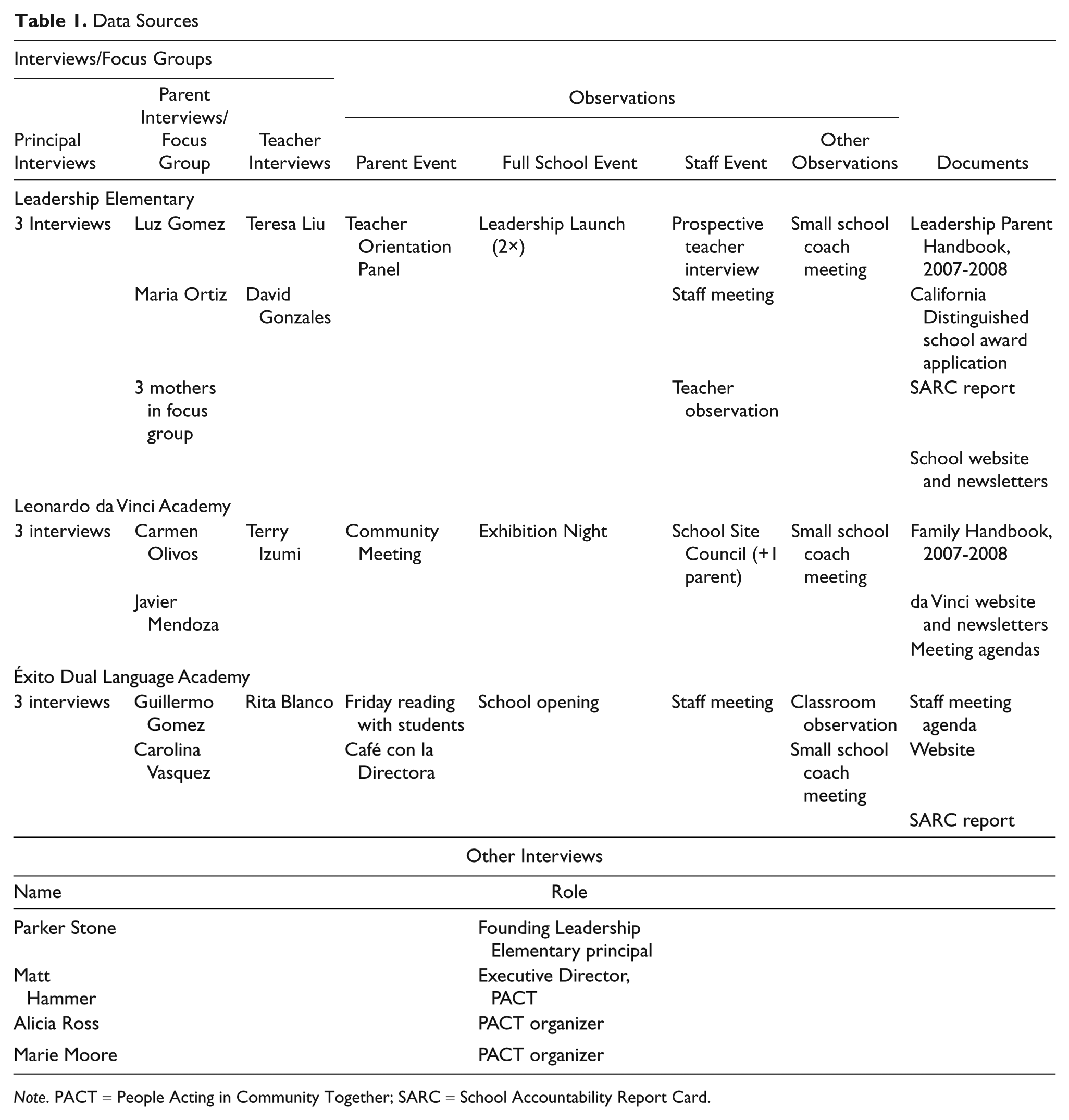
Note. PACT = People Acting in Community Together; SARC = School Accountability Report Card.
Semistructured interviews were 45 to 75 minutes long with a protocol modified for each individual after each site visit. I conducted three to four interviews of each principal across five site visits to address the concern that participants may discuss their perceptions and experiences differently depending on the timing and context, and to ground my later interview questions in observations of principal behaviors and interactions. These interviews focused on principals’ personal histories with the schools; their relationships with teachers, parents, and the organizing group; the school culture; and their leadership approach. Teacher interviews focused on the school culture, their relationships with parents, and their perceptions of school and district leadership. The individual and focus group interviews with parents asked about their histories with PACT and the schools, the design team process, their roles and the culture at their children’s schools, and their perception of the school leadership and district context. Organizer interviews focused on the history of organizing efforts around the schools, the organizing group’s strategies and philosophy, and the group’s relationship and history with the principals.
Observations are particularly important to provide context and triangulate leaders’ self-reports of their behavior, which may be framed to shed the best light on their leadership (Maxwell, 2005). For example, most principals will say they have positive relationships with parents and want them to be involved in the school, but teacher and parent perceptions do not always support this. The observations thus focused on how parents interacted with teachers and principals, how principals used meetings with parents and teachers, what kinds of decisions teachers and parents were involved in, and how the principal used her or his time and what role he or she played in meetings and gatherings. I conducted participant observation, when possible, to be able to better understand the perceptions and interpretations of study participants, particularly since I have not been a school leader, but have been both a teacher and parent. In addition, I also discussed preliminary findings with participants and invited their feedback.
I supplemented these data with selected documents (family handbook, newsletters, accountability reports) related to the schools to better contextualize principals’ descriptions of their school cultures, expectations of teachers and parents, and the broader district.
Data Analyses
After recording and transcribing all interviews and systematically recording fieldnotes of observations, I conducted my data analysis in iterative phases using a “two-level scheme” (Miles & Huberman, 1994), searching first for patterns and themes that addressed my research questions for each principal, and then collating the evidence across school leaders. Using the qualitative software Maxqda, I categorized the data first by coding all interview transcripts using broad “etic” codes I created, based on types of relationships discussed or observed (e.g., parent–teacher or principal–parent relationships). I subsequently coded the data in another round using more specific “emic” codes drawn from participants (e.g., “parent empowerment”) as well as “etic” codes drawn from the literature on social capital (e.g., “bridging”), education organizing (e.g., “organizer”), and educational leadership (e.g., “capacity building”). This method was well suited to the exploratory nature of the inquiry, in terms of allowing a more grounded approach to converge with theoretically driven propositions, and to the multilevel aspect of the design, including both individual principal-level analyses and cross-case analyses.
Using these codes, I constructed profiles of each principal and triangulated across informants and data sources (e.g., checking principal descriptions of their leadership approaches with teacher and parent perceptions from interviews as well as fieldnotes from observations). I created thematic matrices to display emerging themes in columns against principals in the rows of a grid, to create a visual display of similarities and differences between principals (Miles & Huberman, 1994). I then used concepts from the theoretical frameworks in analytic memos to connect and help explain these emerging patterns in the data (Maxwell, 2005). For example, I drew on social capital concepts to build theory about how organizing approaches to leadership development enabled principals to collaborate with parents and community members within a politicized district context.
Throughout the analyses, I also shared my transcripts, codes, and interpretations with an interpretative community of six educational researchers—two of whom were part of the larger research project—who enabled me to check my interpretations and biases, examine alternative hypotheses and analytical stances, and strengthen the validity of my conclusions.
Limitations
Although this sample of three principals does not generalize to all administrators and districts, the district is typical of many low-income, low-performing urban school districts with high proportions of Latino students. Therefore, the site provides a representative case district in which organizing groups may seek to undertake reform efforts. In addition, the methods in this study were principal focused, rather than more broadly focused on leadership in the schools, so future research might examine how parents and teachers perceive, initiate, and enact relationships with principals to capture more fully the dynamic interactions between educational leaders across the school community, broadly defined. Although the relationship between the organizing group and the district provided a key context for the principals in this study, the perspectives of district leaders were outside of the focus of this study; future studies might examine directly the roles of the district and district leadership in organized reform efforts.
Finally, all the principals in this study became administrators as a result of successful organized reform for new small schools, so their motivations may be unlike those described by the broader literature, which focus primarily on existing principals reaching out to parents (Auerbach, 2007; Sanders & Harvey, 2002; Van Voorhis & Sheldon, 2005). An understanding of the study principals’ experiences and perspectives does, however, provide key insights into how organizing approaches to preparation and initiation may shape new administrators’ role conceptions and leadership practices related to parents and communities.
Findings
In the discussion below, I begin with brief case descriptions of the three schools and their principals and then present three main cross-case findings that address each research question in turn. First, I found that the principals came to understand and approach their leadership roles through the small school design team process. This process constituted a key developmental experience that shaped principals’ conceptions of their roles and initiated them into a model of the “principal as organizer,” in which leadership is built on deep relationships and shared across multiple people and roles. Second, I found that principals enacted shared leadership with low-income, predominantly immigrant parents by building deep relationships, developing capacity in the form of “empowered” parents, and creating opportunities for parent leadership in the new schools. Third, I found that the principals experienced role conflict in navigating divergent leadership expectations within the broader district context; they adopted situational coping strategies in the immediate term and strategies shaped by their own role constructions in the long term.
Case Descriptions: New Principals in Three Small Schools
Leadership Elementary and Carolyn Hall
Leadership Elementary was a K-5 elementary school of 228 students located in the center of the Rockland neighborhood. According to school documents, the school’s theory of action was that “with a committed and empowered community, academic success will occur.” The principal emphasized that Leadership’s core is “not just student achievement. We’re about empowering parents to be involved in the school community.” This idea was enacted through a number of routines in the school, from the daily Leadership Launch (a full-school high-energy gathering) and monthly Community Meetings to teacher home visits to every child’s home, weekend family activities, and Exhibition Nights in which students showcase their work to their families. The level of parent involvement in the school was unusually high for an urban, low-income school: a typical Community Meeting was attended by about 70% of the parents in the school and the 30-hour parent volunteer commitment was met by 96% of the parents in 2007. Despite having half the teaching staff turnover the previous year, the school’s Academic Performance Index (API) 4 of 881 ranked it as the highest in the district (excluding the KIPP charter) and in the highest decile for similar elementary schools in the state (California State Department of Education, 2008).
Standing outside Leadership Elementary before school, amid running children and milling parents, Carolyn Hall was easy to spot. She stood heads above everyone else, even most of the adults, and her blond hair leapt out in contrast to the dark haired, dark-eyed children around her. Students and parents treated Carolyn with deference, and her high-energy confidence and ease in the role of principal defied her youthful appearance. In her second year of teaching as a Teach for America corps member, Carolyn had been involved with the design team for the school and became the Teacher Leader when the school opened. When the founding principal left to start a new school, Carolyn moved into the principalship and, at the time of this study, was in her fourth year at Leadership and in her first year as principal. She distinguished her style from charismatic, out-front leaders, characterizing herself as more typically engaged in listening and building trust and relationships. Since becoming principal, though, she felt that she has learned the importance of keeping the school focused and driving toward its vision.
Leonardo da Vinci Academy and John Simon
Leonardo da Vinci Academy of Arts, Science, and Social Justice was a sixth to eighth grade middle school of 205 students. With an API of 795, da Vinci was the highest performing middle school in the Rockland District and was named a California Distinguished School in 2007 (California State Department of Education, 2008). Principal John Simon emphasized the 90-minute instructional blocks, cohort structure (students move together by grade without tracking), looping of teachers with students, and advisory sessions as means by which students and teachers develop close relationships. As at Leadership, there were monthly Community Meetings and an Exhibition Night each trimester, in addition to learner-led conferences. Parents also signed a commitment to volunteer 30 hours per year, but this commitment was not met by a sizeable proportion of da Vinci parents (a typical Community Meeting was attended by about 30% of the families at the school). Most of the teachers at da Vinci had been there for 2 or more years—there was only one new teacher this past year. John talked about the school goals in terms of instructional improvement rather than focusing primarily on test scores, “because my belief is that if our instruction ever matches the energy level that we have and the commitment that we have to the kids, our scores are going to be off the charts.”
John Simon’s button-down shirt still looked neatly pressed at the end of a long day, and he had a familiar manner with students as they walked into a classroom through the door he held for them. A White man in his mid-30s, John was the only principal in this study who chose to pursue administrative leadership independent of involvement in new small schools. He put his “heart and soul” into designing Mosaic, a school from the second wave of proposals that was denied, but he was subsequently approached by the district to replace da Vinci’s founding principal. Now in his 11th year at the district and his 2nd year as principal, John valued the sense of community and family in the school and emphasized his collaborative leadership style, highlighting the level of camaraderie, collegiality, and shared responsibility among staff that distinguish da Vinci from any school he had ever experienced before.
Éxito Dual Language Academy and Ana Gonzalez
At the time of this study, Éxito Dual Language Academy was a school of 194 kindergarten through fourth graders, projected to grow one grade each year to eighth grade. The school’s philosophy was that “El que sabe dos idiomas vale por dos” (one who knows two languages is worth two), and the immersion structure provided 100% Spanish instruction in kindergarten, then increasing increments of English for each year after. Thus, almost everything at the school was conducted in Spanish, with only occasional English translation for any parents who needed it. Principal Ana Gonzalez talked about the school goals as twofold: building the high level of expectations for the foundation in Spanish and building “meaningful” parent involvement, particularly getting parents “directly involved with children in the classroom.” Parent involvement was high at Éxito as well. Although 5 of the 11 teachers at the school were new during the 2007-2008 school year, the majority of the veterans had been at the school since it opened. Éxito’s statewide test scores were not as high as either Leadership or da Vinci, but 75% of second graders were proficient in reading and 90% in mathematics in the Spanish-language exams, and the school continued to make progress on the statewide tests while serving a much-needed function in a district with so many English language learners.
Ana Gonzalez, “La Directora” of Éxito, was a little taller than the tallest of the children, and her subdued clothing blended in with her dark brown hair and that of her students, but she had a quiet commanding presence, and all eyes were on her as she stood facing the lines of children outside between the school buildings each morning. A Latina in her mid-40s, Ana had deep roots in the area and had taught in a bilingual classroom in the district for 11 years prior to the passage of Measure 227, 5 which cut her program midyear, around the time PACT started organizing parents to create new schools. Ana joined fellow bilingual educators and parents in the design team process for Éxito, convinced that bilingual education “is the best way to educate Spanish-speaking English learners.” Following the departure of the founding principal after the first year, Ana overcame her initial reluctance to step into the role. Now in her 17th year in the district and her 3rd year in the principalship of Éxito, Ana was still a part-time administrator, because of the low enrollment at the school. She felt her collaborative style, integrity, and follow-through were key to her success as a leader, emphasizing the importance of her role in facilitating the leadership of others and inspiring students, parents, and teachers to accomplish “great things.”
Finding 1: “Principal as Organizer”— The Design Team Process
When the principals were all still teachers with aspirations of future educational leadership, the organizing group, PACT, supported their development by engaging them in a design team process to create proposals for three new small schools to the district. This design team process initiated the aspiring principals into a new model of shared leadership that prioritized relationships and capacity-building with both educators and low-income, Latino parents. The aspiring principals’ participation in this process shaped their conceptions of their roles as school leaders—toward a model of relational, shared leadership—and their visions for the role of “empowered” parents as equal and valued members of the school community.
With the help of school coaches hired by PACT, design team parents and teachers (including the principals in this study) crafted a proposal for their new schools that included all aspects of the school from curriculum, instruction, and assessment, to parent involvement, site governance, after-school enrichment, scheduling, budgeting, hiring, and student recruitment. Although each school had a different specific focus, as described above, all the schools were “founded on the belief that education is a group effort” enacted through meaningful relationships and deep, ongoing collaboration between teachers, parents, students, and administrators aimed at realizing student achievement and success (Leadership Elementary, 2008). PACT deliberately recruited John as a potential principal for a school; Ana and Carolyn were both recruited as teacher leaders. All three were pursuing their administrative licensure at the initiation of the design team process. Thus, although the explicit purpose of the design team was to create proposals for new small schools, the process also served as an apprenticeship for the aspiring principals in building relationships and capacity to enact shared leadership with other educators and “empowered” parents.
Relationships as the foundation of leadership
As described by PACT Executive Director Matt Hammer, PACT aimed to move the aspiring principals beyond a “traditional” model of leadership, in which principals are respectful toward parents and have an “open-door policy.” Instead, Matt described PACT’s vision of the principals’ role in creating shared leadership and broad ownership in schools:
We’d like to get principals thinking a bit like organizers. It’s a very different way of looking at any sort of situation. It means asking where are the leadership development opportunities and what does that mean about how I act, particularly as the person with the titular head of the organization? Shared leadership is when you have a principal who is . . . always looking for opportunities for people to take on leadership and that that leadership is about being in a relationship with other people, representing their interests. It’s who’s in control and who’s making all the decisions . . . creating this more shared leadership, democratic decision making and a relational culture inside a school.
Through the design team process, then, PACT sought to induct principals into a model of shared leadership built on meaningful relationships with both staff and parents and a focus on developing the leadership of others to build democratic discourse and, ultimately, a deep collective sense of ownership over the school.
According to all three of the principals, their participation in the design team process was critical in developing and deepening relationships with parents. The design team process built bridging social capital between teachers and parents as they shared their experiences in schools and their frustrations, disappointments, aspirations, and dreams for their children and students. Éxito principal Ana Gonzalez recalled hours of long meetings with fellow Éxito teachers and parents on evenings and weekends, a joint effort that built enduring relationships. Leonardo da Vinci Academy’s principal, John Simon, felt that the design team process also impacted his understanding of education and schools:
That was extremely powerful to be able to sit in with the parents and hear what they wanted in a school and just have the interaction between parents and teachers about what they want from the school, what they didn’t want in a school, what they were frustrated about, talking about how they can change that, so the design team process was awesome.
As opposition grew from those who feared the new schools would “steal” the best students and teachers along with an unfair share of district resources, the bridging social capital between the principals and parents became somewhat more akin to bonding social capital—more typical between individuals with a common background—as the relationships grew deeper through many shared experiences and the “act of collective protest” (Putnam, 2000). Carolyn highlighted the deep connections she forged with Leadership Elementary parents involved in the design team:
I have those parents who were on the Design Team who I have probably the deepest relationship with because we went through so much blood, sweat, and tears. For those parents, it’s a friendship. We’ve crossed that line between I’m their school principal and I’m their friend, but . . . we’ve worked together on a professional level.
Likewise, design team parents highlighted how different their relationship with their principal was from other schools. For example, parent Maria Ortiz explained,
Principals always just kind of [make me] really nervous, [and] I feel like I’m the student [laughter]. [Now] it’s almost like a friend or someone you know really well, not just a teacher you see a couple of times a year.
In the midst of challenges and uncertainties of starting a new school, the relationships that were forged during the design team process between the principals and parents leveraged key resources to benefit the schools. For instance, parents advocated alongside educators at the district for the school proposals, conducted outreach to their neighbors, friends, and even fellow shoppers to build the enrollment the schools needed to open, and vouched for the principals when their inexperience was questioned by other educators and potential parents. Both teachers and parents contributed countless volunteer hours to the effort in addition to the proposal planning and writing, from interviewing teacher candidates and designing school-wide events to researching uniforms and raising additional funds.
Leadership as capacity building
The shared leadership model in the design team process also engaged principals in building parents’ knowledge, skills, and leadership capacity to address the power asymmetries that typically preclude authentic partnerships in traditional urban schools. First, because many of the low-income Latino parents on the teams had little knowledge of teaching or U.S. school systems, the aspiring principals helped parents to understand curricular and instructional issues from the perspective of teachers. Carolyn recalled,
So when I first came in, my role was really to substantiate more with why, from a teacher’s perspective, we need these goals. Because the parents knew why they needed it, but they also didn’t understand instructionally what was happening. And that was something that was brand new for the parents to see, . . . so it was really empowering the parents and having them be more informed, really bringing them into a more global perspective from all other stakeholders.
Second, because the parents had little experience with public speaking or political advocacy, the organizers worked with the aspiring principals to help parents prepare to chair meetings to gather information from educators and parents at other schools or political leaders, like school board members. Third, PACT organizers also trained and supported the aspiring principals in conducting one-to-one meetings 6 with parents to deepen their relationships and support the growth of parents. Thus, in building parents’ understanding and skills in advocating for change, the principals helped parents develop a sense of collective power that enabled them to engage in democratic discourse with the professional educators. This process provided a pivotal experience for the aspiring principals that contributed to their notions of how to enact shared leadership in schools.
“Empowered” parents
This capacity building and cultivation of shared leadership produced what all three of the principals referred to as “empowered” parents who were knowledgeable about schools, how to access information, and how to advocate for change in the educational system. Design team parents wrote portions of the proposal, spoke at district school board meetings in support of the design, and advocated for the schools at community and church gatherings. As part of the design team process, then, the aspiring principals also built capacity for parents to challenge the status quo at the district level and “speak to power” for change in a highly contentious environment.
Although the principals perceived that parents were empowered through this process, the nature of power is such that those who have it are generally the least likely to perceive it (Delpit, 1995). However, parents, like Éxito Design Team member Carolina Vasquez, confirmed the principals’ perceptions about the shift in power dynamics between parents and educators as a result of the design team process:
We [parents] discovered that we had much more right than they who were the principals and teachers, and that gave us a lot of strength and a lot of power. We understood that if we joined together, more people joined together, we were stronger. In addition, it was learning to speak out . . . to the people [in the district], how to speak out to them, not fight, but rather speak out . . . using the right words and demanding what we really had to demand, what we deserved, what our children deserved, what they weren’t giving us.
Shaping principals’ visions for parent leadership
Overall, the design process supported and engaged principals in working effectively with parents as equal and valued members of the school community. The principals experienced how the benefits outweighed the risks and learned concrete strategies for leveraging those benefits. Carolyn credited the design team process as a turning point in her thinking about the ability of empowered parents and teachers to make collective change:
So I think PACT definitely changed my perception on how much you could accomplish being just a teacher or just a parent. They’ve definitely empowered me to know that when a community works together, that they have a lot more power—regardless of the expertise and experience that they may have, but they have power just in their sense of shared vision and their sense of their passion of when there’s a strong need that your community can come together and really change things.
Ana also tied her experience on the design team to her vision for the role of parents in schools:
As we were writing the proposal for Éxito, we knew that that was an integral part of what we were going to be doing here—that parent involvement. So it’s hard having parents at school, but it’s wonderful when you see them just taking charge of things. I’d rather do the extra work and know that parents feel like they are part of our school. Because then when you really need them, they’re there for you. Because you’ve built that relationship.
Although John did not explicitly make this same link between his design team experience and his notion of the role of parents, his design team experience may yet have shaped his approach to parent empowerment. John had been involved in a second round of design teams for a small school called Mosiac during a time of increasing tension between PACT and the district. He described a letter from PACT parent leaders “attacking” school board members and his suspicion that their proposal had been hurt by this move. So John also experienced relationships with “empowered” parents in the design team process that became models for those in his current school, but his notion of “positive” political empowerment was more limited than the other principals, as evidenced by concerns he voiced about da Vinci parents’ judgment and autonomy in speaking out.
Thus, principals’ design team experiences complemented their formal administrative schooling with an apprenticeship in building relationships with teachers and low-income, immigrant parents as well as building capacity to engage in joint work around a shared vision. For the principals in this study, the design team process became an important precedent for a new school culture focused on close, collaborative relationships and the sharing of leadership across the entire school community.
Finding 2: Enacting Shared Leadership in Schools
As the three school leaders moved into positions of formal authority as principals and implemented the vision created in the design teams, they continued to engage in a model of shared leadership as they nurtured relationships, built parent capacity, and created opportunities for “empowered” parents to take leadership in many aspects of the new schools. The principals attempted to enact shared leadership through these efforts, which built a sense of deep collective ownership over the schools’ success. PACT’s direct involvement attenuated significantly after the schools opened due to the increasingly hostile relations between the group and the district, but the group’s efforts to develop the principals toward a shared leadership approach appeared to have outlasted close, ongoing interactions.
Building relationships
As in the design team process, relationships were foundational to principal attempts to share leadership with teachers and parents. In all three new schools, the principals disrupted traditional power asymmetries by cultivating not only bonding social capital between teachers but also bridging social capital between teachers, principal, and parents. For instance, Carolyn facilitated Leadership teachers in conducting home visits to gain a better understanding of their students’ interests and home lives, talk with parents about their hopes and dreams for their children, and establish a partnership around learning. John asked da Vinci teachers to call their students’ parents at the beginning of the year and on a regular basis (one teacher even called parents every week) to build and maintain ongoing communication about student progress, not just wait until a problem arose. And at Éxito, Ana facilitated teachers in partnering with parents to create Día de los Muertos altars to draw on parents’ cultural knowledge and expertise. The principals also built relationships with parents directly through their engagement in the community beyond the school, attending quinceañeras (15-year-old celebration for girls), community organizing actions at local churches, and cultural and social events in the community.
Ana believed that these relationships helped build a sense of investment in Éxito, and she emphasized building community as one of the most important components of the school:
I think that by building those personal relationships with families—my relationships with families and the teachers’ relationships with families—that they feel that they belong to this school, and that’s what makes them want to come back so often and help and strengthen the school and make it a great place. Because they feel that they’re part of it, they’re included in that community.
At Leonardo da Vinci Academy, John emphasized the school community as the most important aspect of the school, likening the school culture to a family, with the closeness and tension inherent in families. The constant communication and interactions made possible by this “family, relaxed atmosphere” provide knowledge about each individual that helps the school support their adolescent students more holistically. For example, da Vinci parent Carmen Olivos recalled witnessing two teachers exchanging information about a student’s classroom work and negotiating about his after-school activities. “The teachers know all their students and they’re able to connect and have contact with the teacher next door that teaches a different subject. Where else does that happen?” John also explained that parents and teachers often negotiated expectations for student work and corresponding privileges, such as attendance at dances. Likewise, at Leadership Elementary, parent Luz Gomez said, “It’s definitely more like a family community.” Thus, these relationships formed the basis of a collaborative culture in the schools and a starting place for enacting shared leadership. However, the principals in this study also focused on building the capacity of parents and creating the structures and opportunities for parents to meaningfully participate and then to share in leading the school.
Cultivating parent leadership capacity
The principals perceived the cultivation of “parent empowerment” as part of their leadership roles in the new schools. All three small school principals had a vision of parent empowerment as a central feature and key lever in the success of their schools. Carolyn emphasized her role as both the instructional leader and a cultivator of parent and community capacity at Leadership Elementary:
My role is . . . as an instructional leader, that’s a big part of it, but also that community development, that our parents are being empowered, because our mission is not just about students here at [Leadership], it’s also about the parents. If we’re at an 881 API or 900 API [Academic Performance Index] but we have no turnout at our parent meeting, and we have no volunteers in the classroom, then we’re not meeting our goals. I don’t care if we’re at 1000,
7
it’s still not where we need to be given why we started the school. We started because students needed more academic achievement, but we also started because parents wanted to feel like they mattered.
The Leadership Elementary student/parent handbook also referred to a focus on academic achievement driven by parent and family engagement as part of the school’s mission. Ana saw parents as key resources, who will be there “when you really need them.” Though she was pleased that Éxito has always had parental involvement in the form of more traditional support tasks (help with paperwork, fieldtrips, and attending meetings), Ana envisioned “our parents tak[ing] on leadership.” John pointed to the contributions that da Vinci parents provided and the unusual level of trust, “where principal and teachers can really rely and trust in parents and trust that something will be done, things will be organized.” John hoped “to empower parents and be able to put them in roles of taking on responsibility and being able to see and effect changes.”
The principals engaged in efforts to develop the knowledge and leadership capacity of parents as they enacted their leadership roles. Carolyn explained that “it’s not just that we expect the parents to be leaders, but we help them to tangibly receive those skills and shape their leadership through trainings and workshops.” The principals sometimes did this work directly themselves, through individual and small group meetings with parents. For example, John explained that he felt part of his role at da Vinci was
providing parents with knowledge of how the school district operates, how we operate . . . budgets, just kind of answering those tough questions, things that professionals are having a hard time really coming to grips with, and trying to explain it to parents . . . And I think I’ve done a better job of putting parents in a position where they feel knowledgeable . . . than last year.
Similarly, Ana held Cafés con la Directora (Principal Coffees) at Éxito, where she not only shared information but also actively facilitated parents asking questions and providing suggestions and guidance to one another in supporting their children’s academic work.
In addition to their own efforts, all the principals facilitated partnerships with PACT as well as other community organizations, to build parent knowledge and understanding of the schools and school system, develop their communication and organizational skills, and provide them with experiences facilitating meetings or presenting information. Carolyn explained how PACT helped her to fulfill that part of her role:
I think PACT definitely helps us fulfill our second prong of our mission, that we want to empower the community and empower the parents . . . we need PACT to help us do that, because it is a big task. [I]t takes that follow-up and building that capacity with the one-on-ones and being able to identify to the organizer the people who I know are going to be great leaders. I want to be able to invest my time in it, but truth of the matter is, I need to focus on instruction right now, so . . . I can sort of delegate that onto PACT, [and] they’re helping us to accomplish what we need to accomplish.
Likewise, John described a recent meeting where current da Vinci parent leaders, with support of a PACT organizer, had presented information about school and district decision making to new parents in the school, to both further develop the current leaders’ presentation skills and to begin to educate new parents about the system.
Creating opportunities for leadership
Principals in the study activated the relationships and parent capacity by creating opportunities for parents to share in leadership of the school, including responsibility for educating about the school culture, participation in key decision-making processes, and influence at the district level.
First, all three principals described sharing leadership with parents for educating and initiating new community members into the school culture. For example, Éxito parents Guillermo and Marta Gomez were disappointed that a new teacher to the school only involved parents in menial tasks, like paper-cutting and copying, when they were accustomed to playing a substantive role in supporting instruction. According to Guillermo, Marta talked with the principal about her concerns, and Ana opened the door for her to become the parent coordinator for the school, to support both teachers and parents in working together. “If you get parents that are leaders and motivated to make things happen, they can go about creating the things we need,” explained Guillermo. Similarly, John hoped that Leonardo da Vinci parents will “have a working knowledge of what goes on at the school” and really understand and have “ownership over all that is Leonardo da Vinci “so that the culture of the school will be sustained. He created opportunities for outgoing 8th grade parents to talk with and cultivate incoming 6th grade parent leadership. Carolyn designed the teacher orientation at Leadership Elementary to include a panel of parents who talked about the history of the school, the design team process, and outlined their expectations of teachers for communication and opportunities for engagement. One of the parents on the panel (an immigrant from Mexico with little formal education) even explained in an interview later that she used parent–teacher conferences to check in with her daughter’s teacher, who was new to the school, and to help the teacher understand more about the culture and workings of the school.
Second, all three principals described parents’ active participation in school decision making as a key arena for shared leadership, though this practice appeared to be most highly developed at Leadership Elementary. Carolyn provided opportunities for all Leadership parents to be involved in major decisions about school budget issues, school-wide goals, and even teacher hiring. For example, Teresa Liu, a new teacher at the school described how she had been interviewed and selected by groups of parents at a Leadership Elementary Community Meeting. Carolyn also created structures for parents to participate in writing an application for a school award from the state department of education; nearly 50 parents came to the school one fall evening for a special (not regularly scheduled) meeting where parents facilitated themselves in small groups in providing answers about the school to the various application questions. Fieldnotes from the observation highlighted how the interactions between parents emphasized a culture of building and taking leadership:
I observe one of the small groups as they rotate through the different stations, and after about the fifth rotation, Miguel [one of the parents] turns to me and says heartily, “Your turn! We’ve all taken a turn, now it’s your turn.” The parents in the group all turn to look at me, and I shake my head quickly and explain that I’m just watching. “We’re all leaders,” he reminds me with a smile and hands me the markers. I back off again and say, “I’m not a parent here, I’m just visiting.” He pauses for only a second, then says firmly, “we all participate!” and drops the marker into my hand. I turn to the butcher paper and take my turn facilitating. “If we’re not modeling for our kids,” he tells me privately later, “what will they learn?”
John and Ana also described parents participating in decision making at their schools and, to a lesser degree than Carolyn, both provided opportunities for parents to share leadership in this way. John engaged parents at da Vinci Community Meetings and at the School Site Council in financial and budgeting decisions, and parents interviewed finalists for both teaching and administrative leadership positions. At Éxito Academy, Ana also pointed to school governance and school-wide problem solving as key arenas for sharing leadership with parents. She gave an example of collaborative, problem-solving conversations about parents fulfilling their volunteer commitment. One parent suggested establishing parent coordinators for each classroom who would call parents with particular classroom needs and schedule them to volunteer.
So I liked that idea, and I said, let’s try it. So that’s why I brought it to [the principal coffee] today, to see what they thought of it. That empowers parents because they’re seeing their idea in action. And so then they know that they’re important. They know that their voice is being heard.
Finally, the principals supported parents in advocating for change in the educational system beyond the school walls, thereby expanding the notion of parent leadership to include what scholars have referred to as “political leadership” (Shirley, 1997). Carolyn believed that parents needed to have the ability to make change in the broader political arena, and encouraged Leadership Elementary parents to count their time attending school board meetings or meeting with the superintendent as part of their volunteer hours for the school. Although Ana did not discuss a role for parents at the district level (perhaps out of caution given the political sensitivity at the time of the study), John’s discussion of parent political engagement at the district level highlighted his sense of parent empowerment as both critical to the school’s survival and sometimes problematic. On one hand, he believed that parents should understand how the school district operates and be knowledgeable about “what’s going on politically around the school, and feel powerful enough that they can stand up for the school.” On the other hand, though, John questioned the intent and utility of “empowered” parents going to the district, particularly
if it’s parents taking it on their own, ‘I’m an empowered parent, I know my rights’ and kind of coming with this attitude of “why isn’t this happening?” and I can see it kind of wearing and draining on some people in the district and I hear about it and it’s—“what are you telling these parents?” and it’s coming back on me.
As discussed earlier, John’s ambivalence may grow partly out of his original experiences with the denial of Mosaic’s proposal for a new school. Although John intentionally cultivated shared leadership, in part, to enable parents to advocate for change at the district, he was not always comfortable with the ways in which “empowered” parents approached the district or the repercussions of those interactions for his role.
Leadership as developing new educational leaders
In conclusion, the principals enacted their leadership of parents similar to the way organizers seek to develop their leaders; they worked to build bridging social capital between professional staff and parents and to develop the capacity of parents to transform their schools and communities (Stanton-Salazar, 2010). These efforts by the principals enabled parents to take leadership in many aspects of the school, from educating about school routines and culture to participating in decision making and advocating for their school and community at the district. A funding proposal summed up this new definition of educational leadership: “At Leadership Elementary we have a different vision of leadership. Every person who contributes successfully to the fulfillment of a vision [of high student achievement] is someone who deserves the title of instructional leader” (Leadership Elementary, 2008). The design team process was not the only influence on the principals’ conceptions of shared leadership with parents; these notions may also have been affected by the broader political context of the district.
Finding 3: “Caught in the Middle”— Managing Competing Expectations
Although the principals in this study cultivated shared leadership and collective ownership within their small schools, the principals quickly realized the limitations of their authority and influence within the more traditional district context. In theory, principals are the school actors with the greatest power and access to institutional resources and information, who can provide parents access to broader institutional support and resources at the district level (Stanton-Salazar, 2001). In this study, however, the principals felt “caught” between competing expectations and struggled to be effective bridges in securing resources and ongoing support from the district for the small schools. Despite the schools’ rapid success on state standardized tests, the principals of the new small schools experienced significant challenges in enacting their leadership within the broader district context, in which the schools’ autonomies were increasingly perceived as inconsistent with the new district-wide focus on standardization and direct instruction. In particular, the district’s expectations of the principals reflected a more traditional hierarchical leadership role that conflicted with the shared leadership role enacted by the principals in their schools. The principals’ own conceptions of leadership were situationally specific in responding to the “highwire act” of negotiating these competing expectations. These conceptions, in tandem with the social networks available to them beyond their schools, may have influenced both their immediate and long-term coping behaviors.
Role conflict
All principals are positioned as intermediaries between schools and district offices (Spillane, Diamond, & Burch, 2002), but the principals who lead schools initiated by organized reform efforts must “manage in the middle” of two quite disparate worlds: in this case, a school that aims to empower parents as partners in educating students and build leadership across the school community, and a more hierarchical district context that may expect the principal to be the sole voice and authority for the school. These competing expectations for principal behavior held by organized parents and the district—experienced as role conflict—created conflicting pressures for the principals (Biddle, 1986). Even as they cultivated collaboration, teamwork, and leadership within their schools, the principals struggled to establish their own legitimacy, learn the political context of their jobs, and manage external relationships with the district. Carolyn described feeling unprepared for the challenge of navigating the highly politicized context in which the new schools’ existence appeared to be under constant threat and in which the principals’ advocacy for their schools was perceived by district administrators as a lack of concern for the whole district:
I do want the entire district to move forward, but I also need to advocate for my school. So it is a very difficult balance that’s so political. Being a part of a district, it’s very very very political. So that’s a whole other dynamic that I didn’t really anticipate, which has arisen since I’ve become principal.
Because the culture and relationships within these schools contrasted in many ways with the more traditional district context of which these schools were a part, the principals’ unique position sometimes led them to feel “caught in the middle” of agendas (in Carolyn’s words). Immediately after the schools opened, the district leadership changed and began to question the autonomies of the small schools (they were no longer called “autonomous” or schools “of choice”). Parents, teachers, and principals came to feel the existence of the schools was, in John Simon’s carefully chosen words, “very precarious.” Carmen Olivos, a Leonardo da Vinci parent, described how empowered parents stood up for their schools and how that put principals in a difficult position:
It’s kind of like a ripple effect. Okay, you’re creating this change, and these parents are becoming more educated to the politics of the school district, and then they’re asking questions, and then they’re demanding that you actually do something about it. That scares the school district. That scares people, and that translates into pressuring the principals.
John also described this dynamic as a major challenge for his principalship at Leonardo da Vinci Academy:
Well, I guess the thing that is the biggest challenge is just being able to maintain my position of leader in the school. I’m trying to work with the parents and students and teacher to help us to be successful and to work with the district office, too. To have somebody kind of stirring the pot—it doesn’t make my life any easier and I don’t think it helps the community either because it doesn’t help us to have a confrontational relationship with our school district—we are a district school not a charter school. We work with these people every day, we’re going to be successful based on what we have to demonstrate or unsuccessful based on lack of support.
In fact, this pressure was illustrated in a vivid way when small school parents called a meeting with the superintendent to talk about budget autonomies. The three principals were literally positioned between the superintendent and parents and directed by the superintendent to respond to parents’ questions. Javier Mendoza, a parent of children at all three schools who was at that meeting, described the principals as “stuck with their hands tied behind their backs” as they tried to fulfill the different expectations of both parents and the superintendent.
In navigating the contrasting hierarchical district and the more collaborative school contexts, the principals were shaped by and responded to two divergent leadership role expectations: a traditional, more “heroic” individual leader responsible for all communication and decisions potentially held by the district, versus an “organizer” leader who reflects a more shared or “empowering” approach to leadership held by the school community and organizing group (Murphy, 2002; Sergiovanni, 2006). Although parents and communities do not, in general, tend to share uniform expectations for principals, the organized parents in this study were also initiated in the organizing group’s shared leadership model, so there was an unusual degree of agreement among them.
Likewise, district expectations are also not monolithic or necessarily at odds with the expectations of parents and community, but the Rockland district at this point in time was led by a superintendent who exerted very strong control over her staff and district. For instance, differences of opinion from the superintendent were subject to sanction; Carolyn had been told that her performance was under review because of her public disagreement with the superintendent in district meetings. And at one point, the superintendent had personally informed each principal that they jeopardized their jobs by talking with PACT organizers or attending PACT events without a district administrator present. Although it was beyond the scope of this study to examine the superintendent’s role conceptions, theory suggests that role conflict may also have existed for the school leaders as a result of the superintendent and principals bringing differing notions of leadership to their relationship.
According to role theory, those who experience role conflict and its ensuing pressure will develop coping behaviors (Biddle, 1986). In response to the pressure they experienced, then, the principals in this study may have developed different coping behaviors that were situationally specific. That is, principals were more likely to talk about their roles in ways that suggested “heroic” leadership when referring to contexts related to the district, particularly when “their parents” challenged the superintendent. In contrast, principals’ own conceptions of their leadership within their school contexts were more that of shared leadership, which suggest a metaphor of the leader more as an “organizer.” 8 These metaphors for distinct roles represent two ends of a continuum more than either–or absolutes, but the principals coped with this role conflict by negotiating a tightrope between differing leadership role expectations and contexts.
Rockland district administrator expectations of the principals appeared to be consistent with a metaphor of the leader as “hero.” When parents had questions or issues, the district refused to engage with them and directed them to their principals as the sole conduit for communication. And, as in most districts, principals were held solely responsible for student achievement and failure at their schools. Moreover, the principals felt that the superintendent expected them to control their parents and be the sole advocates and decision makers at their schools. For instance, Carolyn was careful not to mention parent involvement in hiring decisions to the district for fear of censure. Likewise, a PACT organizer emphasized the district’s “heroic” leadership expectation in relating an exchange where the superintendent warned the principals “to keep your parents in line” after they went directly to the school board to override district policy regarding a student trip for which they had raised money. When the founding principal of Leadership Elementary organized his parents to engage with board members politically, he felt his job was threatened (he eventually withdrew from the situation and left the district). And John reflected his perception of the district’s “heroic” leadership expectations of his lone judgment and agency when he said, “as principal and the leader, I need to be the connection with the district office, and when we need things done, parents need to trust that I’m going to advocate for it.”
In contrast, the metaphor of the leader as “organizer” expectation held by PACT and organized community members reflected more of a shared leadership approach, in which the principal’s role, like that of an organizer, was to facilitate communication, decision making, and direction setting in the service of developing the leadership of others (Elmore, 2000; Murphy, 2002; Sergiovanni, 2006). For example, PACT Executive Director Matt Hammer contrasted a typical parent meeting with his expectation for how a principal who is thinking like an organizer might approach a meeting:
The typical way that a PTA or school site council works in a low-income community is that people show up, are given an agenda, and it’s usually reports from the principal, or the active parent, or the active teacher, and it’s anything but a conversation—it’s not about trying to build a broad base of people who feel ownership over the school and the decisions that are in front of the school. So this sort of flips that on its head. Maybe I don’t put the agenda together as the principal for the parent meeting, but I take a little time to sit down with a group of parents and have them put the agenda together and maybe the parent chairs the meeting at a school site council. This is how organizers think, and it’s not how principals are trained to think.
This approach aimed to build the power of all stakeholders and distribute leadership across the organization. According to Matt, school success was thus seen as “everybody’s win, not just a win that the hero principal delivered for the kids.”
Principal role construction
None of the principals thought of themselves as either “heroes” in a traditional sense or “organizers” in a community organizing sense, but these two leadership metaphors represented competing roles and expectations that the principals coped with by adapting their behaviors and role conceptions to the context. When talking about parents in the district context, John, in particular, was more influenced by notions of heroic leadership when he expected parents to show their respect for his position and authority by allowing him to control and frame the information to and from the district:
I’m trying to be a little more guarded. Not that I don’t want the information to be out there, but I just need to kind of define it before going forward with it.
He also wanted parents to let him determine when, if necessary, to activate their power at the district level: “if there’s something that I feel I need to advocate for and it’s not happening, I’ll be the first to know and we can kind of move into action.” Similarly, Carolyn perceived the original leaders of Leadership Elementary and Leonardo da Vinci Academy as more heroic leaders who were able to make things happen in the district context because they were “very charismatic, but they also were very harsh at times, because they knew what they wanted, and they weren’t afraid of saying it.”
In contrast, Carolyn operated under more of an “organizer” notion of leadership when she talked about parents in the context of the broader educational system. For instance, Carolyn perceived the state award application process as an opportunity for parent leadership development, but felt that her use of teachers as facilitators instead was a compromise:
You want to instill that leadership in the parents to be able to facilitate the meetings, but we’re not quite there yet. With some of our parents we are, but it still would take the prep of meeting with those parents, and really discussing with them how to facilitate it, and then sending them on their way. So it’s a balance of trying to find the time to share that leadership with the parents, but not just share it for superficial reasons, but make it meaningful.
Consistent with the description of principals who “think like organizers,” Carolyn also used her Site Council meetings to engage parents in planning Community Meetings, much the way PACT organizers meet with a subset of leaders to plan an upcoming organizing or research meeting.
Likewise, Ana also reflected more of an “organizer” orientation in discussing her role at Éxito:
I think my roles should be one of facilitator, having the meeting but allowing others to take the leadership role and just facilitating the conversations so that if you were ever to step out of that role, the school continues to lead itself, with different leaders you have in the school. If I’m always in control of everything and always leading everything and planning everything, then I leave, then what happens to the school?
An Éxito staff meeting seemed to confirm this approach; Ana sat to the side, occasionally posing questions, as her teachers animatedly debated with one another how they might make their annual Dia de los Muertos altar display activities more enriching and how to engage parents who had been uninvolved this year. Similarly, at a Principals’ Coffee with parents, Ana led the opening discussion (in Spanish) by recommending regular communication with teachers and posing questions. Soon, parents began talking to one another and offering each other suggestions for how to support their children with a new math curriculum.
Thus, principals’ constructions of their roles within their school contexts aligned more closely to the “organizer” metaphor and echoed Murphy’s (2002) call for a “less heroic” and more “empowering” leadership approach. From a list of common leadership metaphors, Carolyn and Ana both immediately chose “community builder” as the role they identified most with, both highlighting their relationships of trust with parents and community, teachers, and students. Within the context of the teachers in his school, John selected “instructional leader,” explaining that he constantly thought about how to develop his staff, “challenging and pushing” them to improve and think about their work, much the way PACT organizers “challenge and push” their leaders to take on a new role or develop a new skill. Indeed, the organizing culture at da Vinci was such that even students felt empowered to make change; at a staff meeting, a group of 8th graders, who had organized themselves ahead of time, presented an argument that postponing the upcoming Exhibition Night 9 would enable them to better model the new expectations to younger students. After some debate, the staff came to a consensus to postpone.
Thus, the design team process introduced the principals to a new model of shared leadership which they worked to enact within the schools, but the principals’ own role constructions were specific to the context as they walked a tightrope between conflicting role expectations, from hero to organizer. It was unclear, however, whether or how these situationally specific coping strategies might be sustainable for the principals over time.
Coping with role conflict
The principals’ informal and formal networks may have influenced their ability to navigate these conflicting roles, both immediately and in the long term. Although it was beyond the scope of this study to determine whether the principals’ experiences of role conflict were the sole cause of their subsequent behaviors, the principals’ longer-term decisions regarding their jobs might plausibly be understood in terms of the range of coping behaviors—withdrawal, adoption, or negotiation—predicted in the literature (Biddle, 1986).
Although all three principals had access to shared instructional coaching (supported by PACT funds), Carolyn had an additional network of educators through Teach for America as well as connections to a new charter organization led by the former Leadership Elementary principal. During this study, of the three principals, she also maintained the strongest relationship with PACT, albeit somewhat clandestine because of the strained relationship between PACT and the district. These relationships were mostly “outside” the district and school system, though, so even if they may have helped her to sustain her collaboration with low-income parents and community members they did not appear to facilitate her access to institutional resources at the district level. Ultimately, Carolyn left the district to join the charter school network her predecessor had cofounded, a decision consistent with coping through withdrawal (Biddle, 1986). In contrast, John had the least amount of interaction with the organizing group, and he may have lacked additional networks or relationships on which to draw to help him navigate the role conflict he experienced. John ultimately accepted the principalship of a traditional elementary school elsewhere in the district, a decision consistent with coping through adoption of district expectations (Biddle, 1986). Finally, Ana was tied to bilingual educators throughout the area, had deep personal roots from growing up in the community, and had relationships at the district level she could call on to provide resources and support to Éxito. “I think that we’ll continue to be supported,” Ana predicted, “but I think it’s also because of the relationship that I have with district people.” Ultimately, only Ana continued on as the principal of a small school, a decision consistent with coping through negotiation or compromise (Biddle, 1986). Thus, principals’ social capital at the district level and with other outside networks may have been influential in maintaining their collaboration with organized parents and/or accessing institutional resources. It is possible, of course, that Carolyn and John left their schools for unrelated reasons, but their experiences of role conflict coupled with PACT’s limited ability to support the principals in navigating these competing expectations and district pressure suggests that the principals were differentially prepared and able to sustain their efforts to access district support and resources while collaborating with “empowered” parents and teachers.
Discussion
Originally recruited by organizers, the principals in this study were developed in a model of shared leadership that engaged parents as “empowered” partners in school leadership. Through the design team experience, these principals learned to develop deep, trusting relationships with low-income Latino parents, build the capacity of their teachers and parents, and share leadership with them in helping all students to succeed. Yet as “mid-level managers,” these new principals navigated conflicting role expectations as they enacted their own situationally specific conceptions of leadership. My findings regarding these principals’ experiences suggest several contributions to our understanding of leadership, social capital, and role theory in the development of collaborative school leaders as well as promising avenues for further research.
Shared Leadership as a Bridge Between Professionalism and Community
The principals all perceived and worked to enact leadership as shared not only with teachers but also with “empowered” parents in their schools. Their language and practices moved beyond the largely symbolic gestures of visibility and accessibility found in other studies of leadership for parent engagement (Auerbach, 2007), and they played active roles in building capacity and relationships with parents, rather than delegating these activities to others in the school. Scholars have highlighted a tension between “professional” (educator) and “community” (including parent) interests and development as a focus for school improvement (see, e.g., Peabody Journal of Education’s special issue on “professionalism versus community,” 1998). This study challenges the notion that these are mutually exclusive or conflicting priorities. Rather, a shared conception of leadership consistent with organizing principles may begin to bridge the “worlds” of professional control and community interest. And whereas previous scholarship exploring this tension explored organizational structures and policies that might bridge these issues (Driscoll, 1998), this study suggests that a more relational, shared conception of leadership developed through organizing processes may provide powerful learning experiences for new principals. Future research might examine these processes prospectively, rather than retrospectively as in this study, and explore whether such experiences are effective with established principals as well as new administrators.
Social Capital as Foundational, Forged Through Joint Work, and a Potential Coping Resource
The findings from this study illuminate three aspects of the role of social capital in organizing approaches to school leadership development. First, the perspectives of these principals highlighted the foundational role of relationships in organizing approaches to leadership and lend further support to studies indicating social capital between educators and parents as a social resource for school reform (Bryk et al., 2010; Bryk & Schneider, 2002). The findings also suggest the extent to which leadership can be shared with parents when principals build relationships with them as a foundation for engagement, consistent with what Warren et al. (2009) call a relational approach to parent engagement. That is, instead of starting with activities, such as fundraising or literacy nights, a relational approach focuses on developing relationships with parents to understand their priorities, concerns, and hopes for their children as drivers for programs and activities. This study adds the critical role of the principal in relational approaches to parent engagement and demonstrates how careful listening and relationship building can foster a sense of ownership over the school and its success.
Second, while bonding and bridging social capital are often treated as distinct, this study illustrated how the benefits of bonding and bridging social capital can converge when people from different backgrounds—like principals and parents—engage in a process that attends to unequal power dynamics and enables them to work toward a common goal. Despite differences in education, race, culture, and socioeconomic status, the principals and low-income parents in this study built bridging social capital that was akin to bonding social capital as they struggled together in joint work, often in opposition to the district, to seek approval, open, and defend their new small schools. The principals all highly valued their relationships with teachers and parents, likened their school communities to “families,” and described the sense of community as vital to student success. Thus, shared leadership of joint work may add the benefits of bonding social capital—which provides support and a sense of solidarity, as in a family or kinship network—to those of bridging social capital, which provides resources and institutional knowledge and access.
Third, this study also underlined the importance of school leaders’ own social capital in coping with role conflict. Though much of the previous scholarship on social capital in schools frames the principal as the primary institutional gatekeeper in the school (Bryk & Schneider, 2002; Stanton-Salazar, 2001), principals also play a “middleman” role in the broader educational bureaucracy, and district expectations for principal leadership affect how school leaders are assessed and their influence in the system. The differences between the principals’ social capital outside of their schools suggest that further research into the role of principals’ broader networks may deepen our understanding of mediating factors in the ability of principals to sustain organized reform efforts. Education organizing groups who want the “organizer” principals they helped develop to succeed within the broader public education system may therefore need to attend not only to building bridging social capital between low-income parents and principals, but also to facilitating relationships between principals and other educational actors, both inside and outside the district. Principals who can leverage relationships with district administrators or other external networks may feel better able to sustain their leadership “in the middle” and their collaboration with organized parents in the face of political tension.
Augmenting Role Theory
Finally, role theory predicts that principals will resolve the pressure and stress of role conflict through coping behaviors that are shaped by how they construct their roles. The principals in this study adopted situational coping behaviors in the immediate term, such as trying to conform to district expectations by asking parents to talk with them first regarding district policies, while continuing to share leadership and decision making with parents at the school-level. However, the longer-term coping behaviors did appear to be shaped by the principals’ own conceptions of their roles. For instance, Carolyn was the principal with the strongest role conception of the principal as community builder and organizer, and her outspoken support of parent voice in the district exposed her to the potential of district sanctions. Her role construction, most at odds with the district’s expectations, may have shaped her eventual withdrawal from the district. On the other hand, John’s conception of his role was, first and foremost, that of the instructional leader with professional expertise in teaching and learning. Although he also worked to build community and facilitate parent and teacher leadership, his role construction was the most aligned with district expectations, and his eventual move to the principalship of a regular district school is consistent with choosing district norms. Finally, Ana conceived of herself not only as a community builder but also as a negotiator with the district, suggesting that her coping response entailed compromise or negotiation that enabled her to maintain her position and perhaps reduce the role conflict as the principal of a small school. This study suggests that coping responses to role conflict may vary over time and be mediated by individuals’ social capital and relational networks, adding a layer of complexity to role conflict theory. The long-term responses of the principals beg the question of the strategies employed by principals who are able to sustain their leadership in the midst of role conflict. Future research might examine how experienced school leaders manage role conflict, sustain their collaboration with organized parents and navigate their broader political context.
Implications
Implications for Practice
In this study, principals’ experiences as members of new school design teams were a testament to the importance of developing new leaders in a process that, itself, modeled shared leadership practices and roles. Leadership preparation programs often espouse leadership practices focused on professional expertise and moral authority but place aspiring principals in learning and practicum environments where line authority and traditional hierarchy predominate and where parents and community are not considered part of the school community (Giles, 2006; Leithwood & Jantzi, 2006). Although all aspiring principals cannot be part of designing a new school, the culture of shared leadership instituted at Leadership Elementary, Leonardo da Vinci Academy, and Éxito Academy provided a powerful apprenticeship for educators in how to enact an “organizer” approach to leadership.
Leadership preparation programs might create opportunities for aspiring school leaders to develop relationships with organized low-income parents and community members through joint design or policy work in partnership with community organizing groups. In addition, home visits, neighborhood walks, community mapping activities, or participation in nondominant cultural experiences may also provide aspiring leaders valuable experiences for building relationships with parents and community members while helping school leaders to understand parent and community assets and potential contributions to the school. Field experiences with principals like the ones in this study or with education organizers could help aspiring leaders learn concrete strategies for capacity building and sharing leadership across the school community, such as facilitating effective community meetings, premeetings with parents to build agendas and strategy, sharing problems and problem solving, and structures for engaging parents and teachers in school decision making. Finally, case method role-plays and simulations could help aspiring administrators to conceptualize leadership more broadly, address common challenges in sharing leadership, and strategize how to engage the vision, perspectives, and leadership of parents, youth, and community members in education.
Research Implications
This study suggests several avenues for future inquiry. First, a number of teachers at the three schools in this study have since become school leaders in other schools. Given the calls for a new generation of educational leaders who can effectively partner with low-income parents of color, future research might investigate the relationship between organized school reforms and collaborative leadership approaches. That is, do schools initiated through organized reform efforts train and cultivate new school leaders with more collaborative approaches? Might these schools, themselves, provide a laboratory for learning how to enact shared leadership in other schools? Another line of inquiry might investigate how both preparation and professional development programs attempt to build relational skills and collaborative leadership among aspiring and practicing administrators. What knowledge, tools, experiences, and processes do these programs use and how does that impact the practice of leadership in schools?
Finally, future research might examine how community-engaged district leadership might impact school-level efforts to meaningfully engage and partner with low-income parents and community members to improve education. Research on school districts that collaborate with community organizing groups may provide promising insight into the development of a new generation of educational leaders who think like organizers and collaborate with organized parents to enact equitable, sustained change to low-income, urban communities.
Footnotes
Declaration of Conflicting Interests
The author declared no potential conflicts of interest with respect to the research, authorship, and/or publication of this article.
Funding
The author disclosed receipt of the following financial support for the research, authorship, and/or publication of this article: This research was supported in part by the Ford Foundation and the Charles Stewart Mott Foundation.