




Abstract
Introduction
The research and findings presented in this article are tied to a larger investigative agenda (Frick, 2011; Frick & Tribble, in press) that examined both elementary and secondary principals’ perspectives about the expression “the best interests of the student” (Stefkovich, 2006) as a viable professional ethic for educational leadership. Additional features of professional moral reasoning were examined as well; this included principals’ perceptions about the morally unique aspects of their work, principals’ sense making about their own experiences and judgments where a plurality of values and situations embody competing and irreducible moral standpoints, and the meanings ascribed to professional moral practice. Reported within this article are findings related to specific ethical issues as they pertain to leadership for special education in public schools.
As part of a larger theoretical standpoint, we were interested in how elementary principals interpreted their experience of leadership decision making as a moral activity in relation to a specific ethical decision making framework, the Ethic of the Profession and its Model for Student Best Interests (Shapiro & Stefkovich, 2001, 2005, 2011; Stefkovich, 2006). This study does not investigate decision making per se, but rather it focuses on principals’ post hoc reasoning about the decisions they made or how they would have decided in a hypothetical situation. We were largely concerned with evidence of moral reasoning when participants were prompted to recall decisions they had made in the past when presented with a dilemma. Our intent was to determine the extent to which principals experienced particular aspects of ethical decision making as depicted in the Ethic of the Profession and its Model for Student Best Interests (Shapiro & Stefkovich, 2001, 2005; 2011; Stefkovich, 2006). The research and findings presented here specifically address the use, understanding, and meanings practicing elementary school principals attribute to the expression “the best interests of the student” within the context of an inclusionary school setting. This research also explores the extent to which principals are challenged by their charge to simultaneously act in the individual best interests of students with disabilities and the collective best interests of all students within the general education environment. In doing so, we acknowledge that attempts to balance the best interests of these two groups may result in administrative and ethical dilemmas that can produce tensions school leaders must reconcile (e.g., McCarthy & Soodak, 2007; McLaughlin, 2010).
Statement of Purpose
Our previous research (Frick & Faircloth, 2007) with secondary principals indicates that building-level school leaders are “torn between the use of equitable inclusive instructional policies [and practices] that meet the differentiated learning needs of all students . . . and the more restrictive, administrative directives that limit discretion, judgment, and moral satisfaction” (p. 21). In this study, we extend our previous research by exploring the perspectives and experiences of elementary principals. The research reported here examines the deep-seated value orientations, tacit assumptions, and professionally socialized dispositions that inform professional practice within the field of educational leadership at the elementary school level. Given the increasing role of the principal in the administrative and supervision of special education programs and services (Bays & Crockett, 2007; Boscardin, 2007; DiPaola & Tschannen-Moran, 2003), we focused on principals’ ethical decision making practices as they relate to students with disabilities.
Research Questions
This study was guided by the following questions:
How do elementary principals balance the needs of students with disabilities against the needs of general education students as inclusionary practices increase?
Do school leaders articulate a guiding principle(s) that assists them in making value-laden decisions; particularly, does the notion of best interests of the student emerge as a guiding principle?
How do building-level administrators formulate ethical decisions about special education issues and what constitutes moral action?
Leadership for Special Education
In the 1980s, proposals to merge general and special education into a unified rather than a dual system of education (Reynolds, Wang, & Walberg, 1987; Stainback & Stainback, 1984; Will, 1986) stimulated a debate regarding the education and placement of students with disabilities in the general education environment (D’Alonzo & Boggs, 1990; J. Jenkins, Pious, & Jewell, 1990; Kavale & Forness, 2000). This debate hinged, in large part, on competing notions of specially designed instruction, the concept of the “least restrictive environment,” mainstreaming, inclusion, and the “specialness” of special education instruction (Baker & Zigmond, 1995; J. Jenkins et al., 1990; Scruggs & Mastropieri, 1995; Wang, Reynolds, & Walberg, 1986; Zigmond, 1993).
Today, this evolving debate continues as federal education policies such as No Child Left Behind and the Individuals with Disabilities Education Act (IDEA) pit the collective and individual needs of students against each other in the drive to obtain adequate yearly progress and other measures of accountability (e.g., Faircloth, 2004; McLaughlin, 2010). By virtue of IDEA, teachers and administrators are required to provide individualized education to students with disabilities, yet their ability to do so is constrained by pressures to focus on the academic achievement of the student body as a whole (e.g., Davis, Darling-Hammond, LaPointe & Meyerson, 2005). McLaughlin (2010) argued that this tension is created by different understandings and definitions of equitable education for all students.
Unfortunately, many principals lack adequate preservice training to prepare them to effectively assume these responsibilities (e.g., Angelle & Bilton, 2009; Bays & Crockett, 2007; Hess & Kelly, 2007; Lasky & Karge, 2006; Petzko, 2008; Sirotnik & Kimball, 1994). The omission or marginalization of special education–focused coursework in administrator preparation programs has far-reaching implications for school leaders. As the instructional leader of the school, the principal must ensure that all students, including those with special educational needs, receive appropriate instruction and related services and that teachers and other support staff assigned to work directly with these programs receive ongoing administrative and instructional support. According to Praisner (2003), principals’ attitudes toward inclusion are influenced by positive past experiences, training in effective inclusion practices, and the eligibility category of the student. Failure to provide adequate preservice and ongoing professional development in the education and inclusion of students with disabilities, within the general education environment, has the potential to detrimentally affect principals’ ability to effectively lead special education programs and services and thus work in the best interest of students with special educational needs.
Ethics and Special Education Leadership
As discussed, principals play an important role in the education of students with disabilities. This role is fraught with administrative and ethical dilemmas that often force principals to make decisions that affect the individual and collective best interests of students. Lashley (2007) expressed the need to understand the ethical role of the principal in suggesting, “The best interests of all students will be served when school leaders come to terms with the ethical demands of their new responsibilities.” (p. 186). He described the need for leadership to focus on understanding how to ethically serve the needs of all children, including students with disabilities and other historically underserved groups, a type of accountability that he likens to “social justice, equity and democracy in schools” (p. 186).
The Individualized Education Program (IEP) document serves as the contract between a school district and the parents/guardians of a student with a special educational need. The IEP meeting requires a “representative of the public agency who is qualified to provide, or supervise the provision of, specially designed instruction to meet the unique needs of children with disabilities” (§300.321). This representative is often the school principal or assistant principal (Bateman & Bateman, 2001). To develop the individual program for a student with a disability, the IEP team considers the individual needs of the student, including how an individual student will participate in state assessments, the accommodations required, the use of alternate assessment, the academic and functional goals for the student and measurement of progress toward these goals, and the least restrictive environment in which to provide the education and meet the unique needs of the child.
For many school leaders, tensions emerge because individual student decisions must be undertaken in an environment focused on overall school and district accountability, where disciplinary performances (Lashley, 2007) and the results of state assessments are aggregated and publicly reported (Thurlow & Wiley, 2006). While these data provide information to make informed decisions, concerns about the use of these data and how they affect the instruction and outcomes of students with disabilities also begin to emerge in the literature. For example, Booher-Jennings (2005) explored one elementary school’s response to the accountability system and found administrators and teachers focused supportive instruction and resources on students they perceived had increased chances of passing the state assessment with hopes of improving the school rating while limiting this type of support for other students deemed too far below level or not affecting the school and teacher ratings.
McLaughlin (2010) questioned whether access decisions are supported based on the individual needs of a student or are rooted in historical misconceptions. She asked, “Without standards that guide the process, how are we to know if a student is being treated equitably?” (p. 274). The need to engage in such decisions in a fair and equitable manner has prompted researchers such as Lashley (2007) to argue for the development of an ethical framework that incorporates special education–directed decision making. In reflecting on his career as a special education director, Lashley (2007) cited the need to support principals in moving beyond legal compliance to fostering attitudes of acceptance and responsibility for all children’s learning. To guide principals in their decision making, Lashley (2007) recommended the use of the ethical framework developed by Shapiro and Stefkovich (2005).
Theoretical Framework
Shapiro and Stefkovich’s Ethic of the Profession and its Model for Student Best Interests (Shapiro & Stefkovich, 2001, 2005, 2011; Stefkovich, 2006) recognizes moral aspects unique to the profession of educational leadership and grounds the moral dimension of the profession on the nomothetic or legal injunction to “serve the best interests of the student” (Shapiro & Stefkovich, 2001) in “promoting the success of all students” (ISLLC, 1996, 2008) by focusing on the needs of children (Walker, 1998). The “best interests of the student” framework situates itself against a larger “multiple paradigm,” ethical landscape of justice, care, and critique (Starratt, 1991, 1994). A brief overview of each of these theoretical standpoints as a backdrop for ethical and moral leadership is important because it informs the framework employed in this study.
The Ethic of Justice
This perspective focuses on ethical concepts that constitute the foundational principles of liberal democracies. Taken as a whole, they can be described as a “civic ethic” where it is believed that all persons—irrespective of culture, race, or other defining categories—possess the capacity for a sense of fairness and the ability to conceptualize their own good. Principles such as individual rights, due process, freedom, equality, and responsibility for the common good are central to this orientation. Fundamental human rights and the protection of those rights by means of justice are central concepts of postindustrial, liberally democratic, constitutional nation states.
Lashley (2007) outlined the importance of the principal’s knowing the laws governing the IEP meeting as well as the assurances that guarantee and protect the individual student’s rights. He argued that the principal must be able to apply this understanding to develop a legally appropriate educational program. However, as Rawls (1971) and Strike, Haller, and Soltis (1998) pointed out, rights alone do not tell the whole story about moral life. Justice is complex and involves two interrelated principles—equality and equity. Justice consists of treating equals equally and unequals unequally precisely in order to be fair (Aristotle, 1980/334-323 BCE). The principle of equity focuses squarely on the needs of society’s most marginalized, oppressed, disadvantaged, and mistreated individuals.
The Ethic of Care
Interpersonal in nature, this moral perspective focuses on the demands of relationship from a position of unconditional positive regard. It is described elsewhere as a deep awareness of “the other” as persons in community with ourselves as subjects. This position asserts that as human beings we have the capacity to feel deep respect or love for other people, especially people different from ourselves. Our attitudes toward others
are determined in part by an understanding of who and what they are: in this case, that they are human beings, persons, and that as persons they possess an inner integrity, a self-determination, a capacity for free and spiritual activity that we also sense in ourselves. (Gilkey, 1993, p. 79)
This level of empathy and self-understanding applied to the other can become the foundation for treating persons as ends and not as means; it can, in large part, provide the inner basis of an outward social order through “motivational displacement toward the projects of the cared-for” (Noddings, 1984, p. 176; see also Beck, 1994).
Although there is a lack of empirical studies specifically addressing the ethical decision making of school leaders, as it relates to students with disabilities, a small number of studies (e.g., DiPaola & Walther-Thomas, 2003) emphasize the critical need for caring and committed school principals who possess at minimum a basic level of proficiency in special education leadership and who model acceptance and act as advocates for students with disabilities. Waldron, McLeskey, and Redd (2011) describe this as being responsible for the learning of “all” students.
The Ethic of Critique
The critique perspective addresses issues beyond interpersonal relations and serves as a moral posture and examination of larger social and institutional dimensions of human life. Particularly, issues of competing interests, power, the nature and structure of bureaucracy, the influence and force of language, and redress for institutionalized injustice are the focus of critical concern as it relates to the legitimacy of social arrangements. The disproportionate benefit of some groups over others as a result of political, economic, and judicial hegemony are moral concerns that transcend the naïve perspective that societal structures and properties are simply the way things are. Reasoning and acting ethically also entails the inherent paradoxes of leading and administrating within an institutional position on one hand and being an activist against practices and procedures that do not support democratic processes, freedom, and social justice on the other (see Apple, 1982; Foster, 1986; Giroux, 1988).
Understanding the legal requirements and contents of an IEP as well as creating a program from which the individual student stands to benefit is an educational challenge. Lashley (2007) argued that educators who view disabilities from the deficit standpoint may often see the required access to general education as returning the student to the environment that created the initial difficulties. Furthermore, he discussed the challenges of meeting federal accountability measures (e.g., adequate yearly progress) and the resultant effects, which often force school leaders to make decisions regarding the distribution of limited resources that serve to privilege the larger student group as a whole in an attempt to improve the school’s performance. Lashley also critiqued the IEP process by pointing out that although federal law mandates that IEPs be developed collectively, through a team process, parents are often silenced in these meetings. School leaders are charged with ensuring that parents play an active role in the development of IEPs and subsequent reviews.
The Ethic of the Profession
In developing a framework for ethical decision making, Shapiro and Stefkovich (2001) recognized that ethical judgment should be an iterative and dynamic process that more often than not draws from a set of ethical principles or moral guideposts rather than a single indicator of what is or is not ethical in a given situation. This framework acknowledges potential differences or tensions between diverse ethical perspectives related to the education of children, professional codes meant to inform decision making and conduct, the personal moral values of school leaders, and professional and/or community standards and expectations for professional practice. When reflective school leaders attempt to integrate these sources of guidance, the result is often moral dissonance, or a “clashing of codes.” What then serves to balance these potentially divergent principles is the belief that these principles can and should work together to form a reasoned consideration of the educational “shibboleth” that is “the best interests of the [student]” (Walker, 1995, pp. 3-4).
Best interests model
A model for determining the best interests of the student emerges from the Ethic of the Profession and consists of a robust focus on the essential nature of individual rights; the duty of responsibility to others for a common interest; and respect as mutual acknowledgement of the other as having personal worth, value, and dignity—together constituting the “three Rs”—individual rights, the child’s duty of mutual responsibility to others for a common interest and the school leader’s role in encouraging that responsibility, and mutual respect as reciprocal acknowledgement of the other as having worth, value, and dignity unto him or herself (Stefkovich, 2006; Stefkovich & O’Brien, 2004). The Model for Student Best Interests first recognizes that adults possess a great deal of power in determining students’ best interests and that it is “incumbent upon school leaders to make ethical decisions that truly reflect the needs of students and not their own self-interest” (Stefkovich, 2006, p. 21). This framework seeks to provide a jurisprudentially and ethically defendable expression of what is in a student’s best interests and to assist educational leaders with understanding that self-reflection, open-mindedness and sensitivity are important aspects of moral choice where “ethically-sound decisions profoundly influence others’ lives” (Stefkovich, 2006, p. 21). As Lashley (2007) suggested, “Perhaps the best interests of all [emphasis added] students will be served when school leaders come to terms with the ethical demands of their new responsibilities” (p. 186) by focusing on the individual needs of students with disabilities. This sentiment is clearly the intent of the theoretical assumption that Stefkovich (2006) proposed:
If the individual student is treated with fairness, justice, and caring, then a strong message is sent to all students that they will also be afforded justice and caring and that they should treat others similarly. Thus rights carry with them responsibilities so much so that the rights of one individual should not bring harm to the group. (pp. 17-18)
Therefore, focusing on and attending to the interests (i.e. rights, responsibility, and respect) of the individual student affords the collective interests of all students by default.
The Ethic of the Profession and its associated Model for Student Best Interests (Shapiro & Stefkovich, 2001, 2005, 2011; Stefkovich, 2006) is promoted as a “free-standing” ethical paradigm within the field of education and educational administration/leadership in particular; and it is imbued with the contemporary characteristics of a pluralistic approach to ethical reasoning and moral action (Hinman, 2008). The conceptualization entailed within this practical ethic could be an overreaching expectation for what is entailed in the daily work of school principals.
Methodology
A Phenomenological-like Research Method for the Educational Context
A phenomenological-like research method, derived from a combination of distinct methodological approaches 1 as articulated by Moustakas (1994), Giorgi (1985) and Polkinghorne (1989), was employed in the study. This allowed us to render an accurate account and interpretation of the experiences of educational leaders as they engage in ethical decision making. Our goal was to generate empirically derived knowledge for theory building and to better understand the inherent logic of the phenomenon (Dukes, 1984) involving moral practice and ethical decision making as it relates to students with disabilities. Specifically, we hoped to better understand the way in which moral and ethical choice was conceptualized and made understandable by participants.
We collected data using qualitative-naturalistic methods of inquiry that were both explorative and generative in nature. In doing so, we followed a set of general guidelines, as outlined below, that address the requirements of an organized, disciplined, systematic and rigorous study:
Initial Preparation—Investigate a topic and question rooted in human experience constituting autobiographical meanings and values as well as having significant social implications, and conduct a literature review.
Data Collection—Construct criteria to locate and select participants, develop questions and topics to guide face-to-face interviews, provide information to participants regarding the nature and purpose of the research and establishment of an agreement that includes informed consent, and conduct lengthy interviews with participants that focus on a specific experience.
Organization and Analysis of Data—Transcribe audio recordings of interviews, read and study each transcript in its entirety, divide transcripts into units or blocks that express self-contained meaning, code statements relevant to the research topic and questions with simple language that expresses dominant meanings, list or cluster meaning units into common categories or themes that represent the words of participants, and develop textural descriptions of participants’ perspectives and experience from thematically organized meaning units (Moustakas, 1994).
In conducting this research, it also became important to engage in constant data comparison, analytic induction, and a search for discrepant evidence (Glaser & Strauss, 1967, 1970). In some cases, participants’ words indicated experiences and conceptions that extended beyond what the theory would allow. Where the data did not fit the theory, a secondary analysis provided a way to contrast practicing principals’ views with theoretical explanations. The secondary data analysis also provided a way to identify common themes and differences between participants in the study and served to alert us to competing explanations.
Participants
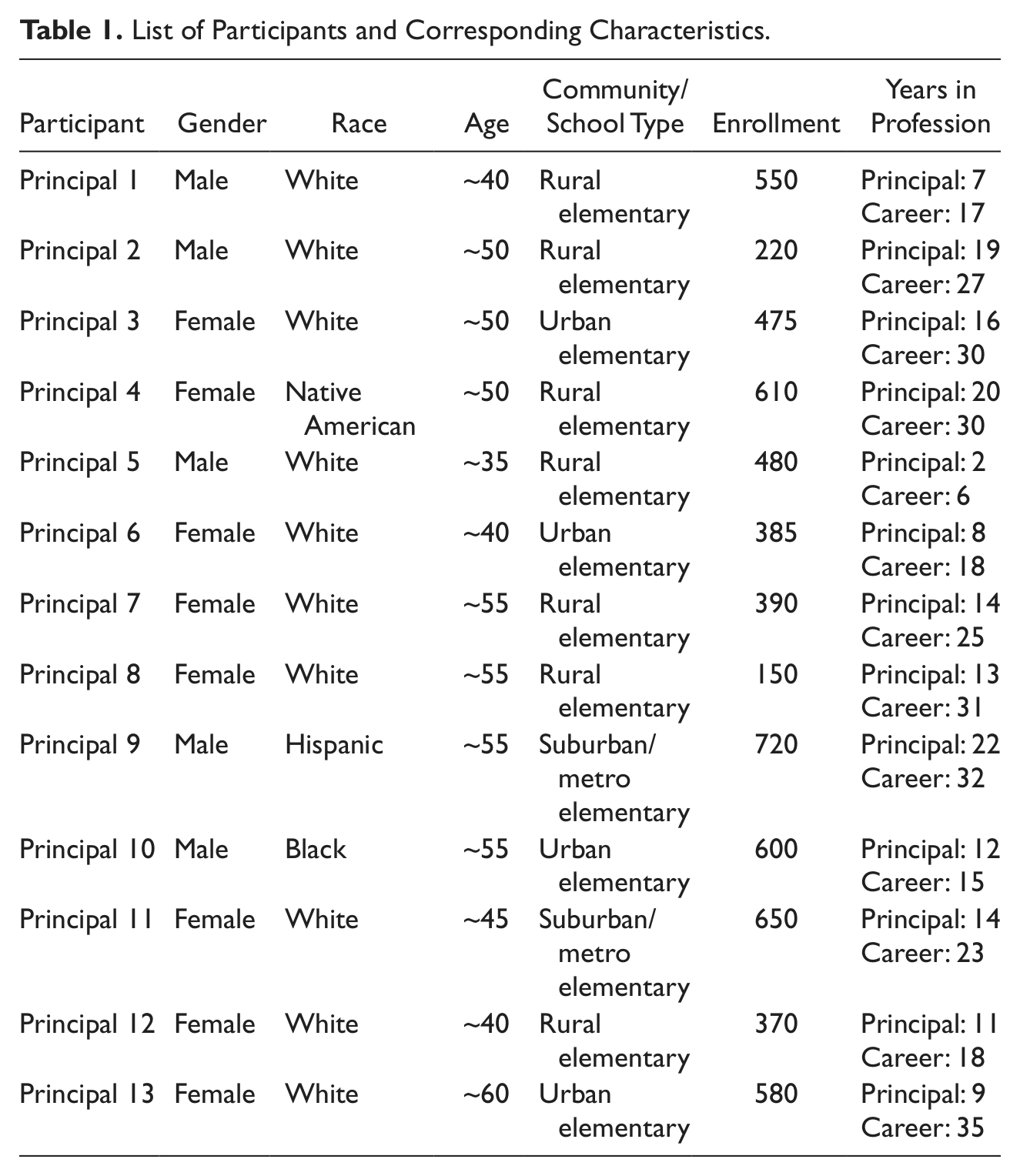
Using purposeful sampling, we interviewed thirteen elementary principals from school districts across the state of Oklahoma. We selected participants by first consulting the executive director of the state-wide elementary principal professional association to identify a representative sample (e.g., school size and location, gender, race/ethnicity, age, length of time as a building principal, student enrollment) of building-level elementary school administrators who would be accessible and willing to participate in an extended, in-depth, two-interview sequence format (see Table 1).
List of Participants and Corresponding Characteristics
Vignette and Interview Protocols
Two face-to-face, semi-structured, in-depth interviews, each ranging in length from 40 minutes to more than an hour, were conducted with each participant within the space of 1 day using both a dilemma vignette and follow-up questions (see Appendix) and a more extensive protocol designed to elicit descriptions of personal and professional experiences and the meanings ascribed to moral and ethical practice. The use of both a vignette interview and a personal refection interview made for a diverse methodological approach that allowed for constant comparative analyses (Bogdan & Biklen, 1998) in an attempt to elicit accurate data. Both open-ended and prefigured questioning techniques were used to guide the interviews. Because of the nature of this investigation, a measure of flexibility was needed to provide alternatively worded queries and elicit what appeared to be, for some participants, challenging self-reflection and sustained ruminations about personal and professional experiences and their meanings. 2
The central interview tasks involved participants’ reading a dilemma vignette (see Appendix), questioning and probing for participant responses, a second and more extensive interview segment on personal experiences, audio recording all responses, observational notes taken in and around the interview times, and reflective-analytic journaling. The use of vignettes as a research tool is evidenced in empirical studies within educational administration (Begley & Johansson, 1998; Goldring, Huff, Spillane, & Barnes, 2009) and the social sciences more broadly (Artino & Brown, 2009; Perri, Callanan, Rotenberry, & Oehlers, 2009; Wilson & While, 1998). Substantial support for the application of vignettes as a stimulus to elicit a wide range of participant perspectives is offered by Hughes (1998), Hughes and Huby (2002), McKeganey, Abel, and Hay (1996), and N. Jenkins, Bloor, Fischer, Berney, and Neale (2010). For the purposes of this study, the vignette served as a control stimulus that was presented to all participants (Lyonski & Gaidis, 1991). Participant responses served as baseline data to be compared and contrasted to the second interview.
The vignette and interview protocol questions were chosen to elicit responses that could serve to better define “best interests” among practicing school administrators. Although the vignette is rendered in such a way as to relate mounting tension and eventual conflict, we believe the story and protocol questions did not in any way foreclose participants’ thinking, meaning making, or responses. The language of the questions permitted open and unaffected responses along with the juxtaposing of dilemma with problem, the exploration of the meaning of need, and the conceptualization of balance and what that might mean for participants in addressing both individual and corporate student issues. We believe the vignette clearly proposed a tension and we believe both the protocol questions and related research questions sought to uncover what might or might not be a struggle in addressing all students’ best interests within schools.
We used multiple researcher reliability procedures by cross-checking both theoretically driven and emergent coding and the eventual thematic meanings derived from code combinations (Creswell, 2009; Miles & Huberman, 1994). Intercoder agreement was achieved by securing consensus among the research team about cross-case code definitions and alerting each other to potential drifts in the meaning of codes while engaging in a peer-debriefing process to enhance the use of “thick, rich, description” (Creswell, 2009, pp. 191-192) “to deepen understanding and explanation” in pursuit of answering the research questions (Miles & Huberman, 1994, p. 173).
A considerable amount of clarification, rephrasing, and participant response checks were part of the conversational nature of each interview. These moves were helpful to understand precisely what was being said and what was meant by participants (Guba & Lincoln, 1981). As a result, the data collection and analysis process rendered, in our estimation, a faithful and accurate account of participants’ views and perceptions based in large part on the fact that all participants had generally experienced similar structural and social conditions within middle class schooling bureaucracies. The ultimate criterion for trustworthiness was the ability to narrate rich description in the data findings—the detailed accounting of participants’ perspectives, experiences, and judgments. Any claims and interpretations originate from these data, and brief and extended quotations within this article serve to make evidentiary claims derived from participants’ words more transparent.
Limitations
Study participants work as educators within a regional U.S. political subculture that is both traditionalistic and focused on strong general social values of individualism and order (Fowler, 2009). As demonstrated in this study, context matters, and participants cannot help being influenced either by adopting these political and social orientations or by actively resisting and redefining them. Thus, characteristics specific to the state of Oklahoma may help to explain common elements participants reported regarding best interests of students with special needs that might not be found in contexts elsewhere across the United States. Although every effort was made to ensure the accuracy and credibility of results and interpretations, we acknowledge that self-report data are limited by lack of independent verification. Although threats of participant bias were considered and possibly attenuated by a two-stage interview design, selective memory, attribution, and exaggeration are possible threats (Creswell, 1998; Labaree, 2012).
One additional limitation is the lack of information provided regarding Cody’s (the student in the dilemma vignette) racial/ethnic identity. The omission of race/ethnicity from this dilemma vignette presents a limitation for this study and prevents us from further exploring the potential impact of student race/ethnicity on school leaders’ responses to potential ethical dilemmas. Given the fact of disproportionate representation (e.g., students from racially and ethnically diverse groups in special education programs and services), the exclusion of such data is a potentially important oversight.
Findings
Several analytical themes derived from coding of data include the following: (a) student best interests and need(s), (b) collective versus individual best interests, (c) the best interests principle as a professional ethics guide, and (d) equality versus equity. Findings reported here are intended to address the research questions posed in this study and to guide an emerging line of inquiry pertaining to the challenges of ethically informed, building-level administrative practice for special education.
Students’ Best Interests as Needs
Overall, participants were committed to the success of all students and sought to promote both collective and individual student accomplishment in many and varied aspects of their young lives. That success was articulated in different ways, such as the ability to deliver instruction adequately so that “all kids can get the same [needed] instruction for everybody to be successful.” As this statement demonstrates, students’ best interests tended to be defined in terms of what a student or students needed in order to be successful. According to one principal,
You have to try to organize educational things, organize social things, organize behavioral things in such a way that all children find success. And maybe it starts with small successes, but as long as we’re building and we’re moving forward. . . . It doesn’t have to be leaps and bounds.
As demonstrated above, participants were overwhelmingly committed to working for “the best interest of students” as a moral/ethical consideration in decision making. This unique moral dimension of the profession involved special responsibilities to students as expressed in a variety of ways by each participant. Some of these responsibilities “stemmed from the commitment and the integrity of teachers.” Principals indicated that they were as responsible as the classroom teacher for ensuring “that a child meets all the academic success as possible.” This kind of responsibility was manifested by principals who engaged teachers in collective problem solving and instructional decision making. At other times, principals, referring to their faculty, felt they simply needed to “push them and push them” so that teachers were “held accountable” in the classroom. Ultimately, principals were aware of their responsibility as a leader of leaders—developing their faculty to identify and address specific individual student needs.
Tensions Encountered in Balancing the Collective Versus Individual Best Interests of Students
Although participants were concerned about the needs of the student body as a whole, there was a discernable focus among participants on the individual student. Multiple statements were made similar to “when you choose to become an educator, you’ve got to put the child first.” Yet a serious internal tension existed as principals related their obligation to represent all students and their best interests in collective terms. This dual focus on meeting both the specific needs of a single student and the collective needs of the entire student body was described as a “balancing act.” One participant explained in very frank terms,
I would like to say that the group doesn’t outweigh the individual, but sometimes it feels like it does. Does it make me happy? No. Is it what I want? No. Ideally I would have enough staff that I would always be able to find the best interest for every child, but that’s not really in reality and it makes me sad. I think it is not fair to 20 children for them to learn nothing because a teacher continuously deals with one child. Does that mean I think we should throw that one child away? Absolutely not. And I think that every step that can be taken should be taken; everything that’s possibly within your realm of ability to be done for every child until there is nothing left to do. You just can’t ever quit trying.
So what does “best interests of the student” mean to principals in a collective sense? According to participants, “best interests” means student “safety,” “happiness,” “an opportunity to have an education,” “providing an environment suitable for learning,” “learning” per se, “achievement” in particular forms of knowledge deemed important by a wider society, and “being equipped to live a good life.” In many respects, “best interests,” as described by elementary principals were essentially educative interests, although other overarching interests in the form of safety and health were recognized. Oddly enough, both learning and achievement were named as important “best interests,” indicating that the nuanced distinction between the two was not readily captured in principals’ moral imagination. With high-stakes testing and the pressure to perform well on outcome measures, some principals equated “best interests” with demonstrating what students know through achievement rather than focusing on learning itself.
Several participants saw the distinction between learning and achievement similarly, and it was expressed by one participant in this way:
When I say what’s best for students, are they going to be safe first of all, is this going to be a nurturing environment? Are they going to learn? Is this going to increase learning ability in the classroom, boost higher achievement? Those are the things I think of when I say what’s in the best interests of students. Are they safe? Are they cared for emotion[ally]? And are they learning? And so those three are the main factors for me.
Although participants ventured to define what a student’s best interests might be, such a focus can, according to participants, result in an ongoing dilemma. According to another participant,
It’s a dilemma, one that’s not easily solved obviously. And when you have so many people with stakes that are involved, just trying to look at all the aspects, look at everyone’s take on it, and then trying to form, based on all the information (or the knowledge that all these people present) what is going to be the best situation for that child, as well as others in the classroom. That’s a hard call, it really is.
The Best Interests Principle as a Professional Ethical Injunction
The tension experienced by principals in determining “best interests” is highlighted by the moral grappling that special education issues can sometimes entail. The vignette presented in this study intentionally sought to elicit the challenges of determining “best interests” when multiple and discrepant interests are in conflict. One participant expressed this conflict when he commented about Jim, the special education director, and his philosophy of full inclusion for all students with disabilities and its result for Cody, an emotionally challenged student:
Jim’s probably so much more tied to [full inclusion] because he is director of special education. It’s his baby [and] it’s an ethical dilemma; can he back up and say, 99% or 97% [of students with disabilities are fully included in regular education]. He’s got to go back to that “all” statement, is this one example where we have to do something a little different? Maybe it’s not full time inclusion but it’s still inclusion. Does that really mean not all? Just because we say all and we want to include . . . does this inclusion really benefit Cody?
Another principal in this study was more frank about the issue:
You cannot let one child ruin the educational process for the others. One “problem child” can disrupt the learning process for everybody else. Sometimes there’s not a whole lot you can do about it. In this situation [referring to the vignette], there are alternatives, and you got to look to your alternatives in situations like this.
The ethical issue of including Cody in the general education classroom because of a strong philosophical belief in full inclusion goes beyond the statutory guidance of IDEA that specifies the education of students in the least restrictive environment (20 U.S.C.S. § 1412(a)(5) (A)). Additionally, IDEA and special education case law indicate that maximizing educational benefit is not the intent of special education protections (Board of Education of the Hendrick Hudson Central School District v. Rowley, 1982). Rather, the intent of the law is to provide appropriate educational services tailored to meet the individual needs and abilities of each student who is eligible for special education programs and services. One principal hinted at this when she said,
It would be in the best interests of all the children definitely to have highly qualified teachers, access to curriculum and materials and good instruction. But the way that’s delivered to the children—the way that’s delivered to Cody might not be in the best interests of the next child.
At one point in the interviews, participants were asked, “Does the best interest of one individual trump the group or does the best interest of the entire group trump an individual’s interest?” Interestingly enough, all but one elementary principal indicated a proclivity toward the interests of an entire group of students. Based specifically on the vignette, principals were inclined to make health, safety, and student welfare a top value to be achieved school-wide, while other interests, either corporate or individual, were considered secondary. In rectifying the conflicting interests between Cody’s needs and those of the other students, one principal related this sentiment held by most principals in this study:
For Cody the educational interests are different because we are talking about educating a child with extreme disabilities and it’s different. In order to learn he will need access to the other avenues that may not be in the best interests of all the children . . . find another pathway for him. I don’t think you can say every child needs to be in a regular classroom or every child needs to be in a special classroom. I think you’ve got to take that child and find what best serves that child.
According to the participants in this study, this issue is one of the reasons why the moral aspects of the profession are unique. One principal reflecting on this matter said,
I think people look at us in a different light. They are entrusting their kids with us, and we are dealing with children’s lives and impacting those kids one way or the other—positive way or negative way, especially in elementary education. We deal with young children . . . and I believe the nature of our profession—that is the training, the education, the nurturing of young people, young minds, young souls—makes it unique.
Another principal spoke about a unique professional moral action this way:
We give them the tools to go out to the world and then do something and make a difference and to be positive and that’s what we want. We have them leaving here with these tools and skills. (If they don’t have the content at least they know how to go get it.) Especially with the young ones, you have a lot a lot of power and influence on them . . . you have to be so careful . . . very, very careful . . . they [teachers] need to have a huge heart.
Equality Versus Equity
Although not expressed by all participants, in its purest form, the moral and ethical work of school leadership entails a strong commitment to grapple with the tensions between equality and equity (McLaughlin, 2010). To focus solely on ensuring equality or even-handed treatment, irrespective of student characteristics and circumstances, would be a travesty in public education even if the reasons for doing so were well intentioned. On the other hand, as Green (1983) pointed out, we as educators should strive for the pursuit of equity whereby some students are treated unequally to counterbalance differences in need, ability, and other confounding factors. As Green wrote, “Persons may be treated unequally but also justly” (p. 324). Unfortunately, the pursuit of equity is not for the faint of heart but rather requires the fortitude of a “crusader.” As one participant noted,
For me this is a mission ground. For me this is an opportunity to help people develop into people that change our world. It is, for lack of a better world, a battlefield where the good guy needs to win and the good guy needs to help the bad guy get better. And I want my children to understand in my school, they are my kids here—mentality of kids first.
Whether depicted as a battleground or a mission field, some of the participants in this study felt “called” to do the work they are doing in public education and that part of the work of leading schooling efforts is to instill a robust sense of fairness (Theoharis, 2009) that characterizes their work in an entire school community. One principal aptly encapsulated this sentiment:
I hone back to the individuals [who] have been important in my life. It reminds me of the source of their efforts. . . . They made my needs the source of their efforts. . . . Everything they did really was centered around me. I was not a pawn for them; I was not a trophy for them to feel good about themselves. They really took an interest in me and meeting my needs . . . made sure that the relationship between us was more than just student-teacher; it was more the master to someone she hoped would rise to be a master; it was the responsible servant to the apprentice, that type of thing. . . . It’s really about giving voice to children; it’s really about nurturing children and training them in a way that they too will have something to share with others that others might be given voice through their efforts . . . see themselves in the role of being servants to the community, to the parents, and ultimately to the students.
Discussion
Given the complexity of today’s educational system, it is imperative that school leaders be skilled in balancing the competing demands that emerge from the challenge to meet the best interests of individual students as well as the best interests of all students. This is especially so when deciding ethically and acting morally in cases involving students with disabilities. In reviewing our findings, we are reminded of a recent statement by Hess (2012):
I find it unfathomable that anyone thinks every school should or will be able to competently cater to every sort of student need and interest. . . . Let’s be clear: the issue is not whether we ought to serve all kids. That was resolved decades ago. We all agree that we should. The question is whether we think every school, or every classroom, ought to be expected to meet every need of every student. And that strikes me as a recipe for mediocrity. (paras. 5, 7)
He goes on to critique the notion of geographic-bounded “service delivery” where schools try to devise ways to meet every need of every single child in a given area. He claims that since schools cannot tailor their service to focus on certain student needs, schools are forced to try to build expertise in a vast number of specialties and services leading to watered-down performance and results. Clearly, the principals in this study do not find the issue and challenge of equity on a local scale “unfathomable” or their educative response mediocre.
Our previous research (Frick & Faircloth, 2007) demonstrates that secondary principals expressed satisfaction in their press for equitable responses to student learning needs, particularly for those students identified as requiring special education services. In contrast, secondary school leaders reported a significant unsettledness with special class protections that dismiss and thereby limit their ability to take (in their minds) fair and just disciplinary actions with students receiving special education services. A moral tension existed between serving the best instructional interests of students with disabilities and disciplinary policies and procedural regulations that limited their moral discretion, ethical judgment, and reasonable retributive justice pertaining to disciplinary matters.
In sum, the results of this study take a different twist on a common theme—how to strike a balance between equal and equitable treatment of students when special education service procedures and policies are in play. The Ethic of the Profession and its Model for Student Best Interests (Shapiro & Stefkovich, 2001, 2005, 2011; Stefkovich, 2006) posits the maxim “the best interests of the student” as a central ethical ideal for educational leaders and attempts to define the expression in order to provide a clearer professional ethic for educational leadership. According to this theoretical framework, “the best interests of the student” is best understood and promoted as a central guiding moral principle in decision making. This study challenges the notion of the expression being used primarily as a maxim to guide behavior, although best interests in participants’ views does hold some insight into how to decide for one student with all or most students keenly in mind.
As principals told their own stories about working with students and faculty, they provided many illustrations of what it meant to serve the best interests of students; and with their responses to direct questioning, a depiction of what is meant by the expression “serve the best interests of the student” emerged. Every participant expressed a moral viewpoint that reached far beyond formal professional obligation. Personal investment in students was described in many ways but primarily centered on being sensitive to students’ needs, expressing care in a way that demonstrates genuine concern for children’s wellbeing, and assuming responsibility for relationships that emulate parental guidance and direction. The tension between equality and equity (intentionally posed within the vignette) entertained a deeper reflection by participants on how a “best interests” ethical principle could be interrogated to construct valid decisions and consequent moral action.
Ironically, practicing elementary school principals did not define the expression “the best interests of the student” in such a way that mirrors the Ethic of the Profession’s model. In contrast, every participant indicated in some fashion a sharp distinction and clear difference between the best interests of one student and the best interests of students as a group. This distinction differs from the conceptual framework guiding this study. Participants viewed the work of deciding and acting in the best interests of the student body as being qualitatively different from working and acting in the best interest of individual students. Balancing the two priorities was difficult but essential within the confines of an institutionalized school setting. Even though administrators would like to consider the best interests of each and every student, they viewed their thinking, decisions, and actions in accordance with the best interests of all students as taking center stage in the daily operation of their schools. Although acting in the best interests of individual students was a vital part of leading a school, these principals made a clear distinction between the best interests of the individual student and those of the collective student body. They also recognized that the best interests of these two groups may vary depending on context and circumstance. This practitioner-based view does not refute Stefkovich’s (2006) Model for Student Best Interests but instead adds a much-needed dimension to the ethical issue of individualism versus collectivism in classrooms. As a result, the use of the term student instead of students is under question, as is the profound understanding and enactment of responsibility for all students, including those with special educational needs. As this study illustrates, students and their interests clearly lie central to the profession, irrespective of one or all.
Implications
There is a unique morality that defines the profession of educational leadership. As part of a professional ethos, one important moral aspect of the work is a response to the needs of children and youth and serving their best interests. This moral imperative can ideally serve as a principle of prima facie duty, but in most cases, at least in practice, the maxim “serve the best interests of the student” is employed as a principle of actual duty when taking into account a variety of other circumstantial and contextual considerations. In the end, this becomes more akin to an injunction of special consideration for a specific profession when balancing and negotiating a wide variety of value claims to meet both individual and collective student needs.
Although there is a common recognition and use of the expression “do what’s best for the student,” and there is a clear aspirational quality to this injunction, the vagaries of professional moral judgment, especially for principals, suggest that this maxim is a reference point, a check among many checks when balancing and negotiating a wide mix of values and considerations while making decisions that have moral and ethical qualities. This is particularly true when working with special education programs and services, faculty, staff, and students.
For example, blindly motivated and ill-informed attempts to include students with disabilities in the general education environment are likely conducted with the notion of equality in mind. For some school leaders, fairness to, or fair treatment of, students requiring special education services is achieved by locating (and supposedly treating as closely as possible) these students with their general education peers. Unfortunately, these students are often physically present in the general education environment yet functionally excluded from the academic and social benefits intended in IDEA’s mandate for education of students with disabilities in the least restrictive environment—a mandate based on the principle of equity. In this case, equity requires the unequal treatment of unique individuals in an attempt to treat these students in a manner that is fair and that reduces the tendency to marginalize and ostracize students whose academic, social, or other characteristics deem them outside the bounds of the larger general education student population.
Clearly, the school leaders in this study struggled with the administrative and ethical dilemmas associated with acting in the best interests of the larger student population while working to meet the requirements of providing appropriate supports and services to students with disabilities. Making such decisions and carrying them out in ways that demonstrate moral leadership practices—ensuring that the physical and attitudinal environment of the school and intervening responses are appropriate for every student—is clearly a daunting challenge and an indefatigable problem of practice.
Compounding this issue is the very real balancing act that occurs when weighing and judging the collective interests of other students potentially affected by the education and inclusion of students with disabilities within the general education environment. The overarching question appears to be whether corporate best interests outweigh individual best interests in the public school arena. The continued existence of dual systems of special and general education, fueled in large part by the way in which federal legislation is crafted (i.e. group-based best interests as outlined in NCLB and individual-based best interests as outlined in IDEA) help to foster this dichotomy, invariably resulting in its operationalization at the school level. Here is where a professional ethic speaks most profoundly—to educate and inform leadership about the very real challenge of grappling with how to work in such a way that an either-or proposition does not force one’s moral hand. In effect, doing what is in the best interests of an individual student can in fact be accomplished in such a way that it benefits all students. A case in point is that federal, state, and local policies mandate the education of students with disabilities in the least restrictive environment; however, they fail to provide adequate moral or ethical guidance on how to do this in the best interests not only of all students but of all faculty and staff by whom these students will be served. To do so requires that individuals invoke what Howe and Miramontes (1992) described as the “ethic of compromise.”
Should the “best interests” professional ideal stand? Certainly. The injunction to “serve the best interests of the student” is situated under two grand deontic principles of justice and beneficence (Frankena, 1973). Responding to principles of justice and beneficence, and cultivating virtues that signify qualities of justice (fairness, even handedness, disposition toward equal treatment) and beneficence (benevolence, kindness, goodwill, disposition toward others’ well-being) that transcend behavior strictly motivated by mere duty or obligation, provides a necessary moral balance—a balance of principle(s) with character traits.
Much of what constitutes good and right professional practice is really subsumed within a broader personal moral vision the school leader possesses as she or he performs her or his professional role. Although there is no doubt that principals feel duty bound in some sense to administrative rules and institutional policies and procedures, most operate from a moral and motivational value base that is primarily constructed outside organizational or professional influences. As one participant noted,
I hone back to the individuals [who] have been important in my life. It reminds me of the source of their efforts. . . . They made my needs the source of their efforts. . . . Everything they did really was centered around me.
All the normative ethical thinking that administrators carry to work is part of who they are, defines them for themselves and others, and has bearing on what professional practice means to them.
Cady (2005) captures the dynamic nature of our moral life and judgment this way:
Few if any of us hold consistently to any one ethical theory as we sort through the moral challenges we face. Sometimes we are preoccupied with thinking through our options to determine their likely consequences. Sometimes we are intent on acting with respect to a specific rule regardless of the outcome. Sometimes we are caught up in cross-examining ourselves about the traits of character we most want to manifest in our behavior. Sometimes we notice ourselves acting more-or-less spontaneously out of compassion for another, or out of deference to social norms. And sometimes we are caught in a combination of these concerns, and with other concerns as well. (p. 10)
This typifies the dynamic of ethical thinking expressed by most school leaders in this study. It involves a thick and rich combination of rule referencing; maximizing benefit and promoting nonmoral good; assessing one’s character, motivation, and disposition and responding with empathy and personal investment in the lives of others; being reflective; and maintaining an open posture to what context, circumstance, or situation may afford as a moral lesson or insight. This depiction is one of authenticity and being true to oneself in “mutually affirming relationship with others” as a basis for ethical decision making in professional practice (Starratt, 2003).
The Ethic of the Profession and its Model for Student Best Interests (Shapiro & Stefkovich, 2001, 2005, 2011; Stefkovich, 2006) centers a professional ethic for educational administration on a rule-like moral imperative: serve the best interests of the student by meeting their individual needs to promote their success. To educators, the ethical ideal encapsulated in the expression “the best interests of the student” means much more than a rule-based principle. This expression resonates with who they are as a moral person and the qualities and dispositions that must be possessed to aspire to a viable professional ethic, an ethic that calls for “an understanding of oneself and others” through reflection (Shapiro & Stefkovich, 2001, 2005). In the end, school leaders are charged with meeting both the individual and collective best interests of students. As Bon and Bigbee (2011) pointed out,
The goal of meeting the best interests of the child is a delicate balancing act, influenced by professional and personal codes of ethics but also possibly disrupted by demands for legal compliance, adherence to administrative directives, and concerns about employment security. (p. 348)
In essence, the pursuit of individual or collective best interests is as much about the child or children school leaders serve as it is about their ability and willingness to grapple with ethically, morally and professionally charged issues and decisions involving these students and themselves.
Footnotes
Appendix
Declaration of Conflicting Interests
The authors declared no potential conflicts of interest with respect to the research, authorship, and/or publication of this article.
Funding
Financial support for the research, authorship, and/or publication of this article was provided by the University of Oklahoma, Jeannine Rainbolt College of Education, in the form of a Faculty Summer Research Grant awarded to William C. Frick.