




Abstract
Keywords
Organizational learning (OL) is a critical component in achieving school effectiveness, and schools that function as learning organizations perform better (e.g., Mulford & Silins, 2011). Such schools develop learning processes, strategies, and structures that strengthen their capacity to react effectively to change, thereby continuing to function efficiently even in uncertain and dynamic environments (Fauske & Raybould, 2005; Giles & Hargreaves, 2006; Kruse, 2003; Louis, 2006; Silins & Mulford, 2002; Strain, 2000). Thus, schools’ ability to collectively process, understand, and apply knowledge about teaching and learning requires the development and maintenance of system structures and processes that facilitate members’ continuous collective learning (Louis, 2006; Schechter, 2008).
This study attempted to explore OL in schools through the conceptual framework of “organizational learning mechanisms” (OLMs). OLMs are institutionalized structural and procedural arrangements for collecting, analyzing, storing, disseminating, retrieving, and using information that is relevant to the performance of the organization and its members. OLMs are concrete social arenas where information can be analyzed and shared by individual members and then become the property of the entire organization through dissemination and changes in standard routines and procedures (Ellis & Shpilberg, 2003; Lipshitz, Popper, & Friedman, 2002). To keep pace with dynamic and uncertain environments, schools should develop collective learning activities and processes (i.e., OLMs) that can foster faculty’s new and diverse knowledge bases and nurture faculty’s shared belief in its capabilities.
Expanding on knowledge gained from the examination of OLMs in elementary schools (Schechter, 2008; Schechter & Qadach, 2012), the current study aimed to develop and field test an instrument designed to measure OLMs among secondary school faculty members, and to explore this questionnaire’s validity and reliability. This article begins with a description of the Israeli secondary school research context, followed by the theoretical framework that guides the study—a structural–social approach to OL from an information-processing perspective. Next, we briefly review prior empirical research on the correlates of various dimensions of OLMs in schools. We then describe our development of the OLM questionnaire, including its item development, exploratory analysis, and confirmatory analysis. To establish validity, we examined the developed questionnaire’s correlations with the well-established constructs of teachers’ collective efficacy and organizational commitment, which have emerged as significant factors in school productivity (e.g., Goddard, Hoy, & Woolfolk-Hoy, 2004; Rowan & Miller, 2007; Shapira & Rosenblatt, 2009). After describing the research methodology and results, the value and utility of this questionnaire in today’s public school realities is discussed, and future research avenues are suggested. Based on the above rationale and purpose, we raised the following questions: (a) What dimensions of OLMs characterize secondary schools, based on the information-processing perspective? (b) How do the dimensions of the developed OLM questionnaire correlate with constructs that predict school productivity—collective efficacy and organizational commitment?
Research Context
The Israeli educational system is highly centralized (Inbar, 2009), with Ministry of Education control extending to writing and distributing curricular materials, standards, testing, and hiring and firing of school staff (Gibton, Sabar, & Goldring, 2000). While all schools follow a basic national curriculum, they do have the freedom to specialize (e.g., in the arts, environmental studies, or other subjects) in accordance with Ministry guidelines (Oplatka, 2006). In recent years, a relaxation of registration-by-zone in urban schools has resulted in increased competition among schools. This more flexible policy has not affected suburban and rural schools, which operate in a less competitive environment. The flexible registration (urban context) has been coupled with attempts since the late 1980s to decentralize the school system through efforts such as school-based management and school autonomy (Nir, 2006). The Ministry of Education has a declared policy of enabling school autonomy; yet principals hesitate to act autonomously because, in reality, the Ministry does not seem to be relinquishing control (Inbar, 2009).
According to the Gini coefficient for measuring a nation’s distributive inequality, Israel is among the four countries with the broadest gap between rich and poor, alongside the United States, the United Kingdom, and Mexico (Organization for Economic Co-operation and Development, 2011). Mindful of the great diversity among school populations, recent educational policy in Israel has been directed toward achieving high levels of equality in educational outcomes across the board. Nevertheless, Israeli students’ academic achievements remain among the lowest in the industrialized countries, and students’ educational gaps (achievement distributions) remain the widest (Ben-David-Hadar & Ziderman, 2011).
Aiming to narrow the achievement gap upward through growing performance pressure (standardization), the Ministry of Education recently initiated a new reform, Oz Le-Tmura (Courage to Change), in Israel’s secondary schools. Since the beginning of the 2011-2012 academic year, the reform has been implemented in 50 secondary schools, and the remaining schools will enter the program gradually over the next 4 years. This reform is intended to raise student achievement levels, improve school climate, and provide equal opportunities for all students. The reform centers on the formation of small-group learning formats, in which teachers work with small groups of students on a daily basis. To help teachers work effectively in this format, schools are given additional resources for professional development, enhancing accountability (teachers’ assessments), and professional commitment (Glickman, Lipshtat, Raz, & Ratner, 2011). In this context, the Israeli educational system has initiated a national Information and communication technology (ICT) program in schools. Understanding and implementing new ICT processes aim to improve the flow of information among school staff members, help retain important data, and make data accessible to school staff, thus improving teaching, learning, and evaluation processes. This evolving educational context—with national Ministry policies on school autonomy, narrowing students’ achievement gap through standardization and accountability, and investing in school staff development and ICT—provides a unique opportunity to explore our research questions.
Conceptual Framework
OL can be perceived as an independent variable or a dependent one (Ellis & Shpilberg, 2003). As an independent variable, OL encompasses activities, structures, and strategies performed by the organization to promote learning. As a dependent variable, it is used to detect the outcomes of the learning process in two ways: (a) through changes in the organization members’ shared mental models regarding goals, desired actions, historical events, tacit assumptions, causal maps, and strategies and (b) through behavioral outcomes, such as changes in organizational standard operating procedures, routines, and performance. The conceptual framework in the current inquiry relates to learning as an independent variable track, studying structural–social arrangements that promote OL (see Schechter, 2008).
Popper and Lipshitz (2000) have proposed a structural–social approach to OL from an information-processing perspective. According to these researchers, OL entails the existence of OLMs, which are institutionalized structural and procedural arrangements for collecting, analyzing, storing, disseminating, retrieving, and using information that is relevant to the performance of the organization and its members. These structural–social mechanisms generally focus on five phases of the information-processing (learning) cycle (Easterby-Smith, 1997): organizational memory and information acquisition, distribution, retrieval, and interpretation. Despite the following consecutive list of phases, OLMs are perceived as cyclical, dynamic, and interactive processes.
Organizational Memory
This phase of information processing refers to the repository where information is stored for future use. The processes and means by which organizational experiences are stored and coded into organizational memory consist of both mental artifacts (e.g., stories that represent an organization’s cultural patterns and values) and structural–technological artifacts (e.g., resource room, written policies, dress, furniture, operating procedures) within an organization (Kruse, 2003; Weick, 2000). Organizational memory includes hard data such as numbers, facts, figures, and rules as well as soft information such as tacit knowledge, expertise, experiences, anecdotes, critical incidents, stories, artifacts, and details about strategic decisions (Morrison, 1993).
Organizational memory can be described as either organic or constructed (Johnston, 1998). Organic memory includes individual organization members’ memories, the embedded memory resulting from organizational culture, standard operating procedures, expected role behaviors, and environmental factors. Constructed memory consists of knowledge stored in facilities deliberately designed and maintained for purposes of organizational memory. Such facilities include electronic databases, transaction records, and historic archives. It seems likely that OL increases when more people have greater access to organizational memory. Also, as more people can potentially update an organizational memory themselves, even greater potential for OL exists (Goodman & Darr, 1998).
Fauske and Raybould (2005) used the concept of mental models to explain how organizational memory operates. Memories exist in individuals, and individuals who are part of an organization may also possess shared knowledge and experience, which may produce shared memories. Such collections of memories that guide responses and are interconnected around specific experiences are called mental models. They include knowledge, assumptions, beliefs, values, and norms that guide behaviors and actions. These mental models function by activating memories and responses that were previously developed to solve problems or address incidents.
School memory plays a critical role in OL. School memory includes educational publications, procedures, work programs, protocols, instructions, exams, worksheets, and so on. The information gathered and stored in the school memory base enables staff to browse subjects at any time, thus improving their activities. This may help schools make appropriate strategic decisions and adapt to changing realities of daily school life (Ozer, 2006).
Information Acquisition
The process of obtaining knowledge includes experiential learning (organizational experiments and organizational self-appraisal, such as action research), vicarious learning (e.g., external alliances, through which organizations attempt to learn from other organizations’ strategies and technologies), grafting-recruiting new members (who possess knowledge that is not available to the organization), and searching and observing the environment (e.g., scanning units). Knowledge acquisition is achieved by monitoring the environment, using information systems to store, manage, and retrieve information, carrying out research and development, carrying out education and training, patent watching, and using bibliometrics (Dodgson, 1993). Organizations can use exterior and interior activities to acquire knowledge, such as rearranging existing knowledge, revising previous knowledge structures, and building and revising theories. Thus, organizations acquire knowledge through competitive intelligence units (which collect information on other organizations), by searching the environment, and by hiring new personnel (grafting).
Information Distribution
This phase of the information-processing cycle refers to the sharing of information that leads to understanding, which then produces new knowledge in the form of tacit know-how, letters, memos, informal conversations, and reports. In addition to traditional forms of information distribution such as telephone, facsimile, face-to-face meetings, and memoranda, there are computer-mediated communication systems such as electronic mail, bulletin boards, computerized conferencing systems, electronic meeting systems, document delivery systems, and workflow management systems. Moreover, learning in an organization takes place by members’ sharing of stories or anecdotes of actual work practice. Greater sharing or distribution of information leads to greater OL and can also lead to the creation of new knowledge (Argote, McEvily, & Reagans, 2003). Although sharing information and ideas of internal members and external facilitators can enhance school outcomes, the constraining factors tend to cluster around norms of privacy, isolation, and individualism (Collinson & Cook, 2004).
Information Retrieval From Memory for Organizational Use
Organization members draw on the encoded information to guide their decisions and actions (Kruse, 2003). Effective use of data by school personnel has become a central tenet in school improvement processes such as increasing test scores, reducing achievement gaps, and changing school culture (Hamilton, Stecher, & Klein, 2002; Wayman, Brewer, & Stringfield, 2009). Research has indicated that schools operating within competitive and high-stakes accountability systems are more involved in data-driven decision-making processes than schools that do not operate within such systems (Marsh, Pane, & Hamilton, 2006). Research findings have linked data use to changes in school culture and teacher practices leading to better student performance (Dantow, Park, & Wohlstetter, 2007; Kerr, Marsh, Ikemoto, Darilek, & Barney, 2006). However, literature on the practice of data use demonstrates a range of ways in which information processing may fail to have the effect intended by school leaders (e.g., Diamond & Spillane, 2004). Concurrently, although scholars note the importance of teachers’ expertise in using data to inform actions, teachers’ ability to apply data has been described as inadequate (e.g., Wayman et al., 2009).
Information Interpretation
In this sociocognitive process, the distributed information is given one or more commonly understood meanings. This occurs when organizations undertake sense-making and information-interpretation activities. Individuals and groups possess belief structures that shape their interpretation of information and thus the formation of meaning (Huber, 1991). These belief structures are stored as a profile, which is automatically applied to any incoming information in order to form meaningful knowledge that can be stored. Greater learning occurs when varied interpretations are developed. Consequently, organization members decide whether or not to incorporate the incoming information into organizational routines. This exchange of views and attitudes can transfer individuals’ tacit knowledge into organizational knowledge and assist in verifying, sorting, and filtering data from both inside and outside the organization (Nonaka & Takeuchi, 1995).
According to Zollo and Winter (2002), information can also be interpreted through knowledge articulation, a process in which implicit knowledge is articulated through collective discussions, debriefing sessions, and performance evaluation processes. By sharing their individual experiences and comparing their opinions with those of their colleagues, organization members can achieve an improved level of understanding of the causal mechanisms intervening between the actions required to execute a certain task and the performance outcomes produced.
Empirical Research
Only limited empirical research has been conducted regarding OLMs in the educational realm. In one such study, extensive use of collective learning mechanisms related to curriculum and instruction has been found to promote greater teacher commitment as well as student engagement in school practices (Bryk, Camburn, & Louis, 1999; Cowan, 2006). In a study in elementary schools (Schechter, 2008), OLMs were positively related to teachers’ sense of collective efficacy and to their commitment to their school. Collective learning mechanisms have been shown to increase teachers’ inquiry into instructional materials and practices within the school, which in turn, facilitated the use of innovative pedagogical methods that were consistent with school reforms (Collinson & Cook, 2007; Leithwood & Louis, 1998; Printy, 2002; Scribner, Hager, & Warne, 2002).
Elementary teachers working in urban schools (a turbulent environment) perceived more extensive use of OLMs than staff members in the more placid environment of suburban schools (Schechter, 2007). Similar findings were reported by Klein (2000), indicating that secondary schools in a highly competitive environment used OLMs more extensively than those in a less competitive environment. Furthermore, OLMs (focusing on storing, retrieving, and using information) served as a prominent mediating variable between teachers’ perceived environmental uncertainty in urban elementary schools and teachers’ sense of collective efficacy, but not in the suburban schools (Schechter & Qadach, 2012).
In elementary schools, the extent of OLMs was significantly and positively related to teachers’ sense of collective efficacy and to their commitment to their schools, but was significantly and negatively related to teachers’ sense of environmental uncertainty (Schechter, 2008). In one study (Kurland, Peretz, & Hertz-Lazarovitz, 2010), mediating regression analysis demonstrated that the school vision was a significant predictor of faculty’s OLMs (the information-processing framework) and functioned as a partial mediator between principals’ transformational leadership style and faculty’s OLMs. Moreover, Schechter and Asher (2012) found a negative relationship between principals’ sense of environmental uncertainty and the extensiveness of OLMs in schools. This resembled findings from the business sector, where a greater intensity of OLM use correlated with managers’ lower feelings of environmental uncertainty (Ellis & Shpilberg, 2003).
A qualitative case study in a comprehensive (Grades 7-12) school (Schechter, 2005) provided the context for studying OLMs and the learning culture influencing productivity (e.g., integrity, transparency, issue orientation). This school operated identical OLMs at both the middle and secondary levels—monthly faculty meetings and monthly departmental meetings according to subject area. However, the learning culture came into play quite differently at each level, influencing the productivity of each OLM. Another study (Schechter & Feldman, 2010) explored OLMs and the learning culture influencing their productivity for three student-functioning levels (low, intermediate, high) in a special education secondary school. Here, too, the effect of learning culture on the effectiveness of OLMs was revealed.
These empirical studies suggest that OLMs not only alter operational structures, procedures, and routines but also facilitate changes in important social organizational attributes (e.g., collective efficacy, organizational commitment). Expanding on knowledge gained from the development of the OLM questionnaire for elementary schools (Schechter, 2008), it was important to develop and field test an instrument to measure OLMs and to determine its validity and reliability among secondary school faculty members. This is especially important because secondary schools place greater emphasis on subject-matter specialization and division of labor than elementary schools, hindering the schools’ capacity for creating and sustaining OLMs.
The OLM Questionnaire
Our OLM questionnaire for secondary schools was developed in phases. Development began with analyzing a measure developed for elementary schools (Schechter, 2008). Next, we developed items specifically relevant to secondary schools, selected two independent school samples, used both exploratory and confirmatory factor analyses to refine the factors and to assess factorial validity, and finally tested the developed OLM questionnaire’s correlations with other known constructs.
Analyzing the Elementary School Measure
Based on the information-processing perspective, Schechter (2008) developed a four-factor model of OLMs in elementary schools comprising (a) analyzing information (e.g., teachers work together on ways to improve the curriculum and instruction), (b) storing–retrieving–putting to use of information (e.g., teachers evaluate their students based on previous reports about learning and teaching), (c) receiving–disseminating information (e.g., evaluation reports on school programs/projects are circulated), and (d) seeking information (e.g., teachers observe other teachers’ lessons for learning purposes). Whereas elementary teachers are much more focused on the holistic development of the student, teachers at the secondary level are more focused on subject matter (Hoy & Miskel, 2008; Hoy, Tarter, & Kottkamp, 1991). Therefore, some items and factors of the OLM questionnaire for elementary schools (Schechter, 2008) may not adequately represent the characteristics of secondary schools. Thus, some of the factors’ conceptual problems and questions about factors’ construct validity called for the development of a specific measure of OLM at the secondary school level.
Item Development
To design a measure that adapted Popper and Lipshitz’s (2000) definition of OLMs to the secondary school level, items were developed in several steps. First, we attempted to develop empirical indicators specifically formulated for faculty members in secondary schools. These indicators were meant to describe the degree to which OLMs (e.g., acquiring, analyzing, disseminating, storing, retrieving, and putting to use of information) exist in various schools.
Second, evaluation of the elementary school OLM questionnaire items’ applicability to secondary schools was conducted by 25 graduate students in education while attending a university graduate seminar course on OL. These in-service teachers had a minimum of 5 years of teaching experience, and 70% taught in secondary schools. These teachers evaluated each of the 27 original items of the elementary school OLM questionnaire (Schechter, 2008). Teachers were asked to either modify that item or to generate a replacement item that more accurately tapped the item’s concept for the secondary school level.
Third, after combining all the graduate students’ items suggestions (only those items for which there was complete agreement were retained), we conducted 13 in-depth interviews. Ten interviews were conducted with veteran secondary school teachers from different educational districts (lasting 40 minutes each), and three interviews were conducted with university professors of educational administration (lasting 30 minutes each). Interviewees were asked to evaluate each of the elementary school OLM questionnaire items’ applicability to secondary schools and to generate new items. Participants were asked to evaluate and generate items pertaining to all aspects of school learning, rather than limiting respondents to a specific subject matter or profession (teaching). Put differently, as OLMs represent distributed knowledge throughout the entire organization, rather than knowledge confined to a central location of one particular knowledge system like that of the principal or teacher (Fauske & Raybould, 2005; Kruse, 2003), participants were asked to provide information regarding the gamut of secondary school characteristics. Based on the aforementioned procedure, a draft version of the secondary school OLM questionnaire was devised.
Fourth, 40 teachers from various secondary schools in central Israel evaluated the draft version of the secondary school questionnaire. Teachers were asked to check items for clarity, phrasing, and relevance to their respective content domains. Teachers’ comments as well as suggestions for modifying, adding, and deleting items were considered. Teachers also evaluated the response scale.
The aforementioned steps yielded an OLM questionnaire for secondary schools that contained 34 descriptive statements of OLM items to be rated along a 5-point Likert-type response scale. Respondents would be asked to indicate the degree to which each statement characterizes their secondary school, from does not exist (1) to exists extensively (5).
Exploratory Analysis
An exploratory factor analysis was conducted to map the construct domain and refine the measure and meaning of OLMs in secondary schools. Exploratory factor analysis is used to explore the number of factors that accounts for the covariation between variables when there is no sufficient a priori evidence to form a hypothesis about the number of factors underlying the data (Stevens, 1996).
Sample and Administration Procedure
To explore the factor structure, we administered the OLM questionnaire to teachers from a random sample of 40 secondary schools in Israel, representing urban, suburban, and rural schools from various socioeconomic and geographical locations throughout the country. In the majority of schools, a research team member administered the questionnaire, although in several cases a faculty member administered it. The data collector explained the study purpose in general terms, guaranteed anonymity, and stressed the importance of candid responses. Thus, we collected usable data from 711 teachers (an 87.5% response rate, predominantly because of incomplete responses). This mean sample size of approximately 18 randomly selected teachers per school is considered appropriate for a minimum factor loading of .40 (Hair, Anderson, Tatham, & Black, 1998). Means for teachers’ classroom teaching experience were 11.8 years at their current school and 16.6 years total.
Item Retention and Deletion
Exploratory factor analysis of the item matrix was performed to study which items clustered together and which did not. For this purpose, a principal-axis factor analysis, rotated using Kaiser’s (1958) varimax criterion, was used to examine the 34-item measure. Items that loaded high on one factor and relatively low on all the others were retained, whereas items with low loadings (a cutoff of .4 was used to interpret the rotated solution) and/or dual factor loadings were either discarded or revised. Deletion decisions were based on the interaction between the conceptual formulation and the empirical factor loadings, retaining items only when clearly related to the measured concept. Moreover, we deleted items that substantially reduced factors’ internal consistency (Cronbach’s coefficient alpha). Deleted items included “Learning sessions with superintendents are convened to set up a curriculum for the school” and “Information obtained while monitoring and evaluating school activities is implemented in planning future school activities.” Based on the aforementioned procedure, 10 items were eliminated, producing a 24-item questionnaire.
Factor Structure
The analytical process of exploring the factor structure was repeated until a preliminary questionnaire with both conceptual meaning and reasonable measurement characteristics was achieved, which explained more than 50% of the total variance and more than 5% of the variance for each factor. Initially, items were assigned to factors without setting a number of factor criteria, and this assignment was coupled with repeated procedures of specifying factor criteria. Once these empirical procedures were completed, results were compared. Despite the OLM dimensions’ strong conceptual interdependence and interrelatedness, four strong latent factors of OLMs that had content validity and discriminatory potential were identified as the better fit between the empirical results and the conceptual formulation. The 24-item OLM questionnaire consisted of four factors with eigenvalues ranging from 9.335 to 1.161, explaining 60.13% of the variance.
The repeated analytic procedures on the initial questionnaire resulted in four relatively strong factors, as seen in Table 1, with four distinct clusters of items and moderate to high reliability coefficients (Cronbach’s alpha): (a) disseminating, storing, and retrieving information (10 items, .93); (b) sharing information among parents and students (6 items, .86); (c) analyzing and interpreting information (6 items, .75); and (d) using online information (2 items, .80). The reliability coefficient for the questionnaire as a whole (24 items) was .95, indicating a high internal consistency.
Structure Matrix for Exploratory Factor Analysis (N = 711).

Note. Extraction method: principal axis factoring. For clarity, only values equal to or greater than .40 are provided. Sample size refers to teachers.
Confirmatory Analysis
Guided by the results of the exploratory analysis, a confirmatory factor analysis was used using Amos 15.0 structural equation modeling software. Amos output was generated for the following four models: (a) the one-factor model was generated because information processing is a cyclical, dynamic, and interactive concept, calling for inquiry into whether OLMs are better depicted as a unidimensional or multifaceted construct; (b) the three-factor model was generated to evaluate whether the fourth factor (Online Information) could be subsumed by the other three factors; (c) the four-factor model derived from the exploratory analysis; (d) the five-factor model was based on the five information-processing phases (organizational memory and information acquisition, distribution, retrieval, and interpretation) as described in the conceptual framework.
Study Sample and Administration Procedure
A separate new random sample was drawn from 40 secondary schools in Israel’s two largest school districts: central and Tel Aviv districts. The questionnaire was administered to teachers at urban, suburban, and rural schools having at least 15 faculty members, which represented the entire socioeconomic range. Typically, data were collected by a research staff member; however, in a few cases, the instrument was administered by a faculty member. In both cases, the study purpose was explained in general terms, anonymity was guaranteed, and the importance of candid responses was stressed.
A total of 480 teachers from these secondary schools (a mean of 12 randomly selected teachers per school) responded to the 24-item questionnaire. Usable data were collected from 435 teachers, comprising a 91% response rate (predominantly because of incomplete responses). This sample size is considered appropriate for confirmatory factor analysis model testing because the number of participants was greater than the minimum of 200, and the ratio of sample size to items was 18:1, which surpassed the minimum of 5:1 (Hair et al., 1998).
Goodness-of-Fit Indices
Fit indices provide feedback about the appropriateness of the model derived from Amos based on the covariance structure of the observed data. Confirmatory factor analysis results clearly indicated that the one-factor model was not a good fit for the data and that the four-factor model had better fit indices compared with the three-factor and five-factor models (see Table 2). Analysis of the four-factor model yielded a sound fit for the data, with all indices at or near the levels proposed for a good model (Joreskog & Sorbom, 1989). Moreover, when compared with the exploratory factor analysis, the confirmatory factor analysis procedure generated similar empirical evidence of the measure’s underlying factor structure (Cramer, 2000; Kerlinger, 1986).
Comparison of Fit Indices of Competing OLM Models (N = 435).
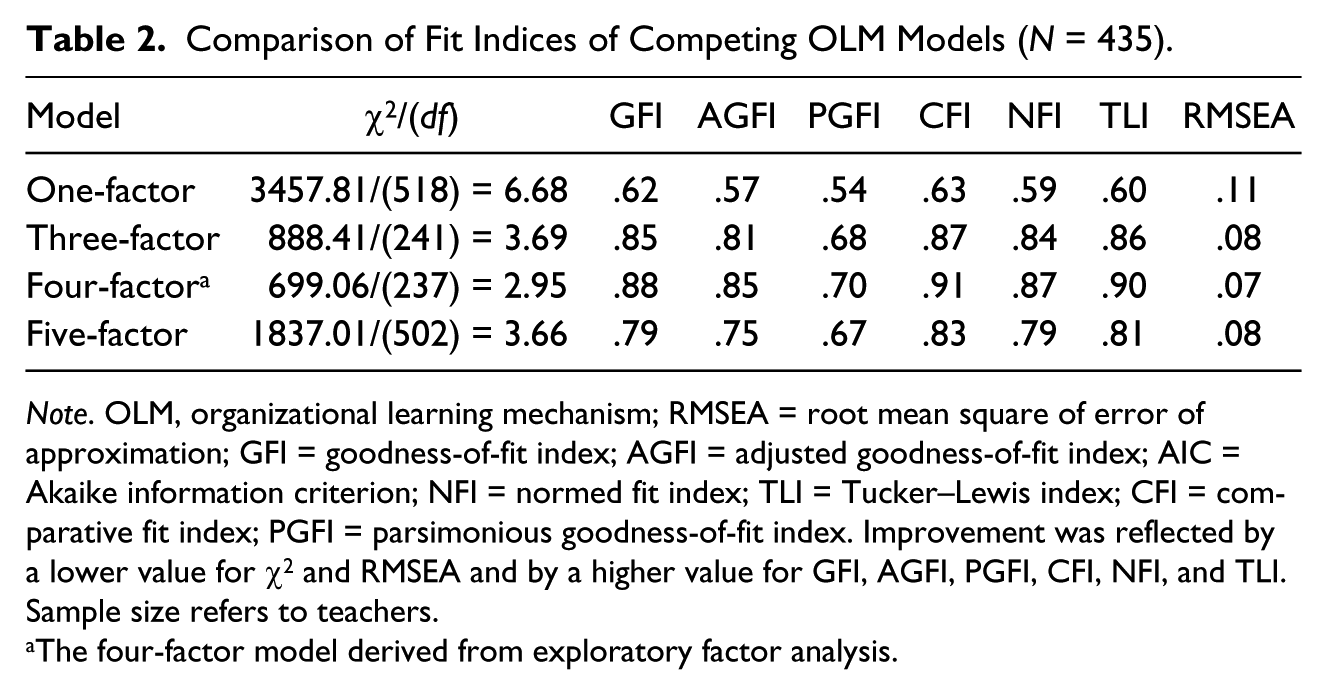
Note. OLM, organizational learning mechanism; RMSEA = root mean square of error of approximation; GFI = goodness-of-fit index; AGFI = adjusted goodness-of-fit index; AIC = Akaike information criterion; NFI = normed fit index; TLI = Tucker–Lewis index; CFI = comparative fit index; PGFI = parsimonious goodness-of-fit index. Improvement was reflected by a lower value for χ2 and RMSEA and by a higher value for GFI, AGFI, PGFI, CFI, NFI, and TLI. Sample size refers to teachers.
The four-factor model derived from exploratory factor analysis.
Factor Loadings, Internal Consistency, and Correlations
Table 3 presents operational definitions of the factors that form the OLM construct for secondary schools. The items defining the four factors are listed in descending order, according to their strength of loadings on each factor. Table 4 presents the range of factor loadings, descriptive statistics, alpha coefficients, interitem correlations, and correlation analysis for the four-factor model of OLMs. The results reveal several insights. First, the analyzing and interpreting information factor, which refers to the process via which incoming information is given meaning through collective sense making, showed the highest mean score (M = 4.15). The lowest factor mean was disseminating, storing, and retrieving information (M = 3.02), which pertained to the processes and means by which information is disseminated to faculty members and stored in school memory for future use. Second, the review of the internal consistency coefficients for the latent factors indicated moderate to excellent results (ranging from .71 to .91). The total questionnaire (24 items) demonstrated a reliability of .93. Interitem correlations ranged from .282 to .691, suggesting that the OLM items represent a broad variety of characteristics for each factor instead of overly similar items (Kivimaki et al., 1997). Third, the correlation matrix for the four-factor model indicated relatively moderate degrees of association between the latent factors. These values are appropriate for models that have proposed a priori that the latent factors (dimensions) are theoretically interrelated (Brew, Beatty, & Watt, 2004).
Four Factors Operationally Defined (N = 435).

Note. Loadings for the four-factor model are all significant (p < .05). All factor loadings not shown in the table were set to zero. Sample size refers to teachers.
Range of Factor Loadings, Descriptive Statistics, Alpha Coefficients, Interitem Correlations, and Correlation Analysis for the Four-Factor OLM Model (N = 435).

Note. OLM = organizational learning mechanism. Response scale ranged from doesn’t exist (1) to exists extensively (5). Sample size refers to teachers.
p < .01.
OLMs and Validity Variables
To test the criterion-related validity, we examined the OLM questionnaire’s correlations with two other well-established constructs: collective efficacy and organizational commitment. Because information processing is a cyclical, dynamic, and interactive concept, both the four-factor model (best fit with data) and the whole questionnaire were correlated to validity criteria.
Validity Using Collective Efficacy
Validity for the OLM questionnaire was measured using a survey of teachers’ sense of collective efficacy (Tschannen-Moran & Barr, 2004), presumed to relate positively to the extent of OLMs in secondary schools. Collective teacher efficacy is a characteristic of schools as experienced by teachers. Thus, like OLMs, collective teacher efficacy is a “property” of the school that has emerged as a significant factor in school productivity (Schechter & Tschannen-Moran, 2006; Goddard et al., 2004). Collective efficacy is defined as “the group’s shared belief in its conjoint capabilities to organize and execute the courses of action required to produce given levels of attainments” (Bandura, 1997, p. 477). Collective efficacy can also be defined as . . . a belief system that includes the mutual recognition of the various agents (e.g., home, school, and community) that each unit has a valuable and distinctive role in promoting success and together—and only together—do they have the capabilities to create environments conducive for the optimal development of the student. (Henderson, Jones, & Self, 1998, p. 4)
Collective teacher efficacy comprises the perceptions of teachers in a specific school that the faculty as a whole can execute courses of action required to positively affect student achievement (Goddard, Hoy, & Woolfolk-Hoy, 2000). In this regard, teachers’ collective efficacy was shown to powerfully influence how teachers instruct and motivate their students and manage their classrooms (Goddard & Goddard, 2001). Thus, strong collective efficacy beliefs can improve the effectiveness of teachers’ work as they modify the nature and practices of their organizations (Goddard, 2001; Goddard, Hoy, & LoGerfo, 2003; Skrla & Goddard, 2002).
Schools are interactive social systems in which teachers collect, analyze, and share information that influences the social environment of the school (Bandura, 1993). In this regard, according to Schechter and Qadach (2012), when schools incorporate and intensely use information-processing mechanisms, they develop and sustain a collective memory (causal maps, strategies) that can nurture faculty’s shared sense of efficacy. Hiatt-Michael (2001) suggested that the degree to which schools function as learning organizations may influence the willingness of faculty members to embrace new innovations for promoting student achievement. Furthermore, it may also nurture their personal well-being, their sense of efficacy in working with students, their work satisfaction, and their evaluation of the school as a high-performing organization.
Tschannen-Moran and Barr’s (2004) 12-item two-factor model survey was used to measure teachers’ perceptions of their school’s collective efficacy beliefs, rather than their personal ones about their own individual efficacy, rated on a 5-point Likert-type scale ranging from nothing (1) to a great deal (5). Factor analysis of the 12 items (using principal components extraction, varimax rotation) yielded two factors:
Collective efficacy for instructional strategies had six items such as “How much can teachers in your school do to produce meaningful student learning?” and “How much can teachers in your school do to promote deep understanding of academic concepts?” (Cronbach’s α = .91; M = 3.88, SD = 0.31).
Collective efficacy for student discipline had six items such as “How well can teachers in your school respond to defiant students?” and “How much can school personnel in your school do to control disruptive behavior?” (Cronbach’s α = .90; M = 3.91, SD = 0.32).
Validity Using Organizational Commitment
Validity for the OLM questionnaire was also measured using a survey of organizational commitment (Meyer & Allen, 1997), presumed to relate positively to the extent of OLMs in secondary schools. Organizational commitment has emerged as a leading construct in organizational research because of its relationship with important work-related concepts (Shapira & Rosenblatt, 2009). It is defined as “the relative strength of an individual’s identification with and involvement in a particular organization” (Mowday, Steers, & Porter, 1979, p. 226) and as a bond linking the individual to the organization (Mathieu & Zajac, 1990). Growing evidence suggests that extensive use of collective learning mechanisms related to curriculum and instruction promotes greater teacher commitment (Bryk & Driscoll, 1988; Bryk et al., 1999; Schechter, 2008).
Meyer and Allen’s (1997) widely used 22-item survey of organizational commitment, which was specifically adjusted to suit educational settings, has three subscales rated along a 5-point Likert-type scale ranging from strongly disagree (1) to strongly agree (5). Factor analysis of the 22 items (using principal components extraction, varimax rotation) yielded three factors:
Affective commitment refers to teachers’ emotional attachment to the organization, identification with it, and involvement in it (eight items such as “I really feel as if this school’s problems are my own” and “This school has a great deal of personal meaning for me”; Cronbach’s α = .88; M = 4.07, SD = 0.31).
Normative commitment reflects a feeling of obligation to continue employment (five items such as “I would not leave my school right now because I have a sense of obligation to the people in it” and “I would feel guilty if I left my school now”; Cronbach’s α = .83; M = 3.73, SD = 0.41).
Continuance commitment refers to teachers who remain in the organization because of their awareness of the cost associated with leaving (nine items such as “It would be very hard for me to leave my school right now” and “I feel that I have too few options to consider leaving this school”; Cronbach’s α = .44; M = 2.96, SD = 0.23).
Cohen (2003) pointed out that in organizational behavior literature, affective commitment has been more dominant in predicting other important work-related concepts than were the normative and continuance dimensions of organizational commitment. Moreover, the continuance commitment factor was excluded for the next statistical procedures, because an alpha coefficient of .70 is generally perceived as the minimum recommended for using composite scales in statistical analysis (George & Mallery, 2003; Nunnally & Bernstein, 1994). This exclusion was supported by earlier research suggesting that continuance commitment was unrelated to work behaviors (Shapira & Rosenblatt, 2009).
Analysis of Findings for the Two Validation Constructs
The 435 teachers from 40 urban, suburban, and rural secondary schools with diverse socioeconomic status, who provided the data for the confirmatory analysis, responded to both validity criteria surveys: teachers’ sense of collective efficacy and organizational commitment. On average, 11 teachers who were randomly selected from each school responded to the validity criteria surveys.
As the OLM construct reflects a specific school, the appropriate analytic focus was the school (Sirotnik, 1980), rather than the individual teacher. To confirm this theoretical assumption, we tested whether aggregation was appropriate using the rWG statistic (James, Demaree, & Wolf, 1993). Faculty members’ perceptions of their work environment must coincide if a claim can be made that a construct constitutes an organizational-level variable (Bliese, 2000). An rWG value of .70 or greater was suggested as a sufficiently “good” amount of within-group interrater agreement (James et al., 1993). In the current study, three of the four factors exceeded this level (all but the online information factor, which neared the proposed value; see Table 5). These results provided sufficient statistical justification for aggregating individual responses into a school-level score (see, Bliese, 2000).
Correlations Between Organizational Learning Mechanism (OLM) Questionnaire and Validity Variables (N = 40).

Note. The rWG statistic represents reliability within schools averaged across all schools (James, Demaree, & Wolf, 1993). Sample size refers to schools.
p < .05. **p < .01.
Thus, we aggregated individual responses for each instrument (OLMs, collective efficacy, organizational commitment) at the school level (Hoy et al., 1991; Hoy & Miskel, 2008). In other words, using between-school analysis (taking the school as the unit of analysis), the aggregation followed these steps: computing the mean of each item for each subscale for all teachers per school, computing the mean of the items for each subscale, aggregating the means to the school level, and aggregating the means at the school level. Pearson correlation coefficients were computed to determine the relations between OLMs (whole questionnaire and factors) and the validating variables (Table 5).
As predicted, the whole OLM questionnaire was significantly and moderately related to both collective efficacy subscales: instructional strategies, r = .35, p < .05, and student discipline, r = .33, p < .05. The OLM factor of Disseminating, storing, and retrieving information had significant, low positive correlations with both the instruction and discipline subscales of collective efficacy, r = .21 and .22, respectively (p < .01). A significant, relatively moderate positive correlation was found between the sharing information with students and parents factor of the OLM and the collective efficacy subscale of instructional strategies, r = .32, p < .05. The analyzing and interpreting information OLM factor showed significant and relatively moderate–high positive correlations with both the instruction and discipline subscales of collective efficacy, r = .46 and .51, respectively (p < .01). Similarly, online information had significant and moderately positive correlations with both the instruction and discipline efficacy subscales, r = .32 and .38, respectively (p < .05).
With regard to organizational commitment, the whole OLM questionnaire exhibited a significant moderate correlation with affective commitment, r = .35, p < .05, whereas no significant correlation emerged with normative commitment, r = .17, p > .05. The disseminating, storing, and retrieving information factor revealed a significant, moderately positive correlation with affective commitment, r = .38, p < .05. The analyzing and interpreting information factor was significantly and positively (relatively moderately) related to affective commitment, r = .38, p < .05. The online information factor was not significantly correlated to either affective or normative components of organizational commitment.
Discussion and Implications
Linking theoretical and empirical knowledge yielded a 24-item questionnaire with four factors, as follows:
Disseminating, storing, and retrieving information: The process for providing school personnel with information, the processes and means for storing organizational experiences and coding them into school memory, school personnel drawing on the encoded information to guide their decisions and actions.
Sharing information with parents and students: Transferring ongoing information to parents and students through meetings, newsletters, emails, and school websites, enabling all partners in the educational work to receive information
Analyzing and interpreting information: The process in which incoming information is given meaning through collective sense-making. As a result, faculty members collectively decide whether and how to incorporate the analyzed information into organizational routines.
Using online information: The process in which the teaching faculty uses online information to improve their work methods; teachers use an online supervisory site to adapt learning materials and instruction methods (articles, sample matriculation exams and the answers) or use online databases that meet their professional needs.
A comparison of the four current factors identified for OLMs in Israeli secondary schools with those identified earlier for Israeli elementary schools (Schechter, 2008) revealed two major differences. First, the secondary school questionnaire includes the sharing of information with parents and students, whereas the elementary school questionnaire does not. This difference may be attributed to the higher competitiveness experienced by urban secondary schools because of changes in registration zoning policies. One outcome of this flexible registration is school leadership’s and faculty’s increased sharing of information with students and parents as a means for disseminating the school’s mission and advantages. The second unique factor in secondary schools is the online information factor, directed toward improving work methods. Secondary-level teachers are more minded toward subject matter (Hoy & Miskel, 2008), thus placing greater emphasis on specialization and the division of labor. In the current era of accountability, this specialization requires Israeli secondary school teachers to constantly align their methods to meet district and national policies, which are often available through technologies (e.g., online database of sample national matriculation exams). This factor may also reflect the Israeli educational system’s new national ICT program in schools, aiming to improve faculty’s information flow, access, and retention, thereby improving teaching, learning, and evaluation processes.
The present findings supported external validation for the OLM questionnaire regarding both tested predictors of secondary school productivity, as shown earlier for elementary schools. First, teachers’ sense of collective efficacy was found to be significantly and positively related to the extent of OLMs that they reported in their secondary schools, as found for elementary schools (Schechter, 2008). OLMs can make faculty members more aware of their colleagues’ accomplishments, promoting personal and consequently collective beliefs in their capabilities to succeed (Hoy, Sweetland, & Smith, 2002). Moreover, the context plays a role in teachers’ sense of collective efficacy. Because schools, especially urban schools, operate in a dynamic environment, the possible relationship between environmental uncertainty/competition and teachers’ collective efficacy would be an interesting new line of research. In the context of standards-based accountability, it is important to explore the effects of OLMs on the sources of efficacy beliefs.
Second, secondary school teachers’ affective commitment to their organizations (schools) was significantly and positively related to the extent of OLMs that they reported in their schools, as found for elementary schools (Schechter, 2008). Ongoing learning forums in which faculty members analyze and interpret incoming information may enhance teachers’ emotional attachment to the organization. These findings substantiated other studies indicating that affective commitment is more dominant than normative commitment in explaining staff behavior (Cohen, 2003; Shapira & Rosenblatt, 2009). In practice, teachers who perceive more extensive OLM processes operating in their schools may have stronger feelings of appreciation, which may enhance more emotional attachment than sense of obligation. This may encourage teachers to devote more time and involvement in formal and informal activities to achieve the school’s goals.
Importantly, in line with the need to collectively think and share information in the context of accountability and school reform, data-driven decision making has become a central tenet in school improvement processes (Halverson, Grigg, Prichett, & Thomas, 2005; Knapp, Swinnerton, Copland, & Monpas-Huber, 2006; Skrla, Scheurich, Garcia, & Nolly, 2004). The data-driven decision-making movement, especially in the United States, focuses primarily on assessing student achievement as a dimension of school improvement (e.g., Boudett, City, & Murnane, 2005). The educational realm has adopted this concept from industry, focusing on the use of multiple forms of data to drive continuous outcome improvement at all levels of the organization (Danielian, 2009). As found in the literature on schools’ information processing (Schechter & Qadach, 2012), research has also indicated that schools operating within competitive and high-stakes accountability systems are more involved in data-driven decision making than schools that do not operate within such educational systems (Marsh et al., 2006).
Implications
The development of the current OLM questionnaire offers schools an instrument for assessing their own learning cycle. Principals and teachers alike may become more knowledgeable about which learning dimensions (e.g., analyzing and interpreting information; disseminating, storing, and retrieving information) require improvement in their particular school. For example, using information-gathering OLMs without sufficient information analysis OLMs can create information overload, consequently increasing faculty’s sense of uncertainty and lowering their sense of collective efficacy. In this regard, information overload—collecting information without sufficient mechanisms for analyzing and storing it in organizational memory—increases the risk of being unable to comprehend the information or use it effectively in decision-making processes (Zahra & George, 2002). Thus, OLM assessment could provide schools with the means to monitor their implementation of widely adopted processes, such as data-driven decision making or other OL strategies, and then adjust such processes/mechanisms to achieve a more productive balance of components. For instance, collecting information could be balanced with arrangements for analyzing information, such that the information could provide guidance for productive action in schools. Beyond serving as an assessment tool, detecting the extensiveness of each OLM dimension in relation to the others can serve as a trigger for establishing and maintaining a dynamic professional learning community, which may enhance the school’s stability and endurance to change in times of information turbulence.
The risks and problems inherent in the OLM framework must also be addressed. Time is perhaps the most salient prerequisite for productive collegial interactions (Collinson & Cook, 2007), but these interactions generally become updating mechanisms. Administrators tend to colonize blocks of time allocated for collective learning, and may use OLMs to advance their administrative agenda instead of focusing on instructional practices (Giles & Hargreaves, 2006). Moreover, concerns have been raised that OLMs may be used against colleagues, prompting mistrust of data use, especially in the context of high-stakes accountability (Heritage & Yeagley, 2005). It is also likely that without appropriate dialogue between schools and districts, states, and federal governments, OLMs could be strictly used by policy makers as a monitoring device rather than as a setting for learning.
Research Possibilities and Limitations
The OLM questionnaire developed in the current study reflects the existence of and capacity for systemic learning through institutionalized structures and procedures that evolve around OLMs. However, the OLM questionnaire requires further analyses in diverse populations and samples to replicate and further refine its factor structure. Important differences may be associated with school context, such as how strongly teachers might perceive certain OLM processes. Thus, it would be an important step in extending the validity of the factorial model to administer it in different school settings, cultures, and countries.
Inasmuch as our research focused on OLMs in secondary schools, school size should be explored as an important ecological feature of the social structure, influencing the nature of social interactions. Lee and Loeb (2000) found that small schools have an advantage over medium-sized or larger schools, because their teachers hold more positive attitudes toward their responsibility for students’ learning. Hence, exploring the interrelationships among school size, social learning interactions, and faculty attitudes (e.g., collective efficacy) is a valuable path to pursue. Furthermore, according to Miller and Rowan (2006), high school teachers have different perceptions of collaborative management, largely as a result of their locations within the school’s academic divisions, which affect their extent of participation in collaborative management forums. Hence, researchers should dissect the OLM framework according to schools’ academic divisions and explore divisions’ learning interactions.
The current investigation of learning at the secondary school level attempted to break out of analysis at the level of the isolated teacher, thereby capturing dynamic learning processes among and within faculty. Yet the small number of teachers who supplied data (about 11 per school) questions the aggregation of the research variables to reliably represent secondary school characteristics. Thus, aggregating the data to the school level should be perceived as a proxy of much more complicated sets of relationships within schools. Although we tested variation in participants’ perceptions as a means of deciding whether it was reasonable to aggregate the data to the school level (rWG statistic), a well-grounded model of OL is needed to solve the dilemma of whether and how individual perceptions of school learning can be integrated into the organizational level of learning. Finally, teachers’ reports on the existence of OLMs in their schools may have been influenced by social desirability (Beretvas, Meyers, & Leite, 2002). Further research should complement these perceptions with more objective measures such as direct observations to evaluate schools’ actual implementation of OLMs.
Footnotes
Declaration of Conflicting Interests
The authors declared no potential conflicts of interest with respect to the research, authorship, and/or publication of this article.
Funding
The authors received no financial support for the research, authorship, and/or publication of this article.