




Abstract
Keywords
The vision and mission statements of schools provide valuable data about the purpose that schools set for themselves (Allen, Kern, Vella-Brodrick, & Waters, 2017). Although schools vary in the extent to which they follow their statement, these statements serve as an unspoken contract between the school and its various stakeholders to reinforce their mutually agreed upon bigger purpose. There has been a call for schools from UNESCO, UNICEF, OECD, and leading academics to become not only academic institutions but also institutes that promote well-being (Waters, Sun, Rusk, Cotton, & Arch, 2017). The present descriptive research study seeks to analyze the current trends in the stated purpose and priorities for secondary schools in Victoria, Australia, as expressed by their school vision and mission statements, to provide an indication of the degree to which Australian schools are seeing their purpose as both an academic institution and a well-being enhancing institution.
The Purpose of Schools
What is the purpose of education? While the answer to this question depends on one’s cultural, political, and sociological orientation, over the past two decades, the rise of high-stakes testing has primarily directed that focus on academic performance, generally operationalized as numeracy and literacy skills. While academic performance is certainly core business to schools, in recent years, schools have begun to acknowledge the importance of well-being for students and this has been promoted by influential international bodies concerned with education (e.g., World Health Organization, UNICEF, UNESCO, Education International; Waters et al., 2017). Consequently, a growing number of Australian schools are adopting a dual purpose of helping students develop academic competencies, as well as learn skills that generate well-being (Waters et al., 2017). These schools acknowledge that academic skills are an important aspect of a student’s education but argue that well-being is just as important. Furthermore, the two purposes are not mutually exclusive but rather mutually reinforcing, and undoubtedly multifaceted (White & Kern, 2017). From this perspective, schools should no longer simply be designed to build intellectual knowledge in young minds but should also guide the holistic development of a child. It is incumbent on schools to build in this approach to education, which focuses on learning, and well-being (social intelligence/social emotional skills) (Allen, Vella-Brodrick, & Waters, 2016; Allen & McKenzie, 2015).
School Vision and Mission Statements
Most schools have a vision and/or mission (V/M) statement (Council of International Schools, 2006). Indeed, accreditation usually requires having a documented set of core values and shared direction. School V/M statements “arise from a set of values that answer fundamental questions about the purpose of education and how educational programs should be carried out” (Boerema, 2006, p. 182). Such statements play a pivotal role in identifying areas for planning, informing budgeting decisions, and directing action. They typically define the physical, social, and political contexts that govern an institution and articulate a shared purpose (Abelman, 2014). Shared visions aid effective organizational planning (Bryson, 2004; Gurley, Peters, Collins, & Fifolt, 2015; Teddlie & Reynolds, 2000) and provide insights into the daily operations of the school (Fritz, 1996). They provide a framework for action, promote collaboration, and incorporate goals for the future (Jones & Crochet, 2007; Manley & Hawkins, 2009).
Visions and mission statements are distinguished by their focus and purpose. Vision statements focus on the destination—where the school aims to go—whereas mission statements focus on the journey—how the school moves forward to reach that vision. Vision statements are the impetus for mission statements and they therefore guide policy, practice, decisions, and operations (Rozycki, 2004). Despite differences in the way V/M statements are described, both reflect a school’s priorities, serving as gauges for major areas of foci in schools and in education more generally (Stemler, Bebell, & Sonnabend, 2011). The existence of such statements has been identified as an important factor for creating effective schools that positively contribute to learning outcomes (Allen, Kern, Vella-Brodrick, & Waters, 2017; Perkins, 1992; Rutter & Maughan, 2002; Teddlie & Reynolds, 2000). The power of V/M statements for educational administrations is that through an articulated purpose, the primary goals and objectives of the school can be enacted (Manley & Hawkins, 2009). School V/M statements are also valuable to educational researchers to observe and analyze educational trends in terms of the purpose that schools see themselves as holding.
Despite their demonstrated usefulness in practice and research (Chapple, 2015; Stemler et al., 2011), V/M statements remain subject to criticism. Some statements have been described as “rhetorical pyrotechnics” that are pleasing to read but have little structural or operational consequence (Morphew & Hartley, 2006, p. 456). For example, while V/M statements may be displayed on a website, it is not necessarily clear whether the sentiments expressed are adopted by the school in day-to-day practice, or if staff members are even aware of what their statement is. Still, although this may be the case at some schools, a study of principals, using structured interviews, concluded that they largely felt that their own school mission statements did indeed reflect the actual practices and aims of their school (Stemler et al., 2011).
Another criticism of school V/M statements is that they are unrealistic and vague (Morphew & Hartley, 2006; Rozycki, 2004). Manley and Hawkins (2009) suggested that to be useful, the statements need to be well-written, transparent, and void of obligatory or fad statements that may obscure their achievability. Yet ambiguity and vagueness are not necessarily a problem. Gioia, Nag, and Corley (2012) have suggested that vagueness of a V/M statement can be helpful in achieving organizational goals, noting that it “enables a sense of alignment between local and larger organisational goals that eases the political path to successful change” (p. 3). Furthermore, regardless of whether it is operationalized, a V/M statement can still demonstrate what the school may aspire to or prioritize.
School Priorities: Academics and Beyond
Schools have a limited number of resources, and school leaders must determine the best use of those resources. The priorities of a school often structure the allocation of resources. Priorities are directed in part by national and state policies, relevant to their location, and in part by the values and focus of the school or local community. Policies, schools, parents, and communities all value “high-quality education,” but the definition of “high quality” is variable. For some, high quality refers to high levels of achievement on national test scores, for others high quality refers to students who are happy and healthy, and still others focus on aspects such as good morals, strong character, and social contribution. The definition of high quality also shifts over time, influenced by the current political context, economic patterns, social norms, and a variety of other factors. Systematically examining school priorities allows stakeholders to better target professional development and interventions aimed at current issues and concerns.
Over the past two decades, government priorities and legislation have placed a major emphasis on academic achievement (Thompson, 2013). For example, in the United States, the No Child Left Behind Act and the Race to the Top initiatives focused on the improvement of learning outcomes and higher achievement rates (U.S. Department of Education, 2009; Uwah, McMahon, & Furlow, 2008). Reviews of the V/M statements of American schools have revealed an emphasis on academic priorities during this period. Specifically, a content analysis across 752 articles related to secondary school education demonstrated that terms such as education, learning, and academic achievement were common (Wilkerson, 2010). Similarly, an analysis across 267 U.S. schools identified cognitive/academic development as the major focus in secondary schools (Stemler & Bebell, 1999). Several studies have found that high academic performance is a central criterion for identifying successful and effective schools (Day, 2012; Döş, 2014).
Over the past decade, Australian policies have similarly emphasized academic achievement. The Common Core Standard Initiative aims to present a coherent curriculum for students for language and mathematics (Porter, McMaken, Hwang, & Yang, 2011). The Australian Education Bill (2013) sets national targets to improve the quality of education, including aiming for Australian students to rank in the top five worldwide for scores in reading, science, and mathematics by 2025 (Commonwealth of Australia, 2013). Other policies around the world similarly focus on improving learning outcomes for all students and reducing achievement gaps (Wilkerson, 2010).
Despite the strong emphasis on academic achievement, local, state, and national policies also include various psychosocial targets. For instance, the Australian curriculum includes personal and social capability as one of the seven general learning areas (Australian Curriculum, Assessment and Reporting Authority, 2013). The National Plan for School Improvement includes bullying, victimization, civics, and citizenship education (Commonwealth of Australia, 2013). Across 421 mission statements in the United States, civic development of students, emotional development, and cognitive development were the most commonly cited objectives for schools (Stemler et al., 2011).
The Current Study
Studies on V/M statements have identified a variety of meaningful themes, including academic and cognitive development, safe environments, civic development, and emotional development (Stemler & Bebell, 1999; Stemler et al., 2011; Wilkerson, 2010). Such summaries indicate what schools value, provide the current state of affairs, and illustrate how “high-quality education” is currently operationalized. Several such syntheses occurred several years ago in the United States, but to our knowledge, none have occurred in Australia. A greater knowledge of Australian school V/M statements not only addresses a gap in the literature but also provides a window into the current trends about the purposes that schools set for themselves. Such a summary highlights to stakeholders (such as parents, students, and the broader community) what schools generally value and aspire to achieve, and the extent to which these aspirations reflect current practical insights and scholarly advancements so that any gaps or concerns can be addressed.
The current study aimed to examine the current trends in Australian schools with respect to school goals (i.e., vision—where the school aims to go) and mission (how the school pans to get to its destination/achieve its goals) and determine the extent to which Australian schools represent themselves as academic and well-being enhancing institutions. We focus specifically on secondary schools in Victoria, one of seven Australian states, and use content analysis to investigate the most common themes. Reflecting the Australian national curriculum and in line with prior reviews, we expected that dominant themes would be related to academic achievement, cognitive development, citizenship, and student well-being. In addition, we examined whether common themes vary based on school type, location, and gender composition. Although prior studies have considered various demographic characteristics (Stemler & Bebell, 2010; Stemler et al., 2011), we did not make specific a priori predictions about the pattern of findings, and as such this was an exploratory analysis.
Method
Sample
The current study included a stratified sample of secondary schools in Victoria, Australia—the second largest state in Australia, located in the southeastern region of the country. While it has a population of more than six million people, most live near Melbourne, with a variety of suburban and rural areas throughout the state. There are a range of socioeconomic levels, and a mix of ethnicities and cultural backgrounds. Education runs from early education through to Year 12, with secondary school typically encompassing Year 7 to Year 12. There are three types of schools: government (public), Catholic, and independent. The Victorian Government 2012 Data Directory included the names, contact details, and demographic information of 2,274 schools (State Government of Victoria, 2013). Primary schools and special development schools (i.e., specifically catering for children with moderate to severe intellectual disabilities) were removed due to our focus on the secondary level only, leaving 579 secondary schools in Victoria. In light of time and resource limitations involved in qualitatively coding and analyzing the data, a stratified sample of 308 was selected for the current analysis. 1 To enable exploration of demographic moderators, stratification was based on school type (Catholic, government, or independent, as defined by the educational governing entities in Australia), gender composition (all female, all male, or coeducational), and location (rural or urban). Table 1 summarizes the demographic composition of the identified 579 Victorian schools and the final set of schools included in the current analyses.
Frequency and Percentage of Secondary Schools in Victoria, and Stratified Sample Included in the Current Study, According to School Type, Location, and Gender Composition.

Data Acquisition
The publicly available V/M statements and demographic characteristics were obtained from each individual school’s website. Eighty-one schools did not display a V/M statement, but published a similar statement (e.g., School Purpose) that outlined their mission, goals, or objectives; these were collected and classified as “Other.” Twenty-nine schools did not have a V/M statement or other document available. These schools were contacted via email and then by phone, and information was obtained for all but three schools, 2 which were removed from the analysis. Of the remaining 305 schools, 88 had a vision statement (28.6%), 76 had a mission statement (24.7%), 79 had both a vision and mission statement (25.6%), and 61 had “other” statements (19.8%).
Coding Procedure
Content analysis through emergent coding by quantitative means (Haney, Russell, Gulek, & Fierros, 1998) was used as a guiding methodology. In this approach, data are first examined, creating an initial set of categories. The researcher then seeks to examine, expand, and refine these themes by an iterative data mining process. The frequency that each category occurs is then counted, converting the qualitative information into quantitative data, which can be summarized and compared across groups and other available variables.
The specific procedure was adapted from the process described by Stemler and Bebell (1999). First, two coders (registered educational and developmental psychologists with Masters-level training in statistical analysis) independently extracted the major themes that appeared to be present in the statements. Each coder read through each statement, noting specific categories that were mentioned. The two coders then met and compared the categories noted, conceptually grouping similar categories into a smaller set of major themes. They agreed upon 10 major categories that best represented the specific categories identified: academic achievement, personal characteristics, school belonging, teacher support, other support, mental health promotion, environment, Christianity, future, and individual needs. 3
The coders also identified specific subthemes that together formed the broader category. These were compiled into a coding rubric that explicitly noted the 10 major themes and corresponding subthemes. Each subtheme represents a measurable construct, representing the broader, more abstract major theme. For example, subthemes of academic achievement included “academic success and performance,” “acquiring knowledge,” and “reaching potential.” Subthemes of school belonging included “school connectedness,” “working together,” and “community.” For instance, the statement X Secondary College is a vibrant learning community where all students are supported and encouraged to achieve success and to pursue excellence.
was coded as including academic, school belonging, and teacher support themes. This was further broken down and labeled according to specific subthemes: X Secondary College is a vibrant learning (A3) community (C5) where all students are supported (D7) and encouraged (D3) to achieve success and to pursue excellence (A2).
where A2 = academic success/performance; A3 = acquiring knowledge/learning; C5 = community; D3 = encouragement; and D7 = academic support.
Next, the two coders independently used the rubric to code 30% of the total V/M statements, marking 1 if a subtheme was used and 0 if the subtheme was not used, regardless of how many times that subtheme was used. Thus, a major theme could occur multiple times within a statement, but each subtheme was only noted as being present or absent. They compared their ratings, finding that interrater reliability was fair (Cohen’s Kappa = .66), according to Dixon, Brown, Engelman, and Jenrick (1990), but values above .75 are preferable. Thus, the coders further discussed the subthemes, reducing the number of codes, more explicitly noting statements that represented the subthemes, and better align their codes. They recoded the same statements, reaching good agreement (κ =.81). The remaining mission statements were then coded by one coder using the final coding rubric (see Supplement S1 for full coding rubric, with examples of how statements were coded; all supplemental materials are available in the online version of the article).
Eight schools (2.6%) had statements that did not fit with the rubric. The two coders qualitatively evaluated the statements, providing labels to the themes mentioned, as well as a definition of that label and the corresponding statement. For example, the statement “We inspire to be great. We inspire the good to be better. We inspire the better to be the best” was labelled “school improvement,” defined as systematic, sustained change to accomplish educational goals more effectively (Bush, 1998). Other identified themes were maintenance, being a world school, reflective organization, application, strength, and leadership (see Supplement S2 for definitions and representative quotes).
Analytic Procedure
Ratings were collated using IBM SPSS Statistics for Mac OS, Version 20.0 (IBM Corp, 2011). Frequencies of each major theme were computed. As some major themes had more subthemes than others, frequencies were dichotomized (0 = theme not mentioned, 1 = theme mentioned). Cochran’s Q test was used to evaluate whether some themes were cited more frequently than others. Cochran’s Q is used in within-subjects designs with a dichotomous outcome and three or more conditions, and it tests whether the probability of a target response is equal across conditions (Griffith, 2007). Cochran’s Q is an omnibus test; thus, pairwise comparisons were then used to determine where differences occurred.
To provide an alternative approach to understanding the main themes and school priorities, word clouds visualizing the 50 most frequent words in the statements were created using a Google Chrome extension application (http://wordcloud.booogle.net/).
Finally, to explore possible moderators, Fisher’s exact tests examined whether the frequency of schools endorsing each major theme differed according to school type, location, or gender composition. The tests were conducted on each theme separately. Due to the multiple comparisons, analyses were corrected using the Holm–Bonferroni correction, which is a sequential alpha correction that is more powerful than the standard Bonferroni correction, but maintains the Type I error rate at the nominal alpha level (Abdi, Edelman, Valentin, & Dowling, 2009). 4
Results
Description of Overall Themes and Subthemes
On average, schools included 4.26 of the 10 major themes (SD = 2.21, range = 0-7, median = 4.00). Table 2 summarizes the frequency that each theme was used. Cochran’s Q test indicated that the frequency of the themes differed, Q(10, N = 308) = 816.593, p < .001. Academic achievement was endorsed most frequently (88%), and was used significantly more than any other theme (p < .001 for all comparisons), followed by mental health promotion (66.2%) and school belonging (57.5%). Other support was the least frequently reported theme (21.1%).
Frequency of Themes, for the Full Sample and Split by School Type, Location, and Gender Composition.

Note. Freq indicates the raw count of schools, % indicates the percentage out of the total n in that category. As schools endorsed multiple themes, percentage totals do not sum to 100.
Each of the 10 major themes comprised between one and nine subthemes. The frequency that each subtheme occurred and examples of representative statements are summarized in Supplement S3. Reflecting the greater use of the academic achievement, mental health promotion, and school belonging themes overall, these categories also had more subthemes than less frequently used themes (e.g., nine subthemes for academic achievement versus only one theme for future focus, Christianity, and individual needs). The most common subthemes included social and emotional learning (56.8%; e.g., “To provide valuable educational opportunities to all students (which) includes the students’ academic, social, physical and emotional development as all being equally important”); academic success and performance (50.8%; e.g., “We maximize our potential to achieve high student outcomes in both academic and sporting arenas”); acquiring knowledge (48.7%; e.g., “Equip all students with the knowledge, skills and attributes to participate successfully in Australian Society”); and community (44.8%; e.g., “We are committed to the development of young people who live successful and constructive lives, with positive personal values and a strong sense of community”).
To further identify the key priorities mentioned in V/M statements, we created word clouds that visualize the most frequent words mentioned in the statements. Larger words were mentioned more frequently than smaller words (colors intend to make distinct words easier to read). This provides a visual snapshot of the explicit values expressed by Victorian secondary schools. As illustrated in Figure 1, although some words reflect an academic focus (e.g., “academic,” “strive,” “knowledge,” “excellence”), numerous words focus on relationships, support, and a positive learning environment (e.g., “respect,” “community,” “safe,” “positive”). Words also emphasize the community as a whole, including “students,” “staff,” and “parents.”
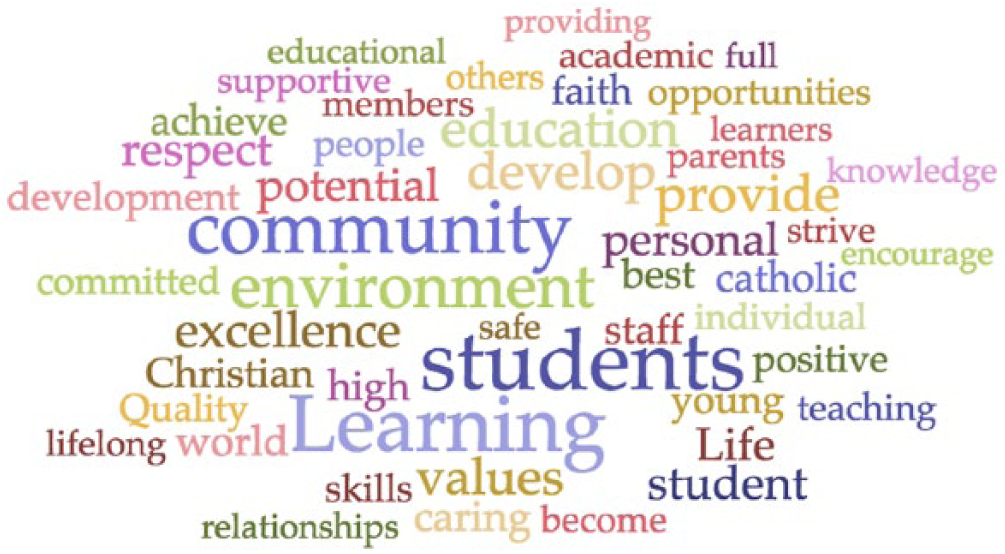
Word cloud visualizing the 50 most frequent words included in the vision and mission statements. Larger words were more frequently used.
Exploring School Type, Location, and Gender Composition as Moderators
Beyond the overall pattern of themes and subthemes, we examined whether dominant themes vary according to school type, location, and gender composition. Frequencies split by these moderators are summarized in Table 2. For school type, personal characteristics were cited significantly more frequently in Catholic schools (46.7%) than in government (29.0%) or independent (22.8%) schools. Belonging was more frequent in Catholic (73.3%) than in government (54.4%) or independent (51.9%) schools. There were also significant differences between schools in terms of other support, mental health promotion, Christianity, and individual needs. Independent schools were more likely to mention other support, but less likely to mention mental health promotion. Christianity was included in most (88.3%) Catholic school statements but in none of the government school statements.
For school location, metropolitan and rural schools differed in terms of including a future focus, with the theme mentioned more by metropolitan than rural schools. No other differences in the distribution of the themes were evident between metropolitan and rural school locations. For gender composition, the parent support theme was not evident in any of the girls-only schools, yet the overall other support theme was more frequent for girls-only schools than for coeducational or boys-only schools. Christianity was more common in single sex schools than coeducational schools. No other themes significantly varied across gender composition.
As a whole, the moderator results suggest considerable consistency in the themes used by schools of different types and locations. However, there was more variance in how the themes are expressed. Figure 2 visualizes the frequency of common words, separately by each moderating characteristic. Larger words are cited more frequently in V/M statements than small words. Learning was commonly included in statement for government schools, and was less frequent for independent and especially Catholic schools. Christian value-based words dominated more in Catholic schools and, to a lesser degree, independent schools. The words learning, students, and community were more common in rural schools than metropolitan schools, and community was more prevalent in all boys’ schools compared with girls’ and coeducational schools. Not surprisingly, women was one of the most frequently used words for girls’ schools, whereas students was frequent in coeducational schools.
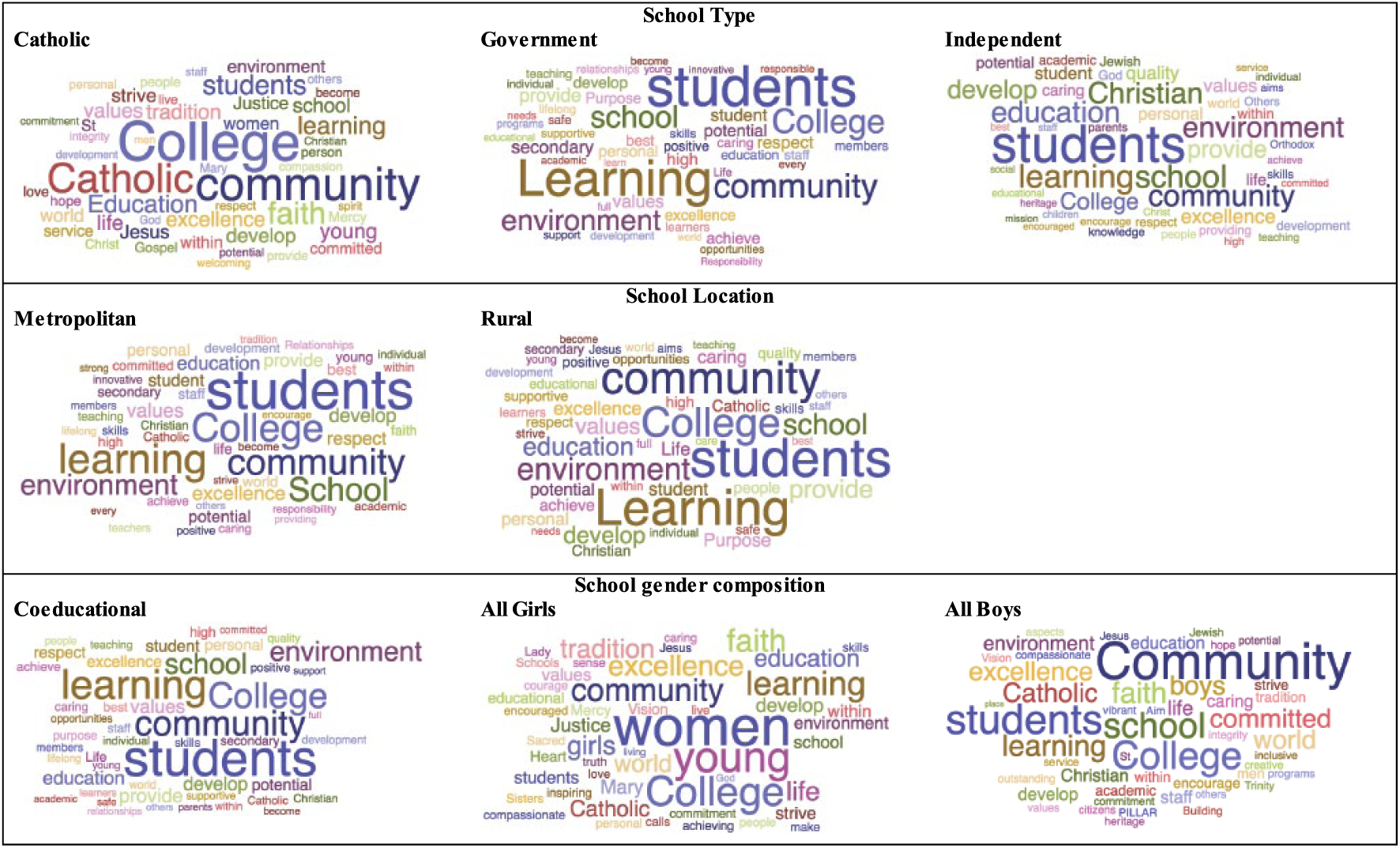
Word cloud visualizing the 50 most frequent words included in the vision and mission statements, split according to school type, location, and gender composition. Larger words were more frequently used.
Discussion
By synthesizing over 300 V/M statements, this study investigated the explicit priorities of Australian secondary schools. The findings of the study revealed that schools do indeed prioritize academic achievement and also mental health promotion and school belonging appear to be a strong theme for most schools sampled. It seems that Australian schools are adopting a dual purpose and becoming both academic institutions and well-being enhancing institutions, which has been strongly advocated by UNESCO, UNICEF, and OECD and leading academics in the field (Waters et al., 2017).
The Most Common Themes
Other research has found that V/M statements can be compared both empirically and quantitatively (e.g., Boerema, 2006; Brown, Choi, & Herman, 2011; Davis, Ruhe, Lee, & Rajadhyaksha, 2007; Stemler et al., 2011). The current study provides further support for using V/M statements as an approach for understanding school priorities. Using the approach of content analysis, 10 major themes emerged: academic achievement, mental health promotion, school belonging, personal characteristics, teacher support, other support, environment, Christianity, future, and individual needs. Consistent with analyses of V/M statements previously conducted in the United States investigating secondary school samples (Stemler & Bebell, 1999), academic achievement was cited significantly more frequently than any other theme. However, a strong focus on mental health promotion and school belonging was also evident in the results, with over 50% of schools espousing these values. Furthermore, although academic-orientated themes were most frequent, they commonly co-occurred with mental health and school belonging, suggesting that schools see academics and psychosocial aspects as mutually supportive. A growing number of studies support positive associations between academic achievement, school belonging, and mental health (e.g., Appleton, Christenson, & Furlong, 2008; Caraway, Tucker, Reinke, & Hall, 2003; Samdal, Nutbeam, Wold, & Kannas, 1998; Sirin & Rogers-Sirin, 2004; Wentzel, 1998; Wilkinson-Lee, Zhang, Nuno, & Wilhelm, 2011). It is likely that schools see the interconnectedness between the themes outlined in their V/M statements (e.g., academic achievement is related to the development of personal characteristics and school belonging and vice versa).
Within the theme of academic achievement, academic success and performance were common subthemes. It is possible that academic performance may be perceived as the most predominant measure of what quantifies a successful school (Wilkerson, 2010). An example can be found in the Australian Government’s My School Website (Australian Curriculum, Assessment and Reporting Authority, 2017), which publishes National Assessment Program—Literacy and Numeracy (NAPLAN) results, a standardized measure of academic achievement, for all primary and secondary schools in the country. Academic achievement results are the only statistical data provided, aside from the geographical location and the funding information of schools, with no mention of other features such as culture, belonging, positive peer groups, or competent teachers. This also illustrates that schools are indeed mirroring current policies and priorities. Future research should examine the extent to which academic-related school priorities are driven by government reform and legislation in the education sector versus priorities that are established independently by the school.
Mental health promotion was the second most cited priority, with the subtheme of social and emotional learning being most frequently reported across school statements. Social and emotional learning has been found to directly build the skills (both social and emotional) in students that allow students to have the levels of positive functioning that lead to high mental health (Frydenberg, Martin, & Collie, 2017). Similarly, Stemler et al. (2011) found that emotional development was within the top three themes cited by secondary school V/M statements in their research. These findings may be a reflection of the increasing interest in positive approaches to mental health by many mainstream schools (Roffey, 2011; Waters, 2011). The past decade has demonstrated a growing interest in social and emotional learning, with programs successfully affecting student academic and psychosocial outcomes (Durlak, Weissberg, Dymnicki, Taylor, & Schellinger, 2011). The literature clearly demonstrates that social and emotional learning programs lead to better mental health outcomes, such as higher well-being, life satisfaction and lower depression and anxiety (Frydenberg et al., 2017).
School belonging was the third most cited theme, with subthemes of community and working together most common. Stemler and Bebell (1999) found that promoting community in schools was ranked moderately, and suggested that the theme of effective citizenship was also concerned with the notion of community pride. Citizenship has been a common theme in U.S. schools (Stemler & Bebell, 1999; Stemler et al., 2011), but did not emerge as a dominant theme in the current sample. Civic engagement, defined by Jennings and Stoker (2004) as “involvement in voluntary organisations and volunteer work, both of which facilitate the development of social networks” (p. 343), has in the Australian context, become of increasing interest to researchers concerned with the health and well-being of adolescents (e.g., O’Connor et al., 2010) and government through the inclusion of civics and citizenship education in the National Curriculum since 2013 (Commonwealth of Australia, 2013). Despite this, words directly related to citizenship (e.g., public service, responsible citizen, productive citizen; Stemler & Bebell, 1999) are yet to feature strongly in Australian school vision and mission statements.
Schools varied considerably in how the concept of school belonging was represented and described. For example, some schools discussed belonging directly (e.g., “The atmosphere is underpinned . . . by a sense of belonging to and being proud of their school”), while other schools used different term like connectedness (e.g., “To provide the kind of environment that will best nurture . . . a feeling of connectedness”) and sense of community (e.g., “They focus on whole student development through . . . a strong sense of community”). Terminology that describes school belonging is also broad and varied across the research literature (e.g., school bonding, attachment, engagement, community, and connectedness; Allen & Kern, 2017; Libbey, 2004). Osterman’s (2000) use of the term community, describing relational characteristics within a school community, is closely related to the concept of belongingness. Pooley, Breen, Pike, Cohen, and Drew (2007) also affirmed that a sense of community includes a sense of belonging and is highly related to emotional connections with others. In defining school priorities, the term community may be more favorable than the individual term belonging. In fact, in the literature, school belonging has been used interchangeably with sense of community (Osterman, 2000; Sánchez, Colón, & Esparza, 2005) and similar relational characteristics that are used to describe school belonging, are also found in definitions of school community (e.g., feeling cared for, supported, and emotionally connected; see Osterman, 2000, for a review).
Other Themes and Moderators
Beyond the main themes of academic, mental health promotion, and school belonging, seven additional themes were identified, and school location, type, and gender composition were considered as potential moderators. Results were fairly consistent in terms of the themes expressed, but how they were expressed differed, with the greatest differences between Catholic versus other types of schools. The themes personal characteristics and belonging, for instance, were cited significantly more frequently in Catholic schools than in government or independent schools, which may be because some of the associated subthemes (e.g., community, hope, and hopefulness), have long been associated with Christian values. It is not surprising therefore that Catholic schools usually included Christianity, whereas government schools, where religious teaching has been controversial, did not refer to Christian values at all.
Personal characteristics were included in only 30.8% of the statements, and was the sixth most common theme. In contrast, Stemler and Bebell (1999) found that individual characteristics were among the top three themes, alongside themes of academics and citizenship. This may reflect cultural differences (United States vs. Australia) or temporal changes in school priorities. V/M statements are dynamic, reflecting public policies and social pressures (Stemler et al., 2011). Although it has been generally understood that personal characteristics such as self-efficacy, self-esteem, and confidence are important features associated with well-being and school belonging (Ryan, Stiller, & Lynch, 1994; Samdal et al., 1998; Sirin & Rogers-Sirin, 2004), fostering student self-esteem can have negative consequences (e.g., Baumeister, Campbell, Krueger, & Vohs, 2000). The greater emphasis on school belonging and mental health promotion themes may reflect a beneficial shift away from individual characteristics to a greater sense of community within the school.
Almost half of the schools included teacher support, with the subthemes of social support and caring being most frequently. In a large-scale synthesis of research, Hattie (2009) ranked a teacher–student relationship (large effect size, d = .72) as an important contributor to enhancing student outcomes. Hattie points out that teachers are in a position to “make a difference” (i.e., influence learning outcomes) and that of the variables amenable to change in achievement, looking at what teachers can offer may be more efficacious than solely looking at policy change and student roles.
Whereas many statements included teacher support, other support (peers and parents) was the least common theme. Evidence suggests that students whose parents are actively involved in their school have better outcomes in respect to prosocial behavior, well-being, and school belonging (Allen et al., 2016; Centers for Disease Control and Prevention, 2009; Nutbrown & Clough, 2009; O’Rourke & Cooper, 2010; “Wingspread Declaration on School Connections,” 2004). Parental involvement in schools tends to decline in the secondary year levels compared with the primary years (Gonzalez-DeHass & Willems, 2003), and statements may simply reflect this reality. However, the lack of prioritizing parents may also drive parent detachment. Future research might investigate whether including parents as a priority helps them be more connected to their adolescent and the educational community as a whole.
The lower use of dispositional qualities, teacher support, and other support may also reflect the fact that more individual-level themes do not necessarily lend themselves to whole-school priorities. In defining school priorities, institutional-level themes can more easily be controlled. Still, the environment theme was used by less than a third of the sample, despite studies showing the importance of a safe and nurturing environment for supporting learning outcomes (e.g., Centers for Disease Control and Prevention, 2009; Samdal et al., 1998; Whitlock, 2006; “Wingspread Declaration on School Connections,” 2004). It may be that the limited research in this area has led schools to ignore the importance that the environment itself can play. Alternatively, environmental themes may be consumed within notions of school climate (Cemalcilar, 2010; Spier, Cai, & Osher, 2007; Spier, Cai, Osher, & Kendziora, 2007).
Limitations
Several limitations to the current study should to be noted. By using a stratified sample, representation across the type, location, and gender composition of the schools was not equally represented. While stratification of a sample is representative of a geographical area, in this case the state of Victoria, Australia, the sample is not represented on a national or international level. The extent to which findings generalize to other parts of Australia are not known and therefore further research on this is needed. However, results were generally consistent with previous analyses of V/M statements in the United States, suggesting that the common themes may indeed generalize to other geographic locations. Future research should consider other regions, with particular attention to how location, school type, and educational policies in the area might affect the salient themes.
Second, we considered school type, location, and gender composition as moderators. As prior studies have not considered demographic moderators, we broke these into a few broad categories. For instance, school type was broken into the three types: government, Catholic, and independent. In Australia, these are the three systems that students can attend, with about one third of students attending each type. Each of these sampling groups include diverse characteristics, including school fees, parental education levels, region (urban vs. rural), community resources, and so on. Our purpose was a broad summary of themes, and as such, we did not collect detailed information on the many characteristics that these groups could be further broken down to (e.g., school fees, parental education levels, available community resources). There most likely is considerable heterogeneity within each of these types. Future research might explore more specific categories.
Third, although the V/M statements might reflect the schools’ priorities on a broad level, such an analysis does not reveal the extent to which the statements represent the actual day-to-day practices within a school. While V/M statements can be accessed from school websites, there is no guarantee that their content reliably reflects an institution’s actions, or whether the statements reflect public pressure or educational fads (Morphew & Hartley, 2006; Rozycki, 2004). The extent to which students, staff, and the school itself adhere to the priorities expressed in V/M statements, as well as the consequences of adherence and nonadherence, is a fertile area for future research. Moreover, as Davis et al. (2007) posit, the question of whether the V/M statements attract students (or parents) to attend the school versus creating priorities for the school to follow remains to be answered.
Conclusion
The aim of this study was to examine current trends in Australian school V/M statements with respect to school priorities and values. The current research extends prior studies that analyzed V/M statements in the United States to an Australian sample. Like other schools around the world, academic-orientated themes dominated. However, given the rising rates of mental health concerns, particularly among youth and the decreases in the average age of onset, it is encouraging that many schools are also prioritizing mental health promotion and school belonging. The question remains as to the extent to which schools achieve their priorities, but at least positive mental health outcomes are receiving attention.
For researchers, school V/M statements offer opportunities to observe and study the priorities and goals of a school. And for schools, their statements offer an opportunity to positively influence both the academic achievement and well-being of young people as a whole. This study has implications for those interested in interventions at the organizational level and provides insight into how schools describe academic achievement, mental health promotion, and school belonging and which other themes are prioritized by schools through their vision and mission statements. Such findings allow schools to better understand V/M statements in educational settings. Understanding the purpose that schools set for themselves using V/M helps guide researchers, administrators, and teachers about how to become better academic institutions and better well-being enhancing institutions.
Footnotes
Declaration of Conflicting Interests
The authors declared no potential conflicts of interest with respect to the research, authorship, and/or publication of this article.
Funding
The authors received no financial support for the research, authorship, and/or publication of this article.

Notes
Author Biographies
References
Supplementary Material
Please find the following supplemental material available below.
For Open Access articles published under a Creative Commons License, all supplemental material carries the same license as the article it is associated with.
For non-Open Access articles published, all supplemental material carries a non-exclusive license, and permission requests for re-use of supplemental material or any part of supplemental material shall be sent directly to the copyright owner as specified in the copyright notice associated with the article.
