



Abstract
Keywords
Over the past four decades, scholars working in societies throughout the world have sought to validate an evidence-based connection between school leadership and student learning (Hallinger & Heck, 1998; Leithwood, Patten, & Jantzi, 2010; Robinson, 2006; Zheng, Li, Chen, & Loeb 2017). This research has established a small but statistically significant, indirect relationship between principal leadership and student achievement. This finding has led scholars to refocus their attention on refining the “paths” through which school leaders influence student learning (Hallinger, 2011; Hallinger & Heck, 1998; Leithwood et al., 2010).
One of the most significant paths to emerge from this substantial body of empirical research connects school leadership and the professional learning of teachers (Leithwood, 1992; Leithwood et al., 2010; Printy, 2008; Li, Hallinger, & Walker, 2016; Liu, Hallinger, & Feng, 2016; Robinson, 2006). Empirical evidence increasingly suggests that leadership which motivates, supports, and sustains the professional learning of teachers has a knock-on effect on teaching quality, student learning, and school improvement (Dinham, 2007; Hallinger, Liu, & Piyaman, 2017; Qian & Walker, 2013; Scribner, 1999; Smylie & Hart, 1999; Zheng, Yin, & Li, 2018). Consequently, in recent years, scholars have stepped up efforts to illuminate the nature of this path in both Western (Geijsel, Sleegers, Stoel, & Krüger, 2009; Printy, 2008; Thoonen, Sleegers, Oort, & Peetsma, 2012) and Eastern societies (Hairon & Dimmock, 2012; Hallinger, Lee, & Ko, 2014; Hallinger, Piyaman et al., 2017; Li et al., 2016; Liu et al., 2016; Qian & Walker, 2013; Qian, Walker, & Yang, 2016; Tran, Hallinger, & Truong, 2018; Zheng et al., 2018).
The current study was conducted in China, where there is a strong tradition of school-based teacher learning practices such as the Master Teacher–Apprentice Bond and Teacher Research Groups (Hallinger, Liu et al., 2017; Lee, Zhang, & Yin, 2011; Paine & Fang, 2006; Wang, 2016). Indeed, recent TALIS results (Organisation for Economic Co-operation and Development [OECD], 2014) attributed the unusually high effectiveness of teachers in Shanghai (China) to the predominance of workplace norms that support professional learning among teachers. These features of the “teacher workplace” in China can be traced to Confucian traditions that accord high social status to teachers and emphasize the importance of lifelong learning (Chen, 2017; OECD, 2014; Paine & Fang, 2006). Notably, the TALIS 2013-2014 report also remarked on the high self-efficacy found among Chinese teachers and documented ways in which that carries over into practices associated with positive classroom management, effective instruction, and high levels of student engagement (OECD, 2014).
These results related sparked our interest in examining the link between principal leadership and the professional learning of teachers in China. Prior studies of leadership and teacher learning in China had suggested that this could be fertile ground warranting further exploration (e.g., Hallinger et al., 2014; Li et al., 2016; Liu et al., 2016; Qian et al., 2016; Qian & Walker, 2013; Wang, 2016; Zheng et al., 2018). The following research questions guided this investigation:
To address these questions, the researchers collected survey data from 3,414 eighth-grade teachers and 186 middle school principals in Qingdao, China. Confirmatory factor analysis (CFA), structural equation modeling (SEM), and bootstrapping were used to analyze the multisource survey data. The research seeks to add to the growing diversity of the global knowledge base in educational leadership and management, while also offering broadly relevant implications for improving leadership practice in schools.
Theoretical Perspective
We begin this section with presentation of the conceptual variables employed in this study. Then we present the conceptual model that guided the research.
Principal Instructional Leadership
During the past four decades a significant body of scholarship has investigated the nature and effects of school leadership. This corpus of research on “educational leadership” includes studies of instructional leadership, transformational leadership, learning-centered leadership, teacher leadership, and distributed leadership (e.g., Geijsel et al., 2009; Hallinger, 2011; Leithwood et al., 2010; Li, Walker, & Qian, 2017; Sebastian, Camburn, & Spillane, 2018). This knowledge base yields two conclusions of salience for the current study. First, leadership effects on student learning are achieved indirectly by shaping conditions that affect the quality of teaching and learning in schools (Hallinger, 2011; Hallinger & Heck, 1998; Leithwood et al., 2010; Robinson, 2006). Second, schools that demonstrate a capacity for sustained school improvement have leadership that develops teacher capacity through meaningful professional learning (Dinham, 2007; Geijsel et al., 2009; Leithwood, 1992; Li et al., 2017; Printy, 2008; Robinson, 2006; Qian & Walker, 2013; Smylie & Hart, 1999).
Among the leadership models mentioned above, “instructional leadership” has attracted persistent attention due to its documented impact on teaching and learning quality (Hallinger, 2011; Hallinger & Heck, 1998; Liu et al., 2016; Robinson, 2006). The most widely used conceptual framework for understanding the instructional leadership role was developed by Hallinger and Murphy (1985). This framework proposes three dimensions in this role: Defines a School Mission, Manages the Instructional Program, and Promotes a Positive School Learning Climate. All three dimensions incorporate leadership practices that potentially influence the professional learning of teachers. When teachers work in a school with a common mission aimed at improving student learning, they are more likely to see the need for the ongoing development of their own knowledge and skills (Dinham, 2007; Elmore & Burney, 1997; Hallinger, Piyaman et al., 2017; Leithwood et al., 2010; Liu et al., 2016; Smylie & Hart, 1999; Wang, 2016). Classroom-focused leadership practices such as coaching and instructional supervision support new learning in teacher practice (Hallinger, 2011; Leithwood, 1992; Leithwood et al., 2010; Liu et al., 2016; Printy, 2008; Smylie & Hart, 1999). Finally, instructional leaders aims to build a school learning climate that motivates, supports, and sustains professional learning among teachers (Frost, 2006; Geijsel et al., 2009; Hallinger et al., 2014; Leithwood, 1992; Printy, 2008; Scribner, 1999; Smylie & Hart, 1999; Thoonen et al., 2012; Zheng et al., 2018). This conceptual framework and an associated instrument, the Principal Instructional Management Rating Scale (PIMRS; Hallinger, 1982/1990/2015), were employed in this study.
Principal Time Management
The literature in educational leadership is replete with both essays and empirical studies that seek to understand how and where school principals find time to lead learning (Grissom, Loeb, & Master, 2012; Hallinger & Murphy, 2012). Bridges (1967) first identified the tension between principals’ time use and instructional leadership, posing the question: Can a principal both manage the school and lead instruction? Dwyer (1985) suggested that successful school leaders find ways to integrate instructional leadership tasks into their daily management routines. Cuban (1988) suggested that the “DNA” of the principalship inexorably draws principals toward their managerial and political roles and away from instructional leadership. Marshall (1996), in a first-person account of a principal intent on coaching teachers, described an “invisible force field” that always seemed to keep him from fulfilling his intentions.
In recent years scholars have begun to explore the relationship between different patterns of time management employed by principals and the effects on school improvement (Grissom, Loeb, & Mitani, 2015; Horng, Klasik, & Loeb, 2010; Sebastian et al., 2018). Grissom, Loeb, and Master (2012) concluded,
[T]ime spent coaching teachers about their instructional practice and evaluating teachers or curriculum predict greater school effectiveness and increases in school effectiveness. In contrast, time spent conducting brief classroom walkthroughs is associated with less effective schools and decreases in school effectiveness. Negative associations are larger when principals report that classroom walkthroughs are not seen as professional development opportunities. (p. 1)
These findings suggest the untapped potential of incorporating time management as a factor in understanding how principals enact their role as leader of teacher learning (Dinham, 2007). In addition to fostering stronger outcomes for teaching and learning, effective time management can reduce personal stress, improve self-efficacy, and enhance psychological well-being (Grissom et al., 2015). As Donaldson (2006) noted, the roles that are enacted by principals must be not only effective for the organization but also sustainable for the principals themselves.
In China, studies find that principals work an average of 50 hours per week (Zhang, 2012; Zhou, 2017). Within this work time, “instructional leadership” has only recently begun to be incorporated formally into their role set (Qian, Walker, & Li, 2017; Walker & Qian, 2015). Indeed, researchers have documented that Chinese principals tend to devote a significant portion of their time to meetings and activities outside of the school (Zhang, 2012; Zhou, 2017). This reflects an emphasis on symbolic activities in which Chinese principals both act as figureheads and develop relationships of potential benefit to themselves and their schools (Walker & Qian, 2015; Zhang, 2012; Zhou, 2017).
Principal and Teacher Self-Efficacy
Over the past two decades a growing body of research has accumulated suggesting a positive relationship between the self-efficacy and leadership behavior of school principals (Dimmock & Hattie, 1996; Domsch, 2009; Leithwood & Jantzi, 2008; Lucas, 2003; Tschannen-Moran & Gareis, 2004). Within this literature, studies have used the PIMRS to investigate how the self-efficacy of principals shapes their enactment of the instructional leadership role (e.g., Fancera & Bliss, 2011; Hallinger, Hosseingholizadeh, Hashemi, & Kouhsari, 2017; Horton, 2013; Miller, 2015). This literature finds that principal self-efficacy is associated with leadership efforts to influence a range of teacher attitudes and behaviors as well as student achievement (Dimmock & Hattie, 1996; Domsch, 2009; Leithwood & Jantzi, 2008; Lucas, 2003; Miller, 2015; Versland, 2009).
One significant line of empirical inquiry has examined how principal self-efficacy and leadership influence the individual and collective efficacy of teachers (Horton, 2013; Rew, 2013; Salazar, 2014; Scribner, 1999). Several studies have also used the PIMRS to explore this relationship (e.g., Dale & Phillips, 2011; Fancera & Bliss, 2011; Fromm, 2017; Hallinger, Hosseingholizadeh, et al., 2017; Horton, 2013; Rew, 2013; Salazar, 2014). The findings suggest that principals influence teacher efficacy by articulating an inspiring vision of learning for the school, setting challenging but attainable goals, clarifying standards of teacher and pupil performance, fostering teacher learning and development, and coaching teachers for success (see also Calik, Sezgin, Kavgaci, & Cagatay Kilinc, 2012; Domsch, 2009; Leithwood & Jantzi, 2008; McGuigan & Hoy, 2006; Tschannen-Moran & Hoy, 2001).
Although research into principal self-efficacy in China remains scarce (Walker & Qian, 2015), the concept of “teacher self-efficacy” resonates with cultural traditions rooted in Chinese society (Jullien, 1999). In addition, empirical research has established self-efficacy as a factor contributing to teacher and student success in Chinese education (see Chan, 2008; Chen, 2017; Cheung, 2008; OECD, 2014; Paine & Fang, 2006). Inquiry into sources of self-efficacy among Chinese teachers has identified “respect and confidence placed in them by students and parents, the training they receive from universities and the experience gained from daily teaching practice” (Cheung, 2008, p. 103) as notable influences. The latter factor reflects the importance placed on “learning from experience” among Chinese teachers (Qian & Walker, 2013).
Teacher Professional Learning
The professional learning of teachers was selected as the dependent variable in this study for two reasons. First, teacher professional learning is increasingly recognized as a critical factor in raising teacher quality and ensuring sustainable school improvement (Barth, 1990; Dinham, 2007; Elmore & Burney, 1997; Lieberman & Pointer Mace, 2008; Parise & Spillane, 2010). Research on school reform provides further evidence for the importance of continuous professional learning as new goals, curricula, and teaching-learning methods emerge (Dinham, 2007; Elmore & Burney, 1997; Geijsel et al., 2009; Lieberman & Pointer Mace, 2008; Qian et al., 2016; Zheng et al., 2018).
Second, in mainland China, the Professional Standards for Teachers in Chinese Primary and Secondary Schools (Ministry of Education, 2012) state explicitly that teachers have a responsibility to pursue professional learning throughout their careers. According to Tan (2012), one of the “secrets” of Shanghai’s PISA (Programme for International Student Assessment) success lies in a heavy system-wide investment in teacher development. Indeed, teacher development in China as a whole tends to emphasize learning that takes place in the workplace (Chen, 2017; OECD, 2014; Paine & Fang, 2006; Qian et al., 2016; Tan, 2012; Wang, 2016; Zheng et al., 2018).
However, teacher learning does not just happen; it must be nurtured (Barth, 1990; Hallinger, Liu et al., 2017; Leithwood, 1992; Parise & Spillane, 2010; Scribner, 1999; Qian et al., 2016). Understanding how to motivate, support and sustain teacher learning has, therefore, emerged as a high-value target for research in both Western (e.g., Frost, 2006; Geijsel et al., 2009; Kwakman, 2003; Parise & Spillane, 2010; Thoonen et al., 2012; Vescio, Ross, & Adams, 2008) and Chinese societies (Lee et al., 2011; Li et al., 2016; Liu et al., 2016; Paine & Fang, 2006; Qian et al., 2016; Qian & Walker, 2013; Wang, 2016; Zheng et al., 2018).
The recent literature tends to conceptualize the school as a social-professional learning environment (Kwakman, 2003; Qian & Walker, 2013; Printy, 2008; Thoonen et al., 2012; Vescio et al., 2008; Wang, 2016). Ongoing opportunities for learning often arise in the course of job-embedded activities in which teachers exchange ideas and share knowledge (Lieberman & Pointer Mace, 2008). These include, for example, planning meetings, coaching and feedback sessions, teacher research groups, mentoring relationships, collaborative assessment of student work, and curriculum development teams (Kwakman, 2003; Paine & Fang, 2006; Parise & Spillane, 2010; Qian et al., 2016; Qian & Walker, 2013; Vescio et al., 2008; Wang, 2016). The conceptualization of teacher professional learning employed in this research included both participation in “external courses and workshops” as well as “job-embedded workplace learning” of teachers.
Within this literature on workplace learning, scholars have highlighted the role of teacher self-efficacy as kind of “filter through which new ideas and innovations must pass before teachers internalize them and change their behaviors” (Rizvi & Elliot, 2005, p. 37). We propose that teacher efficacy, whether measured at the individual (i.e., teacher self-efficacy) or group level (i.e., collective teacher efficacy), shapes teachers’ attitudes toward the value of engaging in further learning as well as their patterns of engagement in professional learning activities (Frost, 2006; Kwakman, 2003; Leithwood & Jantzi, 2008; McGuigan & Hoy, 2006; Scribner, 1999).
Conceptual Framework
Our review of research finds support for the variables included in this study both within the Western and Chinese literatures on leadership and teacher learning. Social-professional approaches to teacher learning employed in China have been documented in terms of the nature of these practices and their effects on the quality of teaching and learning (e.g., Lee et al., 2011; OECD, 2014; Paine & Fang, 2006; Tan, 2012). Leadership has been identified as playing an important role in motivating teachers to learn, creating systems and structures to support their learning, and ensuring coherence in the program of teacher learning within schools (Elmore & Burney, 1997; Leithwood et al., 2010; Printy, 2008; Qian et al., 2016; Smylie & Hart, 1999; Wang, 2016).
The conceptual framework employed in this study was grounded in these prior research findings. We propose a partial mediation model of principal leadership effects on teacher learning (see Figure 1). More specifically, we suggest that principal leadership can have both direct and indirect effects on the professional learning of teachers, with teacher self-efficacy acting as a mediating variable. Our rationale for proposing a partial mediation model lies in the fact that principals have ongoing, one-on-one and group interactions with teachers that afford opportunities to motivate and support their engagement in professional learning (Dinham, 2007; Hallinger, Liu et al., 2017; Leithwood, 1992; Qian & Walker, 2013; Scribner, 1999; Smylie & Hart, 1999; Wang, 2016). These interactions with teachers complement “indirect strategies” aimed at creating a supportive school environment for productive teacher learning (Barth, 1990; Dinham, 2007; Printy, 2008; Scribner, 1999; Smylie & Hart, 1999; Wang, 2016).

Conceptual model of principal leadership effects on teacher professional learning.
This framework contrasts with predominant models of principal leadership effects on students (e.g., Hallinger & Heck, 1998; Leithwood et al., 2010) in which leadership effects are thought to be “fully mediated.” In this case, principals’ interactions with their students tend to be brief, sporadic, and often unrelated to learning (see Hallinger, 2011; Hallinger & Heck, 1998; Leithwood et al., 2010; Zheng et al., 2017). Thus, scholars conclude that principal leadership effects on student learning result largely from efforts to create conditions that shape effective teaching and learning processes in the school.
Our conceptual framework also includes two moderators of the principal’s instructional leadership: time management skills and principal self-efficacy. Principal self-efficacy is also proposed as influencing teacher self-efficacy. As suggested above, this conceptual model draws direct support comes from empirical research conducted on leadership and teacher learning conducted in Western societies as well as mainland China.
Method
This study employed a cross-sectional survey design. The following subsections describe the instruments, sample, data collection methods, and analytical procedures employed in this research.
Instruments
Since the measures used in this research had been developed in English, we used Brislin’s (1970) “back translation method.” The English language scales were first translated into Chinese by a bilingual scholar. Next, we held a meeting with 10 experienced educators (teachers, principals, and educational policy makers) who were invited to discuss the Chinese version of the items and suggest changes to the wording. The resulting Chinese language version was “translated back” into English by another bilingual professional who had not seen the original English language version of the scales. We then compared differences between the versions, further revising the items to ensure clarity. In the end, 63 items were retained, distributed over five scales.
The PIMRS (Hallinger, 1982/1990/2015) was selected as the instrument for collecting data on principal instructional leadership. Meta-analytic studies of the PIMRS report that it meets high standards of reliability and validity (Hallinger & Wang, 2015). The analyses reported in this article draw on data obtained from the 22-item PIMRS Teacher–Short Form, which had already been validated in China (Hallinger & Wang, 2015). In this study we analyzed the PIMRS data in terms of full scale and dimension-level scores (i.e., Mission, Instructional Program, School Climate).
The PIMRS uses a 5-point Likert-type scale to assess the frequency of instructional leadership behaviors performed by the principal. All items employ the same stem: To what extent does your principal . . .? Sample items included: “. . . communicate the school’s mission effectively to members of the school community,” “. . . meet individually with teachers to discuss student progress,” “. . . encourage teachers to use instructional time for teaching and practicing new skills and concepts,” “. . . compliment teachers privately for their efforts or performance.” Item response categories ranged from 1 (almost never) to 5 (almost always). It should be noted that the PIMRS does not measure “leadership effectiveness” but rather measures the degree of role engagement.
Principals’ Time Management was conceptualized as a skill set that is goal-directed and intention-driven, and that employs behaviors such as delegation, planning, and prioritization. To measure this construct, we adopted five items from the longer instrument developed by Grissom, Loeb, and Mitani (2015). The items were, “I write a set of daily goals for myself every day,” “I find myself continuing in unproductive routines or activities” (reverse coded), “I set and honor priorities,” “Find yourself being late for a meeting or event,” and “Try to limit the amount of time you spend on routine paperwork.” Response categories were on a 5-point Likert-type scale from 1 (strongly disagree) to 5 (strongly agree).
It should be noted that this scale, which had not been used previously in China, required the most adaptation. During content validation procedures, the Chinese principals argued strongly that many items considered to be good time management practices in a Western context would be unsuitable in their situation. For example, take the item “‘Find yourself spending a lot of time transitioning from place to place.” In a Western context this might suggest a lack of focus, persistence, planning, and/or self-discipline. Yet the Chinese principals perceived this as a practice that might reflect a principal’s active search for resources and intentional efforts to develop and sustain relationships (guanxi) with system administrators and the community. With this in mind, only 5 of the scale’s 20 items were retained.
Both Principal and Teacher Self-Efficacy were conceptualized as attitudes that reflect confidence in the ability to do the job well and take responsibility for performance. For the Principal Self-Efficacy scale, we used 10 items developed by Riggs, Warka, Babasa, Betancourt, and Hooker (1994). After working with principals in a pilot study, it was determined that all of the items could be employed in the Chinese context with only minor changes to ensure clarity. Sample items included “I have confidence in my ability to do my job,” “There are some tasks required by my job that I cannot do well” (reverse coded), and “My future in this job is limited because of my lack of skills” (reverse coded).
The measure for Teacher Self-Efficacy used items taken from a scale developed by Tschannen-Moran and Hoy (2001). Two items were deleted from the original scale due to unsuitability for Chinese classroom environment. For example, we deleted “How well can you establish a classroom management system with each group of students?” because teachers in the pilot study asserted that they seldom worked with “groups” of students. Sample items that were retained in the scale included “I can control disruptive behavior in the classroom,” “I can get students to believe they can do well in schoolwork,” and “I can motivate students who show low interest in schoolwork.” Both scales used the same response categories, from 1 (strongly disagree) to 5 (strongly agree).
The scale for Teacher Professional Learning drew on 16 items included in scales authored by Kwakman (2003) and Schechter and Qadach (2012). The items comprising our scale had already been adapted, revised, and validated in several previous studies conducted China, thereby ensuring its suitability for use in this study (e.g., Liu et al., 2016). Sample items included “I work together with colleagues to share teaching experiences,” “I often participate meetings with colleagues to discuss students’ learning,” “I often participate in training programs or observe other teachers’ lessons to learn,” and “I often try out new teaching methods in my lessons.” Response categories were the same as for the Teacher Self-Efficacy scale.
The teacher survey was used to evaluate practices associated with Teacher Self-Efficacy, Teacher Professional Learning, and the principals’ Instructional Leadership. We asked principals to assess their own Time Management Skills and Self-Efficacy. The use of different sources of data (i.e., for principal time management skill, teacher self-efficacy, and instructional leadership) reduced the risks of common method variance.
Teacher age and educational level were included as control variables. Education level was measured by the highest level of educational attainment (1 = high school diploma, 2 = bachelor degree, 3 = graduate degree). These controls were necessary because they have been shown to influence teacher learning in previous studies.
Sample and Data Collection
The research was conducted in the coastal city of Qingdao, Shandong, in East China. We collected data with the support of the Qingdao Municipal Education Bureau and the Qingdao Assessment Center for Education Quality. All seven districts and three county-level cities in Qingdao participated in the project.
A two-stage sampling procedure was adopted in the project. First, all middle schools within each district were divided into hierarchies based on school performance (key, normal, weak) and location (urban, rural, suburban). Then a stratified representative sample of 219 middle schools was selected with these characteristics in mind. In the second stage, we identified teachers, principals, and students. This study was part of a larger project focusing on middle years education quality. According to the National Compulsory Education Student Achievement Assessment Project, eighth-grade students’ cognitive and learning ability is relatively stable. Therefore, eighth-grade students had been selected to participate in the project.
A project representative visited each of the schools to explain the purpose of the project. Participants were informed that all responses would be anonymous. We then distributed an online survey to 5,323 eighth-grade teachers and 219 principals. Teacher surveys did not require any identifier for the teacher other than the school.
After receiving all surveys, we removed those with greater than 10% missing data or repetitious answers. In addition, schools with less than five valid teacher surveys or lacking a principal response were also eliminated from the sample. The final sample included in this study consisted of 3,414 teachers and 186 principals.
The teachers were predominately female (n = 2,099, 61.5%), with an average age of 40.86 years (SD = 8.26). Terminal level of educational attainment of the teachers was distributed with 91.5% holding bachelor’s degrees, 2.5% high school diplomas, and 6.0% graduate degrees. Most of the principals were male (85%) with an average age of 47 years (SD = 6.2).
Data Analysis
The initial analyses were aimed at assessing the measurement properties of the scales. We used Cronbach’s alpha test for internal consistency and CFA to evaluate the properties of the latent measures. Maximum likelihood estimation procedures were used. Model fit was evaluated using several recommended indices (see Hu & Bentler, 1998): standardized root mean square residual (SRMR), root mean square error of approximation (RMSEA), Tucker–Lewis index (TLI), and comparative fit index (CFI). We deemed model fit acceptable with CFI > 0.90, SRMR < 0.11, TLI > 0.90, and RMSEA < 0.06 (Hu & Bentler, 1998). Chi-square, another commonly used index, tends to result in a rejection of the model when the sample size is large (Hu & Bentler, 1998). Therefore, we did not employ it in this study.
Next, SEM (Mplus Version 7.4) was used to define the measurement model and analyze the structural parameters between the constructs (Muthen & Muthen, 2012). For the mediation analysis we used both SEM and bootstrapping tests as recommended by Preacher and Hayes (2008). The bootstrapping approach consists of calculating the indirect effect of an independent variable using a resampling estimation technique that generates confidence intervals (CIs) for the results. In bootstrapping the point estimates of total effect, indirect effect, and direct effect represent the means computed over 2,000 bootstrapped samples (MacKinnon, 2008). These estimates are comparable to standardized effects sizes generated by SEM. The standard error shown in the analyses represents the standard deviation of the 2,000 estimates (Preacher & Hayes, 2008).
One issue that arose during data analysis concerned the “level of analysis.” More specifically, the variables Teacher Self-Efficacy and Teacher Professional Learning can be conceptualized at the individual or group (school) level. If conceptualized at the group level, data analyses would “nest” teachers within their schools to capture school-level variability in the construct relationships. Although this multilevel approach to data analysis has been recommended when analyzing school-level constructs (e.g., Bryk & Raudenbush, 1988), we were unable to employ it in this study. The number of variables in the model (five latent variables measured by 63 items) and the fact that the variables were measured as second-order constructs made it impractical to use multilevel SEM.
Results
In this section we present the findings. We begin with verification of the measurement model. Then we proceed sequentially in addressing the three research questions.
Measurement Properties of the Constructs and Conceptual Model
All scales met the desired standard for reliability of .70. Analysis of convergent validity further found that the composite reliability values (see Table 1) exceeded the desired standard of .70 (Hair, Black, Babin, Anderson, & Tatham, 1998).
Means and Standard Deviations of Variables Included in the Research Model and Correlations Among Core Variables.

Note. CR = composite reliability; TMS = time management skill; PSE = principal self-efficacy; PIL = principal instructional leadership; TSE = teacher self-efficacy; TPL = teacher professional learning. n = 3,414 teachers and 186 principals.
1 = high school graduate; 2 = bachelor degree; 3 = graduate degree.
p < .05. **p < .01. ***p < .001.
The mean scores for all five constructs were all relatively high on the 5-point Likert-type scales, ranging from a low of 4.11 on Principal Instructional Leadership to a high of 4.39 on Time Management Skills (see Table 1). The standard deviations for the main research constructs were in the low to moderate range (0.47~0.55) considering the size of the sample (n = 3.414) and the magnitude of the mean scores. Moreover, when we analyzed patterns of instructional leadership across the 186 principals, there did not appear to be any significant differences in the mean scores on the three dimensions (not tabled). This confirmed the acceptability of using the PIMRS “total score” as a second-order factor in the subsequent analyses (Hallinger & Wang, 2015).
All of the factor loadings for the latent variables were significant (p < .001; not tabled). This confirmed that the five latent factors were well represented by their respective indicators. In addition, as shown in Table 1, all latent factors in the measurement model were significantly correlated (p < .001). While the correlations were unremarkable, they anticipate the path effects reported in the subsequent structural equation models.
To confirm the measurement model, we ran a series of CFAs using Mplus 7.4 with the default settings (see Table 2). The hypothesized five-factor model (see Figure 1) generated acceptable fit characteristics based on standards recommended by Hu and Bentler (1999) and detailed earlier in the Method section of this report (see fit statistics in Table 2). Next we compared the five-factor model (Model 1) with an alternative four-factor model (Model 2) that combined Principal Self-Efficacy and Teacher Self-Efficacy into a single factor, Educator Self-Efficacy. The CFA for the four-factor model yielded a poorer fit than the five-factor model (see fit statistics in Table 2). Thus, we proceeded with the SEM and bootstrap analyses using the five-factor mediation model proposed earlier in Figure 1.
Comparison of Measurement Models for Study Variables.

Note. df = degrees of freedom; RMSEA = root mean square error of approximation; TLI = Tucker–Lewis index; SRMR = standardized root mean square residual. n = 3,414 teachers and 186 principals.
Does Instructional Leadership Affect Teacher Professional Learning?
SEM analysis of the path relationships within the five-factor model affirmed the “partial mediation model” of Principal Instructional Leadership effects on Teacher Professional Learning (see Figure 2). The path relationships show that Principal Instructional Leadership was directly and significantly related to both Teacher Self-Efficacy (β = 0.400, p < .001) and Teacher Professional Learning (β = 0.419, p < .001). Teacher Efficacy was also directly and significantly related to Teacher Professional Learning (β = 0.449, p < .001). This test affirmed that Principal Instructional leadership was demonstrating significant direct and indirect effects (i.e., through Teacher Self-Efficacy) on Teacher Professional Learning. Notably, these statistically significant effect sizes (β) were in the moderate range, thereby suggesting a robust model.
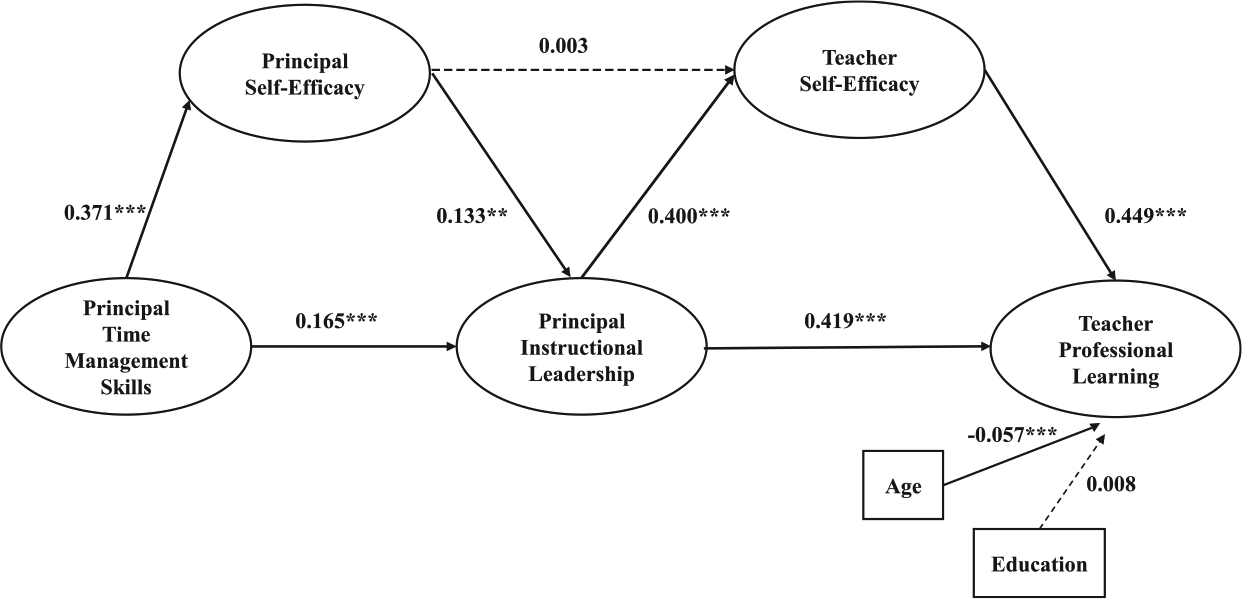
Path relationships among the variables in the structural equation model.
Bootstrapping was used to further examine the role of Teacher Self-Efficacy as a mediator of Principal Instructional leadership effects on Teacher Professional Learning (Preacher & Hayes, 2008). The bootstrapping tests elaborated on the main findings revealed in the SEM analysis (see Table 3). More specifically, the bootstrapping analysis reaffirmed both direct and indirect effects of Principal Instructional Leadership on Teacher Professional Learning (see Table 3).
Bootstrapping Results for the Standardized Direct, Indirect, and Total Effects of Variables in the Conceptual Model.

Note. TMS = principal time management skill; PSE = principal self-efficacy; PIL = principal instructional leadership; TSE = teacher self-efficacy; TPL = teacher professional learning; CI = confidence interval. n = 3,414 teachers and 186 principals. Based on 2,000 bootstrapped samples. Standardized indirect effects = 95% CI does not include zero.
p < .001.
The total effect of Principal Instructional Leadership on Teacher Professional Learning was both statistically significant and meaningful (β = 0.598, CI [0.569, 0.627], p < .001). This total effect was comprised of a moderate direct effect (β = 0.419, CI [0. 384, 0.456, p < .001) and a smaller indirect effect through Teacher Self-Efficacy (β = 0.179, CI [0.156, 0.202, p < .001). Furthermore, the bootstrap analysis revealed that 70.1% of the effect of Principal Instructional Leadership on Teacher Professional Learning was direct, and 29.9% indirect through Teacher Self-Efficacy. In sum, this mediation analysis, based on 2,000 bootstrapped samples, offers further support for a partial mediation model comprised of moderate effect sizes (i.e., β = 0.40-0.60) of strong statistical significance (i.e., p < .001).
How Do Time Management Skills and Principal Self-Efficacy Relate to Instructional Leadership?
Next we turned our attention to examining how the antecedent variables (i.e., Time Management Skills and Principal Self-Efficacy) interacted with each other as well as with Principal Instructional Leadership. First, as shown in Figure 2, we found a significant moderate effect of Time Management Skills on Principal-Self-Efficacy (β = 0.371, p < .001). The SEM analysis in Figure 2 also showed that Time Management Skills evidenced a small direct effect on Principal Instructional Leadership (β = 0.165, p < .001).
These results were further elaborated by the bootstrap analysis (see Table 3). This yielded a somewhat larger “total effect” of Time Management Skills on Principal Instructional Leadership (β = 0.215, p < .001). This was comprised of a small direct effect of Time Management Skills (β = 0.165, p < .001; 76.75% of the total effect) on Principal Instructional Leadership, and a weak indirect effect through Principal Self-Efficacy (β = 0.050, p < .001; 23.25% of the total effect).
Taken together, these results suggest that principals who are capable of managing their time effectively may feel more confident in addressing challenges in their job roles. This sense of self-confidence or efficacy may then enhance the “basic effects” that time management has on engaging in the instructional leadership role. Notably, however, these relationship lack the robust character revealed in the earlier analyses.
Does Principal Self-Efficacy Influence Teacher Self-Efficacy?
The third research question addressed the relationship between Principal Self-Efficacy and Teacher Self-Efficacy. Here we found no meaningful relationship between the two variables. As noted in the SEM analysis (see Figure 2), the direct path between these variables did not evidence a meaningful effect (β = .0003).
Bootstrapping was then used to examine the relationship of Principal Self-Efficacy and Teacher Self-Efficacy, with Principal Instructional Leadership as a possible mediator (see Figure 1). This test yielded a total effect comprised entirely of an indirect effect through Principal Instructional Leadership (not tabled). Nonetheless, the total effect was too small to be meaningful (β = 0.050, p < 0.01). This result could have been influenced by our measurement of Teacher Self-Efficacy as an individual rather than as a group construct (i.e., Collective Teacher Efficacy).
Discussion
This study was undertaken to gain more refined insights into the means by which school leaders influence the professional learning of teachers. Mainland China was considered a prime site for this research given its documented emphasis on the workplace learning of teachers (Chen, 2017; OECD, 2014; Paine & Fang, 2006; Qian & Walker, 2013; Tan, 2012; Wang, 2016). In this section of the article, we review limitations of the study, offer our interpretation of the findings, and discuss implications for research and practice.
Limitations of the Study
As a cross-sectional study, this research is unable to establish causal direction. This impact of this limitation was perhaps most significant in the relationship between Teacher Self-Efficacy and Teacher professional Learning. Although there was ample basis for hypothesizing the direction as indicated in our model, researchers have also found that Teacher Professional Learning can strengthen Teacher Self-Efficacy (e.g., Cheung, 2008). Thus, there is the possibility that this relationship is reciprocal. However, in the absence of longitudinal data, we cannot test for reciprocity.
Second, we acknowledge that the survey used for measuring time management skills of the principals suffered from distinct limitations. The use of direct observation or technology-enabled data collection applications would provide more valid data on how principals manage their time (see Grissom et al., 2012, 2015; Sebastian et al., 2018). Although this was not possible in the current study, we encourage researchers to explore these alternative methods in future research.
Finally, as noted earlier, features of our data set forced us to examine relationships among the constructs in our conceptual model at an “individual level of analysis.” This could have reduced the variability in our data and left school-level variations unexplored. Future studies should consider using multilevel analysis to explore the complexities associated with school-level in addition to teacher-level differences (Bryk & Raudenbush, 1988).
Interpretation of the Findings
The first result of interest arising from this research lies in the confirmation of a partial mediation model of principal instructional leadership and teacher professional learning. Specifically, principal instructional leadership had significant direct and indirect effects through teacher self-efficacy on teacher professional learning. The salience of this finding lies in reaffirming first that principals “make a difference” in the professional learning of teachers, and second that teacher self-efficacy represents a high-value “path” through which this effect is achieved.
The finding that principal instructional leadership had moderate direct effects on both teacher-self efficacy and teacher professional learning reprises results reported in other recent studies (see also Fromm, 2017; Hallinger, Liu et al., 2017; Rew, 2013). The finding of significant indirect effects of instructional leadership on teacher learning reinforces similar results reported by scholars who have used a variety of different leadership constructs. These include instructional (Fancera & Bliss, 2011; Fromm, 2017), transformational (e.g., Dale & Phillips, 2011; Geijsel et al., 2009; Thoonen et al., 2012), learning-centered (Liu et al., 2016), and integrated (Hallinger et al., 2014; Li et al., 2016) leadership. In sum, these empirical studies affirm the importance of “leadership” in shaping environments that motivate, engage, and sustain the professional learning of teachers (Barth, 1990; Hairon & Dimmock, 2012; Leithwood, 1992; Robinson, 2006; Qian et al., 2016; Qian & Walker, 2013; Smylie & Hart, 1999; Wang, 2016; Zheng et al., 2018).
We consider confirmation of the partial mediation model significant in two respects. First, with support from a growing literature (e.g., Calik et al., 2012; Dale & Phillips, 2011; Fromm, 2017; Hallinger, Hosseingholizadeh, et al., 2017; McGuigan & Hoy, 2006; Rew, 2013; Salazar, 2014), our results highlight “teacher self-efficacy” as a potentially important “path” through which leadership sustains teacher professional learning. Second, teacher self-efficacy joins other significant mediators of the relationship between leadership and teacher learning. Empirically validated mediators include teacher trust (Geijsel et al., 2009; Hallinger, Piyaman et al., 2017; Lee et al., 2011; Liu et al., 2016, Wang, 2016), teacher agency (Frost, 2006; Hallinger, Piyaman et al., 2017; Liu et al., 2016), teacher motivation (Geijsel et al., 2009; Qian & Walker, 2013; Thoonen et al., 2012; Tran et al., 2018), and communication (Li et al., 2016; Qian et al., 2016). The underlying importance of this knowledge base lies in the unequivocal role that the continued learning of teachers plays in sustainable school improvement (Barth, 1990; Elmore & Burney, 1997; Geijsel et al., 2009; Lieberman & Pointer Mace, 2008; Smylie & Hart, 1999; Thoonen et al., 2012).
Our research also examined how the time management skills and self-efficacy of principals shaped their enactment of instructional leadership. Both “lack of time” and “lack of confidence” have been cited frequently as reasons why principals are slow to embrace the role of instructional leader (Grissom et al., 2012, 2015; Horng et al., 2010; Marshall, 1996; Sebastian et al., 2018). At its core, self-efficacy implies both a belief and sense of confidence that one can “make a difference,” whether as a teacher or principal (Fancera & Bliss, 2011; Fromm, 2017; Tschannen-Moran & Hoy, 2001; McGuigan & Hoy, 2006; Versland, 2009).
Our results, though weaker, still suggest that principals who feel more “in control of their time” may also feel more confident in their ability to accomplish the challenging tasks of leading learning (Grissom et al., 2012; Hallinger & Murphy, 2012; Horng et al., 2010; Leithwood & Jantzi, 2008; Miller, 2015; Versland, 2009). Notably, a recent study of principal instructional leadership conducted in Iran (Hallinger, Hosseingholizadeh et al., 2017) found a stronger relationship between principal self-efficacy and instructional leadership (β = 0.460, p < .05). Leaders who do not believe that they can make a positive difference in the quality of teaching and learning in their schools are less likely to engage in the types of practices associated with instructional leadership (Domsch, 2009; Gareis &Tschannen-Moran, 2005; Grissom et al., 2012; Horng et al., 2010; Leithwood & Jantzi, 2008; Lucas, 2003; Miller, 2015). These findings have implications for research, practice and leadership preparation and development.
Implications for Research and Practice
Our findings contribute to a growing global knowledge base that both describes and analyzes the effects of leadership on factors that bear directly on school improvement. Building up concentrations of studies from different regions of the world is essential for the task of determining the context-specificity of empirical findings (Clarke & O’Donoghue, 2017; Hallinger, 2018). Over the past 20 years, scholars have gradually reached a consensus that school leadership has small but statistically significant indirect effects on student learning (Hallinger, 2011; Hallinger & Heck, 1998; Leithwood et al., 2010; Robinson, 2006). We suggest that a complementary body of evidence is now accumulating which affirms that school leadership also has both direct and indirect effects on the professional learning of teachers. Given its salience to the challenges of sustainable education reform, it is time for this knowledge base to receive greater acknowledgement and attention from scholars, policy makers, and practitioners.
With this in mind, it seems timely for scholars to undertake systematic reviews of this accumulating knowledge base on leadership and teacher professional learning. This body of quantitative and qualitative research has employed multiple leadership frameworks, as well as a range of mediating variables and definitions of teacher learning (e.g., as a composite of individual teachers or as a collective construct). Thus, the first task for reviewers will be to describe and synthesize the conceptual models and research methods that have been used in this literature. Only after this step can we determine whether it is preferable to use meta-analytic, quantitative synthesis, and/or thematic methods to integrate substantive findings from this literature.
We wish to highlight several implications for practitioners. First, our findings indicate that principals who wish to improve student learning should focus concurrently on motivating, supporting and sustaining the learning of their teachers (Barth, 1990; Elmore & Burney1997; Geijsel et al., 2009; Leithwood, 1992; Lieberman & Pointer Mace, 2008; Robinson, 2006; Smylie & Hart, 1999). Notably, leadership that is conducive for teacher learning appears to incorporate elements that overlap dimensions that are associated with instructional and transformational leadership (Dale & Phillips, 2011; Leithwood et al., 2010; Robinson, 2006).
More specifically, principals should be intentional and persistent in articulating the value of learning for teachers and modeling that in their own practice (Barth, 1990). Principals should adopt a working definition of “teacher learning” that goes beyond “attending courses and workshops.” They should exploit opportunities to foster teacher learning through sharing knowledge on the job, teacher research groups, mentoring, collaborative planning, and joint problem solving (Elmore & Burney, 1997; Paine & Fang, 2006; Kwakman, 2003; Wang, 2016; Zheng et al., 2018). Gaining value from on-the-job learning, regardless of the source, requires “tangible support” from principals and middle-level leaders who find resources, structure time for teachers to observe each other, and participate in learning activities with their teachers (Elmore & Burney, 1997; Hallinger, Piyaman et al., 2017; Leithwood, 1992; Liu et al., 2016; Qian & Walker, 2013; Robinson, 2006; Smylie & Hart, 1999).
This body of research also emphasizes the importance of “relational leadership,” which aims to develop positive norms of trust, mutual respect, and collective responsibility (Hallinger, Liu et al., 2017; Liu et al., 2016; Printy, 2008; Qian & Walker, 2013; Smylie & Hart, 1999; Tran et al., 2018; Wang, 2016; Zheng et al., 2018). Our study highlighted the role of teacher self-efficacy, which reinforces the importance of leadership that communicates a consistent message of high expectations for both students and teachers (Fromm, 2017; Leithwood et al., 2010; McGuigan & Hoy, 2006; Thoonen et al., 2012; Tschannen-Moran & Hoy, 2001).
Our findings also have implications for leadership training and development programs. Over the past 40 years, principal preparation and development programs have increasingly incorporated “leadership of teaching, learning, and school improvement” into the curriculum. We suggest that programs which aim at developing “learning leaders” should embed four core elements.
First, they should articulate an explicit goal to inspire current and future leaders to believe that they “can make a difference” in the learning of their teachers and pupils (Barth, 1990; Gareis & Tschannen-Moran, 2005; Lucas, 2003; Versland, 2009). This assertion reprises the finding that effective instructional leaders hold themselves personally accountability for the learning of their students (Dwyer, 1985; Hallinger, 2011; Horton, 2013; Leithwood & Jantzi, 2008; Miller, 2015; Rew, 2013. They have zero tolerance for the failure of students.
Second, preparation and development programs should become more intentional in developing the time management skills of school leaders. Too often principals fail to lead learning due to an inability to organize themselves with sufficient focus and skill in doing “the right things” (Dwyer, 1985; Grissom et al., 2012, 2015; Horng et al., 2010; Sebastian et al., 2018; Zhang, 2012; Zhou, 2017). The current generation of research seeks to refine our understanding of how time management intersects with instructional leadership enactment (Grissom et al., 2012, 2015; Horng et al., 2010; Sebastian et al., 2018). This may provide useful findings that can inform the school leadership development curriculum. Instead of looking at time management as “just a skill,” school leader preparation and development programs should revel in the fact that time management is a skill that can actually be taught with meaningful effects.
Third, research suggests that principals who succeed as instructional leaders possess a knowledge base related to teaching and learning. In this era, principals must be capable of drawing on a knowledge base that includes powerful learning practices, models of teaching for active learning, learner-centered assessment, and coaching teachers for success. While this knowledge base and skill set may seem self-evident, they are not. Indeed, in many societies around the world (perhaps most), principals are not selected because of their expertise in teaching and learning. Therefore, we cannot assume that principal candidates “know teaching and learning” simply because they were teachers.
Finally, this research suggests that effective leaders of teacher learning possess relational skills (Dinham, 2007; Printy, 2008; Robinson, 2006; Smylie & Hart, 1999). Adult learning can be a difficult process (Barth, 1990; Kwakman, 2003; Parise & Spillane, 2010). More broadly, collaborative learning in the workplace requires support and trust, as well as accountability. The task of developing the leadership skills needed to create a productive environment for teacher learning challenges our existing approaches to school leadership development (Gareis & Tschannen-Moran, 2005; Versland, 2009; Walker, 2015).
Footnotes
Declaration of Conflicting Interests
The authors declared no potential conflicts of interest with respect to the research, authorship, and/or publication of this article.
Funding
The authors received no financial support for the research, authorship, and/or publication of this article.
