




Abstract
Keywords
So often in education, we’re pitted against each other. It’s arts or academics. It’s more time at school, or with families. It’s empowering teachers, or it’s teaching to the test. All these things are false choices. We just need to figure out how we empower more people to be successful. And the courage I saw . . . yesterday in Lawrence is absolutely inspiring.
Politics is the number one factor superintendents say inhibits their job performance, according to a recent American Association of School Administrators survey (Superville, 2015). Studies of improved districts emphasize that the effective navigation of politics is a critical ingredient of success (Honig & Coburn, 2008; Johnson, Marietta, Higgins, Mapp, & Grossman, 2015) and a substantial literature within and beyond education suggests that any policy requires political support to sustain itself and fulfill its objectives (Jochim, 2013; Patashnik, 2003; Stone, Henig, Jones, & Pierannunzi, 2001).
State interventions in low-performing schools and district turnaround efforts tend to be particularly politically contentious. State takeover runs counter to our nation’s deeply embedded tradition of local control over K-12 schools and the resources devoted to running them. Turnaround efforts can also be controversial, especially when involving staff turnover or closures of schools tightly linked to community identity. Recent state-led turnaround efforts have generated heated debate in New Orleans (Buras, 2015; Jabbar, 2015), Memphis (Glazer & Egan, 2016), Newark (Chin, Kane, Kozakowski, Schueler, & Staiger, 2017; Morel, 2018; Russakoff, 2015), Buffalo (Duke, 2016), Georgia (Welsh, Williams, Little, & Graham, 2017), and even smaller Massachusetts cities such as Holyoke (Williams, 2015).
Despite the political challenges accompanying efforts to improve low-performing school systems, the academic literature is short on guidance for leaders seeking to successfully navigate the divisive politics of takeover and turnaround. The new Every Student Succeeds Act carves out an even greater role for states and districts in addressing academic underperformance. As a result, the need for evidence on the political viability of accountability-driven state takeover and the effective navigation of politics in the context of district-wide reform is greater than ever.
The State of Massachusetts’ turnaround of the Lawrence Public Schools (LPS) provides a rare example of a state takeover and district-wide reform that resulted in substantial academic gains in the early years of implementation without generating the kind of controversy that typically accompanies takeover and turnaround. I address two research questions, focused on the first three years of turnaround implementation: (1) How did key stakeholders within Lawrence—the general public, parents, educators, union leaders, and district partners—perceive the state takeover and turnaround reforms? (2) What factors contributed to that stakeholder response?
I find that controversy associated with the Lawrence turnaround, although not absent, was limited and explain why these reforms were not more contentious. I find that features of the Lawrence context and statewide accountability system help explain the stakeholder response. Furthermore, within a context ripe for change, features of the turnaround leaders’ approach worked to limit resistance and increase support. These features illustrate a “third way” mentality that allowed leaders to minimize polarized disputes. Therefore, this study provides lessons for leaders seeking to implement politically viable districtwide improvement.
School District Turnaround
The existing work on turnaround—or dramatic improvement—of low-performing educational organizations has tended to focus on school-level reform (e.g., Dee, 2012; Heissel & Ladd, 2016; Strunk, Marsh, Hashim, Bush-Mecenas, & Weinstein, 2016). Less is known about district-level efforts, which may be better suited to creating the conditions for long-term success (Daly & Finnigan, 2016; Hightower, Knapp, Marsh, & McLaughlin, 2002; Johnson et al., 2015; Supovitz, 2006). The research that has examined districtwide reforms has focused on the effects on student achievement (e.g., Gill, Zimmer, Christman, & Blanc, 2007; Harris & Larsen, 2016; Zimmer, Henry, & Kho, 2017), teacher and school capacity (Rice & Malen, 2003, 2010), identifying cases for qualitative study (e.g., Bowers, 2015), understanding the central office’s role (e.g., Honig, 2003; Rorrer, Skrla, & Scheurich, 2008), uncovering implementation strategies associated with improved academic outcomes (e.g., Coburn, Toure, & Yamashita, 2009; Honig, 2008, 2009; Honig & Coburn, 2008; Strunk et al., 2016), and describing the practices of high-performing districts (Bowers, 2008; Corcoran, Peck, & Reitzug, 2013; Kirp, 2013; Murphy, 2008; Murphy & Meyers, 2007, O’Day, Bitter, & Gomez, 2011). However, less attention has been devoted to unpacking the political dynamics of districtwide turnaround.
The studies that do examine the politics of district reform largely focus on the ways in which political forces influence policy development (e.g., Marsh, 2016; Scott et al., 2017). The academic literature is short on strategies for implementing politically viable district improvement, although the navigation of politics appears to be a key ingredient of success (Honig & Coburn, 2008; Johnson et al., 2015) and positive stakeholder response to reform is arguably an important end in itself. Indeed, previous researchers have argued that school and district effectiveness research has focused on too narrow a set of academic achievement outcomes (e.g., Hamlin, 2017; Trujillo, 2013). Lawrence therefore provides a valuable case of politically viable state takeover and districtwide turnaround with lessons for state leaders in selecting contexts ripe for reform and, given the Lawrence leaders’ third way approach, provides guidance for district leaders on mitigating polarized education policy debates.
What Is the Third Way?
Bobbio (1997) describes “third way” as a political position that attempts not only to reconcile right-wing and left-wing political perspectives but also to “transcend the politics of left and right” (p. 8). The term dates back to at least the late 19th century, when it described efforts to integrate right-wing and left-wing economic and social policies, balancing free market principals with redistribution and regulation (Hombach, 2000; Romano, 2006). In more recent years, the concept has been associated with President Bill Clinton and the New Democrats as well as Prime Minister Tony Blair and New Labour (Giddens, 1998). In these contexts, the third way has represented both a policy approach and a political strategy intended to position the left as capable of “governing capitalist economies” (Romano, 2006, p. 5) and balancing progressive values with limited government.
In the education arena, political opponents do not always fall neatly into typical categories of left and right. However, broadly speaking, education policy debates in recent years have often been characterized by disagreements between groups representing two competing perspectives. The first can be described as “traditionalists” often associated with traditional institutions such as noncharter public schools, schools of education, and teachers unions. The second can be described as “reformers,” including proponents of market-based strategies, charter schools, and merit-based teacher evaluation. In turnaround contexts, these groups often appear to have irreconcilable divisions over issues such as charter expansion, school closures, the replacement of traditionally certified teachers with those from alternative programs, and shifts from experience- to performance-based compensation systems.
Some education leaders have used “third way” terminology narrowly to describe mixed-market environments that allow both charter and traditional public schools to thrive (Anderson, 2016) or union–district collaboration (Pamer, 2011). However, the phrase has broader utility for describing efforts to reconcile polarizing disagreements between what seem like irreconcilable ideological positions in the education space. A third way approach applies to the kind of integrative thinking that Martin (2007) argues is an essential attribute of successful leadership based on his interviews with more than 50 exemplary leaders. Integrative thinking is characterized by an ability to avoid false dichotomies, resolve tensions, and synthesize seemingly contradictory policy options into new solutions that are preferable to the original choices. In the context of education, therefore, the third way involves reconciling and transcending polarized conflicts between traditionalists and reformers to arrive at something new.
The third way is consistent with an orientation that views civic capacity as a central component of effective and sustained educational reform. Stone et al. (2001) argue that when a policy subsystem, such as a school district, is ineffective or corrupt, it is not enough to simply disrupt that system. Lasting reform requires building civic capacity by altering relationships between actors with a stake in the system and bringing various sectors of the community together to collectively problem solve. Stone et al. further suggest that overinvestment in any particular policy approach can generate backlash and “restrain key stakeholders from making pragmatic accommodations that might broaden their constituency” (p. 161). A third way orientation avoids an overcommitment to any one policy approach, such as the typical remedies proposed by either the traditionalists or reformers, and instead, it focuses on creating the “conditions under which it is possible for disparate groups to find and build common ground” (p. 142).
In Lawrence, I find that turnaround leaders convened a diverse set of actors, representing both the reform and traditionalist perspectives, to be part of the improvement effort. In many cases, they were able to avoid false choices, find solutions that reconciled policy disagreements, and minimize polarizing political clashes. This third way approach had important political advantages. In the next section, I describe the methods I used to arrive at these findings.
Methods
Data
To examine stakeholder response to the Lawrence reforms and the factors explaining that response, I relied on one-on-one interviews with leaders of the turnaround and stakeholder groups. I supplemented interviews with a review of news articles and publicly available documents (Merriam, 1998), such as website content, speeches, and meeting minutes. To gauge the overarching public narrative surrounding the turnaround, I identified 259 news articles discussing LPS from fall 2007 to fall 2015 using LexisNexis, Google News Advanced Search, and the archives of Commonwealth Magazine, Boston Magazine, WGBH (Boston-based member station of NPR), Boston Globe, Eagle-Tribune, as well as Rumbo News and El Mundo Boston (regional publications targeting bilingual readers). I coded articles for content-based themes as well as publication date, generating a data set in which each observation represented a news article. Each theme received a value of 0 or 1 depending on whether that theme was present in a given article. I then identified the most common themes by academic year.
Incorporating multiple types of data (interviews, websites, speeches, minutes, media) from a variety of sources (state, district, union, community, schools) helped me triangulate results to reduce systematic biases that could come from one particular mode of data or type of informant (Maxwell, 2005). For instance, interviews with leaders regarding their communication strategy might suffer from self-report bias, while analyzing their speeches allowed me to observe their behavior. Similarly, representatives of stakeholder groups sometimes had different perceptions about how leaders attempted to gain their support than leaders themselves.
Interview Participants and Procedures
I relied on purposeful sampling (Seidman, 2006) to gather a pool of participants representing district- and state-level turnaround leadership, and who could speak to major stakeholder groups’ perceptions. I identified participants based on public documents, an earlier study through which I learned about who played key roles, and snowball sampling. Once my analysis suggested that there had been minimal resistance, I asked interviewees to introduce me to participants who disapproved of the turnaround to ensure I did not miss critical perspectives.
The resulting sample included 20 interviewees. Central office leaders included the Superintendent/Receiver and four other high-ranking district officials, one who worked in LPS for many years pre-takeover. I interviewed the former Massachusetts Secretary of Education who was in office during the transition to receivership, a Massachusetts Department of Elementary and Secondary Education official involved with contract conversations post-takeover, a former State Senator who represented Lawrence throughout receivership transition, and three organized labor leaders from both the Lawrence Teachers Union and Massachusetts American Federation of Teachers (AFT). I interviewed two principals, who had been administrators before and after receivership, and three teachers, who were either nonrenewed or otherwise left the district post-takeover. Finally, I spoke with leaders from three nonprofit partners, including enrichment providers and a local organization that conducted focus groups with community members leading up to and during turnaround implementation.
I used a semistructured protocol (Merriam, 1998), beginning with open-ended questions to avoid steering the interview based on my hypotheses (Seidman, 2006). I asked participants to tell me the story of the takeover from their perspective and then included more specific probes (Merriam, 1998) to get at the reactions of particular groups. I asked turnaround leaders explicitly about their thought process around garnering support. Interviews lasted between 45 and 90 minutes and were audio-recorded for transcription.
Analysis
I relied on content analysis to identify major themes emerging from my data. I coded transcripts using a list of codes, displayed in the appendix, that included examples of Maxwell’s (2005) three types: (1) “organizational” codes that are broad topics anticipated prior to interviews, such as those under the stakeholder groups or turnaround components headers; (2) “substantive” codes describing subjects’ perceptions without implying an abstract theory, such as adjectives describing communication between leaders and stakeholders; and (3) “theoretical” codes implying an abstract framework, such as those in the ideology/pragmatism category. I based codes on relevant literature and public documents. Some emerged from interview data.
The codes identifying evidence of third way thinking were concentrated under the “ideology/pragmatism” category. These included explicit discussions of a third way, as well as efforts to rise above political conflict and ideology. Additional third way indicators included efforts to avoid false choices between the preferred policies of the traditionalists (e.g., strengthening traditional public schools, neighborhood-based student assignment, union–district collaboration, whole child educational approaches) and the reformers (e.g., decentralization, market-based strategies, accountability, high academic expectations), as well as boundary crossing between organizations typically associated with the traditionalist and reform camps and efforts to level the playing field between charter- and district-managed schools.
Analysis occurred simultaneously with data collection in an iterative process in which I conducted and coded an interview, identified new codes, and refined my protocol (Merriam, 1998). Coding throughout data collection helped address validity threats. I developed tentative hypotheses, adapted my protocol to seek out evidence running counter to emerging theories (Glaser & Strauss, 1967), and asked respondents to react to my hypotheses. It alerted me to a stopping point for recruitment once subjects stopped identifying novel themes. I then reanalyzed the interviews with the full set of codes, searching for data that could not be explained by my hypotheses or that supported alternative explanations (Maxwell, 2005).
I conducted two rounds of member checks to improve data accuracy and ensure that inferences were supported by the data. First, I provided each respondent with the text of all quotes I planned to use from their interview, offering them an opportunity to object to inaccuracies (rather than to wordsmith quotations). In a small number of cases, I expanded quotations when respondents felt the context was unclear. Finally, I provided all respondents with an opportunity to review the full paper and provide feedback on whether the inferences I drew from their comments were reasonable. Though I made a handful of edits based on this feedback, my overarching conclusions remained intact.
Background and Policy Context
Lawrence, Massachusetts
Lawrence is a midsized industrial city about 30 miles north of Boston that is one of the most economically disadvantaged communities in Massachusetts. From 2009 to 2013, median household income was $32,851 and the poverty rate was 29.2%. Roughly 11% of residents older than 25 years held a bachelor’s degree. The city is home to a large population of Latino residents, many of whom came to Massachusetts from the Dominican Republic or Puerto Rico. Leading up to the takeover, about 90% of students qualified for subsidized lunch and 70% were learning English as a second language. LPS enrolled approximately 13,000 students in 28 schools as of 2011, making it among the 10 largest districts in Massachusetts, but still roughly a quarter the size of the Boston Public Schools. There were also a small number of charter schools in Lawrence that were not managed by the district.
School Accountability in Massachusetts
Although Massachusetts leads the nation in average academic performance, considerable race- and class-based gaps remain. To address these issues in the midst of competition for federal Race to the Top funding, the State Legislature passed the Achievement Gap Act in 2010. This reform created a tiered system of accountability targeting the lowest performing schools and districts for intensive interventions, including state takeover. Lawrence had a long history of low performance, but the state considered the 2010-2011 results to be especially grim. LPS was in the bottom five districts in the state based on proficiency rates on the state’s ELA (English Language Arts) and math exams. Only half of all students were graduating high school within 4 years. Furthermore, the state now had new policy mechanisms at its disposal for addressing underperformance.
In fall 2011, the state deployed the Achievement Gap Act takeover authority for the first time. The Massachusetts Board of Elementary and Secondary Education gave LPS the lowest possible accountability rating, placing the district into “receivership.” As a result, decision-making power and the ability to name a Superintendent shifted from a locally elected board to the state. In January 2012, the state appointed a “Receiver” who was given the authority of the Superintendent and the School Board, as well as discretion to ignore portions of the collective bargaining agreement and unilaterally extend the school day and year. State data show that post-receivership increases in LPS’ per pupil spending did not outpace statewide increases.
Lawrence Turnaround
The Receiver spent the first 5 months after his appointment visiting schools and meeting parents, educators, potential partners, union leaders, community groups, and elected officials. Consistent with a civic capacity building approach, district leaders said that this period of information gathering and needs assessment informed the creation of the Turnaround Plan outlining the reforms. This strategy was politically advantageous because, as one state-level leader explained, “People support what they help create.”
The Turnaround Plan, released by the Receiver and Commissioner in spring 2012, had five major components. First, there were higher expectations for students and staff through ambitious performance targets and dropout recovery. Second, there was increased school-level autonomy and accountability. A small number of schools—4 of 28—were handed over to new managers. Third, there was an effort to improve the quality of human capital, through staff replacement, staff development, and a new performance-based career ladder compensation system. Fourth, there was extended learning time, through expanded school day, enrichment activities, tutoring, and special initiatives. Fifth, there was an emphasis on using data to drive instructional improvement.
For human capital improvement, the Receiver took an aggressive approach to improving the quality of school leaders, replacing half of all principals in the first 2 years (Education Research Services, 2015). The state reports a principal retention rate of 82% in 2012-2013 and 72% in 2013-2014. The Receiver was less aggressive when it came to replacing teachers. LPS estimates that it actively removed 10% of teachers prior to turnaround Year 1. Between dismissals, resignations, and retirements, the teacher retention rate was 82% in 2012-2013 and 74% in 2013-2014. The district enlisted an alternative certification provider to help with talent recruitment. 1
The first two full years of turnaround implementation led to substantial positive gains in math and modest improvements in reading. There was no evidence of slippage on attendance, grade progression, transfer, school enrollment, or graduation among 12th graders and improvement on grade progression among high school students (Schueler, Goodman, & Deming, 2017). One notable program was the “Acceleration Academies” in which select teachers delivered struggling students with instruction, in a single subject, in small groups of 10, over weeklong vacation breaks. These programs explained roughly half of the math gains and all of the reading gains. The size of the overall effects is slightly larger than the impact of injecting high-performing charter school practices into Houston’s low-performing traditional public schools (Fryer, 2014). The impressive academic gains motivate my exploration of the politics of implementation.
Findings
Stakeholder Response
Although the Lawrence experience was not entirely uncontroversial, I find controversy was minimal relative to other recent cases of takeover and turnaround. For instance, researchers and journalists have documented considerable signs of community resistance to reforms, such as public demonstrations and protests, school walkouts, and critical commentary in the press and other public venues in places such as New Orleans (Buras, 2015; Jabbar, 2015), Newark (Morel, 2018; Russakoff, 2015), Buffalo (Duke, 2016), Tennessee (Glazer & Egan, 2016), Georgia (Welsh et al., 2017), and Holyoke, Massachusetts (Williams, 2015). In contrast, I find fewer signs of significant public dissatisfaction with the Lawrence reforms.
Popular press coverage provides one indicator of the overarching public narrative surrounding receivership. I display the count of news articles I analyzed by publication year in Figure 1 and dominant themes over time in Figure 2. The primary content of LPS coverage shifted from a negative tone pre-receivership to a more positive tone post-receivership. Between 2007 and 2010, a single theme dominated relating to allegations of wrongdoing against public officials, including campaign finance investigations of the Mayor, fraud and embezzlement indictments against an LPS Superintendent, and the firing of three consecutive Superintendents (not including an Interim Superintendent). In 2011, new themes emerged related to low academic achievement and state takeover.
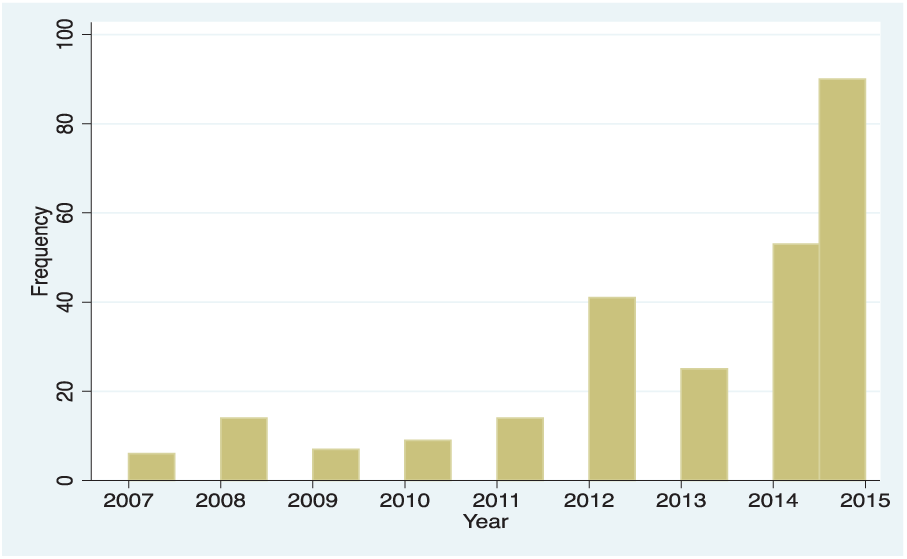
Frequency of press articles on the Lawrence Public Schools, fall 2007 to fall 2015.
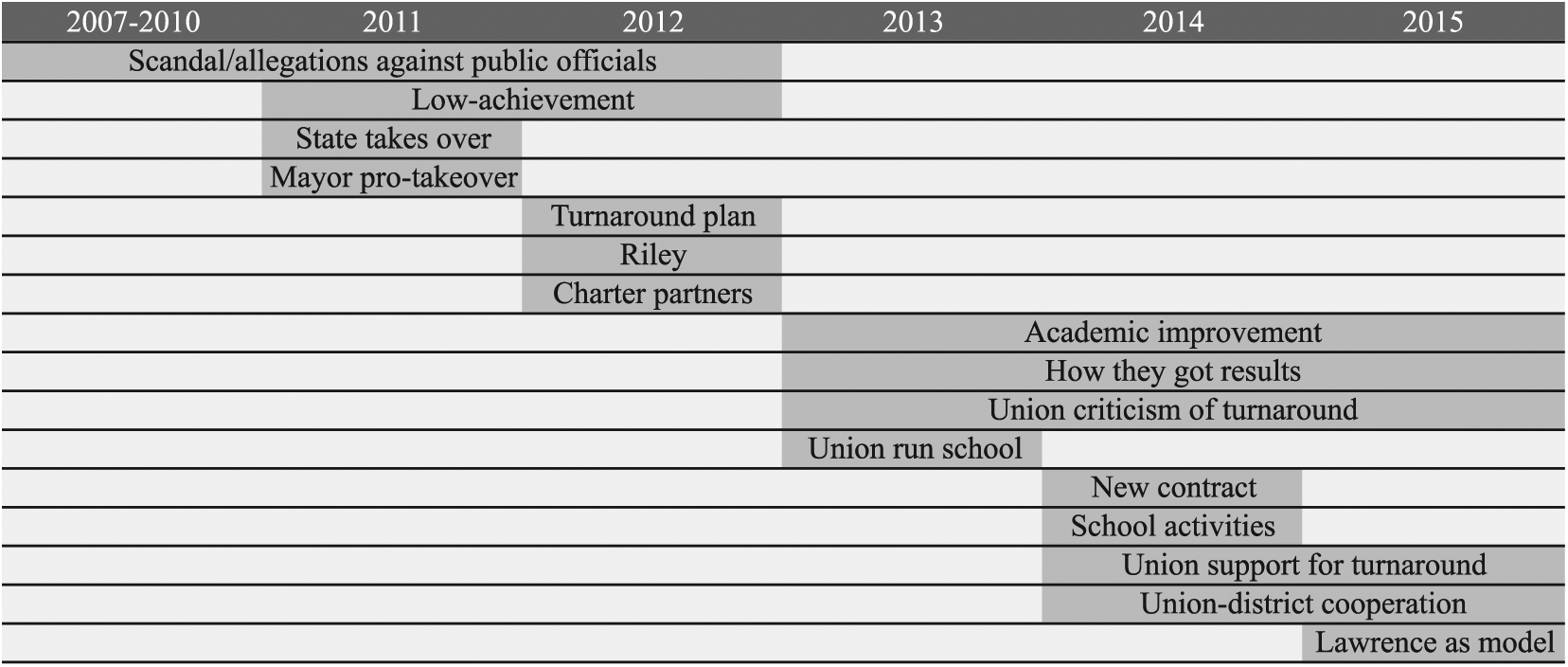
Dominant themes in Lawrence Public Schools–related press coverage, fall 2007 to fall 2015.
In 2013, post-receivership, the coverage shifted to a narrative of improvement. In recent years, Lawrence was often described as a model for district turnaround. Overall, I found minimal mentions of community resistance. The pockets of criticism related to union concerns over collective bargaining, dismissals, performance pay, and extended learning time compensation. Individual teachers expressed due process complaints regarding their evaluations. Finally, some regional leaders argued that the reforms did not go far enough in utilizing market-based approaches.
Another indicator was that elected officials, including the then Mayor and Legislative Delegation, expressed public support for takeover. One district partner explained, “This was not actually a hostile takeover . . . a lot of these places, the biggest problem is if you have a local player who’s . . . fighting it. In fact, the Mayor invited it.” One legislative delegation member argued that support for receivership was representative of the community, “to have Latinos on our side was huge. . . . A white guy [referring to himself] couldn’t have done this without a team from Lawrence. . . . We had reps, parents, young moms, the Mayor . . . say, “We want this.”
Two sources of survey data provide additional signs of support. The MassINC Polling Group polled 404 parents just after the Turnaround Plan’s release but prior to implementation. The majority of respondents (68%) had heard about and approved of the plan while only 5% disapproved. Similarly, data from the March 2012 and January 2014 Teaching, Empowering, Leading and Learning survey of educators suggests no slippage and some notable post-turnaround improvements in educators’ satisfaction with their working environments, at least among those retained under receivership. Full survey results are available on request.
The Lawrence Teachers Union, a local affiliate of the AFT, had a more complicated response. As the state considered receivership, the union expressed agreement that LPS students were not being adequately served. However, union leaders believed the Achievement Gap Act misdiagnosed the cause of the problems, placing more blame on collective bargaining than poor leadership and other causes of low achievement. The local and state unions were opposed to the concept of receivership and had serious concerns about the potential threat it posed to collective bargaining rights and local decision making.
Over time, the union began to view receivership as unavoidable, believing that the State Board had the votes to take over. In this context of perceived inevitability, the local union president told the Commissioner that he was committed to partnership and told the press that he would “make lemonade out of a lemon.” Union leaders made a deliberate decision to be at the table with turnaround leaders, citing Saul Rubenstein’s research on the positive association between union–district collaboration and student outcomes. The union determined that fighting receivership would be counterproductive and that collaboration was their best hope for having a voice.
Despite this commitment to cooperation, the early implementation phase was marked by union–district tension. The membership had anxiety about job security, anticipated charter conversions, and the effect of extended learning time on schedules. The Receiver’s initial review of human capital was likely the most stressful phase, as his team decided who to retain. It is hard to overstate how distressing this process must have been, especially for those who lost jobs as a result. Union leaders acknowledged that some teachers should not have been working in LPS but believed that the district went too far by firing teachers without due process who could have improved with support.
The process of coming to an agreement on a new contract was also tumultuous. The union filed two complaints with the Massachusetts Department of Labor Relations for failure to bargain and the creation of a Teacher Leader Cabinet to advise on district policy paid for via stipends rather than a union-negotiated rate. The state and national AFT got involved. Eventually, the union and district entered into conversations mediated by the state’s Department of Labor Relations. Disagreements centered on the performance-based compensation system and what union leaders viewed as unfairly low compensation for extended learning time. In the face of these concerns, the district moved forward with implementing its new compensation system before union members ratified the contract. The union did move the district toward outlining grievance and arbitration procedures and establishing school-level teacher leadership teams. In spring of 2014, LPS teachers voted to ratify the contract by 57% to 43%. The union viewed the agreement as titled toward management’s objectives but saw it as better than nothing.
Overall union–district relations improved after the contract was in place, but disagreements did not disappear entirely. Dominant press-based themes over 2014 and 2015 included both union–district cooperation and union criticisms of the turnaround related to compensation for extended learning time duties, mid-career teacher salaries, retention among new hires (particularly young, Ivy League–educated teachers), due process for nonrenewed teachers, and compensation for paraprofessionals. In the midst of the tumult, one relative bright spot was the district and union’s decision to co-manage a low-performing LPS school. Planning conversations continued in a positive direction.
Despite policy disagreements, union leaders argued that communication and interpersonal relations with district leaders had improved post-receivership. District leaders said that the union opted for a supportive, rather than oppositional, approach. In 2014, AFT President Randi Weingarten highlighted Lawrence as a model of successful union–district collaboration (Weingarten, 2014). Local union leaders saw this as an overstatement, but they did not hesitate to acknowledge improvements in standardized test scores and parent and educator confidence. However, they believed that successes could have occurred under traditional collective bargaining.
In sum, the turnaround was relatively well received by community members, retained educators, and partner organizations. There was no evidence that these groups generated significant resistance. The union expressed considerable criticism, and district–union relations experienced ups and downs. However, there were signs of improvements in union–district communication and ongoing cooperation despite policy-based disagreements. The union’s response was fundamentally collaborative rather than oppositional. The relatively mild stakeholder response motivated me to explore why the reforms were not met with more resistance.
Contextual Factors Limiting Controversy
I find that several characteristics of the Lawrence context helped limit negative reactions to the turnaround. First, the district is medium sized, allowing the Receiver and his deputies to set foot in all schools. Central office leaders argued that this was essential for successful school-by-school reform. One argued, “You need to have a small number of schools . . . to advise schools or strategically replace people, you have to know that school, pretty much like the back of your hand to be able to do it well.” In addition to the district’s manageable starting size, throughout the post-receivership period, student enrollment was increasing. This prevented leaders from having to make budget cuts or close schools based on declining enrollments.
Lawrence’s political context also helps explain the response. Prior to receivership, there was a widespread perception of dysfunction, instability, and even corruption among city and district officials. One district partner argued that this created receptivity to takeover: There’s a big difference when you say, “I’m only doing this because we’re going to do better with your schools than you were doing,” versus “because people are stealing stuff” . . . that condition really did change the rhetoric . . . there was a moral underpinning.
Many community members perceived a lack of local capacity, as one former state official argued, “there was a sense of urgency . . . things had gone from bad to worse . . . they needed help.” Concerns that receivership would compromise local, transparent, democracy were moderated by the public’s lack of confidence in local policymakers. The Receiver remembered that when he arrived in Lawrence, people told him, “Watch the School Committee tapes from the past, it’s like Jerry Springer!” One leader of a partner organization argued that the pre-receivership School Committee lacked parental representation. Therefore, although the community was not happy about receivership, many viewed it as the lesser evil.
Several characteristics of the organized labor landscape also contributed to the turnaround response. First, Massachusetts’ principals do not have the ability to collectively bargain, clearing the way for school leader replacement. One district official argued, “In other states that have unionized principal associations, you can’t do any of this.” Additionally, relations between the teachers union and the district had been persistently poor prior to receivership. One local union leader recounted a meeting in which the old Superintendent “just started yelling at me.” He went on to say, “. . . for a long time the Lawrence Teachers Union, we were aware of the improprieties . . . by some of the School Committee members, City Council members.” As a result, there was substantial room for improvement in union–district relations. Interestingly, the Receiver’s administration viewed the union as having been, in some ways, a force for good in a dysfunctional pre-receivership system. One district administrator explained, For the last 20 years . . . the union was an incredibly positive force here in the midst of a lot of chaos, a lot of turmoil, a lot of people that were treated incredibly unfairly . . . reformers never think this is a real thing but it literally was the union protecting people from cronyism.
This perception likely contributed to the district’s willingness to collaborate with the union.
The lack of a strong union–parent alliance likely hamstrung the union’s ability to oppose receivership. In many cities, school systems have historically served as a major employer and venue for the social mobility of people of color. This dynamic can reinforce alliances between unions and parents where the teaching force is racially or ethnically similar to the families it serves (Henig, Hula, Orr, & Pedescleaux, 1999). In contrast, the 80% White LPS staff was not representative of the 90% Hispanic student population (reported by the Massachusetts Department of Elementary and Secondary Education). One district partner argued that these dynamics created a disconnect between the union and broader community, “It’s not Latino teachers losing their jobs in Lawrence . . . and [the union President] is a White Irish guy.” One community group leader recounted the days preceding receivership: We got calls from some folks pretty high in the union nationally sort of asking us if we would organize against receivership . . . the challenge with some unions today is that they have become disconnected from the communities they are embedded in . . . organizing to save the union was not something that was going to have resonance with parents and students here.
The broader statewide accountability context also contributed to the turnaround response. First, the new Achievement Gap Act–provided authorities seemed to help the state and district to recruit leaders with political capacity. State-level interviewees argued that it would have been difficult to recruit a politically adept receiver without offering authorities he or she would perceive as necessary for making major improvements, such as the ability to bypass the School Committee and alter portions of the collective bargaining agreement. The authorities also put a spotlight on LPS aiding the recruitment of principals and teachers supportive of the new approach.
Furthermore, the authorities provided leverage, allowing the district to bypass political battles. The Receiver’s ability to ignore the collective bargaining agreement helped the district get union support for a contract the union would not have otherwise accepted. One union leader explained, The Receiver set a deadline . . .saying if we don’t have a contract settled by this date, I’m imposing . . . we were powerless. So we pushed as hard as we could . . . when the clock struck midnight we said okay, we’ll sign the deal . . . there was some lobbying done with the membership to tell them . . . if we didn’t get this, we had . . . nothing in writing, no grievance procedure . . . Better to have this than nothing.
The Achievement Gap Act authorities also provided district officials with a degree of political cover. According to one district partner, the Receiver’s team sometimes responded to requests with, “I’d love to help . . . but [the State] won’t let me.” One union leader argued, “Most people in the district that know [the Receiver] on a personal level like the guy. They might very much dislike some of the policies, but they also know that [the Receiver] can’t do anything without the approval of the Commissioner.” In some cases, stakeholders said district leaders suggested that state leaders, “want to do nothing but charter schools and I’m sort of holding back the floodgates, so work with me and . . . we won’t have to kill you with charter schools.”
In sum, the district’s size and growing enrollment, union politics, and racial/ethnic disconnect between the educator and student populations created a context in which it was possible to implement receivership without a dramatic backlash. Furthermore, the authorities provided by Massachusetts’ accountability system helped the state recruit politically skilled leaders and shielded turnaround leaders from some local conflicts.
The Lawrence Third Way
Within the context described above, the turnaround leaders’ implementation approach limited resistance to the turnaround and reflected a third way orientation to reconciling conflicts between educational reformers and traditionalists. Publicly, the Receiver often characterized his team as rising above polarized ideological battles and embracing a “third way” approach: This problem is far too big for a civil war . . . we’ve made a decision to tune out that stuff. So, sometimes I take shots from extremists in the traditional union camp. Sometimes I take shots from the extremists in the “charter schools are the only way” camp. We don’t need a camp . . . this third way is what we’re about . . . I’ve seen many types of good schools and parents don’t care. They just want a good school for their kid.
This framing likely improved turnaround reception given it’s hard to oppose “good schools” or favor charged conflicts. Furthermore, supporters described the Receiver as capable of crossing ideological lines, arguing he was, “a boundary crosser . . . who had good relationships with the charter entrepreneurial innovation community and a long proven track record as a district administrator.” The Receiver remembered, “I was a principal of . . . an AFT union school . . . quietly I was friends with [charter network leaders]. We always had to kind of talk in secret and have beers because there was such animosity between the worlds” (Riley, 2013). Beyond the rhetoric, the third way was also reflected in several of the team’s policy choices described below.
Differentiating district–school relations
The first feature of the turnaround that improved stakeholder response was its emphasis on differentiated district–school relationships. Rather than adopt a strictly traditionalist centralized approach to district organization, or a uniformly reform-oriented decentralized system, turnaround leaders found a third way. The district did increase school autonomy and accountability but provided supports to schools in making the transition and provided differentiated levels of autonomies based on each school’s capacity. This improved stakeholder response by adapting policies to fit local preferences and by overcoming certain weaknesses of the extreme versions of centralization and decentralization.
Differentiation is consistent with the contingency theory of leadership suggesting that the ideal management style varies depending on the characteristics of the organization being managed (Lawrence & Lorsch, 1967). Differentiation need not come at the expense of achieving policy coherence, a factor that appears in several studies of improved districts (e.g., Supovitz, 2006), as long as actions are aligned toward achieving coordinated objectives (Childress, Doyle, & Thomas, 2009; Chrispeels, Burke, Johnson, & Daly, 2008; Johnson et al., 2015). In fact, scholars emphasize that achieving coherence is an ongoing process in which schools work with the central office to craft a fit between individual schools’ approaches and external policy demands (Honig & Hatch, 2004).
While the Receiver’s team was critical of top-down management, rather than uniformly increased school autonomy, they implemented a system of differentiated autonomy, providing tailored levels of flexibility and central office supports based on each school’s needs. Rather than assuming that failure was the rule, leaders identified and celebrated preexisting pockets of success. Schools that were highest performing pre-turnaround received greater autonomy. Schools in the middle got less autonomy and more intensive support. For the lowest performing schools, the district handed over management to independent operators that were given substantial autonomy.
The team’s decision to pair autonomy with support was an important one. The stated goal was to shift the central office from a compliance- to a service-based organization, consistent with other improved districts (e.g., Johnson et al., 2015). This orientation appealed to school-based staff. One principal described the early information gathering phase: [The Receiver] was . . . meeting with every single principal individually . . . “Tell me what you think . . . What do you need?” . . . the idea of someone asking . . . “What is going to help you to succeed?” that was a new idea . . . very impressive . . . everybody just started to relax.
Listening to principals did not always mean capitulating. One explained, “We don’t have to agree with everything but . . . you’ve had a voice in the change . . . that’s been extraordinary.” This shift also meant cutting the central office budget by $6.6 million in the first 2 years and pushing funds to the school level (Education Research Services, 2015), a decision that again likely appealed to school staff.
While principals’ appreciated flexibility, autonomy also generated trepidation. One remembered, “We were charged with redesigning our school and I didn’t know where to begin. I was incredibly nervous.” To smooth this transition, turnaround leaders took steps consistent with Honig’s (2012) argument that effective central office practices often mirror pedagogical theories typically reserved for classroom teachers. For instance, district leaders used instructional scaffolding by narrowing school-level planning to one area—extended learning time—in the first year. They used “brokering” to connect principals to an external organization—the National Center for Time and Learning—to support schools in the planning process. The district mandated additional time but allowed school staff to decide when to add it and how to use it, improving buy-in for extended learning time.
Diversifying school management
The leaders’ third way approach to diversifying school management also improved the stakeholder response. The team implemented a version of the “portfolio management model” of district governance in which the central office oversees a supply of schools managed by a diverse set of operators (Hill, Campbell, & Gross, 2012). The portfolio model incorporates both market- and public management–oriented approaches to improvement, typically providing school choice, but placing the central office—a democratically governed entity—as the primary arbiter of school quality (Henig & Bulkley, 2010).
The LPS system diverged from typical portfolio management by retaining neighborhood-based rather than choice-based school assignment, but the model still incorporated market-based elements. The district contracted with organizations that, in theory, competed to run schools, including charter groups born from market-based approaches to reform. The district provided schools with autonomies more familiar to CEOs than public administrators. Central office managers then tracked and renewed contracts based on performance. This governance system lent itself to a third way approach by blending market-based reform with centralized regulation.
The district’s selection of operators further illustrates its third way orientation. The majority of schools were kept under district management; however, the district handed over operations of four low-performing schools and launched a new school, also managed by an outside group. Partners included charter operators, an early childhood group, a duo of educators, and the local teachers union. These partnerships reinforced the Receiver’s message that he was willing to work with groups on all sides of major policy debates.
Partnering with the Lawrence Teachers Union to comanage the Oliver School seemed particularly valuable for improving union–district relations. Union leaders viewed the collaboration as increasing their influence district-wide: We went to . . . an AFT conference . . . [the Receiver] did go to that, and his team . . . that’s when a lot of the model for the Oliver Partnership was hashed out . . . that helped build a little bit of trust . . . in other areas. Plus, a lot of the vocabulary of the Oliver School has seeped into the vocabulary of the district . . . to move a school forward, it can be bottom-up and teacher led.
District leaders said that collaboration on the school gave them advantages when negotiating over other policies. One district official said that union leaders were more likely to agree to school-based working conditions when turnaround leaders argued that district-wide policies would limit union flexibility at the Oliver Partnership School. Some observers went a step further, arguing that the partnership was a win–win proposition for the district regardless of the outcome, “If the school’s good, everybody loves it. If the school’s bad, it’s ‘the union had a chance.’” District leaders pushed back against this idea, forcefully asserting, “We want them very much to succeed.” The local union President did worry about being blamed for failure but described the school as a symbol of the union’s future direction and a key part of his legacy.
The third way mentality was also on display at other schools undergoing turnaround. Although charter operators managed low-performing schools, these did not become charter schools. They relied on neighborhood-based rather than choice-based student assignment policies and employed unionized teachers. The Receiver said that this decision stemmed not from compromise but from his deep belief in teacher representation. He further expressed concerns about charter schools, “Frankly, I’m worried that they weren’t servicing the same kinds of kids . . . I always stayed in public schools because I felt it should be one unified system.” One partner argued that the Receiver’s orientation toward charters was politically useful, “most of the people who he needed to woo hate the charters. So [the Receiver’s] very smart about kind of presenting this as a lot less bad than it could be . . . At least it isn’t those charters and stuff, right?”
The Receiver’s team often used the language of a “level playing field” to describe the idea that both charter- and district-managed schools had the same set of foundational rules. Although this created challenges for charter operators accustomed to greater flexibility, one district official argued that it also provided an opportunity: Charters have gotten . . . maligned because they’ve been on an unequal playing field in terms of the kids they can accept, how much money they’re getting, the facilities . . . if you had a chance here to level that, wow, wouldn’t that change the debate? . . . When the charters have to do the real work inside the district, the people from outside can’t yell at the charters for not taking the same kids anymore.
Union leaders said that this arrangement was more palatable than bringing schools of choice to LPS: They’re not really charters. They’re like EMO-run schools . . . there’s openness from the union to working with organizations like that. They need to be neighborhood schools. They can’t use lotteries. The teachers must be unionized . . . if the teachers there feel that they have a voice, and if management is honoring the union contract and they’re not violating people’s rights, we’re open to working with those places.
In sum, keeping most schools under district management, partnering with diverse operators, inviting the union to comanage a school, and asking charter operators to run unionized schools with neighborhood assignment helped avoid polarizing political battles and increased stakeholder receptivity to the reforms.
Making strategic staffing decisions
Public school systems serve as major employers in urban areas (Henig et al., 1999), and unions in the education sector tend to be well organized (Moe, 2011). Education spending makes up nearly half of local budgets (U.S. Government Accountability Office, 2014), and salaries and benefits make up a large share of expenditures. Therefore, education reform often involves major, sometimes painful, implications for people’s livelihoods. Indeed, the most contentious aspects of the LPS reforms related to job security, salaries, and working conditions. However, leaders also made staffing decisions that reduced controversy by synthesizing elements from the reform and traditionalist playbooks.
First, turnaround leaders employed a balance of insiders and outsiders. Roughly one third of the central office staff was replaced, but key employees with a history in Lawrence remained. The team retained staff whose own attitudes and beliefs aligned with turnaround leaders’ approach to reform, reducing possible sources of opposition. One central office leader, new to the district, explained that the people working in LPS pre-receivership who “embraced what we’re trying to do . . . they’ve been the ambassadors with their own friends, family, and the community.” Retaining veteran staff also allowed new leaders to access institutional knowledge and avoid potential political missteps. Another district-level leader said, Other reform models, they said, “Well, what is there must be terrible. So we need to bring all these new people in.” And what can happen is the people there, many of them I’m sure are very good and hardworking and can tell you, “here are the different landmines to avoid.” Like, “Oh yeah, we did that and that didn’t go so well.”
Beyond retaining key insiders, the Receiver’s decision to retain the majority of LPS teachers improved stakeholder receptivity. The Receiver framed this decision as an example of his restraint and a theory of action that likely resonated with educators, explaining, We kept 85-90% of the teachers . . .because I felt like we had some great people, we had some good people, and . . some people we could develop and get better. I can work with those kind of people . . . you can’t blame the teachers for things that sometimes are out of their control.
Another district leader said that the turnaround team placed an emphasis on teacher retention: The last thing that we wanted was for mass exodus to happen. And instead, “How do we keep all the good, great, working hard to improve teachers in the district?” And understanding that we care . . . “Okay, so if we are displacing these 12 teachers, let’s really make sure we find them jobs,” and not say . . . “You are out of luck.”
Union leaders still felt the Receiver went too far but agreed that the negative response would have been more extreme had a greater fraction of teachers been replaced.
Furthermore, turnaround leaders adopted a positive orientation toward retained teachers that likely helped sustain their energy to implement improvement efforts. One principal said, “When you talk to [the Receiver] . . . it’s about . . . taking care of our teachers . . . He meets with teachers more than principals.” The district created new mechanisms for soliciting teacher feedback such as a Teacher Leader Cabinet to advise central office leaders. The Receiver often publicly credited the hard work of educators for the early turnaround results and asked, “Is there anything more important in a school system than the teachers?” Union leaders suggested that this rhetoric resonated with teachers, “[the Receiver] has made several very strong statements about the faculty, stuff they like to hear.”
The district also improved the reception of the controversial new compensation model by emphasizing that it increased pay across the board. LPS estimates that 100% of teachers saw a pay increase and 92% saw a bump beyond what they would have received under the old system. 2 The Receiver argued that the most important part of the new contract was, “trying to pay people like professionals . . . giving people a raise for the first time in many years is certainly a way to help overcome obstacles, having the membership feel respected.”
District leaders also made an intentional effort to build relationships with the teachers union. One elected official explained, Lawrence is a big labor community . . . there’s always the Annual Labor Day Breakfast. And the [former] Superintendent never showed up. [The Receiver] showed up . . . people were blown away . . . [the LTU President] was tough, he’s an old-school union guy. And [the Receiver] really went out of his way to work with him and make him feel a part of it.
Union leaders were clear that communication had improved post-receivership. One explained, “The one thing I like about [the Receiver] is we get on the phone. We’re talking to each other.”
One notable example of union engagement was the district’s decision to enter discussions with union leaders regarding the new teacher contract even though it was not required by the Achievement Gap Act. One central office leader explained the district’s rationale this way: This was honestly just the right thing to do . . . unions help teachers access protections for their jobs in cases where things haven’t been good . . . the teachers here had enlisted this group to be their voice . . . to just say we’re not going to engage in that, I think would’ve really undermined the morale of the district in a needless way . . . Now we weren’t willing to compromise on the things we really needed . . . but we really wanted to reach an agreement.
These negotiations resulted in some wins for the union such as the establishment of school-level teacher leader teams that union leaders said evidenced their broader influence: The big thrust [of the turnaround] is school-based decision making . . . if it’s just window dressing for . . . vesting all power in a principal . . . that’s a very top-down model . . . we’ve tried to . . . reframe it . . . autonomy is teachers having real voice and power . . . that’s how you get sustainable, long-lasting reform that works, when you have the buy in from the people who are doing the job . . . these ideas we introduced to initial resistance from management have become part of the district’s vocabulary now . . . teacher voice, teacher leadership teams . . . it’s definitely part of the fabric of the district now.
Therefore, turnaround leaders’ efforts to engage the union promoted longer term union–district partnership. In sum, although staffing-related decisions were some of the most controversial reforms, several of these choices reduced resistance.
Balancing academics with enrichment
The fourth factor that improved stakeholder response and reflected the third way approach was the district’s dual emphasis on lifting academic expectations and creating more supportive learning environments with expanded enrichment offerings. The Receiver’s team avoided choosing sides in the debate between reformers who often prioritize academic development and traditionalists who often place greater emphasis on a well-rounded experience that includes social and emotional skill development.
While the turnaround plan established ambitious performance targets, the team sent clear signals that they were not focused on boosting academics alone. The leaders intentionally responded to early community feedback by making tangible changes to school environments. The Receiver said that parents “saw we were fixing the buildings . . . bathroom doors on the stalls . . . toilet paper in the boys and girls room” and that those changes increased parental confidence in new leaders. One district partner explained that the Receiver “got that [intramural sports] league going . . . That was one of the first things that happened . . . It is just a totally different message . . . than an academic-only “I’m here to browbeat you people. Look at these terrible test scores.” Expanded enrichment resonated with educators, parents, and students. One principal said, Parents are supportive because we never had enrichment. We [now] have intramurals, our students . . . learn how to swim, we have karate, a dance teacher, a soccer person. . . we put on [a musical] this year . . . it was phenomenal, something that we as a school had always dreamed about . . . I was just blown away. Parents were like, “This was great.”
Rather than overburdening schools to provide enrichment activities, the Receiver’s team again found a third way. Schattschneider’s (1960) framework suggests that leaders will have a political advantage when they attract bystanders into the political arena and convert them into active allies (Hill & Jochim, 2015). Lawrence did this by enlisting and empowering community groups from outside the school system to help implement the extended learning time efforts by providing enrichment programming. In many cases, these arrangements greatly expanded enrichment providers’ operations. An October 2015 CommonWealth Magazine article described, The Boys and Girls Club’s shiny state-of-the-art facility in Lawrence used to sit empty during the day . . . Now, six schools bus students to the club during school hours for . . . swimming, karate, drumming, cooking, basketball, dance, computers, creative writing, and art. Kids . . . go to the Lawrence YMCA, which also sends its instructors . . . to provide enrichment on site. The Y used to serve only 140 Lawrence kids after school; now it works with thousands. (Dain, 2015)
Nonprofit leaders said that this was a major shift, describing preturnaround schools as “impenetrable.” Now these groups said that they could “serve kids whose parents might not get it together to bring them to you.” This generated a large source of support for the turnaround among organizations that saw their programs grow.
Early partnership with community-based leaders also improved broader public perceptions. One community leader explained, “This was a two-way street, we were asking things from [the Receiver] and he’s saying I need your help in selling it.” She described presenting at an early public forum, “we were the mouthpiece saying, ‘this is what we’re excited about.’ . . . it also put us on the line, too . . . you’re saying you’re a part of this.” Early engagement of these groups likely contributed to perceptions that the turnaround was not simply imposed from the outside. Leaders’ dual emphasis on academics and enrichment, and partnerships with community-based enrichment providers, illustrate their integrative thinking and ability to build civic capacity across sectors and to identify win–win solutions for students and the broader community.
Producing early results while minimizing disruption
Finally, turnaround leaders avoided a false choice between the kinds of disruptive innovations reformers often argue are necessary to produce dramatic gains and the efforts to improve the system from within preferred by traditionalists. Leaders’ focus on producing early positive results while minimizing disruptions improved the turnaround’s reception.
Turnaround leaders intentionally prioritized early results. District leaders remembered asking themselves “what is going to make a difference for kids now?” Programs like Acceleration Academies contributed to producing first-year impacts (Schueler et al., 2017), while the district built out other reforms geared toward longer term improvement. One administrator argued, “Schools need some strategies where they can help the kids in front of them right now before they have had time to redesign everything.”
Several interviewees argued that early results built momentum for further progress by illustrating that improvement was possible, particularly when educators felt like they were part of producing those gains. One district leader argued, Acceleration Academies . . . had a really big role in showing people, early on, that you can . . . work hard to meet the individual needs of students and you will see the dividends . . . there were teachers . . . looking around at the other teachers and saying, “Wow, he’s leading a Socratic seminar in there with my kids. I didn’t think that was possible. I’m going to try that next week.” . . . teachers have been accepting of the changes because they actually see that it’s working and they’re doing it.
One principal described the excitement of the positive attention, “People are coming to us like we’re the model . . . It’s like, wow. They’re not going to [wealthy districts]. . . . we were kind of beaten up for a while . . . it’s nice to be acknowledged for hard work.”
Leaders also focused on avoiding initiatives that would cause major disruptions without contributing much to early outcomes. One partner explained, “[the Receiver’s] skill was always to do the least amount of change, except for all the really important things, till they get results. But everything else he looks at as potentially disruptive, potentially distracting.” For instance, the team decided against implementing a school choice system to minimize room for error: From a parent perspective, I’m still going to be sending my kid to the same neighborhood school . . . instead of, “Wait a second . . . I have to choose five different schools and then I’m going to get choice four but I really wanted choice one and I didn’t maybe have the best information to make the right choice and I have to send my kid halfway across the district.”
Another district leader explained, “There are a lot of . . . ‘ed reform’ initiatives out there that . . . ideally would be great to have but it may actually not help the school in a really dramatic way in the short term.” Based on this premise, leaders avoided implementing a new funding formula in an effort to provide stability that they believed would assist principals with planning and allow them to focus on instruction rather than “micromanaging over a few thousand dollars.”
Turnaround leaders also made an effort to sequence reforms, focusing first on elementary and middle grades, while putting high school reform on hold for the first few years. One partner argued that this was politically useful, “high school reform is much harder… when the eighth graders are much less well prepared . . . the high schools are the hotbed for the most oppositional union members. It’s the last place you want to go early.”
Reports of academic improvements after the first year created support for the turnaround among parents who felt their students were benefitting and educators who felt they had helped generate improvements. Results made it difficult for groups to actively oppose the turnaround without being viewed as resistant to positive change. Results alone do not always translate to public support. However, they seemed to improve the public’s reception in Lawrence when combined with efforts to sequence reforms and minimize disruption.
Discussion
The Lawrence reforms generated considerably less public resistance than more typical cases of state takeover and district turnaround. Contextual factors help explain why the experience was not more contentious, including the local environment and state accountability system providing leaders with broad authorities in cases of poor performance. Within this context, several features of the turnaround leaders’ approach limited negative stakeholder response, illustrating the applicability of third way politics to the education space. These findings have several implications for states and districts considering turnaround.
First, given the local contextual factors limiting resistance, leaders should not necessarily expect to replicate the response in radically different districts. A system with declining enrollment, an administrators’ union, and a strong parent–union alliance may require different strategies. At the same time, the findings provide guidance for state leaders on selecting districts ripe for this type of intervention. For instance, Lawrence’s size allowed district leaders to spend time in each school as they worked to understand its needs and to build relationships with staff members. Therefore, states may have more success targeting small- to medium-sized districts or more manageable subsets of their lowest performing schools within larger districts. Additionally, communities with a history of real or perceived corruption among district officials may be more welcoming to state-led intervention than those with low achievement alone. State officials should also assess the organized labor landscape in any district under consideration for turnaround.
Importantly, I find that the authorities granted to the Receiver by the Achievement Gap Act helped state and district officials recruit talented leaders by offering candidates broad authority and autonomy. Therefore, the turnaround’s success was not simply driven by the chance involvement of an exceptional leader. Instead, the presence of skilled leaders was, at least in part, the result of a replicable policy. However, recruitment of effective leaders is also likely dependent on the available supply of talent and state capacity. Furthermore, by transferring authority from a locally elected school board to a state-appointed receiver, the receivership model has implications for the preservation of local democratic decision making worth considering when deciding whether and how to adopt such an approach.
My finding that the new authorities contributed to the stakeholder response also has implications for the sustainability of the reforms. The dynamics will surely shift when the state returns local control and a lack of outrage may not translate to durable support. While most groups believed that conditions were better than they had been prior to receivership, stakeholders will not necessarily “settle” if they feel things could improve further. Concerns over nonrenewals, teacher retention, excessive test prep, disciplinary practices at charter-managed schools, and other issues could build and create challenges for sustaining support in the future. In preparation for a transition from receivership, leaders would be wise to solidify support among stakeholders who will have greater influence in a locally governed system. One potential advantage of the Lawrence model for sustainability was its preservation of and reliance on the local central office—a feature not present in statewide district models such as the Tennessee’s Achievement School District under which district governance is divorced from geography through the placement of low-performing schools from across the state into a single district. In contrast, Lawrence’s efforts to build central office capacity throughout the turnaround period may help the district preserve progress once the state returns local control.
Finally, the third way approach provides guidance for district leaders on implementing politically viable change. In an education policy climate often characterized by polarization, Lawrence provides an exciting case in which leaders were able to transcend either/or thinking to build relationships with both reformers and traditionalists and empower local stakeholders to take ownership over reforms even under a system of state control. Importantly, my findings suggest that the use of third way framing and rhetoric alone is not sufficient to minimize public resistance to change. In Lawrence, the third way was also reflected in a number of the leaders’ policy decisions. The district decentralized decision making and increased accountability but did so in a differentiated way and provided supports to ease the transition to school-level autonomy. The district diversified their set of school managers to include both charter organizations and union leaders and asked charter groups to manage schools with unionized teachers and neighborhood-based school assignment. Leaders included a balance of insiders and outsiders in the work, replacing educators based on performance but retaining the majority of teachers, implementing performance-based compensation, raising pay across the board, and maintaining a positive orientation toward teachers responsible for implementing the reforms. Finally, leaders raised academic standards while engaging community-based partners to bolster enrichment offerings and prioritized generating early results while minimizing disruption. As a result, Lawrence’s third way provides encouraging lessons for school systems seeking improvement.
This study also provides evidence supporting the effectiveness of leading theories and models of leadership and district management, such as portfolio management, contingency theory, and civic capacity building, particularly for improving stakeholder response. For example, leaders can rely on the portfolio management model to facilitate a third way approach given that this model seeks to integrate market-based reform with centralized regulation. Similarly, consistent with the contingency theory of leadership, leaders should consider tailoring reforms to individual school contexts in ways that improve stakeholder reception. Finally, turnaround leaders should aim to build civic capacity by bringing together disparate groups to collectively problem solve in order to build political support for an improvement agenda. In other words, I find that these leadership approaches come with political advantages.
One limitation of this study is that it is not possible to say whether the Lawrence context or the turnaround strategy would have been sufficient to produce the observed stakeholder response on its own. Put in a different way, the data do not allow me to determine whether the same turnaround strategy in a different context or a different strategy in a similar context would have led to a different public reaction. Therefore, cross-case work represents a promising direction for additional research. Future studies looking across districts and states can help the field better isolate the key contextual factors and policy choices necessary for generating academic improvement and community support for educational reforms.
Footnotes
Appendix
Acknowledgements
I owe special thanks to all of my interviewees, the Lawrence Public Schools, the Lawrence Teachers Union, the Massachusetts Department of Elementary and Secondary Education, as well as Jal Mehta, Martin West, David Deming, Joshua Goodman, and Ebony Bridwell-Mitchell at Harvard University and Jeffrey Henig at Columbia University for their valuable feedback.
Declaration of Conflicting Interests
The author declared no potential conflicts of interest with respect to the research, authorship, and/or publication of this article.
Funding
The author disclosed receipt of the following financial support for the research, authorship, and/or publication of this article: This research has been supported by funding from the Taubman Center for State and Local Government at the Harvard Kennedy School and the Harvard University Multidisciplinary Program in Inequality & Social Policy.