



Abstract
Keywords
Increasing collaboration among teachers has been a hallmark of school improvement efforts for many decades (Leithwood & Jantzi, 1990; Rosenholtz, 1989). Stronger collaboration is associated with greater trust among colleagues (Tschannen-Moran, 2001), improved pedagogical and content knowledge among teachers (Louis & Marks, 1998), and higher student achievement (Goddard et al., 2015; Ronfeldt et al., 2015). Research illustrates the potential of collaboration to support teacher learning but also cautions that collaboration can be unproductive, compliance-oriented, or focused on logistical coordination rather than teaching and learning (Hargreaves, 2000; Horn et al., 2017; McLaughlin & Talbert, 2006).
How and how much teachers collaborate is likely shaped by their workplace conditions. Schools leaders, in particular, have considerable influence over the structure of the school day, with whom teachers can work, and common norms about the nature of collaboration (Charner-Laird et al., 2017; Grissom et al., 2021; Louis et al., 2010; Rigby et al., 2019; Talbert, 2010). Prior research exploring variation in teacher-reported collaboration has illustrated how engagement in collaboration differs across contextual characteristics such as school size, school level, and student demographics (Goddard et al., 2015; Johnston & Tsai, 2018; Ronfeldt et al., 2015). However, this research does not typically attend to organizational conditions that can be shaped by school leaders and offers little guidance for leaders hoping to encourage collaborative learning among teachers in their school.
Using survey and administrative data from teachers across the state of Tennessee, this study examines the extent to which teachers report engaging in collaborative learning opportunities and how these opportunities are distributed across schools. This analysis focuses on whether organizational conditions and contextual characteristics of schools are associated with the teacher-reported frequency and perceived helpfulness of collaboration. In particular, there is significant variation in frequency across school and district context (e.g., school level, geographic context, district size). Once accounting for how often teachers collaborate, teachers rate their collaboration as more helpful in schools with higher ratings of the professional climate and lower ratings of direct administrative oversight over collaboration. Given the potential of collaboration to support teacher learning, better understanding variation in these opportunities across schools has important practical and policy implications.
To better situate this analysis in the broader research on teacher learning, this paper first conceptualizes collaborative learning opportunities for teachers and then briefly reviews prior research examining how organizational conditions of schools influence collaboration. Next, the data, sample, and methods used in this analysis are described. Then findings from this analysis are explored and their implications for practice and future research are discussed.
Conceptualizing Teacher Collaborative Learning Opportunities
Collaborative learning opportunities are embedded within broader contextual conditions of teaching. Borrowing from prior research, I define collaborative learning opportunities as “interactions with colleagues around teaching and learning, including conversations about instruction, peer observation and feedback, and advice seeking about instruction” (Parise & Spillane, 2010, p. 324). This analysis conceptualizes collaborative learning opportunities as including more formal and structured collaboration (e.g., weekly grade-level meetings) as well as more informal discussions about teaching or students. These activities create opportunities to transfer helpful information, gain access to expertise and resources, take up new ideas or reforms, and discuss problems of practice (Coburn & Stein, 2006; Spillane et al., 2012). Teachers can “make visible” the aspects of their teaching practice typically only seen by students (Little, 2003), and collaboration can encourage teachers to be more reflective and analytic in their instructional choices (Bryk et al., 1999; Horn et al., 2017). This analysis focuses on schools as the primary site of teacher learning because they are “where problems of practice take on a particular face, where pressures for achievement are most directly felt, and where investments in professional learning pay off or do not” (Little, 2006, p. 3).
Importantly, access to collaborative activities is a necessary but not sufficient condition for teacher learning (Ford & Youngs, 2018). Teachers cannot learn from each other if they do not spend time together. The frequency of these collaborative activities can serve as an important signal of teachers’ access to learning opportunities (Goddard et al., 2015) but the nature of their collaboration also plays a critical role in determining whether collaboration creates opportunities for learning (Horn et al., 2017; Little, 1990). Prior research on collaboration often warns that teachers’ collaborative time can become oriented towards logistics, compliance, or routines divorced from teachers’ instructional needs (Hargreaves, 2000; Talbert, 2010). To better capture the nature of collaboration, this analysis accounts for how frequently teachers report engaging in instructionally focused collaboration but also the extent to which teachers rate those collaborative activities as helpful for making decisions about instruction.
How Leaders Organize Schools for Collaborative Learning
Unlike many externally-driven initiatives to improve teaching (e.g., curricular reforms, accountability-based evaluation), collaborative learning efforts explicitly position teachers themselves as sources of knowledge and improvement (Gore, 2020; Hargreaves & O’Connor, 2018). Numerous organizational factors may influence whether and how teachers engage in meaningful collaboration, including professional norms of teaching, physical aspects of school buildings, and how learning is organized. While earlier studies characterized teaching as having a strong culture of individualism (Little, 1990; Lortie, 1977), many changes in recent decades have shifted norms to encourage professional collaboration among teachers (Hargreaves, 2019; Johnson, 2012). The physical layout of school buildings and teachers’ physical proximity to each other may also influence the degree to which teachers have opportunities to engage in conversations about teaching (Spillane et al., 2017). Similarly, the “educational infrastructure” of schools—including how teaching is organized into certain subjects and grade-levels, the selection and use of certain curricula or standards, or the creation of teacher leadership or coaching positions–also shape how teachers engage in their work and the degree to which they can work collaboratively (Bryk et al., 2010; Spillane et al., 2012; York-Barr & Duke, 2004).
Although teachers’ expertise is likely paramount to effective collaborative learning, individual teachers often have more limited power over how teaching and learning is organized in their school. School leaders, most notably principals, play an important role in shaping whether the organizational conditions of schools facilitate collaborative learning opportunities (Goddard et al., 2015; Horn et al., 2018; Leithwood & Jantzi, 1990; Stoll et al., 2006; Talbert, 2010). This analysis focuses on organizational conditions affecting teacher collaboration that principals can directly influence. For example, an individual principal cannot easily change the physical layout of their school and often has limited control over the standards or curriculum chosen by their state or district. In contrast, principals can encourage a professional climate that facilitates supportive relationships among teachers, structure the school day so that teachers have dedicated time to work together, and provide appropriate support and supervision to ensure that collaboration is meaningful. In this section, I review research examining how these particular conditions influence whether and how teachers engage in collaboration.
However, numerous qualitative studies caution that certain leadership approaches can lead to collaborative time that is overly prescribed, narrowly focused on testing, or compliance-oriented (Charner-Laird et al., 2017; Hargreaves, 2000; Horn et al., 2018; Rigby et al., 2019). For example, in their work with middle school math teachers, Horn and colleagues find that leaders who took a “surveillance approach” to managing teachers’ collaborative work limited teachers’ learning opportunities by steering conversation away from meaningful problems of practice (Horn et al., 2018; Rigby et al., 2019). Relatedly, work on distributed leadership—the extent to which leadership is shared or dispersed throughout a school—suggests that teachers and other school staff should share in the decision-making related to collaborative learning (Bagwell, 2019; Leithwood et al., 2009). Recent research examining the relationships among distributed leadership, teacher collaboration, and teacher job satisfaction find that measures of distributed leadership (operationalized as teachers’ participation in decision-making and shared responsibility among school staff) are positively associated with the frequency of teacher collaboration and job satisfaction (García Torres, 2019; Liu & Watson, 2020). Taken together, this evidence suggests that leaders play an important role in shaping the conditions of collaboration but that collaboration may suffer when leaders overly direct how teachers work together without sharing decision-making with others within the school.
The Role of Context
Numerous contextual conditions may influence whether and how teachers engage in collaborative learning opportunities. When looking across school levels (i.e., elementary, middle, or high), prior research typically reports teachers at elementary schools engage more in collaboration (Louis et al., 1996; Ronfeldt et al., 2015). School size could also shape how teachers work together although prior research is mixed. Smaller schools are characterized by more interpersonal contact among teachers (Bryk et al., 1999), and teachers in smaller schools work in closer physical proximity to one another, which may facilitate conversations about teaching (Spillane et al., 2017). However, teachers in smaller schools are less likely to have other teachers who teach the same grade and/or subject. More recent analyses report small but positive associations between larger school sizes and frequency of collaboration (Goddard et al., 2015; Ronfeldt et al., 2015). Finally, case studies of professional learning communities highlight the unique challenges of engaging in collaborative learning in high poverty schools, which can include higher teacher turnover and more explicit focus on school improvement rather than individual teacher learning (Charner-Laird et al., 2017). In a recent national survey, teachers in higher poverty schools reported slightly more frequent collaboration than teachers in lower poverty schools, but there was a weaker relationship between reported frequency and reported helpfulness of collaboration in higher poverty schools (Johnston & Tsai, 2018).
Research on leadership behaviors rarely attend to how effective leadership may vary across contextual considerations (Neumerski, 2013; York-Barr & Duke, 2004). Case studies of leadership often underscore the importance of leadership as situationally and contextually driven (e.g., Bagwell, 2019; Klar & Brewer, 2013). However, most quantitative studies that examine relationships among teacher collaboration, organizational conditions, and leadership behaviors focus on schools in one district or limit their analysis to certain types of schools such as elementary schools or schools in urban communities (Bryk et al., 1999; Goddard et al., 2015; Ronfeldt et al., 2015; Supovitz et al., 2010; Supovitz, 2002). As a result, researchers are unable to consider whether associations among these factors vary based on the context. Broader analyses of leadership behaviors often do not directly study how contextual conditions influence how leaders lead and how leadership influences teaching and learning (Neumerski, 2013). In one of the few studies that examines leadership across contexts, Louis et al. (2010) find that high school teachers are much less likely to report that their school administrators engage in instructional activities such as discussing instruction, providing instructional resources, or participating in collaboration. When examining differences across school poverty level, they find that teachers in high poverty schools are more likely to report that their principal engages in instructional leadership behaviors but are less likely to report shared leadership, trust, and positive climate. Their analysis highlights how leadership behaviors are only indirectly related to student achievement—through their influence on professional community—and that these relationships are much stronger in certain teaching contexts.
By using a statewide sample of teachers across a broad range of schools and districts, this analysis attends to context in two ways. First, this study examines the extent to which teacher-reported collaboration varies across school and district contexts. Second, this paper builds on prior research by examining whether the relationships between organizational conditions shaped by leaders and how teachers collaborate vary across contexts.
Research Questions
Using statewide data from Tennessee, this paper examines the variation and distribution of collaborative learning opportunities reported by teachers. I define these collaborative learning opportunities based on prior research, and they include collaborative work within instructional teams, common lesson planning, collaborative discussions of student work or data, peer observation and feedback, and informal discussions among teachers in which teachers seek out advice or provide feedback on instructional issues (Goddard et al., 2015; Parise & Spillane, 2010; Ronfeldt et al., 2015; Supovitz, 2002). This study addresses the following questions:
To what extent do organizational conditions influenced by school leaders predict teacher-reported frequency and perceived helpfulness of collaborative learning opportunities? Do these associated relationships vary across school contexts?
Data and Methods
Data
This analysis uses statewide survey and administrative data collected through a partnership between the Tennessee Department of Education (TDOE) and the Tennessee Education Research Alliance (TERA). The administrative data about teachers includes demographic and experience information, school and course assignment, and evaluation scores. School-level and district-level measures drawn from administrative data are also included to better capture the context within which teachers work. To measure collaboration and organizational conditions, I used survey data collected from the Tennessee Educator Survey (TES), a statewide survey administered annually to all public-school teachers. Teacher-level survey data is linked to administrative data using anonymized teacher identification numbers. This analysis focuses on the 2017-2018 academic year and also draws on data from the 2016-2017 academic year to establish teacher’s tenure in their school and measure prior performance.
Sample
The analytic sample is a subset of Tennessee teachers randomly assigned to answer a survey module on professional learning as part of the 2018 TES. Across the state, 56% of teachers responded to the survey (N = 35,693). All surveyed teachers responded to a core set of questions about school climate and leadership, instructional practice, and teacher evaluation. To reduce the overall survey length for each teacher, teachers are then randomly assigned to answer an additional set of survey questions. One of these modules—focused on professional learning—included detailed questions about collaboration. I constructed the dependent variables from teacher responses to these questions and, as such, the sample is restricted to these teachers. Table 1 presents descriptive information for the two analytic samples in this analysis (one sample for each of dependent variables in Panels A and B) 1 . Importantly, these teachers are not representative of all public-school teachers in Tennessee but are drawn from a broad cross-section of the state's schools. Teachers in the frequency sample represent 140 school districts and 1478 schools (N = 9889). For reference, Table 1 also includes descriptive statistics for all public school teachers in the state as captured by the administrative data in Panel C. Notably, teachers of color and teachers in larger, city school districts are underrepresented in both samples (primarily due to lower response rates on the TES in the state's largest, city school districts).
Descriptive Statistics for Analytic Samples.
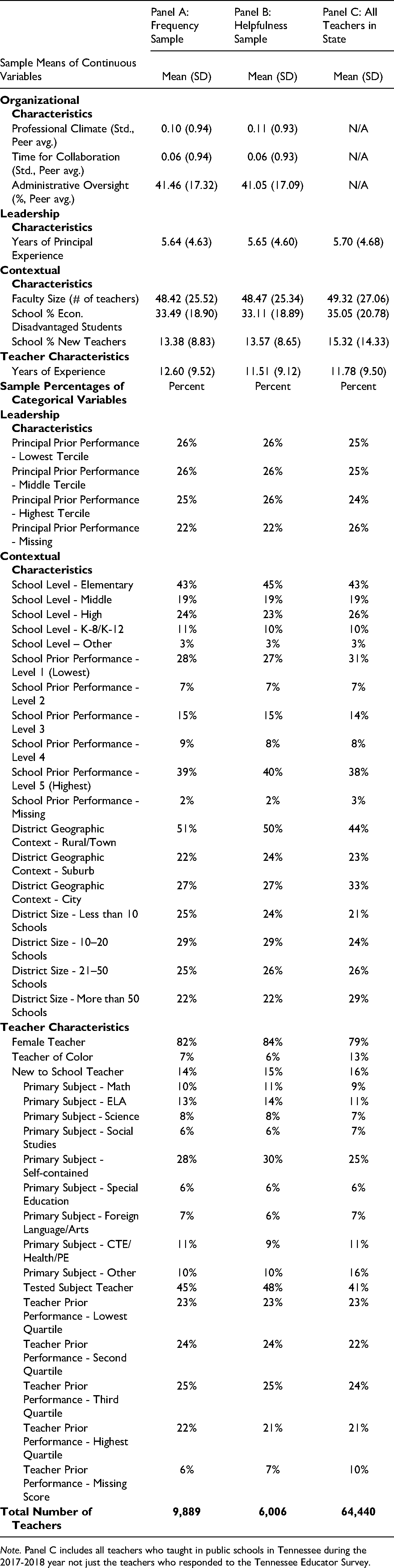
Note. Panel C includes all teachers who taught in public schools in Tennessee during the 2017-2018 year not just the teachers who responded to the Tennessee Educator Survey.
Measures
The following sections briefly describe the measures of interest in this analysis. Table 1 includes descriptive statistics for all independent and control variables.
Teachers also rated the extent to which certain activities were helpful when making decisions about the instructional strategies used in their classrooms. Teachers were only asked to rate the helpfulness of activities that they reported participating in at least once during the year. Thus, if teachers opted out of an activity because they did not perceive it as helpful, these measures may overstate the perceived helpfulness of a given activity. A confirmatory factor analysis indicated that these items load onto one factor (Eigenvalue = 1.86). I created a teacher-level average for the five collaborative activities for which teachers were asked to rate the helpfulness (Cronbach's alpha = 0.73). 3 For both frequency and helpfulness, the factor analysis informed the creation of each measure, but unweighted averages were created (rather than factor scores) to keep the sample as large as possible. 4 Table A1 lists the five helpfulness items and sample averages for each individual item. Unfortunately, a design error in the 2018 survey led many teachers to inadvertently skip the helpfulness questions. As a result, the number of teachers in the helpful analysis is substantially smaller than the frequency analysis. The helpfulness analyses should be interpreted with caution given this issue.
The first measure captures the professional climate within a school and is created using several survey items from the core survey (answered by all survey respondents). These questions ask teachers to report on issues such as trust, collective problem-solving, and staff satisfaction. An initial exploratory factor analysis with a broader set of teacher survey items identified the factor included in this analysis (named “professional climate”). The final survey items, reliability, and factor analysis results are shown in Table A2 in the supplementary materials. 5 This measure includes 6 items with a high degree of internal consistency (Cronbach's alpha = 0.92 on the individual-level survey items). Factor analysis confirmed that these items load onto one factor (Eigenvalue = 4.38). The second measure captures the extent to which teachers within a school report having time for collaboration by aggregating teacher response to a question on the core survey asking whether there is sufficient collaborative planning time. The third measure captures the estimated amount of administrative oversight within each school over teachers’ collaborative activities. Teachers were asked to estimate the percentage of collaborative activities determined by three groups of people within their school: (1) teachers, (2) designated teacher leaders or coaches, and (3) school and district leaders (on a 0–100% scale). This measure captures the percentage of collaborative activities that teachers estimate are determined by school and district leaders.
While intended to capture school-level phenomenon, each of these three measures is operationalized as a peer average. For each teacher in the analytic sample, I created a peer average for each measure that captures the aggregate response for all other teachers in the school who responded to the relevant survey questions (while excluding that teacher's response). I contend that these peer averages are better suited to capture school-level phenomenon than a given teacher's individual response and also mitigate the common source bias that can occur due to correlation among multiple variables measured by perceptual survey questions from the same respondent (Meier & O’Toole, 2013; Podsakoff et al., 2003).
Finally, this analysis includes two variables meant to capture principal leadership capacity. The first measure captures principal experience measured in total years as a principal. The second is an ordinal variable that measures principal prior performance as measured by a principal's prior-year evaluation score. 6
Analytic Approach
To answer the first question, I estimated the relationship between key organizational conditions of schools and the frequency or perceived helpfulness of collaborative learning opportunities. I treat frequency and helpfulness as separate outcomes and present two sets of results. For both outcomes, the primary model is a two-level, multi-level regression model that accounts for the nested structure of teachers within schools (Raudenbush & Bryk, 2002).
7
The following equation summarizes the full model:
Since frequency and perceived helpfulness are moderately correlated (polychoric correlations between the specific frequency and helpfulness items range between 0.31–0.55), all helpfulness models include frequency as a predictor to better isolate the relationship between the predictors of interest and perceived helpfulness. I also ran the helpfulness models without frequency as a covariate and these results are discussed in the results section.
To answer the second question, I create subsamples of the data based on school level (e.g., elementary, middle, high), school size, and school economic disadvantage level and then run separate regression models for each subsample. I present the results graphically to explore whether these associations vary in different contexts. In addition, I ran a model across the full sample with interaction terms to be able to measure whether differences in the relationships across contexts are statistically significant.
Results
Most teachers in this statewide sample report regularly engaging in collaborative learning opportunities and rate these opportunities as helpful in making instructional decisions. Almost all teachers (93%) report engaging in at least one collaborative activity at least monthly and 62% of teachers report engaging at least weekly. Most teachers report engaging in a grade-level or subject-area team (80%), asking for advice about teaching (62%), and collaboratively reviewing student assessment data (58%) at least monthly. In contrast, only 12% of teachers report engaging in peer observation at least monthly and 39% report providing or receiving instructional feedback at least monthly. These frequencies mirror those reported in the 2016 American Educator Panel, a nationally representative survey (Johnston & Tsai, 2018).
Overall, surveyed teachers rated these collaborative learning opportunities as helpful for making instructional decisions. Most teachers rated each specific activity as helping them “some” or “a lot” (between 69–90% of teachers depending on the activity). Teachers who engage more frequently in a collaborative activity tend to rate it as more helpful (polychoric correlations range between 0.31–0.55). However, 23% of teachers report regularly engaging in an activity that they rate as not helpful or only helping them “a little bit.” When examining this subset of teachers descriptively, middle school teacher, high school teachers, teachers in city school districts, and teachers in the largest school districts are all slightly overrepresented in this group when compared to all teachers in the helpfulness sample. Subsequent analyses try to disentangle how frequency and perceived helpfulness vary based on organizational conditions of schools.
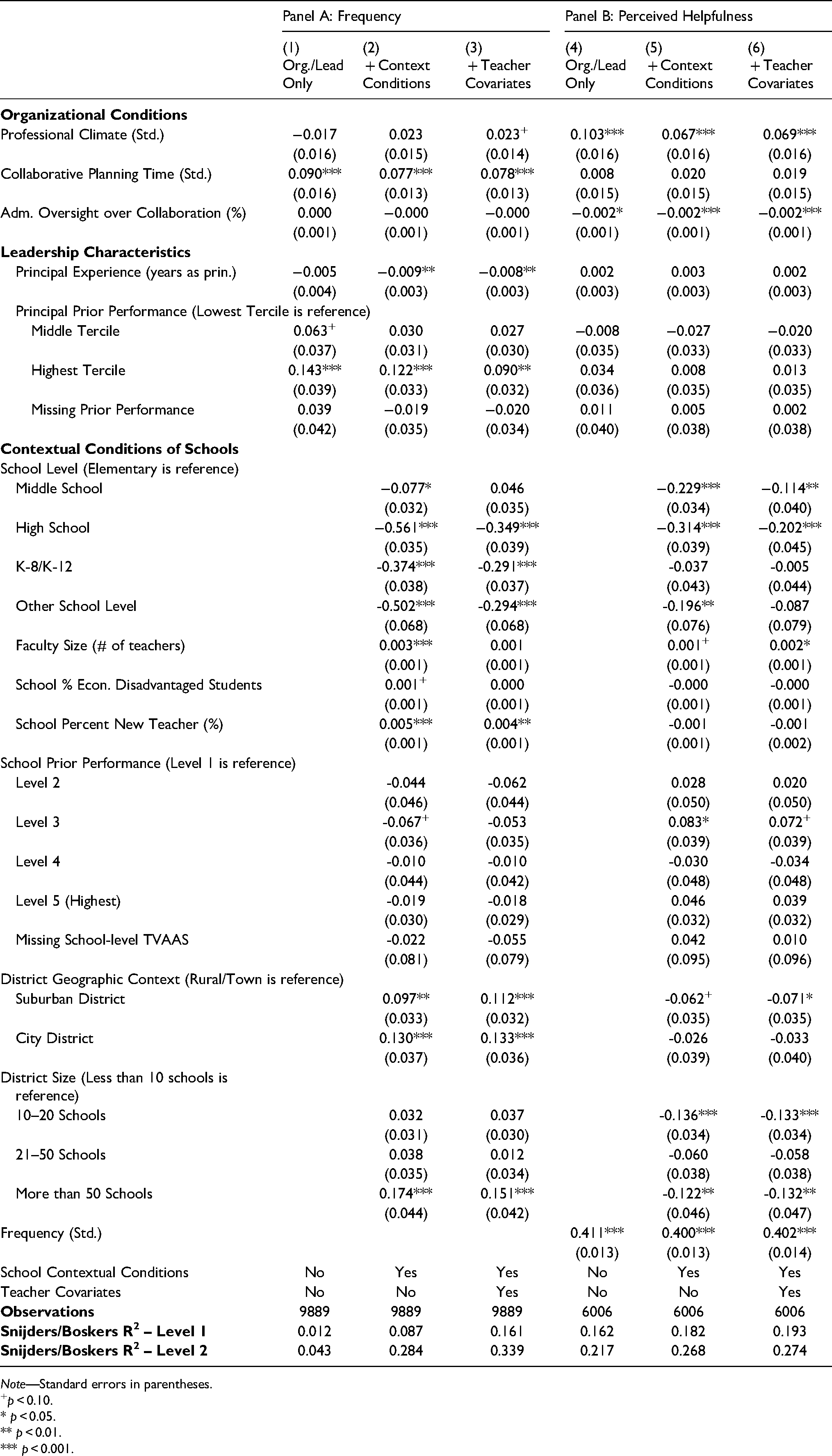
Both frequency and helpfulness vary significantly across teacher and contextual characteristics (see Table A3 and A4 in the supplementary materials for descriptive differences). There are particularly large differences across teaching assignments (e.g., ELA vs. math), school level (e.g., elementary vs. high), and district context (e.g., districts with more than 50 schools vs. districts with less than 10 schools). Table 2 displays these differences across contexts while controlling for organizational, leadership, and teacher characteristics. In terms of the contextual characteristics displayed in Table 2, the largest estimated differences are by school level and district size. Elementary teachers report significantly more frequent collaboration that teachers in high schools and K-8/K-12 schools, and elementary teachers rate this collaboration as significantly more helpful than middle and high school teachers (differences range between 0.1–0.5 sd across models). Teachers in the largest school districts (with more than 50 schools) report signfiicantly more collaboration than their peers in the smallest school districts (with less than 20 schools), but teachers in the largest districts rate this collaboration as less helpful than their peers in the smallest districts (differences range between 0.1–0.2 sd). These differences underscore the importance of accounting for contextual characteristics when trying to isolate the relationship between organizational conditions and collaborative learning experiences.
To What Extent Do Organizational Conditions of Schools Predict the Teacher-Reported Frequency and Helpfulness of Collaborative Learning Opportunities?
Table 2 presents a set of regression models predicting frequency (Panel A) and perceived helpfulness (Panel B). In this section, I separately describe the results of the frequency models and perceived helpfulness models because different patterns of results emerge depending on the outcome measure. All coefficients reported in the text are from the full models (shown in Columns 3 and 6) unless otherwise specified.
Organizational Conditions and Contextual Conditions on the Frequency and Perceived Helpfulness of Collaborative Learning Opportunities.
Note—Standard errors in parentheses.
p < 0.10.
* p < 0.05.
** p < 0.01.
*** p < 0.001.
The two measures of leadership capacity are also significantly associated with frequency but in opposite directions. When controlling for all other covariates including principal's prior performance, a one sd increase in principal experience (4.6 years of experience as a principal) is associated with a 0.04 sd decrease in the frequency of collaboration reported by teachers in their school. In contrast, principals’ prior performance (measured by their administrator observation score) is positively associated with frequency of collaboration. All else equal, teachers in schools whose principals were in the highest tercile of prior performance are predicted to engage more frequently ( + 0.09 sd) than teachers in schools whose principals were in the lowest tercile of prior performance. Although both sets of coefficients are statistically significant in every model, the magnitude is quite small. Among contextual conditions, there are consistent and significant differences in frequency across school level, district geographic context, and district size
Since prior research on collaboration suggests that leaders play an important role in setting expectations and providing shared purpose for collaboration in their school (Charner-Laird et al., 2017; McLaughlin & Talbert, 2006; Scribner et al., 1999), I explored whether certain amounts of oversight are associated with helpfulness with an additional analysis illustrated in Figure 1. Instead of using a linear measure of administrative oversight, schools were split into 10 ordinal groups of equal size based on their average rating of administrative oversight. These results suggest that the negative linear relationship between administrative oversight and perceived helpfulness is driven by schools with the highest levels of administrative oversight (the 10th decile includes schools in which more than 65% of collaborative activities are determined by leaders). The estimated difference in perceived helpfulness between the lowest and high oversight schools is 0.2 sd, and there are no statistically significant differences in helpfulness among schools in the first five deciles. This 0.2 sd difference translates into a change of 0.14 on the original 4-point scale. I also examined whether professional climate moderates the relationship between oversight and helpfulness by running a series of subgroup analyses. These results, illustrated in Figure 2, indicate that there is a stronger negative relationship between administrative oversight and helpfulness in schools with the lowest ratings of professional climate (β = 0.004; p-value<0.01). Leadership characteristics are not associated with perceived helpfulness in any of the models. There are few consistent associations between context and perceived helpfulness except for school level and district size.
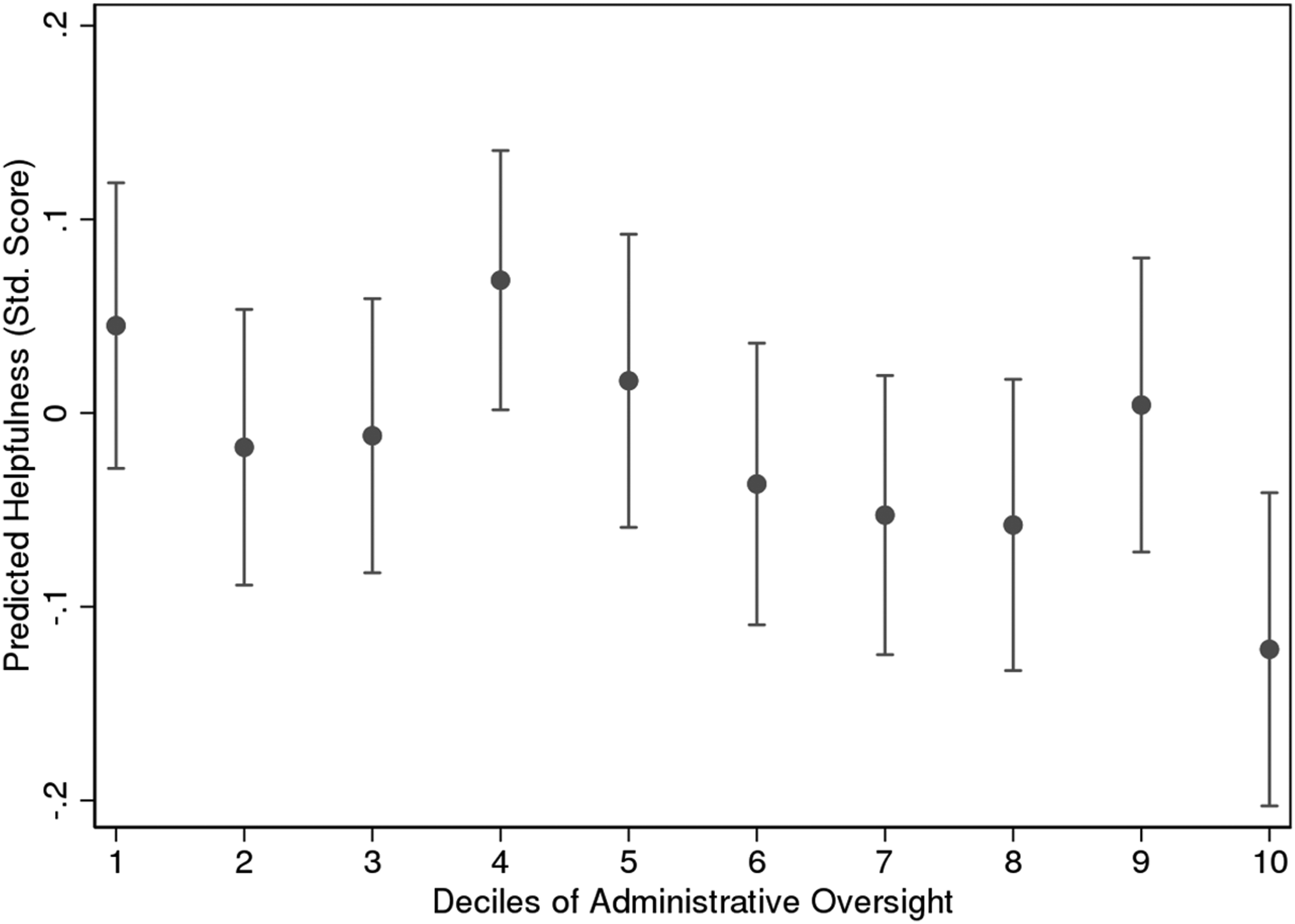
Perceived helpfulness by deciles of administrative oversight. Note—This figure illustrates the marginal effects of an ordinal variable capturing 10 deciles of administrative oversight, with all other covariates held at their mean. Administrative oversight is measured at the school-level using peer averages. Helpfulness is measured at the individual teacher level.
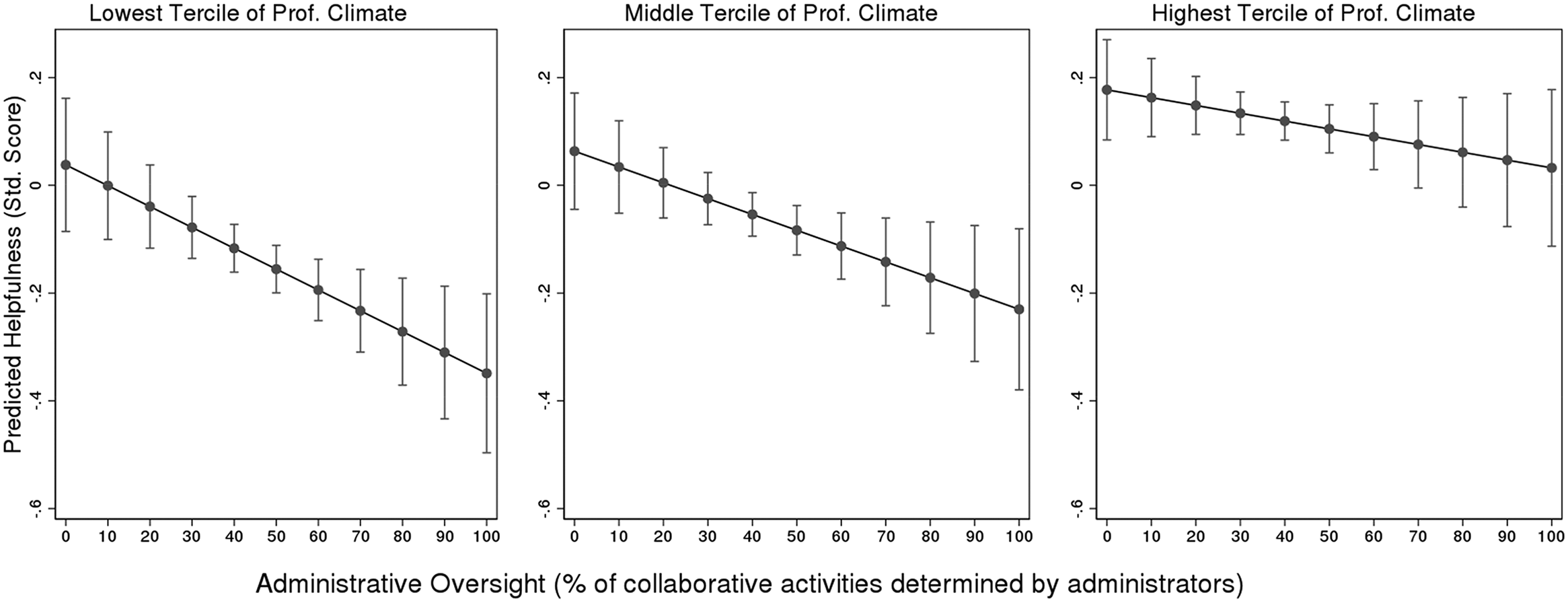
Differential relationship between administrative oversight and helpfulness, by professional climate. Note—This figure illustrates the marginal effects of administrative oversight, with all other covariates held at their mean. The sample has been split into three subsamples based on professional climate scores and separate regression models have been run within each subsample. Both professional climate and administrative oversight are measured at the school-level using peer averages. Helpfulness is measured at the individual teacher level.
How do These Reported Associations Vary Across School Context?
To answer the second research question, I examined whether the three consistent associations described above vary across school level, school size, and school poverty level. The first set of analyses ran the full regression models—mirroring Column 3 and 6 in Table 2—for each subgroup (e.g., separately running the analysis for elementary schools, middle schools, high schools, and K-8/K-12 schools). These results are presented in Figures A1 and A2 in the supplementary materials and Figure 3 in the main text. Figure A1 shows the estimated relationship between collaborative planning time and reported frequency of collaboration across different school levels (Panel A), terciles of school size (Panel B), and terciles of school poverty (Panel C). Figure 3 illustrates the same set of subgroup results for the relationships between professional climate and perceived helpfulness, and Figure A2 shows the subgroup results for administrative oversight and perceived helpfulness. Each figure illustrates the predicted relationship between a given organizational condition and collaboration across each school context 9 . To assess whether differential relationships were statistically different, I also conducted a second set of analyses in which the full regression models included the organizational conditions of interest interacted with each contextual condition (see Tables A5, A6, and A7 in the supplementary materials for these analyses).
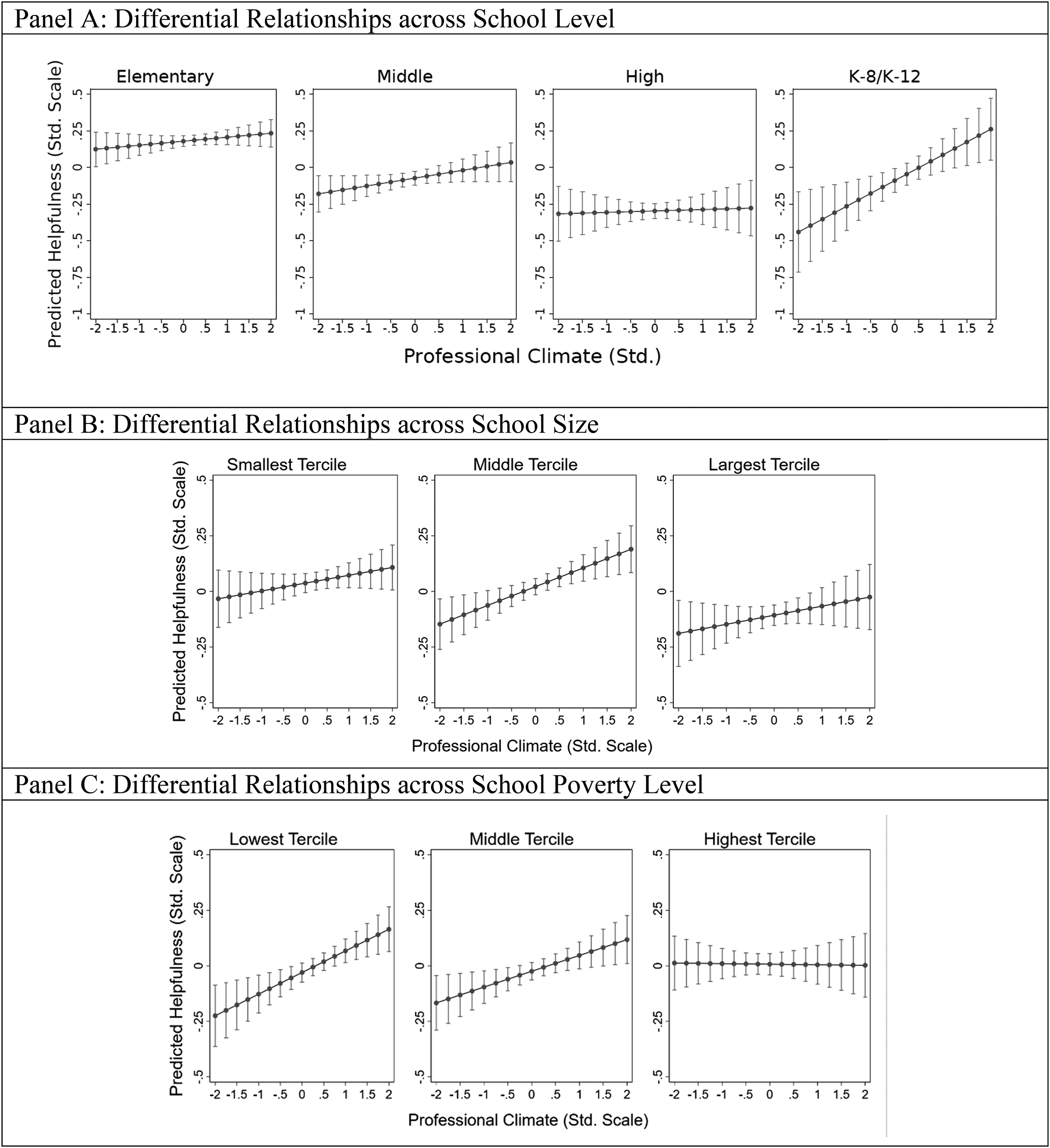
Differential relationships between professional climate and helpfulness, by school context. Note—This figure illustrates the marginal effects of professional climate, with all other covariates held at their mean. The sample has been split into subsamples based on school level, school size, and school poverty level, and separate regressions have been run within each subsample. Professional climate is measured at the school-level using peer averages. Helpfulness is measured at the individual teacher level.
Discussion
Overall, almost all teachers in this statewide sample report regularly participating in at least one collaborative learning activity. This reported frequency is similar to estimates from other large teacher surveys (Johnston & Tsai, 2018; Ronfeldt et al., 2015) and supports the argument that peer collaboration is increasingly becoming a universal expectation of teachers’ professional practice (Hargreaves, 2019; Johnson, 2012). For many teachers, it appears that their professional experiences no longer mirror the traditional notion in which teachers work as sole practitioners behind closed doors in “egg crate” schools (Lortie, 1977).
However, this analysis also shows that not all teachers engage as frequently in collaboration or rate that collaboration as helpful in making instructional decisions. Certain types of teachers—notably special education, creative arts, foreign language, and career and technical education teachers—and teachers in certain types of schools—including K-8/K-12 schools and schools in small, rural districts—appear to engage in less frequent collaborative learning opportunities. These teachers are largely absent in the existing research base on collaboration. Most prior studies focus on elementary teachers, teachers in core academic subjects, or teachers in large, urban districts. Future research should consider the extent to which teachers across a broader range of teaching contexts have access to collaborative learning opportunities.
Certain organizational conditions also appear related to teacher engagement in collaboration. Not surprisingly, peer ratings of sufficient collaborative planning time are positively and significantly associated with frequency of collaboration. The estimated relationship is small in magnitude but consistent across all school contexts studied here. Because this measure of collaborative planning time is relatively indirect (it is constructed as a peer average and asks teachers about sufficient collaborative planning time rather than their actual time allotted), this analysis likely underestimates the true relationship between collaborative planning time and frequency of collaboration. Nevertheless, this finding further confirms—across a broad range of school contexts—what is often reported in case studies of professional learning communities and other collaborative programs: dedicated time is a critical facilitating condition to creating meaningful collaborative learning opportunities for teachers (McLaughlin & Talbert, 2006; Stoll et al., 2006; Vangrieken et al., 2015).
When examining perceived helpfulness of collaboration, peer ratings of professional climate are positively associated with a given teacher's ratings of helpfulness. This aligns with prior work on professional communities (Bryk et al., 1999; Stoll et al., 2006; Tschannen-Moran, 2001) and extends this work by looking at how this relationship varies across school contexts. Most notably, this analysis finds a much stronger relationship between professional climate and perceived helpfulness in K-8//K-12 schools and a weaker relationship between professional climate and perceived helpfulness in high poverty schools. The finding related to high poverty schools is puzzling given how prior work has emphasized the importance of supportive working conditions in high poverty schools (Johnson, 2006; Klar & Brewer, 2013). Future research examining professional climate across contexts may be important to further explore these relationships and test the extent to which school context moderates this relationship between the broader professional climate and engagement in collaborative learning activities.
Additionally, teachers rate their collaborative activities as less helpful for making instructional decisions when they report high levels of administrative oversight (i.e., school and district leaders are heavily involved in determining how teachers spend their collaborative time). This negative relationship between administrative oversight and perceived helpfulness is stronger in schools with weaker professional climates and larger schools. More centralized decision-making about collaborative time (in which school and districts leaders share less decision-making power with teachers) may lead to collaboration that focuses primarily on topics or activities that serve the interests of formal leaders rather than the instructional needs of teachers. In contrast, prior studies of how school leaders distribute leadership through collaborative structures emphasize the importance of teacher leadership and shared decision-making in implementing professional learning communities (Bagwell, 2019; Charner-Laird et al., 2017). The findings suggest that distributing decision-making related to collaboration may be especially important in contexts in which formal school leaders have weaker connections to the instructional problems of practice (e.g., larger schools) or in which school staff have less trust, collective problem-solving, and sense of satisfaction (i.e., schools with weaker professional climates).
Limitations
While this analysis offers suggestive evidence about how collaborative learning opportunities vary across contexts and organizational conditions of schools, I must acknowledge certain limitations that influence the interpretation of these findings. First, I have intentionally framed the analysis around collaborative learning opportunities because this study does not directly measure how and whether teachers learn from collaboration. Instead, I created two measures from survey items that asked teachers to report on the frequency and helpfulness of certain types of instructionally-focused collaboration hypothesized to support professional learning. These measures are unable to capture the nuances of how teachers engage in collaboration and whether that engagement leads to instructional improvement. Importantly, perceived helpfulness as reported on a teacher survey may not actually capture the extent to which collaboration promoted reflection and learning on the part of teachers. Indeed, teachers may rate collaborative activities that are deeply focused on critique and instructional change (both of which can be difficult and time-consuming) as less helpful. However, I argue that these measures offer an important signal about the potential of their collaborative experiences to support teacher learning and align with measures used in prior quantitative work on collaboration (Goddard et al., 2015; Ronfeldt et al., 2015). Future research that captures instructional practice over time along with more nuanced measures of collaboration would be better situated to disentangle perceived helpfulness and more concrete evidence of changes in pedagogical knowledge or instruction.
This analysis is also cross-sectional and correlational, and it is unable to determine the direction of the relationships estimated here. For example, a school's professional climate and leadership may encourage more helpful collaboration, but it is also possible that more helpful collaboration builds a more supportive professional climate (these may also be reciprocal processes). Future analysis using longitudinal data could better disentangle these relationships.
Implications for Practice
These implications may be most relevant for school and district leaders considering how to organize their schools to support collaborative learning. The findings indicate that teacher engagement in collaborative learning opportunities varies across contexts and that certain organizational conditions—which school leaders can often directly or indirectly influence—may make a difference in terms of teacher engagement. One-third of teachers in this sample reported insufficient collaborative planning time in their school. Planning time consistently and positively predicts how frequently teachers report engaging in collaboration. By state law, Tennessee districts are only required to provide teachers 2.5 h of planning time per week and collaborative planning time is not required (Wright, 2012). Teachers’ time is a precious resource, and school and district leaders should consider how to build school schedules that allow teachers to regularly collaborate with their peers during the school day. Leaders can schedule common planning time to facilitate structured collaboration among certain groups of teachers (e.g., a grade-level or subject-based department), and they are also in a position of authority to safeguard that time from being interrupted by other tasks (Nordgren et al., 2021; Stoll et al., 2006). To create regular, protected time for teacher collaboration, leaders may need additional school staff to cover other responsibilities (e.g., lunch duty, recess, enrichment activities) so that teachers can engage in collaborative learning opportunities. In addition, leaders can offer additional financial incentives or professional development credit for teachers to collaboration outside of school hours (Carroll et al., 2021).
Given teachers’ limited time, it is important to consider how to make the most of collaboration. These findings suggest that teachers may rate their collaboration as more instructionally helpful when working in schools with stronger professional climates. One potential pathway for leaders to encourage helpful collaboration within their schools is building relational trust with and among staff by demonstrating their competence (e.g., being visible and actively engaged in classrooms), emphasizing respect, and maintaining consistent expectations (Handford & Leithwood, 2013; Tschannen-Moran, 2001).
Furthermore, the findings also indicate that teachers rate their collaboration as more effective when they have more oversight in determining how they spend their collaborative time. On average, surveyed teachers estimated that school and district leaders determined 41% of their activities during collaborative time. Of the almost 1500 schools in this analysis, teachers in one-tenth of schools reported that administrators determined more than 65% of collaborative activities. Teachers in this latter group of schools rate their collaboration as being significantly less helpful than peers in schools in which teachers have greater autonomy over their collaboration. In these “high oversight” schools, leadership-driven collaboration may more closely resemble the “contrived collegiality” and “compliance-oriented” collaboration found in other research on collaboration (Hargreaves, 2000; Talbert, 2010). In these schools, collaborative mandates and associated routines—such as regular data meetings in which teachers are required by their leaders to report on the progress of struggling students—may constrain teachers’ ability to discuss instructional challenges or address their current needs (Datnow et al., 2020). Distributed leadership approaches, in which teachers are actively involved in school decision-making and work with leaders to develop shared goals for collaboration, may be one way to combat against overly bureaucratic collaborative structures (García Torres, 2019; Talbert, 2010). Notably, when looking across contexts, oversight has the strongest negative relationship with perceived helpfulness in contexts in which it may be most difficult for leaders to authentically engage with teachers around collaboration (e.g., schools with weaker ratings of professional climate and larger schools). These schools may particularly benefit from distributed approaches to leading and organizing collaboration.
Interestingly, administrative oversight does not appear to be related to teacher-reported frequency. Teachers in “low oversight” schools appear to participate just as frequently in collaborative learning opportunities as teachers in “high oversight” schools. Overall, the pattern of results suggest that leaders should be cautious in mandating how teachers spend large portions of their collaborative time without sharing decision-making with teachers. However, this analysis is unable to examine how leaders influence teachers’ collaborative work and whether certain types of oversight are helpful. Qualitative case studies of teacher workgroups emphasize how different leadership approaches can influence whether teachers find collaboration productive and underscore the importance of school leaders partnering with teachers to ensure that collaborative learning opportunities meaningfully address the needs of individual teachers (Charner-Laird et al., 2017; Horn et al., 2018; McLaughlin & Talbert, 2006; Scribner et al., 1999). However, it may also be the case that leaders must sometimes intervene in schools without an existing culture of collaboration and that school leaders may need to use hierarchical and structural approaches to “arrange collegiality” among teachers as a first step (Ford & Youngs, 2018). Future analyses should consider more nuanced measures of administrative oversight or mixed methods approaches to further investigate how leadership approaches are associated with teachers’ reported experiences with collaboration. Given the potential for collaboration to support teacher learning, future work should further consider the extent to which all teachers have access to regular and relevant collaborative learning opportunities.
Supplemental Material
sj-docx-1-eaq-10.1177_0013161X221107628 - Supplemental material for Organizing Schools for Collaborative Learning: School Leadership and Teachers’ Engagement in Collaboration
Supplemental material, sj-docx-1-eaq-10.1177_0013161X221107628 for Organizing Schools for Collaborative Learning: School Leadership and Teachers’ Engagement in Collaboration by Susan Kemper Patrick in Educational Administration Quarterly
Footnotes
Acknowledgments
This project was made possible by the Tennessee Education Research Alliance at Vanderbilt University and the Tennessee Department of Education. Thanks to the Albert Shanker Institute for their financial support through the Eugenia Kemble Research Grant. I would like to thank Ellen Goldring, Joanne Golann, Jason Grissom, and John Papay for their feedback and support throughout the development of this research. Finally, additional thanks to Laura Rogers for providing feedback on multiple drafts of this manuscript.
Declaration of Conflicting Interests
The author(s) declared no potential conflicts of interest with respect to the research, authorship, and/or publication of this article.
Funding
The author(s) disclosed receipt of the following financial support for the research, authorship, and/or publication of this article: This work was supported by the Eugenia Kemble Research Grant from the Albert Shanker Institute,

Supplemental Material
Supplemental material for this article is available online.
Notes
Author Biography
References
Supplementary Material
Please find the following supplemental material available below.
For Open Access articles published under a Creative Commons License, all supplemental material carries the same license as the article it is associated with.
For non-Open Access articles published, all supplemental material carries a non-exclusive license, and permission requests for re-use of supplemental material or any part of supplemental material shall be sent directly to the copyright owner as specified in the copyright notice associated with the article.
