



Abstract
Keywords
Introduction
Over the course of 2021, local school board meetings across the United States transformed from quiet, sparsely attended sessions to dramatic sites of community anger and protest (Ferrare & Phillippo, 2021; Ujifsa, 2021). The National School Board Association (NSBA) requested assistance from federal law enforcement: to deal with the growing number of threats of violence and acts of intimidation occurring across the nation. Local school board members want to hear from their communities on important issues and that must be at the forefront of good school board governance and promotion of free speech. However, there also must be safeguards in place to protect public schools and dedicated education leaders as they do their jobs (2021a, p. 1).
Reflecting the national scope of politicized board conflicts, the letter became its own flashpoint for controversy. Multiple state school board associations withdrew in protest from NSBA (Meckler, 2022), prompting the organization to issue an apology (NSBA, 2021b). Ostensibly, two issues were at the center of the conflict between local school boards and their community members: COVID-19 policies, and the possible instruction of Critical Race Theory in K-12 public schools (NSBA, 2021a; Ujifsa, 2021). The specific policies under debate, however, are a proxy for a broader source of contestation: local control of public education.
Local control is a foundational concept for U.S. public education, dating back to common schools established during colonial times (Bryan, 2010; Jacobsen & Saultz, 2012); schools, as primary public institutions, are governed by their local communities (Schafft, 2016; Tyack, 1974). Local control is typically enacted by democratically elected community members who serve on a board of trustees or school board. However, local control consistently generates controversy, such as the proliferation of political elites in power, cronyism, and corruption, and the lack of board professionalism (Kowalski et al., 2011; Tyack, 1974). Poor student outcomes and weak school standards have been attributed to ineffective school boards (Hochschild, 2005; Kirst, 2008), prompting state-level systemic reform to centralize organizational governance (Marsh & Wohlstetter, 2013). Some of these reforms were intended to curtail community-driven educational inequities (Diem et al., 2015), as locally enacted education policies can institutionalize oppressive and discriminatory values reflected in the community board (Gutmann, 2001; Tieken, 2017). Yet scholars continue to analyze the limits of and barriers to democratic board representation (Bertrand & Sampson, 2022; Sampson, 2019; Trujillo, 2013).
School boards are also less local, as the 2021 NSBA conflict illustrated. Board elections are increasingly nationalized through campaign financing from special interest groups (Henig et al., 2019; Reckhow et al., 2017). At the same time, local political actors are leveraging board meetings to engage voters with both local and national issues (Sawchuck, 2021). The work boards carry out—making educational policies, approving budgets, and overseeing superintendents—has largely been curtailed (Loeb & Strunk, 2007; Mountford, 2008). Many states have centralized district governance by delegating authority to superintendents and state agencies. As a result, school boards now “focus …on accommodating state priorities and ‘correcting’ state policies more than determining local school priorities and policies” (Loeb & Strunk, 2007, p. 201). Instead of implementing locally developed educational policies for their districts, school boards essentially rubber stamp their approval for policies created by superintendents, state agencies, or special interest groups (Malen, 2003; Scribner, 2016).
Despite limitations, school boards remain the primary form of oversight for the superintendent and central office. Boards are responsible for hiring, evaluating, and retaining superintendents, as well as other educational administrators and teaching staff in their districts (Sutherland, 2020). Superintendents must, therefore, carefully negotiate their relationships with school boards to ensure longevity in the role (Kowalski et al., 2011). However, little research has been conducted on superintendent-board relations in locally controlled districts. Rather, research on local control primarily examines the work of professional educators—superintendents, central office staff, principals, and teachers—rather than democratically elected school board members (e.g., Cohen, 1982; Spillane & Thompson, 1997). Furthermore, although rural districts are more likely to retain local control (Sutherland, 2022), the majority of research has been conducted in non-rural contexts.
In this qualitative case study, I examine board–superintendent relationships in rural, locally controlled districts. The study is situated in a multi-district union, where the superintendent oversees multiple locally controlled school boards within a single geographic region. By bounding the case to a single rural superintendent's relationships with three local school boards, the research enables an unusual opportunity to understand the dimensions of local control and board–superintendent relationships. Two questions guide this research: (1) to what extent do local will and local capacity shape the enactment of local control by rural school boards, and (2) how do dimensions of local will and local capacity affect superintendent–school board relations? By addressing these questions, this research serves to provide timely insights into the dimensions of local control, as well as needed strategies for district leaders to navigate locally controlled school boards.
Review of Research
Although local control of education is popular in the United States (Jacobsen & Saultz, 2012), rural districts are more likely to retain tight school-community partnerships than nonrural districts (Loeb & Strunk, 2007; Sutherland, 2022). It is, therefore, useful to center research in rural contexts to best understand the relational dynamics of locally controlled districts. Over half of all public school districts in the United States are rural (National Center for Education Statistics [NCES], 2020). Likewise, the majority of superintendents begin their careers in rural school districts (Kowalski et al., 2011), although Grissom and Andersen (2012) hypothesize rural placements serve as a “stepping stone” for better positions elsewhere (p. 1173).
Superintendents are expected to navigate their relationships with school boards to ensure effective educational governance, as well as stay employed. This is particularly relevant in small and rural districts, superintendents are more likely to engage in a “fishbowl” of scrutiny from community members (Rey, 2014). Superintendents of small and rural districts have higher rates of turnover, by personal choice or school board decision, than their urban and suburban colleagues (Williams et al., 2019). The most common factors for superintendent turnover are a lack of trust between the board and superintendent (Weiss et al., 2018) and significant conflict between the board and superintendent (Kowalski et al., 2011; Rey, 2014; Tekniepe, 2015; Williams et al., 2019). District leaders must strategically navigate the board and community expectations to remain in their roles (Björk & Lindle, 2001; Grissom & Andersen, 2012; Kamrath & Brunner, 2014). Even when rural superintendents maintain positive relationships with their school boards, school boards turn over with election cycles (Alsbury, 2003). New school boards may have different agendas and expectations for the district leaders (Williams et al., 2019), increasing the likelihood of superintendent attrition (Kamrath & Brunner, 2014).
Local Control and Board–Superintendent Relations
Developing effective professional and personal relationships with school board members, regardless of their tenure, can be difficult for superintendents. The challenges of navigating school board relationships are well-documented (Danzberger, 1994; Ford & Ihrke, 2017; Petersen & Short, 2001; Trujillo, 2013; Weiss et al., 2018). A recurring cause of board–superintendent conflicts is role confusion: when school board members become confused about the parameters of their work and attempt to take on responsibilities assigned to the superintendent (Glass et al., 2001; Land, 2002). Role confusion can become “a catalyst for controversy that severely weakness trust and collaboration between the superintendent and his or her board” (Mountford, 2008, p. 86). From this perspective, the gradual decline of local control has disempowered the authority of school boards while exacerbating confusion over governance responsibilities.
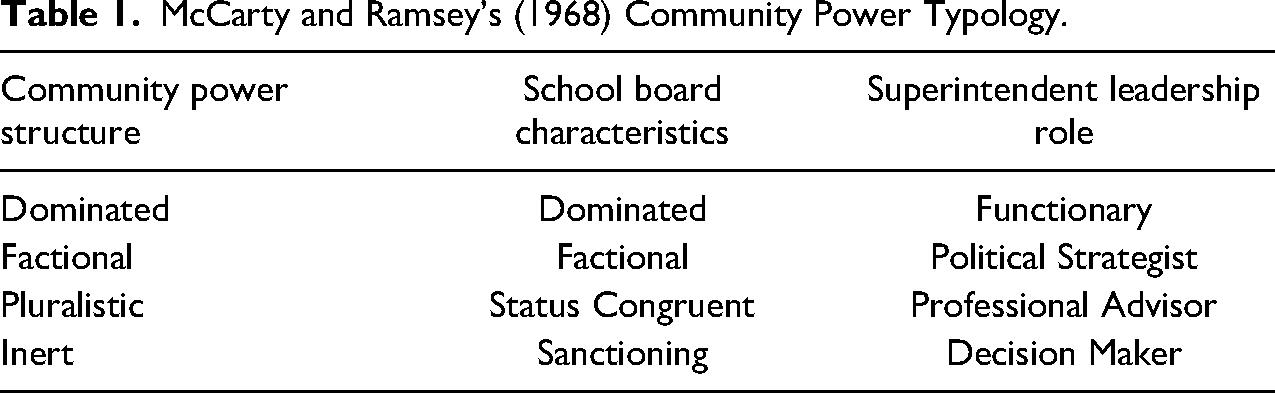
The foundational theory of school board and superintendent relationship dynamics was developed by McCarty and Ramsey (1968, 1971). The research predates national educational reforms that centralized and professionalized aspects of educational governance, yet McCarty and Ramsey's (1968, 1971) seminal framework explains the intersection of community context and educational governance. McCarty and Ramsey (1968) conceptualized relationships between the power structures of communities, school boards, and superintendents (see Table 1). McCarty and Ramsey (1968) tested their hypotheses using a stratified sample, correlating types of school board structures with types of superintendent roles. Superintendent–board relationships are informed by the underlying power structures; misalignment of these structures can cause conflict and superintendent turnover (McCarty & Ramsey, 1971).
McCarty and Ramsey's (1968) Community Power Typology.
In 2001, Björk and Lindle revisited the community power theory, finding over 97% of study participants “reported roles incongruent with their perceptions of their communities’ power structures” (p. 86). The authors hypothesized that the “seemingly politically suicidal leadership strategies” of superintendents who did not adapt to local board dynamics may be due to “(a) professional culture, (b) inadequate preparation, and (c) limitations on methods used to ascertain superintendents’ roles in their work with boards” (Björk & Lindle, 2001, p. 86). Similarly, Alsbury (2003) also concluded that future research on school board–superintendent relations necessitated qualitative, case study methods to understand the complexities of community, board, and superintendent factors. This study is designed to address these methodological recommendations of Alsbury (2003) and Björk and Lindle (2001). Given the rapid expansion of community engagement with local school boards, it is now increasingly important to ensure superintendents and board members have the necessary understanding of interrelational dynamics.
Local Control as a Framework: Will and Capacity
Local control has come to incorporate multiple meanings, predominantly the implementation of local-based governance over state and federal political oversight (Loeb & Strunk, 2007; Scribner, 2016). In an analysis of local control and accountability measures, Loeb and Strunk (2007) defined the construct as: discretion over spending (fewer funds in categorical aid), decentralization of school finance systems (local ability to vote on education finance, the absence of tax limits for education, and court rulings overturning local finance structures), and greater principal autonomy over school-level decisions, specifically regarding hiring and spending (p. 16).
Loeb and Strunk (2007) note the definition excludes nonfinancial dimensions of local control. Yet relational dynamics between district and community leaders are a central component of locally controlled educational governance (Spillane & Thompson, 1997; Sutherland et al., 2022). Educational leaders must make sense of and negotiate for fiscal and policy decisions, ensure implementation, and communicate decisions and outcomes to their communities (Sutherland, 2022). The degree of success for any initiative, program, or policy, therefore, depends on the relational acumen of educational leaders.
Two constructs delineate relational aspects of local control: local capacity and local will. Local capacity is closely intertwined with local will as an educational policy theory to understand local actors’ enactment and interpretation of policy (Coburn, 2003; Elmore & McLaughlin, 1988). They align with the sociological theory of community capacity, “the interaction of human capital, organizational resources, and social capital existing within a given community that can be leveraged to solve collective problems and improve or maintain the well-being of a given community” (Chaskin, 2001, p. 295). Rural sociologists (Beckley et al., 2008) also include natural capital, such as farmland, fisheries, or tourism and recreation areas. In educational research, discussions of community or local capacity include inputs, such as resources, knowledge, and networks, and outputs, such as the interpretation, adaptation, and implementation of policy (Coburn, 2003; Elmore & McLaughlin, 1988; Spillane & Thompson, 1997).
Local will is the interest and commitment of local actors in a defined community to enact a specific policy (Firestone, 1989; McLaughlin & Talbert, 1993). Enacting local will requires social capital, which Chaskin (2001) defines as “a level of commitment among community members” as well as “a sense of community” (p. 296). In educational policy research, local will is used to understand the extent to which local leaders influence the implementation of education policies (Spillane, 1999; Sutherland, 2022).
It is likely that capacity will explain school board actions in locally controlled systems; however, this theory primarily has been used to understand the work of professional educators, such as superintendents, central office staff, principals, and teachers (e.g., Coburn, 2003; Spillane, 1999; Spillane & Thompson, 1997). Yet Björk and Lindle's (2001) research on community power structures suggests the dimensions of local control may influence board–superintendent relationships. Examining the extent to which will and capacity shape the enactment of local control by rural school boards should also engender knowledge of how these factors influence board–superintendent relations.
Research Design and Methodology
The study is designed as a qualitative case study of one supervisory union (SU) and three SU school districts to examine the relationship between locally controlled school boards and a superintendent. The case study provides an unusual opportunity to analyze how different school boards, within the same bounded geographic and educational system, interact with the same SU superintendent. This research was conducted with IRB approval from my prior institutions. All sites and participants are identified with pseudonyms. To ensure confidentiality, as research in rural communities is complicated by small populations where participants can be easily identified through personal or professional characteristics (White & Corbett, 2014), some personal, professional, and place-based characteristics have been obscured.
State Context
The SU is located in Vermont, one of the few states that resist reforms aimed at consolidation and centralization (Rogers et al., 2014), and therefore, provides a rich opportunity to analyze the autonomy of school boards in a state with decentralized governance. Vermont's Agency of Education (AOE) limits state-level accountability and oversight of local districts, engendering systemic autonomy (Holcombe, 2014). The decentralized education system is largely unchanged from the common school model; local control of education has been continuously enacted for over 200 years (Bryan, 2010).
Vermont's districts are loosely organized into SUs, supervisory districts, or interstate districts, which are overseen by superintendents and school boards. These districts also encompass variability in organizational structures. There are 12 distinct district governance structures, ranging from single towns that tuition all students, to multiple-town school unions with jointly run schools. The precise number of school boards in Vermont is unclear, as some communities retain multiple boards within the same district. In 2014, the Vermont School Boards Association estimated there were 290–300 school boards operating; there are 255 towns in the state.
The governance structures of Vermont's multi-district SUs engender exceptional opportunities to analyze board–superintendent relations. A single superintendent works with a centralized SU-board, as well as with each community school board (Vermont Agency of Education, 2015). Although a multi-district superintendency is unusual, 13 states employ a similar governance structure, including Maine, Massachusetts, and South Carolina (Hall & McHenry-Sorber, 2017; McHenry-Sorber & Sutherland, 2019).
Supervisory Union and District Context
The SU was purposefully selected (Creswell & Poth, 2016) to enable a cross-case comparison of superintendent relations with locally controlled school boards. Selection criteria included the rural locale, multi-district organizational structure, evidence of locally controlled school boards, and interest in participating in the study. The case study SU was geographically large, encompassing 10 towns, each of which retained a district school board as well as unified or joint boards (see Table 1). The SU was led by a composite board made up of three members per school board, with more than 25 members. The superintendent oversaw a small central office, staffed by five full-time employees. The small size of the central office is typical of rural districts (Sutherland et al., in press; Wood et al., 2013), which have smaller budgets and fewer resources than nonrural districts. The organizational structure of the SU was representative of other multi-district unions in the state.
I bounded case study sites to single town districts with one school board and one school for cross-case comparison (Creswell & Poth, 2016) of the enactment of local control. Out of the 10 towns in the SU, four met the study criteria: Ashfield, Jackson, Conway, and Blue Hill. Initially, all four towns were included in the study. Blue Hill was subsequently removed from analysis after I realized the site was too small to ensure participant confidentiality. Of the remaining three case study sites, each encompassed a primary school (PreK or K through 6th or 8th grade) and provided school choice for middle and/or high school (see Table 2).
Case Study Supervisory Union Organization, 2016.
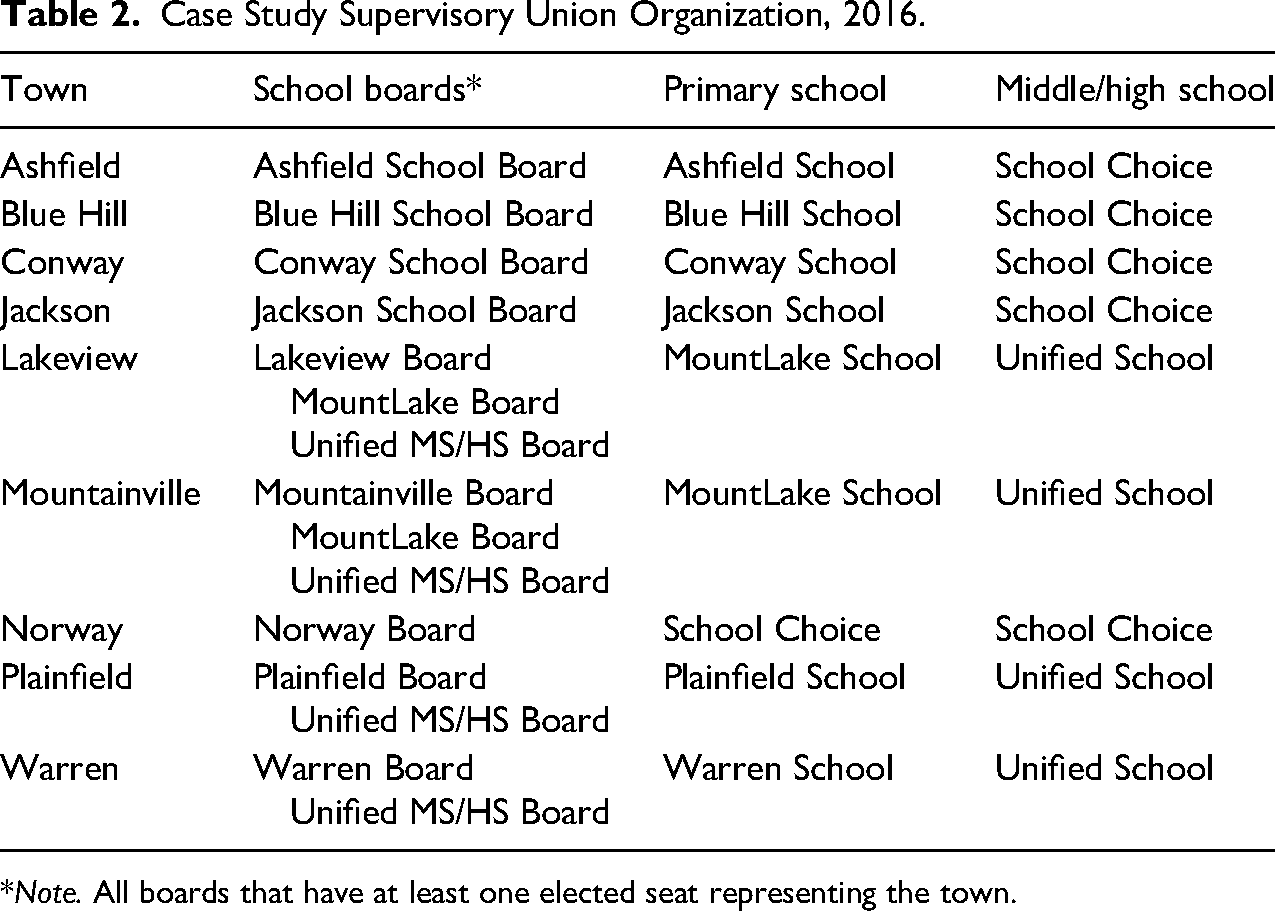
*Note. All boards that have at least one elected seat representing the town.
Data Collection
I collected data between 2013 and 2016 and completed a follow-up research trip in 2022. I completed nine fieldwork trips; each lasting between one to two weeks. Data sources included interviews, observations, and educational policy and governance documents (see Table 3). Data collection encompassed some variability due to scheduling conflicts (e.g., simultaneous town or board meetings) and participant availability. Some participants held multiple roles, and others changed roles over the course of the study. I interviewed these participants at least two times, using the role-specific interview protocols for each position (see Table 3).
Characteristics of Case Study Districts.
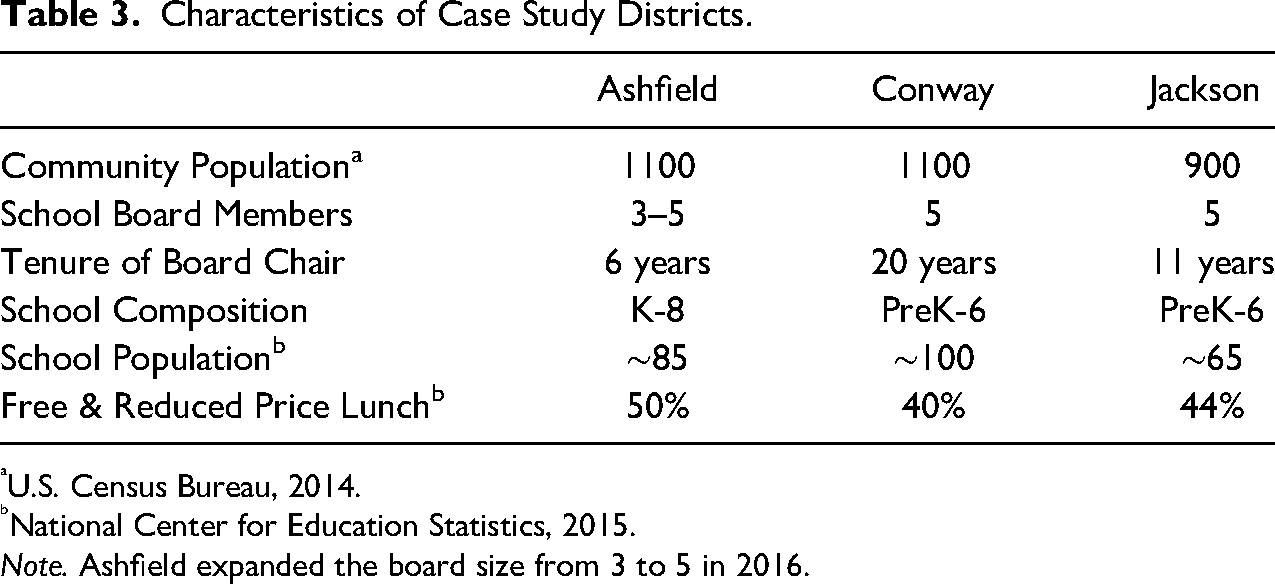
Note. Ashfield expanded the board size from 3 to 5 in 2016.
On the SU level, I conducted three semistructured interviews with the superintendent, four phone conversations, and 9 hours of informal face-to-face conversations. I also conducted two semistructured interviews with the SU board chair and four hours of informal face-to-face conversations. The informal conversations were preemptively disclosed as research material, documented as memos, and were used to provide background context for the SU and individual districts. I used role-specific interview protocols (Creswell & Poth, 2016) to surface aspects of the theoretical framework, including local capacity, will, and board–superintendent relationships. All SU interviews were recorded and transcribed.
On the district level, I conducted two interviews with each board chair. I interviewed each district principal four times, and I conducted up to two interviews with 10 of the 12 district board members (see Table 4). Two board members were unable to participate due to scheduling conflicts. I interviewed former board members, three from Ashfield, and one from Conway, to provide additional perspectives (see Table 5). Again, I used semistructured, role-specific interview protocols that explored elements of my theoretical framework. Topics for district-level interviews included but were not limited to, district governance, district and SU role allocation and confusion, perceptions of leadership, and the historical, social, political, and economic context of their districts. All district-level interviews lasted between 30 and 90 min and were recorded and transcribed.
Data Collection Table, 2013–2016.

Note. * Participants who held more than one role over the course of the study.
School Board Composition of Case Study Districts, 2016.

*Board members appointed in 2016, following Ashfield's expansion to five members.
I conducted 34 hours of ethnographic observations of nine school board meetings, four annual town and school meetings, one SU-wide board meeting, and one SU leadership team meeting. I observed the routine work of boards, relations with the superintendent and administrators, and variations in governance routines across the sites. Meetings also provided opportunities to observe the superintendent's relationships and interactions in different professional settings. To document the nuances of these relationships (Hammersley & Atkinson, 2007), I recorded my perception of participants’ emotional tone (e.g., frustrated, dismissive, worried), physical movements, and seating arrangements, as the board meetings were mostly held in informal settings. Documenting the observations also served as a second source for data triangulation, as I compared what participants discussed in interviews with observations from meetings.
I also collected publicly available documents including official agendas and minutes from school board meetings, annual town and school reports, and newspaper articles documenting educational issues in the SU. School board meeting agendas and minutes were useful background sources for meetings I did not attend in person. I used social media forums and editorials to further assess the array of perspectives in each community. Collectively, the documents provided additional background on policy decisions, community context, district governance and role allocation, and relationships between different educational actors. I used the documents to verify and triangulate data from observations and interviews (Creswell & Poth, 2016).
Data Analysis
Methods of analysis combined policy document analysis with thematic coding of interviews, ethnographic fieldnotes, and documents. I used a priori thematic codes to delineate governance responsibilities, based on Vermont State Statutes for educational governance, such as human resources, facilities and grounds, and transportation. I then conducted in vivo coding for perceptions and interactions within each thematic category. I arranged coded data by theme into a role-ordered matrix (Miles et al., 2018) by position: superintendent, school boards, principals, and community. When coded data was arranged in the role-ordered matrix, some themes showed clear divisions of organizational roles (e.g., communication, facilities & grounds), whereas other themes illustrated overlapping responsibilities between groups (e.g., finances & budget, human resources). Thematic categories with overlapping responsibilities were associated with board–superintendent conflict in qualitative interviews.
For the second round of analysis (Miles et al., 2018), I reviewed the range of data sources for each thematic category for triangulation and validity. I then analyzed emergent findings within-case; expanded the original coding scheme with thematic a priori codes from my theoretical framework, including dimensions of local capacity and local will, role confusion, and role allocation. I created conceptually ordered matrices for each case study site to identify thematic patterns and contradictory evidence for within-case and cross-case analysis (Miles et al., 2018). I comparatively analyzed each site matrix in an iterative process to identify variations in role allocation and confusion (Creswell & Poth, 2016), and to assess how these theoretical constructs intersected with dimensions of local capacity and will. I began cross-case analysis using McCarty and Ramsey's (1968, 1971) community board typology as a theoretical frame. However, the within-case findings did not align with the typology. I then mapped out the micro-dimensions of capacity and will for each site, which I comparatively analyzed across the case study. Finally, I assessed areas of incongruence using the lens of the superintendent and board interactions to develop an emergent typology.
I used data triangulation to assess perceived and enacted board–superintendent relationships (Miles et al., 2018). For example, several board members discussed a conflict with the superintendent that was also documented in a local newspaper. In cases where data were limited or contradictory, such as the extent of school board professional development provided by the district, relevant participants answered clarifying questions via informal phone interviews. Participants also provided member checks to evaluate the validity of findings (Miles et al., 2018). Finally, I delayed the submission of the manuscript for publication per the request of several participants, all of whom have since retired.
Findings
The findings section is organized by case study site, with the use of descriptive examples to illustrate each town's enactment of local control and the resulting board–superintendent dynamics, followed by a cross-case analysis. Although all three towns share multiple commonalities, I find major differences in a capacity that influence board–superintendent relations. The superintendent explained: One thing that's interesting to note about these four schools is the degree to which they are independent and take pride in being different. But, not so much different in terms of trying to get kids to perform well, but different in terms of … how independent they want to be from the superintendent.
To examine the different governance arrangements of each case study district, I discuss elements of local capacity and local will for each town. I conclude with a comparative, cross-case analysis to identify factors that influenced the extent of local control for each town. Finally, I identify distinct relational board–superintendent patterns for each site: role contestation, role confusion, and role collaboration.
Conway: Role Contestation
Conway is a small ski mountain town sustained by the tourism industry. Conway Elementary School is recognized for consistently high student outcomes on state and national assessments. The community is fiscally conservative and has resisted statewide efforts to fund social programs through property taxes. Vermont's progressive education funding system is particularly controversial in Conway. For over 20 years, Conway residents fought to overturn Act 60, the education funding legislation intended to ensure equitable schooling, on the grounds that the community's tax money was used to fund other school districts around the state (for more, see Hall, 2016).
Conway's five-member school board has a low turnover. The chair has served on the board for over 20 years (see Table 5); the newest member has served for three years. At the time of the study, board members were professionals in the local community. The board prioritized long-term strategic planning that sustains high-quality education while minimizing costs for town residents, which the chair dubbed an “educationally sound, taxpayer-friendly” approach.
Participants across the case sites described Conway's board as professional and independent; the superintendent said: [Conway] is the most adamantly independent. They have their own financial books. They have their own master agreement with the Union. They take great pride in doing better than anybody else, and in being able to get their folks to pay for it, and everything runs very well from the board, [which] is definitely highly disciplined and self-regulated.
Multiple board members credited their autonomy to local capacity, such as a town office that can assist with managerial tasks, such as printing paychecks, and “do all the school bills.” Over time, the Conway school board negotiated for significant autonomy within the SU. Per their arrangements with the superintendent, the board maintained their own finances, transportation, professional development, and contract negotiations, which are all responsibilities delegated by statute to either the SU board or the superintendent. Conway even maintained a separate school calendar and daily schedule that is longer than other elementary schools.
The superintendent recognized Conway's independence and spoke far less at Conway's board meetings than in other communities. The board was protective over perceived governance intrusions by the superintendent, even in cases where they did not have legal standing. For example, multiple board members discussed the importance of hiring a strong educational administrator for the school. They also described “fiercely protecting” their principals, even though the superintendent was responsible for the supervision and contract renewal. The board chair explained: Technically the principal works for the superintendent, not the school board. But we’ve always made it very clear to all the different superintendents that come in, tell us that you want us to fire [our principal] … and when we get done picking ourselves up off the floor from laughing at you so hard, we’re going to give [the principal] another contract. And that's where the superintendents get very ugly because they don’t feel like they can run the show when you have a strong board.
In 2010, the Vermont legislature gave superintendents the authority to hire principals (Act 153, V.S.A. § H.66, 2010). In a 2014 interview, the superintendent said he was concerned about Conway's response to the statute change; in 2015, Conway's principal resigned. The board chair initially refused to accept the superintendent's legal authority to hire a new principal for the school. Recounting the heated board meeting, one member said the superintendent “did not handle it well.” The superintendent told the board that it was his legal authority to oversee the hiring “because the superintendent's the CEO” of the district. The local newspaper reported that when the superintendent pressed the legality of his role, the police officer serving on the board fired back, “Laws are meant to be broken… Some laws are bad laws!”
One member attributed the resistance to the superintendent to a “lack of trust.” She explained, “I don't necessarily believe that [the superintendent] respects where we are or has the same desire to see what kind of educational leader that we [want to] have.” The superintendent compromised, however, and collaboratively modified the hiring process with Conway's outgoing principal. The new process included board members in interview committees and left the final hiring decision to the superintendent. Conway's board was not able to circumvent the legal authority of the superintendent, but they were able to force a compromise. The example illustrates how Conway's board actively contested governance decisions they felt were not in their best interest. Having a superintendent “in charge” is “not the value that is there for us,” one board member said.
Conway's inclination to resist superintendent oversight was grounded in the board's confidence that they were fully capable of running their district effectively on their own. Conway's local will for autonomous governance, paired with local capacity, empowered them to enact local control. As a result, Conway's board had a contested relationship with the superintendent, wherein they rely on the capacity to protect their right to local control.
Jackson: Role Confusion
Jackson, which neighbors Conway, is a small rural town tucked in the mountains. The town center has picturesque New England buildings, a public library, and a general store, but much of the community is geographically isolated. “It's a hardworking, hardscrabble, kind of existence here. We are a sort of bedroom community for the [Ski Mountain],” a board member explained.
For several years, Jackson Elementary School struggled with high administrator turnover and low test scores. Most of the school board members cited these issues as motivation to join the board. Shortly before the study started, the board hired a new principal, who implemented major programmatic changes with board support. Per AOE documentation, student outcomes and school stability improved dramatically. Multiple participants noted the community at large was slow to recognize the successes, however. One ethnographically documented example from the 2015 town meeting reflects this tension. During the meeting, an elderly resident protested the principal's salary, asking the audience, “We’re a little town, can we really afford it? I know she's a wonderful principal, she won principal of the year and all. But my gosh…” The speaker became visibly upset, noting “it seems likes nothing ever changes.” One board member interrupted, telling the resident, “Things do change. For years we were rated about 220 for schools in the state, to the top five. We went from one of the worst schools in the state to the top five.” Yet some community members, like the resident at the meeting, did not necessarily value a higher school rating and an award-winning principal.
Jackson's district school board has five members (see Table 4). The chair served on the board for over 11 years. Board members had strong professional expertise that they credited with facilitating board initiatives. Jackson's board valued local control, yet also asserted that their town has limited capacity to handle additional educational governance responsibilities. The board chair explained the single town clerk plays multiple roles: “She pretty much is the town clerk, and the town treasurer, and the collector of delinquent taxes and, you know she's got like four or five different roles… We couldn't really have [her] do the school payroll.” Board members were pragmatic about their limited capacity to carry out extensive educational and managerial tasks, noting “we are basically volunteers.” They were, therefore, inclined to draw on available resources from the superintendent and central office.
Collectively, Jackson's board self-identified as independent, which was confirmed by other participants in the region. At the same time, Jackson had not negotiated with the superintendent to retain responsibilities beyond what was delegated by the state. Jackson relied on the central office to provide services including finances and payroll, contract negotiations, shared professional staff (e.g., school nurse, counselor, and specialist teachers), and other managerial tasks. Explaining the value of this arrangement, one board member said, “I think the SU provides a lot of backup for us… They have taken a lot of the burden off of the individual schools over the years.”
Jackson's board valued local control of education, but their reliance on the superintendent and central office for contract negotiations, hiring practices, budgeting, and shared finances reduced Jackson's autonomy. Discussion of these responsibilities routinely generated conflict and confusion during board meetings. An illustrative example occurred during a board meeting discussion about benefits for educational support staff. After the superintendent handed the board members draft copies of a new employee handbook, the board chair became visibly frustrated. Seemingly confused, he repeatedly interrupted the superintendent with terse questions about the governance responsibilities of the SU versus the board, finally snapping, “So nobody is really in charge!” The superintendent began to speak again, but the chair cut him off. “I need to get it sorted in my head. You know how I feel about this.” The superintendent folded his arms across his chest, sighed, and did not speak about the topic again that evening.
Jackson's board members were also confused about the policy process. As is typical across the U.S., many educational policies are mandated on the state level and developed by the School Board Association. The board chair explained that “somebody at the VSBA will run all the policies,” then the superintendent “will hit print on his printer and bring it to all of us, and tell us that it's time for us to sign off on this policy because we have to, because it's mandatory.” None of Jackson's board members understood where the mandates come from; “I don't know who mandates it, I guess I should ask,” the board chair shared. The confusion about the policymaking process was a source of great concern for all of Jackson's board members, all of whom vented their frustrations about working with the superintendent. One said, “sometimes [the superintendent] tries to jam stuff down our throat that we don't particularly care for…And then being a small independent school, I personally don’t take too well to that.”
Jackson's board consistently expressed confidence in their abilities to interpret and construct their own policies. Several pointed out that by having a lawyer on the board, they were able to make sound legal decisions for their own policy work. I observed the lawyer and board chair argue with the superintendent during meetings about his role, and their ability to assess legal documents themselves. One of the other board members noted, “It's a huge fight. It's a two-hour board meeting.”
The superintendent offered an alternate perspective, however, in which he attributed the board members’ frustration to their confusion over their responsibilities within the policy process. He explained “I don’t think people recognize that… we can’t really vary from what's legally acceptable” for the policy review process. He attributed the frustrations of Jackson's board members to their sense of capacity, noting “they like to relate everything to personal experiences… they don’t rein themselves in, and it causes problems for them.”
Jackson's board illustrates the theory of role confusion in locally controlled districts. The board had some expertise to self-govern, yet lacked the resources to be more autonomous within the SU. Thus, when board members were confused about their responsibilities, they pushed back against the superintendent, especially when they perceived they should have more control. The board did not want increased autonomy; rather, they wanted the superintendent to increase transparency and communication, both of which would likely minimize role confusion.
Ashfield: Role Collaboration
Ashfield is a rural college town adjacent to a small metropolitan area. There are few businesses in Ashfield, and many residents either work for the college or are in creative fields, such as visual artists, poets, and musicians. Ashfield's school serves kindergarten through 8th grade and is infused with a progressive, experiential philosophy. Ashfield residents have demonstrated an intense will to retain local control of the school, well-documented by news articles and blog posts, as they have refused to implement federal educational policies and they disregard accountability measures. Accordingly, Ashfield's school board retained significant control over district governance. Ashfield's board managed their own educational finances and budgeting, transportation, school calendar, professional development, contract negotiations, and other managerial roles. “Independence has been a hallmark of the school for a long, long time,” said one community member, a sentiment repeated by participants across the SU.
Many of the managerial tasks in Ashfield were carried out by school staff, including the principal and a bookkeeper who also ran the front office. It is typical for rural principals to take on additional responsibilities due to typically small student and staff populations. However, the extent of school-based business management was unusual. The principal explained, “We do our own bookkeeping. [Our bookkeeper] is really our business manager… We do our own payroll, all of that.” The bookkeeper and the principal oversaw budgets, contracts, record keeping, facility repairs, and other district tasks. Ashfield's town office provided some support as well, but school employees completed most work in-house.
Ashfield experienced a population shift during the study, due to an expansion of rental properties available for low- to middle-income families. Ashfield's three-member school board also underwent multiple changes. After a long period of stability, several board members resigned in rapid succession. Ashfield's school board chair had been on the board for six years; two members joined the board in the spring of 2015, and two former board members were appointed in 2016 after the community voted to expand the board to five members (see Table 4). Unlike Jackson and Conway board members, Ashfield's board members did not explicitly connect their professional expertise to their work as board members.
During the study, I observed very little role confusion over governance from Ashfield's school board. The board relied on the superintendent and principal to plan agendas, delegate responsibilities, and support ongoing projects, while board members took care of providing a range of snacks for meetings, and inviting special guest speakers. The superintendent was described as a valued advisor who helped the principal and board members make good decisions. One shared that the superintendent's “role in most regards is more as a consultant and resource, particularly with his involvement at the state level because he has chosen …to be very involved at the state level. He often has insights that are really useful.” In contrast to Jackson and Conway, there was no documentation of conflict (verbal or nonverbal) between the superintendent and Ashfield's board members in field notes.
Instead, Ashfield's board collaborated with the superintendent, developing several initiatives in conjunction with the superintendent and central office. Ashfield's board was responsible for local teacher contract negotiations, whereas other district boards relied on the central office to negotiate and develop a salary schedule. In the second year of the study, Ashfield's board worked with the superintendent to create a new teaching salary schedule. The final product matched the SU-wide salary schedule created by the central office. At a community meeting, the board chair explained, “Basically we worked to make their salaries more in line with the rest of the supervisory union. Our teachers are now paid comparably.” By using central office resources, Ashfield's board retained autonomy over contract negotiations, yet was able to leverage work already done by the central office to facilitate the process.
The superintendent's collaboration with Ashfield at times superseded his work with other districts. At the start of the study, Ashfield's school experienced a dramatic and unexpected rise in special education costs. The superintendent called it “an extremely bizarre and horrible situation,” as the school board “thought they had special education students coming in, and overtaxed the public, and didn’t pay employees, only to not have the students enroll at the school.” The budget increase caused conflict in the community, which was well-documented on a social media community forum, as well as in letters to the editors of the local newspaper. The conflict prompted a second wave of school board resignations. Subsequently, Ashfield's board collaboratively developed a proposal to share special education costs across the district. The superintendent advised Ashfield's board on the proposal development, then recommended the proposed special education to other boards in the SU, as each town board in the SU would need to agree to the financial agreement. I observed the superintendent tell Jackson's board, “It is hard to believe [Blue Hill] wouldn’t want something like this… because if they get one or two special needs students, it would decimate their budget.” To Conway's board, he said, “If you want to keep your tax breaks less volatile, it is something you could have control over.” Although the special education funding proposal ultimately did not pass, it did illustrate the superintendent's collaborative relationship with Ashfield's school board.
Former Ashfield board members and other participants noted the increased collaboration with the superintendent was unusual, as the board has a legacy of being adamantly independent. “The superintendent's position used to be a support position,” a former board member said. Yet when that board member was reappointed to the board in 2016, he also expressed appreciation for the superintendent's guidance. Although the board developed the capacity of new members, they appeared to be more reliant on the superintendent than other boards in the study. As such, there was no evidence of conflict or frustration between board members and the superintendent in Ashfield, nor was there role confusion among long-term board members, including those reappointed in 2016. Ashfield's board represents a different type of board–superintendent relationship, one of role collaboration. Like Conway and Jackson, this relationship is shaped by the board's capacity and the community's capacity. Ashfield's school board retains local control, yet over the course of the study, they were thoughtful collaborators with the superintendent.
Cross-Case Analysis: Enactment of Local Control
Through cross-case analysis, I found all case study boards enacted elements of local control of educational governance, even though they operated within a regional SU. In the comparative analysis of the dimensions of local control, I explain how local will and local capacity were enacted across the case study sites, identifying both thematic patterns and incongruences.
Local Will
Local will was evident across the case study boards and communities. As previously discussed, local will includes a sense of commitment to the community and self-governance (Chaskin, 2001; Spillane & Thompson, 1997). All current and former board members discussed deep, personal commitments to their communities. “You are inspired to keep working with [board members] whether you do or do not agree on everything. Like, there is always a collective goal in mind that comes together,” one shared. None of the participating board members used critical language when discussing their responsibilities or relationships with fellow board members. Although two board members did not participate in the study; across the case study, board members expressly demonstrated a positive sense of commitment to the community typical of local will.
Likewise, the local will of each community was also evident; the three case study sites were repeatedly called “independent” and “protective” of local control by study participants. For Ashfield and Conway, policy and news sources documented decades of community-based initiatives to preserve local control of education. Both towns had collectively organized protests, lawsuits, and other forms of political engagement over issues perceived to curtail local control: education finance legislation in Conway and federally mandated assessments in Ashfield (for more, see Sutherland, 2022). Jackson, in comparison, rarely appeared in regional documents. Several participants from other communities described Jackson as “insular” and “closed off” to outsiders. One of Jackson's board members explained the town's ethos, using the example of a natural disaster that devasted the town: All the roads were gone, there was nothing… There's three or four families that have excavating companies in town. They got together—almost everyone knows everybody else—and they just started clearing stuff… so within three or four days we had basic roads back. It was funny because FEMA showed up like a week and a half later and they just were like, “You don’t really need us.”
Here, the Jackson board member describes a community that “just get it done” without relying on outsiders. The example suggests that Jackson has dimensions of local will, such as a strong sense of community and commitment to self-governance.
Local Capacity
Local capacity includes a range of social, economic, political, and natural resources to enact local control (Beckley et al., 2008; Chaskin, 2001; Spillane & Thompson, 1997). Viewed through an urban-centric lens (Biddle & Azano, 2016), rural spaces have often been considered areas of low community capacity (Crumb et al., 2022). The findings from this study, however, reveal the assets and strengths of rural communities, and how rural community capacity can be enacted on a nuanced, micro-level. Case study sites with high local capacity had a local source of economic revenue—ski mountain, liberal arts college—and at least one business manager to oversee financial and managerial responsibilities. By these measures, Conway and Ashfield demonstrated high local capacity, while Jackson had lower local capacity. All three rural districts had a significant local will for self-governance, yet cross-case analysis revealed significantly different board–superintendent relationships. Thus, the education policy dimensions of local control—capacity and will—insufficiently explain the extent to which school boards were able to enact local control, and how those factors affected school board–superintendent relationships. In the following section, I offer a theory of board capacity to explain relational patterns between locally controlled boards and superintendents.
Theorizing Rural Board Capacity
To understand the cross-case variations in how districts enacted local control, I analyzed the dimensions of each school board, including motivation for joining the board, apolitical or competitive elections, time on the board, residency, and professional background. Of these categories, three emic and etic findings emerged as significant for board capacity: board members’ tenure on the board, professional expertise and skills, and residency in the community collectively affected their ability to enact local control. These categories reflect the micro-political dimensions of rural communities, where the collective composition of school boards becomes a source of capacity for self-governance.
Board tenure
The tenure, or amount of time board members held their positions, was a major element of capacity for local control. The board with the greatest longevity of members, Conway, was the most assertive in enacting local control. In comparison, Ashfield had the most turnover and was least assertive in enacting local control. The superintendent and board members associated board stability with efficiency and independence; Ashfield's former board chair called stable boards “the powerful ones, the strong, educational, philosophical school boards.” Board stability appeared to benefit from the enactment of local control, whereas board turnover was associated with reliance on the SU. However, research shows board turnover increases the likelihood of superintendent turnover (e.g., Alsbury, 2003, 2008; Grissom & Andersen, 2012; Tekniepe, 2015).
Professional expertise and skills
Board capacity was also shaped by the professional expertise and skills of board members. Democratically elected school board members in these small, rural communities served as de facto volunteers, with small stipends and limited access to training for their roles. To effectively manage and lead the local district, boards drew from the expertise and skills of their members. Participants discussed the benefits of having members with financial, legal, and political expertise (see Table 4), which they attributed to being able to self-govern. Conway's board was able to sponsor state education policies with assistance from the legislator serving on the board, while Jackson relied on the member who was also a lawyer to review contracts and policy proposals.
Residency
Most rural communities informally classify residents by the length of time they have lived in a community. Locals have lived most or all their lives in the community. Newcomers or outsiders are residents who moved to the community later. Having local board members appeared to increase board capacity; Jackson and Conway each had four local residents, while Ashfield had one at the start of the study, and two in 2016 when the board expanded. Rural scholars have adeptly documented the power of belonging and insider status (e.g., Corbett, 2014; McHenry-Sorber & Schafft, 2015; Sutherland et al., 2022). I also observed local board members use their social networks to solve issues of local control, such as selecting contractors or coordinating school nutrition programs with local farmers. Spillane and Thompson (1997) found similar reliance on networks as a form of local capacity. In contrast, newcomers were less likely to offer solutions, and more likely to observe or ask questions during meetings, a finding that aligns with Miles et al.'s (2018) research on the limits of rural cross-sector collaboration. Social network analysis would provide a more robust analysis, but the findings from this study suggest board members’ residency in a community influences the capacity to enact local control.
In sum, rural board capacity includes board tenure, professional expertise, and residency. By these measures, Conway and Jackson both demonstrate high board capacity, while Ashfield has low board capacity. These factors expand theories of community capacity (Chaskin, 2001) and local capacity (Spillane & Thompson, 1997) to include the micro-political dimensions of rural community capacity.
Discussion: Capacity and Board–Superintendent Relations
Case study districts’ combined community capacity and board capacity shape the extent to which a board enacts local control. Through analysis of patterns of board–superintendent interactions, I theorize that rural school boards with higher combined capacity are more likely to resist superintendent governance, whereas rural boards with lower combined capacity are more likely to rely on the superintendent. This proposed typology of capacity-based and superintendent–board relations is illustrated in Figure 1.

Typology of capacity-based board–superintendent relations.
In this typology, a district with high community and board capacity has the depth of experience and resources to engender self-governance. The capacity of these boards is akin to prior research on the local control enacted by district administrators (Spillane & Thompson, 1997). Capacity is empowering (Chaskin, 2001); high-capacity boards may yield contentious board–superintendent relations because both the board and the community are empowered to enact local control. Superintendents, particularly those who are not residents of the community, may be perceived as a barrier (Sutherland et al., in press).
Conway's school board assertively protected their autonomy, resisting any perceived limits, regardless of state policy. The board “does not accept the law nor live by it,” the superintendent stated. Conway's board members and the superintendent tacitly accepted the governance arrangements, where the board contested superintendent authority and largely self-governed. The superintendent explained, “they do a little dance with me, and they pretend that they care about my opinion … and I pretend that I’m doing something for them, but it's their show.”
A district with high board capacity and low community capacity would likely create conditions for role confusion. Board members have the capacity to enact local control, yet lack the necessary resources for implementation, findings that align with scholarship on local control enactment by district employees (Coburn, 2003; Spillane, 1996; Spillane & Thompson, 1997). The disproportionate capacity engenders role confusion (Mountford, 2008), as boards strive to take on responsibilities that are delegated to the superintendent.
Jackson had high board capacity and low community capacity. Board members were confident in their ability to lead the district, yet they also needed the superintendent to carry out routine tasks related to governance. Their lack of direct control generated confusion and frustration. Board members felt empowered to argue with the superintendent, yet like Conway, they expressed understanding of the relationship. “He's a great resource for us,” one board member explained. “I know people get upset with him, but that's the nature of this job.”
In contrast, rural districts with low board capacity are less likely to contest superintendent leadership. Boards with low capacity do not have the ability to enact local control and may collaborate with the superintendent and central office administration for the majority of governance responsibilities. McCarty and Ramsey's (1968) community power typology categorized these communities as inert, with sanctioning school boards reliant on the superintendent; subsequent research also found boards to be disempowered (Malen, 2003; Mountford, 2008). None of the case studies in the SU reflected low community and board capacity, which would likely encompass high board turnover, low support for local control, and/or few town resources. Lacking resources and expertise to carry out governance increases the dependence on the superintendent and central office (Björk & Lindle, 2001; McCarty & Ramsey, 1968).
In sum, the enactment of local control in rural regions is more complex than previously understood (e.g., McCarty & Ramsey, 1968, 1971). The extent of rural board capacity, community capacity, and local will shape the extent to which communities engage in self-governance. In turn, these dimensions influence board–superintendent interactions. To avoid “politically suicidal leadership strategies,” (Björk & Lindle, 2001, p. 86) rural superintendents need to be able to understand both their local community context and school board capacity and adapt accordingly.
This study also reveals the importance of community capacity as a counterbalance to board capacity, shifting superintendent–board relationships from reliant to collaborative. Rural districts with high community capacity have local will and resources already in place; these communities are, therefore, well-positioned to use their capacity to support and develop board capacity. Although further research is needed, the findings suggest that in rural districts with high community capacity, board capacity can be developed. Board capacity is variable, however, and changes rapidly by election cycle (Alsbury, 2003, 2008), or slowly through capacity building. Thus, the capacity of a given school board is not fixed, engendering additional variability for board–superintendent relations.
Implications and Conclusion
This comparative case study of three rural school districts and their superintendent examines factors that shape school boards’ enactment of local control, and how those factors may influence board–superintendent relations. As communities across the United States continue to press for local control of education (NSBA, 2021a, 2021b), these findings can facilitate a greater understanding of the nuances of self-governance, and how educational leaders and policymakers can best navigate community dimensions.
The study expands to research on local control (Coburn, 2003; Spillane, 1996; Spillane & Thompson, 1997) with the inclusion of school boards as major policy actors. Findings contradict research on the “obsolescence” of local control (Henig, 2009; Malen, 2003; Scribner, 2016), as the study sites are actively engaged in self-governance. Additionally, the findings expand the community power theory (Björk & Lindle, 2001; McCarty & Ramsey, 1968) by analyzing variations in the capacities of rural school boards. The qualitative, comparative case study design enabled detailed analysis of contextual variations of board–superintendent interactions, as recommended by Alsbury (2003) and Björk and Lindle (2001). Yet these methods also bound the study to a single supervisory union; the use of sequential mixed methods across multiple states would enable future research to examine the scope and variations of factors of locally controlled school boards.
Vermont's decentralized education system facilitates autonomous local governance (Shelly, 2008), yet it is important to note the case study boards enacted local control despite lacking the legal authority to do so. This is significant because the factors that enabled case study boards to self-govern are also present in more centralized states. Given the vociferous protests over local control of school boards (Ferrare & Phillippo, 2021; Ujifsa, 2021), scholars, educational leaders, and policymakers would benefit from assessing the extent to which communities are capable of enacting local control. Rather than dismissing community-based local control efforts as illegitimate, key stakeholders can examine the local will, board capacity, and community capacity of communities to understand local educational politics and adapt leadership strategies accordingly (Björk & Lindle, 2001). Such practices are especially important in rural communities, many of which are on the geographic, economic, and political periphery of school districts (Tieken, 2017), prompting rural residents to enact some form of local control of education out of necessity and/or neglect from distant central offices (Sutherland, 2022).
Although multi-district superintendents described in this research are uncommon, board turnover can rapidly change the dynamics of superintendent–board relationships. Interpersonal acumen and flexibility in leadership methods, as recommended by Björk and Lindle (2001), would benefit superintendents in locally controlled regions. Towns that lack community resources, as well as districts with high board turnover, will also need expert guidance to facilitate district governance. Superintendents would benefit from assessing local capacity, which also requires familiarity with local contexts and collaborative relationships with community leaders (McHenry-Sorber & Budge, 2018; McHenry-Sorber et al., 2021).
This is not to say that local control is necessary and beneficial to all communities. From a social justice perspective, local control can be profoundly discriminatory, reinforcing dominant beliefs and marginalizing historically minoritized community members (Diem et al., 2015; Sampson, 2019; Sutherland, 2022; Tieken, 2017; Trujillo, 2013). A major limitation of this research is the homogeneity of participant responses. I employed multiple strategies to recruit diverse participants, but the majority shared common beliefs, and few discussed educational equities/inequities. Initial data from follow-up research suggest a dramatic shift in attention to issues of social justice, racial equity, and LGBTQ+ rights across the SU. Future research will examine these shifts to assess how boards can develop capacity for equity, a vital component of democratic governance. Local will, local capacity, and board capacity are foundational for local control, but equity capacity should be transformational.
Footnotes
Declaration of Conflicting Interests
The author declared no potential conflicts of interest with respect to the research, authorship, and/or publication of this article.
Funding
The author received no financial support for the research, authorship, and/or publication of this article.
