




Abstract
The study aimed to develop the Homophobic Bullying Scale and to investigate its psychometric properties. The items of the Homophobic Bullying Scale were created to measure high school students’ bullying behaviors motivated by homophobia, including verbal bullying, relational bullying, physical bullying, property bullying, sexual harassment, and cyberbullying. Five scales were developed from viewpoints of bullies (toward supposed gay men and lesbians), victims, and witnesses (toward supposed gay men and lesbians). A sample of 863 students enrolled in Grades 9 to 13 in 10 Italian public high schools were involved in this study. The coefficients of internal consistency were greater than .80 for all the scales. Construct validity of its factor structure was demonstrated using confirmatory factor analysis. Discriminant validity was demonstrated by comparatively low correlations with homophobic attitudes and the Homophobic Content Agent Target scale. Results showed the existence of homophobic bullying in various forms other than the use of homophobic epithets. Future research should examine the experience of bullying behaviors motivated by homophobia in schools.
School bullying is currently recognized as a major problem around the world (Due et al., 2009). Much evidence has been provided in the literature showing the concurrent and long-term consequences of bullying and being bullied by peers (e.g., Gini & Pozzoli, 2009). Despite the fact that significant progress has been made in bullying research, relatively little is known about a specific form of bullying motivated by homophobia. Homophobia or sexual prejudice may be defined as negative attitudes toward homosexuals or homosexuality (Herek, 2000). Homophobic bullying is a specific form of bullying behavior motivated by homophobia and directed toward students who identify as or who are perceived to be (but not necessarily identify themselves as) lesbian, gay, bisexual, or transgender. Students with these characteristics may be considered at serious risk for victimization or homophobic bullying (Rivers, 2011; Rivers & D’Augelli, 2001). The most recent survey conducted by Gay, Lesbian, and Straight Education Network (GLSEN) showed that in middle and high school, nearly 1 of 10 sexual minority students experienced harassment and nearly two thirds felt unsafe because of their sexual orientation and heard negative remarks about gender expression (Kosciw, Greytak, Diaz, & Bartkiewicz, 2010). Furthermore, sexual minority youth victimization has a negative influence on students’ mental health and educational attainment (Bontempo & D’Augelli, 2002; D’Augelli, Pilkington, & Hershberger, 2002; Kosciw et al., 2010; Poteat, Espelage, & Green, 2007).
Given the prevalence and the negative consequences of homophobic bullying, an appropriate instrument is necessary for investigating the prevalence of this specific form of school bullying. Poteat and Espelage (2005) developed and validated the Homophobic Content Agent Target (HCAT) scale to evaluate the extent to which students use and are called homophobic epithets. This scale comprises two conceptually related factors of five items each. The first factor (Agent) measures the extent to which respondents act as perpetrators of homophobic verbal content, and the second factor (Target) measures the extent to which respondents are victims of homophobic content by other students. Applications of the HCAT scale showed that homophobic content is prevalent in various forms of school bullying. Although the HCAT scale focuses on assessing the most common form of homophobic bullying (the use of homophobic epithets; Kosciw et al., 2010; Rivers, 2011), there are no instruments that specifically assess other forms of verbal bullying, as well as physical bullying, relational bullying, and cyberbullying motivated by homophobia. Moreover, the HCAT scale investigates the prevalence of homophobic content only from the viewpoints of perpetrators and victims. However, school bullying involves not only perpetrators and victims but also students that witness its occurrence (Cheng, Chen, Liu, & Cheng, 2011). Witnessing school bullying may have negative consequences, such as externalizing problems and school adjustment. Furthermore, student feelings of insecurity following exposure to school bullying partially explained the development of school engagement and truancy (Janosz et al., 2008). In the case of homophobia at school, witnessing homophobic aggression was found to be a crucial aspect of a safe school climate (Kosciw et al., 2010). Therefore, the collection of information from witnesses’ viewpoints may be beneficial to establish a more comprehensive understanding of homophobic bullying. Finally, because there are clear differences in homophobic attitudes and behaviors toward gay men and lesbians (e.g., Herek, 2000; Kosciw et al., 2010; Poteat & Espelage, 2005; Prati, Pietrantoni, & D’Augelli, 2011), homophobic bullying behaviors should be assessed twice, once toward (supposed) gay men and once toward (supposed) lesbians separately.
Hence, the present research aimed to develop five homophobic bullying scales from viewpoints of bullies (aggression toward gay men and toward lesbians), victims, and witnesses (aggression toward gay men and toward lesbians) on the most common types of aggression motivated by homophobia and to scrutinize the instrument’s psychometric properties. Based on previous research on homophobic behavior (e.g., Poteat, 2007, 2008; Prati et al., 2011), I hypothesized that the homophobic bullying scales would show positive correlations with homophobic attitudes. However, I expected medium to low correlation coefficients with homophobic attitudes to substantiate the discriminant validity of the instrument. Additionally, to establish discriminant validity, significant but medium correlations were expected between the two HCAT scales and the homophobic aggressive behavior and victimization dimensions. Finally, to determine construct validity, the factor structure was tested.
To estimate the prevalence of being bullied/bullying other students, lower-bound cutoff points indicated by Solberg and Olweus (2003) were adapted in a conservative manner. More specifically, students who perpetrated at least one homophobic aggression behavior “about once a week” in the past month were considered homophobic bullies. Furthermore, students who were victims of at least one homophobic aggression behavior “about once a week” in the past month were considered victims of homophobic bullying. The “1, 2, or 3 times in the past month” lower-bound threshold value was used as an indicator of the presence of homophobic aggression, rather than bullying, because the latter should go on over time and with some repetitiveness (Solberg & Olweus, 2003).
Method
Participants
Participants were 863 students enrolled in Grades 9 to 13 in 10 Italian public high schools. The majority (60.7%) of the participants were females. Gender was coded as 1 for men and 2 for women. The age of participants ranged from 15 through 22 years (M = 17.26, SD = 1.59). A total of 23.5% (n = 203) of the participants were in Grade 9, 20.6% (n = 178) in Grade 10, 22.5% (n = 194) in Grade 11, 18.3% (n = 158) in Grade 12, and 15.1% (n = 130) in Grade 13.
Procedure
Before conducting the study, 133 accounts of homophobic victimization at school were collected through an anonymous survey posted on the website of Arcigay—Italian Lesbian Gay Association. The accounts were content analyzed, from which I derived the most frequent forms of homophobic aggression: verbal offenses, written offenses, isolation/exclusion, spreading rumors or lies, homophobic teasing, property theft or damage, physical assault, sexual harassment, and electronic harassment or cyberbullying. With the exclusion of verbal offences perpetration and victimization (which is an aspect assessed by the HCAT scale), an item was created for each of the remaining forms of homophobic behavior. All items were formulated in behavioral terms and no reference was made to the term bullying, to provide a more objective estimate of bullying behaviors. The construction of the questionnaire was based on the Italian version of the Bully/Victim Questionnaire (Menesini & Giannetti, 1997; Olweus, 1993) and the University of Illinois Bully Scale (Espelage, Holt, & Henkel, 2003). The time frame of the past 30 days was chosen. This relatively short time frame makes responses less susceptible to recall problems, memory biases, and distortions; at the same time, it guarantees the measurement of ongoing and repeated events.
Once created, the questionnaire was subject to a pilot study conducted with a convenience sample of 104 high school students. The aim of this pilot study was to assess the comprehension of the items and to evaluate the psychometric properties of the instrument. During the pilot test participants were asked to answer a series of questions regarding their comprehension and interpretation of the items. Results were used to improve the wording and instructions for items and to reduce their complexity and/or ambiguity. The reliability and factor analysis results showed good psychometric properties of this preliminary version of the instrument (detailed results are available from the author on request).
After this pilot phase, a stratified random sample of 20 Italian public high schools was selected. The stratification of the sample of schools was judged necessary to allow in the sample a sufficient number of schools from each macro-region and different types of secondary schools differentiated by subjects and activities. Concerning the macro-region, I considered the five first-level NUTS regions (North West, North East, Center, South, and Islands). As to types of schools, I considered two main types of secondary schools: Lyceums (classic, scientific, linguistic, pedagogic) and vocational institute (technical and professional). The number of students per school was not considered for stratification, since the Italian school system guarantees a rather homogeneous number of students per school and per class (average number of students per school is 500, and per class 20).
The school headmasters of the 20 selected schools on the first days of October 2009 were contacted via letter sent by recorded delivery. In the letter the project and its objectives and methodologies were specified. The letter was followed by a telephone call to ask permission to conduct the study in five classes (randomly selected). Half (n = 10) of the school headmasters gave their permission to conduct the study in their schools. The main reason given by those who refused to participate was time constraint. Parental permission where required was obtained by the school headmasters. Five classes corresponding to Grades 9 to 13 in each school were randomly selected.
The survey was administered in class settings in January 2010, using a paper-and-pencil questionnaire. Participants were told that the aim of the study survey was to learn more about their perspectives on specific social issues. The students were informed that the survey was not mandatory; all agreed to participate in the study. Students were also assured about the confidentiality of their responses. Survey proctors assisted students, answered any questions about the questionnaire, and ensured confidentiality of responses. Participants were given the opportunity to discuss the topic of homophobic bullying, after the completion of the questionnaire.
Measures
The following were the measures included in the questionnaire.
Homophobic verbal offenses
The HCAT (Poteat & Espelage, 2005) was used to measure the extent which students called each other homophobic epithets. The Agent scale measures the extent which students called other students homophobic epithets. The Target scale measures the frequency with which students experienced being victims of homophobic epithets. Original HCAT items were used; however, the time frame was the past 30 days.
Homophobic aggressive behavior (bully perspective)
In this section, the perpetration of homophobic bullying behaviors other than the use of homophobic epithets was assessed through the instrument created during the pilot phase. More specifically, participants were asked to report if they engaged in their schools in the past 30 days eight homophobic behaviors (written offenses, isolation/exclusion, spreading rumors or lies, homophobic teasing, property theft or damage, physical assault, sexual harassment, electronic harassment or cyberbullying). The extent which participants engaged in aggressive behaviors was assessed twice, one for aggression toward students who were or seemed to be gay men and the other one for aggression toward students who were or seemed to be lesbians. The questions were introduced by the following statement: “Think about a student who is perceived as gay (or lesbian). Because of this, during the past 30 days, how often did you . . .” Response options include Never (1), 1, 2, or 3 times (2), about once a week (3), more than once a week (4).
Homophobic victimization (victim perspective)
In this section, the victimization component of homophobic bullying behaviors other than the use of homophobic epithets (homophobic verbal offenses) was assessed through the instrument created during the pilot phase. More specifically, participants were asked to report if they were subjected to homophobic behaviors in their schools in the past 30 days (written offenses, isolation/exclusion, spreading rumors or lies, homophobic teasing, property theft or damage, physical assault, sexual harassment, electronic harassment or cyberbullying). The following question format was used in measuring the extent to which participants engaged in homophobic aggressive behaviors: “During the past 30 days in your school, how often were you [the behavior] by a student, because you are perceived be gay or lesbian?” Response options include Never (1), 1, 2, or 3 times (2), about once a week (3), more than once a week (4).
Observation of homophobic aggressive behavior (witness perspective)
Observation of homophobic aggressive behavior was measured with 18 items (9 for gay men and 9 for lesbians) about the extent to which participants observed homophobic aggression episodes perpetrated by classmates (verbal offenses, written offenses, isolation/exclusion, spreading rumors or lies, homophobic teasing, property theft or damage, physical assault, sexual harassment, electronic harassment or cyberbullying). The questions were introduced by the following statement: “Think about a student who is perceived as gay (or lesbian). Because of this, during the past 30 days, how often did you . . . ?” Response options include Never (1), 1, 2, or 3 times (2), about once a week (3), more than once a week (4). The question format and the items were repeated twice, one for homophobic aggression episodes toward (supposed) gay men and the second for homophobic aggression episodes toward (supposed) lesbians.
Homophobic attitudes
Homophobic attitudes toward gay men and lesbians were assessed using the 56 items of the Italian scale of homophobia (Falanga, Parisi, & Di Chiacchio, 2006). This scale was based on an Italian translation of the Modern Homophobia Scale (Lingiardi, Falanga, & D’Augelli, 2005; Raja & Stokes, 1998). The Italian scale of homophobia comprises two subscales of 28 items each, one assessing negative attitudes toward gay men and one assessing negative attitudes toward lesbians. Examples of items included in the scale are the following: “Being gay (or lesbian) is a mental illness” and “Gay men (or lesbians) should not be allowed to join the army.” Response options on a 5-point Likert-type scale range from 1 (strongly disagree) through 5 (strongly agree), with higher scores reflecting more negative attitudes. Construct validity has been documented among a sample of 503 Italian citizens, with a previously reported reliability coefficient of α = .93 for both subscales (Falanga et al., 2006).
Results
Analysis Strategy
To detect deviation from normality, DeCarlo (1997) suggested a test of univariate kurtosis based on b2. The tests of kurtosis showed that the measures of homophobic attitudes toward gay men and lesbians were normally distributed, whereas the measures of homophobic verbal offenses (the HCAT scale), homophobic aggressive behavior (both victim and bully perspective), and observation of homophobic aggressive behavior observation were not normally distributed. These variables had a floor effect, as was evident from the inspection of the curve. The presence of a floor effect is most obvious in data on bullying (Due et al., 2009; Kosciw et al., 2010; Menesini & Giannetti, 1997; Olweus, 1993). This data characteristic requires the use of nonparametric statistics, such as Kendall’s tau coefficient (a nonparametric measure of correlation). Besides, in the confirmatory factor analysis of such items, the use of the ordered-categorical factor model was employed in Mplus 6 (Muthén & Muthén, 1998-2010). The WLSMV estimator (a robust weighted least squares estimator using a diagonal weight matrix) was used. Finally, missing data were treated with full information maximum likelihood imputation, as recommended by Graham (2009).
Confirmatory Factor Analysis
To evaluate the factor structure of the Homophobic Bullying Scale, two models were tested using confirmatory factor analysis. The models were as follows: (a) single factor and (b) five factors based on the five scales. Although the analyses revealed an acceptable fit for the single factor model, χ2(819) = 1937.40, p < .001, normed fit index (NFI) = .93, comparative fit index (CFI) = .93, root mean square error of approximation (RMSEA) = .040, the five-factor model was considered to provide the best fit to the data, χ2(809) = 1438.55, p < .001, NFI = .96, CFI = .96, RMSEA = .030. Tables 1 and 2 give an overview of the parameters of the five homophobic bullying scales from viewpoints of bullies (aggression toward gay men and toward lesbians), victims, and witnesses (aggression toward gay men and toward lesbians), including the standardized regression weights (and standard errors) and the descriptive statistics for each item (the statistics concerning homophobic verbal offenses and homophobic attitudes are available from the author on request). All the scale items loaded significantly (p < .001) on their corresponding latent constructs, indicating good convergent validity. As a matter of fact, standardized factor loadings ranged from .55 to 1.00, with the exception of the item “Hear insulting remarks about him” (standardized factor loadings = .28).
Summary of Parameter Estimates and Descriptive Statistics for Observation and Perpetration of Homophobic Aggressive Behavior (Witness and Bully Perspectives)

z-Scores refers to the Wilcoxon signed-rank test.
The questions were introduced by the following statement: “Think about a student who is perceived as gay (or lesbian). Because of this, during the past 30 days, how often did you . . .” Response options include Never (1), 1, 2, or 3 times (2), about once a week (3), more than once a week (4).
The questions were introduced by the following statement: “Think about a student who is perceived as gay (or lesbian). Because of this, during the past 30 days, how often did you . . .” Response options include Never (1), 1, 2, or 3 times (2), about once a week (3), more than once a week (4).
p < .05, two-tailed.
Summary of Parameter Estimates and Descriptive Statistics for Homophobic Victimization (Victim Perspective)

Note. The questions were introduced by the following statement: “Think about a student who is perceived as gay (or lesbian). Because of this, during the past 30 days, how often did you . . .” Response options include Never (1), 1, 2, or 3 times (2), about once a week (3), more than once a week (4).
To provide evidence that responses regarding homophobic behaviors toward gay men and lesbians were different, the Wilcoxon signed-rank test was used (this test works in a similar way to the dependent t test when data are nonnormal). As shown in Table 1, results of this test demonstrated that, with the exception of three items, participants responded differently according to the perceived sexual orientation of the target (gay men vs. lesbians).
To test for discriminant validity, a model composed of the following correlated factors was tested: (a) Agent scale of the HCAT scale, (b) Target scale of the HCAT scale, (c) Homophobic aggressive behavior toward (supposed) gay men (Bully perspective), (d) Homophobic aggressive behavior toward (supposed) lesbians (Bully perspective), (e) Homophobic victimization, (f) Observation of homophobic aggressive behavior toward (supposed) gay men (Witness perspective), (g) Observation of homophobic aggressive behavior toward (supposed) lesbians (Witness perspective), (h) Homophobic attitudes toward gay men, (i) Homophobic attitudes toward lesbians. This model provided an adequate fit to the data, χ2(1,674) = 2897.18, p < .001, NFI = .94, CFI = .94, RMSEA = .029. The fit of this model was significantly better than the fit of the single-factor model comprising all the 9 factors, χ2(1,710) = 5344.60, p < .001, NFI = .81, CFI = .82, RMSEA = .050.
Nonparametric Correlations and Descriptive Statistics
First, the number of homophobic bullies were computed, considering the answers to the eight items of the Homophobic Behavior Scale. When “about once a week” was used as the lower-bound threshold value, there were 86 students (9.97%) who may be considered homophobic bullies. When “1 or 2 times” was used as the lower-bound threshold value, there were 332 students (38.47%) who perpetrated homophobic aggression behaviors at school.
Second, the number of victims of homophobic bullying was computed, taking into account the answers to the eight items of the Victimization Behavior Scale. When “about once a week” was used as the lower-bound threshold value, the total number of victims was 30, or 3.47% of all students. When “1 or 2 times” was used as the lower-bound threshold value, there were 111 (12.86%) victims of homophobic aggression behaviors at school.
Table 3 shows nonparametric correlations and descriptive statistics for the nine factors and for age and gender. With the exception of observation of aggressive behavior toward lesbians and homophobic aggressive behavior toward lesbians, female participants reported lower scores on all the variables compared with male participants. A younger age was associated with higher scores on observation of aggressive behavior toward gay men, attitudes toward gay men, attitudes toward lesbians, homophobic epithets victimization (Target scale of the HCAT), and homophobic victimization. Significant and positive relationships between homophobic aggressive behavior (toward gay men and lesbians) and negative attitudes (toward gay men and lesbians) were found. However, the size of the correlation coefficients was small. Furthermore, medium to large correlation coefficients were found between the Agent scale of the HCAT and homophobic aggressive behavior toward gay men and lesbians. Finally, a medium coefficient was found between the Target scale of the HCAT and homophobic victimization (Victim perspective). The scores for observation of aggressive behavior toward gay men and lesbians were significantly, but moderately, related to the Target scale and the Agent scale of the HCAT.
Nonparametric Correlations and Descriptive Statistics
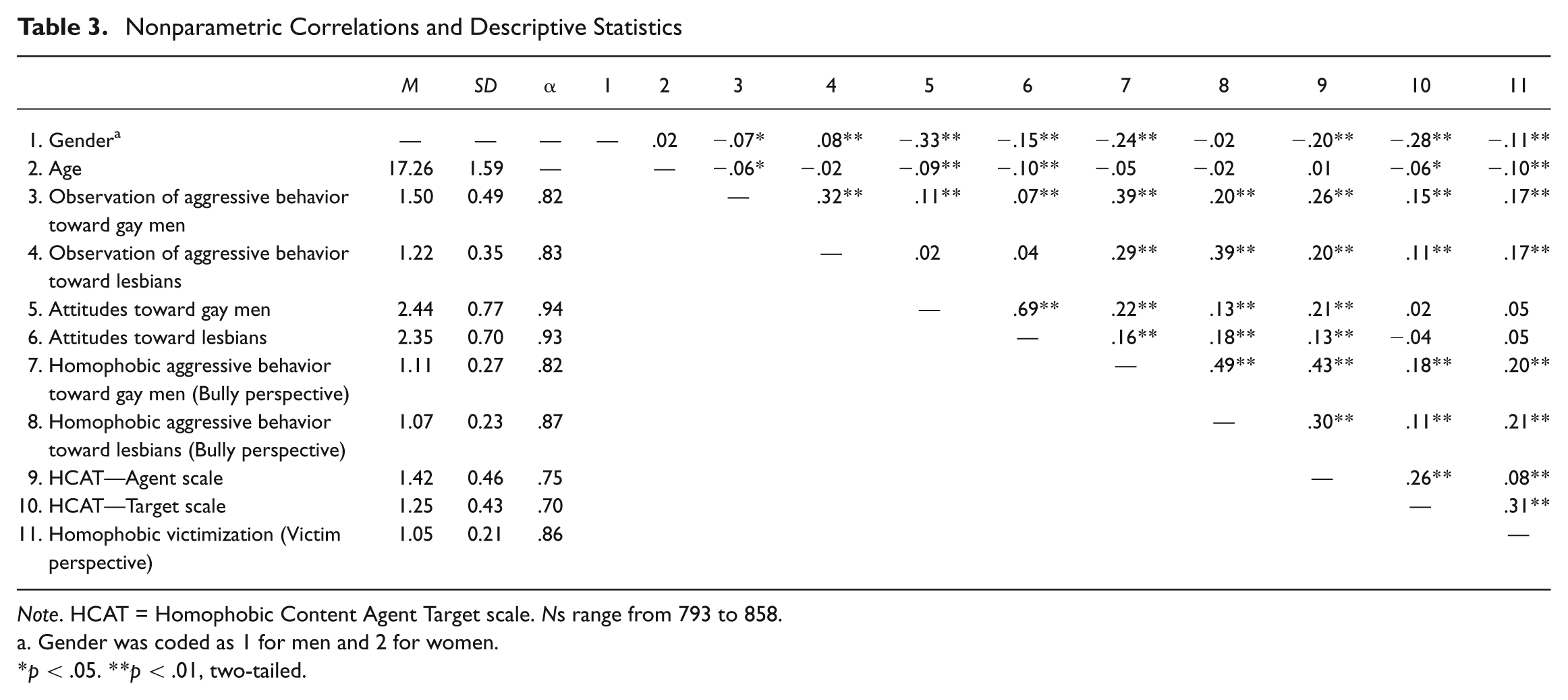
Note. HCAT = Homophobic Content Agent Target scale. Ns range from 793 to 858.
Gender was coded as 1 for men and 2 for women.
p < .05. **p < .01, two-tailed.
Discussion
The aim of this study was to develop and investigate the psychometric properties of the Homophobic Bullying Scale. This instrument differs from the HCAT scale (which measures the extent to which students use and are called homophobic epithets; Poteat & Espelage, 2005), because it collects information about homophobic bullying behaviors other than the use of homophobic epithets from different viewpoints: witnesses, bullies, and victims. Additionally, this instrument differentiates between bullying behaviors toward gay men and toward lesbians, in accordance with the literature (e.g., Kosciw et al., 2010; Poteat & Espelage, 2005; Prati et al., 2011). As a matter of fact, the Homophobic Bullying Scale is composed of five scales from viewpoints of bullies (aggression toward gay men and toward lesbians), victims, and witnesses (aggression toward gay men and toward lesbians). In line with this literature (e.g., Kosciw et al., 2010; Poteat & Espelage, 2005; Prati et al., 2011), the scores produced by this instrument showed that homophobic aggressive behaviors were more directed toward male students in comparison with female students. Furthermore, male students perpetrated more acts of homophobic aggression compared with female students. However, there are two exceptions to this general pattern. First, there are small gender differences in the observation of aggressive behavior: male students reported more episodes of aggressive behavior toward gay men, whereas female students noticed more episodes of aggressive behavior toward lesbians. Second, there are no gender differences in the perpetration of homophobic aggressive behavior toward lesbians.
The factor loadings for the individual items showed that the items of the Homophobic Bullying Scale had loadings that were between .55 and 1.00, indicating that they are appropriate indicators of their respective factors. These findings imply that this instrument has adequate construct validity of its factor structure and add strong support to the assumption that homophobic bullying behaviors need to be analyzed from a multidimensional perspective. One exception to this is the case of the item “Hear insulting remarks about him,” which showed a low factor loading. This finding may suggest that homophobic verbal aggression may differ from the other behaviors. One explanation may be that verbal forms of homophobic aggression toward (supposed) gay men (i.e., the use of homophobic epithets) have been the most frequent (Kosciw et al., 2010, Plummer, 2001; Prati et al., 2011; Rivers, 2001) and, therefore, may be perceived as “normal.”
Medium-to-small correlations were found between the five scales of the instrument and both homophobic attitudes and the HCAT scale. The relatively low correlation coefficients indicate that there is little shared variance between these measures and, thus, provide evidence that the Homophobic Bullying Scale offers unique data.
In this study, it was found that approximately 1 of 10 high school students may be considered homophobic bullies and that 3.50% are victims of homophobic bullying. Additionally, homophobic aggression behaviors at school (not bullying) were widespread: about 4 of 10 students perpetrated homophobic aggression behaviors at school, whereas more than 1 of 10 were victimized. It is interesting to note that the prevalence estimates of homophobic bullies (without taking into account verbal bullying concerning the use of homophobic epithets, measured by the HCAT scale) are similar and, in some cases, higher than those reported in the literature on “general bullying” (without reference to perceived sexual orientation; e.g., Delfabbro et al., 2006; Menesini, Nocentini, & Fonzi, 2007; Nansel, Overpeck, & Pilla, 2001; O’Moore & Kirkham, 2001; Solberg & Olweus, 2003). This may suggest that the use of measures not specifically designed for homophobic bullying may underestimate it.
In the construction of this instrument, I chose to avoid the definition of bullying. Although it was argued that students should be presented with a definition of bullying before being asked whether or not they perceive themselves as victims or bullies (Solberg & Olweus, 2003), others claim that this definition may enhance social desirability (Espelage, Bosworth, & Simon, 2001). Their rationale is that bullies do not define their aggressive behaviors as bullying. This issue should be the focus of future studies.
There are some limitations to the present study. First, it is unknown whether the psychometric properties of this instrument are generalizable to other countries or cultures. Future studies can investigate differences across countries to clarify whether cultural discrepancies exist on homophobic bullying. Second, test–retest scores were not collected; therefore, the stability and reliability of the instrument over time were not evaluated. Consequently, studies must be conducted to show whether the instrument gives repeatable results. Third, although this study provided evidence of construct validity, further evidence is needed. Fourth, because the present study builds on self-report measures obtained by means of a cross-sectional design, the relationships may be inflated because of common method bias (Podsakoff, MacKenzie, Lee, & Podsakoff, 2003). However, there are some reasons to believe that this is not the case. The one-factor model did not fit the data well. Furthermore, the Homophobic Bullying Scale contains well-specified observable behaviors, which require little inference when responding, therefore reducing the influence of attitudinal and dispositional factors. Finally, it should be noted that because cyberbullying has been evolving in the past years, it is likely that new forms will emerge (e.g., Tokunaga, 2010). Therefore, additional studies are needed to add new items concerning cyberbullying homophobic behaviors.
Practical Application of the Homophobic Bullying Scale and Conclusions
The use of the Homophobic Bullying Scale seems to be quite simple, because of the small number of items (25) and their readability. The scales also may be used separately to measure the different perspectives on homophobic bullying. The Homophobic Bullying Scale also may be used in conjunction with the HCAT scale (Poteat & Espelage, 2005) to tap different forms of homophobic bullying (i.e., including homophobic content).
When estimating the prevalence of bullying from the responses to the Homophobic Bullying Scale, one may use commonly used operational criteria provided by Solberg and Olweus (2003). More specifically, it is possible to define bullies or victims as those respondents who perpetrated or reported being subjected to at least one negative act on at least a weekly basis during the past 30 days.
In summary, this study contributes to the academic literature by developing and investigating the psychometric properties of the Homophobic Bullying Scale. The instrument seems appropriate for assessing aggressive behavior at school motivated by homophobia because good internal consistency, construct validity of its factor structure, and discriminant validity were demonstrated; however, although the validity and reliability of this instrument seem promising, further studies are needed to validate the Homophobic Bullying Scale. Additional suggestions for future research include involving different age groups (e.g., middle school students).
Footnotes
Acknowledgements
The author thanks Marco Coppola, Marco Saccà and Rosario Murdica for their help in data collection.
Declaration of Conflicting Interests
The author(s) declared no potential conflicts of interest with respect to the research, authorship, and/or publication of this article.
Funding
The author(s) disclosed receipt of the following financial support for the research, authorship, and/or publication of this article:
This research was supported by the Italian Minister of Health, Labour and Social Policies project grant titled “Interventi per la prevenzione contro il bullismo a sfondo omofobico” (ai sensi della L. 383/2000, anno 2007, lett. F) in collaboration with Arcigay—Italian Lesbian Gay Association.