




Abstract
A study was designed to examine a multidimensional measure of children’s coping in the academic domain as part of a larger model of motivational resilience. Using items tapping multiple ways of dealing with academic problems, including five adaptive ways (strategizing, help-seeking, comfort-seeking, self-encouragement, and commitment) and six maladaptive ways (confusion, escape, concealment, self-pity, rumination, and projection), analyses of self-reports collected from 1,020 third through sixth graders in fall and spring of the same school year showed that item sets marking each way of coping were generally unidimensional and internally consistent; and confirmatory analyses showed that multidimensional models provided a good fit to the data for both adaptive and maladaptive coping at both time points. Of greatest interest were the connections of these ways of coping to the constructs from a model of motivational resilience. As predicted, adaptive coping was positively correlated with students’ self-system processes of relatedness, competence, and autonomy as well as their ongoing engagement and reengagement, and negatively correlated with their catastrophizing appraisals and emotional reactivity. Maladaptive coping showed the opposite pattern of correlations. The potential utility of the measure, the different scores derived from it, and the role of constructive coping in motivational resilience are discussed.
More than a decade ago, the study of “everyday coping” ushered in the notion that children and youth cope, not only with major life stressors (such as serious illness, bereavement, or parental divorce) but also with the cumulative demands and problems presented by their everyday lives (Wolchik & Sandler, 1997). When asked about the events that they find most stressful, children typically mention “difficulties with school” as among the top three demands they face (along with peer problems and issues with parents; Spirito, Stark, Grace, & Stamoulis, 1991). Hence, the academic stressors that children and youth encounter in school, such as difficulty understanding material presented in class, problems with completing homework, or doing poorly on exams, can be considered legitimate targets for their coping. How children respond to such obstacles and setbacks, whether by persisting in the face of challenges or by giving up, can cumulatively make a material difference to their learning and achievement, perhaps contributing long-term to whether they complete high school or drop out (Boekarts, 1993; Dweck, 2006; Skinner & Pitzer, 2012a; Skinner & Wellborn, 1997). The goal of this study was to examine the structure, psychometric properties, and concurrent validity of a multidimensional measure of children’s coping in the academic domain (Skinner & Pitzer, 2012b).
Families of Coping
To identify the ways in which children and youth can cope with the everyday academic demands they face in school, a motivational model (Skinner & Wellborn, 1997) based on self-determination theory (SDT; Deci & Ryan, 1985, 2000, 2002) was used. This model draws from reviews of systems for identifying core coping categories, which have uncovered more than 400 ways of coping (Skinner, Edge, Altman, & Sherwood, 2003). According to the motivational model, these can be grouped together into about 12 families based on their shared functional properties (see Table 1). For example, a set of common ways of coping, such as problem solving, effort exertion, strategizing, and planning, can be grouped as members of the same family, because they have in common their function in selecting and employing actions based on their efficacy in producing desired and preventing undesired outcomes. These families are sometimes given labels that reflect higher-order distinctions (e.g., primary control coping; Connor-Smith, Compas, Wadsworth, Thomsen, & Saltzman, 2000) and sometimes are named for a prototypical way of coping (i.e., problem solving).
Ways of Coping From Each Coping Family Used for Capturing Adaptive and Maladaptive Coping in the Academic Domain During Childhood and Adolescence.
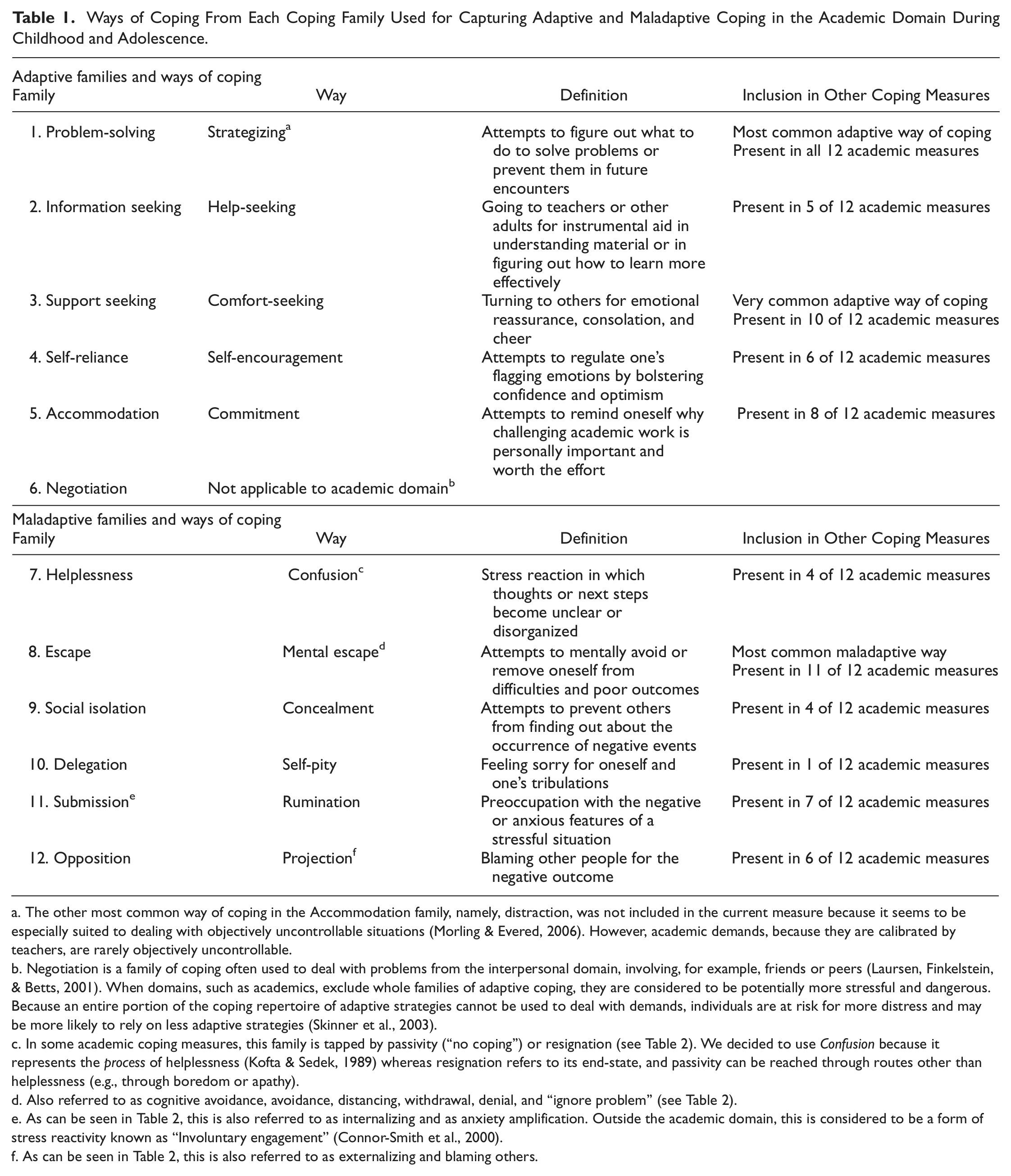
The other most common way of coping in the Accommodation family, namely, distraction, was not included in the current measure because it seems to be especially suited to dealing with objectively uncontrollable situations (Morling & Evered, 2006). However, academic demands, because they are calibrated by teachers, are rarely objectively uncontrollable.
Negotiation is a family of coping often used to deal with problems from the interpersonal domain, involving, for example, friends or peers (Laursen, Finkelstein, & Betts, 2001). When domains, such as academics, exclude whole families of adaptive coping, they are considered to be potentially more stressful and dangerous. Because an entire portion of the coping repertoire of adaptive strategies cannot be used to deal with demands, individuals are at risk for more distress and may be more likely to rely on less adaptive strategies (Skinner et al., 2003).
In some academic coping measures, this family is tapped by passivity (“no coping”) or resignation (see Table 2). We decided to use Confusion because it represents the process of helplessness (Kofta & Sedek, 1989) whereas resignation refers to its end-state, and passivity can be reached through routes other than helplessness (e.g., through boredom or apathy).
Also referred to as cognitive avoidance, avoidance, distancing, withdrawal, denial, and “ignore problem” (see Table 2).
As can be seen in Table 2, this is also referred to as internalizing and as anxiety amplification. Outside the academic domain, this is considered to be a form of stress reactivity known as “Involuntary engagement” (Connor-Smith et al., 2000).
As can be seen in Table 2, this is also referred to as externalizing and blaming others.
These 12 families include the ways of coping used most frequently by children and youth in general (Zimmer-Gembeck & Skinner, 2011) and they are also common to the best and most frequently used multidimensional measures of coping during childhood and adolescence (e.g., Ayers, Sandler, West, & Roosa, 1996; Connor-Smith et al., 2000), including ones focused explicitly on academic coping. Table 2 lists, for the 12 measures used most frequently in the academic domain, the ways of coping tapped by each, and maps these ways onto the 12 families proposed by the motivational theory. As can be seen, with few exceptions, the ways of coping typically measured in academic settings can be encompassed by these 12 families.
Mapping Adaptive and Maladaptive Ways of Coping Assessed in Measures of Academic Coping Onto Categories From the Motivational Model. a

Because of inconsistencies in how categories are labeled, this analysis relied on the items that make up each subscale rather than their labels.
The overarching list of families of coping is useful in providing a comprehensive menu of coping options, only some of which may be realized in particular domains and ages (Skinner & Zimmer-Gembeck, 2007; Zimmer-Gembeck & Skinner, 2011). The list of particular ways of coping included in current measures of academic coping provides a menu of specific responses from each family that students may employ when they encounter obstacles and setbacks in school. We used these families as a means of ensuring that the multidimensional measure included the most important ways of coping used in the academic domain during childhood and adolescence (Skinner & Wellborn, 1997). Of special significance was the inclusion of multiple adaptive ways of coping. These are typically underrepresented in lists of ways that children and adolescents (and even adults) deal with stressful events (Skinner et al., 2003). However, the identification of adaptive ways of coping is of critical importance if measures are to provide information about how coping not only protects children and youth from the harmful effects of stress but also contributes to their success, growth, and positive development (Skinner & Zimmer-Gembeck, 2007, 2009).
Adaptive Academic Coping
Five ways of dealing constructively with academic demands were included: Strategizing, Help-seeking, Comfort-seeking, Self-encouragement, and Commitment (see Table 1 for definitions; Skinner & Pitzer, 2012b). In school, Strategizing and Help-seeking are considered adaptive because they provide students a route back toward reengaging constructively with challenging academic material (A. M. Ryan, Pintrich, & Midgley, 2001). Comfort-seeking and Self-encouragement should be adaptive because students can use them to ameliorate negative and shore up positive emotions, which in turn can promote engaged behaviors (Skinner, Furrer, Marchand, & Kindermann, 2008). And Commitment is adaptive because it provides energy for persistence and reengagement in the face of obstacles and setbacks. We did not include the sixth adaptive family of coping, namely, Negotiation, because it generally is not an option for students to negotiate with their teachers about whether (or even how) to complete their class work or exams. Consistent with this reasoning, none of the other measures of academic coping included this way of coping.
Maladaptive Coping
Six ways of coping poorly with academic stressors were also included in the multidimensional measure: Confusion, Escape, Concealment, Self-pity, Rumination, and Projection (see Table 1 for definitions; Skinner & Pitzer, 2012b). In school, Confusion is considered maladaptive because it can amplify distress and disorganize action. Escape preempts students’ reengagement with challenging academic material, thus preventing them from learning successfully. Self-pity is likely to lead to disengagement with academic tasks by focusing students’ thoughts on themselves rather than on their work and by amplifying negative emotions. Concealment is maladaptive because it cuts students off from contact with people who could provide the kinds of instrumental or emotional aid that would help them get back on track. Rumination is problematic because it exacerbates distress and uses up mental resources needed for the task at hand. Projection can contribute to disaffection and may even lead to direct opposition, such as disruptive behavior in the classroom, because it amplifies negative emotions about teachers and academic work.
In sum, the multidimensional measure focused on 11 ways of coping, considered to be adaptive and maladaptive when used in school, which together cover most of the territory identified by the 12 families of coping, including those that are most commonly measured across all domains (i.e., problem solving, support seeking, and escape; Skinner et al., 2003) as well as those most commonly used by children and adolescents (Zimmer-Gembeck & Skinner, 2011), and those most often included in measures in the academic domain. At the same time, no other measure in the academic domain has previously covered all 11 of these ways of coping.
Motivational Resilience
The current multidimensional measure was examined within a model of motivational resilience that focuses on the dynamics among ongoing engagement, emotional reactivity, coping, and reengagement in the face of difficulties and setbacks (see Figure 1; Skinner & Pitzer, 2012b). The key notion is that ongoing engagement can act as an energetic resource that allows students to cope more adaptively, leading to reengagement with challenging tasks. In contrast, students who are disaffected do not have access to such resources, and so use more maladaptive coping strategies, leading them to give up instead of persevere.
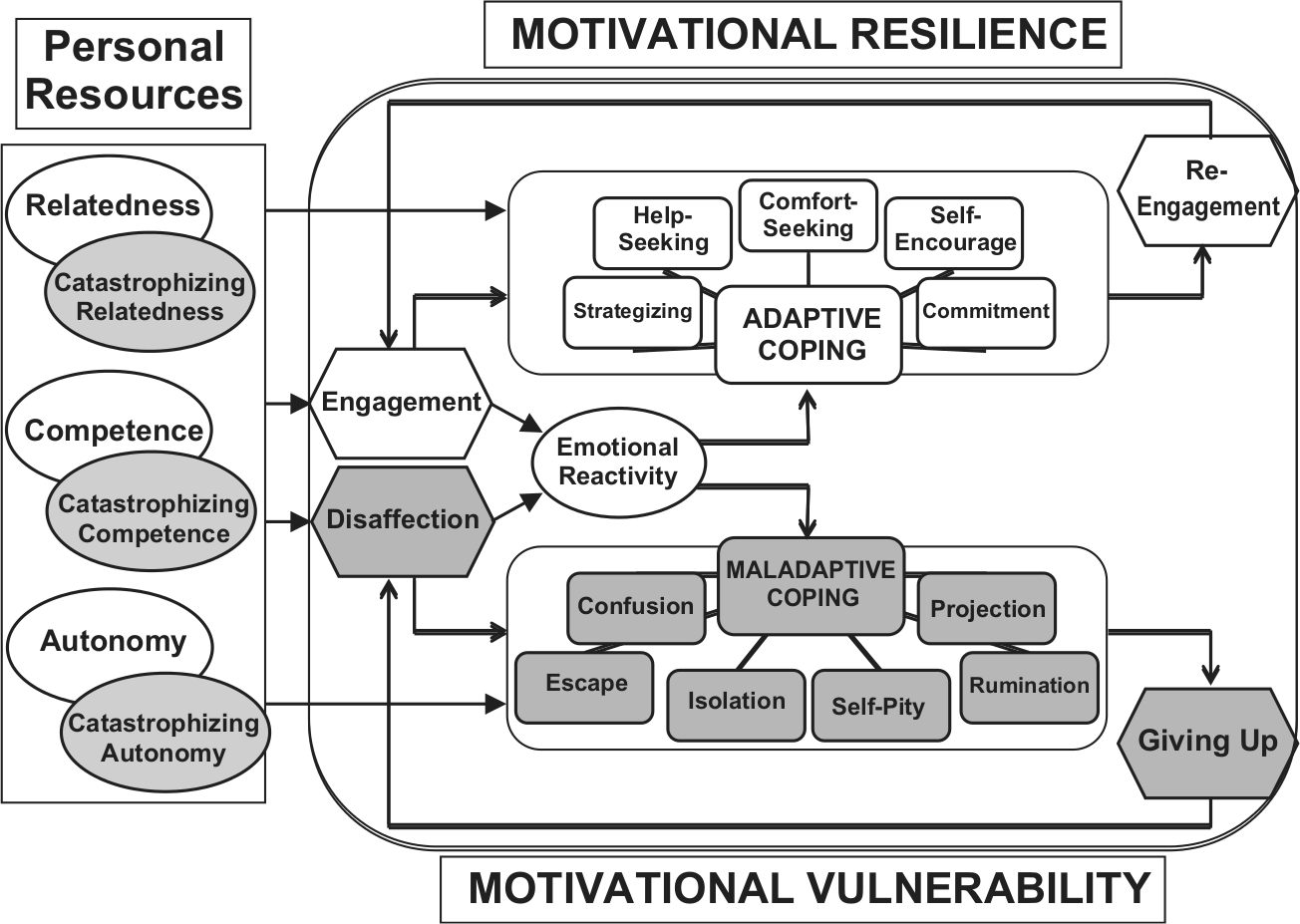
A model of how adaptive and maladaptive ways of coping in the academic domain are tied to the self-system processes of relatedness, competence, and autonomy and are part of a model of motivational resilience in which engagement acts as an energetic resource and coping promotes or undermines students’ reengagement with challenging academic tasks.
Engagement Versus Disaffection
In the model of motivational resilience, academic engagement (versus disaffection) refers to children’s enthusiastic focused “heads-on” and “hands-on” participation in classroom activities (Skinner, Kindermann, Connell, & Wellborn, 2009). Highly engaged students pay attention, evince interest and curiosity, and work hard. In contrast, disaffected students embody the prototypical “unmotivated student,” because they tend to be passive, bored, and frustrated (Skinner, Kindermann, Connell, et al., 2009). Indeed, engagement is a robust predictor of learning, achievement, retention, and graduation (Fredricks, Blumenfeld, & Paris, 2004). Because it has been so thoroughly documented as a positive force in students’ learning and success (Christenson, Reschly, & Wylie, 2012), engagement was used in this study as a target to examine whether ways of coping identified as adaptive correlated positively with this motivational asset, whereas those identified as maladaptive correlated negatively.
Emotional Reactivity and Reengagement
A second set of targets were also drawn from the model of motivational resilience, namely, emotional reactivity and reengagement. Emotional reactivity refers to the severity of an individual’s initial negative reaction to a stressful event and can vary from equanimity (or low reactivity) to fear, anger, and panic (Compas, 2009). If it is strong enough, reactivity can disrupt constructive coping because it escalates the demands in the situation (i.e., individuals have to manage not only the event but also their own reactions), and it can divert energy away from dealing directly with the task and toward emotion regulation (Boekarts, 1993).
Reengagement, sometimes also called “buoyancy” (Martin & Marsh, 2009; Skinner & Pitzer, 2012b), is the end-game in motivational resilience. A student is considered to “bounce back” when he or she is able to reengage constructively with the challenging academic material. Reengagement usually involves redoubling effort, increased determination, and other signs of mastery (Dweck, 2006). The opposite of reengagement is giving up or abandoning the demanding work. Hence, this study used emotional reactivity and reengagement as another set of targets for criterion validity, with the general expectation that adaptive coping would be negatively correlated with emotional reactivity and positively correlated with reengagement, whereas maladaptive ways of coping would show the opposite pattern.
Appraisals
The final constructs drawn from the motivational model were students’ self-appraisals in the academic domain (Connell & Wellborn, 1991). Students’ appraisals of their relatedness (belonging) to important social partners (parents, teachers, classmates, and friends), academic competence (self-efficacy), and autonomy (self-determination) in learning are considered to be personal motivational resources that boost children’s enthusiastic engagement and shape how they cope. Programs of research document the connection between each of these appraisals and students’ intrinsic motivation, valuing, achievement, and engagement versus disaffection in school (Elliot & Dweck, 2005; Osterman, 2000; Su & Reeve, 2011).
Moreover, connections between coping and a set of negative appraisals were also examined, with the expectation that appraisals that amplify the distressing implications of stressful events, which we refer to as catastrophizing, would function as a liability when students are dealing with problems. Three kinds of catastrophizing appraisals were considered, corresponding to the three self-systems: catastrophizing of relatedness, which amplifies the harmful interpersonal consequences of the event (e.g., “When something bad happens at school, I feel like nobody will like me”); catastrophizing of competence, which magnifies the significance of the event for one’s ability (e.g., “I feel totally stupid”); and catastrophizing of autonomy, which emphasizes self-blame and guilt (e.g., “I feel like it’s all my fault”). Hence, it was expected that adaptive coping would show positive correlations with appraisals of relatedness, competence, and autonomy and negative correlations with catastrophizing appraisals, whereas maladaptive coping would show the opposite pattern of connections.
Method
Sample and Design
This study used data from a 4-year longitudinal study of children’s engagement and coping in school (for a complete description, see Skinner, Zimmer-Gembeck, & Connell, 1998). Participants were 1,608 students in Grades 3 through 7, approximately equally divided by gender, who attended public elementary and middle schools in a rural–suburban school district located in upstate New York, and 53 of their teachers. Students were predominantly Caucasian, with approximately 5% of the students identifying as non-White. The students’ socioeconomic status (as determined by parents’ level of education and occupation) ranged between working and middle class.
Data from a subset of these children (N = 1,020) from Year 3 were used in the current study. The students were in Grades 3 through 6 for the two time points used for these analyses. Grades and genders were represented as follows: 138 third-grade students (66 boys and 72 girls), 342 fourth graders (172 boys and 170 girls), 170 fifth graders (78 boys and 92 girls), and 368 sixth graders (192 boys and 176 girls); grade and gender data were missing for two students.
Procedures
Data were collected in October and May by trained interviewers who administered self-report questionnaires to students in their classrooms in three 40-minute sessions. In each session, one interviewer read the questions aloud while students marked their answers on the questionnaire. A second interviewer was present to monitor comprehension of questionnaire items and to answer questions. During these sessions, teachers were not present in the classroom.
Students reported on 11 ways of coping with academic problems, appraisals (of their self-systems of relatedness, competence, and autonomy, and catastrophizing appraisals), and motivational resilience (engagement vs. disaffection in the classroom, emotional reactivity, and reengagement). Students used 4-point Likert-type scales to indicate whether each item was: Not at all true for me (1), Not very true for me (2), Sort of true for me (3), or Very true for me (4). Negatively worded items were reverse-coded, and items in each scale were averaged to calculate a composite score.
Ways of Coping
Each of the 11 coping subscales consisted of five items. Items were randomly mixed and subsets followed one of four stems describing stressful academic events in school, including “When something bad happens to me in school (like not doing well on a test or not being able to answer an important question) . . .,” “When I run into a problem on an important test . . .,” “When I have trouble with a subject in school . . .,” and “When I have difficulty learning something . . .”
Adaptive Ways of Coping
Five adaptive ways of coping were included (see the appendix for all items): (a) Strategizing, which refers to attempts to figure out what to do to solve problems or prevent them in future encounters; (b) Help-seeking, which refers to going to teachers or other adults for instrumental aid in understanding material or in figuring out how to learn more effectively; (c) Comfort-seeking, which refers to turning to other people for emotional reassurance, consolation, and cheer; (d) Self-encouragement, which refers to children’s attempts to regulate their own flagging emotions by bolstering confidence and optimism; and (e) Commitment, which refers to children’s attempts to remind themselves why the challenging academic work is personally important to them and worth their effort.
Maladaptive Ways of Coping
Six maladaptive ways of coping were included (see the appendix for all items): (a) Confusion, which refers to a reaction to stress in which thoughts or next steps become unclear or disorganized; (b) Escape, which refers to attempts to mentally avoid or remove oneself from difficulties and poor outcomes; (c) Concealment, which refers to preventing others from finding out about the occurrence of negative events; (d) Self-pity, which refers to feeling sorry for oneself and one’s problems; (e) Rumination, which refers to preoccupation with the negative or anxious features of a stressful situation; and (f) Projection, which refers to blaming other people for negative outcomes.
Coping Allocation and Profile Scores
In addition to average scores, two other kinds of scores were calculated, which have been shown to provide clearer indicators of coping per se, distinguished from the stress that elicits it (Lewis & Frydenberg, 2002; Skinner & Pitzer, 2012b). Coping allocation scores were created in three steps: (a) total coping was calculated by summing each students’ coping scores across all 11 ways of coping, without reverse coding maladaptive ways of coping; this score represented the total coping (both adaptive and maladaptive) reported by each student; (b) the sum for each individual way of coping was divided by this total score to determine the proportion of each student’s total coping that was allocated to this means of coping; and (c) these scores were multiplied by 100, so that allocation scores could range from 1 to 100. Coping profile scores were created in three steps: (a) Adaptive coping scores were created by averaging the scores for all five adaptive ways of coping, (b) Maladaptive coping scores were created by averaging the scores for all six maladaptive ways of coping, and (c) Profile scores were created by averaging adaptive and maladaptive coping scores, with the maladaptive scores reverse coded. Profile scores represented the balance of overall adaptive relative to overall maladaptive coping.
Appraisals of Self-Systems and Catastrophizing Appraisals
Self-System Appraisals
Students’ sense of relatedness was measured using 20 items that tapped their feeling of belonging or connectedness to their teachers, their mothers, their fathers, their friends, and their classmates (Connell & Wellborn, 1991; Furrer & Skinner, 2003). For each item, the stem mentioned the specific social partner, for example, “When I’m with my teacher” or “When I’m with my mother,” and the items for each social partner were the following: “I feel accepted,” “I feel like someone special,” “I feel ignored” (reverse-coded), and “I feel unimportant” (reverse-coded). The items were averaged to form a summary score.
Perceived competence was assessed using 27 items from five scales of the Student Perceptions of Control Questionnaire (Skinner et al., 1998). Students reported about their (a) Control Beliefs using 6 items tapping general expectancies about achieving success and avoiding school failure (e.g., “I can do well in school if I want to”); (b) Effort Strategy Beliefs using 5 items tapping their beliefs about the effectiveness of effort (e.g., “The best way for me to get good grades is to work hard”); (c) Unknown Strategy Beliefs using 4 items tapping the extent to which the causes of success and failure in school are perceived to be unknown (e.g., “I don’t know how to keep myself from getting bad grades,” reverse coded); (d) Effort Capacity Beliefs using 6 items tapping their beliefs about the extent to which they can try hard (e.g., “I can work really hard in school”); and (e) Ability Capacity Beliefs using 6 items tapping their beliefs about their academic ability (e.g., “I don’t have the brains to do well in school,” reverse coded). A summary score was created by averaging these five subscales.
The measure of academic autonomy (R. M. Ryan & Connell, 1989) comprised 17 items that tap four reasons children engage in academic activities, which differ in their degree of self-determination: (a) external self-regulation, which refers to doing work because of rules or fear of punishment (“Why do I do my homework? Because I’ll get in trouble if I don’t”); (b) introjected self-regulation, which refers to doing work because one “should” and to avoid negative emotions (“Because I’ll feel really bad about myself if I don’t do well”); (c) identified self-regulation, which refers to reasons for working related to the desire for understanding and learning (“Because I think class work is important for my learning”); and (d) intrinsic self-regulation, which refers to doing work because it is enjoyable (“Because it’s fun”). A summary score was created by averaging all four subscales, with External and Introjected subscales reverse coded.
Catastrophizing Appraisals
Three kinds of negative appraisals were assessed using 9 items each; they tapped the extent to which students’ appraisals amplified the harmful consequences of stressful academic encounters by focusing on the negative implications of the event for each of the self-systems at the current moment or in the future: (a) Catastrophizing of relatedness emphasized the harmful interpersonal consequences of the event (e.g., “When something bad happens in school [like not doing well on a test or not being able to answer an important question], I feel like no one will like me as much” or “I feel like I let everybody down”); (b) Catastrophizing of competence focused on the event’s significance in revealing inadequate academic abilities or forecasting future failures (“I feel like the dumbest person in the world” or “I worry that I’ll never learn how to do it”); and (c) Catastrophizing of autonomy highlighted the negative implications of the event for self-worth or loss of intrinsic interest (“I feel like I’m a bad person” or “It really spoils the subject for me”).
Motivational Resilience
Three components of motivational resilience were captured using student self-reports: engagement versus disaffection, emotional reactivity, and reengagement in the face of challenges.
Engagement Versus Disaffection
Students reported on their own engagement versus disaffection using a measure developed to tap their behavioral and emotional participation in (or withdrawal from) learning activities in the classroom (Skinner, Kindermann, & Furrer, 2009): (a) behavioral engagement was assessed using five items that tapped students’ effort, attention, and persistence while initiating and participating in learning activities (e.g., “I try very hard at school”); (b) behavioral disaffection was assessed using five items that tapped students’ lack of effort and withdrawal from learning activities while in the classroom (e.g., “In class, I try to do just enough to get by”); (c) emotional engagement was measured using six items that tapped emotions indicating students’ motivated participation during learning activities (e.g., “When we start something new in school, I feel interested”); and (d) emotional disaffection comprised 10 items tapping students’ boredom, anxiety, or frustration during learning activities (“When my teacher first explains new material, I feel bored”). Structural analyses show that these four components can be distinguished, but are sufficiently intercorrelated that they can be combined (with the disaffection items reverse coded) to form a summary score (Skinner, Kindermann, & Furrer, 2009).
Emotional Reactivity
Students responded to 11 items tapping the extent to which they react negatively when they run into academic problems and obstacles (e.g., “When I get stuck on a problem, it really bothers me”). These items were averaged to form a summary score (Skinner & Pitzer, 2012b).
Reengagement in the Face of Academic Challenges and Problems
Nine self-report items tapped students’ motivational reactions when they encounter academic difficulties. Four items tapped mastery or persistence reactions (e.g., “When I run into a difficult question, I try even harder”) and five items tapped giving up (e.g., “If a problem is really hard, I just quit working on it”). These items were averaged (with the negative items reverse coded) to form a summary score (Skinner & Pitzer, 2012b).
Results
Data analyses were conducted in two parts. First, the multidimensional model of coping was examined in three ways: (a) structural analyses were performed to determine whether item sets for each way of coping were unidimensional at both measurement points (fall and spring); (b) reliabilities of the coping subscales were examined, including both internal consistencies and test–retest correlations from fall to spring; and (c) the hypothesized multidimensional structures of the adaptive and maladaptive ways of coping were examined to see whether they were a good fit to data from both measurement points. Second, within a frame created by a model of motivational resilience, the functional properties of the multidimensional measure were explored by examining correlations of the two kinds of coping scores (allocation and profile scores) with five sets of constructs, namely, self-system appraisals, catastrophizing appraisals, engagement, emotional reactivity, and reengagement.
Multidimensional Measure of Coping
Structural Analyses of the Item Sets for Each Way of Coping
To determine whether the item sets marking each way of coping were unidimensional, the first set of analyses used structural equation modeling to test whether a single-factor model was a good fit to the five items from each subscale. The fit indices for single factor models for each way of coping, which are presented in Table 3, were generally adequate or satisfactory, with comparative fit indexes (CFIs) averaging .98 in fall and .97 in spring. Single-factor models showed marginal fits to only two item sets, namely, Comfort-seeking and Self-pity in spring; however, both showed satisfactory fits to item sets in fall. In general, factor loadings on the single factor models were also satisfactory, ranging from .43 to .83, averaging .61, and slightly higher in spring (averaging .65) than fall (averaging .59).
Fit Statistics for Single Factor Models for Each Way of Coping in Fall and Spring.
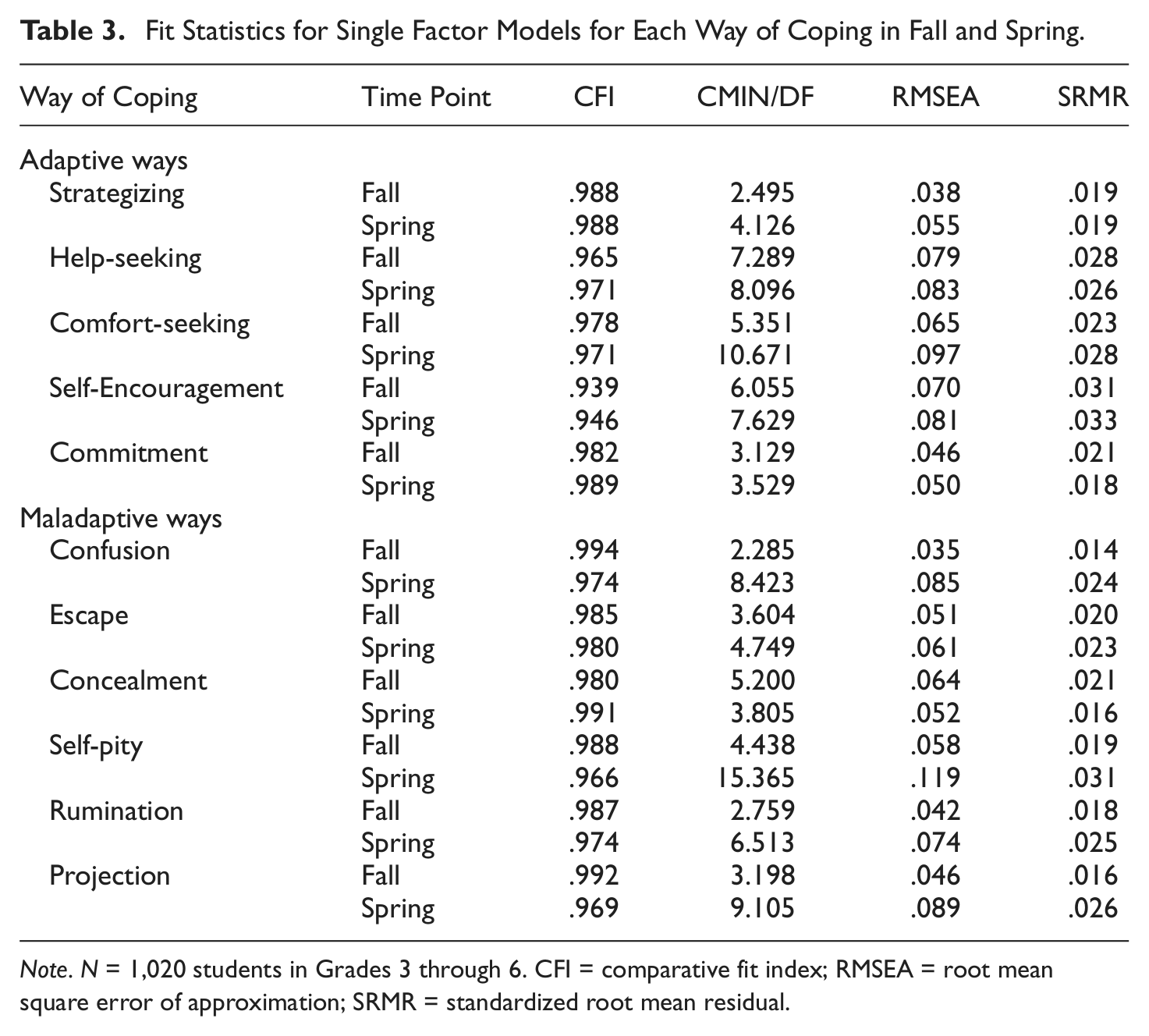
Note. N = 1,020 students in Grades 3 through 6. CFI = comparative fit index; RMSEA = root mean square error of approximation; SRMR = standardized root mean residual.
Internal Consistency and Test–Retest Reliabilities
Table 4 contains the internal consistency reliabilities (Cronbach’s alpha and McDonald’s Omega) for each way of coping at both measurement points, and their test–retest reliabilities or cross-time correlations. As can be seen, the Cronbach alphas for the 5-item scales were generally satisfactory, ranging from .59 to .85, average α = .75, and slightly higher in spring (averaging .78) than in fall (averaging .72). Four subscales, Strategizing, Commitment, and Rumination in fall, and Self-encouragement in fall and spring, showed alphas below .70, although the alphas for Strategizing, Commitment, and Rumination were above .70 at the spring measurement point. Although these levels may be adequate for 5-item subscales completed by children, the correlations with these subscales may be attenuated somewhat due to measurement error. The McDonald Omegas converged on exactly the same pattern of internal consistencies at both time points. The “test–retest” reliabilities, which were correlations between measurements in fall and spring, were generally high, ranging from .47 to .70 (average r = .57). Taken together, these findings suggested that the item sets tapping the 11 ways of coping generally showed satisfactory internal consistency and cross-time reliabilities.
Internal Consistency Reliability (Cronbach’s Alpha and McDonald’s Omega) in Fall and Spring and Test–Retest Reliability From Fall to Spring for Each Way of Coping.
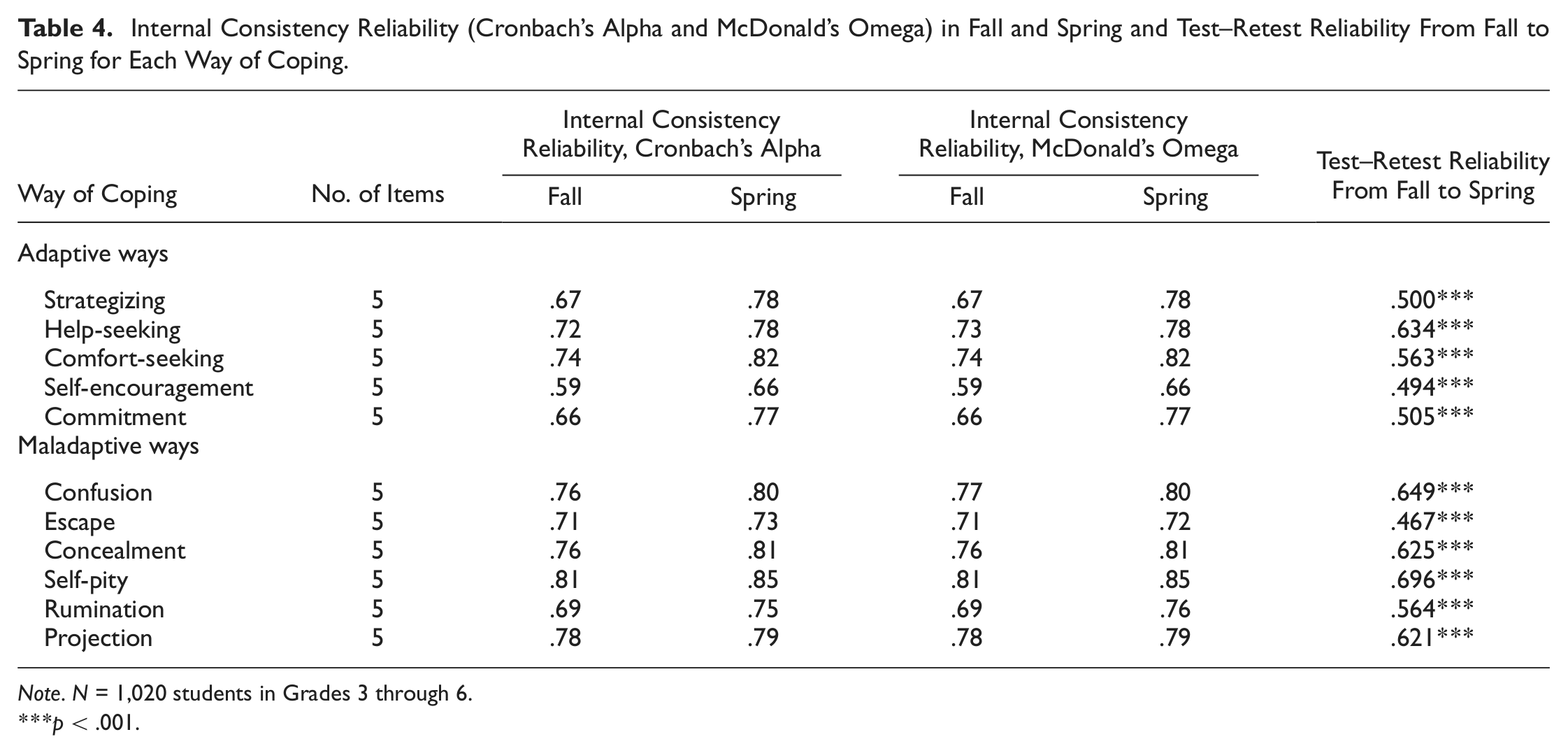
Note. N = 1,020 students in Grades 3 through 6.
p < .001.
Multidimensional Structures of Adaptive and Maladaptive Ways of Coping
Confirmatory structural analyses examining multidimensional models showed that the models provided a good fit to the data for both adaptive and maladaptive coping at both the fall and spring time points. For adaptive coping in fall, CFI = .923, CMIN/df = 2.81, standardized root mean residual (SRMR) = .036, root mean square error of approximation (RMSEA) = .042, 90% confidence interval (CI) on RMSEA = .038-.046; and in spring CFI = .927, CMIN/df = 3.64, SRMR = .038, RMSEA = .051, 90% CI on RMSEA = .047-.054. For maladaptive coping in fall, CFI = .922, CMIN/df = 3.10, SRMR = .046, RMSEA = .045, 90% CI on RMSEA = .042-.048; and in spring CFI = .921, CMIN/df = 3.58, SRMR = .046, RMSEA = .050, 90% CI on RMSEA = .047-.053. The CFI values indicated adequate model fit, and the RMSEA values, which represent a per degree of freedom index of model fit, were excellent (Hu & Bentler, 1999). Hence, we concluded that, as expected, the multiple ways of adaptive and maladaptive coping were distinguishable from each other.
Descriptive Statistics for Multiple Dimensions of Coping
Means and standard deviations for the average and allocation scores for all 11 ways of coping and the coping profiles are presented in Table 5. As can be seen, students reported using adaptive ways of coping more often than maladaptive ways, and relied especially on Strategizing and Help-seeking as a first line of defense, followed by Self-encouragement, with somewhat less use of Comfort-seeking or Commitment. The maladaptive reaction students reported using most often was Rumination, followed by Confusion; they turned less often to Self-pity, Concealment, and Escape; and resorted to Projection (i.e., blaming the teacher) the least. Table 6 contains the intercorrelations among the 11 ways of coping using allocation scores. As expected, adaptive ways of coping were positively intercorrelated with each other, as were maladaptive ways, whereas the adaptive and maladaptive ways showed a pattern of negative intercorrelations.
Descriptive Statistics for Average, Allocation, and Profile Scores for Ways of Coping in Fall and Spring.

Note. N = 1,020 students in Grades 3 through 6. Average scores could range from 1 (Not at all true for me) to 4 (Very true for me). Allocation scores could range from 1 to 100.
Intercorrelations Among Allocation Scores for Ways of Coping in Fall and Spring.
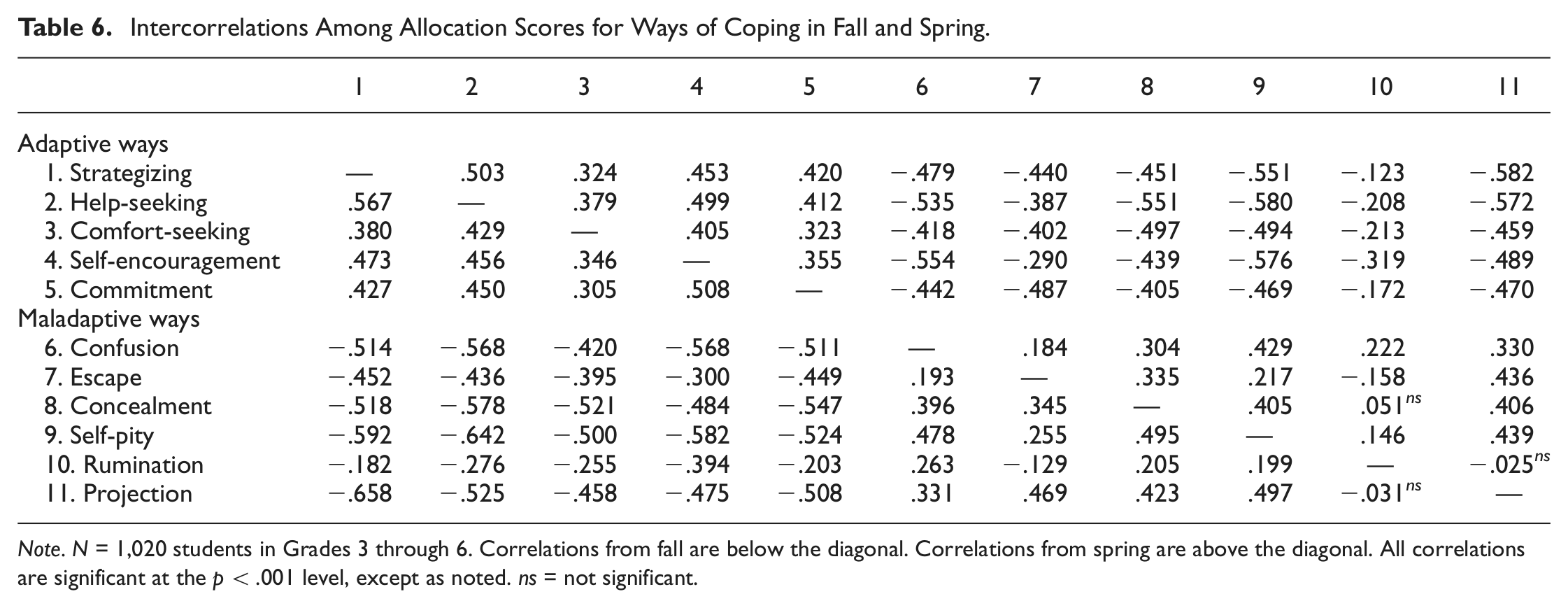
Note. N = 1,020 students in Grades 3 through 6. Correlations from fall are below the diagonal. Correlations from spring are above the diagonal. All correlations are significant at the p < .001 level, except as noted. ns = not significant.
Model of Motivational Resilience
Table 7 contains descriptive statistics, including reliabilities, means, and standard deviations, for all the variables from the model of motivational resilience. Internal consistencies were satisfactory, ranging from .78 to .92. Based on the mean levels, students seemed to feel competent, related to their parents, teachers, and peers, and not very identified with school. They also reported themselves to be relatively engaged and to bounce back easily from setbacks. Students reported low levels of catastrophizing, especially Catastrophizing of Relatedness, but they did note moderate levels of Emotional Reactivity in the face of academic stressors. To examine the multiple dimensions of coping within the frame created by the model of motivational resilience, the allocation and profile scores for each way of coping were correlated with the other aspects of the model, namely, self-system appraisals, catastrophizing appraisals, engagement, emotional reactivity, and reengagement.
Descriptive Statistics for Appraisals of Self-Systems and Motivational Resilience in Fall and Spring.

Note. N = 1,020 students in Grades 3 through 6. All scores could range from 1 (Not at all true for me) to 4 (Very true for me).
Self-System Appraisals
The correlations between coping allocation and profile scores, on the one hand, and the three self-appraisals, namely, Competence, Relatedness, and Autonomy, on the other, are presented in Table 8. As predicted by the motivational theory, the three self-appraisals showed robust positive correlations with all the adaptive ways of coping (rs averaging .47) and generally strong negative correlations with the maladaptive ways (rs averaging .41) at both time points. Self-appraisals of Competence showed the strongest links with coping, followed by Relatedness, and then Autonomy. At the same time, some differentiation was discernible: Help-seeking involved close connections to both Competence and Relatedness; Comfort-seeking showed relatively strong connections to Relatedness; Self-Pity and Projection also showed strong (negative) connections to Relatedness; and Rumination showed generally weak links to the self appraisals, but relatively higher (negative) correlations with Autonomy. Given the long histories of research showing that these appraisals are powerful motivational resources (Elliot & Dweck, 2005; Osterman, 2000; Su & Reeve, 2011), this pattern of correlations suggests that the ways of coping labeled as adaptive do indeed tap positive reactions in the face of stress, and the maladaptive subscales tap negative reactions.
Correlations Between Appraisals of Self and Ways of Coping in Fall and Spring (Spr), for Allocation Coping Scores.
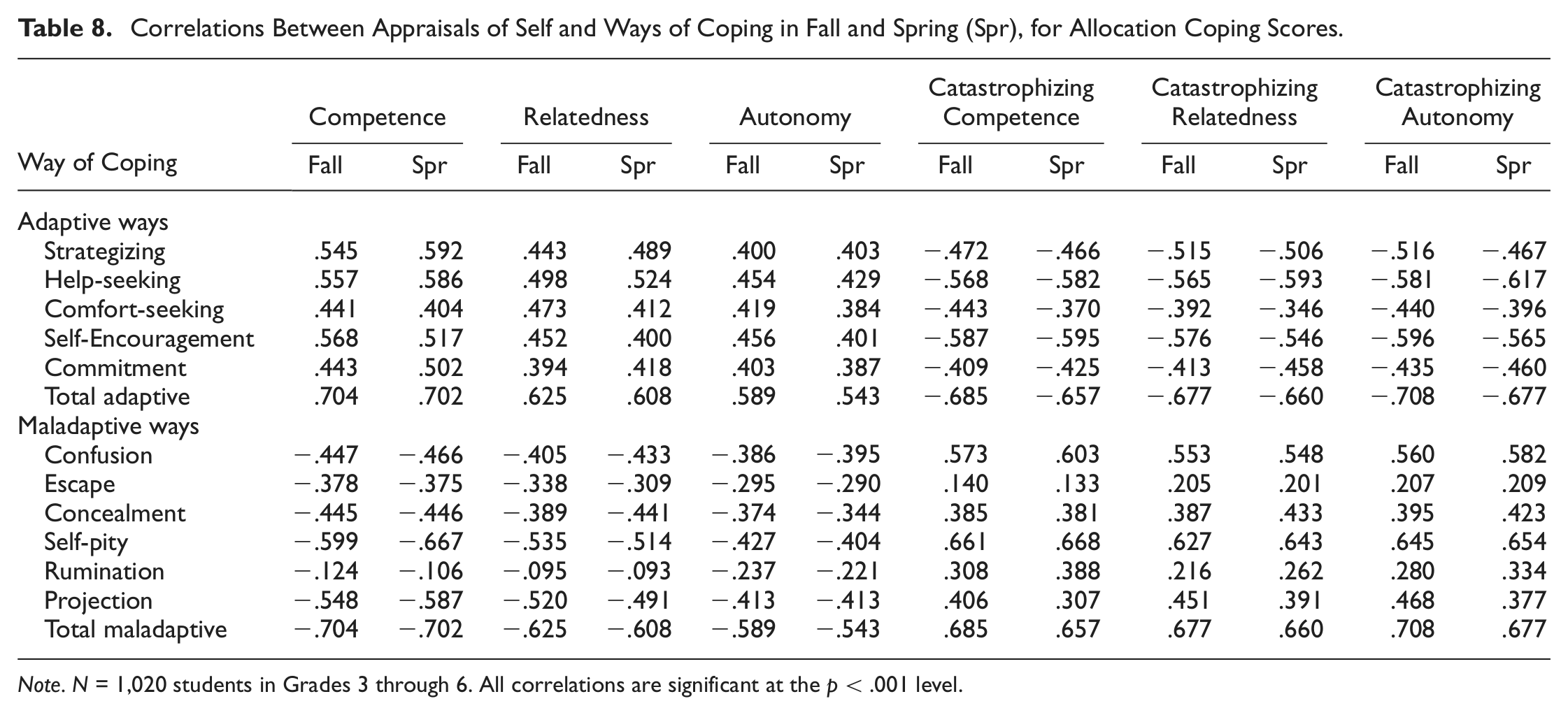
Note. N = 1,020 students in Grades 3 through 6. All correlations are significant at the p < .001 level.
Catastrophizing Appraisals
Table 8 also contains correlations between the two kinds of coping scores and students’ Catastrophizing of Competence, Relatedness, and Autonomy. For the adaptive ways of coping, all three kinds of catastrophizing seemed to interfere with positive coping, especially Help-seeking and Self-encouragement (average r = −.58), with slightly lower connections to Strategizing (average r = −.49) and Comfort-seeking and Commitment (average r = −.43). A somewhat more differentiated pattern emerged for the maladaptive ways of coping. Catastrophizing was a strong correlate of Confusion and Self-pity (average r = .61), whereas it was connected less strongly to the two social ways of coping maladaptively, namely, Concealment and Projection (average r = .40), and even less strongly to Rumination (average r = .30) and Escape (average r = .18).
Motivational Resilience
Table 9 presents correlations between all the coping scores and the three other aspects of motivational resilience, namely, ongoing Engagement, Emotional Reactivity, and Reengagement in the face of challenges or difficulties. In general, as predicted, evidence of criterion validity was strong: All the adaptive ways of coping were positively and significantly correlated with both ongoing Engagement and Reengagement (averaging .57), and all the maladaptive ways were negatively and significantly correlated with Engagement and Reengagement (averaging −.52). In a similar vein, Emotional Reactivity was negatively correlated with all the adaptive ways of coping (averaging −.35) and positively correlated with the maladaptive ways (mean r = .30).
Correlations Between Components of Motivational Resilience and Ways of Coping in Fall and Spring (Spr), for Allocation Coping Scores.
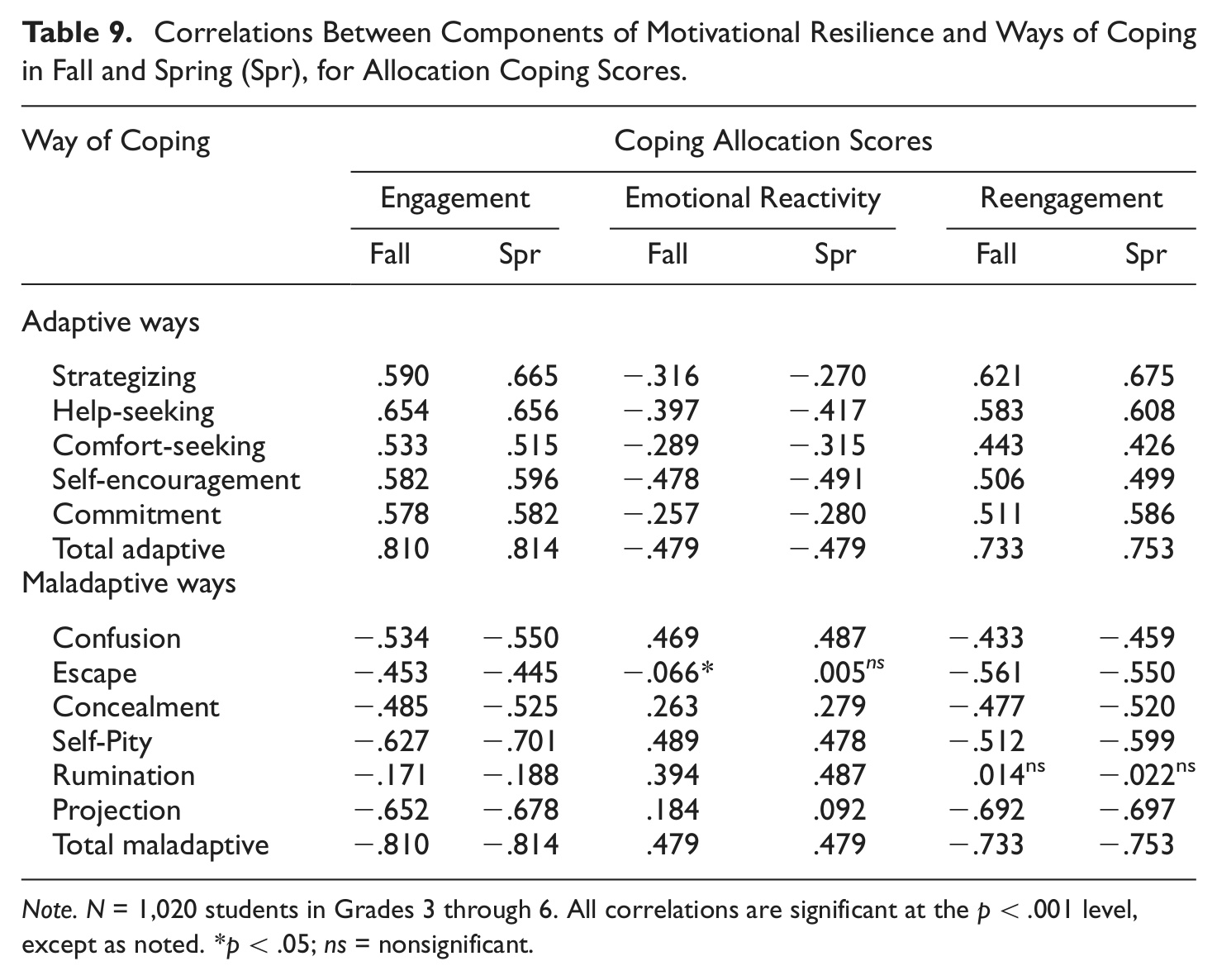
Note. N = 1,020 students in Grades 3 through 6. All correlations are significant at the p < .001 level, except as noted. *p < .05; ns = nonsignificant.
Discussion
This study used a model of motivational resilience to frame the examination of a multidimensional measure of students’ coping, which relied on the notion of families of coping (Skinner et al., 2003) to identify five adaptive (strategizing, help-seeking, comfort-seeking, self-encouragement, and commitment) and six maladaptive (confusion, escape, concealment, self-pity, rumination, and projection) ways of dealing with academic stressors (Skinner & Wellborn, 1997). The study, using self-report data from a large sample of third through sixth graders collected in fall and spring of the same school year, had as its first goal to examine the instrument’s structural and psychometric properties.
Multiple Dimensions of Adaptive and Maladaptive Coping
Psychometric and factor analyses showed that, in general, item sets marking each way of coping were unidimensional, internally consistent, and relatively stable over the school year. Even those few subscales that were less than satisfactory on a particular psychometric indicator were nevertheless strong on all the other indicators. For example, the two subscales that showed only adequate fit to their single-factor models in spring, namely, Comfort-seeking and Self-pity, nevertheless showed good model fit in fall, satisfactory factor loadings and high internal consistencies in spring, and satisfactory test–retest reliabilities across the school year. Only one 5-item set, namely, that tapping Self-encouragement, showed less than adequate internal consistencies at both time points, although it did show a good fit to a single factor model at both measurement points and adequate test–retest reliability. This subscale would likely benefit from the addition of a few more items.
In terms of the multidimensionality of the measure as a whole, correlational analyses showed that the subscales were intercorrelated as would be expected, with adaptive ways of coping positively intercorrelated with each other, maladaptive ways positively intercorrelated with each other, and the adaptive and maladaptive ways either uncorrelated or negatively correlated with each other. At the same time, confirmatory structural analyses also showed that multidimensional models provided a good fit to the data for both adaptive and maladaptive coping at both time points, demonstrating that these ways of coping can be distinguished from each other. Taken together, findings suggest that the multidimensional measure provides a psychometrically and structurally sound basis for capturing all of the 11 ways of coping that the motivational theory suggested would be relevant to the academic domain during middle childhood and early adolescence.
Model of Motivational Resilience
The second goal of the study was to examine the extent to which the ways of coping captured by the multidimensional measure could be confirmed as adaptive and maladaptive by using a motivational model as a frame that clearly identified sets of proposed assets and liabilities in the academic domain. As predicted, students’ self-appraisals of relatedness, competence, and autonomy as well as their ongoing engagement and reengagement showed a robust pattern of positive connections to adaptive and negative connections to maladaptive ways of coping. At the same time, catastrophizing appraisals and emotional reactivity showed the predicted pattern of negative correlations with adaptive and positive correlations with maladaptive ways of coping.
Analyses of the connections between coping and the other constructs in the model supplemented analyses confirming the multidimensionality of the scale, by suggesting that the different kinds of coping captured in the measure are distinguishable, not only structurally, but also in terms of their functional connections to potential motivational antecedents and consequences. Findings, summarized in Table 10, revealed that ways of coping differed in their frequency of use (in Table 10, they are ordered by relative frequency) and also in their associations to each other, their connections to self and catastrophizing appraisals for competence, relatedness, and autonomy, and their links to motivational resilience.
Summary of the Findings for Each Way of Coping Included in the Multidimensional Measure, in Order of Reported Usage.
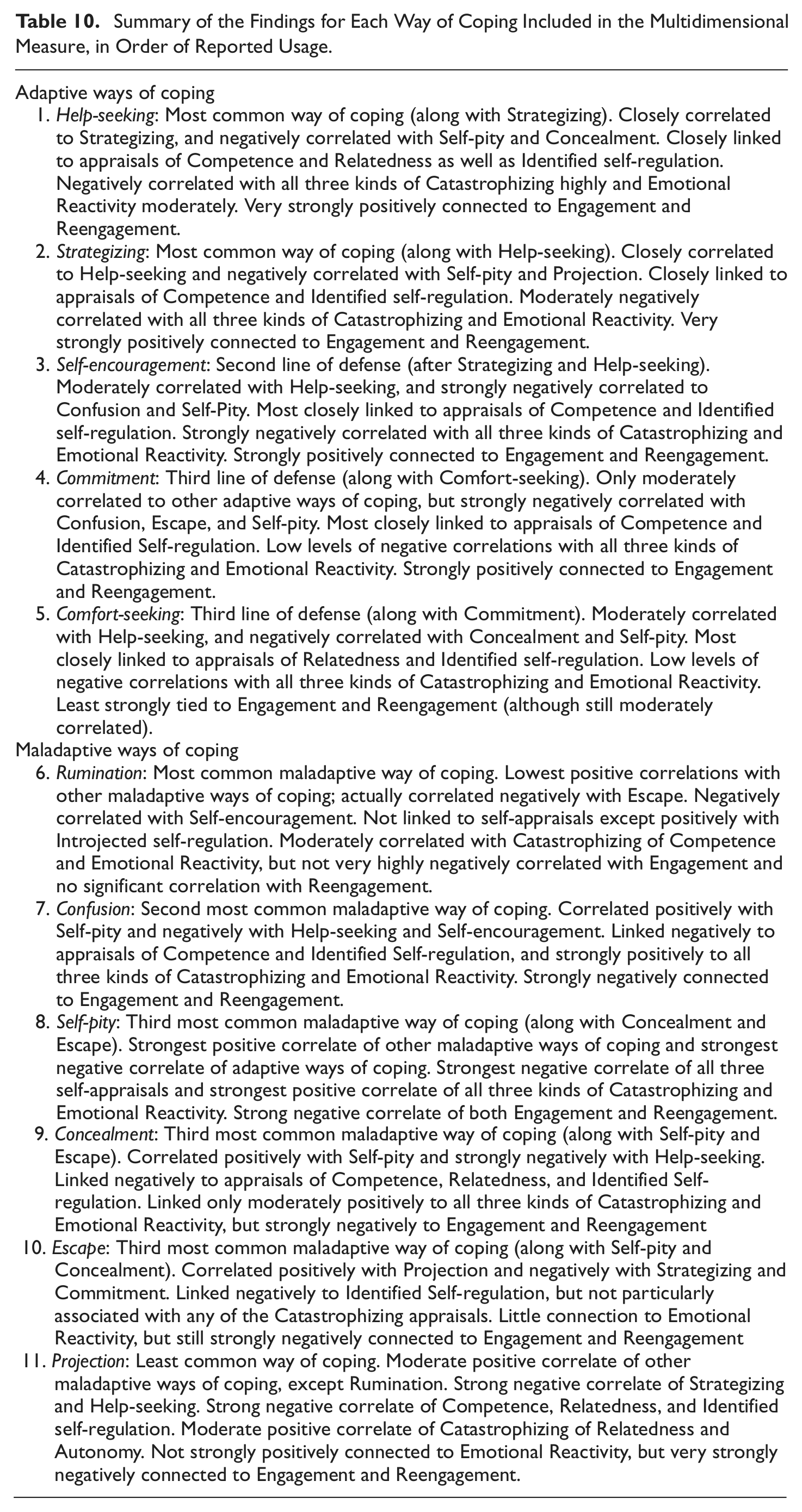
For example, students reported that they used Help-seeking and Strategizing most frequently and these two ways of coping were tightly coupled. However, perhaps because of its social nature, Help-seeking was more closely linked to appraisals of Relatedness (positively) and to Concealment (negatively) than was Strategizing. Likewise, maladaptive ways of coping differed in their patterns of correlates: Self-pity, although not frequently employed, seemed to be a liability all around (i.e., showing strong negative correlations with adaptive coping, self appraisals, Engagement, and Reengagement; and strong positive correlations with Catastrophizing and Emotional Reactivity) whereas Rumination, although the most frequent of the maladaptive ways of coping, evinced a milder nomological net (i.e., actually correlating negatively with Escape, and although positively correlated with Catastrophizing and Emotional Reactivity, not tightly linked to Engagement or Reengagement). Such a pattern of differentiated correlates suggests that the several ways of coping captured by the new measure may each play its own role in the dynamics of motivational resilience.
Limitations
The implications of these results should be considered in the context of the study’s limitations, which include the nature of the sample and the criterion validity indicators available. Although the sample was a reasonable size for measurement analyses and included students from a range of grade and age levels, participants were overwhelmingly Caucasian and from working- to middle-class families. Participants also seemed to be functioning well academically, as evidenced by their relatively high mean levels for adaptive ways of coping, self-system appraisals, engagement, and reengagement. As a result, it is not clear whether this measure would function as well with children and adolescents who come from low socioeconomic or ethnic minority families. Because such students typically face more stressors in their daily lives at home and at school, it would be especially important to be sure that measures of academic coping are validated on these populations as well (Tolan, Guerra, & Montaini-Klovdahl, 1997).
A second set of limitations was imposed by the kinds of measures that were available for analysis of criterion validity. Although it was a strength of the study that multiple markers of motivational resilience could be used, it would also have been helpful to include additional reference variables, especially ones tapping more global indicators of functioning, such as internalizing and externalizing behaviors, which are often examined in research on coping during childhood and adolescence (Compas, Connor-Smith, Saltzman, Thomsen, & Wadsworth, 2001). Moreover, it would have been useful to include variables from sources other than students’ own self-reports. Although students are the only ones who have access to their own appraisals, teachers and observers can provide solid reports of student engagement in the classroom (Skinner, Kindermann, & Furrer, 2009). Likewise, parents and peers can also provide information, especially about children’s and adolescents’ global functioning. Future studies would be enriched by examining connections between ways of coping and markers of academic and overall functioning from multiple sources.
Implications and Future Studies
Future research can use this multidimensional measure of coping, and the larger model of motivational resilience of which it is a part, to begin answering questions about the social and personal resources that allow children to cope well with academic challenges and difficulties as well as to examine the outcomes of academic coping, in terms of both motivation and academic success. In addition, future research can potentially expand and improve the conceptualization and measurement of coping, by carefully considering the specific ways of coping that were incorporated.
Ways of Coping in the Academic Domain
Although it is a strength of the current measure that the ways of coping it comprises were theoretically derived from reviews that identified core families, there has not been enough research to ensure that in every case the specific way of coping chosen from each family was the most important representative from that family for use in the academic domain. For some families, like problem solving, information seeking, support seeking, helplessness, and social isolation, the prototypical way of coping was incorporated, thus bolstering the rationale for its selection. At the same time, however, because every family potentially contains dozens of members, there are always other candidates (see Table 2). For example, the member chosen from the “Information-seeking” family was “Help-seeking,” which referred to seeking out a teacher as the source of information. Adaptive help-seeking is indeed an important way of coping in the classroom (Newman, 2000; Ryan, Patrick, & Shim, 2005), but there are other ways of gathering information in school (e.g., Ayers et al., 1996; Lewis & Frydenberg, 2002), and some of them might also be valuable as targets of study.
Especially challenging is the selection of ways of coping from families in which the prototype cannot be expressed (or is only very rarely expressed) in school. These families include escape, delegation, opposition, and negotiation—because students are simply not allowed to leave the classroom, get others to complete their assignments, block their teachers, or negotiate with them about schoolwork. Hence, we needed to select ways in which students could actually adapt these families for use in the classroom. On the one hand, some of our selections, like mental escape or blaming others, seem uncontroversial, since they are common to other measures in the academic domain (see Table 2).
On the other hand, some of ways of coping we selected, like self-encouragement and self-pity, appear in only a few other academic measures. Of course, we would argue they are credible candidates as representatives of their respective families, and item sets designed to capture them behaved well in psychometric and criterion validity analyses. At the same time, however, they are not the only possible members of these families that children could enact in school (see Table 2), and with continued study, better choices may become apparent. Likewise, even though no one has yet figured out how negotiation might be expressed in school, future researchers may be able to do so, thereby adding that strategy to the inventory captured by measures of coping.
Coping and Motivational Resilience
To expand our understanding of how children and adolescents learn to cope with challenges and setbacks, it may be particularly informative to consult closely related areas of research that focus on regulation (Compas, 2009; Eisenberg, Valiente, & Sulik, 2009; Skinner & Zimmer-Gembeck, 2009). In the academic domain, it would be especially important to connect coping to the rich set of strategies studied in research on self-regulated learning (Zimmerman & Cleary, 2009). Sometimes referred to as “proactive” coping (Aspinwall & Taylor, 1997), these strategies describe how students can actively plan, carry out, and monitor their own learning of challenging academic material.
The study of coping and that of self-regulated learning, although from two largely distinct traditions, have much to offer each other. Because coping generally focuses on reactions—actions students employ only after they have encountered problems—the identification of strategies for self-regulated learning can help build out proactive conceptualizations of coping. Moreover, strategies for self-regulated learning, when they are used effectively, may even avert the need for coping because they reduce students’ encounters with academic stressors, such as failures and problems with academic coursework. At the same time, coping can offer the study of self-regulated learning a conceptualization of why children might not be using proactive strategies, namely, because they are mired in maladaptive ways of coping (Lewis & Frydenberg, 2002). Indeed, coping itself might be a site for the development of self-regulated learning. Failures and setbacks, if handled sensitively by parents and teachers, can provide students motivation and opportunities to learn how to cope adaptively and how to prevent future stressful occurrences, thus building both their capacity for self-regulated learning and their motivational resilience (Boekarts, 1993; Dweck, 2006). Taken together, the findings from the current study suggest that the multidimensional measure of academic coping may prove to be a useful tool in the pursuit of these important questions.
Footnotes
Appendix
| Adaptive Coping |
| 1. Strategizing |
| When something bad happens to me in school (like not doing well on a test or not being able to answer an important question), |
| I try to figure out what I did wrong so that it won’t happen again. |
| I try to see what I did wrong. |
| I think about some way to keep this from happening again. |
| I try to figure out how to do better next time. |
| I think of some things that will help me next time. |
| 2. Help-seeking |
| When I have trouble with a subject in school, |
| I ask for some help with understanding the material. |
| I get some help to understand the material better. |
| I ask the teacher to go over it with me. |
| I ask the teacher to explain what I didn’t understand. |
| I get some help on the parts I didn’t understand. |
| 3. Comfort-seeking |
| When something bad happens to me in school (like not doing well on a test or not being able to answer an important question), |
| I talk about it with someone who will make me feel better. |
| I spend time with someone who will cheer me up. |
| I talk about it with someone I’m close to. |
| I discuss it with someone who will help me feel better about it. |
| I talk with someone who will keep me from feeling bad about it. |
| 4. Self-encouragement |
| When I run into a problem on an important test, |
| I think about the times I did it right. |
| I tell myself it’s not so bad to make a mistake. |
| I tell myself I’ll do better next time. |
| I tell myself I’ll have another chance. |
| I tell myself it’ll be okay. |
| 5. Commitment |
| When I have difficulty learning something, |
| I think about all the reasons it’s important to me. |
| I remind myself that it’s worth it to me in the long run. |
| I remind myself that this is important in reaching my own goals. |
| I remind myself that it’s something that I really want to do. |
| I think about how this is important for my own personal goals. |
| Maladaptive Coping |
| 6. Confusion |
| When I run into a problem on an important test, |
| I’m not sure what to do next. |
| I can’t remember what to do. |
| My mind goes blank. |
| I get all confused. |
| It’s difficult for me to think. |
| 7. Escape |
| When something bad happens to me in school (like not doing well on a test or not being able to answer an important question), |
| I quit thinking about it. |
| I tell myself it’s not such a big deal. |
| I tell myself it didn’t matter. |
| I say it wasn’t important. |
| I say I didn’t care about it. |
| 8. Concealment |
| When something bad happens to me in school (like not doing well on a test or not being able to answer an important question), |
| I try to keep people from finding out. |
| I make sure nobody finds out. |
| I try to hide it. |
| I don’t tell anyone about it. |
| I don’t let anybody know about it. |
| 9. Self-pity |
| When something bad happens to me in school (like not doing well on a test or not being able to answer an important question), |
| I think about all the times this happens to me. |
| I say “This always happens to me.” |
| I ask myself “Why is this always happening to me?” |
| I say “Here we go again.” |
| I can’t believe this is always happening to me. |
| 10. Rumination |
| When something bad happens to me in school (like not doing well on a test or not being able to answer an important question), |
| I just can’t stop thinking about it. |
| I keep thinking about it over and over. |
| I think about it all the time. |
| I’m always thinking about it afterwards. |
| I can’t get it out of my head. |
| 11. Projection |
| When I run into a problem on an important test, |
| I say it was the teacher’s fault. |
| I say the teacher didn’t tell us the right thing to study. |
| I say the teacher isn’t fair. |
| I say the test was too hard. |
| I say the test was not fair. |

Acknowledgements
We express our gratitude to the Motivation Research Group, especially James Connell, Edward Deci, Thomas Kindermann, and Richard Ryan. We would especially like to appreciate James Wellborn for his earlier work on conceptualization and measures of coping. In terms of the research project, we thank the Brockport School District, and its superintendent, principals, teachers, students, and parents for their generous participation. The hard work and good spirits of the research team members are gratefully acknowledged, including Jeff Altman, Michael Belmont, Helen Dorsett, Jennifer Herman, Marianne Miserandino, Brian Patrick, Cara Regan, Hayley Sherwood, and Peter Usinger.
Declaration of Conflicting Interests
The author(s) declared no potential conflicts of interest with respect to the research, authorship, and/or publication of this article.
Funding
The author(s) disclosed receipt of the following financial support for the research, authorship, and/or publication of this article: We acknowledge support from the W. T. Grant Foundation, from the National Institute of Child Health and Human Development (Research Grant No. HD19914), and from the National Institutes of Mental Health (Training Grant No. 527594).