



Abstract
The existing body of literature suggests that evoking emotions through design provides rich interactions. The authors tested Pleasure and Approach reactions of 111 participants toward two curvilinear and two rectilinear simulated interior settings. The curvilinear forms resulted in significantly stronger Pleasure ratings than the rectilinear forms. The circumplexes of emotions indicated that the curvilinear settings elicited higher amounts of pleasant-unarousing emotions (such as feeling relaxed, peaceful, and calm) than the rectilinear settings. The respondents desired to approach those settings more compared with the settings with only rectilinear lines. This research extends the empirical findings for study of emotions and forms by focusing specifically on furniture forms in the interior environment.
It is important to understand how the near environment influences people and their emotions to design better interactions between the two. The study of people and their near environment has many interacting variables: those that derive from the artifact, such as its color, shape, and texture; those that derive from the person, such as his or her experiences, personality, and culture; and those that derive from the context of interaction, such as activities that are done in that physical setting. In this study, we focused on how form as a visual characteristic of the environment influences our emotional reactions to interior environments.
Many studies examine human responses to curvilinearity in the environment (Hesselgren, 1987; Hopkins, Kagan, Brachfeld, Hans, & Linn, 1976; Küller, 1980; Madani Nejad, 2007; Papanek, 1995; Salingaros, 1998; Shepley, 1981). Measuring emotions triggered by the environment has also been extensively investigated (Desmet, 2002; Hull & Harvey, 1989; Kaltcheva & Weitz, 2006; Küller & Mikellides, 1993; Mehrabian & Russell, 1974; Russell, 1992; Russell & Mehrabian, 1977; Russell & Pratt, 1980; Russell, Ward, & Pratt, 1981). We interpreted and applied the findings from the existing body of literature to a more focused context by testing emotional responses elicited by specific interior settings and furniture forms. We measured the emotional responses to simulated, controlled interior settings displaying curvilinear lines of furniture compared with settings displaying rectilinear lines of furniture. We expected that curvilinear forms would elicit more pleasant emotions from participants than would rectilinear forms as curvilinear lines have been theorized to elicit positive emotions in people (Hesselgren, 1987; Küller, 1980; Madani Nejad, 2007; Papanek, 1995; Shepley, 1981). Moreover, we tested the influence of furniture style and layout on emotions triggered by different form types by applying two different furniture styles to the stimuli. It was hypothesized as follows: (a) The settings with only curvilinear lines would elicit more pleasant emotions than would the settings with only rectilinear lines, (b) People would approach the settings with only curvilinear lines more compared with the settings with only rectilinear lines. We hoped that the findings would provide a foundation for further research on emotions and the near environment.
Research Background
Emotions
Emotions are affective mental, short-term states (Desmet, 2002; Ekman, 1994; Frijda, 1986; Scherer, 2005; Trabasso, Stein, Rodkin, Munger, & Baughn, 1992). There are many definitions of “emotions” in the literature (Kleinginna & Kleinginna, 1981). They are multidimensional, subjective, complex concepts. Admiration, boredom, pleasure, stress, joy, and hate are some of the possible emotions that people can generate with regard to the near environment. According to Scherer (2005), emotions have five components: behavioral, physiological, expressional, cognitive, and feeling components. It is not possible to measure all of the components of emotion but the researcher can focus on one of them according to the context of the study. Although it is not possible to measure emotions comprehensively, some aspects of them can be measured. In this study, we measured the feeling component of emotions using verbal scales to test whether curvilinear forms can create more positive emotions in people compared with the rectilinear forms.
Scherer (2005) also categorized emotions as utilitarian and aesthetic. Aesthetic emotions are unrelated to adaptive reactions to pragmatic concerns and involve appreciation of intrinsic qualities, such as the beauty of a piece of furniture. In the present study, ownership and buying dimensions were not included so as to focus on the aesthetic and the hedonic features of the interior environment. Accordingly, we focused on the responders’ gut reactions to the environments.
Emotions and Design
Consumer expectations are shaped by a number of aspects of consumer goods: technology, affordability, variety, and mass-media presence. Scholars (e.g., Jordan, 2000; Norman, 2002) claimed that users expect more than usability and functionality from a product. They expect products to provide pleasure through their emotional and hedonic interaction with people. As a result, scholars from design, consumer behavior, and marketing fields have paid increasing attention to emotions and affect over the last two decades. Evoking emotions through design provides rich interactions, and it influences satisfaction with the artifacts we use in our daily lives. Artifacts—whether designed settings or products—can appeal to human emotions through their usability, social or cultural context, semantics, and affordability. They can also appeal to people through their visual appearances such as with their color, form, complexity, texture, and size.
According to Russell (1992), affective quality is a key factor in determining the human response to an environment. For example, people approach pleasant settings more and they affiliate more with a person in a pleasant setting (Russell & Mehrabian, 1977). When people feel happy or pleasant with excitement, they approach a setting even more. We utilized the circumplex model of emotions in this study (see Russell, 1980; Russell & Pratt, 1980, for more information on circumplex model of emotions). Russell’s (1980) circumplex model of emotions has two main emotion dimensions: arousal and pleasure. All the other emotions are a combination of arousal and pleasure in varying degrees. For example, calmness is a combination of low level of arousal and high level of pleasure. With Mehrabian and Russell’s “semantic differential measures of emotional state or characteristic emotions” scale it is possible to measure those “pleasure” and “arousal” dimensions using verbal scales.
Emotions and Curvilinearity
According to Papanek (1995), roundness contributes to the perceived youthful age of a product due to an association with a child’s physiognomy. As a result of this association, curvilinear forms can evoke feelings of warmth and protectiveness in individuals. Curved shapes of internal spaces invoke feelings of “joy, harmony, and well-being” (Papanek, 1995, p. 229). Pearson (2001) emphasized organic forms and their association with nature and human body. “Emphasizing beauty and harmony, its free flowing curves … are sympathetic to the human body, mind, and spirit. In a well-designed organic building, we feel better and freer” (Pearson, 2001, p. 8). Salingaros (1998) also explained that buildings with natural and biological forms appear more psychologically comfortable. Madani Nejad (2007) found that people appraised curvilinear forms to be pleasant, elevating, and reducing stress. Other scholars who favored curvilinear forms over rectilinear forms include Hesselgren (1987), Küller (1980), and Shepley (1981).
Method
We utilized an online survey to collect data via four different computer-drafted grayscale interior settings as visual stimuli. The settings represented controlled environments with an emphasis on form. Half of the settings had curvilinear forms and the other half had rectilinear forms. We asked the respondents to answer the same questions for each stimulus (see Figure 1 for the visual stimuli). We utilized a repeated measures design. We collected data via Mehrabian and Russell’s (1974) semantic differential measures of Pleasure and Arousal to measure the circumplexes of emotions for each visual stimulus using 9-point scales. Pleasure was averaged from six responses: annoyed/pleased; unhappy/happy; bored/relaxed; unsatisfied/satisfied; melancholic/contented; and despairing/hopeful. Arousal was averaged from six responses: unaroused/aroused; calm/excited; sluggish/frenzied; dull/jittery; sleepy/wideawake; and relaxed/stimulated. Higher scores corresponded to higher Pleasure and Arousal. Three items measured Approach: “How much time would you like to spend in this room?” (four response options, from “none” to “a few hours”); “Once in this room, how much would you enjoy exploring around?” (five response options, from “not at all” to “very much”); and “To what extent does this place make you feel friendly and talkative to a stranger who happens to be near you?” (five response options, from “not at all” to “very much”).
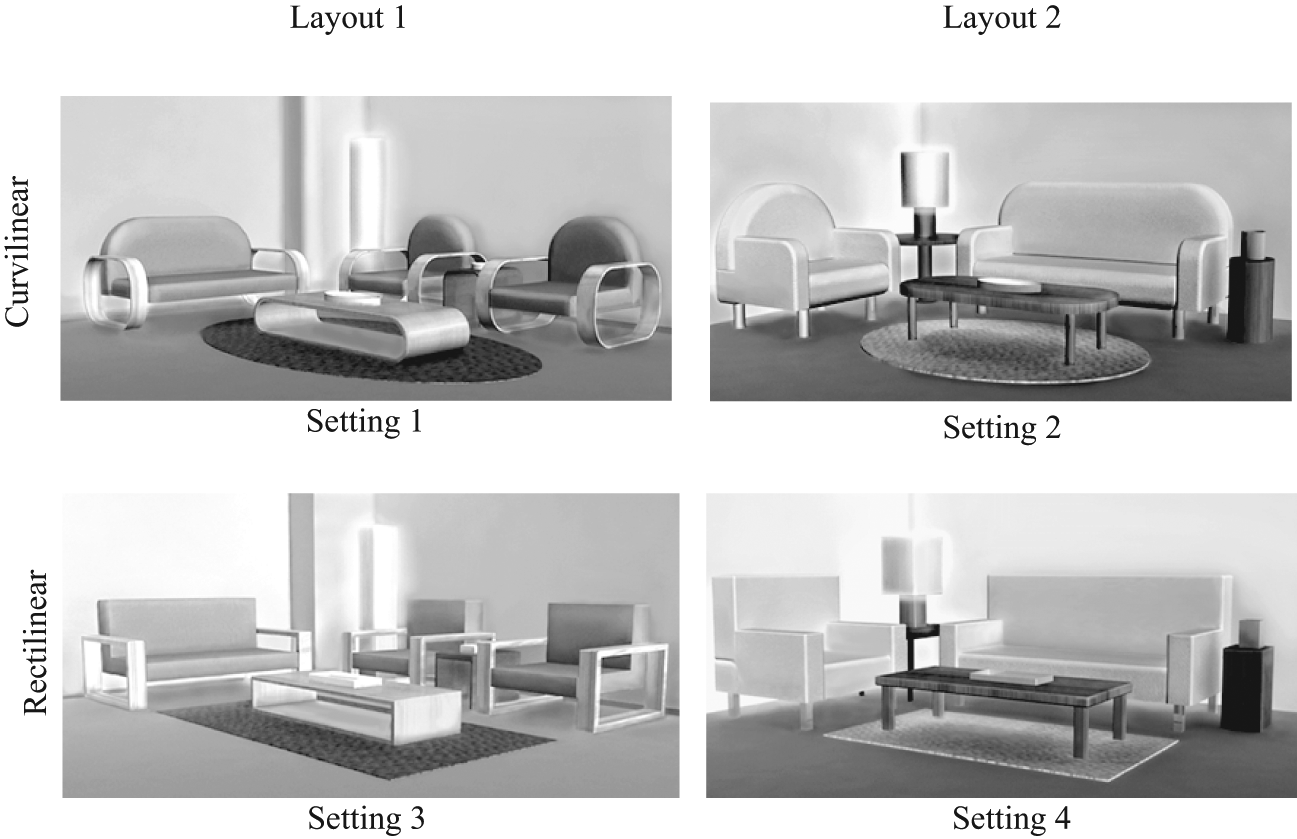
Visual stimuli
We compared the emotion responses (Pleasure and Arousal) and Approach responses between the settings with curvilinear lines and the settings with rectilinear lines. The visual-stimuli survey included two settings with only curvilinear lines and two settings with only rectilinear lines. Among those four settings, two of them had Layout 1 and the other two had Layout 2 (see Figure 1 for visual stimuli). The reason for using two different furniture styles and layouts for each form type was to examine their influence on the results and to test more settings with each form type to increase the generalizability of the results. Visual stimuli with the same furniture style and layout displayed the same kind, amount, and placement of furniture. The furniture was designed with geometric forms for all four settings. Diagonal lines, patterns, and artwork were not used in the settings. There were no suggested activities in the settings such as eating, sleeping, or studying. The visual stimuli were rendered from similar points of views. The furniture, walls, floors, and carpets had the same texture and similar gray values among all settings for the major difference between the stimuli to be the form of the furnishings.
Participants in the study were 111 undergraduate students enrolled at a Northwestern university in the United States. The students were from design and art programs. They were predominantly White (n = 98) and female (n = 96) between the ages of 18 and 51 years (Mage = 22 years). The respondents completed an online survey that took approximately 20 min. They were instructed to provide their responses quickly without thinking too much about the settings shown on the screen or about their answers. Accordingly, it was expected that their responses would provide aesthetic/hedonic emotions via gut reactions.
We collected Pleasure, Arousal, and Approach scores for each visual stimulus. We used them to create circumplexes of emotion for each interior setting. Although we used Arousal to construct the circumplexes, we compared curvilinear and rectilinear forms only through Pleasure and Approach because the existing body of literature did not support a relation between Arousal and Form in interiors. We also used qualitative responses from open-ended questions to interpret the results.
Subsequently, we compared the Pleasure and Approach responses and tested the null hypotheses using dependent-sample-paired t tests (nonparametric Wilcoxon signed-rank tests were also computed resulting in no change in significant effects). We expected higher Pleasure and Approach scores from curvilinear interior settings compared with rectilinear settings.
Results
Pleasure, Arousal, and Approach
The Pleasure and Arousal scores ranged between “4” and “–4.” All visual stimuli (except from Setting 1) received negative Pleasure and Arousal scores. The qualitative responses revealed that this was because of respondents’ dislike of the visual stimuli. The respondents repeatedly expressed their dislike of the computer-drafted interior settings because of their plain and grayscale characteristics. Many students evaluated the settings as boring. Approach scores ranged between “3” and “14.” We compared the Pleasure and Approach variables between the settings with curvilinear lines and rectilinear lines on basis of the existing body of literature. We did not test the Arousal dimension of emotion. See Table 1 for Pleasure, Arousal, and Approach means.
Pleasure, Arousal, and Approach Means (and SDs) for Each Setting
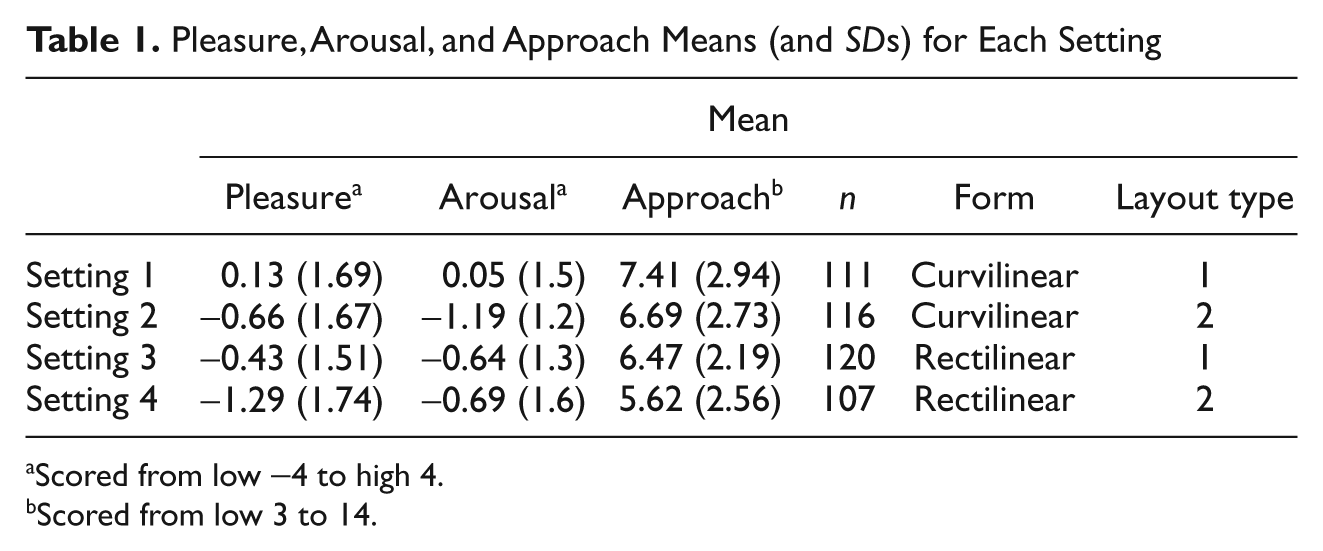
Scored from low −4 to high 4.
Scored from low 3 to 14.
Preliminary tests
Before testing the null hypotheses, we compared the two setting variants within the same form type to see if the variants differed on Pleasure and Approach. We compared the two curvilinear settings (Setting 1 and Setting 2) with each other and the two rectilinear settings (Setting 3 and Setting 4) with each other.
We found that the curvilinear setting (Setting 1) with Layout 1 received significantly higher Pleasure (M = 0.13, SD = 1.7) means compared with the other curvilinear setting (Setting 2) with Layout 2 (M = −0.65, SD = 1.7), t(110) = 4.77, p = .000, d = .46, 95% confidence interval (CI)diff = [1.12, 0.46]. The curvilinear Setting 1 received significantly higher Approach (M = 7.45, SD = 2.92) means compared with the curvilinear Setting 2 (M = 6.68, SD = 2.77), t(109) = 2.67, p = .0087, d = .25, 95% CIdiff = [1.35, 0.20]. The t-test results indicated that having different furniture styles and layouts influenced the participants’ Pleasure and Approach responses toward the curvilinear settings. The curvilinear setting with Layout 1 received significantly higher Pleasure and Approach scores compared with the curvilinear setting with Layout 2.
We found that the rectilinear setting (Setting 3) with Layout 1 received significantly higher Pleasure (M = −0.53, SD = 1.47) means compared with the other rectilinear setting (Setting 4) with Layout 2 (M = −1.29, SD = 1.74), t(106) = 5.11, p = .000, d = .50, 95% CIdiff = [0.46, 1.04]. The rectilinear Setting 3 with Layout 1 received significantly higher Approach (M = 6.4, SD = 2.0) means compared with the rectilinear Setting 4 with Layout 2 (M = 5.64, SD = 2.6), t(104) = 2.88, p = .005, d = .28, 95% CIdiff = [0.24, 1.28].
The above tests indicated that having different furniture styles and layouts influenced the responses to form type. The settings with Layout 1 received significantly higher Pleasure and Approach means compared with the settings with Layout 2. The qualitative responses from the open-ended questions also revealed that many respondents favored the furniture style used in Layout 1 more. Accordingly, we ran tests between the settings with the same Layout. Thus, we did not average across variants within setting type but kept each setting separate. The curvilinear and rectilinear settings with Layout 1 (Setting 1 and Setting 3) were compared with each other, and the curvilinear and rectilinear settings with Layout 2 (Setting 2 and Setting 4) were compared with each other.
Tests for pleasure
The curvilinear Setting 1 with Layout 1 received significantly higher Pleasure (M = 0.13, SD = 1.7) means compared with the rectilinear Setting 3 with Layout 1 (M = −0.47, SD = 1.5), t (110) = 3.43, p = .0008, d = .33, 95% CIdiff = [0.25, 0.96]. The curvilinear Setting 2 with Layout 2 received significantly higher Pleasure (M = −0.68, SD = 1.72) means compared with the rectilinear Setting 4 with Layout 2 (M = −1.29, SD = 1.74), t(106) = 3.08, p = .0026, d = .30, 95% CIdiff = [0.22, 1.00]. Thus, Table 2 shows that curvilinear lines in interiors triggered more pleasant emotions in respondents compared with the rectilinear lines.
Pleasure Means (and SDs) of Settings With Curvilinear and Rectilinear Forms According to Their Furniture Style and Layout
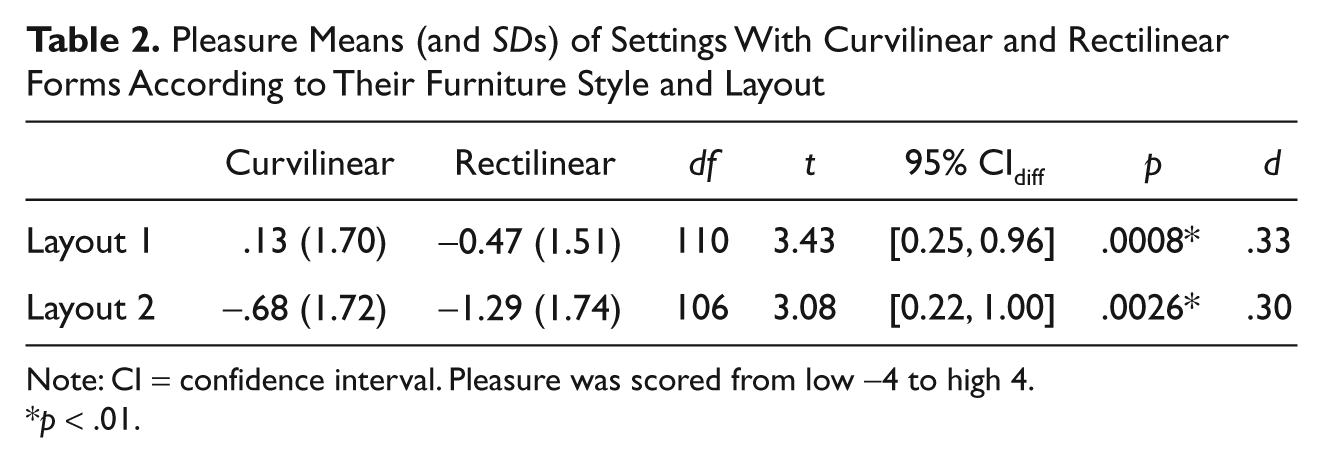
Note: CI = confidence interval. Pleasure was scored from low −4 to high 4.
p < .01.
Tests for approach
The curvilinear Setting 1 with Layout 1 received significantly higher Approach (M = 7.47, SD = 2.93) means compared with the rectilinear Setting 3 with Layout 1 (M = 6.45, SD = 2.09), t(108) = 3.55, p = .0006, d = .33, 95% CIdiff = [0.45, 1.58]. Similarly, the curvilinear Setting 2 with Layout 2 received significantly higher Approach (M = 6.67, SD = 2.8) means compared with the rectilinear Setting 4 with Layout 2 (M = 5.64, SD = 2.56), t(105) = 3.07, p = .0027, d = .30, 95% CIdiff = [0.36, 1.69]. Thus, Table 3 shows that the curvilinear lines in interiors received higher Approach scores compared with the rectilinear lines.
Approach Means (and SDs) of Settings With Curvilinear and Rectilinear Forms According to Their Furniture Style and Layout

Note: CI = confidence interval. Approach was scored from low 3 to high 14.
p < .01.
Both sets of expected results were supported. The respondents associated more pleasure within curvilinear forms and would approach and affiliate more with others in those settings compared with the settings with rectilinear forms.
Circumplex of Emotions
The circumplexes of emotions helped us predict the types of emotions each particular setting evoked in participants in more detail. Figure 2 illustrates the distribution of emotional responses for each visual stimulus on the circumplex layout. There are four types of emotions on the circumplex: pleasant-arousing (such as excitement, feeling elated, and happy), pleasant-unarousing (such as feeling relaxed, peaceful, contented, serene, and calm), unpleasant-arousing (such as feeling stressed, frightened, annoyed, and angry), and unpleasant-unarousing (such as feeling sad, gloomy, bored, and depressed) emotions. The upper half of the circumplex layout shows arousing emotions and the right-hand side of the circumplex shows pleasant emotions.
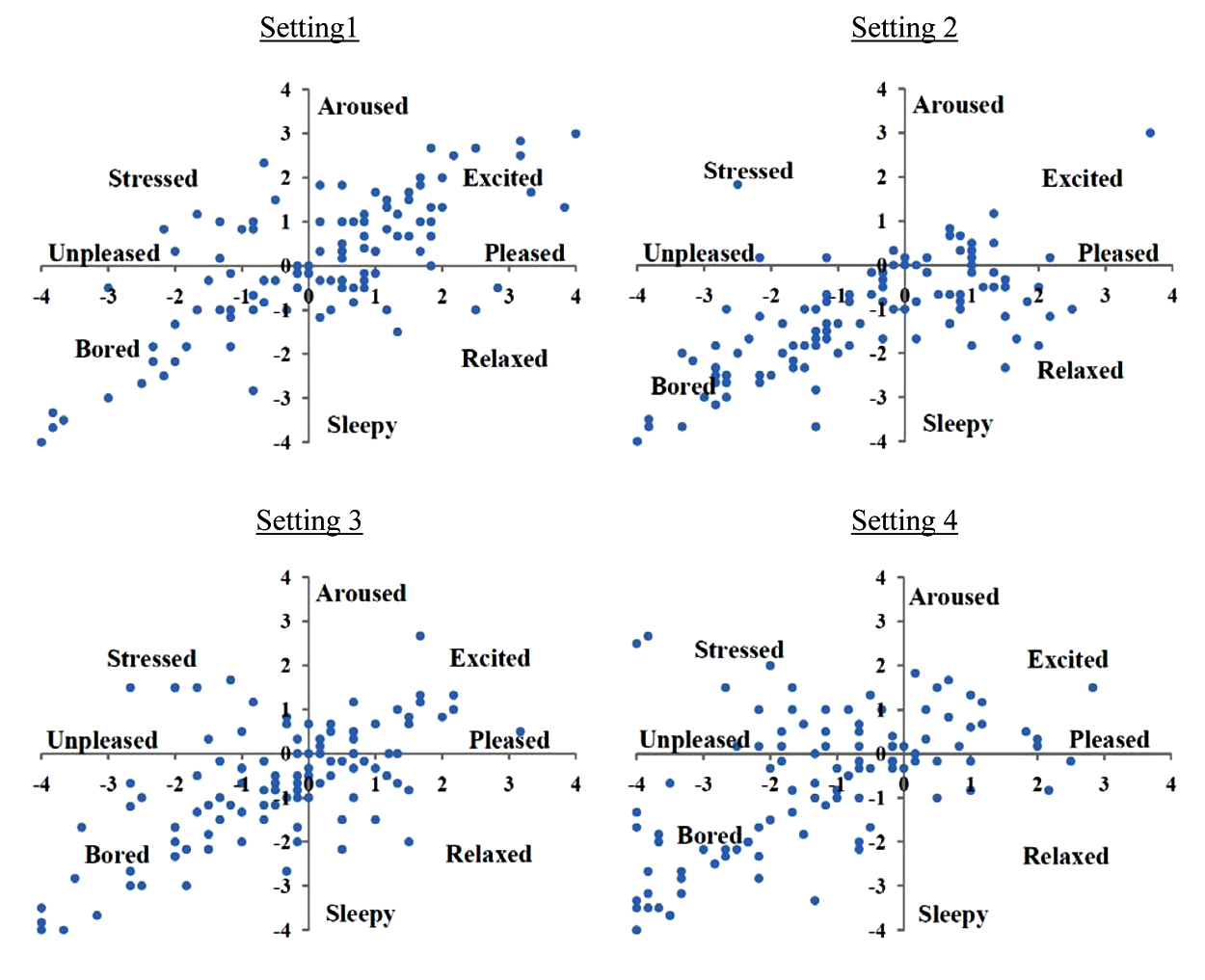
Circumplexes of emotions for each visual stimulus
The circumplexes clearly depicted generally negative responses for each setting. Many responses for Setting 2, Setting 3, and Setting 4 concentrated in the unpleasant-unarousing quadrant. The negative responses reflected the plain and grayscale nature of the visual stimuli.
Discussion
Emotions influence the way people react to, affiliate with, approach, and avoid their near environments. The paired t-test findings supported the literature about curvilinearity and its positive emotional effects on people. Curvilinear forms elicited more pleasant emotions than did rectilinear forms. Participant responses reflected a desire to approach the pleasant settings more compared with the unpleasant settings. Accordingly, participants desired to spend more time in the settings with only curvilinear lines, and they desired to affiliate with others more in those settings compared with the settings with only rectilinear lines. Some respondents explained that curvilinear furniture looked more comfortable, interesting, and calming compared with the rectilinear furniture. One respondent explained, “I like the rounded shapes. They make the furniture look comfortable and inviting like I could lie on the couch and read for several hours.” Another respondent explained, “The rounded furniture seems to give off that calming feel.”
The findings of circumplex of emotions indicated that curvilinear settings had higher percentage of pleasant emotions compared with the rectilinear settings. The circumplexes show that pleasant-unarousing emotions such as feeling pleased, peaceful, contented, calm, and relaxed were associated with the curvilinear settings more. The unpleasant-arousing emotional states such as feeling stressed, annoyed, and angry were associated more with the rectilinear settings. The circumplexes supported the literature on curvilinearity and its relation to positive emotions, which in turn, supported the findings of the paired t tests.
Although the controlled development of the stimuli allowed us to focus participants on curvilinear and rectilinear forms, future research is needed to determine how robust these results are. Future research should test whether adding color and decor would alter results. One respondent explained, “The room is very plain and uninteresting. There is no artwork on the walls to give the room any character or individuality.” Furthermore, different age groups or gender groups can also be compared in larger and more variable samples. This study utilized geometric forms, and future research could examine diagonal lines, organic forms, or other form types in the simulated settings. This study helps to build a foundation for future research that focuses on emotion in the interior environment.
In sum, further work is required to gain a more complete understanding of the relationship between emotions and curvilinearity, our findings can guide designers to design more welcoming and pleasant environments with the use of curvilinear lines in their designs. This study suggested that designing settings with curvilinear forms would promote feelings of happiness, calmness, and relaxation.
Footnotes
Authors’ Note
This manuscript is based on data also used in Sibel S. Dazkir’s master’s thesis at Oregon State University.
Declaration of Conflicting Interests
The authors declared no potential conflicts of interests with respect to the authorship and/or publication of this article.
Funding
The authors received no financial support for this research and/or the authorship of this article.