



Abstract
The authors examined the efficacy of a two-factor model of consideration of future consequences (CFC) in understanding environmentally sustainable behaviors. In Study 1, individual differences in CFC-Immediate and CFC-Future were examined as predictors of environmental concern (EC) and behavior motivation (EB), controlling for values and sociodemographic variables. Results showed that low scores on the CFC-Immediate predicted EC and EB, with nonsignificant effects for CFC-Future. A prospect-concept priming task was used in Study 2 to implicitly activate future thinking which resulted in increases in ECs and behaviors, and these links were partially mediated by CFC-Immediate but not CFC-Future. The findings show that the associations between future time perspective and sustainable behaviors are driven by reduced immediate concerns. Implications for the role of time perspective in understanding and affecting sustainability efforts are discussed.
Introduction
The decision to behave in sustainable ways requires a focus on future outcomes at the expense of immediate benefits. Because the long-term benefits of proenvironmental behavior often involve immediate costs (e.g., time and money spent in the short term), researchers have been paying increasing attention to the role time perspective plays in influencing individuals’ decisions to engage in proenvironmental behaviors. Indeed, there is now a recognition that environmental problems entail not only a conflict between personal and cooperative social interests, which is neatly exemplified by social dilemmas (Arnocky & Stroink, 2011; Arnocky, Stroink, & DeCicco, 2007; Hardin, 1978; Messick & Brewer, 1983), but also a temporal conflict between short-term and long-term interests (Joireman, 2005; Joireman, Van Lange, & Van Vugt, 2004; Milfont & Gouveia, 2006). When tapping the conflict between personal and social interests, research has generally focused on individual differences in values by showing that those who place greater emphasis on altruistic values tend to engage in more sustainable practices than those who emphasize egoistic values (Arnocky et al., 2007; Milfont, Sibley, & Duckitt, 2010; Schultz & Zelezny, 1999; Schwartz, 1992; Stern, Dietz, & Kalof, 1993; Stern, Dietz, Kalof, & Guagnano, 1995). When tapping the temporal conflict between short-term and long-term benefits, research has focused on individual differences in time perspective, or individuals’ conceptions of past, present, and future time (Atance & O’Neill, 2001; Strathman, Gleicher, Boninger, & Edwards, 1994).
Research investigating individual differences in time perspective and its association with sustainable behavior has shown that future time perspective predicts (a) proenvironmental attitudes, such as greater attitudes toward environmental protection and lower attitudes toward environmental utilization (Milfont & Gouveia, 2006) and (b) engagement in sustainable behaviors (Joireman et al., 2004; Joireman, Lasane, Bennett, Richards, & Solaimani, 2001), such as proenvironmental consumerism (Lindsay & Strathman, 1997), use of public transportation (Joireman et al., 2004), and motivation to engage in general proenvironmental actions (Joireman et al., 2001). A recent meta-analytical summary of this literature (involving 19 independent samples and 6,301 participants from seven countries) showed that future time perspective has a stronger influence on sustainable behaviors than a combined score of past–present perspective (Milfont, Wilson, & Diniz, 2012).
However, because few studies have examined the associations between sustainable behavior and both past and present time perspectives, that meta-analysis may primarily be a reflection of the association between sustainable behavior and future time perspective. In fact, the authors of the aforementioned study cautioned that
Because most of the reviewed studies focused only on future time perspective, the trivial effect found for past–present time perspective might be due to the small number of studies in the analyses. Therefore, the associations between environmental engagement and both past and present time perspective should be further reconsidered in future research. (Milfont, Wilson, et al., 2012, p. 331)
Recent developments in the field also support this point of caution. The Consideration of Future Consequences (CFC) Scale (Strathman et al., 1994), which is one of the most widely used measures to assess individual differences in future time perspective, has been traditionally used as a unidimensional scale ranging from low CFC of immediate behavior to high CFC of immediate behavior. However, a number of recent studies have suggested that two theoretically and empirically distinct factors underlie the CFC Scale (Adams, 2012; Charlton, Gossett, & Charlton, 2011; Joireman, Balliet, Sprott, Spangenberg, & Schultz, 2008; Joireman, Kees, & Sprott, 2010; Joireman, Shaffer, Balliet, & Strathman, 2012; Petrocelli, 2003; Rappange, Brouwer, & Van Exel, 2009; Toepoel, 2010); one encompassing concern with future consequences and another encompassing concern with immediate consequences.
Herein we present two studies that contribute to this debate in two ways. First, previous research supporting the two-factor model of the CFC Scale has focused on factor analysis or on validity assessment with health-related behavior. We are the first to explore the usefulness of considering two distinct CFC factors when making predictions about sustainable behavior. Second, we used a priming paradigm to experimentally examine the distinction between the two CFC factors with respect to sustainable behavior. The article starts with a description of the CFC theory and scale as well as findings from recent studies exploring the proposed two-factor solution.
CFC
CFC was proposed by Strathman and colleagues (1994) as a stable individual difference construct on the extent to which individuals consider the future versus immediate consequences of their behavior. The authors specifically stated that
The CFC refers to the extent to which individuals consider the potential distant outcomes of their current behaviours and the extent to which they are influenced by these potential outcomes. It involves the intrapersonal struggle between present behaviour with one set of immediate outcomes and one set of future outcomes. (Strathman et al., 1994, p. 743)
They developed and validated a 12-item CFC Scale to measure this construct, which has been extensively used since its development. In December 2012, a Scopus search yielded 258 citations to the Strathman et al. (1994) publication.
CFC scores are calculated as the average or sum of the five future items and the seven reverse-coded immediate items. This proposed one-factor model assumes that individuals scoring high on the CFC Scale are more aware of the future consequences of their behaviors and also more willing to sacrifice at-the-moment benefits for future gains. Those scoring low on the CFC Scale, in contrast, are assumed to be less aware of the consequences of their actions and to pay more attention to at-the-moment gains.
In the context of environmental issues, a number of studies have shown that the CFC Scale is positively correlated with proenvironmental attitudes and behaviors (e.g., Collins & Chambers, 2005; Joireman et al., 2001; Joireman et al., 2004), such that higher CFC scores are associated with greater proenvironmental engagement. However, because the CFC Scale has both present- and future-oriented items, this one-factor model may reflect mixed concerns related to immediate and future consequences. For example, high CFC scores could mean that an individual is highly concerned about future consequences, or not concerned about immediate consequences, or both (cf. Joireman et al., 2010). This reasoning has implications for reported findings between the CFC Scale and environment-related behaviors. When interpreting the positive correlation between CFC and these behaviors, researchers typically assume that concern over future consequences drives the relationship between the CFC and proenvironmental attitudes and behaviors. Yet this positive correlation may equally be driven by individuals who are high in immediacy concerns being less likely to engage in proenvironmental attitudes and behaviors (cf. Joireman et al., 2008). In support of this perspective, a number of recent studies have provided evidence for the distinction between an immediate and a future factor underlying the CFC Scale (Adams, 2012; Charlton et al., 2011; Joireman et al., 2008; Joireman et al., 2010; Joireman et al., 2012; Petrocelli, 2003; Rappange et al., 2009; Toepoel, 2010).
Empirical Support for a Two-Factor Model
Although few studies have examined the validity of the CFC Scale as a unidimensional indicator of time perspective (e.g., Joireman, 1999; Strathman et al., 1994), it has nevertheless been considered as a single construct in most of the research to date. In response to this paucity of studies, Petrocelli (2003) assessed its underlying factor structure using a large sample of undergraduate students in the United States (N = 664). Principal components analysis indicated two correlated factors. Factor 1 comprised the seven reverse-coded immediate items plus a future item (Item 2), while Factor 2 included the remaining four future items. Males scored significantly higher in Factor 1 than females, with no significant gender difference for Factor 2. Confirmatory factor analysis confirmed a model with two correlated latent factors, but a better fit was found for the model containing only the single latent factor with the eight items from Factor 1. The low internal consistency of Factor 2 (Cronbach’s α of .48) and better fit for a one-factor model, led Petrocelli to advocate the use of a shorter, eight-item version of the CFC Scale. As this shorter version mainly comprises reverse-coded immediate items, Petrocelli concluded that this eight-item version of the CFC Scale would indicate the extent to which an individual’s behavior is uninfluenced by immediate consequences.
Subsequent studies examining the validity of the CFC Scale were published several years later. Rappange et al. (2009) examined the factor structure and validity of the scale with a large sample of high school students in the Netherlands (N = 2,006) and found a factor comprising the seven immediate items, and one or two factors comprising the remaining future items (Items 6-8 and Items 1-2, respectively). In another study, Toepoel (2010) analyzed 11 waves of a panel study (from 1996-2006) carried out in Netherlands and also confirmed a two-factor solution underlying the CFC Scale. Similar to the previous studies, the seven reverse-coded immediate items formed Factor 1 and the five future items formed Factor 2. Charlton et al. (2011, Study 2) investigated the relationship between the two CFC factors and measures of discounting rate and self-efficacy. The correlation between the two factors reflected a small effect size (r = −.29). More importantly, they found that the measure assessing discounting rates was only significantly related to the immediate factor but not significantly related to the future factor. Both factors were correlated to self-efficacy, but the correlation with the future factor was stronger than the correlation with the immediate factor (.43 vs. –.22). These results support the two-factor model by showing that discounting has a focus on making immediate decisions, whereas self-efficacy is about future possibilities and outcomes (Charlton et al., 2011).
More recently, Adams (2012) reanalyzed previously published data to determine whether a two-factor model would in fact be more informative than a unidimensional conceptualization of the CFC Scale. Confirmatory factor analyses showed that the two-factor model, with a medium correlation between the latent factors (Φ = −.45; with r = −.28), was indeed a better fit to this data from a large U.K. sample (N = 800) than the one-factor model. Moreover, examination of aspects that would be expected to vary based on future versus immediate thinking have highlighted the importance of using a two-factor CFC model. Both body mass index (BMI; as a proxy for excessive and impulsive food consumption) and cigarette smoking were significantly predicted by the immediate factor, even after controlling for sociodemographic variables; whereas the future factor was unrelated to these variables (Adams, 2012).
Based on the early evidence of an empirical distinction between two factors underlying the CFC Scale, Joireman and colleagues (2008) have labeled the specific factors as CFC-Future and CFC-Immediate, formed by the five future items and the seven reverse-coded immediate items, respectively. They showed that trait self-control was only predicted by the CFC-Immediate factor, and experimentally showed that the CFC-Immediate factor moderated the impact of ego-depletion on temporal discounting, whereby individuals whose self-control capabilities had been depleted were more likely to discount the future if they had also scored highly on the CFC-Immediate factor.
In a more recent study, Joireman et al. (2010) examined links between CFC scores and compulsive buying tendencies and credit card debt. Again supporting the existence of two distinct factors, only CFC-Immediate was significantly related to both compulsive buying tendencies and credit card debt, whereas the correlations with CFC-Future were nonsignificant. Moreover, CFC-Immediate also moderated the impact of compulsive buying tendencies on credit card debt, with this impact being stronger at lower levels of CFC-Immediate. Finally, Joireman et al. (2012) showed that promotion orientation (a goal pursuit strategy that focuses on achieving positive outcomes) mediated the relationship between CFC-Future and exercise and healthy eating attitudes and intentions. CFC-Immediate was associated with prevention orientation (a goal pursuit strategy that focuses on avoiding negative outcomes), but this factor was not significantly associated with exercise and healthy eating attitudes and intentions. 1
Overview of Studies
The empirical evidence reviewed above provides support for the distinction between immediate and future factors underlying the CFC Scale. This two-factor model suggests that concern with immediate and future consequences are not polar opposites, which supports other conceptualizations distinguishing present and future time perspectives (e.g., Zimbardo & Boyd, 1999), and indicates that a lack of focus on immediate outcomes inevitably denotes a focus on a concern for distant outcomes of current behavior (Petrocelli, 2003). Therefore, although negatively related, the two factors are still empirically and theoretically distinct because it is possible for an individual to disregard immediate outcomes while focusing on future outcomes and vice versa (Charlton et al., 2011).
Despite the fact that a number of studies have already shown that a two-factor structure underlying the CFC Scale has theoretical and empirical advantages, additional studies are needed to provide further empirical support for the advantages of having a less parsimonious two-factor structure and two distinct scores (CFC-Future and CFC-Immediate) instead of an one-factor structure and a single CFC score. Specifically, we draw from the Joireman et al. (2012) argument that “evidence for a two-factor solution should move beyond factor analysis and include an examination of the CFC subscales’ ability to differentially predict relevant outcomes” (p. 1278). Hence, we conducted two studies to further assess the construct validity of the separate factors. Our research goes beyond previous studies by specifically focusing on whether the distinction between CFC-Future and CFC-Immediate matters in relation to environmental issues.
In Study 1, we used a correlational design to explore the extent to which relying on two CFC factors, as opposed to one, provides differing and discriminatory information in the prediction of environmental motivations and intentions. In Study 2, we used an experimental design to advance previous studies in two significant ways. First, we tested whether priming future or present orientation would affect environmental motivations and intentions. Second, we experimentally examined if a priming manipulation would have differing effects on the two CFC factors. Such an experimental effect would also provide much-needed support for the use of separate CFC subscales for the differential prediction of behavior (cf. Joireman et al., 2012).
We are unaware of any studies that have explicitly sought to experimentally induce environmentalism through priming differences in immediate and future time perspectives (but for conceptually related research see, Pahl & Bauer, 2011; Rabinovich, Morton, & Postmes, 2010, Study 3). Such studies are necessary to determine the directionality of the relationship in question. For instance, while it is presumed that time perspective leads to changes in environmentalism, it is feasible that, alternatively, being an environmentalist forces the individual to consider the future, rather than vice versa. If this were the case, then social marketing efforts aimed at increasing environmentalism by reducing immediate thinking and increasing future thinking would be wasteful.
Study 1
Participants and Procedure
Study participants were 78 third-year undergraduate psychology students from the Victoria University of Wellington, New Zealand, who voluntarily took part in the study without any form of incentive. Participants ranged in age from 19 to 30 years (M = 21.4 years, SD = 1.93). Of the participants, the majority were New Zealand born (57, 73.1%), female (64, 82.1%), and self-identified as New Zealand European (54, 69.2%). Participants completed the paper-and-pencil survey in class under untimed neutral conditions.
Measures
CFC
The CFC Scale (Strathman et al., 1994) is a measure of the degree to which one considers the distal versus proximate consequences of their actions. The CFC consists of 12 items rated on a 5-point Likert-type scale, anchored at 1 = extremely uncharacteristic and 5 = extremely characteristic. Example items include “Often I engage in a particular behavior in order to achieve outcomes that may not result for many years,” “My convenience is a big factor in the decision I make of the actions I take” (reverse coded), and “I consider how things might be in the future, and try to influence those things with my day-to-day behavior.” CFC-Future and CFC-Immediate scores were respectively calculated as the average of the five future items and the seven immediate items.
Environmental Concern
The Environmental Concern Scale (ECS; Weigel & Weigel, 1978) was employed to assess participants’ concern about environmental issues. The ECS consists of 16 items rated on a 5-point Likert-type scale, anchored at 0 = strongly disagree and 4 = strongly agree. Seven of the scale items reflected self-reported concern for the environment. The remaining nine items reflect a lack of concern and were reverse coded. Example items are as follows: “The federal government will have to introduce harsh measures to halt pollution as people will not regulate themselves”; “Although there is continual contamination of our lakes, streams, and air, nature’s purifying processes soon return them to normal” (reverse coded); and “The benefits of modern consumer products are more important than the pollution that results from their production and use” (reverse coded).
Proenvironmental Behavior Motivation
We used the Intent of Support subscale from Milfont and Duckitt (2004) as an indicator of participants’ environmental behavior motivation. The measure consists of eight items and used a 7-point Likert-type scale anchored at 1 = strongly disagree and 7 = strongly agree. Example items are as follows: “If I ever get extra income, I will donate some money to an environmental organization”; “I would NOT get involved in an environmentalist organization” (reverse coded); and “I often try to persuade others that the environment is an important thing.” Confirmatory factor analysis has found this scale to be distinct from other measures of environmental attitudes/concerns (Milfont & Duckitt, 2004).
Value Orientation
Altruistic and egoistic values were measured using subscales from the Brief Inventory of Values developed by Stern, Dietz, and Guagnano (1998). Participants were asked to indicate how important each item was as a guiding principle in their life using a 9-point Likert-type scale anchored at 1 = not important and 9 = extremely important. The measure of altruistic values comprised the following three items: “A world at peace, free of war and conflict”; “Social justice, correcting injustice, care for the weak”; and “Equality, equal opportunity for all.” The measure of egoistic values comprised the following three items: “Authority, the right to lead or command”; “Influential, having an impact on people and events”; and “Wealth, material possessions, money.”
Results and Discussion
Correlation Analyses
Bivariate correlations among the variables are presented in Table 1. As can be seen, the correlation between the CFC factors was large and, as expected, negative (r = −.67). Some evidence of construct validity was also revealed. Both CFC-Future and CFC-Immediate were both correlated with environmental concern, but in opposite directions, as would be expected. Higher CFC-Future scores, and lower CFC-Immediate scores, were associated with higher environmental concern. Providing initial indication of differential associations, CFC-Immediate scores were more strongly associated with proenvironmental behavioral motivation than CFC-Future scores. Similarly, CFC-Immediate scores, but not CFC-Future scores, were significantly (negatively) associated with egoistic values.
Descriptive Statistics and Correlations (Study 1).

Note: CFC = consideration of future consequences. Gender: 0 = male, 1 = female.
p < .05. **p < .01. ***p < .001.
Regression Analyses
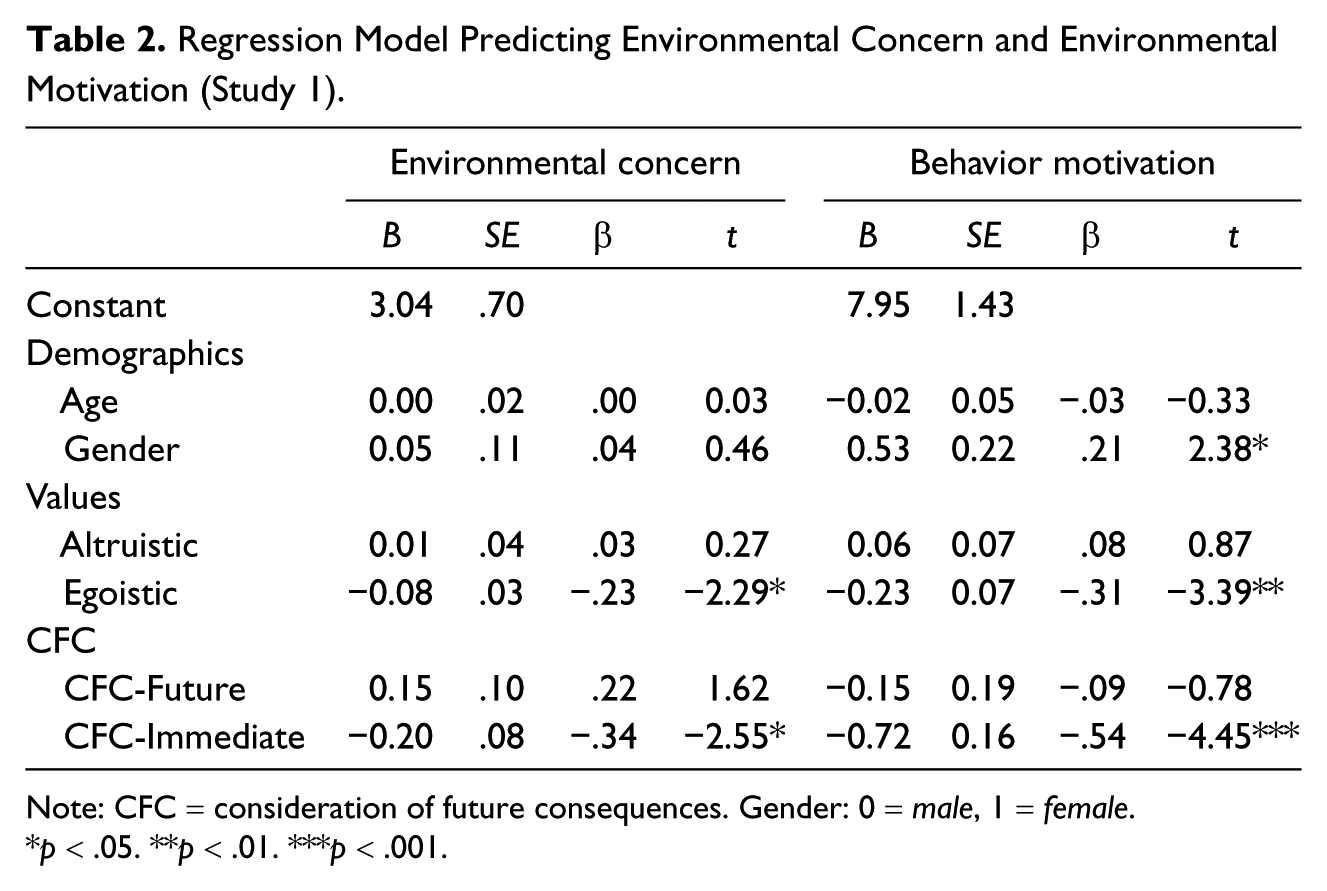
To complement the initial findings, we conducted multiple regression analyses for predicting environmental concern and environmental motivation separately from the two CFC factors. In each analysis, we also entered—and, therefore, controlled for—a number of other individual differences that might plausibly explain or attenuate the predicted associations between CFC factor scores and environmental variables. In addition to age and gender (dummy coded as 0 = male, 1 = female), all analyses included altruistic and egoistic values. Observation of significant effects between CFC factors and environmental variables would indicate that these effects were not attributable to these other demographic or values.
Table 2 presents the results of the multiple regression analyses in the final step with all variables added to the model. As can be seen, after controlling for the other variables, only egoistic values and CFC-Immediate significantly and negatively predicted environmental concern. 2 Greater environmental concern was associated with lower endorsement of egoistic values and lower consideration of immediate consequences. Similar findings were observed for environmental motivation, with the addition of gender which was also a significant predictor. Greater environmental motivation was associated with being female and with lower levels of egoistic concern and consideration of immediate consequences. The CFC-Future × CFC-Immediate interaction was not significant in either analysis (p > .23).
Regression Model Predicting Environmental Concern and Environmental Motivation (Study 1).
Note: CFC = consideration of future consequences. Gender: 0 = male, 1 = female.
p < .05. **p < .01. ***p < .001.
This study provides support for the empirical advantage of considering two factors underlying the CFC Scale. Notably, results reported in Table 2 are virtually identical when the single CFC score is included as a predictor instead of the two factors. Here CFC also has a positive association with both environmental variables, but critically it is not possible to discern which underlying factor (future or immediate) drives the association. Only by using the specific CFC-Future and CFC-Immediate scores does it become possible to establish that it is an individual’s consideration of the immediate consequences of their behavior (and not their tendency to discount the future consequences of their behavior) that drives the negative associations with the environmental variables. Study 2 provides further evidence using an experimental design.
Study 2
Method
Participants and Procedure
Participants were 104 undergraduate university students between the ages of 18 and 35 (Mage = 21 years, SD = 2.8 years). Of these students, 72 were female and 32 were male. Students were recruited from lecture halls on the campus of a midsized Canadian university. Our sample predominantly comprised individuals of Caucasian descent (98%). Participants were randomly assigned to either an experimental (i.e., future prime) or control (i.e., present-day prime) condition. The experimenter was blind to condition. Participation was voluntary and no remuneration was offered. A missing values analysis showed that no variables contained missing cases greater than 5%.
Measures
Priming manipulation
A modified prospect-concept prime, based on and as described in Cheng, Shien, and Chiou (2012), was used as the priming manipulation in this study. This is a guided imagery task meant to induce either future-oriented mind-set or a present-oriented mind-set. Participants in the future condition were given 3min to read and follow the instruction of the following passage, meant to induce a future-oriented mind-set:
Please take a few minutes to envision what your everyday life circumstances might be like FOUR years in the future. Visualize what happens on a typical day from the time you wake up until you go to sleep, FOUR years in the future. Try to include as much detail as possible (sights, sounds, smells, etc.). Take three deep breaths before you begin. Feel free to close your eyes during this task. You will be verbally instructed when to stop. Please do not turn the page until instructed to do so.
In the present condition, participants received a nearly identical set of instructions, meant to induce a present-oriented mind-set:
Please take a few minutes to envision what your everyday life circumstances are. Visualize what happens on a typical day (such as today) from the time you wake up until you go to sleep. Try to include as much detail as possible (sights, sounds, smells, etc.). Take three deep breaths before you begin. Feel free to close your eyes during this task. You will be verbally instructed when to stop. Please do not turn the page until instructed to do so.
Cheng et al. (2012) established the target time frame of visualizing one’s circumstances 4 years in the future based on extant research suggesting that individuals extemporaneously produce past and future events approximately ±3.6 years from the present day (e.g., Addis, Wong, & Schacter, 2007). Providing validity for this task, Cheng et al. (2012, Experiment 1) showed that those primed with a future-oriented mind-set scored higher on the Future subscale of the Zimbardo Time Perspective Inventory (Zimbardo & Boyd, 1999) than those primed with a present-oriented mind-set.
Results and Discussion
Correlational Analyses
Bivariate correlations along with descriptive statistics are presented in Table 3. There were no differences between the two time perspective conditions on any of our control variables (age, sex, and personal values). Consistent with previous research, sex was positively correlated with both environmental concern (r = .22, p < .05) and environmental behavior motivation (r = .45, p < .001), with females scoring higher on each variable. As expected, and also in line with previous research, altruistic values were positively correlated with environmental concern (r = .32, p < .001) and behavior motivation (r = .37, p < .001), whereas egoistic values were negatively correlated with environmental concern (r = −.33, p < .001) and behavior motivation (r = −.34, p < .001). Greater environmental concern and environmental behavior motivation was associated with being female, higher endorsement of altruistic values, and lower endorsement of egoistic values.
Descriptive Statistics and Correlations (Study 2).

Note: CFC = consideration of future consequences. Gender: 0 = male, 1 = female.
p < .05. **p < .01. ***p < .001.
Priming and the Two-Factor Model
In the present study, we further examined the distinction between CFC-Future and CFC-Immediate in whether the prospect-concept priming manipulation would have differing effects on these factors. We first ran independent-samples t tests to compare the scores for these factors among participants in each of the priming conditions. Participants primed with a future-oriented mind-set had significantly lower CFC-Immediate scores (n = 49; M = 2.35, SD = .61) than those primed with a present-oriented mind-set (n = 53; M = 2.66, SD = .60), t(100) = 2.54, p < .05, d = .51. CFC-Future scores did not differ for participants in the future-oriented (n = 50; M = 3.72, SD = .44) and present-oriented (n = 54; M = 3.58, SD = .54) priming conditions, t(102) = −1.43, p = .16.
Priming and Environmental Concern and Motivation
Next, we explored whether the future- and present-oriented primes had different effects on environmental concern. We were further interested in determining whether the experimentally induced change in CFC-Immediate would mediate links between the priming condition and both environmental concern and environmental behavior motivation. We used a bootstrapping mediation method to test these hypotheses, using the INDIRECT macro developed for SPSS (Preacher & Hayes, 2008). Bootstrapping is superior to alternative methodologies for testing mediation models because it does not enforce the assumption of normality and might also relate to increased power and reduced Type I error (MacKinnon, Lockwood, Hoffman, West, & Sheets, 2002). For each analysis in the present study, age, sex, egoistic values, and altruistic values were entered as covariates. Priming condition was entered as the predictor and CFC-Immediate was entered as the mediating variable. A total of 1,000 bootstrapping samples were derived.
We first examined the effects of priming condition on environmental concern. Results showed that sociodemographic characteristics (age and sex) did not explain a significant amount of variance in environmental concern (see Table 4), while altruistic values (b = 0.14, p < .05) and egoistic values (b = −.10, p < .01) significantly predicted environmental concern. Greater environmental concern was associated with higher endorsement of altruistic values and lower endorsement of egoistic values. When considered alongside egoistic and altruistic values, the significant associations of sex and age with environmental concern are diminished. It is noteworthy that the limited effects of age may be a function of the restricted age-range of our sample.
Full Bootstrapping Mediation Model Predicting Environmental Concern and Environmental Motivation (Study 2).

Note: c = direct effect; c’ = c-prime (mediated effect); CFC = consideration of future consequences. Gender: 0 = male, 1 = female.
p < .05. **p < .01. ***p < .001.
Results showed that with the covariates in the model, the prospect-concept prime significantly predicted environmental concern, b = 0.21, p < .01, indicating that experimentally manipulating future thinking increased environmental concern. CFC-Immediate was then entered simultaneously as a mediating variable. Results showed that CFC-Immediate also significantly predicted environmental concern, b = −0.16, p < .05, with greater environmental concern associated with lower immediate concern; and upon its inclusion in the model, partially mediated (i.e., significantly reduced) the original relationship between priming condition and environmental concern, b = 0.17, p < .05. Importantly, the mean indirect effect from the bootstrap analysis was positive and significant (.040), with a 95% confidence interval excluding 0 [.008, .114] which indicates a significant mediation effect (Zhao, Lynch, & Chen, 2010). This model accounted for 27% explained variance (adjusted R2), and the mediation role of CFC-Immediate on the relationship between future prime and environmental concern is depicted in Figure 1 (Panel A).

Study 2: CFC-Immediate, but not CFC-Future, partially mediates the effect of future priming on both environmental concern (Panel A) and environmental behavior (Panel B) motivation (N = 102).
Similar results were observed for desire to engage in proenvironmental behaviors. Age, sex, egoistic values, and altruistic values were again entered as covariates. The results showed that age did not predict environmental behavior motivation, b = 0.02, ns. However, sex (b = 0.44, p < .05), egoistic values (b = −0.21, p < .001), and altruistic values (b = 0.29, p < .05) were each significantly predictive of proenvironmental behavior motivation. Greater proenvironmental behavior motivation was associated with being female, higher endorsement of altruistic values, and lower endorsement of egoistic values. More importantly, the results showed that even after controlling for age, sex, egoistic values, and altruistic values, the prospect-concept prime significantly predicted proenvironmental behavior motivation, b = 0.51, p < .01, indicating that experimentally manipulating future thinking also leads to an increase in environmental behavior motivation. CFC-Immediate was then entered as a mediating variable, and was shown to significantly predict environmental behavior motivation, b = −0.39, p < .01, with greater environmental behavior motivation associated with lower immediate concern. With CFC-Immediate entered in the model, the relationship between priming condition and environmental behavior motivation was significantly reduced, b = 0.41, p < .01. Supporting a significant mediation effect for CFC-Immediate, the mean indirect effect from the bootstrap analysis was positive and significant (.103), with a 95% confidence interval excluding 0 [.014, .272]. The mediation model accounted for 41% explained variance (adjusted R2) and is depicted in Figure 1 (Panel B).
The results of the present study provide the first empirical evidence that manipulating time perspective affects individuals’ environmental concerns and motivations through induction of lower scores on the CFC-Immediate. The results also provide novel experimental data on the effect of priming on both environmental-related concern and behavior and on the two CFC factors. Specifically, priming participants with a future-oriented mind-set, compared with a present-oriented mind-set, decreased their focus on immediate concerns (i.e., reduced CFC-Immediate scores) which in turn partially mediated links to environmental concern and motivations. Thus, the prospect-concept priming task increases ones concern for environmental issues and at the same time decreases ones focus on concern with immediate consequences (i.e., CFC-Immediate) of their behavior.
General Discussion
A decision to behave in sustainable ways requires a focus on future benefits at the expense of immediate benefits, and a growing number of studies have examined the extent to which individual differences in future thinking is associated with greater environmental engagement. The present study contributes to this literature. We explored whether a two-factor model of CFC provides novel predictive information as it relates to environmental concerns and behaviors (Study 1), and whether a priming manipulation could affect CFC-Immediate or CFC-Future factor scores, and environmental concern and behavior (Study 2).
The results of Study 1 showed that environmental concern and environmental behavior motivation were positively predicted by CFC-Immediate scores but not CFC-Future scores. This finding is consistent with previous research using the two-factor CFC structure, which has found that individuals who emphasize immediate consequences are likely to exhibit less self-control and are more likely to engage in temporal discounting compared with those who are less prone to consideration of immediate consequences. No differences were found with respect to the CFC-Future scale on either environmental concern or environmental behavior motivation.
The results of Study 1 also suggest that previous works which have identified a link between the single-factor CFC and various environmental measures may be driven primarily by variance on the CFC-Immediate, rather than on the CFC-Future subscale. Study 1 was, however, not without limitations. First, the somewhat low internal consistency of the CFC-Future subscale may have influenced its ability to predict environmental concern and behavior. Indeed some researchers have suggested the alternative use of an eight-item CFC measure that assesses primarily CFC-Immediate items (Petrocelli, 2003), whereas others have developed additional items meant to balance the CFC-Future and CFC-Immediate subscales (CFC-14 Scale; Joireman et al., 2012) and provide better internal consistency to that factor. Use of the modified CFC-Future subscale may provide greater insight into the distinct contributions of immediate versus future thinking with respect to environmental concerns and behaviors. Use of the CFC-14 Scale in future studies is thus encouraged.
Study 1 was also limited by the cross-sectional nature of its design, and thus we were unable to draw firm conclusions regarding the direction of the observed effects. For instance, it is possible that being more proenvironmental (i.e., expressing more environmental concern and more desire to behave environmentally) leads individuals to think less about the immediate consequences of their behavior, in a manner reflective of low scores on the CFC-Immediate subscale.
With this in mind, our second study (Study 2) experimentally manipulated time orientation by means of a prospect-concept prime wherein participants were instructed to think about a typical day in their lives either presently (control condition) or 4 years in the future (priming condition). Individuals who were exposed to the future condition expressed significantly lower scores on the CFC-Immediate compared with those who were exposed to the control (present) condition. Moreover, those individuals in the future priming condition also expressed significantly more environmental concern and environmental behavior motivation than those in the control (present) condition, which is in line with past research suggesting a link between future time perspective and sustainable behavior. The findings from Study 2 show that environmental concerns and behavior motivations can be experimentally enhanced (at least, temporarily) through priming techniques that induce less focus on one’s immediate circumstances (also see, Pahl & Bauer, 2011; Rabinovich et al., 2010, Study 3). Interestingly, however, the influence of future priming on sustainable behavior was partially mediated by CFC-Immediate scores. These findings underscore those of Study 1, in that low scores on the CFC-Immediate seem to be particularly important for promoting sustainable behavior.
In conjunction, results from both studies showed that the relationship between time perspective and environmental attitudes and behavior is due to a concern with the immediate consequences of behavior. This finding provides novel information given that previous studies have shown a positive association between CFC (combined Future and Immediate scales) and environmental engagement (Joireman et al., 2001; Joireman et al., 2004; Milfont, Wilson, et al., 2012), but it was hitherto unclear whether the association was driven by future or immediate concerns. The present findings show that future prime reduced immediate concerns and increased sustainable behavior, and that immediate concerns mediated the influence of future prime on sustainable behavior. This novel finding suggests that reduced immediate concern (and not increased future concern) is the mechanism by which future thinking influences sustainable behaviors. Results from both studies also indicate that individuals who are concerned with the immediate consequences of their actions are less likely to engage in proenvironmental attitudes and behaviors. Supporting this, studies have reported negative associations between present time perspective and both environmental preservation (Milfont & Gouveia, 2006) and water conservation behavior (Corral-Verdugo, Fraijo-Sing, & Pinheiro, 2006).
These findings may have important implications for sustainability initiatives. For instance, based on the findings of the present studies, we would expect that advertisements and awareness campaigns would benefit from a focus on minimizing immediacy concerns (e.g., overcoming opposition to the initial costs of solar energy production), rather than focusing solely on promoting a future orientation, such as those directed at maintaining the planet for individuals living generations from now (cf. J. Joireman et al., 2012). Future studies should explore this possibility further. The findings also indicate a partial (or complementary) mediation which suggest the likelihood of another mediator in the influence of future prime on sustainable behavior (cf. Zhao et al., 2010). Future studies should also explore this possibility.
Perhaps lower levels of environmentalism among those induced to focus on immediate consequences is a reflection of changes in abstract versus concrete thought. Indeed, time perspective has recently been correlated with differential allocation of cognitive resources as well as in task performance (Nowack, Milfont, & van der Meer, in press). Based on premises from Construal Level Theory, Förster, Friedman, and Liberman (2004) described greater temporal distance, such as that induced via the concept-prospect prime of thinking 4 years into the future, as necessitating representations of events that are more abstract and decontextualized, whereas those who were induced to think about the present would likely represent such images in very concrete and specific ways. They note, to illustrate: a person thinking about a conference a year from now might think about it in terms of more superordinate goals, such as “learning about new research,” whereas a person thinking about a conference that takes place tomorrow might be construing it in terms of more subordinate and concrete goals, such as “ironing one’s pants.” (Förster et al., 2004, p. 177)
This example illustrates the influence of temporal distance on desirability and feasibility considerations of behavior, which respectively deals with why and how aspects of an action (Liberman & Trope, 1998). Environmentally sustainable behavior involves both desirability (moral principles and ideals) and feasibility (difficulty, cost, and situational pressures) considerations (Milfont, 2010), and inducing less immediacy-focused thinking (i.e., low scores on the CFC-Immediate) should assist with greater focus on the more abstract desirability considerations.
The distinct influence of temporal distance between abstract/desirability and concrete/feasibility has clear implications for the assessment of environmental risks, such as climate change (Milfont, 2010). A large body of research now suggests that the consequences of anthropogenic climate change will become more severe over the next century. Predicted future outcomes include more frequent water stress, desertification, heat waves, and flooding, contingent upon the ultimate degree of global temperature increase as well as geographical region (Fourth Assessment Report of the Intergovernmental Panel on Climate Change [IPCC-AR4-WG2]; Confalonieri et al., 2007). The World Health Organization (WHO) estimated that by the year 2030, climate-related health risk will more than double (McMichael et al., 2004). Heading these warnings requires a degree of abstraction. Yet, it is often easier for us to think more concretely about current and often conflicting social and/or personal issues (e.g., Hamilton, 2010; Hirsh & Dolderman, 2007). By priming a reduction in consideration of such immediate consequences, individuals might allow for more mental capacity to be devoted to abstract, future thought, which might in turn enhance environmental concerns and behavior motivations.
It should be noted that the results of our research may be limited by the age of our participants. Specifically, in both studies we used young adults, primarily in their early 20s. It is possible that because few of participants would be parents and none of them would be grandparents that they would be less likely to be influenced by appeals to future thinking, and perhaps more influenced by appeal to immediate thinking, compared with adults with children and/or grandchildren. Indeed, research has shown that age is inversely related to both temporal discounting (Steinberg et al., 2009) and impulsivity (Steinberg et al., 2008), and that parental status and fertility intent are linked to environmental concern (Arnocky, Dupuis, & Stroink, 2012; Milfont, Harré, Sibley, & Duckitt, 2012), which may explain why our effects applied to the CFC-Immediate factor and the priming technique that induced less focus on one’s immediate circumstances. While speculative, this interpretation of our results leads to the testable hypothesis that because adults with offspring have a greater incentive to focus on the future consequences of their behavior—which has been termed environmental generativity (Milfont, Harré, et al., 2012; Milfont & Sibley, 2011)—as opposed to the costs and benefits of their immediate consumption, appeals to focus on the future would have a larger influence on their attitudes and behavior than appeals to focus on the present. In other words, we might see the opposite pattern that we observed in the present studies if we used a sample comprising adult parents instead of adult undergraduates.
One additional limitation may be related to our priming conditions in Study 2. Without a pure control condition, it is unclear whether the future prime reduced CFC-Immediate scores, or whether the present-day prime increased CFC-Immediate scores. Using Study 1 as a baseline level of CFC-Immediate (M = 2.58, Table 1), it appears that future prime did reduce CFC-Immediate scores, M = 2.35; one-sample t test: t(77) = 2.734, p < .01, while the control (present) prime did not yield change (M = 2.66; p = .32). Inasmuch as the two studies are based on different populations, this reasoning is only speculative and follow-up research would be advised to include a true baseline group. 3 This could be accomplished in one of two ways. A between-subjects design could be used wherein participants in a pure control condition would complete the CFC subscales without exposure to the priming manipulation, and comparisons would be made to those in the future and present-day priming conditions. Alternatively, researchers could use a within-subjects design wherein participants would first complete the CFC subscales at Time 1 in the absence of any priming, and then would be assigned to either the future or present-day prime at Time 2, and would again complete the CFC subscales. This would permit assessment of a directional change in CFC scores to see if the present-day prime increases CFC-Immediate scores or whether the CFC-Future prime causes them to go down.
One final limitation is that our priming manipulation may not have significant ecological validity, in that the effects of the prime may not be long lasting. However, it is noteworthy that even temporary modification of individuals’ environmental attitudes might positively augment their environmental behavior (i.e., a well-placed prime in a cafeteria). As such, this study represents an important first step in showing that priming manipulations of temporal orientation can in fact induce proenvironmental attitudes and behavior motivation.
Conclusion
The present set of studies builds on those showing the importance of individual differences in time perspective in understanding environmental engagement and also the predictive utility of a two-factor model of CFC. In line with the extant literature, we found the distinction between CFC-Future and CFC-Immediate has empirical utility. Advancing previous studies, we also showed that the CFC-Immediate was particularly important in the prediction of environmental concern and behavior motivation, and that environmentalism can be primed through induction of low CFC-Immediate. By distinguishing the two CFC factors and using experimental designs to implicitly activate time perspectives moves the field beyond correlational studies that focus on a single factor of future consequences. Future use of the CFC-Future and CFC-Immediate subscales and studies using experimental designs to examine the associations between time perspective and environmental engagement is encouraged.
Footnotes
Authors’ Note
Steven Arnocky and Taciano L. Milfont contributed equally to the writing of this article.
Declaration of Conflicting Interests
The author(s) declared no potential conflicts of interest with respect to the research, authorship, and/or publication of this article.
Funding
The author(s) disclosed receipt of the following financial support for the research, authorship, and/or publication of this article: Collection of data analyzed in Study 1 and preparation of this manuscript was supported by a Marsden Fast Start grant from the Royal Society of New Zealand awarded to Taciano L. Milfont. Collection of data analyzed in Study 2 was supported by a grant from the Northern Ontario Heritage Fund Corporation awarded to Steven Arnocky, Jeffrey R. Nicol, and two others.