



Abstract
Post-secondary institutions require appropriately designed informal learning spaces (ILSs) outside of classrooms for studying and group-work activities, but few studies have investigated how these spaces perform, especially in terms of acoustics. We measured objective acoustical characteristics and architectural features in 23 such spaces, and captured environmental assessments and well-being outcomes from a survey of 850 student occupants. Objective measures indicated that sound levels generated by occupants and other sound sources tended to exceed maximum values recommended by standards. Some components of perceived suitability and well-being were greater in spaces with lower background sound levels (e.g., from ventilation systems), but with more occupant-generated sound, and more reverberation. Furthermore, some design features such as more vegetation, the presence of soft furnishings, and lower seating density predicted some components of perceived suitability and well-being. This evaluation of ILSs offers lessons for designers and suggests additional directions for further study.
Keywords
At university, the majority of learning should occur outside of the classroom; scholars of learning and teaching recommend approximately 2 to 4 hours of studying or homework for every hour of classroom instruction (Jensen, 2011). The quality of this study time is a key predictor of students’ grade point averages (Plant, Ericsson, Hill, & Asberg, 2005), and it can be enhanced by using particular study strategies and selecting appropriate physical study environments (Zimmerman & Kitsantas, 2002). To support this, universities incorporate learning spaces, sometimes featuring study carrels, tables, couches, or other seating, into the design of campus buildings. These spaces, termed informal learning spaces (ILSs), are located outside of the classroom, are available for use without booking, and are intended for individual or group study purposes.
Over the past several decades, numerous studies in environmental psychology and related fields have demonstrated that the physical characteristics of a learning space can influence students’ attitudes toward learning and their institutions, their ability to learn, and their well-being (e.g., see Gifford, 2014). These characteristics include acoustics (Shield & Dockrell, 2008), design (Cohen & Trostle, 1990), lighting (Mott, Robinson, Walden, Burnette, & Rutherford, 2012), natural views (Benfield, Rainbolt, Bell, & Donovan, 2015), temperature, humidity and air circulation (Czubaj, 2002), seating and density (Kantrowitz & Evans, 2004), and the presence of couches and other soft materials (Sommer & Olsen, 1980).
Acoustics have proven to be particularly important to students’ learning and well-being (e.g., Klatte, Hellbrück, Seidel, & Leistner, 2010; Shield & Dockrell, 2008). However, the majority of research on acoustics and learning has been conducted in elementary school classrooms and in university-type classrooms and lecture halls, not in ILSs. This is an important difference, given that traditional post-secondary classroom learning via lecture relies mainly on auditory and visual learning modalities, whereas learning in informal study spaces likely involves various non-auditory tasks, such as reading, writing, memorization, and problem-solving, as well as auditory tasks and verbal communication activities, such as small-group discussion. Other work has demonstrated that noise in residential environments has negative associations with children’s learning and academic achievement (e.g., Lercher, Evans, & Meis, 2003); the investigation of acoustics and learning in non-classroom spaces deserves expansion to adult learners in spaces that are intended to support learning. Therefore, identifying which acoustical features most strongly predict students’ perceptions of an ILS, its suitability for learning, and its affective impact, is important for informing the optimal design of these spaces.
This study explored the relations between key acoustical characteristics of ILSs (e.g., background sound levels and reverberation) and psychological outcomes (e.g., perceived suitability of the space for learning, and self-reported well-being). Other non-acoustical features (e.g., occupant density, lighting) were also assessed, given their expected impact on learning and well-being.
Acoustics and Learning
Sound has complex effects on learning, and at least five factors underlie this complexity (e.g., Gifford, 2014). First, the physical attributes of the sound, such as the decibel level, frequency, and reverberation, have been considered. For example, low-frequency (i.e., 20-200 Hz) sound such as from traffic, aircraft, ventilation systems, or wind turbines, can be judged as louder and more annoying than higher frequency sounds at equal sound-pressure levels (e.g., Berglund, Hassmen, & Job, 1996), and can interfere with tasks requiring attention, such as proof-reading (Bengtsson, Waye, & Kjellberg, 2004; Waye, Bengtsson, Kjellberg, & Benton, 2001). Higher frequency sounds can impair verbal communication but provide speech privacy.
Second, the effects of sound on learning vary by individual characteristics such as gender, age, and personality (e.g., Belojevic, Evans, Paunovic, & Jakovljevic, 2012). For example, some learners appear particularly sensitive to noise (i.e., unwanted sound) and have difficulty screening it out, whereas others prefer to work in louder environments (Mehrabian, 1977; Weinstein, 1978). Moreover, some sounds in learning spaces are desired and beneficial, whereas others are undesirable and detrimental. In fact, the same sound (e.g., speech) may be both detrimental and beneficial to different people at the same time. Thus, louder sound does not necessarily indicate a less suitable environment. Third, the type of task is relevant. In one study, for example, noise from irrelevant speech impaired proof-reading performance, but did not affect other cognitive tasks, including reading comprehension, reaction time, and simple arithmetic (Venetjoki, Kaarlela-Tuomaala, Keskinen, & Hongisto, 2007). For tasks that require listening (e.g., during a lesson), or verbal communication, the source must be intelligible (e.g., Kennedy, Hodgson, Edgett, Lamb, & Rempel, 2006; McSporran, 1997). Fourth, situational factors, such as similarity between the acoustical environment during learning and recall (Hambrick-Dixon, 1988), and whether instructions are verbal or written (Hartley, Boultwood, & Dunne, 1987), can play a role. Fifth, the timing of the noise is relevant; noise during learning appears to be more detrimental than is noise during subsequent performance (Bell et al., 1984; Hygge, 2003). This latter point underscores the importance of creating acoustically suitable ILSs, where students are typically learning new material rather than demonstrating their mastery of it on an exam. In this article, we focus on two acoustical properties of ILSs: background sound and reverberation.
Sound Levels
Sound levels in classrooms are comprised of noise as well as wanted sound. Background noise, whether from external sources such as traffic, internal building sources such as ventilation systems and elevators, or from internal classroom sources such as occupant speech and movement, can exert deleterious effects on a host of cognitive functions important for learning (Choi & McPherson, 2005). For example, the negative effects of chronic external noise, such as from aircraft and traffic, on children’s memory, reading ability, academic performance, and motivation are well-documented (e.g., Cohen, Evans, Krantz, & Stokols, 1981; Shield & Dockrell, 2008; Evans & Lepore, 1993; Hétu, Truchon-Gagnon, & Bilodeau, 1990). Irrelevant classroom noise can hinder speech perception, attention, and student participation (Choi & McPherson, 2005). Similarly, chronic external noise in residential environments is negatively associated with children’s reading ability, auditory discrimination (e.g., Cohen, Glass, & Singer, 1973), and memory (e.g., Evans, Lercher, Meis, Ising, & Kofler, 2001; Lercher, Evans, & Meis, 2003).
Despite the negative effects of noise, sound generated by the learning activities themselves is important for learning to occur. In classrooms, teachers’ voices that carry a high signal-to-noise ratio result in better student understanding of information and language processing (e.g., Kennedy, Hodgson, Edgett, Lamb, & Rempel, 2006; Larsen & Blair, 2008). Hearing one’s peers is also important for peer-to-peer learning as well as socialization (Shield & Dockrell, 2003). Similarly, collaborative group work requires adequate room acoustics for individuals to effectively communicate with others. In open-plan office work areas, for example, breakout rooms are recommended to address the need for private communication and collaboration (Brennan, Chugh, & Kline, 2002).
In ILSs, “wanted” sound is likely to result from talkers communicating to listeners at short distances, such as in small-group discussion. Unwanted sound may arise from person- or non-person-generated background “noise,” that is not part of the learning activity, or that is perceived as distracting. Considering the above research, the first hypothesis was that louder background sound measured in spaces when they are unoccupied (e.g., sound from HVAC systems) will be negatively associated with perceptions of the environment’s perceived suitability. The second hypothesis investigated the impact of occupant-generated sound on perceived suitability; given that this may be either a wanted product of the learning activities, or unwanted noise, the direction of this effect is exploratory.
Reverberation
Reverberation refers to the temporal prolongation of sound reflecting inside an enclosed space; a layperson may describe it as the echoing of sound in a space. Reverberation time (RT) is defined as the time in seconds taken for sound at a given frequency to decay 60 dB after the sound is generated (International Standards Organisation [ISO], 2009). Along with background sound, reverberation is a key element of room acoustics with implications for learning. It is well-established that increased reverberation reduces speech intelligibility, but increases speech privacy (e.g., Houtgast, Steeneken, & Plomp, 1980). Studies with children have found that those in classrooms with longer RTs performed more poorly on speech perception, short-term memory, and phonological processing tasks (Klatte, Hellbrück, Seidel, & Leistner, 2010). Similarly, longer RTs interfere with adults’ memory for spoken items (Ljung & Kjellberg, 2009) and spoken lectures, even when the lectures were intelligible (Ljung, Sörqvist, Kjellberg, & Green, 2009).
Such negative effects of reverberation are thought to relate to cognitive load (Culling, Hodder, & Toh, 2003; Darwin & Hukin, 2000; Kjellberg, 2004). Specifically, because reverberation interferes with the discrimination of speech signals, cognitive resources must be expended to compensate, leaving fewer resources available to other learning tasks, such as comprehension and memory. Not surprisingly, reverberation is problematic in classrooms, where word identification is a central task. However, whether reverberation in ILSs exerts similar effects is unclear, given that learning tasks in these spaces are generally solitary, or involve group members in close proximity, rather than speech from a distant talker (i.e., the teacher or lecturer). Therefore, the third hypothesis, that reverberation is associated with the perceived suitability of ILSs for learning, is exploratory.
Acoustics and Well-Being
In addition to their effects on cognitive functioning, acoustical conditions have implications for well-being. They can lead to emotional responses such as annoyance, and psychophysiological responses such as stress. Well-being-related outcomes serve as indicators of an environment’s success, because they predict patronage and the habitability of a space, and because they interact with productivity and performance, interpersonal relations, organizational commitment, and other outcomes (Gifford, 2014).
Sound Levels
A common finding is that high sound levels are associated with more annoyance (Dockrell & Shield, 2004; Jahncke, Hygge, Halin, Green, & Dimberg, 2011; Ouis, 2002; Pierrette et al., 2012; Shield & Dockrell, 2003; Wålinder, Gunnarsson, Runeson, & Smedje, 2007). Noise annoyance is higher when the source can be seen (Bangjun, Lili, & Guoqing, 2003), when it is speech-related (Schlittmeier, Hellbrück, Thaden, & Verländer, 2008; Venetjoki, Kaarlela-Tuomaala, Keskinen, & Hongisto, 2007), and when it is intermittent, as opposed to continuous (Astolfi & Pellerey, 2008).
Noise annoyance manifests physiologically as a stress response (Ljungberg & Neely, 2007). Total, A-weighted, equivalent sound levels, ranging from 59 to 87 dBA, covaried with elementary school students’ self-reported (e.g., headaches) and objective (e.g., diurnal cortisol variability) symptoms (Wålinder et al., 2007). Whether sound levels detract from well-being in ILSs has not yet been investigated. Given the above findings, the fourth hypothesis was that louder background sound levels, as measured in unoccupied ILSs, would be associated with more negative psychological consequences. The fifth hypothesis investigated the influence of occupied sound levels on well-being, but given that occupied sound can be wanted (e.g., as part of one’s learning activities) or unwanted, the direction of this effect is not specified here, and was to be explored.
Reverberation
Like sound level, reverberation in classrooms is associated with negative outcomes for well-being. When classrooms have longer RTs, students report more annoyance (Kjellberg, 2004; Klatte, Hellbrück, Seidel, & Leistner, 2010; Meis, Nocke, Hofmann, & Becker, 2005). Interestingly, longer RTs in classrooms also have negative implications for social outcomes, as reflected in students’ lower ratings of social relationships with peers and teachers (Klatte, Hellbrück, Seidel, & Leistner, 2010). Reverberation is notably important for teachers’ well-being. Those who worked at schools with longer RTs (RT = 0.59-0.73 s) experienced lower job satisfaction and lower energy levels after work, and a greater desire to leave their job (Kristiansen, Persson, Lund, Shibuya, & Nielsen, 2011). As mentioned, the effects of reverberation in ILSs are unknown. However, because of consistent findings about the effects of reverberation on well-being, we hypothesized here that occupants would report more negative, and fewer positive, well-being-related outcomes in spaces with longer RTs.
Method
Study Sites
Data were collected in ILSs at a large Canadian university. These spaces were defined as non-classroom indoor areas on campus where students engage in learning-related activities such as discussion, studying, or working on a computer. Given this, 23 spaces in 11 buildings (ranging from 1 to 5 spaces per building) were identified. To ensure that a variety of ILSs were represented, students were recruited from 7 coffee shops or eateries (n = 227), 5 libraries (n = 208), 3 atriums (n = 148), 3 lobbies in academic buildings (n = 106), and 5 lounges (n = 161). Their volumes ranged from quite small (242 m3) to quite large (15,246 m3), and the number of seats in each space ranged from 15 to 150 (M = 66.94, SD = 35.21).
Participants
University students found within the identified ILSs on data collection days were invited to participate in the study, and approximately 90% agreed, for a final sample size of 850. More females (62%) than males (38%) participated. Participants’ self-reported activities in the spaces included thinking (57%), reading (56%), writing (38%), working on a computer (35%), talking with others (28%), talking on a cell phone (4%), and engaging in other learning or non-learning activities (i.e., checking email, drinking coffee, and praying; 9%). These learning and non-learning activities were predominantly solitary (66%), but some involved others (34%). A minority of participants (16%) reported that they were wearing earplugs or headphones. Participants were treated in accordance with the Tri-Council Policy Statement on the Ethical Conduct for Research Involving Humans.
Measures
Perceptions of acoustical and environmental suitability
A 19-item questionnaire created for the purposes of this study assessed participants’ perceptions of suitability of various aspects of the environment for their learning activities, and environment-related well-being. Four items focused on perceptions of acoustics, including people-related sound (e.g., others talking, moving), continuous noise (e.g., from ventilation systems), intermittent sound (e.g., speech, doors banging), and reverberation, which were evaluated on a 7-point Likert-type scale ranging from −3 (interferes a lot) to +3 (enhances a lot). Using the same 7-point scale, 5 items captured participants’ perceived suitability of non-acoustical aspects of the physical environment for their learning activities, including one question about the learning space in general, and four about the lighting, temperature, air quality, and furniture comfort.
Ten items assessed participants’ experience of six negative (e.g., stress, distraction, fatigue) and four positive (e.g., relaxation, productivity) aspects of well-being, using a 6-point Likert-type scale ranging from 0 (not at all) to 5 (a lot).
Contextual information
Other than participants’ assessments of the acoustical and physical environment, the questionnaire gathered contextual information about their current activities, the number of others in their group, their usage of earplugs, and whether they had selected the space with its acoustical qualities in mind. Some students (i.e., 22%) reported that they chose their study locations because of the acoustical environment. Specifically, most chose their location because it was quiet; others chose a location with some continuous background sound that masked distracting sounds, allowing them to concentrate, or talk without disturbing others.
The questionnaire was evaluated by acoustics professionals and a psychologist. It was pilot tested with graduate students (n = 8) who commented on wording and the range of response options. These comments were used to refine the questionnaire until a final version was obtained (see online appendix at http://eab.sagepub.com/supplemental).
Physical-environmental parameters
Objective measurements of the ILSs included acoustical (i.e., sound level, RT) and non-acoustical (i.e., architectural) aspects. The acoustical measurements were compared with acceptability criteria recommended by the American National Standards Institute (ANSI).
Sound level
Because sources of sound generate energy over a range of frequencies simultaneously, sound levels were measured using a set of octave-band filters. In this study, the octave bands covered the range of 63 to 8,000 Hz. Ambient background equivalent-continuous sound levels were measured when spaces were occupied as well as unoccupied, given the different characteristics of sounds that emerge when people are present or absent. Three measures of sound were recorded: (a) total A-weighted decibel levels (i.e., LAtot in dBA), in which a filter is applied to approximate how the loudness of sound varies with frequency as perceived by humans; (b) Noise Criteria (NC) for which frequency-varying sound levels assessed in unoccupied spaces are compared with reference curves; (c) Noise Criteria Balanced (NCB) for which frequency-varying sound levels assessed in occupied spaces are compared with reference curves.
Reverberation Time (RT)
As mentioned, RT is defined as the time (in seconds) taken for a sound to decay 60 dB after the sound is generated. Reverberation was assessed in the unoccupied spaces at a mid-frequency (1,000 Hz) octave band (Tmid).
Architectural aspects
Ten architectural aspects of the ILSs were measured. Size was assessed by the volume of the space (m3), as well as the total area in square meters of the floor space designated for student seating, including main passageways. The space was characterized as being either “coupled” to another space through an opening to a hall or room, or enclosed. Density was determined by the number of students per square meter of seating area (e.g., see Stokols, 1972). The “materiality” (“softness” or “hardness”) of the room was defined as the proportion of surfaces (i.e., walls, floors, ceilings) that were soft and upholstered (as opposed to hard and sound-reflective), the proportion of furniture that was upholstered (as opposed to hard), and the presence or absence of carpet. Daylighting was assessed as the proportion of seats that were illuminated by natural (as opposed to artificial) lighting by way of windows or transparent atria roofs. Similarly, the presence or absence of windows was noted, as was the amount of vegetation in the space.
Procedure
Data were collected between April and August, during which time four visits were made to each space. During three of the visits (in the occupied ILS), sound levels were measured using a Rion NA-29E sound level meter, the number of occupants was noted, and the questionnaire was administered; this occurred at 9:30 a.m. to 11:00 a.m., 12:00 p.m. to 14:00 p.m. (lunchtime) and 14:00 p.m. to 16:00 p.m. (afternoon).
The questionnaire administration in each ILS in the selected time periods was spread over several days to avoid approaching the same people more than once. The participants first read a letter of information for implied consent, which generally informed them that the purpose of the study was to evaluate the acoustical environment, its uses, and its impacts. Completion of the questionnaire was done on paper and took approximately 5 to 7 min.
The fourth visit occurred when the ILS was unoccupied, and was not necessarily on one of the same days as the previous three visits. At this time, all remaining acoustical measurements and architectural observations were made. As was done in the occupied ILS, sound-pressure levels were measured using a Rion NA-29E sound level meter. RT was measured using the WinMLS 2000 software. It generated test signals that were amplified and sent to a “speech source”—a dodecahedral loudspeaker array—calibrated for its sound-power-level output.
Results
Physical Data Descriptives
Acoustical variables
Table 1 summarizes the measured and calculated values of the objective acoustical parameters. These were evaluated for acceptability according to established standards. Because no criteria exist for ILSs, the evaluation criteria chosen for use in this study were adopted from values for similar spaces in the ANSI classroom-acoustics standard (ANSI, 2009) and other sources of building-acoustics acceptability/design criteria (ANSI, 1995; Beranek, 2005; Cavanaugh et al., 2006); these criteria must be considered indicative, not definitive.
Descriptive Statistics for Continuous Physical-Environment Variables.

Specifically, background noise acceptability criteria for total, A-weighted levels were as follows: up to 40 dBA is considered to be acceptable, and up to 35 dBA is considered to be excellent. For occupied learning spaces, background levels up to 47 dBA are considered to be acceptable; levels up to 42 dBA are considered to be excellent.
Acceptabilities for NC values were as follows: continuous sound in unoccupied learning spaces (i.e., mainly generated by mechanical services) should be below NC 35; values below NC 30 are considered to be excellent. Continuous sound in occupied learning spaces should not exceed NC(B) 40, and values below NC(B) 35 are considered to be excellent (ANSI, 1995).
Considering these standards, results showed that sound levels in the unoccupied spaces varied from 32.2 dBA and NC 15 (excellent) to 54.9 dBA and NC 45 (unacceptable), with an average of 43.4 dBA (unacceptable) and NC 33 (acceptable). Sound levels in the occupied spaces varied from 37.7 dBA (acceptable) and NC(B) 30 (excellent) to 76.6 dBA and NC(B) 72 (unacceptable), with an average of 56 dBA and NC(B) 51 (unacceptable).
Recommended RT criteria exist for unoccupied classrooms (e.g., maximums of 0.5-0.7 s for volumes up to 566 m3; ANSI, 2009). However, the spaces evaluated in this project were not classrooms and were larger (sometimes considerably larger) than those considered by the ANSI classroom-acoustics standard. Moreover, students generally experience spaces that are occupied, and the presence of people in a space reduces the RT of the unoccupied space through sound absorption. Thus, for the ILSs in this study, an RT of less than 1.0 s was considered acceptable, and values less than 0.7 s were considered excellent. RT (Tmid) varied from 0.31 s (excellent) to 2.77 s (unacceptable) with an average of .96 s (SD = .55; marginally unacceptable).
Architectural variables
The majority of spaces (78%) were coupled to other spaces rather than partially coupled (9%) or enclosed (13%). Density varied from .05 to .70 1/ft2 (M = .20, SD = .14). The surface materiality ranged from 0 (surfaces that were hard and sound-reflective) to .67 (surfaces that were more upholstered), (M = .25, SD = .25), but the furniture was soft and sound absorbent (52%), a combination of hard and soft material (22%), or hard (26%). Some of the spaces were carpeted (48%) and some were not (52%). In terms of lighting, some of the seats were substantially lit with artificial light (22%), some were substantially lit with natural light (30%), but the majority were mixed (48%). Related to this, windows with views to the outside were present in the majority of the spaces (61%), but some featured windows with partial views (13%), and some spaces did not have windows (26%). Indoor vegetation was present in 39% of the spaces, sparse in 26% of the spaces, and absent in 35% of the spaces.
Psychological Data
Data screening
The subjective data were entered into SPSS (Version 22) for analyses. The overall percentage of missing questionnaire data was very low (0.06%), and was not concentrated within particular participants’ responses or variables. Given the scarcity and unsystematic nature of the missing data, the missing values (n = 10) were replaced with variable means from responses in the same location at the same time of day.
Exploratory factor analysis of the environmental suitability items
As discussed, one of the objectives of this study was to assess participants’ perceptions of suitability of the physical environment (with an emphasis on acoustics) for their learning activities. To investigate the dimensionality of perceived environmental suitability within the set of 19 items, an exploratory, maximum likelihood factor analysis with an Oblimin rotation was conducted. Several initial tests (e.g., the Kaiser–Meyer–Olkin measure of sampling adequacy, and Bartlett’s Test of Sphericity) confirmed that the assumptions of factor analysis were met.
However, one item (i.e., “conversational privacy”) was poorly represented by the initial factor solution, as indicated by a low communality (.21), and so it was removed. In addition, the item for “distraction” loaded highly onto two factors; because of this high cross-loading, it was also removed, and the remaining 17 variables were re-factored.
The final four-factor solution was found to be adequate: The scree plot indicated four factors above the point of inflexion that explained approximately 52% of the total variance in the items (see Table A1 in online appendix), and their communalities were found to be acceptable (M = .52). Furthermore, each factor contained three or more items, and high cross-loadings were absent (see the pattern matrix in Table 2).
Pattern Matrix.
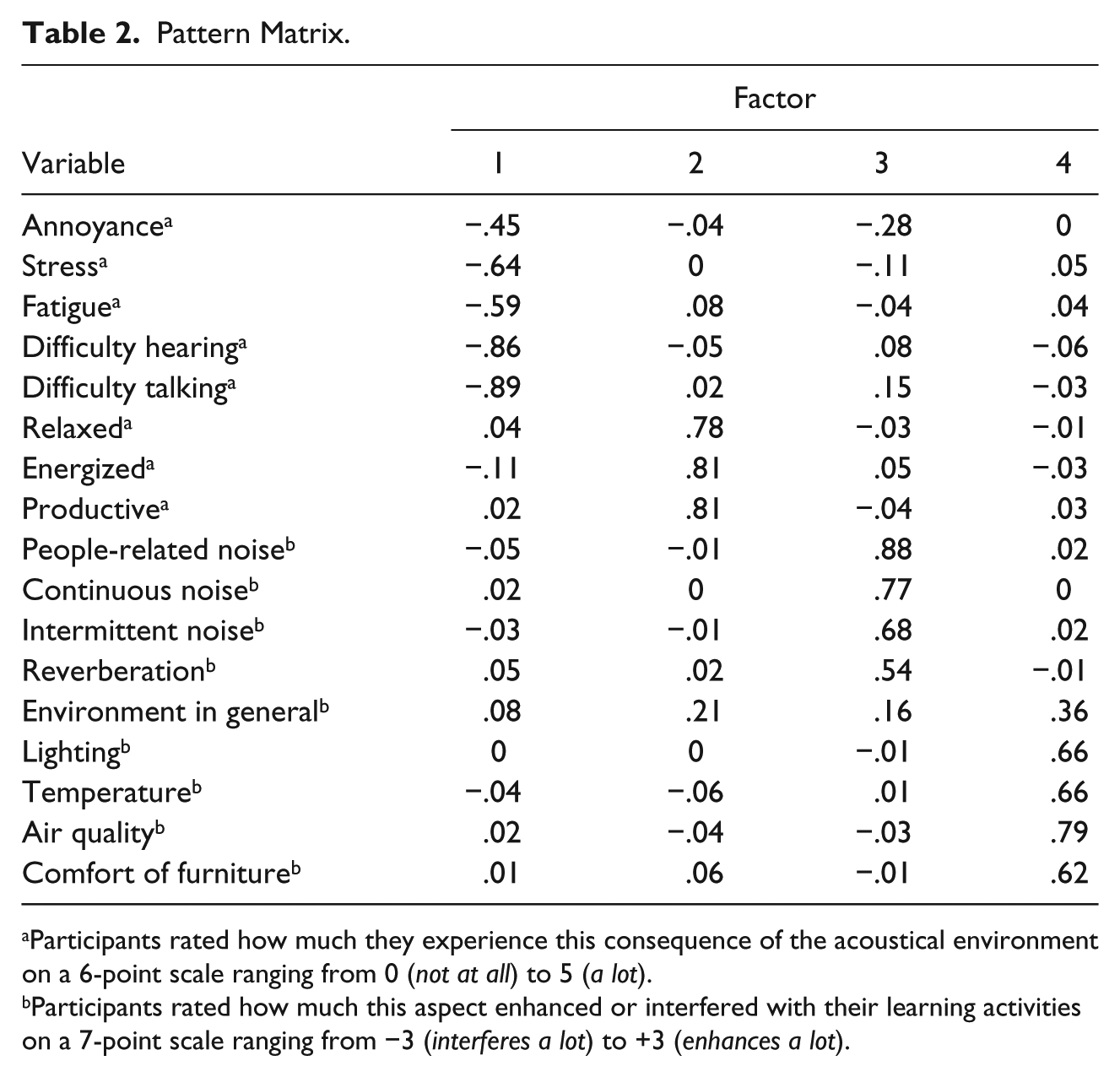
Participants rated how much they experience this consequence of the acoustical environment on a 6-point scale ranging from 0 (not at all) to 5 (a lot).
Participants rated how much this aspect enhanced or interfered with their learning activities on a 7-point scale ranging from −3 (interferes a lot) to +3 (enhances a lot).
The factors were examined for item content and labeled. Factor 1 was labeled “Restorative psychological consequences of the acoustical environment.” Restoration is the recovery of depleted cognitive resources (Kaplan & Kaplan, 1989), or the improvement of negative affective states (Ulrich, 1993) and this factor included negatively loaded items such as “stress” (−.64). Factor 2 was labeled “Vitalizing psychological consequences of the acoustical environment” given that items such as “feeling energized” loaded strongly (.81). This is congruent with previous work defining vitality as an activated state of positive physical and psychological energy (Ryan et al., 2010). Factor 3 was labeled “Perceived suitability of the acoustical environment” given highly loading items such as “people-related noise” (.88) and “continuous noise” (.77). Factor 4 was labeled “Perceived suitability of the non-acoustical physical environment,” and items such as “air quality” (.79) and “temperature” (.66) loaded strongly onto this factor. Given this satisfactory factor solution, factor scores were computed using the regression method, which is appropriate when the factors are correlated (Field, 2009). These scores were saved for further use in the planned multivariate multiple regression.
Finally, the internal consistencies of the items within each of the factors were examined. Cronbach’s alpha values were acceptable, ranging from .77 to .84 (Table 3), and no items showed corrected item-total correlations below .40.
Descriptive Statistics for the Psychological Variables.
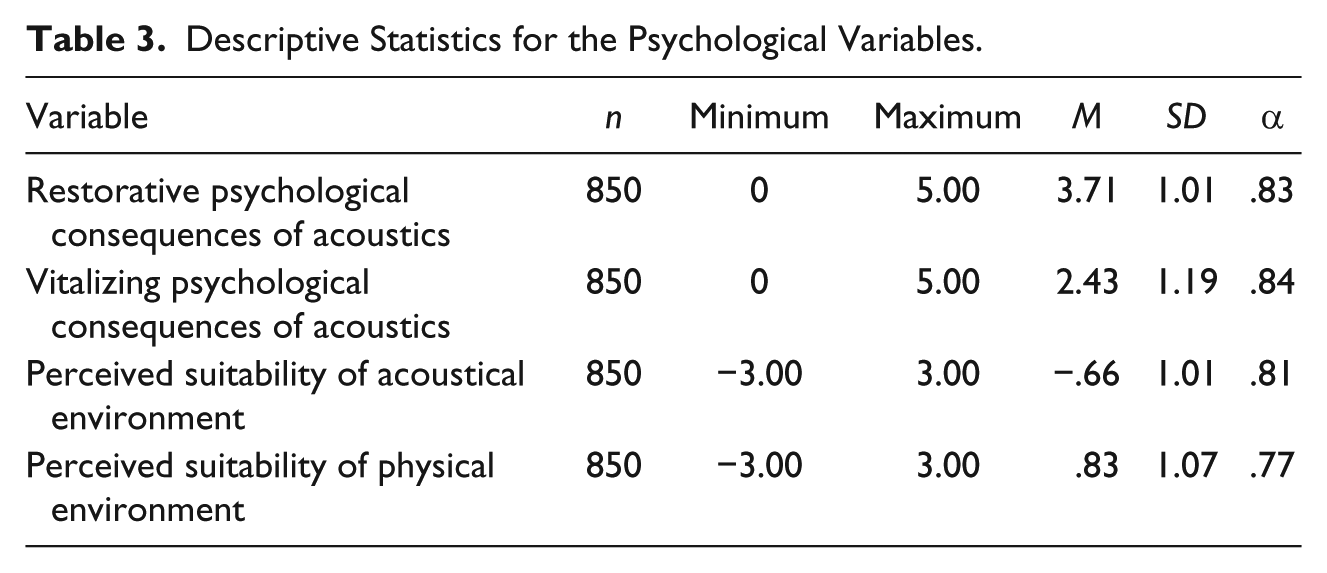
Descriptives for psychological data
Items within each of the factors were averaged into composite indices, to derive means and standard deviations (Table 3). Given the negative loadings of items onto the restorative psychological consequences factor, the items in this factor were reverse coded to produce interpretable descriptive statistics.
In general, participants viewed the acoustical aspects (e.g., people-related noise and continuous noise) of the ILSs as somewhat unsuitable for their learning activities (M = −.66, SD = 1.01), and building averages were all negative, ranging from −1.00 (SD = 1.13) to −.26 (SD = .93). The non-acoustical physical-environmental aspects (e.g., air quality, temperature, and lighting) were perceived as slightly suitable for participants’ learning activities (M = .83, SD = 1.07), and building averages were all positive, ranging from .35 (SD = 1.01) to 1.41 (SD = .98).
Although the acoustics of the spaces were perceived as unsuitable for learning, the acoustical environment was somewhat restorative psychologically (M = 3.71, SD = 1.01), as negative psychological states decreased in most of the spaces. Averages across buildings ranged from 3.49 (SD = 1.02) to 3.95 (SD = .82), and this variation was significant, F(10, 839) = 2.50, p < .01. Furthermore, scores for the vitalizing psychological consequences of the acoustical environment were above the scale’s midpoint of 2 (M = 2.43, SD = 1.19). Building averages ranged from 2.21 (SD = 1.11) to 2.80 (SD = 1.10).
The Effects of Physical-Acoustical and Architectural Features on Psychological Outcomes
A single multivariate multiple regression was performed to predict variations in the four psychological outcomes (i.e., perceived acoustical suitability, perceived environmental suitability, vitalizing psychological consequences of the acoustical environment, and restorative psychological consequences of the acoustical environment) from the nine physical-acoustical and architectural parameters. Specifically, these included background sound in the occupied space (the average of Z-transformed LAtot and NC(B) values), background sound in the unoccupied space (again, the average of Z-transformed LAtot and NC values), RT at mid-frequency (Tmid), the occupant-square-footage density, the total volume, the presence of soft materials (averages of Z-transformed surface materiality, furniture, and carpet), vegetation, whether the room was coupled or enclosed, and natural lighting (i.e., average of Z-transformed window views and lighting).
Bivariate correlations among the variables and collinearity statistics were first examined (Table 4). None of the Pearson correlation coefficients exceeded .70. Furthermore, all the Variance Inflation Factor values were lower than 3.71, and all tolerance values were above .27 (M = .43), which indicates that collinearity is not of concern (e.g., Kutner, Nachtsheim, & Neter, 2004; Menard, 1995).
Correlation Matrix for Key Study Variables.

p < .05. **p < .01.
The overall association between the sets of physical and psychological variables was significant, multivariate multiple R2 = .22, F(36, 3123.37) = 5.97, p < .001. The four follow-up univariate regressions indicated that the predictors explained a significant amount of variance in each of the psychological factors (Table 5). The results from each univariate regression are described below.
Univariate Regression Coefficients for Perceived Suitability and Well-Being Factors.

Predicting perceived suitability of the acoustical environment
Together, the nine predictors significantly predicted the degree to which participants rated the acoustical aspects of the ILSs as suitable for their learning activities, F(9, 836) = 3.62, p < .001, but the overall amount of variance explained was small, at 4%. Density was the strongest predictor, β = −.19, SE = .04, t(840) = −4.48, p < .001, followed by vegetation, β = .13, SE = .07, t(840) = 1.97, p = .05, and sound level in the occupied environment, β = .12, SE = .06, t(840) = 2.11, p = .04.
Predicting perceived suitability of the non-acoustical environment
Perceived suitability of the non-acoustical environment for learning was also significantly explained by the physical predictors, F(9, 840) = 10.62, p < .001, which accounted for approximately 10% of the variance, and thus represents a medium effect size (Cohen, 1988). The significant unique predictors included “soft” material features within the space, β = .13, SE = .04, t(840) = 2.96, p = .003, RT, β = .13, SE = .06, t(840) = 2.18, p = .03, vegetation, β = .12, SE = .06, t(840) = 1.97, p = .05, and sound levels in unoccupied spaces, β = −.10, SE = .05, t(840) = −1.98, p = .05.
Predicting restorative psychological consequences
The physical variables explained a significant amount of variance in restorative psychological consequences of the acoustical environment, F(9, 840) = 4.90, p < .001; 5% of the variance was accounted for, representing a small effect size (Cohen, 1988). Controlling for the other variables, the significant unique predictors of restorative psychological consequences included RT, β = .15, SE = .06, t(840) = 2.46, p = .01, and density, β = −.10, SE = .04, t(840) = −2.42, p = .02. In addition, vegetation, β = .12, SE = .07, t(840) = 1.84, p = .07, as well as background sound levels in the unoccupied environments, β = −.09, SE = .05, t(840) = −1.84, p = .07, were marginally significant unique predictors.
Predicting vitalizing psychological consequences
The vitalizing psychological consequences of the acoustical environment were also significantly associated with the physical variables assessed, F(9, 840) = 5.40, p < .001; they explained approximately 6% of the variance, which represents a small-medium effect size (Cohen, 1988). Three of them emerged as significant predictors: background sound in the unoccupied space, β = −.16, SE = .05, t(840) = −3.17, p = .002, soft material features within the space, β = .14, SE = .05, t(840) = 3.17, p = .002, and density, β = −.11, SE = .04, t(840) = −2.60, p = .01. Background sound level in the occupied space was marginally significant, β = .11, SE = .06, t(840) = 1.85, p = .06.
Discussion
We evaluated the roles of two acoustical features (sound levels and RT) in students’ perceptions of suitability and well-being in ILSs. Earlier work has highlighted the relevance of these factors in classrooms, open-plan offices, and residences (e.g., Kennedy, Hodgson, Edgett, Lamb, & Rempel, 2006; Klatte, Hellbrück, Seidel, & Leistner, 2010; Lercher, Evans, & Meis, 2003; Shield & Dockrell, 2003), but this is the first study to examine their interplay in university ILSs, where learning does not rely on the transmission of distant speech. Acoustics and several design features emerged as relevant predictors of students’ assessments of the environment and their well-being; these results inform designers as they aim to optimize the suitability of these important spaces.
Subjective and Objective Performance of Acoustics in ILSs
A factor analysis revealed two factors representing perceptions of environmental suitability (perceived suitability of the acoustical environment, and perceived suitability of the non-acoustical environment) and two factors representing well-being (restorative psychological consequences of the acoustical environment, and vitalizing psychological consequences of the acoustical environment). Three of the factors were rated by participants as acceptable (on average), but the perceived suitability of the acoustical environment was inadequate; participants generally perceived that the acoustical qualities of their learning spaces were not conducive to their learning. This echoes a result common in the sustainable building post-occupancy evaluation literature that, in contrast to other aspects of indoor environmental quality, employees are generally dissatisfied with the acoustical conditions of their workspaces (Baird & Dykes, 2010; Newsham et al., 2013).
The objective acoustical results support the subjective results, given that, on average, both Noise Criterion and decibel levels did not meet the standard acceptability criteria in occupied as well as unoccupied spaces. Average RTs were marginally acceptable. Similar problems have been found in classrooms, but RTs are generally worse (Hodgson, 1999; Klatte et al., 2010). This study highlights the need for improvements to the acoustical environments in ILSs. These convergent objective and subjective findings underline the need for acoustical considerations during the design of such spaces.
Predicting Psychological Outcomes
The nine objective predictors explained a statistically significant amount of variance in the multivariate psychological outcome measure. The effect size, although small, is typical of those of other studies investigating associations between objective and subjective aspects of indoor environmental quality (e.g., Veitch, Charles, Newsham, Marquardt, & Geerts, 2003; Veitch & Newsham, 1996).
Environmental suitability
The first hypothesis anticipated a negative relation between sound levels in unoccupied spaces and perceived suitability of the physical environment for learning. In support of this, the non-acoustical environment was perceived as more suitable for learning when unoccupied spaces had lower sound levels, which typically are generated by building ventilation systems. This is in line with previous research on unoccupied noise in classrooms, open-plan offices, and residences.
The second hypothesis explored the impact of sound levels in occupied spaces on perceived suitability of the physical environment for learning. Interestingly, suitability ratings were higher in occupied spaces with higher levels of sound. One possible explanation for this result is that louder environments are associated with one’s own conversation, collaboration, or socializing; another is that sound from others could support conversational privacy. This is in line with work highlighting the need for collaboration in the classroom as well as in the workplace (e.g., Brennan, Chugh, & Kline, 2002; Shield & Dockrell, 2003), although occupied sound is not identified as beneficial to learning in residential environments, which may be less likely to involve collaboration. In addition, some individuals such as extraverts (Standing, Lynn, & Moxness, 1990) and younger people (Jennings, Nebes, & Brock, 1988) prefer to study in places with higher levels of stimulation and noise (Mehrabian, 1977). Indeed, in this study, some participants reported seeking out the environment for its acoustical qualities.
Although sound levels in occupied spaces were somewhat favorable to the perceived suitability of the acoustical environment, density was detrimental. Density has previously been shown to adversely affect learning (Maxwell, 2003), and our results suggest that it may be even more of a contributor than sound levels to perceptions of ILSs. Limiting the number of seats (e.g., Oldham, 1988), or adding design features like high partitions (Maher & von Hippel, 2005), may reduce the negative effects of density.
The third hypothesis explored the role of reverberation in perceived suitability of the spaces for learning purposes. Reverberation was unrelated to perceptions of acoustical suitability, but it was related to perceptions of non-acoustical suitability. Interestingly, spaces with longer RTs were perceived to be more suitable for learning activities. One possible explanation is that an ILS that is more reverberant may offer more speech privacy for those engaged in small-group discussion, provided that enough others are talking.
Other than sound levels in unoccupied spaces, RT, and density, two additional physical features predicted perceptions of environmental suitability. First, perceptions of suitability were higher in spaces that included vegetation, reflecting a common finding that workspaces and residences with natural elements are preferred (Dravigne, Waliczek, Lineberger, & Zajicek, 2008; Kaplan, 1993). This effect has been attributed to the perceptual ease of processing nature (Joye, 2007), and an evolved preference for environments relevant to human survival (Ulrich, 1993). Second, perceptions of the acoustical environment were somewhat more positive in spaces containing soft material features, such as upholstered furniture, carpets, or curtains. Previous research has demonstrated that introducing soft materials into classrooms increased participation in, and preference for, the space (Sommer & Olsen, 1980). Current results support the use of soft materials in ILSs.
Well-being
The remaining hypotheses investigated the role of the acoustical features in perceived well-being. In support of the fourth hypothesis, individuals were less likely to experience positive, vitalizing states, and somewhat less likely to be psychologically restored, with higher levels of background sound in unoccupied spaces. A number of studies have demonstrated that noise annoyance in classrooms covaries with sound levels (e.g., Dockrell & Shield, 2004; Wålinder et al., 2007); our study extends this finding to ILSs, and specifies that background sound levels not generated by occupants (i.e., assessed in unoccupied spaces) are particularly detrimental. With regard to the fifth hypothesis, which was exploratory, sound levels in occupied spaces were not uniquely associated with restorative psychological consequences, but they had a marginally positive association with vitalizing psychological consequences. As mentioned, sound can be favorable when it is generated by conversation with one’s peers, when it enhances speech privacy, or when it suits one’s environmental stimulation preferences.
Contrary to the sixth hypothesis, restorative psychological consequences were more common in spaces with longer RTs. As discussed, perceptions of the non-acoustical environment were better in spaces with more reverberation. Thus, perhaps a third variable underlies the relation between RT and these positive outcomes.
Other than acoustics, three additional environmental features predicted well-being. Density was a negative predictor of both measures of well-being. Apart from the sounds that others make, dense environments can be distracting, crowded, and have poor ventilation (Sommer & Becker, 1971). Vegetation was a marginally positive predictor of restorative psychological consequences; this is in line with numerous studies demonstrating the restorative impact of nature on negative affective states (Hartig, Evans, Jamner, Davis, & Gärling, 2003; Velarde, Fry, & Tveit, 2007). Finally, well-being was higher in ILSs featuring more soft materials. As mentioned, the psychological benefits of soft materials in classrooms have previously been investigated.
Implications for Design
ILSs are important, but under-examined, institutional spaces where learning outside the classroom can occur. To support students’ scholarly activities and well-being, such spaces must be carefully designed.
Current results suggest that limiting density, incorporating vegetation, including couches or other soft materials, implementing and maintaining quiet ventilation systems, and enhancing speech intelligibility and privacy are all relevant objectives when designing or renovating ILSs. Ensuring that some ILSs allow for group collaboration is also useful. As mentioned, further work is needed to examine the mechanism of the positive impact of reverberation and its implications for design.
Limitations
One issue in any correlational design is the inability to make causal inferences. In this study, we cannot be certain that sound level and reverberation directly affected the learning and well-being outcomes. This issue was tempered by controlling for a number of third variables with suspected influence, but additional mediators and moderators, such as the meaning and predictability of the sound, familiarity of the space, and personality (e.g., extraversion) may help explain results further.
Another limitation is that data collection occurred between April and August; physical properties of ILSs may differ in summer and winter months. For example, different usage of doors and windows, ventilation systems, and indoor/outdoor activity, can change the type and level of indoor sound. Therefore, further work on acoustics and indoor environmental quality would benefit from data collection spread over a longer period of time, with seasonal variation. Despite this, the ILSs at this large university appear to be well-used by students throughout the year, and so the occupancy is likely representative.
It should also be noted that the measurement of well-being tapped into select aspects of the construct (i.e., restoration and vitality) without capturing other psychological dimensions such as other aspects of state affect (e.g., Watson, Clark, & Tellegen, 1988), mindfulness (Brown & Ryan, 2003), and meaning (Heine, Proulx, & Vohs, 2006). A broader operationalization of well-being would provide further understanding of the impact of ILSs on well-being.
A final limitation is that the criterion measures of interest included perceptions of suitability between the physical environment and one’s learning activities, as well as affective responses to the environment. These self-reported measures do not serve as proxies for actual learning outcomes; thus future studies may wish to incorporate additional learning measures, such as memory or problem-solving tasks (e.g., Shield & Dockrell, 2008). Nevertheless, these subjective indicators reflect participants’ degree of comfort and efficacy in the space, and may have implications for continued use of, and impressions about, the institution as a whole.
Conclusion
Acoustical properties of ILSs are important to students’ perceptions of the spaces, and the degree of well-being they experience when using them. Background (non-speech) sound, as assessed in unoccupied spaces, was generally detrimental, but occupied (speech) sound and reverberation were not. These findings demonstrate that acoustical properties are important to ILSs, but that they are not always perceived in predictable ways. Taken together, these subjective data are informative in the design of future ILSs.
Footnotes
Declaration of Conflicting Interests
The author(s) declared no potential conflicts of interest with respect to the research, authorship, and/or publication of this article.
Funding
The author(s) disclosed receipt of the following financial support for the research, authorship, and/or publication of this article: This research was supported by Grant 11R09296 from the Natural Sciences and Engineering Research Council of Canada.
Author Biographies
References
Supplementary Material
Please find the following supplemental material available below.
For Open Access articles published under a Creative Commons License, all supplemental material carries the same license as the article it is associated with.
For non-Open Access articles published, all supplemental material carries a non-exclusive license, and permission requests for re-use of supplemental material or any part of supplemental material shall be sent directly to the copyright owner as specified in the copyright notice associated with the article.
