



Abstract
This article investigates the impact of the running environment on perceived satisfaction, restoration, and running participation based on a questionnaire distributed to 1,581 novice runners. The most frequently experienced impediments on running routes are poor lighting, unleashed dogs, and encounters with cyclists and cars. Regression analyses reveal that attractiveness and restorativeness are positively associated with the quality of the running surface and running in parks or outside towns and negatively by running on public roads in town, by running in larger cities (>250,000 inhabitants), and by other road users. However, attractiveness and restorativeness of running routes play only a minor role in the decision of how frequently to run. Practical considerations (proximity, threats) appear to have a larger impact on running frequency. Importantly, the most frequently mentioned impediments (poor lighting, cars, unleashed dogs) do not affect running frequency, whereas infrequent impediments (threats by other people) significantly affect running frequency.
Keywords
Introduction
Participation in running has steadily increased over the past decade. In the Netherlands, the percentage of the population that runs at least once a week reached 11.3% among women and 13.2% among men in 2014 (Sociaal en Cultureel Planbureau [SCP], 2015). Similar trends are observed in other European and North American countries (Pascual, Regidor, Martínez, Elisa Calle, & Domínguez, 2009; Shipway & Holloway, 2010). Research into the effects of running has convincingly shown positive effects on both physical and mental health (Paluska & Schwenk, 2000; Stathopoulou, Powers, Berry, Smits, & Otto, 2006; Williams & Thompson, 2013). An important aspect of the mental health benefits of running is the restorative capability of running (Bodin & Hartig, 2003). Shipway and Holloway (2010) found in a qualitative study that running leads to improved mood and provides an escape from daily hassles and worries.
Given the health benefits and restorative quality of running, authorities and athletic organizations have developed programs to encourage citizens to take up running via online training programs (National Health Service, 2015), introductory programs for novice runners, and provision of information about running, such as how to find a running club (iRun, 2015; Road Runners Club of America [RRCA], 2015a). Increasingly, authorities also recognize that the built environment is an important factor that may make participation in physical activity and sports more attractive and thereby contribute to more engagement in these activities. For example, many studies on walking (Saelens & Handy, 2008) have shown that conditions related to the built environment (such as density and mixed land use) and infrastructure (connectivity, presence of dedicated infrastructure, perceived safety) lead to higher levels of walking.
Although a substantial body of research has addressed which urban form characteristics contribute to walking and cycling, few studies have, to the author’s knowledge, investigated how these factors are related to the attractiveness of the specific activity of running, engagement in running, and outcomes of running in terms of restoration. Because running has typical characteristics in terms of speed, intensity, spatial extent, and sensory experiences, one cannot safely assume that an environment that is attractive for walking, cycling, or team sports is equally attractive to runners and has the same restorative effects. However, the potential relevance of the built environment to running has been recognized. For example, the RRCA (2015b) runs a “Runner Friendly Community” program to encourage communities to offer (among other features) appropriate infrastructure for running, consisting of well-lit and well-maintained sidewalks and trails, ideally complemented by facilities such as water fountains, toilets, parking areas near trails, and emergency telephones. Qualitative studies of running experience (e.g., Allen Collinson, 2008) provide further evidence of the relevance of environmental factors, such as surface and social context, on the running experience. However, larger scale quantitative studies of the environmental factors influencing the attractiveness and restorative capacity of the running environment and their impact on running involvement are lacking. This gap is surprising because running is one of the most frequently practiced sports (Breuer, Hallmann, & Wicker, 2011), implying that adjustments in the built environment and improvement of running routes may benefit many and lead to larger numbers of people taking up and adhering to running.
This article sets out to explore how characteristics of the running environment are associated with both the perceived attractiveness and restorative capacity of these environments and the frequency of running for a specific segment of the running population: novice runners. It is recognized that the perceived attractiveness of the running environment and its effect on running engagement may differ considerably between novice and experienced runners. Nevertheless, given the importance of increasing physical activity in various forms, including running, novice runners are a particularly relevant group from a policy perspective.
Theoretical Insights Regarding the Influence of Public Space on Running Attractiveness, Restorativeness, and Frequency
Two strands of research provide starting points for developing hypotheses about the potential impact of the built environment on running. First, a large body of literature concerning walkability, which describes what elements in the built environment are conducive or obstructive to walking, may provide a starting point for studying the effect of the built environment on running. Second, there is a small body of mostly qualitative literature that not only describes running experiences from a sociological or psychological point of view but also touches upon the role of the physical and social environment. Both strands will be discussed in this section, particularly with respect to their relevance for the perceived attractiveness and restorative quality of running environments and running behavior.
Walkability Studies
Many papers have identified mostly physical determinants of the built environment that are associated with higher walking rates (e.g., Rodríguez, Aytur, Forsyth, Oakes, & Clifton, 2008; Saelens & Handy, 2008). A notable distinction made in at least some of these studies is between transportation walking and recreational walking. Saelens and Handy (2008) reported, based on a meta-analysis, that transportation walking is positively correlated with higher densities and mixed land use. The effects of connectivity, presence of parks, and safety are ambiguous among studies, and no effects are found of infrastructure conditions, traffic conditions, aesthetics, or access to physical activity facilities. In contrast, these studies find recreational walking to be associated with pedestrian infrastructure conditions and aesthetics. Another meta-analysis by McCormack and Shiell (2011) reported that transportation walking is associated with various built environment factors, such as network connectivity and mixed land use, and that recreational walking is affected only by population density. Boarnet, Forsyth, Day, and Oakes (2011) distinguished between recreational and transportation walking and found that the amount of transportation walking correlates positively with the quality of pedestrian infrastructure (including crossings), absence of other traffic, mixed land use, aesthetics, and absence of dogs. Recreation walking appears to be positively related to aesthetics, presence and quality of pedestrian infrastructure, presence of cafes, and proximity of highways. Although these studies are not entirely consistent, all find different influential factors for transportation and recreational walking and also that recreational walking is affected by aesthetics (including absence of highways), quality of the walking infrastructure, and attractions such as cafes.
Whereas the above studies focused on correlations between the built environment and walking behavior, other studies have focused on how pedestrians perceive the attractiveness of the built environment when walking. For example, Ettema and Smajic (2015) found that the presence of other people and facilities such as bars and shops create a lively atmosphere resulting in improved mood, whereas the absence of people and uncontrolled areas create a feeling of unsafety that triggers negative emotions. However, quiet and green areas are also found to be attractive places for walking by offering restorative qualities.
Another factor in walking attractiveness concerns perceived safety. Roman and Chalfin (2008) indicated that fear of outdoor walking depends on neighborhood characteristics, such as crime rates, and also on age and gender, with females and older people showing higher levels of fear. In a review paper, Foster and Giles-Corti (2008) concluded that the physical built environment (e.g., presence of front porches, escape routes, street lighting, and disorder) also influences the fear of harassment.
Apart from the mere enjoyment of the walking environment, walking in certain environments may result in restoration. Restoration (Kaplan, 1995) refers to the replenishment of mental resources by the experience of non-volitional attention. In particular, environments that provide some form of fascination and are sufficiently spacious offer restorative qualities. Green environments have been shown to have especially positive effects on restoration. The positive effects of walking in green environments on stress reduction and overcoming mental fatigue are well documented (e.g., Roe & Aspinall, 2011). In the context of walking, the literature suggests that individuals actively choose routes (Middleton, 2009) or locations (Tinsley, Tinsley, & Croskeys, 2002) because of the presence of green space and also that green spaces and walking routes make them more vitalized and relaxed (Martens, Gutscher, & Bauer, 2011).
In sum, with respect to the effect of the built environment on running behavior, recreational walking is expected to resemble running in the sense that minimizing distance and accessing functional facilities are not the goals of the walk or run, which is carried out as an activity in its own right. In that sense, the built environment characteristics that stimulate recreational walking, such as aesthetics, variation in functions, and quality of infrastructure, may also stimulate running. However, running may also bear similarity to transportation walking in the sense that runners want to keep moving without interactions with other traffic, which suggests that the absence of other traffic might be relevant. In terms of attractiveness, the literature on walking experience suggests that liveliness and perceived safety may contribute to the attractiveness of running environments. In addition, the literature on walking and restoration suggests that green running environments may provide opportunities for restoration.
Studies of the Running Experience
A number of studies have addressed the impact of the environment on running experiences in a qualitative sense. Allen Collinson (2008) described aspects of both the physical and social environments that may make running more or less attractive. Regarding the physical environment, she noted how the slope may make running more or less difficult and that different surfaces also affect the effort required (e.g., smooth pavement or grass vs. uneven pavements, muddy paths, holes) and may increase the probability of injury (Hockey & Allen-Collinson, 2006). In addition, poor street lighting and encounters with other types of traffic (either pedestrians or motorized traffic) are reported as increasing risk of injury. Other potential causes of injuries are dog owners and parents with small children because both dogs and small children may get in the way of runners and harm them (Hockey & Allen-Collinson, 2006). In general, as noted by Allen Collinson (2008), maintaining momentum, enhancing performance, and avoiding injury are the main qualities that a running environment should offer.
Another issue is annoyances or risks resulting from interaction with the social environment while running. As noted by Gimlin (2010) and Allen Collinson (2008), runners may become subject to verbal harassment from others in public spaces. Crowds of idling teenagers or intoxicated bar-goers are identified as risk groups for aggression. Allen Collinson (2008) noted that running with company may reduce feelings of discomfort and unsafety created by these negative social interactions. The presence of others may, however, also help confirm one’s identity as a runner through the wearing of similar types of clothing and shoes or verbal and non-verbal signs of appreciation (Shipway & Jones, 2007).
It is noted that runners should not be regarded as a uniform group. Allen-Collinson and Hockey (2007) distinguished among athletes, runners, and joggers/fun runners, who differ in terms of capacity and ambition and have specific identities. Different types of runners may experience their running routes differently due not only to differences in distance and speed but also to their objectives. In a qualitative study, Groenink (2013) described how fun runners in the Amsterdam Vondelpark (situated in the central part of the city) enjoy the presence of tourists and residents involved in leisure activities because it creates a lively environment. Runners and athletes, in contrast, prefer the Amsterdamse Bos, a natural area that allows for running longer distances with much less interaction with non-runners.
Regarding the restorative effects of running, Bodin and Hartig (2003) investigated whether green environments have similar restorative capacity for runners as for walkers. Their study suggests that runners indeed prefer green running environments over urban settings and reports that they serve better in offering fascination and escape from daily hassles. This preference for green running environments is in line with Shipway and Holloway’s (2010) finding that being in nature is a reason for running.
Summary
Taken together, existing studies on recreational walking and running suggest that various environmental factors may affect the perceived attractiveness and restorativeness of running environments and running frequency. Studies of running experience emphasize factors that allow or prevent running safely and maintaining momentum, such as the running surface, obstacles, interactions with other road users, and unfriendly or threatening social contexts. However, qualities that add to the pleasure of running are also noted, such as liveliness (for fun runners), restorative quality of the environment, and positive experience of other runners’ presence. Studies of walkability suggest that neighborhood aesthetics, traffic safety, social safety, and mixed land use might be relevant factors, influencing both the attractiveness of running environments and running frequency. Restorative qualities of running routes are likely associated with the greenness of the running environment.
To our knowledge, the effects of the built environment on the attractiveness and restorative quality of the running environment and on running participation have not been investigated quantitatively. As noted previously, it cannot be safely assumed that built environment characteristics that influence attractiveness and restoration for walking and walking frequency have the same effect on running. This article therefore sets out to explore these relationships, making two important distinctions. First, we test the effects of both objective locational characteristics, such as running location, type of surface, and city size, and subjective evaluations of the running environment, such as experienced nuisances and impediments. Second, we test the effects of objective and subjective factors on (a) the experienced attractiveness of the running environment, (b) the perceived restorative quality of the running environment, and (c) running participation. The latter is crucial because apart from the attractiveness and restorative quality of the running environment, there may be other factors, such as personal motivation or household scheduling constraints, that influence running participation. Hence, we investigate whether the factors that influence attractiveness and restorative quality influence running participation to the same extent.
To this end, analyses are performed on a survey of 1,581 Dutch novice runners participating in the Start-To-Run program. It is recognized that novice runners are a specific segment of the runner population who differ from more experienced runners in terms of their ambitions, running distance, and frequency and requirements regarding running routes. However, given governments’ and athletic organizations’ ambitions to increase peoples’ physical activity levels, a focus on novice runners seems relevant and may provide a starting point for more extensive studies.
Method
Study Design
This study conducted a large-scale survey among novice runners to investigate how the built environment affects the perceived attractiveness of the running routes and running frequency. The survey was conducted among participants of the Start-To-Run program offered by the Dutch Athletics Union two times per year. Start-To-Run is a 6-week course meant to introduce runners without prior experience to running by providing central training sessions and information about running, including training schedules. Participants are encouraged to also practice running independently outside the central sessions. Start-To-Run courses are offered in 133 locations in the Netherlands, ranging from small villages to major cities, resulting in sufficient variation in environmental factors. Upon completing the program, participants in the Start-To-Run program were asked by the Dutch Athletics Union to fill out a questionnaire, which includes standard questions regarding age, gender, and location of the Start-To-Run program. Because the Athletics Union controls this questionnaire, it was not approved by an instututional review board or ethics committee, and the respondents were not compensated for participation.
Measures
For the specific purpose of this study, a set of questions were added to the standard questionnaire. These questions covered the following issues: First, questions were included about running frequency, running companions, and time of day. Second, the reviewed literature suggests a number of environmental characteristics that influence the running experience. To test to what extent these factors also hold for the novice runners in our sample, the survey asked the respondents to score their usual training routes on these items. Specifically, the respondents were asked to indicate whether they run in particular environments (in their neighborhood, in parks, outside their neighborhood but within the city limits, outside the city limits) and on specific surfaces (unpaved roads, paved roads specifically for pedestrians/cyclists, paved roads shared with motorized vehicles). In addition, they were asked to indicate to what extent (on a scale of 1-5) they experienced nuisance from the following issues: interactions with pedestrians, interactions with cyclists, interactions with cars, interactions with unleashed dogs, verbal harassment, threats by other people, poor street lighting, having to stop for other road users, unpleasant running surface.
The main objective of this study is to investigate how environmental factors influence (a) the perceived attractiveness of the running environment, (b) the restorativeness of the running environment, and (c) running frequency. Because we are interested in an overall evaluation of running routes based on combined considerations of comfort, fear, safety, and other factors, we asked the respondents to indicate on a single-item scale of 1 to 5 how attractive they find the environment where they practice running. We defined attractiveness in a subjective way, based on the assumption that individuals can reliably express the experienced attractiveness of running routes on a predefined, quantitative scale. This approach is common in research in marketing (e.g., when measuring customer satisfaction; Fugl-Meyer, Melin, & Fugl-Meyer, 2002; Herzog, Maguire, & Nebel, 2003) and well-being (Abou-Zeid, Witter, Bierlaire, Kaufmann, & Ben-Akiva, 2012; Pavot & Diener, 2008), where it allows disentangling the relative effects of multiple factors on satisfaction or well-being. In a similar vein, we asked the respondents to rate on a single-item scale of 1 to 5 how restorative they find their running routes. To measure restorativeness, we asked the respondents to indicate to what extent (on a scale of 1-5) they find their running routes relaxing. Although we are aware that multiple-item scales exist to measure restorativeness (e.g., Laumann et al., 2001), we used a single-item scale to be consistent with the measurement of attractiveness. Our approach is in line with existing work (Felsten, 2009; Herzog et al., 2003), which applies single-item measures to measure preference for places and experienced place qualities, such as spaciousness, fascination, and openness.
Participants
The survey was distributed among 4,395 participants in the Start-To-Run program in the spring of 2013. One thousand five hundred eighty-one participants completed the survey, indicating a 36.0% response rate. The participants’ training locations were recoded into classes based on the municipality size of the training location (<10,000, 10,000-25,000, 25,000-50,000, 50,000-100,000, 100,000-250,000, >250,000 inhabitants). Although it was not certain that the participants actually lived in the municipality where the training program was offered, they were likely to live in a similar environment in terms of density and urbanity.
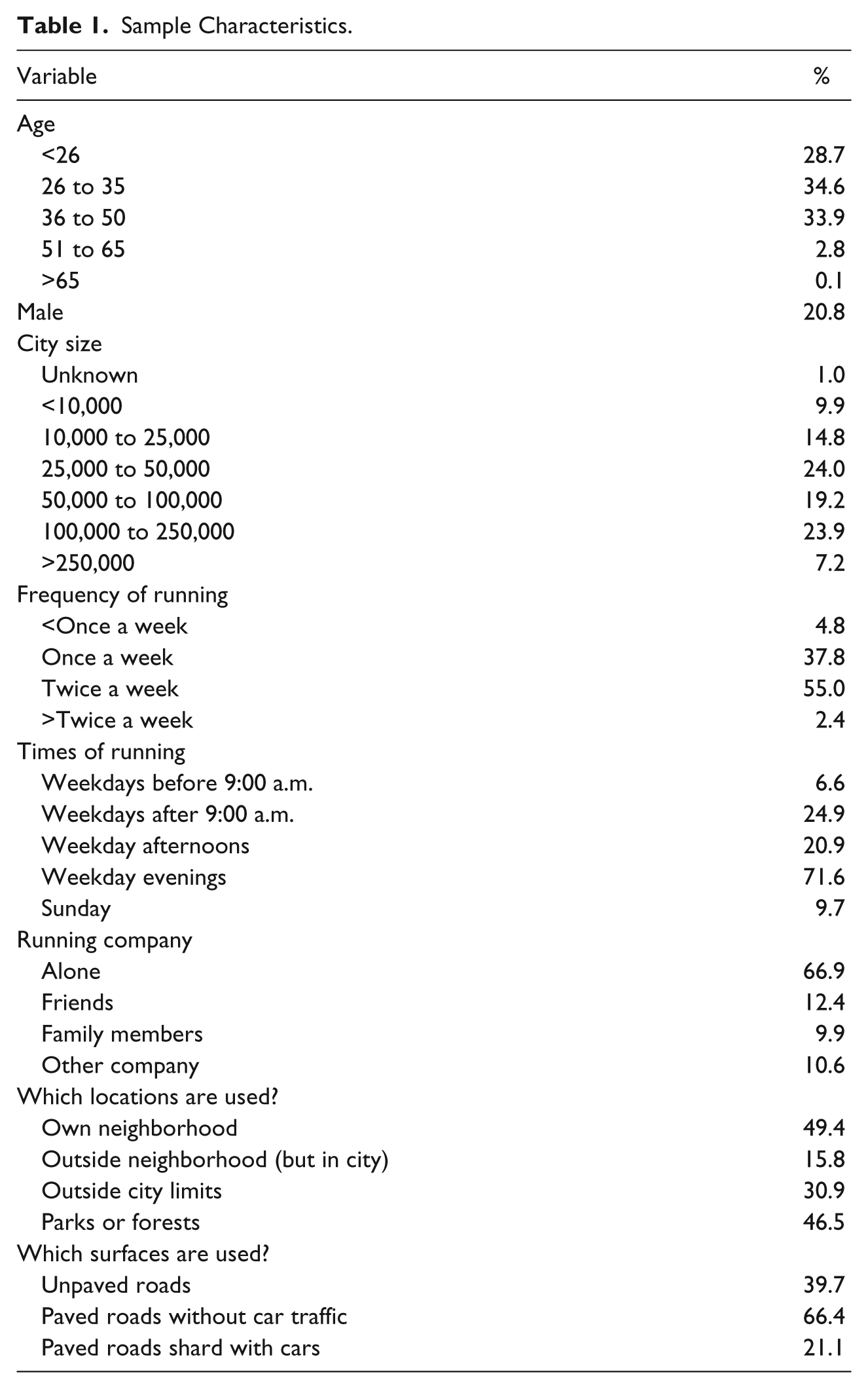
Table 1 displays some key characteristics of the sample. The table suggests that the participants in the sample primarily fall in the age cohort of up to 50 years and include 80% women. The distribution across municipality size is reasonably even, with the smallest and largest categories being somewhat less well represented. Regarding running frequency, we found that only 2.4% of the participants run less than once a week (outside the central Start-To-Run sessions), 37.2% run once a week, 54.3% twice a week, and 2.3% more than twice a week. With respect to the timing of running, 6.6% occasionally run on weekdays before 9 a.m., 24.9% run on weekday mornings after 9 a.m., 20.9% run on weekday afternoons, 71.6% run on weekday evenings, and 9.7% run on Sundays. Hence, weekday evenings appear to be the most preferred time for running outside the Start-To-Run sessions on Saturday. Most participants run alone (66.9%), whereas 12.4% run with friends, 9.9% with family members, and 10.6% in other company (often other participants from the Start-To-Run group). The table further indicates that 49.4% of the respondents use their own neighborhood for running and that 46.5% use parks for running. Running outside the neighborhood (15.8%) or outside the city limits (30.9%) occurs less often. With respect to the road type used for running, it is found that 39.7% run on unpaved roads, 66.4% run on paved roads without car traffic, and only 21.1% run on paved roads with car traffic. In general, expressed on a scale ranging from 1 (not at all) to 5 (very much), annoyances and impediments are relatively low (Table 2). This outcome is logical because runners likely select their routes to avoid impediments and maximize attractiveness and restoration. The most frequently experienced annoyances are poor lighting (M = 2.12, SD = 1.28), unleashed dogs (M = 1.98, SD = 1.22), cyclists (M = 1.78, SD = 1.00), and cars (M = 1.76, SD = 1.06). Least experienced are unpleasant remarks (M = 1.26, SD = 0.67) and threats by other people (M = 1.30, SD = 0.70).
Sample Characteristics.
Regression Models of Attractiveness and Restorativeness.

Significant at p = .05. **Significant at p = .01.
Statistical analyses
The following analyses were carried out. First, hierarchical regression analyses were performed to investigate how the evaluation of the running environment along two dimensions (attractiveness and restorativeness) is explained from both objective locational factors and the impediments encountered. Next, hierarchical regression analyses were carried out to explain how the running frequency of novice runners is determined by objective locational factors, the impediments encountered, and perceived attractiveness.
Results
Perceived Attractiveness and Restorativeness of Running Routes
The respondents’ evaluation of running routes took place along two dimensions: attractiveness and the restorative effect of the route. Attractiveness and restoration are different concepts. Restoration is related to aspects such as emptying one’s mind, communing with nature, and restoring depleted attentional resources (Kaplan, 1995). Attractiveness in theory covers a broader spectrum of qualities. For example, also providing visual stimuli or social interaction may be considered to make routes attractive (Ettema & Smajic, 2015; Ziegler & Schwanen, 2011). The average scores on both attractiveness (M = 3.71, SD = 1.23) and restoration (M = 3.59, SD = 1.26) suggest that on average, runners are quite satisfied with their routes. This finding is no surprise because runners select routes themselves and may be expected to do so according to their preferences. A surprising finding is that the scores on attractiveness and restorativeness correlate strongly and very significantly (r = .89, p < .001), which suggests that attractive routes are often restorative routes and vice versa.
We investigated whether the attractiveness and restorativeness of a route are determined by various route characteristics and by what mechanism. To this end, hierarchical regression analyses were carried out in which attractiveness and restorativeness were regressed on a set of spatial variables (city size, running location, road type) and a set of control variables (gender, timing of running). In a second step, the specific subjective indicators of impediment and hindrance were added to the model to test whether the effect of locational characteristics is correlated with these hindrances. The results are summarized in Table 2.
The base model of attractiveness turns out to be significant with an adjusted R2 of .07. In this base model, it is found that running within one’s own neighborhood is less attractive than running outside town or in a park. In addition, the estimates indicate that running in the largest cities is less attractive (although only marginally significant). Road type, timing of running, and gender or age do not affect perceived route attractiveness. Adding the impediment and hindrance factors leads to a very significant increase in the R2 (to .35). Of the impediment factors, a poor running surface appears to be by far the most significant factor determining attractiveness. Thus, a comfortable running surface is a base condition for creating attractive routes. In addition, it is found that having to stop for other traffic negatively affects attractiveness and that hindrance from dogs is positively associated with attractiveness. Obviously, this outcome is counterintuitive and cannot easily be explained. A potential explanation is that places where unleashed dogs are more common (such as parks) are more attractive running areas. However, because we controlled for these locational factors, the presence of dogs appears to be an effect independent of location type. The data suggest that within parks, the variation in the extent of experiencing hindrance from unleashed dogs is considerable (M = 2.14, SD = 1.24). Perhaps unleashed dogs are more often present in larger green areas, such as forests, which may nevertheless be more attractive for running. More study is needed to identify the underlying mechanism. In addition, the hindrance of traffic has a (marginally significant) effect on attractiveness. The fact that the negative effect of the largest city size disappears in the extended model suggests that this effect is associated with traffic hindrance. Finally, it is noted that although poor lighting was experienced more than most other environmental factors, it does not have an independent effect on the attractiveness of the running route.
Regarding the restorativeness of routes, the initial model is significant and has an adjusted R2 of .09. The results suggest that running in one’s own neighborhood is less restorative and that running outside the city or in parks is more restorative. In addition, running on unpaved roads is experienced as more restorative. The most likely explanation is that it is not only the road type per se but also the landscape characteristics of unpaved routes, which are more often situated in parks or forests, that provide the restorative effect. In addition, we find that running in larger cities (>250,000 inhabitants) is experienced as less restorative.
Adding the impediment factors to the equation leads to a large increase in the adjusted R2 (to .33). Here also, the quality of the running surface has the largest effect on restoration experienced while running. Apparently, comfortable running conditions coincide with experiencing restoration. However, we cannot determine whether the quality of the surface adds to restorative experiences or whether restorative environments (e.g., out-of-town locations) generally have better-quality surfaces due to their location. For example, out-of-town roads in the Netherlands, which are likely more restorative, often have dedicated and separate cycle lanes with a smooth asphalt surface. The negative effect of paved roads is likely relative to the positive effects of unpaved roads in natural areas (parks or forests). In addition, poor lighting appears to be positively related to the experience of restoration. Although in themselves unpleasant, these factors may indicate more natural and abandoned areas with restorative qualities. As for attractiveness, the presence of unleashed dogs adds to the restorative qualities of the running environment. The same explanation may apply here—that within the category of green areas (parks, forests), the presence of unleashed dogs is associated with more extensive and therefore more restorative green areas.
Running Frequency
As previously noted, running frequency outside the Saturday training session was measured as a categorical variable, with most participants running once a week (37.8%) or twice a week (55.0%). To assess the effect of the built environment on running frequency, ordinal logit regression models were estimated, in which objective and perceived built environment characteristics and measures of running route attractiveness were stepwise added (Table 3). A first model with a Nagelkerke R2 of .061 suggests that personal characteristics do not influence running frequency. However, organizational issues may influence running frequency. In particular, we find that those running on Sundays run with a higher frequency than others. Apparently, Sunday is used by some as an opportunity for running in addition to running on weekdays. In addition, some objective locational variables are associated with running frequency. In particular, those running in their own neighborhood and outside town have higher running frequencies and to a lesser extent than those running outside their neighborhood (all effects relative to running in parks). A possible explanation is that if the direct neighborhood is suitable for running, the threshold for going for a run is lower, which increases frequency. However, more dedicated runners who have a higher running frequency may be more likely to run longer distances or be willing to travel to out-of-town places. In addition, we find that those running on paved roads (without cars) have a higher running frequency than those using other road types.
Ordinal Logistic Regression Models of Running Frequency.

Significant at p = .05. **Significant at p = .01.
Adding subjective built environment variables (nuisances and impediments) to the model increases the Nagelkerke R2 to .088. Several subjective variables significantly influence running frequency. The strongest effect is feeling threatened while running, which logically reduces running frequency. In contrast, finding the running surface comfortable is associated with a higher running frequency. It is likely that a comfortable running surface stimulates running, especially for novice runners, for whom running, as a new and rather demanding form of physical activity, may be challenging already. However, we may not exclude the possibility that those for whom running is easier and therefore more pleasant have a higher running frequency but also find the running surface of their route less problematic. Finally, we find that those who experience more hindrance from cyclists display a higher running frequency. This finding may be a corollary to the fact that more frequent runners more often run both in and outside their neighborhood (but in town), where they are more likely to run into cyclists.
Finally, adding restorativeness as explanatory variable to the model, the Nagelkerke R2 increases to .093. Given the high correlation between attractiveness and restorativeness (.89), we chose to include only one variable in the model. A model including attractiveness (not reported here) indicated no significant effect of attractiveness on running frequency. A model including restorativeness, which turned out to have a significant effect, is reported here. The significant effects of objective locational characteristics and subjective evaluations of impediment and hindrance are maintained in this model, with the exception of a comfortable running surface, which is now only marginally significant. The fact that the effect of restorativeness on running frequency is significant and positive suggests that the effect of the surface is mediated by perceived restorativeness, and it is primarily restorativeness that is associated with higher running frequency. However, it is noteworthy that the effects of running location, presence of cyclists, and feeling threatened are maintained in the extended model (and also in the model to which attractiveness was added). This finding implies that these factors have an effect on frequency that is not captured in terms of attractiveness or restorativeness and may be related with issues such as accessibility and personal safety.
Conclusion and Discussion
This study has investigated which environments novice runners use in terms of geographic settings, what aspects of these environments they find annoying or stimulating, and how these factors affect novice runners’ evaluation of the attractiveness and restorativeness of their running routes and their running frequency. To this end, a survey of 1,581 novice runners was used. In general, annoyances and impediments experienced during running are relatively infrequent. The most frequently experienced annoyances are poor lighting, unleashed dogs, cyclists, and cars. The least experienced are unpleasant remarks and threats by other people.
Regarding the overall evaluation of running routes in terms of attractiveness and restorativeness, it is found that novice runners are overall positive about their running routes. The regression models indicate that novice runners in larger cities (>250,000 inhabitants) and those running in their own neighborhood find their running routes less attractive and restorative. This finding reflects outcomes of studies showing the restorative effect of natural areas in general (Kaplan, 1995; Martens et al., 2011) and specifically in the context of running (Bodin & Hartig, 2003). The effects on running frequency differ, however. City size has no effect on running frequency, and running in one’s own neighborhood has a positive effect on running frequency. Running outside one’s neighborhood and town have a similar and positive effect on attractiveness, restorativeness, and running frequency.
In terms of subjective nuisances and impediments, effects on attractiveness, restorativeness, and running frequency differ as well. Whereas attractiveness and restorativeness are positively affected by the presence of dogs and negatively by interactions with other traffic, running frequency is positively affected by the presence of cyclists and negatively by feeling threatened. The effect of traffic on attractiveness mirrors the results of qualitative studies by Allen Collinson (2008), who identified other road users as potential causes of injury and harassment and breaking runners’ momentum. However, these factors have no effect on running frequency. A comfortable running surface has a positive effect on attractiveness, restorativeness, and running frequency; however, the effect on frequency is mediated by restorativeness. This finding is in line with Allen-Collinson (2008) and Hockey and Allen-Collinson (2006), who reported that the running surface is an important facet of the running environment, allowing one to practice specific forms of running but also constituting injury hazards. An important conclusion is that the attractiveness and restorativeness of running routes play only a minor role in the decision of how frequently to run. Practical considerations (the proximity to home of the running environment, more frequent runners’ coverage of more distance, threats) seem to have a larger impact on running frequency. This impact is also indicated by the non-significance of attractiveness as a predictor of running frequency. Also important is that the most frequently mentioned impediments may have no effect on attractiveness, restorativeness, or frequency (poor lighting, presence of cars); only on attractiveness and restorativeness (unleashed dogs); or only on frequency (presence of cyclists). The least mentioned impediments (unpleasant remarks and threats by other people) do not influence attractiveness or restorativeness; however, experiencing threats by others has a very significant effect on running frequency.
Also relevant, the factors that make environments conducive to walking (Boarnet et al., 2011; Saelens & Handy, 2008) play out differently for running attractiveness and running frequency. Mixed land use, presence of facilities, and high density stimulate walking but likely reduce attractiveness for running because they cause many interactions with other road users and do not allow runners to maintain their momentum. However, we do not find negative associations among high density, mixed land use, and running participation because neither city size nor running in urban environments has a negative effect on frequency. This finding suggests that environments that stimulate walking do not negatively influence participation in running.
Although this study provides initial insights, further research can contribute to more complete insight into runners’ choices and experience of running routes. First, more insight is needed into the more specific elements of the built, natural, and social environments that may influence the running experience and running behavior. This insight may be gained from recording more precisely where runners run (e.g., using GPS tracking) and relating their experience to more detailed elements along their routes, using detailed land use databases or qualitative research methods. Second, more insight is needed with respect to heterogeneity in preferences. This heterogeneity may arise from differences in experience and level of ambition (e.g., preferring more challenging or more comfortable and “cozy” routes) and taste variations with respect to, for example, urban versus natural environments or safety concerns. Such research will require a more detailed assessment of runners’ backgrounds, motivations, and ambitions in relation to their running routes, which should target not only novices but also more experienced athletes because these groups potentially differ in spatial reach and preferences in terms of distance, interaction with other road users, or running surface. The findings about novice runners from this study therefore cannot be generalized to other, more experienced runners.
Footnotes
Acknowledgements
The author wishes to thank Bob Winter of the Athletics Union Netherlands for facilitating the data collection and making the data available for this study.
Declaration of Conflicting Interests
The author(s) declared no potential conflicts of interest with respect to the research, authorship, and/or publication of this article.
Funding
The author(s) received no financial support for the research, authorship, and/or publication of this article.