



Abstract
Although well-theorized causal explanations exist at the person level, scholars of environmental behavior have long neglected the social nature of environmental activism. Using a unique data set of individuals nested within local communities along the Han River, South Korea, we propose a novel empirical model for analyzing the contextual effect of social capital on different sets of self-reported environmental behaviors. Our findings, based on multilevel structural equation modeling, indicate that the community-level construct of social capital is a significant predictor of spatial variations in both private and public environmental behaviors, whereas the person-level construct of community ties has predictive power for private environmental behavior. Understanding these multilayered paths in which social capital relates to pro-environmental behaviors provides a crucial balance to previous single-level findings.
Introduction
The literature on environmental behavior has long been concerned with which causal properties are most important in explaining pro-environmental behavior (Steg, Bolderdijk, Keizer, & Perlaviciute, 2014). Much of the focus has been on the micro-level explanations heavily drawn from Ajzen’s (1985) theory of planned behavior. Within the literature, some authors portray potential actors as self-interested, rational egoists (Lubell, 2002), whereas others describe environmental behaviors as voluntary choices driven by the altruistic values that transcend self-interest (Karp, 1996). However, throughout the literature, we have also witnessed an undercurrent of contextual studies that sheds light on social aspects of environmental behavior on a larger scale (Guagnano, Stern, & Dietz, 1995; Jaeger, Dürrenberger, Kastenholz, & Truffer, 1993). In contrast to person-level theorizing, this line of research has argued that pro-environmental behavior is neither purely selfish nor altruistic but conditional on the features of the societies in which actors are embedded.
Although scholarly interest in the socio-spatial context has emerged partly due to increasing acceptance of considerable spatial variation in environmental behavior, further theoretical development has been driven by the rapidly growing attention to the concept of “social capital” (Corraliza & Berenguer, 2000; Macias & Williams, 2014). Variously referred to as collective efficacy, relational assets, or social embeddedness, a small but growing literature has provided rich and nuanced views on the relationships between environmental behavior, social contexts, and their structural outcomes. Studies have shown that individuals systematically differ in their patterns of environmental attitudes or behaviors as influenced by socio-spatial contexts. This, in turn, leaves open the question of which particular features of “where you are” influence behaviors beyond what is attributable to “who you are” (Laidley, 2013; Sønderskov, 2009; Videras, Owen, Conover, & Wu, 2012).
Such attempts to consider societal antecedents of environmental behavior offer great potential to advance our understanding of environmentalism through a multilevel theoretical lens; however, they also require appropriate research designs for identifying contextual effects. Unfortunately, scholars of environmental behavior have yet to fully incorporate social capital into multilevel modeling (MLM). Most large-scale quantitative studies linking social capital to environmental behavior have, until recently, followed conventional empirical strategies, basing their analysis on person-level measures, as though social capital is a property of the individuals, and person-level assessments, as if their causal relationships can be estimated independently of the social contexts (Miller & Buys, 2008; Videras et al., 2012). Such positioning is difficult to justify when considering current empirical standards (Raudenbush & Bryk, 2002). More importantly, we have substantive reasons to reject such a priori privileging of a particular scale because single-level positioning is most likely to conceal significant interactions between actors and structures, which must be at the heart of the social capital theory.
This article develops a novel empirical framework to unpack which of the aspects of social capital are related to which aspects of environmental behaviors, and perhaps most importantly, on which scales of analysis. We focus on one of possibly multiple conceptualizations of social capital, which has been termed bonding social capital (Schuller, Baron, & Field, 2000). Reviewing 23 distinct conceptualizations of social capital, Adler and Kwon (2002) disentangled internal and external perspectives of social capital depending on whether social capital’s locus of activity is within collectivities or spans boundaries to other collectivities. The former principally reflects bonding forms of social capital that stem from recursive social interactions and particularistic affinities. In contrast, the latter is mainly concerned with how the existence of intracommunity ties serves as potential bridges to new resources or opportunities located outside the internal networks, what some may call bridging social capital (Putnam, 1995; 2000) or “brokerage opportunities in a network” (Burt, 1997, p. 355). For our purposes here, we limit our analysis to the former, that is, the internal delineation of social capital, focusing on the linkages among individuals internal to a geographic community.
Social Capital as a Multilevel Theoretical Lens
The literature on environmental behavior has adopted the concept of social capital drawn from a micro-level perspective that focuses on how individuals use their social relationships to access embedded resources in networks (Bourdieu, 1986; Burt, 1997), rather than the meso-level version that describes social capital as a collective asset possessed by communities (Putnam, 1995). Accordingly, empirical findings have been based on person-level assessments, indicating that pro-environmental actions are more likely to be seen in “people with more extensive social ties” (Macias & Williams, 2014) or “individuals characterized by a profile of green family ties” (Videras et al., 2012). This approach would be appropriate if it is accepted that the person-level social capital attributes influence pro-environmental behaviors in a spatially unvariegated way. However, if this relationship is conditional on the characteristics of the communities within which people operate, such positioning runs the risk of committing the psychologistic fallacy (Riley, 1963), which arises when drawing inferences regarding group-level associations based on person-level observations. A key issue here is the extent to which social capital can influence individual behaviors as a contextual effect, that is, an effect of the aggregate measure “over and above the effects of any individual-level variables that may be operating” (DiPrete & Forristal, 1994, p. 354). However, the answer to such a question necessitates a recognition of a geography of social capital, which means that the way in which social capital influences pro-environmental behavior is not a homogeneous but a socio-spatially constituted process.
Scholars from numerous disciplines have theorized social capital on multiple levels of analysis, suggesting that social capital is inherently a multilevel theoretical perspective (Payne, Moore, Griffis, & Autry, 2011). What characterizes social capital thinking is an understanding of a mutually constitutive relationship wherein actors are not only the reflections of social structures but also the agents of these structures (Portes & Sensenbrenner, 1993). On a larger scale, social capital shapes the members’ attitudes toward, and capabilities for, social relationships. Simultaneously, each member participates to varying degrees in nurturing social networks, drawing the boundaries of social norms, and then, constituting the sets of conventions that guide social interactions in pragmatic situations. In sum, the functioning of social capital can be viewed as a cross-level, reciprocal relationship, in which social capital is produced and sustained by the individual’s pursuit of collective goals and, simultaneously, social capital fosters interpersonal cooperation.
To embrace social capital from such a multilevel perspective, the next logical step is to specify the conceptual link between person-level manifestations and a community-level construct of social capital. Coleman (1990) described social capital as “some aspect of social structure that facilitates certain actions of individuals within the structure,” highlighting that “social capital is lodged not in individuals but in the structure of social organization” (p. 302). The logic of Coleman’s conceptualization is clearly rooted in an understanding of actors being embedded in social structures but still lacks its own concrete account of “which” actions of the individuals are actually embedded in “what” aspects of social structure. While continuing to depict social capital as a socio-structural resource, Putnam (1995) identified three principal components of social capital—“networks, norms, and social trust” (p. 67), which have been widely applied to quantitative assessments of social capital. For example, Knack and Keeper (1997) linked “trust, cooperative norms, and associations within groups” (p. 1251) to the cross-country analysis of economic performance, whereas Videras et al. (2012) examined the relationship between social capital, measured in terms of “the number of ties, intensity of relationships, and norms” (p. 37) and environmental behavior.
Following Putnam’s (1995) lead, we conceptualize community ties, norms, and social trust as reflective properties of community-level social capital. Specifically, we consider community social capital as being reflected in, and deriving from, a presence of ongoing interpersonal networks (Community Ties), a shared perception of social norms guiding what each member is supposed to feel obligated to do or not to do (Norms), and finally, one’s general sense of others’ trustworthiness (Social Trust). Viewed from the perspective of structural and relational embeddedness (Granovetter, 1992), the first component of our framework concerns the structural dimension of social capital—that is, how members in a network relate to each other. The other components describe different forms of relational qualities in forming social integration, either through the mechanism of enforcement of community norms (e.g., reputation effects) or through mutually aligned expectations of receiving cooperative payoffs from others. This distinction between norms and trust fits well with Coleman (1988) who proposed “the existence of effective norms” and “the trustworthiness of social structures that allows the proliferation of obligations and expectations” (p. 107) as crucial manifestations of social capital. The primary evaluation of social capital influences should be based on a community-level social capital construct, not on person-level indicators. However, the residual variation in social capital indicators may still have a substantive meaning that captures each resident’s unique attributes beyond what can be explained by the aggregated stock of social capital. By this logic, we deconstruct social capital into an individual component, referring to the strength of social ties or trusting actions of each member, and a contextual effect, corresponding to an emergent power flowing from the aggregated pool of social practices among members.
How Does Social Capital Foster Pro-Environmental Behaviors?
Defining social capital in this way, in turn, takes us back to a critical question—how do the different aspects of social capital unleash their causal effect on environmental behaviors on multiple analytic scales? In accordance with recent studies (Hadler & Haller, 2011; Pisano & Lubell, 2017), we deconstruct the environmental behaviors into private environmental behavior and public environmental behavior. The former involves habitual actions in everyday life, such as reducing water consumption, recycling, or avoiding products for environmental concerns, whereas the latter involves organized actions for the sake of the environment, such as volunteering in environmental campaigns.
When intersecting two categorical dimensions (private/public environmental behavior and individual/collective social capital), it seems that in most, but not all, previous quantitative assessments, social capital is modeled as a person-level construct that accounts for private environmental behavior. One of the robust findings in this literature is that strong community ties make people more likely to engage in private environmental actions. In Macias and Williams (2014), community ties reflected in social evenings spent with neighbors proved to be the most frequently significant predictor of private pro-environmental behaviors. It has been argued that many of the benefits of neighborly ties inhere in the flow of place-specific information, which stimulates interpersonal feedback processes (Aral & van Alstyne, 2011). In addition, face-to-face interactions with neighbors may serve as a valuable resource through providing one another with advice and examples that are grounded in local environmental problems. People with close neighborly ties are thus exposed to a wider variety of environmental perspectives that might challenge their past habits, lifestyles, or stereotypes (Macias & Nelson, 2011).
With regard to public environmental behavior, Macias and Williams (2014) showed that the frequency of social evenings with neighbors was associated with current membership in a green organization or having attended an environmental demonstration but had no significant effects on the propensity to give money to a green organization or sign an environmental issue petition. Similarly, Lubell (2002) found the intensity of engagement in a variety of civic groups (what he calls social capital) to be correlated with reported environmental activism, although its impact on the willingness to sacrifice material well-being for the environment was not significant. As such, both studies indicate that the central role of extensive community ties in motivating public environmental activism is in encouraging people to join environmental groups. This is consistent with the findings that social ties with people who were already active in an environmental group are a strong predictor of someone joining an environmental group (Manzo & Weinstein, 1987).
Social capital as a community asset can also be expressed as the strong enactment of community norms. According to Ajzen (1991), the impact of social norms on behavior is conditional on “the likelihood that important referent individuals or groups approve or disapprove of performing a given behavior” (p. 195). Coleman (1988) argued that such pressures become even more pronounced in certain kinds of social structures in which social norms are highly salient. Under these conditions, social norms may serve as a so-called “behavioral wedge” by pressing individuals to be concerned about how their behaviors will be interpreted by others (McKenzie-Mohr, 2011). According to McKenzie-Mohr’s (2000) community-based social marketing thesis, normative influences on behavior can be activated by increasing the level of community awareness of who is or is not engaging in environmentally desirable actions (e.g., placing a sticker on their garbage bins). In light of this argument, Miller and Buys (2008) suggested that normative pressures, coupled with the visibility of the behavior, might motivate people to wash their cars on the lawn, which is more environmentally sustainable than washing their cars on the driveway. Videras et al. (2012) also showed that public environmental actions (e.g., environmental volunteering or community activities) were positively associated with the perception of community norms, measured via the normative beliefs that neighbors are willing to do things to help the environment and the frequency with which neighbors discuss environmental issues. However, this literature does not directly examine whether the effects of social norms depend on larger, community-level contexts. As a result, the spatial scale at which social norms might operate is not clearly evident. If social norms are a by-product of the functioning of social capital on a larger scale, such person-level normative influences may actually be effects lying on the causal path between group-level social capital and environmental behavior.
The person-level relationship between social trust and environmental behavior is less consistent and conclusive. Miller and Buys (2008) detected no significant effect of feelings of trust and safety on pro-environmental behavior. Macias and Williams (2014) found that social trust was positively associated with the willingness to sacrifice for the environment but not significantly related to actual behaviors. That said, one may suppose that social trust should be treated as contextual properties of communities underpinning the interactive and cumulative nature of cooperation. The literature on environmentalism has described pro-environmental behavior as having the structure of an n-person prisoner’s dilemma game, wherein the individual willingness to cooperate depends on the number of other members who contribute likewise (Hardin, 1982; Rydin & Pennington, 2000). Such a framework of incentives creates rationality for potential actors to free ride (Fehr & Schmidt, 1999; Olson, 1965). Confronted with this social dilemma, one’s trusting attitude per se may be rarely translated into action in a community where the expected proportion of other who will cooperate is relatively low (Ostrom, 1990). The problem of coordination may depend more on the public good aspect of social trust, which inheres in communities as a whole.
Only a few studies have, until recently, explicitly analyzed the association between group-level social capital and pro-environmental behaviors. Notably, Sønderskov (2009) showed that countries with high levels of social trust tend to strongly report higher degrees of recycling or organic food consumption, supporting a theoretical prediction that social capital in the form of high levels of trust facilitates collective actions for the environment (Pretty, 2003; Pretty & Ward, 2001). In communities where members share mutual expectations that others will reciprocate cooperative behaviors, such generalized trust fosters effective norms of reciprocity, which in turn, leads to a higher acceptance of risk arising from engaging in pro-environmental actions. However, the author urged caution when making causal inferences from this association to individual behaviors, because his cross-national assessment cannot rule out the possibility of “a fallacy of composition” (Sønderskov, 2009, p. 156), which calls for the addition of person-level analysis controlling for compositional differences within each country.
A related line of research has shown the link between associational activities and public environmental activism. Parisi, Taquino, Grice, and Gill (2004) found that the level of community environmental activeness is attributed to community social capital, measured via community key informants’ self-reports about the extent to which all parties in a community cooperate to engage in collective efforts. Portney and Berry (2010) also showed that cities with a higher proportion of citizens who belong to local reform groups, sign petitions, and join demonstrations or neighborhood associations tend to be more committed to pursuing sustainability policies. As such, these findings support the communitarian view of social capital (Coleman, 1990; Putnam, 1995), wherein associative-based relations are believed to contribute to forming public forms of social capital, which in turn, facilitate other types of pro-social activities (Agyeman & Angus, 2003; Layzer, 2002). However, one might suppose that the phenomenon to be explained is to some extent targeted at the same phenomenon addressed by the explaining factors, leading to questions concerning social capital’s cause and effect relations. These studies elucidated what happens at the meso-level (i.e., collective support for sustainable policies) through indicators observed at the meso-level (i.e., local commitment to community engagement), but they eventually bracketed the ongoing interactions between individuals through which social phenomena are constituted. In this sense, the presence of associational activities may not be so much a causal property of environmental activism because both phenomena could be wedded in a given community context and emanate from the way multiple agents mutually interact with each other. Their causal link to environmental activism should therefore be examined in relation to their roots in individual interactions.
The discussion thus far suggests enormous potential for a multilevel approach examining the effects of social capital as benefiting both the community and the individuals in the community. Although the literature on environmental behavior has addressed the nature of social capital at various levels of analysis, the relational qualities of social capital, that is, norms or social trust, have been understudied at the community level. The lack of such assessments may partly be because those dimensions are not amenable to quantification at the group level, which calls for the analytic capacity to associate the scale of individuals with that of communities. To address this gap, the current study uses multilevel structural equation modeling (MSEM) to determine community-level “latent” values of social capital based on individual responses. The main hypothesis tested is that the higher the level of social capital among members in a community, the more likely members in that community will be involved in private and public environmental behavior, net of individual- and community-level characteristics. In addition, this study tests whether community residents with high levels of social capital characteristics (i.e., community ties, norms, and social trust) are more likely to engage in private and public environmental behavior, regardless of their community context.
Method
The Study Context
Throughout the past decade, the natural landscapes of the major river basin areas in South Korea (hereafter, Korea) have been largely reengineered. In 2008, the Korean government started an ambitious project, “The Four Major Rivers Restoration Project,” aiming to transform the ecology of four major rivers (the Han, Geum, Yeongsan, and Nakdong rivers), as well as hundreds of miles of tributary streams. This national project was designed to pursue various policy objectives simultaneously: securing water supply, comprehensive flood control, restoring river ecosystems and improving water quality, designing multiuse open spaces for residents in the many communities along the major rivers and their tributaries, and finally, boosting local economic growth (Kim & Kim, 2009). The rationale behind this project was grounded in the technocratic view, which relies on technical instruments for managing environmental uncertainty, as well as the neoliberal view, which defines public interest in terms of global competitiveness. Drawing from these perspectives, the government dredged 570 million cubic meters of sand and gravel and then built 16 dams, 690 km of river banks, and a large number of recreational facilities (Kim & Kim, 2009).
Unsurprisingly, such a large influx of government projects has evoked considerable opposition (Normile, 2010). First, local environmentalists had been fiercely opposed to the implementation of hard engineering techniques (e.g., dredging, weir building, culverting and damming of rivers) on the ground that they may lead to substantial loss of biodiversity in the rivers and adjacent wetlands. Second, the acquisition of agricultural lands, during which more than 1,500 farmers were forced to leave their homes, provoked conflicts between local farmers, land developers, and governments. Finally, the “one size fits all” prescriptions, which were designed by the government before adequate processes of building social consensus (e.g., building 1,757 km of bike trails), caused conflicts where residents had differing place attachments and local values.
Communities subject to the project were seriously challenged in their capabilities to coordinate internal struggles between groups and find workable solutions. Some communities were able to develop more inclusive channels, where the public could be involved in the decision-making processes. Within these regions, several civic networks (e.g., river forums) emerged to influence the manner by which state-led projects were planned in accordance with the meanings the natural environments hold for community residents. Indeed, such collaborative efforts among residents and stakeholders resulted in scaling back the construction of weirs. However, in most communities, the spirit of public participation was hampered by ongoing conflicts, defeatist attitudes, low trust, and rent-seeking behaviors. In the absence of community participation, it was barely possible to generate the collective efficacy needed to facilitate coordinated actions. In sum, the existence of spatial variation across communities in patterns of environmental activism raises a critical question that will be addressed in this article—which community-level characteristics explain why some, but not all, communities produce more desirable social outcomes in the face of environmental challenges?
Data and Method
Data collection
To address such questions, this article analyzes samples of residents nested in communities along the Han River and its tributaries. The Han River is 307 miles (494 km) long, flowing through Gangwon Province, Gyeonggi Province, and Seoul before it merges with the Yellow Sea. We defined the spatial boundaries of each community by the level of Eup-Myeon-Dong, which is a neighborhood unit in the Korean administrative divisions, ranked below district, county, or city. In selecting the study communities, this article used a purposive sampling strategy with a focus on the exposure to the Four Major Rivers Restoration Project. Specifically, the following three criteria were applied: (a) whether communities have, until recently, experienced a large influx of governmental projects; (b) whether they are a part of the Han River Basin Environment Office, which is a municipal authority organized by waterfront regions along the Han River; and (c) whether they encompass a large fraction of lands adjacent to and including the course of the Han River and its tributaries. Of 467 communities in Seoul, we chose 22 inner-city communities. Next, 23 suburban communities were selected from Gyeonggi Province. Consequently, 45 communities are analyzed here, and the average number of observations per community is approximately 29.96. The average population size of communities was 14,922 in 2010. Within the target region, we collected samples of residents using a spatially stratified, random sampling telephone survey, which was conducted in the summer of 2014. The final sample was 1,348, with a response rate of approximately 40.0%. We completed missing values using the hot deck imputation procedure (Myers, 2011).
As shown in Table 1, slightly less than half of the respondents were male (49.93%) and their ages ranged from 20 to 71 years, with a mean of 44.74 years (SD = 12.98 years). Comparing the demographic composition of respondents with that of the target population in the 2010 Population and Housing Census revealed no significant differences in gender and age; the mean age in the target population, which was restricted to permanent residents aged 20 years or above, was 44.17 years and the male percentage was approximately 50.85%. However, we detected a significant, though modest, difference in the years of education. The proportion of those with a college degree or above was 38.72% in our sample but only 36.84% of the total population. Although this gap indicates that highly educated residents responded at a slightly higher rate, Winship and Radbill (1994) showed that the possibility of sampling bias can be attenuated by including control variables for respondents’ characteristics on which sampling may be biased. Given that our survey includes information on gender, age, household income, education, and duration of residency, over-sampling issues should not be a major concern. We provide additional information on the survey procedures in the online appendix (at http://eab.sagepub.com/supplemental).
Descriptive Statistics and Item Wording (N = 1,348).
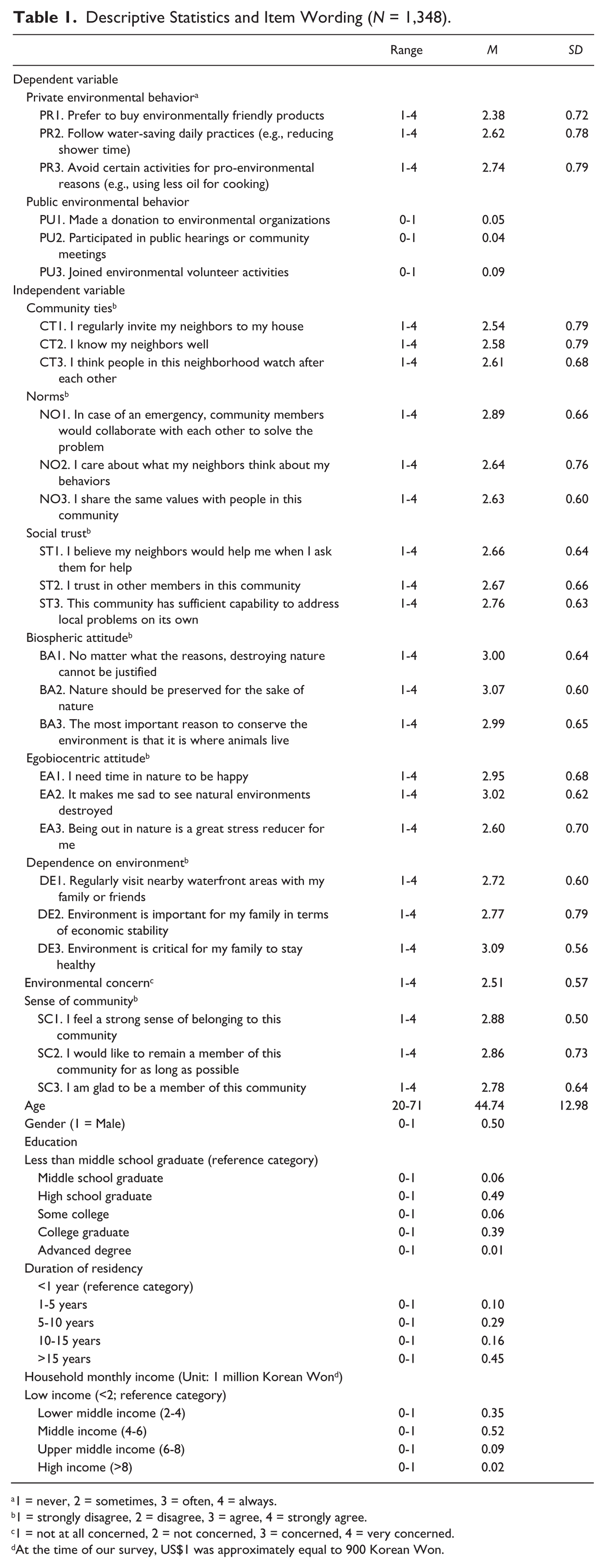
1 = never, 2 = sometimes, 3 = often, 4 = always.
1 = strongly disagree, 2 = disagree, 3 = agree, 4 = strongly agree.
1 = not at all concerned, 2 = not concerned, 3 = concerned, 4 = very concerned.
At the time of our survey, US$1 was approximately equal to 900 Korean Won.
Measures
Environmental behavior
In the societal context described above, our measures of environmental behavior focus on environmental practices that may affect river ecology and conservation, rather than on general pro-environmental activities. Respondents indicated (0 = no or 1 = yes) whether, in the last 12 months, (a) they have participated in public hearings or community meetings concerned with the local river project, (b) they have participated in environmental volunteer activities, or (c) they have supported environmental organizations or governmental programs designed for the local river environment. The resulting responses were used as indicators of public environmental behavior. Respondents were also asked to state, on a 4-point scale (1 = never, 4 = always), to what extent they practice environmentally friendly behavior, such as efficient water use, environmental consumption, and avoiding water pollution.
Social capital
The three statements each measure community ties, norms, and social trust. First, the items for community ties measure how much respondents and neighbors in their community know each other well, visit with each other, and watch after each other (e.g., I regularly invite my neighbors to my house). As discussed, this study posits that social capital is a latent, community-level construct that can be inferred from the observed characteristics of social relationships between individuals in a community. Thus, although these measures of community ties indicate the extent to which a respondent feels connected to his or her neighbors, the aggregated individual responses are assumed to reflect a close-knit community structure. Second, we combine items that capture the theoretical sources of normative influences, which have been discussed in the social norms theory: normative beliefs regarding how community residents should behave (e.g., In case of an emergency, community members would collaborate with each other to solve the problem) and social pressures to comply with these implicit rules (e.g., I care about what my neighbors think about my behaviors). Finally, three items for social trust measure how much a resident trusts in others belonging to the same community (e.g., I trust in other members of this community). In opposition to a widely used but highly elastic measure of trust from the World Values Survey based on the statement of “most people can be trusted,” we measure a resident’s subjective trust toward other community residents and limit the perceived meaning of “community” to the geographical boundary of Eup-Myeon-Dong.
Pro-environmental attitudes
Our survey collects a series of questions that address environmental attitudes. Prior studies have long retained a single axis lying between ecocentric and anthropocentric values, typically naming the former pro-environmental attitudes (Thompson & Barton, 1994). However, much research now challenges such a bipolar conceptualization of pro-environmental attitudes and proposes a series of specific distinctions for a more meaningful use of the concept. For example, Amérigo, Aragonés, Sevillano, de Frutos, and Cortés (2007) proposed a conceptual breakdown of biospheric and egobiocentric attitudes and demonstrated that both dimensions can be measured with high reliability. Following that suggestion, we categorized individuals’ pro-environmental value orientations into biospheric–egobiocentric dimensions. The biospheric value orientation represents the environmental attitude valuing nature for its own sake, whereas the egobiocentric value orientation denotes the environmental attitude valuing nature for the self within nature. Three statements each were used to measure biospheric value orientation (e.g., Nature should be preserved for the sake of nature) and egobiocentric value orientation (e.g., I need time in nature to be happy).
Environmental perceptions
From the perspective of studies emphasizing perceived benefits/costs of pro-environmental action (Lindenberg & Steg, 2007), our survey includes additional measures that represent respondents’ perception of environmental threats and its impacts. First, we measured the extent to which one’s everyday life depends on the local river in terms of both emotional and practical dimensions. Respondents were asked how often they visit nearby waterfront areas with their family or friends, and how much the environmental quality of local rivers affects their family’s health status as well as economic performance. We combined the resulting responses using a principal component analysis into an Environmental Dependence scale. Also, we measured the level of environmental concern with a question “How concerned are you about local river environment?” Responses range from “very concerned” (high values) to “not at all concerned” (low values). Lubell (2002) showed that the perceived problem severity is a significant predictor of environmental activism.
Sense of community
Sense of community involves a feeling of being part of a community (McMillan & Chavis, 1986; Talò, Mannarini, & Rochira, 2014). Although some authors treated this concept as being a cognitive dimension of social capital (e.g., Perkins & Long, 2002), we assumed it to be conceptually sound to separate the sense of community scale from the concept of social capital. Sense of community is usually taken to indicate the extent to which an individual is socially attached to a community, but it does not concern the relational qualities embedded in social networks that are central to the idea of social capital. Studies have found that residents who feel strongly attached to their community are more likely to engage in both private environmental actions as well as public environmental actions (Kurz, Linden, & Sheehy, 2007; Takahashi & Selfa, 2015). Sense of community was measured via three items (e.g., I feel a strong sense of belonging to this community), with a 4-point scale (1 = strongly disagree, 4 = strongly agree). We combined responses to each item using a principal component analysis into a Sense of Community scale.
Other controls
Our survey includes respondents’ sociodemographic information about gender, age, educational attainment, household income, and duration of residency. In addition to these person-level controls known to be correlated with environmental behavior, we also need to adjust for the effects of locational variables that may affect the spatial patterning of environmental behavior. To this aim, two dichotomous variables were used to index whether each community is a part of the riparian buffer zone (1 = yes) and whether it is located in the upstream suburban region of the Han River (1 = yes). In the Han River basin area, water governance has been conducted in an attempt to reconcile potential conflicts between upstream and downstream residents. Downstream urban residents in the Han River watershed bear the burden of an environmental tax, which is used as a fund for watershed conservation and preservation. Conversely, the Korean Ministry of Environment has regulated various types of upstream activities that could potentially harm the environment in riparian zones. Given the importance of controlling for locational factors related to environmental behavior (Mobley, 2016), we model these variables as potential confounders of the relationships between community-level social capital and environmental behavior.
Analytic approach
As stated, studies linking social capital to environmentalism have tended to rely on person-level models, in which social capital is measured by personal attributes and is then applied to the explanation of personal behavioral outcomes. Problems arise, however, because such person-level accounts cannot deal with the inherently multilevel data structure wherein a community’s social capital is produced through interactions between individuals. Conventional statistical models are based on the fundamental assumption that measures collected for individuals are independent of those for others. If individual responses of social capital reflect a common characteristic of social entities in which individual agents are situated, and if individuals belonging to the same social group tend to have correlated error terms, then such a nested structure of data is likely to violate the independence assumption (Raudenbush & Bryk, 2002). Non-independence of individual responses within the same group might result in substantially biased estimates of standard errors as well as coefficients (Goldstein, 2011).
One solution to this problem is to base the analysis on collective-level measures that are obtained by the aggregation of individual-level measures. The most widely cited author in this tradition is Putnam (2000), who has defined social capital as the averages of the associational activities, followed by analysis of the impact of social capital on the other aggregated social indicators. This approach, unfortunately, may also be subject to multiple sources of bias. First, studies usually analyze only a small fraction of samples from each group, which results in a biased estimation of the unobserved “true” group means (O’Brien, 1990). Second, measuring social capital by incorporating multiple indicators of the observed characteristics essentially raises the question of measurement error (Lüdtke et al., 2008; Marsh et al., 2012).
To address these issues, this article follows the “doubly-latent multilevel modeling of contextual effects” approach proposed by Marsh et al. (2009), in which our variables of social capital and environmental behavior are considered to be latent in relation to both combining items and sampling persons. Although both MLM and structural equation modeling (SEM) have long been applied to a broad range of disciplines, it was not until recent methodological advances that researchers were able to integrate the modeling frameworks of MLM and SEM (Preacher, Zyphur, & Zhang, 2010). MSEM enables us to address the serious problem of nested data structure and further provides a correction for both measurement error and sampling error (Marsh et al., 2009). First, as is typical in the MLM literature, MSEM permits us to recognize properly the nested data hierarchies and examine mechanisms by which individual factors interact with macro-level factors. Second, MSEM corrects measurement error by inferring person- and group-level constructs on the basis of a set of person-level observed indicators. Finally, MSEM helps us to correct for sampling error by measuring true group means as the unobserved latent variables, which can be statistically inferred from the group means of the observed values. Further details of the methodology of this article are available in the online appendix (at http://eab.sagepub.com/supplemental).
When the estimation is based on the maximum likelihood (ML) and likelihood-ratio chi-square testing, MSEM may require substantially large sample sizes both at Level 1 and Level 2, such that the optimization algorithms in ML estimation converge to a proper solution (Marsh et al., 2009). Particularly when coping with categorical data, ML estimation involves high-dimensional numerical integration (Muthén & Asparouhov, 2012). To overcome these computational problems, recent studies have suggested that Bayesian procedures offer a more flexible and efficient alternative for complex multilevel models (Depaoli & Clifton, 2015; Lee, 2007; Marsh et al., 2009; Muthén & Asparouhov, 2012). Following that suggestion, this article relies on the Bayesian perspective of MSEM, wherein we specified non-informative prior distributions for intercepts and regression slopes as N(0, ∞), and loading parameters as N(0, 5), thus allowing each parameter to be estimated based on our data. Inverse Wishart prior distributions were used for the variance covariance parameters. We used Markov Chain Monte Carlo methods with a Gibbs sampler to explore the posterior distribution (Chib & Greenberg, 1998). Estimates were derived using the Mplus software, Version 7.2.
Results
We initially estimated the multilevel confirmatory factor analysis (MCFA) models. As illustrated in Figure 1, MCFA allows us to assess the amount of variability attributable to the community level, that is, intraclass correlation coefficients (ICCs). In multilevel studies, ICCs offer valuable information on the relative importance of different levels (Gelman & Pardoe, 2006). To ensure correct estimation of ICCs for latent constructs, factor loadings were constrained to be invariant across levels (Muthén, 1991). The evidence indicates that approximately 37.9% of the variance in public environmental behavior can be attributed to differences across communities, whereas 58.1% of the variance in private environmental behavior lies between communities. That is, variation across communities explains a substantial portion of the total variability in both dimensions of environmental behavior, which strongly supports our expectation that where one lives significantly affects the patterns of environmental behavior. The proposed model provides a satisfactory fit to the data; the majority of items loaded strongly on their corresponding latent factors, and all factor loadings were statistically significant at the p < .05 level. Table 2 also indicates that geographically disaggregated constructs of social capital are measurable with high validity. The variance component for our social capital construct is highly significant. Approximately 36.2% of the total variance in social capital indicators is among communities. However, the evidence also shows substantial residual variations in social capital indicators within communities. The fact that social capital varies substantially within and between communities indicates that we have enough power to ask whether social capital constructs defined at different levels are related to environmental behavior.
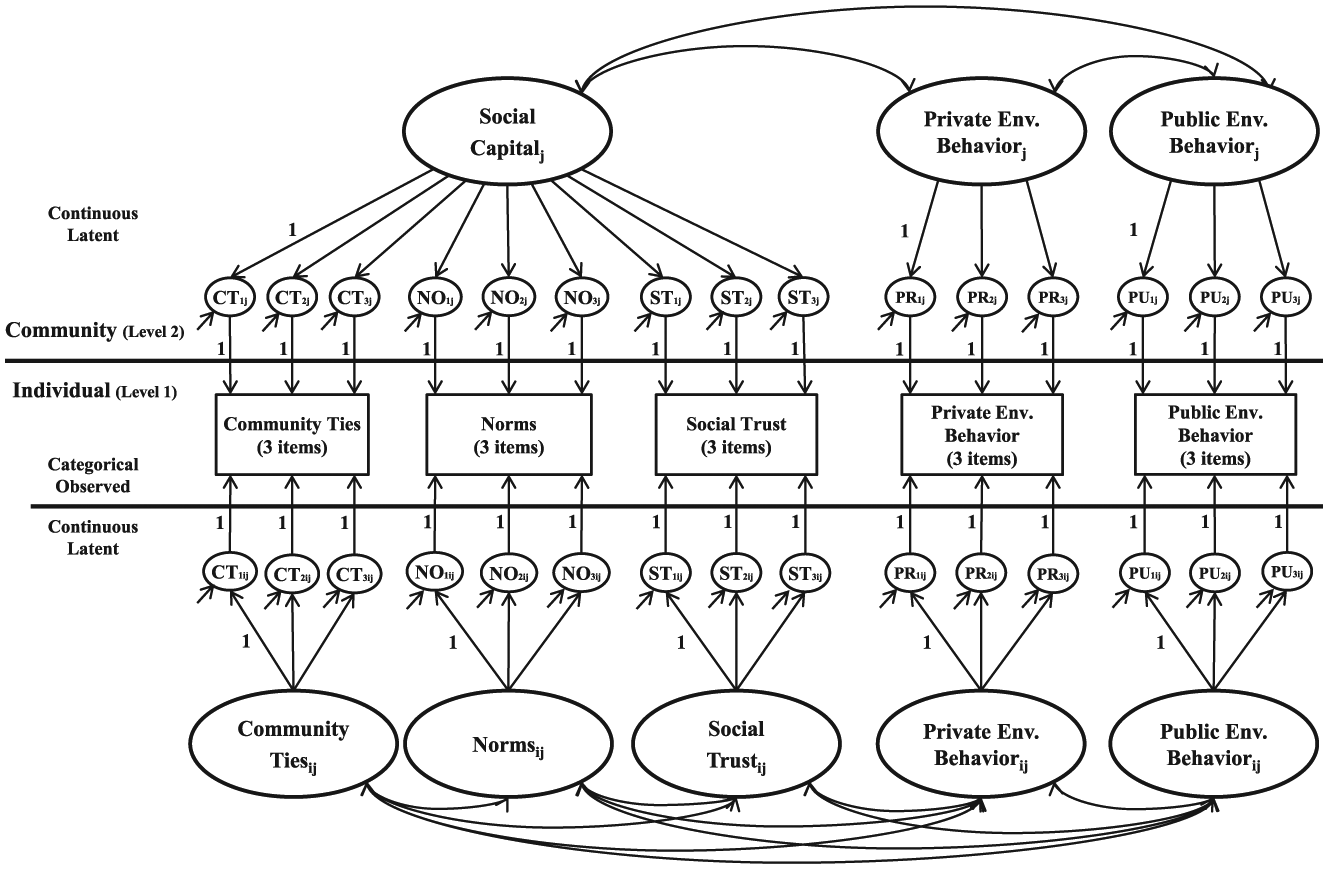
Path diagram for multilevel confirmatory factor analysis.
Unstandardized Factor Loadings of Items for the Multilevel Confirmatory Factor Analysis.

Note. We numbered these items with the same number in Table 1. Factor loadings were constrained to be invariant across Level 1 and Level 2. PR = private environmental behavior; PU = public environmental behavior; CT = community ties; NO = norms; ST = social trust.
Factor loading fixed to 1.
Table 3 presents our main results. We allowed the simultaneous estimation of within- and between-community variation in environmental behavior and the contribution of person- and community-level predictors to both sources of variability. At the community level, the social capital construct proved to be a highly significant predictor of spatial variations in both private and public environmental behaviors. This finding confirms our hypothesis that higher levels of social capital are associated with a significantly increased tendency to engage in pro-environmental actions. The measures of explained variation at the community level indicate that our group-level model explained many spatial variations in both dimensions of environmental behavior. With this multilevel research design, these community-level associations are most likely not due to person-level attributes (e.g., environmental attitudes), locational conditions, (e.g., urban/suburban contrast), or the compositional differences in the individual-level social practices of the people living in each community.
Standardized Parameter Estimates of the Bayesian Multilevel Structural Equation Modeling Analysis.
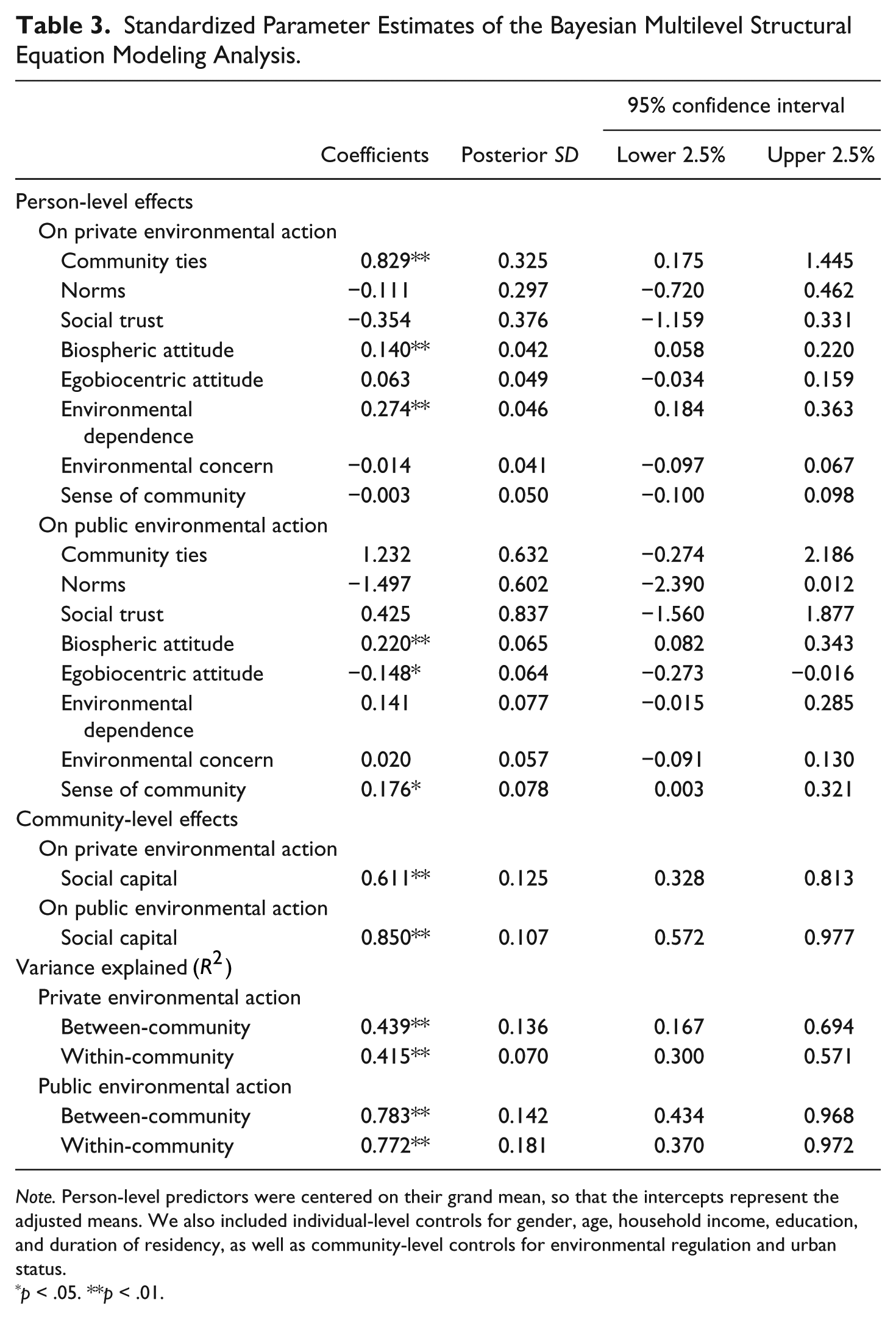
Note. Person-level predictors were centered on their grand mean, so that the intercepts represent the adjusted means. We also included individual-level controls for gender, age, household income, education, and duration of residency, as well as community-level controls for environmental regulation and urban status.
p < .05. **p < .01.
Among the person-level social capital indicators, the only statistically significant relationship was that between community ties and private environmental behavior. This micro-level finding suggests that people with extensive communitarian bonds are more likely to engage in environmentally responsible lifestyles, regardless of what sort of community they live in. That is, private environmental behavior is associated not just with social capital at the community level but also with individual’s own social networks. In contrast, neither norms nor social trust was significantly associated with any dimension of environmental behavior. That is, a resident’s perceptions of norms or trust seem to have little to do with that resident’s environmental behavior, net of the community’s social capital.
Aside from social capital, we found that the effects of attitudinal variables were less consistent. When comparing two indices of pro-environmental attitudes, the biospheric attitude scale was associated with higher levels of private and public environmental behavior, but the egobiocentric attitude scale negatively predicted public environmental behavior. These findings demonstrate the importance of the distinction between egobiocentric and biospheric attitudes, showing that distinct environmental attitudes lead to distinct behavioral outcomes. Turning to perceptional variables, we found that environmental dependence was a statistically significant predictor of likelihood of involvement in pro-environmental everyday lifestyles, whereas environmental concern was not significantly related to either private or public environmental behavior. Sense of community also had a significant correlation with participation in environmental activism, but its impact on private environmental behavior was not statistically significant.
Discussion
Scholars of environmental behavior have stressed the role of attitudinal and perceptional variables on the environment. Our findings reiterate the importance of these personal determinants but also enhance our understanding of how environmental behavior relates to the societal environment in which individuals are embedded. The major implications are outlined as follows.
First, the evidence shows that social capital varies within and between communities, and therefore, deconstructing social capital into individual- and community-level components is possible and desirable. The spatially disaggregated construct of social capital is significantly related to place-to-place variation in environmental behaviors, whereas person-level variation in community ties can still be predictive of environmental behavior even after accounting for the community-level influences. By so doing, our research provides a crucial balance to previous single-level findings. In contrast with previous macro-level studies that have relied on aggregate measures of associational activities, we suggest that higher levels of civic organization memberships among community residents perhaps ought to be considered as a consequence of social capital, rather than its defining element. If social capital is to be a relational asset embedded in social networks, its micro-level foundation must be explicitly taken into account. In this sense, our study offers a nuanced view that recognizes the ways in which social capital is constructed through, and itself impacts the relational qualities of, social relationships between people in a locality. On the contrary, this research complements previous micro-level findings that have been based on self-reported personal attributes as proxies for social capital. Consistent with previous studies (e.g., Macias & Williams, 2014; Miller & Buys, 2008), we found no evidence that environmental behavior is predicted by individual differences in the perceptions of norms or trust. This lack of results may reflect that such relational dimensions of social capital are primarily operating at the community level of analysis and should therefore be treated as collective entities rather than intrinsically personal attributes. Taken as a whole, our multilevel findings indicate that community social capital may have beneficial effects on communities as a macro-social construct, over and above what is attributable to the sum of its person-level namesake.
The ICC for private environmental behavior (0.581) was sizable, given that ICCs in community studies are usually smaller than 0.30 (e.g., Sampson, Morenoff, & Earls, 1999). Such a large amount of ICC may result from controlling for Level 1 measurement error. Raudenbush, Rowan, and Kang (1991) argued that analysis for latent variables tends to yield larger ICCs than do those for observed variables due to the disattenuation for measurement error (see also Muthén, 1991). Indeed, when we form Level 2 constructs based on manifest aggregations of Level 1 indicators (i.e., the observed group means), the ICCs were substantially attenuated: 0.329 for private environmental behavior and 0.237 for public environmental behavior. Another explanation for this result would be that it reflects a more collective culture in Korea. Studies of environmentalism in Korea have shown the link between collectivism and environmental behavior (e.g., Kim, 2011). For instance, drawing on cross-cultural samples in Korea and the United States, Cho, Thyroff, Rapert, Park, and Lee (2013) found that Korean respondents reported having higher levels of Confucian collectivism, defined as a particular type of collectivism characterized by hierarchical authority, in-group conformity, and face-saving actions (Chiou, 2001; Park, 1998). Cho et al. (2013) also found the collectivism scale to be positively related to pro-environmental attitudes. Given this cultural background, the distinctive features of Korean society, whereby in-group members feel pressure to become internally cohesive and conform to an explicit group norm, may to some extent contribute to creating the observed strong agreement among residents within the same community.
Second, the evidence shows that social capital influences do not operate in the same way in different types of environmental behavior. Unlike many previous studies that have tended to prioritize either environmental lifestyles or collective activism, we have developed a comparative framework through which different causal mechanisms for both types of environmental behavior can be assessed. At the person level, community ties proved to be a strong predictor of private environmental behavior, which is unsurprising given that such an association has been documented by several studies of residential water-affecting actions (Miller & Buys, 2008), household water recycling (Tucker, 1999), or environmentally desirable lifestyles (Macias & Williams, 2014). Consistent with this literature, our findings indicate that residents’ own community networks directly influence their intention or capacity to take environmentally responsible practices, regardless of whether they live in communities with a high or a low social capital. Although this study cannot sort out the mechanism through which community ties relate to private environmental behavior, the flow of local-specific information through neighborly networks may play an important role in encouraging environmentally beneficial practices. In contrast, no person-level social capital indicators, including community ties, were found to be significant in explaining public environmentalism. Note that community social capital accounts for a large fraction of the cross-community variation in public environmental behavior. Thus, it may be argued that organized forms of environmental behavior depend more on there being a sufficiently high level of community social capital, rather than the configuration of one’s own social ties. Put differently, individuals’ personal networks would not be effectively projected into the collective sphere unless they are grounded in generalized trust or social norms accompanied by sanctions.
Regarding attitudinal variables, we found egobiocentric attitude to be negatively related to public environmental behavior, whereas biospheric attitude positively predicted both dimensions of environmental behavior. Recall that we conceptualized the egobiocentrism as the extent to which individuals value the environment for its contribution to their mental and physical well-being, rather than its intrinsic values (Amérigo et al., 2007). If the motivation to participate in public environmental activism is based on a commitment to the community goals in which people share sets of values and interests, too much egobiocentrism may discourage both the coordination of diverse interests and collective responses to community problems. Indeed, Gärling, Fujii, Gärling, and Jakobsson (2003) found that awareness of egoistic environmental consequences is negatively associated with public pro-environmental actions, whereas awareness of social-altruistic and biospheric consequences makes people more likely to engage in public environmental actions.
Among perceptional variables, we found an association between environmental dependence and private environmental behavior. The positive effects of environmental dependence are consistent with the findings of Zanetell and Knuth (2004), which showed that dependence on the local river provides an additional incentive for participating in environmental preservation. People who feel strongly dependent on the local environment may be more vulnerable to environmental pollution, and therefore perceive more benefits from engaging in collective activities with pro-environmental intent. One might argue, however, that these perceptional variables should be treated as place-specific characteristics in that the places where one lives might critically structure the extent to which one’s daily life depends on the environment. In this study, this concern does not seem to be relevant because our estimates were based on the residual correlation between outcomes within communities that persists after accounting for individual- and community-level characteristics.
Finally, our micro-level findings indicate that respondents with a strong sense of community are more likely to engage in public environmental activism. Studies have argued that a strong sense of community leads to a sense of co-ownership and of responsibility for local natural resources, which in turn fosters the engagement in place-protective actions for shared community goods (Anderson, 2009; Chavis & Wandersman, 1990; Kurz et al., 2007; Takahashi & Selfa, 2015). The current study supports these studies but further shows that sense of community has predictive power for public environmentalism even after controlling for person- and community-level attributes.
Conclusion
Although work within the environmentalism literature has recognized that environmental behaviors vary not only between people but also between places, the empirical studies have been largely silent on the methodological challenges involved in analyzing such a nested data structure. In this investigation, we have developed a multilevel framework through which the relationships between social capital and environmental behavior can be assessed in a variety of community settings. As such, this research is situating the problem of environmental behavior within space-specific contexts, where ongoing social relationships and their structural outcomes create behavioral incentives.
Our findings broaden the empirical basis for environmental behavior from a multilevel econometric perspective. The overall results suggest that a structure in which individuals belong to communities is uniquely suited for identifying nested sources of variability in environmental behavior. By its capacity to decompose person- and community-level channels, this study provides a more fruitful assessment of social capital’s roles as a public good. Future studies could extend the multilevel framework that this article has developed to address other processes linking environments and behaviors, thus deepening our knowledge of how the patterning of human behaviors, in particular, social units interacts with the macro contexts. Given these empirical results drawn from our MLM, we question the relevance of single-level models that have focused on person-level attributes of social capital. As stated, ignoring such hierarchical data structures might cause biased standard errors and estimates due to the within-group correlation of the responses. More importantly, as long as empirical models cannot articulate the interplay between person- and group-level relationships, the substantive meaning of social capital will remain truncated and become little more than a new label for pre-existed sociological concepts.
However, at the same time, we need to be circumspect in making substantive interpretations of what the social capital constructs reflect. Our research has measured social capital based on latent aggregates of responses by residents within the community, assuming that social capital is manifested by its effect: the extent to which it shapes the quality of social relationships between people. Our investigation was not structured in a way that makes explicit a causal connection between the person-level indicators and the community-level construct, which should involve processes over time. Efforts to replicate these results in longitudinal research designs might provide a stronger causal interpretation. In addition, we have interpreted the residual variation in social capital indicators within communities as representing each resident’s unique attributes that are not captured by the aggregate stock of social capital. Although our measurement model showed a high level of agreement among residents within the same community, we found the residual variation in community ties to be predictive of private environmental behavior. As such, our micro-level findings indicate that the benefits flowing from social networks do not accrue equally to everyone, because some enjoy more extensive networks than others. Given that both sense of community and length of residence are taken into account, the extent of embeddedness in the local community should not be a major source of within-community heterogeneity in community ties. However, the residual variation may result from the existence of subgroups (e.g., social action groups, hobby clubs, or interest groups) through which heterogeneity in access to community social capital is produced. In support of this view, sociologists have recognized that the capacity to form social ties depends on the organizational context by which social connections are purposely or non-purposely created (Small, 2009). Yet this study cannot determine conclusively why some members (or groups) have better networks than others.
Our findings may have broader policy implications. Although the importance of environmental collective actions has received serious policy attention during the last decade, the Korean policy framework still seems to be grounded in the “information-deficit” perspective that views public education as the solution for the failure of environmental participation. Such understanding often neglects the reality that environmental actions occur as part of a complex context in which structural and cultural forces frame the incentive structures, that is, failing to take into account that knowledge is only one factor among diverse motivators simultaneously at work. In contrast, our findings support an alternative framework interacting with social entities in which public participation is guided. Indeed, this approach, often labeled the civic model (Bulkeley & Mol, 2003), has recently been manifested in emerging forms of policy arrangements, such as open forums and problem-solving workshops (Kay, 2005; Schultz et al., 2015). In line with these policy shifts, this article calls for a more community-based form of policy making, which derives its institutional capacity and political legitimacy more from locally grounded trust-building processes, not from top-down, closed decision-making processes.
Footnotes
Acknowledgements
The authors are grateful to Minseon Kim, Yonsei University, for her support on this project.
Authors’ Note
The findings, conclusions, and recommendations expressed in this article are those of the authors and do not necessarily reflect the views of the Korea Environment Institute.
Declaration of Conflicting Interests
The author(s) declared no potential conflicts of interest with respect to the research, authorship, and/or publication of this article.
Funding
The author(s) disclosed receipt of the following financial support for the research, authorship, and/or publication of this article: This study received financial support of the research project “Paradigm Shift on Water Culture and Its Policy Direction” from the Korea Environment Institute (No. 2014-05-01).
Author Biographies
References
Supplementary Material
Please find the following supplemental material available below.
For Open Access articles published under a Creative Commons License, all supplemental material carries the same license as the article it is associated with.
For non-Open Access articles published, all supplemental material carries a non-exclusive license, and permission requests for re-use of supplemental material or any part of supplemental material shall be sent directly to the copyright owner as specified in the copyright notice associated with the article.
