




Abstract
In industrialized societies, techno-optimism is a belief that human ingenuity, through improved science and technology, will ultimately provide remedies to most current and future threats to human well-being, such as diseases, climate change, and poverty. Here we examine (a) whether techno-optimism is found among Midwestern corn and soybean farmers and (b) how this confidence in human ingenuity influences their support for climate change adaptation. By examining data from a survey of nearly 5,000 grain farmers in the Midwestern United States, we found that greater techno-optimism can reduce farmers’ support for climate change adaptation and increase their propensity to express a preference to delay adaptation-related actions. This study advances our understanding of how social and cognitive factors influence farmers’ attitude toward climate change. Findings from this study can also help extension educators to develop outreach programs that are sensitive to farmers’ views about the ability of science and technology to solve climate change–related issues.
Climate change presents significant challenges to agriculture and society (Coumou & Rahmstorf, 2012; J. Hatfield et al., 2014). Farmers are at the frontier of adapting or responding to the impacts of climate change on agriculture (Lal et al., 2011). These responses can be managerial and technological and often require changes in human behavior (Gardezi & Arbuckle, 2017). Understanding the social and behavioral drivers of farmers’ attitudes toward climate change adaptation is crucial for increasing agriculture’s resilience in the face of climate change.
Concepts of risk perception and perceived capacity are central for explaining farmers’ attitudes toward climate change adaptation. Risk perceptions are a person’s subjective judgment or assessment of risk. It is how risk and uncertainty are socially constructed and perceived (Wachinger, Renn, Begg, & Kuhlicke, 2013). Past research has found several factors such as previous experiences of hazard and emotions to influence individuals’ assessment of risk and the willingness to take precautionary actions to reduce potential harm (Feldman, Myers, Hmielowski, & Leiserowitz, 2014). Closely related to the concept of risk perception is perceived capacity—defined as the “extent to which [people] feel prepared to endure changes and take necessary steps to cope with them” (Seara, Clay, & Colburn, 2016, p. 50). In social and behavioral research, perceived capacity is generally conceptualized as people’s personal belief in their ability to cope, adapt, or respond to social and environmental change (Ross & Mirowsky, 2006). Perceived capacity is synonymous with self-efficacy or people’s beliefs about their capabilities to produce action that can affect their lives (Bandura, 1982). Both risk perception and perceived capacity can affect people’s decisions about the willingness to respond to risks (Gardezi & Arbuckle, 2017).
While perceived risks and capacity are important personal indicators of behavior change, they may be filtered through social paradigmatic dimensions of capacity. Environmental sociologists have shown that in industrialized societies, the “Human Exemptionalism Paradigm (HEP)” has become a dominant worldview (Foster, 2012; McDonald & Patterson, 2007; Williams, 2007). The main tenets of the HEP include an assertion that humans are (a) unique among other species on earth, (b) independent from the ecosystems that they inhabit, and (c) able to use technology to dominate nature (Catton & Dunlap, 1978). Confidence in science and technology is a core component of the HEP and Barry (2012) labels this attribute as “techno-optimism” or “belief in human technological abilities to solve problems of unsustainability while minimizing or denying the need for large-scale social, economic and political transformation” (p. 3). Although much attention has been devoted to understanding how these paradigmatic beliefs can influence pro-environmental behavior in agriculture (Beus & Dunlap, 1990; Dentzman, Gunderson, & Jussaume, 2016), little theoretically informed research has examined how techno-optimism might influence farmers’ attitudes toward climate change adaptation.
Previous work on human behavior change acknowledges that while some people may support (or not) decisions regarding adaptation, others can be uncertain and may decide to wait and see (Morton, Roesch-Mcnally, & Wilke, 2017). “Decision-delay” is an important concept to indicate uncertainty in decision making. It is a psychological phenomenon in which people delay important decisions instead of making them today (McNeill, Dunlop, Skinner, & Morrison, 2015). This behavior is especially relevant for natural resource managers such as farmers who have to respond to multiple complexities in decision making from changes in markets and policy to weather and climate (Hess, McDowell, & Luber, 2012).
This research examines how two primary dimensions of perceived capacity, (a) belief in personal capacity and (b) a dimension of human exemptionalism that has been characterized as “techno-optimism,” can influence the relationship between farmers’ climate risk perceptions and attitude toward climate change adaptation. This study combines elements of the “Human Exemptionalism Paradigm (HEP)” (Catton & Dunlap, 1978; Dunlap & Catton, 1994; Foster, 2012) and more recent cognitive factor approaches (Bubeck, Botzen, & Aerts, 2012; Wachinger et al., 2013) to test the hypothesis that techno-optimism can be an ideological force that may hinder farmers from engaging in climate change adaptation, even when they perceive that the risks associated with climate change are serious.
This study is organized as follows: First, relevant literature is reviewed to examine four key concepts: risk perception, perceived technical capacity, techno-optimism, and decision-delay. Next, conceptual models are developed to frame the complex relationships between determinants of farmers’ climate change–related risk perception and support for climate change adaptation. The hypothesized relationships are empirically examined using a survey of almost 5,000 conventional farmers from the Upper Midwestern United States. Finally, the main findings of this research are presented and possibilities for future research on this subject are discussed.
Risk Perception
An important thread of research on human behavior has focused on risk perceptions as significant for influencing actors’ support for pro-environmental behavior, including adaptation to climate change (Grothmann & Patt, 2005; Moser, Stauffacher, Blumer, & Scholz, 2014). Although a positive relationship between risk perceptions and the willingness to take actions to cope, adapt, or ignore such risk is intuitive, scholars in the realm of natural hazard and climate change adaptation research have been perplexed by inconsistent findings. While some studies find a positive relationship between risk perceptions and attitudes toward behavior change, some studies do not (Hung, Shaw, & Kobayashi, 2007), and still other research shows a negative correlation between the two (Jorgensen & Termansen, 2016; Lo, 2013). Against this background, recent farm-level research suggests that farmers who perceive climate change to be a threat to their farm enterprises are more likely to support adjustments to anticipate or react to changing conditions that may place the farm enterprise at risk (Arbuckle, Morton, & Hobbs, 2013; Morton, Hobbs, Arbuckle, & Loy, 2015).
Perceived Technical Capacity
Another important thread of social and behavioral research has focused on perceived capacity as important for influencing actors’ support for pro-environmental behavior. Perceived capacity—defined as the “extent to which [people] feel prepared to endure changes and take necessary steps to cope with them” (Seara et al., 2016, p. 50)—has been found to influence actors’ decisions about taking actions for managing climatic risks (Moser et al., 2014).
In the realm of adaptation to climate change in agriculture, farmers’ perceived capacity is generally conceptualized as their personal beliefs as to whether they are able to adapt to climate change (i.e., they have sufficient knowledge, financial, and technical skills to make changes to their farming practices). For example, in a study of Sri Lankan farmers, Truelove, Carrico, and Thabrew (2015) found that those farmers who felt capable of using climate-smart agriculture and perceived adoption as necessary to reduce risks related to climate change were more likely to engage in adaptive responses. In the United States, there is a lack of research on perceived capacity and agricultural adaptation (Chatrchyan et al., 2017), and the single study we are aware of (Roesch-McNally, Arbuckle, & Tyndall, 2017) did not detect a relationship between perceived capacity and potential adaptive behaviors among farmers. Numerous studies in other behavioral settings, however, have assessed the relationships between actors’ perceived capacity and various environmental behaviors, such as water conservation (Trumbo & O’Keefe, 2005), recycling behavior (Botetzagias, Dima, & Malesios, 2015; Cheung, Chan, & Wong, 1999), health-related practices (Black & Babrow, 1991), and use of public transportation (Tikir & Lehmann, 2011). Thus, in general, these studies have found that higher perceived capacity can lead actors to more strongly support and practice pro-environmental behavior.
Techno-Optimism in U.S. Agriculture
Techno-optimism is a “belief in human technological abilities to solve problems of unsustainability while minimizing or denying the need for large-scale social, economic and political transformation” (Barry, 2012, p. 3). It is a central element of the HEP (Beus & Dunlap, 1990, 1994) and represents people’s unfettered confidence in human ingenuity to provide solutions for current and future social, economic, and environmental problems (Barry, 2012). Techno-optimism is central to conventional agriculture in the United States (Beus & Dunlap, 1990; Dentzman, 2018). Technological transformations in U.S. agriculture, which are widely known as the “Green Revolution,” changed farming from a labor-intensive to industrial or capital-intensive system of operation (Rasmussen, 1962). The widespread transitions to mechanization, advances in plant and animal breeding, and greater use of fertilizer and chemicals have led to a dramatic increase in farm output and productivity (Dimitri, Effland, & Conklin, 2005). The legacy of technological advancement during the Green Revolution and the resulting improvement in agricultural productivity is “ . . . a source of national pride for many Americans, especially farmers, agricultural scientists, and politicians” (Beus & Dunlap, 1990, p. 590).
In recent years, human ingenuity in agriculture has been manufactured in sophisticated agricultural technologies such as commercial inputs, global positioning systems (GPS), and genetics. Conventional farmers often highlight the strategic importance of technological advancements in solving challenges pertaining to agriculture. For example, some research has documented a perception among farmers that private seed and chemical companies will supply the next technological breakthrough to solve most problems related to weed (Dentzman et al., 2016). Dentzman et al. (2016) used focus groups to examine whether farmers’ adherence to a techno-optimist worldview could constrain their adoption of pro-environmental behavior. They found that most farmers had faith in future technologies to provide adequate weed management, which made them less likely to use pro-environmental farming practices, such as holistic weed management.
In the last century, high-input, science-based capital-intensive forms of agriculture contributed to substantial increases in yields, but have had impacts on the sustainability of farm income (Lobao & Meyer, 2001), well-being of farming communities (Lobao & Meyer, 2001), and on-farm and off-farm environmental degradation (Lowe, Marsden, & Whatmore, 1990). In light of these events, research has examined the relationships between farmers’ values, beliefs, and norms, and pro-environmental attitudes and behavior, including climate change adaptation and mitigation (Arbuckle, Morton, & Hobbs, 2015). Yet, little research has determined the relationship between farmers’ adherence to techno-optimism and their support for climate change adaptation. This study is building on the limited research that exists on the relationship between techno-optimism and farmers’ pro-environmental behavior. Following the general findings from previous research, it can be argued that in the absence of complete knowledge about the risks associated with climate change, conventional farmers’ attitude toward climate change adaptation may be guided by an abstract faith in technology (techno-optimism). This type of trust can be characterized as a “leap of faith” (Möllering, 2006) and may reduce farmers’ support for climate change adaptation.
Decision-Delay
Previous studies have examined farmers’ decisions to support adaptation as a dichotomous choice made by them, that is, farmers either support or do not support taking adaptive measures on their farm. Yet, managed farming systems are complex and dynamic with unpredictability due to markets, policy, weather, and climate (Hess et al., 2012). Regarding uncertainty, research on motivation and risk suggests that “decision-delay” is a common response to threats that may be well-known to people, but are perceived to pose no immediate risks (Anderson, 2003). This is a psychological phenomenon in which, rather than deciding on and preparing for risky scenarios ahead of time, people delay decisions and instead prefer to wait and see (McNeill et al., 2015). Instead of being assertive in accepting or rejecting the use of adaptive management practices, farmers can be uncertain toward taking an action and may decide to wait and see.
Decision-delay is related to uncertainty, and Morton et al. (2017) recently examined some of the social and behavioral drivers of farmers’ uncertainty about the impact of climate change on their farm operation. Findings from their research show that farmers’ uncertainty can be explained by the variation in beliefs held by them about the causes of climate change. We build upon this scholarship and advance our knowledge about how “decision-delay” can be influenced by broader ideological beliefs, such as farmers’ adherence to a techno-optimistic worldview and beliefs about personal capacity.
Conceptual Frameworks and Hypotheses
In the previous section, we reviewed the concept of risk perception as a predictor of farmers’ support for adaptation. We also established that perceived technical capacity and techno-optimism are potential moderators of the relationship between risk perception and support for adaptation (including decision-delay). Drawing on the literature reviewed above, we develop two conceptual models. In the first model, we outline the hypothesized relationships between two moderating variables; techno-optimism and perceived technical capacity, and farmers’ risk perception and support for adaptation (Figure 1). As shown in Figure 1, we hypothesize that risk perception is positively associated with support for climate change adaptation. Techno-optimism will weaken the hypothesized positive relationship between risk perception and support for adaptation, while perceived technical capacity will strengthen the hypothesized positive relationship between risk perception and support for adaptation.
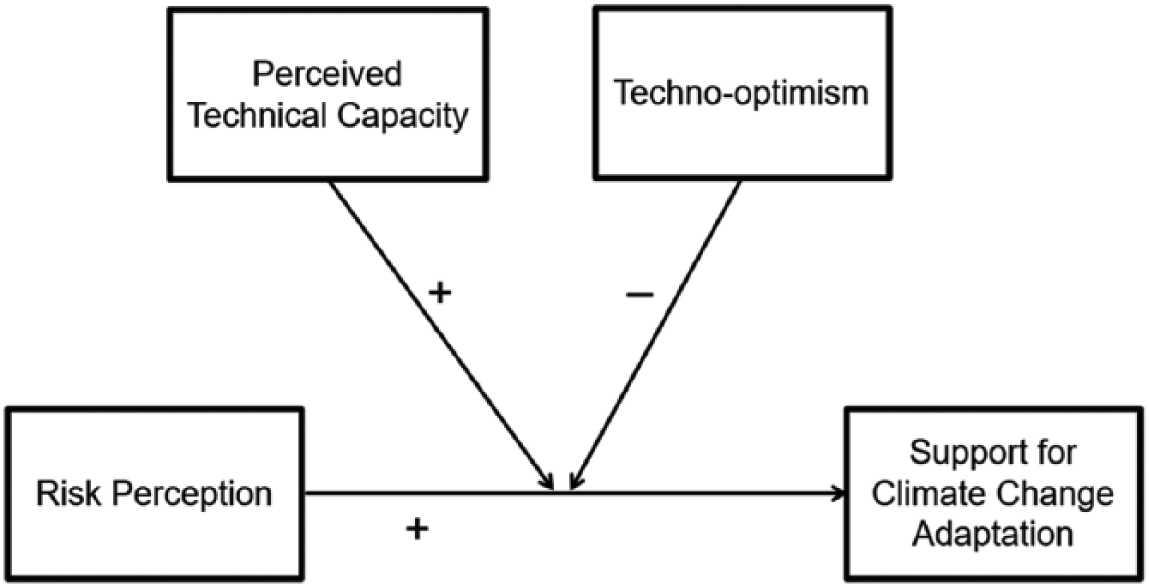
Multiple moderation model with “support for climate change adaptation” as outcome variable (Model 1).
The second model outlines how the moderators (techno-optimism and perceived capacity) modify the relationship between farmers’ climate change–related risk perception and their propensity toward decision-delay (Figure 2). Based on the literature examined, we hypothesize a negative relationship between risk perception and decision-delay. In other words, higher levels of risk perception among farmers will lead to lower levels of decision-delay. We also posit that techno-optimism will weaken the hypothesized negative relationship between risk perception and decision-delay, while perceived technical capacity will strengthen the hypothesized negative relationship between risk perception and farmers’ propensity to delay adaptation-related decisions. The interaction between the moderators and the predictor variables allows us to examine whether farmers’ adherence to a human exemptionalist ideology can negatively influence their support for adaptation, even when they perceive that the risks associated with climate change are serious.

Multiple moderation model with “decision-delay” as outcome variable (Model 2).
Based on the literature reviewed above, for this study of Midwestern corn and soybean farmers, we propose the following hypotheses:
Method
Data Collection
The data employed in this research are from a February 2012 random sample survey of farmers stratified by 22 HUC6 watersheds in the Upper Midwestern United States (Arbuckle et al., 2013). Only farm operations with greater than 80 acres of corn production and gross farm revenue in excess of US$100,000 were included in the sample frame, because (a) the overall project focused on resilience of corn-based production systems and (b) while farms with greater than US$100,000 in revenue constituted a minority of farmers in the region, they farm a majority of the farmland in the region, allowing us to draw conclusions about farmers who produce the majority of the region’s corn. The survey was sent to over 18,000 farmers and 4,778 respondents replied, a response rate of 26%. Statistical tests for non-response bias showed no practical differences between respondents and non-respondents (Arbuckle et al., 2013).
Measures
The study develops two models. Each model employs the same predictor, moderator, and control variables, but a different outcome variable. Thus, there are two outcome variables in total. Listwise deletion of cases with missing values on at least one variable reduced the sample size from 4,778 to 4,363 and 4,391 for Model 1 and Model 2, respectively. Cook’s D, leverage, and Mahalanobis distance criteria were used to assess for outlier respondents. Tests were conducted for multicollinearity, multivariate normality, and heteroscedasticity. Correlations between variables are in the range of .1 to .3, so the assumption of no multicollinearity is met.
Outcome Variables
There are two outcome variables, each measuring a unique attitude toward climate change adaptation. “Support for adaptation” consists of a single item that asked farmers to rate their agreement with the following question: “I should take additional steps to protect the land I farm from increased weather variability” on a 5-point scale from strongly disagree (1) to strongly agree (5). The mean score on the support for adaptation item was 3.47 out of 5 (Table 1). The Likert-type scale for the adaptation item was transformed into two categories: 0 = strongly disagreed, disagreed, uncertain and 1 = agreed or strongly agreed.
Descriptive Statistics for the Variables in the Analysis.

Note. Each variable is measured on a 5-point scale from strongly disagree (1) to strongly agree (5).
“Decision-delay” is measured through a single survey question that asked respondents to rate their agreement, on the same 5-point scale, with the statement: “There’s too much uncertainty about the impacts of climate change to justify changing my agricultural practices and strategies.” The mean score of 3.66 out of 5 on this question is evidence of sizeable agreement with the statement. We constructed a dichotomous item for “decision-delay” with 0 assigned to farmers who strongly disagreed, disagreed, or were uncertain and 1 who agreed or strongly agreed with the statement.
Moderator Variables
This study uses two moderator variables. “Techno-optimism” is measured through a single item that asked respondents to rate their agreement with the statement, “climate change is not a big issue because human ingenuity will enable us to adapt to changes,” on a 5-point scale from strongly disagree (1) to strongly agree (5). The mean score was 3.02 out of 5 on the techno-optimism item (Table 1). “Perceived technical capacity” is measured through a question that asked farmers to rate their agreement (on the same 5-point scale) with the statement, “I have the knowledge and technical skill to deal with any weather-related threats to the viability of my farm operation.” This question measures their assessment of their farms’ capacity to withstand impacts of climate change.
Predictor and Control Variables
One predictor variable—“Perceived Risk”—is measured through a single question that was answered on a 5-point scale ranging from 1 (strongly disagree) to 5 (strongly agree): “My farm operation will likely be harmed by climate change.” This question measures respondents’ perception of the threat associated with climate change. To maintain a parsimonious model, we included just two control variables that we believed to be exceptionally important: education, because level of education could explain some variation in both techno-optimism and perceived technical capacity (Sherer et al., 1982); and acres of land owned, because it represents the degree of exposure of farmers’ foundational productive asset—the soil—to increased weather extremes and other impacts of climate change. Education was measured on a scale from 1 to 6, where 1 denotes less than high school and 6 represents graduate degree. The mean of the education variable was 3.27 with a standard deviation of 1.32. Farmland owned was measured in acres and ranged from 0 acres (some farmers only rented land) to 13,760 acres. The mean owned acreage for this sample of farmers was 356 acres.
Analytical Approach
We use a binary logistic regression with moderation and interaction effects to model farmers: (a) support for adaptation and (b) propensity to delay adaptation decisions. We conducted multiple moderation analysis to analyze the effect of moderators (“techno-optimism” and “perceived technical capacity”) on the responses of the outcome variables. Moderation refers to a theoretical condition when strength of the relationship between a predictor variable and an outcome variable can be explained by their relationship to one or more moderating variables (Hayes, 2013). This analysis was administered using the PROCESS Model 3 SPSS script developed by Hayes (2013). PROCESS Model 3 allows for simultaneous examination of multiple moderators and comparison of specific interaction effects. Following recent recommendations for testing moderation (Preacher & Hayes, 2008), we used 1,000 parametric bootstrap samples to obtain empirical standard errors and 95% bias-corrected confidence intervals with which to assess the significance of estimates (Williams & Mackinnon, 2008). Parametric bootstrap confidence intervals generally perform better without requiring one to make assumptions about the normality of the sampling distribution of the indirect effect (Hayes, 2013).
Results
Table 2 shows the results of the multiple moderator models that were specified in Model 1 (Figure 1) and Model 2 (Figure 2). The table reports logistic coefficients and standard errors. Statistical significance is illustrated using conventional asterisks on the coefficients. Model 1 examines both the main and interaction effects of Perceived Risk (PR) on Support for Adaptation (SA) through two moderators (TO and PTC). PR is the predictor, TO and PTC are moderators, and SA is the outcome variable. This moderation model allows us to consider each moderator’s unique influence on the relationship between PR and SA. The log odds estimates of Model 1, their standard errors, and statistical significance (represented with an asterisk) are presented in Table 2. Overall, the model shows a coefficient of determination (R2) of .05. The low R2 is expected because of the relatively few predictor/moderator variables included in our model to explain farmers’ support for adaptation.
Binary Logistic Regression With Interactions (Log Odds With Standard Errors).
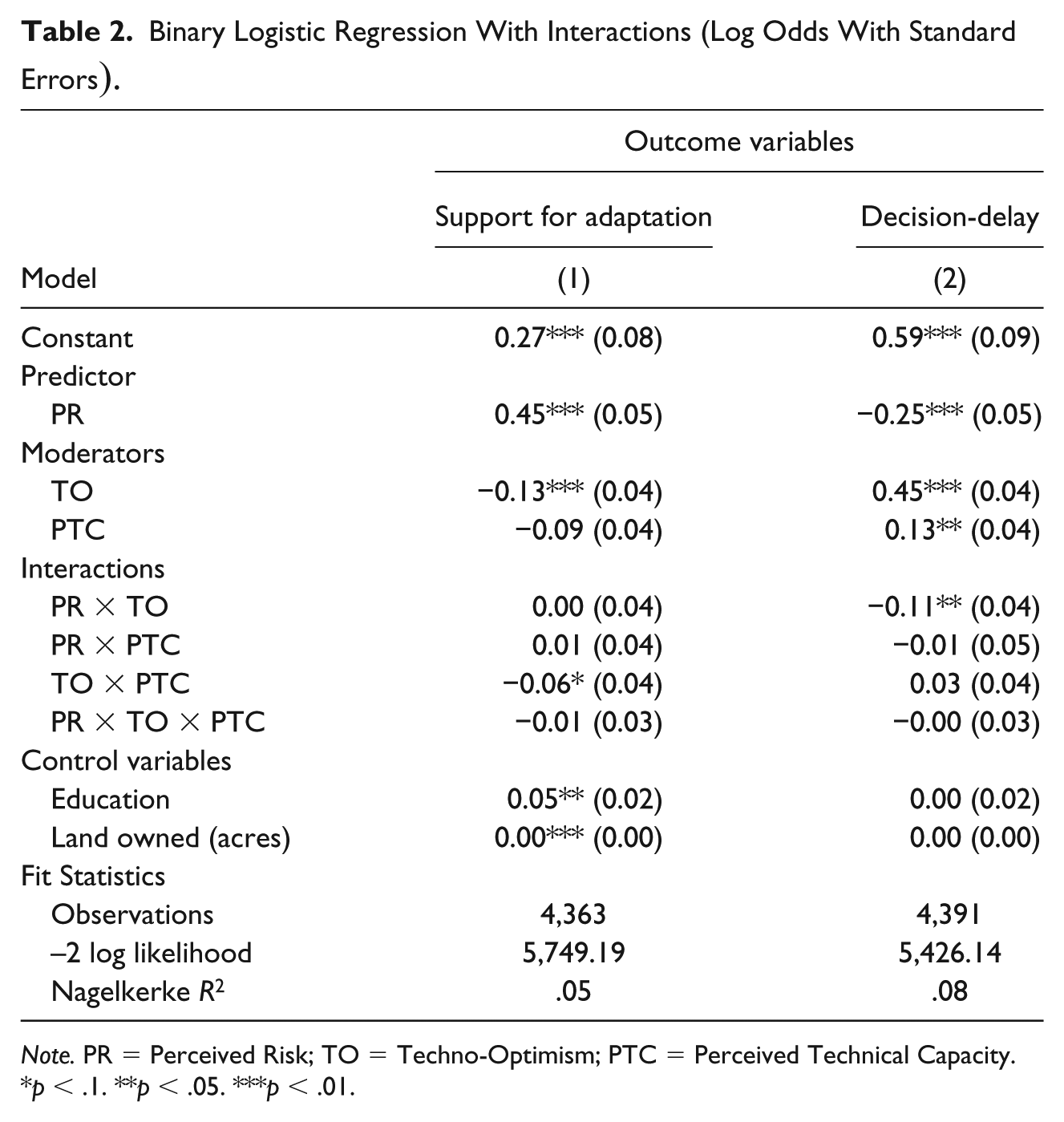
Note. PR = Perceived Risk; TO = Techno-Optimism; PTC = Perceived Technical Capacity.
p < .1. **p < .05. ***p < .01.
Model 1 can be divided into two types of effects: main and interaction effects. As shown in Table 2, with respect to the main effects, PR was positively associated with SA (b = 0.45, SE = 0.05, p < .001), thus providing support for Hypothesis H1a. Consistent with Hypothesis H1b, higher levels of TO were associated with lower levels of SA (b = −0.13, SE = 0.04, p < .001). However, the relationship between PTC and SA was not statistically significant (b = −0.09, SE = 0.04, p = .81). Thus, we do not find evidence to support Hypothesis H1c. Table 2 also shows three two-way interactions (TO-PR, TO-PTC, PR-PTC) and one three-way interaction (TO-PTC-PR) effect. Only one of the two-way interactions was weakly statistically significant (TO-PTC) suggesting that the effect of perceived risk on support for adaptation can become weaker at higher levels of techno-optimism and perceived technical capacity (b = −0.06, SE = 0.04, p = .09). Thus, the combined effect of TO and PTC can weaken support for adaptation.
We graphically examine the conditional effect of risk perception on support for adaptation at low, average, and high values of the moderators (TO and PTC). Figure 3 illustrates risk perception on the x axis and support for adaptation on the y axis. Values on the x axis represent one standard deviation below mean (low), mean value (average), and one standard deviation above mean (high) for the perceived risk survey item. Values on the y axis show predicted probabilities of farmers self-reporting in favor of climate change adaptation—as opposed to against it. The graph shows that when TO is low (Panel A), there is a significant positive relationship between PR and SA; at the mean value of TO (Panel B), there is a weaker positive relationship between PR and SA, and this relationship weakens at higher levels of TO (Panel C). Therefore, higher techno-optimism (TO) moderates the relationship between perceived risk (PR) and support for adaptation (SA). Figure 3 also shows the interaction effect of PTC on support for adaptation. It shows that the relationship between PR and SA is weakest at the highest levels of PTC and TO (Panel C). Thus, the probability of supporting adaptation is at the lowest level when farmers (a) do not perceive climate change to be a risk to their farming operation, (b) perceive higher levels of technical capacity, and (c) are highly techno-optimistic.
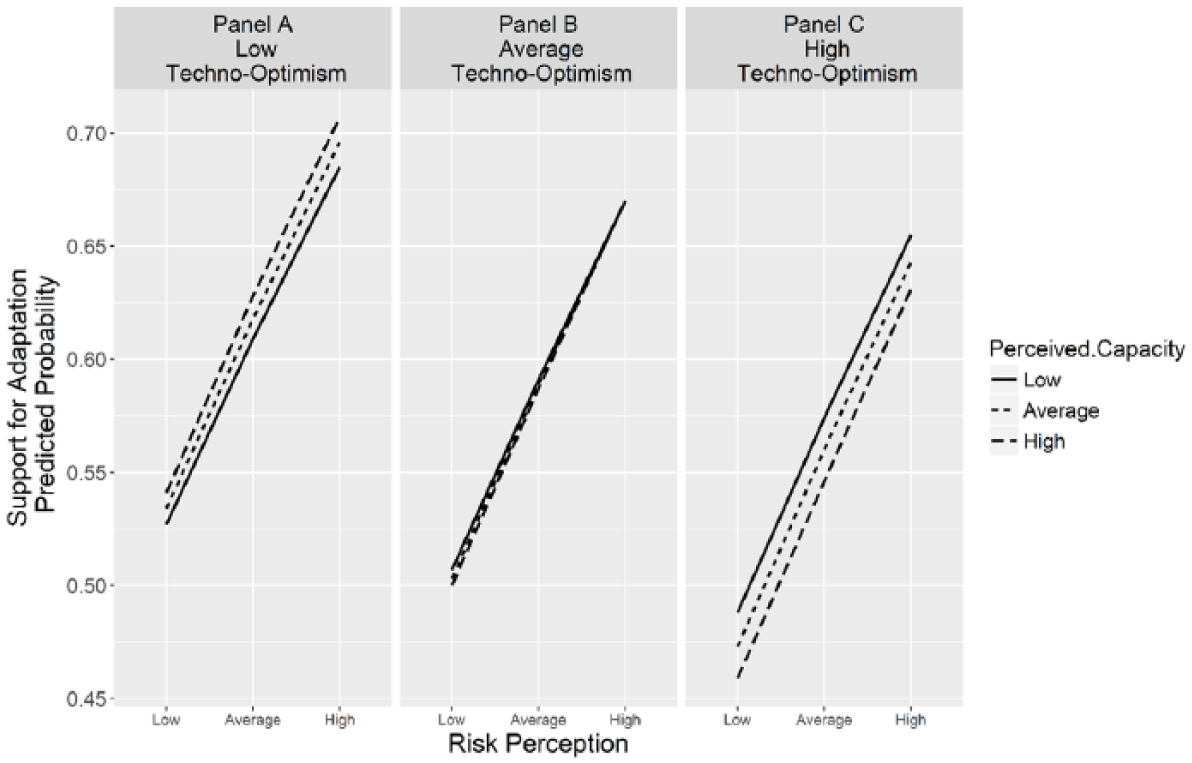
Interactions with support for adaptation as the outcome variable (values on the x axis and for moderators represent one standard deviation below mean [low], mean value [average], and one standard deviation above mean [high] for the predictor and moderator items).
Whereas Model 1 examined farmers’ support for adaptation as an outcome of their perceived risk (PR), Model 2 takes a slightly different conceptual angle, with propensity to “decision-delay” (DD) as an outcome of risk perception moderated by techno-optimism (TO) and perceived technical capacity (PTC). Table 2 shows the model results, including standard errors in parentheses. This model also allows investigation of the main and interaction effects of perceived risk (PR) on decision-delay (DD) while modeling a process where moderators (TO and PTC) influence this relationship (Hayes, 2013).
Model 2 (Table 2) is a multiple moderation model with two moderators (TO and PTC) representing three direct effects, three two-way interaction effects and one three-way interaction. As shown in Table 2, with respect to the main effects and consistent with Hypothesis H2a, climate change risk perception was negatively associated with the decision-delay (b = −0.25, SE = 0.05, p < .001). With respect to the main effects from the moderators (TO and PTC) to DD, higher levels of TO were associated with higher levels of DD (b = 0.45, SE = 0.04, p < .001), thus lending support to Hypothesis H2c. However, contrary to expectations based on previous studies that have shown perceived capacity to be a positive predictor of adaptive action, our results suggest that the relationship between PTC and DD was statistically significant and positive (b = 0.13, SE = 0.04, p = .02). In other words, this result suggests that higher levels of perceived capacity can increase propensity to delay decisions regarding adaptation. Thus, our results are not consistent with Hypothesis H2b.
Table 2 also shows three two-way interactions (PR-TO, TO-PTC, PR-PTC) and one three-way interaction (PR-TO-PTC) effects. The two-way interaction, PR-TO, is statistically significant (b = −0.11, SE = 0.04, p = .04), implying that the relationship between perceived risk (PR) and decision-delay (DD) is significantly (weakly) moderated by techno-optimism (TO). Conditional effects are illustrated in Figure 4. Figure 4 illustrates risk perception on the x axis and decision-delay on the y axis. Values on the x axis represent one standard deviation below mean (low), mean value (average), and one standard deviation above mean (high) for the perceived risk survey item. Values on the y axis show the predicted probability of farmers responding either agree or strongly agree to the survey item that measured “decision-delay.” When techno-optimism is low (Panel A), there is a negative relationship between risk perception and decision-delay. This negative relationship becomes stronger as levels of techno-optimism rise (Panels B and C). Thus, higher levels of techno-optimism are associated with greater propensity to delay decisions associated with taking adaptive measures. Thus, decision-delay is highest for those farmers who (a) perceive low levels of climate change risk to their farming operation (low risk perception), (b) perceive higher levels of technical capacity, and (c) are highly techno-optimistic.
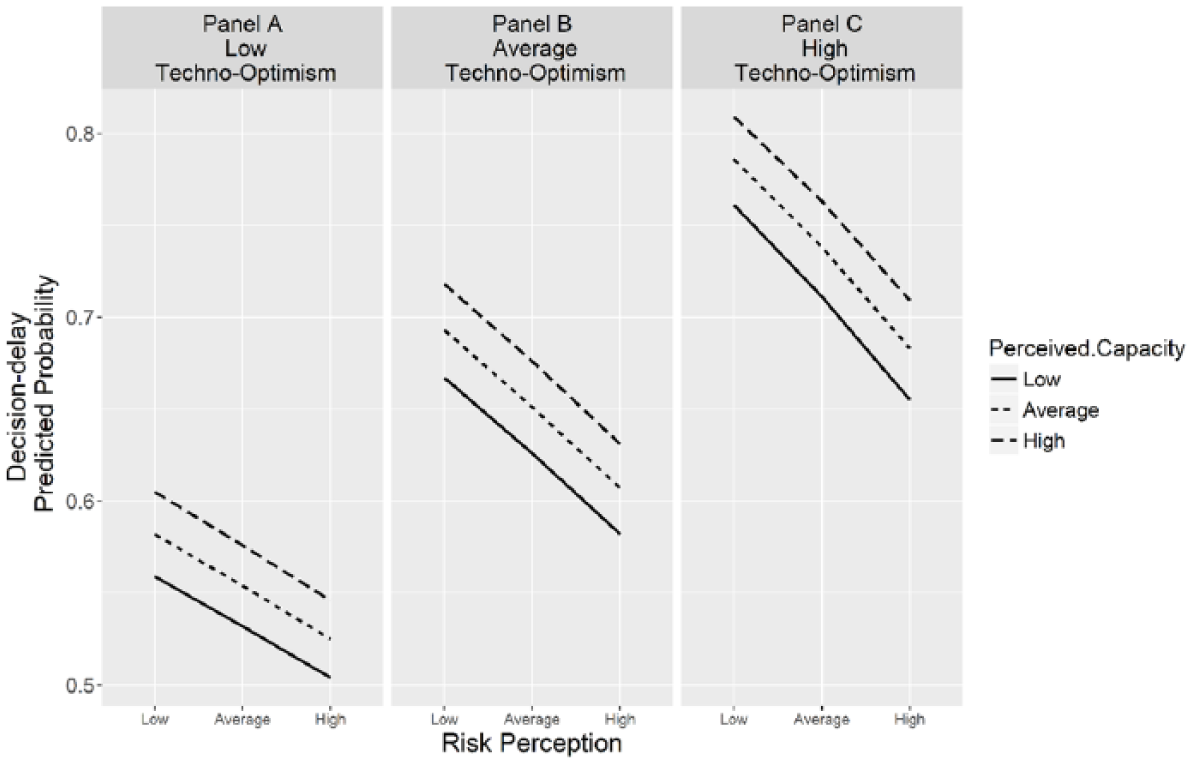
Interactions with decision-delay as the outcome variable (values on the x axis represent one standard deviation below mean [low], mean value [average], and one standard deviation above mean [high] for the response and moderator items).
Discussion
This study assessed the influence of techno-optimism, perceived technical capacity, and risk perceptions on farmers’ attitudes toward climate change adaptation. We found that higher levels of techno-optimism and perceived technical capacity can (a) reduce farmers’ support for climate change adaptation and (b) increase their propensity to express a preference to delay adaptation-related actions. The findings from this study advance our understanding of how social and cognitive factors influence farmers’ attitudes toward climate change adaptation. This study makes several contributions to our understanding of farmers and climate change. First, it shows that human exemptionalism beliefs may influence adaptive management trajectories among corn farmers in one of the most productive agricultural areas in the world. Second, it contributes to the area of natural hazard research by highlighting that actors may not support adaptive behavior even when climatic risks are perceived to be serious and concerning. Third, the research contributes to literature on farmers’ decision making in uncertainty, specifically, as it relates to their willingness to support adaptation to climate change.
Natural resource-based production systems such as farming are highly complex and fraught with large uncertainties due to vagaries of weather and markets (Gunderson, 1999, 2015). Climate change is likely to create additional uncertainties related to farm management, such as crop and seed selection, timing of planting and harvest, and selecting appropriate adaptation practices and strategies. Therefore, farmers ought to continuously respond to the threats posed by climate change by planning, learning, and experimenting to facilitate adaptation. However, as shown in this study, farmers’ adherence to an abstract faith in human ingenuity to solve future challenges associated with climate change may reduce their willingness to take adaptive action and increase their propensity to delay decisions pertaining to agricultural adaptation. For example, farmers could decide to wait and see whether research and development by the public/private sector will develop technologies such as varieties that are resistant to drought or excessive moisture to manage uncertainty associated with climate change. To address the dampening effect that abstract faith in human capacity appears to have on support for adaptation actions, we suggest that engagement strategies should highlight both the limitations and possibilities of current and near-future agricultural science and technology for addressing the challenges associated with climate change.
Contrary to expectations based on previous research that has shown perceived capacity to positively influence actors’ support for adaptation (Esham & Garforth, 2013), we found that higher perceived technical capacity was negatively associated with support for adaptation (although not statistically significant in the regression model) and positively and statistically significantly associated with decision-delay (Table 2). Thus, farmers who reported higher levels of perceived technical capacity to prepare for climate change were more likely to express uncertainty about adaptation decisions, a finding that appears contradictory to previous research showing that higher levels of perceived capacity can facilitate people’s willingness to take risks and solve problems.
A possible explanation for these findings is that despite increasingly variable weather across the Corn Belt (Takle et al., 2013), Midwestern corn farmers in the last decade have produced more total corn and soybeans than in the past and have experienced increased yields per acre using advanced seed genetics and other new agronomic and pest and disease management technologies. These innovations have produced consistent growth in yields (Wang, Heisey, Schimmelpfennig, & Ball, 2015), although it is increasingly recognized that increasing weather variability has led to a substantial gap between current yields and the genetic potential of major crops (J. L. Hatfield, Wright-Morton, & Hall, 2018).
Thus, although increasing weather variability has negatively impacted grain production, steadily increasing yields due to new technology may make it difficult for farmers to perceive those impacts. This may lead to greater perceived capacity, techno-optimism, and overall confidence that their status quo management will be sufficient to cope with potential future threats from climate change. In other words, many farmers may be overconfident, and that overconfidence may be delaying important adaptation decisions.
This finding has important lessons for climate change adaptation engagement strategies. It contributes to the line of thinking that highlights the need to understand heterogeneity among farmers as a potentially powerful means of improving the effectiveness of engagement strategies on climate change adaptation. For example, previous research on potential outreach strategies found that farmers who seemed to be least engaged with climate change adaptation (“detached”) tended to express higher perceived capacity and confidence in their capacity to deal with weather extremes (Arbuckle et al., 2014). Development of outreach strategies that appeal to farmers’ sense of self-efficacy while explaining opportunities and limitations of current and potential adaptive management practices might help farmers to have more accurate understandings about current impacts of climate change on their operations and their capacity to overcome challenges associated with climate change and variability such as the yield gap identified by J. L. Hatfield et al. (2018). In other words, helping farmers to develop a realistic view of the potential for science and technology to help solve climate change–related issues might allow farmers to more effectively align their perceived and actual technical capacities.
Conclusion
We examined how the interaction effects between ideological dimensions of capacity (techno-optimism) and beliefs about personal capacity (perceived technical capacity) can moderate farmers’ willingness to respond to the threats posed by climate change. This study found that the combined effect of farmers’ techno-optimism and perceived technical capacity was associated with reduced support for adaptation (Figure 3) and greater decision-delay (Figure 4). Interestingly, these findings applied to farmers with low, average, and high levels of risk perception. In other words, even at higher levels of risk perception, farmers who perceived higher technical capacity and greater techno-optimism were (a) less likely to support adaptation (Figure 3) and (b) more likely to express decision-delay regarding adaptation decisions (Figure 4). Thus, a key finding of this research is that while perceived risks are important indicators of farmers’ support for adaptation, they are filtered through other socio-cognitive dimensions of risk. These results suggest that a focus on risk perception, although an important complementary determinant of behavior, perhaps is not sufficient on its own. For example, past research on farmer adoption of best management practices (BMPs) highlights the importance of farmers’ belief in the efficacy of BMPs to reduce risks and achieve desired results (response efficacy), pro-environmental attitudes, and higher environmental awareness as important predictors of adaptive action (Burnett, Wilson, Heeren, & Martin, 2018; Prokopy, Floress, Klotthor-Weinkauf, & Baumgart-Getz, 2008; Wilson, Howard, & Burnett, 2014). Therefore, engagement strategies need to consider how these mediating factors can play a role in shaping adaptation-related behavior.
In this study, we found that techno-optimistic farmers were less likely to indicate support for individual-level adaptation to climate change. An important implication of this finding is that effective outreach for adaptive management practices, such as soil and water conservation, might be more effectively promoted from a techno-optimistic perspective. In other words, as many farmers attribute higher crop productivity and profitability to the use of new technology, outreach activities for soil and water conservation should highlight the technical aspects of sustainable farming practices to appeal to farmers’ techno-optimism. Communication with farmers should focus on the science of practices by highlighting their effectiveness in technological terms and linked to human ingenuity. Stakeholders who work with farmers on soil and water conservation and climate change adaptation might be well-served by looking to the principles and strategies of modern advertising, such as those that many input firms (seed and chemical fertilizer firms) use to market their products, to communicate the science behind adaptation practices.
Several limitations of the study require discretion in drawing conclusions. First, the measures used in this research have limitations. The use of single-item measures as variables can create a mono-operation bias threat to the internal validity of the analysis. Although this is a common limitation of social-psychological research, future research could improve the construct validity of our measurement procedure by taking into account more dimensions of the constructs. Additional items might have also provided a more accurate understanding of the relationship between constructs. Furthermore, while we used only two control variables—farmland owned and level of education—to test a parsimonious model, additional control variables such as political affiliation, age, and experience with environmental impacts could potentially provide a more nuanced understanding of how techno-optimism influences farmers’ adaptation decisions in relation to a range of demographic, social and economic status, and political orientation variables. Future research might include such variables to control for heterogeneity on such variables among farmers.
Limitations notwithstanding, the results have important implications for extension and other actors that work to improve the resilience of agriculture in the Midwestern United States. The findings suggest that techno-optimism, or abstract faith in human ingenuity’s ability to solve challenges associated with climate change in agriculture, can reduce farmers’ support for adaptation and lead to greater uncertainty about whether adaptive action is necessary. Furthermore, higher levels of techno-optimism can interact with high levels of perceived technical capacity, together dampening perceived risks and in turn reducing support for adaptation. Gardezi and Arbuckle (2017) found that farmers may systematically overestimate their own ability to adapt to weather and climatic impacts and underestimate these risks. The findings of this research support that conclusion, and suggest that high levels of techno-optimism may lead farmers to overestimate their risks and capacities in relation to climate change, causing a mismatch between farmers’ perceived and actual capacity. Thus, despite recognizing that climate change presents a serious and urgent threat to their farm operation, techno-optimism might increase some farmers’ propensity to express a preference to delay adaptation-related actions.
Footnotes
Declaration of Conflicting Interests
The author(s) declared no potential conflicts of interest with respect to the research, authorship, and/or publication of this article.
Funding
The author(s) disclosed receipt of the following financial support for the research, authorship, and/or publication of this article: This research is part of a regional collaborative project supported by the USDA-NIFA, Award No. 2011-68002-30190, “Cropping Systems Coordinated Agricultural Project: Climate Change, Mitigation, and Adaptation in Corn-based Cropping Systems.” Project website:  .
.