




Abstract
The main aim of the present study was to explore the impact of three stimulus-related variables—that is, ordinal position of viewing, relative size of exhibit objects, and proximity to larger sized objects—on visitor attention and interest in exhibitions. A field experiment that utilized timing and tracking through unobtrusive observation, as well as a questionnaire, was conducted with 120 participants in one control and three experimental conditions. The results suggest that (a) visitor attention declines across ordinal position, being interrupted in the experimental conditions by the presence of a larger object; (b) larger exhibit objects attract and hold more attention than smaller ones, especially those adjacent to (and appear before rather than after) the larger object; and (c) while larger objects attract more attention on an individual comparison, they seem to have a suppressing effect on the overall level of attention to the exhibition compared with the control condition.
Exhibit objects are usually displayed together with others in a single space. Although this togetherness helps to convey reinforced meanings, it also results in competition for visitor attention between the exhibit objects. According to the general value principle proposed by Bitgood (2006), as, at any moment when viewing, visitors have limited attention to devote to exhibits, they instinctively make decisions about how they will distribute it by intuitively weighing the experience’s costs (e.g., time, energy, money) against its benefits (e.g., enjoyment, knowledge). Thus, the value ratio of the experience is identified as the ratio of benefit divided by cost (Bitgood, 2010). As a result, certain exhibits receive more attention than others due to certain parameters determining the cost and benefit of the experience, which are visitor-related parameters, spatial organization and layout of exhibit elements, and intrinsic properties of the exhibit objects that make them less or more salient.
Regarding visitor-related parameters, previous research findings indicate that attention distribution schemes differ according to age, gender, and locality (e.g., Imamoğlu & Yılmazsoy, 2009; Koran, Morrison, Lehman, Koran, & Gandara, 1984). Although these parameters should be carefully considered while designing exhibitions, they can hardly be modified. For this reason, they can be regarded as independent factors to design processes of exhibitions, whereas spatial and exhibit attributes are dependent, and tend to be interrelated. For example, Bitgood (2010) has listed salience and spatial layout of exhibit elements together as factors influencing visitor attention, which has been considered to lie at the core of exhibition success (Bitgood, 2013).
In this vein, aiming to address the impact of object salience in conjunction with spatial layout, in the present study, we explored the impact of three stimulus-related variables—exhibit objects’ ordinal position, relative size, and proximity to larger sized objects—on visitor attention (and on interest levels as a side issue) in exhibitions. Below, we first provide a review of the related literature on visitor behavior with a particular focus on visitor attention, and then specify the aims and hypotheses of the present study.
Ordinal Position of Viewing
Previous studies have demonstrated gradual decreases in visitor attention occurring both within each exhibit hall and over the entire visits, which were associated with fatigue, object satiation, or exit attraction (Bitgood, 1992, 2002, 2009a, 2009b, 2009c, 2010, 2013, 2014; Bitgood, McKerchar, & Dukes, 2013; Bitgood & Patterson, 1987; Johnston, 1998; Melton, 1935, 1972; Robinson, 1928). Among these frequently discussed phenomena, fatigue is caused by prolonged physical or mental effort (Bitgood, 2009a, 2009b, 2009c; Bitgood & Patterson, 1987; Johnston, 1998; Melton, 1935; Robinson, 1928), whereas object satiation occurs when visitors are exposed to repetitive and monotonous displays (Bitgood, 2002, 2009a, 2009b, 2009c, 2013; Melton, 1935). In an early demonstration of object satiation through an experiment in an art museum, Melton (1935) found that the percentage of paintings viewed by the visitors and average time spent at each painting decreased as the number of paintings increased, and that the amount of attention allocated to individual exhibit objects decreased as the visitors proceeded toward the exit. Concerning exit attraction, Melton (1935) has explained, when the object is located along the route between the entrance and the exit it receives less attention the nearer it is to the exit, but when it is located along the route beyond the exit, i.e., when the visitors must pass the exit before reaching the object, it receives more attention the nearer it is to the exit. (p. 144)
That is, if the exit is located along the path leading toward the objects, exhibit objects further away from the exit could attract less attention than those closer to the exit. In such a situation, visitors tend not to spare much energy or time on the exhibits that are located further away from the exit, as “the attraction value of the exit or some other factor such as a conflict with the visitors’ directional orientation, object satiation, or fatigue, becomes progressively stronger the farther the visitors move away from an exit after having passed it” (Melton, 1935, p. 145).
The frequent occurrence of the gradual decrease in attention throughout museum visits is demonstrated in numerous studies. For example, in a zoo reptile building with similar-sized snakes, Bitgood, Patterson, Benefield, and Landers (1986) found that the visitors spent more time at the first display than they did at the last, in both normal and reverse traffic flows. Marcellini and Jenssen (1988) also found that the visitors spent more time viewing the first group of animals compared with the last group, in both normal and reverse flow directions, although various species were exhibited in this display. These examples and other similar studies (e.g., Falk, Koran, Dierking, & Dreblow, 1985; Melton, 1935; Robinson, 1928) suggest that the visitors become less willing to spare time and energy as they proceed toward the end of their visits, as “the resources of attention have a limited capacity in the sense that there appears to be only so much available and they appear to become depleted with physical and mental effort” (Bitgood, 2002, p. 12).
Bitgood (2002, 2009b) has suggested that decreasing the perceived effort, increasing the perceived interestingness, and avoiding distractions could be helpful in minimizing the decline in the amount of attention paid to the exhibit objects. In this case, “heterogeneous exhibits rather than monotonous displays with similar objects all in a row” could keep visitor attention alive throughout the visit, as being exposed to similar objects may lead to a more rapid decrease in visitor attention due to object satiation (Bitgood, 2002, p. 469).
Relative Size as a Salience Parameter
Research has shown that object salience in exhibitions depends on several object parameters: (a) size (Bitgood, 2014; Bitgood & Patterson, 1987; Bitgood, Patterson, & Benefield, 1988; Bitgood et al., 1986; Donald, 1991; Marcellini & Jenssen, 1988), (b) three-dimensionality (Peart, 1984), (c) sense-modality (Bitgood & Patterson, 1987; Donald, 1991; Peart, 1984), and (d) motion (Bitgood et al., 1988; Bitgood et al., 1986; Melton, 1972). Specifically, larger, three-dimensional, multi-sensory, and dynamic objects tend to attract and hold visitor attention more successfully (Bitgood, 1992). Interactions of these parameters are also important. For example, in the machine-tool section of a museum, Melton (1972) found that a massive gear-shaper exhibit attracted more visitors than the panels of moving mechanisms only when in motion, despite its larger size. Even though it received very little attention while motionless, it became the focus of attention when operated, such that it hindered the attention paid to the panels of moving mechanisms in the center of the gallery, which were previously in the focus of attention.
Novelty might also increase an exhibit object’s perceived salience independently from the parameters listed above, due to the relative nature of the concept (Screven, 1986). Namely, an exhibit object might be perceived as more salient than a larger object, only because it is unique or unexpected. In fact, even familiar objects might be perceived as novel if they appear out of context (Screven, 1986).
Among the exhibit object parameters listed above, we selected size as the focus of this study for three main reasons. First, Robinson (1928) listed size as the most effective extrinsic factor influencing the way an exhibit would attract and hold attention. Second, it is the most basic parameter and is operative in any exhibition. Third, it is a relative parameter, which means that an exhibit object can be perceived as both small and large, depending on the sizes of co-present objects. Thus, we attempted to maximize the relevancy of our findings to the field of visitor studies.
Competition Effects
While co-visibility of exhibit objects contributes to the quality of the visiting experience (Rohloff, Psarra, & Wineman, 2009; Tzortzi, 2007; Wineman & Peponis, 2010), it also increases competition for visitor attention (Bitgood, 1992, 2010; Bitgood et al., 1988; Melton, 1972). In this regard, Robinson (1928) conducted an experiment by showing 100 pictures to participants and recording the viewing times. The first group of participants was shown one picture at a time, the second group two pictures at a time, and the third group 10 pictures at a time. As a result, Robinson found that the viewing time per picture decreased as the number of pictures shown at a time increased. Similarly, Melton (1935) found “increases in the number of paintings did not produce proportional increases in the total gallery time” (p. 163).
Bitgood (2009a, 2013) differentiated between two types of competition: One is sensory distraction, whereby a salient stimulus may pull attention away from other objects sharing the exhibition space, and the other is selective choice, which refers to visitors being selective in choosing to view objects that have larger value ratios (i.e., benefit/cost). In fact, some early investigations considered the effects of both types of object competition (Melton, 1935; Robinson, 1928). For example, Bitgood et al. (1988) demonstrated the effects of sensory distraction by showing that auditory stimuli from other exhibits can distract the attraction of a particular exhibit object. Considering selective choice, Melton (1935) has long ago recommended future research to focus on “the effect of an adjacent exhibit of great or small attractiveness” (p. 151), with an adequate degree of control and isolation of the competition factor. In this regard, Bitgood et al. (1988) found that individual exhibit objects received less attention when exhibits were arranged on both sides of the visitors’ path, compared to one-sided situations. In a similar vein, increasing the number of paintings in a gallery resulted in the visitors skipping some of the paintings, but did not change the time spent at individual paintings they viewed (Bitgood et al., 2013). These examples reveal that an increase in the number of exhibits may result in visitors becoming more selective and skipping some of the options rather than equally distributing their attention across the exhibits.
Aims and Hypotheses of the Present Study
In light of the above research, our first aim was to replicate the findings involving ordinal position and size/salience effects in conjunction with each other in a highly controlled experimental set-up. A second and more important aim of our study was to explore what effect the presence of a larger sized object has on the attention to smaller adjacent objects, as well as on the overall level of attention to the exhibition. Below we report the specific hypotheses of the study, which were tested under several experimental conditions to control for some extrinsic variables that may confound the results:
In addition, we aimed to explore how the introduction of a larger object affects the level of attention to the exhibition as a whole, by comparing overall attention level differences between experimental conditions that had larger objects with a control condition. However, because this issue has not been explored before, we did not generate any hypotheses as to whether the attention suppression effect hypothesized for the adjacent objects would be generalized to the exhibition as a whole or whether the increased attention to the large object would overcome the decrease in the overall attention to the smaller objects when compared with the control condition.
Furthermore, as a side issue, we explored whether the observed attention trends would show any parallels with the interest reports of visitors. Although interest and attention are different concepts, they were assumed to be closely related in some early papers; for example, Burnham (1908) noted, “whenever we turn attention to a subject, we have a feeling called interest” (p. 15). In a similar vein, McDougall (1949) stated that if a person is interested in an object, the object is likely to attract and hold attention when that person encounters it (p. 274), and has further noted, “interest is latent attention; and attention is interest in action” (p. 277). In contrast, Bitgood (2013) has pointed out that having interest in a topic might not result in paying attention to an exhibit about that topic, and visitors might pay attention to an exhibit even though they are not interested in its content. By addressing interest as well as attention, we aimed to discover the extent to which size and ordinal position of exhibit objects influenced their perceived level of interest and the amount of attention they attracted, thus revealing the relationship between attention and interest in the context of the present study.
Method
Venue
The exhibition took place in one of the galleries at the Contemporary Arts Center in Ankara, Turkey. It is one of the most established and popular art centers in the city center, attracting a wide range of visitor profiles. The Center has an exhibition hall on each of its four floors, of which the smallest is Z-Gallery shown in Figure 1, located on the ground floor opposite the main entrance of the building. All the other halls are organized openly around a large atrium and connected by a staircase in the middle. Only Z-Gallery is isolated from the others with a single access point that serves for both entering and exiting the gallery, eliminating external distractions and therefore making it suitable for our experiment. Another characteristic that made this space suitable for the present study is that the gallery wall is perpendicular to the main circulation area, so it imposes a left-to-right viewing direction. This provided a higher level of control, by maximizing the chance of exhibits to be viewed in the intended order (Bitgood, 2010) and eliminating personalized paths and encounters with the exhibits (Kaynar, 2005). No other exhibit objects were displayed in Z-Gallery during the experiments, preventing any competition for attention with objects not part of our study.

Ground floor plan of the Contemporary Arts Center in Ankara, Turkey, showing the approach to Z-Gallery, in which the exhibition took place.
Participants
One hundred twenty (65 women and 55 men) visitors to the exhibition venue participated in the study by visiting the exhibition in Z-Gallery and then completing a questionnaire. As we wanted to diminish the level of obtrusiveness, visitors were not personally asked to attend the exhibition but chose to participate on their own upon noticing the exhibit objects.
Based on the demographic information obtained through the questionnaire (as considered below), the age of the participants ranged from 18 to 65 (M = 38.57, SD = 15.79), with 13% having a high-school diploma, 65% a bachelor’s degree, and 22% a postgraduate degree. Eight percent reported that they visited exhibitions less often than once a year; 39% reported that their exhibition-visiting frequency varied between once and 5 times a year; and 53% reported that they visited exhibitions more than 5 times a year. Twenty-three percent of the participants were first-time visitors, while 77% stated that they had been to the venue before. Separate analyses indicated that the study conditions did not differ in terms of gender, age, education, exhibition-visiting frequency, and previous experience with the exhibit venue.
Exhibit Objects
To control for possible confounding variables, the objects to be exhibited were specifically produced for this study. We decided to start with only two sizes of exhibit objects to maintain a high level of control over the independent variables. Thus, we used seven same-size objects in the control condition, and replaced one of these objects with a larger one for each of the experimental conditions. The dimensions of the smaller objects were 35 cm by 35 cm, whereas the dimensions of the larger objects were 50 cm by 50 cm. For control purposes, we designed all the objects in square shapes and specified a black-and-white color scheme, as individual color tastes and preferences may act as confounding variables. Considering that visitors tend to pay more attention to familiar-shaped exhibit objects (Bitgood, 2014), we aimed to control the content of exhibit objects by employing a high level of abstraction. In addition, we did not place interpretive labels next to the exhibit objects to avoid the interference of extrinsic issues (e.g., personal interests and preferences, or the artist’s nationality, familiarity, popularity and gender). Thus, as shown in Figure 2, each of the exhibit objects consisted of six layers of square tracing paper between seven layers of black cardboard that were cut in irregular shapes. In the following pages, each exhibit object is referred to as Exhibit Object X, where X represents its ordinal position in the set (e.g., first exhibit object is referred to as Exhibit Object 1, second is referred to as Exhibit Object 2, and so on).

The exhibit objects used in the experiment consisting of six layers of square tracing paper between seven layers of black cardboard that were cut in irregular shapes.
Measures and Procedure
We collected data through unobtrusive observation and by administering a questionnaire. We tested the design and structure of the exhibition and the questionnaire through a pilot study with eight participants in an exhibition hall of a university prior to the actual exhibition. The pilot study enabled us to improve several issues (e.g., placement of the camera, exhibit objects, and questionnaire forms) and confirm that the exhibit objects did not contain any recognizable images or forms.
We set up four conditions in Z-Gallery (control condition and three experimental conditions of L1, L4, and L7) on the same wall, consecutively at different times to explore how the ordinal position of different-sized exhibit objects affects distribution of visitor attention. In each condition, seven objects were exhibited in a row on a single wall of the gallery, as shown in Figure 3. The control condition consisted of seven small objects. In the experimental condition L1, Exhibit Object 1 was larger than the following six objects. Similarly, Exhibit Object 4 in L4 and Exhibit Object 7 in L7 were the larger elements in the set (see Figure 4).
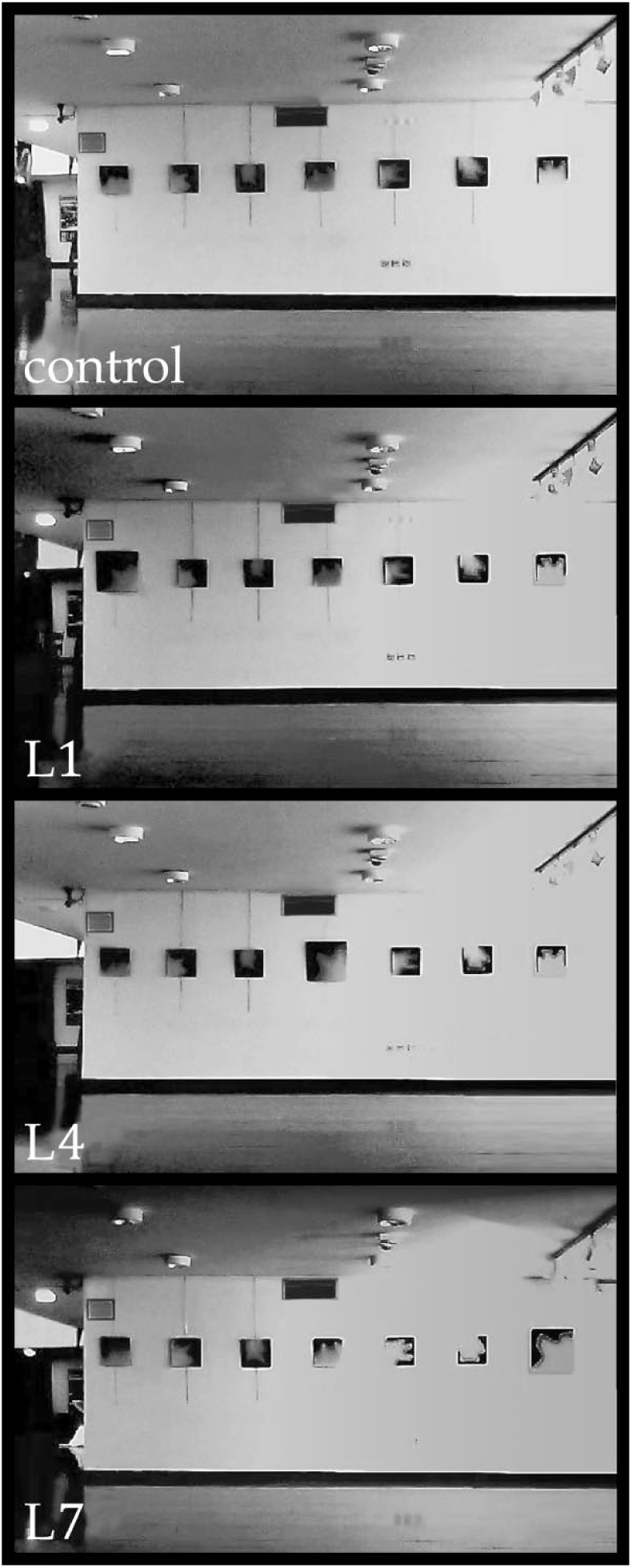
Snapshots from the four conditions.
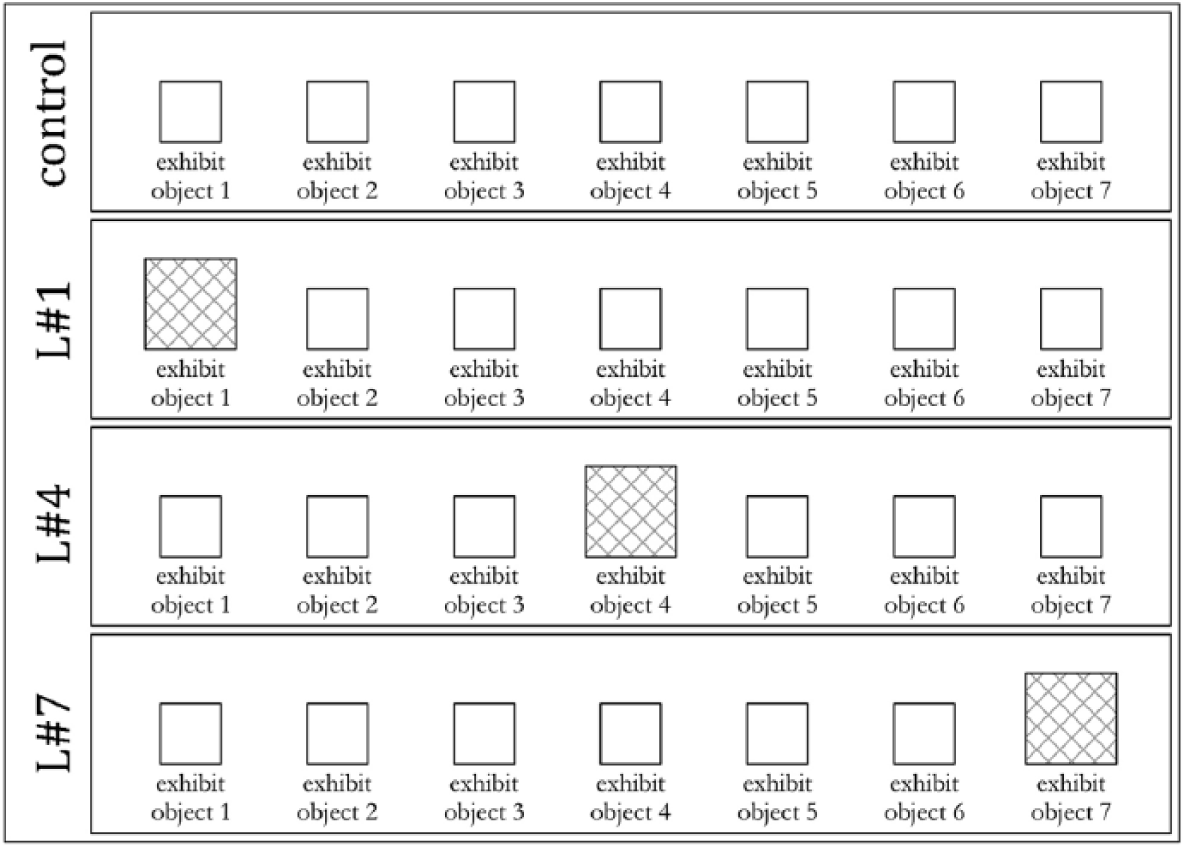
Chart illustrating the research design and the four conditions.
The unobtrusive observation consisted of recording participant visits using a webcam connected to a laptop computer. At the beginning of the exhibition, visitors were informed by a notice on the wall that the exhibition was part of a scientific research project and that visits were being video-recorded. The recordings were used to collect timing data for each exhibit object in each condition. We moved on to the next condition as soon as we reached a sample of 30 participants per condition with a balanced number of women and men. In addition, we ensured that each participant visited only one condition by including a question in the questionnaire that asked whether they were seeing these exhibit objects for the first time.
After viewing the exhibit objects, the participants voluntarily completed a questionnaire at a table provided next to the exhibit objects. The questionnaire consisted of two sections. In the first section, we collected demographic and personal background information. In the second section, the participants were asked to rate the individual exhibit objects and the exhibition as a whole, in terms of how interested they were in them, using a 7-point rating scale (1 = not interested at all, 7 = very interested), as well as an open-ended section for verbal comments.
Results
Analysis of the Timing Data
We analyzed the videos to obtain the viewing durations for each exhibit object in each condition. Then, we converted the timing data into attracting power (AP) and average holding time (AHT) values. AP represents the percentage of visitors who stop at a particular exhibit object, while AHT refers to the mean time spent at a particular exhibit object (whenever a participant skipped an exhibit object, the viewing duration was counted as zero, and included in the calculation of AHTs). Below, we first report the results of analyses conducted to test our main hypotheses involving AP and AHT, and then consider overall attention differences between the experimental and control conditions.
Trends observed in AP values
Whenever a participant viewed an exhibit object for 2 s or more without moving on to the next object, a stop was recorded in the observation sheet as in Serrell (1997). As shown in Figure 5, in general, a gradual decrease can be observed in the APs of the exhibit objects toward the end of the exhibition in each experimental condition (Hypothesis 1). Separate z-tests for two proportions indicated that the AP values for the first exhibit objects were significantly greater than those for the last objects, as shown in Table 1. In a similar vein, overall mean AP value calculated for the earlier three objects across all conditions (78%) exceeded the level for the later three objects across all conditions (51%, p < .05), shown in Figure 5.
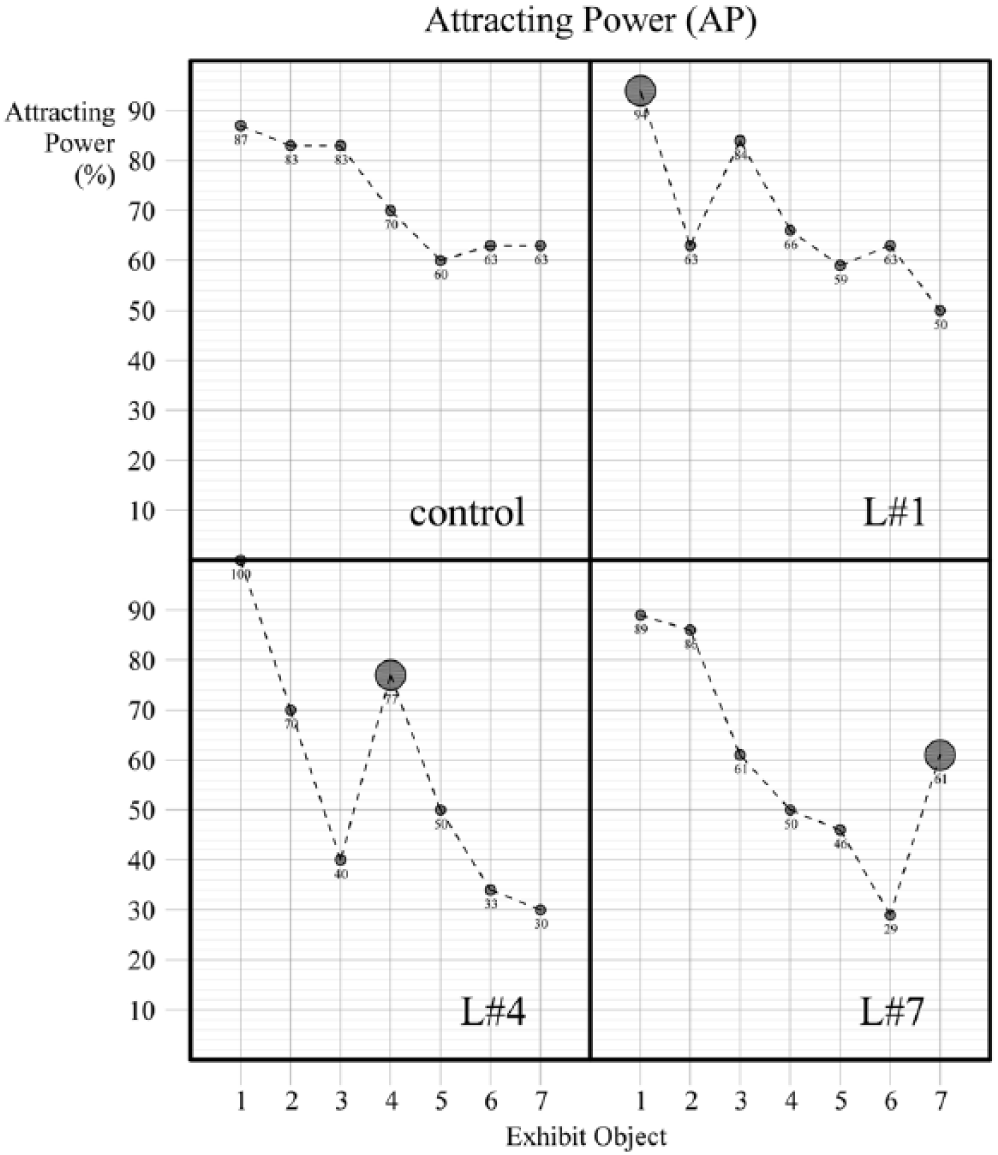
AP values of the exhibit objects in four conditions.
Differences Between the First and the Last EO in Each Condition in Terms of AP.
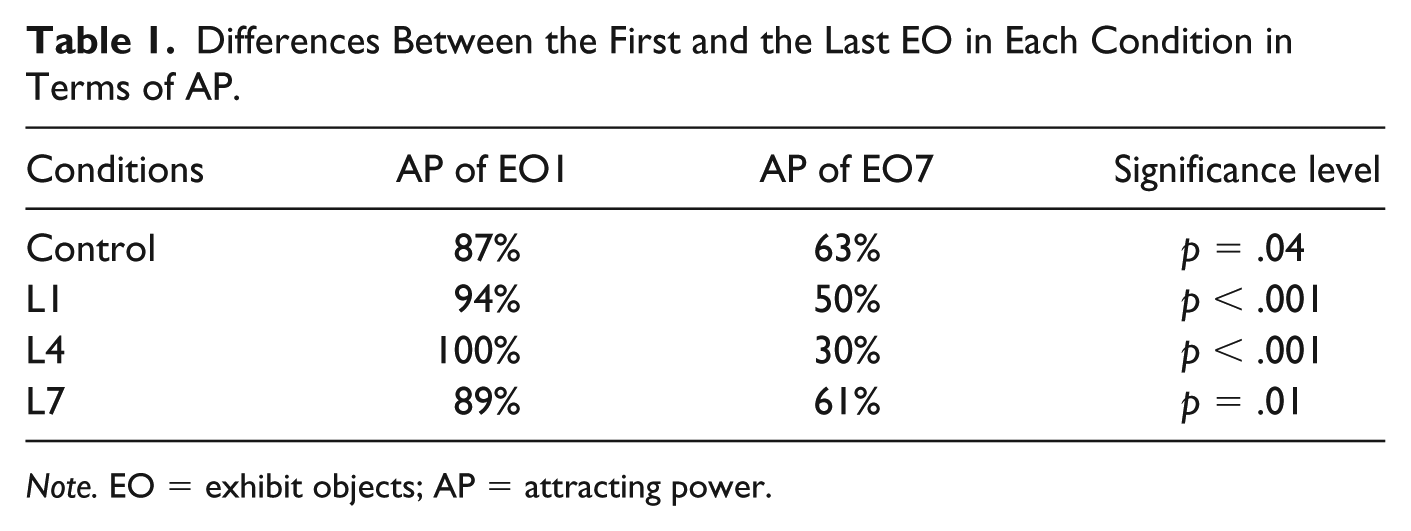
Note. EO = exhibit objects; AP = attracting power.
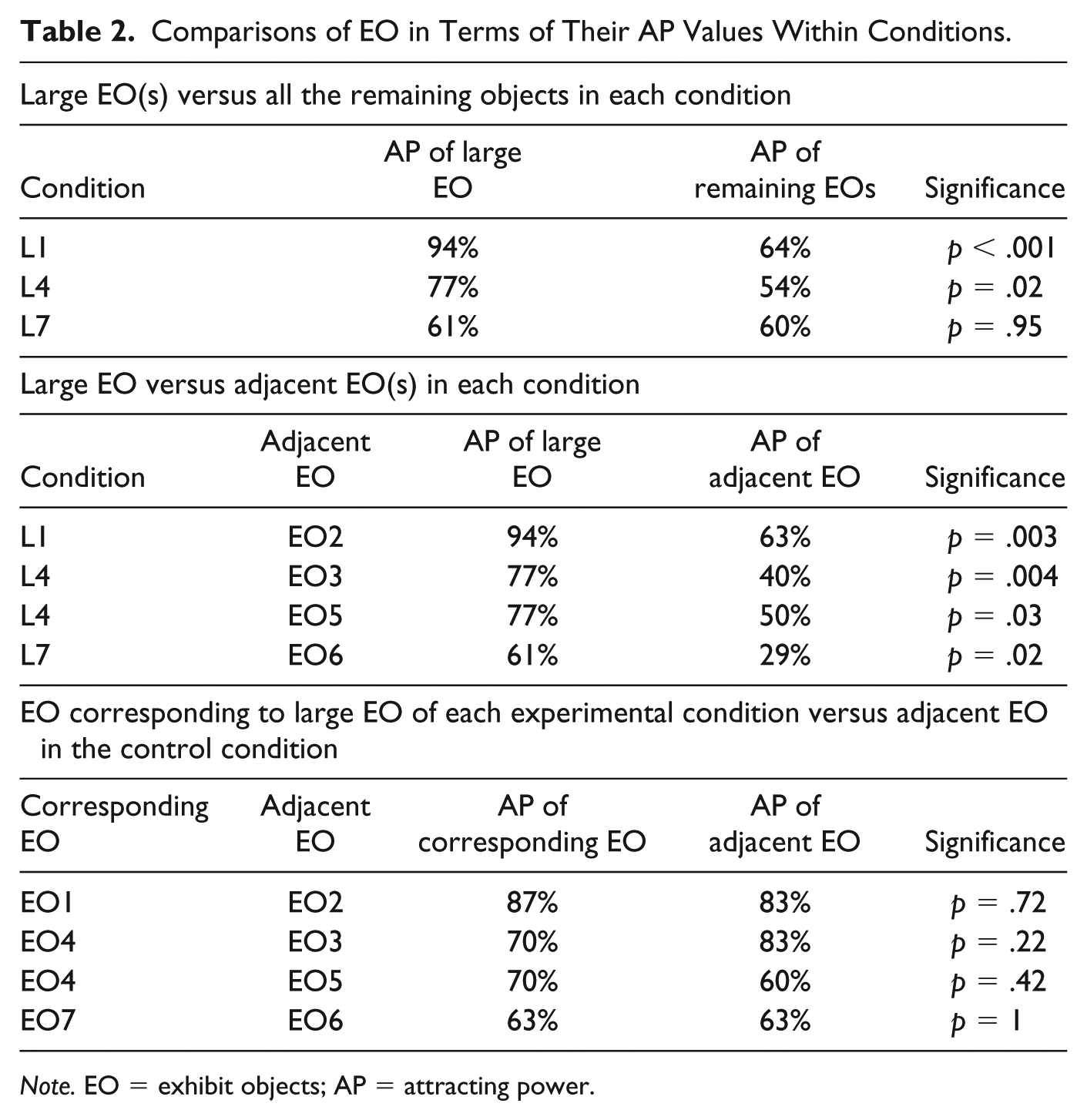
These gradual trends of decreasing values were transiently interrupted in the conditions that had a larger exhibit object in the set (Hypothesis 2). A z-test for two proportions indicated that the AP value of the three large objects (78%) was significantly greater relative to the overall AP value of the 18 small objects (59%, p < .001) in the three experimental conditions. On the contrary, considering the experimental conditions separately, we found that the AP values of the larger objects exceeded the levels of the remaining six objects in L1 and L4, but not in L7, in which the larger object appeared last, as shown in Table 2.
Comparisons of EO in Terms of Their AP Values Within Conditions.
Note. EO = exhibit objects; AP = attracting power.
As shown in Table 2, the AP values of the larger objects (i.e., Exhibit Object 1 in L1, Exhibit Object 4 in L4, and Exhibit Object 7 in L7) were significantly greater than those of the adjacent objects (Hypothesis 3). Repeating the same test for the control condition revealed no significant differences between the AP values of the exhibit objects corresponding to the larger objects in L1, L4, and L7, and the objects adjacent to them (see Table 2). Further supporting our third hypothesis, we found that the overall AP of the small objects adjacent to the larger objects in all three experimental conditions (i.e., Exhibit Object 2 in L1, Exhibit Objects 3 and 5 in L4, and Exhibit Object 6 in L7; 46%) was significantly lower than both the overall AP of the corresponding objects in the control condition (i.e., Exhibit Objects 2, 3, 5, and 6 in the control condition; 73%, p < .001) and the overall AP of the other small objects that are not adjacent to the larger objects in all three experimental conditions (63%, p < .001).
Trends observed in AHT values
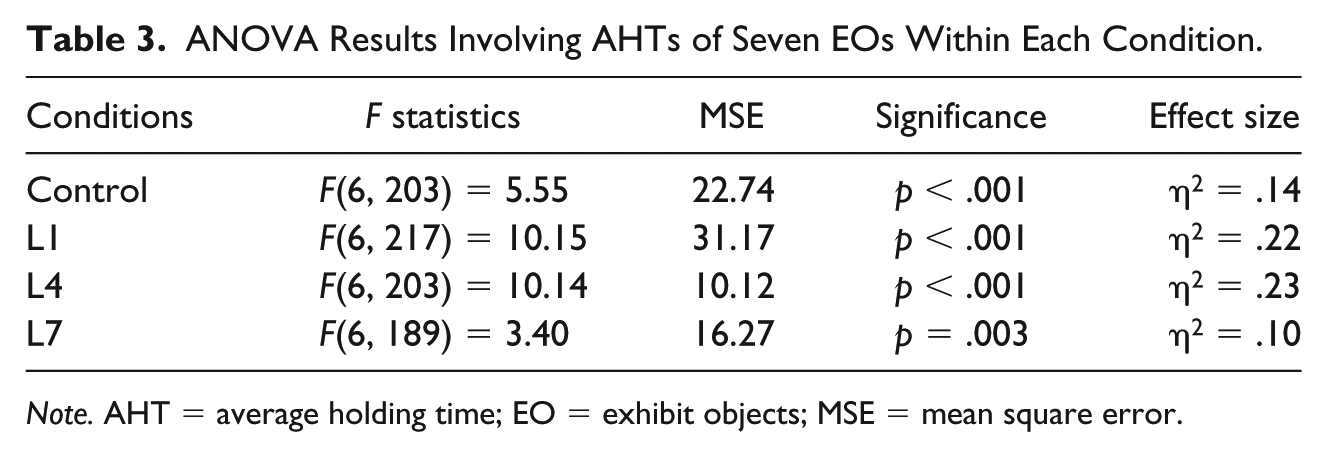
As shown in Figure 6, the trends observed in AHT values within and between experimental conditions seemed to be similar to those in APs. Separate one-way ANOVAs conducted to test the significance of the differences between individual exhibit objects in terms of their AHTs for each condition yielded significant results, as shown in Table 3. As expected (Hypothesis 1), AHTs gradually decreased toward the end of the exhibition. Follow-up Scheffé tests indicated that the time spent at Exhibit Object 1 was significantly greater than the time spent at Exhibit Objects 5 (p = .002), 6 (p = .008), and 7 (p < .001) in the control condition; all the other six objects in L1 (p < .001 for all); Exhibit Objects 3 (p < .001), 5 (p = .003), 6 (p < .001), and 7 (p < .001) in L4; and Exhibit Object 6 (p = .02) in L7 (all means and standard deviations are indicated in Figure 6). Furthermore, an independent-samples t test conducted to compare the mean times spent at the first three objects (M = 5.82, SD = 5.97) with the last three objects (M = 3.19, SD = 3.43) across four conditions also revealed a significant difference, t (573) = 7.25, p < .001, d = 0.54. Degrees of freedom were adjusted from 718 to 573 as Levene’s test indicated unequal variances, F(1, 718) = 31.70, p < .001.
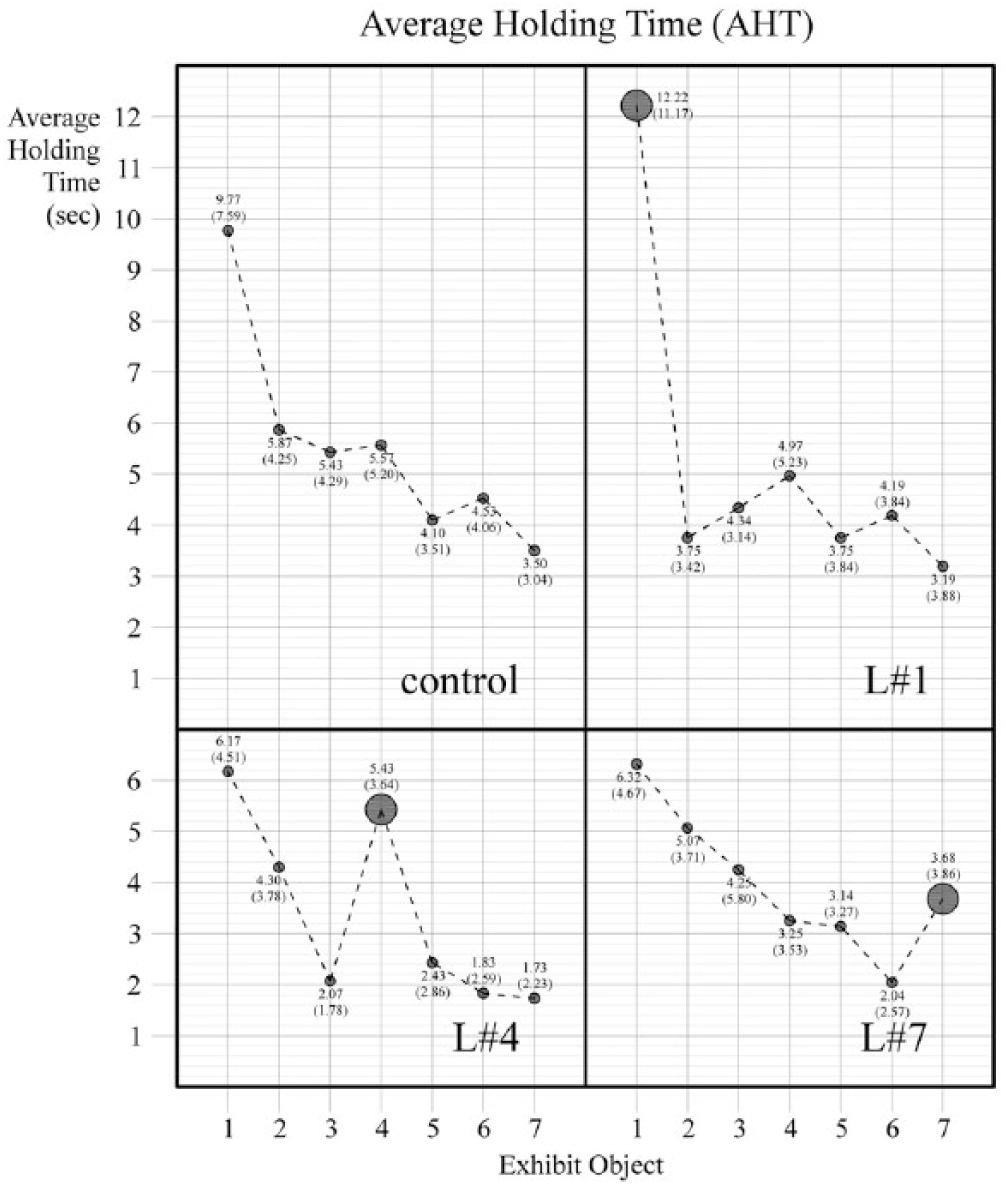
AHT values of the exhibit objects in the four experimental conditions.
ANOVA Results Involving AHTs of Seven EOs Within Each Condition.
Note. AHT = average holding time; EO = exhibit objects; MSE = mean square error.
An independent-samples t test, conducted to test Hypothesis 2, indicated that the mean AHT value of the three larger objects (M = 7.30, SD = 8.14) was significantly greater than the mean AHT value of the 18 small objects (M = 3.71, SD = 3.90) in the three experimental conditions, t(96) = 4.10, p < .001, d = .56. As Levene’s test indicated unequal variances, F(1, 628) = 40.23, p < .001, degrees of freedom were adjusted from 628 to 96.
Next, we conducted a group of analyses to test Hypothesis 3. Through separate independent-samples t tests, we found that the mean time spent at the four small objects adjacent to the larger ones (M = 2.60, SD = 2.80) was significantly less than
the mean time spent at the larger objects (M = 7.30, SD = 8.14) across the experimental conditions, t(105) = 5.25, p < .001, d = .77; note, first, that Levene’s test indicated unequal variances, F(1, 208) = 30.94, p < .001, so degrees of freedom were adjusted from 208 to 105, and, second, that a similar test conducted for the corresponding objects in the control condition yielded a nonsignificant result;
the mean time spent at the other small objects that were not adjacent to any larger objects in all three experimental conditions (M = 4.03, SD = 4.11), t(281) = 4.40, p < .001, d = 1.07; note that because Levene’s test indicated unequal variances, F(1, 538) = 16.45, p < .001, degrees of freedom were adjusted from 538 to 281;
the mean time spent at the corresponding objects in the control condition (M = 4.98, SD = 4.05), t(212) = 5.31, p < .001, d = 1.36; note that Levene’s test again indicated unequal variances, F(1, 238) = 25.90, p < .001; hence, degrees of freedom were adjusted from 238 to 212.
Overall attention differences between the experimental and control conditions
We analyzed our data to find out if the presence and the ordinal position of the larger object made any difference in terms of the overall attention to the exhibition. First, based on the values shown in Figure 5, we calculated the overall AP values for all three experimental conditions and for the control condition. A z-test for two proportions based on those values indicated that the mean AP of the three experimental conditions (62%) was significantly lower than that of the control condition (73%, z = 2.84, p = .005). Next, we repeated the same test for all four conditions separately, comparing the APs of L1 (68%), L4 (57%), and L7 (60%), with that of the control condition (73%). These analyses revealed that the APs of L4 (z = 3.38, p < .001) and L7 (z = 2.70, p = .007) were significantly lower than that for the control condition. Although L1, in which the large object appeared first, also seemed to have a lower overall AP relative to the control condition, the difference did not reach significance (z = 1.04, p = .30).
We also calculated the mean viewing times for each of the experimental and control conditions, based on the AHT values shown in Figure 6. First, through an independent-samples t test, we found that, in general, the mean time spent at the control condition (M = 5.54, SD = 5.07) was significantly greater than the mean time spent at the three experimental conditions altogether (M = 4.22, SD = 4.90), t(348) = 3.28, p = .001, d = .26. Levene’s test indicated unequal variances, F(1, 838) = 4.00, p = .05, so degrees of freedom were adjusted from 838 to 348. Next, we conducted a one-way ANOVA, which indicated that the mean differences between the four conditions were also significant, F(3, 836) = 8.78, mean square error (MSE) = 24.06, p < .001, η2 = .03. Follow-up analyses indicated that the participants spent significantly more time at the control condition (M = 5.54, SD = 5.07) than they did at L4 (M = 3.42, SD = 3.58, p < .001) and L7 (M = 3.96, SD = 4.18, p = .02), while the difference involving the mean AHT for the L1 condition (M = 5.20, SD = 6.23, p = .92) was not significant, in a similar vein with the AP findings noted above. Furthermore, we also found that the visitors spent significantly more time at L1 than they did at L4 (p = .003).
Trends observed in deviation scores
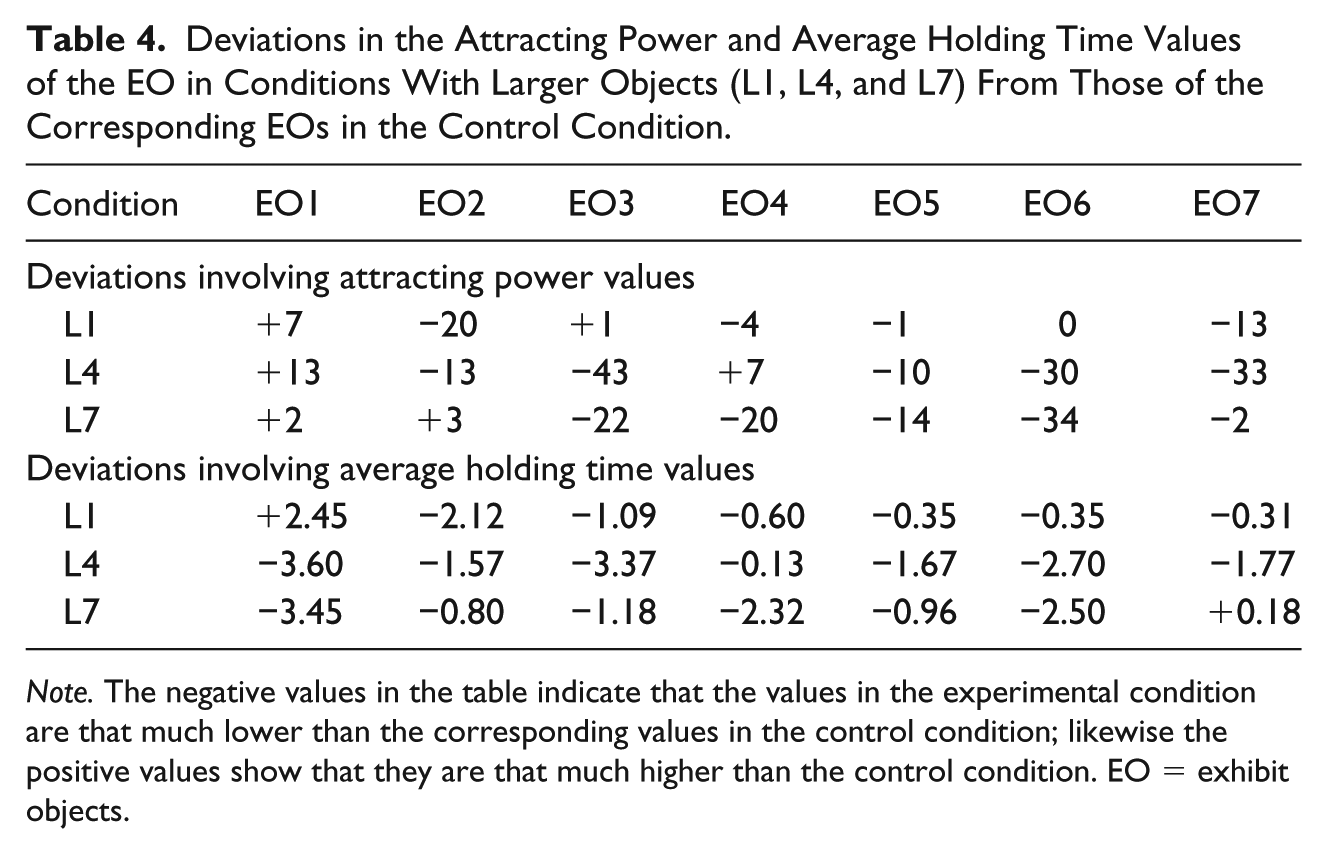
To further account for the confounding of size and ordinal position, we also calculated deviation scores, as suggested by an anonymous reviewer. That is, using the control data as baseline, which presumably reflects how attention would be affected when all objects are of similar size, we calculated deviations for each experimental condition from those starting points. The deviation scores involving AP and AHT for each of the exhibit objects in the three experimental conditions are reported in Table 4. Those scores provided additional support for our hypotheses by enabling an overall visualization of the effects described above. Scores shown in Table 4 demonstrate a suppression trend in overall attention levels observed in the experimental conditions, which seems to be stronger for L4 and L7. Specifically, the objects in the control condition not only seem to attract more attention (in more than 70% of the cases) but also to hold it longer (in approximately 90% of the cases) than the experimental conditions. Interestingly, the only two experimental objects that did not perform below the corresponding control objects, in terms of viewing time, were the large objects appearing first and last.
Deviations in the Attracting Power and Average Holding Time Values of the EO in Conditions With Larger Objects (L1, L4, and L7) From Those of the Corresponding EOs in the Control Condition.
Note. The negative values in the table indicate that the values in the experimental condition are that much lower than the corresponding values in the control condition; likewise the positive values show that they are that much higher than the control condition. EO = exhibit objects.
Regarding the AP decrements involving comparisons of pre- and postlarge objects, as can be seen in Table 4, in L4, the AP decrement (revealed in deviation scores) to Exhibit Object 3 ([+7] – [–43] = 50) was much larger than that to Exhibit Object 5 ([+7] – [–10] = 17); z = 5.29, p < .001. A similar trend could also be observed when the decrease of the mean AP at the prelarge object in L4 (50) and L7 (32) is compared with the decrease at the postlarge object in L1 (27) and L4 (17), that is, the means of 41 and 22, respectively (z = 2.89, p = .004). However, due to the confounding effects resulting from large ordinal position differences (i.e., first and last) involving conditions L1 and L7, comparisons across those two conditions should be viewed with caution. As for AHT, a similar but nonsignificant trend was observed for the viewing time decrement involving the prelarge (M = 3.37, SD = 2.89) and the postlarge object (M = 3.00, SD = 3.98) comparisons in L4; t(29) = .66, p = .52, d = .12. Thus, AP comparisons reflected by deviation scores suggested a greater impact of distraction for the prelarge object than the postlarge object, which did not seem to be significant for AHT data.
Interest Levels
Means and standard deviations involving interest ratings are presented in Figure 7. Using one-way ANOVAs, we did not find significant differences between the interest ratings of exhibit objects in any of the four conditions. Consistent with the ANOVA results, planned comparisons to test our first hypothesis also yielded nonsignificant results.

Average interest ratings of the exhibit objects in the four conditions.
Regarding the salience effect of size on the interest levels (Hypothesis 2), we found that the mean interest rating of the three larger objects (M = 4.52, SD = 1.86) was significantly greater than that of the 18 small objects (M = 3.93, SD = 1.75) across the three experimental conditions, t(628) = 2.96, p = .003, d = .03, hence supporting our second hypothesis.
Analyses conducted to explore the suppression effect of adjacency to the larger object on interest ratings (Hypothesis 3) indicated that the mean interest rating of the adjacent objects in the three experimental conditions (M = 3.88, SD = 1.70) was significantly lower than both the mean of the three larger objects, M = 4.52, SD = 1.86, t(208) = 2.59, p = .01, d = .04, and the mean of the objects corresponding to the adjacent ones in the control condition, M = 4.38, SD = 1.79, t(238) = 2.13, p = .03, d = .29, but did not differ from the mean interest rating of the remaining small objects that were not adjacent to the larger objects (M = 3.94, SD = 1.76) across the three experimental conditions, t(538) = 3.16, p = .75, d < .01. Thus, analyses involving interest ratings provided partial support for Hypothesis 3.
In addition, another independent-samples t test was conducted to explore whether the generalized suppression effect noted in the timing data would also be observed in the interest data. Results indicate that the mean interest ratings reported for the control condition (M = 4.58, SD = 1.74) were significantly greater than the mean interest ratings reported for the three experimental conditions altogether (M = 4.01, SD = 1.77), t(838) = 4.04, p < .001, d = .32, in congruence with the finding for attention.
Discussion
The results provided supportive evidence for our hypotheses. Regarding our first hypothesis, analyses of the timing data, represented as AP and AHT, indicated that the first exhibit objects were likely to attract and hold more attention than the last ones in all the conditions. Comparisons between the APs and AHTs of the first three and the last three exhibit objects also yielded similar results. Although such attention decrements have been interpreted as arising either from fatigue or object satiation, in the present study, fatigue may be a less likely cause, as “there is limited physical exertion” needed (Bitgood, 2015, p. 28), and none of the participants viewed the exhibition for more than 3 min (Bitgood et al., 2013). On the contrary, object satiation appears to be a likely cause as the exhibit involved repetitive exposure to similar objects (Melton, 1935). Also, exit attraction might be responsible for the downtrend (Melton, 1935, 1972), which functions not only as visitors approach the exit but also when they get further away from it. In the latter case, in line with the general value principle (Bitgood, 2006), the value of viewing the objects toward the end of the sequence seems to compete with the cost of moving away from the exit (that also functions as the entrance in our experiment), which may be even stronger than approaching the exit (Melton, 1935) because each step taken away from the exit means another step is required to get back to it. Hence, visitors seem less willing to spare time and energy as they proceed toward the end of their visits, in congruity with the general value principle, particularly if it implies getting further away from the exit as in the present study.
Regardless of the reason, the steadiest decrease in viewing durations occurred in the control condition, in which there was no larger exhibit object to affect attention levels. Therefore, the gradual decline in attention due to object satiation or exit attraction was not interrupted by “powerful sensory attractors such as large objects, loud noises or movement” (Bitgood, 2014, p. 6). Hence, the effects of object satiation and exit attraction were most clearly apparent in the control condition consisting of same-size objects.
Another important finding involved the instant increase in attention regarding the large exhibit object in each experimental condition. As expected, both the AP and the AHT values involving the larger objects were significantly greater than the ones for the small objects (except when the large object appeared last, as is considered later on). This finding, supporting our second hypothesis about object salience, is congruous with the results of previous research (i.e., Bitgood, 2014; Bitgood & Patterson, 1987; Bitgood et al., 1988; Bitgood et al., 1986; Donald, 1991; Marcellini & Jenssen, 1988). It is also consistent with the Gestalt principle of similarity, which states that visitors may perceive objects that share certain attributes (such as shape, size, or color) as groups (Arnheim, 1974); therefore, the object that does not belong to that group may be likely to stand out. Also connected to the principle of similarity is the focal points principle, which states that attention will be drawn toward the contrasting item (i.e., the large one, in the present study).
The impact of contrast or visual competition was apparent mostly in the negative effect of the larger exhibit object on the amount of attention garnered by the adjacent object(s). More specifically, the small exhibit objects adjacent to the larger ones attracted significantly less attention relative to (a) the larger objects, (b) other small objects that were not adjacent to the larger ones, and (c) objects in the control condition corresponding to the objects adjacent to the larger ones in the three experimental conditions, hence suggesting that the presence of the large object could have a negative influence on the adjacent objects’ capability of attracting and holding attention. Thus, our third hypothesis that larger exhibit objects might overshadow small objects displayed in an adjacent location was supported. Also regarding this issue, an interesting trend was observed: the overshadowing effect in terms of AP appeared to be stronger for the adjacent object positioned before rather than after the salient object. This finding, which was not predicted, suggests that the visual competition with the salient object seems to have a stronger negative influence on the attention-attracting capability of the object positioned before the larger one. However, this trend was not significant for the AHT data.
Our results also pointed to the importance of considering the interrelationships between ordinal position, size, and proximity effects. That is, although L1, L4, and L7 all consisted of one large and six small exhibit objects, they yielded distinct schemes of attention distribution depending on the larger object’s position within the set. For example, when the larger object was also the first object, the above-noted salience effect seemed to be enhanced by the effects of object satiation and exit attraction, favoring the first appearing objects. In contrast, when the larger object appeared last (i.e., L7), the salience effect seemed to be overshadowed by the effects of object satiation and exit attraction such that the difference between the amounts of attention received by the larger object and the other objects did not reach significance. In this latter condition (in which the larger object appeared last), only the time spent at the first object seemed to be significantly different from (greater than) the time spent at Object 6, which was adjacent to the larger object appearing last. On the contrary, when the larger object appeared in the middle (the fourth object in L4), it seemed to attract more attention only relative to the adjacent objects and those closer to the end.
In sum, significant differences were obtained between AP and AHT values of the large objects and those of the remaining objects in L1 and L4 (favoring the large objects appearing first and in the middle, respectively), whereas the differences did not reach significance when the large object appeared last, as in L7. Thus, although we found support for the attention-attracting and -holding capability of object size, our findings also suggested that the effect of object size may be reduced or canceled by the particular ordinal position of the objects (e.g., when object satiation or exit attraction may be involved). Our results also suggest that the influence of object satiation or exit attraction may be stronger than the effect of object size, as the exhibit object that attracted the highest amount of attention in all the experimental conditions was not the larger one but the first appearing exhibit object.
Finally, regarding the specific and general effects of the salient object, our findings pointed to an interesting dilemma: Despite the significantly superior attention-attracting capability of the larger object, its presence seemed to have a negative effect on the overall amount of attention paid to the exhibition as a whole. This effect was evident when the AP and AHT values in the control condition were compared with those in the three experimental conditions. Although we have observed the steadiest attention decline in the control condition, the overall level of visitor attention in the control condition exceeded the overall attention level for the experimental conditions involving larger objects. This finding seems to suggest that one needs to be cautious when designing heterogeneous exhibits to avoid decreases in visitor attention (Bitgood, 2002), as the increased amount of attention attracted by the larger object may fail to compensate for the decreased attention to the smaller objects when compared with the control condition. Although the present results should be replicated to find out whether this finding is an exceptional case, a general suppression effect seems to be associated with the presence of a more salient exhibit object. In such a case, the salient object may be likely to appear as the figure and attract more attention, while the smaller objects may tend to recede to the background. The implications of this finding may need to be carefully considered by those designing exhibitions.
We should also note that, although the above-mentioned salience and adjacency effects occurring with the presence of the larger object were also revealed in the interest data, other observational trends consistently detected in the timing data (e.g., attention declines toward the end of the visits, decreases at adjacent objects) did not seem to appear in the interest levels reported by the participants. Thus, although attention and interest were addressed as equivalent concepts in earlier studies (e.g., Melton, 1935; Robinson, 1928), our results suggest that attention levels should not be considered as directly reflecting interest ratings, hence supporting Bitgood’s (2013) outlook on the issue, as noted in the introduction. In this regard, one also needs to be cautioned that reporting interest levels in the questionnaire did not involve an immediate behavioral reaction to the objects but an evaluative response as a consequence of the visit.
Overall, our main findings support previous research in the field and present new perspectives on the spatial layout and relative salience levels of objects on display. We expect that these research results will contribute to advancing the understanding of visitor attention in museum settings.
Limitations and Conclusions
In the present study, we investigated how the distribution of visitor attention in exhibitions would be influenced by the exhibit objects’ ordinal position, relative size, and proximity to larger objects, by means of a field experiment. First, we found that exhibit object size seems to significantly influence the distribution of visitor attention to objects exhibited in the same space. Second, the introduction of a larger exhibit object into a set of smaller objects seems to create a suppression effect on attention to smaller objects, as well as suppress the amount of attention to the overall exhibition (relative to a control condition). Adjacency to the larger object seems to increase the magnitude of the suppression effect. Our findings also suggested that the sequential suppression effect tends to be stronger for the object preceding the large object than the one following it. We could explore this unpredicted effect mainly in our second experimental condition in which the large object appeared in the middle, but not in the other conditions where the large object was positioned first or last. Hence, as was suggested by an anonymous reviewer, future researchers may consider placing large or salient objects not at the edges but in between non-salient objects (e.g., in positions two, four, and six rather than one, four, and seven, as in the present study). The first and last positions, though interesting, may have other characteristics beyond simple ordinal effects, such as competition with surrounding objects that are not part of the exhibit. We do not think that this was a problem in the present study because, as noted, there were no other objects in the gallery we used. Still, placing the large objects in the second and sixth positions would have provided additional opportunities to explore the ordinal proximity effects and the pre- and postlarge object effects. Regarding ordinal position, we can also conclude that our study supports previous research that phenomena such as object satiation and exit attraction affect attention distribution (Bitgood, 2002; Bitgood & Patterson, 1987; Melton, 1935; Robinson, 1928); hence, we suggest that these factors should be considered together with layout when designing and evaluating exhibitions (Bitgood, 2006; Melton, 1935, 1972).
As is typical of experimental studies, we used only two sizes of objects while investigating the effect of object size on the distribution of visitor attention. This provided us the control that is necessary to distinguish the effect of our independent variables. Further research would be needed to explore the generalizability of our findings to a wider range of objects. Considering the Gestalt principle of similarity explained above, the study could also be repeated by introducing a smaller exhibit object in the set instead of a larger one. In this way, one could test whether the distribution of visitor attention was indeed mainly affected by a larger size and not just object distinctiveness or novelty (Screven, 1986). It should also be noted that we did not use interpretive texts in the exhibit for control purposes. However, in view of the observation that most museum exhibits tend to be accompanied by some type of interpretation, future researchers may also need to consider the impact of the content and placement of those interpretive labels to improve the external validity of the present findings.
In addition, as, to our knowledge, this is the first study that considers effects on salience levels of exhibit objects in experimental and control conditions, replicating the study by employing a larger and more diverse sample would be useful in determining the generalizability of the present findings. Moreover, focusing on the other three exhibit attributes emphasized in previous research (three-dimensionality, sense-modality, and motion) as well as some additional variables such as color, shape, texture, opacity, illumination levels, or spatial patterns would broaden the subject in terms of object salience parameters. The symbolic meaning of a venue, artist, or artwork could also affect salience levels, which can be another issue to be investigated in future research.
Finally, the experiment was conducted in a single exhibition venue, the characteristics of which enabled us to control for possible confounding variables. Repeating the experiment in another venue would enrich the variety of visitors, and hence the generalizability of the results. In addition, it would be possible to investigate how the present trends may be influenced by visual and auditory contact or conversational interaction with others (Heath, Luff, vom Lehn, Hindmarsh, & Cleverly, 2002; Serrell, 2002; vom Lehn, 2010; vom Lehn, Heath, & Hindmarsh, 2001).
In spite of the above-noted limitations, we think that our study has a number of strengths. To start with, it supports previous research that investigated object salience and visitor attention in exhibition environments by providing data from a Turkish sample, which is less often studied. Also, it approached the subject from an experimental perspective, which enabled the collection of quantitative field data under fairly controlled conditions to test our hypotheses. Moreover, although the attributes that make an exhibit object more salient were already addressed in several studies in the field (e.g., Bitgood & Patterson, 1987; Bitgood et al., 1988; Donald, 1991; Melton, 1972; Peart, 1984), the sequential and generalized competition effects on the other objects exhibited in the same space have not been examined previously. To our knowledge, the present study was the first to demonstrate the negative influence of a large exhibit object’s introduction into a set of smaller objects on the overall attention allocated to an exhibition.
On the whole, this research has identified significant aspects of exhibit object characteristics and placement that influence visitor attraction and holding time. Although a countless number of interconnected factors influence visitor attention in exhibition environments, the findings of the present study are expected to form a basis for predicting the isolated effects of ordinal position, exhibit object size, and proximity to salient objects on visitor attention, thus contributing to more effective exhibition planning and design.
Footnotes
Acknowledgements
This study was conducted as part of a doctoral thesis at Bilkent University, and was kindly supported by the Municipality of Çankaya’s Contemporary Arts Center, which provided a gallery and relevant equipment for the field research. The authors are grateful to Rana Nelson for proofreading and helpful comments on an earlier draft of the manuscript. They also wish to thank their anonymous reviewers for their generous efforts to improve the clarity and presentation of their study.
Declaration of Conflicting Interests
The author(s) declared no potential conflicts of interest with respect to the research, authorship, and/or publication of this article.
Funding
The author(s) received no financial support for the research, authorship, and/or publication of this article.