




Abstract
Knowledge of the relationships among psychological constructs such as values and motivations that influence proenvironmental behavior provides public land management agencies with guidance on how to minimize stakeholder impacts on the environment. A rich body of research has demonstrated that values form a tripartite structure underlying environmental concern, encompassing biospheric, egoistic, and altruistic values; however, recent work has suggested hedonic values are also an instrumental basis for environmental concern. Few studies have tested this proposition. We contend that hedonic values are instrumental in explaining the psychological processes that gird individual decisions, particularly in nature-based settings where stakeholder decisions are compelled by leisure pursuits. Our results indicate that place-based motivations, particularly escape from the pressures of everyday life, can help close the prominent value–action gap and explain why outdoor recreationists engage in minimum-impact activities specified in the U.S. Leave No Trace educational outreach program.
Introduction
The value concept lies at the center of behavior change science due to its assumed role as a foundation for other psychological processes that fall along a cognitive heirarchy of beliefs and moral normative concerns (Dietz, Fitzgerald, & Shwom, 2005; Gifford & Nilsson, 2014; Jones, Shaw, Ross, Witt, & Pinner, 2016; Karp, 1996; Poortinga, Steg, & Vlek, 2004; van Riper & Kyle, 2014; Wynveen, Wynveen, & Sutton, 2015). Building on Schwartz (1994) and Rokeach (1973), values are conceptualized as guiding principles and trans-situational goals that influence individual decisions. In this vein, there is general consensus that values are a multi-dimensional construct. Specifically, Stern, Dietz, Abel, Guagnano, and Kalof (1999) developed a tripartite framework encompassing Egoistic, Altruistic, and Biospheric dimensions of the values basis of environmental concern. This approach to understanding the influence of values on environmentalism has been adopted in a growing body of research guided by the Value-Belief-Norm (VBN) Theory (Stern, 2000; Stern et al., 1999). However, recent work by Steg, Perlaviciute, van der Werff, and Lurvink (2014) has drawn on goal-framing theory to suggest Hedonic values are also instrumental in shaping a range of psychological processes that predict proenvironmental behavior (Higgins, 2015). Despite this advancement, empirical research has only recently begun to test Steg et al.’s proposition, and more expliclitly link it to research rooted in Schwartz’ value theory. Given the importance of values for understanding the fundamental basis of behavior, there is a substantive need to investigate how these four value dimensions are structured and related to other psychological processes.
There is indirect evidence of the relationship between value orientations and specific motivations that compel proenvironmental activity (Steg et al., 2014). However, uncertainty remains about the conceptual distinctions and, at times, even circularity between these two constructs. For example, previous research has suggested that values have motivational components (Rokeach, 1973), express motivational concern (Jolibert & Baumgartner, 1997; Schwartz & Bilsky, 1994), and are even interchangeable (Maslow, Frager, & Fadiman, 1970). Scholars have also argued for alignment between the enduring end states (i.e., values) and means (i.e., motivations) of goal achievement (Bengston, Asah, & Butler, 2011; De Groot & Steg, 2010; Woosnam, McElroy, & Van Winkle, 2009). Despite evidence of their complementarity, little attention has been directed to the empirical properties of the value–motivation relationship (Howell & Allen, 2017). Even fewer studies have considered how these constructs work in tandem to influence behavior and account for the reasons why individuals make decisions with respect to natural resources (Gifford & Nilsson, 2014).
This article advances previous research in three respects. First, we provide conceptual and empirical clarity on the relationship between values and motivations by testing the proposition that four dimensions of value are antecedents to six dimensions of place-based motivations that represented survey respondents’ evaluations of leisure pursuits. These motives were predicted to influence the intended adoption of behaviors specified in the U.S. Leave No Trace (LNT) educational program. Second, we empirically examined Hedonic values to extend a growing body of research focused on the value basis of environmental concern. Given that fostering responsible use of the environment is central to the mission of public land management agencies in the United States, greater knowledge of the psychological processes that shape pro-environmental behavior (PEB) will support decision making while advancing theoretical propositions about the stable and fundamental basis of human decisions (Lawhon et al., 2013; Marion & Reid, 2001; Vagias, Powell, Moore, & Wright, 2014). Finally, this article addresses a long-standing concern in environmental and social psychological research centered on closing the value–action gap that occurs when people who hold proenvironmental orientations abstain from environmentally friendly activities (Kollmuss & Agyeman, 2002; Schultz, 2011). We contend that one avenue for closing this gap is to elucidate how place-based motivations serve as a mediator of the value–behavior relationship.
Literature Review
Behavioral Intentions in Public Land Management Contexts
Human behavior is influenced by a range of antecedents that span personal and social domains (Gifford & Nilsson, 2014; Osbaldiston & Schott, 2012). Previous research has converged on the need for scholars to direct attention to the moderating and mediating effects of these correlates of behavior (Bamberg & Möser, 2007; Gifford, 2014; Hines, Hungerford, & Tomera, 1987; Raymond, Brown, & Robinson, 2011; Turaga, Howarth, & Borsuk, 2010). This guidance from past work is particularly relevant for the study of behavioral intentions, which are the most proximal predictor of behavior (Ajzen, 1985; Armitage & Conner, 2001; Bamberg & Möser, 2007; Fielding, McDonald, & Louis, 2008).
Measurement of reported and intended PEB has varied across contexts and been informed by numerous frameworks such as the VBN Theory (Stern et al., 1999), Theory of Planned Behavior (TPB) (Ajzen & Driver, 1991), and the Self-Determination Theory (Deci & Ryan, 1985) that range in assumptions from moral normative concerns to rationale choice (Kaiser, Hubner, & Bogner, 2005; Turaga et al., 2010). This line of research has spawned a number of behavioral typologies such as Stern’s (2000) categories of public (e.g., writing letters to officials), private (e.g., composting at home), organizational (e.g., recycling in schools), and activist (e.g., voting) actions that benefit the environment. To measure intentions tied to PEB, scales have been developed to encompass more place-based concerns using summative scores in contexts such as parks and protected areas (Halpenny, 2010; van Riper & Kyle, 2014) and relied on multi-dimensional measures that reflect the heterogeneous structure of actions of ecological and social significance (Landon, Woosnam, & Boley, 2018; Larson, Stedman, Cooper, & Decker, 2015). In response to this body of work, there is a growing need to develop more comprehensive behavioral metrics that resonate with survey respondents, align with theory, and remain relevant to decision makers that aim to influence how stakeholders such as outdoor recreationists perceive and interact with the environment.
In the context of U.S. public land management, agencies are largely focused on minimizing behavior that leads to human impacts through education, management regulations, and technology (Heberlein, 2012). In particular, the U.S. federal agencies such as the Forest Service, Bureau of Land Management, Fish and Wildlife Service, and National Park Service encourage people to adhere to a set of principles specified in the LNT educational outreach campaign (Manning, 2011; Marion, 2014) when engaging with places that are managed by these agencies. This framework is characterized by seven principles that were designed to more effectively communicate how people in the outdoors can minimize their impacts on natural and cultural resources: (a) travel and camp on durable surfaces, (b) plan ahead and prepare, (c) be considerate of other visitors, (d) respect wildlife, (e) minimize campfire impacts, (f) leave what you find, and (g) dispose of waste properly. Given the potential for outdoor recreation participation to influence PEB (Larson, Whiting, & Green, 2011), the LNT program provides a basis for communicating about how best to minimize negative environmental impacts stemming from human activities (Vagias et al., 2014). Moreover, research into the factors that predict intentions to comply with these principles can be used to strengthen the theoretical basis of LNT, as well as inform the development of persuasion and social influence strategies through environmental education (Allen, 2016; Guo, Smith, Moore, & Schultz, 2017).
The Value Basis of Human Behavior
Values are underlying psychological orientations that shape behavior and define how people relate to their environments. In support of this conceptualization, a long-standing body of research has defined values as enduring, desirable beliefs that serve as guiding principles in life (Rokeach, 1973; Sagiv, Roccas, Cieciuch, & Schwartz, 2017; Schwartz, 1992). Values are relatively stable throughout an individual’s life stages and formed through fundamental processes such as acculturation and intergenerational transfers (Dietz et al., 2005; Inglehart, 1995). In this sense, values, in addition to multiple other social psychological processes such as identity, attitudes, and norms, create a proverbial compass that individuals rely on to navigate experience (De Groot & Steg, 2009; Hitlin, 2011; Schultz, 2001; Stern et al., 1999). The multi-dimensional structure of the value construct is particularly important to understand in conceptual and empirical terms, because it is comprised of varied but related facets that have differential effects on behavior (Manfredo et al., 2017). Consequently, the manner in which values shape other psychological processes often varies among individuals (Axelrod, 1994).
Previous research has indicated there are three value orientations that indirectly influence environmentally consequential decisions, including Egoistic (i.e., concerns for the self), Altruistic (i.e., concerns for other people), and Biospheric (i.e., concern for ecosystems) (Stern, 2000). These values align with two antipodes of the circumplex hypothesized by Schwartz (1994). On one hand, self-transcendence encompasses Biospheric and Altruistic values such as unity with nature and equality, respectively, which positively correlate with PEB (Pradhananga, Davenport, Fulton, Maruyama, & Current, 2017; van Riper & Kyle, 2014). On the other hand, the self-enhancement axis is related to Egoistic values such as achievement and power, which negatively correlate with proenvironmental outcomes (Hurst, Dittmar, Bond, & Kasser, 2013). Applied and theoretical research has demonstrated the utility of values as instruments for understanding and inducing behavior change in contexts pertaining to the environment such as sustainable energy use (Braito, Flint, Muhar, Penker, & Vogel, 2017; Perlaviciute & Steg, 2015), invasive species (Seekamp et al., 2016), and climate variability (Adger et al., 2009; Howell & Allen, 2017; Milfont, Sibley, & Duckitt, 2010).
As an extension to the tripartite value model, Steg et al. (2014) asserted that the self-enhancement motivational axis was comprised of both Egoistic and Hedonic values that place emphasis on private benefits and personal well-being. Drawing on goal-framing theory, Lindenberg and Steg (2013) argued that people who had relatively pronounced Hedonic values acted in accordance with their interests to derive short-term pleasure and gratification from an activity despite potential impacts on the environment. However, there is robust evidence that Hedonic values relate to the self-enhancement dimension of Schwartz’s circumplex as well as the openness to change motivational axis that emphasizes independent action, thought, and feeling, as well as readiness for new experience (Schwartz, 1994, 2012). Kollmuss and Agyeman (2002) reified the linkages between values and motivations by showing that motivations were the sum of multiple value dimensions, as well as reflections of the weighted importance of an orientation toward an attitude object. In line with this proposition, De Young (2000) argued that goal-directed behavior was driven by fundamental motives including self-interest and intrinsic satisfaction. Given the human desire for competence, belonging, and satisfaction, motivations for engaging in PEB may be influenced by hedonic value orientations, particularly for pleasure seeking desires that include enjoyment, escape, and leisure experience.
The Role of Motivations in Predicting Behavior
Motivations are a useful mechanism for explaining human behavior, and have been previously conceptualized in several ways (Deci & Ryan, 2000; Herzberg, 1966; Maslow, 1943; Vroom, 1982). Here, we follow Vroom’s (1982) and Lawler’s (1973) expectancy-valence theory of motivation, which was originally developed as an explanation of what motivated people to perform tasks in the workplace, and has since been adapted to understand motivation in a variety of contexts. This theory suggests that motivations arise from two expectancies associated with the performance of a behavior. Specifically, if individuals invest resources, their actions will either result in a valued outcome or the intensity of the motive will vary with the expected likelihood that their behavior yields benefits. In this sense, behavior is outcome-focused, and can be both volitional and utilitarian, as well as rooted in rational decisions (Kyle, Mowen, & Tarrant, 2004).
Much of the motivation research in the arena of the environmental social sciences and public land management has grown out of an approach introduced by Driver and Tocher (1970). These authors drew on expectancy-valence theory to develop a psychometric Recreation Experience Preference (REP) scale that measured “place-based motivations” for engagement in outdoor recreation activities (Driver & Bruns, 1999; Manfredo, Pierce, Vaske, & Whittaker, 2002). The REP scale conceptualized place-based motivations as the expected benefits individuals receive from engagement in recreation. As a testament to the validity and the reliability of the REP scale, Manfredo, Driver, and Tarrant (1996) conducted a meta-analysis of 36 studies that determined trip-specific motivations, activity-specific motivations (i.e., why people engage in a particular activity), the extent to which leisure achieves goal states in life, and satisfaction obtained from engagement in recreation. Other scholars have used the REP scale to assess topics such as the choice and patterns of recreation participation for racial and ethnic minorities (Whiting, Larson, Green, & Kralowec, 2017), support for wilderness management alternatives (Hall, Seekamp, & Cole, 2010), and subjective evaluations of experience before and after activity engagement (Stewart, 1992).
Values and motivations share conceptual space (Woosnam et al., 2009). However, few researchers have tested the combined effects of the value–motive relationship in predicting intended behavioral outcomes. Several exceptions include research conducted by Bolderdijk, Steg, Geller, Lehman, and Postmes (2013); De Groot and Steg (2010); and Sherman, Rowe, Bird, Powers, and Legault (2016). Of these studies, none have tested how values influence motivations conceptualized as the perceived benefits of nature-based experiences and measured using the REP scale. Therefore, this study investigated two psychological factors—values and place-based motivations—that can trigger responses to management interventions and, in turn, promote and sustain PEB intentions (Larson et al., 2015; Steg & Vlek, 2009; Stern, 2000). Specifically, we hypothesized that four dimensions of values would predict eight dimensions of place-based motivations that would explain why respondents intended to engage in LNT behaviors. By incorporating place-based motivations into the value-action, we provide insight into the psychological processes that contributed to PEBs that are instrumental for public land management agencies to form behavior change strategies.
Method
Study Context
This study was conducted on the Kern River, which is a popular rafting destination in the southern Sierra Nevada of California. The Kern is primarily fed by snowmelt and, depending on a variety environmental factors, flows range from a low of 100 cubic feet per second to a high of 900 cubic feet per second creating Class I-IV rapids. The Kern River was designated a National Wild and Scenic River by U.S. Congress in 1987 due to its outstanding scenic beauty and opportunities for outdoor recreation. Of the Kern’s 151 miles, 123.1 are designated as Wild, and Scenic, and 20.9 as Recreational. The river also sustains one of the most productive agricultural areas of the United States and is a municipal water supply for local residents.
Management of the Kern is multi-faceted, though the U.S. Forest Service is primarily responsible for administering use permits on the wild and scenic designated portions of the river. Concessionaires work under contract with the U.S. Forest Service to maintain operations such as hydroelectric power generation and provide recreational activities such as white water rafting and kayaking on the upper and middle sections of the river. During the data collection period in 2014, three white water rafting and kayaking concessionaires were in operation. These rafting companies facilitated high-risk recreation activities by providing the equipment, transportation, guiding, and knowledge for how to safely navigate rapids along the river (van Riper et al., 2016). In their quest to educate and guide recreationists in sustainable, minimum-impact activities, principles of LNT developed by the Center for Outdoor Ethics program (https://lnt.org/learn/seven-principles-overview) were shared with customers. The LNT framework, including seven principles that aid in mitigating and avoiding recreation-related impacts, is a widely adopted tool among public land management agencies in the United States.
Survey Administration
Intercept surveys were administered to individuals engaged in white water rafting activities facilitated by three concessionaires of the U.S. Forest Service from April to July 2014. Of the 584 persons contacted on-site, 520 agreed to participate resulting in an 89% response rate for the initial point of contact. Contact logs were used to collect observational data on all potential respondents to check for non-response bias, which was not detected on the basis of gender (χ2 = 0.308) and group size (t = 0.487, df = 295). Follow-up, mixed mode surveys were sent via mail and email to the 520 respondents in three waves. A total of 242 surveys were completed and returned, resulting in an overall response rate of 48%.
Measurement and Analysis
Measures of value, place-based motivation, and PEB intentions were drawn from past research. Four dimensions of values were measured: (a) Egoistic, (b) Altruistic, (c) Biospheric, and (d) Hedonic. Items in the first three dimensions were drawn from Stern et al. (1999) whereas the Hedonic value items were drawn from Steg et al. (2014). We hypothesized that Egoistic and Hedonic values would negatively predict motivations and intentions to engage in PEB, whereas Altruistic and Biospheric values would positively predict all motivations and intended behavior. Place-based motivations were measured using the REP scale developed by Driver and Tocher (1970). A total of six dimensions were selected based on their performance in past research and relevance to the study context (Manfredo et al., 1996): (a) Achievement, (b) Risk-Taking, (c) Similar People, (d) Learning, (e) Enjoy Nature, and (f) Escape Personal/Social Pressures. Each dimension of place-based motivation was measured using multiple items and hypothesized to positively correlate with intentions to engage in PEB. To measure behavioral intentions, we adapted the seven LNT principles to a river rafting context (Marion & Reid, 2001). Dichotomous (yes/no) questions were asked to determine whether the respondent intended to engage in these activities in the 12 months following completion of the survey in response to what they learned from their white water rafting guide.
A two-step structural equation modeling procedure was used to test the study hypotheses (Anderson & Gerbing, 1988). First, the measurement properties of the model were tested using confirmatory factor analysis, followed by a full structural equation model. Data were analyzed in Mplus version 7.2 using a robust maximum likelihood estimation procedure and a full information maximum likelihood method to account for data that were missing completely at random (Muthén & Muthén, 2012). Following Kline (2011), model fit was assessed using a suite of indices, including root mean square error of approximation (RMSEA) values less than 0.07 (Steiger, 2007), comparative fit index (CFI) values greater than 0.90 (Bentler, 1990), and standardized root mean square residual (SRMR) values less than 0.07 (Hu & Bentler, 1999). All non-significant paths (α ⩾ .05) and survey items with standardized factor loading scores below 0.40 were dropped from the final structural model.
Research Results
Respondent Demographic Profile and Descriptive Statistics
As displayed in Table 1, most respondents were White (79.1%) and male (62.0%), with ages ranging from 20 to 75 (M = 43). A total of 14.7% identified as Asian, 3.5% as American Indian/Native, 3.1% as Black/African American, 2.2% as Native Hawaiian/Pacific Islander, and 6.2% as “Other.” Most were relatively well educated, in that 74.6% of respondents reported having obtained a graduate degree or a 4-year college degree. Reported incomes indicated that respondents were mostly middle to upper-middle class, 31.9% reported household incomes of US$50,000 to US$99,999, and 28.2% reported incomes between US$100,000 and US$149,999 before taxes. A total of 71.9% of respondents rafted or kayaked with family/friends, while 2.5% were alone, 2.0% were with an organized group, and 1.7% were with an “other” group type.
Sociodemographic Characteristics.

Descriptive statistics revealed variation in values, place-based motivations, and PEB intentions (see Table 2). Egoistic values (M = 5.03, SD = 1.37) were relatively less important to respondents as guiding principles in life in comparison with Biospheric (M = 6.83, SD = 1.53), t(224) = −15.11, p < .001; Altruistic (M = 6.77, SD = 1.57), t(223) = −14.69, p < .001; and Hedonic values (M = 6.32, SD = 1.56), t(221) = −11.30, p < .001. The highest rated place-based motivations were Enjoy Nature (M = 3.94, SD = 0.95), Escape (M = 3.76, SD = 1.08), being with Similar People (M = 3.57, SD = 1.00), and Learning (M = 3.49, SD = 0.95). In comparison with those four motivations, paired t tests indicated that Achievement (M = 2.42, SD = 1.10, p = .000) and Risk-Taking (M = 2.46, SD = 1.23, p = .003) were statistically less salient forces that compelled people to engage in white water rafting on the Kern River. As for PEB, respondents intended to engage in the majority of LNT activities in the coming year in response to their river rafting experience. Specifically, the average summative score was 5.10 (SD = 1.80) out of 7.00. The most common intentions were proper disposal of waste and maintaining river etiquette by respecting and communicating with other rafters. On average, approximately 50% of respondents reported agreement with all of the LNT principles (see Table 3). All constructs exhibited adequate reliability. However, the Cronbach’s alpha of the Similar People dimension of place-based motivation was .60. Although acceptable, this metric should be considered a lower bounds estimate of reliability given possible deviations from the assumption of tau-equivalence in scale items (Tavakol & Dennick, 2011).
Construct Reliability, Mean Values, and Factor Loadings for Values and Motivations.
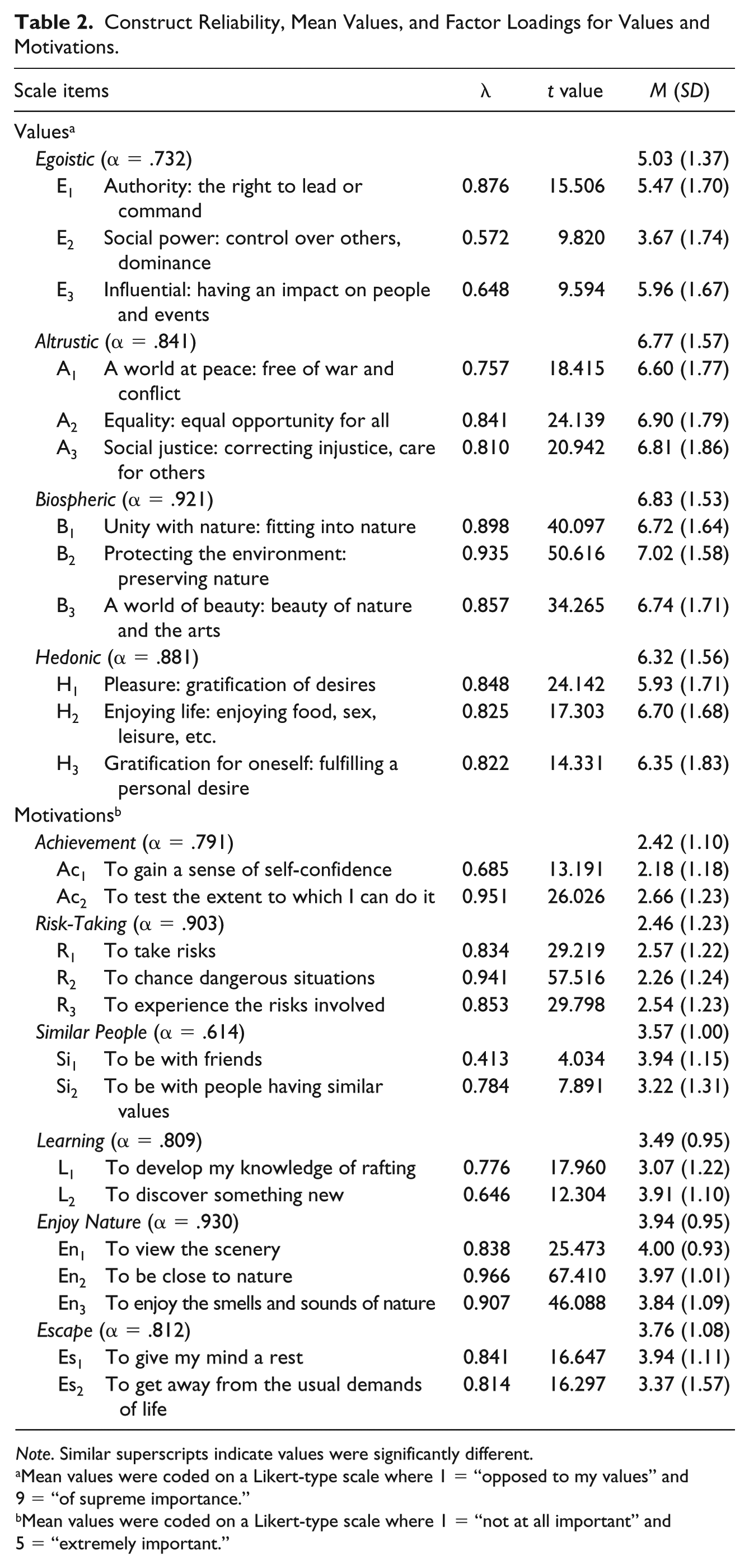
Note. Similar superscripts indicate values were significantly different.
Mean values were coded on a Likert-type scale where 1 = “opposed to my values” and 9 = “of supreme importance.”
Mean values were coded on a Likert-type scale where 1 = “not at all important” and 5 = “extremely important.”
Leave No Trace Behavioral Intentions Performed After Visiting the Kern River.
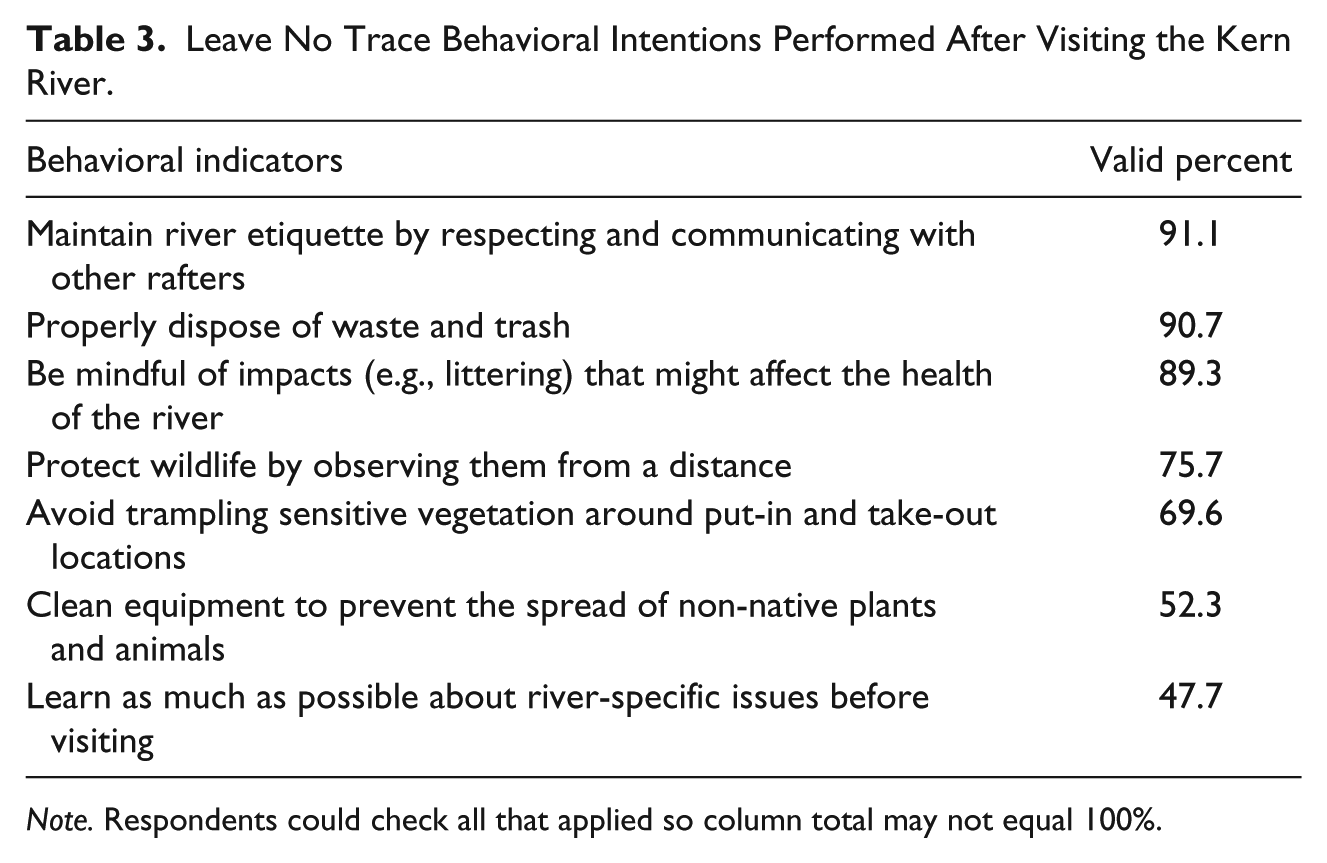
Note. Respondents could check all that applied so column total may not equal 100%.
Modeling Results
Modeling results indicated that both the measurement model (χ2 = 420.457, df = 280; RMSEA = 0.046; CFI = 0.953; SRMR = 0.058) (Table 3) and structural model (χ2 = 473.603, df = 293; RMSEA = 0.051; CFI = 0.940; SRMR = 0.068) fit the sample data in accordance with established criteria (Brown, 2014; Kline, 2011). In particular, we observed that four dimensions of respondents’ value orientations (i.e., Hedonic, Egoistic, Altruistic, Biospheric) predicted six dimensions of place-based motivations (i.e., Achievement, Risk-Taking, Similar People, Learning, Enjoy Nature, Escape) to engage in white water rafting, with Escape, in turn, predicting behavioral intentions (Table 4). Consistent with the study hypotheses, Biospheric values positively predicted Learning (γ = 0.513) and Enjoy Nature (γ = 0.515), Egoistic values negatively predicted Risk-Taking (γ = −0.200) and Similar People (γ = –.221), and Altruistic values predicted Achievement (γ = 0.194), Similar People (γ = 0.328), and Escape (γ = 0.354). Hedonic values predicted Achievement (γ = 0.199), Risk-Taking (γ = 0.254), and Escape (γ = 0.268). Results also indicated that PEB intentions were directly influenced by Escape (β = 0.223) and indirectly influenced by Altruistic (β = 0.079, t statistics = 2.239, 95% confidence interval [CI] = [.010, .148]), and Hedonic values (β = 0.060, t statistics = 1.937, 95% CI = [–.001, .120]). 1 Results from a Wald chi-squared test showed that the effect of Altruistic value was not stronger than the effect of Hedonic value (χ2 = 68.97, df = 1, p = .86) on Escape. Values accounted for 15% of the variance in Achievement, 14% of Risk-Taking, 21% of Similar People, 30% of Learning, 27% of Nature, and 31% of Escape. In addition, Escape explained 5% the variance in PEB intentions (see Figure 1).
Structural Regression Modeling Results.

Note. Final structural model fit: χ2 = 473.603, df = 293; RMSEA = 0.051; CFI = 0.940; SRMR = 0.068. RMSEA = root mean square error of approximation; CFI = comparative fit index; SRMR = standardized root mean square residual.

Research results from a structural model of factors predicting intended proenvironmental behavior. The dotted lines show non-significant relationships.
Discussion
This study examined the relationships among values, motivations, and PEB by testing a structural equation model of factors influencing intentions to engage in LNT practices among a sample of outdoor recreationists. A multi-dimensional measure of values (i.e., a quadripartite model) was hypothesized to predict the perceived benefits of leisure pursuits. These hypotheses were adapted from two theoretical backdrops, Schwartz’s (1992) value theory and Lawler’s (1973) expectancy theory, which provided a basis for contending values and motivations occupy similar theoretical space but should be empirically distinguished in models that characterize the antecedents to PEB intentions. We confirmed that values predicted motivations, though not all dimensions were significantly correlated. Also, the valence of relationships among Biospheric and Altruistic values, place-based motivations, and intent was consistent with our predictions that built on past research (Norlund & Garvill, 2002; van Riper & Kyle, 2014). Thus, our model offered partial support for the study hypotheses and provided evidence for the need to conceptualize and measure hedonic values in addition to the conventional tripartite basis of value orientations.
In line with Schwartz (1994), previous research conducted by Steg et al. (2014) posited that self-enhancement (Egoistic and Hedonic) and self-transcendent (Altruistic and Biospheric) values were negatively and postively correlated with PEB, respectively. Although the study findings confirmed that Hedonic values were part of the value basis of environmental concern, this construct positively predicted motivations and behavior intended by individuals engaged in leisure pursuits. We provide initial evidence of boundary conditions pertaining to the effects of Hedonic values on environmental behavior, in that findings indicated respondents compelled by short-term gains, reflected by engagement in a high-risk activity, remained conscious of their potential impacts on the environment. That is, we suggest that directionality may not be as straightforward as previous literature has suggested when considering people who seek direct pleasure from leisure pursuits. Given that Hedonic values straddle the self-enhancement and openness to change motivational axes established by Schwartz (1992), it is plausible that motivations centered on Achievement, Risk-Taking, and Escape of personal and social pressures to be engaged in outdoor activities were due to not only personal pleasure but also an interest in living life freely with independent and stimulating action. In other words, the hedonic goal frames of respondents to experience the excitement and uncertainty of white water rafting were not incompatible with proenvironmental intent.
Results from this study corroborated past research that has suggested values and motivations are related to behaviors that benefit the environment (Lindenberg & Steg, 2007; Manfredo et al., 2017; Steg, 2016; Woosnam et al., 2009). When values are conceptualized as goals (cf. Verplanken & Holland, 2002), as articulated by goal-framing theory (Lindenberg & Steg, 2007, 2013), they maintain a complementary relationship with place-based motivations measured using the REP scale, and respond to situational cues and contextual affordances (Lindberg & Steg, 2013). That is, values move through intermediate constructs such as motivations to influence intentions to engage in LNT practices (Kil, Holland, & Stein, 2014; Sotomayor, Barbieri, Stanis, Aguilar, & Smith, 2014). This information provides insight into individual responses to incentives and barriers to behavioral goals. Public land management agencies focused on behavior change can consider our results to more effectively work within existing value structures (Manfredo et al., 2017), while also targeting less stable social psychological processes such as recreation experience preferences to encourage PEB (Wynveen et al., 2015).
We found that LNT behaviors were influenced by motivations measured using the REP scale. These findings suggested individuals who engaged in white water recreation to fulfill Escape motivations were more likely to report intentions to comply with LNT practices. The factors that influenced respondents’ abilities to realize expectations associated with Escape motives were tied to their on-site experience, including the behavior of other recreationists and conditions of the resource (Steg, Lindenberg, & Keizer, 2016). It could be that respondents who sought to escape personal and social pressures through outdoor recreation viewed themselves as outside the bounds of everyday life. These individuals may have been more receptive to information about LNT principles imparted by their river rafting guide because they were in a novel environment that required greater learning and understanding. In other words, people who sought escape reported greater intentions to adhere to LNT principles taught by their river rafting guide, because they benefited from seeing themselves in a foreign environment. Although this research built on a long-standing literature focused on motivations in the context of public land management (Manfredo et al., 1996), future research should consider related approaches to measuring motivation. For example, the concepts of intrinsic motivation, extrinsic motivation, and amotivation from self-determination theory could be particularly informative, because these types of motivations may have a different relationship with the value concept. Intrinsic motivations, in particular, indicate a high level of self-determination related to behaviors that stem from pleasure and freedom (Baard, Deci, & Ryan, 2004; Deci & Ryan, 1985). This conceptualization would provide a useful basis for explaining egoistic and hedonic self-enhancement values that in turn shape behavior (De Groot & Steg, 2010).
The positive relationship revealed between Hedonic values and PEB intentions was noteworthy. Results indicated that respondents who acted in line with their individual interests to engage in leisure also acted proenvironmentally, indicating that the adoption of PEB intentions such as activities specified by the LNT program did not require restraining hedonic interests. In this case, self-focused values and an array of motivations, particularly the desire to escape the pressures of everyday life, need not be framed as antithetical to environmental protection (Chan, Shaw, Cameron, Underwood, & Daily, 2006). Emphasizing opportunities to fulfill individual desires while engaging in a group context may resonate with stakeholders, particularly individuals engaged in high-risk recreation (van Riper et al., 2016). Discourse surrounding human impacts on the environment has previously adopted a narrative that emphasizes urgency and the consequences of acting out of interests for the self as opposed to others. Our results indicate that PEB can be postively influenced by values that are oriented toward the self. That is, stakeholders may find intrinsic satisfaction from acting in ways that are environmentally responsible and individually focused.
Limitations and Future Research Directions
The data analyzed in this investigation are not without limitations. First, while the socio-demographic profile of the sample from which the data were collected broadly align with the population characteristics of backcountry outdoor recreationists in the United States (Cordell, 2012), the manner in which our respondents engaged both the activity and resource differs from the manner in which most Americans experience nature. In particular, our respondents’ experience was mediated by a trained guide. For both the guides and their companies to maintain their concession permit with the U.S. Forest Service, they are obligated to uphold the tenets of LNT. Consequently, throughout their rafting experience, guides reinforce appropriate PEBs. While this may have inflated respondents’ intent to engage in LNT behavior for the future, it does not have bearing on their value orientations, which are more stable and enduring (Rokeach, 1973; Schwartz, 1992). Consequently, these findings still offer support for a positive linear association between the values-motivation-behavior constructs that have been previously reported and implied in theory. Continued examination in other nature-based contexts will likely begin to more overtly define the contextual boundaries for the hypothesized relationships.
Two additional caveats tied to our empirical results should be noted when interpreting the study findings. First, given the small amount of variance explained in intended PEB by the antecedents evaluated in this study, it could be that a larger model that included variables specified by the VBN Theory (Stern et al., 1999) and TPB (Ajzen, 1985) would eclipse the effects that were detected. Although the relationships among a multi-dimensional measure of values, particularly hedonic values, motivations, and behavioral intentions, yield noteworthy findings, the predictive capacity of our model should be considered in light of existing literature and theory. Second, the causal inference implied in our hypothesized model warrants attention in future research. Given our analyses are based on the covariance structure of the variables of interest, the findings do not establish causality on their own. Our hypothesized causal associations rest on past work and theory related to values and its motivating properties (Jolibert & Baumgartner, 1997; Schwartz & Bilsky, 1994). While the data do not establish causal association, they do offer further evidence in support of this past work and the tenets of the underlying theory.
Conclusion
Values work through place-based motivations to predict intentions to engage in PEB. Our results reveal that four types of values—Egoistic, Altruistic, Biospheric, and Hedonic—collectively play roles in explaining motivations and, in turn, influencing behavioral intentions set forth by the U.S. LNT educational outreach program. We suggest that Hedonic values act as guiding principles in life that are distinguishable from the traditional tripartite basis of environmental concern, as well as provide empirical evidence that they are grounded in both self-enhancement and openness to change dimensions of Schwartz’s (1992) circumplex. Moreover, respondents’ motives to escape the pressures of everyday life are instrumental in shaping intended PEBs that are imparted during a high-risk recreational pursuit. These findings underline the need to better understand intermediary psychological factors that can close the value–action gap and, in turn, identify ways for decision makers to effectively encourage minimum-impact activities in natural resource management contexts.
Footnotes
Acknowledgements
The authors thank the three river guide companies—White Water Voyages, Sierra South, and Mountain River Adventures—that graciously provided access to their clientele during the 2014 rafting season. They also express gratitude to Jihee Park and Anna Pechenik-Mausolf for their logistical support during data collection, as well as the U.S. Forest Service for their assistance in facilitating this research.
Declaration of Conflicting Interests
The author(s) declared no potential conflicts of interest with respect to the research, authorship, and/or publication of this article.
Funding
The author(s) disclosed receipt of the following financial support for the research, authorship, and/or publication of this article: This research was financially supported by the Human Dimensions of Natural Resources Laboratory at Texas A&M University, and the University of Illinois at Urbana–Champaign Campus Research Board (Grant Number: RB16092).