



Abstract
In the present study, we adopted a global view for exploring how parent–adolescent dyads influence one another’s pro-environmental behaviors across 14 societies. We evaluated whether their own and the other’s familiarity with climate change are linked with their pro-environmental behaviors between parents and adolescents. We also explored the moderating role of societal power distance and individualism on these dyadic effects. We tested hypotheses using the data from the Program for International Student Assessment 2018 (including 62,080 parent–adolescent dyads from 14 societies). Conducting multilevel actor–partner interdependence models, we found that parents’ and adolescents’ familiarity with climate change generally predicted their own and the other’s pro-environmental behaviors within a family context in most societies. More importantly, the dyadic patterns were stronger in societies with lower levels of power distance or higher levels of individualism. Finally, we discuss the implications of promoting pro-environmental behaviors from a cultural perspective and a dyadic approach.
Keywords
Climate change is one of the greatest threats to humanity in contemporary society (Milfont, 2010). Thus, one agenda collectively shared among many countries is how to increase pro-environmental behavior to mitigate climate change. To achieve this goal, adopting intra-person perspectives that focus on personal characteristics such as attitudes and beliefs may not be enough because individual behaviors hugely depend on social relationships and surrounding social contexts (Rusbult & Van Lange, 2008). Therefore, immediate contexts (e.g., family) and social contexts (e.g., cultural characteristics) should receive more attention (Tam & Milfont, 2020; Žukauskienė et al., 2020).
Among different immediate contexts, private households, in particular, account for a large proportion of society’s environmental impact (Fremstad et al., 2018). Household energy consumption has been a major contributor to global greenhouse gas emissions on national and regional scales (Xu et al., 2015). In the United States, over 20% of carbon dioxide emissions, such as housing and electric power, are directly attributed to households (Goldstein et al., 2020). Hence, the promotion of pro-environmental behaviors within a family context is emphasized in worldwide environmental conversation campaigns (Singh et al., 2020). Importantly, family interactions are culturally specific (Gentina & Singh, 2015), and cultural influences can be observed in many family domains, such as family purchasing decisions (Chen et al., 2013) and parental involvement (Hofferth, 2003). However, the question of how culture influences the transmission of pro-environmental behaviors between parents and their children remains largely unknown.
This study adopted a global view to explore the parent–adolescent dyadic effect of familiarity with climate change on their pro-environmental behaviors (with adolescents aged 15) in 14 societies. To evaluate the influence of culture, we explored the moderating role of societal power distance and individualism, two important societal moderators that are closely related to family relationships (Lansford et al., 2021; Shoham & Dalakas, 2003), on the parent–adolescent dyadic effects.
The findings of this study may make several novel contributions to the existing literature. First, most previous studies have focused on a single direction, either parents’ influence on adolescents (e.g., Jia & Yu, 2021) or adolescents’ influence on parents (e.g., Damerell et al., 2013). The present study will be the first to apply a cross-cultural perspective that fully explores the parent–adolescent dyadic influence on pro-environmental behaviors, which contributes to evaluating the interdependent nature of promoting pro-environmental behaviors worldwide. Second, previous studies were mostly conducted in one culture with a dominant proportion of participants from Western countries (e.g., Žukauskienė et al., 2020). Cross-cultural studies on pro-environmental behaviors are still scarce and in high demand (Tam et al., 2021; Tam & Milfont, 2020). Our study will test the effect of two important societal moderators (i.e., societal power distance and individualism) on the dyadic processes in multiple cultures. Investigating the moderating role of societal factors may help reconcile the inconsistent findings in environmental research and deepen the understanding of how to cultivate pro-environmental behaviors across different cultural contexts. Third, based on the ecological socialization theory (Bronfenbrenner, 1987) and resocialization theory (Gentina & Muratore, 2012), this study will further advance knowledge of the important effect of familiarity with climate change in pro-environmental behaviors in a family context. Therefore, the present study will provide innovative insights into what policymakers can do to promote pro-environmental behaviors in the family context and across worldwide populations.
Intergenerational Transmission of Pro-environmental Behaviors
Parents typically take the most important role in the family context, in which they deeply influence their children’s values (Song et al., 2017), attitudes (Dong et al., 2020), and behaviors (McQuillan et al., 2020). Specific to environmental research, previous researchers have explored the transmission of pro-environmental behaviors from parents to children, which provided convergent evidence for the positive influence of parents on their children’s pro-environmental behaviors. Parents’ environmental values (Gong et al., 2022; Grønhøj & Thøgersen, 2009), attitudes (Collado et al., 2019), motivation (Grønhøj & Thøgersen, 2017), and behaviors (Jia & Yu, 2021; Grønhøj & Thøgersen, 2012) are key factors for promoting their children’s pro-environmental behaviors. For example, they can influence children’s pro-environmental behaviors through family norms (Collado et al., 2019) and verbal communications (Meeusen, 2014).
In previous studies, researchers have mostly applied the theory of ecological socialization (or environmental socialization; Bronfenbrenner, 1987) to explain the transmission of pro-environmental intentions and behaviors from parents to children. The theory refers to the process of how young people learn environmental knowledge, values, attitudes, and behaviors from others (Gentina & Muratore, 2012), who are likely their parents in the family context (Grusec, 2011). Numerous studies have explored the socialization process between parents’ and children’s values and behaviors in non-environmental contexts. Researchers have found that parents’ internal values and attitudes were the psychological basis for determining their behaviors and that their behaviors could, in turn, act as a proximal socialization force that generates the intergenerational transmissions of these values and behaviors (Gong et al., 2022; Grønhøj & Thøgersen, 2009).
The question of how children, especially those in adolescence, can influence parents’ pro-environmental behaviors has also been raised (Gentina & Muratore, 2012), which can be recognized as the process of reverse socialization (i.e., ecological resocialization; Gentina & Muratore, 2012). In the process, children can influence and further transmit their environmental values, attitudes, and knowledge to their parents (Gentina & Singh, 2015). Two reasons make it important to examine the influence of adolescents on their parents in ecological domains. First, adolescents are in a special transition period in that they are easily affected by social contexts (Sabatier, 2008) and more open to new experiences than adults (Ozdemir et al., 2021). Young people nowadays are exposed to grand environmental issues much more than other generations (Balundė et al., 2020). They actively show their environmental concern in response to environmental issues (e.g., Fridays for the future movement of young people; Wallis & Loy, 2021). Their great influence on sustainable development has been widely acknowledged (Prendergast et al., 2021). Therefore, understanding their role in environmental issues may bring insights into how to mobilize the public to engage in environmental protection. Second, within a family context, adolescents can be the primary channels of environmental knowledge and information in their family. Compared with adults, adolescents have greater and more diverse opportunities to access environmental information. Their knowledge of digital technologies provides them with great opportunities to access environmental information and communication around the world (Ai et al., 2021). They also obtain formal and informal environmental education programs in schools, which become the sources of environmental information for other family members (Ballantyne et al., 2001).
Interestingly, research on adolescents’ influences on their parents’ pro-environmental behaviors has shown inconsistent findings. Some researchers found that parents learned environmental knowledge from their children (Vaughan et al., 2003), which affected their environmental attitudes and consequent pro-environmental behaviors (Damerell et al., 2013). In contrast, some studies did not find supportive evidence (e.g., Straub & Leahy, 2017).
Two recent studies were conducted to further evaluate the intergenerational transmission of pro-environmental behavior. Wallis and Klöckner (2020) explored the correlations of the 224 parent–adolescent dyadic data for energy-saving behaviors. They found that the adolescents’ perception of parents’ behaviors explained the positive relationship between adolescents’ and parents’ energy-saving behavior. However, this study did not test the bidirectional parent–adolescent dyadic influence on pro-environmental behaviors’ transmission. Žukauskienė et al. (2020) conducted the first attempt to fully investigate the bidirectional influences on parents’ and adolescents’ pro-environmental intentions and behaviors. They revealed that both parents and adolescents influenced each other’s pro-environmental intentions and behaviors. Specifically, parents’ awareness of the need to reduce purchasing bottled water was indirectly related to adolescents’ pro-environmental behaviors via their own and their children’s intentions. Adolescents’ attempts to impact their parents’ behaviors directly predicted their parents’ pro-environmental behaviors and intentions. These findings highlight the importance of studying the parent–adolescent dyadic influence rather than a unidirectional influence (i.e., parents to adolescents or adolescents to parents) in environmental contexts. However, this study did not evaluate the universality of the parent–adolescent dyadic influence across cultures.
Familiarity With climate change
To deepen the understanding of the parent–adolescent dyadic influences on pro-environmental behaviors, we focused on the role of familiarity with climate change. The effect of familiarity has been explored in many environmental domains, including knowledge of the risk of climate change (e.g., Bradley et al., 2020), the space environment (Bocchi et al., 2021), and brands (Phelps & Hoy, 1996). In the present study, we examined familiarity with climate change, which refers to the degree of knowledge on climate change and global warming (Murillo, 2013).
Some evidence has suggested a positive relationship between familiarity with climate change and pro-environmental behaviors. Masud et al. (2015) indicated that public knowledge of global climate change was positively related to pro-environmental actions. Wu and Lu (2013) further suggested that, among four dimensions of environmental concern (i.e., the source of knowledge, familiarity with environmental knowledge, awareness of environmental pollution, and attitudes to environmental issues), familiarity with environmental knowledge demonstrated the greatest positive relationship with recycling behavior. The positive relationships between the risk perception of climate change, which was highly related to familiarity with climate change (You & Ju, 2020), and pro-environmental behaviors (Bradley et al., 2020) also suggested that familiarity with climate change would be positively related to pro-environmental behaviors.
However, previous studies have mainly focused on the effect of individuals’ familiarity with climate change on their pro-environmental behaviors. Despite the limited research, some evidence has provided support for the dyadic effect of familiarity with climate change on pro-environmental behaviors. Intergenerational learning plays an important role in transferring environmental knowledge between parents and their children (Vaughan et al., 2003). On the one hand, the information, knowledge, attitudes, and behaviors can be transmitted from parents to their children (Grønhøj & Thøgersen, 2012). On the other hand, sharing environmental knowledge with parents among students can promote parents’ pro-environmental behaviors (Damerell et al., 2013). Therefore, familiarity with climate change, an indicator of environmental knowledge (Umuhire & Fang, 2016; Wu & Lu, 2013), may demonstrate the dyadic effects on pro-environmental behaviors in the family context through intergenerational learning, although familiarity may not reach the conceptual and structural level of knowledge (Hoppe et al., 2018).
In the present study, we integrated the socialization theory (Bronfenbrenner, 1987) and ecological reverse socialization (Gentina & Muratore, 2012) to propose a new conceptual model for understanding the dyadic influence between parents and adolescents in pro-environmental behaviors. We propose the first hypothesis below.
H1. Parents’ familiarity with climate change will be positively related to adolescents’ pro-environmental behaviors (H1a), and adolescents’ familiarity with climate change will be positively associated with their parents’ pro-environmental behaviors (H1b).
Moderating Roles of Societal Power Distance and Individualism
Family interaction can be understood as a function of “an adaptive culture, a mix of history, traditions, and adaptive responses to present contextual demands and not solely as individual patterns of interactions” (Coll et al., 1996, p. 1908). Thus, culture plays an important role in influencing family dynamics in addition to personal values and behaviors (Hofstede, 2001; Singh et al., 2020). Ho et al. (2008) indicated that East Asian parents are more concerned with controlling behaviors and placing emphasis on obedience so that children need to comply with a set of standards. In contrast, families in European backgrounds aim to strike a balance between demanding their children to behave appropriately and responding to their children’s needs. These cultural differences in family dynamics may possibly shape the transmission processes of pro-environmental behaviors in the family context. Katz-Gerro et al. (2020) explored the cultural differences in the intergenerational transmission of environmental behavior. They found that the positive association between children’s and parents’ pro-environmental behaviors was weaker in Korea than in the United States and Israel. Ando et al. (2015) indicated that parents’ pro-environmental behavior affected children’s behaviors via the children’s perceived subjective norms, and this pattern was stronger in Japan than in Germany.
Previous findings have suggested the importance of considering the effect of sociocultural contexts to better understand the parent–adolescent dyadic effects on pro-environmental behaviors. To provide direct evidence of how societal cultural factors may shape the parent–adolescent dyadic effects in environmental contexts, we examine in the present study the moderating roles of societal power distance and individualism.
Societal power distance refers to the extent to which a society expects and accepts inequality in power (Hofstede, 1984; Winterich & Zhang, 2014). Low societal power distance may motivate individuals to put efforts into minimizing inequality (Hofstede, 1984, 2001; Winterich & Zhang, 2014). In contrast, individuals from societies with high power distance tend to ensure that everyone should have a “defined” place within the social order. Societal power distance is also reflected in parent–adolescent relationships (Mertens & d’Haenens, 2014) and family behaviors (Shoham & Dalakas, 2003). In low power distance societies, parents are less likely to value children’s obedience and more likely to seek equality with their children (Guan & Li, 2017).
Societal individualism refers to the extent to which individuals in a society prefer to act as individuals rather than as members of groups (Hofstede, 1984). Specifically, people from collectivistic societies tend to emphasize ingroup identities (e.g., families), whereas those from individualistic societies tend to emphasize personal goals and values (Triandis, 2001). Therefore, individualistic cultures endorse self-expression and egalitarian relationships (Hofstede et al., 2010), and collectivistic cultures endorse and promote obedience and social obligations (Huppert et al., 2019), thus affecting how parents socialize with their children (Baumrind, 1971) and family dynamics (Rudy & Grusec, 2006).
The different priorities for socialization across cultural contexts promote various parenting strategies. Low societal power distance and high societal individualism may likely encourage authoritative parenting strategies (Pinquart & Kauser, 2018), which display high levels of both responsiveness and demandingness. Authoritative parents demand their children’s behaviors in an age-appropriate manner and encourage children to express their points of view. In contrast, the authoritarian parenting style is encouraged in societies with higher power distance and collectivism (Garcia et al., 2019). Authoritarian parents show high levels of demandingness and a low level of responsiveness. These parents are likely to control their children in psychological and behavioral aspects (Rudy & Grusec, 2006).
The authoritative parenting practice may lead to stronger influences of children on their parents and weaker influences of parents on their children in societies with lower power distance or higher individualism. It can be argued that, on the one hand, children may minimize inequality in the family through influencing their parents’ decisions, a sign of family inequality, in societies that endorse and promote egalitarian relationships (Shoham & Dalakas, 2003). On the other hand, parents may encourage children to express or behave following their internal motivation by not controlling their children’s behaviors. In contrast, the authoritarian parenting practice may facilitate the hierarchy in families, which may lead to weaker influences of children on their parents but stronger influences of parents on their children. Consistently, the strong influence of parents on children’s behaviors is often seen (Chan & McNeal, 2003), but the reverse impact from children to parents is less frequently discovered (Gentina & Singh, 2015) in societies with higher power distance or lower individualism.
To summarize, ecological reverse socialization (i.e., adolescents to parents) may be more prevalent in cultures with lower power distance or higher individualism. In contrast, the ecological socialization process (i.e., parents to adolescents) may be more prevalent in cultures with higher power distance or higher collectivism. Following the abovementioned rationales, we proposed the second and third hypotheses:
H2. Societal power distance will moderate the dyadic influence between parents and adolescents in the relationship between familiarity with climate change and pro-environmental behaviors. Specifically, a weaker relationship between parents’ familiarity with climate change and adolescents’ pro-environmental behaviors (H2a) but a stronger relationship between adolescents’ familiarity with climate change and parents’ pro-environmental behaviors (H2b) will be found in societies with lower power distance than in societies with higher power distance.
H3. Societal individualism will moderate the parent–adolescent dyadic influences in the relationship between familiarity with climate change and pro-environmental behaviors. Specifically, a weaker relationship between parents’ familiarity with climate change and adolescents’ pro-environmental behaviors (H3a) and a stronger relationship between adolescents’ familiarity with climate change and parents’ pro-environmental behaviors (H3b) will be found in individualistic societies than in collectivistic societies.
The Theoretical Model in the Present Study
A theoretical model was developed based on the hypotheses (see Figure 1). The propositions of the theoretical model indicated that parents’ familiarity with climate change is related to adolescents’ pro-environmental behaviors (H1a) and that adolescents’ familiarity with climate change is related to parents’ pro-environmental behaviors (H1b). It also proposed that the above relations would be moderated by societal power distance (H2) and individualism (H3).

A conceptual model for the effect of familiarity with climate change on pro-environmental behavior between parents and adolescents, and the moderating role of societal power distance and individualism. The links for our main hypotheses are bold in the figure. Although some links were not our main explored questions, they would also be tested in the model.
To explore the relationships between familiarity with climate change and pro-environmental behaviors in parent–adolescent dyads, we conducted the actor–partner interdependence model (APIM; Cook & Kenny, 2005). It is a statistical method that accounts for the interdependent nature of family member pairs (Cook & Kenny, 2005). This APIM analysis allowed us to better understand the unique effect of parents’ and adolescents’ familiarity with climate change on their engagement with pro-environmental behaviors (i.e., actor effect) and the other’s engagement with pro-environmental behaviors (i.e., partner effect). To fully consider all of the effects of the APIM model and keep its integrity as most previous studies have done (e.g., Kim et al., 2011), we also included the actor effects and the moderating roles of societal power distance and individualism on these effects in the theoretical model for the comprehensive presentation of the tested models.
Although these relationships were not the main focus of our research questions regarding the dyadic parent–adolescent effects, we made the following expectations based on the previous studies. Following a study of Wu and Lu (2013), we expected that one’s familiarity with climate change would be positively related to their own pro-environmental behaviors among parents and children. Some studies have suggested that societal power distance and individualism could moderate these actor effects. Stronger effects of personal attitudes or values were found in predicting people’s pro-environmental behaviors in cultural contexts that encouraged expression of personal characteristics (Eom et al., 2016; Tam & Chan, 2018). Therefore, we speculated that the actor effect would be stronger in societies with lower power distance and higher individualism, which may afford greater freedom for expressing people’s personal characteristics.
Methods
Participants
To examine the dyadic effect of familiarity with climate change on pro-environmental behaviors, we analyzed data from the Program for International Student Assessment 2018 (Organisation for Economic Co-operation and Development [OECD], 2019; https://www.oecd.org/pisa/), which was the most recent wave and included measures for all key variables in the present study. PISA 2018 adopted a two-stage sampling procedure to select a representative sample of 15-year-old students from each country/region (OECD, 2019). We used the data in PISA 2018 with the following criterion: Both adolescents and their caregivers answered the items of familiarity with climate change and pro-environmental behaviors. We only included the parent–adolescent dyads with data for both target independent and dependent variables. There were 124,160 participants in the final sample (i.e., 62,080 dyads), which consisted of one parent and one adolescent child (Mage = 15.78, SD = 0.29; 51 % girls) per household from 14 countries/regions (i.e., Brazil, Chile, Germany, Dominican Republic, Hong Kong, Croatia, Ireland, Italy, Korea, Macau, Mexico, Malta, Panama, and Portugal). Of the parents sampled, 80% were mothers, 23% were fathers, and 0.02% were other primary caregivers. One-third of the parent sample (39.4%) had a degree of theoretically oriented tertiary or postgraduate study.
Measurements
Familiarity With climate change
One item was used to measure participants’ familiarity with climate change and global warming. Both adolescents and caregivers were asked to indicate how much they were informed about “climate change and global warming” on a 4-point Likert scale (1 = I have never heard of this to 4 = I am familiar with this and I would be able to explain this well).
Pro-environmental behaviors
Three items were used to assess participants’ pro-environmental behaviors. They were, “I reduce the energy I use at home (e.g., by turning the heating or air conditioning down or by turning off the lights when leaving a room) to protect the environment,” “I choose certain products for ethical or environmental reasons, even if they are a bit more expensive,” and “I participate in activities in favor of environmental protection.” 1 Both adolescents and caregivers responded as to whether they were involved in these activities (0 = no to 1 = yes). We computed a sum score (ranging from 0 to 3) for each participant, with higher scores indicating more pro-environmental behaviors (Parents: Cronbach’s alpha = .36; Adolescents: Cronbach’s alpha = .42).
Societal power distance and individualism
The societal power distance and individualism scores from 13 countries/regions in the present study were available from Hofstede et al. (2010; https://www.hofstede-insights.com/product/compare-countries/); thus, only 13 countries were included in the analysis when considering the effect of societal power distance or individualism. Although these scores were based on the data collected before PISA 2018, they were found to be stable and widely explored by various studies from 2010 until now (e.g., Lou & Li, 2022).
The composite scores of power distance, ranging from 0 to 100, were based on the responses to a series of questions provided by employees of a large international company. A sample item includes, “How frequently, in your experience, are employees afraid to express disagreement with their managers?” The composite scores of individualism, ranging from 0 to 100, were calculated based on responses to a set of 14 values related to work (e.g., freedom, personal time, and skills). The scores of societal power distance and individualism were calculated for each country or region, with higher scores indicating higher levels of societal power distance or individualism.
Societal-level and individual-level covariates
Some variables were included to evaluate the robustness of obtained results. For the societal-level covariates, societal affluence was assessed by GDP per capita in 2018 (World Bank, 2018; https://data.worldbank.org/indicator/NY.GDP.PCAP.CD?view=chart). In addition, the Sustainable Development Index (https://dashboards.sdgindex.org/rankings) and Education Index (https://worldpopulationreview.com/country-rankings/education-rankings-by-country) were also included as societal-level covariates. The scores for all three indexes were available only for 12 countries or regions. For the individual-level covariates, we included the gender of adolescents (1 = Female; 0 = Male) and family wealth index. The family wealth index was computed by PISA (OECD, 2019) based on the adolescents’ reports on the possessions in their home, such as a room of their own and the number of possessions. A previous study showed that household possessions are a more reliable indicator of family wealth than income (Traynor & Raykov, 2013). These covariates have been associated with pro-environmental behaviors in previous studies (e.g., GDP per capita: Tam & Chan, 2018; Sustainable Development Index: Brulé, 2022; educational development: Pisano & Lubell, 2017; personal demographics: Patel et al., 2017).
Data Analysis
As discussed in the introduction, we utilized the actor–partner interdependence model (APIM; Cook & Kenny, 2005) to explore the relationships between familiarity with climate change and pro-environmental behaviors in parent-adolescent dyads. We used the two-intercept method to distinguish the actor effects and partner effects from both parents and adolescents (Cook & Kenny, 2005).
The APIM model included the dyad as the highest unit of analysis, with individuals nested within the dyad. In the present study, each dyad was also nested within societies. Therefore, we conducted a series of multilevel APIM models and their cross-level interaction with societal power distance or individualism in separate analyses. The intercept of pro-environmental behaviors was allowed to vary randomly across dyads and societies. We first examined the actor and partner effects of familiarity with climate change on participants’ pro-environmental behaviors. Next, we examined the moderating role of societal power distance or individualism on the abovementioned dyadic effect of familiarity on pro-environmental behaviors. Individual-level variables (except gender) were centered by the mean within each country, and the scores of societal power distance, individualism, sustainable development index, and education index were centered by the grand mean. A standardized score of GDP per capita was computed. All analyses were conducted with and without controlling for the effect of adolescents’ gender, family wealth, GDP per capita, sustainable development index, and educational index. The APIM and multilevel modeling analyses were conducted using the R package [nlme] (Pinheiro et al., 2021).
Results
Table 1 presents the descriptive statistics of key variables and demographic characteristics. The findings without adjusting for control variables are reported in the main text. The results remained significant after adjusting for all control variables (Refer to Tables S4–S6 in the Supplemental Material for the results with control variables).
Descriptive Statistics of the Variables in the Study (N = 62,080 dyads, N = 124,160 Individuals From 14 Societies).

Note. The list of 14 countries/regions was: Brazil (N = 5,984), Chile (N = 5,289), Germany (N = 1,767), Dominican Republic (N = 2,210), Hong Kong (N = 5,131), Croatia (N = 5,160), Ireland (N = 4,541), Italy (N = 8,117), Korea (N = 6,453), Macau (N = 3,674), Mexico (N = 4,653), Malta (N = 2,353), Panama (N = 2,041), and Portugal (N = 4,707).
The Dyadic Effects of Familiarity with Climate Change on Pro-environmental Behaviors
Table 2 presents the APIM results of the dyadic relationship between familiarity with climate change and pro-environmental behaviors. The results showed that actor effects for parents and adolescents were both significant, indicating that higher levels of familiarity with climate change were significantly related to greater engagement in pro-environmental behaviors (parents: b = 0.26, p < .001, 95% Confidence Interval = [0.25, 0.27]; adolescents: b = 0.14, p < .001, 95% CI = [0.13, 0.15]). More importantly, significant partner effects were also observed for both parents and adolescents. Specifically, parents’ familiarity with climate change was positively associated with adolescents’ engagement in pro-environmental behaviors, b = 0.05, p < .001, 95% CI = [0.04, 0.06], and adolescents’ familiarity with climate change was positively associated with parents’ engagement in pro-environmental behaviors, b = 0.04, p < .001, 95% CI = [0.03, 0.05] (see Figure 2).
The APIM Results of the Dyadic Relationship Between Familiarity With Climate Change and Pro-Environmental Behaviors (N = 62,080 Dyads, N = 124,160 Individuals From 14 Societies).

Note. Unstandardized coefficients are reported.
p < .001.

An actor-partner interdependence model for the effect of familiarity with climate change on pro-environmental behavior between parents and adolescents without adjusting for controlling variables. Unstandardized coefficients are reported.
The Moderating Role of Societal Power Distance on the Dyadic Effects of Familiarity With Climate Change on Pro-environmental Behaviors
Table 3 presents the APIM results of the moderating role of societal power distance on the parent-adolescent dyadic relationship between familiarity with climate change and pro-environmental behaviors. Only the moderating effect is discussed in the main text.
The APIM Results of the Moderating Role of Societal Power Distance on the Dyadic Relationship Between Familiarity With Climate Change and Pro-Environmental Behaviors.

Note. Unstandardized coefficients are reported. N = 58,406 dyads, N = 116,812 individuals from 13 societies.
p < .05. **p < .01. ***p < .001.
For adolescents, the results showed that the level of societal power distance significantly moderated the positive relationship between their parents’ familiarity with climate change and their own pro-environmental behaviors (i.e., partner effect), b = –.001, p = .003, 95% CI = [−0.002, −0.0004], which showed a stronger positive relationship in societies with a lower power distance (1SD below mean), b = .06, p < .001, 95% CI = [0.05, 0.08], relative to societies with a higher power distance (1SD above mean), b = 0.03, p < .001, 95% CI = [0.01, 0.04] (see Figure 3). The results also showed that societal power distance significantly moderated the positive relationship between adolescent’s familiarity with climate change and their own pro-environmental behaviors (i.e., actor effect), b = −.001, p = .011, 95% CI = [−0.002, −0.0002], showing a stronger positive relationship in societies with lower power distance (1SD below mean), b = .16, p < .001, 95% CI = [0.15, 0.18], than in societies with higher power distance (1SD above mean), b = .13, p < .001, 95% CI = [0.12, 0.15].
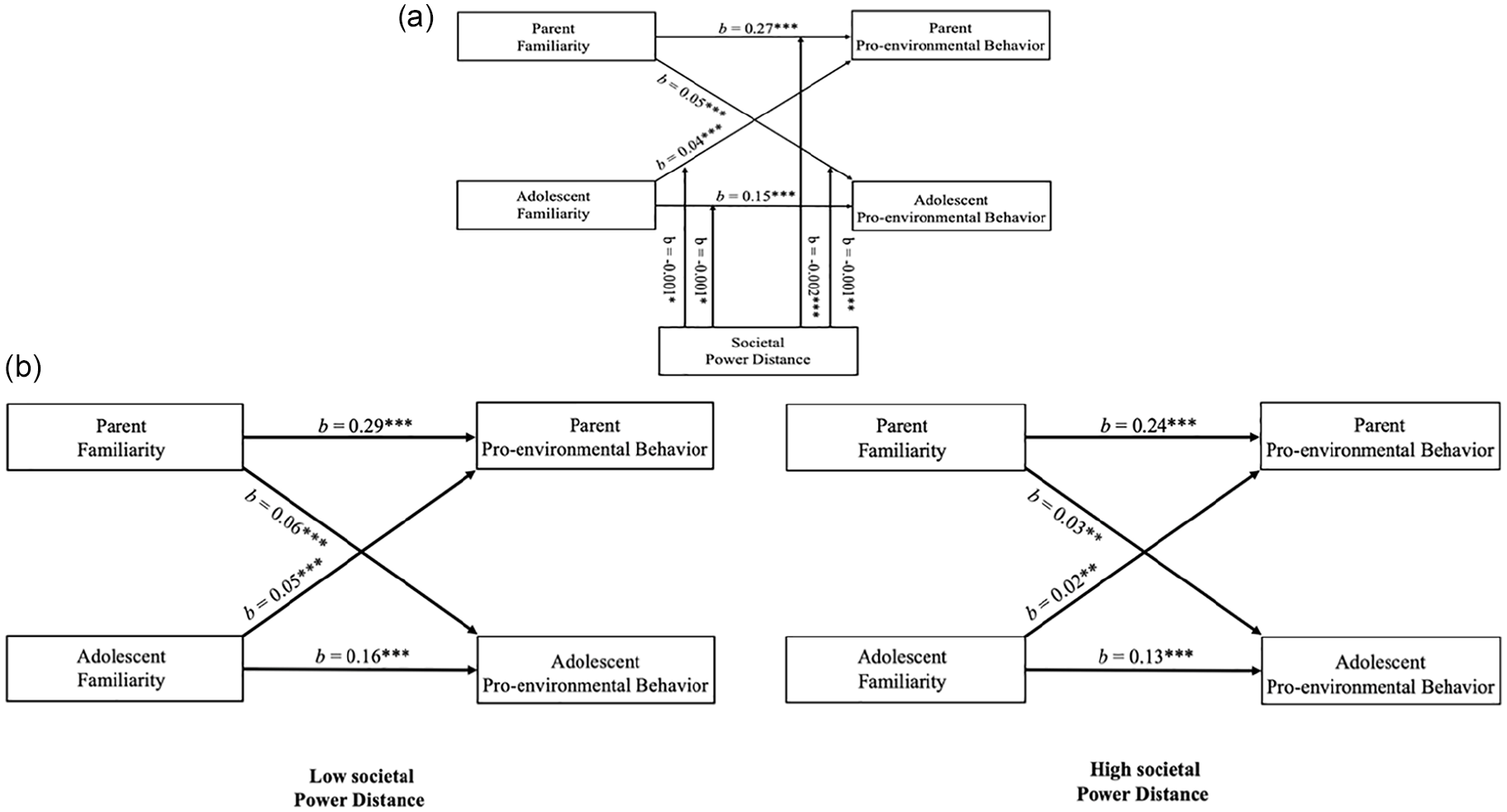
An actor-partner interdependence model for (a) the moderating role of societal power distance on the relationship between familiarity with climate change and pro-environmental behavior; (b) for the patterns in societies with lower levels of societal power distance and in societies with higher levels of societal power distance, respectively. The significant moderated link between familiarity and pro-environmental behavior was bold in Figure b. Gender of adolescents, family wealth, GDP per capita, Sustainable development index, and Education index were not controlled. Unstandardized coefficients are reported.
For parents, the results showed that societal power distance significantly moderated the positive relationship between their adolescent child’s familiarity with climate change and their own pro-environmental behaviors (i.e., partner effect), b = −.001, p = .03, 95% CI = [−0.001, −0.0001], which showed a stronger pattern in societies with a lower power distance (1SD below mean), b = .05, p < .001, 95% CI = [0.04, 0.07], than in societies with a higher power distance (1SD above mean), b = .02, p = .003, 95% CI = [0.01, 0.04] (see Figure 3). The results also showed that societal power distance significantly moderated the positive relationship between parents’ familiarity with climate change and their own pro-environmental behaviors (i.e., actor effect), b = −.002, p < .001, 95% CI = [−0.002, −0.001], which showed a stronger pattern in societies with a lower societal power distance (1SD below mean), b = .29, p < .001, 95% CI = [0.28, 0.31], relative to societies with a higher power distance (1SD above mean), b = .24, p < .001, 95% CI = [0.22, 0.26].
The Moderating Role of Societal Individualism on the Dyadic Effects of Familiarity With Climate Change on Pro-environmental Behaviors
Table 4 presents the APIM results of the moderating role of societal individualism on the parent-adolescent dyadic relationship between familiarity with climate change and pro-environmental behaviors. Only the moderating effect is discussed in the main text.
The APIM Results of the Moderating Role of Societal Individualism on the Dyadic Relationship Between Familiarity With Climate Change and Pro-Environmental Behaviors.

Note. Unstandardized coefficients are reported. N = 58,406 dyads, N = 116,812 individuals from 13 societies.
p < .01. ***p < .001.
For adolescents, the results show that societal individualism significantly moderated the relationship between parents’ familiarity with climate change and their own pro-environmental behaviors (i.e., partner effect), b = .001, p = .02, 95% CI = [0.0001, 0.001]. Follow-up analysis showed a stronger positive relationship in individualistic societies (1SD above mean), b = .06, p < .001, 95% CI = [0.04, 0.07], than in collectivistic societies (1SD below mean), b = .03, p < .001, 95% CI = [0.02, 0.05] (see Figure 4). Societal individualism did not significantly moderate the relationship between adolescents’ familiarity with climate change and their own pro-environmental behaviors (i.e., actor effect), b = −0.0002, p = .51, 95% CI = [−0.001, 0.0003].
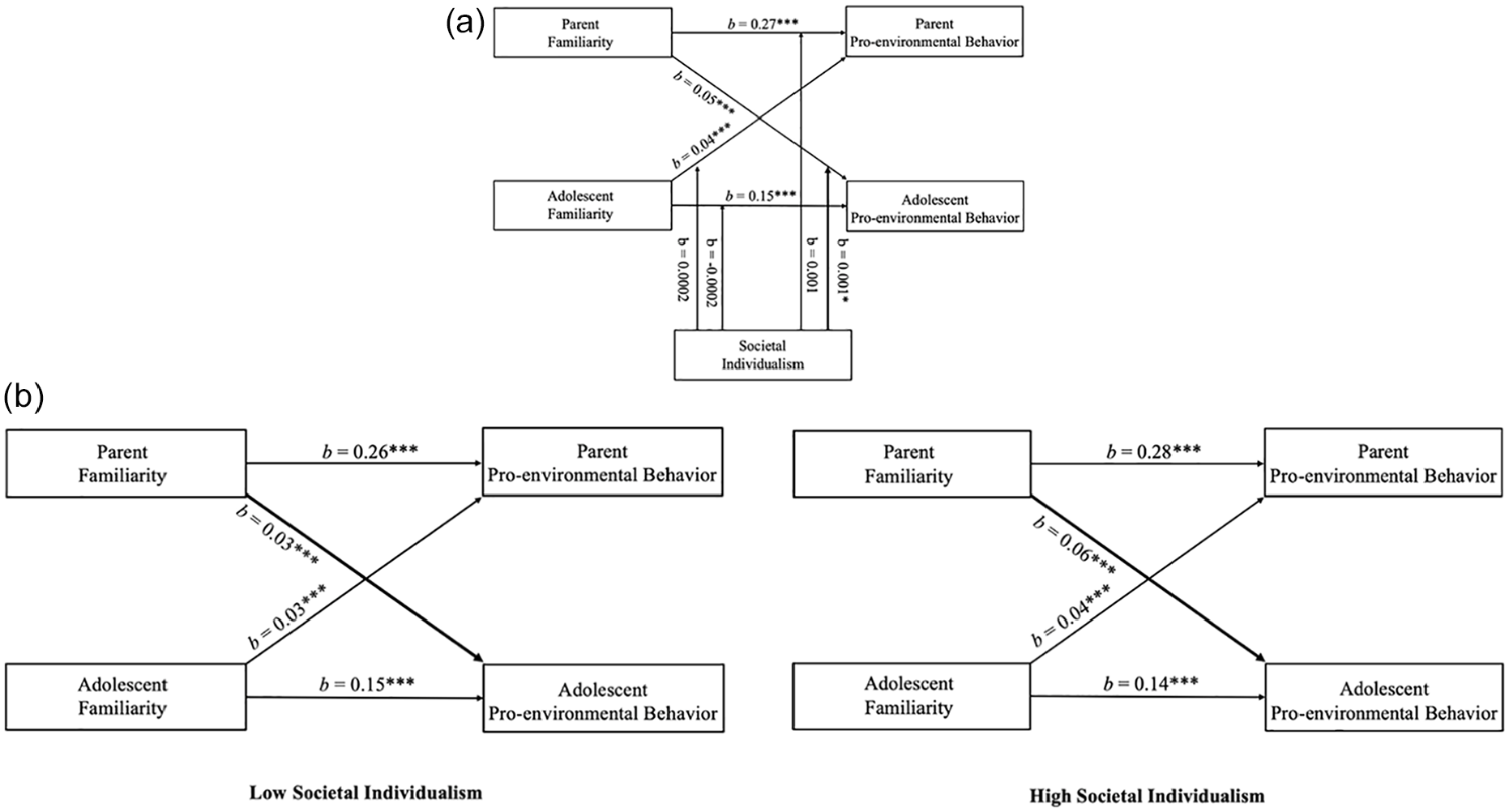
An actor-partner interdependence model for (a) the moderating role of societal individualism on the relationship between familiarity with climate change and pro-environmental behavior; (b) for the patterns in societies with lower levels of societal individualism and in societies with higher levels of societal individualism, respectively. The significant moderated link between familiarity and pro-environmental behavior was bold in Figure b. Gender of adolescents, family wealth, GDP per capita, Sustainable development index, and Education index were not controlled. Unstandardized coefficients are reported.
For parents, the results showed that societal individualism did not significantly moderate the relationship between their adolescent child’s familiarity with climate change and their own pro-environmental behaviors (i.e., partner effect), b = .0002, p = .34, 95% CI = [−0.0002, 0.001]. Societal individualism also did not significantly moderate the relationship between parents’ familiarity with climate change and their own pro-environmental behaviors (i.e., actor effect), b = .001, p = .08, 95% CI = [−0.0001, 0.001].
Discussion
Previous studies emphasized the importance of examining the mutual influence of parents and adolescents on each other’s pro-environmental behaviors; however, most of them tested one-way directional influence, focusing on either parents’ influence on children’s behaviors or children’s influence on parents’ behaviors (Cipriani et al., 2013; Collado et al., 2019). To our knowledge, only one published single-culture study tested the parent-child dyadic effects on pro-environmental behaviors (Žukauskienė et al., 2020), which devoted little knowledge of cultural influence. The present study was thus the first one that applied a global cross-cultural perspective to investigate the parent-adolescent dyadic influence through familiarity with climate change on pro-environmental behaviors.
There were three major findings in the present study (See a summary of hypothesis testing in Table 5). First, we obtained evidence generally supporting the positive parent-adolescent dyadic influence when considering all participants. Within a family context, one’s pro-environmental behaviors were predicted by not only their own familiarity with climate change (i.e., actor effect) but also the familiarity of their parent or adolescent (i.e., partner effect). The results generally supported H1 and were consistent with existing theories, including ecological socialization (Bronfenbrenner, 1987) and resocialization theory (Gentina & Muratore, 2012). Of note, we found that actor and partner effects were both significant in 8 out of 14 societies (refer to Table S2 for the detailed results for each society in the Supplementary file), which revealed the importance of considering the moderating effect of cultural contexts.
Summary of the Hypothesis Testing Results of a Series of APIM Model Analyses.

Note. Unstandardized coefficients are reported. PEB = pro-environmental behavior.
p < .05. **p < .01. ***p < .001.
Importantly, the present study provided new perspectives on understanding the cultural variations in the parent-adolescent dyadic influence on pro-environmental behaviors by revealing the significant moderating effects of societal power distance and individualism. The results partially supported H2. We found a stronger positive effect of adolescents’ familiarity with climate change on parents’ pro-environmental behaviors in societies with a lower power distance (H2b). Unexpectedly, we also found a stronger positive effect of parents’ familiarity with climate change on adolescents’ pro-environmental behaviors in societies with lower power distance. In contrast, the results did not support H3. We found a stronger positive effect of parents’ familiarity with climate change on adolescents’ pro-environmental behaviors in individualistic societies than in collectivistic ones, while societal individualism did not significantly moderate the relationship of adolescents’ familiarity with climate change and parents’ pro-environmental behaviors.
Dyadic Effect of Familiarity With Climate Change on Pro-environmental Behaviors
Different from the dominant focus on intra-personal perspectives in previous environmental research (Collado & Evans, 2019), in the present study, we extended previous work by revealing the dyadic influence between parents and adolescents in environmental contexts across cultures. The findings provide valuable evidence in advancing the understanding of promoting pro-environmental behaviors in different social contexts. To our knowledge, no other study has tested the parent-adolescent dyadic effect of familiarity with climate change on pro-environmental behaviors. We used APIM to explore the effect of familiarity with climate change on the pro-environmental behaviors of parents and children. Extending previous studies (e.g., Collado et al., 2019; Žukauskienė et al., 2020), we made theoretical contributions by highlighting the interdependent nature of the transmission of pro-environmental behavior in the family context.
In the present study, we observed the dyadic effects of familiarity with climate change in most societies. We found that parents’ familiarity with climate change was associated with adolescents’ pro-environmental behaviors, as found in 10 out of 14 societies in the present study. This finding is in line with other studies that demonstrate the transmission of pro-environmental behaviors from parents to adolescents (e.g., Collado et al., 2019). Parents’ pro-environmental intentions and behaviors can be the sources to drive adolescents’ pro-environmental behaviors (Grusec, 2011; Žukauskienė et al., 2020). The present findings extend the previous studies by showing the importance of parents’ familiarity with climate change during transmission. We also found that adolescents’ familiarity with climate change was related to their parents’ pro-environmental behaviors, as found in 9 societies in the present study. This finding supports the idea that adolescents can be an important channel for sharing environmental information and promoting pro-environmental behaviors within a family (Ballantyne et al., 2001).
Relatedly, the present findings provided further evidence that family interactions may facilitate the positive effect of familiarity with climate change on pro-environmental behaviors. Previous studies revealed the important roles of environmental values and attitudes (e.g., Collado et al., 2019; Gong et al., 2022) in the transmission of pro-environmental behaviors in the family context. Extending these studies, we found that familiarity with climate change could motivate not only one’s behaviors but also the behaviors of significant others, although it may not reach the conceptual and structural level of knowledge (Hoppe et al., 2018). The present findings were consistent with some studies showing the positive effect of familiarity with environmental issues (e.g., Wu & Lu, 2013). In contrast, some studies suggested that familiarity with climate change may not always have a positive effect on pro-environmental behavior. The knowledge of climate change may increase hopelessness and helplessness, which may decrease further actions to protect the environment (Ratinen, 2021). This negative effect can happen among adolescents; however, communicating with friends and parents can help promote environmental behaviors instead of feelings of hopelessness (Ojala & Bengtsson, 2018). Consistent with this argument, the present study further extends previous studies by supporting the significantly positive (dyadic) effect of familiarity with climate change on pro-environmental behaviors in the family context.
Cultural Variations in the Dyadic Effects of Familiarity With Climate Change on Pro-Environmental Behaviors
While most previous research conducted in Western societies has not explored the influence of culture (Žukauskienė et al., 2020), the present study with multicultural samples identified significant societal moderators, that is, societal power distance and individualism. Our results were consistent with previous studies demonstrating the important role of culture on environmental behaviors (e.g., Ito et al., 2020; Li et al., 2020; Lou & Li, 2021). The present study suggests that culture could shape different relationship dynamics for parents and children, which, in turn, could lead to different transmission processes for pro-environmental behaviors within the family context.
In the present study, we found that societal power distance and individualism moderated the parent-adolescent dyadic effects on pro-environmental behaviors. Specifically, low societal power distance and high societal individualism strengthened the positive relationship between parents’ familiarity with climate change and adolescents’ pro-environmental behaviors. We found that low societal power distance also strengthened the positive relationship between adolescents’ familiarity with climate change and parents’ pro-environmental behaviors. These findings may imply that a relatively equal parent-child relationship is important for transmitting pro-environmental behaviors in families. The authoritative parenting style prevalent in low-power-distance or individualistic cultures (e.g., Pinquart & Kauser, 2018) displays high levels of both responsiveness and demands to their children, which may encourage parents and adolescents to express and share their own views. In contrast, the authoritarian parenting style prevalent in high-power-distance or collectivistic cultures (Garcia et al., 2019) emphasizes the hierarchy of parent-child relationships, which may limit opportunities for exchange between parents and adolescents. This, in turn, may lead to stronger parent-adolescent dyadic effects in low-power-distance or individualistic societies. Further investigation is needed to directly test the role of parenting style in explaining these patterns. To summarize, the present study highlights the importance of social contexts, including both immediate family contexts and distal societal contexts, as well as their interplay, in shaping the transmission processes of pro-environmental behaviors.
Practical and Policy Implications
Although environmental attitudes are key factors in understanding and promoting pro-environmental behaviors (e.g., Janmaimool & Khajohnmanee, 2019; Liu et al., 2020), we should not ignore the positive effect of familiarity as found in the present study. Moreover, importantly, previous studies suggested that education can likely cultivate familiarity, whereas cultivating environmental attitudes can be more difficult because they are more internally stable and cannot be readily influenced (Pavalache-Ilie & Cazan, 2018). The present study demonstrated the positive relationship between familiarity with climate change and pro-environmental behaviors at the individual and family levels across societies. These findings provide important insights into developing an effective strategy for promoting pro-environmental behaviors worldwide.
First, the present findings revealed a positive relationship between one’s familiarity and their own pro-environmental behaviors in all societies of the present sample. This implicates that familiarity with climate change can be recommended for international pro-environmental campaigns. Additionally, the present study suggests that cultivating both parents’ and adolescents’ familiarity with climate change may result in positive intergenerational transmission of pro-environmental behaviors. Therefore, one valuable implication is that formal and informal education programs on climate change (Muroi & Bertone, 2019) should be conducted for different generations, including parents and adolescents. The content of a climate change educational program may cover various aspects of climate change, such as policy, knowledge, and strategies to adapt (Muroi & Bertone, 2019). These programs may help parents and adolescents acquire a deeper understanding of climate change and thus enhance their level of familiarity, which may, in turn, promote pro-environmental behaviors in a family context (Lo & Chow, 2015).
These findings can have important implications for policymaking. Governments should make relevant educational programs more accessible for both adults and adolescents. The educational programs and activities in schools are usually the major platforms for acquiring environmental knowledge, which may help cultivate familiarity with climate change (Ballantyne et al., 2001). However, adults often do not have the opportunity to participate in these activities. Therefore, governments may provide more opportunities for adults to easily acquire environmental knowledge (Eiseman et al., 2020) by incorporating organizations and communities to provide informal environmental education in communities or workplaces.
The present study also advances our understanding of how culture may affect the transmission of pro-environmental behaviors between parents and adolescents. This can bring insights into how to design effective policies and strategies for pro-environmental behaviors worldwide. Consistent with previous studies (e.g., Ito et al., 2020; Li et al., 2020), the present study suggests that pro-environmental campaigns at the family level need to be more culturally relevant. We found positive effects of low societal power distance and high societal individualism on strengthening the parent-adolescent dyadic effect in pro-environmental behaviors. Thus, we recommend that policymakers instill the importance of equality between parents and children into their public educational initiatives (Shoham, & Dalakas, 2003), especially in societies with higher power distance or collectivism. For instance, messages to the public can emphasize adolescents’ positive impact on the environment (e.g., “adolescents have power in promoting pro-environmental behaviors”).
Limitations and Further Directions
The present study has some limitations. First, some methodological concerns exist. The reliability of Cronbach’s alpha for the measurement of pro-environmental behavior was low. This is often observed in large international surveys that cover a wide range of topics and use brief measures (Tam & Chan, 2018). We might attribute this low Cronbach’s alpha value to having only three items for measuring pro-environmental behavior, as the short length of measures could reduce Cronbach’s alpha (Tam & Chan, 2018). Nevertheless, the present results may still be reliable, as we observed similar patterns when each pro-environmental behavior was analyzed separately. In addition, these three items were rather representative, as they were included in different environmental behavior scales and assessed in many previous environmental studies (e.g., Miao & Wei, 2013). Given that the type of pro-environmental behaviors (Homburg & Stolberg, 2006) and culture (Tam & Chan, 2018) may affect how people respond, future studies should consider measuring a wider scope of pro-environmental behaviors for a thorough evaluation.
The measure of familiarity with climate change in the present study was another limitation, although this issue could probably be unavoidable by using a large open dataset. Having one item measuring familiarity with climate change did not allow us to check its reliability. However, previous studies using a similar one-item measure for familiarity supported the validity of this item. Wu and Lu (2013) used a one-item familiarity measure (i.e., “familiarity with the concept of green, ecological, environmental protection”) and found that it was significantly related to environmental behaviors. Moreover, it will be important to understand the effect of knowledge of climate change in different aspects, such as climate change threats and adaptive strategies (Muroi & Bertone, 2019), on people’s pro-environmental behaviors. Future studies may measure familiarity with climate change across diverse domains in a less subjective way. For example, future researchers can develop open-ended questions to assess participants’ actual knowledge of climate change across domains (Zhang & Ghorbani, 2004).
Third, social desirability may affect the self-reported data in the present study. For instance, individuals tend to over-report their engagement in pro-environmental behaviors (Barr, 2007; Tam & Chan, 2018). Thus, behavioral measures, which are less vulnerable to social desirability, are needed in future studies.
Moreover, mother-father differences in parenting and socialization have been discovered in previous studies (e.g., Lindsey et al., 2006). Considering the feminine gendered nature of pro-environmental behaviors (Liu et al., 2020) and women normally performing more pro-environmental behaviors in families (Xiao & Hong, 2010), the effects of mother-child dyadic interaction may be greater than that of father-child dyadic interaction in the transmission of pro-environmental behaviors. However, the present dataset did not make it possible to explore or control for these effects. Future studies can investigate such gender-typed interactions to better understand the parent-child dyadic effects in promoting more pro-environmental behaviors.
Finally, previous studies showed that pro-environmental behaviors could be transmitted in other relationships, such as romantic relationships and friendships (Ojala & Bengtsson, 2018; Singh et al., 2020). Different relationships have different dynamics, which may lead to different transmission processes for pro-environmental behaviors. Therefore, future studies can explore the generalizability of the present findings in other social relationships.
Conclusion
Our findings highlight the importance of considering family dynamics and cultural influence to better understand pro-environmental behaviors. We discovered the dyadic influence between parents and adolescents on each other’s pro-environmental behaviors via the effect of familiarity with climate change in most societies. These findings urge us to conduct climate change education both for parents and adolescents, an important and urgent task for efficiently and effectively fostering pro-environmental behaviors at a family level.
Supplemental Material
sj-docx-1-eab-10.1177_00139165221129550 – Supplemental material for Multilevel Evidence for the Parent-Adolescent Dyadic Effect of Familiarity With Climate Change on Pro-Environmental Behaviors in 14 Societies: Moderating Effects of Societal Power Distance and Individualism
Supplemental material, sj-docx-1-eab-10.1177_00139165221129550 for Multilevel Evidence for the Parent-Adolescent Dyadic Effect of Familiarity With Climate Change on Pro-Environmental Behaviors in 14 Societies: Moderating Effects of Societal Power Distance and Individualism by Weiwei Xia and Liman Man Wai Li in Environment and Behavior
Footnotes
Declaration of Conflicting Interests
The author(s) declared no potential conflicts of interest with respect to the research, authorship, and/or publication of this article.
Funding
The author(s) disclosed receipt of the following financial support for the research, authorship, and/or publication of this article: The present research was funded by the Early Career Scheme (28604318) of Hong Kong Research Grants Council, the Seed Funding Grant (RG 58/2021-2022R, R4265) and the Departmental Research Grant (R2242 & E0473) from the Education University of Hong Kong.

Supplemental Material
Supplemental material for this article is available online.
Notes
Author Biographies
References
Supplementary Material
Please find the following supplemental material available below.
For Open Access articles published under a Creative Commons License, all supplemental material carries the same license as the article it is associated with.
For non-Open Access articles published, all supplemental material carries a non-exclusive license, and permission requests for re-use of supplemental material or any part of supplemental material shall be sent directly to the copyright owner as specified in the copyright notice associated with the article.
