



Abstract
Promoting sustainable practices to hotel guests, such as towel reuse, can help reduce the hotel industry’s environmental impact and raise awareness about the importance of environmental conservation. However, little is known about how hotel guests’ incidental emotions that arise incidentally (not intentionally induced) influence the effectiveness of rewards in promoting sustainable behavior. This study adopts the Appraisal Tendency Framework (ATF) to examine the interaction effect of incidental emotions (hope vs. fear) and reward certainty on tourists’ pro-environmental behaviors. The study employs a 2 × 2 between-subject experimental design (Incidental emotions: hope vs. fear) × (Reward types: certainty vs uncertainty). The findings show that there are significant interaction effects of incidental emotions and (un)certain monetary rewards on guests’ towel reuse behavior. The research has both theoretical implications for research on reward types and incidental emotions and practical implications for designing and implementing rewards to encourage pro-environmental behaviors.
Introduction
Tourists are becoming more aware of the importance of pro-environmental behavior and taking steps to reduce their environmental impact and promote sustainable tourism while traveling (Casado-Díaz et al., 2020; Q. Su & Li, 2022). Some tourists are increasingly aware of the importance of recycling and waste reduction, such as bringing reusable water bottles and shopping bags to reduce waste. Other tourists stay in eco-friendly accommodations, such as hotels implementing green initiatives to reduce environmental impact (Ban & Ramsaran, 2017). Hotel companies have also implemented various green initiatives and energy-saving interventions (e.g., energy-efficient lighting or water-saving measures) to reduce their environmental impact (Q. C. Wang et al., 2023). For example, the Marriot International hotel chain introduced the “Make a Green Choice” program to encourage towel reuse (Marriott International Inc., 2019). Hence, innovative energy-saving interventions can influence hotel guests’ pro-environmental behaviors by providing them with tangible ways to contribute to environmental conservation.
While the hospitality and tourism sector contributes significantly to nations’ economic development, there are growing concerns about the negative environmental impacts (e.g., waste generation and carbon emissions due to increased tourism activities or increased water consumption due to guest needs and cleaning) caused by the operations and activities in the sector (McKercher, 1993; Mikayilov et al., 2019). Researchers in hospitality and tourism have attempted to investigate how tourists’ can be motivated to be more environmentally responsible in their sustainable behaviors (Ahmad et al., 2020; Miller et al., 2015; Tonge et al., 2015). Prior studies applied various behavioral models to understanding the impact of social and psychological factors that influence tourists’ pro-environmental behaviors (Table 1). Loureiro et al. (2022) suggested that understanding tourists’ emotions in pro-environmental behaviors is one of the emerging areas to be investigated in future studies. Emotions are one of the core building blocks in the hospitality and tourism fields to construct experiences and influence people’s choice behaviors (Bastiaansen et al., 2019; Tuerlan et al., 2021). On a valence-based approach, emotions are specific psychological states (i.e., positive or negative) triggered by individuals’ subjective experiences and cognitive appraisals of an event or situation (Wyer et al., 2019). In other words, individuals’ thoughts and interpretations of the event or situation can lead to different emotional responses that can be either positive or negative. When predicting future outcomes in goal attainment, hope is regarded as a positive anticipatory emotion, whereas fear is represented as a negative anticipatory emotion (Harvey & Victoravich, 2009; Lagomarsino & Lemarié, 2024).
Recent Studies of Pro-Environmental Behaviors (PEB) in the Hospitality Context.

There are two concepts of the role of emotions in decision-making and judgment: integral and incidental emotions. Integral emotions are directly associated with consumer judgment being made in product choices (Poels & Dewitte, 2019), pro-environmental behaviors (M. Sun & Trudel, 2017), vacations (Prayag et al., 2017), and hotel services (Ali et al., 2016). For example, guests feel good when served by friendly and helpful hotel staff. Incidental emotion is developed from a separate and unconnected event or situation (e.g., a magnificent landscape or worn-out decoration). Still, such unrelated emotions can also influence individuals’ decisions (Achar et al., 2016). People often are unaware of being influenced by incidental emotions. Such emotions can influence decisions in the short term and become the basis for future decisions. Although studies on integral emotions in consumer behaviors are prolific, studies on the effect of incidental emotions on judgments and choices have been underexplored (Lerner & Keltner, 2000).
Rewards and incentives for individuals can encourage pro-environmental behaviors (Bolderdijk et al., 2018; Steg & Vlek, 2009). Rewards have been widely studied to attract and retain customers (Nastasoiu & Vandenbosch, 2019). Previous studies have investigated the role of rewards in motivating customer behaviors that often focus on customer loyalty (Nastasoiu & Vandenbosch, 2019), and referrals (Ryu & Feick, 2007) and reviews on products/services (Q. Wang et al., 2018). Furthermore, rewards and incentives are often regarded as effective tools to encourage desirable behaviors (e.g. behaviors in tax incentives for electric cars and pricing-based energy tariffs) (Gärling & Schuitema, 2007; Mahmoodi et al., 2021; Steg & Vlek, 2009). However, these studies only focused on fixed or guaranteed rewards where individuals are assured of receiving specific rewards or incentives upon completing a desired action. Limited understanding has been gained of how reward certainty and uncertainty (i.e., guaranteed or chance-based) influence pro-environmental behaviors, particularly in the hospitality and tourism context. The nature of reward certainty and uncertainty can contribute to understanding customer decision-making and behaviors.
Echoing Q. C. Wang et al.’s (2023, p. 1363) call to examine more “mechanisms driving different kinds of hotel pro-environmental behaviors, such as . . . towel reuse,” this study aims to fill the gap by investigating the interplay effects of incidental emotions (hope and fear) and reward certainty and uncertainty on tourists’ pro-environmental behaviors. Although there is a general understanding of how emotions influence pro-environmental behaviors, there is still a need to delve deeper into the specific effects of incidental emotions, like anticipatory emotions of hope and fear, about the predictability of rewards in hospitality and tourism. More research is required to understand the underlying mechanisms through which these emotions impact decision-making and tourists’ responses. There are different forms of pro-environmental behaviors in hospitality behaviors. This study focused on towel reuse because it helps lower carbon footprint and reduce the operational costs of accommodation providers (Cvelbar et al., 2017). The results of this study are expected to provide insights to businesses and marketers for designing effective strategies for encouraging pro-environmental behaviors.
The following section will summarize the theoretical background and the proposed hypotheses. The methods section will describe the research design, materials and data analysis method adopted in this study. The findings of this study will then be presented, followed by a discussion of the theoretical and managerial implications of the study. Finally, the research limitations and conclusions are provided.
Theoretical Background
Pro-environmental Behavior in the Hospitality Industry
Pro-environmental behavior refers to actions taken by individuals or organizations to reduce their negative impact on the environment and promote sustainability (Wesselink et al., 2017). This includes conserving energy and water, reducing waste, using environmentally friendly products, engaging in sustainable transportation practices, and supporting environmental initiatives and policies (Thomas & Sharp, 2013). Studies on pro-environmental behaviors in the context of hospitality are related to the 3Rs: recycling, reusing (e.g., linen and towels), reducing (e.g., unnecessary water usage or daily room cleaning; Table 1). In the context of reusing, Gössling et al.’s (2019) study confirmed that using the comprehensive message is more effective in increasing hotel guests’ intention to reuse towels and linens than using the existing standard and simplified messages. Budovska et al.’s (2020) findings ratified that the Theory of Planned Behavior (TPB) variables affected hotel guests’ intention to reuse towels. Similarly, Nosrati et al. (2023) adopted the value-attitude-behavior (VAB) model to investigate the relationship between cultural and individual values on pro-environmental behaviors. Using the same VAB model, Q. C. Wang et al. (2023) examined how altruistic, biospheric and egoistic values influence attitude and energy-saving behaviors in three different types of hotel guests (i.e., leisure, business and extended-stay residents). In the context of water conservation, H. H. Han and Hyun (2018) confirmed that cognitive and normative factors significantly influence water conservation intention. H. Han et al. (2020) further added the affective determinants of anticipated feelings of pride and guilt in understanding customers’ waste reduction and water-saving intentions. In addition, Chan et al. (2022) reported that the monetary incentive approach was the most effective approach to influencing linen reuse intention. However, there is a gap in examining the effectiveness of reward certainty (e.g., guaranteed price discounts) or uncertainty (e.g. chance-based price discounts) to motivate hotel guests’ sustainable behaviors. As X. Yang and Thøgersen (2022, p. 217) commented, “The relative effectiveness of economic incentives and appeals to promote environmental responsibility still needs further investigation.” Addressing this gap, this study adopts the Appraisal Tendency Framework (ATF) to examine the interaction effect of the incidental emotions of hope and fear and reward certainty and uncertainty on tourists’ pro-environmental behaviors.
The Appraisal Tendency Framework (ATF)
Emotions play a vital role in driving consumption within the tourism and hospitality industry (Le et al., 2020). People’s evaluations often involve both cognitive and emotional appraisals in their decision-making process (Achar et al., 2016). Encountering different social and physical environments (e.g., feeling loved/ neglected or experiencing sunny/stormy weather), people perceive and react differently to identical information depending on whether they are in a positive or negative mood (Kim et al., 2010; Van Lange et al., 2011). The Appraisal Tendency Framework (ATF) proposes that “each emotion activates a cognitive predisposition to appraise future events in line with the central appraisal dimension that triggered the emotion” (Lerner & Keltner, 2000, p. 477).
One of the emotions under the ATF framework is incidental emotions which refer to people’s experiences derived from a separate and irrelevant situation unrelated to the other situation (Lerner & Keltner, 2000). Despite the unrelatedness of these two events, the incidental emotion developed from the previous unconnected situation influences and transfers to the subsequent judgments and behaviors of discrete topics (Achar et al., 2016). Incidental emotion can impact how individuals process and respond to information. Individuals may develop incidental emotions from dispositional effects or past events that can influence their decision-making (Garg et al., 2005; Wyer et al., 2019). For instance, consumers who just watched a horror movie and experienced the emotion of fear will subsequently influence their product evaluation or perception of risk-taking when purchasing a lottery ticket. People sometimes are unaware of the impact of the incidental event on their subsequent decision-making (Lerner et al., 2007). Incidental emotions have been widely studied in consumer research in terms of product evaluations (Kim et al., 2010), brand preferences (L. Dunn & Hoegg, 2014; Venkatraman et al., 2012), risk perception (Ferrer & Ellis, 2021) and advertisements (Poels & Dewitte, 2019).
Incidental emotions can be important in an individual’s attitudes and behaviors toward the environment in unexpected ways. Research has shown that incidental emotions can have a significant impact on pro-environmental participation (Ibanez et al., 2017). Positive emotions, such as awe or happiness, have been found to increase people’s willingness to engage in pro-environmental behaviors. Negative emotions, such as anger, can also motivate individuals to take action toward environmental issues. However, incidental emotions in relation to reward (un)certainty (e.g., cash rebates, vouchers or discounts) in pro-environmental participation receive limited attention. This study will focus on the incidental emotions (i.e., fear and hope) that interplay with guaranteed or chance-based monetary rewards (i.e., reward certainty and uncertainty) to identify the effective incentive to encourage people’s pro-environmental behaviors.
Fear
Fear is a negative anticipatory emotion responding to the current or anticipated dangerous or frightening situations in which people potentially feel threatened (L. Dunn & Hoegg, 2014; LaTour & Rotfeld, 1997; Longmire et al., 2021). Under the Appraisal Tendency Framework of emotional and cognitive appraisals in judgment and choice, incidental fear can elicit people’s feelings of uncertainty when they perceive unstable and uncontrollable situations (Lerner & Keltner, 2001). Subsequently, people make choices that help them ease off their negative feelings and attempt to gain more control over the situation (Moulard et al., 2012). For example, using a framing manipulation of a hypothetical scenario of “Asian disease problems,” Lerner and Keltner (2001) participants who experienced fear from an irrelevant event (i.e., incidental fear from the scenario) decided not to put too much risk in gambling situations when they feel pessimistic about the out-of-control situation. Similarly, in the context of financial decision-making, the incidental emotion of fear manipulated by a horror movie exposure made participants sell stocks earlier to minimize the monetary loss as the simulated stock market has the characteristics of high uncertainty and low controllability (C. J. Lee & Andrade, 2011). Likewise, L. Dunn and Hoegg (2014) found that consumers who experienced fear-induced events had a stronger emotional attachment to brands as a coping mechanism for affiliation. Longmire et al.’s (2021) study on materialism also concluded that people with incidental fear believe that possessing more goods can gain “strength in things” and reduce uncertainty in an adverse situation. These studies of anticipatory fear in different contexts show that individuals with the incidental fear emotion consistently make their certainty judgments and choices to reduce risk in an attempt to gain more control over the situations.
Hope
Hope is a positive anticipatory emotion based on the anticipation of desirable outcomes (Cavanaugh et al., 2015; Wyer et al., 2019). Olsen et al. (2021) found that hope is a significant determinant of youth participation in a volunteer tourism program. In marketing, Revlon founder Charles Revson (1906–1975) once said, “In the factory, we make cosmetics. In the drugstore, we sell hope” (Maclaran & Chatzidakis, 2022). People purchase cosmetics, hoping to become more beautiful or sign up for a gym membership, expecting to be healthier in the future. As Lazarus (2006, p. 16) described, hopeful people are “yearning for better and believing the wished-for-improvement is possible.” Hope has a future orientation that makes people willing to take a chance and stay optimistic about attainable outcomes. In light of the temporal focus of events, Lerner and Keltner (2000) suggested that the same valence of positive emotions can have different cognitive appraisals of certainty. While the feelings of happiness and pride are derived from present and past events that have happened (i.e., certainty), hope is evoked from the expectation of future events that are uncertain but attainable to have a positive outcome (Smith & Ellsworth, 1985; Winterich & Haws, 2011). Averill et al.’s (1990) study also showed that college students’ hope diminished when the anticipated event occurred, and the expected outcome had been confirmed.
In the goal-congruency dimension, people with hope stay optimistic and believe that good outcomes could occur in a positive environment and undesired outcomes could be prevented in a negative situation (MacInnis & De Mello, 2005). As Chew and Ho (1994, p. 268) contended, “hope is experienced when there is enjoyment in delaying the resolution of uncertainty often involving a potential gain.” The incidental emotion of hope may also induce self-control motivation to achieve favorable outcomes (Wyer et al., 2019). For example, Winterich and Haws’s (2011) study on unhealthy food consumption reported that respondents in the hopeful condition chose to consume less unhealthy food to attain better health. These studies imply that consumers with the anticipatory emotion of hope are willing to take risks in uncertain situations. While there are studies on hope in the marketing context, little research has addressed how the incidental emotion of hope influences consumers’ judgment on choices in their behavior (Poels & Dewitte, 2008). Understanding the anticipatory emotion of hope can help to develop more effective strategies for promoting and encouraging pro-environmental behaviors (J. He et al., 2022).
Reward Certainty and Uncertainty
Reward certainty and uncertainty are based on the concept of certainty effect in prospect theory ranging from certain to probable (i.e., random or by chance) in probability (Kahneman & Tversky, 2013). Rewards are one of the most effective promotional tools used in marketing to influence buying behaviors (Goldsmith & Amir, 2010; Shi et al., 2021; Zou et al., 2022). Companies use rewards as incentives to induce purchase decisions or change purchase behaviors (e.g., use a particular credit card to collect more rewards). Generally, rewards can be classified as certainty and uncertainty incentives (Shen et al., 2015). The valued reward at certainty refers to a definite value of the incentive (such as bonus, premium, price or discount) that consumers know a guaranteed incentive that they will receive. Reward uncertainty is a chance-based random incentive (e.g., lucky draws, contests or instant-win games) that consumers will not know the exact value of rewards they obtain beforehand. There is a risk involved in unpredictable and unknown rewards that consumers may have a chance to win the highest prize or nothing. Consumers may feel apprehensive and lose control of chance-based and uncertain rewards with insufficient reward information (Zou et al., 2022).
Previous studies examined the effectiveness of reward certainty and uncertainty in relation to risk aversion and suggested that reward uncertainty might not be as effective in sales promotion as reward certainty (Kimball, 1993; Shen et al. 2015). The perception of risk plays a significant role in influencing consumers’ choices of rewards (Shen et al., 2019). In the seminal work of Kahneman and Tversky (1979), they concluded that people who are averse to risks would be less interested in uncertain rewards as they want to be sure of what they receive. In addition, Laran and Tsiros (2013) posited that consumers with an emphasis on their cognitive decision-making process tended to avoid taking risks. Hence, consumers’ purchase intention decreased when they were offered rewards that were not guaranteed (i.e., not knowing the exact value of the reward beforehand). However, reward uncertainty can be desirable for consumers with a positive state of affective emotion as they perceive the unpredictable nature of rewards as full of possibilities in the outcomes (Goldsmith & Amir, 2010). Despite rewards often used in promotion in consumer marketing, studies on incidental emotions (i.e., fear and hope) influencing consumers’ judgment on reward certainty or uncertainty receive limited attention.
It has been argued that research should consider specific emotions (e.g., hope and fear) rather than emotions in general, as specific emotion influences certain customers’ choice judgments (Winterich & Haws, 2011). Much academic research on reward uncertainty reported that consumers with positive feelings found reward uncertainty enjoyable and were willing to take the risk for unknown outcomes (Y. H. Lee & Qiu, 2009; Zou et al., 2022). However, the underlying mechanisms that the specific anticipatory emotions influence reward certainty and uncertainty remain largely underexplored.
To respond to the call to examine the interplay of conditions and reward certainty and uncertainty (Goldsmith & Amir, 2010; L. Su et al., 2018), this article aims to explore the effectiveness of specific anticipatory emotions (i.e., fear and hope) under reward certainty and uncertainty. It is expected that people with the emotion of fear are motivated to choose guaranteed rewards (i.e., reward certainty) because of the pessimistic risk perception (Achar et al., 2016). They prefer to avoid risk to reduce uncertainty and gain a feeling of control over a situation. In contrast, people with the emotion of hope feel more optimistic and positive about anticipated future events and regard chance-based rewards as possibilities. Hence, we proposed the following hypotheses:
Methods
Study Context
Hong Kong is one of the key tourist-generating markets in Asia Pacific (Guillet et al., 2011). The hectic lifestyle and high-density living environment play a role in motivating residents to actively seek leisure activities as a break from their relentless pace of life (Guillet et al., 2012). Staycations have gained popularity during the COVID-19 pandemic mainly due to the travel restrictions; this drives people to stay in the city and spend their vacations close to home (Muritala et al., 2022; Zhang et al., 2021).
As a viable alternative for urban dwellers seeking relaxation and rejuvenation, this study examines the pro-environmental behaviors of staycation guests in Hong Kong. In light of the recent Product Eco-responsibility (Amendment) Bill 2023, which prohibits hotels from providing complimentary disposable toiletries and in-room plastic bottled water to guests, this study focuses on guests’ voluntary pro-environmental practices, such as towel reuse, within the context of staycations. The findings would provide valuable insights into consumer sustainable behavior and offer significant implications for the local hospitality industry’s sustainability efforts and environmental initiatives.
Research Design
A 2 (Incidental emotions: fear vs. hope) × 2 (Rewards: certainty vs. uncertainty) between-subjects experimental design was employed. The study was conducted through an online survey. With the specification of desired respondent characteristics (e.g., gender, age, and education), the respondents were recruited through a marketing research agency. The respondents were randomly assigned to one of the four conditions.
Prior studies generally employed two different approaches to induce incidental emotion. The first method involves utilizing an autographical emotional memory task (J. R. Dunn & Schweitzer, 2005; Jin & Atkinson, 2021) in which respondents are asked to write a personal experience related to the target emotion. The second approach involves exposing participants to materials designed to evoke the desired emotion, such as reading a paragraph or watching a video (L. Dunn & Hoegg, 2014; Longmire et al., 2021). The second method was used in this research as it allows for more consistency and control, reducing potential variations that might arise from personal experiences. The materials were selected and pre-tested by a small sample (i.e., 30 respondents, approximately 10% of the total sample) via the marketing research agency to check the wording and the logical flow of the survey sequence. In the incidental fear condition, respondents’ fear emotions were induced by reading an article originally from The Sun that was translated by a local newspaper AM730 Woman, 21, shared a shocking photo of a mouth ulcer she ignored for months that turned into cancer and a 2.5-min movie trailer for the horror movie Halloween Kills, Trailer. Given their intense and unsettling content, these materials are well-suited to elicit fear effectively. Respondents assigned to the incidental hope conditions were asked to read an article from BBC News, Why We Should All Hold On to Hope and a 2.5-min video on the poem And the People Stayed Home by Kitty O’Meara that offers an optimistic view of the future about the pandemic. During the pandemic, when many people were experiencing significant challenges and a lack of social interaction, these materials provided a sense of reassurance and encouragement. The positive contents of these materials could effectively enhance feelings of hope in the prevailing sense of hardship. In addition, each respondent was asked to read one of the following messages about guaranteed or chance-based random rewards (i.e., reward certainty or uncertainty). The reward was set at USD12.80, which aligns with the average room rate in Hong Kong of USD110 (Statista, 2023). This amount represents a 12% discount that is consistent with early bird and loyalty offers typically provided by hotels in the industry. This incentive level is considered appropriate to effectively encourage participation without compromising the pro-environmental intentions of the customers.
Imagine you are on vacation and stay at the same hotel for three consecutive nights. The hotel is running a promotional program in which customers will get
Imagine being on vacation and staying at the same hotel for three consecutive nights. The hotel is running a promotional program in which customers will
In line with the research ethics, with consent, respondents were granted 2 min to read through the news article; after 2 min, they were allowed to move to watch the video. After the whole video was played, the respondents were allowed to proceed with an online survey section that requested to complete an online survey, including manipulation checks, dependent variables, and demographic questions.
Measures
Manipulation Check Questions
Respondents’ understanding of fear-hope framing was assessed via eight 7-point scales adapted from the study of Feldman and Hart (2018) and Watson and Clark (1994). The items are presented as “The newspaper article/video clip makes me feel afraid/jittery/hopeful/optimistic.” Meanwhile, two 7-point items were used to measure the understanding of certainty-uncertainty framing, “The above scenario describes that, if customers did not request a new towel every day, they would get an instant cash rebate of USD$12.8 / cash rebate of USD$0 or USD$12.8.”
Dependent Variables
Participants were required to indicate their intention was measured by three 7-point items, which were adapted from the study on pro-environmental behavior by Wan et al. (2017): “How likely are you to reuse hotel towels?”, “How willing are you to reuse hotel towels?”, “How motivated are you to reuse hotel towels?” (1 = not at all, 7 = very much; α = .933).
Data Collection and Analysis
Data was collected through the online panel services of an international marketing research agency, Kantar Group. The target respondents are people in Hong Kong aged 18 or above who have stayed at a local hotel over the past 2 years as Hong Kong people enjoyed a staycation in a hotel without leaving the city during COVID-19. The study recruited respondents who had completed a staycation at hotels and focused on their individual pro-environmental behaviors. The sample included guests with diverse purposes for their stay, and this approach allows us to capture and understand individual experiences across a wide range of staycation contexts. The data collection was conducted between January and February 2022. During this period, the city imposed stringent travel restrictions, including the flight ban from many overseas countries. The minimum sample size required for each study was estimated using G*Power 3.1 software (Faul et al., 2009). For this study, having four experimental groups, using a two-tailed test of significance at the 5% level, under a power of 95% and an estimated medium effect size of 0.25, at least 279 respondents should be recruited in total. Finally, 350 valid responses were collected for the analysis, fulfilling the sample size requirement. Manipulation checks were performed using one-way ANOVA to compare the difference between the fear versus hope conditions and the reward certainty versus reward uncertainty conditions. To test the hypotheses, we employed a general linear model (GLM) analysis using SPSS 28.0, along with pairwise comparisons. A two-way ANCOVA was conducted to examine the main and interaction effects of incidental emotions and reward (un)certainty on guests’ intention to reuse towels. This approach allowed us to control for potential covariates related to demographic differences and better understand how incidental emotions and reward (un)certainty influenced pro-environmental behavior.
Findings
Respondents’ Profile
A total of 350 Hong Kong respondents recruited by a market research agency participated in the study (177 males and 173 females) with a mean age of 40.41 (SD = 12.129). Their education level ranged from secondary (23.1%) to post-secondary (18.0%) and degree or above (58.9%; Table 2). The respondents were randomly allocated to one of the four experimental conditions. The N for each condition ranged from 87 to 88. The sample size of 350 exceeds the minimum requirement determined by prior power analysis as described in Section “Data Collection and Analysis”. This ensures sufficient statistical power to support the findings of this study.
Respondents’ Profile.

Manipulation Checks—Emotion Induction
To evaluate the success of both emotion induction of fear-hope framing manipulations, one-way ANOVA was conducted. As expected, respondents in the induced fear condition rated their emotions triggered by the newspaper article and video as “afraid” and “jittery” significantly higher than those in the hope condition. By contrast, respondents in the induced hope condition rated their emotions elicited by materials as “hopeful” and “optimistic” significantly higher. On the other hand, the two items checking the reward (un)certainty also demonstrated the expected difference between the respondents that are assigned to the reward certainty vs reward uncertainty conditions. In sum, both manipulations were successful (Table 3).
Manipulation Checks.

Interplay Effect of Rewards and Incidental Emotions
GLM analysis was performed to test the main and interaction effects of incidental emotion and reward (un)certainty on towel reuse intention. The GLM framework provides a flexible and robust approach for analyzing data with multiple factors and their interactions, and specifically, it allows for the modeling of relationships between one or more categorical predictors and a continuous dependent variable (Rutherford, 2012). The demographic variables, that is, gender, age, and education level, were added as co-variates. The results showed that the main effects and the two-way interaction effect significantly influence the respondents’ intention to reuse towels during the hotel stay (Table 4).
GLM Analysis.

The main effect of incidental emotions on towel reuse intentions was significant (MFear = 4.877, MHope = 5.320, F = 7.146, p < .01, ηp2 = .02) in which hope elicited a stronger intention to reuse towel than fear and the effect size of 0.020 indicated a small to medium effect (Cohen, 2013). The main effect of reward certainty was also significant (MCertain = 5.398, MUncertain = 4.799, F = 12.937, p < .001, ηp2 = .036) in which guaranteed reward (i.e. certainty) was more effective in eliciting stronger pro-environmental intention than chance-based random reward (i.e. uncertainty) with a small to medium effect. Furthermore, the interaction effect of incidental emotion and reward certainty was significant (F = 664, p < .05, ηp2 = .019). The graphical representation of the interaction is shown in Figure 1. The further pairwise comparisons showed that when fear is paired with a guaranteed reward (i.e. reward certainty), the respondents indicated a stronger intention to reuse towels (MFear-Certainty = 5.391 vs. MFear-Uncertainty = 4.363, p < .001). Thus, hypothesis 1 is partially supported. In the reward uncertainty condition, the incidental emotion of fear elicited a weaker intention than hope to reuse towels (MFear-Uncertainty = 4.363 vs. MHope-Uncertainty = 5.235, p < .001) and this supported Hypothesis 2. However, no significant difference was found between fear and hope emotions in reward certainty conditions.
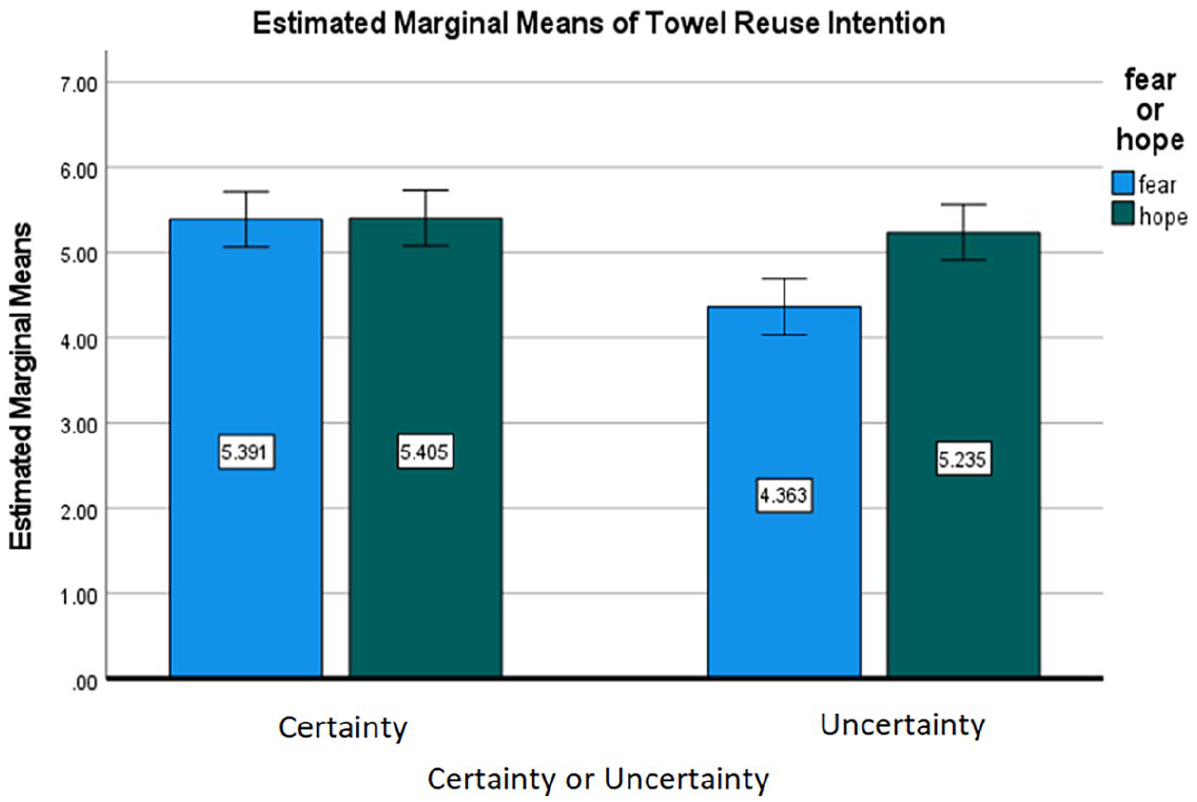
Means of the four experimental conditions.
Discussion
Understanding and managing incidental emotions is crucial for businesses in the tourism and hospitality industry, as emotions are often a key factor in decision-making and can significantly influence the overall travel experience (Walls et al., 2011). The Appraisal Tendency Framework (ATF) provides a theoretical foundation for understanding how individuals experiencing a specific emotion activate their cognitive predisposition to assess future events. In particular, the framework explains how individuals’ positive/ negative future-oriented incidental emotions (i.e., hope and fear) derived from unrelated or peripheral situations or events will shape their judgment and behaviors. For example, hope as an incidental emotion can arise from hotel guests’ positive experiences through greener hotel surroundings (e.g., rooftop gardens and green walls) stimulating the senses of sight, smell and hearing. By eliciting positive future-oriented emotions of hope, hotels can motivate guests with random chance-based rewards (i.e., uncertainty) to promote effective and sustainable behaviors. When offering uncertain rewards, such as lucky draws, respondents in the hope-framed condition have a stronger intention to participate in the towel reuse promotion. The findings suggest that using incidental emotions and rewards can be an effective way for hotels to promote sustainable behaviors among their customers.
Theoretical Implications
This study advances the understanding of the interplay effects between incidental emotions (fear vs. hope) and reward (un)certainty. The incidental emotions that are unconnected to the situation or context also exert a significant impact on sustainable behaviors (Andrade & Ariely, 2009). Promoting sustainable practices to hotel guests, such as towel reuse, can help reduce the hotel industry’s environmental impact and raise awareness about the importance of sustainability and environmental conservation. Using the context of towel reuse during hotel stays, this study contributes to the literature by examining the interaction effects of incidental emotions and reward (un)certainty. Individuals tend to be more risk-averse when experiencing fear and more risk-seeking when experiencing hope. Hope has the characteristic of future positive orientation: individuals are inclined to take chances for attainable outcomes and be more open to the unknown. When hope is paired with reward uncertainty, it can strengthen individuals’ cognitive appraisals of their sustainable behaviors. In other words, chance-based random rewards (i.e., uncertainty) can be desirable for individuals with a positive state of affective emotion (Goldsmith & Amir, 2010). It can also be explained using Hofstede’s cultural dimension of “Uncertainty Avoidance,” which is related to the degree of acceptance of uncertain or ambiguous situations (Hofstede, 2001). Hong Kong has a very low score of 29 on “Uncertainty Avoidance” compared with other collectivist countries/ regions, such as Japan (92), Korea (85), and Taiwan (69) in Asia (Insights, 2024). People with low “Uncertainty Avoidance” feel more hopeful and comfortable with ambiguity. Hence, they are willing to take risks for unknown outcomes (i.e., chance-based random rewards).
Tourists’ incidental emotions of fear can also be influenced when they encounter visible signs of negative surroundings (e.g., signs of environmental degradation). Knowing that tourists with fear tend to avoid risk-taking in their decision-making, guaranteed rewards (i.e., certainty) will be a better option to motivate them to participate in pro-environmental behaviors. This fills the gaps by examining the incidental emotions and rewards (un)certainty in the hospitality and tourism sector. By understanding the underlying mechanisms that drive the relationship between incidental emotions and decision-making, researchers can further develop theoretical models to understand individuals’ sustainable behaviors, which in turn can inform the development of more effective interventions and policies.
Managerial Implications
From a managerial perspective, the findings of this study provide insightful recommendations for businesses and managers for designing appropriate rewards for encouraging pro-environmental behaviors. Several strategies that hotels can use to ensure their sustainability initiatives are eliciting the desired incidental emotional responses from guests. For the immediate effect, environmental stimuli within the service scape can arouse incidental emotions (L. Su et al., 2018), potentially influencing customers’ perception in evaluating reward (un)certainty. Hotels can use the design of the physical environment to evoke positive emotions related to sustainability, such as incorporating green spaces, natural materials, and energy-efficient lighting in surroundings to create a sense of calm and well-being. The findings in this study show that hotels can utilize incidental emotions of hope and fear along with guaranteed and chance-based rewards (i.e., reward certainty and uncertainty) in pro-environmental promotions. For example, hotels can induce guests’ incidental emotions of hope by sharing and highlighting visions of sustainable initiatives on their official website or social media platforms to create a positive impact on the environment or local community. Maintaining a sense of optimism (even in uncertain circumstances), guests envision hope in future scenarios and, hence, have a high chance to accept uncertain rewards, such as lucky draws or surprise deals, to engage in eco-friendly behaviors. Chance-based rewards as variable promotional costs can reduce marketing expenses while effectively motivating customer behaviors (Goldsmith & Amir, 2010; Rahman & Reynolds, 2019). In addition, when guests perceive cities/areas that are unsafe or polluted, their incidental emotions of fear might be evoked. In this case, guaranteed rewards, such as fixed price discounts or rebates, would be a more effective incentive for hotels to promote sustainable behaviors.
In addition, hotels can also consider other aspects, such as advertising, digital touchpoints, and digital reward apps, that instill customers’ incidental emotions (Kemp et al., 2021; Straker et al., 2015; J. C. Wang et al., 2016). For example, smart hotels have leveraged artificial intelligence and technology to enhance customer experiences, focusing on sustainable operation efficiency (Sinha et al., 2021). Leveraging data analytics in reward apps, companies collect customers’ data points on communication messages (i.e., posts) through interactions such as comments, likes, and shares to detect their emotional cues of hope and fear. Based on customers’ responses, companies can predict and categorize them into different groups (e.g., hope or fear). They can now adjust incentive strategies that offer a mix of rewards to resonate with their emotional state.
Limitations and Future Study
This study confronts limitations that need to be acknowledged for future endeavors. First, this study used the intention to reuse towels as the outcome variable. This is one of the many forms of pro-environmental behaviors in the hospitality and tourism fields. Therefore, future studies can consider measuring and examining other types of pro-environmental behaviors. Second, this study's reliance on self-reported measures may lead to a weak conclusion because of the potential attitude-behavior gap. Together with self-reported behavioral data, a field experiment measuring actual behaviors is recommended for future research to validate the findings of this study. For example, the study of Nowak et al. (2023) had access to visitors’ actual donations as well as self-reported surveys to provide a comprehensive perspective to evaluate the norm nudges in tourists’ sustainable behaviors. Third, we recruited participants through a paid online panel service, and all participants were self-selected to participate in the research. The voluntary participation may suggest that participants are already interested in the environmental issue, which, in turn, may result in significant relationships in the end. Fourth, we did not distinguish between respondents staying alone or with others. Future research could explore how these factors may influence pro-environmental behavior in staycations.
Future studies may consider a more diverse and representative sample for investigation. In addition to personal emotions, future research may examine social emotions that arise in response to social interactions or situations with others. Taking others’ perspectives in the emotional experiences will impact their judgment and behaviors. Furthermore, the types of hotels (e.g., smart, luxury, or chain hotels) or hotels in different regions may have different energy-saving schemes or sustainable promotional strategies (Q. C. Wang et al., 2023). Future studies may compare companies’ strategies or customers’ sustainable behavior in various types of hotels. Future research may also explore how tourists’ cultural backgrounds and incidental emotions interact with reward types in promoting pro-environmental behaviors in different countries/ regions. For example, the quality of government providing more sustainable facilities and environments in public areas plays an important role in people’s pro-environmental behaviors (Kulin & Johansson Sevä, 2021).
Conclusions
The sustainability practices of hospitality and tourism businesses warrant particular attention because of the intense use of resources and potential impacts on the environment (Cerchione & Bansal, 2020). Encouraging pro-environmental behaviors in the hospitality and tourism sector can differ from that in the everyday context (Budovska et al., 2020), as hospitality and tourism businesses are used to provide a hedonic customer experience, which may be the barrier to motivating sustainable consumption. This study offers empirical evidence on how incidental emotions and reward (un)certainty influence the intention to reuse towels in a hotel. Although guaranteed rewards (i.e., certainty) are generally preferable by customers for engaging in pro-environmental behaviors, unknown rewards (i.e., uncertainty) would also be effective when paired with incidental emotions of hope. This study contributes to the literature by advancing the understanding of the interplay effect of incidental emotions and reward (un)certainty. Hotel companies and managers need to consider the feelings elicited by their service-scape and touchpoints in the hotel customer journey when formulating sustainable activities and the associated rewards.
Footnotes
Declaration of Conflicting Interests
The author(s) declared no potential conflicts of interest with respect to the research, authorship, and/or publication of this article.
Funding
The author(s) disclosed receipt of the following financial support for the research, authorship, and/or publication of this article: This research was fully supported by a grant from the Research Grants Council of the Hong Kong Special Administrative Region, China (Project No.: UGC/FDS24/H10/20).
Ethics Approval
All respondents in this study gave their informed consent prior to participating in the study.

Data Availability Statement
Authors elect not to share data.