




Abstract
The idea that nature has spiritual qualities is common across cultures. In North American samples, evidence supports a link between ecospirituality and pro-environmental outcomes. The generalizability of this claim, however, remains untested. A cross-cultural sample of religious individuals from 15 countries spanning 5 world religions (N = 11,186) is used to (1) estimate the association between ecospirituality and three pro-environmental outcomes: pro-environmental behavioural intentions, policy support, and financial donations; and (2) assess the pathways by which ecospirituality translates to pro-environmentalism. The results of pre-registered analyses showed ecospirituality positively predicted each of the pro-environmental outcomes similarly across diverse cultural and religious populations. Moreover, the associations between ecospirituality and pro-environmental outcomes were mediated by the same variables across cultures: (1) moral responsibility for nature, (2) gratitude to nature, and (3) self-efficacy over environmental issues. Ecospirituality unites diverse cultural worldviews in motivating care for nature, making it a potentially powerful foundation for global environmental stewardship.
Introduction
A growing body of psychological research is beginning to discover what anthropologists have argued to be true for many decades: When nature is construed as spiritually significant, it is treated with more care and respect. This seemingly straightforward proposal is not without its complications. Specific expressions of spiritual connections with nature – or ecospirituality – can look quite different across cultural and religious contexts. And thus, it is possible that ecospirituality shapes the human-nature relationship in different ways and via different mechanisms across these various cultural contexts. As a result, a general claim about the relationship between ecospirituality and environmental care requires evidence that can generalize to many different cultures – evidence that currently does not exist.
In this study, we survey 11,186 individuals from 15 culturally and geographically diverse countries spanning the five world religions to investigate the generalizability of the relationship between ecospirituality and multiple pro-environmental outcomes: Pro-environmental behavioural intentions, policy support, and financial donation behaviour. Results tell a clear story: Ecospirituality predicts pro-environmental outcomes across cultures. Even more, it does so via the same psychological mechanisms.
Ecospirituality and Pro-Environmental Outcomes
Many people around the world understand the connection between human life and the natural environment in spiritual terms. But what does this mean? Spirituality refers to “a search for or a relationship with the sacred” (Harris et al., 2018, p. 1). Humans treat all sorts of things as sacred when those things are felt to symbolize or be associated with divinity, holiness, transcendent beings, or one’s ultimate concerns and values (Pargament & Mahoney, 2005). A scripture can be sacred if it recounts the word of God; a day can be sacred if it symbolizes the completion of the creation of the cosmos. Ecospirituality refers to the phenomenon of individuals or groups treating aspects of nature – from a tree or a pebble to entire landscapes and the Earth itself – as something sacred (Billet et al., 2023; Billet, Baimel, et al., 2025).
Ecospirituality is core to the conservation ethics of cultures around the world (Selin, 2003) and is said to motivate the most devoted environmental advocates (Taylor, 2009). These observations suggest that ecospirituality would play some role in promoting care for the environment. Recent studies measuring individual differences in ecospirituality support this hypothesis. People who score highly on a self-report measure of ecospirituality tend to feel a greater personal obligation to ensure the welfare of natural entities, like forests and animals (Billet et al., 2023), and even report engaging in more pro-environmental citizenship behaviours, like writing letters to local politicians (C. J. M. White & Billet, 2024). These relationships are reliable; they are not attributable to constructs closely conceptually related to ecospirituality, like more generalized pro-environmental attitudes or religiosity (Billet et al., 2023); and have been observed using a different self-report measure of ecospirituality developed in Indian samples (Suganthi, 2020).
Pathways Between Ecospirituality and Pro-Environmental Outcomes
What explains this link between ecospirituality and environmental care? One idea comes from models of moral cognition that suggest that people feel a moral obligation to protect things that they believe to be sacred (Atran, 2016; Skitka et al., 2021; Tetlock, 2003). Just as destroying a bible would be a moral violation to a devout Christian, clear-cutting a forest would be a moral violation to a person who believes it to be sacred (of course, these actions don’t have intrinsic meaning – to a person who has never heard of Christianity, destroying a bible would not activate their moral cognition 1 .) According to this hypothesis, people greater in ecospirituality feel a responsibility to protect nature because harming nature is considered a moral transgression, and it is this sense of responsibility that explains how ecospirituality would promote pro-environmental behaviour (Billet et al., 2023; Billet, McPherson, et al., 2025).
A second idea is that ecospirituality activates relational cognitions by emphasizing the deep relationships between humans and nature (Atran & Medin, 2008; ojalehto et al., 2017). A non-relational perspective frames nature as raw resources that can be extracted, managed, and ultimately consumed to advance human welfare (Milfont & Duckitt, 2010). Such a relationship is guided by the rules of economic reasoning: “how much value does the forest have in terms of raw timber”, “what is the cost of extraction”, etc. However, a relational perspective frames nature as a partner in a social relationship. From this perspective, resources might be construed as gifts from nature (e.g., Kimmerer, 2013). Such a relationship is guided by social norms of reciprocity, which are regulated by social emotions that have evolved to maintain beneficial relationships between humans (Tam, 2022).
Gratitude, in particular, is a key social emotion that facilitates reciprocal prosocial relationships (Emmons et al., 2019; Lambert et al., 2009; Wood et al., 2008). Gratitude felt towards other people has been linked to prosocial reciprocal behaviour (Gordon et al., 2012; Ma et al., 2017; Nelson et al., 2022). But gratitude need not only be felt towards other people, it can also be felt towards all sorts of nonhuman agents with similar prosocial outcomes (Rosmarin et al., 2011; Tam, 2022; C. J. M. White et al., 2024). Spirituality – and the self-transcendent emotions associated with spirituality – have been linked to gratitude, as they orient people away from themselves and towards others (Wirtz et al., 2014; Yaden et al., 2017). One study found gratitude to partially mediate the link between ecospirituality and pro-environmental outcomes in the United States and in Singapore (C. J. M. White & Billet, 2024). That study did not assess other potential mediators, which may work independently of gratitude or otherwise account for it. According to this hypothesis, people greater in ecospirituality feel gratitude towards nature, which promotes concordant behavioural commitments to caring for nature.
Another pathway linking ecospirituality to pro-environmental behaviour is through a greater sense of efficacy over environmental issues. If nature is a complex physical system and its issues are the result of equally complex human systems, environmental issues can feel distant, impersonal, and uncontrollable (Markowitz & Shariff, 2012). However, if nature and humanity share a deep and personal connection, one’s impact on the environment may feel more direct (i.e., nature may feel psychologically closer, Trope & Liberman, 2010). Research on folkbiological reasoning suggests that psychological closeness to nature is greater in communities that emphasize interconnectedness and relatedness with nature, beliefs associated with ecospirituality (Bang et al., 2007; Unsworth et al., 2012). This idea resonates with the work of Taylor (2009, 2019, 2020) who argues that the most devoted environmental advocates – hence, those who most believe their actions can address environmental issues – share a “dark-green spirituality”, inspired by experiences of awe and wonder and feelings of connection and kinship with Earth and its living systems. According to this hypothesis, people greater in ecospirituality perceive greater efficacy over environmental issues, which explains why they tend to engage in more environmental care.
These three pathways reflect key ingredients of a prosocial orientation towards nature, in which nature is deserving of altruism, cooperation, and caregiving. Prosocial behaviour towards humans – acting in ways that benefit others – is promoted by various kinds of appraisals, values, and emotions (Keltner et al., 2014), including norms of moral responsibility (Cialdini & Trost, 1998), feelings of gratitude (McCullough et al., 2001), and appraisals of self-efficacy (Caprara et al., 2012). The likelihood of helping others in any given scenario can be modelled as a function of these and other key ingredients, which shape the perceived costs and benefits of helping versus not helping others (Keltner et al., 2014). Cultural systems, like the world’s major religions (Cohen, 2009), can amplify these key ingredients through shared norms, values, stories, and rituals that justify and reward prosocial behaviour (Armstrong, 2009).
Likewise, in many cultures, a prosocial orientation towards nature is justified by ecospiritual beliefs about humanity’s connection with nature, such that because we are spiritually connected with nature, benefits gained from nature are gifts deserving of gratitude, which we have a responsibility to reciprocate (Anderson & Pierotti, 2022; Selin, 2003). These concepts tend to go hand-in-hand. Take, for example, this description of the conservation principles of the Coeur d’Alene peoples of northern Idaho by Frey (2001, pp. 9–12, as quoted in Anderson & Pierotti, 2022): “. . .the understanding that the landscape is spiritually created and endowed. . .that the landscape is inhabited by a multitude of ‘Peoples,’ all of whom share in a common kinship. . . .That. . .[humans have an] ethic of sharing [which includes the animal people too]. . .that. . .the gifts [of nature] are also to be respected and not abused. . .and. . .one is to show thanks for what is received”.
One additional pathway might be considered here. Ecospirituality may promote environmental outcomes through participation in nature-based rituals. Rituals are events in which “more or less invariant sequences of formal acts and utterances not entirely encoded by the performers” are performed (Rappaport, 1999, p. 24). Rituals themselves can directly regulate the relationship between humans and the natural environment – a ritual feast, for example, can return the local pig population to equilibrium (Rappaport, 1968). But rituals can also mediate the relationship between belief and behaviour by reinforcing the importance of cultural values and norms, both in those who participate in the ritual and in those who observe the ritual (Hobson et al., 2017). Research on how humans treat other humans has found that religious participation is a better predictor of prosociality than religious belief (Kelly et al., 2024). This hypothesis suggests that ecospiritual ritual participation will better predict how humans treat nature than ecospiritual belief, as ritual indicates people’s commitment to the underlying belief.
The Need for Cross-Cultural Methods
Cross-culturally, there are a multitude of ways to be ecospiritual. Even within a single religious tradition the specific content of people’s spiritual beliefs about nature can differ. For example, the Christian belief that nature is God’s gift to humanity can be interpreted from a stewardship perspective (humans are the caretakers and protectors of nature) or a dominion perspective (humans are the masters and subduers of nature), the former being associated with greater environmental care (Eom & Ng, 2023; Shin & Preston, 2021; L. White, 1967). Across religions the differences become dramatic: Nature could be God’s creation, a god (or gods) itself, or spiritually connected to humans through some shared essence (Selin, 2003).
Cross-cultural methods are beginning to map out the ways in which differences in religious belief and practice can shape individual psychology and behaviour, including in the domains of morality (Cohen & Rozin, 2001), cooperation (Norenzayan et al., 2016), and environmental decision-making (Preston & Baimel, 2021). However, those same methods are also identifying the ways in which an underlying religious psychology unites individuals across religions and cultures (Hoogeveen et al., 2022; Saroglou, 2003; Saroglou & Cohen, 2011; Van Tongeren et al., 2021; C. J. M. White et al., 2021). The concept of “ecospirituality” implies that there is a common thread that unites these disparate cultural conceptions of nature, but this has not yet been empirically verified. The way ecospirituality operates psychologically may differ cross-culturally, making some pathways discussed above more relevant to one cultural context compared to another. Any broad claim about the benefits of ecospirituality for environmental care must contend with these issues, ideally, by drawing on observations from culturally and religiously diverse populations.
Study Overview
In this study, we assess the relationship between ecospirituality and three pro-environmental outcomes – pro-environmental behavioural intentions, policy support, and donation behaviour – in a large cross-cultural sample of 15 countries spanning the 5 world religions. The countries sampled cover a wide area of geographical space (i.e., six continents) as well as a large range of cultural variability, allowing us to assess the generalizability of key relationships. In addition, we examine the four mediating pathways between ecospirituality and environmental outcomes: moral responsibility to nature, gratitude to nature, self-efficacy over environmental issues, and nature-based ritual.
The analysis plan is guided by the following preregistered hypotheses:
A Note on Methodology, Causal Assumptions, and Transparency
Ultimately, the effect of interest is whether ecospirituality causes people to care more about the environment. Inferring causal effects from observational data is difficult because of confounding: The presence of a common cause (otherwise known as a third variable) that affects the independent and dependent variables. Confounding can introduce spurious correlations between variables. Without addressing confounds, these spurious correlations can be mistaken for causal effects. However, if all confounds are controlled for in a statistical model, then the estimated effect reflects the true causal effect. The challenge is in selecting the appropriate control variables in a statistical model that unconfound an association (thoughtlessly entering a control variable may even introduce additional confounding in some cases!)
One way to approach unconfounding is by using directed acyclic graphs (DAGs, Pearl, 2000; Rohrer, 2018). DAGs are one way for researchers to formalize an assumed causal web that underlies the variables of interest. A DAG involves variables and unidirectional causal connections between them. A DAG assumes that all relevant variables are included and that all unidirectional causes are accurate depictions of reality (These are difficult assumptions to meet, but all analyses rely on assumptions and importantly these assumptions are transparently formalized in a DAG.) Once a DAG is designed, researchers can deduce the appropriate statistical control variables for each analysis of interest (the arithmetic for which is automated in programs like www.dagitty.net). The estimated effect, therefore, will reflect the causal effect of interest given the assumptions of one’s DAG of choice (assumptions for which other researchers may or may not judge sufficiently realistic with varying degrees of confidence.)
In this study, we rely on a DAG (Figure 1) to select statistical control variables with the aim of estimating causal effects. Justifications for each causal arrow in the DAG are provided in the Supplemental Material. This DAG was preregistered – along with our hypotheses and analysis plans – prior to data analysis on the Open Science Framework: https://osf.io/n5uga/. Deviations from the preregistration are indicated in the manuscript. Data, analysis scripts, and a complete set of survey materials (including those not pertinent to the present study) are provided on the Open Science Framework page. All procedures were approved by the university’s behavioural research ethics board (H16-02712) and were compliant with participant privacy rights, informed consent, and relevant laws and institutional guidelines.
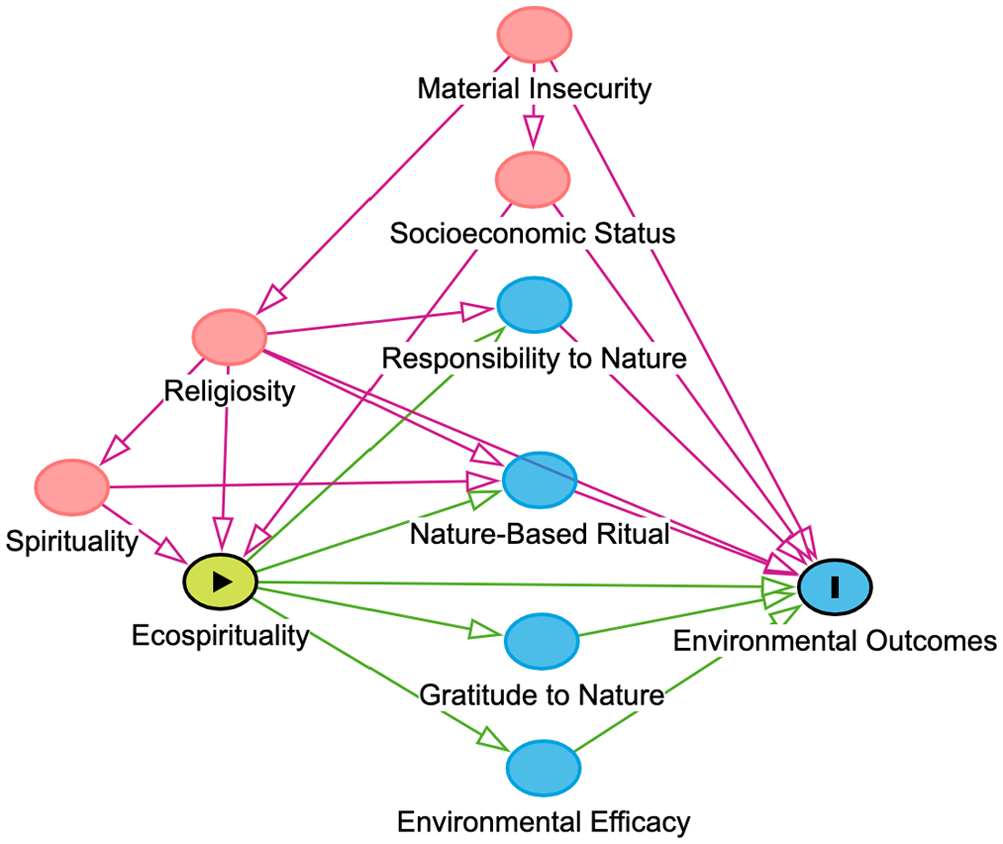
Directed acyclic graph (DAG) stating the causal assumptions behind the planned analyses.
Methods
Participants and Procedures
Participants (N = 11,186) were recruited to participate in an online survey in exchange for payment through Qualtrics’ panel service. Qualtrics partners with web-based panel providers to supply access to a large global pool of participants who have opted-in to be contacted about opportunities to complete surveys. All surveys were completed online. Participants were compensated for their time in line with their agreement with Qualtrics and their partners (exact compensation varied by country but were typically around £5.00. One participant per country also received a bonus payment with regards to their decisions in the donation task.) Participants were sampled from the predominant religious affiliation in 15 countries: Christians in Argentina, Brazil, the Philippines, South Africa, South Korea, and the United Kingdom; Muslims in Egypt, Indonesia, Nigeria, and Pakistan; Hindus in India; Jews in Israel, and Buddhists in Singapore, Taiwan and Thailand. The strategy to sample from the predominant religion in each country was largely a practical matter – in some countries, the predominant religion constitutes an overwhelming majority of the country’s population (e.g., 79% of the Philippines is Catholic), which makes the recruitment of the religious minorities prohibitively expensive. Participants were able to select their preferred language for the survey, which was professionally translated into languages most common to the sample populations (Arabic, English, Hebrew, Hindi, Indonesian, Korean, Portuguese, Spanish, Tagalog, Thai, Urdu.) Sample size was determined based on the requirements of an unrelated project and provides 80% power (α = .05) to detect small correlation coefficients (r ~ .10) within each country.
To be included in the survey, participants were required to affiliate with the predominant religion in their respective country and to have indicated that they believe in a god/gods/higher power/life-force/spiritual being of some kind (item from ISSP Research Group, 2020; complete item wording available in the open study materials.) Qualtrics also performed response-quality screening, removing participants based on an explicit question about giving honest responses, a textual attention check, straight-lining responses, gibberish/nonsensical responses to open-ended questions, speeding, and repeat participation (participants excluded for these reasons were replaced at the time of data collection by Qualtrics until quotas were met for recruitment.) Data collection was completed over May and June 2023.
For the purposes of an unrelated project, participants were randomly assigned to one of three conditions prior to survey completion that manipulated survey order and religious framing. In the control condition, participants completed the pro-environmental outcome measures before the rest of the survey. In the survey order condition, participants completed some survey items before the pro-environmental outcome measures. In the religious framing condition, participants were asked to “think about what God would want you to do” before completing some survey items, followed by the pro-environmental outcome measures. These conditions were not designed to manipulate ecospirituality. Since no results changed controlling for experimental condition, it is not discussed further. Sample characteristics are presented in Table 1.
Sample Characteristics by Country.
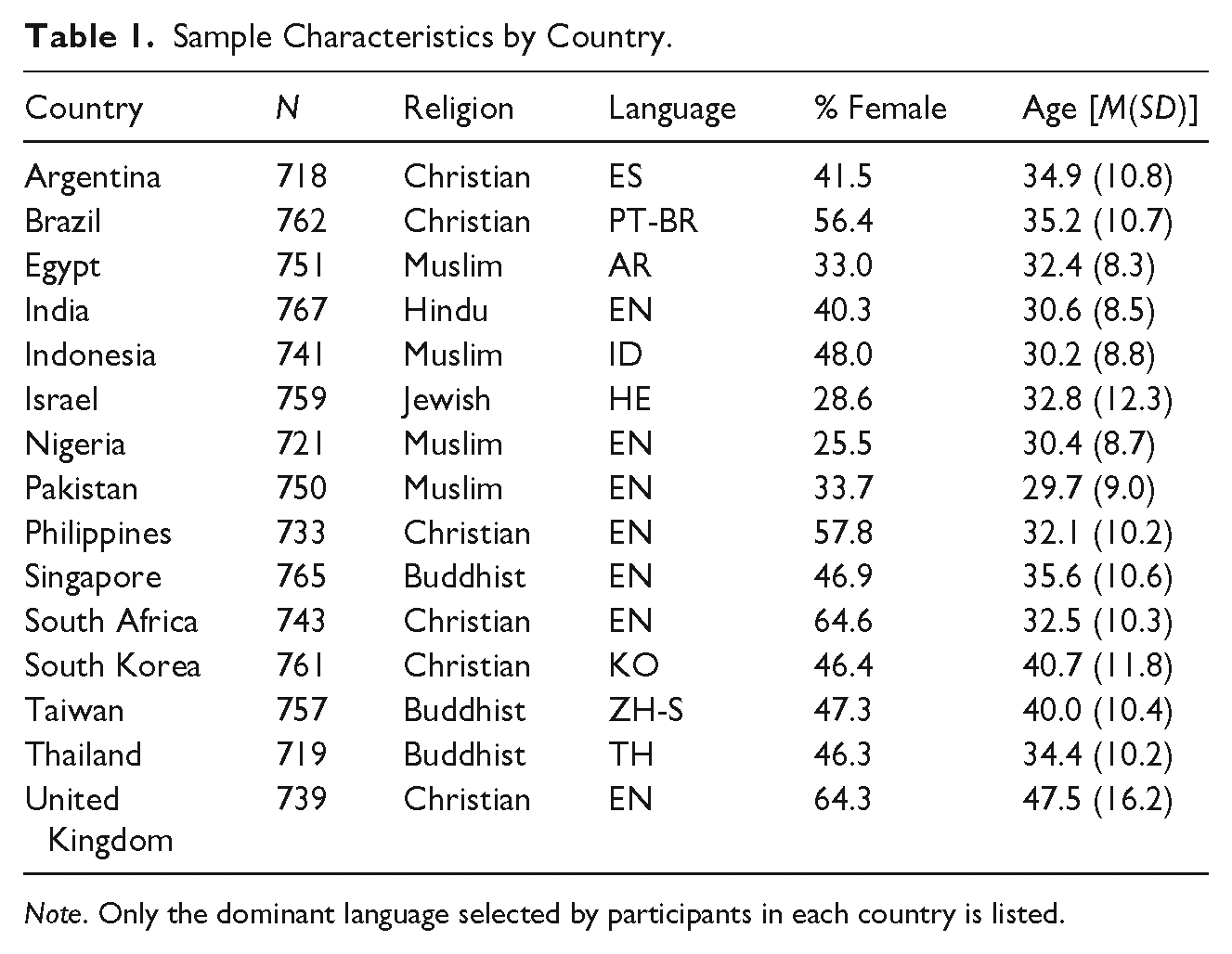
Note. Only the dominant language selected by participants in each country is listed.
Materials
Ecospirituality was assessed using the eight-item self-reported Ecospirituality Scale (Billet et al., 2023). The measure includes four items assessing spiritual perceptions of nature (e.g., “Nature is a spiritual resource”) and four items assessing spiritual experiences in nature (e.g., “When I am in nature, I feel a sense of awe”.) Participants reported agreement with each item on a 7-point scale (strongly disagree – strongly agree) and the mean of all items was computed (α = .89).
Pro-environmental outcomes were assessed using two self-report measures of pro-environmental preferences (behavioural intentions and policy support) and a behavioural measure (donation task.)
Pro-Environmental Behavioural Intentions were assessed using the 24 self-report items from Bain et al. (2016). The measure includes 12 items assessing civic behaviours (e.g., “Sign a petition in support of protecting the environment”) and 12 items assessing personal behaviours (e.g., “Buy environmentally-friendly products”.) Participants reported how likely they would be to perform each behaviour in the next year on a 7-point scale (extremely unlikely – extremely likely) and the mean of all items was computed (α = .96).
Pro-Environmental Policy Support was assessed using four items (similar in style to Milfont & Duckitt, 2010). The items read, “I would agree with the government if they made new legal restrictions that required changes in my everyday behaviour in order to protect the environment”, “I would support new government regulations if they helped limit my religious community’s impact on the environment”, “I would support the government in more strictly regulating the way businesses and industry use natural resources”, and “I would support policies that compel business/industries to protect the environment”. Participants rated agreement on a 7-point scale (strongly disagree – strongly agree) and the mean of all items was computed (α = .85).
A Donation Task (Bain et al., 2016) was used to assess participants’ willingness to donate their own money to support a pro-environmental organization. Participants were informed that they would be entered into a raffle for a £200 cash prize for completing the survey. Participants reported the proportion of the prize – if they were to win the raffle – they would be willing to donate to a pro-environmental organization on their behalf (and were given the opportunity to specify an organization by name.) A percentage score from 0 (keep all money) to 100 (donate all money) was recorded. There was one draw per country, and all the money was sent to the winner (response anonymization restricted the linking of contact information to participant responses on this item.)
Four potential mediators that might explain an association between ecospirituality and pro-environmental outcomes were assessed using self-report measures of responsibility to nature, gratitude to nature, environmental efficacy, and participation in nature-based rituals.
Responsibility to Nature was assessed using one item capturing personal responsibility to nature (“It is my personal responsibility to do what I can to limit my impact on the natural world and protect the environment”) and one item capturing perceptions of one’s religious community’s responsibility to nature (“Most people in my religious community would agree that it is their personal responsibility to limit their impact on the natural world and protect the environment”.) Participants reported agreement on a 7-point scale (strongly disagree – strongly agree) and the mean of the items was computed (α = .70).
Gratitude to Nature was assessed using four items (similar in style to Tam, 2022). The items read, “I am thankful for what nature provides for us”, “I try to find ways to express my gratitude for the natural world in my everyday life”, “We should all be more thankful for what the natural world provides for us”, and “My religion reminds me to be thankful for what nature provides for me and my community”. Participants reported agreement on a 7-point scale (strongly disagree – strongly agree) and the mean of all items was computed (α = .86).
Environmental Efficacy was assessed using four items. Two items captured self-efficacy: “I consider myself capable of limiting the impact I have on the environment” and “My personal behaviour can contribute to solving environmental problems”. Two items captured perceptions of one’s religious community’s efficacy: “My religious community is capable of limiting its impact on the environment” and “My religious community can, in working together, contribute to solving environmental problems”. Participants reported agreement on a 7-point scale (strongly disagree – strongly agree) and the mean of all items was computed (α = .87).
Nature-Based Rituals. Participants were asked “How often do you perform any of the following” nature-based rituals: “Pray for or about the natural world”, “Pray for people facing the consequences of environmental problems”, “Perform religious rituals outside in nature”, “Perform religious rituals to honour or show my gratitude to the natural world”, and “Perform religious rituals to honour God’s creation”. Participants selected one of the following responses for each ritual on a 5-point scale: never, a few times per year, once a month, weekly, every day or more than once a day. The mean of all items was computed (α = .88).
We designed a directed acyclic graph (DAG; Pearl, 2000; Rohrer, 2018) to inform our choice of covariates (Figure 1). We identified four potential confounders in the association between ecospirituality and pro-environmental outcomes: Subjective socioeconomic status, material insecurity, religiosity, and spirituality.
Subjective Socioeconomic Status was assessed using a graphic 10-rung ladder (Adler et al., 2000), in which participants reported their perceived socioeconomic standing in relation to others “in society”. At the top of the ladder are “the people who are the best off, those who have the most money, most education, and the best jobs”, while at the bottom are “the people who are the worst off, who have the least money, least education, worst jobs”.
Material Insecurity. Participants were asked, “Do you worry that your household will not be able to meet its basic needs (e.g., access to food, employment, housing) at some time in the next [month/six months/year/five years]”. For each of the time windows, participants could select (0) No or (1) Yes. The mean of the four items was computed (α = .84).
Religiosity was assessed using three self-report items. The first two items assessed religious self-identification (“I am a religious person” and “I consider myself committed to the teachings of my religion”.) Participants reported agreement on a 7-point scale (strongly disagree – strongly agree.) The third item assessed religious service attendance, which participants reported on a 9-point scale (never, less than once a year, once or twice a year, several times a year, once a month, 2 to 3 times a months, about once a week, several times a week, daily.) Responses on the three items were standardized as z scores to allow combination across differing response scales, then the mean was computed (α = .79).
Spirituality was assessed with a single item (“I am a spiritual person”) based on similar one-item measures used in culturally diverse samples (e.g., Johnson et al., 2024; Park et al., 2021), to which participants reported agreement on a 7-point scale (strongly disagree – strongly agree.)
Results
Measurement Invariance Analyses and Mean Ecospirituality Across Cultures
We assessed the degree of measurement invariance exhibited by the Ecospirituality Scale across the 15 samples collected in this study (Kline, 2016; Schmitt et al., 2011; van de Schoot et al., 2012). A previous study found the original English version of the Ecospirituality Scale to be scalar invariant (equivalent factor loadings and item intercepts, which allows for the direct comparison of group means) between an American sample and a Singaporean sample, and across five religious denominations within a Singaporean sample (Billet et al., 2023). In this study, the Ecospirituality Scale was metric invariant (equivalent factor loadings) across the 15 countries, which allows for tests of predictive relationships to be compared across samples (the other key measures also achieved metric invariance, see Supplemental Material for complete details.)
To compare levels of ecospirituality across countries, we sought to establish partial scalar invariance by progressively relaxing invariance constraints on item intercepts with the largest modification indices until model fit stabilized (i.e., backward-selection approach; Yoon and Millsap, 2007). Accurate estimates of relative group means can then be retrieved from the latent factor scores of the partially scalar invariant model (Byrne et al., 1989; Luong & Flake, 2023). After freeing the intercepts for items 6 (“When I am in nature, I feel a sense of awe”) and 7 (“Sometimes I am overcome with the beauty of nature”), we achieved acceptable fit according to Chen’s (2007) cutoff for RMSEA (ΔRMSEA = 0.014) but not for CFI (ΔCFI = −0.029). After freeing the intercepts for items 6, 7, 8 (“There is nothing like the feeling of being in nature”), 2 (“There is sacredness in nature”), 3 (“Everything in the natural world is spiritually interconnected”), and 4 (“Nature is a spiritual resource”), we achieved acceptable fit on both cutoffs (ΔRMSEA = 0.006; ΔCFI = −0.008). The observed scale means and the factor scores from these two partially invariant model solutions are presented in Figure 2.
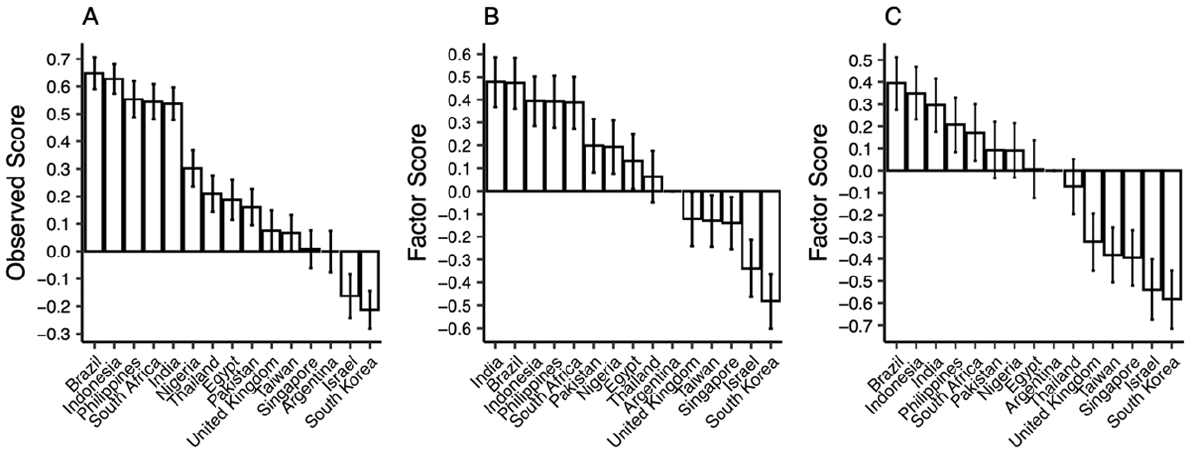
Country means of ecospirituality from observed scores and from two partially invariant factor models.
Descriptive Statistics
Means and standard deviations of all variables, as well as indicators of their variability across countries, are provided in Table 2. Bivariate correlations between variables and the standard deviation of these correlations across countries are provided in Table 3. Variables show a fair degree of variability (standard deviation equal to approximately one scale point), although some variables in some countries are near ceiling. Patterns of correlations appear intuitive and commensurate with the logic of our pre-registered hypotheses. Variable means and their intercorrelations display some variance across countries. Furthermore, intraclass correlations obtained from intercept-only mixed-effects models with random intercepts for country suggest that ecospirituality (ICC = 0.08), behavioural intentions (ICC = 0.17), policy support (ICC = 0.12), and donation behaviour (ICC = 0.05) all cluster within countries above the rule-of-thumb threshold of 0.05, in which the estimates of a mixed-effects model that accounts for the nested structure of the data (i.e., participants within countries) are likely to differ from those of a fixed-effects only model.
Descriptive Statistics of Variables.
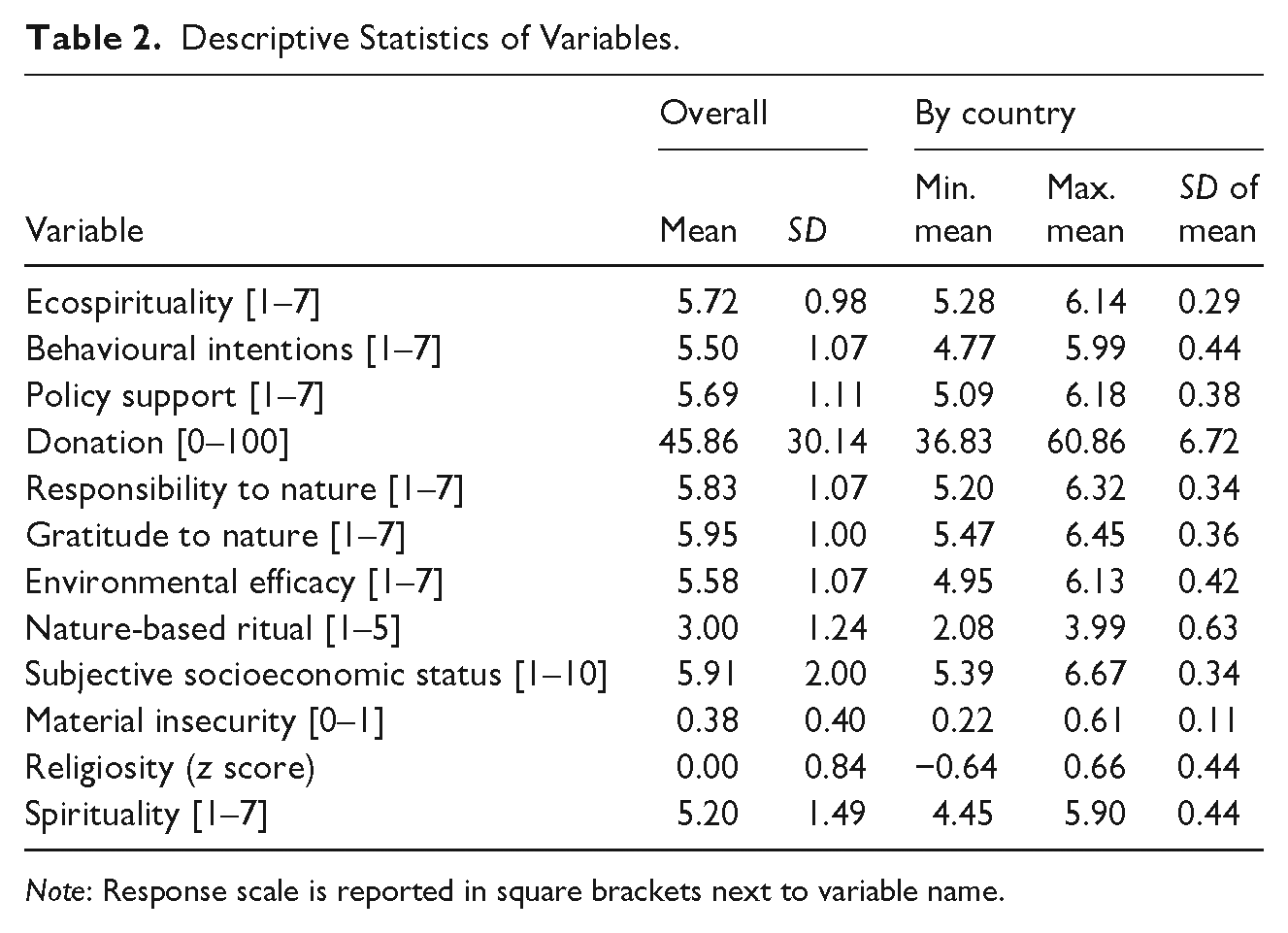
Note: Response scale is reported in square brackets next to variable name.
Bivariate Correlations Between Variables.
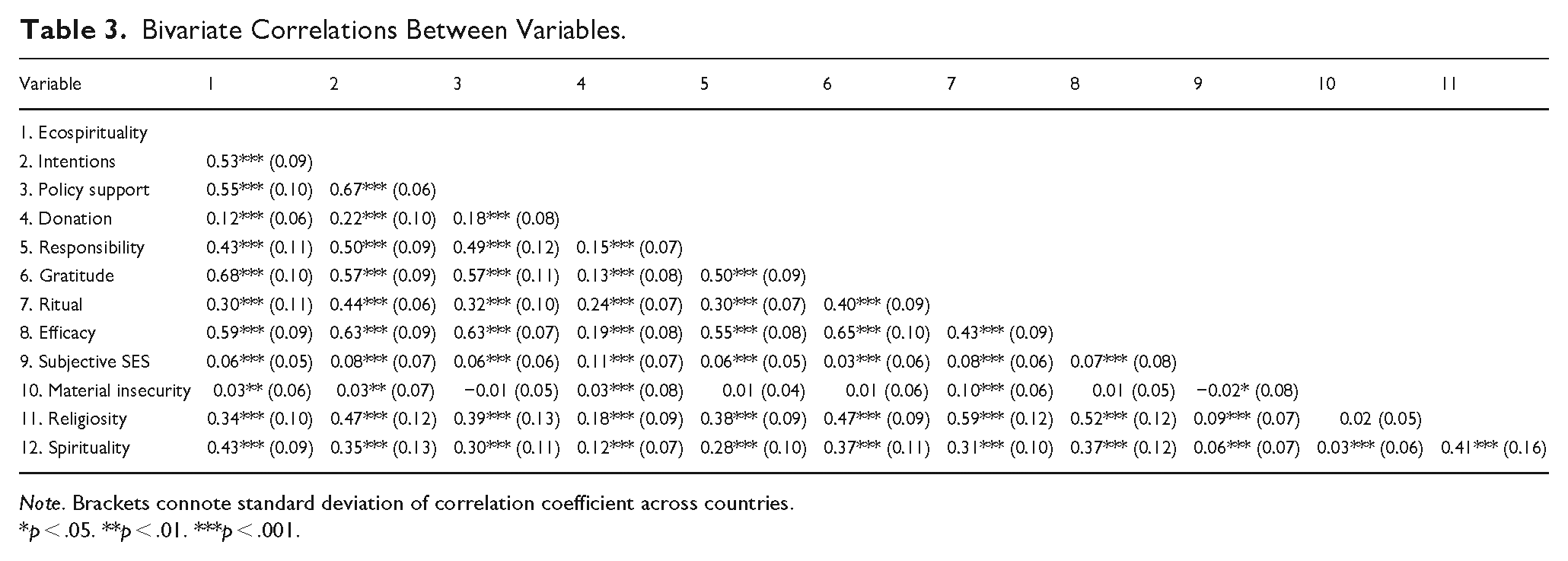
Note. Brackets connote standard deviation of correlation coefficient across countries.
p < .05. **p < .01. ***p < .001.
The Effect of Ecospirituality on Pro-Environmental Outcomes Across Countries
Hypothesis 1 stated that ecospirituality will be positively associated with all three pro-environmental outcome variables, controlling for potential confounds. The pre-registered analysis plan called for the use of mixed-effects models nesting participants within country with a random intercept and random slope for ecospirituality. Pre-registered covariates (selected based on the causal assumptions outlined in Figure 1) included subjective socioeconomic status, religiosity, and spirituality. We departed from the pre-registration by group-mean-centring each predictor variable within country to disentangle the within-country effects from the between-country effects. This adjustment did not change the fixed-effects coefficient estimates in any meaningful way.
Model outputs are presented in Table 4 and visualized in Figure 3. Results supported the hypothesis, indicating that ecospirituality was moderately associated with pro-environmental behavioural intentions (β = 0.39 [0.35, 0.43], p < .001) and pro-environmental policy support (β = 0.45 [0.40, 0.50], p < .001). To put the effect sizes into context, a participant one standard deviation below the mean ecospirituality score is expected to score a 5.2/7 on pro-environmental policy support, while a participant one standard deviation above the mean ecospirituality score is expected to score a 6.2/7, a full scale-point increase. Ecospirituality only weakly correlated with pro-environmental donation behaviour (β = 0.04 [0.01, 0.07], p = .010). Preregistered follow up analyses indicated that neither subjective socioeconomic status (β = −0.01 [−0.01, 0.02], p = .45) nor material insecurity (β = −0.02 [−0.05, 0.01], p = .29) moderated the relationship between ecospirituality and donation behaviour, as might be expected if donation behaviour was shaped by participants’ financial constraints. These effects showed little variability across countries.
Results for Models Assessing the Adjusted Associations Between Ecospirituality and Pro-Environmental Outcomes.
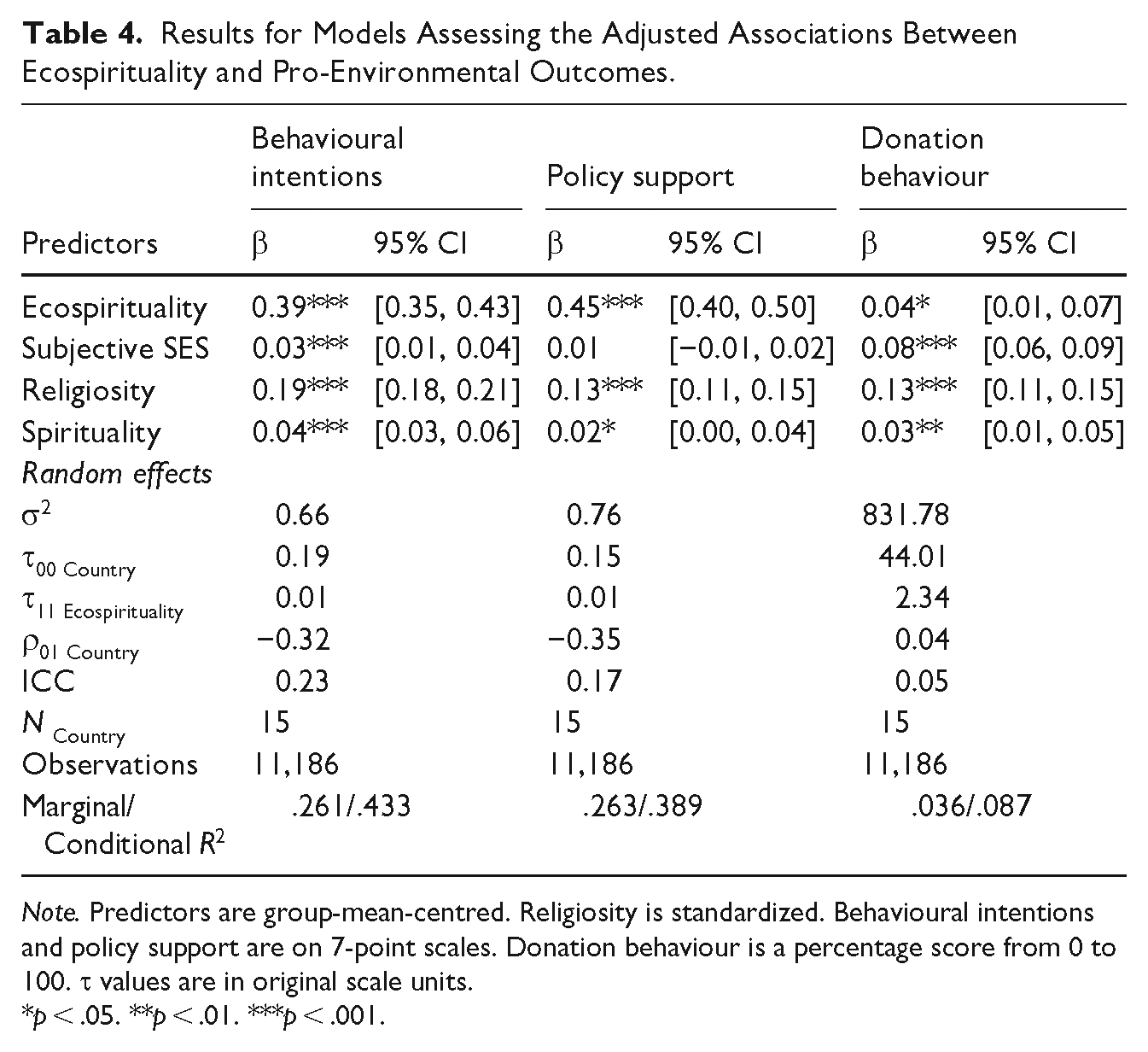
Note. Predictors are group-mean-centred. Religiosity is standardized. Behavioural intentions and policy support are on 7-point scales. Donation behaviour is a percentage score from 0 to 100. τ values are in original scale units.
p < .05. **p < .01. ***p < .001.
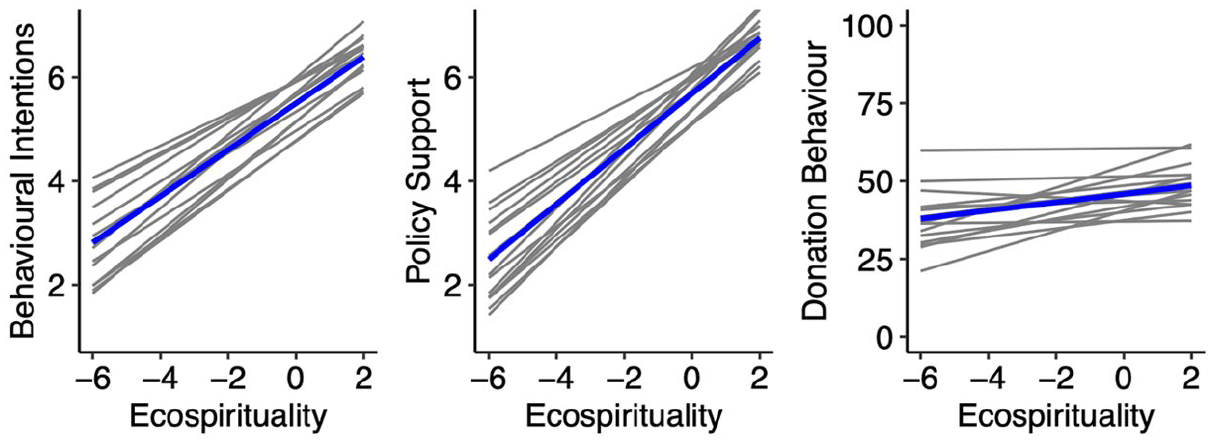
Average relationship between ecospirituality and pro-environmental outcomes with controls (blue) and country-specific relationships (gray.)
Mediating Pathways from Ecospirituality to Pro-Environmental Outcomes
Hypothesis 2 examined the potential mediating pathways between ecospirituality and pro-environmental outcomes, stating that the associations between ecospirituality and all three pro-environmental outcome variables will be reduced or eliminated, controlling for potential mediating pathways. The pre-registered analysis plan called for the use of mixed-effects models nesting participants within country with a random intercept and random slope for ecospirituality. Pre-registered covariates (selected based on the causal assumptions outlined in Figure 1) included the potential mediators – responsibility to nature, gratitude to nature, environmental efficacy, and nature-based ritual – as well as subjective socioeconomic status and religiosity. Again, we departed from the pre-registration by group-mean-centring all predictors. Model outputs are presented in Table 5. Results supported this hypothesis, indicating that the potential mediators reduced the associations between ecospirituality and behavioural intentions (β = 0.39 to 0.17) and policy support (β = 0.45 to 0.19), and eliminated the association between ecospirituality and donation behaviour (β = 0.04 to −0.01).
Results for Models Assessing the Adjusted Associations Between Ecospirituality and Pro-Environmental Outcomes, Controlling for Potential Mediators.
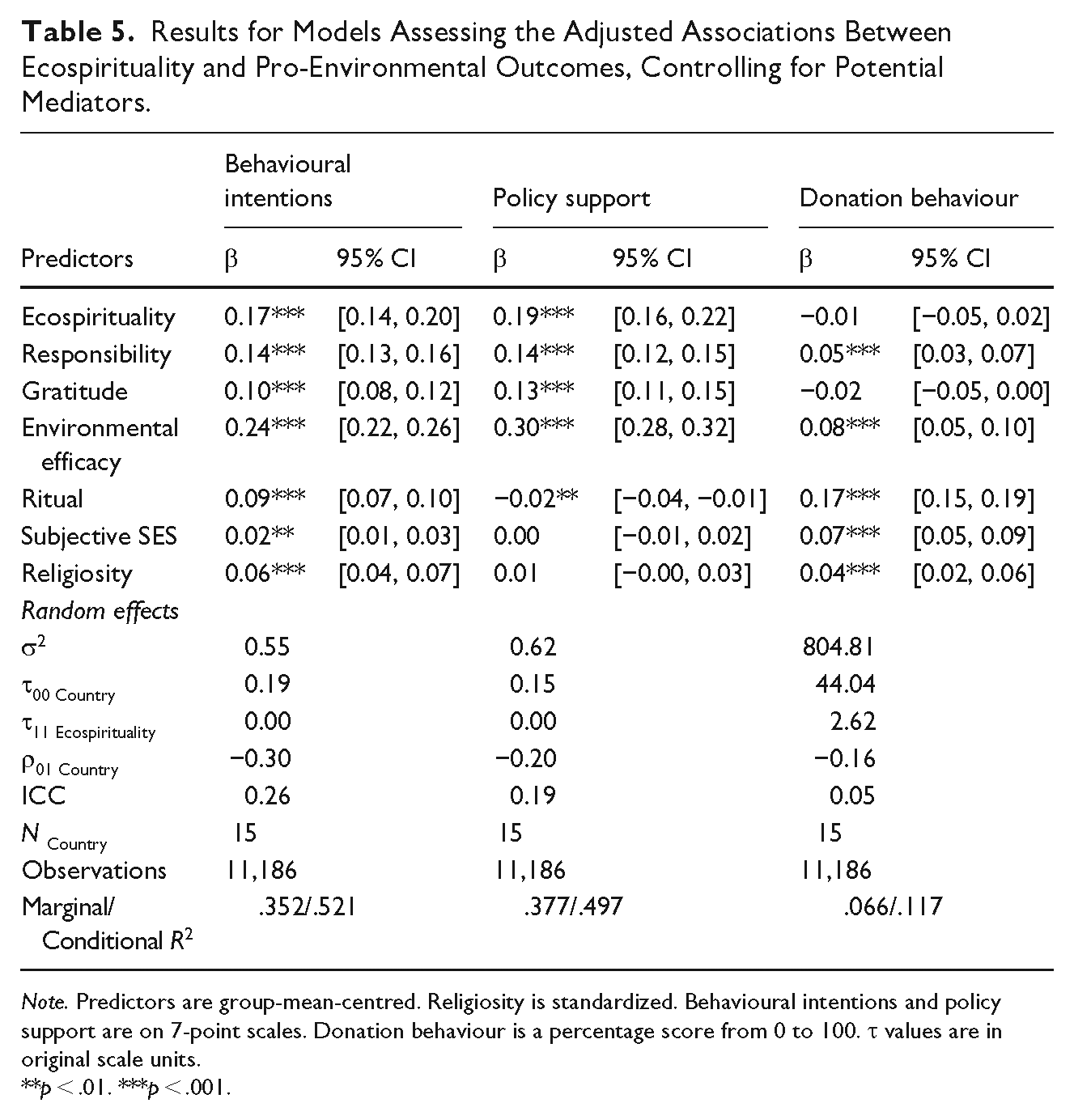
Note. Predictors are group-mean-centred. Religiosity is standardized. Behavioural intentions and policy support are on 7-point scales. Donation behaviour is a percentage score from 0 to 100. τ values are in original scale units.
**p < .01. ***p < .001.
We inspected the indirect paths for each mediator to determine the magnitude of each hypothesized pathway from ecospirituality to pro-environmental outcomes (Table 6). The structural equation models followed the specifications of our DAG (Figure 1) with dummy-coded fixed-effects for country, and showed the following global fit metrics for behavioural intentions (CFIrobust = 0.83, RMSEArobust = 0.08, SRMR = 0.04), policy support (CFIrobust = 0.83, RMSEArobust = 0.08, SRMR = 0.04), and financial donation (CFIrobust = 0.79, RMSEArobust = 0.08, SRMR = 0.04). For pro-environmental behavioural intentions, environmental efficacy showed the strongest indirect effect (β = 0.14 [0.13, 0.15]), followed by gratitude (β = 0.07 [0.06, 0.08]), responsibility (β = 0.05 [0.04, 0.06]), and nature ritual (β = 0.01 [0.01, 0.01]). Similarly, for pro-environmental policy support, environmental efficacy showed the strongest indirect effect (β = 0.18 [0.16, 0.19]), followed by gratitude (β = 0.09 [0.07, 0.11]), responsibility (β = 0.05 [0.04, 0.05]), and nature ritual (β = −0.00 [−0.00, −0.00]). For donation behaviour, indirect paths were generally weaker: Environmental efficacy (β = 0.04 [0.03, 0.06]), nature ritual (β = 0.02 [0.01, 0.02]), responsibility (β = 0.02 [0.01, 0.03]), and gratitude (β = −0.01 [−0.03, 0.00]). Results were fairly consistent across countries, suggesting ecospirituality promotes pro-environmental outcomes through similar psychological pathways across cultures (see Supplemental Material for results across country-specific models.)
Results for Path Models Assessing Mediational Pathways Connecting Ecospirituality to Pro-Environmental Outcomes.
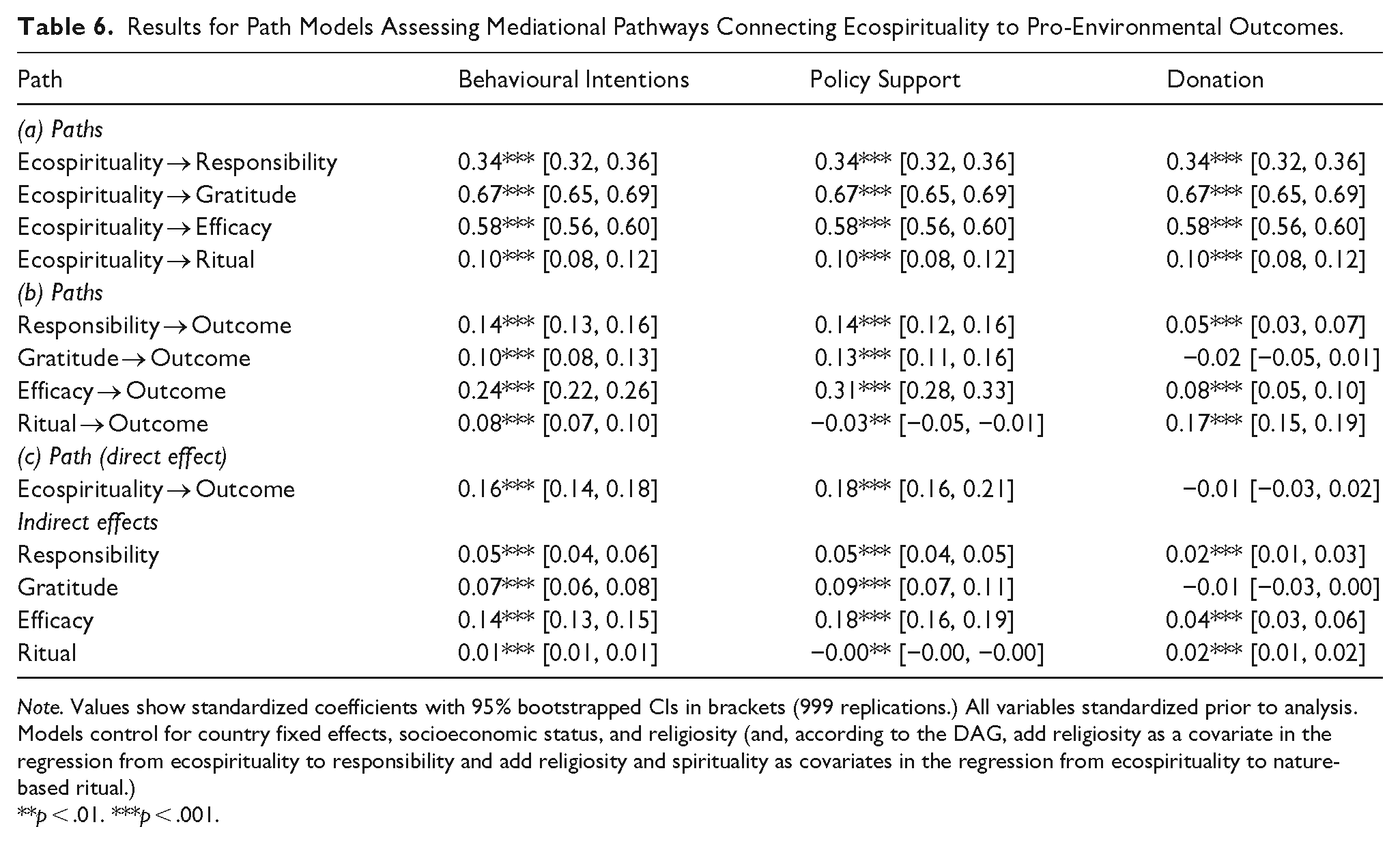
Note. Values show standardized coefficients with 95% bootstrapped CIs in brackets (999 replications.) All variables standardized prior to analysis. Models control for country fixed effects, socioeconomic status, and religiosity (and, according to the DAG, add religiosity as a covariate in the regression from ecospirituality to responsibility and add religiosity and spirituality as covariates in the regression from ecospirituality to nature-based ritual.)
**p < .01. ***p < .001.
General Discussion
Is the relationship between ecospirituality and pro-environmental outcomes generalizable across diverse geographical, cultural, and religious samples? Results from samples representing 15 countries and 5 world religions showed that ecospirituality predicted greater pro-environmental behavioural intentions and policy support and, to a lesser degree, willingness to donate to an environmental organization.
The relationship between ecospirituality and pro-environmental outcomes showed a notable lack of variation across samples that differed dramatically in their religious beliefs. One interpretation of this finding is that the cultural content of people’s spiritual beliefs about nature matters less than the intensity of belief – what exactly one believes about humans’ spiritual connection with nature matters less than how much one believes in that connection. However, this interpretation is at odds with previous work showing that the content of religious beliefs about nature do, in fact, matter (Preston & Baimel, 2021). For example, Christians who believe in religious stewardship over nature report greater environmental concern than those who believe in religious dominion over nature – both are ostensibly “spiritual” orientations towards the human-nature relationship, defining nature as God’s creation and gift to humanity (Eom et al., 2021).
A different interpretation is that ecospirituality promotes a prosocial orientation towards the natural world that is compatible with the worldviews of various world religions. Specifically, ecospirituality promotes the sense that the self and nature are relational partners, and that both parties have the power to help and to harm, so that benefits from nature ought to be received with a sense of gratitude, and that one is responsible to reciprocate these benefits. Results pertaining to potential mediators supported this interpretation. Efficacy over environmental issues, responsibility to nature, and gratitude to nature were found to partially mediate the relationship between ecospirituality and environmental outcomes, and these relationships showed little variance across diverse cultural and religious contexts.
This explanation would entail additional testable consequences. If ecospirituality promotes a prosocial orientation towards nature, we would expect other social and self-transcendent emotions that regulate cooperative relationships – like compassion, awe, shame, and guilt – to be characteristic of people’s spiritual relationships with nature (Stellar et al., 2017; Van Kleef & Lelieveld, 2022; Zelenski & Desrochers, 2021). It is possible that an analysis accounting, not just for gratitude, but for other social and self-transcendent emotions would more fully explain the link between ecospirituality and environmental care (see Ng & Eom, 2024 for related work.)
Another testable consequence follows from the claim that ecospirituality promotes a prosocial orientation to nature through a greater psychological closeness to nature. If true, then we would expect that, just as helpful actions towards nature feel more impactful, so should harmful actions. Some evidence currently exists that supports this hypothesis. In a study of university students, participants who scored particularly high on self-reported ecospirituality also tended to refuse causing harm to nature for any amount of money (Billet, McPherson, et al., 2025). Some of these actions were quite minor in their relative severity (e.g., “Spit gum on the ground instead of the trash can”), and the refusal to consider performing these actions for any amount of money could reflect greater estimates of the impacts of those actions on the environment. Convictions of this sort could prove beneficial in some contexts, like overcoming the effects of temporal and spatial discounting of environmental harm, which are major barriers to conceptualizing climate change as a moral concern (Brügger, 2020; Singh et al., 2017; Sparkman et al., 2021). Future research might further investigate the role of psychological distance in the relationship between ecospirituality and environmental concern (and such a study may also consider different conceptions of temporality across cultural and religious contexts as a moderator, Brislin & Kim, 2003).
In this study, environmental behaviour was measured as a willingness to donate from a potential windfall to an environmental organization. This behaviour was only weakly predicted by ecospirituality, even among more affluent participants whose financial decision-making should be unconstrained and thus more closely reflect their environmental attitudes. Perhaps this reflects the attitude-action gap – the gulf between what one thinks should be done and what one does – which has been reliably observed in the environmental domain (ElHaffar et al., 2020; Kollmuss & Agyeman, 2002). However, this result challenges Billet et al.’s (2023) findings that suggested costs and benefits do not factor into the environmental decisions of highly ecospiritual individuals. One reason for this apparent contradiction is that participants in Billet et al.’s (2023) studies were asked to make decisions with strong moral implications (e.g., endorsing the construction of an oil pipeline that would risk the health of an ecosystem), while participants in this study were asked to make a more straightforward economic decision. When a decision is framed as morally-relevant, it is likely that ecospirituality (and other morally-relevant beliefs) are more salient and thus more determinant of actual behaviour (Böhm & Pfister, 2005). Future research is needed to fully resolve this conflict.
This study is limited in several respects worth addressing in future research. In this study, a causal structure is assumed but not directly tested. Ecospirituality may not exert a causal effect on the psychological processes with which it is found to predict in this study, the causal direction may be reversed, or – most probably – involve reciprocal causal processes that unfold over time. To tease apart these possibilities, future research may venture to design a reliable and precise manipulation of ecospirituality (for one attempt see Billet, McPherson, et al., 2025). A longitudinal design could clarify these dynamics by allowing the estimation of cross-lagged effects, testing whether ecospirituality prospectively predicts changes in the proposed mediators, whether the reverse ordering holds, or whether both processes operate simultaneously over time. While a large cross-cultural sample provided coverage of 15 countries and the 5 major world religions, two populations of particular importance were not assessed: Indigenous peoples whose worldviews and conservation ethics often deeply integrate ecospiritual concepts (Anderson & Pierotti, 2022; Celidwen & Keltner, 2023; Chunhabunyatip et al., 2018; Cowie et al., 2016), and nonreligious individuals whose ecospiritual beliefs (while present, Billet et al., 2023) are not interpreted through the lens of a particular religious tradition. Studies targeting those populations may reveal convergences and divergences of theoretical interest in the study of ecospirituality. We hope our open data, materials, and analysis scripts might be valuable resources for future research.
It is unlikely that ecospirituality (or any one variable) is the key to sustainable ecological change. However, sustainable ecological change will need to be supported by cultural change (Kashima, 2020). Religion and spirituality are powerful nodes in cultural systems, having been at the root of all manner of large-scale historical events, including perhaps the current ecological crisis (L. White, 1967). This research suggests that ecospirituality may be one framework for prosocial relationships with the natural world compatible with the worldviews of individuals across cultural, religious, geographic, and even political (Billet et al., 2024) divides.
Supplemental Material
sj-docx-1-eab-10.1177_00139165261421073 – Supplemental material for Ecospirituality Predicts Pro-Environmental Outcomes Across Cultures
Supplemental material, sj-docx-1-eab-10.1177_00139165261421073 for Ecospirituality Predicts Pro-Environmental Outcomes Across Cultures by Matthew I. Billet and Adam Baimel in Environment and Behavior
Footnotes
Acknowledgements
Thank you to Ara Norenzayan and Mark Schaller for providing guidance and feedback on this work. Thank you to Jiaying Zhao, Jessica Flake, Katherine White, and Adam B. Cohen for providing feedback on this work as part of MIB’s dissertation committee.

Ethical Considerations
All procedures were approved by the university’s behavioural research ethics board (H16-02712, initial approval date: February 16, 2017) and were compliant with participant privacy rights, informed consent, and relevant laws and institutional guidelines.
Funding
The authors disclosed receipt of the following financial support for the research, authorship, and/or publication of this article: This work was funded by grants from the Social Sciences and Humanities Research Council of Canada (Grant Number: 435-2019-0359) and the Issachar Fund and Templeton Religion Trust (grant number: TRT0207).
Declaration of Conflicting Interests
The authors declared no potential conflicts of interest with respect to the research, authorship, and/or publication of this article.
Data Availability Statement
Supplemental Material
Supplemental material for this article is available online.
Notes
Author Biographies
References
Supplementary Material
Please find the following supplemental material available below.
For Open Access articles published under a Creative Commons License, all supplemental material carries the same license as the article it is associated with.
For non-Open Access articles published, all supplemental material carries a non-exclusive license, and permission requests for re-use of supplemental material or any part of supplemental material shall be sent directly to the copyright owner as specified in the copyright notice associated with the article.
