




Abstract
Special education teachers (SETs) who teach students with emotional or behavioral disorders (EBD) in self-contained settings are often less qualified, more stressed and burned out, and more likely to leave teaching than other SETs, resulting in a less effective workforce teaching students with significant behavioral and academic needs. Working conditions are a lever by which outcomes can be improved for SETs in these settings, yet the extant research on SETs’ working conditions in self-contained settings is scarce; no researchers have comprehensively examined these SETs’ working conditions using a national sample. To fill this crucial gap in the literature, we surveyed a national sample (n = 171) of SETs serving students with EBD in self-contained classes. We describe findings in terms of the working conditions that SETs experienced—social (e.g., administrator support, paraprofessionals, professional development) and logistical (e.g., instructional grouping, instructional resources, planning time)—providing implications for research, policy, and practice.
Working conditions—the social and logistical context of teachers’ work—may be an important lever for improving the quality of the special education teacher (SET) workforce and reducing the current national SET shortage (Billingsley & Bettini, 2017; Gilmour & Wehby, 2019), especially for SETs who educate students with emotional or behavioral disorders (EBD; Bettini, Cumming, Merrill, Brunsting, & Liaupsin, 2017). SETs who serve students with EBD are, on average, less experienced, less likely to hold a teaching credential, and more likely to be alternatively certified than other SETs (Billingsley, Fall, & Williams, 2006). Furthermore, they tend to experience higher stress (Nichols & Sosnowsky, 2002; Singh & Billingsley, 1996), report greater burnout (Embich, 2001), and leave teaching at higher rates than other SETs (Gilmour & Wehby, 2019). As such, it is perhaps unsurprising that many studies have documented substantial problems with the quality of instruction that SETs provide to students with EBD (e.g., Levy & Vaughn, 2002; Maggin, Wehby, Moore-Partin, Robertson, & Oliver, 2011; McKenna & Ciullo, 2017).
Improving SETs’ working conditions holds potential to address long-standing problems attracting and retaining a qualified SET workforce for students with EBD (Bettini, Cumming, et al., 2017). Working conditions are associated with retention (Billingsley, 2004; Johnson, Kraft, & Papay, 2012), including that among SETs serving students with EBD in self-contained settings (e.g., Albrecht, Johns, Mounstevens, & Olorunda, 2009). Supportive working conditions are also associated with lower burnout (Bettini, Jones, et al., 2017; Brunsting, Sreckovic, & Lane, 2014) and better quality instruction (e.g., Bettini, Crockett, Brownell, & Merrill, 2016) among SETs. Johnson and Birkeland (2003) contend that working conditions can either facilitate or constrain educators’ capacities to effectively serve students through “a sense of success” motivation or disinvestment in the profession through burnout.
Supportive working conditions are especially important for SETs who serve students with EBD in self-contained classes (Bettini, Cumming, et al., 2017). Students with EBD are at greatest risk for poor outcomes, including low achievement, dropout, unemployment, and incarceration (Wagner, 2014). Of approximately 350,000 K–12 students with EBD in the United States, 35.5% are in self-contained settings (e.g., therapeutic day schools, separate classes in neighborhood schools) for >60% of the day (Office of Special Education and Rehabilitative Services, 2017). These settings are intended to provide the most effective, intensive interventions (Rozalski, Stewart, & Miller, 2012). Yet, cultivating and retaining skilled SETs to serve in these settings is a persistent challenge (Conroy, Alter, Boyd, & Bettini, 2014).
To date, extant research provides limited insights into SETs’ working conditions in self-contained settings for students with EBD. In a comprehensive review of research from 1990 to 2015, Bettini, Cumming, et al. (2017) found only 10 studies examining SETs’ working conditions in these settings, only one of which used national data (Henderson, Klein, Gonzalez, & Bradley, 2005) and none of which examined a full range of working conditions. Understanding the nature of SETs’ working conditions is necessary to build a foundation for research and inform efforts to support these SETs. Given limited prior research, it is still largely unknown which working conditions need to be systematically improved in these settings. Thus, the purpose of the present study is to descriptively examine the working conditions that SETs experience in self-contained settings serving students with EBD. We first review research about which working conditions are important for SETs and what is currently known about conditions in self-contained settings for students with EBD; we then present results from our analysis of a national survey of SETs in these settings.
Special Educators’ Working Conditions
Working conditions include the social and logistical context of teachers’ work (Bettini, Cumming, et al., 2017; Bettini et al., 2016; Johnson et al., 2012). We follow Bettini and colleagues in focusing on working conditions that (a) administrators can influence and (b) prior research indicates likely contribute to SETs’ instruction and retention.
Social Context
The social context of SETs’ work includes administrative support, collegial and paraprofessional support, professional development (PD), school culture, and autonomy (Bettini et al., 2016; Johnson et al., 2012). Limited research has explored relationships between social contexts and SETs’ instructional quality/effectiveness (Bettini et al., 2016), but research on general educators indicates that social contexts can shape effectiveness. For example, teachers become more effective when they work with more effective colleagues (e.g., Jackson & Brueggman, 2009; Sun, Loeb, & Grissom, 2017) and when they work in more collaborative schools (e.g., Ronfeldt, Farmer, McQueen, & Grissom, 2015). PD that fosters instructionally focused interactions with colleagues (e.g., through lesson study, coaching) can also improve teachers’ effectiveness (Brock & Carter, 2017; Gersten, Dimino, Jayanthi, Kim, & Santoro, 2010). In addition, ample prior research indicates that SETs experience lower rates of burnout (Garwood, Werts, Varghese, & Gosey, 2018; Zabel & Zabel, 2002) and stronger job commitment when they experience more support from colleagues (e.g., Gilmour & Wehby, 2019; Johnson et al., 2012; Jones, Youngs, & Frank, 2013) and administrators (e.g., Boyd et al., 2011; Conley & You, 2017; Gersten, Keating, Yovanoff, & Harniss, 2001), whereas some limited evidence suggests that SETs view PD as important in their decisions to continue teaching (e.g., Gehrke & McCoy, 2007; Hagaman & Casey, 2018).
Paraprofessional support may be especially important for SETs serving students with EBD (Bettini, Wang, Cumming, Kingerling, & Wilson, 2018), as paraprofessionals provide essential academic and social-emotional/behavioral instruction to students with EBD. Prior research on paraprofessional support for SETs serving students with EBD in self-contained settings is limited, but two studies found that SETs’ ratings of paraprofessional support (i.e., frequency of paraprofessional support, Albrecht et al., 2009; adequacy of support from paraprofessionals, George & George, 1995) was associated with their intent to continue teaching students with EBD.
Administrators can also shape school culture, which may underlie other forms of social support (Billingsley, McLeskey, & Crockett, 2017; Goddard, Goddard, Kim, & Miller, 2015). School culture is defined as shared norms, values, and assumptions about teachers and teaching (Youngs, Frank, Thum, & Low, 2012). Prior research indicates that school cultures are associated with important outcomes, such as student achievement (Johnson et al., 2012; Goddard et al., 2015; Ronfeldt et al., 2015) and intent to stay (Billingsley, 2004; Borman & Dowling, 2008; Guarino, Santibañez, & Daley, 2006), including that among SETs serving students with EBD in self-contained settings (Albrecht et al., 2009). SETs may especially rely on school cultures of collective responsibility, which are characterized by a normative belief that all teachers share responsibility for supporting students with disabilities (e.g., Bettini, Jones, Brownell, Conroy, & Leite, 2018; Jones et al., 2013). In schools with cultures of collective responsibility, SETs interact with colleagues more on instructional issues (Bettini, Jones, et al., 2018) and are less likely to plan to leave (Berry, 2012; Conley & You, 2017; Jones et al., 2013). School cultures can also shape teachers’ autonomy—the degree to which SETs can act independently and make decisions; there is some limited evidence that SETs with more autonomy are more likely to intend to continue teaching (Miller, Brownell, & Smith, 1999).
Despite the importance of social contexts, due to limited studies, we know little about SETs’ experiences of social contexts in self-contained settings for students with EBD (Bettini, Cumming, et al., 2017). Several studies have surveyed convenience samples of members of the Council for Children with Behavior Disorders and found that SETs serving students with EBD in self-contained settings rated administrative support, collegial support, and school culture relatively highly (Albrecht et al., 2009; Cancio, Albrecht, & Johns, 2013; Nelson, Maculan, Roberts, & Ohlund, 2001). These results are positive, but reliance on convenience samples limits generalizability. Furthermore, researchers in these studies mostly asked about generic perceptions of whether social contexts were positive/negative (Cancio and colleagues’ study is an exception), without articulating specific dimensions likely to be most important (e.g., instructionally focused collegial interactions, culture of collective responsibility; Bettini, Cumming, et al., 2017). In a qualitative study of four experienced SETs in these settings, Bettini, Wang, et al. (2018) found that, even when SETs felt that colleagues were generally supportive, they had few opportunities to collaborate with them. This study, although not generalizable, indicates that generic ratings of collegial support may not capture key dimensions (e.g., instructionally focused interactions). No prior studies have examined more nuanced dimensions of social supports among a generalizable sample of SETs serving students with EBD in self-contained classes (Bettini, Cumming, et al., 2017).
Logistical Context
The logistical context of SETs’ work includes instructional resources (e.g., curricula, books, instructional materials) and planning and preparation—practical supports that make it possible for SETs to fulfill their roles (Bettini et al., 2016; Billingsley, Bettini, & Jones, in press). Instructional materials provide SETs with tools necessary to teach general education curricula and the foundational skills addressed in students’ individualized education programs (Billingsley et al., in press). Ample research has shown that material resources can shape the instructional practices that teachers enact and their instructional effectiveness (e.g., Jackson & Makarin, 2016; Jimenez, Lo, & Saunders, 2014; Siuty, Leko, & Knackstead, 2018), and some limited evidence indicates that they are associated with SETs’ plans to continue teaching students with EBD (Albrecht et al., 2009).
Whereas instructional resources provide SETs with materials to teach, schedules provide them with opportunities to plan and use those materials in the service of students (Bettini et al., 2016; Billingsley et al., in press). Studies of SETs’ planning time are limited, but it appears that SETs may be more likely to enact newly learned practices when they have adequate planning time (Allinder, 1996) and to plan to continue teaching when they have adequate time for planning and paperwork (Billingsley, 2004; Billingsley & Bettini, 2019). For example, Albrecht et al. (2009) found that SETs’ perceptions of the adequacy of time for paperwork differentiated those who planned to continue teaching students with EBD in self-contained settings from those who planned to leave.
Despite the importance of logistical supports, we know little about SETs’ access to them in self-contained settings for students with EBD (Bettini, Cumming, et al., 2017). Albrecht et al. (2009) found that slightly less than half (48%) of Council for Children with Behavior Disorders members reported having good or excellent access to curricular/instructional resources, and SETs intending to leave teaching reported significantly lower access than SETs intending to stay. Furthermore, studies indicate that SETs serving students with EBD in self-contained classes typically have little to no planning time available during their workday, despite needing to plan an average of 20 lessons across multiple subjects and grades (Bettini, Kimerling, Park, & Murphy, 2015; McManus & Kauffman, 1991). Furthermore, in one study (Albrecht et al., 2009), >50% of SETs serving students with EBD in self-contained classes reported that their time allotted for paperwork was poor or very poor. Though these studies yield important findings, they are limited in their generalizability and measurement approach (e.g., time and material resources measured by a single item; Albrecht et al., 2009). Thus, there is a need to gain insight into the logistical resources available to SETs in self-contained settings for students with EBD.
Demands
Demands include instructional groups (e.g., class size, homogeneity of students’ learning needs) and responsibilities (i.e., lessons to plan, grade levels taught). Researchers have consistently found that when SETs teach students with similar learning needs in small groups, they provide stronger instruction and students experience better outcomes (Russ, Chiang, Rylance, & Bongers, 2001; Wanzek & Vaughn, 2007). Conversely, when SETs experience more job demands, requiring them to teach students with more varied needs from more grade levels, they are less likely to intend to stay in teaching (e.g., Bettini et al., 2019). Yet, as with other working conditions, limited research has examined the demands that SETs experience in self-contained classes for students with EBD. Two studies conducted in the 1990s indicated that SETs in these settings were assigned approximately 10 students with EBD (George & George, 1995; McManus & Kauffman, 1991). Henderson et al. (2005) found that, as compared with other SETs, those who taught students with EBD in self-contained classes had more homogeneous instructional groups, in terms of disability categories. Yet, Bettini et al. (2015) found that SETs serving students with EBD in self-contained settings taught students from several grade levels, and McManus and Kauffman (1991) found that SETs had an average of 20 lessons to prepare for almost 19 groups, suggesting that SETs in these settings are assigned to teach heterogenous instructional groups. No other previous studies have examined the instructional groups and instructional responsibilities of SETs in self-contained classes for students with EBD.
Method
Understanding the nature of SETs’ working conditions in self-contained settings in the United States is essential for informing leaders’ and policy makers’ efforts to better support these SETs. To address the limitations of prior research, we conducted a descriptive survey study of SETs’ working conditions in self-contained settings for students with EBD, using a national sample.
Sampling
The survey sample consisted of a national sample of SETs serving in self-contained settings for K–12 students with EBD. To build our sampling frame, we obtained a comprehensive list of all U.S. school districts, including public, private, charter, and therapeutic schools, from the U.S. Department of Education. To ensure representation of all sizes of districts, we stratified districts by size, defining four strata using population ranges commonly used in nationally representative surveys by the National Center for Education Statistics. The four strata were defined as very large (>33,552 students), large (10,474–33,552 students), medium (3,523–10,473 students), and small (25–3,522 students). From each stratum, we randomly selected 25 districts (100 in total). In each district, we recruited district special education administrators/directors, who provided contact information for eligible SETs in their districts, including those serving students with EBD in neighborhood schools and public/private therapeutic schools. When a district declined participation or when we determined that a district was not part of our intended sampling frame (e.g., it had no relevant classes), we randomly selected another district from the same stratum; thus, although we recruited no more than 100 districts (25 per stratum) at one time, we attempted to recruit 224 eligible districts total. Of the districts recruited, 41 (18.30%) agreed to participate, 180 declined, and 3 agreed to participate but contravened study protocols and were excluded. Our final sample included 12 very large (29.27%), 10 large (24.39%), 9 medium (21.95%), and 10 small (24.39%) districts, with a total of 459 SET participants. We did not stratify the districts by U.S. region during sampling, resulting in overrepresentation of certain regions, with 12 from the West (29.27%), 5 from the Midwest (12.20%), 17 from the South (41.46%), and 7 from the Northeast (17.07%). Similarly, we did not stratify by locale classification, and our final sample included 17 city districts (41.46%), 10 suburban districts (24.39%), 3 town districts (9.76%), 9 rural districts (21.95%), and 1 suburban and rural district (2.44%). We compared the demographics of participating districts with those who declined and found that they differed on one dimension, with fewer American Indian students in participating districts (see Appendix A, available online). It is important to note that the mean enrollment in participating districts (7,079) was larger than districts that declined (2,648), but due to large SDs, this difference was not statistically significant.
Instrumentation
We selected constructs to measure, using those identified in Bettini, Cumming, and colleagues’ (2017) literature review of SETs’ working conditions in self-contained settings for students with EBD. We examined existing surveys, such as the Schools and Staffing Survey (National Center for Education Statistics, 2012) and Michigan Indiana Early Career Teacher Study (Jones et al., 2013), to identify scales that have demonstrated strong model fit and composite reliability in prior investigations (e.g., Bettini, Jones, et al., 2018; Jones et al., 2013). After developing the survey, we improved its content and response process validity by having an expert panel review survey items and provide feedback. Panel members included researchers with expertise in students with EBD, working conditions, exclusionary schools, and measurement. We revised items based on their feedback. We then conducted “think aloud” cognitive interviews (Desimone & Le Floch, 2004) with seven SETs from the target population and revised items accordingly. The final survey (see Appendix B, available online) could be completed in approximately 20 to 30 minutes, and it included scales examining the following working conditions: instructional grouping, instructional resources, instructional responsibilities, planning and preparation, administrative support, autonomy, paraprofessional support, collaboration with colleagues, school culture, and PD.
Procedures
The Institutional Review Boards at our institutions approved all procedures. Recruitment began in summer 2017 and continued through spring 2018. We administered the survey at two time points—one in fall 2017 with districts that had already agreed to participate (n = 20) and one in spring 2018 with the districts recruited since the first administration (n = 21). We followed the same procedures at each administration. Before administering the survey, district administrators sent an e-mail to eligible SETs to inform them of the study; the e-mail stated that the district approved the study and explained that participation was completely voluntary, data would be kept strictly confidential, and that there was no immediate benefit to teachers. Although this initial district e-mail did not offer time to complete the survey during the workday or specifically recommend participation, it did state that the district supported the study. We then directly e-mailed SETs a link to the online survey through Qualtrics. The survey began with an Institutional Review Board–approved informed consent stating that participants’ completion of the survey served as their consent and that participation was voluntary and confidential. Initial items had embedded skip logic to eliminate participants who were not members of the target population (i.e., SETs in self-contained classes serving K–12 students with EBD). After 1 week, we sent a reminder e-mail to SETs who had not yet completed the survey. After 2 weeks, we mailed a paper copy with a preaddressed, prestamped envelope and $2 to anyone who had still not responded. Multiple contacts and the monetary incentive were intended to increase response rates (Dillman, 2007), and no other compensation for participating SETs or school districts was provided. In total, we sent the survey to 459 SETs, of whom 235 responded—a response rate of 51.20%. Of those 235, 171 respondents were members of the target population and were therefore included in our analyses. We conducted descriptive analyses using SPSS 25.
Results
Participant Demographics
Survey participants’ demographic information is shown in Table 1. Most participants were female (72.37%) and White/Caucasian (72.67%). Most reported a master degree as the highest degree attained (57.79%) and the highest education degree attained (42.86%). Although 38.96% of participants did not report having any degree in special education, 24.03% reported having a bachelor degree, and 37.01% reported having a master degree in special education. Most held certification (72.73%), with 63.64% reporting certification in special education. On average, respondents had been teaching full-time for 12.74 years (range: 1–43) and 5.43 years (range: 0.5–30) at their current school. A majority of respondents taught in a self-contained classroom located in a general education school (82.35%). On average, participants had 8.73 total students in their class (range: 2–25) and 8.11 students with EBD (range: 1–25).
Participant Demographic Information.
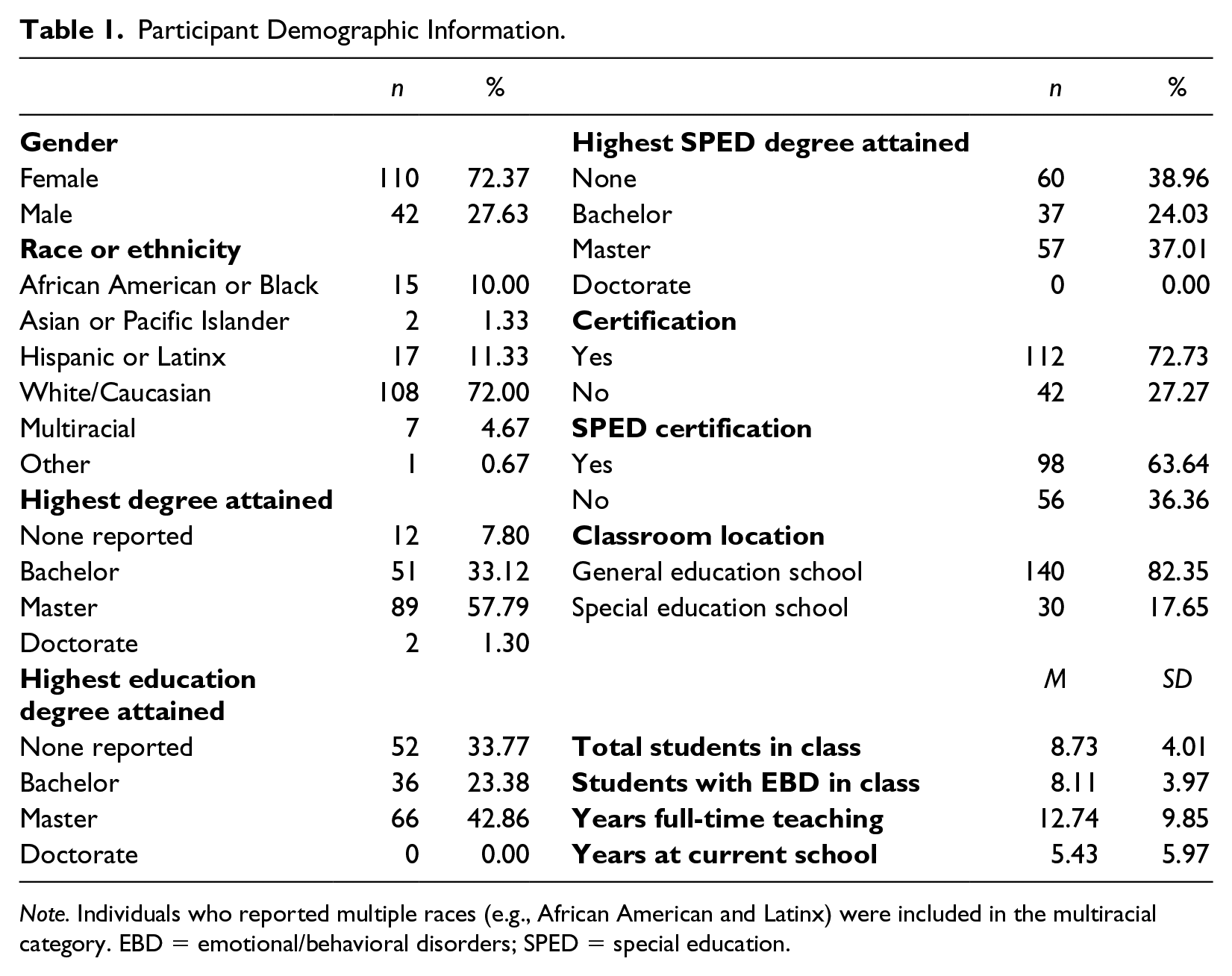
Note. Individuals who reported multiple races (e.g., African American and Latinx) were included in the multiracial category. EBD = emotional/behavioral disorders; SPED = special education.
Logistical Working Conditions
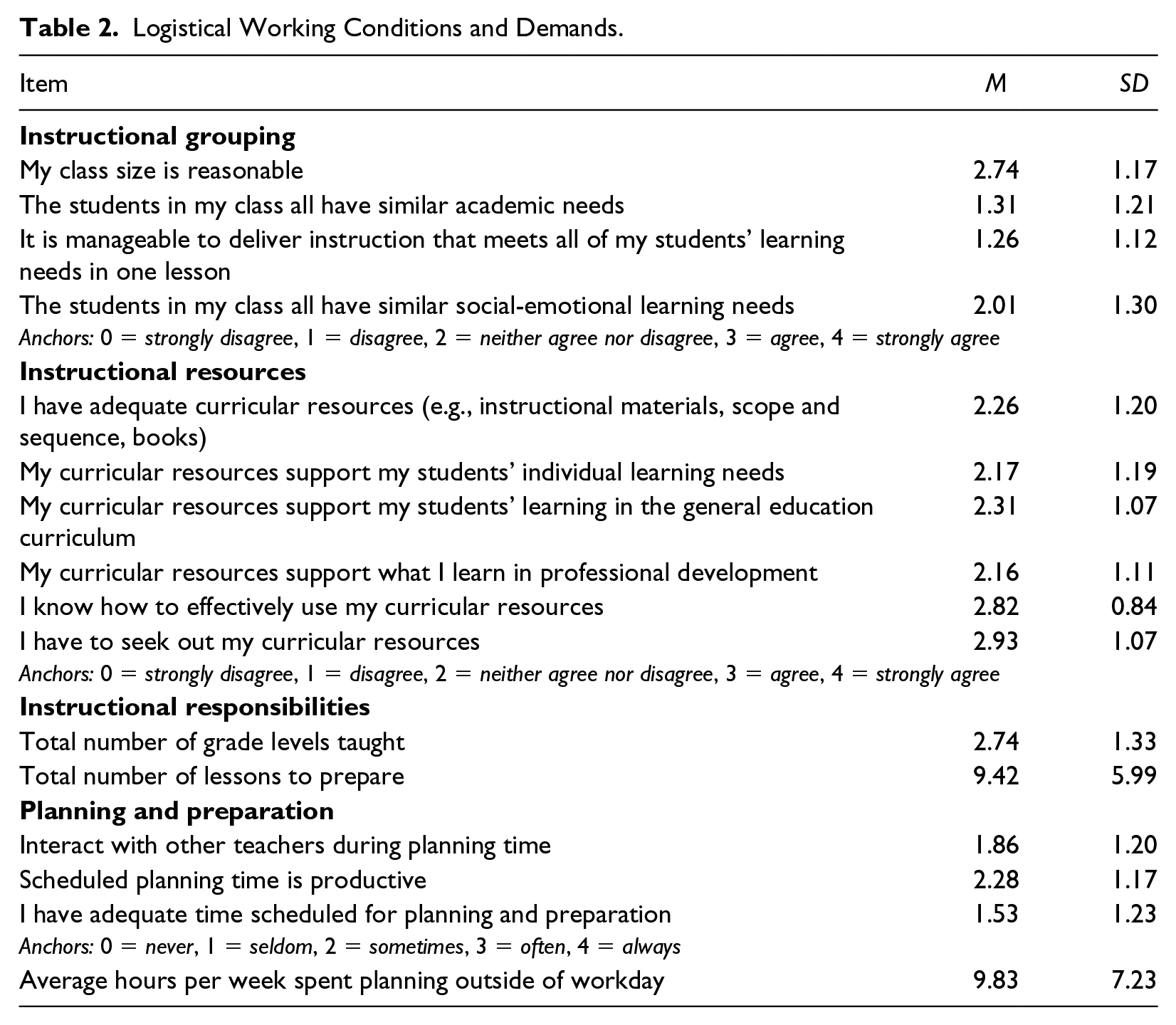
Results for logistical working conditions (i.e., instructional resources, and planning and preparation) and demands (i.e., instructional grouping and instructional responsibilities) are shown in Table 2. In the following sections, when we present results, we round most mean responses to the nearest anchor (e.g., rounding 1.2 to 1, where 1 indicates seldom; rounding 1.8 to 2, where 2 indicates sometimes). When the mean response is within 0.1 of the midpoint between two responses (e.g., between 1.4 and 1.6, where 1 indicates seldom and 2 indicates sometimes), we report that the average responses was between those two anchors.
Logistical Working Conditions and Demands.
Instructional grouping
On average, SETs agreed that their class size was reasonable. They disagreed that students in their class had similar academic needs (M = 1.31, SD = 1.21), whereas they neither agreed nor disagreed that their students all had similar social-emotional learning needs. Participants disagreed that it was manageable to deliver instruction that meets all students’ learning needs in one lesson (M = 1.26, SD = 1.12).
Instructional resources
Whereas participants neither agreed nor disagreed that they have adequate curricular resources, they agreed that they have to seek out their curricular resources (M = 2.93, SD = 1.07) and that they know how to effectively use their curricular resources. SETs overall neither agreed nor disagreed that their curricular resources support their students’ individual learning needs, their students’ learning in the general education curriculum, and what they learn in PD.
Instructional responsibilities
SETs reported teaching a mean total of 2.74 grade levels, with an average of 9.42 lessons to prepare (i.e., total subject areas across reported grades).
Planning and preparation
SETs reported spending an average of 9.83 hours planning outside contractual hours. They reported that they seldom to sometimes have adequate scheduled planning time during the workday (M = 1.53, SD = 1.23), sometimes their planning time is productive, and sometimes they interact with other teachers during scheduled planning time.
Social Working Conditions
Table 3 shows results for social working conditions (i.e., administrative support, autonomy, paraprofessional support, collaboration with colleagues, school culture, participation in PD, and perceptions of PD).
Social Working Conditions.

Note. EBD = emotional/behavioral disorders.
Administrative support
Overall, participants felt supported by administrators. SETs agreed that administrators support classroom management, students’ behavior plans, and students’ transition to more inclusive settings. SETs agreed that administrators included them in disciplinary decisions about students. They agreed that administrators care about them as a person and understand their instructional responsibilities. The lowest ratings for administrative support indicate that SETs neither agreed nor disagreed or agreed that administrators help improve their instruction (M = 2.42, SD = 1.05) and neither agreed nor disagreed that administrators protect their instructional time (M = 2.33, SD = 1.20).
Autonomy
Respondents reported having a lot of control over all responsibilities. They felt the most control over choosing student incentives and reinforcers, selecting teaching techniques, and evaluating students. They also reported having a lot of control when selecting instructional materials, selecting what content and skills to teach, and disciplining students.
Paraprofessionals
Participants reported a mean 1.99 full- and part-time paraprofessionals who support their classroom and students. Thus, there was an average ratio of 1 paraprofessional for every 5.29 students and for every 4.96 students with EBD. SETs agreed or strongly agreed that paraprofessionals are an essential part of their classroom (M = 3.52, SD = 0.83). They also agreed, on average, that they can trust paraprofessionals to interact positively with their students, to behave professionally, and to make good decisions. SETs neither agreed nor disagreed or agreed that paraprofessionals were actively involved in providing academic instruction. SETs neither agreed nor disagreed that paraprofessionals need a lot of support and are adequately trained in behavior management and providing instructional support. They disagreed or neither agreed nor disagreed that they have adequate time scheduled to develop paraprofessionals’ knowledge and skill (M = 1.52, SD = 1.26).
Collaboration with colleagues
SETs reported collaborating most frequently with paraprofessionals (every day, on average) and least frequently with learning specialists (less than once a month) for both instruction and classroom/behavior management. They reported working on instruction an average of one to two times per week with other SETs and one to three times per month with related service providers, general education teachers, school psychologists, and therapeutic school counselors. They collaborated on instruction between less than a month and one to three times per month with social workers, guidance counselors, and behavior specialists. They reported working on classroom and behavior management with other SETs one to two times per week and with general education teachers and related service providers around one to three times per month. They also indicated collaborating on classroom and behavior management with social workers, school psychologists, therapeutic school counselors, and behavior specialists between less than once a month and one to three times per month, and they collaborated with guidance counselors less than once a month.
School culture
Participants reported that they believe between about half and most of the teachers in their school take responsibility for improving the quality of teaching in the school, take responsibility for helping one another do well, and are committed to helping all students (including those with disabilities) to learn. SETs believed that about half of the teachers in their school help maintain discipline in the entire school and back them up when they need it. The lowest mean rating was that about half of the teachers in the school understand what these SETs do (M = 1.89, SD = 0.99).
Professional development
Participants reported participating in required PD opportunities within their school or district around one to three times per month and in voluntary opportunities less than once a month. SETs agreed that the people who provide PD are knowledgeable and that PD provides opportunities to collaborate with colleagues. They neither agreed nor disagreed that PD helps to improve academic instruction, is relevant to their job, and is engaging. Of the statements about PD opportunities, participants agreed least (neither agreed nor disagreed) with the statement that PD helps to improve classroom or behavior management (M = 1.98, SD = 1.08).
Discussion
The purpose of this survey study was to examine the working conditions that SETs experience in self-contained settings for students with EBD. Given the important role of working conditions cultivating an effective SET workforce for students with EBD, our study fills a crucial gap in the literature, as the first study to examine a wide array of working conditions using a national sample (Bettini, Cumming, et al., 2017).
We found that although SETs felt that they had manageable class sizes, with approximately one to two students less than reported in earlier studies (George & George, 1995; McManus & Kauffman, 1991), they did not feel that they were able to meet the learning needs of all students in one lesson. As in prior research (Bettini et al., 2015; McManus & Kauffman, 1991), SETs were responsible for planning and providing instruction for multiple subjects and grade levels (though, encouragingly, they planned fewer lessons, 9.42, than what prior studies found; McManus & Kauffman, 1991). Despite these extensive lesson planning responsibilities, SETs reported that they did not have adequate, protected planning time during the school day, spending >9 hours a week outside the classroom preparing for instruction. In addition, during their limited planning time, SETs reported having to seek out curricular resources. In alignment with our findings, prior studies indicated that SETs serving students with EBD have limited time for planning within school hours (Bettini et al., 2015; McManus & Kauffman, 1991). In one of the earliest studies investigating the planning time of SETs servings students with EBD, McManus and Kauffman (1991) found that 45% of SETs had <30 minutes of preparation time during the school day; thus, this continues to be an ongoing problem. Lack of planning time is a great concern given research indicating that adequate planning time may be related to integrating novel practices into instruction (Allinder, 1996) and to intending to stay in teaching (Albrecht et al., 2009; Billingsley, 2004).
With regard to social contexts, our findings were mostly positive and aligned with prior research. Overall, SETs felt positively about their colleagues and their school culture, and they shared that administrators supported their classroom and behavior management, consistent with past research (e.g., Albrecht et al., 2009; Nelson et al., 2001). For instance, more than half of the SETs in Albrecht and colleagues’ (2009) study indicated that they felt supported by administrators. We find the continued positive view of administrative support encouraging, given the role that administrators play in SETs’ job satisfaction (e.g., Cancio et al., 2013), stress (Pullis, 1992), and intent to continue teaching (e.g., Albrecht et al., 2009; Johnson et al., 2012). Yet, consistent with Bettini, Wang, and colleagues’ (2018) findings, SETs felt that administrators provided less support for academic instruction, a major concern given their extensive instructional responsibilities.
It is concerning, however, that, like prior research (e.g., Bettini, Wang, et al., 2018; McManus & Kauffman, 1991), we found that these SETs were relatively isolated from colleagues. We found that SETs reported experiencing limited collaboration around academic instruction and student behavior with any colleagues, except for paraprofessionals. Similarly, McManus and Kauffman found that 85% of SETs reported receiving assistance from paraprofessionals yet noted much less contact with other school professionals. The trend in continued isolation from colleagues is an alarming finding given previous research indicating that collegial support is important for stress (e.g., Nelson et al., 2001; Pullis, 1992), intent to continue teaching (e.g., Albrecht et al., 2009; Johnson et al., 2012), and instructional quality/effectiveness (e.g., Ronfeldt et al., 2015).
Our study highlights the importance of paraprofessionals in self-contained settings for students with EBD. SETs identified paraprofessionals as essential to their classrooms, and they reported collaborating with them every day for both instruction and behavior management—more often than with any other colleagues. As such, it is also of great concern that SETs felt that paraprofessionals were not adequately trained and that SETs reported having limited time to develop paraprofessionals’ skills. This aligns with prior research on paraprofessionals in general (e.g., Giangreco, Suter, & Doyle, 2010) and specifically with research on paraprofessionals in self-contained settings for students with EBD. For example, researchers have found that paraprofessionals are being given increasing responsibilities to serve students with EBD, despite insufficient training (Carter, O’Rourke, Sisco, & Pelsue, 2009; Maggin, Wehby, Moore-Partin, Robertson, & Oliver, 2009; Mann & Whitworth, 2017).
Limitations
This is the first survey using a national sample to examine a wide array of working conditions among SETs serving students with EBD, but there were some limitations. First, due to recruitment challenges, we had to administer the survey at two time points (i.e., fall and spring), and there could be differences in SETs’ perceptions of their working conditions in the fall semester than the spring semester. Although our response rate was strong (51.20%), there could also be differences between those SETs who responded and those who did not. We do not have data on those SETs who did not respond, so we are unable to determine if those who responded are representative of this population of SETs overall, though demographic data are consistent with prior studies (e.g., Henderson et al., 2005). Additionally, our relatively small sample size is a limitation of the study, and the disproportionate participation of districts by U.S. regions results in a sample that may not be nationally representative. Our research questions and analyses were descriptive; we did not examine relationships among working conditions and outcomes. Finally, although survey research is crucial for examining how SETs experience working conditions, the self-reported data in our study solely captured teachers’ perceptions of their working conditions and are not corroborated by observational data or other informants.
Implications for Research
Further research is needed to continue exploring SETs’ working conditions in these settings. First, researchers should examine how working conditions relate to SETs’ affective outcomes (e.g., stress, workload manageability), retention, and instructional quality/effectiveness in self-contained settings for students with EBD; although prior research indicates that working conditions have some relationships with those outcomes, few studies have investigated these relationships among SETs in self-contained settings for students with EBD (Bettini, Cumming, et al., 2017). Second, researchers should corroborate self-reported data on working conditions with observational data to address potential self-report bias. Researchers should also consider comparing SETs’ working conditions in self-contained settings for students with EBD with their working conditions in other service delivery models and with other populations of students with disabilities; such comparisons would provide insights into the extent to which working conditions are particularly challenging for certain SETs. Additionally, researchers should consider disaggregating self-contained schools (i.e., alternative educational settings, such as therapeutic day schools; Gagnon & Barber, 2015) to determine how working conditions vary across different kinds of self-contained settings for students with EBD. Other comparisons would also have useful implications for how to target efforts to improve SETs’ working conditions; for example, are working conditions more challenging for SETs serving students with EBD in self-contained settings in high-poverty communities than in low-poverty communities? Thus, we suggest that future studies examine differences by disaggregating the sample by key variables (e.g., poverty levels, U.S. regions, district size). Our findings indicate that paraprofessionals are a key support for SETs in these settings, and there is a need for a closer examination of how to increase paraprofessionals’ knowledge and training in self-contained settings for students with EBD. Finally, our findings indicate that some working conditions are systematically poor for this population of teachers (e.g., planning time, curricular resources, isolation); further research is needed to explore mechanisms by which these working conditions might be changed.
Implications for Policy and Practice
Results indicate several areas in which SETs’ working conditions may require systematic improvement. In particular, results raise concerns about (a) the extent to which SETs serving students with EBD in self-contained classes have opportunities to collaborate with colleagues, (b) the availability of appropriate instructional resources, (c) the adequacy of planning time, and (d) paraprofessional training. These are issues that state policy makers should consider addressing systematically, identifying policies that would systematically support more frequent collaboration, better provision of instructional resources, more appropriate planning time, and more consistent paraprofessional training. For example, state-level administrators could provide guidance to schools about how to evaluate whether teachers have adequate planning time and appropriate instructional resources. Policy makers should also consider what supports school leaders might need to improve these conditions, as school administrators tend to report having limited knowledge of special education (Petzko, 2008; Wakeman, Browder, Flowers, & Alhgrim-Delzell, 2006). For example, policy makers could provide data tools that schools and districts could use to monitor these conditions, and they could provide coaching to help administrators improve these conditions.
School administrators should also consider whether they are supporting SETs to address the complex academic and behavioral needs of students with EBD (e.g., Kauffman & Landrum, 2018) from multiple grade levels and across multiple content areas. Teaching multiple subjects to multiple grade levels is a complex responsibility, requiring extensive planning; school administrators can consider the extent to which they (a) assist with SETs’ scheduling and protect planning time, (b) provide opportunities for SETs to collaborate with skilled colleagues, (c) provide curricular resources that support SETs across all of the content areas and grade levels that they serve, and (d) ensure that paraprofessionals are appropriately trained for the extensive responsibilities that they fulfill for students with EBD.
The pervasiveness of challenging working conditions—especially isolation, limited planning time, and insufficient instructional resources—across the country also has im-plications for SETs. Specifically, SETs serving in these settings may need to consider advocating for better working conditions, whereas teachers’ educators should consider how they might equip these teachers with the knowledge and skill to self-advocate.
Conclusions
Working conditions can be an important lever for improving the experiences of SETs working with students with EBD in self-contained settings. As Hirsch (2007) stated, “teacher working conditions are student learning conditions”; improving learning conditions for students with EBD will require greater attention to the conditions in which their SETs teach. Our results provide an initial insight into the extent to which SETs across the United States are well supported in serving students with EBD, and they suggest several areas in which policy makers and school leaders should consider improving working conditions. Although SETs rated some conditions relatively highly (e.g., administrative and collegial support), our findings raise serious concerns about the extent to which these teachers are expected to enact complex instructional responsibilities for a vulnerable population of students, in relative isolation, and with limited planning time and instructional resources.
Footnotes
Authors’ Note
Kristen Merrill O’Brien, Division of Special Education and disAbility Research, College of Education and Human Development, George Mason University; Nelson C. Brunsting, International Studies, Wake Forest University; Elizabeth Bettini, Special Education Program, Boston University Wheelock College of Education and Human Development; Michelle M. Cumming, Department of Teaching and Learning, School of Education and Human Development, Florida International University; Maalavika Ragunathan, Special Education Program, Boston University Wheelock College of Education and Human Development; Rachel Sutton, Special Education Program, Boston University Wheelock College of Education and Human Development.
This research was supported by a grant (No. 201800060) from the Spencer Foundation.
